Hubbry Logo
Human fertilizationHuman fertilizationMain
Open search
Human fertilization
Community hub
Human fertilization
logo
8 pages, 0 posts
0 subscribers
Be the first to start a discussion here.
Human fertilization
Human fertilization
from Wikipedia
Human fertilization
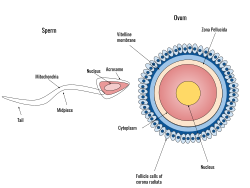
Sperm about to enter the ovum with acrosomal head ready to penetrate the zona pellucida and fertilize the egg
Illustration depicting ovulation and fertilization
Details
Days0
PrecursorGametes
Gives rise toZygote
Anatomical terminology

Human fertilization is the union of an egg and sperm, occurring primarily in the ampulla of the fallopian tube.[1] The result of this union leads to the production of a fertilized egg called a zygote, initiating embryonic development. Scientists discovered the dynamics of human fertilization in the 19th century.[2]

The process of fertilization involves a sperm fusing with an ovum. The most common sequence begins with ejaculation during copulation, follows with ovulation, and finishes with fertilization. Various exceptions to this sequence are possible, including artificial insemination, in vitro fertilization, external ejaculation without copulation, or copulation shortly after ovulation.[3][4] Upon encountering the secondary oocyte, the acrosome of the sperm produces enzymes which allow it to burrow through the outer shell called the zona pellucida of the egg. The sperm plasma then fuses with the egg's plasma membrane and their nuclei fuse, triggering the sperm head to disconnect from its flagellum as the egg travels down the fallopian tube to reach the uterus.

In vitro fertilization (IVF) is a process by which egg cells are fertilized by sperm outside the womb, in vitro.

History

[edit]

Fertilization was not understood in antiquity. Hippocrates believed that the embryo was the product of male semen and a female factor. Aristotle held that only male semen gave rise to an embryo, while the female only provided a place for the embryo to develop,[5] a concept he acquired from the preformationist Pythagoras. Aristotle argued for form and function emerging gradually, in a mode called by him as epigenetic.[6] In 1651, William Harvey refuted Aristotle's idea that menstrual blood could be involved in the formation of a fetus, asserting that eggs from the female were somehow caused to become a fetus as a result of sexual intercourse.[7]

Sperm cells were discovered in 1677 by Antonie van Leeuwenhoek, who believed that Aristotle had been proven correct.[8] Some observers believed they could see an entirely pre-formed little human body in the head of a sperm.[9] The human ovum was first observed in 1827 by Karl Ernst von Baer.[8] Only in 1876 did Oscar Hertwig prove that fertilization is due to fusion of an egg and sperm cell.[5]

A common metaphor used to describe human fertilization is that of sperm racing to meet an egg. Another commonly used metaphor is that of two halves making a whole.[10]

Sperm and oocyte meet

[edit]

Ampulla

[edit]

Fertilization occurs in the ampulla of the fallopian tube, the section that curves around the ovary. Capacitated sperm are attracted to progesterone, which is secreted from the cumulus cells surrounding the oocyte.[11] Progesterone binds to the CatSper receptor on the sperm membrane and increases intracellular calcium levels, causing hyperactive motility. The sperm will continue to swim towards higher concentrations of progesterone, effectively guiding it to the oocyte.[12] Around 200 out of 200 million spermatozoa reach the ampulla.

Sperm preparation

[edit]
The sperm entering the ovum using acrosomal enzymes to dissolve the gelatinous envelope (zona pellucida) of the oocyte

At the beginning of the process, the sperm undergoes a series of changes, as freshly ejaculated sperm is unable or poorly able to fertilize.[13] The sperm must undergo capacitation in the female's reproductive tract, which increases its motility and hyperpolarizes its membrane, preparing it for the acrosome reaction, the enzymatic penetration of the egg's tough membrane, the zona pellucida, which surrounds the oocyte.[14]

Corona radiata

[edit]

The sperm binds through the corona radiata, a layer of follicle cells on the outside of the secondary oocyte. The corona radiata sends out chemicals that attract the sperm in the fallopian tube to the oocyte. It lies above the zona pellucida, a membrane of glycoproteins that surrounds the oocyte.[15]

Cone of attraction and perivitelline membrane

[edit]

Where the spermatozoon is about to pierce, the yolk (ooplasm) is drawn out into a conical elevation, termed the cone of attraction or reception cone. Once the spermatozoon has entered, the peripheral portion of the yolk changes into a membrane, the perivitelline membrane, which prevents the passage of additional spermatozoa.[16]

Zona pellucida and acrosome reaction

[edit]

After binding to the corona radiata the sperm reaches the zona pellucida, which is an extracellular matrix of glycoproteins. A ZP3 glycoprotein on the zona pellucida binds to a receptor on the cell surface of the sperm head. This binding triggers the acrosome to burst, releasing acrosomal enzymes that help the sperm penetrate through the thick zona pellucida layer surrounding the oocyte, ultimately gaining access to the egg's cell membrane.[17]

Some sperm cells consume their acrosome prematurely on the surface of the egg cell, facilitating the penetration by other sperm cells. As a population, mature haploid sperm cells have on average 50% genome similarity, so the premature acrosomal reactions aid fertilization by a member of the same cohort.[18] It may be regarded as a mechanism of kin selection.

Recent studies have shown that the egg is not passive during this process. In other words, they too appear to undergo changes that help facilitate such interaction.[19][20]

Fusion

[edit]
Fertilization and implantation in humans

Cortical reaction

[edit]

After the sperm enters the cytoplasm of the oocyte, the tail and the outer coating of the sperm disintegrate. The fusion of sperm and oocyte membranes causes cortical reaction to occur.[21] Cortical granules inside the secondary oocyte fuse with the plasma membrane of the cell, causing enzymes inside these granules to be expelled by exocytosis to the zona pellucida. This in turn causes the glycoproteins in the zona pellucida to cross-link with each other — i.e. the enzymes cause the ZP2 to hydrolyse into ZP2f — making the whole matrix hard and impermeable to sperm. This prevents fertilization of an egg by more than one sperm.[22]

Fusion of genetic material

[edit]

Preparation

[edit]

In preparation for the fusion of their genetic material both the oocyte and the sperm undergo transformations as a reaction to the fusion of cell membranes.

The oocyte completes its second meiotic division. This results in a mature haploid ovum and the release of a polar body.[23] The nucleus of the oocyte is called a pronucleus in this process, to distinguish it from the nuclei that are the result of fertilization.

Drawing of an ovum

The sperm's tail and mitochondria degenerate with the formation of the male pronucleus. This is why all mitochondria in humans are of maternal origin. Still, a considerable amount of RNA from the sperm is delivered to the resulting embryo and likely influences embryo development and the phenotype of the offspring.[24]

Fusion

[edit]

The sperm nucleus then fuses with the ovum, enabling fusion of their genetic material.

Blocks of polyspermy

[edit]

When the sperm enters the perivitelline space, a sperm-specific protein Izumo on the head binds to Juno receptors on the oocyte membrane.[25] Once it is bound, two blocks to polyspermy then occur. After approximately 40 minutes, the other Juno receptors on the oocyte are lost from the membrane, causing it to no longer be fusogenic. Additionally, the cortical reaction will happen which is caused by ovastacin binding and cleaving ZP2 receptors on the zona pellucida.[26] These two blocks of polyspermy are what prevent the zygote from having too much DNA.

Replication

[edit]

The pronuclei migrate toward the center of the oocyte, rapidly replicating their DNA as they do so to prepare the zygote for its first mitotic division.[27]

Mitosis

[edit]

Usually 23 chromosomes from spermatozoon and 23 chromosomes from egg cell fuse (approximately half of spermatozoons carry X chromosome and the other half Y chromosome). Their membranes dissolve, leaving no barriers between the male and female chromosomes. During this dissolution, a mitotic spindle forms between them. The spindle captures the chromosomes before they disperse in the egg cytoplasm. Upon subsequently undergoing mitosis (which includes pulling of chromatids towards centrioles in anaphase) the cell gathers genetic material from the male and female together. Thus, the first mitosis of the union of sperm and oocyte is the actual fusion of their chromosomes.[27]

Each of the two daughter cells resulting from that mitosis has one replica of each chromatid that was replicated in the previous stage. Thus, they are genetically identical.[citation needed]

Fertilization age

[edit]

Fertilization is the event most commonly used to mark the beginning point of life, in descriptions of prenatal development of the embryo or fetus.[28] The resultant age is known as fertilization age, conceptional age, embryonic age, fetal age or (intrauterine) developmental (IUD)[29] age.

Gestational age, in contrast, takes the beginning of the last menstrual period (LMP) as the start point. By convention, gestational age is calculated by adding 14 days to fertilization age and vice versa.[30]

Comparison of dating systems for a typical pregnancy
Event Gestational age

(from the start of the last menstrual period)

Fertilization age Implantation age
Menstrual period begins Day 1 of pregnancy Not pregnant Not pregnant
Has sex and ovulates 2 weeks pregnant Not pregnant Not pregnant
Fertilization; cleavage stage begins[31] Day 15[31] Day 1[31][32] Not pregnant
Implantation of blastocyst begins Day 20 Day 6[31][32] Day 0
Implantation finished Day 26 Day 12[31][32] Day 6 (or Day 0)
Embryo stage begins; first missed period 4 weeks Day 15[31] Day 9
Primitive heart function can be detected 5 weeks, 5 days[31] Day 26[31] Day 20
Fetal stage begins 10 weeks, 1 day[31] 8 weeks, 1 day[31] 7 weeks, 2 days
First trimester ends 13 weeks 11 weeks 10 weeks
Second trimester ends 26 weeks 24 weeks 23 weeks
Childbirth 39–40 weeks 37–38 weeks[32]: 108  36–37 weeks

Fertilization though usually occurs within a day of ovulation, which, in turn, occurs on average 14.6 days after the beginning of the preceding menstruation (LMP).[33] There is also considerable variability in this interval, with a 95% prediction interval of the ovulation of 9 to 20 days after menstruation even for an average woman who has a mean LMP-to-ovulation time of 14.6.[34] In a reference group representing all women, the 95% prediction interval of the LMP-to-ovulation is 8.2 to 20.5 days.[33]

The average time to birth has been estimated to be 268 days (38 weeks and two days) from ovulation, with a standard deviation of 10 days or coefficient of variation of 3.7%.[35]

Fertilization age is sometimes used postnatally (after birth) as well to estimate various risk factors. For example, it is a better predictor than postnatal age for risk of intraventricular hemorrhage in premature babies treated with extracorporeal membrane oxygenation.[36]

Diseases affecting human fertility

[edit]

Various disorders can arise from defects in the fertilization process. Whether that results in the process of contact between the sperm and egg, or the state of health of the biological parent carrying the zygote cell. The following are a few of the diseases that can occur and be present during the process.

  • Polyspermy results from multiple sperm fertilizing an egg, leading to an offset number of chromosomes within the embryo.[37] Polyspermy, while physiologically possible in some species of vertebrates and invertebrates, is a lethal condition for the human zygote.
  • Polycystic ovary syndrome is a condition in which the woman does not produce enough follicle stimulating hormone and excessively produces androgens. This results in the ovulation period between contact of the egg being postponed or excluded.[38]
  • Autoimmune disorders can lead to complications in implantation of the egg in the uterus, which may be the immune system's attack response to an established embryo on the uterine wall.[38]
  • Cancer ultimately affects fertility and may lead to birth defects or miscarriages. Cancer severely damages reproductive organs, which affects fertility.[38]
  • Endocrine system disorders affect human fertility by decreasing the body's ability to produce the level of hormones needed to successfully carry a zygote. Examples of these disorders include diabetes, adrenal disorders, and thyroid disorders.[38]
  • Endometriosis is a condition that affects women in which the tissue normally produced in the uterus proceeds to grow outside of the uterus. This leads to extreme amounts of pain and discomfort and may result in an irregular menstrual cycle.[38]
  • Teratogenesis is a condition in which the woman pregnant with a developing offspring has defects form in the embryo or fetus they are carrying. This can inhibit the growth of the offspring physiologically, physically, and cause a degeneration in the overall wellbeing of the offspring later in life. It can be caused by the intake of substances harmful to the offspring.[39]

See also

[edit]

References

[edit]
[edit]
Revisions and contributorsEdit on WikipediaRead on Wikipedia
from Grokipedia
Human fertilization is the in which a single cell from the male fuses with a mature , or , from the female, resulting in the formation of a diploid that marks the beginning of embryonic development. This union restores the full complement of 46 chromosomes, combining 23 from each , and activates the zygote to initiate and growth. The process is highly species-specific and tightly regulated to ensure and viability of the offspring. In humans, fertilization typically occurs in the ampullary region of the , shortly after , and is completed within approximately 24 hours. The , released from the , is surrounded by the , a layer that plays a crucial role in recognition and binding. Only one successfully penetrates this barrier, preventing through rapid biochemical changes in the oocyte's . The fertilization process involves several key steps: first, the undergoes in the female reproductive tract, enhancing its and ability to undergo the , where enzymes are released to digest the . Upon binding to the zona, the 's head fuses with the oocyte's plasma membrane, delivering its nucleus and triggering cortical granule in the egg to block additional entry. The male and female pronuclei then fuse, forming the , which begins cleavage divisions as it travels toward the for implantation. This event is fundamental to sexual reproduction, ensuring the transmission of genetic material from both parents while establishing the foundation for prenatal development. Disruptions in fertilization can lead to infertility, highlighting its clinical significance in reproductive medicine.

Historical Context

Early Observations and Theories

In ancient Greece, Hippocratic medicine posited that both males and females produced "seeds" derived from all parts of the body, which mixed during intercourse to generate offspring, with parental resemblances arising from the dominant seed contributions. This pangenesis-like concept influenced later ideas but lacked a clear mechanism for fertilization. Aristotle refined these views in the 4th century BCE, arguing that male semen served as the active principle imparting form and soul to the embryo, while the female provided passive material in the form of menstrual blood; development occurred through epigenesis, a gradual unfolding from undifferentiated matter rather than preformed structures. Medieval scholars, building on Galen and Arabic translations of Aristotle, largely upheld this framework, viewing fertilization as the imposition of male "heat" and form on female matter, though empirical observations remained limited by the absence of microscopy. The invention of the in the 17th century enabled direct observations of reproductive elements, revolutionizing early theories. In 1677, Dutch microscopist , prompted by student Johan Ham to examine human , identified motile "animalcules"—now known as spermatozoa—which he described as tiny, wriggling organisms visible in ejaculates from humans and other mammals. Leeuwenhoek's letters to the Royal Society in 1677 and 1682 detailed these findings, hypothesizing that the animalcules might penetrate the female "egg" to initiate development, though he viewed them as parasites or independent entities rather than direct contributors to . These observations fueled the preformationist doctrine, with "spermists" claiming the animalcules contained miniature preformed humans (homunculi) that grew within the after implantation. Opposing spermism, "ovists" in the late 17th and 18th centuries asserted that preformed embryos resided in the ovum, discovered earlier in birds but elusive in mammals, with merely stimulating development. This debate persisted amid misconceptions like the theory, popularized by figures such as Nicolas Hartsoeker in 1694, who illustrated heads enclosing tiny, folded human figures poised for growth. The controversy highlighted the era's reliance on analogy over evidence, as no mammalian ovum had been identified. A pivotal advancement came in 1827 when , examining dog ovaries, isolated the true mammalian ovum—a small, transparent vesicle—demonstrating its presence in non-pregnant females and refuting claims of from fluids. Published in De Ovi Mammalium et Hominis Genesi, von Baer's work shifted the paradigm toward epigenesis, suggesting fertilization involved interaction between ovum and rather than unilateral preformation, though the exact process remained unclear. By the late , these foundations paved the way for 20th-century embryology's integration of cellular and genetic insights.

Key Scientific Milestones

In 1876, German zoologist Oscar Hertwig published observations from his microscopic studies of eggs, marking the first demonstration of fertilization as the fusion of pronuclei, thereby establishing the cellular mechanism underlying . This discovery resolved longstanding debates about whether fertilization involved simple contact or actual nuclear merger, providing a foundational understanding of how genetic material combines during union. Building on this, in the early 1890s, and independently advanced the chromosome theory of inheritance through cytological analyses of in and grasshoppers. Boveri's experiments on embryos showed that chromosomes maintain individuality and are essential for normal development, while Sutton's 1902 paper detailed how chromosomes segregate during , paralleling Mendel's laws of and linking fertilization to the transmission of discrete genetic units. These insights shifted the focus from vague blending inheritance to precise chromosomal contributions from sperm and egg. The mid-20th century brought ultrastructural revelations through electron microscopy, with studies in the elucidating the 's complex architecture in spermatozoa. These investigations revealed the as a cap-like containing hydrolytic enzymes, crucial for penetration of the egg's protective layers, thus clarifying the morphological basis for fertilization's penetration phase. A major breakthrough occurred in the 1970s when Robert G. Edwards, Patrick C. Steptoe, and Jean M. Purdy achieved the first successful fertilization (IVF) in humans, culminating in the birth of on July 25, 1978. Their 1978 report detailed the retrieval of oocytes, laboratory fertilization by spermatozoa, and , confirming that human fertilization could occur extracorporeally while mimicking natural mechanics of interaction and early development. In the 1980s, molecular studies identified key zona pellucida glycoproteins, notably ZP3, as primary mediators of species-specific sperm binding. Pioneering work by Jurrien D. Bleil and Paul M. Wassarman demonstrated that ZP3 on the mouse egg's serves as the sperm receptor, initiating adhesion and the essential for penetration. This identification highlighted the biochemical specificity governing fertilization and paved the way for understanding molecular barriers in reproduction.

Biological Prerequisites

Sperm Structure and Production

is the process of sperm production that occurs within the seminiferous tubules of the testes, transforming diploid spermatogonial stem cells into mature haploid spermatozoa. This process unfolds in three primary phases: the mitotic proliferation of spermatogonia, to produce haploid spermatids, and , during which spermatids differentiate into spermatozoa through morphological changes such as nuclear condensation and formation. The entire cycle in humans typically spans 64 to 74 days, with one complete cycle of the seminiferous epithelium lasting about 16 days. Human spermatozoa exhibit a highly specialized adapted for and fertilization, consisting of a head, midpiece, and tail. The head is an oval structure containing a compact nucleus with haploid DNA and an overlying , a cap-like vesicle derived from the Golgi apparatus that houses . The midpiece is packed with a helical array of mitochondria, which generate ATP to power flagellar movement via . The tail, or , is a long structure composed of a central with a 9+2 arrangement surrounded by fibrous sheath and outer dense fibers, enabling progressive . The contains key hydrolytic enzymes essential for sperm function, including , which facilitates the dispersion of the surrounding the , and acrosin, a that aids in penetrating the . These enzymes are sequestered within the acrosomal vesicle during and are crucial for the sperm's preparatory role in fertilization. In a typical ejaculate, the total sperm count ranges from 15 to 200 million spermatozoa, with a lower reference limit of 39 million per ejaculate according to guidelines; is generally associated with at least 42% motile sperm according to guidelines, to ensure sufficient numbers reach the . These parameters reflect the efficiency of and epididymal maturation, though only a fraction of sperm are fertilization-competent. Genetically, each spermatozoon is haploid, carrying 23 chromosomes, with approximately half bearing an and half a , determining the sex of the resulting upon fertilization with the complementary . This genetic composition arises during I, where sex segregate, ensuring balanced gametic contribution.

Oocyte Structure and Maturation

Oogenesis begins during fetal development, where oogonia proliferate and enter to form primary oocytes that arrest at the diplotene stage of I, remaining in this dictyotene arrest until . This prolonged arrest allows for the accumulation of cytoplasmic components essential for early embryonic development, with the primary oocytes enclosed within primordial follicles. At , cyclic hormonal changes initiate follicular development, and a subset of primary resume in response to (FSH) and (LH). The mid-cycle LH surge triggers germinal vesicle breakdown, progression through I, and extrusion of the first , leading to a secondary oocyte arrested at II. This surge also induces expansion of the cumulus-oocyte complex (COC), where surrounding cumulus cells form a mucified that aids in oocyte maturation and subsequent . The mature human oocyte measures approximately 100-120 μm in diameter and features a multilayered structure designed for protection and fertilization readiness. It is surrounded by the , a glycoprotein-rich about 15-20 μm thick that mediates binding, and an outer of cumulus cells that provide nutritional support during maturation. Beneath the plasma membrane lie cortical granules, specialized vesicles containing enzymes and proteins that will be released upon activation to prevent . Within the ooplasm, the II spindle aligns the 23 haploid chromosomes, poised for completion of II. This II arrest persists until a fertilization signal, such as entry, triggers calcium oscillations that resume and initiate activation.

Gamete Transport

Sperm Migration in the Female Tract

Upon during coitus, approximately 200–500 million spermatozoa are deposited in the posterior fornix of the , near the cervical os, within a volume of 2–5 mL of . This initial deposition exposes the sperm to the acidic vaginal environment ( 4–5), which rapidly immobilizes or kills many non-motile or poorly adapted cells, initiating the selective process of migration. Upon deposition, the semen forms a gel that protects the sperm from this acidic environment. The gel liquefies within 20–30 minutes by enzymes from the prostate gland, freeing motile sperm to enter the cervical mucus. Many sperm are eliminated by vaginal acidity or the immune system, but surviving sperm can live up to 5 days in the reproductive tract. The acts as a primary barrier and filter, with its playing a crucial role in selection during the fertile window around . Under the influence of rising levels in the late , cervical becomes less viscous, more hydrated, and forms a fertile-type with a fenestrated microstructure that facilitates the entry of progressive motile while trapping immotile or abnormal ones. This estrogen-dependent change allows only about 10% of ejaculated to penetrate the within minutes to hours post-ejaculation. Once in the , sperm are propelled upward through the by a combination of their own flagellar and tract contractions, including peristaltic waves in the uterine and ciliary activity in the , reaching the fallopian tubes within minutes to hours. These contractions, enhanced by oxytocin in the periovulatory period, facilitate rapid transit to the uterotubal junction, where only about 1% of the original ejaculated enter the and fewer than 0.1% reach the fallopian . Of those entering the , only hundreds typically reach the , the site of fertilization, though overall survival rates are low due to immune surveillance and nutritional limitations in the tract. Sperm can survive in the reproductive tract for up to 5 days, primarily by binding to epithelial surfaces in the for protection and —a preparatory physiological change enabling hyperactivated and competence. In contrast, the remains viable for only 12–24 hours post-ovulation, underscoring the need for timely arrival. Guidance to the is further aided by , where progesterone secreted by cumulus cells surrounding the creates picomolar gradients that attract capacitated via CatSper ion channels, reorienting their swimming path toward the . This multi-stage journey represents a rigorous , reducing the millions of ejaculated to approximately 200 that reach the vicinity of the in the , ensuring only the fittest gametes participate in fertilization.

Oocyte Release and Transport

Ovulation in humans is triggered by a mid-cycle surge in (LH), which initiates a cascade of events leading to follicular rupture and the release of the mature . Approximately 36 hours after the onset of the LH surge, the dominant ruptures, expelling the cumulus-oocyte complex (COC)—consisting of the surrounded by cumulus cells and a hyaluronan-rich matrix—into the near the ovarian surface. This process is essential for positioning the for potential capture and transport toward the site of fertilization. The released COC is promptly captured by the fimbriae, finger-like projections extending from the infundibulum of the , which lie adjacent to the . These fimbriae, lined with ciliated epithelial cells, actively sweep and adhere to the COC through coordinated ciliary beating and muscular contractions, drawing it into the lumen. Once inside, the is propelled along the —primarily through the —by the combined action of ciliary motility and in the tubal wall, ensuring its progression toward the uterotubal junction over several hours. The oviductal environment plays a critical role in maintaining oocyte viability during transport, with epithelial cells secreting nutrient-rich fluid containing glucose, , growth factors, and extracellular vesicles that support metabolic needs and prevent degeneration. These secretions create a dynamic microenvironment that sustains the COC's integrity until potential fertilization. In a typical 28-day , occurs around day 14, with the mature remaining viable for fertilization for approximately 12-24 hours post-release. must arrive in the concurrently to enable fertilization within this narrow window. Failure in oocyte capture or transport can lead to ectopic pregnancies, such as tubal implantation if propulsion is impaired by ciliary dysfunction or damage, or rare primary abdominal pregnancies if the COC enters the without fimbrial uptake.

Initial Contact and Preparation

Site of Fertilization in the Ampulla

The , the widest segment of the measuring approximately 4-6 cm in length and up to 8 mm in diameter, serves as the primary site of human fertilization and is located adjacent to the following the infundibulum, roughly 2-3 cm from the ovarian surface. This dilated region features a complex mucosal lining composed of ciliated and non-ciliated secretory epithelial cells, which produce a nutrient-rich fluid containing glucose, pyruvate, and other metabolites essential for supporting viability and early embryonic development. The provides optimal environmental conditions for fertilization, including an alkaline of approximately 7.3-7.7 that facilitates and , as well as viscous mucus secretions that create a favorable matrix for trapping and concentrating viable in proximity to the . Most fertilizations occur within a narrow timing window of 30 minutes to 6 hours following , as can rapidly reach the while the remains viable for up to 24 hours, though the majority of successful unions happen early in this period due to coordinated . The anatomical configuration of the contributes to prevention through spatial constraints, as only a small fraction of the millions of ejaculated successfully navigate the tract to arrive at this site, thereby limiting the number available to interact with the . While the is the typical location, rare cases of fertilization have been documented in the infundibulum or, exceptionally, within the if transport is altered.

Sperm Capacitation and Hyperactivation

Sperm refers to the physiological and biochemical alterations that ejaculated spermatozoa undergo in the female reproductive tract to acquire fertilizing competence. This process typically occurs over 6-8 hours post-ejaculation, primarily within the oviductal environment of the , where spermatozoa are exposed to specific fluids that promote these changes. is essential for enabling sperm to undergo the and penetrate the , distinguishing competent sperm from the majority that remain non-functional. Key biochemical modifications during capacitation include the removal of stabilizing proteins from seminal plasma, which had previously coated the sperm surface to prevent premature activation. This is accompanied by cholesterol efflux from the plasma membrane, facilitated by albumin in the oviductal fluid, leading to increased membrane fluidity and lateral reorganization of lipids and proteins. Bicarbonate ions, also present in the female tract, play a crucial role by stimulating soluble adenylyl cyclase (sAC), elevating intracellular cAMP levels and activating protein kinase A (PKA). These events collectively destabilize the sperm membrane, preparing it for subsequent interactions. Molecular hallmarks of capacitation involve protein phosphorylation, particularly of A-kinase anchoring proteins (AKAPs) such as AKAP3 and AKAP4, which localize PKA to specific flagellar compartments and regulate . This phosphorylation cascade, driven by PKA activation, occurs predominantly in the principal piece of the and serves as a marker of progress. acts as a mechanism to ensure only the most viable proceed to fertilization. Hyperactivation emerges as a late stage of , characterized by vigorous, asymmetric flagellar beating that propels with high amplitude and low linearity, aiding navigation through the and penetration. This shift is mediated by calcium ion (Ca²⁺) influx through CatSper channels in the , triggered by progesterone or other signals in the female tract, which alters axonemal beat patterns from symmetrical to asymmetrical. Hyperactivation enhances 's ability to reach and interact with the , complementing the preparatory changes of .

Penetration Mechanisms

Dispersion of Corona Radiata

The consists of 4–5 layers of cumulus cells that closely surround the , embedded within a hyaluronic acid-rich derived from follicular fluid. This structure provides an initial barrier to sperm access following , maintaining oocyte integrity during transport in the female reproductive tract. Dispersion of the begins when capacitated make contact with the cumulus-oocyte complex in the of the . -borne , primarily the GPI-anchored PH-20 on the plasma , degrades the matrix, loosening the intercellular connections and facilitating cell detachment. This enzymatic creates transient paths through the matrix, enabling a cohort of approximately 100 to advance toward the surface. Multiple contribute to dispersion through collective release, facilitating efficient penetration, though individual possess sufficient enzymatic capacity via redundant mechanisms such as HYAL5. Recent genetic studies show that combined absence of PH-20 and HYAL5 severely impairs , highlighting their cooperative importance. Human sperm hyaluronidase exhibits species-specific differences from that in other mammals, such as , in its membrane localization and substrate specificity, which influences the efficiency of corona penetration and reinforces . This dispersion paves the way for subsequent sperm-oocyte interactions at the .

Acrosome Reaction and Zona Pellucida Binding

The (ZP) surrounding the oocyte consists of four glycoproteins: ZP1, ZP2, ZP3, and ZP4, which form a viscoelastic matrix essential for species-specific recognition. In humans, ZP1, ZP3, and ZP4 serve as the primary receptors for binding capacitated, -intact spermatozoa to the ZP surface, primarily through interactions with the head's plasma overlying the . ZP2 plays a key role in initial binding of -intact human via its N-terminal domain, while ZP1, ZP3, and ZP4 contribute to recognition and induction. Upon binding to ZP2 (and to a lesser extent ZP1, ZP3, and ZP4), spermatozoa undergo the , an event triggered by ZP-induced . This interaction activates G-protein-coupled receptors on the surface, leading to intracellular calcium (Ca²⁺) oscillations that promote fusion between the outer acrosomal and the overlying . The resulting releases the acrosomal contents, including hydrolytic enzymes stored within the vesicle. Recent genetic studies (as of 2023) confirm acrosin's essential role, with deficiencies causing total fertilization failure in humans due to impaired ZP penetration. Key among these enzymes is acrosin, a trypsin-like serine protease that becomes activated upon release and digests the ZP matrix, creating a pathway for sperm penetration toward the oocyte. Acrosin works in concert with other enzymes like hyaluronidase and glycosidases to locally solubilize the ZP glycoprotein network, forming a fertilization cone that guides the sperm's progression. Only spermatozoa that have undergone the acrosome reaction can bind secondary receptors on the inner ZP (primarily ZP2) and penetrate effectively, with estimates indicating a success rate of approximately 10-20% among ZP-bound sperm in vitro. Following fertilization and , the ZP hardens through ovastacin-mediated cleavage of ZP2, which inactivates additional binding and reinforces the matrix to prevent . This transition ensures that subsequent encounters are less permissive, optimizing monospermic fertilization.

Gamete Fusion

Sperm-Oocyte Membrane Fusion

The -oocyte membrane fusion represents the culminating step in interaction, where the plasma membranes of the two cells merge to allow the 's genetic material to enter the . This event occurs specifically at the equatorial segment of the head, a region exposed after the , which interacts with the microvilli-rich surface of the plasma membrane. The microvilli facilitate close apposition of the membranes, enabling the initial and subsequent merger that incorporates the into the ooplasm while excluding additional entries. Central to this fusion are specific protein interactions that mediate recognition and membrane merging. On the sperm surface, the protein IZUMO1, a member of the , protrudes from the equatorial segment and binds to JUNO, a folate receptor homolog expressed on the membrane. This IZUMO1-JUNO interaction is essential for initial , but JUNO is shed shortly after contact, allowing IZUMO1 to subsequently engage (Fc receptor-like 3) on the , which stabilizes the complex and drives membrane fusion. These interactions are indispensable for gamete merging, as demonstrated by knockout studies in mice where disruption of IZUMO1 or JUNO results in complete , and human studies confirm their conservation with MAIA's added role. Structural analyses reveal that the binding induces conformational changes in IZUMO1, promoting its dimerization and facilitating the close membrane proximity required for mixing. The fusion process proceeds through an initial hemifusion state, where the outer leaflets of the sperm and oocyte membranes merge without content mixing, followed by full fusion that opens a conduit for sperm incorporation into the ooplasm. This single-sperm entry occurs rapidly, typically within seconds to minutes after the sperm penetrates the zona pellucida, ensuring timely genetic union. The energy for this merger is derived from localized calcium (Ca²⁺) elevations in the oocyte at the fusion site, which initiate propagating Ca²⁺ waves that support membrane dynamics and immediately trigger the cortical reaction to block polyspermy.30296-0)

Cortical Reaction and Polyspermy Blocks

Upon fusion of the and membranes, the undergoes rapid through a series of calcium-dependent events that initiate the , the primary mechanism to prevent in humans. This reaction is triggered by the release of sperm-specific zeta (PLCζ), which enters the ooplasm and hydrolyzes (PIP2) into inositol 1,4,5-trisphosphate (IP3) and diacylglycerol (DAG). The IP3 then binds to receptors on the , releasing stored Ca²⁺ into the and initiating long-lasting Ca²⁺ oscillations that propagate across the . These oscillations, typically lasting several hours in humans, are essential for sustaining the and other processes. The involves the of cortical granules, specialized secretory vesicles positioned just beneath the oolemma in the cortical region. These granules, ranging from 0.2 to 0.6 μm in diameter, contain a variety of enzymes and proteins, including the metalloendoprotease ovastacin (also known as ASTL), which is released into the perivitelline space during Ca²⁺-triggered fusion with the plasma membrane. occurs within minutes of fertilization, with the granules docking and fusing via SNARE proteins in response to the Ca²⁺ waves. In humans, is prevented primarily by the slow block established by the , which modifies the through the action of released cortical granule contents. Ovastacin specifically cleaves zona pellucida protein 2 (ZP2) at a defined , inactivating sperm receptors and causing cross-linking of zona proteins, which hardens the zona and prevents additional penetration. This structural change renders the zona impermeable to supernumerary while allowing the to develop until . A block also contributes, involving biochemical changes rather than electrical , providing additional protection against multiple entry. In humans, is rare due to the efficacy of these blocks, occurring in less than 5% of natural fertilizations, but when it does happen—often in cases of multiple binding before full block establishment—it results in triploid zygotes with severe , leading to embryonic lethality or spontaneous . The ensures monospermic fertilization, which is critical for normal diploid development in mammals.

Genetic Union and Activation

Pronuclei Formation and Syngamy

Following fusion, the nucleus undergoes decondensation within the , a process initiated by the removal of protamines—arginine-rich proteins that compact the paternal DNA during —and their replacement with s supplied by the . This histone exchange facilitates , enabling the formation of the male pronucleus, which typically appears around 6-10 hours post-fusion (median approximately 8 hours). The decondensation is mediated by factors, including for disulfide bond reduction in protamines and chaperones like nucleoplasmin-like proteins that bind and displace protamines, ensuring the paternal achieves a transcriptionally permissive state. Concurrently, the completes the second meiotic division, extruding the second to yield a haploid set of chromosomes that form the , typically emerging simultaneously or slightly after the male , around 6-10 hours post-fusion (median approximately 8 hours). This extrusion occurs adjacent to the site of sperm entry, with the often positioned near the second , reflecting the asymmetric segregation of maternal chromosomes. The process is triggered by calcium oscillations from the , ensuring the transitions from II arrest to . The male and female pronuclei then migrate toward the oocyte center via microtubule-based motility driven by the sperm aster, achieving approximately 12-20 hours post-fusion. Syngamy ensues as the pronuclei come into close contact, marked by the breakdown of their nuclear envelopes, intermingling of maternal and paternal chromosomes on the spindle, and fusion into a single diploid nucleus. This genetic union results in a 46-chromosome , comprising 23 pairs of homologous chromosomes, restoring the full diploid complement essential for embryonic development. The entire process from fusion to syngamy spans 12-24 hours in humans. Syngamy immediately precedes zygotic genome activation, where the unified genome initiates transcription to support early embryogenesis.

Zygotic Genome Activation

Zygotic genome activation (ZGA) represents a pivotal transition in human early embryonic development, shifting control from maternally inherited transcripts and proteins to the embryo's own transcriptional machinery. This process, part of the broader maternal-to-zygotic transition (MZT), ensures the zygote progresses beyond reliance on oocyte-supplied factors following syngamy. In humans, ZGA is characterized by an early/minor activation with limited transcription starting from the 1- to 4-cell stage and a major wave at the 8-cell stage, where widespread zygotic commences. Recent research (as of 2025) using single-cell sequencing has confirmed that initial transcription may begin as early as the 1-cell stage. Central to ZGA is the degradation of maternal mRNAs, which clears cytoplasmic stores accumulated during and allows zygotic transcripts to dominate. This selective degradation, mediated by ubiquitination and other post-transcriptional mechanisms, coincides with the onset of zygotic transcription around the 8-cell stage in embryos. Zygotic genes activated during this period include those involved in regulation, , and lineage specification, marking the embryo's first independent program. Recent advances have identified key regulators such as the TPRX family (TPRX1, TPRX2, TPRXL), which initiate minor ZGA, and H3K4 methylation, which ensures transcriptional memory for precise activation. Key regulators driving ZGA include pioneer transcription factors such as OCT4 (encoded by POU5F1) and NANOG, which bind to enhancers and promoters to initiate chromatin opening and recruit RNA polymerase II. These factors are among the earliest zygotically transcribed genes in humans, establishing a core pluripotency network essential for subsequent development. Additionally, primate-specific factors like ZNF675 contribute to paternal genome activation at the 8-cell stage. The timing and regulation of ZGA exhibit evolutionary conservation across mammals, with humans displaying a delayed major activation compared to rodents (e.g., minor ZGA at the 2-cell stage in mice versus later in ), likely adapting to longer gestational periods and complex implantation requirements. Disruptions in ZGA, such as impaired expression, often result in embryonic developmental arrest at the preimplantation stage, contributing to a significant proportion of early losses in assisted .

Early Embryonic Development

Zygote Formation and DNA Replication

Following syngamy, the fusion of the male and female pronuclei, the emerges as a single diploid cell containing the complete set of 46 chromosomes, marking the genetic union of the parental genomes. This entity, approximately 100 μm in diameter, represents the initial stage of embryonic development, with its cytoplasm primarily derived from the but incorporating contributions from the . The 's formation consolidates the haploid contributions into a stable diploid state, enabling subsequent cellular processes without immediate division. DNA replication occurs within the separate male and female pronuclei prior to syngamy, during the S-phase of the first cell cycle. This process duplicates the haploid set of 23 chromosomes in each pronucleus (to 46 chromatids) and takes place approximately 8-14 hours after fertilization (starting) and completes between 10-18 hours after fertilization, preparing the genomes for fusion and the impending mitotic division. It involves coordinated activation of replication origins across the genome, ensuring accurate copying of the DNA content. The process is essential for genetic integrity, as any errors could lead to chromosomal instability in early embryogenesis. Cytoplasmic reorganization accompanies this genetic consolidation, driven by the sperm-derived , which serves as the primary microtubule-organizing center in the . Upon entry, the sperm's proximal recruits maternal pericentriolar material to form a functional , nucleating that facilitate the migration and apposition of pronuclei during syngamy and promote even distribution of cytoplasmic components. This reorganization integrates organelles, such as mitochondria from both gametes, and establishes polarity cues within the zygote's interior. A metabolic shift also occurs in the zygote to support these integrative processes, with an increase in glycolytic activity providing rapid energy through ATP production under the low-oxygen conditions of the oviduct. This enhanced glycolysis, utilizing oocyte-stored glycogen and exogenous glucose, supplements oxidative phosphorylation and fuels the biosynthetic demands of DNA replication and cytoskeletal dynamics. Zygotic genome activation signals may briefly influence this metabolic transition, but the focus remains on pre-division stabilization.

First Mitotic Division

The first mitotic division of the human zygote, which transforms it into a two-celled , typically occurs 24 to 30 hours after fertilization. This timing follows the completion of within the pronuclei, preparing the diploid for segregation. In humans, this initial cleavage is asynchronous, with variable durations observed across embryos, often lasting around 2.5 to 3 hours from to completion. The mitotic spindle assembly during this division is orchestrated by centrosomes derived from the , which provide the centrioles essential for organization. The paternal centrioles replicate shortly before , forming the spindle poles that ensure proper alignment and separation. This sperm-dependent mechanism is critical in humans, as the lacks functional centrioles, highlighting the male gamete's role in initiating embryonic mitotic competence. Cleavage proceeds as a rapid mitotic process without intervening phases (G1 and G2), resulting in the partitioning of the into two smaller daughter cells, each approximately half the original volume. This division produces two blastomeres that are genetically identical and totipotent, capable of developing into a complete if isolated. The resulting two-celled maintains the zygote's overall size while establishing the foundation for subsequent cleavages. However, this first division is highly error-prone, with frequent chromosomal missegregation events such as , leading to in one or both blastomeres and potential mosaicism in the . Such errors, often linked to spindle irregularities or delayed , contribute significantly to early embryonic arrest or developmental abnormalities, affecting over 50% of human preimplantation embryos.

Clinical Relevance

Fertilization Timing and Age Determination

Fertilization age, also referred to as conceptional or embryonic age, measures the time elapsed since the fusion of and , marking the onset of actual embryonic development. In contrast, is the standard metric used in , calculated from the first day of the woman's last menstrual period (LMP), which assumes a typical 28-day with occurring around day 14. As a result, fertilization age lags approximately two weeks behind , providing a more precise timeline for embryonic milestones but less commonly used outside specialized contexts like fertilization (IVF). Gestational age is determined by counting weeks and days from the LMP, offering a practical, non-invasive method for that aligns with population-level norms. This approach facilitates standardized , including screening schedules and estimated due dates, calculated as 280 days (40 weeks) from the LMP. However, its accuracy depends on reliable recall of the LMP and regular cycles; irregularities in menstrual patterns can introduce errors, with timing variability typically affecting estimates by up to ±5 days. To refine , first-trimester is recommended, particularly of the fetal (CRL) from 6 to 13 weeks of , which achieves an accuracy of ±5–7 days and is considered the gold standard for confirmation when LMP data is uncertain. In medical and legal contexts, precise fertilization timing and assessment are essential for evaluating , guiding interventions, and informing reproductive policies. For instance, in IVF procedures, the known date of retrieval and fertilization allows direct calculation of fertilization age, enabling optimized timing—typically on day 3 or 5 post-fertilization—to maximize implantation success and align with endometrial receptivity. This precision supports viability assessments in assisted reproduction, where embryonic age informs decisions on transfer protocols and monitoring for early development stages.

Disorders Impacting Fertilization

Human fertilization can be disrupted by various medical conditions and external factors that impair production, , , or oocyte quality, leading to in affected individuals. Globally, affects approximately 10-15% of couples of reproductive age, with fertilization-related defects contributing to a significant portion of cases, estimated at around 30% when considering combined male and female gamete or issues. Male factors play a prominent role in fertilization disorders. , characterized by reduced , is a leading cause of , accounting for about 19% of cases where male factors are identified as the primary issue. This condition hinders 's ability to reach and penetrate the , often resulting from genital tract infections, , or metabolic disturbances. Antisperm antibodies (ASAs), which occur in 2.6-6.6% of infertile men, further impair fertilization by causing , reducing , and interfering with sperm-oocyte binding. Female factors also substantially contribute to fertilization failures. Tubal blockages, often resulting from (PID), account for 25-35% of cases, with PID implicated in more than half of these. Such obstructions prevent from accessing the or the fertilized from reaching the , severely limiting natural conception. Premature ovarian insufficiency (POI), formerly known as premature ovarian failure, leads to diminished oocyte production and quality before age 40, directly impacting fertilization potential and resulting in for most affected women. Genetic disorders underlie specific fertilization impairments. In , congenital bilateral absence of the (CBAVD) affects 97-98% of males, causing obstructive and preventing transport, thus rendering natural fertilization impossible despite normal . (47,XXY karyotype), which accounts for about 3% of cases, results in and or severe in nearly all affected men, blocking effective contribution to fertilization. Environmental influences exacerbate these risks. Advanced maternal age beyond 35 years increases oocyte aneuploidy rates due to meiotic errors, reducing fertilization success and viable embryo formation, with aneuploidy affecting over half of oocytes in this group. Exposure to toxins like cigarette smoking diminishes fertility by accelerating oocyte depletion, altering hormone levels, and impairing sperm parameters, thereby disrupting the fertilization process in both partners.

References

Add your contribution
Related Hubs
User Avatar
No comments yet.