


Community hub
Recent from talks
Contribute something
Nothing was collected or created yet.
Humen
View on Wikipedia| Humen | |||||||||||||
|---|---|---|---|---|---|---|---|---|---|---|---|---|---|
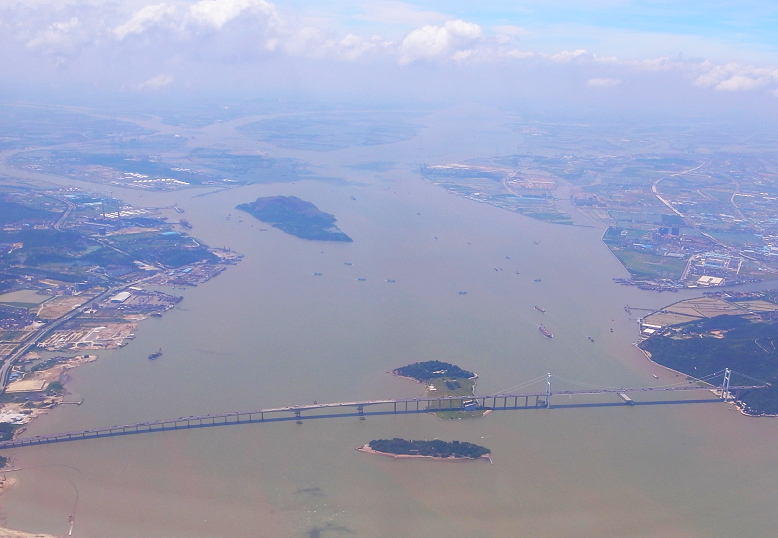
 View of the Humen Bridge over the strait | |||||||||||||
| Traditional Chinese | 虎門 | ||||||||||||
| Simplified Chinese | 虎门 | ||||||||||||
| Postal | Hu-mun | ||||||||||||
| Literal meaning | The Tiger Gate | ||||||||||||
| |||||||||||||
The Humen, also known as the Bocca Tigris or the Bogue, is a narrow strait in the Pearl River Delta that separates Shiziyang in the north and Lingdingyang in the south. It is located near Humen Town in China's Guangdong Province. It is the site of the Pearl River's discharge into the South China Sea. It contains the Port of Humen at Humen Town. The strait is formed by the islands of Chuenpi (穿鼻, p Chuanbi) and Anunghoy (阿娘鞋, p Aniangxie; also called 威远, p Weiyuan) on the eastern side, and Taikoktow (大角头, p Dajiaotou) on the western side.[1] Since 1997, the strait has been traversed by the Humen Pearl River Bridge. Bocca Tigris was the entry to China's only trading city, Canton.
Name
[edit]The Latinate Bocca Tigris is derived from the Portuguese Boca do Tigre, which is a calque of the Mandarin Chinese and Cantonese name 虎門, literally meaning "The Tiger Gate".[2] The name Bogue is also a corruption of the Portuguese Boca.[2]
The name comes from the impression given by Tiger Island, situated about 3.2 km (2.0 mi) above the Hengdang Islands in the middle of the strait, of a tiger couchant[3] or at least of a tiger's head on its eastern side.[4][5][6] American Commodore Matthew Perry, who later played a leading role in the opening of Japan to the West, noted that: "Although the resemblance is not at first very striking, it becomes quite obvious after examination".[4]
History
[edit]

Because of its strategic location as the naval gateway to the city of Guangzhou (Canton), the strait was strongly fortified during 1702. It was defended by eight forts: Shakok (Shajiao), Taikok (Dajiao), Wangtung (Hengdang), Yung-an (Yong'an), Kung-ku (Gonggu), Chen-yuan (Zhenyuan), Ching-yuan (Jingyuan), and Wei-yuan.[7] Between September 1809 and January 1810, Portuguese Navy ships based in Macau defeated a group of Chinese pirates in the Battle of the Tiger's Mouth.
The first major battle of the First Opium War between the United Kingdom and China occurred at the entrance of the Humen in the First Battle of Chuenpi on 3 November 1839. The British captured the Bogue forts in the Second Battle of Chuenpi on 7 January 1841 and the Battle of the Bogue on 23–26 February. The forts were recaptured on 2 April 1847 during the British Expedition to Canton. In the Second Opium War, the British recaptured the forts in the 1856 Battle of the Bogue on 12–13 November.
Geography
[edit]- Eastern shore: Humen Town in Dongguan City
- Western shore: the Nansha District of Guangzhou City
- Upper and Lower Hengdang Islands (横档岛), or North and South Wangtong Islands, in the middle of the strait
- Humen Pearl River Bridge
- Several Qing dynasty forts, including:
- Weiyuan Fort (威远炮台), near Humen Town
- Shajiao Fort (沙角炮台), in Humen Town
- Nansha Pier (新南沙客运港), in the Nansha District, 1.6 km (0.99 mi) south of the Humen Bridge
Port of Humen
[edit]The Port of Humen at Humen Town serves as the port of the industrial city of Dongguan and as one of the big logistic hubs of the Pearl River Delta. It extends on the east shore of the delta beyond the strait all the way to the Dongjiang River. It is divided into five port areas:
- Shatian Port Area (沙田港区): focuses on containers, chemicals, yard logistics, shoreline industry, and comprehensive trading services.
- Mayong Port Area (麻涌港区): focuses on grain, vegetable oil, coal, construction materials, and break-bulk cargo.
- Shajiao Port Area (沙角港区): focuses on passenger transport, leisure boating, and coastal transport and cabotage.
- Chang'an Port Area (长安港区): focuses on large-scale deep-water berths and the waterfront industry.
- Neihe Port Area (内河港区): focuses on traditional waterborne transport services for the Dongguan industries.
The port has 72 km2 (28 sq mi) of territorial waters and 32 km2 (12 sq mi) of jurisdictional area. The main navigation channel is 13.5 m (44 ft) deep, enough for vessels of 100,000 DWT.[8] Originally called Taiping port, the State Council approved it as an open port in 1983. It was merged with the Shatian port in June 1997 and renamed Humen port.[9]
See also
[edit]- Treaty of the Bogue (1843)
Notes
[edit]- ^ Bingham, J. Elliot (1843). Narrative of the Expedition to China from the Commencement of the War to Its Termination in 1842 (2nd ed.). Volume 2. London: Henry Colburn. p. 3.
- ^ a b Taylor 1898, p. 70
- ^ Wathen, James (1814). Journal of a Voyage, in 1811 and 1812, to Madras and China. London: J Nichols, Son and Bentley. p. 177.
- ^ a b Hawks, Francis L.; Perry, Matthew (1857). Narrative of the Expedition of an American Squadron to the China Seas and Japan. New York: D. Appleton and Company. p. 161.
- ^ Taylor 1898, p. 277
- ^ Bernard, William Dallas; Hall, William Hutcheon (1846). The Nemesis in China (3rd ed.). London: Henry Colburn. p. 81.
- ^ Waley, Arthur (1958). The Opium War Through Chinese Eyes. Woking, Surrey: George Allen and Unwin. ISBN 0049510126. pp. 130, 139.
- ^ "港区概况 - 中国·虎门港". Archived from the original on 2014-06-03. Retrieved 2016-07-24.
- ^ Yeung, Godfrey (2001). Foreign Investment and Socio-Economic Development: The Case of Dongguan. New York: Palgrave. p. 97. ISBN 9780333978115.
References
[edit]- Taylor, Isaac (1898). Names and Their Histories: A Handbook of Historical Geography and Topographical Nomenclature (2nd ed.). London: Rivingtons.
External links
[edit]
- Satellite view of Bocca Tigris on Google maps
 Tiger Island., painted by Clarkson Frederick Stanfield and engraved by Edward Goodall for Fisher's Drawing Room Scrap Book, 1832, with a poetical illustration by Letitia Elizabeth Landon, The Pirate's Song off Tiger Island.

Humen
View on GrokipediaEtymology
Name Origins and Variations
The name Humen derives from the Standard Mandarin Chinese term 虎门 (Hùmén), literally translating to "Tiger Gate," a designation reflecting the strait's narrow, strategically defensible passage in the Pearl River Delta, where historical fortifications on either side evoked the imagery of tigers flanking and guarding the entrance to Guangzhou (Canton).[9] This nomenclature emphasizes the geographical chokepoint's formidable natural and man-made barriers, akin to a gated portal protected by predatory sentinels.[10] In Western accounts, particularly from Portuguese explorers and later British naval records, the name appeared in phonetic and calqued variations such as "Bocca Tigris" (Italianate/Portuguese for "Tiger's Mouth," a direct translation of the Chinese term) and "Bogue," the latter a corruption of Boca do Tigre used in 19th-century maritime logs to denote the same strait.[11] These renderings, documented in European trade and military dispatches from the 16th to 19th centuries, adapted the Chinese toponymy while preserving its predatory connotation amid efforts to navigate the estuary for commerce and conflict. Earlier romanizations of the town's name included "Fumun," an archaic transliteration reflecting pre-Pinyin conventions in Western sinology.[12] Under the People's Republic of China, the official designation has remained Hùmén (虎门), with the locality formalized as Humen Town (Hùmén Zhèn, 虎门镇) within Dongguan municipality following 1950s administrative reorganizations that integrated it into provincial structures without altering the core nomenclature.[13] This continuity contrasts with broader regional renaming trends post-1949, such as the simplification of administrative hierarchies in Guangdong, but preserves the historic "Tiger Gate" etymology tied to the site's enduring strategic identity.History
Pre-Modern Period
The region encompassing Humen, situated at the eastern entrance to the Pearl River Delta, exhibits evidence of human activity dating back approximately 7,000 years, primarily associated with early Baiyue indigenous groups who engaged in fishing, shell collection, and rudimentary coastal resource exploitation.[14] These prehistoric settlements evolved into fishing communities, including water-faring Tanka populations—descended from Baiyue minorities—who maintained a symbiotic relationship with the delta's waterways, relying on boat-based livelihoods for sustenance and mobility.[15] By the Han Dynasty (circa 206 BCE–220 CE), the broader Pearl River Delta, including areas near Humen, supported localized economies centered on marine resources, with Guangzhou (ancient Panyu) serving as a administrative hub under Nanhai Commandery, facilitating early coastal trade and resource extraction such as sea salt production through evaporation in coastal pans.[16][17] During the Song Dynasty (960–1279 CE), Humen's strategic position at the Humen Strait enhanced its integration into regional maritime networks, as the Pearl River provided primary access to Guangzhou, a premier port on the Maritime Silk Road alongside Quanzhou, where foreign vessels delivered spices, aromatics, and textiles in exchange for Chinese silks, porcelain, and metals.[18] Local communities benefited from ancillary trade activities, including provisioning ships and processing fish, though primary commerce flowed upstream; this period marked increased human settlement density in delta fringes due to expanded navigation and agricultural reclamation.[19] In the Ming Dynasty (1368–1644 CE), Humen's role shifted toward defensive postures amid heightened piracy threats from wokou raiders targeting Guangdong coasts, prompting construction of coastal watchposts and rudimentary fortifications to safeguard delta approaches, though major batteries postdated this era. Population expansion continued, driven by the area's fertile alluvial soils and riverine access supporting rice cultivation and fisheries, with lineage-based villages organizing labor for salt panning and boat maintenance, reflecting organic growth unmarred by large-scale foreign disruptions until later centuries.[20] Local gazetteers from the late imperial period document sustained residency tied to these subsistence and protective functions, underscoring Humen's pre-modern character as a peripheral yet vital nodal point in delta socio-economics.Qing Dynasty and Trade Dynamics
Under the Canton System, formalized in 1757, the Qing Dynasty restricted all foreign maritime trade to the port of Guangzhou, with Humen serving as a critical customs and defensive outpost at the Pearl River estuary.[21] Fortified with the Bogue batteries, Humen controlled access for incoming vessels, facilitating the funneling of exports like tea and silk while imposing duties through the Hoppo, the imperial customs superintendent.[22] This arrangement centralized revenue collection under the Cohong guild of licensed merchants, but the strategic chokepoint at Humen exposed systemic vulnerabilities in oversight and smuggling prevention.[23] Throughout the 18th century, China's favorable trade balance drew substantial silver inflows, as European demand for tea, silk, and porcelain outpaced exports of Western goods; by the mid-1700s, approximately 90 percent of payments to Canton consisted of silver bullion.[23] However, by the 1820s, illicit opium imports—smuggled primarily via Portuguese Macao and smaller lorchas—reversed this trend, escalating silver outflows from about two million ounces annually in the early decade to over nine million by the late 1830s.[24] Qing imperial edicts, including the Jiaqing Emperor's 1799 prohibition on opium importation and domestic cultivation, proved ineffective due to pervasive corruption among local officials and inadequate naval patrols, allowing trade volumes to surge despite repeated bans.[25] Administrative control over Humen fell under the Viceroy of Liangguang, who governed Guangdong and Guangxi provinces, supervising military defenses, customs enforcement, and trade mediation through layered bureaucracies that often prioritized revenue quotas over strict policy adherence.[21] This structure, while intended to insulate the imperial core from foreign influence, fostered inefficiencies such as fund diversion and bribe-taking by customs officers, undermining edict implementation and exacerbating fiscal imbalances from unchecked smuggling routes. Such decentralized execution amid centralized mandates highlighted inherent tensions in Qing governance, where local incentives conflicted with broader economic stability goals.The Opium Crisis and Destruction
In March 1839, Lin Zexu arrived in Guangzhou as Imperial Commissioner with a mandate to eradicate the opium trade, amid estimates of 4 to 12 million addicts in China by 1838.[26] He imposed a blockade on foreign traders and demanded the surrender of opium stocks held by British, American, and other merchants.[27] Under pressure, including threats to their lives and trade privileges, the merchants relinquished 20,283 chests containing approximately 1,200 tons of opium by late May.[27] [28] The opium was transported to Humen Beach near the Boca Tigris estuary for public destruction, commencing on June 3, 1839, and extending over 23 days under Lin's supervision, as documented in his official reports to the Daoguang Emperor.[28] Workers broke open the chests, extracted the opium balls, and placed them in large trenches where they were stirred and dissolved with seawater; salt and lime were then added to accelerate decomposition and prevent salvage, producing a noxious mixture flushed into the sea.[27] This method ensured thorough neutralization without burning, involving thousands of laborers and verifiable through Qing archival records of the process.[27] The destroyed opium, valued at roughly £2 million sterling—or approximately $10 million in 1839 U.S. dollar equivalents based on contemporary exchange rates and per-chest pricing—represented significant private property of the surrendering merchants.[29] British officials, including Foreign Secretary Lord Palmerston, contended that this confiscation and destruction violated established international norms protecting commercial cargoes, framing it as an illegitimate seizure rather than a legitimate enforcement against smuggling.[30] Lin's action aimed directly at curbing the spread of addiction, which had drained silver reserves and impaired military and administrative efficiency, though it provoked immediate diplomatic rupture with Britain.[28]First Opium War Engagements
The primary military engagements at Humen during the First Opium War occurred in early 1841, as British forces sought to breach the Qing Dynasty's Bogue fortifications guarding the Pearl River estuary. On January 7, 1841, in the Second Battle of Chuenpi, a British squadron under Commodore James John Gordon Bremer assaulted the forts on Chuenpi and Taikoktow islands, capturing them after intense bombardment and amphibious landings.[31] The attacking force included iron-hulled steamers like HMS Nemesis, which demonstrated superior mobility and firepower against Qing shore batteries and war junks, resulting in over 500 Chinese killed and approximately 250 wounded, with British losses limited to 38 wounded. This victory exposed the Qing defenses' vulnerabilities, including outdated smoothbore cannons and ineffective fire control, contrasted against British Congreve rockets and naval artillery.[32] Following the initial success, British forces advanced to the inner Bogue forts in February 1841, bombarding and capturing additional batteries at Anunghoy and other positions to secure passage toward Canton.[33] The British China Expedition fleet, comprising roughly 16 warships and several armed steamers, enabled a naval blockade that crippled Qing supply lines and naval resistance in the region.[30] Qing casualties in these actions exceeded 250 killed or wounded at key sites like Wangtong, with minimal British losses due to technological disparities—steam propulsion allowed precise maneuvering under fire, while Qing forces relied on static fortifications and wooden vessels prone to destruction. The breaches facilitated British dominance in the Pearl River Delta, underscoring causal factors such as the Qing's failure to industrialize artillery and naval tactics. The tactical realities of these engagements highlighted Humen's strategic centrality, as the fort captures dismantled layered defenses intended to protect Canton, leading to resident displacement amid shelling and occupations. Ruins of the demolished batteries persist as physical evidence of Qing military inferiority, with empirical assessments from British dispatches noting captured ordnance exceeding 190 guns and the destruction of 11 junks.[31] By mid-1841, the secured waterway enabled sustained British operations, culminating in the war's resolution via the Treaty of Nanking in 1842, though local communities endured evacuation and economic disruption from the blockade.[32]Republican Era to Early People's Republic
During the Japanese occupation of the Guangdong region, which began after the fall of Guangzhou on October 21, 1938, Humen and surrounding areas in the Pearl River Delta fell under Imperial Japanese control, severely disrupting local port activities and maritime trade routes that had historically supported fishing and small-scale commerce. Japanese forces prioritized securing coastal defenses and exploiting resources for military logistics, leading to the curtailment of civilian shipping and economic stagnation in peripheral towns like Humen, where pre-war reliance on riverine transport for goods to Guangzhou was interrupted.[34] Resistance activities by local guerrillas affiliated with Nationalist or Communist forces occasionally targeted supply lines, further hampering recovery until Japan's surrender on August 15, 1945.[35] Following World War II, the Kuomintang (KMT) administration oversaw a brief period of postwar reconstruction in Dongguan county, to which Humen belonged administratively, focusing on restoring basic infrastructure amid hyperinflation and the escalating Chinese Civil War. Efforts included rehabilitating damaged wharves and agricultural output, but these were undermined by resource shortages and KMT retreats, with local GDP per capita remaining below pre-war levels due to ongoing conflict and corruption in supply distribution.[36] By late 1949, as People's Liberation Army forces captured Guangdong province in October, Humen transitioned to People's Republic of China (PRC) control, with the area formally integrated into Dongguan county under centralized Communist governance, marking the end of KMT oversight.[37] In the early PRC years, land reform campaigns from 1950 to 1953, guided by the Agrarian Reform Law of June 1950, redistributed approximately 40% of arable land nationwide from landlords to tenants in Guangdong's rural districts, including Humen, dismantling traditional clan-based landholdings that had dominated local social structures since the Qing era.[38] This process involved public trials and executions of designated class enemies, suppressing influential lineages and reallocating over 700 million mu of land across China, though specific figures for Humen remain undocumented in available records; outcomes in Guangdong showed uneven equalization, with middle peasants retaining modest holdings while fostering dependence on state directives.[39] Subsequent collectivization from 1953 onward organized farmers into mutual-aid teams and higher-stage cooperatives by 1956, prioritizing grain procurement for urban industrialization over local incentives, resulting in agrarian stasis with annual agricultural growth averaging under 2% in the Pearl River Delta through the 1950s and 1960s.[40] Economic output in Humen, predominantly rice and fishing-based, exhibited minimal expansion, constrained by central planning and campaigns like the Great Leap Forward (1958-1962), which exacerbated shortages without verifiable industrial offsets until later decades.[41]Post-1978 Reforms and Contemporary Growth
Following Deng Xiaoping's economic reforms initiated in 1978, Humen Town in Dongguan benefited from its proximity to the Shenzhen Special Economic Zone, established in 1980, which facilitated foreign direct investment and export-oriented manufacturing without formal SEZ status for Dongguan itself.[7][42] This positioning spurred rapid industrialization, transforming Humen into a key hub for labor-intensive industries, particularly garments and textiles, leveraging low-cost labor and supply chain integration in the Pearl River Delta.[43] By the 2000s, Humen had earned the moniker "Clothing Capital of China" due to its concentration of garment factories and wholesale markets, exporting apparel to markets in Japan, South Korea, Europe, and the United States.[44] The sector's growth contributed significantly to Dongguan's export economy, with the city's manufacturing output encompassing over 60,000 product types by the early 2010s.[7] Urbanization accelerated accordingly, with Humen's population expanding from approximately 100,000 in the 1980s to 577,548 by the 2000 census and reaching 838,000 by 2023, driven by migrant workers attracted to factory jobs.[45] Infrastructure investments further catalyzed growth, exemplified by the Humen Bridge, completed in 1997 with a main span of 888 meters, which improved connectivity between Guangzhou and Dongguan, reducing transport times and boosting regional GDP per capita through enhanced logistics and trade flows.[46] Empirical analysis indicates the bridge's opening positively impacted Dongguan's per capita GDP growth rate, underscoring infrastructure's causal role in amplifying reform-era gains.[46] Dongguan's overall GDP surpassed 1 trillion yuan (about $150 billion USD) in 2021, reflecting sustained post-1978 expansion.[47] Integration into the Guangdong-Hong Kong-Macau Greater Bay Area, formalized in the 2017 development outline and advanced through projects like the 2019 Nansha Bridge, has further optimized Humen's logistics role, alleviating congestion on the Humen Bridge and fostering tech-manufacturing synergies.[48] However, this growth has imposed environmental costs, including soil contamination with heavy metals like cadmium and lead in Humen and adjacent areas, attributed to unchecked industrial discharges, with pollution indices indicating low to moderate levels but necessitating remediation.[49] Air and water pollution from factories have also persisted, though recent measures have mitigated some particulate matter issues amid ongoing economic pressures.[50][51]Geography
Location and Topography
Humen is situated at coordinates 22°49′N 113°40′E, on the eastern bank of the Pearl River estuary—historically known as the Bocca Tigris—in Dongguan, Guangdong Province, southern China.[52] This positions it approximately 50 km southeast of central Guangzhou, at the strategic mouth where the Pearl River meets the South China Sea.[53] The town's administrative area spans 178.5 km², dominated by low-lying alluvial plains formed by riverine sedimentation, with average elevations below 20 meters above sea level.[1][54] These flat terrains, typical of the Pearl River Delta's estuarine environment, include meandering channels and tidal flats that support navigation but are vulnerable to silting from upstream sediment loads. To the east, modest hills rise slightly above the plains, integrating into the urban landscape and providing natural vantage points that influenced historical fortifications.[52]Pearl River Delta Integration
Humen functions as a primary tidal gateway within the Pearl River Delta, channeling freshwater and sediment discharge from the delta's distributary network into the South China Sea via the Humen outlet, one of eight major waterways. These channels, influenced by interactions between streamflow and tidal forces, maintain hydrological connectivity across the delta's compound river system, with navigable routes extending approximately 100 km upstream from the estuary.[55][56] This configuration supports the redistribution of the Pearl River's annual discharge, peaking during wet seasons, and facilitates pre-2020 freight volumes exceeding 1 billion metric tons across the system, with outlets like Humen enabling access for substantial cargo loads.[57][58] Sedimentation processes in the delta, particularly around Humen, involve tidal pumping and riverine inputs that promote land accretion in intertidal flats, counterbalanced by erosion risks from reduced upstream sediment delivery due to reservoirs and channel regulations. Human activities have altered these dynamics since the mid-20th century, leading to channel incision and morphological shifts verifiable through satellite imagery and bathymetric surveys.[59][60] From 1975 to 2017, surface sediments in the Pearl River Estuary coarsened, indicating declining fine-grained deposition amid ongoing accretion-erosion balances.[61][62] Humen's urban linkages within the delta stem from its strategic location, approximately 40 km from Shenzhen and 60 km from Hong Kong, which has bolstered hydrological and infrastructural ties post-1997 Hong Kong handover. This proximity integrates Humen into regional water management and cross-border flows, enhancing functional connectivity without direct port delineation.[63][64]Climate and Environmental Features
Humen experiences a humid subtropical monsoon climate characterized by hot, humid summers and mild, dry winters. The annual average temperature is 22.3 °C, with monthly means ranging from about 14 °C in January to 29 °C in July.[65] Annual precipitation totals approximately 1,956 mm, concentrated primarily during the wet season from April to September, when monthly rainfall often exceeds 200 mm.[65] The region is prone to typhoons originating from the western Pacific, with Guangdong Province, including Dongguan, affected by multiple events annually during peak seasons from July to September. Historical records indicate that typhoons have caused significant flooding and wind damage in the Pearl River Delta area, contributing to episodic extreme weather.[66] Air quality in Humen has been impacted by industrial activities, with PM2.5 concentrations averaging 40-60 μg/m³ during the 2010s, driven largely by emissions from manufacturing and vehicular traffic in Dongguan. These levels exceeded national standards and were linked to regional haze episodes, though subsequent reductions occurred through emission controls.[67] Ecologically, Humen's coastal position in the Pearl River Delta supports mangrove habitats, but biodiversity has declined due to urbanization and industrialization. Mangrove coverage in the delta decreased by 45% (11.73 km² net loss) between 1985 and 2015, attributed to coastal reclamation, aquaculture expansion, and pollution. Fisheries have similarly suffered, with Guangdong's coastal stocks collapsing by up to 75% from excessive reclamation and habitat loss since the late 20th century, reducing species abundance and catch yields.[68][69]Economy
Port Infrastructure and Trade Role
Humen Port, integrated within the Dongguan Port Group, operates as a key logistics node in the Pearl River Delta, featuring 23 berths designed to handle containerized cargo from vessels ranging 3,000 to 50,000 tons deadweight, alongside bulk commodities.[70] These facilities support efficient transfer of goods, with specialized terminals for dry bulk such as minerals and aggregates, reflecting the port's role in servicing inland manufacturing clusters.[71] Infrastructure upgrades in the 2010s, including the Phase 3 expansion initiated in 2015 by CCCC Fourth Harbor Engineering, deepened access channels and added quay lengths to enable larger vessel calls, transitioning Humen from a supplementary outpost under the historical Canton trading monopoly to a competitive modern terminal.[72] Further developments, such as Phase IV construction starting December 2022, incorporate 999 meters of berth line with capacity for 1.8 million TEUs annually, accommodating ships up to 100,000 deadweight tons.[73] Container throughput at Dongguan Port, which includes Humen operations, reached 3.91 million TEUs in 2017, following a 16.3% increase to 3.36 million TEUs in 2015 from prior years.[74][75] Cargo volumes hit 157 million tons that year, with pre-COVID peaks sustaining similar scales before global disruptions reduced activity.[74] The port's trade composition emphasizes export-oriented shipments from Dongguan's factories, dominated by electronics components and textiles bound for the EU and US markets, balanced by imports of raw materials like petrochemicals and metals to fuel assembly lines.[76] This logistics focus generates consistent outbound surpluses at the regional level, underpinning Dongguan's contribution to Guangdong Province's overall positive trade balance, as evidenced by sustained container growth rates exceeding 15% annually in the mid-2010s.[75] Humen's strategic position at the Pearl River estuary facilitates rapid feeder connections to mega-hubs like Hong Kong and Shenzhen, amplifying its efficiency in high-volume, time-sensitive commerce without relying on broader industrial processing.[77]Industrial Development and Manufacturing
Humen's manufacturing sector expanded rapidly following China's economic reforms in the late 1970s, transitioning from agriculture to labor-intensive industries, particularly apparel production, fueled by massive rural-to-urban labor migration from interior provinces. By 2010, the town supported over 2,000 garment enterprises, employing more than 350,000 workers and generating annual output exceeding 16 billion RMB, establishing it as a key node in China's export-oriented clothing supply chain.[78] Low entry barriers, skilled tailoring labor, and integration with nearby fabric markets enabled rapid scaling, with products ranging from jeans to youth fashion destined for domestic and international markets including Europe and the United States.[79][80] Foreign direct investment played a pivotal role, with Dongguan's cumulative contracted FDI reaching approximately US$17.92 billion by the mid-2000s, much of it channeled into Humen's factories due to average monthly manufacturing wages around US$500 in the early 2010s, attracting apparel firms seeking cost advantages over higher-wage regions.[81][82] This inflow supported cluster effects, where suppliers, designers, and logistics firms co-located, boosting efficiency but also fostering dependency on low-skill assembly. Rising labor costs—doubling from about 2,000 RMB monthly in 2010 to over 4,000 RMB by mid-decade—prompted initial automation adoption, such as sewing machine upgrades, to maintain competitiveness amid global buyer demands for faster turnaround.[83] Post-2020, Humen pursued diversification into higher-value sectors, including electronics assembly and components for semiconductors, aligning with Dongguan's broader pivot to intelligent manufacturing amid national policies like Made in China 2025.[84][85] This shift addressed overcapacity in traditional apparel, where factory closures surged during 2022-2023 due to weak post-pandemic demand and excess supply, with many Dongguan firms, including in Humen, facing utilization rates below 50 percent.[86] Intellectual property challenges persisted, as evidenced by ongoing WTO disputes and U.S. Trade Representative reports citing systemic enforcement gaps in Guangdong's manufacturing clusters, deterring some high-tech investments and spurring local firms toward proprietary designs.[85] These factors have driven endogenous adaptations, such as R&D incentives and vocational training for automation, aiming to sustain output amid endogenous cost pressures rather than relying solely on wage suppression.Integration into Greater Bay Area
Humen's integration into the Guangdong-Hong Kong-Macao Greater Bay Area (GBA), formalized by the 2019 Outline Development Plan, emphasizes enhanced connectivity and policy synergies to foster regional economic cohesion. High-speed rail links, such as those from Humen Station to Hong Kong's West Kowloon Station, reduce travel time to approximately 38 minutes, enabling efficient cross-border movement of goods, personnel, and capital.[87][88] These infrastructure improvements support Humen's role in the GBA's supply chain networks, where Dongguan facilitates manufacturing integration across the bay's cities.[89] Policy incentives under the GBA framework provide targeted support for innovation and talent attraction in Humen and broader Dongguan. High-end foreign talent qualifies for individual income tax subsidies covering the difference between China's 45% top rate and the 15% global standard, extended until 2027 to bolster sectors like advanced manufacturing and technology.[90] Additionally, Dongguan offers one-time rewards ranging from RMB 2 million to RMB 100 million for qualifying headquarters establishments, encouraging relocation and expansion of high-value enterprises.[91] These measures have driven growth in e-commerce and digital services in Humen, with online sales exceeding 57 billion yuan in 2022 and averaging over 13% annual growth since 2013.[92] Economic contributions from Humen align with the GBA's overall GDP surpassing 13 trillion RMB in 2022, where Dongguan's manufacturing prowess, including Humen's industrial clusters, enhances intra-regional trade and value chains. Participation in initiatives like the Binhaiwan Bay Area positions Humen as a platform for Dongguan's GBA engagement, promoting aviation and port economic clusters.[93] However, rapid integration strains local resources, with land constraints amid expansion pressures, though specific mitigation through urban planning continues to support sustainable development.[94]Cultural and Historical Significance
Heritage Sites and Preservation
The opium destruction pools in Humen, utilized by Imperial Commissioner Lin Zexu to dissolve and flush over 20,000 chests of confiscated opium into the Pearl River from June 3 to 25, 1839, stand as key preserved relics of the event. Located within the Lin Zexu Memorial in Zhenkou Village, these purpose-built concrete basins retain their original form, demonstrating the scale of the operation through their dimensions and residual structural features. Designated a National Key Cultural Relics Protection Unit, the site receives ongoing maintenance to preserve its archaeological integrity against environmental degradation from the adjacent estuary.[95][96][97] Qing dynasty coastal forts, including Weiyuan Battery constructed in 1835, represent another category of preserved military heritage, with remnants such as cannon platforms and battered walls evidencing bombardment during the 1841 clashes in the Humen Strait. Positioned strategically at the strait entrance, these structures—originally equipped with dozens of artillery pieces—exhibit physical damage consistent with historical accounts of naval engagements, verified through site inspections and photographic documentation of erosion and impact marks. As components of broader defensive batteries like Jinyuan and Zhenyuan, they are protected under national relic status, limiting development and supporting periodic conservation to maintain their ruined state as historical testimony.[98][99][100] Preservation efforts emphasize structural stabilization and erosion control, given the sites' exposure to tidal influences and urban proximity, with access facilitated for educational purposes while restricting alterations to original fabrics. These locations collectively inventory Humen's tangible Opium War legacy, prioritizing empirical conservation over reconstruction to uphold evidentiary value.[96]Museums and Commemorative Efforts
The Opium War Museum in Humen, established in 1957, serves as a primary institution for preserving artifacts and narratives related to Lin Zexu's opium destruction and the ensuing conflicts.[6][101] Its core exhibits include displays on opium prohibition, historical timelines of the Opium War, and dioramas reconstructing key events such as Lin's confiscation efforts and naval engagements like the Battle of the Bogue forts.[6][10] The museum, state-administered alongside the Lin Zexu Memorial and Sea Battle Museum, features over 1,800 artifacts across its sites, encompassing opium paraphernalia, weaponry, and multimedia reconstructions of 19th-century maritime battles.[6][102] Annual commemorative events on June 3 mark the 1839 destruction of approximately 1,016 tons of opium at Humen Beach, organized by local authorities and blending historical remembrance with contemporary anti-drug initiatives.[103][104] These include public ceremonies, wreath-laying at Lin Zexu's statue, and symbolic destruction of seized narcotics by police, attended by officials, students, and residents to honor Lin as a symbol of resistance while promoting education on narcotics' societal harms.[105][106] State sponsorship underscores the events' role in fostering national pride, with participation from regions like Guangdong, Hong Kong, and Macao in milestone anniversaries, such as the 180th in 2019.[105][103] The museum's curation, rooted in Marxist-Leninist historiography, prioritizes themes of foreign aggression and Chinese heroism, portraying the Opium Wars as the onset of imperial humiliation and emphasizing Lin's actions as righteous suppression of illicit trade.[10][107] This narrative, disseminated through exhibits and school-linked programs, cultivates a perspective of victimhood that shapes public memory, though it has drawn observation for limited exploration of Qing-era trade imbalances or internal governance factors preceding the conflicts.[107] State media coverage of the sites reinforces this framing, prioritizing patriotic education over multifaceted economic analyses.[103]Local Traditions and Modern Culture
Local traditions in Humen reflect its riverine location within the Pearl River Delta, where the Dragon Boat Festival (Duanwu Jie) features races emphasizing communal paddling and historical ties to water-based livelihoods. These events, held annually on the fifth day of the fifth lunar month, involve teams navigating long, dragon-headed boats, a practice rooted in ancient rituals to ward off evil and honor figures like poet Qu Yuan, as recognized by UNESCO. In Dongguan, which encompasses Humen, such festivals extend over a month in some towns, blending preparation rituals like unearthing and repainting buried boats with competitive races that draw local participation.[108][109][110] Cuisine in Humen centers on seafood, shaped by its fishing heritage and proximity to the South China Sea and Pearl River estuary. Annual fishing moratoriums end in August, ushering in fresh catches like crabs, shrimp, and fish sold at markets such as Xinwan Seafood Market, where locals prepare dishes including Humen baked crab patties—combining crab meat, pork, egg, and herbs like Thai basil. This tradition persists amid modern adaptations, with port-side trading and seasonal feasts highlighting marine biodiversity influenced by tidal fluctuations. Tourism has introduced varied preparations, though core offerings remain tied to daily hauls from nearby waters.[111][112][113][114] Modern culture in Humen shows social shifts driven by rapid urbanization and labor migration, with non-local residents comprising over 70% of Dongguan's population as of the early 2020s, a trend extending to Humen as a manufacturing hub. This influx, reaching 76% non-hukou holders by recent estimates, has diluted traditional clan-based village structures prevalent in Guangdong's rural lineages, fostering a more transient, diverse community with weakened familial ties and increased reliance on wage labor networks. Surveys indicate these migrants, often from inland provinces, introduce varied customs while adapting to local practices, contributing to a hybrid social fabric less anchored in ancestral villages.[115][116]Controversies and Interpretations
Debates on Opium Destruction Legality
In June 1839, Qing imperial commissioner Lin Zexu oversaw the destruction of opium stocks surrendered by British and other foreign merchants at Humen, totaling approximately 20,000 chests mixed with lime and flushed into the sea over 23 days.[117] The Chinese government justified this as a sovereign measure to enforce longstanding prohibitions on opium importation and consumption, first decreed in 1729 and reiterated in subsequent edicts, framing the substance as contraband harmful to public health and state stability.[117] Lin viewed the action as rightful punishment under domestic law for smuggling, detaining non-compliant merchants to compel compliance and arguing that foreign traders bore responsibility for violating Qing regulations.[118] British authorities, led by Superintendent of Trade Charles Elliot, contested the legality by emphasizing the coerced nature of the surrender, obtained through a naval blockade of Canton and threats to merchants' lives and property, rendering it involuntary under principles of duress.[119] They asserted that the opium represented private commercial assets held by individual traders, not state property, and its uncompensated destruction violated fundamental property rights, akin to arbitrary expropriation without due process or recourse—prefiguring modern international disputes over seized assets.[120] In parliamentary addresses, British demands prioritized restitution for subjects' losses as the foremost grievance, portraying Lin's methods as exceeding mere law enforcement into punitive overreach against extraterritorial commerce.[120] Scholarly analyses highlight inconsistencies in Qing policy that complicate claims of uniform legality: while edicts explicitly banned opium trade with foreigners, prior lax enforcement and corruption enabled smuggling networks, suggesting selective application rather than consistent rule-of-law adherence.[121] This undermined arguments for the destruction as straightforward sovereignty, as the regime's own edicts oscillated between prohibition and tolerance for fiscal reasons, eroding the juridical foundation for coercing private holdings without negotiation or international precedent.[122] Such critiques, drawing on 19th-century diplomatic norms, posit that absent clear treaties defining jurisdiction over foreign goods in Chinese waters, the action breached emerging principles of comity and compensation in cross-border trade disputes.[119]Causality of the Opium Wars
The First Opium War (1839–1842) arose from deep-seated economic disruptions in Qing China caused by the opium trade, which reversed the longstanding favorable balance of trade with Europe. Prior to the 1820s, China exported tea, silk, and porcelain to Britain, receiving silver in return, but the influx of Indian opium—smuggled increasingly after Qing bans—shifted this dynamic, leading to net silver outflows that strained the empire's silver-based monetary system. By the 1830s, annual opium imports exceeded 20,000 chests, each containing roughly 140 pounds, fueling addiction among millions and prompting imperial commissioner Lin Zexu's crackdown at Humen in 1839.[123][24] Opium addiction had permeated Qing society, with estimates indicating over 10 million users by the late 1830s, contributing to labor productivity losses, moral decay, and fiscal pressure as addicts prioritized the drug over taxes and duties. This crisis was quantified in imperial audits, revealing annual silver drains of approximately 9 million taels by the 1830s, equivalent to a substantial portion of government revenue and exacerbating deflationary pressures on copper-silver exchange rates. Such data underscored systemic vulnerabilities, including widespread addiction among soldiers and officials, which weakened military and administrative capacity.[124][125] British actions, while protective of merchant interests, reflected broader frustrations with the Canton System, which confined foreign trade to Guangzhou under the monopolistic cohong guild, limiting market access and diplomatic engagement. Proponents of free trade, including Superintendent Charles Elliot, sought to dismantle these restrictions to balance Britain's trade deficit, rather than purely imperial conquest, as evidenced by parliamentary debates prioritizing commercial equity over territorial gain. Domestic British opposition, including anti-opium societies and missionary critiques in the 1830s, further tempers narratives of unbridled aggression, with figures like William Gladstone decrying the trade's ethics in 1840 Commons speeches.[5][24][126] Qing internal dysfunction amplified these external pressures, with corruption enabling smuggling despite edicts banning opium in 1729, 1799, 1813, and 1831; officials often accepted bribes, undermining enforcement and reflecting bureaucratic inertia against reform. Pre-Lin Zexu efforts failed due to elite complicity and resistance to disrupting entrenched revenue streams from tolerated vice, positioning the addiction crisis as a domestic policy failure that invited confrontation rather than an isolated act of foreign predation. Historians note that this governance rot, including in military procurement, rendered Qing defenses brittle, causal to escalation when Lin's destruction of 20,000 chests provoked retaliation.[127][128][5]Long-Term Economic and Political Impacts
The First Opium War, precipitated by the destruction of opium stocks at Humen in 1839, compelled the Qing dynasty to open treaty ports under the Treaty of Nanking (1842), which expanded foreign access to Chinese markets and reversed prior restrictions on trade. This forced liberalization increased China's total foreign trade volume from approximately 28 million taels of silver in 1840 to over 200 million taels by 1890, representing a roughly sevenfold rise, though much of the growth stemmed from opium imports and re-exports rather than balanced domestic gains.[129][130] Economic benefits were concentrated near treaty ports like Guangzhou (adjacent to Humen), where proximity facilitated market integration and infrastructure development, boosting local GDP proxies by up to 20-30% in affected regions by the late 19th century, while exacerbating inland-rural disparities due to unequal tariff concessions and foreign dominance in key sectors.[129][131] Politically, the Qing's military humiliation eroded imperial legitimacy, as the swift British naval victories exposed systemic weaknesses in defense and administration, fueling domestic discontent and accelerating rebellions such as the Taiping Rebellion (1850-1864), which claimed an estimated 20-30 million lives and further destabilized central authority.[31] This loss of prestige prompted partial modernization initiatives, including the importation of Western arsenals and steamships via the Self-Strengthening Movement (1861-1895), which transferred technologies like rifled guns and telegraphs, laying groundwork for industrial capacity despite initial inefficiencies.[132] Globally, the war's treaties introduced extraterritoriality, granting foreigners immunity from Chinese law in concessions, a practice that persisted until the 1940s and set precedents for coerced market access in subsequent "unequal treaties" with other powers, though it drew criticism for undermining sovereignty without reciprocal obligations. In the Humen region specifically, the Pearl River estuary's strategic role evolved from a contested wartime chokepoint to a cornerstone of export manufacturing; by the early 21st century, Humen Port supported an export-oriented economy processing over 5 million TEUs annually in 2004, integrating into supply chains for textiles and electronics amid post-1978 reforms.[133] These legacies highlight a causal shift from isolation to selective globalization, with empirical gains in trade efficiency offset by entrenched institutional vulnerabilities.[129]References
- https://en.wiktionary.org/wiki/Bogue