



Community hub
Recent from talks
Contribute something
Nothing was collected or created yet.
Vietnamese Martyrs
View on WikipediaVietnamese Martyrs (Vietnamese: Các Thánh Tử đạo Việt Nam), also known as the Martyrs of Tonkin and Cochinchina, collectively Martyrs of Annam or formerly Martyrs of Indochina, are saints of the Catholic Church who died between 1745 and 1862,[2] and were canonized by Pope John Paul II. On June 19, 1988, thousands of overseas Vietnamese worldwide gathered at St. Peter's Square for the celebration of the canonization of 117 Vietnamese Martyrs, an event organized by Monsignor Trần Văn Hoài.[3] Their memorial in the current General Roman Calendar, which refers to Saint Andrew Dung-Lac and Companions (Vietnamese: Anrê Dũng-Lạc và các bạn tử đạo), is on November 24, although many of these saints have a second memorial, having been beatified and inscribed on the local calendar prior to the canonization of the group.
Key Information


The Vatican estimates the number of Vietnamese martyrs at between 130,000 and 300,000.[2] John Paul II decided to canonize both those whose names are known and unknown, giving them a single feast day.
History
[edit]The Vietnamese Martyrs fall into several groupings: those of the Dominican and Jesuit missionary era of the 18th century, and those killed in the politically inspired persecutions of the 19th century. A representative sample of only 117 martyrs, including 96 Vietnamese, 11 Spanish Dominicans, and 10 French members of the Paris Foreign Missions Society (Missions Etrangères de Paris (MEP)), were beatified on four separate occasions: 64 by Pope Leo XIII on May 27, 1900; eight by Pope Pius X on May 20, 1906; 20 by Pope Pius X on May 2, 1909; and 25 by Pope Pius XII on April 29, 1951.[4] All 117 of these Vietnamese Martyrs were canonized on June 19, 1988.[5] A young Vietnamese Martyr, Andrew of Phú Yên, was beatified in March 2000, by Pope John Paul II.
Martyrs of the Dominican and Jesuit missionary era of the 18th century
[edit]Six of the canonised martyrs died during the 18th century.[2]
Christians at the time [when?] were branded on the face with the words "tả đạo" (左道, lit. "unorthodox religion")[6] and families and villages which subscribed to Christianity were obliterated.[7]
The Nguyễn Campaign against Catholicism in the 19th century
[edit]
The Catholic Church in Vietnam was devastated during the Tây Sơn rebellion in the late 18th century. During the turmoil, the missions revived, however, as a result of cooperation between the French Vicar Apostolic Pigneaux de Behaine and Nguyen Anh. After Nguyen's victory in 1802, he was grateful for the assistance received and ensured protection for missionary activities. However, only a few years into the new emperor's reign, there was growing antipathy among officials against Catholicism and missionaries reported that it was purely for political reasons that their presence was tolerated.[8] Tolerance continued until the death of the emperor and the new emperor, Minh Mang, succeeding to the throne in 1820.
Converts began to be harassed by local governments without official edicts in the late 1820s. In 1831, the emperor passed new laws regulating religious groupings in Viet Nam, and Catholicism was then officially prohibited. In 1832, the first act occurred in a largely Catholic village near Hue, with the entire community being incarcerated and sent into exile in Cambodia. In January 1833, a new kingdom-wide edict was passed calling on Vietnamese subjects to reject the religion of Jesus and required suspected Catholics to demonstrate their renunciation by walking on a wooden cross. Actual violence against Catholics, however, did not occur until the Lê Văn Khôi revolt.[8]
During the rebellion, a young French missionary priest, Joseph Marchand, was sick and residing in the rebel citadel of Gia Dinh. In October 1833, an officer of the emperor reported to the court that a foreign Christian religious leader was present in the citadel. This news was used to justify the edicts against Catholicism and led to the first executions of missionaries in over 40 years. The first executed was named Francois Gagelin. Marchand was eventually captured and executed as a "rebel leader" in 1835; he was put to death by "slow slicing".[8] Further repressive measures were introduced in the wake of this episode in 1836. Before 1836, village heads had only to report to local mandarins about how their subjects had recanted Catholicism. However, after 1836, officials could visit villages and force all the villagers to line up one by one to trample on a cross, and if a community was suspected of harboring a missionary, militia could block off the village gates and perform a rigorous search; if a missionary was found, collective punishment could be meted out to the entire community.[8]
Missionaries and Catholic communities were able to escape punishment through bribery of officials on occasion; they were also sometimes victims of extortion attempts by people who demanded money under the threat that they would report the villages and missionaries to the authorities.[8] The missionary Father Pierre Duclos said:
with gold bars murder and theft blossom among honest people.[8]
The court became more aware of the problem of the failure to enforce the laws and applied greater pressure on its officials to act; officials who failed to act or those who were seen to be acting too slowly were demoted or removed from office (and sometimes were given severe corporal punishment), while those who attacked and killed the Christians could receive promotion or other rewards. Lower officials or younger family members of officials were sometimes tasked with secretly going through villages to report on hidden missionaries or Catholics who had not apostatized.[8]
The first missionary arrested during this (and later executed) was the priest Jean-Charles Cornay in 1837. A military campaign was conducted in Nam Dinh after letters were discovered in a shipwrecked vessel bound for Macao. Quang Tri and Quang Binh officials captured several priests along with the French missionary Bishop Pierre Dumoulin-Borie in 1838 (who was executed). The court translator, Francois Jaccard, a Catholic who had been kept as a prisoner for years and was extremely valuable to the court, was executed in late 1838; the official who was tasked with this execution, however, was almost immediately dismissed.[8]
A priest, Father Ignatius Delgado, was captured in the village of Can Lao (Nam Định Province), put in a cage on public display for ridicule and abuse, and died of hunger and exposure while waiting for execution; [1] the officer and soldiers that captured him were greatly rewarded (about 3 kg of silver was distributed out to all of them), as were the villagers that had helped to turn him over to the authorities.[8] The bishop Dominic Henares was found in Giao Thuy district of Nam Dinh (later executed); the villagers and soldiers that participated in his arrest were also greatly rewarded (about 3 kg of silver distributed). The priest, Father Joseph Fernandez, and a local priest, Nguyen Ba Tuan, were captured in Kim Song, Nam Dinh; the provincial officials were promoted, the peasants who turned them over were given about 3 kg of silver and other rewards were distributed. In July 1838, a demoted governor attempting to win back his place did so successfully by capturing the priest Father Dang Dinh Vien in Yen Dung, Bac Ninh province. (Vien was executed). In 1839, the same official captured two more priests: Father Dinh Viet Du and Father Nguyen Van Xuyen (also both executed).[8]
Pope Gregory XVI wrote to the faithful of the Apostolic vicariates of Tonkin and Cochinchina in August 1839 to express his shock at these executions and to offer consolation to those who remained.[9]
In Nhu Ly near Hue, an elderly Catholic doctor named Simon Hoa was captured and executed. He had been sheltering a missionary named Charles Delamotte, whom the villagers had pleaded with him to send away. The village was also supposed to erect a shrine for the state-cult, which the doctor also opposed. His status and age protected him from being arrested until 1840 when he was put on trial, and the judge pleaded (due to his status in Vietnamese society as both an elder and a doctor) with him to publicly recant; when he refused, he was publicly executed.[8]
A peculiar episode occurred in late 1839, when a village in Quảng Ngãi province called Phuoc Lam was victimized by four men who extorted cash from the villagers under threat of reporting the Christian presence to the authorities. The governor of the province had a Catholic nephew who told him about what happened, and the governor then found the four men (caught smoking opium) and had two executed as well as two exiled. When a Catholic lay leader then came to the governor to offer their gratitude (thus perhaps exposing what the governor had done), the governor told him that those who had come to die for their religion should now prepare themselves and leave something for their wives and children; when news of the whole episode came out, the governor was removed from office for incompetence.[8]
Many officials preferred to avoid execution because of the threat to social order and harmony it represented, and resorted to use of threats or torture in order to force Catholics to recant. Many villagers were executed alongside priests according to mission reports. The emperor died in 1841, and this offered respite for Catholics. However, some persecution still continued after the new emperor took office. Catholic villages were forced to build shrines to the state cult. The missionary Father Pierre Duclos (quoted above) died in prison in after being captured on the Saigon river in June 1846. The boat he was traveling in, unfortunately contained the money that was set for the annual bribes of various officials (up to 1/3 of the annual donated French mission budget for Cochinchina was officially allocated to 'special needs') in order to prevent more arrests and persecutions of the converts; therefore, after his arrest, the officials then began wide searches and cracked down on the Catholic communities in their jurisdictions. The amount of money that the French mission societies were able to raise made the missionaries a lucrative target for officials that wanted cash, which could even surpass what the imperial court was offering in rewards. This created a cycle of extortion and bribery which lasted for years.[8]
The letters and example of Théophane Vénard inspired the young Saint Thérèse of Lisieux to volunteer for the Carmelite nunnery at Hanoi, though she ultimately contracted tuberculosis and could not go. In 1865, Vénard's body was transferred to his Congregation's church in Paris, but his head remains in Vietnam.[4]
List of Vietnamese Martyrs
[edit]Those whose names are known are listed below:[2]
- Andrew Dung-Lac An Tran, Vietnamese priest
- Andrew Thong Kim Nguyen, layman
- Andrew Trong Van Tran, layman and soldier
- Andrew Tuong Manh Nguyen, layman
- Anthony Dich Tien Nguyen, layman
- Anthony Quynh Huu Nguyen, layman and doctor
- Agnes Thanh-De Thi Le, laywoman
- Augustin Schoeffler MEP, French priest
- Augustine Huy Viet Phan, layman and soldier
- Augustine Moi Van Nguyen, layman
- Bernard Vũ Văn Duệ, Vietnamese priest
- Celement Ignatius Delgado Y OP, Spanish bishop
- Dominic Cam Van Nguyen, Vietnamese priest
- Dominic Dat Dinh, layman and soldier
- Dominic Hanh Van Nguyen OP, Vietnamese priest
- Dominic Henares Minh, Spanish bishop
- Dominic Huyen Van Tran, layman and fisherman
- Dominic Kham Trong Pham, layman and local judge
- Dominic Mau Duc Dinh, Vietnamese priest
- Dominic Mao Duc Nguyen, layman
- Dominic Nhi Duc Nguyen, layman
- Dominic Ninh Duy Tran, layman
- Dominic Nguyen Huy Nguyen, layman
- Dominic Toai Van Tran, layman and fisherman
- Dominic Trach-Doai Duc Vu OP, Vietnamese priest
- Dominic Tuoc Dinh Vu OP, Vietnamese priest
- Dominic Uy Van Bui, catechist
- Dominic Xuyen Van Nguyen OP, Vietnamese priest
- Emmanuel Phung Van Le, layman
- Emmanuel Trieu Van Nguyen, Vietnamese priest
- Francis Chieu Van Do, catechist
- Francis Gil de Frederich Te OP, Spanish priest
- Francis Isidore Gagelin Kinh MEP, French priest
- Francis Jaccard Phan MEP, French priest
- Francis Trung Van Tran, layman and military officer
- Francis Xavier Can Nguyen, catechist
- Francis Xavier Mau Trong Ha, catechist
- Hyacinth Casteñeda Gia OP, Spanish priest
- James Nam Mai Do, Vietnamese priest
- Jean-Charles Cornay MEP, French priest
- Jerome Hermosilla OP, Spanish bishop
- John Dat Viet Doan, Vietnamese priest
- John Hoan Trinh Doan, Vietnamese priest
- John Louis Bonnard Huong MEP, French priest
- John Baptist Con Ngoc Tran, layman
- John Baptist Thanh Van Dinh, catechist
- Joseph Mary Díaz Sanjurjo OP, Spanish bishop
- Joseph Canh Luong Hoang, layman and doctor
- Joseph Fernández de Ventosa OP, Spanish priest
- Joseph Hien Quang Do OP, Vietnamese priest
- Joseph Khang Duy Nguyen, catechist
- Joseph Luu Van Nguyen, layman
- Joseph Marchand MEP, French priest
- Joseph Nghi-Kim Dinh Nguyen, Vietnamese priest
- Joseph Thi Dang Le, layman and military officer
- Joseph Uyen Dinh Nguyen, Vietnamese priest
- Joseph Vien Dinh Dang, Vietnamese priest
- Joseph Ta Trong Pham, layman and governor
- Joseph Tuc Quang Pham, layman
- Joseph Tuan Van Tran OP, Vietnamese priest
- Joseph Tuan Van Tran, layman
- Lawrence Ngon Viet Pham, layman and soldier
- Lawrence Huong Van Nguyen, Vietnamese priest
- Luke Loan Ba Vu, Vietnamese priest
- Luke Thin Trong Pham, layman and governor
- Martin Tho Ngoc Tran, layman
- Martin Thinh Duc Ta, Vietnamese priest
- Matthew Alonzo Leciniana Dau, OP, Spanish priest
- Matthew Phuong-Dac Van Nguyen, layman
- Matthew Gam Van Le, layman and merchant
- Melchior García Sampedro OP, Spanish bishop
- Michael Hy Dinh Ho, layman and court mandarin
- Michael My Huy Nguyen, layman
- Nicholas The Duc Bui, layman and soldier
- Paul Tong Viet Buong, layman and military officer
- Paul Duong-Dong Van Vu, layman
- Paul Hanh Van Tran, layman
- Paul Khoan Khac Pham, Vietnamese priest
- Paul Loc Van Le, Vietnamese priest
- Paul My Van Nguyen, catechist
- Paul Ngan Nguyen, Vietnamese priest
- Paul Tinh Bao Le, Vietnamese priest
- Peter Almató OP, Spanish priest
- Peter Thuan Van Dinh, layman
- Peter Dung Van Dinh, layman
- Peter Da Huu Phan, layman and carpenter
- Peter Duong Van Truong, catechist
- Peter Francis Néron MEP, French priest
- Peter Hieu Van Nguyen, catechist
- Peter Khanh Hoang, Vietnamese priest
- Peter Khoa Dang Vu, Vietnamese priest
- Peter Luu Van Nguyen, Vietnamese priest
- Peter Qui Cong Doan, Vietnamese priest
- Peter Thi Van Truong, Vietnamese priest
- Peter Truat Van Vu, catechist
- Peter Tu Van Nguyen OP, Vietnamese priest
- Peter Tu Khac Nguyen, catechist
- Peter Tuan Ba Nguyen, Vietnamese priest
- Peter Tuy Le, Vietnamese priest
- Peter Van Van Doan, catechist
- Philip Minh Van Phan, Vietnamese priest
- Pierre Dumoulin-Borie MEP, French bishop
- Simon Hoa Dac Phan, layman and doctor
- Stephen Theodore Cuenot The MEP, French bishop
- Stephen Vinh Van Nguyen, layman
- Théophane Vénard MEP, French priest
- Thomas De Van Nguyen, layman
- Thomas Du Viet Dinh, Vietnamese priest
- Thomas Thien Van Tran, seminarian
- Thomas Toan Dinh Dao, catechist
- Thomas Khuong Tuc Ngo, Vietnamese priest
- Valentine Berriochoa, OP, Spanish bishop
- Vincent Phạm Hiếu Liêm (Vicente Liêm de la Paz), OP, Vietnamese priest
- Vincent Duong Van Pham, layman
- Vincent Diem The Nguyen, Vietnamese priest
- Vincent Tuong Manh Nguyen, layman and local judge
- Vincent Yen Do, OP, Vietnamese priest
-
 Martyrdom of Joseph Marchand, 1835
 -

-
 Martyrdom of Jean-Charles Cornay in 1837
 -
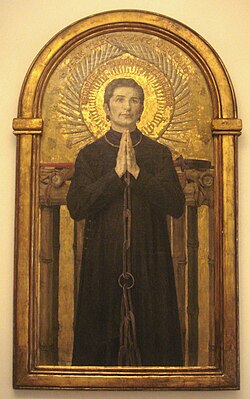 Théophane Vénard in chains, martyred in 1861


Causes being promoted
[edit]- Blessed Andrew of Phú Yên, catechist
- Servant of God François Xavier Truong Buu Diep, Vietnamese priest
- Servant of God Marcel Nguyễn Tân Văn CSsR, Religious brother
- Venerable Phanxicô Xaviê Nguyễn Văn Thuận, Cardinal
Legacy
[edit]There are several Catholic parishes in the United States, Canada, and elsewhere dedicated to the Martyrs of Vietnam (Holy Martyrs of Vietnam Parishes), one of the largest of which is located in Arlington, Texas, in the Dallas-Fort Worth area.[10] Others can be found in Houston and Austin, Texas,[11] Denver, Seattle, San Antonio,[12] Arlington, Virginia; Richmond, Virginia; and Norcross, Georgia.[13] There are also churches named after individual saints, such as St. Philippe Minh Church in Saint Boniface, Manitoba.[14]
See also
[edit]Notes
[edit]- ^ "Pilgrimage Mass and Proclamation of the Elevation of Sở Kiện as National Pilgrimage Shrine". ARCHDIOCESE OF HÀ NỘI. Archdiocese of Hà Nội. 7 June 2024. Retrieved 19 July 2025.
- ^ a b c d "LA CHIESA NEL VIET-NAM FECONDATA DAL SANGUE DEI MARTIRI". La Santa Sede (in Italian). Vatican See. Retrieved 24 December 2021.
- ^ D'Emilio, Frances (1988). "Pope Canonizes 117 Saints Martyred in Vietnam In Largest Such Ceremony". AP News. Retrieved 11 March 2023.
- ^ a b St. Andrew Dung-Lac and his 116 companions, Attwater dk, Farmer, Lodi, Butler, Den katolske kirke (Catholic Church in Norway)
- ^ Crossette, Barbara (1988). "SAINTHOOD FOR 117 OUTRAGES VIETNAM". The New York Times. Retrieved 11 March 2023.
- ^ Les Missions Etrangeres, p. 291
- ^ Attwater, Donald and Catherine Rachel John. The Penguin Dictionary of Saints. 3rd edition. New York: Penguin Books, 1993. ISBN 0-14-051312-4.
- ^ a b c d e f g h i j k l m Jacob Ramsay, "Extortion and Exploitation in the Nguyên Campaign against Catholicism in 1830s–1840s Vietnam". Journal of Southeast Asian Studies, Vol. 35, No. 2 (June 2004), pp. 311–328.
- ^ Pope Gregory XVI, Breve Quae Nuncia, in Italian, published on 4 August 1839, accessed on 22 August 2025
- ^ "Largest U.S. Catholic Vietnamese Church Dedication Set in Arlington" (PDF). Catholic Diocese of Fort Worth. Retrieved 30 May 2024.
- ^ Holy Vietnamese Martyrs Catholic Church, Yager Lane, Austin, TX
- ^ Vietnamese Martyrs Catholic Parish, Holbrook Rd, San Antonio, Texas
- ^ Nelson, Andrew (26 December 2019). "With church dedication, Holy Vietnamese Martyrs Church begins new chapter". The Georgia Bulletin. Retrieved 27 August 2025.
- ^ Archdiocese of Saint Boniface web-site, Parishes Chaplaincies and Stations, St. Philippe Minh Church, Winnipeg
References
[edit]- Les Missions Etrangères. Trois siecles et demi d'histoire et d'aventure en Asie, Editions Perrin, 2008, ISBN 978-2-262-02571-7
- St. Andrew Dung-Lac & Martyrs, by Father Robert F. McNamara, Saints Alive and All God's Children Copyright 1980–2010 Rev. Robert F. McNamara and St. Thomas the Apostle Church.
- Vietnamese Martyr Teaches Quiet Lessons, by Judy Ball, an AmericanCatholic.org Web site from the Franciscans and St. Anthony Messenger Press.
External links
[edit] Media related to Vietnamese Martyrs at Wikimedia Commons
- "Saints and Blesseds of Vietnam" at GCatholic


_colour_scheme_-_%C4%90%E1%BA%A1i_Nam_(%E5%A4%A7%E5%8D%97).svg)
Vietnamese Martyrs
View on GrokipediaHistorical Background
Origins of Catholicism in Vietnam
Catholicism first reached Vietnam in the 16th century through Portuguese Franciscan missionaries and Spanish Dominicans, who arrived via trade routes from Malacca and accompanied Vietnamese merchant ships.[6][7] These early efforts yielded limited results, with initial contacts focused on coastal areas like Cochinchina (southern Vietnam) and sporadic baptisms among traders and locals.[8] By the early 17th century, Jesuit missionaries established a more structured presence, arriving in 1615 to minister to Japanese Catholic refugees in Faifo (near modern Da Nang) and gradually extending outreach to Vietnamese communities.[9] A pivotal figure was French Jesuit Alexandre de Rhodes, who entered Cochinchina in 1624 and later worked in Tonkin (northern Vietnam) around 1627–1630.[10] De Rhodes collaborated with Vietnamese scholars to refine the Latin-based script known as quốc ngữ, building on Portuguese orthographic influences to transcribe Vietnamese tones and phonetics more accurately, which facilitated catechesis and literacy among converts.[11] His efforts, alongside fellow Jesuit Antoine Marquez, resulted in over 6,000 baptisms during 1627–1630, targeting both elites at royal courts and commoners through preaching and demonstrations of European knowledge in astronomy and medicine.[12] Conversions spread among diverse social strata, with estimates reaching approximately 100,000 Catholics by the late 17th century, driven by appeals to spiritual fulfillment and social mobility rather than coercion.[13] Local lords under the Trịnh and Nguyễn domains initially tolerated these activities, viewing missionaries as sources of technical expertise and trade alliances, though this leniency masked emerging concerns over foreign loyalties and doctrinal challenges to Confucian ancestor veneration.[14] This period of relative acceptance laid the groundwork for Catholicism's entrenchment before tensions escalated in subsequent eras.[6]Early Growth and Initial Resistance
Catholicism's introduction to Vietnam dates to 1533 with initial preaching efforts, but systematic evangelization commenced in the early 17th century following the arrival of Jesuit missionaries in Cochinchina in 1615 and Tonkin in 1626.[15] Alexandre de Rhodes, active from 1627, advanced the mission by baptizing thousands and devising the quốc ngữ Romanized script, which facilitated scriptural access and literacy among converts.[15] Native lay catechists supplemented missionary work, enabling grassroots propagation despite linguistic and cultural barriers. By the late 17th century, converts numbered around 100,000, comprising approximately 80,000 in Tonkin and 20,000 in Cochinchina, reflecting rapid adoption amid a population estimated at several million.[15][16] State resistance emerged from causal tensions between Christian exclusivity and Confucian imperatives, as adherents rejected rituals honoring ancestors and the emperor—practices integral to familial piety and political allegiance, thereby signaling potential subversion of hierarchical order.[15] In May 1630, Trịnh Tráng, lord of Tonkin, promulgated the inaugural edict prohibiting Christianity and mandating the expulsion of Jesuit missionaries, framing the faith as a foreign heterodoxy disruptive to social harmony.[15] Enforcement remained intermittent and localized under Trịnh rule, yielding small-scale repercussions such as missionary deportations, convert exiles to remote areas, and isolated executions for non-compliance, rather than widespread campaigns.[15] These precursors, though limited in scope—contrasting with later escalations—highlighted rulers' apprehensions over loyalty fractures, as Christian communities prioritized ecclesiastical authority over temporal mandates, with estimates suggesting dozens to hundreds affected in the 17th century before cumulative martyrdoms reached 30,000 by 1802.[15]Periods of Persecution
17th and 18th Centuries under Trịnh and Nguyễn Lords
During the division of Vietnam between the Trịnh lords in the north (Đàng Ngoài) and the Nguyễn lords in the south (Đàng Trong) from the early 17th century onward, Catholic communities faced intermittent edicts branding Christianity as a heterodox doctrine incompatible with Confucian hierarchy and ancestral rites. The Trịnh regime, wielding de facto power under the Lê emperors, promulgated bans starting in the 1640s, with renewed enforcement in the late 17th and early 18th centuries under lords like Trịnh Cương (r. 1709–1729), targeting missionaries and converts for undermining state orthodoxy; penalties included exile, property confiscation, and execution by strangulation or drowning for persistent adherents. In the south, the Nguyễn lords initially tolerated Catholic presence due to alliances with European traders and missionaries aiding territorial expansion, but by the mid-18th century, edicts under Nguyễn Phúc Khoát (r. 1738–1765) and successors restricted proselytism, viewing it as a potential vector for foreign interference. Over this period, at least a dozen such prohibitions were issued by the rival lords, reflecting causal fears that Catholic loyalty to Rome superseded fealty to temporal rulers.[17][18] Executions, though sporadic compared to later imperial campaigns, claimed hundreds of lives, often through public spectacles like beheadings in Hanoi or Quảng Trị to deter conversions; records from missionary accounts detail cases such as the 1663 martyrdom of indigenous catechist Nguyễn Đình Thi under Trịnh Tráng for refusing to apostatize. Enforcement varied by locale and political exigency—lax in frontier areas where Catholics provided agricultural or military labor—but intensified during succession crises, as lords sought to consolidate Confucian legitimacy against perceived "barbarian" influences. In Cochinchina, relative leniency persisted until the 1770s Trịnh-Nguyễn wars, when captured priests faced torture, yet no systematic purges occurred until the late 18th-century upheavals. These measures stemmed from realist concerns over divided allegiances, as Catholic networks spanned the demilitarized zone, potentially aiding espionage or rebellion.[15] Amid edicts like the 1798 decree under the usurping Tây Sơn ruler Cảnh Thịnh—prompted by suspicions of Catholic support for rival claimant Nguyễn Ánh, who had leveraged French Catholic aid—believers adopted evasion tactics, including clandestine Masses in rural hideouts and coded communications via lay leaders. Foreign missionaries, primarily French from the Paris Foreign Missions Society after Jesuit declines, operated covertly, smuggling catechisms and ordaining native clergy to perpetuate the faith underground; communities in Quảng Trị and Nghệ An endured by integrating Catholic practices with village customs, fostering resilience against isolation. This era's persecutions, while not totaling the scale of 19th-century tolls (estimated at tens of thousands overall from 1625–1886), honed adaptive structures that preserved an estimated 200,000–300,000 adherents by century's end, despite lordly prohibitions.[19][17]19th Century under the Nguyễn Emperors
The unified Nguyễn dynasty, established in 1802, initially tolerated Catholicism but shifted to systematic persecution under Emperor Minh Mạng (r. 1820–1841), who viewed the faith as a foreign threat undermining Confucian authority and loyalty to the state. On January 6, 1833, Minh Mạng issued an edict mandating that all Christians renounce their faith or face execution, labeling Christianity a "perverse European" doctrine corrupting Vietnamese society.[20] Further edicts in 1836 and 1838 intensified the campaign, prohibiting Catholic practice, destroying churches, and ordering the arrest of clergy, resulting in the execution of numerous missionaries and native converts between 1836 and 1841.[12] Under Emperor Thiệu Trị (r. 1841–1847), persecution eased temporarily after Minh Mạng's death but persisted, with officials labeling missionaries as spies and demanding on-the-spot executions of Christians, though enforcement was inconsistent. Thiệu Trị issued an edict in 1847 reinforcing anti-Christian measures before his death.[15] The most severe phase occurred under Emperor Tự Đức (r. 1847–1883), who enacted multiple edicts from 1849 to 1862, including one in 1868 categorizing the population to isolate and punish Catholics, leading to widespread arrests, forced apostasy, and executions.[21] State tactics included mass executions by beheading or strangulation, prolonged torture to extract recantations—such as repeated beatings, exposure, and dismemberment—and the razing of Catholic villages to terrorize communities.[5] These measures were enforced through 53 documented royal edicts across the dynasty, signed by emperors or officials, targeting both foreign missionaries and Vietnamese faithful.[22] Vatican records document over 130 priests and missionaries killed during Minh Mạng's peak repression alone, with broader estimates of total martyrs under the Nguyễn emperors contributing to 100,000–300,000 deaths across Vietnam's Christian persecutions, primarily in the 19th century.[23][2] French military intervention began in 1858 with the capture of Saigon, partly motivated by demands to protect missionaries, but the martyrdoms predated and stemmed independently from indigenous state policies rather than colonial pretexts.[24] Persecution waned after 1862 treaties granting religious freedoms, though sporadic violence continued until the late 1880s.[25]Profiles of the Martyrs
Composition and Demographics of the Canonized Group
The 117 Vietnamese Martyrs canonized by Pope John Paul II on June 19, 1988, comprise a group whose documented martyrdoms occurred between 1745 and 1862, primarily during intensified persecutions under the Nguyễn dynasty.[26] This selection represents only a fraction of the estimated 130,000 to 300,000 total Catholic martyrs in Vietnam's history, as the Vatican prioritized cases with verifiable historical records, excluding many anonymous victims whose deaths were attested but not individualized.[2] [4] By nationality and origin, the group consists of 96 native Vietnamese, underscoring the predominantly indigenous character of the early Catholic resistance to persecution, 11 Spanish Dominican missionaries, and 10 French priests from the Paris Foreign Missions Society.[27] [4] [28] The Vietnamese majority—over 80% of the canonized—reflects the faith's deep local roots, with converts and native clergy facing execution for refusing to renounce Christianity amid edicts targeting both foreign influences and domestic adherents.[27] In terms of roles and demographics, the martyrs include 8 bishops, 50 priests (both native and foreign), and 59 laypeople, encompassing a diverse cross-section of society: adult men and women, families, catechists, and even children as young as nine years old.[4] [2] Among the laity were parents, such as a mother of six, and ordinary faithful whose executions involved methods like beheading, strangulation, and burning, often after torture to extract apostasy.[2] This composition highlights the persecution's broad sweep across ecclesiastical hierarchy and civilian life, with native Vietnamese forming the core of both clerical and lay victims.[28]| Category | Number |
|---|---|
| Native Vietnamese | 96 |
| Spanish Dominicans | 11 |
| French Missionaries | 10 |
| Total | 117 |
| Role | Number |
|---|---|
| Bishops | 8 |
| Priests | 50 |
| Laypeople | 59 |
| Total | 117 |