Hubbry Logo
Martin de PorresMartin de PorresMain
Open search
Martin de Porres
Community hub
Martin de Porres
logo
8 pages, 0 posts
0 subscribers
Be the first to start a discussion here.
Contribute something
Martin de Porres
Martin de Porres
from Wikipedia

Martín de Porres Velázquez OP (9 December 1579 – 3 November 1639) was a Peruvian lay brother of the Dominican Order who was beatified in 1837 by Pope Gregory XVI and canonized in 1962 by Pope John XXIII. He is the patron saint of Black people, mixed-race people, barbers, innkeepers, public health workers, all those seeking racial harmony, and animals.

Key Information

He was noted for his work on behalf of the poor, establishing an orphanage and a children's hospital. He maintained an austere lifestyle, which included fasting and abstaining from meat. Among the many miracles attributed to him were those of levitation, bilocation, miraculous knowledge, instantaneous cures, and an ability to communicate with animals.

Lifestyle

[edit]

Martin was born in the city of Lima, Viceroyalty of Peru, Spanish Empire, on 9 December 1579. He was the illegitimate son of a Spanish nobleman, Don Juan de Porras y de la Peña, and Ana Velázquez, a freed slave of African and Native descent.[1][2] He had a sister named Juana de Porres, born two years later in 1581. After the birth of his sister, the father abandoned the family.[3][4] Ana Velázquez supported her children by taking in laundry.[5] Martin grew up in poverty and, when his mother could not support him, he was sent to a primary school for two years, and then placed with a barber surgeon as an apprentice.[2] He spent hours of the night in prayer, a practice that increased as he grew older.

Under Peruvian law, descendants of Africans and Native Americans were barred from becoming full members of religious orders. The only route open to Martin was to ask the Dominicans of Holy Rosary Priory in Lima to accept him as a "donado", a volunteer who performed menial tasks in the monastery in return for the privilege of wearing the habit and living with the religious community.[6] At the age of 15, he asked for admission to the Dominican Convent of the Rosary in Lima and was received first as a servant boy, and as his duties grew he was promoted to almoner.

Martin continued to practise his old trades of barbering and healing and was said to have performed many miraculous cures. He also took on kitchen work, laundry, and cleaning. After eight years at Holy Rosary, the prior Juan de Lorenzana decided to turn a blind eye to the law and permit Martin to take his vows as a member of the Third Order of Saint Dominic. Holy Rosary was home to 300 men, not all of whom accepted the decision of De Lorenzana: one of the novices called Martin a "mulatto dog", while one of the priests mocked him for being illegitimate and descended from slaves.[6]

When Martin was 24, he was allowed to profess religious vows as a Dominican lay brother in 1603. He is said to have several times refused this elevation in status, which may have come about due to his father's intervention, and he never became a priest.[1] It is said that when his convent was in debt, he implored them: "I am only a poor mulatto, sell me." Martin was deeply attached to the Blessed Sacrament, and he was praying in front of it one night when the step of the altar he was kneeling on caught fire. Throughout all the confusion and chaos that followed, he remained where he was, unaware of what was happening around him.[7]

A mid-20th-century stained-glass representation of Martin de Porres in St Pancras Church, Ipswich, with a broom, rosary, parrot and monkey

When Martin was 34, after he had been given the religious habit of a lay brother, he was assigned to the infirmary, where he was placed in charge and would remain in service until his death at the age of 59. He was known for his care of the sick.[2] His superiors saw in him the virtues necessary to exercise unfailing patience in this difficult role. It was not long before miracles were attributed to him. Martin also cared for the sick outside his convent, often bringing them healing with only a simple glass of water. He ministered without distinction to Spanish nobles and to slaves recently brought from Africa.[1] One day an aged beggar, covered with ulcers and almost naked, stretched out his hand, and Martin let the man use his own bed. When one of his brethren reproved him, Martin replied: "Compassion, my dear Brother, is preferable to cleanliness."

When an epidemic struck Lima, there were in this single Convent of the Rosary 60 friars who were sick, many of them novices in a distant and locked section of the convent, separated from the professed. Martin is said to have passed through the locked doors to care for them, a phenomenon which was reported in the residence more than once. The professed, too, saw him suddenly beside them without the doors having been opened. Martin continued to transport the sick to the convent until the provincial superior, alarmed by the contagion threatening the friars, forbade him to continue to do so. His sister, who lived in the country, offered her house to lodge those whom the residence of the religious could not hold. One day he found on the street a poor Indian, bleeding to death from a dagger wound, and took him to his own room until he could transport him to his sister's hospice. The prior, when he heard of this, reprimanded him for disobedience. He was extremely edified, however, by his reply: "Forgive my error, and please instruct me, for I did not know that the precept of obedience took precedence over that of charity."[8] The prior gave him liberty thereafter to follow his inspirations in the exercise of mercy.

Martin did not eat meat. He begged for alms to procure necessities the convent could not provide.[8] In normal times, he succeeded with his alms in feeding 160 poor persons every day, and distributed a remarkable sum of money every week to the indigent. Side by side with his daily work in the kitchen, laundry and infirmary, Martin's life is said to have reflected extraordinary gifts: ecstasies that lifted him into the air, light filling the room where he prayed, bilocation, miraculous knowledge, instantaneous cures and a remarkable rapport with animals.[4] He founded a residence for orphans and abandoned children in the city of Lima.[4]

Death and commemoration

[edit]
The Basilica and Convent of Santo Domingo, where de Porres is buried, in Lima, Peru
Devotional statue of Martin de Porres in Kildare, Ireland, depicting him with dark skin

Martin was a friend of both Saint Juan Macías, a fellow Dominican lay brother, and Saint Rose of Lima, another lay Dominican. By his death on 3 November 1639, he had won the affection and respect of many of his fellow Dominicans as well as a host of people outside the priory.[6] Word of his miracles had made him known as a saint throughout the region. As his body was displayed to allow the people of the city to pay their respects, each person snipped a tiny piece of his habit to keep as a relic.[5]

When the body of de Porres was exhumed after 25 years, it was reportedly found intact, and exuded a fine fragrance. Letters to Rome pleaded for his beatification; the decree affirming the heroism of his virtues was issued in 1763 by Pope Clement XIII. Pope Gregory XVI beatified Martin de Porres on 29 October 1837, and the cause for his canonization was opened on 8 June 1926.[9]

Pope John XXIII canonized him in Rome on 6 May 1962.[10][11] He is the patron saint of people of mixed race, and of innkeepers, barbers, public health workers and more, with a feast day on November 3, also commemorated in the Calendar of Saints of the Church of England.[12]

Iconography

[edit]
Forensic facial reconstruction of Martin de Porres

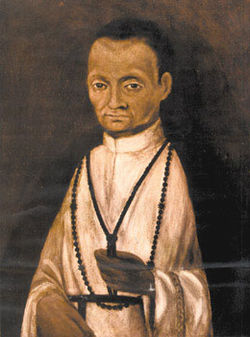
Martin de Porres is often depicted as a young mixed-race friar wearing the old habit of the Dominican lay brother, a black scapular and capuce, along with a broom, since he considered all work to be sacred, no matter how menial. He is sometimes shown with a dog, a cat and a mouse eating in peace from the same dish.

Legacy

[edit]

Martin's sometimes defiant attachment to the ideal of social justice achieved deep resonance in a church attempting to carry forward that ideal in today's modern world.[1]

Today, Martin is commemorated by, among other things, a school building that houses the medical, nursing, and rehabilitation science schools of the Dominican University of Santo Tomas in the Philippines. A programme of work is also named after him at the Las Casas Institute at Blackfriars Hall, University of Oxford.[13] He is the titular saint of the parish of St. Martin de Porres in Poughkeepsie, New York,[14] and some elementary schools. A number of Catholic churches are named after him. The Southern Province of Dominicans in the United States also bears his name.

[edit]

In 1965, American composer E. Anne Schwerdtfeger composed the Mass of St. Martin de Porres for chorus and organ.[15]

In the 1980 novel A Confederacy of Dunces, Ignatius Reilly contemplates praying to Martin for aid in bringing social justice to the black workers at the New Orleans factory where he works. In music, the first track of jazz pianist Mary Lou Williams's album Black Christ of the Andes is titled "St. Martin De Porres".[16]

There are several Spanish and Mexican works regarding his life in cinema and television, starring Cuban actor Rene Muñoz, most of them referring to his mixed race, his miracles and his life of humility. The best known movies are Fray Escoba (Friar Broom) (1963)[17] and Un mulato llamado Martin (A Mulatto Called Martin) (1975).[18]

In the Moone Boy episode "Godfellas", the character Martin Moon is shown to be named by his grandfather after San Martin de Porres. His grandfather is unable to actually remember any of San Martin's accomplishments, and simply refers to him as "one of the black ones" when asked about him.

American singer Madonna's hit single "Like a Prayer" (1989) featured Martin de Porres as a character in the song's music video. The portrayal of de Porres and Madonna in a romantic relationship was met with mixed criticism from the Catholic church in Peru and the Vatican.

The name is used as an alias by the titular character of the movie The Saint.

See also

[edit]

References

[edit]
[edit]
Revisions and contributorsEdit on WikipediaRead on Wikipedia
from Grokipedia
Martin de Porres Velázquez (December 9, 1579 – November 3, 1639) was a Peruvian of the Order of Preachers (Dominicans) who dedicated his life to charitable service among the impoverished, ill, and marginalized in colonial . Born illegitimately to a Spanish knight, de Porres, and a freed black slave from , Ana Velázquez, he faced early and racial that confined him to menial roles, yet he apprenticed as a barber-surgeon and later joined the Dominicans as a tertiary before admission as a in 1603. As the infirmarian at the , de Porres demonstrated exceptional skill in medical care, treating fellow friars, orphans, slaves, and street destitute without distinction, often funding his efforts through manual labor and personal austerity. He established a for the poor and abandoned children, promoted racial harmony by advocating for equal treatment of indigenous and African-descended individuals within the order, and extended to animals, reportedly commanding rats and other creatures to cease troubling the . These acts of and , coupled with accounts of miraculous interventions such as and healings, defined his legacy during his lifetime. Beatified in 1837 by and canonized on May 6, 1962, by , de Porres became the first of the recognized for African heritage, serving as patron of mixed-race people, barbers, and workers. His canonization highlighted the Church's affirmation of virtues transcending social barriers in the context, amid reports of widespread devotion evidenced by healings attributed post-mortem.

Early Life

Birth and Family Background

Martin de Porres, born Juan de Porres Velázquez, entered the world on December 9, 1579, in , the bustling capital of Spain's . He was the illegitimate offspring of Juan de Porres, a Spanish knight and nobleman originally from , and Ana Velázquez, a freed black slave of African ancestry hailing from . This union reflected the racial intermixing common in colonial ports but fraught with under Spanish imperial norms. Juan de Porres initially acknowledged paternity by arranging Martin's at the of , but soon abandoned the family—reportedly upon seeing the infant's dark complexion, which clashed with his own status-conscious lineage—leaving Ana to raise Martin and their daughter in destitution. Ana Velázquez sustained the household through menial labor, primarily by taking in laundry from wealthier residents, amid the harsh economic realities facing single mothers of color in the city. Lima in the late 16th century functioned as a stratified colonial hub, enforcing a system that categorized individuals by racial mixture and ancestry to preserve Spanish dominance, with mulattos—those of Spanish and African parentage like Martin—confined to lower tiers entailing restricted access to guilds, land ownership, and higher education. This hierarchy drew from Iberian concepts of , originally denoting freedom from Jewish or Muslim blood but adapted in the to underscore European purity against indigenous and African elements, thereby limiting opportunities for mixed-race persons and reinforcing servitude or roles.

Childhood in Colonial Lima

Born on December 9, 1579, in , , then part of the Spanish Viceroyalty, Martín de Porres Velázquez was the illegitimate son of Juan de Porres, a Spanish knight and from Alcalá de Guadaíra, and Ana Velázquez, a freed black slave originally from . The couple never married, and shortly after Martín's birth, Juan de Porres abandoned Ana and the infant, ceasing financial support and leaving them destitute in the stratified colonial society where racial mixing and illegitimacy compounded social exclusion for mulattos like Martín. Ana Velázquez relocated to a slum district of , supporting herself and her children through menial labor such as laundering, while Martín's sister Juana was born around 1581, further straining the family's meager resources amid the era's harsh economic disparities and discriminatory laws limiting opportunities for people of African descent. Colonial Lima's rigid caste system barred Martín from formal schooling beyond basic literacy, reflecting systemic racial barriers that confined mixed-race individuals to manual trades rather than intellectual pursuits. Around 1591, at approximately age twelve, Martín began an under barber-surgeon Marcel de Rivero, acquiring practical skills in , minor , herbal remedies, and barbering—trades essential in the pre-modern medical landscape where barbers often doubled as rudimentary physicians. During these formative years, proximity to Dominican convents in exposed him to the order's emphasis on piety and service, fostering early devotional habits such as nighttime prayer that aligned with the visible charitable activities of local friars amid the city's impoverished .

Religious Vocation

Apprenticeship and Entry into the Dominican Order

At the age of twelve, in 1591, Martin de Porres commenced his apprenticeship under the barber-surgeon Marcel de Rivero in , acquiring practical expertise in , minor , wound dressing, and the application of herbal remedies prevalent in colonial Peruvian medicine. This training, typical for barber-surgeons of the era who doubled as rudimentary physicians, equipped him with skills that later informed his charitable endeavors, though it initially positioned him in a secular trade amid the socioeconomic constraints faced by those of mixed Spanish and African descent. He completed this apprenticeship by approximately 1594, at age fifteen, demonstrating notable proficiency that allowed him to practice independently thereafter. Drawn to religious life, de Porres sought entry into the at the Convent of (also known as the Priory of the Holy Rosary) in around 1595, initially received as a donado—a lay volunteer or who provided manual service in exchange for room, board, and spiritual benefits, without formal vows. This status reflected the era's institutional racial hierarchies within the in viceregal , where statutes prohibited individuals of non-European ancestry from admission as full friars, relegating them to auxiliary roles to maintain perceived purity of blood () requirements enforced by Spanish colonial authorities and religious superiors. Despite these barriers, de Porres persisted in humble service, performing tasks such as cleaning and assisting in the infirmary, which gradually earned the community's regard for his and . By 1603, at age twenty-four, his exemplary conduct prompted the prior to admit him to religious profession as a coadjutor brother (lay brother), enabling him to don the Dominican habit and bind himself through simple vows of poverty, chastity, and obedience. This exceptional allowance, bypassing standard racial exclusions, underscored de Porres' personal sanctity amid a stratified order where coadjutor brothers undertook non-ordained, subservient duties like maintenance and care for the sick, roles he embraced with deliberate humility as an expression of evangelical poverty and fraternal charity. Such admission highlighted his resolve to integrate vocational medical knowledge with monastic discipline, though scholarly Dominican sources note ongoing debate over whether his status fully equated to professed brotherhood or remained that of a dedicated oblate, given sparse contemporary documentation.

Life as a Lay Brother

Upon his admission as a in 1603 at the in , Martin de Porres undertook a range of menial duties vital to the priory's operations. These tasks encompassed sweeping corridors, laundering religious habits, kitchen assistance, and tending to the medical needs of friars and lay affiliates through his skills as a barber-surgeon. Martin maintained an austere regimen marked by frequent fasting, often limited to bread and water, alongside complete abstinence from meat. He routinely observed all-night vigils dedicated to , immersing himself in extended that deepened his spiritual focus amid convent demands. Such practices reflected his deliberate pursuit of and detachment from worldly comforts. As a lay brother of mixed African-Spanish heritage in a racially stratified colonial society, Martin demonstrated absolute obedience to superiors, enduring prejudices that typically barred individuals of his background from full religious membership. He submitted to directives and corrections, including rebukes for overextending charitable aid from convent provisions, which superiors viewed as imprudent. This humility, paired with his evident virtues, facilitated his progression from oblate to professed brother after nine years.

Works and Practices

Charitable Service and Medical Care

Martin de Porres, having apprenticed as a barber-surgeon from age 12, served as the infirmarian in the Dominican monastery of in , where he applied practical medical skills including , wound dressing, and herbal remedies to treat the sick among the friars. He extended these services beyond the by admitting impoverished patients—primarily slaves, indigenous laborers, and mestizos—into the monastery's facilities for free care, especially amid recurrent epidemics such as those documented in during the 1600s, which disproportionately affected the . Eyewitness accounts from contemporaries, preserved in Dominican records, describe him personally attending to hundreds of such cases annually, prioritizing empirical treatments over available resources. To support broader welfare efforts, de Porres begged alms throughout , redirecting the collections to fund an for abandoned infants and children of slaves, as well as a rudimentary distributing daily meals to the destitute. He integrated basic medical oversight into these operations, nursing lepers and orphans with hygienic practices and simples derived from his training, often at personal expense by forgoing his own portions. These initiatives addressed the acute vulnerabilities in colonial Lima's stratified society, where racial hierarchies limited access to care for non-Spaniards. De Porres's reputation for competent treatment transcended social barriers; Spanish elites, including viceregal officials, sought his consultations at the or their homes, as attested in period testimonies, underscoring how skill-based efficacy enabled cross-racial service in a rigidly divided colonial context. This practical outreach, grounded in direct intervention rather than institutional , sustained welfare for Lima's marginalized without reliance on endowments.

Austerity and Devotional Disciplines

Martin de Porres adhered to a rigorous ascetic regimen throughout his life in the Dominican convent of El Rosario in , abstaining entirely from meat as a form of and embracing lifelong to discipline the body and unite with Christ's suffering. He restricted his to the bare minimum necessary, often subsisting on only a few hours per night to allocate more time for and manual labor within the . These practices, documented in contemporary eyewitness accounts from the process, reflected his commitment to as a means to cultivate and detachment from worldly comforts. Porres incorporated traditional forms of bodily mortification, including the wearing of a hair shirt beneath his habit and regular self-flagellation with a , which he performed in private to avoid drawing attention. Such disciplines, common among devout Catholics of the era but intensified in his case according to testimonies, served as personal sacrifices intended to atone for sins and foster spiritual purity amid the social hierarchies of colonial . His devotional life centered on prolonged periods of mental prayer, with a particular emphasis on adoration of the Eucharist, which he regarded as the source of his vocational strength and performed extended vigils before the Blessed Sacrament. Porres also exhibited profound devotion to the Virgin Mary, aligning with Dominican traditions of Marian piety, through daily recitations and invocations that informed his interior life of contemplation. In practicing , Porres modeled within his family, eventually restoring relations with his , Juan de Porres, who had initially rejected him due to his mixed-race heritage, and extended this ethic to community frictions in the by humbly submitting to superiors and peers despite racial prejudices. These efforts, rooted in of , underscored his view of mercy as an essential discipline for overcoming colonial-era divisions and attaining personal sanctity.

Miracles and Supernatural Claims

Documented Attributions During Lifetime

Contemporary Dominican friars and lay witnesses reported numerous supernatural phenomena attributed to Martin de Porres during his lifetime (1579–1639), with these accounts later formalized in inquiries following his death, including testimonies gathered between 1679 and 1685 that described a total of 105 . These reports, primarily from members of the in , emphasized events witnessed firsthand and subjected to scrutiny in processes, though they remain historical attestations rather than independently corroborated empirical events. Bilocation incidents were among the most frequently cited, with witnesses claiming Martin appeared simultaneously in distant locations to assist the afflicted, such as aiding the sick in and northern while remaining in . For instance, Francisco de Vega Montoya provided sworn testimony regarding Martin's bilocative visits to to minister to slaves, corroborated by multiple observers who recognized his distinctive features and . Similar accounts placed him in , , and the , where he reportedly comforted and the ill, as attested by local eyewitnesses unfamiliar with but identifying him through descriptions shared by returning travelers. Instantaneous healings of severe conditions were documented by fellow Dominicans, including cures of gangrenous wounds and high fevers deemed incurable by physicians of the era. One superior recounted Martin's intervention in a case of advanced , where the patient recovered fully after Martin's prayers and applications, defying prognosis. These healings often involved Martin's reputed discernment of hidden ailments, leading to targeted remedies like instructing a hemorrhaging woman to consume a simple , resulting in immediate recovery as verified by attending friars. Reports of Martin's rapport with animals included eyewitness observations by convent superiors of him summoning and pacifying rats that had infested the , directing them to feed from his hand without harm to stores or residents thereafter. Dominican chroniclers noted instances of food multiplication to sustain stray animals during famines, with friars attesting to the sufficiency of meager provisions under Martin's care, extending to dogs, cats, and birds that obeyed his commands as if rational. Levitation during ecstatic prayer was observed by multiple superiors and brethren, who described Martin rising several inches above the chapel floor while absorbed in devotion before the altar, his body remaining suspended for minutes without disturbance. These events, witnessed in the Convento del Rosario, were recorded as occurring repeatedly, with no signs of fraud or contrivance noted by the observers. At least two raisings from the dead were attributed to him in 17th-century Dominican testimonies: one involving a deceased companion revived after Martin's in the infirmary, and another a young child restored to life following fervent over the body, as reported by the child's mother and verifying clerics. These claims, submitted under , formed part of the early hagiographic record scrutinized by the Order.

Posthumous Miracles and Skeptical Perspectives

Claims of posthumous miracles attributed to Martin de Porres emerged shortly after his death on November 3, 1639, with reports of healings occurring at his tomb in Lima's Convento de , leading to a formal papal inquiry in 1660 to assess the phenomena. During the early stages of his process, witnesses testifying between 1679 and 1685 documented a total of 105 such miracles, primarily involving cures from illnesses like fevers, wounds, and , invoked through prayers and relics associated with de Porres. Later investigations for , initiated in 1926, scrutinized additional cases, including an 18th-century Peruvian healing of a severe reported in regional Dominican records, where recovery followed invocation of de Porres' amid ongoing popular devotion. A pivotal example examined for the 1962 was the 1956 case of a young Peruvian boy, , diagnosed with and given days to live; after family prayers to de Porres and application of a relic, the boy's count normalized inexplicably within days, allowing discharge from by September 7, 1956, with physicians attesting no natural explanation. The Vatican-required process for validating these involved Dominican-led inquiries, medical board reviews declaring events scientifically inexplicable, and exclusion of via witness and documentation of prior incurability. Skeptical analyses, drawing from Enlightenment and contemporary secular , attribute many such reports to cultural in colonial , where limited diagnostics often mistook transient illnesses for terminal ones, enabling spontaneous remissions or effects to be hailed as . Modern critics further posit psychological factors like in devotional communities, noting that pre-20th-century lacked tools to rule out undetected natural recoveries, thus rendering claims unverifiable beyond testimonial . These views emphasize causal realism, demanding controlled, replicable evidence over ecclesiastical moral certainty, which relies on historical attestations potentially amplified by hagiographic incentives. The Church's causa protocol addresses fraud concerns through phased scrutiny—initial diocesan probes, apostolic validation, and Vatican commissions requiring "moral certainty" of divine origin after ruling out artifice or science—but skeptics contend this threshold accommodates subjective interpretation, as medical "inexplicability" evolves with advancing knowledge and does not preclude unknown natural mechanisms. Historical precedents, such as the inquiry's inconclusive deferral amid evidentiary gaps, underscore ongoing tensions between faith-based attribution and empirical demands for in supernatural propositions.

Death and Canonization

Final Years and Passing

In his later years, Martin de Porres experienced increasing physical frailty, attributed by contemporaries to decades of rigorous austerities, including prolonged fasts, self-flagellation, and minimal sleep, which compounded the toll of his unceasing charitable labors among the sick and poor in Lima. Despite this decline, he persisted in his duties at the Convent of the Rosary until early 1639, when a persistent fever confined him to his cell for nearly a year, rendering him unable to perform his customary tasks of nursing and sweeping. He died on November 3, 1639, at the age of 59, after exhorting those around him to prioritize and charity in their service to and others, words recorded in accounts from fellow Dominicans emphasizing his lifelong virtues. His body was immediately dressed in the Dominican habit and buried in the convent's , with large crowds gathering for the , a testament to the widespread local regard he had earned among diverse social strata in colonial , notwithstanding his status as a of mixed African-Spanish descent.

Beatification Process and Papal Canonization

Following Martin de Porres's death on , 1639, his tomb in the Convento de Santo Domingo in became a site of immediate popular devotion, with numerous reported miracles attributed to his intercession prompting the to initiate formal proceedings for his in 1664. This early process involved compiling dossiers of eyewitness testimonies regarding his virtues and supernatural events, though it encountered scrutiny from the Holy Office of the , which oversaw sanctity investigations amid concerns over unregulated cults in colonial . Historical disruptions, including political instability and the (1821–1824), contributed to prolonged delays in advancing the cause through the Congregation of Rites. Efforts to revive and substantiate the beatification dossier gained momentum in the 18th and early 19th centuries, with Dominican chroniclers documenting heroic virtues such as extreme charity and , alongside empirical validations of at least two required through medical and testimonial inquiries. On October 29, 1837, declared Martin de Porres blessed, confirming his exercise of virtues to a heroic degree and the authenticity of the , which included inexplicable healings investigated under Vatican protocols emphasizing causal evidence over mere anecdote. The path to full sainthood required additional rigorous scrutiny, including two further miracles verified by the Sacred Congregation of Rites: one in 1948 involving a cure in and another in the mid-20th century. canonized him on May 6, 1962, in , proclaiming him the first saint of African descent born in the , a declaration grounded in centuries of accumulated evidence rather than contemporary ecclesiastical reforms, though it preceded the Second Vatican Council by mere months. This papal act underscored the Church's commitment to procedural empiricism in sanctity claims, prioritizing verifiable testimonies and outcomes amid historical biases against non-European figures.

Veneration and Historical Impact

Patronage and Feast Observance

Saint Martin de Porres is officially recognized by the as the of mixed-race people, , workers, and animals, associations derived from his roles as a who practiced barber surgery, tended to the ill regardless of status, and reportedly demonstrated miraculous rapport with creatures during his lifetime. These intercessory patronages, affirmed through ecclesiastical tradition and Vatican-approved hagiographic accounts, underscore invocations for healing, in service, and amid social distinctions, without endorsement of modern activist paradigms. In 1945, specifically declared him patron of in , linking his charitable works to equitable aid for the marginalized. The feast of Saint Martin de Porres falls on November 3, commemorating his death in 1639, and is observed as an optional memorial in the General Roman Calendar, permitting its celebration outside obligatory liturgical days. In Peru, his native country, the feast holds obligatory status within the national liturgical norms, often featuring nine-day novenas that emphasize his exemplary obedience, austerity, and devotion to the poor as models for intercession. Devotional practices invoke his aid for racial concord, grounded in his lived submission to hierarchical orders while extending mercy across ethnic lines, as documented in Dominican order records.

Legacy in Catholic Tradition and Colonial Context

Martin de Porres exemplifies lay sanctity within Catholic tradition, demonstrating that holiness is attainable for non-clerical individuals through rigorous service and obedience amid social hierarchies. His establishment of shelters, orphanages, and free medical facilities for the impoverished, including slaves and indigenous peoples, underscored the preferential option for the poor as articulated in Catholic social doctrine, prioritizing acts of mercy over institutional reform. This model has influenced Dominican missions, extending his ethos of charitable labor to evangelization efforts in the Americas and African contexts, where devotees adapted his practices to local needs without altering core virtues of humility and fidelity to Church authority. In the colonial Peruvian society of the late 16th and early 17th centuries, marked by Spanish viceregal oversight and caste-based discriminations against mulattos like Martin, his approach bridged racial and ethnic divides through evangelical charity rather than adversarial politics. Born to a Spanish knight and freed African slave in in 1579, he navigated prohibitions on mixed-race entry into religious orders by accepting the status of tertiary and later , earning respect via proven piety and labor in the Dominican priory of . This fidelity to hierarchical structures contrasts with contemporary interpretations that recast his story primarily as resistance to racial oppression, often overlooking how his advancement stemmed from voluntary and alignment with norms rather than demands for structural upheaval. Papal affirmations reinforce this legacy's emphasis on spiritual fraternity over secular equity. Canonized on May 6, 1962, by , Martin was hailed as the "saint of universal brotherhood," highlighting unity derived from shared in Christ amid diverse origins, a theme echoed in subsequent Church teachings on human development. His veneration thus promotes —cultivating personal holiness to transcend divisions—in opposition to reductionist views prioritizing identity-based grievances, as evidenced by his enduring invocation in Catholic responses to social fragmentation without endorsement of confrontational ideologies.

Iconography

Depictions in Art and Symbols

Saint Martin de Porres is conventionally depicted in religious art as a Dominican lay brother attired in the order's white habit and black scapular, emphasizing his role as a humble servant within the monastery. He is frequently portrayed holding a broom, a symbol of his voluntary engagement in menial tasks such as sweeping, which underscored his theological commitment to viewing all labor as sacred and redemptive. Accompanying animals, typically a , sharing a single dish, illustrate hagiographic narratives of his miraculous inducement of among creatures, symbolizing his extension of charity to all creation and foreshadowing interspecies harmony as a reflection of divine order. A often appears in his grasp, denoting his profound devotion to Christ's suffering and his ministry of healing the infirm through and remedies. These elements, rooted in 17th-century Peruvian , served to convey virtues of and universal benevolence amid colonial societal constraints. In Baroque-style artworks from , such as those preserved in Dominican convents dating to the early 1600s, his mixed racial features—dark skin from African ancestry combined with European traits—are accentuated, highlighting sanctity as attainable irrespective of birth status. Later variants in global retain core symbols like the and animals but incorporate local adaptations, such as varied animal representations or integrated rosaries for devotional emphasis, while preserving the intent to exalt his transcendence of social divisions through pious service.

Interpretations Across Cultures

![Black saint, Kildare.jpg][float-right] Depictions of Martin de Porres in European art maintain traditional Dominican iconography, such as a in a Roman church near the portraying him in his . Icons in Byzantine style emphasize spiritual themes of good versus evil, aligning with his historical role in the Order rather than localized racial motifs. In the United States, Catholic devotions often highlight Martin de Porres's mixed-race background and experiences of , framing him as a symbol of racial reconciliation. These interpretations, prominent during observances, integrate his image into discussions of and harmony. However, scholarly analyses critique such politicized readings in civil rights iconography for projecting modern racial activism onto his life, which centered on personal and service within the Dominican framework rather than organized advocacy. Dominican Order art consistently symbolizes obedience through elements like the , representing his willing service and fidelity to over any emphasis on racial identity. This fidelity persists across non-Peruvian contexts, prioritizing causal roots in his documented amid colonial hierarchies against appropriations that diverge into contemporary ideological narratives.

References

Add your contribution
Related Hubs
Contribute something
User Avatar
No comments yet.