


Community hub
Recent from talks
Contribute something
Nothing was collected or created yet.
Jan Hus
View on Wikipedia
![A gold-colored medal, struck in silver, about four and a half centimeters across, showing the image of Jan Hus tied to a band of stakes. Inscriptions in capital letters read: (around the circumference), CENTVM REVOLVTIS ANNIS DEO RESPONDEBITIS ETMIHI / ANNO A CHRIST[o] NATO 1415 IO[annes] HVS; (and across the center), CONDEM / NATVR](https://en.wikipedia.org/wiki/File:German_or_Austrian_16th_Century,_John_Huss_Centenary_Medal_(reverse),_1515,_NGA_45407.jpg)
Key Information

Jan Hus (/hʊs/; Czech: [ˈjan ˈɦus] ⓘ; c. 1369 – 6 July 1415), sometimes anglicized as John Goose or John Huss, and referred to in historical texts as Iohannes Hvs or Johannes Huss, was a Czech theologian and philosopher who became a Church reformer and the inspiration of Hussitism, a key predecessor to Protestantism, and a seminal figure in the Bohemian Reformation. Hus is considered to be the first Church reformer, even though some designate the theorist John Wycliffe.[a][2][3][4][5] His teachings had a strong influence, most immediately in the approval of a reformed Bohemian religious denomination and, over a century later, on Martin Luther.
After being ordained as a Catholic priest, Hus began to preach in Prague. He opposed many aspects of the Catholic Church in Bohemia, such as its views on ecclesiology, simony, the Eucharist, and other theological topics. Hus was a master, dean, and rector at the Charles University in Prague between 1409 and 1410.
Alexander V issued a Papal bull that excommunicated Hus; however, it was not enforced, and Hus continued to preach. Hus then spoke out against Alexander V's successor, Antipope John XXIII, for his selling of indulgences. Hus' excommunication was then enforced, and he spent the next two years living in exile.
When the Council of Constance assembled, Hus was asked to be there and present his views on the dissension within the Church. When he arrived, with a promise of safe-conduct,[6] he was arrested and put in prison. He was eventually taken in front of the council and asked to recant his views. He refused. On 6 July 1415, he was burned at the stake for "heresy" against the teachings of the Catholic Church.
After Hus was executed, the followers of his religious teachings (known as Hussites) refused to elect another Catholic monarch and defeated five consecutive papal crusades between 1420 and 1431 in what became known as the Hussite Wars. Both the Bohemian and the Moravian populations remained majority Hussite until the 1620s, when a Protestant defeat in the Battle of the White Mountain resulted in the Lands of the Bohemian Crown coming under Habsburg dominion for the next 300 years and being subject to immediate and forced conversion to Catholicism in an intense campaign.
Early life
[edit]The exact date of Hus's birth is disputed. Some claim he was born around 1369,[7] while others claim he was born between 1373 and 1375.[8] Though older sources state the latter,[9] more contemporary research states that 1372 is more likely.[10] The belief that he was born on 6 July, also his death day, has no factual basis.[8] Hus was born in Husinec, southern Bohemia (now the Czech Republic), to peasant parents.[11] It is well known that Hus took his name from the village where he lived (Husinec). The reason behind his taking his name from his village rather than from his father is up to speculation; some believe that it was because Hus did not know of his father, while others say it was simply a custom at that time.[12] The name "Hus," however, means "goose" in Bohemian (now called Czech), and he was a century later referenced as a "Bohemian goose" in a dream given to Frederick, the Elector of Saxony. Nearly all other information known about Hus's very early life is unsubstantiated.[13] Similarly, we know little of Hus's family. His father's name was Michael; his mother's name is unknown. It is known that Hus had a brother due to his expressing concerns for his nephew while awaiting execution at Constance. Whether or not Hus had any other family is unknown.[14]
At the age of roughly 10, Hus was sent away to a monastery. The exact reason is not known; some claim that his father had died,[15] others say he went there due to his devotion to God.[16] He impressed the teachers with his studies, and they recommended him to move to Prague, one of the largest cities in Bohemia at that time. Hus apparently supported himself by securing employment in Prague, which allowed him to fulfill his necessities and access to the Prague Library.[17]
Three years later, he was admitted to the University of Prague.[18] Though not an exceptional student, he pursued his studies with ferocity.[19] In 1393, Hus earned a Bachelor of Arts degree at the University of Prague, and he earned his master's degree in 1396.[20] The strongly anti-papal views that were held by many of the professors there likely influenced Hus's future works.[21] During his studies, he served as a choir boy, to supplement his earnings.[22]
Career
[edit]Hus began teaching at the University of Prague in 1398, and in 1399, he first publicly defended propositions of Wycliffe.[7] He was ordained as a Catholic priest in 1400.[23] In 1401, his students and faculty promoted him to dean of the philosophical department, and a year later, he became a rector of the University of Prague.[24] He was appointed a preacher at the Bethlehem Chapel in 1402.[25] Hus was a strong advocate for the Czechs and the Realists, and he was influenced by the writings of John Wycliffe.[26] Although Church authorities banned many of Wycliffe's works in 1403, Hus translated Trialogus into Czech and helped to distribute it.[27]

Hus denounced the moral failings of clergy, bishops, and even the papacy from his pulpit.[28][29] Archbishop Zbyněk Zajíc tolerated this, and even appointed Hus a preacher at the clergy's biennial synod. On 24 June 1405, Pope Innocent VII directed the Archbishop to counter Wycliffe's teachings, especially the idea of impanation in the Eucharist.[27] The archbishop complied by issuing a synod decree against Wycliffe, as well as forbidding any further attacks on the clergy.[27]
In 1406, two Bohemian students brought to Prague a document bearing the seal of the University of Oxford and praising Wycliffe. Hus proudly read the document from his pulpit.[27] Then, in 1408, Pope Gregory XII warned Archbishop Zajic that the Church in Rome had been informed of Wycliffe's heresies and of the sympathies of King Wenceslaus IV of Bohemia for nonconformists.[30] In response, the king and university ordered all of Wycliffe's writings surrendered to the archdiocesan chancery for correction. Hus obeyed, declaring that he condemned the errors in those writings.[31]
Papal Schism
[edit]In 1408, the Charles University in Prague was divided by the Western Schism, in which Gregory XII in Rome and Benedict XIII in Avignon both claimed the papacy. Wenceslaus felt Gregory XII might interfere with his plans to be crowned Holy Roman Emperor. He denounced Gregory, ordered the clergy in Bohemia to observe a strict neutrality in the schism, and said that he expected the same of the university. Archbishop Zajíc remained faithful to Gregory. At the University, only the scholars of the Bohemian "nation" (one of the four governing sections), with Hus as their leader, vowed neutrality.[32]
Kutná Hora Decree
[edit]In January 1409, Wenceslaus summoned representatives of the four nations comprising the university to the Czech city of Kutná Hora to demand statements of allegiance. The Czech nation agreed, but the other three nations declined. The king then decreed that the Czech nation would have three votes in university affairs, while the "German nation" (composed of the former Bavarian, Saxon, and Polish nations) would have one vote in total. Due to the change in voting structure by May 1409, the German dean and rector were deposed and replaced by Czechs. The Palatine Elector called the Germans to his own University of Heidelberg, while the Margrave of Meissen started a new university in Leipzig. It is estimated that over one thousand students and masters left Prague. The emigrants also spread accusations of Bohemian heresy.[33]
Antipope Alexander V
[edit] | This section needs additional citations for verification. (July 2020) |
In 1409, the Council of Pisa tried to end the schism by electing Alexander V as Pope, but Gregory and Benedict did not submit (Alexander was declared an "antipope" by the Council of Constance in 1418). Hus, his followers, and Wenceslaus IV transferred their allegiance to Alexander V. Under pressure from King Wenceslaus IV, Archbishop Zajíc did the same. Zajíc then lodged an accusation of "ecclesiastical disturbances" against Wycliffites in Prague with Alexander V.
On 20 December 1409, Alexander V issued a papal bull that empowered the Archbishop to proceed against Wycliffism in Prague. All copies of Wycliffe's writings were to be surrendered and his views repudiated, and free preaching discontinued. After the publication of the bull in 1410, Hus appealed to Alexander V, but in vain. The Wycliffe books and valuable manuscripts were burned, and Hus and his adherents were excommunicated by Alexander V.
Crusade against Naples
[edit]Alexander V died in 1410 and was succeeded by John XXIII (also later declared an antipope). In 1411, John XXIII proclaimed a crusade against King Ladislaus of Naples, the protector of rival Pope Gregory XII. This crusade was preached in Prague as well. John XXIII also authorized indulgences to raise money for the war. Priests urged the people on, and they crowded into churches to give their offerings. This traffic in indulgences was a sign of the corruption of the Church needing remediation.[34]
Condemnation of indulgences and Crusade
[edit]Archbishop Zajíc died in 1411, and with his death, the religious movement in Bohemia entered a new phase during which the disputes concerning indulgences assumed great importance. Hus spoke out against indulgences, but he could not carry with him the men of the university. In 1412, a dispute took place, on which occasion Hus delivered his address Quaestio magistri Johannis Hus de indulgentiis. It was taken literally from the last chapter of Wycliffe's book, De ecclesia, and his treatise, De absolutione a pena et culpa. Hus asserted that no pope or bishop had the right to take up the sword in the name of the Church; he should pray for his enemies and bless those who curse him; man obtains forgiveness of sins by true repentance, not money.[35] The doctors of the theological faculty replied, but without success. A few days afterward, some of Hus' followers, led by Vok Voksa z Valdštejna, burned the Papal bulls. Hus, they said, should be obeyed rather than the Church, which they considered a fraudulent mob of adulterers and Simonists.[36]
In response, three men from the lower classes who openly called the indulgences a fraud were beheaded. They were later considered the first martyrs of the Hussite Church. In the meantime, the faculty had condemned the forty-five articles of Wycliffe and added several other theses, deemed heretical, which had originated with Hus. The king forbade the teaching of these articles, but neither Hus nor the university complied with the ruling. They requested that the articles should first be proven to be unscriptural. The tumults at Prague had stirred up a sensation. Papal legates and Archbishop Albik tried to persuade Hus to give up his opposition to the papal bulls, and the king made an unsuccessful attempt to reconcile the two parties.[37]
Attempts at reconciliation
[edit]King Wenceslaus IV made efforts to harmonize the opposing parties. In 1412, he convoked the heads of his kingdom for a consultation and, at their suggestion, ordered a synod to be held at Český Brod on 2 February 1412. The synod was instead held in the palace of the archbishops at Prague to exclude Hus from participation. Propositions were made to restore peace in the Church. Hus declared that Bohemia should have the same freedom regarding ecclesiastical affairs as other countries and that approbation and condemnation should therefore be announced only with the permission of the state power. This was the view of Wycliffe (Sermones, iii. 519, etc.).
There followed treatises from both parties, but no harmony was obtained. "Even if I should stand before the stake which has been prepared for me," Hus wrote at the time, "I would never accept the recommendation of the theological faculty." The synod did not produce any results, but the king ordered a commission to continue the work of reconciliation. The doctors of the university demanded that Hus and his followers approve the university's conception of the Church. According to this conception, the pope is the head of the Church and the Cardinals are the body of the Church. Hus protested vigorously. The Hussite party seems to have made a great effort toward reconciliation. To the article that the Roman Church must be obeyed, they added only "so far as every pious Christian is bound".[38] Stanislav ze Znojma and Štěpán Páleč protested against this addition and left the convention; they were exiled by the king, with two others.[citation needed]
Hus leaves Prague and appeals to Jesus Christ
[edit]By this time, Hus's ideas had become widely accepted in Bohemia, and there was broad resentment against the Church hierarchy. The attack on Hus by the pope and archbishop caused riots in parts of Bohemia. King Wenceslaus IV and his government took the side of Hus, and the power of his adherents increased from day to day. Hus continued to preach in the Bethlehem Chapel. The churches of the city were put under the ban, and an interdict was pronounced against Prague. To protect the city, Hus left and went into the countryside, where he continued to preach and write.[39]
Before Hus left Prague, he decided to take a step that gave a new dimension to his endeavors. He wanted to become a preacher and then taught at the university he studied at before. He no longer put his trust in an indecisive king, a hostile pope, or an ineffective council. On 18 October 1412, he appealed to Jesus Christ as the supreme judge.[40] By appealing directly to the highest Christian authority, Christ himself, he bypassed the laws and structures of the medieval Church. For the Bohemian Reformation, this step was as significant as the Ninety-five Theses posted in Wittenberg by Martin Luther in 1517.
After Hus left Prague for the country, he realized what a gulf there was between university education and theological speculation and the life of uneducated country priests and the laymen entrusted to their care.[41] Therefore, he started to write many texts in Czech, such as the basics of the Christian faith or preachings, intended mainly for the priests whose knowledge of Latin was poor.[42]
Writings of Hus and Wycliffe
[edit]Of the writings occasioned by these controversies, those of Hus on the Church, entitled De Ecclesia, were written in 1413 and have been most frequently quoted and admired or criticized, yet their first ten chapters are an epitome of Wycliffe's work of the same title and the following chapters are an abstract of another of Wycliffe's works (De potentate papae) on the power of the pope.[43] Wycliffe had written his book to oppose the common position that the Church consisted primarily of the clergy, and Hus now found himself making the same point. He wrote his work at the castle of one of his protectors in Kozí Hrádek and sent it to Prague, where it was publicly read in the Bethlehem Chapel. It was answered by Stanislav ze Znojma and Štěpán z Pálče (also Štěpán Páleč) with treatises of the same title.[citation needed]
After the most vehement opponents of Hus had left Prague, his adherents occupied the whole ground. Hus wrote his treatises and preached in the neighborhood of Kozí Hrádek. Bohemian Wycliffism was carried into Poland, Hungary, Croatia, and Austria. But in January 1413, a general council in Rome condemned the writings of Wycliffe and ordered them to be burned.[citation needed]
Hus was also a musical composer. Many of his writings were adapted into musical pieces by other composers.[44]
Council of Constance
[edit]King Wenceslaus's brother Sigismund of Hungary, who was "King of the Romans" (that is, head of the Holy Roman Empire though not then Emperor) and heir to the Bohemian crown, was anxious to put an end to religious dissension within the Church. To put an end to the papal schism and to take up the long-desired reform of the Church, he arranged for a general council to convene on 1 November 1414, at Konstanz (Constance).[45] The Council of Constance (1414–1418) became the 16th ecumenical council recognized by the Catholic Church. Hus, willing to make an end to all dissensions, agreed to go to Constance, under Sigismund's promise of safe-conduct.[6]
Imprisonment and preparations for trial
[edit].jpg)
It is not known whether Hus knew what his fate would be; however, he made his will before setting out. He started on his journey on 11 October 1414, arriving in Constance on 3 November 1414. The following day, the bulletins on the church doors announced that Michal z Německého Brodu (Michal de Causis) would be opposing Hus. In the beginning, Hus was at liberty under his safe-conduct from Sigismund and lived at the house of a widow. But he continued celebrating Mass and preaching to the people, in violation of restrictions decreed by the Church. After a few weeks, on 28 November 1414, his opponents succeeded in imprisoning him on the strength of a rumor that he intended to flee. He was first brought into the residence of a canon and then on 6 December 1414 into the prison of the Dominican monastery. Sigismund, as the guarantor of Hus's safety, was greatly angered and threatened the prelates with dismissal. The prelates convinced him that he could not be bound by promises to a heretic.[46]
On 4 December 1414, John XXIII entrusted a committee of three bishops with a preliminary investigation against Hus. As was common practice, witnesses for the prosecution were heard, but Hus was not allowed an advocate for his defense. His situation became worse after the downfall of John XXIII, who had left Constance to avoid abdicating. Hus had been the captive of John XXIII and in constant communication with his friends, but now he was delivered to the bishop of Constance and brought to his castle, Gottlieben on the Rhine. Here he remained for 73 days, separated from his friends, chained day and night, poorly fed, and ill.
Trial
[edit]On 5 June 1415, he was tried for the first time and was transferred to a Franciscan monastery, where he spent the last weeks of his life. Extracts from his works were read, and witnesses were heard. He refused all formulae of submission but declared himself willing to recant if his errors should be proven to him from the Bible. Hus conceded his veneration of Wycliffe and said that he could only wish his soul might some time attain unto that place where Wycliffe's was. On the other hand, he denied having defended Wycliffe's view of The Lord's Supper or the forty-five articles; he had only opposed their summary condemnation. King Sigismund admonished him to deliver himself up to the mercy of the council, as he did not desire to protect a heretic.[47]
At the last trial, on 8 June 1415, thirty-nine sentences were read to him. Of these, twenty-six had been excerpted from his book on the Church (De ecclesia), seven from his treatise against Páleč (Contra Palecz), and six from that against Stanislav ze Znojma (Contra Stanislaum). The danger of some of these views to worldly power was explained to Sigismund to incite him against Hus. Hus again declared himself willing to submit if he could be convinced of errors. This declaration was considered an unconditional surrender, and he was asked to confess: 1. That he had erred in the theses which he had hitherto maintained; 2. That he renounced them for the future; 3. That he recanted them; and 4. That he declared the opposite of these sentences.
He asked to be exempted from recanting teachings that he had never taught. Other views, which the assembly considered erroneous, he was not willing to revoke, and to act differently would be against his conscience. These words found no favorable reception. After the trial on 8 June, several other attempts were purportedly made to induce him to recant, which he resisted.[48]
Condemnation
[edit]
| This section needs additional citations for verification. (July 2020) |
The condemnation of Jan Hus took place on 6 July 1415 in the presence of the assembly of the council in the cathedral. After the High Mass and Liturgy, Hus was led into the church. The Bishop of Lodi (then Giacomo Balardi Arrigoni) delivered an oration on the duty of eradicating heresy; various theses of Hus and Wycliffe and a report of his trial were then read.
An Italian prelate pronounced the sentence of condemnation upon Hus and his writings. Hus protested, saying that even at this hour he did not wish anything but to be convinced from Scripture.[citation needed] He fell upon his knees and asked God with a soft voice to forgive all his enemies.[citation needed] Then followed his degradation from the priesthood. He was dressed in priestly vestments and again asked to recant, and again he refused. With curses, Hus's ornaments were taken from him, his priestly tonsure was destroyed. The judgment of the Church was pronounced:
This holy synod of Constance, seeing that God’s church has nothing more that it can do, relinquishes John Hus to the judgment of the secular authority and decrees that he is to be relinquished to the secular court.
— Council of Constance, Session 15 – 6 July 1415[49]
A tall paper hat was allegedly put upon his head with the inscription "Haeresiarcha" (i.e., the leader of a heretical movement).[50] Hus was led away to the stake under a strong guard of armed men.[51]
Before his execution, Hus is said to have declared, "You may kill a weak goose [Hus is Czech for "goose"], but more powerful birds, eagles and falcons, will come after me."[citation needed] Luther modified the statement and reported that Hus had said that they might have roasted a goose, but that in a hundred years a swan would sing to whom they be forced to listen. In 1546, in his funeral sermon for Luther, Johannes Bugenhagen gave a further twist to Hus's declaration: "You may burn a goose, but in a hundred years will come a swan you will not be able to burn." Twenty years later, in 1566, Johannes Mathesius, Luther's first biographer, found Hus's prophecy to be evidence of Luther's divine inspiration.[52]
Execution
[edit]


At the place of execution, he knelt, spread out his hands, and prayed aloud. The executioner undressed Hus and tied his hands behind his back with ropes. His neck was bound with a chain to a stake around which wood and straw had been piled up so that it covered him to the neck. At the last moment, the imperial marshal, von Pappenheim, in the presence of the Count Palatine, asked Hus to recant and thus save his own life. Hus declined, stating:
God is my witness that the things charged against me I never preached. In the same truth of the Gospel which I have written, taught, and preached, drawing upon the sayings and positions of the holy doctors, I am ready to die today.[36]
Anecdotally, it has been said that the executioners had trouble intensifying the fire. An old woman then came to the stake and threw a relatively small amount of brushwood on it. Upon seeing her act, a suffering Hus then exclaimed, "O Sancta Simplicitas!" ("O holy simplicity!"). It is said that when he was about to expire, he cried out, "Christ, son of the Living God, have mercy on us!" (a variant of the Jesus Prayer). Hus's ashes were later thrown into the Rhine river as a means of preventing the veneration of his remains.
Aftermath
[edit]Bohemian Protest
[edit]As news of Hus's death spread, outrage was brewing among the local nobles and doctors.[53] On 2 September 1415, a document now called the Bohemian Protest was signed with corresponding attached wax seals by 100 notable people from Bohemia and Moravia in protest of Jan Hus's burning. There is evidence that four documents of this kind were made in total, however only this one is known to survive and is currently held at the University of Edinburgh.[54] The statement inside reads that "Master John Hus was a good, just and catholic man" that "consistently detested all error and heresies" and that anyone that believed that heresy was arising within Bohemia or Moravia to be "the worst of traitors".[53]
Hussite Wars
[edit]

Responding with horror to the execution of Hus, the people of Bohemia moved even more rapidly away from Papal teachings. Rome then pronounced a crusade against them (1 March 1420): Pope Martin V issued a Papal bull authorizing the execution of all supporters of Hus and Wycliffe. King Wenceslaus IV died in August 1419, and his brother, Sigismund of Hungary, was unable to establish a real government in Bohemia due to the Hussite revolt.[55]
The Hussite community included most of the Czech population of the Kingdom of Bohemia. Under the leadership of Jan Žižka (c. 1360–1424) and later of Prokop the Great (c. 1380–1434)—both excellent commanders—the Hussites defeated the crusade and the other three crusades that followed (1419–1434). Fighting ended after a compromise between the Utraquist Hussites and the Catholic Council of Basel in 1436. It resulted in the Basel Compacts, in which the Catholic Church officially allowed Bohemia to practice its own version of Christianity (Hussitism). A century later, as much as ninety percent of the inhabitants of the Czech Crown lands still followed Hussite teachings.
Hus's scholarship and teachings
[edit] | This section needs additional citations for verification. (July 2020) |

Hus left reformatory writings. He translated Wycliffe's Trialogus and was very familiar with his works on the body of Jesus, the Church, and the power of the pope, as well as and especially with his sermons. There are reasons to suppose that Wycliffe's view of the Lord's Supper (consubstantiation rather than transubstantiation[56]) had spread to Prague as early as 1399, with strong evidence that students returning from England had brought the work back with them. It gained an even wider circulation after it had been prohibited in 1403, and Hus preached and taught it. The view was seized eagerly by the Taborites, who made it the central point of their system. According to their book, the Church is not the clerical hierarchy that was generally accepted as 'the Church'; the Church is the entire body of those who from eternity have been predestined for salvation. Christ, not the pope, is its head. It is no article of faith that one must obey the pope to be saved. Neither internal membership in the Church nor churchly offices and dignities is a surety that the persons in question are members of the true Church.
Hus's efforts were designed to rid the Church of its ethical abuses. The seeds of the Reformation are clear in Hus's and Wycliffe's writings. In explaining the plight of the average Christian in Bohemia, Hus wrote, "One pays for confession, for Mass, for the sacrament, for indulgences, for churching a woman, for a blessing, for burials, for funeral services and prayers. The very last penny that an old woman has hidden in her bundle for fear of thieves or robbery will not be saved. The villainous priest will grab it."[57] After Hus's death, his followers, known as Hussites, split off into several groups including the Utraquists, Taborites and Orphans.
Apology of the Catholic Church
[edit]Nearly six centuries later in 1999, Pope John Paul II expressed "deep regret for the cruel death inflicted" on Hus and added "deep sorrow" for Hus's death and praised his "moral courage".[58] Cardinal Miloslav Vlk of the Czech Republic was instrumental in crafting John Paul II's statement.[58] Members of the Moravian Church believe that it remains for God to judge those who were involved in the death of Hus.
Hus and the Czech language
[edit]The works of Jan Hus incorporate reforms to medieval Czech orthography, including the "hook" (háček) diacritic which was used to form the graphemes ⟨č⟩, ⟨ě⟩, ⟨š⟩, ⟨ř⟩ and ⟨ž⟩, which replaced digraphs like ⟨cz⟩, ⟨ie⟩, ⟨sch⟩, ⟨rz⟩ and ⟨zs⟩; the "dot" above letters for strong accent,[clarification needed] as well as the acute accent to mark long vowels ⟨á⟩, ⟨é⟩, ⟨í⟩, ⟨ó⟩, and ⟨ú⟩, in order to represent each phoneme by a single symbol.[59] Some sources mention documented use of the special symbols in Bible translations (1462), the Schaffhausen Bible, and handwritten notes in the Bible. The symbol ⟨ů⟩ (instead of ⟨uo⟩) came later. The book Orthographia Bohemica (1406) was attributed to Hus by František Palacký, but it is possible that it was compiled by another author from Charles University.
Legacy
[edit]
A century after the Hussite Wars began, as many as 90% of inhabitants of the Czech lands were Hussites (although in the Utraquist tradition following a joint Utraquist—Catholic victory in the Hussite Wars).[60] Bohemia was the site of one of the most significant pre-reformation movements,[61] and there are still Protestant adherents remaining in modern times,[62][63] though they no longer comprise the majority: suggested historical reasons include the persecution of Protestants by the Catholic Habsburgs,[64] particularly after the Battle of White Mountain in 1620; restrictions during the Communist rule; and also the ongoing secularization.[61] Modern Czechs exhibit very high distrust of religious and other institutions.[65]: 27
Jan Hus was a key contributor to Protestantism, whose teachings had a strong influence on the states of Europe and on Martin Luther.[66] The Hussite Wars resulted in the Basel Compacts, which allowed for a reformed Church in the Kingdom of Bohemia—almost a century before such developments would take place in the Lutheran Reformation. The Unitas Fratrum (or Moravian Church) is the modern-day home of Hus's followers.[67] Hus's extensive writings earned him a prominent place in Czech literary history.
In 1883, the Czech composer Antonín Dvořák composed his Hussite Overture based on melodies used by Hussite soldiers. It was often performed by the German conductor Hans von Bülow.
Professor Tomáš Garrigue Masaryk used Hus's name in his speech at Geneva University on 6 July 1915, for defense against Austria and in July 1917 for the title of the first corps of troops of his legions in Russia.[68]
Today, the Jan Hus Memorial is located at the Prague Old Town Square (Czech: Staroměstské náměstí), and there are many smaller memorials in other towns throughout the Czech Republic.
In New York City, a church in Brooklyn (located at 153 Ocean Avenue) and a church and a theatre in Manhattan (located at 351 East 74th Street) are named for Hus, the John Hus Moravian Church and the Jan Hus Playhouse, respectively. Although Manhattan's church and theatre share a single building and management, the playhouse's productions are usually nonreligious or nondenominational.
A statue of Jan Hus was erected at the Union Cemetery in Bohemia, New York (on Long Island) by Czech immigrants to the New York area in 1893.
In contrast to the popular perception that Hus was a proto-Protestant, some Eastern Orthodox Christians have argued that his theology was far closer to Eastern Orthodox Christianity. Jan Hus is considered a martyr saint in some jurisdictions of the Orthodox Church.[69] The Czechoslovak Hussite Church claims to trace its origin to Hus, to be "neo-Hussite", and contains mixed Eastern Orthodox and Protestant elements. Nowadays, he is considered a saint by the Orthodox churches of Greece, Cyprus, Czechoslovakia, and several others.[70]
Hus was voted the greatest hero of the Czech nation in a 2015 survey by Czech Radio.[71]
In popular culture
[edit]Hus appears in the Mezi proudy trilogy by writer Alois Jirásek.
Jan Hus is a major character of the "Hussite Revolutionary Trilogy" directed by Otakar Vávra. He is played by Zdeněk Štěpánek in the 1954 film Jan Hus.
Jan Hus is played by Rod Colbin in the 1977 American film John Hus.
Jan Hus is a major character in the stage play České nebe.
The Czech television film Jan Hus was released in 2015. It starred Matěj Hádek.
Jan Hus is frequently mentioned in the 2018 video game Kingdom Come: Deliverance and its sequel, Kingdom Come: Deliverance II, both of which take place in the lead up to the Hussite Wars.
Hus appears in the 2022 film Medieval played by Viktor Krištof.
The lives of Hus and Petr Chelčický are the subject of the 2014 Hus a Chelčický book for older children, written and illustrated by Renáta Fučíková. The book won the Association of Czech Graphic Artists' HOLLAR award for its illustrations.[72]
Holidays commemorating Hus
[edit]- Moravian Church – 6 July. Members of the Unitas Fratrum and Czech Brethren claim Hus as a spiritual forerunner.
 – Jan Hus Day (Den upálení mistra Jana Husa, literally: The day of burning of Master Jan Hus) on 6 July, the anniversary of Hus martyrdom. It is a public holiday in the Czech Republic.
 He is also commemorated as a martyr on the Calendar of Saints of the Evangelical Lutheran Church in America.[73]


Famous followers of Jan Hus
[edit]- Jerome of Prague, Hus's friend and devoted follower, shared his fate and on 30 May 1416 was also burned at Konstanz
- Jan Kardinál z Rejnštejna (1375–1428) (German: Johannes Cardinalis von Bergreichenstein)[74]
- Jan Žižka z Trocnova a Kalicha (c. 1360–1424), Czech general and Hussite leader
- Matěj z Knína (died 26 March 1410) (in German: Matthäus von Knin)
- Mikuláš of Pelhřimov (1385 Pelhřimov – 1460 Poděbrady) (in Latin: Nicolaus Pilgramensis, in German: Nikolaus von Pelgrims)
- John Amos Comenius (1592–1670) (Czech: Jan Amos Komenský) – pastor, teacher, philosopher, educator, and writer. The last bishop of Unitas Fratrum before its renewal (as the Moravian Church). Early champion of universal education, and education in one's mother language.
Gallery
[edit]-
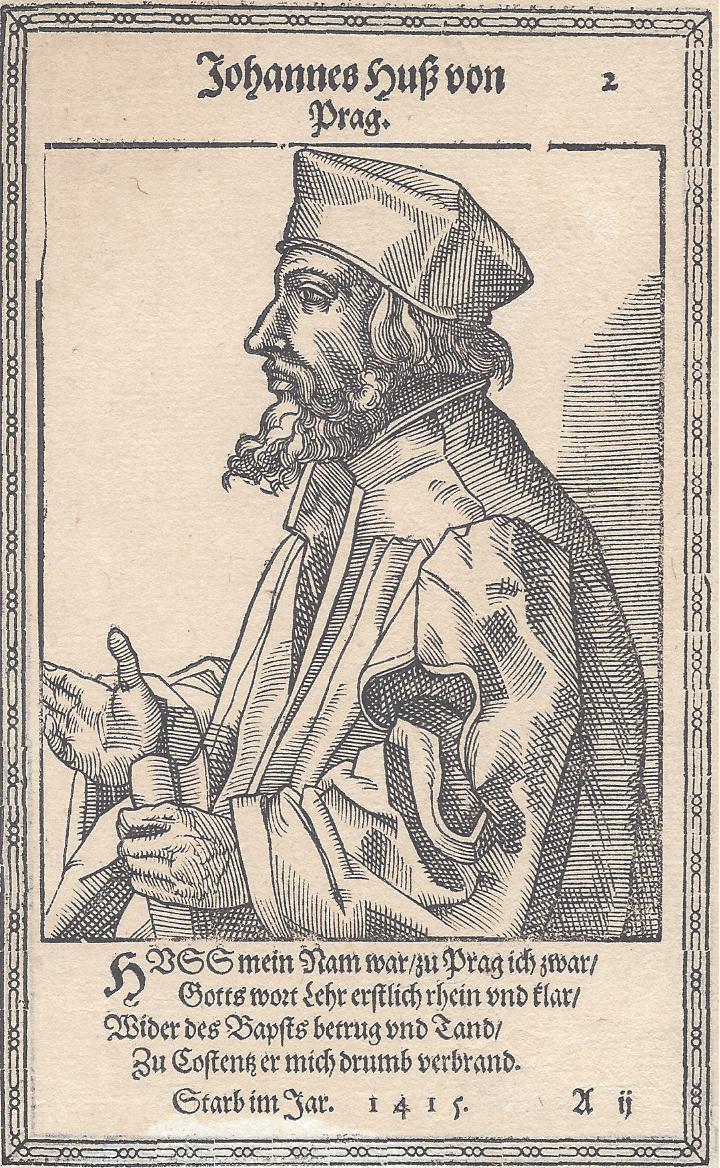
 Portrait of Jan Hus, 16th century
 -
 Painting of Jan Hus at the Council of Constance by Václav Brožík (1883)
 -
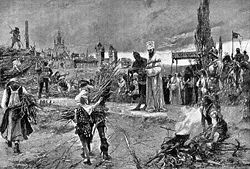 Preparing the execution of Jan Hus
 -
 Alphonse Mucha: Master Jan Hus Preaching at the Bethlehem Chapel: Truth prevails, 1916; part of the 20-painting work, The Slav Epic
 -
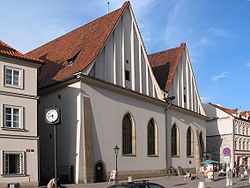 Bethlehem Chapel (exterior) in Prague
 -
 Bethlehem Chapel (interior) in Prague
 -
 Medallion portrait of Jan Hus
 -
 Preparing to burn Jan Hus at the stake
 -
 Medallion of Jan Hus, showing his portrait and execution
 -
 Profile of Jan Hus on the Giordano Bruno Statue


_-_Foto_Giovanni_Dall%27Orto,_6-Apr-2008.jpg)
Works
[edit]- Iohannes Hus. Postilla adumbrata, ed. G. Silagi (Corpus Christianorum. Continuatio Mediaevalis 261), Turnhout: Brepols Publishers (ISBN 978-2-503-55275-0)
- De Ecclesia. The Church, Jan Hus; David S. Schaff, translator, New York, Charles Scribner's Sons, 1915.Internet Archive
- Letters of John Huss Written During His Exile and Imprisonment, Jan Hus; Campbell Mackenzie, translator, Edinburgh, William Whyte & co., 1846
- The letters of John Hus, Jan Hus; Herbert B. Workman; R. Martin Pope, London, Hodder and Stoughton, 1904.
- The Letters of John Hus, Jan Hus; Matthew Spinka, translator.
- The Letters of John Hus
See also
[edit]

- Orthographia bohemica, a treatise thought to have been written by Jan Hus
- Jan Hus Presbyterian Church, a New York City parish of the Presbyterian Church (USA) and named after Jan Hus
Notes
[edit]- ^ "John Wycliffe may be thought of as the theorist of ecclesiastical Reformation, but Hus is considered the first church reformer, the antecedent of Luther, Calvin, and Zwingli, as such. His teachings had a strong influence on the states of Western Europe in the formation of a reformist Bohemian religious denomination and, more than a century later, on Martin Luther himself. Hus was burned at the stake for heresy against the teachings of the Roman Catholic Church, including those on ecclesiology, the Eucharist, and other theological dogma."[1]
References
[edit]Citations
[edit]- ^ Lamport, Forrest & Whaley 2019, p. 227.
- ^ Demy, Timothy J.; Larson, Mark J.; Charles, J. Daryl (2019). The Reformers on War, Peace, and Justice. Wipf and Stock Publishers. p. 5. ISBN 978-1-4982-0698-3. Retrieved 21 January 2022.
- ^ Lamport, Mark A.; Forrest, Benjamin K.; Whaley, Vernon M. (2019). Hymns and Hymnody: Historical and Theological Introductions, Volume 2: From Catholic Europe to Protestant Europe. Wipf and Stock Publishers. p. 227. ISBN 978-1-5326-5125-0. Retrieved 21 January 2022.
- ^ Walker, Williston (2014). A History of the Christian Church. Ravenio Books. p. 56. Retrieved 21 January 2022.
- ^ Verhoeven, Ludo; Perfetti, Charles (2017). Learning to Read across Languages and Writing Systems. Cambridge University Press. p. 372. ISBN 978-1-107-09588-5. Retrieved 21 January 2022.
- ^ a b Gillett 1863, pp. 464–466.
- ^ a b Kuhns 1907, p. 40.
- ^ a b Lützow 1909, p. 64.
- ^ Gillett 1863, p. 43.
- ^ Kuhns 1907, p. 64.
- ^ Lützow 1909, p. 65.
- ^ Gillett 1863, p. 44.
- ^ Gillett 1863, pp. 43–44.
- ^ Fudge 2010, p. 9.
- ^ Gilpin 1809, p. 141.
- ^ Gillett 1863, pp. 44–45.
- ^ Gillett 1863, pp. 46–48.
- ^ Gillett 1863, pp. 47–50.
- ^ Lützow 1909, pp. 70–71.
- ^ Gilpin 1809, p. 142.
- ^ Lützow 1909, pp. 73–76.
- ^ Spinka, Matthew (2017). John Hus: a biography. [Place of publication not identified]: Princeton University Press. ISBN 978-0-691-62219-4. OCLC 975125037.
- ^ Campbell, Gordon (2003). "Hus, Jan or Jan Huss (c.1372–1415)". The Oxford Dictionary of the Renaissance. Oxford: Oxford University Press. ISBN 9780191727795.
- ^ Kuhns 1907, p. 43.
- ^ Kuhns 1907, p. 47.
- ^ Kuhns 1907, pp. 45–46.
- ^ a b c d Wilhelm 1910.
- ^ Gillett 1863, pp. 76–78.
- ^ Gilpin 1809, p. 143.
- ^ Gillett 1863, pp. 140–141.
- ^ Hus 1372–1415, p. 69.
- ^ Kuhns & Dickie 2017, pp. 67–70.
- ^ Fudge 2010, pp. 97–100.
- ^ "Archaeological and Historical Evidence – Falling Away from the Pure Gospel of Jesus Christ". www.supportingevidences.net. Retrieved 11 December 2020.
- ^ Hus, Jan (1904) [1412]. Workman, Herbert B.; Pope, R. Martin (eds.). "Letter to King Ladislaus of Poland, 1412". Retrieved 5 February 2025.
- ^ a b Schaff 1953, pp. 415–420.
- ^ Herzog, Johann Jakob; Hauck, Albert; Jackson, Samuel Macauley; Sherman, Charles Colebrook; Gilmore, George William (1909). The New Schaff-Herzog Encyclopedia of Religious Knowledge: Embracing Biblical, Historical, Doctrinal, and Practical Theology and Biblical, Theological, and Ecclesiastical Biography from the Earliest Times to the Present Day. Funk and Wagnalls Company. pp. 416.
Archbishop Albik tried to persuade Hus to give up his opposition to the papal bulls, and the king made an unsuccessful attempt to reconcile the two parties.
- ^ Kuhns 1907, p. 75.
- ^ Kuhns 1907, pp. 77–78.
- ^ Funda, Otakar A. (2009). Když se rákos chvěje nad hladinou (in Czech). Karolinum Press. p. 145. ISBN 978-8024615929.
- ^ Nodl 2010, pp. 530–531.
- ^ Šmahel 2013, p. 143.
- ^ Knoll, Paul W. (June 2014). "The Trial of Jan Hus: Medieval Heresy and Criminal Procedure. Thomas A. Fudge". The Sixteenth Century Journal. 45 (2): 479–481. doi:10.1086/SCJ24245808. ISSN 0361-0160.
- ^ "moravian music foundation".
- ^ Lützow 1909, pp. 224–228.
- ^ Fudge 2010, pp. 125–127.
- ^ Shahan 1908, p. III.
- ^ Kuhns 1907, pp. 126–127.
- ^ Fathers, Council (5 November 1414). "Council of Constance 1414-18 Council Fathers". Papal Encyclicals.
- ^ De Schweinitz, Edmund (1885). The History of the Church Known as the Unitas Fratrum: Or the Unity of the Brethren, Founded by the Followers of John Hus, the Bohemian Reformer and Martyr. Bethlehem, PA.: Moravian Publication Office. p. 74.
- ^ "Huss, John, Hussites". www.ccel.org. Retrieved 11 May 2024.
- ^ Scribner, R. W. (1986). "Incombustible Luther: The Image of the Reformer in Early Modern Germany". Past & Present (110): 38–68. doi:10.1093/past/110.1.38. ISSN 0031-2746. JSTOR 650648.
- ^ a b Cuthbertson, David (1913). The Protest Against the Burning of John Huss. London: Alexander Moring Limited. p. 11.
- ^ "Bohemian Protest, Recto". ED. Retrieved 30 November 2022.
- ^ Lützow 1914, pp. 177–79.
- ^ Lechler 1904, p. 381.
- ^ Macek 1958, p. 16.
- ^ a b Allen, John L. Jr. (15 September 2009). "The German shepherd bids farewell to a 'wolf in winter'". National Catholic Reporter.
- ^ Wein, Martin J. (1 February 2009). "'Chosen Peoples, Holy Tongues': Religion, Language, Nationalism and Politics in Bohemia and Moravia in the Seventeenth to Twentieth Centuries*". Past & Present (202): 37–81. doi:10.1093/pastj/gtn023. ISSN 0031-2746.
- ^ Václavík 2010, p. 53.
- ^ a b "Protestantism in Bohemia and Moravia (Czech Republic)".
- ^ "Tab 7.1 Population by religious belief and by municipality size groups" (PDF) (in Czech). Czso.cz. Archived from the original (PDF) on 21 February 2015. Retrieved 19 November 2013.
- ^ "Tab 7.2 Population by religious belief and by regions" (PDF) (in Czech). Czso.cz. Archived from the original (PDF) on 4 November 2013. Retrieved 19 November 2013.
- ^ Mastrini, Hana (2008). Frommer's Prague & the Best of the Czech Republic (7th ed.). Wiley. ISBN 978-0-470-29323-2.[page needed]
- ^ Halík, Tomáš; Hošek, Pavel (2015). Czech Perspective on Faith in a Secular Age: Czech Philosophical Studies, V (PDF). Washington, DC, USA: Council for Research into Values and Philosophy. ISBN 9781565183001. Retrieved 24 September 2023.
- ^ Oberman & Walliser-Schwarzbart 2006, pp. 54–55.
- ^ "The Origin & Growth". Unitas Fratrum. Archived from the original on 26 September 2011. Retrieved 17 September 2011.
- ^ Preclík, Vratislav. Masaryk a legie (Masaryk and legions), váz. kniha, 219 str., vydalo nakladatelství Paris Karviná, Žižkova 2379 (734 01 Karviná) ve spolupráci s Masarykovým demokratickým hnutím (Masaryk Democratic Movement, Prague, CZ), 2019, ISBN 978-80-87173-47-3, pp. 17–25, 33–45, 70–76, 159–184, 187–199
- ^ "Jan Hus, Jerome of Prague and Orthodoxy in Czechia & Slovakia". Archived from the original on 13 December 2013. Retrieved 26 January 2019.
- ^ "More and More People in Czechia and Slovakia Are Giving Preference to the Orthodox Church".
- ^ "Anketa: Kdo Je Pro Vás hrdina.cz?". www.rozhlas.cz (in Czech). Retrieved 20 June 2017.
- ^ "Výsledky 2014". Památník národního písemnictví. Archived from the original on 2 June 2023. Retrieved 22 February 2023.
- ^ "Český statistický úřad". Archived from the original on 3 November 2014.
- ^ "Jan Kardinál z Rejnštejna". Phil.muni.cz. Retrieved 5 September 2008.
Sources
[edit]- Fudge, Thomas A. (2010). Jan Hus: Religious Reform and Social Revolution in Bohemia. Adams County Public Library: I.B. Tauris.
- Gillett, E.H. (1863). The life and times of John Huss; or, The Bohemian reformation of the fifteenth century (pt.1). Princeton Theological Seminary Library: Gould and Lincoln.
- Gilpin, William (1809). The Lives of the Reformers. Princeton Theological Seminary Library: T. Cadell and W. Davies.
- Oberman, Heiko Augustinus; Walliser-Schwarzbart (2006). Luther: Man Between God and the Devil. Yale University Press. ISBN 0-300-10313-1.
- Hus, Jan (1372–1415). The Letters of John Hus. Trinity College-University of Toronto: Hodder and Stoughton.
- Kuhns, Oscar (1907). John Huss: The Witness. Cincinnati; New York: Jennings & Graham; Eaton & Mains – via New York Public Library.
- Kuhns, Oscar; Dickie, Robert (2017). Jan Hus: Reformation in Bohemia. Morrisville, NC: Lulu. ISBN 978-1-87255629-1.
- Lützow, Francis (1909). The Life & Times of Master John Hus. Princeton Theological Seminary Library: E.P. Dutton.
- Lützow, Francis (1914). The Hussite Wars. Toronto Public Library: London:Dent, New York:Dutton.
- Lechler, Gotthard Victor (1904). John Wycliffe and His English Precursors. Religious Tract Society. p. 381.
- Macek, Josef (1958), The Hussite Movement in Bohemia, Prague: Orbis
- Nodl, Martin (2010). Horníčková, Kateřina; Šroněk, Michal (eds.). Umění české reformace (1380–1620) [The Art of the Bohemian Reformation (1380–1620)]. Praha: Academia. ISBN 978-80-200-1879-3.
- Schaff, Philip (1953). "Huss, John, Hussites". The New Schaff-Herzog Encyclopedia of Religious Knowledge.
- Shahan, Thomas Joseph (1908). . Catholic Encyclopedia. Vol. 4.
- Šmahel, František (2013). Jan Hus : život a dílo [Jan Hus: Life and Work] (in Czech). Praha: Argo. ISBN 978-80-257-0875-0.
- Václavík, David (2010). Náboženství a moderní česká společnost [Religion and Modern Czech Society] (in Czech). Grada Publishing a.s. p. 53. ISBN 9788024724683.
- Wilhelm, Joseph (1910). The Catholic Encyclopedia. Vol. 7. New York NY: Robert Appleton Company.
Further reading
[edit]- Budgen, Victor, On Fire for God, Evangelical Press, 2007.
- Fudge, Thomas A. Jan Hus: Religious Reform and Social Revolution in Bohemia, I. B. Tauris, 2010.
- Fudge, Thomas A. The Memory and Morivation of Jan Hus, Medieval Priest and Martyr, Brepols, 2013.
- Fudge, Thomas A. The Trial of Jan Hus: Medieval Heresy and Criminal Procedure, Oxford University Press, 2013.
- Fudge, Thomas A. Jan Hus Between Time and Eternity: Reconsidering a Medieval Heretic, Lexington Books, 2016.
- Fudge, Thomas A. Living with Jan Hus: A Modern Journey Across a Medieval Landscape, Center for Christian Studies, 2015.
- Lášek, Jan Blahoslav and Angelo Shaun Franklin, Jan Hus: Faithful Witness to Truth, Rowman and Littlefield, 2022.
- Lützow, Francis, Life & Times of Master John Hus, E. P. Dutton & Co., 1909.
- Ratto, Pietro, Il gioco dell'oca. I retroscena segreti del processo al riformatore Jan Hus, Bibliotheka Edizioni, 2020. ISBN 978-88-6934-644-6.
- Spinka, Matthew (1972). The Letters of John Hus. Totowa, NJ: Manchester University Press. OCLC 590290.
- ——— (1968). John Hus: A Biography. Princeton, NJ: Princeton University Press. OCLC 441706.
- ——— (1966). John Hus' Concept of the Church. Princeton, NJ: Princeton University Press. OCLC 390635.
- Spinka, Matthew, John Hus at the Council of Constance, Columbia University Press, 1965 (includes the eye-witness account by Peter of Mladonovice).
- Wilhelm, J. (1910). "Jan Hus". The Catholic Encyclopedia. New York: Robert Appleton Company. Retrieved 16 May 2011 from New Advent.
External links
[edit] Media from Commons
 Quotations from Wikiquote
 Texts from Wikisource


- John Hus, a movie produced by Faith for Today (1977)
- Jan Hus, a Czechoslovak movie directed by Otakar Vávra (1955)
- Hussitism and the heritage of Jan Hus Archived 30 October 2008 at the Wayback Machine – Official Website of the Czech Republic
- Final Declaration written on 1 July 1415 – Modern History Sourcebook, Fordham University
- Letters of John Huss Written During His Exile and Imprisonment, with a preface by Martin Luther, by Jan Hus, François Paul Émile Boisnormand de Bonnechose, tr. Campbell Mackenzie, Edinburgh, William Whyte & Co., 1846
- Works by Jan Hus at LibriVox (public domain audiobooks)

- The life and times of John Huss "btm" format
- Bohemian Reformation and Religious Practice – online translation of a Czech academic journal
- Jan Hus and the Hussite Wars on Medieval Archives Podcast
- Jan Hus Centre (historical Jan Hus Birth-house in Husinec, Czech Republic)

| Works |  | |
|---|---|---|
| Topics and events | ||
| Legacy and memorials | ||
| Cultural depictions | ||
| Related | ||

| 400–1100 AD |
|  | ||||
|---|---|---|---|---|---|---|
| 1100–1400 AD |
| |||||
| 1400–1500 AD |
| |||||
| Events | ||||||
| Literature | ||||||
| Other | ||||||
Italics indicate their inclusion to be controversial or disputed. | ||||||
| International | |
|---|---|
| National | |
| Academics | |
| Artists | |
| People | |
| Other | |

Jan Hus
View on GrokipediaEarly Life and Education
Birth and Family Background
Jan Hus was born around 1370 in the village of Husinec in southern Bohemia, then part of the Kingdom of Bohemia within the Holy Roman Empire.[1][7][8] The precise date remains uncertain due to limited contemporary records, with scholarly estimates varying slightly between 1369 and 1373, though circa 1370 is commonly accepted.[9][10] Hus originated from a family of modest peasant means, with his parents unnamed in historical accounts and details of his siblings or immediate relatives largely absent from primary sources.[7][8][11] His surname derived from his birthplace, Husinec, which translates to "Goosetown" in Czech, reflecting the linguistic root of "hus" meaning goose—a detail he later referenced in his writings and correspondence.[10][12] The family's humble circumstances motivated Hus's pursuit of education as a path out of poverty, leading him to study in Prague by his early teens.[13][14] Little else is verifiably known of his childhood, as early biographical records focus more on his later ecclesiastical career than personal origins.[15]Studies at Charles University
Hus enrolled in the Faculty of Arts at Charles University in Prague around 1390, having arrived in the city from his rural Bohemian origins to pursue higher education despite his modest background.[11] To sustain himself, he served as a chorister and clerical assistant in local churches, roles that provided both income and exposure to ecclesiastical practices.[16] The university's arts curriculum emphasized the trivium—grammar, rhetoric, and logic—alongside philosophical debates influenced by late medieval scholasticism, including tensions between realist and nominalist traditions. Hus progressed through the required examinations and disputation, earning his baccalaureus artium (Bachelor of Arts) on October 11, 1393, after fulfilling residency and lecture obligations.[3] He advanced to magister artium (Master of Arts) status by June 1396, granting him the right to teach as a full member of the faculty.[7] Upon obtaining his master's degree, Hus immediately began lecturing in the arts faculty, delivering courses on logic, philosophy, and related disciplines, which positioned him among the emerging Czech scholarly elite at the institution founded by Emperor Charles IV in 1348.[17] His academic rigor during this period laid the groundwork for later theological pursuits, though he deferred formal enrollment in the Faculty of Theology until approximately 1400, concurrent with his ordination as a priest.[7] In the winter semester of 1401–1402, Hus served a term as dean of the Faculty of Arts, reflecting his growing influence within the university's Bohemian "nation."[18]Rise as Reformer and Preacher
Appointment at Bethlehem Chapel
In 1402, Jan Hus, then a prominent figure at Charles University in Prague, was appointed as the preacher at the Bethlehem Chapel (Betlémská kaple), a position he held until 1412.[19][20] The appointment stemmed from Hus's established reputation as an eloquent preacher and theologian, following his ordination to the priesthood and academic advancements, including his role as rector of the university that same year.[16][21] The Bethlehem Chapel had been established in 1391 by disciples of the Czech preacher Jan Milíč of Kroměříž, with the explicit purpose of delivering sermons in the vernacular Czech language to reach the laity, contrasting with the predominant Latin services in Prague's churches.[19][22] Architecturally simple and spacious, the chapel featured a large open hall without fixed seating, capable of accommodating up to 3,000 listeners, which facilitated Hus's public addresses that often drew substantial crowds from various social strata.[23][24] Hus's tenure marked the chapel's zenith as a center for reformist preaching, where he delivered sermons multiple times weekly, emphasizing scriptural authority, moral reform, and critiques of clerical abuses, though his initial appointment focused on pastoral duties rather than overt doctrinal challenges.[24][25] This role amplified his influence in Bohemian society, bridging academic theology with popular devotion, and laid groundwork for his later conflicts with ecclesiastical authorities.[26][27]Adoption and Adaptation of Wycliffite Ideas
Jan Hus encountered the theological writings of John Wycliffe through Bohemian students who studied at Oxford University and returned to Prague with manuscripts around 1401, introducing approximately 45 volumes of Wycliffe's works to Charles University.[18] These texts initially focused on philosophical critiques but shifted toward religious reforms, gaining traction amid growing discontent with clerical abuses in Bohemia.[18] Hus, as a faculty member and later rector candidate, engaged these ideas during university debates, publicly defending Wycliffe's books against condemnation in 1403 and incorporating selections into his lectures.[28] Hus adopted Wycliffe's core doctrine of ecclesiastical dominion, asserting that legitimate authority in the church derives solely from personal grace and adherence to Scripture, not hierarchical office or temporal power—a view that undermined papal supremacy and clerical privileges like simony and indulgences.[1] He echoed Wycliffe's emphasis on the church as the invisible community of the predestined elect rather than the visible institution led by Rome, prioritizing biblical authority (sola scriptura) over conciliar or papal traditions.[29] This adaptation fueled Hus's preaching at Bethlehem Chapel from 1402, where he advocated vernacular Czech translations of Scripture to empower laity, mirroring Wycliffe's English Bible efforts but tailored to Bohemian linguistic nationalism.[30] However, Hus moderated Wycliffe's more radical positions to align with local contexts and avoid outright schism. Unlike Wycliffe's outright rejection of transubstantiation in favor of remanence (the persistent presence of bread and wine alongside Christ's body), Hus upheld the sacramental union while critiquing superstitious interpretations, emphasizing spiritual reception over mechanical ritual.[1] He translated key Wycliffite texts, such as excerpts from the Trialogus, into Czech for broader dissemination but integrated them with Augustinian emphases on predestination and moral reform, focusing on clerical poverty and anti-corruption campaigns relevant to Bohemian grievances under Sigismund's influence.[31] This selective adaptation preserved Wycliffe's anti-hierarchical thrust while grounding it in empirical critiques of observable church excesses, such as land ownership by clergy exceeding one-third of Bohemian territory, thereby resonating with university reformers like Jerome of Prague.[32]Involvement in Ecclesiastical Conflicts
The Western Schism and Kutná Hora Decree
The Western Schism (1378–1417) divided Christendom with competing papal claimants in Rome and Avignon, fostering widespread ecclesiastical disorder and financial exploitation that Hus decried in his sermons as symptomatic of clerical corruption.<grok:render type="render_inline_citation">Campaign Against Indulgences and Papal Crusades
In 1411, during the Western Schism, Pope John XXIII authorized the sale of plenary indulgences across Christendom to finance a crusade against King Ladislaus of Naples, a supporter of rival pope Gregory XII.[23] In Bohemia, half the proceeds from these sales were allocated to King Wenceslaus IV, providing him with a financial incentive to permit the campaign despite its controversial nature.[33] Jan Hus, serving as preacher at Prague's Bethlehem Chapel, publicly denounced these indulgences as simony—the illicit sale of spiritual benefits—and argued that genuine remission of sins required personal repentance rather than monetary payment.[34] Hus intensified his criticism in 1412 through sermons that condemned the indulgences for funding papal military expeditions while enriching corrupt clergy, whom he accused of patronizing brothels and taverns.[34] He called for a boycott of the sales, asserting that obedience to such papal decrees contradicted Scripture, and declared that he would not remain silent even under threat of death: "Shall I keep silent? God forbid! Woe is me, if I keep silent."[34] Supporters, including Jerome of Prague, organized demonstrations that disrupted official indulgence sermons in Prague, leading to public unrest and clashes with indulgence vendors and ecclesiastical authorities.[34] The campaign escalated tensions with the church hierarchy; Prague was placed under interdict, halting sacraments, and Hus faced multiple excommunications, culminating in a papal bull against him in September 1412.[33] To prevent further violence in the city, Hus voluntarily departed Prague on October 15, 1412, continuing his preaching against indulgences and papal overreach in southern Bohemia during two years of exile.[34] This opposition highlighted Hus's broader critique of papal authority's misuse for worldly crusades, prioritizing empirical reform over institutional loyalty.[33]Excommunication, Appeals, and Exile
Hus's public denunciations of Pope John XXIII's 1410 crusade against King Ladislaus of Naples, which involved the sale of indulgences to fund the effort, prompted ecclesiastical authorities to act against him.[35] The Archbishop of Prague, Zbyněk Zajíc, initially excommunicated Hus and his followers on July 16, 1410, for refusing to submit to church authority and for disseminating Wycliffite ideas.[36] This local excommunication was followed by a papal one from John XXIII in February 1411, with the sentence published in Prague churches on March 15, 1411, barring Hus from preaching and sacraments.[37] Despite royal protection from King Wenceslaus IV, who sought to shield Prague from an interdict, Hus persisted in his criticisms, leading to a fourth excommunication that intensified the pressure.[38] In response, Hus formally appealed the excommunications, first to the rival popes Gregory XII and Benedict XIII in 1411, arguing their superior jurisdiction amid the Western Schism.[39] When these appeals yielded no resolution, he escalated to a future general council, invoking conciliar supremacy over papal authority as a check against abuse.[7] By October 18, 1412, disillusioned with divided papal courts, Hus submitted a final appeal directly to Jesus Christ as supreme judge, bypassing ineffective ecclesiastical hierarchies.[16] These appeals, documented in his letters and treatises, reflected his commitment to scriptural and rational adjudication over institutional loyalty, though they were rejected by authorities as defiant.[40] To avert a full interdict on Prague, which would deny sacraments to the populace, Hus voluntarily entered exile in late October 1412, retreating to southern Bohemia under the patronage of sympathetic nobles.[41] During this two-year period until 1414, he resided in castles, continuing clandestine preaching and authoring key works such as De Ecclesia (On the Church), which argued for a scripture-based church headship under Christ rather than the pope.[42] He also composed Czech-language expositions to reach laity, including defenses against simony and critiques of clerical corruption, sustaining reformist momentum without direct confrontation in the capital.[43] This exile phase honed his theological output, influencing Bohemian dissent amid escalating tensions.[39]Theological Doctrines and Writings
Views on Church Authority and Headship
Hus articulated his views on church authority primarily in his 1413 treatise De Ecclesia, where he posited that Christ alone serves as the head of the true church, rejecting the pope's claim to that role. Drawing from Matthew 16:18, he interpreted the "rock" as Christ himself rather than Peter or his successors, arguing that papal headship derives not from divine institution but from moral virtue and adherence to scripture.[44][45] The pope, in Hus's estimation, holds authority only insofar as he imitates Christ through humility and righteousness; a sinful pope forfeits legitimacy and cannot bind the faithful in matters contrary to God's law.[46] Central to Hus's ecclesiology was the distinction between the invisible "true church"—comprising the predestined elect known solely to God—and the visible institutional church, which often deviated from apostolic purity through corruption and worldly power. This predestination-based definition, influenced by John Wycliffe, implied that church membership and authority rest on divine foreknowledge rather than hierarchical office or sacraments administered by unworthy clergy.[45] Hus maintained that the true church's unity stems from shared faith in Christ, not submission to Roman primacy, and he critiqued the equation of the catholic church with the pope and cardinals as a distortion that elevated human institutions over spiritual reality.[44] While not advocating outright abolition of ecclesiastical hierarchy, Hus conditioned clerical authority on personal sanctity and scriptural fidelity, asserting that bishops and priests derive power from Christ directly, bypassing papal intermediation unless aligned with gospel truths. He rejected papal bulls and decrees that conflicted with scripture, prioritizing biblical mandates over conciliar or pontifical traditions, though he stopped short of Wycliffe's more radical denial of transubstantiation or purgatory.[46] This framework challenged the medieval synthesis of spiritual and temporal power, portraying the papacy as a ministerial office revocable by moral failure rather than an infallible monarchy.[45]Positions on Sacraments, Indulgences, and Clerical Reform
Hus maintained the traditional seven sacraments of the Catholic Church but insisted their administration and efficacy must conform to scriptural precedents rather than ecclesiastical customs or traditions that deviated from apostolic practice.[47] In particular, he advocated for the laity's reception of communion under both kinds—bread and wine—arguing that no biblical text opposed it and that Christ's institution at the Last Supper provided the binding example over later church prohibitions.[47] He rejected the notion that sacraments administered by morally unworthy or excommunicated priests retained validity, positing that such ministers lacked the spiritual authority to confer grace, a view influenced by Wyclif but grounded in Hus's reading of scriptural qualifications for clerical office.[48] Regarding indulgences, Hus vehemently denounced their sale as a form of simony and a fraudulent permission to sin, contrary to apostolic doctrine and Christ's teachings on repentance.[49] In sermons and letters from 1412, he criticized the preaching of indulgences in Prague under Pope John XXIII's crusade against King Ladislaus of Naples, highlighting how priests installed money chests in churches to collect funds, thereby exploiting the faithful for papal wars rather than promoting genuine contrition.[49] Hus argued that true remission of sins derived from God's grace through faith and confession aligned with Scripture, not from papal dispensations purchasable for coin, and he publicly disputed theologians who defended their apostolic warrant, asserting obedience was owed only to commands echoing Christ's law.[49][47] On clerical reform, Hus called for the eradication of corruption within the priesthood, including simony, sexual immorality, and excessive wealth accumulation, which he saw as betrayals of the apostolic model of poverty and moral purity.[2] He urged priests to emulate the early church's emphasis on preaching the Gospel and scriptural study over ritualistic or financial pursuits, condemning the hierarchy's worldly power as unscriptural and detrimental to the church's spiritual mission.[50] In works like De ecclesia (1413), Hus redefined the true church as the invisible body of the predestined faithful rather than the visible institution dominated by prelates, thereby subordinating clerical authority to divine law and individual conscience informed by Scripture.[47] This framework implied reforms such as punishing clerical vices through deprivation of office and prioritizing vernacular preaching to foster lay accountability over hierarchical indulgence.[47]Catholic Critiques and Charges of Heresy
The Catholic Church's critiques of Jan Hus's theology centered on his endorsement of doctrines derived from John Wyclif, which were viewed as eroding the visible hierarchy, papal primacy, and sacramental integrity central to Catholic ecclesiology. Hus's treatise De Ecclesia (1413) posited that the true Church comprises solely the predestined assembly known only to God, excluding the institutional body of prelates and faithful under the Pope's headship—a position echoing Wyclif's emphasis on predestination over hierarchical office.[37] [51] This was condemned as denying Christ's delegation of authority to Peter and his successors, with Hus asserting that papal dignity derived partly from imperial grant rather than divine right.[51] Additional charges highlighted Hus's alignment with Wyclif's views on dominion and grace, including the claim that no one in mortal sin could validly exercise civil lordship, prelacy, or bishopric, thereby invalidating sacraments administered by sinful priests.[51] Critics, including Jean Gerson, extracted propositions from Hus's works like De sex erroribus arguing that priests in vice polluted the priesthood and rendered consecrations ineffective, undermining the ex opere operato efficacy of sacraments independent of the minister's moral state.[37] Hus's qualified acceptance of Wyclif's remanence theory—positing that the substance of bread persists alongside Christ's presence in the Eucharist—was also scrutinized as deviating from strict transubstantiation, though Hus maintained orthodoxy on the change of accidents.[37] In its fifteenth session on July 6, 1415, the Council of Constance formally condemned 30 articles drawn from Hus's writings as heretical or erroneous, including assertions that the Roman Church's authority was presumptuous without moral distinction and that unjust excommunication lacked force.[51] [52] These were linked to Hus's broader propagation of Wyclif's 45 previously condemned propositions, despite Hus's claim to reject over 30 of them; the Council deemed his defenses evasive and his persistence in preaching against indulgences, simony, and papal bulls as fostering sedition and schism.[37] [51] The charges reflected a Catholic insistence on the Church's visible unity and jurisdictional supremacy, viewing Hus's reforms as subordinating divine institution to subjective predestination and personal virtue.[37]Trial and Execution at Constance
Summoning, Safe Conduct, and Imprisonment
In September 1414, Jan Hus received a summons from Pope John XXIII to appear before the Council of Constance to answer charges of heresy stemming from his teachings and association with Wycliffite ideas.[6] The council, convened to resolve the Western Schism and address ecclesiastical reform, began sessions on November 5, 1414, under the auspices of the Pisan pope and with the support of Emperor Sigismund of Luxembourg, who sought to end papal divisions and consolidate his influence.[51] Hus, already under papal interdict and excommunication, agreed to attend despite risks, motivated by a desire to defend his positions and contribute to church unity. Emperor Sigismund issued a safe conduct letter guaranteeing Hus's safe passage to Constance, his freedom to speak during proceedings, and secure return, a customary medieval assurance for contentious disputants.[53] Hus departed from the Prague area on October 11, 1414, accompanied by faithful supporters including his brother Jan Husinec, and after a three-week journey arrived in Constance on November 3, 1414, two days before the council's formal opening.[54] [55] Upon arrival, Hus initially enjoyed relative freedom, lodging with supporters and even preaching once, while submitting written defenses of his views; however, his books were confiscated by authorities for examination. On November 28, 1414, approximately three weeks after arrival, Hus was arrested at the Dominican monastery where he lodged, at the urging of cardinals and prelates who feared his influence and potential flight amid growing complaints against his doctrines.[56] [57] This action directly violated the safe conduct, prompting Sigismund's initial outrage; he threatened to disband the council and depart, arguing that such betrayal undermined the assembly's legitimacy and his royal authority.[54] Prelates countered by asserting that safe conducts did not extend to notorious heretics, drawing on precedents where papal safe conducts were overridden for doctrinal threats, and Sigismund, prioritizing schism resolution over Hus's fate, ultimately relented and endorsed the detention.[58] Hus was first confined under house arrest in the Dominican monastery, chained and guarded, before transfer to stricter custody in a tower of Constance's episcopal palace and later to Gottlieben Castle on the Rhine for prolonged interrogation.[56] Conditions were harsh, involving isolation, inadequate sustenance, and physical restraint, yet Hus continued composing theological works and appeals from captivity, protesting the breach of promise as a moral failing that exposed the council's prioritization of institutional power over justice.[19] The imprisonment persisted through preliminary hearings, with Hus's safe conduct formally revoked in early January 1415 on grounds that protections lapsed for the obstinately errant.[57]Council Proceedings and Hus's Defenses
The trial proceedings against Jan Hus at the Council of Constance commenced following his imprisonment on November 28, 1414, with initial interrogations conducted by a commission appointed by the council rather than in full public sessions.[54] This commission, comprising theologians and canon lawyers, focused on charges of heresy derived primarily from Hus's writings, including De ecclesia, and his association with John Wyclif's ideas, though Hus had publicly rejected certain Wycliffite doctrines such as the denial of transubstantiation.[39] Over the ensuing months, Hus endured harsh conditions in confinement, including transfer to the Dominican monastery and later the castle of Gottlieben, yet he continued to submit written defenses and respond verbally when permitted.[56] Key hearings occurred in private before escalating to public confrontation. On March 26 and 27, 1415, Hus appeared before the commission, where he was presented with accusations including advocacy for communion in both kinds (utraquism), the assertion that the church consists solely of the predestined rather than hierarchical officeholders, and critiques of papal authority and indulgences as unscriptural.[59] Hus defended these positions by appealing to Scripture as the ultimate authority, arguing that true church headship belongs to Christ alone and that clerical reforms were necessary to align with apostolic purity, while denying any intent to undermine ecclesiastical order.[54] He refused to recant unless his errors were demonstrated through rational and biblical proof, stating in one response that he would submit if shown wrong but maintained his views aligned with evangelical truth over tradition.[39] [35] By June 5, 1415, the council formalized 45 articles extracted from Hus's works, condemning them as heretical in a public session.[54] [60] Hus, brought before the assembly, rejected outright 32 of these articles as misrepresentations or not reflective of his intended meaning, qualified others with scriptural caveats—such as affirming that a priest in mortal sin validly consecrates but unworthily—and insisted the charges conflated his ideas with Wyclif's without evidence of personal endorsement.[54] Despite lacking formal defense counsel and facing proceedings conducted in Latin amid a multilingual council, Hus invoked his prior appeals to a future general council and Emperor Sigismund's safe conduct, though the latter was disregarded by the assembly, which prioritized doctrinal orthodoxy over procedural guarantees.[35] [61] Throughout, Hus's arguments emphasized sola scriptura principles avant la lettre, prioritizing biblical exegesis over conciliar or papal decrees, and he accused opponents of suppressing evidence while favoring institutional preservation.[39] The commission's reports, influenced by Bohemian expatriates and German theologians hostile to Prague's reforms, portrayed Hus as obstinate, leading to his final public degradation on July 6, 1415, without yielding to his substantive rebuttals.[54] This outcome reflected the council's commitment to eradicating perceived threats to sacramental and hierarchical unity, even as Hus's defenses highlighted tensions between emerging reformist individualism and medieval catholicity.[51]Condemnation, Degradation, and Burning
On July 6, 1415, the Council of Constance issued its final verdict against Jan Hus, condemning him as a relapsed and obstinate heretic guilty of 30 specific articles deemed erroneous, drawn primarily from his writings and sermons, including denials of papal supremacy, critiques of indulgences, and assertions that the church comprised the predestined rather than the hierarchical institution.[39] Hus, offered a last chance to recant during the public session in Constance Cathedral, refused, declaring his unwillingness to affirm falsehoods and maintaining that he had never taught heresy.[62] The council's sentence revoked his priestly orders, ordered the burning of his books, and consigned him to the secular arm for execution, as canon law prohibited clergy from directly shedding blood.[63] The degradation ceremony immediately followed the condemnation, conducted by the archbishop of Milan and six assisting bishops in a ritual reversal of ordination rites. Hus was clothed in full priestly vestments, including alb, stole, maniple, and chasuble, which were then stripped away piece by piece amid declarations that he was unworthy of ecclesiastical dignity.[64] His tonsure was scraped or his hair cut to symbolize lay status, and a tall paper mitre painted with demons and the words "Archheretic" was placed on his head.[65] Throughout, Hus remained composed, reportedly praying and affirming his faith in Christ, rejecting the proceedings as unjust.[66] Degraded and handed to Duke Louis of Bavaria representing Emperor Sigismund, Hus was escorted outside Constance's walls to a meadow near the Danube. His writings were publicly burned before him, after which he was bound to a stake with wood and straw piled around, including 2,000 pounds of materials to ensure complete incineration.[62] As flames rose, contemporary accounts record Hus singing hymns, praying for his persecutors, and invoking Jesus until smoke and fire overcame him; executioners strangled him with a chain before full burning to hasten death, though he endured alive initially.[65] His remains were pulverized and scattered into the Rhine River to preclude any veneration as relics.[66]Immediate Aftermath in Bohemia
Bohemian Protest and Defenestration of Prague
Following Jan Hus's execution by burning at the Council of Constance on July 6, 1415, Bohemian and Moravian nobles responded swiftly with a formal protest against the council's verdict. On September 2, 1415, approximately 100 prominent figures from these regions affixed their signatures and wax seals to a document addressed to the council, denouncing the proceedings as unjust and a violation of the safe conduct promised to Hus.[67][68] The protest contended that Hus had been condemned without a fair hearing, emphasizing his adherence to scriptural truth over ecclesiastical decrees, and warned of the decision's potential to incite broader dissent in Bohemia.[69] This act marked an early collective assertion of lay authority against papal and conciliar overreach, preserving one surviving copy that underscores its historical significance as a precursor to organized resistance.[67] Tensions escalated over the subsequent years under King Wenceslaus IV, who sympathized with reformist sentiments but faced pressure from Catholic hardliners and foreign influences. By 1419, Hussite preachers like Jan Želivský had mobilized urban crowds in Prague against perceived clerical abuses and royal appointees enforcing anti-Hussite policies. On July 30, 1419, during a Corpus Christi procession led by Želivský through Prague's New Town, councillors at the town hall reportedly mocked the participants, prompting a stone to be thrown from the building, which incited the mob to storm the hall.[70] Seven city officials were seized and hurled from an upper-story window onto the street below, where they died from the fall or subsequent beating by the crowd.[71] The defenestration symbolized a decisive rupture with established authority, galvanizing Hussite factions and triggering immediate reprisals across Bohemia. News of the event reached King Wenceslaus IV, reportedly causing him such shock that he suffered a stroke, leading to his death on November 16, 1419, and creating a power vacuum that intensified the conflict.[70] This violent episode, distinct from later defenestrations, directly precipitated the Hussite Wars by uniting reformist nobles, clergy, and commoners in armed opposition to Sigismund's succession claims and Catholic crusades.[72]Emergence of Utraquist and Radical Hussite Factions
In the aftermath of Jan Hus's execution on July 6, 1415, the Bohemian reform movement fragmented into moderate and radical wings, with the Utraquists emerging as the primary moderate faction centered in Prague. Led by Jakoubek of Stříbro, Hus's successor at the Bethlehem Chapel, the Utraquists prioritized the restoration of communion sub utraque specie—bread and wine for laity—drawing on scriptural precedents and early church practices to challenge the Catholic restriction to bread alone. This emphasis on utraquism, which Jakoubek defended through theological treatises like De sanguine Christi, gained traction among urban clergy, nobility, and Charles University scholars, positioning it as a symbol of fidelity to Hus's teachings without broader ecclesiastical rupture.[73][74] The Utraquists' program crystallized in the Four Articles of Prague, drafted in 1420 by Jakoubek and university faculty amid escalating tensions with Emperor Sigismund. These demands included: unrestricted preaching of the Gospel; communion in both kinds for all communicants; clerical renunciation of secular property in favor of apostolic poverty; and impartial punishment of mortal sins to curb societal corruption. Intended to encapsulate Hussite grievances, the articles fostered initial unity but highlighted interpretive divides, as moderates sought negotiation with Rome while rejecting papal overreach.[73] Parallel to this, radical Hussites, drawn from peasants and artisans in southern Bohemia, founded the stronghold of Tábor in summer 1420, invoking the biblical Mount Tabor as a communal bastion against Antichrist forces. The Taborites, who rejected priestly hierarchy, transubstantiation nuances, and church wealth, adhered to sola scriptura more rigorously, limiting sacraments to baptism and communion, abolishing images, and experimenting with egalitarian property sharing. Under figures like Jan Žižka, they militarized rapidly, viewing utraquism as insufficient and prioritizing apocalyptic purification over compromise, thus diverging sharply from Utraquist pragmatism.[74][75][76] This bifurcation, exacerbated by the 1419 Defenestration of Prague and impending crusades, pitted urban elites favoring restrained reform against rural zealots pursuing total renewal, setting the stage for intra-Hussite conflicts amid external assaults. Utraquists, with noble backing, aimed for ecclesiastical concessions within Bohemia, while Taborites' militancy ensured defensive innovations like wagon forts, though their extremism alienated potential allies.[74][75]The Hussite Wars and Reformation
Causes, Key Battles, and Phases of Conflict
The Hussite Wars arose from religious grievances rooted in Jan Hus's critiques of Catholic practices, including the sale of indulgences and clerical corruption, compounded by political opposition to Holy Roman Emperor Sigismund's claim to the Bohemian throne following his perceived betrayal in failing to protect Hus despite a safe conduct promise.[6] Nationalistic tensions between Czechs and Germans within Bohemia, alongside social unrest among peasants and burghers demanding greater lay participation in church affairs, fueled the uprising.[77] The immediate trigger was the First Defenestration of Prague on July 30, 1419, when Hussite nobles threw Catholic town councilors from a window, symbolizing rejection of Sigismund's authority and sparking armed rebellion.[6] The wars progressed through distinct phases: an initial consolidation period from 1419 to 1420, marked by Hussite seizure of Prague and defensive preparations; a series of five failed crusades against Bohemia from 1420 to 1431, during which Hussite forces under leaders like Jan Žižka repelled invaders using innovative wagon-fort tactics; offensive raids into neighboring territories in the late 1420s under Prokop the Great; and internal divisions culminating in civil conflict between moderate Utraquists and radical Taborites by 1434.[77] [6] These phases shifted from defensive survival to expansion and eventual moderation, ending with the Compactata of Basel in 1436, which granted limited reforms.[6] Key battles highlighted Hussite military ingenuity and the failure of crusading armies:| Battle | Date | Outcome |
|---|---|---|
| Sudoměř | March 25, 1420 | Žižka's small force repelled a larger Catholic army, validating early wagon tactics.[77] |
| Vítkov Hill | July 14, 1420 | Hussites decisively defeated the first crusade's assault on Prague, securing the capital.[77] |
| Kutná Hora | December 21, 1421 | Hussites routed a superior Catholic force, demonstrating tactical superiority.[77] |
| Aussig | August 16, 1426 | Žižka's army annihilated invading crusaders, one of the most lopsided victories.[77] |
| Lipany | November 30, 1434 | Moderate Utraquists and Catholics crushed radical Taborites, fracturing the movement and paving the way for compromise.[77] [6] |
Compact of Basel and Internal Divisions
Following the decisive defeat of the radical Taborites by Utraquist and Catholic forces at the Battle of Lipany on May 30, 1434, moderate Utraquists gained dominance within the Hussite movement and pursued negotiations with the Council of Basel to resolve the ongoing wars.[78] These talks, initiated earlier with Hussite delegations debating the Four Articles of Prague in 1433, sought to reconcile key demands like communion in both kinds (utraquism) with Catholic authority, amid Emperor Sigismund's efforts to stabilize Bohemia after his 1436 coronation.[79] The resulting Compacts of Basel, also known as the Compactata or Prague Compactata, were signed on July 5, 1436, in Jihlava by Sigismund, Utraquist representatives including Jan Rokycana, and Catholic delegates, effectively marking the wars' endpoint by granting limited concessions.[80] The Compacts permitted lay reception of communion under both bread and wine, affirmed the reading of scripture in the vernacular, and allowed punishment of ecclesiastical crimes by secular authorities, but included restrictive clauses that subordinated these to papal approval and diluted broader reforms like unrestricted preaching or clerical poverty.[79] Unlike the radical Four Articles, which demanded sweeping changes to church structure and morality, the agreement preserved hierarchical obedience and avoided explicit endorsement of Hussite critiques of indulgences or simony, reflecting Utraquist pragmatism over Taborite extremism.[81] Ratified by Bohemian and Moravian estates, the document was promulgated as law in 1436, enabling Sigismund's unchallenged rule and reintegration of moderate Hussites into a semi-autonomous ecclesiastical framework under Rokycana's de facto archiepiscopal authority.[79] While the Compacts quelled external crusades against Bohemia, they exacerbated internal Hussite divisions, as Taborites and other radicals rejected the compromises as heretical capitulation, viewing utraquism's conditional allowance as insufficient against their demands for communal property, iconoclasm, and millennial egalitarianism.[82] This schism, already evident in the 1434 Lipany alliance of Utraquists with Catholics, led to the suppression of Taborite strongholds and execution of leaders like Prokop the Great's successors, with radical factions retreating to isolated communities or assimilating into underground networks.[78] The Utraquists' acceptance solidified their political ascendancy but alienated purists, fostering long-term factionalism that limited unified reform and allowed papal non-recognition of the Compacts by 1437, though Bohemian enforcement persisted as de facto policy.[81]Resolution and Long-Term Ecclesiastical Outcomes
The Hussite Wars concluded in 1436 through negotiations at the Diet of Jihlava (Iglau), culminating in the Compacts of Basel (Compactata Basiliensia), a compromise agreement between moderate Utraquist representatives, Emperor Sigismund, and the Council of Basel.[83][81] These compacts permitted the administration of communion under both kinds (sub utraque specie)—wine to the laity alongside the host—in Bohemia and Moravia, while subordinating this practice to papal authority and moderating other demands from the original Four Articles of Prague, such as clerical property ownership and secular punishment of ecclesiastical crimes.[84][6] In exchange, Sigismund was recognized as King of Bohemia on August 23, 1436, upon entering Prague, effectively integrating Utraquism into the Bohemian ecclesiastical framework without full schism from Rome.[84] This resolution fostered a dual ecclesiastical structure in Bohemia, with the Utraquist Church operating autonomously alongside the Catholic hierarchy, electing its own administrators and viewing itself as a reformed branch of the universal Catholic Church rather than a heretical sect.[85] Legal parity between Utraquists and Catholics was formalized in the Religious Peace of Kutná Hora in 1485, allowing shared access to parishes and burial rights based on tithe payments, which sustained coexistence for over a century.[86] However, radical Hussite elements, such as the Taborites, were marginalized through internal conflicts, giving way to separatist groups like the Unity of the Brethren (Jednota bratrská), founded in 1457 at Kunvald, which rejected Utraquist compromises, emphasized scriptural authority, communal living, and separation from state churches, prefiguring Protestant congregationalism.[87][88] Long-term, Utraquism endured as a tolerated practice in Bohemia until its suppression following the Catholic victory at the Battle of White Mountain in 1620 during the Thirty Years' War, when Habsburg forces imposed Counter-Reformation measures, outlawing non-Catholic rites and expelling or converting remaining Hussite communities.[85] The Unity of the Brethren, meanwhile, persisted underground and in exile, influencing Anabaptist and later Moravian traditions through emphasis on personal piety and lay preaching, with exiles establishing communities in Poland and Germany that contributed to the broader Protestant Reformation by disseminating Hussite critiques of indulgences and papal supremacy.[89] Ecclesiastically, the movement's legacy included a precedent for conciliar limits on papal power and national churches with lay communion, though full integration into Catholicism proved illusory, as popes like Pius II confirmed the compacts in 1462 only to see them contested thereafter, highlighting ongoing tensions between reformist autonomy and Roman centralization.[81][84]Enduring Legacy
Precursor Role in the Protestant Reformation
Jan Hus's theological positions, articulated in sermons and treatises from the early 1400s, anticipated core Reformation principles by emphasizing the authority of Scripture over ecclesiastical tradition, condemning indulgences, simony, and papal overreach, and advocating for preaching in the vernacular to make doctrine accessible to the laity.[90][91] These views, rooted in his study of John Wycliffe's writings, challenged the Roman Church's hierarchical control and moral failings, much as Martin Luther would a century later in his 95 Theses of 1517. Hus's insistence that the Bible, not papal decrees, should guide faith and practice directly paralleled Luther's sola scriptura doctrine, positioning Hus as a proto-reformer whose execution in 1415 for heresy underscored the risks of such dissent.[92][93] Luther encountered Hus's ideas through preserved Bohemian texts and explicitly acknowledged their impact, reportedly stating in 1520 that "we are all Hussites without knowing it" after reading Hus's works, which he found aligned with evangelical truth on issues like clerical corruption and the priesthood of all believers.[94] During the 1519 Leipzig Disputation, Luther defended Hus against charges of heresy, arguing that Hus had been unjustly condemned and that many of his positions—such as the rejection of transubstantiation in favor of a more scriptural view of the Eucharist—were biblically sound, thereby bridging medieval reform efforts with the magisterial Reformation.[92] This defense marked a pivotal moment where Luther embraced Hus's critique of conciliar authority, as demonstrated at the Council of Constance, rejecting the idea that church councils could err while affirming personal conscience bound to Scripture.[30] The Hussite movement that emerged post-1415 further exemplified proto-Protestant dynamics, with factions like the Utraquists demanding communion in both kinds—a practice Luther later endorsed—and radicals pushing for lay preaching and iconoclasm, ideas that resonated in Lutheran and Anabaptist circles.[6] Though regional and ultimately compromised by the 1436 Compact of Basel, Hussitism preserved reformist momentum through wars and compacts that weakened papal influence in Central Europe, creating fertile ground for Luther's message to take root without immediate total suppression.[7] Hus's martyrdom, contrasted with Luther's survival amid printing press dissemination and princely support, highlighted causal differences in reception, yet his unyielding stand for truth over institutional loyalty inspired reformers to prioritize doctrinal purity against Rome's temporal power.[95]Contributions to Czech Language and National Identity
Jan Hus significantly advanced the Czech language through his advocacy for vernacular preaching and orthographic reforms. At Bethlehem Chapel in Prague, where he served as preacher from 1402, Hus delivered sermons exclusively in Czech rather than Latin, making religious teachings accessible to the laity and elevating the status of the native tongue in ecclesiastical contexts.[96][30] His collection of Czech Festival Sermons (Česká sváteční kázání), the oldest extant work by Hus in the vernacular, further demonstrated practical application of Czech for theological discourse.[97] Hus's orthographic innovations, outlined in the treatise De orthographia Bohemica (circa 1406–1410), replaced cumbersome digraphs with diacritical marks, such as the háček (hook) for soft consonants (e.g., č, š, ž) and acute accents for lengthened vowels.[98][99] These changes simplified Czech spelling to better reflect phonetics, abolishing redundant Latin-based conventions and laying the groundwork for modern Czech orthography, which remains phonetic and diacritic-heavy.[100][101] By standardizing written Czech, Hus facilitated broader literacy and literary development, influencing subsequent Slavic orthographies.[102][103] These linguistic efforts intertwined with Hus's role in fostering Czech national identity amid Bohemia's multi-ethnic Habsburg domain, where German dominated administrative and clerical spheres. His insistence on Czech in sermons and writings challenged Latin and German hegemony in the church, symbolizing resistance to foreign cultural imposition and promoting a distinct Bohemian consciousness rooted in native language and reformist ideals.[104][105] The Hussite movement, ignited by his 1415 execution, amplified this by defending vernacular rights and ecclesiastical autonomy, framing Czech identity against perceived Roman and Teutonic overreach.[6] In subsequent centuries, Hus emerged as a national icon, with 19th-century commemorations like the 1868 Prague statue unveiling mobilizing Czech revival against Austro-German assimilation.[106] Modern surveys, such as a 2015 poll naming him the most significant Czech historical figure, underscore his enduring embodiment of linguistic pride and sovereignty.[96][107] His legacy thus causally linked religious dissent to ethnolinguistic nationalism, sustaining Czech self-perception independent of imperial or clerical externality.[104]Historical Evaluations: Achievements, Criticisms, and Debates
Jan Hus is historically evaluated as a pivotal figure in challenging ecclesiastical corruption, particularly the sale of indulgences and clerical abuses, which he denounced in sermons at Bethlehem Chapel from around 1402 onward.[1] His emphasis on moral purity among clergy, including critiques of priestly celibacy violations and simony, positioned him as an early advocate for internal church reform grounded in scriptural authority over hierarchical traditions.[1] These efforts, detailed in works like De Ecclesia (1413), redefined the church as the invisible body of the predestined rather than the visible Roman institution, influencing subsequent reform movements.[45] Hus's promotion of vernacular preaching in Czech elevated the language's status, fostering literacy and national consciousness amid Bohemian resentment toward German-dominated institutions like the University of Prague.[43] This linguistic achievement, alongside his insistence on Scripture's supremacy, anticipated Protestant principles by a century, earning him recognition as a forerunner to Martin Luther, who reportedly declared at the 1520 Leipzig disputation that he would gladly stand in Hus's place if condemned for similar views.[1] His martyrdom on July 6, 1415, at the Council of Constance galvanized the Hussite movement, leading to the Compactata of Basel (1436), which secured limited concessions like lay chalice communion (utraquism) for Bohemia, marking a rare instance of conciliar compromise with reformers.[108] Criticisms from Catholic perspectives center on Hus's adoption of John Wyclif's doctrines, including a predestinarian view that the church comprises only the predestined (not all baptized members) and rejection of transubstantiation in favor of a more symbolic eucharistic presence, deemed heretical by the Council of Constance.[52] His denial of papal supremacy and infallible authority, as articulated in appeals to a general council over the pope, undermined the medieval ecclesiastical order, with contemporaries like Jean Gerson arguing it fostered schism.[47] Posthumously, his ideas are faulted for contributing to the Hussite Wars' violence (1419–1434), where radical factions like the Taborites escalated critiques into iconoclasm and social upheaval, diverging from Hus's more moderate intentions.[36] Debates persist over Hus's orthodoxy: some scholars contend his ecclesiology aligned with Catholic tradition by emphasizing the church as the "people of God," prefiguring Vatican II's Lumen Gentium, and that his protests remained within doctrinal bounds until radicalized by followers.[45] Others, drawing from trial records, view him as a Wycliffite heretic whose resistance to Constance exemplified defiance against legitimate conciliar authority, though his recantation of extreme positions under duress raises questions of procedural fairness in medieval heresy trials.[109] Historiographical assessments highlight national biases, with Czech narratives elevating Hus as a proto-nationalist martyr against imperial and papal overreach, while English-language scholarship from 1863–2013 traces evolving portrayals from heretic to reformer, influenced by Protestant sympathies and anti-Catholic polemics.[110] Claims of Eastern Orthodox affinities, based on shared anti-papal stances, lack substantiation, as Hus's theology rooted in Western scholasticism rather than Byzantine traditions.[111]References
- https://en.wikisource.org/wiki/The_life_and_times_of_Master_John_Hus/Chapter_3
- https://en.wikisource.org/wiki/The_letters_of_John_Hus
- https://en.wikisource.org/wiki/The_letters_of_John_Hus/The_Indulgence_Controversy;_etc.