Hubbry Logo
Javanese SurinameseJavanese SurinameseMain
Open search
Javanese Surinamese
Community hub
Javanese Surinamese
logo
8 pages, 0 posts
0 subscribers
Be the first to start a discussion here.
Javanese Surinamese
Javanese Surinamese
from Wikipedia

Javanese Surinamese are an ethnic group of Javanese and by extension Indonesian descent in Suriname. They have been present since the late 19th century, when their first members were selected as indentured laborers by the Dutch colonizers from the former Dutch East Indies.

Key Information

History

[edit]
Javanese immigrants from the Dutch East Indies, picture taken between 1880 and 1900.

After the abolition of slavery, the plantations in Suriname needed a new source of labor. In 1890, the influential Netherlands Trading Society, owner of the plantation Mariënburg in Suriname, undertook a test to attract Javanese indentured workers from the Dutch East Indies. Until then, primarily Indian indentured workers from British India worked at the Surinamese plantations as field and factory workers. On 9 August, the first Javanese arrived in Paramaribo. The test was considered successful and by 1894 the colonial government took over the task of recruiting Javanese hands. They came in small groups from the Dutch East Indies to the Netherlands, and from there to Paramaribo. The transport of Javanese immigrants continued until 1914 (except 1894) in two stages through Amsterdam.

Monument commemorating 100 years (1890–1990) of Javanese presence in Suriname. Sana Budaya, Paramaribo, Suriname.

The workers most came from villages in Central and East Java. But not all of them are Javanese people, some of them are Sundanese people who come from Oost-Preanger. Departure points were Batavia, Semarang and Tandjong Priok. The recruited workers and their families awaited their departure in a depot, where they were inspected and registered and where they signed their contract.

The immigrants were recruited to work on the plantations. The exception was a group in 1904, when 77 Javanese were recruited specifically to work at the Colonial Railways. From World War I Javanese also worked at the Suriname Bauxite Company in Moengo. Immigration continued until 13 December 1939. The outbreak of World War II ended transplantation schemes.

Population

[edit]

A total of 32,956 Javanese immigrants went to Suriname.[5][6][7] In 1954, approximately 1,000 Javanese returned to Indonesia, with the rest remaining in Suriname. The census of 1972 counted 57,688 Javanese in Suriname, and in 2004 there were 71,879. In addition, in 2004 more than 60,000 people of mixed descent were recorded, with an unknown number of part Javanese descent.

Religion of Javanese Surinamese[8]
  1. Sunni Islam (64.2%)
  2. Christianity (14.5%)
  3. Buddhism (5.59%)
  4. Hinduism (1.23%)
  5. Irreligion (1.82%)
  6. Unknown (9.27%)
  7. Not Answered (0.13%)
  8. Others (3.25%)

Diaspora

[edit]

In 1953, a large group of 300 families (1,200 people), led by Salikin Hardjo, went back to Indonesia on the ship Langkuas of the Royal Rotterdam Lloyd. They intended to settle in Java or Lampung, but their request was not approved by the Indonesian government, and instead they were sent to West Sumatra. They established the village of Tongar, also referred to as Tongass in Pasaman Regency, north of Padang, clearing land and building new houses. They integrated smoothly with the Minangkabau community, despite the fact that most of the Javanese were Christian. Marriages with the mainly Muslim Minangkabau were common. The current generation is said to identify more as Indonesian than Surinamese, but still maintain contacts with family and friends in Suriname and the Netherlands, sometimes traveling to those countries.

In the 1970s, 20,000–25,000 Javanese Surinamese went to the Netherlands. They settled mainly in and around cities such as Groningen, Amsterdam, The Hague, Rotterdam, and Zoetermeer. They are well integrated into Dutch society, but preserve their Javanese identity through associations and regularly organized meetings. Most still have relatives in Suriname and send remittances, and regularly visit Suriname.

Notable people

[edit]

References

[edit]
[edit]
Revisions and contributorsEdit on WikipediaRead on Wikipedia
from Grokipedia

Javanese Surinamese are an ethnic group in consisting of descendants of approximately 33,000 Javanese contract laborers recruited from in the and transported to the colony between 1890 and 1939 to work on plantations following the abolition of . They form the third-largest demographic segment in Suriname, comprising about 14 percent of the population or roughly 85,000 individuals based on recent estimates.
This community originated from Dutch colonial efforts to address labor shortages in Suriname's , , and cocoa plantations after the of enslaved Africans in 1863, with Javanese migrants selected due to their familiarity with and the ' control over both territories. Conditions during the five-to-ten-year contracts were often harsh, involving low wages, poor housing, and limited repatriation options, leading to a majority electing to remain in after contract completion. Post-independence in 1975, many Javanese Surinamese maintained rural livelihoods in rice farming while gradually urbanizing, contributing to Suriname's multicultural fabric alongside Hindustani, Creole, and groups. Javanese Surinamese have notably preserved core elements of Javanese heritage, including the Sranan Tongo-influenced dialect of Javanese, traditional like orchestras and shadow puppetry, and cuisine featuring dishes such as with Javanese curries, despite adaptations and interethnic influences over generations. Religiously diverse, the group includes a significant Muslim minority—reflecting Java's Islamic traditions—alongside converts to and smaller Hindu adherents, with cultural festivals and associations reinforcing identity amid 's Dutch-speaking, pluralistic society. This resilience in cultural transmission distinguishes Javanese Surinamese as a bridge between Indonesian roots and Caribbean adaptation, fostering unique hybrid expressions in music, dance, and .

Origins and History

Indentured Labor Migration (1890–1939)

Following the abolition of in in 1863, Dutch colonial authorities faced persistent labor shortages on plantations, initially addressed through indentured workers from British , but supplemented by recruitment from the starting in as Indian inflows declined. Javanese laborers were sought to sustain production of , , cocoa, and bananas amid economic pressures on the colony's export-oriented . Between 1890 and 1939, approximately 32,956 Javanese contract laborers were transported to , with recruitment peaking in the early decades before tapering due to the and disruptions. The vast majority originated from densely populated rural areas of , including regions near and , where poverty, land scarcity, and periodic famines drove emigration. Recruiters, often local agents under Dutch oversight, targeted impoverished peasants, offering prospects of steady wages and ownership post-contract, though these promises frequently overstated opportunities and downplayed hardships. Migrants included adult males, but also women and children, comprising family units in some cases to foster stable plantation workforces. The recruitment process involved medical examinations and registration in under the Dutch colonial emigration system, with laborers signing five-year indenture contracts binding them to specific plantations upon arrival. Transport occurred via steamships from ports like to , lasting about six weeks, during which , inadequate , and led to elevated mortality; for instance, one 1894 voyage recorded 64 deaths among 614 passengers, while others exceeded 10% fatality rates due to delays and poor provisioning. Contract terms mandated daily labor quotas under planter supervision, with provisions for housing, rations, and medical care, but enforcement often resulted in coercive practices akin to , including for infractions and restrictions on mobility. Wages were minimal, deducted for advances and fines, and living conditions on estates involved with limited , exacerbating health issues like and in the . High early mortality persisted post-arrival, reflecting the physical toll of unaccustomed fieldwork and nutritional deficits, though exact figures varied by .

Early Settlement and Socio-Economic Challenges

Following the completion of their five-to-ten-year indenture contracts, a significant portion of Javanese laborers elected to remain in rather than accept the offered repatriation to , influenced by factors such as the prohibitive costs of independent return travel, established family ties formed during residency, and familiarity with local agricultural practices. Between 1890 and 1939, approximately 33,000 Javanese arrived under , with many post-contract settlers acquiring small plots of land near former plantations to establish self-sustaining kampongs, or villages, characterized by clustered bamboo and thatch housing. These communities primarily engaged in subsistence rice farming using traditional sawah methods adapted to Surinamese soils, supplemented by market vending of vegetables, fruits, and handmade goods in urban centers like . Socio-economic hardships persisted into the post-indentured era, marked by widespread poverty stemming from low yields on marginal lands and limited access to capital for tools or seeds, exacerbating vulnerability to economic downturns such as the Great Depression's impact on economies after 1929. Former laborers often faced continued exploitation through debt peonage or unfavorable arrangements with planters, while outbreaks of tropical diseases including and inflicted high mortality rates, particularly among children and the elderly, due to inadequate healthcare infrastructure. Social isolation from dominant ethnic groups like Hindustanis and Creoles was pronounced, as linguistic barriers and cultural differences limited intergroup marriages and collaborations, fostering ethnic insularity and reliance on intra-community networks for support. Community resilience was underpinned by the Javanese principle of gotong royong, or mutual aid, which facilitated collective labor in land clearing, house construction, and harvest sharing, essential for survival in resource-scarce environments. Family structures emphasized extended kin groups, with men typically handling plow-based rice cultivation and women managing domestic processing, childcare, and small-scale trading, reinforcing gender-divided roles amid chronic material shortages. This cooperative ethos helped mitigate immediate crises but did little to alleviate broader structural inequalities in colonial Suriname's agrarian economy.

Post-Colonial Developments and Nationalism

In the aftermath of Indonesia's 1945 declaration of independence, Javanese Surinamese experienced heightened political mobilization from 1946 to 1954, manifesting as Indonesian-style adapted to local aspirations against Dutch colonial rule. The Indonesian People’s Movement of Suriname (PBIS), founded in 1946, promoted cultural symbols like the red-white flag and the anthem while addressing socioeconomic improvements within . Concurrently, the Indonesian Farmers’ Union (KTPI), established around the same period, initially emphasized repatriation to via the Mulih Njowo (Return to Java) campaign but pivoted toward enhancing Javanese welfare in and endorsing gradual self-governance. Key milestones included KTPI's electoral victory in , signaling Javanese entry into Surinamese , and the 1951 establishment of an Indonesian Commissariat in to coordinate interests. These efforts culminated in 1954 with the of 1,018 individuals through PBIS-affiliated Tanah Air Foundation initiatives, amid approximately 75% of Javanese Surinamese opting for Indonesian over Dutch, reflecting dual loyalties between ancestral and emerging local . Such movements fostered ethnic assertiveness in multi-ethnic , countering isolation and aligning with broader pressures without fully supplanting territorial attachments. Suriname's independence on November 25, 1975, triggered economic dislocations and a mass exodus, with roughly 20,000 Javanese Surinamese emigrating to the amid fears of post-colonial instability, including of industries and currency devaluation. This wave exacerbated community splits, yet remaining Javanese resisted passive assimilation by allying with other minorities, such as Hindustanis via KTPI-VHP coalitions, to advocate ethnic pluralism against Creole hegemony in and . Persistent turbulence—marked by the 1980 coup, 1986–1992 civil war, and —underscored Javanese emphasis on consociational models to mitigate inter-ethnic tensions. Post-2000 stabilization has seen Javanese Surinamese bolster national cohesion through preserved identity and , including remittances equivalent to 3–4% of GDP from 2008–2014 and cultural links with via events honoring figures like the of . The 2014 Persons of Surinamese Ancestry (PSA) legislation enabled reintegration without dual citizenship, facilitating return migration of about 13,000 from 2000–2012 and reinforcing pluralism amid Suriname's diverse . These dynamics highlight Javanese agency in hybrid , prioritizing cultural continuity over erasure in a context of relative ethnic harmony.

Demographics and Distribution

Population Composition and Growth

The Javanese Surinamese constitute the third-largest ethnic group in , after Hindustani and (encompassing Creoles and ). In the 2012 national census conducted by the Algemeen Bureau voor de Statistiek, they comprised 13.7% of the total of 541,638, equating to approximately 74,000 individuals. Recent estimates indicate a current of around 82,000, maintaining a share of roughly 13-14% amid 's overall of 632,638 as of 2022. Population growth among Javanese Surinamese has been sustained primarily through natural increase, with the national annual growth rate at 1.13% in recent years, despite substantial flows—particularly to the , where Surinamese-born residents numbered over 350,000 by 2014. This emigration has offset some gains but not reversed the trend of expansion via births exceeding deaths. Historically, Javanese fertility rates exceeded national averages during the mid-20th century, mirroring broader Asian immigrant group patterns before declining in parallel with the country's overall , which stabilized around 2.2 children per woman by the 2020s. Intermarriage rates remain low among Javanese Surinamese, fostering sustained ethnic at higher levels than observed in Creole or groups, as evidenced by persistent self-identification in data and studies. The 2012 census further highlights demographic patterns such as a relatively younger age structure and balance approximating the national norm, with vital statistics indicating urban concentrations but steady rural contributions to growth.

Geographic Concentration in Suriname

Javanese Surinamese exhibit primary concentrations in northern Suriname, centered on the capital Paramaribo and the surrounding districts of Wanica and Commewijne, where historical settlement from indentured labor eras evolved into both urban suburbs and rural kampongs dedicated to rice cultivation. These patterns contrast with the more dispersed placements of Indo-Surinamese laborers across individual plantations, as Javanese migrants coalesced into tighter community enclaves that supported mutual aid systems like gotong royong and sustained ethnic networks. Districts such as Commewijne maintain high ethnic densities, with academic analyses confirming Javanese dominance alongside Hindustani groups in residential patterns persisting into recent decades. Rural settlements in Commewijne and Saramacca districts originated as post-contract farming villages, emphasizing wet-rice adapted from Javanese practices, which differed from the sugar-focused, estate-bound lives of other groups. This clustering enabled cultural continuity through localized institutions, though less rigidly plantation-tethered than distributions. The 2012 national census, conducted by Suriname's Algemeen Bureau voor de Statistiek, underscores these coastal concentrations, with ethnic data revealing elevated Javanese proportions in (urban core), Wanica (suburban expansion), and Commewijne (mixed rural-urban). Following Suriname's independence in 1975, accelerated toward urban centers amid economic restructuring and declining rural viability, drawing Javanese from kampongs to for employment in trade, services, and manufacturing. This post-colonial shift reduced rural isolation but preserved enclave dynamics in peri-urban zones, where community ties buffered adaptation challenges. By the , had notably outpaced earlier rates for the group, though Javanese retained a relatively stronger rural footprint compared to Creole or Hindustani populations, aiding resilience in traditional practices.

Cultural Retention and Adaptation

Language Evolution

Surinamese Javanese, a variety of the spoken by descendants of indentured laborers from , emerged from dialects primarily of Central and East Javanese origin transported to between 1890 and 1939. This contact variety has undergone phonological adaptations due to sustained multilingual exposure, including shifts such as palatal plosives /c/ and /j/ evolving into voiceless and voiced alveolo-palatal affricates, and certain alterations influenced by Dutch and phonologies. Lexical borrowing is prominent, with Dutch terms integrated for modern concepts and elements appearing in everyday vocabulary, yet core Javanese syntax and morphology remain largely intact, distinguishing it from more hybridized forms in other Javanese diasporas. Oral proficiency persists strongly within households, particularly among older speakers who retain traditional speech levels like ngoko (informal) and (formal), used to signal social hierarchy and respect in intra-community interactions. Written usage has declined sharply since the mid-20th century, with rates low even among proficient speakers, as Dutch supplanted Javanese in formal education post-1950. Younger generations exhibit bilingualism in Dutch and , often in casual speech, which accelerates phonetic simplification and lexical dilution, though community initiatives like informal language classes aim to mitigate erosion by emphasizing oral transmission. This retention of syntactic structures serves as a marker of ethnic identity amid creolization pressures from dominant contact languages, contrasting with near-total assimilation in diasporas like those in or , where Javanese substrates have largely dissolved into local lingua francas. Empirical surveys indicate that while fluency wanes intergenerationally— with post-1980 cohorts reporting reduced passive understanding—domestic and ritual contexts sustain the variety's vitality, preventing full shift to hybrids.

Religious Practices

The Javanese Surinamese community predominantly adheres to a syncretic variant of Sunni Islam, rooted in the abangan traditions of rural Java, which blend orthodox Islamic tenets with pre-Islamic animistic and Hindu-Buddhist elements known as kejawen. This manifests in beliefs in ancestral spirits (roh) and supernatural forces (gaib), alongside core Muslim practices like the five daily prayers (salat) and fasting during Ramadan, often adapted to local contexts with simplified observances due to limited resources and isolation from Indonesian scholarly networks. Rituals such as the slametan—a communal feast marking life events like births, circumcisions, marriages, and deaths—involve feasting, Qur'anic recitations, and offerings (sajen) to appease spirits, reflecting a causal emphasis on maintaining harmony (rukun) between the physical and spiritual realms rather than strict doctrinal purity. Religious institutions include over a dozen mosques, such as Masjid Nabawi and Masjid Pemuda in , serving as centers for salat, pengajian (religious instruction), and community discussions (mushawara). Organizations like Stichting Islamitische Gemeenten (SIS, reformist-leaning), Figs (traditionalist), and Persatuan Java Suriname (PJIS, Shafi'i-oriented) organize these activities, though they reflect internal divisions, notably the historical kiblat () debate where early migrants oriented mosques westward toward before aligning eastward to under reformist influence. These groups draw loosely from 's traditionalist streams but lack direct ties to bodies like , prioritizing cultural preservation over orthodoxy. Intra-community tensions arise from debates between kejawen traditionalists, who integrate folk practices like mitoni (seventh-month pregnancy rituals) and incense offerings, and reformists who decry them as (innovation), advocating Qur'an- and Hadith-centric purification akin to ideals—a evident since the 1930s and intensified post-1950 amid influences. Javanese Surinamese Muslims have also resisted proselytization from Creole Christian evangelicals, maintaining ethnic insularity through and ritual exclusivity, though a minority—estimated at around 10-35%—has converted to or , often via intermarriage or mission exposure, diluting kejawen adherence in urban areas.

Traditional Arts, Performances, and Social Customs

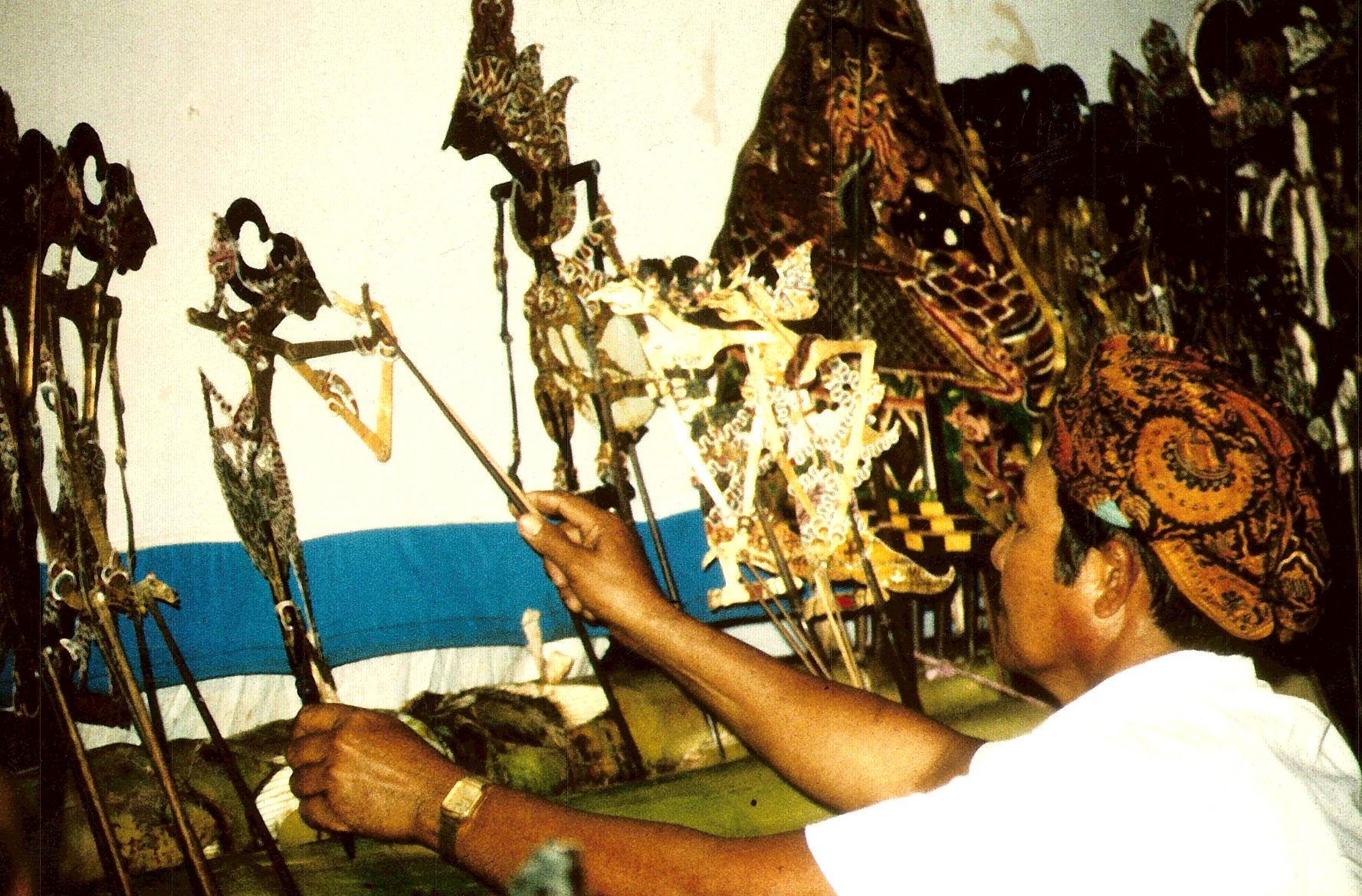
The Javanese Surinamese community preserves several traditional rooted in Central , including shadow puppet theater, which dramatizes epic narratives from Hindu-Buddhist and Islamic traditions. These performances are typically accompanied by ensembles, consisting of metallophones, drums, and gongs, adapted to local contexts despite historical resource constraints that limited instrument production. The tradition, maintained through community groups since the early , underscores cultural continuity among the approximately 80,000 Javanese Surinamese as of recent estimates. Martial arts demonstrations of and trance dances such as (also known as jaran kepang) feature prominently in communal events, emphasizing physical discipline, spiritual elements, and group synchronization. , involving stylized combat and weapon forms, serves both as recreation and identity marker, while dancers simulate horseback riding on woven props, often entering states to perform feats like fire-walking, reflecting pre-Islamic Javanese blended with Islamic practices. These performances, held during festivals and rites, reinforce social bonds and resist cultural dilution by engaging youth in ancestral rituals. Social customs center on communal reciprocity, exemplified by gotong royong mutual aid in organizing life-cycle events like slametans, which are ritual feasts invoking blessings for births, marriages, and deaths. In weddings, slametans involve shared meals and prayers, with processes including the preparation of kembar mayang symbolic offerings, fostering extended family and neighborhood participation over individualistic norms. Such practices, sustained through associations formed post-1930s independence from indenture, promote ethnic cohesion amid Suriname's multi-ethnic society, with participation rates high in rural Javanese-majority areas like Tamanredjo. Modern adaptations, including fusions in national festivals, blend these with Surinamese elements while prioritizing core Javanese motifs for identity preservation.

Socio-Economic Contributions and Challenges

Labor, Economy, and Upward Mobility

Upon completion of their contracts between 1890 and 1939, during which approximately 33,000 Javanese laborers were transported to to replace emancipated slaves on and , many transitioned to smallholder farming and informal vending to achieve economic independence. This shift was driven by limited plantation opportunities and a preference for self-sufficiency, leading to the establishment of paddies in rural districts like Wanica and Saramacca, where Javanese farmers specialized in cultivation techniques adapted from . By the mid-20th century, Javanese Surinamese had begun entering urban trades, positions, and small-scale commerce, though their penetration into these sectors lagged behind Hindustani and Creole groups until the late 1900s. In contemporary , they remain overrepresented in —particularly production, which constitutes a key staple—and informal sectors such as transportation services and entrepreneurship, including market vending and family-run enterprises in . This occupational distribution reflects both cultural emphases on agrarian and barriers to higher-wage formal employment, contributing to gradual upward mobility since the , when socioeconomic indicators for the group began converging with national averages through community-based savings and land accumulation. Remittances from the Javanese Surinamese , primarily in the , have supplemented household incomes and facilitated investments in housing and small businesses, bolstering economic resilience amid Suriname's volatile resource-dependent economy. However, persistent challenges include elevated rates of within the community, which historical analyses link to post-indenture coping mechanisms and cultural practices, eroding savings and hindering for broader mobility. Despite these factors, Javanese self-help networks have yielded lower initial exposure compared to urban-dependent groups, with progress evidenced by increased business ownership, though disparities in access to and urban markets endure.

Education, Health, and Community Self-Reliance

Javanese Surinamese exhibit levels comparable to national averages, with mean schooling of 6.5 years for men and 6.6 years for women in 2012, on a 0-14 scale where spans 0-3 years and lower secondary 4-7 years. This marks substantial generational advancement from parental averages of 3.0 years for fathers and 2.7 for mothers, overcoming early 20th-century barriers to formal schooling through emphasis on practical vocational in and trades. Such community-driven focus on skill acquisition has narrowed initial disparities, aligning Javanese outcomes with Hindustani peers and surpassing figures, while contributing to Suriname's overall adult rate of 95% by 2021. Health resilience among Javanese Surinamese stems from integrated use of traditional pharmacognosy, derived from ancient Javanese herbal formulations, which addresses physical ailments and vulnerabilities alongside modern interventions. Strong familial networks provide supplemental care, diminishing public system burdens, as evidenced by Javanese women recording the lowest stillbirth rates at 6 per 1,000 births amid national obstetric challenges. Cardiovascular risks persist, with affecting 26% overall and ischaemic heart disease elevated in Asian groups including Javanese at 52%, yet cultural practices bolster adaptive coping without predominant state reliance. Gotong royong, the Javanese of reciprocal cooperation, drives community by enabling collective endeavors such as the 1990 construction of the Sana Budaya cultural center via voluntary labor, which sustains social welfare and familial stability. This mechanism fosters tight-knit units that prioritize internal support over external dependencies, contrasting with higher state welfare uptake in other ethnic cohorts and countering unsubstantiated claims of inherent victimhood through demonstrable causal efficacy in cohesion and resource pooling.

Political Engagement

Early Political Movements and Indonesian Nationalism

In the aftermath of , Javanese Surinamese began organizing political groups that emphasized a pan-Indonesian identity, drawing inspiration from the independence struggle in their ancestral homeland. The Indonesian People’s Movement of Suriname (PBIS) emerged in 1946, advocating for improved conditions while maintaining cultural ties to through symbols such as the red-and-white flag, the anthem , and annual celebrations of 's Independence Day on August 17. Similarly, the Indonesian Farmers’ Union (KTPI), established around 1949, prioritized repatriation to via the Mulih Njowo (Return to ) campaign and petitioned Dutch authorities with protest telegrams against colonial policies restricting Javanese rights. These efforts fostered solidarity among the roughly 40,000 Javanese in —descendants of contract laborers recruited from 1890 to 1939—by framing local grievances within broader anti-colonial nationalism, including demands for political participation and economic equity. Strategies included cultural associations like the Tanah Air Foundation, founded in 1951 to support and preserve Indonesian heritage, alongside electoral engagement that secured KTPI victories in the 1949 Surinamese elections, granting representation in the colonial . These actions influenced Dutch-Indonesian relations, prompting to establish a commissariat in in 1951 to address concerns and culminating in the of 1,018 Javanese to by 1954. Despite suppression, including threats to revoke Javanese voting rights from 1951 onward due to perceived support for Indonesian independence, the movement achieved modest labor and welfare reforms by shifting focus post-1954 toward local improvements in living standards. However, internal divisions undermined cohesion: KTPI's repatriation emphasis clashed with PBIS's integrationist stance, leading to PBIS's decline by 1949 and highlighting ethnic particularism over unified action. Alliances with Creole and Hindustani groups occurred in parliamentary coalitions, yet persistent stereotypes—such as portraying Javanese as "chicken thieves"—reflected underlying ethnic tensions and realism, limiting broader anti-colonial unity in favor of group-specific advocacy amid colonial decline.

Integration into Surinamese Politics and Ethnic Dynamics

The Javanese Surinamese, constituting about 15% of the , have achieved notable post-independence through ethnically aligned parties that prioritize coalition-building in Suriname's fragmented . Parties such as the Kaum Tani Persatuan Indonesia (KTPI), rooted in agrarian Javanese interests, participated in early post-1975 coalitions, including the New Front alliance alongside Creole and Hindustani groups, countering dominance by the larger Hindustani (27%) and Creole (18%) blocs. The later (PL), founded in 1998 under , continued this pattern, securing ministerial roles in governments like Desi Bouterse's 2010-2020 administration by allying with the National Democratic Party, thereby amplifying Javanese leverage beyond demographic weight. Ethnic voting patterns, persistent despite some erosion, have reinforced Javanese parties' role as pivotal swing blocs in power-sharing arrangements, fostering multi-ethnic cabinets essential for stability in a society without a majority group. However, this dynamic has generated frictions, as rigid ethnic loyalties contribute to governmental instability, evidenced by frequent shifts and Suriname's of coups and parliamentary deadlocks post-1975. Javanese leaders have resisted policies perceived as favoring larger groups, such as disproportionate resource allocations to Hindustani or Creole constituencies, advocating instead for equitable tied to their agricultural heritage. Suriname's consociational framework, shaped by its small scale and ethnic pluralism, has benefited from Javanese inclusion, distributing power to mitigate zero-sum conflicts and enhance national cohesion; for example, KTPI-influenced coalitions in the 1980s-1990s supported agrarian reforms that stabilized rural economies, reducing urban-rural divides amid economic volatility. Despite critiques of fragmentation, empirical patterns show that such pluralism correlates with lower ethnic violence compared to non-power-sharing multi-ethnic states, as Javanese participation ensures broader policy buy-in. In recent elections, like 2020, PL retained two seats, underscoring ongoing coalition indispensability.

Diaspora and Transnational Ties

Post-Independence Migration Patterns

Following Suriname's independence from the on November 25, 1975, a significant outflow of Javanese Surinamese occurred, primarily to the , amid fears of losing Dutch citizenship and economic uncertainty. Approximately 20,000 Javanese emigrated in the , contributing to the broader Surinamese exodus that saw over 110,000 Surinamese in the by the end of 1975. This migration intensified after the 1980 military coup led by , which triggered economic decline and political instability, prompting further departures from rural areas where many Javanese resided. Migration patterns were predominantly family-based and chain-driven, with initial migrants sponsoring relatives, leading to the formation of ethnic enclaves in urban centers such as and . These communities often replicated kampong-like social structures, emphasizing kinship networks and cultural continuity rather than individual economic pursuits alone. Economic motivations, including access to better opportunities and welfare systems in the , outweighed claims of direct , as much of the pre-1980 movement preceded major violence. Despite settlement in the , Javanese Surinamese maintained ties to through regular visits and remittances, though return migration rates remained relatively low compared to other Surinamese groups, reflecting entrenched family and in Dutch society. By the 1980s, the total Surinamese population in the had risen to 145,000, with Javanese forming a notable subset that sustained transnational connections without widespread . The Javanese Surinamese community maintains ongoing cultural and diplomatic ties with , primarily through participation in Indonesian-organized events and initiatives aimed at preserving shared heritage. Since , community members have actively engaged in Indonesian cultural activities, such as programs and heritage workshops, to reinforce ancestral connections despite historical migration disruptions. These efforts contribute to bilateral relations, with the serving as a bridge for economic opportunities, including potential Indonesian exports like agricultural products tailored to Javanese preferences in . 's toward the group emphasizes mutual identity reinforcement, fostering goodwill without large-scale repatriation, as most Javanese Surinamese express reluctance to relocate permanently to due to established local roots. On a global scale, Javanese Surinamese participate in transnational networks that link dispersed communities, including those in and , where Javanese populations preserve linguistic and customary elements akin to Surinamese practices. Organizations like the Global Javanese Diaspora promote cross-border exchanges, such as webinars and events hosted by institutions like PUI Javanologi at Universitas Sebelas Maret, which in 2023 gathered representatives from , , , and the Surinamese ambassador to discuss heritage preservation and mutual cooperation. These networks facilitate projection of Javanese communal values, exemplified by gotong royong (mutual assistance), through diaspora-led initiatives that extend cultural influence beyond . Generational shifts pose challenges to these links, with younger Javanese Surinamese often experiencing diluted ties to amid local assimilation and in . However, digital platforms have spurred revival, enabling virtual connections via groups like Global Javanese Diaspora Suriname, which unite members for heritage discussions and event coordination across continents. This online engagement counters disconnect by providing accessible avenues for identity reinforcement, particularly among diaspora youth navigating hybrid cultural contexts.

Notable Individuals

Political and Activist Figures

Salikin Hardjo (1910–1993), a Javanese-born activist who migrated to , founded the Pergerakan Bangsa Indonesia Suriname (PBIS) in the late to promote and critique Dutch colonial governance among the Javanese community. His efforts included organizing initiatives for Javanese Surinamese seeking return to post-1945 independence, addressing grievances over contract labor exploitation and cultural disconnection. Hardjo's involvement extended to Surinamese politics through affiliation with the (NPS), where he influenced early Javanese party formation and participated in the 1948 Conference negotiations on colonial reforms. Iding Soemita (1908–2001), an indentured laborer from , led the Kaum Tani Persatuan Indonesia (KTPI), established in 1949 as a peasant-focused party advocating for Javanese farmers' land rights and economic upliftment in Suriname's agrarian sector. KTPI's platform emphasized reforms to secure smallholder plots and access, benefiting Javanese communities transitioning from plantations to independent farming, and secured parliamentary seats in multi-ethnic coalitions from the onward. Soemita's leadership fostered Javanese political mobilization but drew critiques for prioritizing ethnic over broader Surinamese integration, as seen in KTPI's early alignment with Indonesian return movements amid post-colonial tensions. Paul Somohardjo (1937–2010) founded the party in 1998 to consolidate Javanese representation in Suriname's , achieving consistent electoral success by addressing community-specific issues like cultural preservation and equitable resource allocation in ethnic coalitions. The party's advocacy contributed to policies enhancing minority ethnic quotas in governance, though it faced accusations of for leveraging Javanese voter blocs in alliances dominated by larger Hindustani and groups.

Cultural and Intellectual Contributors

Karin Amatmoekrim, a Surinamese-Dutch writer born in 1976, has contributed significantly to exploring Javanese-Surinamese experiences, with her works drawing from her Javanese-Surinamese family background. Her 2011 novel Het gym portrays a Surinamese protagonist navigating , reflecting broader themes of ethnic identity in multicultural settings. Amatmoekrim's writing, including essays on Surinamese history as a transmodern project, challenges assimilation narratives by highlighting overlooked Javanese contributions to . In performing arts, Javanese-Surinamese practitioners have revived traditional forms like shadow puppetry and music, adapting them to local contexts while preserving cultural continuity. Dalang Sapto Sopawiro, active into the late 20th century, maintained wayang traditions introduced by 19th-century immigrants, using performances to transmit Javanese moral and historical narratives to younger generations amid declining language proficiency. ensembles in Suriname blend original Javanese instrumentation with influences from terbangan percussion, fostering community events that sustain ethnic heritage despite multilingual pressures. Literary efforts in Surinamese Javanese, though sporadic, include vernacular poetry that asserts community pride and resists cultural erosion, as seen in works describing Javanese as "proud new citizens" of published in the . These publications, often oral-derived, counter the shift toward Dutch and dominance, with younger Javanese-Surinamese showing limited fluency in their ancestral language, estimated at under 20% conversational proficiency by the . While such introspective outputs strengthen intra-community bonds, critics note their niche focus may limit crossover appeal to wider Surinamese or international audiences, prioritizing preservation over broader dialogue.

References

Add your contribution
Related Hubs
User Avatar
No comments yet.