Hubbry Logo
JuneeJuneeMain
Open search
Junee
Community hub
Junee
logo
8 pages, 0 posts
0 subscribers
Be the first to start a discussion here.
Junee
Junee
from Wikipedia

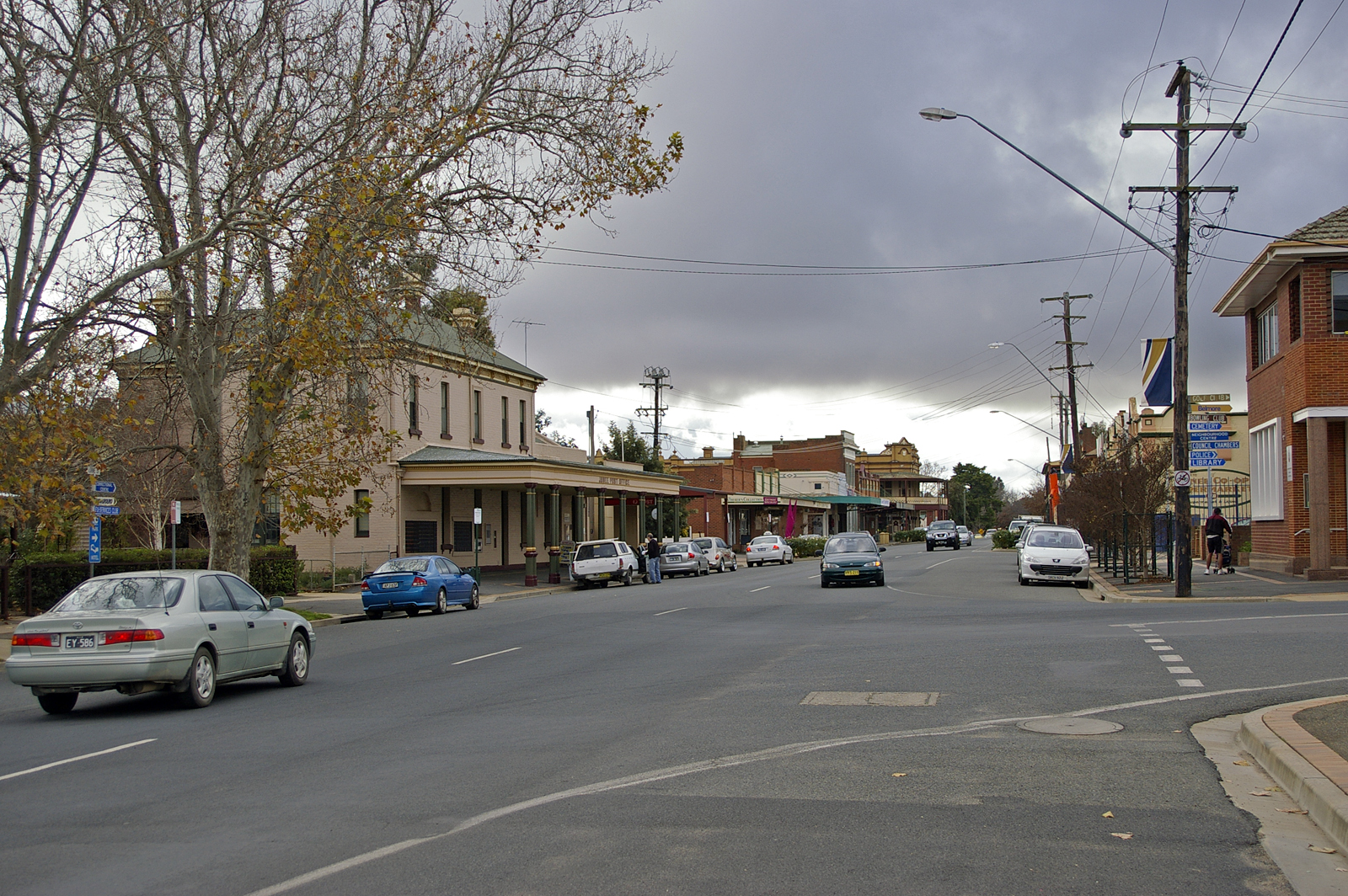
Junee (/ˈn/)[3] is a medium-sized town in the Riverina region of New South Wales, Australia. The town's prosperity and mixed services economy is based on a combination of agriculture, rail transport, light industry and government services, and in particular correctional services. In 2021 Junee's urban population was 4,882.[4]

Key Information

Place name

[edit]

One theory is that word Junee which originates from the Aboriginal word 'Junee' means "speak to me".[5] Another theory is that it is an Aboriginal word "Choo-nee" meaning "frog".[6]

History

[edit]

The Wiradjuri people are the traditional owners of the local area prior to European settlement. Leopold de Salis (1816–1898), pastoralist and later politician was one of the first squatters to open up the Riverina region to grazing.[7] He established the 'Junee' pastoral run in 1845. Leopold held the licence for this run for a total of three years. Other run licencees followed until Thomas Hammond and Richard Gwynne bought the licence in 1857. The Junee run progressively reduced in area as selectors took up land but Hammond lived on it until his death in 1899, the remaining property having been named "Wyoming" in 1887. A post office opened in 1862 and a village called 'Junee' was gazetted in 1863 on the wool road to Sydney. That same year, Ben Hall and his bushranging gang raided the village.[8]

Junee railway station with a CountryLink XPT at the platform in 2009

In 1866 Junee's population was recorded as twelve but the discovery of reef and alluvial gold during the 1860s triggered a gold rush. The main sites- Junee Reefs (to the north), was mined on and off until after World War 1, as well as Wantiool and Eurongilly (to the east) until the 1880s.

By 1878 with the southward expansion of the Main South line in New South Wales, the main railway line between Sydney and Melbourne passed 8 kilometres east of the village. Junee's Post Office was renamed Old Junee in 1885 (Junee railway station).[9][better source needed] Loftus was the original name of the locality being farm land and as the settlers moved in for the rail line it was renamed. Junee Railway Station Post Office opened on 6 July 1878, was renamed Junee Junction in 1881 and later still, Junee in 1893.[9]

Rail and road

[edit]

The Main South railway line between Sydney and Melbourne runs through Junee, as does the Olympic Highway, named for the route of the 1956 Summer Olympics Torch Relay. The advent of rail transport in 1878 provided the impetus for an economic boom providing local agricultural producers with affordable direct access to markets in Sydney. In 1952 the largest wheat terminal in the Southern Hemisphere was constructed at Junee, adjacent to the South West Railway, providing both rail and road transport.[8]

Rail transport makes an important contribution to the local economy with Regional Rail Logistics[needs update] operating a containerised freight service that delivers various goods from Junee to Sydney,[10] with interstate freight trains also passing through the town.

Local Government

[edit]

On 1 January 1981, Junee Municipal Council amalgamated with the surrounding "Illabo Shire Council', creating Junee Shire Council.

Climate

[edit]

Junee has as a rather dry humid subtropical climate (Köppen Cfa), lying about 75 millimetres or 3 inches above semi-arid classification. It features hot and dry summers and cool, moderately cloudy winters. The highest temperature recorded at Junee was 46.1 °C or 115.0 °F on 31 January 1968; the lowest recorded was −5.0 °C or 23.0 °F on 1 July 1971 and 6 August 1974. The average annual rainfall is 530.6 millimetres or 20.89 inches spread across 88 days (with the majority in winter). It can snow on rare occasions, with the last snowfall in August 2019.

Climate data for Junee Treatment Works (1907–1975, rainfall 1891–2022); 280 metres (919 ft) AMSL; 34.85° S, 147.57° E
Month Jan Feb Mar Apr May Jun Jul Aug Sep Oct Nov Dec Year
Record high °C (°F) 46.1
(115.0)
44.4
(111.9)
40.6
(105.1)
32.8
(91.0)
25.6
(78.1)
21.6
(70.9)
23.0
(73.4)
26.1
(79.0)
33.3
(91.9)
35.0
(95.0)
38.3
(100.9)
40.6
(105.1)
46.1
(115.0)
Mean daily maximum °C (°F) 32.4
(90.3)
31.6
(88.9)
28.4
(83.1)
22.8
(73.0)
17.9
(64.2)
13.9
(57.0)
13.2
(55.8)
15.1
(59.2)
18.9
(66.0)
22.7
(72.9)
27.0
(80.6)
30.8
(87.4)
22.9
(73.2)
Mean daily minimum °C (°F) 15.5
(59.9)
15.6
(60.1)
12.9
(55.2)
8.6
(47.5)
5.5
(41.9)
3.3
(37.9)
2.3
(36.1)
3.2
(37.8)
5.0
(41.0)
7.4
(45.3)
10.2
(50.4)
13.5
(56.3)
8.6
(47.4)
Record low °C (°F) 5.6
(42.1)
7.0
(44.6)
3.9
(39.0)
0.6
(33.1)
−2.8
(27.0)
−4.0
(24.8)
−5.0
(23.0)
−5.0
(23.0)
−3.3
(26.1)
−2.8
(27.0)
1.7
(35.1)
3.8
(38.8)
−5.0
(23.0)
Average precipitation mm (inches) 40.8
(1.61)
37.2
(1.46)
40.9
(1.61)
40.6
(1.60)
42.9
(1.69)
49.8
(1.96)
47.0
(1.85)
46.8
(1.84)
44.2
(1.74)
50.9
(2.00)
44.7
(1.76)
41.4
(1.63)
530.6
(20.89)
Average precipitation days (≥ 0.2 mm) 4.9 4.6 4.5 5.5 7.8 9.5 11.2 11.0 8.8 8.2 6.3 5.4 87.7
Source: Bureau of Meteorology (1891–2022)[11]

Heritage listings

[edit]
Photograph of Junee Post Office from across street
Junee Post Office, Lorne Street

Junee has a number of heritage-listed sites, including:

Other attractions

[edit]

Demographics

[edit]

According to the 2021 census, there were 4,882 people in Junee.

Historical population
YearPop.±%
19213,560—    
19334,213+18.3%
19474,010−4.8%
19544,064+1.3%
19613,980−2.1%
19663,906−1.9%
19713,772−3.4%
19764,005+6.2%
19813,993−0.3%
19863,720−6.8%
19913,673−1.3%
19963,681+0.2%
20013,589−2.5%
20063,744+4.3%
20114,400+17.5%
20164,762+8.2%
20214,882+2.5%
Source: Australian Bureau of Statistics data.[16][4][17][18][19][20]

Sport

[edit]

The most popular sport in Junee is rugby league. The town's team, the Junee Diesels, compete in the Group 9 Rugby League competition, in which they have won two premierships. The club is notable for having produced New South Wales and Australian captain Laurie Daley.

The town had now defunct Australian rules and rugby union teams, known as the Bulldogs and Rams.[21]

Notable people

[edit]

Communications

[edit]

Junee is served by:

  • Junee Independent newspaper
  • Radio 1RPH transmitter (99.5FM)

See also

[edit]
[edit]

References

[edit]
[edit]
Revisions and contributorsEdit on WikipediaRead on Wikipedia
from Grokipedia
Junee is a town in the region of , , situated approximately 40 kilometres north of along the Olympic Highway. Originally gazetted as the village of Jewnee in 1863 near a pastoral run established in the , the modern town developed in the late 1870s as a key junction following the arrival of the Great Southern Railway in 1878, and was officially renamed Junee in 1885 after local petitions. As of the 2021 census, Junee had a population of 4,882 residents, representing a diverse community with strong Indigenous representation at 11.0%. The town's economy is mixed and services-based, with significant contributions from agriculture—particularly cereal crops valued at $66 million as of 2020/21—and rail transport, bolstered by its position on the Main Southern Railway line between Sydney and Melbourne. Junee's heritage as a railway hub is epitomized by the Junee Roundhouse Railway Museum, opened in 1947 and once the largest roundhouse in the Southern Hemisphere, which preserves steam locomotives and railway artifacts. The town attracts visitors with its well-preserved , rolling hills, and notable attractions, including the infamous —built in 1884 and reputed as Australia's most haunted house due to reported —and the Junee Licorice and Chocolate Factory, a family-owned producer offering tours and tastings since 2001. Junee also supports a vibrant community life with four local schools, excellent medical facilities, and proximity to higher education in , making it a desirable location for families seeking an affordable, rural lifestyle.

Geography and Climate

Location and Setting

Junee is situated at coordinates 34°52′S 147°35′E, with an elevation of approximately 301 meters above . The town lies in the South West Slopes bioregion of , approximately 38 kilometers north of , within the broader district. This location places Junee on the traditional lands of the people, who are acknowledged as the custodians of the area. The topography of Junee consists of flat to gently undulating plains characteristic of the , with modest elevation variations and low-relief riverine floodplains. These features include fertile alluvial soils that underpin the region's . The surrounding environment is shaped by its proximity to the basin, which influences local and landforms through associated waterways and ephemeral courses. As part of Junee Shire, the town occupies a defined urban area integrated with natural features, including the Junee Wetlands—a biodiversity-rich site that supports local and —and nearby reserves such as Bethungra Dam, which contribute to the shire's environmental diversity. The shire boundaries encompass approximately 2,030 square kilometers of varied terrain, blending the town's structured layout with these ecological elements.

Climate

Junee features a classified as Köppen Cfa, marked by hot, often humid summers and mild winters with no pronounced . The annual mean maximum temperature is 22.9 °C, while the mean minimum is 8.6 °C, based on records from 1907 to 1975. Extreme temperatures include a record high of 46.1 °C on 31 January 1968 and a record low of -5.0 °C on 6 1974. Average annual precipitation totals 526.4 mm, distributed relatively evenly across the year, though slightly higher in winter and spring. Monthly averages range from 37.4 mm in February to 50.6 mm in October, with summers experiencing relatively lower rainfall and winters remaining comparatively dry overall. Snowfall is uncommon but can occur during cold snaps, as seen in August 2019 when flurries reached regional New South Wales areas including Junee. The region's climate exhibits variability, with periodic droughts posing significant risks to in the , where reduced rainfall leads to shortages affecting yields and production. Recent trends show warming conditions, with rising temperatures exacerbating heat extremes and altering patterns as observed through 2025.

History

Indigenous and Early Settlement

The land now known as Junee has been occupied by the Wiradjuri people for thousands of years, who are the traditional custodians of the region. As part of the Wiradjuri nation's extensive territory along the Murrumbidgee, Lachlan, and Macquarie rivers, the area holds deep cultural significance, encompassing songlines, dreaming stories, and sites tied to the goanna totem that reflect the people's spiritual and ancestral connections to Country. The Wiradjuri language, part of the broader Yuin-Yithangithi group, was spoken across this landscape, embedding place names and narratives that described the environment and its resources. The name "Junee" derives from the , with interpretations including "speak to me," reflecting a call for communication or in traditional contexts. Alternative derivations suggest it means "two spears lying across," symbolizing crossed weapons or a , while another variant, "Choo-nee," translates to "frog," possibly alluding to local waterways and fauna. These etymologies highlight the linguistic richness of heritage in naming the land, which European settlers later adopted and adapted, initially spelling it as "Jewnee." European contact began in the mid-19th century with pastoral expansion into Country. In 1845, Leopold Fane de Salis, an Italian-born settler, established the "Junee" pastoral run—a large sheep and —on land centered around what is now Old Junee, marking one of the earliest European outposts in the area amid broader activities during the and 1850s. This run, initially unoccupied and spanning thousands of acres, served as a base for production along early stock routes, though it faced challenges from the rugged terrain and distance from markets. By the early 1860s, as gold discoveries drew prospectors southward, the region saw increased transient activity, transforming the pastoral outpost into a nascent settlement hub. Pre-railway settlement formalized in 1863 when the small village of "Jewnee" was officially gazetted along the wool road connecting to southern districts, including a that had opened the previous year to support mail and traveler needs. This early village, comprising rudimentary inns and stores, quickly became a target for ; in the same year, notorious Ben Hall and his gang conducted a raid on the outpost, robbing travelers and underscoring the vulnerabilities of frontier life in the district.

19th Century Development

The village of Jewnee was officially gazetted in 1863 on the site of an earlier stock run, positioned along linking inland areas to for overland transport of and other . A post office had opened the previous year in 1862, supporting initial trade and communication needs, while basic infrastructure like hotels and general stores emerged to serve drovers, settlers, and passing traffic on routes extending toward . This pre-gold phase established Junee as a modest waypoint in the region's economy, focused on sheep and production. The discovery of alluvial and reef gold in the late 1860s transformed the area, initiating a rush that attracted miners from nearby fields like Grenfell and sparked an economic surge around Junee Reefs, approximately 20 km north of the village. By July 1868, active mining operations were reported, leading to rapid settlement growth; the Junee Reefs community reached about 100 residents by 1869, with a nearby outpost at Sebastopol housing around 120 people in tent accommodations amid surrounding claims. The population influx peaked at approximately 4,000 during the early 1870s heyday, fueling prosperity through gold yields that funded local ventures, though activity waned by 1871 as prospectors shifted to richer sites like Gulgong. Before the railway's influence, Junee's economy centered on alongside ongoing , with sheep stations providing steady wool output and road-based trade sustaining commerce along the wool routes to coastal ports. Gold revenues from key sites like the Dirt Hole mine supported early diversification, but the sector's volatility highlighted reliance on agricultural staples and overland exchanges with neighboring towns. Social cohesion strengthened in the as the community formalized institutions; a public school opened in 1880 to educate growing families, initially serving children from and farming households. Religious life took root with the first Anglican service held on March 7, 1880, in the emerging town center, followed by the construction of the Presbyterian Church in 1905; an earlier Methodist church building, dating to the , also hosted provisional schooling before dedicated facilities. These developments reflected the shift from transient camps to a more stable settler society.

Railway Expansion and Economic Growth

The arrival of the marked a pivotal shift for Junee, with the Main Southern line extending to the town on 6 1878, establishing it as the temporary terminus from Bethungra. This development relocated the original settlement, previously centered on 6 km to the east, to a new site around the station for better access to flatter terrain, fostering rapid township formation. By 1880, the line extended further to Bomen, solidifying Junee's role as a key junction, while railway sheds and workshops were relocated from , employing initial staff and spurring infrastructure growth. The station building, designed by NSW Government Railways engineer John Whitton, was completed in March 1885, incorporating refreshment rooms and a to support increasing . This railway expansion transformed Junee's economy from a modest outpost—with a population of just 12 in 1866—to a thriving rail-dependent hub by the late 1880s, providing affordable transport for local agricultural produce and attracting settlers. Workshops at Junee became a major employer, supporting hundreds of workers and their families through maintenance and repairs, which sustained the town's prosperity into the . By the , Junee had evolved into a central rail operations node on the interstate Main Southern line to and Victoria, with branch lines like the 1881 extension to enhancing its junction status and boosting regional connectivity. The parallel development of the Olympic Way (d as Main Roads 57 and 239 in August 1928) complemented , improving road access and integrating freight movement by the late 1920s. (Note: Using Wiki for route history as primary gazette reference; cross-verified with government records.) During the world wars, Junee's rail facilities saw heightened activity, with the line duplicating between and Junee in to handle increased troop movements, supplies, and critical to the . The completion of the massive 42-road roundhouse in 1947—the last depot built by NSW Government Railways—underscored its strategic importance, servicing engines amid post-war recovery. However, the shift to dieselization in the 1970s, culminating in the end of steam operations by 1974, led to a decline in rail employment and maintenance activities, reducing the sector's economic dominance as diesel locomotives required less intensive servicing. Despite this, the railway's legacy as the foundation of Junee's growth persisted, with workshops adapting to modern needs.

Local Government Formation

The establishment of local government in Junee began in response to the rapid growth spurred by the railway's expansion, which created a need for organized administration to manage the burgeoning settlement. In 1886, Junee was incorporated as a provisional under the Municipalities Act, with the first election of aldermen occurring shortly thereafter. By 1887, it achieved full municipal status as the Junee Municipal Council, enabling the adoption of by-laws to regulate urban development and services. Early mayors, such as G.F. Phelps who served from 1886, played pivotal roles in rail-era planning, overseeing infrastructure like streets and public facilities to support the junction's economic hub status. Over the decades, administrative boundaries evolved through mergers to address regional needs. The Junee Municipal Council operated independently until 1 January 1981, when it amalgamated with the neighboring Illabo Shire under the Local Government Areas Amalgamation Act 1980, forming the Junee Shire Council. This consolidation integrated urban and rural governance, expanding the council's jurisdiction. The amalgamation reflected broader NSW reforms to streamline local authorities amid post-war population shifts. Subsequent adjustments refined the shire's structure, emphasizing efficient service delivery across diverse communities. In recent years, the Junee Shire Council has focused on forward-looking governance, exemplified by the adoption of the "Making Tracks" Community Strategic Plan on 24 June 2025, which outlines a vision to 2040 for sustainable growth and community priorities. Key milestones include mayoral leadership in integrating rail heritage with modern planning, ensuring resilience against economic changes. Today, the shire encompasses approximately 2,030 square kilometers, serving over 6,000 residents with essential services such as , community facilities, and environmental protection, while fostering regional collaboration. This structure supports a stable administrative framework amid steady trends.

Demographics and Education

Population and Demographics

As of the , the population of Junee town stood at 4,882 residents. This figure reflects the urban centre and locality (UCL) boundaries defined by the Australian Bureau of Statistics (ABS). The broader Junee Shire, which includes the town and surrounding rural areas, recorded 6,415 people in the same , highlighting an urban-rural split where the town comprises about 76% of the shire's total population. By 2025, the shire's estimated resident population (ERP) had risen to 6,738, indicating modest ongoing growth. Historical population trends for Junee town show steady expansion in the early , from 3,589 residents in the 1921 to an increase of 3,744 in 1954, driven by railway development and agricultural opportunities. The shire's similarly peaked in the at around 6,303, before experiencing a gradual decline through the mid-20th century due to shifts in regional employment patterns. Recent decades have seen stabilization and slight increases, with the town's rising from 4,762 in 2016 to 4,882 in 2021. Demographically, Junee's residents have a median age of 39 years, slightly below the shire's of 41. The composition is predominantly Australian-born, with 84.1% of the town's population originating from , while Aboriginal and Torres Strait Islander people account for 11.0% (538 individuals). Household structures include 66.2% family households and 30.4% single-person households, with couple families without children forming the largest subgroup at 41.7%. Median weekly household income in the town is $1,334, supporting a stable regional profile. Population growth in Junee has been influenced by migration patterns linked to its historical railway hub and agricultural base, which attracted workers during expansion phases in the 19th and early 20th centuries. In recent years, increases stem from the area's regional appeal, including lifestyle factors that draw internal and overseas migrants seeking affordability and proximity to larger centers like . Overseas migration has driven 77.5% of post-2021 growth in the statistical area, complemented by increase.

Education Facilities

Junee Public School, established in 1880, serves the central Junee community and surrounding rural areas with a focus on , , and positive behavior programs. The school enrolled 108 students in 2023, including 24% from Aboriginal backgrounds, and features heritage buildings alongside modern classrooms supporting evidence-based teaching practices. Junee North Public School, founded in 1923, caters to 104 students as of 2024, with 14% Aboriginal enrollment, and emphasizes curriculum differentiation, explicit teaching, and pathways for diverse needs. It includes facilities such as a Yarning Circle with Indigenous artworks and recent investments in technology to enhance . These primary schools trace their origins to provisional one-room schools in the late , evolving from basic elementary education amid Junee's railway-driven growth into comprehensive institutions with integrated support for transitions. Both schools incorporate modern STEM elements through hands-on science and technology integration, preparing students for while addressing enrollment drawn from Junee's of approximately 4,000 residents. Junee High School, established in 1961 as the town's sole secondary institution, provides comprehensive education for Years 7 to 12 with an enrollment of 265 students in 2023, including 22% Aboriginal students. The encompasses Higher School Certificate (HSC) preparation, electives in Stage 5 and 6, and options like TAFE-delivered courses, virtual classes, and , alongside a Support Unit for multi-categorical needs. Facilities include state-of-the-art science laboratories, a (BYOD) program with provided electronics, and well-maintained grounds supporting extra-curricular activities such as sports and cultural excursions. Vocational training links to the local economy through School-based Apprenticeships and Traineeships (SBAT), work placements, and experiences tailored to agriculture and primary industries, with 44% of students in 2023 undertaking vocational or trade training and 81% attaining HSC or equivalent qualifications. In 2025, the school completed an LED lighting upgrade as part of a statewide $157.8 million program to improve energy efficiency and learning environments. Preschool options in Junee include community-based providers for children aged 3 to 5, such as Junee Preschool, which delivers programs aligned with the in a not-for-profit setting. Additional facilities like Little Kindy Junee and Junee Kids Early Learning offer preschool sessions emphasizing play-based learning and school readiness, with daily programs supporting up to 3-5-year-olds. For adult education, provides outreach services including vocational courses and the Adult Migrant English Program, often delivered through partnerships with local high schools or nearby campus, focusing on skills for employment in regional industries. Enrollment across Junee's primary and secondary schools has remained stable at around 477 students in recent years, reflecting steady community demand amid rural trends.

Economy

Agriculture and Primary Industries

Junee's agricultural sector is dominated by dryland cropping and livestock grazing, reflecting its position in the region. The primary crops include , , and canola, which together form the backbone of production across the shire's approximately 2,030 square kilometers of . In 2020/21, crops accounted for 41.5% of the shire's total agricultural output, valued at $66 million, underscoring their economic importance. Livestock activities, particularly sheep and grazing, contribute significantly, with livestock slaughterings representing 23.4% of output ($37 million) and production adding 8.6% ($13.6 million). These sectors support broadacre farming systems adapted to the region's , where rainfall variability influences planting and yields. The total agricultural output reached $275 million in 2023/24. Historically, Junee's economy transitioned from gold mining to pastoralism in the late 19th century. Gold discoveries at Junee Reefs in 1868 initially drove settlement, but as alluvial mining waned post-1870s, the area shifted toward sheep and cattle grazing on established pastoral runs dating back to the 1840s. This pivot was facilitated by the fertile soils of the Riverina plains, with limited irrigation from the nearby Murrumbidgee River enhancing pastoral and early cropping viability, though the shire remains predominantly reliant on dryland methods. By the early 20th century, grain cultivation expanded, integrating with grazing to form mixed farming enterprises that stabilized the local economy. In modern times, Junee's primary industries produce substantial grain harvests, contributing to regional outputs exceeding 100,000 tonnes annually of , , and canola, bolstered by sustainable practices such as and to mitigate climate variability. predominates, with farmers employing and to maintain yields amid irregular rainfall patterns influenced by broader weather trends. These efforts ensure resilience, as seen in the shire's total agricultural output of $275 million in 2023/24. in , , and engages about 17.3% of the local workforce (384 jobs in 2023/24), fostering community ties through cooperatives like the longstanding Junee District Co-operative Society and regional grain markets that facilitate produce distribution via nearby rail infrastructure.

Industry and Services

Junee's non-agricultural economy is significantly anchored by rail logistics, which leverages the town's position on the Southern Railway line. The Junee Railway Workshop serves as a key maintenance facility for freight and passenger operations, supporting companies such as the Australian Rail Track Corporation (ARTC), , and Qube in handling repairs, inspections, and freight coordination. This sector employs 11.6% of the local workforce, totaling 258 jobs within transport, postal, and warehousing activities in 2023/24, contributing to the area's role in regional freight networks enhanced by the ongoing project, which is advancing toward completion by 2027. Manufacturing in Junee focuses on , particularly , with the Junee Licorice and Chocolate Factory standing out as a prominent example. Established in a historic flour mill building acquired by the Druce family in 1998, the factory produces organic licorice and chocolate products using locally grown ingredients, employing local staff and participating in youth training programs with Junee High School and . The sector overall accounts for 10.3% of employment, or 229 jobs in 2023/24, including operations at Junee Prime Lamb, a major abattoir and processing facility with around 300 employees that processes lamb for domestic and export markets. Services form the backbone of Junee's tertiary economy, encompassing healthcare, public administration, and professional firms, with roughly 60% of the 2,223 total jobs in 2023/24 falling into these categories when combining public administration (18.6%), health care and social assistance (8.8%), and related areas like education and retail. The Junee Multipurpose Health Service, operated by the Murrumbidgee Local Health District, provides 24-hour emergency care, acute hospital beds, residential aged care, and community services such as nursing and physiotherapy, employing over 50 nurses to serve the shire's residents. Professional services include firms supporting rail and agriculture, alongside retail outlets that bolster daily community needs. Recent economic growth in Junee as of 2025 includes investments in , highlighted by the 2.32 MW Junee Solar Farm, an operational behind-the-meter project since 2024 supplying stable power to Junee Prime Lamb and aligned with the shire's Renewable Energy Action Plan for leveraging private and government funding. Emerging tech services are also gaining traction through digital support for and , though still nascent compared to traditional sectors. These developments build on agricultural inputs and rail infrastructure to diversify the .

Tourism and Retail

Tourism plays a significant role in Junee's visitor economy, with heritage sites serving as primary draws for regional travelers arriving by rail and . In 2023/24, total tourism sales reached $17.4 million, including $9.8 million in , supporting 121 jobs directly and indirectly. The sector's output averaged around $8 million annually prior to the , dipping to $5.4 million in 2020 before recovering through increased domestic visitation. Retail in Junee centers on Broadway, the main street lined with specialty shops offering fashion, home goods, and local products, alongside a co-operative established in 1925. A standout attraction is the Junee Licorice and Chocolate Factory, housed in a historic flour mill, which functions as a retail-tourism hybrid by providing guided tours, free tastings, and on-site sales of handmade . The factory draws 160,000 visitors yearly, boosting retail spending through its Willy Wonka-inspired store and experiential offerings. Events further enhance Junee's appeal, with the annual Junee Show, held since 1888, featuring agricultural displays, live entertainment, and community activities that attract thousands each October. The Junee Rotary Farmers Markets, occurring monthly, promote local produce such as wine, olives, cheese, and organic beef from the region, fostering direct sales and ties. Post-2020, Junee's has rebounded with a 45% rise in regional overnight spending from February 2020 to February 2021, emphasizing domestic markets and nature-based experiences like Bethungra Dam for eco-tourism growth. Ongoing initiatives include digital enhancements, such as online promotion and bookable experiences via and the Visitor Information Centre, to streamline access to attractions and support sustainable recovery into 2025.

Infrastructure and Transport

Road and Rail Infrastructure

Junee serves as a significant junction on the Main Southern railway line, which connects to and facilitates both passenger and freight movements across southern . The line's infrastructure at Junee supports key intermodal operations, including connections to branch lines like the Junee to Griffith corridor, enhancing regional freight efficiency. Junee Railway Station is a heritage-listed facility that accommodates passenger services operated by , including daily XPT trains between and . Freight services on the Main Southern line, managed by the Australian Rail Track Corporation, handle substantial volumes of agricultural commodities, with Junee acting as a critical hub for loading and distribution. Recent developments include the project's replacement of the Kemp Street bridge in Junee, with designs unveiled in August 2025 and demolition completed in September 2025, improving safety and connectivity. Proposals for integration along the Sydney-Melbourne corridor continue to advance planning stages to boost regional connectivity and . Logistics expansions focus on rail upgrades between Junee and Griffith to increase grain export capacity, shifting more agricultural freight from roads to rail and supporting the Riverina's production of grains and other commodities. The Olympic Way, designated as State Route A41, forms the primary arterial road through Junee, linking it northward to and southward to , thereby supporting regional connectivity and commerce. The Sturt Highway (A20) lies in close proximity approximately 40 kilometers south of Junee via the Olympic Way, providing access to broader interstate routes toward . Local road maintenance, including patching and culvert replacements along the Olympic Way, is overseen by Junee Shire Council to ensure safety and durability. Public transport in Junee includes bus services operated by Junee Buses Pty Ltd, which cover multiple routes with approximately 138 stops across the local area, connecting to nearby towns like . Cycle paths and shared pedestrian infrastructure link key destinations such as schools, , and the , with ongoing upgrades including new bike tracks along Rocky Hill and from Junee to Old Junee. Accessibility enhancements at Junee Railway Station, funded through the NSW Government's Transport Access Program, feature improved paths, ramps, and parking to better serve users with disabilities and limited mobility.

Communications and Utilities

Junee residents have access to local media outlets that provide community-focused news and information. The Junee Independent serves as a key local newspaper, covering news, sports, and events in the region. Additionally, the Junee Southern Cross is a weekly publication delivering local news, community events, and sports coverage for Junee and surrounding areas. Radio broadcasting includes 1RPH on 99.5 FM, a volunteer-operated station that relays content from , offering readings of newspapers, magazines, and other print materials primarily for people with print disabilities, while also entertaining the broader community. Telecommunications infrastructure in Junee supports reliable connectivity for residents and businesses. The (NBN) has been available in the area, with fiber-to-the-premises (FTTP) options progressively rolling out since the mid-2010s, enabling high-speed plans starting from around 2018 in many premises. Mobile coverage includes 4G and emerging 5G services from major providers such as , , and , with strong signal availability across the postcode 2663. Essential utilities are managed through regional and local systems to ensure reliable service. Water supply for Junee is sourced primarily from surface water in the catchment and bores, delivered via schemes operated by Goldenfields Water County Council, including treated river allocations. Electricity is transmitted through the high-voltage network managed by TransGrid, which operates key infrastructure like the Junee 132/66 kV substation to distribute power across . Waste management falls under the Junee Shire Council, which oversees kerbside collections, a facility in Kahmoo Lane, and rural transfer stations, with processed fortnightly and general directed to regional facilities like Gregadoo. In 2025, infrastructure saw significant enhancements through NBN Co's nationwide upgrades, boosting speeds for fixed-wireless and fiber connections to support and digital services; eligible Junee premises on FTTP or networks automatically transitioned to higher tiers, such as up to 500 Mbps downloads, from .

Heritage and Culture

Heritage Listings

Junee features several heritage-listed sites that highlight its development as a key railway hub in the late 19th and early 20th centuries, with protections under the NSW State Heritage Register (SHR) and the Junee Local Environmental Plan 2012 (LEP). These listings emphasize the town's rail-era architecture, including Victorian and styles, which symbolize the prosperity brought by the Main Southern Railway line established in the 1870s. The NSW Heritage database records these entries, ensuring their conservation through legal safeguards and incentives for restoration. The Junee Post Office, completed in July 1888, is a prominent SHR-listed structure (SHR #01425) exemplifying Victorian with later Federation additions, designed by Colonial Architect James Barnet. Its historical value lies in its role as a major telegraph junction and communication center, reflecting Junee's growth as a rail town; aesthetically, it features symmetrical facades and arched windows that contribute to the town's streetscape integrity. Listed on the SHR on 22 December 2000, the building remains in good condition with high archaeological potential, supported by a recommended Conservation Management Plan. The Junee Railway Station, yard, and locomotive depot (including the Roundhouse), opened in 1878 with the depot constructed between 1943 and 1947, form a core SHR-listed precinct (SHR #01173) that underscores the town's railway heritage. This complex, with its extensive yards and the Southern Hemisphere's largest roundhouse at the time of opening, represents mid-20th-century for maintenance, featuring radial tracks and a 33-meter turntable. Its significance stems from operational importance on the Main Southern line, embodying the economic boom of the rail era; the site was added to the SHR on 2 1999 and operates as a preserving movable relics (SHR #01172). Ongoing volunteer-led maintenance ensures its functionality and historical integrity. The Athenium Theatre (formerly Jadda Centre), built in 1929 at 89 Broadway, is an SHR-listed venue (SHR #01687) known for its rare intact Interwar Functionalist interior and exterior with classical elements, including ornate and a arch that evoke early 20th-century . Historically, it served as a cinema and community hall, capturing Junee's social vibrancy during the ; its architectural value includes a wide facade with classical motifs, making it a standout in the Broadway precinct. Gazetted on the SHR on 9 2004, the theatre underwent significant restoration in 2010 and further upgrades in 2025, including exterior repainting to enhance its visual prominence, funded through council and heritage grants. Other notable listings include the , a locally heritage-listed Victorian manor (LEP Item I17) constructed in 1884–1885 by pioneer Christopher William Crawley, featuring Gothic Revival elements like gabled roofs and verandas that reflect rural prosperity tied to Junee's expansion. As of November 2025, the homestead, previously open for tours, has closed to the public and is listed for sale, while retaining its local heritage status as a private residence with intact period interiors that holds local significance for its architectural completeness and association with early settler life, though not on the SHR. Broadway buildings, such as shops and facades from the 1880s–1910s, are protected under the LEP's heritage conservation area, preserving the street's cohesive rail-era commercial character. These sites collectively illustrate Junee's 19th- and 20th-century heritage, with preservation efforts in the focusing on to sustain their cultural and architectural legacy.

Cultural and Community Institutions

Junee is home to several key institutions dedicated to preserving and promoting its , with a strong emphasis on its railway legacy and local history. The Junee Roundhouse Railway Museum, located at the former Junee Locomotive Depot on the Main Southern railway line, serves as a primary site for interactive exhibits on rail history. Opened in 1947 as the last steam depot built in , it is one of the few surviving working roundhouses in the and was once the largest of its kind. The museum features preserved , diesel engines, and educational displays that highlight the evolution of Australian , allowing visitors to explore the mechanics and stories behind these artifacts. Complementing this focus, the Broadway Museum houses an extensive collection of local memorabilia that captures the social and daily life of Junee from its early settlement. Situated in the heritage-listed former Broadway Hotel built in 1914, the museum showcases artifacts, photographs, and documents illustrating the town's development, including items from pioneer families and early industries. Operated entirely by volunteers, it provides a tangible connection to Junee's past through curated exhibits in multiple rooms dedicated to themes like agriculture, education, and community events. The Junee Library, managed by Junee Shire Council and part of the Riverina Regional Library network, acts as a central hub for cultural access and community engagement. Located at 92 Lorne Street, it offers a modern, award-winning facility with resources including books, digital databases, WiFi, and programs like storytime sessions for children held weekly. As the largest regional library service in New South Wales by coverage, it supports digital literacy and lifelong learning through online catalogs and e-resources accessible to residents. For , the Athenium Theatre stands as a cornerstone of Junee's cultural scene. Constructed in , this heritage-listed venue on Broadway Street is renowned for its unique architectural design and serves as a hall hosting theatrical productions, , and live performances. It fosters local talent through events organized by the Junee , maintaining its role as one of the most significant cultural buildings in the shire. Community organizations play a vital role in sustaining these institutions, with the Junee & District Historical Society Inc. leading preservation efforts since its founding in 1970. Dedicated to recording and sharing the stories of Junee's people and history, the society manages the Broadway Museum and organizes talks, exhibitions, and archival projects to engage residents. It collaborates with local groups to promote through events such as historical reenactments and public lectures. Complementing this, community festivals like those celebrating Junee's confectionery heritage—highlighted by events at the Junee Licorice & —bring residents together to showcase local traditions and products, including guided tours and chocolate-making demonstrations that emphasize the town's innovative spirit.

Attractions and Recreation

Tourist Attractions

Junee offers a variety of experiential tourist attractions that draw visitors seeking unique food, historical, and natural encounters. The town's compact layout makes it easy to explore these sites, which emphasize hands-on activities and scenic relaxation. One of the most popular food attractions is the Junee Licorice and Chocolate Factory, housed in the historic Junee Flour Mill built in 1935. Licorice production began here in 2001, with chocolate added in 2003, utilizing organic ingredients from the Druce family's farm established in 1962. Visitors can enjoy self-guided tours daily from 9 a.m. to 4 p.m., observing the production process, while hands-on chocolate-making sessions offer tastings for $6 per plate. The factory is family-friendly, with free entry for children under 5 and wheelchair-accessible facilities, making it suitable for groups. For those interested in haunted experiences, the , constructed in 1884, has long been promoted as Australia's most haunted house due to reported ghostly activity linked to its tragic history. Private ghost tours, including evening sessions starting at 6 p.m. on Saturdays, were a staple attraction, allowing visitors to explore the mansion, servants' quarters, and ballroom. However, as of early 2025, the homestead is closed to the public following a change in ownership and remains privately held, with no tours currently available; it was listed for sale in November 2025. Seasonal events, such as Halloween gatherings with costume prizes from 5 p.m. to 9 p.m., were held annually in the past but have been paused. Self-guided historic walks provide an accessible way to discover Junee's railway heritage and . The East Side tour, starting from the Broadway Museum, traces the development of the town around the Great Southern Railway since the , using the AppVenture app for narrated insights. The West Side tour begins at Dobbyns Park Visitor Information Booth and highlights key figures like Christopher Crawley, contrasting lifestyles through preserved buildings. These walks are family-oriented, with flat paths suitable for all ages, and take about 1-2 hours each. Nature enthusiasts can visit the Junee Urban Wetland reserve, a with paths offering views of native plants, birds, and waterways. This hidden gem provides a peaceful escape for short strolls, enhancing the town's appeal for eco-. features include wheelchair-friendly sections, supporting family outings year-round. These attractions contribute to Junee's economy, complementing nearby cultural sites like the rail museum for a well-rounded experience.

Sports and Leisure Activities

is the dominant sport in Junee, centered around the Junee Diesels Rugby League Football Club, which competes in the competition and has secured two first-grade premierships, in 1964 against the Harden-Murrumburrah Hawks (17–7) and in 1986 against the Young Cherrypickers (10–6). The club, established in 1926, plays home games at Laurie Daley Oval and fosters strong community ties through its senior and junior teams. Other codes, such as , are supported via the Junee Auskick Centre, which provides introductory programs for young participants, though remains the primary focus in the region. Key recreational facilities include the Junee Junction Recreation and Aquatic Centre, which features a 50-meter outdoor pool (convertible to a 25-meter heated indoor pool in winter), a toddler pool, waterslide, fully equipped 24/7 , and a multi-purpose indoor with two full-size courts for sports like , , and indoor . Outdoor venues encompass Oval for and , Loftus Oval hosting junior , touch football, and matches, and four well-lit synthetic courts available for public hire. These spaces promote year-round and host local training sessions. Community events emphasize organized sports and leisure, including the annual Riverina Schoolboys Football Carnival, a round-robin tournament for under-18 teams from across the region, held at Laurie Daley Oval and marking its 80th edition in 2025. Local leagues under Group 9 provide regular fixtures for adults and juniors, while community sports days encourage broad participation through casual tournaments in touch football and six-a-side soccer at Loftus Oval. Walking trails enhance passive recreation, with the Junee Urban Wetlands offering a family-friendly boardwalk through diverse bird habitats and marshlands, and over 5 kilometers of shared and pedestrian paths linking parks, schools, and town centers. Youth involvement in sports is notably high, supported by the Junee Diesels Junior Rugby League Club, which fields teams from under-6 to under-16 levels, including girls' league tag, promoting skill development and social engagement. In 2025, Junee Shire Council allocated resources for facility upgrades to enhance inclusivity, including revitalization of Oval and accessibility improvements to courts and clubhouses in nearby Illabo, ensuring better access for people with disabilities and broader community participation.

Notable Residents

Sports Personalities

Junee has produced several prominent figures in , a sport deeply embedded in the town's culture through the local Junee Diesels club. These individuals have achieved success at state, national, and international levels, contributing to the sport's legacy in regional . , born in Junee on 20 October 1969, is one of the town's most celebrated sports personalities. A versatile and lock, he began his career with the Junee Diesels before moving to the , where he played 245 first-grade games from 1987 to 2000. Daley represented in 23 matches between 1989 and 1999, captaining the Blues in 10 of them and earning acclaim for his leadership during a dominant era. He also played 21 Tests for from 1990 to 1999, including Australia's 1995 World Cup victory and captaining Australia to a series win against in the 1997 Tri-series. As coach of the NSW Blues from 2013 to 2018, Daley led the team to a historic 2-1 series win in 2014, ending Queensland's eight-year streak. Inducted into the NRL Hall of Fame in 2008, Daley's contributions extend to regional development; the Laurie Daley Oval in Junee honors his roots and inspires local talent. Ray Warren, born in Junee on 11 June 1943, is renowned as a commentator rather than a player, but his iconic voice has elevated the sport's profile worldwide. Known as "The Voice," Warren called 99 games and 45 grand finals for Channel Nine over five decades, retiring in 2022. His distinctive style, blending passion and precision, made him a household name, earning induction into the NRL Hall of Fame in 2019 as the first commentator honored. A bronze statue of Warren was unveiled in Dobbyn Park, Junee, on 6 August 2011, symbolizing his enduring connection to the town and the sport. Other notable figures from Junee include Kerry Hemsley, born on 10 May 1960, who played as a for the in the 1970s and 1980s, appearing in 106 first-grade games and later with in ; he represented against in 1979. Adam Perry, born 29 May 1979, was a hooker who debuted for the Canterbury Bulldogs in 2000, playing 43 NRL games and contributing to their 2002 minor premiership. Michael Dobson, born 29 May 1986, excelled as a halfback, playing 87 NRL games for and others, while also representing the Indigenous All Stars. Jason Lidden, from the Junee area, featured as a utility back for Western Suburbs, Penrith, and Canterbury in the , with over 100 first-grade appearances. These Diesels alumni highlight Junee's role in nurturing talent that advances regional programs and community engagement.

Political and Cultural Figures

Bill Heffernan, born in Junee in 1943, emerged as a prominent political figure with deep roots in the town's agricultural community. A farmer by background, he served as a councillor on the Junee Shire Council from 1981 to 1996 and was its president in 1989–1990 and 1991–1993, influencing local governance during a period of rural economic challenges tied to Junee's farming heritage. Elected as a Liberal Senator for in 1996, Heffernan held the seat until 2016, becoming a vocal advocate for rural and agricultural policies, including opposition to agreements that he argued disadvantaged Australian farmers and pushes for relief measures benefiting regional areas like the . His tenure highlighted connections to Junee's farming legacy, as he frequently drew on his experiences in and local land management to champion infrastructure and sustainability initiatives for rural . Another key local influencer was James Edward Hoad, born in 1858 in but settling in Junee as a saddler and dairy farmer. Hoad was an from 1894 until his death in 1931 and served as mayor on seven occasions, including 1899, 1906–1909, and 1920–1921, shaping the town's early development amid its rail expansion and agricultural growth. As a Labor supporter, he co-founded the Junee Labor League in 1893 and was elected to the in 1925, where he advocated for workers' rights and rural infrastructure, reflecting Junee's intertwined rail and farming economies. In the cultural sphere, Barry Thornton stands out as a pioneering country musician born in Junee on June 14, 1934, the eldest of 16 children in a family shaped by the town's rural life. Purchasing his first guitar at age 17 while working in , Thornton developed a signature lead guitar style that defined , touring with from 1954 to 1973 and creating the comedy persona Mulga Dan for live performances. His recordings, including the 1964 EP and solo album The Country Way (1981), earned him a Golden Guitar Award in 1982, along with induction into the Australian Country Music Hands of Fame (1980) and Roll of Renown (1991), cementing his influence on the genre's instrumental traditions. Thornton's career echoed Junee's rail heritage through Dusty's train-themed tours and its farming ethos in bush ballads that celebrated regional Australian life.

References

Add your contribution
Related Hubs
User Avatar
No comments yet.