


Community hub
Recent from talks
Contribute something
Nothing was collected or created yet.
LATAM Airlines
View on Wikipedia
LATAM Airlines Chile, formerly known as LAN Chile and LAN Airlines, is a Chilean multinational airline based in Santiago and one of the founding companies of the LATAM Airlines Group, the largest airline holding company in Latin America. Its main hubs are in the Arturo Merino Benítez International Airport in Santiago, Guarulhos International Airport in São Paulo and Jorge Chávez International Airport in Lima, with secondary hubs in Bogotá, Quito, Guayaquil and Asunción.[3]
Key Information

.svg)


LAN was the flag carrier of Chile until its privatization in the 1990s; it is the predominant airline in Chile, Ecuador, and Peru, the largest carrier in Brazil, and the second-largest in Colombia, through its local subsidiaries. LATAM is the largest airline in Latin America, serving Latin America, North America, the Caribbean, Oceania, Asia, and Europe. The carrier was a member of the Oneworld airline alliance from 2000 until 2020.[4]
LATAM Airlines Group was formed after the takeover by LAN of Brazilian airline TAM Linhas Aéreas, which was completed on June 22, 2012. In August 2015, it was announced that both airlines would rebrand as LATAM, with one livery to be applied on all aircraft by 2018.[5][6][7] Currently, LATAM Chile and LATAM Brasil continue to work as separate companies, under LATAM Airlines Group acting as the parent company. LATAM Airlines Group is currently the largest airline corporation in Latin America.[8]
History
[edit]Early years
[edit]
The airline was founded by Chilean Air Force Commodore Arturo Merino Benítez (after whom Santiago International Airport is named), and began operations on March 5, 1929, as Línea Aeropostal Santiago-Arica (English: Postal Air Line Santiago-Arica), under the government of President Carlos Ibáñez del Campo. In 1932 It was rebranded as Línea Aérea Nacional de Chile (English: National Air Line of Chile), using the acronym LAN Chile as its commercial name. LAN Chile's first fleet consisted of de Havilland Moth planes.[9]
Merino Benitez was a strong defender of Chilean carriers' exclusivity on domestic routes, differing from most Latin American countries which easily granted authorization on domestic flights to US-based Panagra, influenced by the propaganda made by Charles Lindbergh's Atlantic crossing.[10] Also because of this reason, US-built airplanes became more difficult to incorporate to LAN's fleet until the beginning of WWII. In 1936, 2 French Potez 560 airplanes were purchased while in 1938, 4 German Junkers Ju 86Bs were incorporated into the fleet. During that same year, a cooperation agreement was established with Lloyd Aéreo Boliviano and the Peruvian carrier Faucett. Another agreement with Lufthansa was signed for flights to and from Europe and America's Atlantic coast.[10]


In 1940, given the restrictions imposed during WWII on access to spare parts for the Junkers BMW engines, LAN Chile had to replace them with Lockheed Model 10A Electras, adding in 1941 further Lockheed Lodestar C-60 and Douglas DC-3 in 1945.
Post-war and international service expansion
[edit]On August 23, 1945, LAN Chile became a member of the newly formed IATA. In October 1946, it started international service to Buenos Aires at Morón Airport and in 1947 to Punta Arenas, Chile's most distant continental destination.[11]
In December 1954, LAN Chile made its first commercial flight to Lima, Perú. On December 22, 1956, a LAN Chile Douglas DC-6B made the world's first commercial flight over Antarctica. Since then, all of LAN's DC-6 fleet had painted on their fuselage Primeros sobre la Antártica ("The first over Antarctica"), using this same aircraft type for its first commercial service to Miami International Airport in 1958.[12]
LAN Chile entered the jet era in 1963, purchasing three French Sud Aviation Caravelle VI-R, which initially flew to Miami, Guayaquil, Lima, Panama City and within Chile to Punta Arenas, Puerto Montt and Antofagasta.[13]

In 1966, LAN Chile purchased its first Boeing 707 from Lufthansa, in exchange for flying rights in the Lima-Santiago route. With this aircraft model, the company developed new long-haul routes to the US, Oceania, and Europe. LAN-Chile started on April 15, 1967, the route Santiago-John F. Kennedy International Airport and Santiago-Easter Island on April 8. In October 1967 a LAN Chile Sud Aviation Caravelle made the first ILS landing in South America at Lima's Jorge Chávez International Airport.[14] On January 16, 1968, the Santiago-Easter Island flight was extended to Papeete-Faa'a International Airport, in Tahiti, French Polynesia using a Douglas DC-6B. The airline then introduced Boeing 707 jet service on the Santiago – Easter Island –Papeete, Tahiti route in April 1970.[15] On September 4, 1974, this route was extended to Fiji.
In 1969, LAN Chile expanded its destinations to Rio de Janeiro, Asunción and Cali with new Boeing 727s.[14] In 1970, with Boeing 707s, LAN Chile opened its first transatlantic routes to Madrid–Barajas Airport, Frankfurt Airport and Paris-Orly.
Since its inception and until 1970, the airline had its headquarters, main hub, and maintenance center at Los Cerrillos Airport, in southwest Santiago.[16] The restrictions imposed by the growing metropolitan area of Santiago and the need for modern, jet-era airport facilities that could safely accommodate both domestic and intercontinental flights, drove the need to relocate the Chilean capital's principal airport from Los Cerrillos to the denser southwest metropolitan region of Santiago to the more rural northwest metropolitan area. For this reason, Santiago International Airport in Pudahuel was built between 1961 and 1967, fully moving LAN Chile's flights to this new airport in 1970.

On February 10, 1974, a LAN-Chile Boeing 707 flown by captain Jorge Jarpa Reyes made the world's first transpolar non-stop flight between South America (Punta Arenas Airport) and Australia (Sydney Kingsford-Smith Airport).[17]
In 1980, the company replaced its Boeing 727s with the Boeing 737-200 on its domestic routes. Also, McDonnell Douglas DC-10-30s, LAN Chile's first wide-body jets, were added for use on routes to Los Angeles, Miami, and New York. That same year, the maintenance facilities were relocated from Los Cerrillos to Arturo Merino Benítez Airport.
In 1985, LAN-Chile implemented a program of flights around the world called Cruceros del Aire ("Air Cruises"), pioneers and unique in Latin America. The initial version included two flights per year (April 26 and September 26) on a Boeing 707 named Three Oceans because it crossed the Atlantic, Indian and South Pacific oceans, visiting 18 different places. The aircraft was specially prepared for these flights. It had 80 seats in first class, thus providing passengers with ample room for their comfort. Eighty tourists were selected for a 31-day tour that included visits to the main cities of Africa, Asia and Oceania. Such flights were made until 1989, marketed according to their route under various names such as "Around the World", "Three Oceans", "Three Continents", "Mediterranean","East-West China", etc.[18]

In June 1986, Boeing 767-200ERs replaced the DC-10 fleet, with a new route to Montréal–Mirabel International Airport.
In 1988, LAN Chile started construction of its maintenance center at Santiago Airport and added a Boeing 747-100 on lease from Aer Lingus to its fleet during the summer season for its US flights.
Privatization and internationalization
[edit]
In September 1989, the Chilean government privatized the carrier, selling a majority stake in the company to Icarosan and Scandinavian Airlines (49%), which subsequently sold its stake a few years later to local investors. Since 1994, major shareholders have been the Cueto Family and businessman Sebastián Piñera (until 2010), who sold his shares when taking office as President of the Republic of Chile.
The approval from the Chilean Anti-Trust Authority resulted in the acquisition of the country's second-largest airline Ladeco on August 11, 1995. In October 1998, LAN-Chile merged its cargo subsidiary Fast Air Carrier with Ladeco, forming LAN Express.
In 1998, LAN established a joint venture with Lufthansa called LLTT (Lufthansa-LAN Technical Training S.A.) with the aim of satisfying the needs for aircraft maintenance training in Latin America.[19] LLTT was based at LAN's hangars in Arturo Merino Benítez Airport.[20] LLTT was the only A320 Maintenance Simulator (CMOS) training provider in Latin America.[21]
In 2000, LAN Cargo opened up a major operations base at Miami International Airport and currently operates one of its largest cargo facilities there.
In 2002, LAN Chile started its internationalization process through LAN Perú and LAN Ecuador.
.jpg)
In March 2004, LAN-Chile and its subsidiaries, LAN Perú, LAN Ecuador, LAN Dominicana and LAN Express, became unified under the unique LAN brand and livery, eliminating each airline country name on the brands. On June 17, 2004, LAN-Chile changed its formal name to LAN Airlines (which was said to mean Latin American Network Airlines, even though the airline says LAN is no longer an acronym) as part of this re-branding and internationalization process; although, when founded in 1929, LAN originally meant "Línea Aérea Nacional" (National Airline).
In March 2005, LAN opened its subsidiary LAN Argentina in Argentina and operates national and international flights from Buenos Aires, and is the third-largest local operator behind Aerolíneas Argentinas and Austral[clarification needed]. This subsidiary is also under the LAN brand.
As of August 1, 2006, LAN merged first and business classes of service into a single class, named Premium Business.
On October 28, 2010, LAN acquired 98% of the shares of AIRES, the second-largest air carrier in Colombia. On December 3, 2011, AIRES started operating as LAN Colombia under the unified LAN livery.
Since May 5, 2016, LAN has been operating as LATAM Airlines. The airline opened many routes during 2017, one of them being the longest flight in their history: Santiago to Melbourne, which started operating October 5 of that year.
LATAM Airlines Group
[edit]
On August 13, 2010, LAN Airlines signed a non-binding agreement with Brazilian Airline TAM Linhas Aéreas for the purchase of LAN from TAM Linhas Aéreas to form the LATAM Airlines Group. The purchase was completed on June 22, 2012. The Brazilian Administrative Council for Economic Defense ("CADE") and the Court for the Defense of Free Competition ("TDLC") approved the purchase subject to mitigation measures. The airlines have to relinquish four daily slot pairs from São Paulo-Guarulhos International Airport to other airlines willing to fly the Santiago-São Paulo route, waive membership in Star Alliance (of which TAM Linhas Aéreas was a member) or Oneworld, and interline agreements with other airlines operating selected routes, among other provisions. It still continued to use its "LAN CHILE" call sign, as well as its post-merger IATA and ICAO identities for its LATAM-operated flights.
During the first half of 2018, the airline experienced problems due to the Rolls-Royce engines on its Boeing 787 Dreamliner fleet, having grounded at least six of them since February 2018. In April 2018, its domestic subsidiary LATAM Express suffered a major workers' strike. This caused several economic losses for the airline. Later that year they began to recover from this and were expected to resume 787 deliveries for 2019, which resumed with CC-BGO in November of that year.
Corporate affairs
[edit]The airline has its headquarters on the 20th floor of the 5711 Avenida Presidente Riesco Building in Las Condes, Santiago Province.[22] Previously its headquarters were in Estado 10 in downtown Santiago de Chile.[23]
Subsidiaries
[edit]Current
[edit]- LATAM Airlines Brasil
- LATAM Airlines Colombia
- LATAM Airlines Ecuador
- LATAM Airlines Paraguay
- LATAM Airlines Perú
- LATAM Cargo Brasil
- LATAM Cargo Chile
- LATAM Cargo Colombia
- LATAM Express
Former
[edit]- AerOasis
- Fast Air Carrier
- Florida West International Airways (25%) - sold its shares to Atlas Air.
- Ladeco
- LAN Box USA - American shipping network.
- LAN Courier - Logistic distributor, renamed to Blue Express in 2008 and sold in 2011.[24]
- LAN Dominicana
- LATAM Airlines Argentina - Ceased operations in 2020.[25]
- Lufthansa LAN Technical Training - A joint venture with Lufthansa.[19]
- Mas Air (39.5%) - sold its shares in 2018.[26]
Destinations
[edit]LATAM flies to 30 international destinations in 16 countries along with 17 domestic destinations in Chile.[27] LATAM Chile was a popular choice for surfers traveling to South America because of their policy of not charging extra baggage fees. However, starting on December 19, 2016, they changed their policy and now charge US$200 per way for a surfboard bag of up to three boards.[28]
On October 5, 2017, LATAM inaugurated their direct route between Santiago and Melbourne, a 15-hour (westbound) and 11,300 kilometres (6,100 nmi) flight. It is currently the southernmost commercial point-to-point flight. The flight's great circle passes south of the Antarctic Circle, at a distance of about 800 km from the Antarctic mainland.[29]
In November 2017, the company announced the opening of a direct air route to Asia.[30] The route operated with a flight departing from Santiago, Chile with a stop in São Paulo, Brazil, and from there it proceeded directly to Tel Aviv, Israel. The flights were operated three times a week starting from December 2018 until 2020, using the company's Boeing 787. This was the second air route operated by a South American company from South America to Asia.[citation needed]
Codeshare agreements
[edit]LATAM codeshares with the following airlines:[31]
Interline agreements
[edit]LATAM interlines with the following airlines:
- Alaska Airlines (from 01 October 2025)
- Singapore Airlines
Fleet
[edit]Current
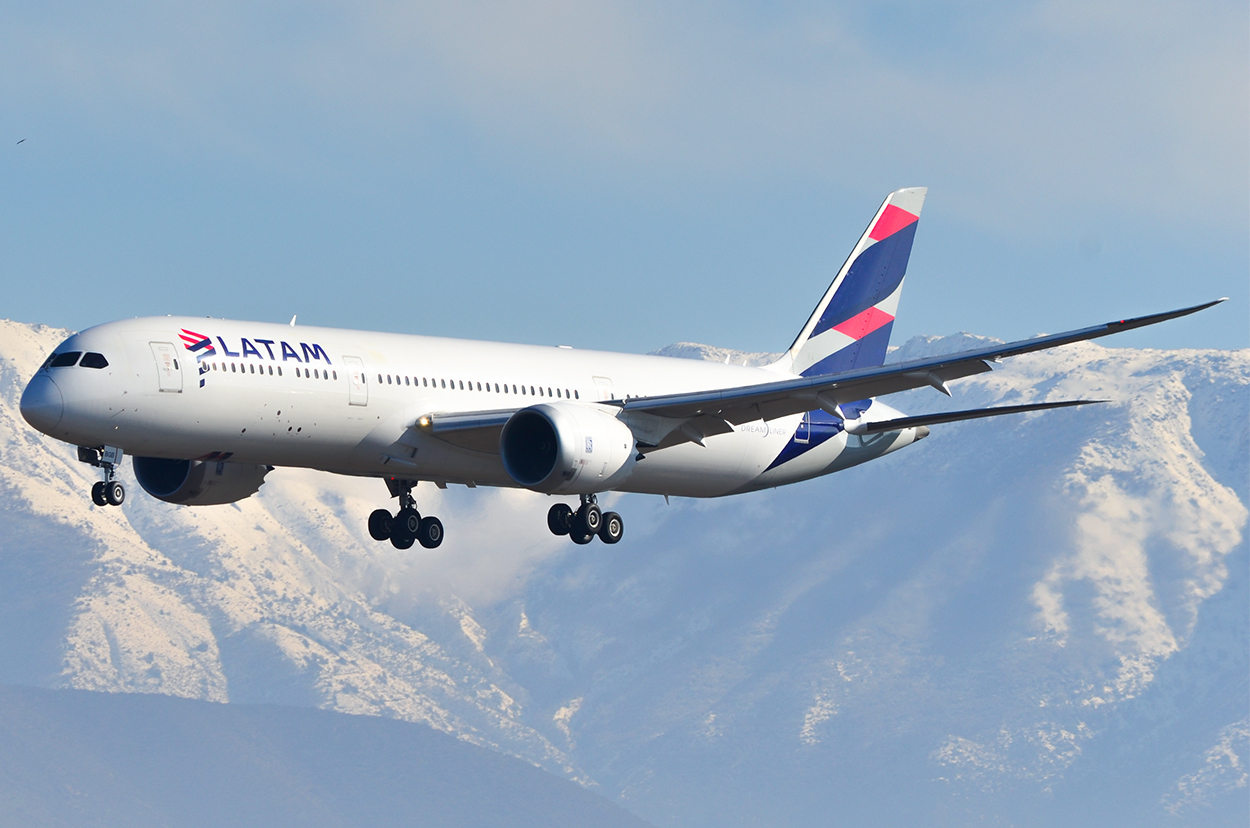
[edit]As of February 2025[update], LATAM operates the following aircraft:[citation needed]

.jpg)
_Boeing_787-8_Dreamliner_at_Sydney_Airport_(1).jpg)
.jpg)
| Aircraft | In service |
Orders | Passengers | Notes | |||
|---|---|---|---|---|---|---|---|
| J | W | Y | Total | ||||
| Airbus A319-100 | 15 | — | – | – | 144 | 144 | |
| Airbus A320-200 | 78 | — | – | – | 168 | 168 | |
| 174 | 174 | ||||||
| 180 | 180 | ||||||
| Airbus A320neo | 7 | — | – | – | 174 | 174 | |
| Airbus A321-200 | 18 | — | – | – | 220 | 220 | |
| 224 | 224 | ||||||
| Airbus A321XLR | — | 5 | TBA | Deliveries from 2026.[40] | |||
| Boeing 767-300ER | 9 | — | 20 | – | 211 | 231 | |
| 213 | 234 | ||||||
| 218 | 238 | ||||||
| Boeing 787-8 | 10 | — | 30 | – | 217 | 247 | |
| Boeing 787-9 | 27 | 22 | 30 | 57 | 216 | 303 | Additional order 10 with 5 options.[41] |
| – | 283 | 313 | |||||
| Total | 164 | 27 | |||||
Fleet development
[edit]LAN was the launch customer for the Pratt & Whitney PW6000 engine on the Airbus A318.[42] Its Airbus A319s and Airbus A320s are equipped with the IAE V2500s or CFM56s engines. LATAM overhauled its Boeing 767s, adding amenities like flatbed seats in Premium Business class, which offers 180 degrees of recline, and new touchscreen personal TVs with on-demand content.[43]
In May 2008, LAN Chile retired its last 737 from service and was replaced by the Airbus A320s. In addition to its A320 family aircraft and Boeing 767, LATAM purchased the Boeing 787 for its long-haul routes to Auckland, Sydney, and selected European routes, replacing its Airbus A340-300s that left the fleet in April 2015. In 2011, LAN Chile ordered 10 A318s but sold them to Avianca Brasil, in order to purchase another 128 jets from the A320 family and one more A340-300. That year the airline placed orders for more Airbus A320 and brand new Airbus A321 aircraft. LATAM Chile is the American launch customer for the Sharklets for its A320 fleet.[44]
In 2012, LAN Chile became the launch customer in the Americas of the Boeing 787 Dreamliner. On November 23, 2014, the airline received their first Airbus A321. This has been the domestic flagship of the airline ever since. On April 17, 2015, the airline officially retired the Airbus A340-300 from their fleet, the last one being CC-CQA. In December 2017 the airline received their first Airbus A320neo. However, months later these were grounded due to an issue with the Pratt & Whitney PW1000G engines. LATAM faced many problems caused by both groundings of the A320neo and Boeing 787 aircraft in 2018. Later that year, they started recovering from that.
In 2021, LATAM acquired four Boeing 787-9 aircraft that used to fly for Norwegian Air Shuttle, which entered service in late 2022.
Former
[edit]LATAM has formerly operated the following aircraft;
| Aircraft | Total | Introduced | Retired | Notes |
|---|---|---|---|---|
| Airbus A318-100 | 15 | 2007 | 2013 | Used on domestic routes All aircraft sold to Avianca Brasil. Used to be one of the few A318 operators with the PW6000 engines, instead of the more common CFM56. |
| Airbus A330-200 | 2 | 2019 | 2019 | Wet-leased from Wamos Air |
| Airbus A340-300 | 5 | 2000 | 2015 | |
| BAe 146-200 | 3 | 1990 | 1997 | |
| Boeing 707-320 | 11 | 1967 | 1994 | Operated first scheduled international flight to Frankfurt. (via Paris–Orly, Madrid and São Paulo) |
| Boeing 727-100 | 5 | 1968 | 1979 | |
| Boeing 737-200 | 33 | 1980 | 2008 | |
| Boeing 747-100 | 1 | 1989 | 1990 | Leased from Aer Lingus |
| Boeing 747-400 | 1 | 2018 | 2018 | Wet-leased from Wamos Air.[45] |
| Boeing 757-200[46] | 1 | 1996 | 1997 | |
| Boeing 767-200ER | 6 | 1986 | 1997 | |
| Boeing 777-200ER | 2 | 2018 | 2019 | Leased from Boeing Capital |
| Consolidated PBY Catalina | 1 | Unknown | Unknown | |
| Convair 340 | 4 | 1961 | 1965 | |
| Curtiss T-32 Condor II | 3 | 1935 | 1942 | |
| de Havilland Canada DHC-6 Twin Otter | 6 | 1974 | 1974 | Acquired but never entered service. Transferred to the Chilean Air Force. |
| de Havilland DH.60 Moth | 2 | 1929 | Unknown | |
| de Havilland DH.104 Dove | 12 | 1949 | 1955 | |
| Douglas C-47 Skytrain | 18 | 1946 | 1979 | |
| Douglas DC-6B | 10 | 1955 | 1973 | Operated first long-haul flight to Miami (via Lima and Panama City) |
| Fairchild FC-2 | 7 | 1932 | 1939 | |
| Ford 5-AT-DS Trimotor | 3 | 1930 | 1938 | |
| Hawker Siddeley HS 748 | 9 | 1967 | 1978 | |
| Junkers W.34 | 1 | Unknown | Unknown | |
| Junkers Ju 52 | 1 | 1938 | 1938 | |
| Junkers Ju 86 | 4 | 1938 | 1940 | |
| Lockheed Model 10A Electra | 6 | 1941 | 1955 | |
| Lockheed Model 18 Lodestar | 2 | 1943 | 1944 | |
| Martin 2-0-2 | 4 | 1947 | 1958 | |
| McDonnell Douglas DC-10-30 | 5 | 1980 | 1986 | |
| Potez 56 | 11 | 1936 | 1943 | |
| Sud Aviation Caravelle | 3 | 1964 | 1975 | Operated first long-haul flight to New York City (via Lima, Bogotá and Montego Bay) |
| Sikorsky S-43 | 2 | 1936 | Unknown |
LATAM Pass
[edit]LATAM Pass is the airline's frequent flyer program to reward customer loyalty. There are currently over four million members. Members earn miles every time they fly with LATAM Chile, an affiliated airline, or by using the services of any LATAM Pass-associated business around the world.[47]
The LATAM Pass program has five membership categories:[48]
- Gold
- Gold Plus
- Platinum
- Black
- Black Signature
On May 5, 2016, LANPass was rebranded as LATAM Pass, once LAN Chile fully transitioned into LATAM Chile.
Lounges
[edit]
LATAM Airlines operates lounges at the following airports:[49]
- Mistral Lounge at Arturo Merino Benítez International Airport, in Santiago de Chile
- Neruda Lounge at Arturo Merino Benítez International Airport, in Santiago de Chile
- Ezeiza International Airport, in Buenos Aires, Argentina
- El Dorado International Airport, in Bogotá, Colombia
- Miami International Airport
- São Paulo–Guarulhos International Airport
These lounges are accessible for passengers traveling in Premium Business, Business, and Premium Economy, as well as selected members of the LATAM Pass program who are Black or Platinum members.
The newly renovated LATAM lounges were designed by Chilean architects Mathias Klotz and Olivia Putman.
Accidents and incidents
[edit]- On April 3, 1961, LAN Chile Flight 621, a Douglas C-47A registered as CC-CLD, on a scheduled domestic passenger flight from Temuco Airport (now Maquehue Airport, later La Araucania Airport) to Santiago, crashed into a hillside due to inclement weather near La Gotera Hill, Chile. On board were many members of the Chilean association football club C.D. Green Cross. All four crew members and all twenty passengers on board were killed.[50]
- On February 6, 1965, a Douglas DC-6, operating LAN Chile Flight 107 from Santiago to Ezeiza, Argentina, flew into a mountain near the San José Volcano in the Las Melosas area of the Andes shortly after takeoff. All of the 87 passengers and crew on board died in what is as of 2012 the worst aircraft accident in Chile.[51]
- On April 28, 1969 LAN Chile Flight 160 crashed short of the runway at Colina, Chile. None of the 60 passengers and crew were injured in the accident.[52]
- On December 5, 1969, a Douglas C-47A registration CC-CBY, crashed shortly after takeoff from El Tepual Airport, Puerto Montt. The aircraft was operating a cargo flight; all three people on board survived.[53]
- On May 25, 1972, Lan Chile Flight 154, a Boeing 727-100 registration CC-CAG, made an emergency landing at Sir Donald Sangster International Airport after a pipe bomb exploded on board. The aircraft was operating a passenger flight from Tocumen International Airport to Miami International Airport; there were no fatalities or injuries.[54]
- On August 3, 1978, a Boeing 707 registered as CC-CCX was approaching Ministro Pistarini International Airport in thick fog when it struck trees in a gentle descent, some 2500 meters short of the runway threshold and 300 meters out of line with the runway centreline. All 63 people on board the aircraft survived the accident.[55]
- On August 4, 1987, a Boeing 737-200, while on the approach at El Loa Airport, landed short of the displaced threshold of runway 27. The nosegear collapsed and the aircraft broke in two. A fire broke out 30 minutes later and destroyed the aircraft. The threshold was displaced by 880m due to construction work. There was one fatality.[56]
- On February 19, 1991, a chartered BAe 146–200 operating LAN Chile Flight 1069, overran the runway on landing at Puerto Williams in southern Chile and sank in the nearby waters. Of the 73 people aboard, 20 perished.[57][58][59]
- On May 18, 2013, an Airbus A340 departing for Sydney from Auckland Airport lined up on what was thought to be the center line of the runway. Instead, it was actually the lights on the edge of the runway and the crew took off without noticing it. The damage wasn't discovered until a runway inspection was made.[60][61]
- On October 26, 2022, LATAM Chile Flight 1325, an Airbus A320-214, was on approach to Silvio Pettirossi International Airport when the aircraft encountered a hail storm. The aircraft lost most of its nose radome, suffered damage to its windshield, and lost both engines which led to the Ram air turbine being deployed. The aircraft made an emergency landing at Asunción with no injuries aboard.[62]
- On November 18, 2022, LATAM Perú Flight 2213, an Airbus A320-271N operated by LATAM Chile, struck a fire truck during its rejected takeoff roll at runway 16 of Jorge Chávez International Airport. The right main landing gear of the aircraft collapsed and the right-hand engine separated from the collision, which started a fire. Everyone aboard the aircraft survived with 24 people sustaining injuries, however, both firefighters aboard the fire truck were killed.[63][64]
- On August 14, 2023, LATAM Chile Flight 505, a Boeing 787–9 Dreamliner, was cruising 120 miles north of Panama City when the captain became incapacitated and collapsed in the restroom. The relief captain and first officer diverted the aircraft to Panama City's Tocumen International Airport. The captain was pronounced dead by medical crews on landing.[citation needed]
- On March 11, 2024, LATAM Airlines Flight 800, a Boeing 787–9 on its way to Auckland, New Zealand, from Sydney, Australia experienced what was described as a technical event during the flight which caused strong movement before landing at Auckland Airport. As a result, 50 people on board were injured, of which 12 were hospitalized and one received possible serious injuries.[65][66][67]
See also
[edit]References
[edit]- ^ "Federal Aviation Administration – Airline Certificate Information – Detail View". Federal Aviation Administration. Retrieved January 23, 2017.
- ^ "LATAM Airlines on ch-aviation". ch-aviation. Retrieved November 9, 2023.
- ^ "| oneworld".
- ^ "Details | oneworld". www.oneworld.com. Retrieved February 14, 2020.
- ^ "LAN and TAM to operate as LATAM with a new livery". August 6, 2015. Retrieved August 9, 2015.
- ^ "Chile's LAN Airlines completes takeover of rival TAM". Reuters. June 22, 2012.
- ^ "LATAM's entire fleet to have new livery by 2018". Retrieved August 9, 2015.
- ^ "Topic: LATAM Airlines Group". Statista. Retrieved January 8, 2024.
- ^ "Asociación de Pilotos en Retiro". Pilotosretiradoslan.cl. Archived from the original on December 14, 2011. Retrieved March 20, 2013.
- ^ a b "Nuestra Historía". Pilotosretiradoslan.cl. Archived from the original on September 10, 2011. Retrieved March 20, 2013.
- ^ "Al finalizar 1945 las operaciones regionales en Magallanes se desarrollaban con todo éxito y al igual como sucedió en los comi". Pilotosretiradoslan.cl. Archived from the original on September 10, 2011. Retrieved March 20, 2013.
- ^ "DE LOS DOUGLAS DC-6B A LOS CONVAIR 340 / 440". Pilotosretiradoslan.cl. Archived from the original on April 14, 2014. Retrieved March 20, 2013.
- ^ "DE LOS CARAVELLE VI R A LOS AVRO HS 748". Pilotosretiradoslan.cl. Archived from the original on September 11, 2011. Retrieved March 20, 2013.
- ^ a b "De los Avro HS-748 a los Boeing 707". Pilotosretiradoslan.cl. Archived from the original on March 5, 2013. Retrieved March 20, 2013.
- ^ http://www.timetableimages.com, January 1, 1970, UTA system timetable, LAN-Chile Santiago-Easter Island-Papeete, Tahiti flight schedules[full citation needed]
- ^ "Head Office: Los Cerrillos Airport, Santiago, Chile". World Airline Directory, Flight International. March 26, 1970.
- ^ "La adquisición de los Twin Otter iba a significar un nuevo enfoque a la regional sur de LAN, por lo que se iniciaron los estud". Pilotosretiradoslan.cl. Archived from the original on September 11, 2011. Retrieved March 20, 2013.
- ^ "Preludio de la privatización de Lan Chile". Pilotosretiradoslan.cl. June 26, 1979. Archived from the original on March 11, 2009. Retrieved March 20, 2013.
- ^ a b "Lufthansa's blueprint for South American training". Flightglobal.com. August 1, 2005.
- ^ "Company". Lltt.cl. Archived from the original on April 16, 2015. Retrieved March 20, 2013.
- ^ "Reasons For Choosing Us". Lltt.cl. Archived from the original on April 16, 2015. Retrieved March 20, 2013.
- ^ "Annual Report 2010" (PDF). LAN Airlines. p. 7. Archived from the original (PDF) on December 23, 2012. Retrieved January 25, 2013.
Corporate Headquarters Avenida Presidente Riesco 5711 20th Floor Las Condes, Santiago, Chile
- ^ "99". World Airline Directory, Flight International. March 27 – April 2, 1991.
Head Office: Estado 10, Santiago, Chile.
- ^ "About us". Blue.cl.
- ^ "LATAM Airlines Argentina halts domestic cargo service". Global Cargo News. June 18, 2020. Archived from the original on January 19, 2021. Retrieved July 2, 2020.
- ^ "LATAM Airlines concluye venta de participación en MASAir Cargo" (in Spanish). Transponder 1200. December 3, 2018. Retrieved July 21, 2019.
- ^ "LATAM Airlines Destination network". LATAM. Retrieved October 16, 2024.
- ^ Prolite International (March 29, 2013). "Boardbag Charges". Archived from the original on March 16, 2015. Retrieved March 13, 2015.
- ^ "Executive Traveller formerly AusBT | Travel News, Reviews & More". Executive Traveller. August 10, 2024.
- ^ קנדל, רינה רוזנברג. "בשורה לתרמילאים: קו תעופה חדש יטוס 3 פעמים בשבוע מנתב"ג לצ'ילה ולברזיל". TheMarker.
- ^ "Profile on LAN Airlines". CAPA. Centre for Aviation. Archived from the original on October 29, 2016. Retrieved October 29, 2016.
- ^ "Aerolineas Argentinas / LATAM Plans Codeshare Partnership in 1Q25". AeroRoutes. Retrieved March 31, 2025.
- ^ "LATAM Expands Airlink Codeshare in NS25".
- ^ "Ouch: Alaska Cuts Partnerships With Singapore & LATAM Airlines". Thrifty Traveler. September 2, 2025. Retrieved September 9, 2025.
- ^ "LATAM Partnership". delta.com. March 21, 2025.
- ^ "LATAM/China Eastern Airlines begins codeshare service from late-Oct 2024". aeroroutes.com. October 21, 2024.
- ^ Liu, Jim (September 4, 2019). "Finnair / LATAM begins codeshare service from Oct 2019". Routesonline. Retrieved September 4, 2019.
- ^ "LATAM Expands Qantas Codeshare in 1Q25".
- ^ "LATAM Expands WestJet Codeshare in NW25".
- ^ Sloan, Chris (January 2025). "Going the XLR Mile". Airliner World. No. 306. pp. 88–97.
- ^ "LATAM Airlines Group orders 10+5 B787-9s". ch-aviation.com. October 28, 2024.
- ^ "LAN Airlines takes delivery of its first A318" (Press release). Airbus. June 5, 2007. Archived from the original on April 3, 2015. Retrieved July 6, 2010.
- ^ Latin America Travel Association. "Latin American Travel Association – LAN Airlines". Archived from the original on July 10, 2010. Retrieved October 16, 2012.
- ^ "FARNBOROUGH: Germania firms A319 order". Retrieved July 21, 2010.
- ^ "LATAM aluga Boeing 747 para substituir temporariamente o 787 Dreamliner". Aeroflap.com.br (in Portuguese). April 19, 2018. Retrieved April 19, 2018.
- ^ "LAN Chile Fleet of B757 (History) – Airfleets aviation". www.airfleets.net. Retrieved June 25, 2017.
- ^ "LANPASS – Vuelos a Chile, Perú, Argentina, Ecuador y Latinoamérica (Sudamérica) – LAN.com – Acerca de LANPASS". LAN.com. Retrieved March 20, 2013.
- ^ "Terms and Conditions of the LATAM Pass frequent flyer program". Retrieved December 5, 2018.
- ^ "Comunicados de Prensa". LAN.com. Archived from the original on January 22, 2014. Retrieved January 4, 2014.
- ^ Ranter, Harro. "ASN Aircraft accident Douglas DC-3C CC-CLDP Linares". aviation-safety.net. Retrieved June 25, 2017.
- ^ "Aviation Safety Network CC-CCG accident synopsis". Retrieved May 28, 2010.
- ^ "Accident description". Aviation Safety Network. Retrieved February 18, 2013.
- ^ "CC-CBY Accident Description". Aviation Safety Network. Retrieved February 14, 2011.
- ^ "CC-CAG Criminal Occurrence Description". Aviation Safety Network. Retrieved April 8, 2015.
- ^ "ASN Aircraft accident Boeing 707-351B CC-CCX Buenos Aires/Ezeiza-Ministro Pistarini Airport, BA (EZE)". Aviation-safety.net. August 3, 1978. Retrieved January 4, 2014.
- ^ "ASN Aircraft accident Boeing 737-2A1 CC-CHJ Calama-El Loa Airport (CJC)". Aviation-safety.net. Retrieved January 4, 2014.
- ^ "Witnesses Tell of Icy Deaths in Plane Crash". Los Angeles Times. February 22, 1991. Retrieved March 20, 2013.
- ^ "Accident Database: Accident Synopsis 02201991". Archived from the original on May 3, 2008. Retrieved June 25, 2017.
- ^ Viesturs, Ed; Bangs, Richard (2001). Richard Bangs, adventure without end. Seattle: The Mountaineers Books. p. 80. ISBN 0-89886-860-2.
- ^ Lake, Dan (March 24, 2016). "Shoddy take-off destroyed runway lights – report". Newshub (New Zealand). Archived from the original on April 4, 2016.
- ^ Weekes, John (March 24, 2016). "Airline says sorry for damage". NZME.
- ^ Ranter, Harro. "Incident Airbus A320-214 CC-BAZ, 26 Oct 2022". aviation-safety.net. Retrieved October 28, 2022.
- ^ "Accident: LATAM Chile A20N at Lima on Nov 18th 2022, collision with fire truck on takeoff". avherald.com. Retrieved November 18, 2022.
- ^ "LATAM Airbus A320 collides with fire truck upon takeoff in Peru". www.aerotime.aero. November 18, 2022. Retrieved November 18, 2022.
- ^ Brancatisano, Emma; Aidone, David (March 11, 2024). "Sydney-Auckland LATAM flight: 50 people injured, hospitalisations". SBS News. Special Broadcasting Service.
- ^ Clark, Emily (March 11, 2024). "Fifty people injured after 'technical problem' on LATAM Airlines flight from Sydney to Auckland". ABC News. Australian Broadcasting Corporation.
- ^ Loren, Anna; Ingoe, Maia (March 11, 2024). "LATAM Airlines Sydney to Auckland flight: 50 people treated after mid-air incident". RNZ News. Radio New Zealand.
External links
[edit]
- Official website
- LAN Airlines inflight magazine Archived January 26, 2013, at archive.today


| |||||||||||||||||||

LATAM Airlines
View on GrokipediaHistory
Origins of LAN and TAM
Línea Aérea Nacional de Chile (LAN), the precursor to LATAM Airlines' Chilean operations, was established on March 5, 1929, by Commodore Arturo Merino Benítez, a pioneering officer in the Chilean Air Force. Initially named Línea Aeropostal Santiago-Arica, the airline was created to connect remote northern regions of Chile, focusing on air mail delivery and limited passenger transport from Santiago to Arica. Supported by the Chilean government, which held majority ownership, LAN operated as the nation's flag carrier from its inception, utilizing early aircraft such as the Junkers F.13 and de Havilland Dragon Rapide for rugged terrain. This foundation emphasized military-civilian collaboration, with the Air Force providing pilots and infrastructure to ensure reliable service in challenging Andean conditions.[7][10] During its early decades, LAN expanded domestically, linking key cities like Valparaíso and Concepción by the 1930s, while gradually modernizing its fleet with Douglas DC-3 aircraft in the 1940s. The airline's international ambitions began post-World War II; its inaugural overseas flight occurred on December 1, 1946, to Buenos Aires, Argentina, marking Chile's entry into regional aviation networks. By the 1950s, LAN had initiated services to Lima, Peru, and further destinations, solidifying its role in South American connectivity. Government oversight ensured LAN's monopoly on domestic routes until the 1980s, when partial privatization began, but its origins as a state-backed enterprise shaped its focus on national integration and export support.[7][18] TAM Linhas Aéreas, the Brazilian arm that later merged into LATAM, traces its roots to Táxi Aéreo Marília (TAM), founded on February 21, 1961, in the city of Marília, São Paulo, by a consortium of ten aviators led by Captain Rolim Adolfo Amaro. Established as a modest air taxi operation, it primarily transported cargo and passengers for local industries, including those owned by businessman Orlando Ometto, using small aircraft like the Cessna 185 to serve underserved rural areas. Amaro, a former military pilot, envisioned expanding access to air travel in Brazil's interior, starting with short-haul charters that addressed the limitations of the country's vast geography and poor road infrastructure. This entrepreneurial beginning positioned TAM as a regional player amid Brazil's fragmented aviation sector.[7][19] The transition to a scheduled airline came in 1975, when the Brazilian government launched the Sistema Integrado de Transporte Aéreo Regional (SITAR), prompting the restructuring of Táxi Aéreo Marília into Transportes Aéreos Regionais (TAM-Transportes Aéreos Regionais) under Amaro's sole leadership. Operations commenced with regular passenger flights on March 4, 1976, targeting Mato Grosso and São Paulo routes using Embraer EMB 110 Bandeirante turboprops, which were ideal for short regional hops. Early growth involved acquiring smaller operators, such as Votec in 1978, enabling TAM to dominate Brazil's regional market by the early 1980s. Amaro's hands-on approach, including personal involvement in flight operations, fostered a customer-centric culture that propelled TAM from a taxi service to a national contender, emphasizing affordability and frequency in domestic travel.[7][20]Merger and formation of LATAM Airlines Group
In August 2010, LAN Airlines S.A., Chile's flag carrier, and TAM S.A., Brazil's largest airline, announced their intention to merge in an all-stock transaction to form a unified holding company named LATAM Airlines Group S.A.[8] The proposed structure positioned LAN as the surviving entity, which would be renamed LATAM Airlines Group, overseeing LAN's affiliates in Peru, Argentina, Colombia, and Ecuador; LAN Cargo and its subsidiaries; TAM and its affiliates, including TAM Mercosur; and Multiplus S.A., TAM's frequent flyer program operator.[8] This combination aimed to create the largest airline group in Latin America, serving over 115 destinations in 23 countries with a combined fleet exceeding 220 aircraft and more than 40,000 employees, while projecting annual synergies of approximately US$400 million through enhanced operational efficiencies and network integration.[8] The merger faced a multi-year regulatory review process, requiring approvals from antitrust authorities in multiple jurisdictions, including Brazil's CADE (Administrative Council for Economic Defense), which cleared the deal in December 2011 after assessing potential competition impacts on domestic and international routes.[21] Additional clearances came from the U.S. Securities and Exchange Commission (SEC) and other bodies, addressing concerns over market concentration in South American aviation; the process also involved shareholder approvals, with LAN's statutes mandating a two-thirds majority, secured by the Cueto family's controlling stake.[22][23] Delays extended the timeline beyond initial estimates of six to nine months, but the transaction proceeded without major divestitures, preserving the airlines' operational autonomy under the new group structure.[24] On June 22, 2012, the merger was officially completed following the exchange of shares, with 95.9% of TAM shares tendered or committed by its controlling shareholders, leading to TAM's delisting from the Brazilian stock exchange (BM&FBOVESPA).[5] LAN Airlines S.A. was renamed LATAM Airlines Group S.A., becoming the parent holding company listed on the New York Stock Exchange (NYSE: LTM) and the Santiago Stock Exchange, while TAM shares were exchanged at a ratio of 0.9 LATAM shares per TAM share, issued as Brazilian Depositary Receipts (BDRs) and American Depositary Receipts (ADRs).[5] The formation immediately expanded the group's reach to approximately 150 passenger destinations in 22 countries and cargo services to 169 destinations in 27 countries, with initial integration steps including the merger of frequent flyer programs LANPASS and TAM Fidelidade starting June 27, 2012, and projected synergies rising to US$600–700 million annually by the fourth year through route optimization and cost savings.[5] This consolidation marked a pivotal shift in Latin American aviation, establishing LATAM as a dominant player capable of competing globally while retaining the individual brands of LAN and TAM for regional operations.[10]Rebranding and post-merger growth
Following the completion of the merger between Chile's LAN Airlines and Brazil's TAM Linhas Aéreas on June 22, 2012, which formed LATAM Airlines Group, the company pursued a unified brand identity to consolidate its operations across Latin America.[5] On August 6, 2015, LATAM announced its rebranding, retiring the separate LAN and TAM names in favor of a single corporate identity that blended elements from both legacies.[25] The new "LATAM" name, derived as a hybrid of "LAN" and "TAM," symbolized a modern, regionally focused airline group, accompanied by a refreshed visual identity featuring coral and indigo colors, a custom typography, and a sound-branding project.[26] This rebranding process began implementation in 2016, with the unveiling of a new aircraft livery that incorporated dynamic wave patterns representing connectivity across the Americas.[27] The rebranding extended to passenger-facing elements, including updated uniforms, airport lounges, and in-flight services, aiming to create a cohesive experience while honoring the cultural diversity of its operations in countries like Chile, Brazil, Colombia, and Peru.[28] By mid-2016, LATAM Airlines Brasil and LATAM Airlines Chile emerged as the primary operating entities under the new brand, with full integration of TAM's fleet and routes into the group's network.[10] The transition culminated in October 2025, when the final aircraft bearing the legacy LAN livery—a cargo Boeing 767 freighter—was repainted, marking the complete phase-out of pre-merger branding.[29] Post-merger, LATAM leveraged the combined strengths of LAN and TAM to achieve significant operational growth, emerging as the dominant carrier in South America with approximately one-third of the region's total capacity by 2012.[9] This positioned the group for network expansion, growing from core Latin American routes to over 150 destinations across 26 countries by the early 2020s, with a focus on enhancing international connectivity to North America, Europe, and Asia.[30] Fleet modernization supported this scale-up; for instance, LATAM ordered 10 Boeing 787-9 Dreamliners in recent years to bolster long-haul capabilities, contributing to a 12% fleet increase over the two years leading into 2025.[31] By March 2025, the airline served 153 destinations in 27 countries, with consolidated available seat kilometers (ASK) rising 8.3% year-over-year in the second quarter, driven by a 10% expansion in international operations.[32] In the second quarter of 2025, revenues reached US$3.279 billion, an 8.5% increase from the prior year, with cargo revenues hitting US$419 million amid rising e-commerce demand.[32] This growth underscored LATAM's resilience, solidifying its role as Latin America's largest airline group by market share and operational scale.[33]Challenges and recovery (2010s–2025)
Following the 2012 completion of its merger with TAM Linhas Aéreas, LATAM Airlines Group encountered significant integration challenges, including harmonizing operations across diverse regulatory environments in Chile and Brazil, as well as aligning corporate cultures and IT systems.[34] The merger exposed LATAM to Brazil's economic volatility, where a recession from 2014 onward led to declining domestic demand and currency depreciation, exacerbating revenue pressures across the group's network.[35] In response, LATAM implemented capacity reductions, such as cutting Chilean domestic flights by up to 10% in 2014 amid slower GDP growth and the real's devaluation, while adjusting its fleet to retire older aircraft and defer deliveries.[36] These measures were compounded by broader Latin American headwinds, including rising fuel costs and weakening yields, which strained profitability throughout the mid-2010s.[37] By the late 2010s, LATAM faced additional operational hurdles, such as persistent engine issues with Pratt & Whitney GTF-powered A320neo aircraft, leading to groundings and route disruptions starting in 2018.[38] The airline's heavy reliance on international routes, which accounted for over 50% of capacity, made it vulnerable to global trade tensions and fluctuating exchange rates, prompting further cost-cutting initiatives like workforce reductions and supplier renegotiations.[39] Despite these efforts, net profits declined sharply, with the group reporting losses in several quarters by 2019 due to competitive pressures from low-cost carriers and economic slowdowns in key markets like Argentina and Brazil.[34] The COVID-19 pandemic intensified LATAM's challenges, grounding over 95% of its fleet by mid-2020 and slashing passenger volumes by more than 90% year-over-year.[40] On May 26, 2020, LATAM filed for Chapter 11 bankruptcy protection in the United States, becoming the world's largest airline to do so amid the crisis, with estimated claims totaling between $8 billion and $9.9 billion.[41] The filing allowed the group to restructure operations while maintaining essential services, but it resulted in a $4.54 billion net loss for 2020, driven by grounded aircraft, furloughs of over 28,000 employees, and liquidity strains that reduced available cash to critical levels.[42] During the bankruptcy process, which spanned over two years, LATAM negotiated with creditors to reduce its debt burden and secure financing, including a $734 million backstop commitment from 15 institutions to support $5.4 billion in new stock and debt issuances.[43] The U.S. Bankruptcy Court confirmed the reorganization plan on June 18, 2022, enabling LATAM to emerge from Chapter 11 on November 3, 2022, with approximately $8 billion in restructured debt and a leaner balance sheet that slashed net debt by $3.6 billion from pre-pandemic levels.[44] This restructuring included equity dilution for existing shareholders and enhanced liquidity, positioning the airline for gradual network restoration amid ongoing pandemic restrictions.[45] Post-bankruptcy recovery accelerated in 2023 and 2024, as LATAM ramped up capacity by over 20% year-over-year, focusing on domestic Latin American routes and leisure travel demand.[46] The group returned to profitability, posting cumulative losses of $4.9 billion for 2020–2021 but achieving a record net income of $977 million in 2024, nearly double the prior year's figure, while transporting 82 million passengers—a 15% increase.[47] This turnaround was supported by cost efficiencies from the restructuring, such as optimized fleet utilization and fuel hedging, alongside a 19% revenue growth driven by premium cabin demand.[48] In 2025, LATAM continued its momentum, reporting US$3.279 billion in second-quarter revenues—an 8.5% increase from 2024—and an adjusted operating margin of 19.9%, bolstered by an 8.3% capacity expansion.[32] Year-to-date net income reached nearly $597 million by mid-2025, with the group returning $445 million to shareholders through dividends and buybacks, signaling strengthened financial health.[13] In the third quarter, revenues rose to US$3.856 billion, a 17.3% increase year-over-year, further demonstrating robust recovery.[49] Expansion efforts included new regional routes and aircraft orders, though challenges like ongoing engine recalls for A320neo jets persisted, potentially grounding up to 40 planes into the decade.[38] Despite macroeconomic uncertainties in Latin America, LATAM's focus on operational resilience and debt management has solidified its position as the region's leading carrier.[17]Corporate affairs
Headquarters and leadership
LATAM Airlines Group's corporate headquarters are located at Presidente Riesco 5711, 20th Floor, in the Las Condes district of Santiago, Chile.[50] This facility serves as the central hub for the airline's executive operations, strategic decision-making, and administrative functions across its multinational network.[51] The leadership of LATAM Airlines Group is structured around a board of directors and an executive management team, overseeing the company's operations in passenger transport, cargo, and maintenance services. Ignacio Cueto Plaza has served as Chairman of the Board since 2017, bringing over 30 years of experience in the aviation industry, including prior roles as CEO of LAN Airlines.[52] The board includes independent directors such as Frederico Curado and Alexander Wilcox, who contribute expertise in global business and finance.[53] At the executive level, Roberto Alvo has been Chief Executive Officer since March 31, 2020, leading the company through post-pandemic recovery and expansion initiatives; he previously held senior commercial roles within LATAM.[53] Ricardo Bottas Dourado joined as Chief Financial Officer in January 2025, with nearly three decades of experience in finance and operations from previous positions in multinational firms.[54] Other key executives include Ramiro Alfonsín as Chief Commercial Officer, responsible for network and revenue strategies, and Hernan Pasman as Chief Operating Officer, managing fleet and safety operations.[55] This leadership team reports to the board and focuses on sustainability, digital transformation, and regional connectivity.[56]Subsidiaries and affiliates
LATAM Airlines Group S.A. operates primarily through a series of wholly owned subsidiaries focused on passenger transportation, cargo services, and ancillary operations across Latin America. These entities enable the group to manage country-specific regulations, local markets, and tailored route networks while maintaining unified branding and operational standards. The passenger subsidiaries include LATAM Airlines Chile S.A., headquartered in Santiago and serving as the group's flagship carrier for international long-haul routes; LATAM Airlines Brasil S.A., based in São Paulo and handling Brazil's extensive domestic and regional flights; LATAM Airlines Peru S.A., operating from Lima with a focus on Andean connectivity; LATAM Airlines Colombia S.A., centered in Bogotá for Colombian domestic and Caribbean links; LATAM Airlines Ecuador S.A., from Quito emphasizing Ecuadorian and northern South American routes; and LATAM Airlines Paraguay S.A., based in Asunción for Paraguayan and southern cone operations. The group continues to provide international services to and from Argentina through other subsidiaries, though LATAM Airlines Argentina ceased domestic operations in 2020.[57][1] In the cargo division, LATAM Airlines Group relies on dedicated subsidiaries to oversee freight operations, leveraging both freighter aircraft and belly capacity from passenger flights. Key entities are LATAM Cargo Chile S.A., which coordinates the group's primary cargo hub in Santiago and international freighter services; LATAM Cargo Colombia S.A., handling cargo from Bogotá with emphasis on perishables and e-commerce; and LATAM Cargo Brasil S.A., based in São Paulo and focusing on Brazil's high-volume import-export trade lanes. These subsidiaries collectively form one of Latin America's largest cargo networks, transporting goods to destinations in North America, Europe, and Asia.[58][59] Beyond core aviation, the group includes affiliates supporting customer services and financial operations. LATAM Pass S.A., the operator of the LATAM Pass loyalty program, functions as a key affiliate with over 50 million members, allowing accumulation and redemption of miles across the group's network and partners to drive revenue through co-branded credit cards and retail partnerships. Other affiliates encompass ground handling and maintenance entities, such as those under LAN Cargo affiliates for logistics support, though the group has divested non-core assets like Mas Air in 2018 to streamline its structure.[1][60]| Subsidiary/Affiliate | Location | Primary Role |
|---|---|---|
| LATAM Airlines Chile S.A. | Santiago, Chile | Passenger operations, long-haul international flights |
| LATAM Airlines Brasil S.A. | São Paulo, Brazil | Passenger domestic and regional services in Brazil |
| LATAM Airlines Peru S.A. | Lima, Peru | Passenger Andean and Pacific routes |
| LATAM Airlines Colombia S.A. | Bogotá, Colombia | Passenger Colombian domestic and Caribbean connectivity |
| LATAM Airlines Ecuador S.A. | Quito, Ecuador | Passenger Ecuadorian and northern South American flights |
| LATAM Airlines Paraguay S.A. | Asunción, Paraguay | Passenger Paraguayan and southern cone routes |
| LATAM Cargo Chile S.A. | Santiago, Chile | Cargo freighter operations and hub management |
| LATAM Cargo Colombia S.A. | Bogotá, Colombia | Cargo perishables and regional freight |
| LATAM Cargo Brasil S.A. | São Paulo, Brazil | Cargo import-export handling |
| LATAM Pass S.A. | Santiago, Chile | Loyalty program management and mile redemption |
Financial overview
LATAM Airlines Group faced significant financial strain during the COVID-19 pandemic, filing for Chapter 11 bankruptcy protection in the United States on May 26, 2020, to restructure its operations and debt amid a sharp decline in air travel demand.[61] The restructuring process, which lasted over two years, resulted in the airline emerging from bankruptcy on November 3, 2022, with enhanced liquidity of over $2.2 billion and a 35% reduction in debt, equivalent to approximately $3.6 billion less on its balance sheet compared to pre-filing levels.[62] Post-emergence, LATAM demonstrated robust recovery, reporting a net income of $2.538 billion for the fourth quarter of 2022, largely driven by one-time gains from the restructuring, followed by sustained profitability in subsequent years.[63] In 2023, the group achieved an operating margin of 11%, exceeding pre-merger performance levels from 2010, supported by network expansion and cost efficiencies.[39] The year 2024 marked a record period, with full-year operating revenues reaching $13.034 billion, a 10.6% increase from $11.787 billion in 2023, and net income totaling $977 million; fourth-quarter revenues alone hit $3.395 billion.[47] Entering 2025, LATAM continued its strong trajectory, posting total operating revenues of $3.28 billion for the second quarter, an 8.2% year-over-year increase, fueled by an 8.5% rise in passenger revenues to $2.824 billion and capacity expansion of 8.3%.[64] The adjusted operating margin for the quarter reached 19.9%, contributing to a year-to-date net income of nearly $597 million for the first half of 2025, with second-quarter net income at $242 million.[32] The company returned $445 million to shareholders in the second quarter through dividends ($293 million for 2024) and share buybacks, underscoring improved cash flow and balance sheet strength.[13] In the third quarter of 2025, operating revenues increased 17.3% year-over-year to approximately $3.9 billion, with net income of $379 million, reflecting continued growth.[65] As of November 2025, LATAM projected a full-year operating margin of 14-15%, reflecting resilience amid macroeconomic uncertainties, with a focus on debt management—reduced significantly post-restructuring—and liquidity preservation to support fleet modernization and regional growth.[17]| Year | Operating Revenues (US$ billion) | Net Income (US$ million) | Key Notes |
|---|---|---|---|
| 2022 | 9.5 (post-emergence) | 2,538 (Q4, incl. restructuring gains) | Emergence from Chapter 11 with $2.2B liquidity |
| 2023 | 11.787 | Not specified in aggregate | 11% operating margin |
| 2024 | 13.034 | 977 | Record revenues, 10.6% YoY growth |
| 2025 (H1) | ~6.5 (estimated from Q2) | 597 | 19.9% Q2 adjusted operating margin |
Operations
Network and destinations
LATAM Airlines Group operates one of the largest route networks in Latin America, serving a total of 162 destinations across 27 countries as of November 2025. This includes 17 domestic destinations primarily within its key home markets and 145 international destinations, emphasizing connectivity across South America while extending to North America, Europe, and Oceania. The network is designed to facilitate seamless regional travel, with a focus on high-frequency services between major urban centers.[66] The airline's primary hubs are Arturo Merino Benítez International Airport in Santiago, Chile; Jorge Chávez International Airport in Lima, Peru; and São Paulo–Guarulhos International Airport in Brazil, which together handle the majority of its operations and serve as gateways for long-haul flights. These hubs enable efficient hub-and-spoke operations, allowing passengers to connect from smaller regional airports to international routes. For instance, Santiago acts as the central node for trans-Pacific and European flights, while São Paulo dominates connections to North America and intra-Brazilian services.[67][68] In Latin America, LATAM's network is the most extensive, covering all major countries in the region with over 100 destinations. Key routes include high-density services between Santiago and Buenos Aires, Argentina; Lima and Bogotá, Colombia; and São Paulo and Rio de Janeiro, Brazil, supporting both leisure and business travel. The airline maintains a strong presence in countries like Chile, Peru, Brazil, Colombia, Argentina, and Ecuador, where it operates domestic flights alongside international feeders. Recent expansions in 2025 include new routes to Curaçao in the Caribbean and Tucumán in Argentina, enhancing connectivity to underserved areas.[66][69] Beyond Latin America, LATAM provides direct services to 20 destinations in North America, primarily from its South American hubs to major U.S. cities such as Miami, New York, Los Angeles, and Orlando. In Europe, the network reaches 10 cities including Madrid, Paris, and London, often via Santiago or São Paulo. Long-haul operations extend to Oceania with nonstop flights from Santiago to Sydney and Melbourne in Australia, as well as Auckland in New Zealand, operated mainly by Boeing 787 aircraft. These international routes have seen capacity increases in 2025, driven by demand recovery and fleet modernization.[32][70]| Region | Key Destinations | Notes |
|---|---|---|
| Latin America | Santiago (Chile), Lima (Peru), São Paulo (Brazil), Buenos Aires (Argentina), Bogotá (Colombia), Rio de Janeiro (Brazil) | Core network with daily high-frequency flights; over 100 destinations. |
| North America | Miami (USA), New York (USA), Los Angeles (USA), Mexico City (Mexico) | Primarily from South American hubs; codeshare enhancements with partners. |
| Europe | Madrid (Spain), Paris (France), London (UK), Frankfurt (Germany) | Long-haul focus; seasonal adjustments for demand. |
| Oceania | Sydney (Australia), Melbourne (Australia), Auckland (New Zealand) | Trans-Pacific routes; increased frequencies in 2025. |
Codeshare and alliance partnerships
LATAM Airlines Group was a founding member of the oneworld alliance in 2014, alongside its predecessors LAN Airlines and TAM Linhas Aéreas, which provided access to a global network of over 1,000 destinations through codeshare and interline agreements with partners such as American Airlines, British Airways, and Qantas.[11] However, on September 26, 2019, LATAM announced a strategic partnership with Delta Air Lines, under which Delta acquired a 20% equity stake valued at $1.9 billion, leading to LATAM's departure from oneworld effective May 1, 2020.[72] This shift marked LATAM's transition to a non-alliance model, emphasizing bilateral joint ventures and codeshare agreements to enhance connectivity across the Americas and beyond.[73] The cornerstone of LATAM's current partnerships is its comprehensive joint venture with Delta Air Lines, launched in 2020, which facilitates extensive codesharing on routes between South America and the United States, including flights from key hubs like São Paulo, Santiago, and Bogotá to Atlanta, Los Angeles, and New York.[12] Under this agreement, passengers can earn and redeem LATAM Pass miles on Delta-operated flights, access reciprocal elite benefits such as priority boarding and lounge access, and book seamless itineraries covering over 300 destinations.[74] By October 2025, the partnership had enabled 62,000 flights and transported more than 14.5 million passengers since 2022, with ongoing expansions including new routes to support increased capacity between the regions.[73] In addition to Delta, LATAM maintains codeshare agreements with several other carriers to broaden its network, particularly in Europe, Asia, and within Latin America. With Aeroméxico, a SkyTeam member, LATAM operates codeshares on intra-Mexico and Mexico-U.S. routes, allowing mutual mileage accrual through LATAM Pass and Aeroméxico Rewards programs.[75] Similarly, partnerships with Iberia and Aerolíneas Argentinas enable codesharing on transatlantic flights from Madrid to South American destinations and regional routes within Argentina and Chile, respectively, with benefits including shared frequent flyer earnings and baggage handling.[76] In Asia and Oceania, codeshares with Japan Airlines cover Tokyo-São Paulo services, while agreements with Qantas facilitate connections from Australia to South America via Santiago, both supporting mile redemption and elite status recognition.[75] A notable recent development is the strategic codeshare with TAP Air Portugal, launched in the northern summer of 2025, which expands options from Brazil to Europe via Lisbon, enhancing transatlantic connectivity with reciprocal loyalty perks.[77] LATAM has also adjusted several partnerships in 2025 to streamline operations. The codeshare with Alaska Airlines, which previously allowed connections to U.S. West Coast destinations, officially ended on October 1, 2025, terminating reciprocal mileage earning and elite benefits for travel after that date.[78] Likewise, LATAM terminated its codeshare with Brazilian regional carrier Voepass in the second half of 2025, focusing instead on larger network partners.[79] These changes reflect LATAM's strategy to prioritize high-traffic, revenue-generating alliances while maintaining flexibility in a competitive aviation landscape.Fleet composition
As of September 2025, LATAM Airlines Group operates a fleet of 360 aircraft, with an average age of 12.2 years.[80][81] This fleet supports the group's extensive network across Latin America, North America, Europe, and Oceania, emphasizing fuel-efficient modern aircraft for both passenger and cargo operations. The composition reflects a strategic focus on the Airbus A320 family for short- and medium-haul routes and Boeing wide-bodies for long-haul services, supplemented by dedicated freighters. The narrow-body segment, comprising the majority of the fleet, consists of 284 Airbus aircraft primarily from the A320 family, including A319, A320-200, A320neo, A321-200, and A321neo variants.[82] These single-aisle jets are configured for high-density operations on domestic and regional flights, typically accommodating 144 passengers on the A319 in an all-economy layout, up to 186 on the A320-200, and around 220 on the A321-200.[83] The neo variants incorporate advanced engines for improved efficiency and reduced emissions, with LATAM operating approximately 51 A320neo-family aircraft as of September 2025.[84] For long-haul passenger services, the group deploys 56 Boeing wide-body aircraft, including Boeing 767-300ER, 777-300ER, 787-8, and 787-9 models.[82] The Dreamliner fleet stands at 37 units (10 787-8s and 27 787-9s), valued for their range and passenger comfort on transcontinental routes, often featuring lie-flat business seats and premium economy cabins.[85] Boeing 777-300ERs, numbering 10, serve high-demand international corridors with two-class configurations seating up to 400 passengers.[86] In February 2026, LATAM Airlines Group announced an agreement with Lufthansa Technik to retrofit all ten of its Boeing 777-300ER aircraft with AeroSHARK, a bionic riblet film developed in partnership with BASF Coatings that mimics sharkskin to reduce aerodynamic drag by approximately 1%. The retrofit, which began with initial testing in December 2023 and had half the fleet equipped by the end of 2025, is expected to be completed by 2027. Once fully implemented, the modifications are projected to save up to 4,000 metric tons of jet fuel and 12,000 metric tons of CO₂ emissions annually across the subfleet. This will make LATAM the first airline outside the Lufthansa Group to operate a fully AeroSHARK-equipped Boeing 777 subfleet.[87] Boeing 767-300ERs, numbering around 9, provide additional capacity on select routes. Three Airbus A330 wide-bodies are operated under short-term leases to supplement capacity. LATAM Cargo maintains 17 Boeing 767-300F freighters, dedicated to air cargo operations and integrated with passenger flights via belly hold space.[82] These converted aircraft support the group's logistics arm, with plans to stabilize at 19 freighters through 2027.[29] The following table summarizes the key aircraft types in the fleet (active numbers as of September 2025, subject to minor variations):| Aircraft Type | In Service | Typical Configuration | Primary Use |
|---|---|---|---|
| Airbus A319-100 | ~48 | 144 seats (economy) | Regional/domestic |
| Airbus A320-200 | ~135 | 168-186 seats | Domestic/regional |
| Airbus A320neo | ~37 | 174 seats | Domestic/regional |
| Airbus A321-200 | ~49 | 220 seats | Domestic/regional |
| Airbus A321neo | ~14 | 220 seats | Domestic/regional |
| Boeing 767-300ER | ~9 | 200-250 seats (2-class) | Long-haul |
| Boeing 777-300ER | 10 | 400 seats (2-class) | Long-haul |
| Boeing 787-8 | 10 | 300 seats (3-class) | Long-haul |
| Boeing 787-9 | 27 | 300-345 seats (3-class) | Long-haul |
| Boeing 767-300F | 17 | Freighter | Cargo |
| Airbus A330 | 3 | Varies (leased) | Long-haul supplement |
Services and amenities
Frequent flyer program
LATAM Pass is the frequent flyer loyalty program operated by LATAM Airlines Group, enabling members to accumulate miles through flights, credit card spending, and partnerships with hotels, car rentals, and retailers. Membership is free and open to anyone, with miles redeemable for award tickets, cabin upgrades, hotel bookings, merchandise from the LATAM Pass catalog, and charitable donations. The program emphasizes customer loyalty by offering personalized benefits and incentives, including access to exclusive promotions and priority services.[88][89] Miles, known as LATAM Pass Miles, are primarily earned on LATAM-operated flights based on flight distance and booking class, with accrual rates varying from 50% to 200% of miles flown depending on the fare type. Elite members receive bonus miles on top of base earnings, ranging from 25% for entry-level elites to 125% or more for top tiers. Qualifying Points (QP), a separate currency used solely for elite status qualification, are calculated as 1 QP per U.S. dollar (or equivalent) spent on the base fare of LATAM tickets, excluding taxes and fees. Members can also earn miles and QP through partner airlines in LATAM's network, such as Delta Air Lines via their joint venture, as well as Aeroméxico and Alaska Airlines, where accrual follows specific airline and route rules. Non-flight earning options include co-branded credit cards like the LATAM Airlines Mastercard, which provide miles on everyday purchases and contribute 20% of earned miles toward QP, alongside partnerships with entities like Rentalcars.com for car rentals and various hotel chains.[90][91][12] As of 2025, LATAM Pass features four elite membership categories—Gold, Platinum, Black, and Black Signature—qualified exclusively through accumulating QP over a 12-month period, with no minimum flight segment requirements, simplifying access compared to prior years. The Gold Plus tier was discontinued in 2025, streamlining the structure while introducing enhanced earning potential on select fares (up to 50% more QP). Elite benefits scale with status level and include priority boarding and check-in, complimentary extra-legroom seating (LATAM+ seats), additional checked baggage allowances (up to two extra pieces for top tiers), waived fees for flight changes or rescheduling, and complimentary onboard Wi-Fi on international routes. Higher tiers provide access to LATAM VIP lounges, guaranteed advance seat selection, and priority on the waitlist for cabin upgrades via bidding or certificates. Black and Black Signature members receive the most comprehensive perks, such as unlimited lounge access for companions, 100% mileage bonuses on partner flights, and dedicated customer service lines. Status is valid for one year and can be extended or upgraded based on ongoing QP accumulation.[92][93][94] Redemption options for LATAM Pass Miles are flexible, with award flights bookable on LATAM and select partners. For LATAM-operated flights, redemptions use dynamic pricing with no fixed route-specific award chart; for domestic flights in Brazil, the minimum required is 3,000 miles per segment in Economy and 7,000 miles per segment in Premium Economy, with the exact amount varying based on advance booking time, travel period, route (such as Marabá-Fortaleza), schedules, and seat availability—earlier bookings typically require fewer miles. An additional redemption fee may apply (R$17 one-way or R$34 round-trip) for bookings made less than 90 days prior to departure. For precise costs and availability, consult the LATAM Pass website. Long-haul international awards typically require 40,000 to 100,000 miles one-way in economy or premium cabins. Upgrades from economy to premium economy or business class can be redeemed using miles or a combination of miles and cash, with elite members enjoying priority clearance. The LATAM Pass Catalog allows miles to be exchanged for consumer goods, experiences, and services, while transfers to family or friends are possible for a fee. For those seeking accelerated benefits, the optional LATAM Pass Club subscription (Basic or Prime plans) provides 1,000 to 2,500 monthly miles, elite status matching to Gold for the subscription duration, and exclusive offers like discounted award redemptions, independent of flight activity. Miles expire after 36 months of inactivity but can be extended through account engagement.[95][88][96][97]Airport lounges and onboard offerings
LATAM Airlines maintains a network of proprietary lounges at major international hubs, designed to reflect local cultures and provide premium pre-flight experiences. These facilities are available exclusively for international departures and emphasize comfort, gastronomy, and connectivity. The lounges include locations in Lima (Peru), Santiago (Chile), São Paulo (Brazil), Bogotá (Colombia), Buenos Aires (Argentina), and Miami (United States). In August 2025, LATAM opened a new dual-zone lounge at Lima's Jorge Chávez International Airport in the expanded terminal, featuring a Signature Lounge for elite members and a Premium Lounge for broader access, both entered via a single point and inspired by Peruvian heritage with amenities like cultural artwork, dining options, and relaxation areas. The Santiago lounge stands out as the largest in South America, spanning three distinct zones for dining, work, and rest, while the Bogotá facility incorporates Colombian motifs such as coffee-inspired decor. São Paulo's lounge at Guarulhos Airport's Terminal 3 offers Brazilian culinary highlights, and the Miami lounge in Concourse J operates extended hours from 4:30 a.m. to 1:00 a.m. (or 24 hours on select days) with features like unlimited Wi-Fi and shower facilities. Buenos Aires' Ezeiza lounge prioritizes tranquility with quiet zones and spa-like elements. Access to these lounges is granted to LATAM Pass members at Black Signature, Black, or Platinum tiers, as well as holders of qualifying premium credit cards from partners like Visa and Mastercard, subject to availability and international flight requirements. Additionally, LATAM has agreements with third-party lounges at various airports worldwide, extending benefits to eligible passengers for domestic or connecting flights, with entry conditions varying by location and typically including elite status or paid passes. Onboard offerings across LATAM's fleet vary by cabin class—Premium Business, Premium Economy, and Economy—and emphasize Latin American hospitality, with enhancements announced in October 2025 and rolled out beginning December 1, 2025, to the Premium Business experience. These updates incorporate regional aesthetics through redesigned elements like new upholstery in earth tones, wooden accents, and textiles inspired by South American landscapes, alongside improved service protocols for a more personalized touch. In Premium Business, passengers enjoy lie-flat seats, a multi-course menu curated by renowned Latin American chefs featuring seasonal ingredients such as Andean quinoa or Amazonian fruits, paired with award-winning South American wines from vineyards like those in Chile and Argentina; the refreshed menu includes upgraded coffee selections, three-course lunches or dinners, and a revamped cocktail lineup served on enhanced tableware for greater comfort. Premium Economy provides enhanced legroom, priority boarding, and upgraded meals like hot entrees with sides, complemented by a selection of beverages including premium teas and spirits. Economy class service focuses on efficiency for short- and long-haul flights, offering a complimentary ham and cheese sandwich, daily baked goods, fresh seasonal fruit, and non-alcoholic drinks such as premium coffee or juices, with purchasable upgrades for snacks or alcohol on longer routes. Entertainment is accessible via LATAM Play, a streaming platform that passengers connect to using their personal devices over onboard Wi-Fi, providing over 100 movies, 300 television series episodes, music playlists from Latin artists, and games without needing airline hardware. Connectivity options include complimentary messaging for LATAM Pass and elite members, with purchasable Wi-Fi plans for browsing or streaming available on most international flights equipped with the service, ensuring broad accessibility across cabins.Baggage allowance and fees
For international flights operated by LATAM Airlines, the standard checked baggage allowance is typically 23 kg per bag, depending on fare class, cabin, and route. Excess baggage fees for overweight checked bags are charged as flat fees per bag rather than per kilogram. Bags exceeding the allowance but weighing up to 32 kg incur a fee of US$100 (referential equivalent R$575) per bag. Bags weighing between 32 kg and 45 kg incur a fee of US$200 (R$1,150) per bag. These fees apply per bag and may vary slightly by route, fare class, or exchange rate; prices are referential and subject to change.[98]Incidents and safety record
Major accidents
LATAM Airlines, formed by the merger of LAN Airlines and TAM Airlines in 2012, has inherited the accident history of its predecessors, which include some of the deadliest aviation disasters in South American history. While the airline group maintains a generally strong safety record in recent years, major accidents have involved significant loss of life, primarily from operations prior to the merger. Post-merger incidents have been less severe in terms of passenger fatalities but have still resulted in ground casualties and injuries. The following outlines the most notable fatal accidents associated with the LATAM brand and its legacy carriers.[99] One of the earliest significant accidents linked to LAN Chile occurred on February 20, 1991, when Flight 1069, a British Aerospace BAe 146-200A (registration CC-CET), overran the runway at Puerto Williams Airport in Chile during landing in light rain and plunged into the Beagle Channel. The flight, carrying 72 passengers and crew (66 passengers and 6 crew)—many of them American tourists en route to Antarctica—resulted in 20 fatalities from drowning and hypothermia in the icy waters, with 52 survivors rescued after clinging to the aircraft's wings and fuselage. The investigation attributed the overrun to pilot error in not adequately compensating for wet runway conditions and a tailwind, leading to insufficient braking.[100][101] The deadliest accident in LATAM's history stems from its TAM Airlines predecessor: On July 17, 2007, TAM Flight 3054, an Airbus A320-233 (registration PR-MBK), crashed during landing at São Paulo–Congonhas Airport in Brazil amid heavy rain. The aircraft, arriving from Porto Alegre with 181 passengers and 9 crew, failed to stop on the short, contaminated runway due to a malfunctioning thrust reverser on one engine and the pilots' decision to use only one reverser, leading to a runway overrun, collision with a warehouse, and a post-crash fire. All 187 on board perished, along with 12 people on the ground, marking Brazil's worst aviation disaster and one of the world's deadliest single-aircraft crashes. The Brazilian Aeronautical Accidents Investigation Center (CENIPA) cited inadequate airport infrastructure, including the lack of a sufficient runway safety area, as a contributing factor alongside maintenance issues with the reverser.[99][102] In a post-merger incident, LATAM Perú Flight 2213, an Airbus A320-271N (registration CC-BHB), collided with a fire truck during takeoff from Jorge Chávez International Airport in Lima, Peru, on November 18, 2022. The Boeing fire truck, positioned on the runway as part of an unauthorized drill, was struck at high speed by the accelerating aircraft, which carried 102 passengers and 6 crew. All 108 on board survived, but 4 passengers sustained serious injuries and 36 minor injuries during evacuation; the impact killed two firefighters and seriously injured a third. The aircraft sustained substantial damage to its nose and engines but remained intact. Peru's aviation authority (DGAC) determined the accident resulted from poor coordination between air traffic control and airport emergency services, with the fire truck failing to clear the active runway in time.[103][104] More recently, on August 9, 2024, Voepass Flight 2283—an ATR 72-500 (registration PS-VPB) operating under a codeshare agreement with LATAM from Cascavel to São Paulo-Guarulhos in Brazil—crashed in a residential area near Vinhedo, killing all 61 people on board. The aircraft entered a flat spin during descent in stormy weather, likely due to severe airframe icing that exceeded the aircraft's limits, leading to an aerodynamic stall from which recovery was impossible. Preliminary investigations by CENIPA highlighted possible inadequate de-icing procedures and weather briefings, with no ground fatalities reported despite the crash site. LATAM faced legal liability as the marketing carrier under the codeshare, contributing to the subsequent termination of the partnership with Voepass. This incident marked the deadliest aviation accident in Brazil since the 2007 TAM crash.[99][105]| Date | Flight | Aircraft | Location | Fatalities | Brief Description |
|---|---|---|---|---|---|
| February 20, 1991 | LAN Chile 1069 | BAe 146-200A | Puerto Williams, Chile | 20 (of 72 on board) | Runway overrun into water during landing in rain; pilot error on wet runway.[101] |
| July 17, 2007 | TAM 3054 | Airbus A320-233 | São Paulo, Brazil | 199 (187 on board + 12 ground) | Runway overrun due to thrust reverser failure and rain; crashed into building and fire.[99] |
| November 18, 2022 | LATAM Perú 2213 | Airbus A320-271N | Lima, Peru | 2 (ground) | Collision with fire truck on runway during takeoff; coordination failure.[103] |
| August 9, 2024 | Voepass 2283 (codeshare with LATAM) | ATR 72-500 | Vinhedo, Brazil | 61 (all on board) | Icing-induced stall and flat spin in storm; inadequate de-icing.[99] |