


Community hub
Recent from talks
Contribute something
Nothing was collected or created yet.
Model (art)
View on Wikipedia

An art model is a person who poses, often nude, for visual artists as part of the creative process, providing a reference for the human body in a work of art. The importance of the human figure in Western art begins with the Ancient Greeks, which was rediscovered in the Renaissance, art modelling then becoming an occupation. With few exceptions, models remained anonymous until the 19th century.
Modern nude models have most often been employees of art schools, and paid by the hour to pose. As an occupation, modeling requires the often strenuous 'physical work' of holding poses for the required length of time, the 'aesthetic work' of performing a variety of interesting poses, and the 'emotional work' of maintaining a socially ambiguous role. While the role of nude models is well-established as a necessary part of artistic practice, public nudity remains transgressive, and models may be vulnerable to stigmatization or exploitation.[1]: 1
Role of the model
[edit]Contemporary art models are most often paid professionals with skill and experience. Rarely employed full-time, they must be gig workers or independent contractors if modeling is to be a major source of income.[1]: 51 Models are most frequently employed by institutions of higher learning, other art schools, or by informal groups of artists that gather to share the expense of a model. Models are also employed privately by professional artists. Although commercial motives dominate over aesthetics in illustration, its artwork commonly employs models. For example, Norman Rockwell employed his friends and neighbors as models for both his commercial and fine-art work.[2]
In the second half of the 20th century, the dominance of abstraction in the art world reduced the need for models by professional artists except for the remaining representational artists.[3] However, drawing from life remained an important part of the training needed for a complete visual arts education at the majority of art schools.[4]: 8–9 In the 21st century, art modeling has expanded from educational settings to non-traditional art spaces and sometimes bars, blurring the line between art and entertainment.[1]: 9 With the increasing presence of sexual imagery in popular culture, effort is required to maintain the desexualized context of nude modeling in studio classes.[1]: 21–22
Training and selection
[edit]In some countries there are figure model guilds that concern themselves with the competence, conduct and reliability of their members. An example is the Register of Artists' Models (RAM) in the United Kingdom. Some basic training is offered to beginners and membership is by audition – to test competence, not to discriminate on grounds of physical characteristics. RAM also acts as an important employment exchange for models and publishes the 'RAM Guidelines', which are widely referred to by models and employers.[5] A similar organization in the United States, the Bay Area Models Guild in California, was founded in 1946 by Florence Wysinger Allen.[6] Groups also exist in Australia[7] and Sweden.[8] These groups may also attempt to establish minimum rates of pay and working conditions, but only rarely have models been sufficiently organized to go on strike.[9]
Diversity of models and students
[edit]
Unlike commercial modeling, modeling in an art school classroom is for the purpose of teaching students of art how to draw humans of all physical types, genders, ages, and ethnicities.[10]: 11, 77, 81 The minimum age for life models in the United States is usually 18. Younger children are not good candidates for art modeling since they are not able to stay still.[4]: 9
_01.jpg)
Gender roles and stereotypes in society are reflected in different experiences for male and female art models, and different responses when those not in the arts learn that someone is a nude model. However, both male and female models tend to keep their modeling careers distinct from their other social interactions, if for different reasons. Attitudes toward male nudity, issues of homosexuality when male artists work with male models, and some bias in favor of the female form in art may lead to less opportunity for male models.[4] Works of art that include male nudity are much less marketable.[11]
Figure on Diversity is an organization that seeks to diversify the field of figurative representation in art education by leading workshops for models and artists.[12] Founded in Boston in 2018, it has since moved to Florida, but has an increasing presence online.[13][14]
Working as a model
[edit]Posing nude is physically and emotionally challenging, but models find the effort worthwhile and appreciate having a role in the creative arts.[15][16]
Phillips reported that some who tried modeling casually found it to be rewarding, and then sought to learn more about the job. Some had previously taken an art class and seen other models, but others had relied upon fine-art museums and books for suggestions on how to pose.[4]: 103–104
Physical work
[edit]While posing, a model is expected to remain essentially motionless, and return to the same pose after a break.[10]: 47–55 [4]: 111–113 While holding a pose, models generally do not talk, and should not be spoken to by students, maintaining the serious atmosphere of the studio.[4]: 64–67 Poses can range in length from seconds to many hours—with appropriate breaks—but the shortest is usually one minute. Short dynamic poses are used for gesture drawing exercises or warm-ups, with the model taking strenuous or precarious positions that could not be sustained for a longer pose. Sessions proceed through groups of poses increasing in duration. Active, gestural, or challenging standing poses are often scheduled at the beginning of a session when the models' energy level is highest.[17] Specific exercises or lesson plans may require a particular type of pose, but more often the model is expected to do a series of poses with little direction. The more a model knows about the types of exercises used to teach art, the better they become at posing.[11] Occasionally a pose will cause unexpected problems, such as constricting blood flow that could result in a model passing out.[18] While the first time posing may cause anxiety, most continue due to the relatively high pay. The most significant characteristic of the job mentioned by models is the physical exertion required.[19]
Poses fall into three basic categories: standing, seated and reclining. Within each of these, there are varying levels of difficulty, so one kind is not always easier than another. Artists and life drawing instructors will often prefer poses in which the body is being exerted, for a more dynamic and aesthetically interesting subject. Common poses such as standing twists, slouched seated poses and especially the classical contrapposto are difficult to sustain accurately for any amount of time, although it is often surprising what a skilled model can do. The model's level of experience and skill may be taken into account in determining the length of the posing session and the difficulty of the poses.[4]: 9–10 A typical short-pose session may begin with five or ten gestures, followed by two 5-, two 10-, and five 25-minute poses separated by five-minute breaks.[11]: 30
Models usually pose on a raised platform called the model stand or dais. When artists are working standing at easels, a model stand is essential to avoid a distorted perspective. If the model is posed standing on the floor, the artist should draw while seated.[20]: 14–15 In sculpture studios this platform may be built to rotate periodically through the session to allow for a 360° view for every artist.[21] Long poses are generally required for painting (hours) and sculpture (perhaps days).[4]: 9–10
Aesthetic work
[edit]When modeling for the same group, new poses are expected at each session. Most models learn on the job, but many have experience in the performing arts, athletics, or yoga that provide a basis for posing, such as strength, flexibility, and a well-developed sense of body position.[10]
Emotional work
[edit]Sexuality is an issue in an art studio where naked models are present, and has become more so with the sexualization of the body in contemporary cultures. The traditional definition of the situation in art studios has been that the nudity of models is functional, not sexual. The norms and behaviors that support this understanding included models being naked only while posing, quickly disrobing/robing and not interacting with others while naked. This understanding is less strict when student artists are also models, either in classes or posing for each other outside of class. The other aspect of sex in the arts is gender, including feminist critiques of the performance of gender in the classroom and representations of gender in figurative works.[22]: 127–131
A common experience for young first-time participants in a figure class, both models and students, is overcoming anxiety for the initial session due to preconceptions regarding public nudity.[23][24]
Public perception
[edit]Much of the public perception of art models and their role in the production of artworks is based upon mythology, the conflation of art modeling with fashion modeling or erotic performances, and representations of art models in popular media.[22]: 15–18 One of the perennial tropes is that in addition to providing the physical form for humans in an artwork, models may be thought of as muses, or sources of inspiration without whom the art would not exist.[25]: 68–79, 102–115 Another popular narrative is the female model as a male artist's mistress, some of whom become wives.[4]: 3 None of these public perceptions include the professional model's own experience of modelling as work,[4]: 44–45 the performance of which has little to do with sexuality.[4]: Ch. 10
In popular media
[edit]After becoming a celebrity in the early 1910s by posing nude for many of the notable public sculptures in the United States, Audrey Munson appeared in four films in which she portrayed a model, appearing fully nude in some, partially nude in others. In her first film "Inspiration" (1915), Munson's role was that of a muse for a young artist who later married her. The lack of sexual impropriety established a precedent for the National Board of Censorship to allow or reject nudity in later films. Munson's second film "Purity" proves more difficult for the censors, containing a more complex allegory. Munson's plays a woman who agrees, after initial refusal, to pose nude for an artist in order to pay for a poet's work to be published in order for them to marry. The moral ambiguity of the nude scenes resulted in sharp difference of opinion between members of rewiewing audiences. The result was that by 1917 the renamed National Board of Review would no longer pass films that included female nudity. This certification was not binding, allowing films to be shown in some jurisdictions, but not others.[26]
.jpg)
Recent films have continued the portrayal of models as muses. In The Artist and the Model (2012) set during WWII, an elderly sculptor is prompted to resume working by the arrival of a beautiful Spanish refugee who is willing to pose.[27] In La Belle Noiseuse (1991) an aging artist is coaxed out of retirement by an aspiring young artist's suggestion that his girlfriend pose nude for a new painting.[28] In the film Camille Claudel (1988); Gérard Depardieu as Auguste Rodin interacts sexually with the nude models in his studio accompanied by Isabelle Adjani as Camille Claudel when she was Rodin's assistant.[29] The story of the sinking of the Titanic is changed from one of pure tragedy to one of female liberation in the 1997 film by James Cameron by focusing on two fictional characters, a young impoverished artist (Jack) who wins his passage in a card game and meets a young woman (Rose) being forced by her mother to marry a rich man that she dislikes. The act that confirms Rose's decision to free herself is posing nude for Jack, which is soon followed by sex.[30]
Types
[edit]The major distinction in types of art modeling is between posing for art classes or other groups, usually on an hourly basis, versus posing for an individual artist in the creation of a particular work. The latter may include friends, family, or others with a continuing relationship with the artist. These types apply to all the media, figure drawing, figure painting, sculpture and figure photography.
Academic modeling
[edit]
Beginning with the Renaissance, drawing the human figure has been considered the most effective way to develop the skills of drawing. The life class became an essential part of the curriculum in art school, allowing students to understand the figure in three dimensions, and to learn about human anatomy.[31]: 8–9 In the classroom setting, where the purpose is to learn how to draw or paint the human form in all the different shapes, ages and ethnicities, anyone who can hold a pose may be a model. In addition to technical requirements, an artist has an emotional[32]: 32 or empathic[20]: 4 connection to drawing another human being that cannot exist with any other subject.
Given the generally negative view of public nudity, particularly in America, the institutions teaching art must maintain that within the figure studio, nudity is necessary and proper; which sociologist Sarah Phillips called "Establishing that serious work is happening".[4]: 43–47 In some institutions, guidelines for the conduct of all participants in a nude model session may be specified in a handbook, and are observed to maintain decorum and emphasize the serious intent of figure studies.[33][34][35][36] Admission to and visibility of the area where a nude model is posing is tightly controlled. Disrobing is done discreetly, and the model wears a robe when not posing.[4] Models may not be accompanied by non-class members.[35] It is generally prohibited for anyone (including the instructor) to touch a model. Very close examinations are only made with the permission of the model. Some institutions allow only the instructor to speak directly with a model. Experienced models avoid any sexually suggestive poses.[4]: 59–60 Art instructors and institutions may consider the incident of a male model gaining an erection while posing cause for termination, or grounds for not hiring him again.[4]: 60 [35][37] Guidelines at St. Olaf College discourages students making comments on a model's appearance.[38] Photography is generally forbidden.[39]
At many public universities in the United States, "Art Model" is listed in the human resources system as would any part-time temporary job.[40][41] Sometime modeling jobs are reserved for students.[42][43] At Indiana University, however, current students at the Eskenazi School of Art, Architecture + Design may not pose nude, but only clothed, while students in other departments may be nude.[44] At other institutions students cannot be models, even if they are not art students, to avoid any possibility of conflict of interest.[45][46][39] Some colleges have a model coordinator assigned to supervise the selection and scheduling of models for all classes.[47][48]
Any of these policies may vary in different parts of the world. In Europe and South America attitudes are more relaxed than in the United States, while in China, Taiwan and Korea attitudes are more conservative.[10]: 39 A figure class held in Singapore is conducted as it would be in other parts of the world.[49]
Artist's groups
[edit]While otherwise similar to art school modeling, events variously called "open studios" or "drop-in sessions" lack instruction. They may be sponsored by arts organizations or galleries, or meet in an artist's private studio or home. Generally the attendees are experienced artists who want to continue the practice of life drawing, sharing the expense of model fees by paying for each session or a series.[11]: 18–19
In many locations there may be few opportunities for figure drawing, and also few that are willing to model. Those that do so seek an additional source of income, but also find validation in being able to hold poses and contributing to the artistic process. However, they are more likely to avoid letting it be known that they model, given the negative associations toward nudity. The Philbrook Museum of Art in Tulsa, Oklahoma has been holding a weekly session for as long as anyone can remember. Otherwise a typical open session, a professor at the University of Tulsa offers instruction once each month. The models for these sessions tend to be middle age or older, and the artists are generally experienced drawing nude models with only the occasional new participant.[50]
Modeling for individual artists
[edit]In non-academic settings, models may pose as requested by artists within the limits of the law and their own comfort, including work that requires physical contact with other models, the artist, or the public. French artist Yves Klein applied paint to models' bodies which were then pressed into or dragged across canvas both as performance art and as a painting technique.[51] In 2010 at the Museum of Modern Art, a retrospective of the work of Marina Abramović included two nude models, male and female, standing in a narrow doorway through which visitors passed, replicating a work performed by the artist and a partner in 1977.[52]
-
 Model (1914), life drawing of actress Faina Shevchenko by Boris Kustodiev
 -
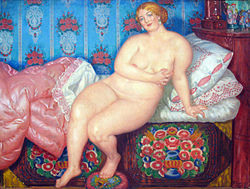 The Beauty (1915), painting based upon the 'Model' drawing


Models who work for individual artists in a private studio tend to observe art school norms in order to maintain the definition of modeling as serious artistic work. However, there are no longer strict rules, so a more informal working relationship may be established over time. This may include not undressing in another room, or not wearing a robe during breaks. In addition, silence is no longer necessary if the artist is comfortable working and conversing with the model. A more collegial relationship may develop where artist and model feel that they are collaborating. However, in a private studio environment, with an artist on a deadline or with commission guidelines, stricter work standards may apply regarding punctuality and holding longer, more demanding poses, but also higher rates of pay. However, private studio work is rare outside of major cities.[4]: 49–54
Chuck Close apologized in 2017 when several women accused him of making inappropriate comments when they came to his studio to pose, but initially denied any wrongdoing.[53] Following his death in 2021, it was revealed that Close suffered from a form of dementia, which could account for his behavior.[54]
-
 Jan de Bray, The Banquet of Cleopatra, Royal Collection (1652)
 -
 Arrangement in Grey and Black No. 1, better known as Whistler's Mother, a portrait of Anna McNeill Whistler by her son, James McNeill Whistler (1871)
 -
 The Woman with a Parasol (Suzanne Hoschedé) by Claude Monet (1886)
 -
 Vincent van Gogh, Portrait of the Artist's Mother, (October 1888)
 -
 The Artist and His Family by Lovis Corinth (1909)
 -
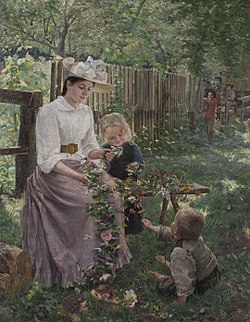 Summer by Ivana Kobilca (1890). Young woman in the painting is her sister Fani Kobilica.
 -
 Artist's husband Eugène Manet and their daughter Julie Manet in the Bougival garden (1881) by Berthe Morisot
 -
 The Game of Chess (1555) by Sofonisba Anguissola It depicts her sisters Lucia (left), Minerva (right) and Europa (middle) Anguissola playing chess. The older woman is their maidservant.
 -

-
 The Artist's Brother Étienne Vigée as schoolboy (1773)) by Élisabeth Vigée Le Brun
 -
 Artist's sister Danica Šantel (1904) by Henrika Šantel


_1555_(4096x3236px).jpg)


Family members, spouses and life partners
[edit]Through history, artists have used family members as models, both nude and otherwise, in creating their works. The Dutch Golden Age painter Jan de Bray specialized in the portrait historié, "portraits" of historical figures using contemporary figures as models, including himself and his family, as in two versions of The Banquet of Cleopatra (1652 and 1669).[55] Rose Beuret was the subject of several portrait sculptures by Auguste Rodin and his companion for 53 years, but his wife only in the final year of her life. Camille Doncieux, first wife of Claude Monet also posed for paintings by Pierre-Auguste Renoir and Édouard Manet. Hortense Fiquet, companion and later wife of Cézanne is rarely mentioned in art history.[56] Lucian Freud painted many of his 14 children, sometimes nude; the most controversial being his daughter Annie Freud in 1963 when she was 14.[57] However, she now looks back upon posing for her father as a positive experience.[58]
-
 The Prodigal Son in the Tavern by Rembrandt van Rijn depicts the artist and his wife Saskia (c. 1635)
 -
 The Startled Nymph (modeled by Suzanne Manet (née: Leenhoff)) by Édouard Manet (1859–1861)
 -
 Marie-Hortense Fiquet Cézanne by Paul Cézanne (1877)
 -

-
 Paul Gauguin portrait of his wife Tehamana, (1893)
 -

-
 Portrait d'Olga dans un fauteuil, (Pablo Picasso's wife Olga Khokhlova, 1917–1918)
 -
 Jeanne Hébuterne by Amedeo Modigliani (1918)


_-_Google_Art_Project.jpg)

,_oil_on_canvas,_130_x_88.8_cm,_Mus%C3%A9e_Picasso,_Paris,_France.jpg)

- Artist's husbands as models
-
 Presumed Betrothal Portrait of artist's future husband Gian Paolo Zappi by Lavinia Fontana
 -
 Portrait of Charles Beale, the artist's husband by Mary Beale
 -
 Self-Portrait of the Artist and Her Husband on Their Wedding Trip (1821) by Hortense Haudebourt-Lescot
 -
 Portrait of Alexis Soyer, the artist's husband 1841 by Emma Jones Soyer
 -
 Portrait of Anton Šantel, the artist's husband by Slovenian painter Avgusta Aigentler Šantel
 -
 Une loge aux Théâtre Italiens (1874) by Eva Gonzalès. The man in the painting is her future husband Henri Guérard and the woman is her sister Jeanne Gonzalès.
 -
 Artist's husband Eugene Manet and Their Daughter in the Garden (1883) by French painter Berthe Morisot
 -
 Domestic Happiness (Artist's husband Georg Pauli reading for their children) by Hanna Hirsch-Pauli
.jpg)


_Een_loge_in_het_Th%C3%A9%C3%A2tre_des_Italiens_(1874)_Mus%C3%A9e_d%27Orsay_22-8-2017_17-29-43.JPG)

_by_Hanna_Pauli.jpg)
Clothed modeling
[edit]

Painting classes, and artists doing historical themed works often require clothed or costumed models who take poses that may be sustained until the work is completed. This creates some demand for clothed models in those schools that continue to teach academic painting methods. Some models may promote their services based upon having interesting or varied costumes.[60] Clothing is required in public venues, such as Dr Sketchy's Anti-Art School,[61] but occurs in more traditional settings as well, such as the fund-raising marathons sponsored by the Bay Area Models Guild.[11]: 39
Usually an individual who is having their own portrait painted or sculpted is called a "sitter" rather than a model; when they are not being paid to pose, it is frequently the case that the artist is being paid to create a likeness.[62] Modern portraits are done from photographs at least in part, although artists prefer to have at least some hours of live sitting at the beginning to better capture the personality, and at the end for final touches. In some cases, the sitter may reject a portrait as unflattering, and destroy it.[63]
Photography
[edit]
There has been controversy regarding the status of photography as a fine-arts medium that is reflected in the unwillingness of some models to also pose nude for photography as they would for drawing or painting.[4]: 18–25 The experience of nude modeling for an amateur photographer is different from that of posing for figure drawing/painting.[21] Traditional media create a single image that is not a true likeness of the individual model, but photographs require a release in order to protect the model's right to privacy. The hourly rate of pay for models posing for fine-art photography is much higher than for other media, although less than for commercial photography.[4]: 18–25
Photographer Sally Mann published the book Immediate Family, in which 13 of the 65 images are of her children nude.[64] Mary Gordon characterized many of these images as sexualizing children regardless of artistic merit.[65] Mann's response to this criticism has been that the images were spontaneous and natural, having no sexual connotations other than those supplied by the viewer.[66] Less well-known photographers have been charged, but not convicted, for suspected child abuse for similar photographs of their own children.[67] Jock Sturges photographed entire families of naturists,[68] which led to an FBI investigation when a photo-lab employee reported the images; however, no charges were made.[69]

The relationship between male photographers and their wives as models is studied in Arthur Ollman's book, The Model Wife. It focuses on the photographers Baron Adolph de Meyer (whose wife was Olga de Meyer), Alfred Stieglitz (whose wife was Georgia O'Keeffe), Edward Weston and model Charis Wilson, Harry Callahan, Emmet Gowin, Lee Friedlander, Masahisa Fukase, Seiichi Furuya, and Nicholas Nixon.[70]
Occasionally the distinction of participating in Fine Art may make a young amateur model willing to pose for a well-known photographer, examples being Vanessa Williams and Madonna. A signed print of one of the nude photographs of Madonna taken by Lee Friedlander in 1979 sold at auction in 2012 for $37,000. Although largely a result of her fame, the model does not share in this increased value of the artwork.[71]
Online
[edit]During the COVID-19 pandemic, life drawing classes began to appear on online platforms, most frequently on Zoom. This shift to virtual spaces created new, global communities and increased access to artists who were able to join sessions from their homes.[72] Although remote sessions suffer from some difficulties, such as the flattening and distortion of the camera and the lack of direct communications, there has been an expansion of the community willing and able to participate, both as models and artists.[73][74]
Models at the Government College of Art & Craft in India for whom posing for classes is their only income do not have the online option, but have been supported by donations from artists.[75]
Nudity and body image
[edit]
In recent years, a connection has been made between social issues of body image, sexualization and art modeling with some promoting wider participation in life drawing, including at a younger age, to provide an experience of real nude people as an alternative to social media representations of idealized bodies.[76] The social benefits of life drawing were suggested by David B. Manzella in the 1970s while director of the Rhode Island School of Design. Nude models were introduced to the young people's classes with the permission of parents.[77] Models often cite acceptance of their bodies as one of the benefits of modeling.[78][79] While younger women continue to be the typical model, men and older models are welcomed in cities with an active arts community such as Glasgow, Scotland.[59] Figure On Diversity is one initiative which aims to increase representation in studio art and studio art education by creating resources in support of models who hold visible marginalized identities.[12] Sociologist Sarah R. Phillips, in a 2020 follow-up to her 2005 book Modeling Life notes that models who have contacted her during these years generally experience posing nude in a classroom as empowering.[80]
Alternative views
[edit]The mainstream view of art modeling is based upon a moderate position regarding the value of figure studies and nudity in art. There are also schools or studios that may be more conservative, or more liberal. Many art programs in Christian institutions consider nudity in any form to be in conflict with their beliefs, and therefore hire only clothed models for art classes.[81] None of the Protestant Evangelical colleges in the United States were found to include nude models in their arts and graphic design programs, citing it as an immodest practice; yet similar institutions in Australia held life drawing classes.[82]
At Louisiana State University (LSU), there are rare objections to nudity by religious or conservative students, but the faculty assert that drawing the body is necessary training for art in general and to understand the structure underneath clothing. Models at LSU are full-time students who learn about modeling from other students or artists.[19] Brigham Young University does not allow nude models, describing their policy as self-censorship within the context of the school's honor code.[83] Other institutions view the absence of figure studies as bringing into question the completeness of the art education offered.[84] Some recognize that an appreciation of the beauty of the human body is compatible with a Christian education.[85] Gordon College not only maintains the need for nude figure studies as part of a complete classical art education, but sees the use of models clad in swimwear or other revealing garments as placing the activity in the context of advertisement and sexual exploitation.[86]
James Elkins voices an alternative to classical "dispassionate" figure study by stating that the nude is never devoid of erotic meaning, and it is a fiction to pretend otherwise.[87] The advocate of classical aesthetics Kenneth Clark recognized that "biological urges" were never absent even in the most chaste nude, nor should they be unless all life is drained from the work.[88] Most models maintain that posing nude need not be any more sexual than any other coed social situation as long as all participants maintain a mature attitude.[4] However, decorum is not always maintained when either a model or the students are not familiar with the often unspoken rules. Models may be apprehensive about posing for incoming freshmen who, having never encountered classroom nudity, respond immaturely.[10][21]
Acceptance of the erotic is apparent in the work and behavior of some artists. For example, Picasso was also famous for having a series of model/muse/mistresses through his life: Marie-Thérèse Walter, Fernande Olivier, Dora Maar, and Françoise Gilot. The painter John Currin, whose work is often erotic, combines images from popular culture and references to his wife, Rachel Feinstein.[89]
A feminist view is the male gaze, which asserts that nudes are inherently voyeuristic, with the viewer in the place of the powerful male gazing upon the passive female subject.[90]
History
[edit]The role of art models has changed through different eras as the meaning and importance of the human figure in art and society has changed.[88][91] Nude modeling, nude art and nudity in general have at times been the subject to social disapproval, at least by some elements in society.[1]: 3 When the nude in art was most popular, the models that made these artworks possible might be of low status and poorly paid. The stereotype of the female art model was part of bohemianism in the late 19th and early 20th century Europe. The combination of nakedness and the exchange of money led others to associate nude modeling with prostitution, particularly in the United States.[4]: 6–7
As the 20th century progressed, models gained more recognition and status, including forming the first organizations with some of the functions of labor unions thus becoming a professional occupation. It became possible for individuals to gain notoriety, such as Audrey Munson, who was the model or inspiration for more than 15 statues in New York City in the 1910s.[92] Quentin Crisp began a thirty-year career as a model in 1942.[1]: 20–21
Ancient and Post-classical
[edit]The Greeks, who had the naked body constantly before them in the exercises of the gymnasium, had far less need of professional models than the moderns; but it is scarcely likely that they could have attained the high level reached by their works without constant study from nature. It was probably in Ancient Greece that models were first used. The story told of Zeuxis by Valerius Maximus, who had five of the most beautiful virgins of the city of Crotone offered him as models for his picture of Helen, proves their occasional use. The remark of Eupompus, quoted by Pliny, who advised Lysippos, "Let nature be your model, not an artist", directing his attention to the crowd instead of to his own work, also suggests a use of models which the many portrait statues of Greek and Roman times show to have been not unknown.[93] The names of some of these models of the era are themselves known, such as the beautiful Phryne who modeled for many paintings and sculptures.[94]
The nude almost disappeared from Western art during the Middle Ages, largely due to the attitude of the early Christians,[95] although in Kenneth Clark's famous distinction "naked" figures were still required for some subjects, especially the Last Judgment. This changed with the Renaissance and the rediscovery of classical antiquity, when painters initially used their male apprentices (garzoni) as models, for figures of both genders, as is often clear from their drawings. Leon Battista Alberti recommends drawing from the nude in his De pictura of 1435; as remained usual until the end of the century, he seems only to mean using male models.[96]: 49–50
-

-
 Draughtsman Making a Perspective Drawing of a Reclining Woman, Albrecht Dürer (c. 1600)


Early modern
[edit]
Possibly the first images of nude women done from the life are a number of drawings and prints by Albrecht Dürer from the 1490s, which were ahead of Italian practice.[96]: 51–55 The production of female nudes suddenly became important in Venetian painting in the decade after 1500, with works such as Giorgione's Dresden Venus of c. 1510. Venetian painters made relatively little use of drawings, and it has been thought that these works did not involve much use of live models, but this view has recently been challenged.[96]: 55–56 The first Italian artist to regularly use female models for studies is usually thought to have been Raphael, whose drawings of the female nude clearly do not use teenage boys.[96]: 56–60 Michelangelo's earlier Study of a Kneeling Nude Girl for The Entombment (c. 1500) may or may not have used a female model, but if it did this was not his normal practice.[97]
The story of the love between Raphael and his mistress-model Margarita Luti (La Fornarina) is "the archetypal artist-model relationship of Western tradition".[98] There was also a tradition of incorporating donor portraits as minor figures into religious narrative scenes, and several Virgin and Child compositions by court painters are thought to use princesses or other court figures as models for the Virgin Mary; these are sometimes called "disguised portraits".[99]: 3–4, 137 [100] The most notorious of these is the portrayal as the Virgo lactans (or just post-lactans) of Agnès Sorel (died 1450), the mistress of Charles VII of France, in a panel by Jean Fouquet.[99]: 3–4 [101]
Raphael's relationship was probably somewhat untypical, although the Autobiography of Benvenuto Cellini records his use, in both Rome and Paris, of servant girls as model, mistress and maid. However, when he broke with one he had difficulty in finding another model, and was forced to rehire her just to pose.[96]: 60–61 Lorenzo Lotto records payments to prostitutes to pose in Venice in 1541, perhaps the earliest record of what long remained an option for artists.[96]: 60
Art modeling as an occupation appeared in the late Renaissance when the establishment of schools for the study of the human figure created a regular demand, and since that time the remuneration offered ensured a continual supply.[93] However, academy models were usually only men until the late 19th century, as were the students.[102] The Académie royale de peinture et de sculpture only allowed female models, clothed, from 1759.[96]: 61 In London the students at the female branch of the Royal Academy of Art were not allowed to study the undraped figure until the later 19th century.[103]
Late modern and contemporary
[edit]-

-
 Olympe Pélissier (1799–1878), a French artists' model and the second wife of Gioachino Rossini
 -
 Apollonie Sabatier (1822–1890), a French courtesan, artists' muse and bohémienne in 1850s Paris
 -
 Fanny Eaton (1835–1924), a Jamaican-born British art model known for her work with the Pre-Raphaelite Brotherhood
 -

-

-
 Rosina Ferrara (1861–1934), an Italian girl from Capri, who became the favorite muse of John Singer Sargent
 -
 Misia Sert (1872–1950), patron and friend of numerous artists, for whom she posed
 -
 Painter and art collector Julie Manet (1878 –1966) often posed for her mother, painter Berthe Morisot and other Impressionist artists.


.jpg)
_1862.jpg)


In 19th-century Paris, a number of models earned a place in art history. Victorine Meurent became a painter herself after posing for several works, including two of the most infamous: Manet's Olympia and Le déjeuner sur l'herbe.[105] Joanna Hiffernan was an Irish artists' model and muse who was romantically linked with American painter James Abbott McNeill Whistler and French painter Gustave Courbet. She is the model for Whistler's painting Symphony in White, No. 1: The White Girl and is rumored to be the model for Courbet's painting L'Origine du monde. Suzanne Valadon, also a painter, modeled for Pierre-Auguste Renoir (most notably in Dance at Bougival), Henri de Toulouse-Lautrec, Pierre Puvis de Chavannes, and Edgar Degas.[106] She was the mother of the painter Maurice Utrillo.[107] Julie Manet, who posed for her mother Berte Morisot and many other Impressionist artists, was also a painter and an important art collector.[108]
The second Bal des Quat'z'Arts held in 1893 was a costume ball featuring nude models among the crowd, blurring the distinction between the idealized images in works of art and the real people who posed for them. This was symbolic of other social changes that marked the fin de siècle. Four studio models were convicted of public indecency, which was followed by protests of censorship by students of the École des Beaux-Arts.[109][110]
When Victorian attitudes took hold in England, studies with a live model became more restrictive than they had been in the prior century, limited to advanced classes of students that had already proved their worthiness by copying old master paintings and drawing from plaster casts.[91]: 9 This is in part because many schools were publicly funded, so decisions were under the scrutiny of non-artists.[91]: 12 Modeling was not respectable, and even less so for women. During the same period, the French art atelier system allowed any art student to work from life in a less formal atmosphere, and also admitted women as students. In England, the life class became well established as a central element in art education only with the approach of the 20th century.[91]: 14–16
-
 Masked nude, drawing by Thomas Eakins (c. 1863–1866)
 -
 Two Boys Boxing at the Art Students League of Philadelphia, by Thomas Eakins
 -
 Male model posing at the École des Beaux-Arts in the 19th century. Women artists were excluded from the life room until late in that century.

_-_2_Boys_Boxing_in_atelier-GHP-445992.jpg)
.jpg)
In the United States, Victorian modesty sometimes required the female model to pose nude with her face draped (Masked Nude by Thomas Eakins, for example).[111]: 84 In 1886, Eakins was dismissed from the Pennsylvania Academy of Fine Art for removing the loincloth from a male model in a mixed classroom.[112]
-
 James Carroll Beckwith's c. 1901 portrait of Evelyn Nesbit, a popular American chorus girl and artists' model
 -
 Photograph of Evelyn Nesbit by Gertrude Käsebier, 1903
 -
 Fountain of the Setting Sun (1915) by Adolph Alexander Weinman, modeled by Audrey Munson
 -


In the postmodern era, the nude has returned to gain some acceptance in the art world, but not necessarily the art model. Figure drawing is offered in most art schools, but may not be required for a fine art degree. Peter Steinhart says that in trendy galleries, the nude has become passé,[11]: 21 while according to Wendy Steiner there has been a revival in the importance of the figure as a source of beauty in contemporary art.[113] Some established living artists work from models, but more work from photographs, or their imagination. Yet privately held open drawing sessions with a live model remain as popular as ever.[114]
See also
[edit]- The Helga Pictures
- Russell Nesbit
- Artistic canons of body proportions – Criteria used in formal figurative art
References
[edit]- ^ a b c d e f Bharali, Kannaki (2019). Nude in a Classroom: The Contemporary World of Life Modelling (PhD). City University of New York. Retrieved December 5, 2021.
- ^ Denny, Diana (November 16, 2012). "A Day in the Life of Norman Rockwell Model Chuck Marsh". Saturday Evening Post. Retrieved November 29, 2012.
- ^ "Employment". Studio Incamminati. August 2, 2021. Retrieved October 21, 2024.
- ^ a b c d e f g h i j k l m n o p q r s t Phillips, Sarah R. (2006). Modeling Life: Art Models Speak about Nudity, Sexuality and the Creative Process. Albany: SUNY Press. ISBN 978-0-7914-6908-8. Retrieved January 12, 2025.
- ^ "Guidelines". Register of Artists' Models. Retrieved December 10, 2021.
- ^ "About". Bay Area Models' Guild. Retrieved December 10, 2021.
- ^ "Life Models Society". Lifemodelssociety.org. Retrieved December 10, 2021.
- ^ "KYO – Konstmodellernas yrkesorganisation" [Kyo - the professional organization of the art models] (in Swedish). Retrieved December 10, 2021.
- ^ "Model's Strike 1941". Argus. Trove. October 28, 1941. Archived from the original on October 4, 2023.
- ^ a b c d e Bullock, Linda (2005). Finding Human Form: Artists' Models in Studio and Classroom. Ashville: R.S. Press. ISBN 978-0-9613949-9-8.
- ^ a b c d e f Steinhart, Peter (2004). The Undressed Art: Why We Draw. New York: Alfred A. Knopf. ISBN 978-1-4000-4184-8.
- ^ a b "About". Figure On Diversity. Retrieved May 5, 2024.
- ^ "This Organization Is Trying To Diversify Boston's Figure Modeling World". WBUR. July 26, 2019. Retrieved January 7, 2024.
- ^ Sheets, Brenna (June 3, 2021). "Figure on Diversity spotlights excluded identities in the art community". The Independent Florida Alligator. Gainesville, Florida. Retrieved May 6, 2024.
- ^ Leber, Holly (February 24, 2012). "Art models disrobe to help immortalize the human form". Chattanooga Times Free Press. Retrieved November 26, 2021.
- ^ Nesich, Hannah (March 21, 2013). "Baring It All For Fine Art". The New Paltz Oracle. Retrieved November 26, 2021.
- ^ "What to Expect as an Art Model" (PDF). Valdosta State University. Retrieved October 21, 2024.
- ^ * Baker, Laura. "Models 'expose' students to nude art". The Daily Collegian. Retrieved November 26, 2021.
- ^ a b Ben Bourgeois (March 5, 2010). "Yes--They Do Use Nude Models For Art Class". WAFB. Retrieved November 26, 2021.
- ^ a b Berry, William A. (1977). Drawing the Human Form: A Guide to Drawing from Life. New York: Van Nortrand Reinhold Co. ISBN 978-0-442-20717-5.
- ^ a b c Rooney, Kathleen (2009). Live Nude Girl: My Life as an Object. Fayetteville: University of Arkansas Press. ISBN 978-1-55728-891-2.
- ^ a b Mayhew, Margaret (2010). Modelling Subjectivities: Life Drawing, Popular Culture and Contemporary Art Education (PhD). Sydney, Australia: University of Sydney. Retrieved December 15, 2021.
- ^ Rocha, Kimberlina (February 2, 2005). "Art in the Nude". The Collegian. California State University, Fresno. Retrieved November 26, 2021.
- ^ Jenkins, Audrey (March 21, 2014). "Attention: Will Strip for Art". The Cento. Retrieved November 26, 2021.
- ^ Annette and Luc Vizin (2003). The 20th Century Muse. New York: Harry N. Abrams, Inc. ISBN 0-8109-9154-3.
- ^ a b Chris, Cynthia (2012). "Censoring Purity". Camera Obscura (79). Retrieved September 1, 2025.
- ^ "The Artist and the Model (2012)". IMDB. Retrieved March 6, 2016.
- ^ "Festival de Cannes: La Belle Noiseuse". festival-cannes.com. Retrieved April 21, 2020.
- ^ "Camille Claudel (1988)". IMDB. Retrieved March 6, 2016.
- ^ Gerstner, David (2002). "Unsinkable Masculinity: The Artist and the Work of Art in James Cameron's "Titanic"". Cultural Critique (50): 1–22. ISSN 0882-4371. JSTOR 1354686. Retrieved September 3, 2025.
- ^ Arbus, Victor (1989). How to Draw the Human Figure. Brian Todd Publishing House. ISBN 1-55521-380-4.
- ^ Jacobs, Ted Seth (1986). Drawing with an Open Mind. New York: Watson-Guptill Publications. ISBN 978-0-8230-1464-4.
- ^ "Figure Models in the Studio". Student Handbook 2023-2024 (PDF). Ringling College of Art and Design. pp. 100–101. Retrieved August 31, 2025.
- ^ "Policy for the Study of Nude Models in SIUE Figure Drawing Classes". Southern Illinois University Edwardsville. Retrieved September 24, 2019.
- ^ a b c Model Handbook (PDF), Columbus College of Art & Design, retrieved March 7, 2024
- ^ Figure Model Guidelines, University of South Carolina Aiken: Visual and Performing Arts, 2018, retrieved March 7, 2024
{{citation}}: CS1 maint: publisher location (link) - ^ "RAM Guidelines – Contentious Issues". Retrieved October 18, 2012.
- ^ "Modeling Q&A" (PDF). St. Olaf College. Retrieved September 24, 2019.
- ^ a b Amy K. Stewart (March 26, 2008). "UVSC drafts nude-modeling rules". Deseret News. Archived from the original on March 6, 2016.
- ^ "CUNY Art Model" (PDF). City University of New York. July 10, 2017. Retrieved November 26, 2021.
- ^ "Figure Models Needed for Studio Art Classes (paid position)". Ohio State University: Department of Art. Retrieved March 7, 2024.
- ^ "Students Financial Aid". Western Washington University. Retrieved November 26, 2021.
- ^ "Department of Human Resources". Jacksonville State University. Retrieved October 21, 2024.
- ^ "Part-time Position Descriptions: Careers/Opportunities". Eskenazi School of Art, Architecture + Design: Indiana University Bloomington. Retrieved November 26, 2021.
- ^ "Opportunity for Contract Figure Models" (PDF). Art Academy of Cincinnati. Retrieved December 10, 2021.
- ^ "Classified Staff, Management and Other Opportunities". Coast Community College. Retrieved December 10, 2021.
- ^ "Working with life models: An interview with PCA&D Model Coordinator Evan Kitson". Pennsylvania College of Art & Design. April 7, 2022. Retrieved January 8, 2025.
- ^ "Figure Model". College for Creative Studies. Retrieved January 8, 2025.
- ^ "Naked art: Take a peek inside a nude drawing class in Singapore". CNA Lifestyle. Retrieved March 7, 2024.
- ^ Zack Stoycoff (February 20, 2019). "For art's sake". Tulsa World. Retrieved November 26, 2021.
- ^ "Yves Klein, Anthropometries". Tate Modern. January 17, 2013. Retrieved December 10, 2019.
- ^ Randy Kennedy (March 19, 2010). "Who's Afraid of Marina?". The New York Times.
- ^ Pogrebin, Robin (December 20, 2017). "Chuck Close Apologizes After Accusations of Sexual Harassment". THe New York Times. Retrieved October 30, 2019.
- ^ Johnson, Ken; Pogrebin, Robin (August 19, 2021). "Chuck Close, Artist of Outsized Reality, Dies at 81". The New York Times. ISSN 0362-4331. Retrieved August 19, 2021.
- ^ Christopher Lloyd, Enchanting the Eye, Dutch Paintings of the Golden Age, pp. 49-52, Royal Collection Publications, 2004, ISBN 1-902163-90-7.
- ^ Butler, Ruth (2008). Hidden in the Shadow of the Master: The Model-Wives of Cézanne, Monet, and Rodin. New Haven, United States: Yale University Press. ISBN 978-0-300-14953-1. Retrieved July 8, 2021.
- ^ Geordie Greig (October 17, 2013). "A Daughter's Tale". Vanity Fair.
- ^ Cunningham, Erin (October 22, 2013). "New Book Gives A Rare Glimpse Into The Life of Lucian Freud". The Daily Beast. Archived from the original on July 8, 2018. Retrieved July 8, 2018.
- ^ a b "Life-modelling: the art of poise". Herald Scotland. Retrieved November 26, 2021.
- ^ "Kimono Model". Atelier Kanawa. Retrieved July 7, 2021.
- ^ Rachel Kramer Bussel. "Model Behavior". The Village Voice. Archived from the original on August 3, 2008. Retrieved October 10, 2012.
- ^ "sitter". Merriam-Webster Online Dictionary. Retrieved November 29, 2012.
- ^ Pierce, Andrew (2008). "Lucian Freud portrait worth millions destroyed by sitter". The Telegraph. Retrieved November 29, 2012.
- ^ Mann, Sally; Price, Reynolds (1992). Immediate Family. Aperture. ISBN 978-0893815233.
- ^ Gordon, Mary (1996). "Sexualizing Children: Thoughts on Sally Mann". Salmagundi (111). Skidmore College: 144–145. JSTOR 40535995.
- ^ Mann, Sally; Gordon, Mary (1997). "An Exchange on "Sexualizing Children"". Salmagundi (114/115): 228–232. ISSN 0036-3529. JSTOR 40548981. Retrieved December 24, 2021.
- ^ Powell, Lynn (2010). Framing Innocence: A Mother's Photographs, a Prosecutor's Zeal, and a Small Town's Response. The New Press. ISBN 978-1595585516.
- ^ "Jock Sturges Biography". RoGallery. Archived from the original on July 17, 2018.
- ^ Harold Maass (July 5, 1990). "Photo Lab Sets Off FBI Probe : Art: Jock Sturges' photographs of nude families are at issue". Los Angeles Times.
- ^ Ollman, Arthur (1999). The Model Wife. Little, Brown. ISBN 9780821221709.
- ^ "Nude (Madonna), 1979". Christie's. Retrieved October 20, 2012.
- ^ "Covid Has Created a Virtual Renaissance for Life Drawing". Wired. ISSN 1059-1028. Retrieved September 15, 2021.
- ^ Angelica Frey (May 26, 2020). "The Imperfect but Invaluable Experience of Virtual Figure-Drawing Classes". Artsy.
- ^ "Clothing Not Optional: Fine Art Models Find New Ways To Sketch A Virtual Future". KUNC. NPR. September 15, 2020. Retrieved November 26, 2021.
- ^ Bishwabijoy, Mitra (March 31, 2021). "City artists pitch in to help lockdown-hit nude models". The Times of India. ISSN 0971-8257. Retrieved November 26, 2021.
- ^ "Body Image and Mental Health: Leading a Life Art Class". Mental Health Foundation. April 26, 2019.
- ^ Manzella, David B. (1973). "Nude in the Classroom". American Journal of Art Therapy. 12 (3).
- ^ "London's Life Models: The Naked Truth". Londonist. August 21, 2018. Retrieved November 26, 2021.
- ^ Holland, Maggie (January 26, 2018). "Baring it all: Student models in nude modeling program at Lamar Dodd discuss art and body positivity". The Red and Black. University of Georgia, Athens. Retrieved November 26, 2021.
- ^ Phillips, Sarah R. (2022). "Ways of Connecting with the Secret World Behind the Life Model". In Chare, Nicholas; Contogouris, Ersy (eds.). On the Nude: Looking Anew at the Naked Body in Art. Routledge Research in Gender and Art. New York, NY: Routledge. doi:10.4324/9781003049968. ISBN 978-1-00-304996-8.
- ^ Daniel Grant (July 18, 2011). "Christian Colleges Struggle with Their Fine Art Programs". Huffington Post. Retrieved October 7, 2012.
- ^ Bower, Lorraine (December 29, 2009). "Faith–Learning Interaction in Graphic Design Courses in Protestant Evangelical Colleges and Universities". Christian Higher Education. 9 (1): 5–27. doi:10.1080/15363750902973477. ISSN 1536-3759. S2CID 144153863. Retrieved March 21, 2021.
- ^ Katelyn Johns (October 19, 2012). "Honor Code and the visual arts". The Daily Universe. Retrieved September 24, 2019.
- ^ White, Jenny (March 1, 2012). "Nudity in art is professional, not sexual". Associated Students of Olivet Nazarene University. Retrieved February 28, 2013.
- ^ "Art Policy on Nude Models" (PDF). Archived from the original (PDF) on October 4, 2023. Retrieved September 13, 2025.
- ^ "Policy on the Use of Nude Models in Art". Gordon College. Retrieved December 10, 2019.
- ^ Elkins, James (2001). Why Art Cannot Be Taught: A Handbook for Art Students. Urbana: University of Illinois Press. p. 85. ISBN 978-0-252-06950-5.
- ^ a b Clark, Kenneth (1956). The Nude – A Study in Ideal Form: Chapter 1. The Naked and the Nude. Princeton: Princeton University Press. ISBN 978-0-691-01788-4.
{{cite book}}: ISBN / Date incompatibility (help) - ^ Colman, David (March 11, 2011). "Rachel Feinstein and John Currin, Their Own Best Creations". The New York Times. ISSN 0362-4331. Retrieved October 21, 2024.
- ^ Eaton, E.W. (September 2008). "Feminist philosophy of art". Philosophy Compass. 3 (5): 873–893. doi:10.1111/j.1747-9991.2008.00154.x.
- ^ a b c d Postle, Martin; Vaughn, William (1999). The Artist's Model: from Etty to Spencer. London: Merrell Holberton. ISBN 978-1-85894-084-7.
- ^ Rozas, Diana & Gottehrer Bourne, Anita (1999). American Venus: The Extraordinary Life of Audrey Munson, Model and Muse. Los Angeles: Balcony Press.
- ^ a b One or more of the preceding sentences incorporates text from a publication now in the public domain: Chisholm, Hugh, ed. (1911). "Models, Artists'". Encyclopædia Britannica. Vol. 18 (11th ed.). Cambridge University Press. p. 640.
- ^ Cooper, Craig (1995). "Hyperides and the Trial of Phryne". Phoenix. 49 (4): 303–318. doi:10.2307/1088883. ISSN 0031-8299. JSTOR 1088883. Retrieved September 1, 2025.
- ^ Sorabella, Jean (January 2008). "The Nude in the Middle Ages and the Renaissance, In Heilbrunn Timeline of Art History". New York: The Metropolitan Museum of Art. Retrieved October 25, 2012.
- ^ a b c d e f g h Bernstein, Joanne G. (1992). "The Female Model and the Renaissance Nude: Dürer, Giorgione, and Raphael". Artibus et Historiae. 13 (26): 49–63. doi:10.2307/1483430. ISSN 0391-9064. JSTOR 1483430. Retrieved December 8, 2020.
- ^ Dunkerton, Jill; Foister, Susan; Penny, Nicholas (1999). Dürer to Veronese: Sixteenth-Century Painting in the National Gallery. New Haven and London: Yale University Press. ISBN 9780300095333. Retrieved March 28, 2025.
- ^ Lathers, Marie (2001). Bodies of Art: French Literary Realism and the Artist's Model. University of Nebraska Press. p. 60. ISBN 978-0-8032-2941-9.
- ^ a b Campbell, Lorne (1990). Renaissance Portraits, European Portrait-Painting in the 14th, 15th and 16th Centuries. Yale University Press. ISBN 0-300-04675-8.
- ^ Ainsworth, Maryan W. (January 2008). "Intentional Alterations of Early Netherlandish Painting". Heilbrunn Timeline of Art History. New York: The Metropolitan Museum of Art.
- ^ *Ainsworth, Maryan Wynn et al., From Van Eyck to Bruegel: Early Netherlandish Paintings in the Metropolitan Museum of Art, p. 192, 2009, Metropolitan Museum of Art, 2009. ISBN 0-8709-9870-6, google books Archived 2021-05-10 at the Wayback Machine
- ^ Lathers, Marie (1996). "The Social Construction and Deconstruction of the Female Model in 19th-Century France". Mosaic: An Interdisciplinary Critical Journal. 29 (2): 23–52. ISSN 0027-1276. JSTOR 44029745. Retrieved October 29, 2022.
- ^ Bluett, Amy (March 2, 2021). "Victorian women and the fight for arts training". Royal Academy of Arts. Retrieved January 5, 2025.
- ^ Lathers, Marie (October 15, 2013). "Laure". In Jiminez, Jill Berk (ed.). Dictionary of Artists' Models. Routledge. pp. 315–316. ISBN 9781135959142.
- ^ Lipton, Eunice (1992). Alias Olympia: A Woman's Search for Manet's Notorious Model and Her Own Desires. Cornell University Press. ISBN 978-0-8014-8609-8.
- ^ "Suzanne Valadon | Artist Profile". National Museum of Women in the Arts. Retrieved October 21, 2024.
- ^ "Maurice Utrillo". Artnet. Retrieved October 21, 2024.
- ^ Marlowe Paris, Lara. "'The last Manet': Julie Manet was the living legacy of impressionism". The Irish Times. Retrieved September 11, 2025.
- ^ Felter-Kerley, Lela (2010). "The Art of Posing Nude: Models, Moralists, and the 1893 Bal Des Quat'z-Arts" (PDF). French Historical Studies. 33 (1): 69–97. doi:10.1215/00161071-2009-021.
- ^ Kerley, Lela F. (June 7, 2017). Uncovering Paris: Scandals and Nude Spectacles in the Belle Époque. LSU Press. ISBN 978-0-8071-6634-5.
- ^ Boime, Albert (1974). Strictly Academic: Life Drawing in the Nineteenth Century. Binghamton: State University of New York at Binghamton.OCLC 935594325
- ^ Sewell, Darrel (2001). Thomas Eakins. Yale University Press. ISBN 0-87633-143-6.
- ^ Wendy, Steiner (2001). Venus in Exile: The Rejection of Beauty in Twentieth-century Art. The Free Press. ISBN 978-0-684-85781-7.
- ^ Gail Gregg (December 1, 2010). "Nothing Like the Real Thing". ArtNews.

Further reading
[edit]- Meskimmon, Marsha; Desmarais, Jane; Postle, Martin; Vaughan, William; Vaughan, Martin; West, Shearer; Barringer, Tim (2006). Model and Supermodel: The Artists' Model in British Art and Culture. Manchester University Press. ISBN 978-0-7190-6662-7.
- Waller, Susan (2006). The Invention of the Model: Artists and Models in Paris, 1830–1870. Burlington: Ashgate. ISBN 978-0-7546-3484-3.
External links
[edit]
- Dr. Sketchy's Anti-Art School
- LIFE magazine compilation of photos of artist and models
- Smithsonian Institution: Artists and Their Models
| Nakedness and clothing | |
|---|---|
| Nudity and sexuality | |
| Issues in social nudity | |
| Naturism | |
| Nude recreation | |
| By location | |
| Social nudity advocates | |
| Depictions of nudity | |
| See also | |


| International | |
|---|---|
| National | |
| Other | |

Model (art)
View on GrokipediaDefinition and Fundamentals
Role in Artistic Practice
Artistic models serve as essential live references in the practice of figure drawing, painting, and sculpture, enabling artists to observe and replicate the human body's anatomy, proportions, and dynamic gestures with precision. By posing in controlled sessions, models facilitate direct study of skeletal structure, musculature, and skin texture, which photographs or anatomical diagrams cannot fully convey due to limitations in capturing three-dimensional volume and subtle shifts in light and shadow.[7][8][9] This role emerged prominently during the Renaissance, when direct observation from life became a cornerstone for naturalistic depiction, as seen in preparatory drawings like Raphael's red chalk studies for the Villa Farnesina frescoes around 1518. Formalized in art academies by the 18th century, nude modeling supported rigorous training in anatomical fidelity; the Royal Academy in London, founded in 1768, incorporated life drawing sessions with models—initially male, with females introduced by 1769—to prioritize empirical observation over idealized templates.[4][3][10] In contemporary practice, models remain vital for developing observational acuity and empathy with the subject, allowing artists to discern gesture and form in real time during sessions lasting from short poses of minutes to extended holds of hours. This hands-on method enhances skills in rendering believable figures, as evidenced by ongoing use in ateliers and workshops where live sessions outperform static references in conveying motion and proportion.[11][12][13]Selection, Training, and Professionalism
Art models are typically selected by art academies, studios, or individual artists based on reliability, physical stamina, and the ability to maintain static poses for durations ranging from one minute to several hours.[14] [15] Minimum age requirements stand at 18 years, with no formal education or qualifications mandated, though a high school diploma may be preferred in some institutional settings.[16] [15] Selection often prioritizes candidates comfortable with nudity and capable of professional conduct, including punctuality and boundary respect; physical attributes vary to provide anatomical diversity for educational purposes, rather than adhering to narrow aesthetic ideals.[17] [14] Training for art models occurs primarily through practical experience rather than structured programs, focusing on developing endurance to hold poses without fatigue-induced movement and mastering a repertoire of dynamic positions that highlight anatomical features.[15] [18] Aspiring models practice short gestures building to longer holds, such as progressing from 1-minute to 20-minute poses, and learn to align body elements like head, hands, and feet for balanced, sustainable stances.[18] [19] While no certifications are universally required, some pursue informal preparation via art classes or self-study to anticipate session demands, enhancing employability in competitive academic environments.[20] Professionalism in art modeling emphasizes ethical boundaries, dependability, and mutual respect in the studio, with models expected to arrive prepared, adhere to session schedules, and avoid personal interactions that could compromise the work-focused atmosphere.[21] [22] Organizations such as art model guilds enforce standards through vetting processes and behavioral guidelines, ensuring models maintain composure and artists uphold non-invasive conduct; in unionized contexts, like certain fine arts guilds, members commit to professional protocols to safeguard session integrity.[23] [24] Optional certifications, such as Professional Figure Model credentials from regional guilds, signal adherence to these norms, though widespread unionization remains limited, with most oversight occurring via institutional hiring practices.[24]Economic and Motivational Realities
Art models generally earn modest hourly wages, with United States averages reported at approximately $19.50 per hour as of October 2025, though rates range from $5 to $25 depending on location, session duration, and model experience.[25] In specialized life drawing contexts, figures hover around $16 to $26 per hour, often higher in academic or urban settings like art schools where pre-negotiated rates apply.[26] Annual incomes for full-time models rarely exceed $37,000, frequently falling to $20,000 or less due to the profession's part-time and irregular nature.[27][28] The gig-based structure exacerbates economic variability, as employment relies on sporadic bookings from artists, classes, or workshops rather than steady contracts, compelling many models to pursue supplementary jobs in fields like acting, teaching, or service industries.[29] Physical constraints, such as holding poses for 20 minutes to hours, limit workable sessions to 3-4 hours daily, further capping earnings potential despite the role's demands on endurance and reliability.[30] Motivations for entering art modeling often stem from practical economic needs, including flexible scheduling that suits students, performers, or those with irregular lifestyles, alongside immediate cash payments without long-term commitments.[16] While some cite intrinsic appeals like contributing to artistic education or embracing bodily vulnerability, the persistently low remuneration—below median wages for comparable physical labor—indicates financial supplementation as the dominant driver rather than prestige or passion alone.[31] In regions like the United Kingdom, recommended rates of £20 per hour reflect efforts to sustain viability amid these challenges, yet models report ongoing instability akin to broader creative gig economies.[30]Types and Methods of Modeling
Studio and Academic Modeling
Studio and academic modeling involves professional figures posing for artists or students in controlled environments such as private ateliers or institutional life drawing classes to facilitate the study of human anatomy and form. These sessions emphasize sustained postures to allow for detailed observation, typically requiring models to maintain immobility for periods ranging from short gestures of two to five minutes to longer holds of twenty minutes or more.[32] Nudity is standard in academic settings to enable precise depiction of musculature, proportions, and surface anatomy without the distortion of clothing, a practice rooted in the empirical necessity for anatomical fidelity in representational art.[33] Historically, the formalized use of live nude models emerged during the Renaissance, when direct observation supplanted idealized approximations, with early academies prioritizing such sessions for training in naturalism; by the 18th century, institutions like the Royal Academy of Arts in London introduced female models in 1769, often drawn from working-class backgrounds and compensated at double the rate of male counterparts due to prevailing social constraints.[10] In these early academic contexts, modeling constituted the largest budgetary expense, underscoring its centrality to curricula focused on dissecting the body's structural realities through repeated sketching and casting exercises.[10] Modern sessions, lasting two to three hours, structure around sequential poses selected by the model or instructor, beginning with dynamic gestures to capture movement and culminating in sustained positions for refined anatomical rendering; breaks every twenty minutes accommodate model fatigue, with robes provided for modesty during intervals.[34] Models must meet a minimum age of 18 years, demonstrate physical endurance to hold challenging stances without significant shifting, and adhere to professional boundaries, such as avoiding personal interactions with artists to preserve focus and impartiality.[15] [35] In studio settings, individual artists may request draped or costumed variations, but academic environments prioritize undraped forms to train observational accuracy, countering any abstracted or ideologically filtered representations.[3] Professionalism demands models arrive prepared with practiced poses that highlight anatomical landmarks, transitioning smoothly between them to minimize disruptions; institutions enforce codes of conduct prohibiting proximity to the model's stand or unsolicited commentary, ensuring an environment conducive to concentrated study rather than social exchange.[19] [21] While economic incentives vary by locale—often hourly rates reflecting session intensity— the role's core value lies in providing unmediated access to the human figure's causal mechanics, from skeletal alignment to soft tissue dynamics, indispensable for artists pursuing realist techniques over stylized approximations.[16]Individual and Group Sessions
Group sessions, prevalent in academic institutions, open studios, and workshops, feature the model posing simultaneously for multiple artists or students, facilitating collective study of anatomy and form. These sessions generally span 2 to 3 hours, commencing with brief gesture poses lasting 1 to 5 minutes to emphasize dynamism and proportion, progressing to sustained poses of 20 minutes or longer, and often concluding with an extended 45- to 60-minute pose for detailed rendering.[36][34] Models receive compensation on a per-session basis, typically $20 to $30 per hour, with fees in informal groups divided among participants at rates of $5 to $10 per artist, while institutional settings provide fixed payments independent of attendance.[17][37][38] Individual sessions, conducted privately between the model and a single artist, enable tailored posing sequences aligned with specific project requirements, such as iterative refinements for portraits or compositions, potentially extending beyond standard durations for continuity in ongoing works. These one-on-one arrangements yield higher remuneration than group equivalents, reflecting the undivided focus and reduced logistical demands on the model.[39] Pay structures mirror hourly norms but escalate due to exclusivity, often negotiated directly without splitting.[39] In both formats, models must sustain immobility to support accurate observation, though group environments offer diffused scrutiny across observers, mitigating singular pressure, whereas individual interactions necessitate explicit boundary discussions to foster professional trust. Universal protocols mandate no physical contact or spatial intrusion, ensuring consent and comfort irrespective of session scale.[22][40]Clothed, Photographic, and Digital Variants
Clothed modeling employs live human subjects dressed in garments to facilitate studies of fabric dynamics, costume integration, and gestural form under attire, distinct from nude sessions that prioritize underlying anatomy. Such poses allow artists to observe how clothing modifies silhouette, creates folds through tension and gravity, and conveys historical or cultural context, as practiced in academic studios for portraiture and drapery exercises. Ringling College of Art and Design, for instance, incorporates clothed model sessions alongside nude ones to develop skills in rendering clothed figures, with models holding poses for durations similar to undraped work, typically 20 minutes to hours depending on complexity.[41] Professional guidelines emphasize consistent etiquette across clothed and nude modeling, including sustained stillness and professional detachment, to support focused artistic observation without disruption.[22][35] Photographic modeling captures human poses via still images or video sequences, serving as reproducible references for artists unable to access live sessions, with models hired or sourced to embody specific actions, expressions, or attire. These references enable extended study of transient dynamics like motion blur or lighting on fabric, though they flatten three-dimensional volume compared to live viewing. Platforms such as Croquis Cafe deliver weekly videos of timed poses—ranging from 30 seconds to 10 minutes—featuring models in varied clothing to simulate studio conditions for gesture drawing practice.[42] AdorkaStock provides extensive libraries of high-resolution photos depicting diverse body types in clothed poses, curated by artists to ensure anatomical and proportional accuracy for reference without ethical concerns over live nudity.[43] Bodies in Motion offers sequences of 384-frame photographic bursts documenting peak human actions, including clothed variants, captured at 24 frames per second to aid analysis of sequential anatomy under everyday garments.[44] Digital variants leverage software-generated 3D humanoids or scans as posable proxies, eliminating logistical dependencies on physical models while permitting infinite adjustments to lighting, angle, and pose for preliminary sketching or composition. Tools like PoseMy.Art enable users to manipulate rigged 3D figures with drag controls and animation libraries, producing custom references exportable as images or videos, particularly useful for dynamic or inaccessible scenarios such as aerial perspectives.[45] Anatomy 360 supplies photogrammetry-based 3D models derived from real scans, offering rotatable views of clothed and unclothed forms with muscle overlays, calibrated to human proportions for precise metric study without session scheduling.[46] Figurosity integrates 360-degree viewers with options for clothed textures, timed modes, and anatomical toggles, drawing from a database of expressive poses to approximate live variability, though limited by algorithmic approximations of organic subtlety like skin tension or breath-induced shifts.[47] These approaches, proliferating since the early 2010s with accessible web tools, lower barriers for independent artists—reducing costs from $20–50 per hourly live session to free or subscription-based access—but empirical comparisons reveal they underperform live modeling in conveying micro-movements and empathetic rapport, per practitioner accounts in art education forums.[48]Nudity and Anatomical Fidelity
Necessity for Realistic Depiction
The depiction of the human figure in art demands anatomical fidelity, which necessitates the use of nude models to reveal underlying structures such as bones, muscles, and surface contours that clothing conceals.[49] This direct observation enables artists to capture the natural flow of the body, proportions, and flesh tones essential for realistic representation.[50] Nude modeling facilitates comprehension of how anatomy shifts, tenses, stretches, and turns during movement, forming a mental reference for dynamic poses even in clothed or imaginative works.[5] Without such study, artists cannot accurately render the three-dimensional form on a two-dimensional surface, as draped alternatives compress the body and obscure muscle definition.[50][49] Historically, this practice originated in Renaissance workshops, where direct study from life supplemented anatomical dissections to master proportions and musculature, becoming a cornerstone of academies like the Florentine Accademia del Disegno founded in 1563.[4] By the 18th century, institutions such as the Royal Academy of Arts in London institutionalized life drawing sessions with nude models to train artists in naturalistic fidelity.[4] These methods persist in fine art education, underscoring life drawing as the pinnacle of draftsmanship for achieving realism.[5]Physical and Psychological Demands
Art models must sustain static poses for durations typically ranging from 20 to 30 minutes, engaging in isometric muscle contractions that demand considerable physical endurance and can lead to fatigue, stiffness, and pain in limbs and joints.[40][51] Difficult poses, such as those involving contrapposto or asymmetrical weight distribution, exacerbate strain on the core, back, and extremities, heightening the risk of repetitive stress injuries if not managed with breaks or proper technique.[52] Models often report the need for body awareness to minimize tremors and maintain balance, with sessions involving repeated cycles of short gestures (1-5 minutes) building to longer holds, compounded by environmental factors like studio temperatures affecting comfort during undraped posing.[51][53] Psychologically, the role requires high stress tolerance to cope with the vulnerability of nudity before groups of observers, who scrutinize the body's proportions and form intensely, potentially triggering initial anxiety or self-consciousness about physical imperfections.[51][52] Experienced models cultivate mental discipline to detach from external judgments, entering a state of focused stillness that mitigates emotional discomfort through habituation, though the exposure demands confidence and a professional mindset to avoid objectification or interpersonal awkwardness.[52] While some report empowering aspects, such as perceiving artistic interpretations of their form as affirming, the sustained objectification as an anatomical reference can evoke detachment or meditative calm, but lacks empirical studies quantifying long-term mental health impacts beyond anecdotal resilience-building.[52]Standards of Proportional Ideals
In classical Greek sculpture, standards of proportional ideals were formalized by Polykleitos in the 5th century BCE through his treatise Canon, which established mathematical ratios for the human figure emphasizing symmetria—a balanced harmony of parts where, for instance, the height of the body equals seven or eight times the head length, with fingers and other segments in integral multiples.[54] This canon prioritized contrapposto stance and idealized male forms derived from empirical observation but abstracted for aesthetic perfection, influencing subsequent Western art as a benchmark for anatomical fidelity over mere replication of average physiques.[55] Renaissance artists revived and refined these ideals, as seen in Leonardo da Vinci's Vitruvian Man (c. 1490), which integrated Vitruvius's Roman prescriptions—such as the body's height equaling eight heads, the face one-tenth of height, and the foot one-sixth—with Leonardo's own dissections to propose geometrically harmonious proportions like the navel dividing the figure in golden ratio segments.[56] Empirical validation persists: a 2020 analysis of 3D-scanned U.S. Air Force recruits found modern averages aligning closely with Vitruvian metrics in 14 of 17 proportions, including head-to-height ratios, suggesting enduring biological realities underpin these artistic standards rather than arbitrary convention.[56][57] In figure drawing and modeling practice, these canons guide artists in constructing idealized forms from live models, who are often selected for relatively balanced physiques approximating eight-head heights (versus the human average of 7.5 heads) to facilitate study of dynamic poses revealing proportional relationships, though real models introduce natural variations that train observational accuracy beyond rigid ideals.[58] Albrecht Dürer's Four Books on Human Proportion (1528) further systematized this by cataloging diverse body types while upholding classical ratios as aspirational, enabling artists to idealize models' anatomies for compositions evoking beauty through measurable harmony.[59] Such standards reflect causal principles: proportions optimizing structural efficiency and visual rhythm, empirically linked to perceived attractiveness in cross-cultural studies, rather than subjective bias.[60]| Vitruvian Proportion | Ratio Description | Empirical Modern Alignment |
|---|---|---|
| Total Height | 8 heads | Matches average male recruits[56] |
| Face Length | 1/10 height | Closely approximates scanned data[56] |
| Foot Length | 1/6 height | Aligns within 1-2% variance[56] |
| Navel to Crown | ~1/2 height (golden section) | Consistent with skeletal geometry[57] |