Hubbry Logo
search
logo
2210872

Linear algebraic group

logo
Community Hub0 Subscribers
Read side by side
from Wikipedia

In mathematics, a linear algebraic group is a subgroup of the group of invertible matrices (under matrix multiplication) that is defined by polynomial equations. An example is the orthogonal group, defined by the relation where is the transpose of .

Many Lie groups can be viewed as linear algebraic groups over the field of real or complex numbers. (For example, every compact Lie group can be regarded as a linear algebraic group over R (necessarily R-anisotropic and reductive), as can many noncompact groups such as the simple Lie group SL(n,R).) The simple Lie groups were classified by Wilhelm Killing and Élie Cartan in the 1880s and 1890s. At that time, no special use was made of the fact that the group structure can be defined by polynomials, that is, that these are algebraic groups. The founders of the theory of algebraic groups include Maurer, Chevalley, and Kolchin (1948). In the 1950s, Armand Borel constructed much of the theory of algebraic groups as it exists today.

One of the first uses for the theory was to define the Chevalley groups.

Examples

[edit]

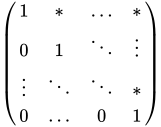
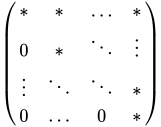
For a positive integer , the general linear group over a field , consisting of all invertible matrices, is a linear algebraic group over . It contains the subgroups

consisting of matrices of the form, resp.,

and .

The group is an example of a unipotent linear algebraic group, the group is an example of a solvable algebraic group called the Borel subgroup of . It is a consequence of the Lie-Kolchin theorem that any connected solvable subgroup of is conjugated into . Any unipotent subgroup can be conjugated into .

Another algebraic subgroup of is the special linear group of matrices with determinant 1.

The group is called the multiplicative group, usually denoted by . The group of -points is the multiplicative group of nonzero elements of the field . The additive group , whose -points are isomorphic to the additive group of , can also be expressed as a matrix group, for example as the subgroup in  :

These two basic examples of commutative linear algebraic groups, the multiplicative and additive groups, behave very differently in terms of their linear representations (as algebraic groups). Every representation of the multiplicative group is a direct sum of irreducible representations. (Its irreducible representations all have dimension 1, of the form for an integer .) By contrast, the only irreducible representation of the additive group is the trivial representation. So every representation of (such as the 2-dimensional representation above) is an iterated extension of trivial representations, not a direct sum (unless the representation is trivial). The structure theory of linear algebraic groups analyzes any linear algebraic group in terms of these two basic groups and their generalizations, tori and unipotent groups, as discussed below.

Definitions

[edit]

For an algebraically closed field k, much of the structure of an algebraic variety X over k is encoded in its set X(k) of k-rational points, which allows an elementary definition of a linear algebraic group. First, define a function from the abstract group GL(n,k) to k to be regular if it can be written as a polynomial in the entries of an n×n matrix A and in 1/det(A), where det is the determinant. Then a linear algebraic group G over an algebraically closed field k is a subgroup G(k) of the abstract group GL(n,k) for some natural number n such that G(k) is defined by the vanishing of some set of regular functions.

For an arbitrary field k, algebraic varieties over k are defined as a special case of schemes over k. In that language, a linear algebraic group G over a field k is a smooth closed subgroup scheme of GL(n) over k for some natural number n. In particular, G is defined by the vanishing of some set of regular functions on GL(n) over k, and these functions must have the property that for every commutative k-algebra R, G(R) is a subgroup of the abstract group GL(n,R). (Thus an algebraic group G over k is not just the abstract group G(k), but rather the whole family of groups G(R) for commutative k-algebras R; this is the philosophy of describing a scheme by its functor of points.)

In either language, one has the notion of a homomorphism of linear algebraic groups. For example, when k is algebraically closed, a homomorphism from GGL(m) to HGL(n) is a homomorphism of abstract groups G(k) → H(k) which is defined by regular functions on G. This makes the linear algebraic groups over k into a category. In particular, this defines what it means for two linear algebraic groups to be isomorphic.

In the language of schemes, a linear algebraic group G over a field k is in particular a group scheme over k, meaning a scheme over k together with a k-point 1 ∈ G(k) and morphisms

over k which satisfy the usual axioms for the multiplication and inverse maps in a group (associativity, identity, inverses). A linear algebraic group is also smooth and of finite type over k, and it is affine (as a scheme). Conversely, every affine group scheme G of finite type over a field k has a faithful representation into GL(n) over k for some n.[1] An example is the embedding of the additive group Ga into GL(2), as mentioned above. As a result, one can think of linear algebraic groups either as matrix groups or, more abstractly, as smooth affine group schemes over a field. (Some authors use "linear algebraic group" to mean any affine group scheme of finite type over a field.)

For a full understanding of linear algebraic groups, one has to consider more general (non-smooth) group schemes. For example, let k be an algebraically closed field of characteristic p > 0. Then the homomorphism f: GmGm defined by xxp induces an isomorphism of abstract groups k* → k*, but f is not an isomorphism of algebraic groups (because x1/p is not a regular function). In the language of group schemes, there is a clearer reason why f is not an isomorphism: f is surjective, but it has nontrivial kernel, namely the group scheme μp of pth roots of unity. This issue does not arise in characteristic zero. Indeed, every group scheme of finite type over a field k of characteristic zero is smooth over k.[2] A group scheme of finite type over any field k is smooth over k if and only if it is geometrically reduced, meaning that the base change is reduced, where is an algebraic closure of k.[3]

Since an affine scheme X is determined by its ring O(X) of regular functions, an affine group scheme G over a field k is determined by the ring O(G) with its structure of a Hopf algebra (coming from the multiplication and inverse maps on G). This gives an equivalence of categories (reversing arrows) between affine group schemes over k and commutative Hopf algebras over k. For example, the Hopf algebra corresponding to the multiplicative group Gm = GL(1) is the Laurent polynomial ring k[x, x−1], with comultiplication given by

Basic notions

[edit]

For a linear algebraic group G over a field k, the identity component Go (the connected component containing the point 1) is a normal subgroup of finite index. So there is a group extension

where F is a finite algebraic group. (For k algebraically closed, F can be identified with an abstract finite group.) Because of this, the study of algebraic groups mostly focuses on connected groups.

Various notions from abstract group theory can be extended to linear algebraic groups. It is straightforward to define what it means for a linear algebraic group to be commutative, nilpotent, or solvable, by analogy with the definitions in abstract group theory. For example, a linear algebraic group is solvable if it has a composition series of linear algebraic subgroups such that the quotient groups are commutative. Also, the normalizer, the center, and the centralizer of a closed subgroup H of a linear algebraic group G are naturally viewed as closed subgroup schemes of G. If they are smooth over k, then they are linear algebraic groups as defined above.

One may ask to what extent the properties of a connected linear algebraic group G over a field k are determined by the abstract group G(k). A useful result in this direction is that if the field k is perfect (for example, of characteristic zero), or if G is reductive (as defined below), then G is unirational over k. Therefore, if in addition k is infinite, the group G(k) is Zariski dense in G.[4] For example, under the assumptions mentioned, G is commutative, nilpotent, or solvable if and only if G(k) has the corresponding property.

The assumption of connectedness cannot be omitted in these results. For example, let G be the group μ3GL(1) of cube roots of unity over the rational numbers Q. Then G is a linear algebraic group over Q for which G(Q) = 1 is not Zariski dense in G, because is a group of order 3.

Over an algebraically closed field, there is a stronger result about algebraic groups as algebraic varieties: every connected linear algebraic group over an algebraically closed field is a rational variety.[5]

The Lie algebra of an algebraic group

[edit]

The Lie algebra of an algebraic group G can be defined in several equivalent ways: as the tangent space T1(G) at the identity element 1 ∈ G(k), or as the space of left-invariant derivations. If k is algebraically closed, a derivation D: O(G) → O(G) over k of the coordinate ring of G is left-invariant if

for every x in G(k), where λx: O(G) → O(G) is induced by left multiplication by x. For an arbitrary field k, left invariance of a derivation is defined as an analogous equality of two linear maps O(G) → O(G) ⊗O(G).[6] The Lie bracket of two derivations is defined by [D1, D2] =D1D2D2D1.

The passage from G to is thus a process of differentiation. For an element xG(k), the derivative at 1 ∈ G(k) of the conjugation map GG, gxgx−1, is an automorphism of , giving the adjoint representation:

Over a field of characteristic zero, a connected subgroup H of a linear algebraic group G is uniquely determined by its Lie algebra .[7] But not every Lie subalgebra of corresponds to an algebraic subgroup of G, as one sees in the example of the torus G = (Gm)2 over C. In positive characteristic, there can be many different connected subgroups of a group G with the same Lie algebra (again, the torus G = (Gm)2 provides examples). For these reasons, although the Lie algebra of an algebraic group is important, the structure theory of algebraic groups requires more global tools.

Semisimple and unipotent elements

[edit]

For an algebraically closed field k, a matrix g in GL(n,k) is called semisimple if it is diagonalizable, and unipotent if the matrix g − 1 is nilpotent. Equivalently, g is unipotent if all eigenvalues of g are equal to 1. The Jordan canonical form for matrices implies that every element g of GL(n,k) can be written uniquely as a product g = gssgu such that gss is semisimple, gu is unipotent, and gss and gu commute with each other.

For any field k, an element g of GL(n,k) is said to be semisimple if it becomes diagonalizable over the algebraic closure of k. If the field k is perfect, then the semisimple and unipotent parts of g also lie in GL(n,k). Finally, for any linear algebraic group GGL(n) over a field k, define a k-point of G to be semisimple or unipotent if it is semisimple or unipotent in GL(n,k). (These properties are in fact independent of the choice of a faithful representation of G.) If the field k is perfect, then the semisimple and unipotent parts of a k-point of G are automatically in G. That is (the Jordan decomposition): every element g of G(k) can be written uniquely as a product g = gssgu in G(k) such that gss is semisimple, gu is unipotent, and gss and gu commute with each other.[8] This reduces the problem of describing the conjugacy classes in G(k) to the semisimple and unipotent cases.

Tori

[edit]

A torus over an algebraically closed field k means a group isomorphic to (Gm)n, the product of n copies of the multiplicative group over k, for some natural number n. For a linear algebraic group G, a maximal torus in G means a torus in G that is not contained in any bigger torus. For example, the group of diagonal matrices in GL(n) over k is a maximal torus in GL(n), isomorphic to (Gm)n. A basic result of the theory is that any two maximal tori in a group G over an algebraically closed field k are conjugate by some element of G(k).[9] The rank of G means the dimension of any maximal torus.

For an arbitrary field k, a torus T over k means a linear algebraic group over k whose base change to the algebraic closure of k is isomorphic to (Gm)n over , for some natural number n. A split torus over k means a group isomorphic to (Gm)n over k for some n. An example of a non-split torus over the real numbers R is


with group structure given by the formula for multiplying complex numbers x+iy. Here T is a torus of dimension 1 over R. It is not split, because its group of real points T(R) is the circle group, which is not isomorphic even as an abstract group to Gm(R) = R*.

Every point of a torus over a field k is semisimple. Conversely, if G is a connected linear algebraic group such that every element of is semisimple, then G is a torus.[10]

For a linear algebraic group G over a general field k, one cannot expect all maximal tori in G over k to be conjugate by elements of G(k). For example, both the multiplicative group Gm and the circle group T above occur as maximal tori in SL(2) over R. However, it is always true that any two maximal split tori in G over k (meaning split tori in G that are not contained in a bigger split torus) are conjugate by some element of G(k).[11] As a result, it makes sense to define the k-rank or split rank of a group G over k as the dimension of any maximal split torus in G over k.

For any maximal torus T in a linear algebraic group G over a field k, Grothendieck showed that is a maximal torus in .[12] It follows that any two maximal tori in G over a field k have the same dimension, although they need not be isomorphic.

Unipotent groups

[edit]

Let Un be the group of upper-triangular matrices in GL(n) with diagonal entries equal to 1, over a field k. A group scheme over a field k (for example, a linear algebraic group) is called unipotent if it is isomorphic to a closed subgroup scheme of Un for some n. It is straightforward to check that the group Un is nilpotent. As a result, every unipotent group scheme is nilpotent.

A linear algebraic group G over a field k is unipotent if and only if every element of is unipotent.[13]

The group Bn of upper-triangular matrices in GL(n) is a semidirect product

where Tn is the diagonal torus (Gm)n. More generally, every connected solvable linear algebraic group is a semidirect product of a torus with a unipotent group, TU.[14]

A smooth connected unipotent group over a perfect field k (for example, an algebraically closed field) has a composition series with all quotient groups isomorphic to the additive group Ga.[15]

Borel subgroups

[edit]

The Borel subgroups are important for the structure theory of linear algebraic groups. For a linear algebraic group G over an algebraically closed field k, a Borel subgroup of G means a maximal smooth connected solvable subgroup. For example, one Borel subgroup of GL(n) is the subgroup B of upper-triangular matrices (all entries below the diagonal are zero).

A basic result of the theory is that any two Borel subgroups of a connected group G over an algebraically closed field k are conjugate by some element of G(k).[16] (A standard proof uses the Borel fixed-point theorem: for a connected solvable group G acting on a proper variety X over an algebraically closed field k, there is a k-point in X which is fixed by the action of G.) The conjugacy of Borel subgroups in GL(n) amounts to the Lie–Kolchin theorem: every smooth connected solvable subgroup of GL(n) is conjugate to a subgroup of the upper-triangular subgroup in GL(n).

For an arbitrary field k, a Borel subgroup B of G is defined to be a subgroup over k such that, over an algebraic closure of k, is a Borel subgroup of . Thus G may or may not have a Borel subgroup over k.

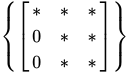
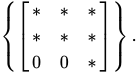
For a closed subgroup scheme H of G, the quotient space G/H is a smooth quasi-projective scheme over k.[17] A smooth subgroup P of a connected group G is called parabolic if G/P is projective over k (or equivalently, proper over k). An important property of Borel subgroups B is that G/B is a projective variety, called the flag variety of G. That is, Borel subgroups are parabolic subgroups. More precisely, for k algebraically closed, the Borel subgroups are exactly the minimal parabolic subgroups of G; conversely, every subgroup containing a Borel subgroup is parabolic.[18] So one can list all parabolic subgroups of G (up to conjugation by G(k)) by listing all the linear algebraic subgroups of G that contain a fixed Borel subgroup. For example, the subgroups PGL(3) over k that contain the Borel subgroup B of upper-triangular matrices are B itself, the whole group GL(3), and the intermediate subgroups

and

The corresponding projective homogeneous varieties GL(3)/P are (respectively): the flag manifold of all chains of linear subspaces

with Vi of dimension i; a point; the projective space P2 of lines (1-dimensional linear subspaces) in A3; and the dual projective space P2 of planes in A3.

Semisimple and reductive groups

[edit]

A connected linear algebraic group G over an algebraically closed field is called semisimple if every smooth connected solvable normal subgroup of G is trivial. More generally, a connected linear algebraic group G over an algebraically closed field is called reductive if every smooth connected unipotent normal subgroup of G is trivial.[19] (Some authors do not require reductive groups to be connected.) A semisimple group is reductive. A group G over an arbitrary field k is called semisimple or reductive if is semisimple or reductive. For example, the group SL(n) of n × n matrices with determinant 1 over any field k is semisimple, whereas a nontrivial torus is reductive but not semisimple. Likewise, GL(n) is reductive but not semisimple (because its center Gm is a nontrivial smooth connected solvable normal subgroup).

Every compact connected Lie group has a complexification, which is a complex reductive algebraic group. In fact, this construction gives a one-to-one correspondence between compact connected Lie groups and complex reductive groups, up to isomorphism.[20]

A linear algebraic group G over a field k is called simple (or k-simple) if it is semisimple, nontrivial, and every smooth connected normal subgroup of G over k is trivial or equal to G.[21] (Some authors call this property "almost simple".) This differs slightly from the terminology for abstract groups, in that a simple algebraic group may have nontrivial center (although the center must be finite). For example, for any integer n at least 2 and any field k, the group SL(n) over k is simple, and its center is the group scheme μn of nth roots of unity.

Every connected linear algebraic group G over a perfect field k is (in a unique way) an extension of a reductive group R by a smooth connected unipotent group U, called the unipotent radical of G:

If k has characteristic zero, then one has the more precise Levi decomposition: every connected linear algebraic group G over k is a semidirect product of a reductive group by a unipotent group.[22]

Classification of reductive groups

[edit]

Reductive groups include the most important linear algebraic groups in practice, such as the classical groups: GL(n), SL(n), the orthogonal groups SO(n) and the symplectic groups Sp(2n). On the other hand, the definition of reductive groups is quite "negative", and it is not clear that one can expect to say much about them. Remarkably, Claude Chevalley gave a complete classification of the reductive groups over an algebraically closed field: they are determined by root data.[23] In particular, simple groups over an algebraically closed field k are classified (up to quotients by finite central subgroup schemes) by their Dynkin diagrams. It is striking that this classification is independent of the characteristic of k. For example, the exceptional Lie groups G2, F4, E6, E7, and E8 can be defined in any characteristic (and even as group schemes over Z). The classification of finite simple groups says that most finite simple groups arise as the group of k-points of a simple algebraic group over a finite field k, or as minor variants of that construction.

Every reductive group over a field is the quotient by a finite central subgroup scheme of the product of a torus and some simple groups. For example,

For an arbitrary field k, a reductive group G is called split if it contains a split maximal torus over k (that is, a split torus in G which remains maximal over an algebraic closure of k). For example, GL(n) is a split reductive group over any field k. Chevalley showed that the classification of split reductive groups is the same over any field. By contrast, the classification of arbitrary reductive groups can be hard, depending on the base field. For example, every nondegenerate quadratic form q over a field k determines a reductive group SO(q), and every central simple algebra A over k determines a reductive group SL1(A). As a result, the problem of classifying reductive groups over k essentially includes the problem of classifying all quadratic forms over k or all central simple algebras over k. These problems are easy for k algebraically closed, and they are understood for some other fields such as number fields, but for arbitrary fields there are many open questions.

Applications

[edit]

Representation theory

[edit]

One reason for the importance of reductive groups comes from representation theory. Every irreducible representation of a unipotent group is trivial. More generally, for any linear algebraic group G written as an extension

with U unipotent and R reductive, every irreducible representation of G factors through R.[24] This focuses attention on the representation theory of reductive groups. (To be clear, the representations considered here are representations of G as an algebraic group. Thus, for a group G over a field k, the representations are on k-vector spaces, and the action of G is given by regular functions. It is an important but different problem to classify continuous representations of the group G(R) for a real reductive group G, or similar problems over other fields.)

Chevalley showed that the irreducible representations of a split reductive group over a field k are finite-dimensional, and they are indexed by dominant weights.[25] This is the same as what happens in the representation theory of compact connected Lie groups, or the finite-dimensional representation theory of complex semisimple Lie algebras. For k of characteristic zero, all these theories are essentially equivalent. In particular, every representation of a reductive group G over a field of characteristic zero is a direct sum of irreducible representations, and if G is split, the characters of the irreducible representations are given by the Weyl character formula. The Borel–Weil theorem gives a geometric construction of the irreducible representations of a reductive group G in characteristic zero, as spaces of sections of line bundles over the flag manifold G/B.

The representation theory of reductive groups (other than tori) over a field of positive characteristic p is less well understood. In this situation, a representation need not be a direct sum of irreducible representations. And although irreducible representations are indexed by dominant weights, the dimensions and characters of the irreducible representations are known only in some cases. Andersen, Jantzen and Soergel (1994) determined these characters (proving Lusztig's conjecture) when the characteristic p is sufficiently large compared to the Coxeter number of the group. For small primes p, there is not even a precise conjecture.

Group actions and geometric invariant theory

[edit]

An action of a linear algebraic group G on a variety (or scheme) X over a field k is a morphism

that satisfies the axioms of a group action. As in other types of group theory, it is important to study group actions, since groups arise naturally as symmetries of geometric objects.

Part of the theory of group actions is geometric invariant theory, which aims to construct a quotient variety X/G, describing the set of orbits of a linear algebraic group G on X as an algebraic variety. Various complications arise. For example, if X is an affine variety, then one can try to construct X/G as Spec of the ring of invariants O(X)G. However, Masayoshi Nagata showed that the ring of invariants need not be finitely generated as a k-algebra (and so Spec of the ring is a scheme but not a variety), a negative answer to Hilbert's 14th problem. In the positive direction, the ring of invariants is finitely generated if G is reductive, by Haboush's theorem, proved in characteristic zero by Hilbert and Nagata.

Geometric invariant theory involves further subtleties when a reductive group G acts on a projective variety X. In particular, the theory defines open subsets of "stable" and "semistable" points in X, with the quotient morphism only defined on the set of semistable points.

[edit]

Linear algebraic groups admit variants in several directions. Dropping the existence of the inverse map , one obtains the notion of a linear algebraic monoid.[26]

Lie groups

[edit]

For a linear algebraic group G over the real numbers R, the group of real points G(R) is a Lie group, essentially because real polynomials, which describe the multiplication on G, are smooth functions. Likewise, for a linear algebraic group G over C, G(C) is a complex Lie group. Much of the theory of algebraic groups was developed by analogy with Lie groups.

There are several reasons why a Lie group may not have the structure of a linear algebraic group over R.

  • A Lie group with an infinite group of components G/Go cannot be realized as a linear algebraic group.
  • An algebraic group G over R may be connected as an algebraic group while the Lie group G(R) is not connected, and likewise for simply connected groups. For example, the algebraic group SL(2) is simply connected over any field, whereas the Lie group SL(2,R) has fundamental group isomorphic to the integers Z. The double cover H of SL(2,R), known as the metaplectic group, is a Lie group that cannot be viewed as a linear algebraic group over R. More strongly, H has no faithful finite-dimensional representation.
  • Anatoly Maltsev showed that every simply connected nilpotent Lie group can be viewed as a unipotent algebraic group G over R in a unique way.[27] (As a variety, G is isomorphic to affine space of some dimension over R.) By contrast, there are simply connected solvable Lie groups that cannot be viewed as real algebraic groups. For example, the universal cover H of the semidirect product S1R2 has center isomorphic to Z, which is not a linear algebraic group, and so H cannot be viewed as a linear algebraic group over R.

Abelian varieties

[edit]

Algebraic groups which are not affine behave very differently. In particular, a smooth connected group scheme which is a projective variety over a field is called an abelian variety. In contrast to linear algebraic groups, every abelian variety is commutative. Nonetheless, abelian varieties have a rich theory. Even the case of elliptic curves (abelian varieties of dimension 1) is central to number theory, with applications including the proof of Fermat's Last Theorem.

Tannakian categories

[edit]

The finite-dimensional representations of an algebraic group G, together with the tensor product of representations, form a tannakian category RepG. In fact, tannakian categories with a "fiber functor" over a field are equivalent to affine group schemes. (Every affine group scheme over a field k is pro-algebraic in the sense that it is an inverse limit of affine group schemes of finite type over k.[28]) For example, the Mumford–Tate group and the motivic Galois group are constructed using this formalism. Certain properties of a (pro-)algebraic group G can be read from its category of representations. For example, over a field of characteristic zero, RepG is a semisimple category if and only if the identity component of G is pro-reductive.[29]

See also

[edit]

Notes

[edit]

References

[edit]
[edit]
Revisions and contributorsEdit on WikipediaRead on Wikipedia
from Grokipedia
A linear algebraic group over a field kk is a smooth affine algebraic variety over kk that carries a group structure compatible with its algebraic structure, typically realized as a closed subgroup of the general linear group GLn(k)\mathrm{GL}_n(k) for some positive integer nn, where the group operation is matrix multiplication and the defining equations are polynomial.[1][2][3] These groups generalize classical Lie groups to an algebraic geometry setting, allowing study over arbitrary fields rather than just the reals or complexes, and they form the foundation for much of modern representation theory and arithmetic geometry.[1][3] The theory of linear algebraic groups emerged in the mid-20th century, with foundational contributions from Claude Chevalley in the 1950s, who developed the structure theory over algebraically closed fields of characteristic zero, and Armand Borel, who extended it to positive characteristic.[1] Key texts, such as James E. Humphreys' Linear Algebraic Groups (1975) and T.A. Springer's Linear Algebraic Groups (1968, revised 1998), formalized the subject by integrating algebraic geometry and Lie theory.[2] Prominent examples include the general linear group GLn\mathrm{GL}_n, consisting of all invertible n×nn \times n matrices; the special linear group SLn\mathrm{SL}_n, defined by determinant one; the orthogonal group On\mathrm{O}_n; and the symplectic group Sp2n\mathrm{Sp}_{2n}, all of which arise as subgroups preserving specific bilinear forms.[1][2] Simpler cases are the additive group Ga=(k,+)\mathbb{G}_a = (k, +) and the multiplicative group Gm=k×\mathbb{G}_m = k^\times, which embed into GL1\mathrm{GL}_1.[1] Structurally, every linear algebraic group GG has a Lie algebra g\mathfrak{g}, obtained as the tangent space at the identity equipped with a Lie bracket from the group law, and over algebraically closed fields of characteristic zero, GG is closely tied to its Lie algebra via the exponential map.[1] Groups are classified as solvable, semisimple, or reductive based on their unipotent radical and derived subgroup: reductive groups, such as GLn\mathrm{GL}_n and SLn\mathrm{SL}_n, have no nontrivial unipotent normal subgroups and have a structure theorem expressing them in terms of a maximal torus and unipotent root groups isomorphic to Ga\mathbb{G}_a.[2][1] Semisimple groups, like the simple groups SLn\mathrm{SL}_n (for n2n \geq 2) or exceptional types such as E8E_8, are direct products of such simple components, classified by Dynkin diagrams into four infinite families (A, B, C, D) and five exceptional ones (E_6, E_7, E_8, F_4, G_2).[2] Borel subgroups, maximal connected solvable subgroups, play a central role, being conjugate and parametrizing flag varieties like G/BG/B.[1][2] Linear algebraic groups underpin diverse applications, from the study of finite groups of Lie type (e.g., Chevalley groups) in finite group theory to Galois cohomology in number theory, where they model descent data and provide tools for solving Diophantine equations.[3] In representation theory, their finite-dimensional representations decompose into irreducibles labeled by dominant weights, facilitating connections to quantum groups and modular forms.[1] Over non-algebraically closed fields, phenomena like anisotropic tori and Galois actions introduce additional complexity, as explored in works on the Kneser-Tits problem.[3]

Introduction and History

Overview and motivation

A linear algebraic group over a field $ k $ is defined as a closed subgroup of the general linear group $ \mathrm{GL}_n(k) $ for some positive integer $ n $, where the subgroup is closed in the Zariski topology and carries a compatible group structure via matrix multiplication.[4] This setup endows the group with the structure of an affine algebraic variety, allowing the application of algebraic geometry tools to study its properties.[1] The Zariski topology on affine space $ \mathbb{A}^n_k $, the spectrum of the polynomial ring $ k[x_1, \dots, x_n] $, is generated by the closed sets consisting of zeros of ideals of polynomials, making it coarser than classical topologies and suited to algebraic rather than analytic phenomena.[1] Regular functions on such varieties are precisely the polynomial functions that restrict to the variety, forming the coordinate ring that encodes the geometry.[4] This framework provides a purely algebraic setting for groups, contrasting with the differential structure of Lie groups over $ \mathbb{R} $ or $ \mathbb{C} $. The study of linear algebraic groups is motivated by their role as algebraic counterparts to Lie groups, facilitating the analysis of representations and symmetries in both continuous and discrete settings.[5] In particular, they arise naturally in the context of linear representations of abstract groups, where the image of a representation into $ \mathrm{GL}_n(k) $ often forms such a subgroup, bridging group theory with algebraic geometry.[2] This connection is essential for understanding finite groups of Lie type through reduction modulo primes.[5] The systematic development of linear algebraic groups began in the 1950s with Claude Chevalley's work, where they were first employed to construct Chevalley groups over arbitrary fields, providing a uniform algebraic framework for classical simple Lie groups.[6]

Historical development

The theory of linear algebraic groups traces its roots to the late 19th century, when the classification of simple Lie algebras laid the groundwork for understanding the associated Lie groups. Wilhelm Killing initiated this effort in his seminal papers published between 1888 and 1890 in Mathematische Annalen, where he classified the finite-dimensional simple Lie algebras over the complex numbers, identifying four infinite families (corresponding to linear, orthogonal, symplectic, and exceptional types) and introducing the Cartan-Killing form as a key invariant.[7] Élie Cartan refined and rigorously proved this classification in his 1894 doctoral thesis, Sur la structure des groupes de transformations finis et continus, establishing the complete list of simple Lie algebras over C\mathbb{C} and extending the results to real forms by 1914, which provided the infinitesimal structure essential for later developments in continuous transformation groups. In the early 20th century, the focus shifted to continuous groups and their representations, with contributions from Ludwig Maurer, Élie Cartan, and Hermann Weyl. Maurer advanced the study of continuous transformation groups around 1900–1910, developing parameterizations and infinitesimal generators that bridged local and global aspects of Lie's original theory.[8] Cartan extended his work on Lie algebras to infinite-dimensional continuous groups and their applications in geometry during the 1910s–1920s. Weyl, in a series of papers from 1925–1926, provided the first complete theory of representations of compact continuous groups, proving complete reducibility and deriving character formulas, which were pivotal for quantum mechanics and invariant theory; his 1939 book The Classical Groups further generalized these ideas to non-compact cases.[9] The mid-20th century marked the transition to algebraic groups proper, beginning with Ellis Kolchin's 1948 paper "Algebraic Matric Groups and the Picard-Vessiot Theory of Homogeneous Linear Ordinary Differential Equations," which introduced foundational concepts for solvable algebraic matrix groups and proved the Lie-Kolchin theorem characterizing connected solvable subgroups of GL(n). Claude Chevalley advanced the theory in the 1950s, particularly through his 1955 work constructing simple algebraic groups over finite fields (now known as Chevalley groups), which linked Lie algebras to finite groups of Lie type, and his 1956–1958 seminar notes on semisimple groups.[1] Armand Borel, collaborating with Chevalley, systematically developed the structure theory in the 1950s1960s, including his 1956 paper on linear representations and Borel subgroups, culminating in his influential 1969 book Linear Algebraic Groups (revised 1991), which established key results on reductive groups and their cohomology. In the 1960s, Alexander Grothendieck integrated algebraic groups into his scheme-theoretic framework, as detailed in Séminaire de Géométrie Algébrique du Bois-Marie (SGA 3) (1963–1964), where group schemes were defined over arbitrary schemes, enabling the study of algebraic groups over rings and resolving issues with nilpotents and positive characteristic.[1] This reformulation facilitated deeper connections to arithmetic geometry. Post-1960 developments included Jacques Tits and Borel's 1965 work on buildings, which provided a combinatorial framework for the structure of reductive groups over local fields via BN-pairs. Recent work continues to emphasize ties between linear algebraic groups and the Langlands program.[10]

Definitions and Basic Concepts

Formal definition over algebraically closed fields

An affine algebraic variety over an algebraically closed field kk is defined as the zero set V(I)V(I) of an ideal II in the polynomial ring k[x1,,xn]k[x_1, \dots, x_n], where II is taken to be radical (the vanishing ideal I(V(I))I(V(I))), as justified by the Hilbert Nullstellensatz, which establishes a bijection between radical ideals and affine algebraic sets. The points of the variety correspond to maximal ideals in the coordinate ring k[V]=k[x1,,xn]/I(V)k[V] = k[x_1, \dots, x_n]/I(V).[11] The Zariski topology on such varieties is generated by the closed sets, which are themselves zero loci of polynomials, providing a coarse topology suited to algebraic geometry.[12] A linear algebraic group GG over kk is a smooth affine algebraic variety that is a closed subgroup of GL(n,k)\mathrm{GL}(n, k) for some nn, where closedness is with respect to the Zariski topology on the ambient space An2\mathbb{A}^{n^2}.[12] Equivalently, GG is an affine variety equipped with morphisms of varieties m:G×GGm: G \times G \to G for multiplication and i:GGi: G \to G for inversion, satisfying the group axioms, with the identity morphism from the singleton variety to GG.[11] The coordinate ring k[G]k[G] of GG is the finitely generated, reduced kk-algebra k[x1,,xn]/I(G)k[x_1, \dots, x_n]/I(G), where I(G)I(G) is the vanishing ideal of GG, and the group structure induces a comultiplication Δ:k[G]k[G]kk[G]\Delta: k[G] \to k[G] \otimes_k k[G] making k[G]k[G] into a Hopf algebra, with the dual maps corresponding to the group operations.[11] The multiplication mm and inversion ii are morphisms of varieties because they are given by polynomial functions on the ambient affine space, hence regular maps that restrict to G×GG \times G and GG, respectively, preserving the algebraic structure; this follows from the fact that the defining equations of GG are preserved under these operations due to the subgroup property.[12] For instance, if GG is defined by polynomial equations fj(g)=0f_j(g) = 0 for gGL(n,k)g \in \mathrm{GL}(n,k), then fj(gh)=0f_j(gh) = 0 and fj(g1)=0f_j(g^{-1}) = 0 whenever fj(g)=fj(h)=0f_j(g) = f_j(h) = 0, ensuring the images lie in GG.[11] The dimension of GG, as an algebraic variety, is the Krull dimension of k[G]k[G], equivalently the transcendence degree of the function field k(G)k(G) over kk, or the dimension of the tangent space at the identity element.[11] This dimension is finite since k[G]k[G] is finitely generated, and for closed embeddings into GL(n,k)\mathrm{GL}(n,k), it satisfies dimGn2\dim G \leq n^2, with equality for G=GL(n,k)G = \mathrm{GL}(n,k).[12]

Extension to arbitrary fields and schemes

The notion of a linear algebraic group over an arbitrary field $ k $ extends the classical definition by considering the group of rational points $ G(k) $, which consists of the $ k $-points of the scheme $ G $ satisfying the group law defined by the scheme morphisms. These points form an abstract group, but to capture the full algebraic structure, one uses Galois descent to relate $ G $ over $ k $ to its base change $ G_{k_s} $ over a separable closure $ k_s $, where $ k_s / k $ is Galois. A $ k $-form of a group $ H $ defined over $ k_s $ is a group $ G $ over $ k $ such that $ G_{k_s} \cong H $, and such forms are classified by the Galois cohomology set $ H^1(k, \Aut(H)) $, where the action is via the Galois group $ \Gal(k_s / k) $. This descent ensures that properties like connectedness and dimension are preserved under base change.[1][12][13] In the language of scheme theory, a linear algebraic group over $ k $ is an affine group scheme of finite type over $ \Spec(k) $, meaning it is a representable functor $ G: (\text{Comm } k\text{-Alg})^{\op} \to \text{Groups} $ from the opposite category of commutative $ k $-algebras to groups, represented by an affine scheme $ \Spec(A) $ with $ A $ a finitely generated $ k $-algebra. The group structure arises from compatible morphisms for multiplication, inversion, and the identity, satisfying the group axioms functorially. Over arbitrary $ k $, including non-algebraically closed cases, this framework allows uniform treatment without assuming separability.[1][14][12] For non-perfect fields (those where the Frobenius is not surjective), linear algebraic groups are defined to be smooth and geometrically reduced, ensuring that the relative tangent space at every point has dimension equal to the relative dimension of the scheme and that base change to the algebraic closure yields a reduced scheme with no nilpotent elements. Smoothness over such fields implies the existence of a maximal $ k $-torus in connected reductive groups, as guaranteed by Grothendieck's theorem, and avoids pathologies like non-separated quotients. Reducedness excludes infinitesimal group schemes, focusing on those of classical interest.[1][13][12] The coordinate ring $ O(G) = k[G] $ of an affine linear algebraic group $ G $ over $ k $ is a commutative Hopf $ k $-algebra, equipped with a comultiplication $ \Delta: O(G) \to O(G) \otimes_k O(G) $ induced by the multiplication morphism $ m: G \times_k G \to G $, a counit $ \varepsilon: O(G) \to k $ from the identity section, and an antipode $ S: O(G) \to O(G) $ from the inversion morphism. These structures encode the group law algebraically, with coassociativity and compatibility axioms holding functorially; for example, in $ \GL_n $, $ \Delta(T_{ij}) = \sum_\ell T_{i\ell} \otimes T_{\ell j} $. This Hopf algebra perspective dualizes the group scheme and facilitates representation theory over arbitrary $ k $.[14][1][13] A prominent example of a non-split form arises with anisotropic tori over the real numbers $ \mathbb{R} $, such as the norm torus defined by the equation $ z \overline{z} = 1 $ in $ \mathbb{C}^\times $, which is a form of $ \mathbb{G}_m $ over $ \mathbb{R} $ but contains no non-trivial split subtorus and is compact as a real Lie group. Such tori illustrate Galois descent in action, as their splitting fields are quadratic extensions of $ \mathbb{R} $, and they appear in forms of orthogonal or unitary groups.[1][13]

Group operations and homomorphisms

Linear algebraic groups are affine algebraic varieties equipped with group structure, where the multiplication map $ m: G \times G \to G $, defined by $ m(g, h) = gh $, and the inversion map $ i: G \to G $, defined by $ i(g) = g^{-1} $, are both morphisms of algebraic varieties. These operations ensure that the group law is compatible with the algebraic structure, allowing G to function as both a group and an algebraic variety.[13] A homomorphism $ \phi: G \to H $ between linear algebraic groups G and H is a morphism of algebraic varieties that preserves the group operations, satisfying $ \phi(gh) = \phi(g)\phi(h) $ and $ \phi(g^{-1}) = \phi(g)^{-1} $ for all $ g, h \in G $. The kernel of $ \phi $, defined as $ \ker \phi = { g \in G \mid \phi(g) = e_H } $, where $ e_H $ is the identity in H, is a closed normal subgroup of G. The image $ \phi(G) $ is a closed subgroup of H.[13] An isogeny is a surjective homomorphism $ \phi: G \to H $ with finite kernel; such maps are finite morphisms of degree equal to the order of the kernel. Isomorphisms are bijective homomorphisms whose inverses are also homomorphisms, equivalently bijective with bijective differential at the identity. In positive characteristic, an isogeny is separable if its kernel is reduced (étale) or if the induced map on tangent spaces is injective; inseparability arises when the kernel contains non-reduced components, as in the Frobenius morphism.[13][15] The center $ Z(G) $ of a linear algebraic group G is the closed subgroup consisting of all elements that commute with every element of G, given by $ Z(G) = { z \in G \mid zg = gz \ \forall g \in G } $. The derived subgroup $ G' $, or commutator subgroup, is the smallest closed normal subgroup such that $ G/G' $ is abelian; it is generated by all commutators $ [g, h] = ghg^{-1}h^{-1} $ for $ g, h \in G $. For connected semisimple groups, $ G' = G $.[13] Associated to any homomorphism $ \phi: G \to H $ is its differential at the identity, a linear map $ d\phi_e: \Lie(G) \to \Lie(H) $ between the Lie algebras, defined via the tangent space at the identity element. This map preserves the Lie bracket and is injective if $ \phi $ is separable; for isomorphisms, $ d\phi_e $ is an isomorphism of Lie algebras.[13]

Examples

Classical matrix groups

The general linear group GL(n,k)\mathrm{GL}(n,k) over a field kk consists of all invertible n×nn \times n matrices with entries in kk, defined as the Zariski-open subset of the affine space of all n×nn \times n matrices where the determinant is nonzero.[16] This group has dimension n2n^2, as its Lie algebra is the full matrix algebra gl(n,k)\mathfrak{gl}(n,k).[16] It serves as the ambient space for many classical examples and is itself a fundamental linear algebraic group. The special linear group SL(n,k)\mathrm{SL}(n,k) is the kernel of the determinant morphism det:GL(n,k)Gm\det: \mathrm{GL}(n,k) \to \mathbb{G}_m, where Gm\mathbb{G}_m is the multiplicative group, consisting of all matrices in GL(n,k)\mathrm{GL}(n,k) with determinant 1.[16] Its defining equation is det(A)=1\det(A) = 1 for AMn(k)A \in M_n(k), and it has dimension n21n^2 - 1, reflecting the single polynomial constraint on GL(n,k)\mathrm{GL}(n,k).[16] For n2n \geq 2, SL(n,k)\mathrm{SL}(n,k) is a simple linear algebraic group over algebraically closed fields, meaning it has no nontrivial proper connected normal subgroups.[16] The orthogonal group O(n,k)\mathrm{O}(n,k) (assuming char(k)2\mathrm{char}(k) \neq 2) preserves the standard nondegenerate symmetric bilinear form, defined by the equation XTX=InX^T X = I_n for XMn(k)X \in M_n(k), where InI_n is the n×nn \times n identity matrix.[17] This group has dimension n(n1)/2n(n-1)/2, corresponding to the number of independent entries above the diagonal in an orthogonal matrix.[17] The special orthogonal group SO(n,k)\mathrm{SO}(n,k) is the kernel of the determinant map on O(n,k)\mathrm{O}(n,k), satisfying the same equation with the additional condition det(X)=1\det(X) = 1, and thus shares the same dimension n(n1)/2n(n-1)/2.[17] The symplectic group Sp(2n,k)\mathrm{Sp}(2n,k) preserves a nondegenerate alternating bilinear form on k2nk^{2n}, standardly given by the equation XTJX=JX^T J X = J, where J=(0InIn0)J = \begin{pmatrix} 0 & I_n \\ -I_n & 0 \end{pmatrix} and InI_n is the n×nn \times n identity.[16] This defining relation ensures the form ω(x,y)=xTJy\omega(x,y) = x^T J y remains invariant under the group action. The dimension of Sp(2n,k)\mathrm{Sp}(2n,k) is n(2n+1)n(2n+1), arising from the constraints on the matrix entries that maintain the symplectic structure.[16]

Elementary and other simple examples

One of the simplest non-trivial examples of a linear algebraic group is the multiplicative group Gm\mathbb{G}_m, defined over a field kk as the spectrum of the Hopf algebra k[T,T1]k[T, T^{-1}], which corresponds to the affine line Ak1\mathbb{A}^1_k minus the origin.[12] This group has dimension 1 and consists of invertible elements k×k^\times, with the group operation given by multiplication in kk.[12] It serves as the building block for more complex tori, which are split as direct products of copies of Gm\mathbb{G}_m.[18] Another elementary example is the additive group Ga\mathbb{G}_a, the spectrum of the Hopf algebra k[T]k[T], representing the affine line Ak1\mathbb{A}^1_k itself.[12] Here, the group operation is polynomial addition on kk, and Ga\mathbb{G}_a is unipotent of dimension 1, with all elements satisfying g1g - 1 nilpotent.[12] Any connected one-dimensional linear algebraic group over an algebraically closed field is isomorphic to either Gm\mathbb{G}_m or Ga\mathbb{G}_a.[19] For a higher-dimensional unipotent example, consider the Heisenberg group H3H_3 over kk, a three-dimensional nilpotent algebraic group of class 2.[20] It can be realized as the affine variety with coordinates (x,y,z)k3(x, y, z) \in k^3 and multiplication (x,y,z)(x,y,z)=(x+x,y+y,z+z+xy)(x, y, z) \cdot (x', y', z') = (x + x', y + y', z + z' + x y'), where the center is one-dimensional, spanned by elements with x=y=0x = y = 0.[20] This structure illustrates the nilpotency typical of unipotent groups, with the Lie algebra also Heisenberg-type.[21] Among simple linear algebraic groups, the projective special linear group PSLn(k)\mathrm{PSL}_n(k) for n2n \geq 2 provides a classical example, which is simple and of semisimple rank n1n-1.[22] Exceptional simple groups include those of types E6E_6, E7E_7, and E8E_8, with ranks 6, 7, and 8, respectively, and corresponding dimensions 78, 133, and 248; these arise from exceptional Lie algebras and have no classical analogs.[23] Their Dynkin diagrams distinguish them from series like AnA_n.[22] Non-split examples highlight field dependence: over the real numbers R\mathbb{R}, the multiplicative group of the Hamilton quaternion algebra H\mathbb{H} (with basis 1,i,j,k1, i, j, k and relations i2=j2=k2=ijk=1i^2 = j^2 = k^2 = ijk = -1) forms a non-split inner form of SL2(C)\mathrm{SL}_2(\mathbb{C}), where the norm-1 elements yield the compact group SU(2)\mathrm{SU}(2).[24] This contrasts with the split form M2(R)\mathrm{M}_2(\mathbb{R}) over R\mathbb{R}, demonstrating how quaternion algebras ramify at infinite places to produce anisotropic groups.[24]

Structural Elements

Connected components and radical

In the Zariski topology on a linear algebraic group $ G $, the connected components coincide with the irreducible components of $ G $ as an algebraic variety. These components all have the same dimension as $ G $, and $ G $ is a finite disjoint union of them.[13] The identity component $ G^0 $ is the unique connected component containing the identity element $ e $; it is an irreducible affine algebraic variety that forms an open normal subgroup of $ G $ with finite index.[13] As a normal subgroup, $ G^0 $ is stable under conjugation by elements of $ G $, and the cosets $ gG^0 $ for $ g \in G $ partition $ G $ into its connected components. Over an algebraically closed field, $ G^0 $ is smooth, and it acts transitively on each irreducible component of homogeneous spaces under $ G $. When $ G $ is defined over a subfield $ k $, $ G^0 $ is also defined over $ k $ if $ k $ is perfect. Moreover, over perfect fields, $ G^0 $ is Zariski dense in $ G $.[13][25] The unipotent radical $ R_u(G) $ of $ G $ is defined as the largest normal unipotent subgroup of $ G $; it is unique, characteristic (stable under automorphisms of $ G $), closed, connected, nilpotent, and solvable.[13] Equivalently, $ R_u(G) $ is the identity component of the intersection of the unipotent radicals of all Borel subgroups of $ G $ containing a fixed maximal torus. Over a perfect field $ k $, if $ G $ is a $ k $-group, then $ R_u(G) $ is defined over $ k $. The quotient $ G / R_u(G) $ is a reductive linear algebraic group.[13] The solvable radical $ R(G) $ of $ G $ is the largest connected normal solvable subgroup; it is unique, closed, and contains $ R_u(G) $ as its unipotent part.[13] It can be characterized as the identity component of the intersection of all Borel subgroups of $ G $. Over a perfect field, $ R(G) $ is defined over the base field and, in the reductive case, takes the form of a central torus. The quotient $ G / R(G) $ is then semisimple.[13] A Levi subgroup $ L $ of $ G $ is a maximal reductive subgroup such that $ G = R_u(G) \rtimes L $ via a semidirect product; it is unique up to conjugation and contains a maximal torus of $ G $.[13] The reductive quotient $ G / R_u(G) $ is isomorphic to $ L $, providing a structural decomposition that reduces the study of general linear algebraic groups to reductive ones. Over algebraically closed fields, the existence of such Levi subgroups follows from the theory of parabolic subgroups.[13]

Lie algebra and its properties

The Lie algebra of a linear algebraic group GG over an algebraically closed field kk, denoted \Lie(G)\Lie(G), is defined as the tangent space at the identity element ee of GG.[5] This vector space captures the infinitesimal structure of GG, serving as a linear approximation to the group near the identity.[13] In characteristic zero, \Lie(G)\Lie(G) can also be identified with the space of kk-derivations \Derk(k[G],k)\Der_k(k[G], k) of the coordinate ring k[G]k[G], where derivations are left-invariant under the group action.[5] This identification equips \Lie(G)\Lie(G) with a Lie bracket given by the commutator of derivations, making it a Lie algebra over kk.[13] A key connection between the Lie algebra and the group is provided by the exponential map exp:\Lie(G)G\exp: \Lie(G) \to G, which sends an element X\Lie(G)X \in \Lie(G) to the group element obtained via the formal power series exp(X)=I+X+X22!+\exp(X) = I + X + \frac{X^2}{2!} + \cdots, assuming a matrix representation of GG.[5] This map is well-defined for nilpotent elements and plays a central role in characteristic zero, where it relates the algebraic and infinitesimal structures.[13] However, in positive characteristic, the exponential map is not always surjective onto unipotent elements, and its behavior is more restricted due to issues with formal power series convergence and pp-nilpotency.[5] The group GG acts on \Lie(G)\Lie(G) via the adjoint representation \Ad:G\Aut(\Lie(G))\Ad: G \to \Aut(\Lie(G)), defined by conjugation: for gGg \in G and X\Lie(G)X \in \Lie(G), \Ad(g)X=gXg1\Ad(g)X = gXg^{-1}.[13] The differential of this representation at the identity yields the adjoint action \ad:\Lie(G)\End(\Lie(G))\ad: \Lie(G) \to \End(\Lie(G)), where \ad(X)Y=[X,Y]\ad(X)Y = [X, Y] for Y\Lie(G)Y \in \Lie(G).[5] In characteristic zero, the Killing form κ(X,Y)=\Tr(\ad(X)\ad(Y))\kappa(X, Y) = \Tr(\ad(X) \circ \ad(Y)) on \Lie(G)\Lie(G) is an invariant bilinear form that provides important structural information, such as nondegeneracy for semisimple Lie algebras.[5] This form arises naturally from the trace in the adjoint representation and aids in distinguishing solvable and semisimple components.[13] For a closed subgroup HGH \leq G, the Lie algebra \Lie(H)\Lie(H) is a Lie subalgebra of \Lie(G)\Lie(G), obtained as the subspace of derivations vanishing on the ideal defining HH.[5] This inclusion preserves the Lie bracket and reflects the embedding of infinitesimal structures.[13] Semisimple elements in \Lie(G)\Lie(G) correspond to those whose adjoint action is diagonalizable over an algebraic closure.[5] In positive characteristic p>0p > 0, several classical properties of Lie algebras fail to hold for those arising from linear algebraic groups. For instance, Cartan's criterion for solvability or semisimplicity, which relies on the trace form in the adjoint representation, does not generally apply, as the Killing form may degenerate even for simple Lie algebras.[5] Additionally, Lie's theorem on simultaneous triangularization of representations breaks down, exemplified by the Lie algebra sl2(k)\mathfrak{sl}_2(k) becoming solvable in characteristic 2 without upper-triangularizable representations.[5] These limitations necessitate alternative approaches, such as restricted Lie algebras incorporating pp-operations.[13]

Element Decompositions

Unipotent elements

In a linear algebraic group GG defined over an algebraically closed field kk, an element gGg \in G is unipotent if all eigenvalues of gg (with respect to any faithful rational representation of GG) are equal to 1.[1] This condition is independent of the choice of representation and characterizes unipotency intrinsically within the group.[2] For the general linear group GL(n,k)\mathrm{GL}(n, k), an element gg is unipotent if and only if gIg - I is a nilpotent matrix, meaning there exists a positive integer mnm \leq n such that (gI)m=0(g - I)^m = 0, where II denotes the identity matrix.[1] In this setting, unipotent elements correspond to matrices that are conjugate to strictly upper triangular matrices with 1s on the diagonal.[2] The set of all unipotent elements in a reductive linear algebraic group GG forms a closed subvariety known as the unipotent cone.[1] In characteristic zero, this cone corresponds closely to the image under the exponential map of the nilpotent cone in the Lie algebra of GG, and the unipotent elements generate unipotent subgroups.[1] The centralizer CG(u)C_G(u) of a unipotent element uGu \in G in a connected reductive group is itself connected and has a structure given by a Levi subgroup together with its unipotent radical.[1] The normalizer NG(u)N_G(u) is finite over CG(u)C_G(u), often involving components related to the Weyl group action on the centralizer.[1] In positive characteristic, the definition of unipotency remains the same—all eigenvalues equal to 1—but the relationship to the Lie algebra differs significantly; for instance, not all unipotent elements arise as exponentials of nilpotent elements in the Lie algebra, due to the limited surjectivity of the exponential map.[1]

Semisimple elements and tori

In the theory of linear algebraic groups over a field kk, an element gG(k)g \in G(k) of a linear algebraic group GG is defined to be semisimple if, in every rational representation (V,ρV)(V, \rho_V) of GG, the linear operator ρV(g)\rho_V(g) is semisimple, meaning it is diagonalizable over the algebraic closure k\overline{k}.[26] This property is independent of the choice of representation and aligns with the semisimple part in the Jordan-Chevalley decomposition.[27] Over perfect fields, semisimple elements form a subgroup GsG_s of GG, though this subgroup is not necessarily closed in the Zariski topology; for example, in the group B2B_2 of upper triangular 2×22 \times 2 matrices with determinant 1 over an algebraically closed field of characteristic not 2, GsG_s is not closed.[27] A fundamental property of semisimple elements is their containment in tori: every semisimple element sGss \in G_s lies in some maximal torus of GG.[26][27] Moreover, the centralizer ZG(s)Z_G(s) of a semisimple element ss is connected and reductive.[26] In connected solvable groups, the semisimple elements generate the derived subgroup, and their centralizers contain maximal tori.[27] For reductive groups, regular semisimple elements—those whose centralizers are tori—form a Zariski-open dense subset of GG, and their conjugates generate GG.[26] A torus in a linear algebraic group is a connected commutative algebraic subgroup TT that becomes isomorphic, after base change to a finite separable field extension k/kk'/k, to a finite direct product of copies of the multiplicative group Gm\mathbb{G}_m.[26] Equivalently, TT is a connected subgroup consisting entirely of semisimple elements and is diagonalizable over k\overline{k}, meaning its rational representations decompose as direct sums of one-dimensional representations.[27] The character group X(T)X^*(T) of a torus TT is a finitely generated free abelian group, and TT is smooth with dimension equal to the rank of X(T)X^*(T).[26] Split tori, which are isomorphic to Gmr\mathbb{G}_m^r directly over kk, serve as building blocks; every torus is a quotient of an induced torus, constructed as a product of twists (Gm)ki/k(\mathbb{G}_m)_{k_i/k} for separable extensions ki/kk_i/k.[26] Maximal tori play a central role in the structure of reductive and semisimple groups. A maximal torus in a connected linear algebraic group GG is a torus not properly contained in any larger torus.[27] In a connected reductive group, any two maximal tori are conjugate under an element of G(ks)G(k_s), where ksk_s is the separable closure of kk, and the centralizer of a maximal torus TT is TT itself.[26][27] For example, in GLn(k)GL_n(k), the group of invertible n×nn \times n matrices, the diagonal matrices form a split maximal torus of dimension nn, with normalizer the monomial matrices and Weyl group the symmetric group SnS_n.[27] Tori normalize unipotent subgroups and appear in the Levi decomposition of parabolic subgroups, underscoring their role in classifying representations and root systems.[26]

Jordan-Chevalley decomposition

In a linear algebraic group GG over an algebraically closed field kk, every element gG(k)g \in G(k) admits a unique decomposition g=gsgu=gugsg = g_s g_u = g_u g_s, where gsg_s is semisimple and gug_u is unipotent, with gs,guG(k)g_s, g_u \in G(k).[28] This Jordan-Chevalley decomposition generalizes the classical Jordan canonical form for matrices and holds for any linear algebraic group, not just matrix groups like GLn(k)\mathrm{GL}_n(k).[13] The proof proceeds by embedding GG as a closed subgroup of GLn(k)\mathrm{GL}_n(k) and considering the regular representation or a faithful representation ϕ:GGLV(k)\phi: G \to \mathrm{GL}_V(k). For gG(k)g \in G(k), the image ϕ(g)\phi(g) decomposes uniquely as ϕ(g)=ϕ(g)sϕ(g)u=ϕ(g)uϕ(g)s\phi(g) = \phi(g)_s \phi(g)_u = \phi(g)_u \phi(g)_s via the matrix Jordan form, where ϕ(g)s\phi(g)_s is diagonalizable over kk and ϕ(g)u\phi(g)_u has all eigenvalues 1. Since the semisimple and unipotent parts are polynomials in ϕ(g)\phi(g), they lie in ϕ(G(k))\phi(G(k)), and by faithfulness of ϕ\phi, there exist unique gs,guG(k)g_s, g_u \in G(k) mapping to them. Uniqueness follows from the uniqueness in GLV(k)\mathrm{GL}_V(k) and the embedding properties.[29][28] In characteristic 0, this relies directly on the Jordan canonical form over algebraically closed fields.[13] The decomposition is preserved under group homomorphisms and automorphisms: if ψ:GH\psi: G \to H is a morphism of linear algebraic groups, then ψ(gs)\psi(g_s) and ψ(gu)\psi(g_u) are the semisimple and unipotent parts of ψ(g)\psi(g), respectively.[28] This functoriality extends the abstract Jordan decomposition in the Lie algebra to the group level via the exponential map in characteristic 0.[4] In positive characteristic p>0p > 0, the decomposition still exists over algebraically closed kk, but the proof adapts using the fact that semisimple elements are diagonalizable over kk and unipotent elements satisfy gpm=1g^{p^m} = 1 for some mm, without relying on the full Jordan form, which may fail. Chevalley's version refines this for semisimple groups by incorporating restricted root systems in the Lie algebra, ensuring the decomposition aligns with the pp-structure via the Frobenius map and ensures compatibility with the Chevalley basis.[13][4] For rationality over non-closed fields, if GG is defined over a perfect field FkF \subseteq k and gG(F)g \in G(F), then gs,guG(F)g_s, g_u \in G(F), so the decomposition is defined over FF. This fails over imperfect fields, where separability issues arise, but holds for perfect FF due to the polynomial nature of the parts.[28][13] This property facilitates descent and Galois cohomology applications in the study of forms of algebraic groups.[4]

Key Subgroups

Maximal tori

A torus $ T $ in a linear algebraic group $ G $ defined over a field $ k $ is a connected diagonalizable subgroup, meaning it is isomorphic to a closed subgroup of the diagonal matrices in $ \mathrm{GL}_n(k) $ for some $ n $. Over an algebraically closed field, every torus $ T $ is isomorphic to $ (\mathbb{G}_m)^r $ for some integer $ r \geq 0 $, where $ \mathbb{G}_m = k^\times $ is the multiplicative group and $ r = \dim T $ is the dimension of the torus.[2] The character lattice $ X^*(T) = \mathrm{Hom}(T, \mathbb{G}_m) $ of a torus $ T $ is then a free abelian group of rank $ r $, consisting of the algebraic group homomorphisms from $ T $ to $ \mathbb{G}_m $.[25] A maximal torus in $ G $ is a torus that is maximal among all tori with respect to inclusion, or equivalently, a maximal connected abelian subgroup consisting entirely of semisimple elements. In a connected linear algebraic group $ G $ over an algebraically closed field $ k $, every maximal torus has the same dimension, called the rank of $ G $, and any two maximal tori are conjugate under an element of $ G(k) $.[30] Moreover, every semisimple element of $ G $ lies in some maximal torus.[30] Over a general field $ k $, a torus $ T $ may not be split, meaning it need not be isomorphic to $ (\mathbb{G}_m)^r $ over $ k $ itself; instead, there exists a finite Galois extension $ L/k $, called a splitting field for $ T $, over which $ T_L $ becomes isomorphic to $ (\mathbb{G}_m)^r $. The absolute rank or split rank of $ T $ is this dimension $ r $, while the $ k $-rank of $ G $ is the dimension of a maximal $ k $-split torus in $ G $, i.e., the largest $ r $ such that $ G $ contains a subgroup isomorphic to $ (\mathbb{G}_m)^r $ over $ k $. Any torus decomposes uniquely as a product of its maximal $ k $-split part and its $ k $-anisotropic kernel.[25] For a maximal torus $ T $ in a connected reductive group $ G $, the normalizer $ N_G(T) $ and centralizer $ C_G(T) $ satisfy $ C_G(T)^0 = T $, and the Weyl group $ W(G, T) = N_G(T) / C_G(T) $ is a finite group that acts faithfully on the character lattice $ X^*(T) $ by permutation of the basis elements corresponding to the roots. This action is independent of the choice of maximal torus up to isomorphism.[25][30]

Unipotent subgroups

A unipotent subgroup $ U $ of a linear algebraic group $ G $ is a closed subgroup consisting entirely of unipotent elements, i.e., elements whose eigenvalues are all 1 in every rational representation of $ G $.[16] Such subgroups arise as the unipotent radicals of parabolic subgroups and are generated by unipotent elements of $ G $.[13] In characteristic 0, every unipotent subgroup is connected.[16] Unipotent subgroups are nilpotent algebraic groups, meaning that the lower central series $ U = \gamma_1(U) \supset \gamma_2(U) \supset \cdots $, defined by $ \gamma_{i+1}(U) = [U, \gamma_i(U)] $, terminates at the identity after finitely many steps.[16] The commutator subgroup $ [U, U] $ is itself a unipotent subgroup, and this property holds over any field.[13] Nilpotency implies the existence of a central series $ 1 = Z_0(U) \subset Z_1(U) \subset \cdots \subset Z_m(U) = U $, where each $ Z_{i+1}/Z_i(U) $ is central in $ U/Z_i(U) $.[16] Over a perfect field, a connected unipotent subgroup $ U $ admits a composition series with successive quotients isomorphic to the additive group $ \mathbb{G}_a $, the one-dimensional unipotent group. Over a perfect field, a connected unipotent subgroup U of dimension d admits a composition series with successive quotients isomorphic to ℊ_a, making it a nilpotent group of dimension d. In particular, it is unipotent and, in characteristic 0, isomorphic as a variety to affine space 𝔸^d via the exponential map.[16][13] In characteristic 0, the exponential map $ \exp: \operatorname{Lie}(U) \to U $ is an isomorphism of algebraic varieties, identifying the Lie algebra with the group via a polynomial bijection.[16] The group multiplication on $ U $ corresponds to the Baker-Campbell-Hausdorff formula on $ \operatorname{Lie}(U) $, which expresses the product $ \exp(x) \exp(y) = \exp(Z(x,y)) $ for $ x, y \in \operatorname{Lie}(U) $, where $ Z(x,y) $ is a convergent power series in the nilpotent Lie algebra.[16] This isomorphism facilitates the study of representations and structure theorems for unipotent subgroups.[13]

Borel subgroups and parabolic subgroups

In a linear algebraic group GG defined over an algebraically closed field kk, a Borel subgroup BB is a maximal connected closed solvable subgroup.[2] Such a subgroup BB contains a maximal torus TT (as detailed in the section on maximal tori) and can be decomposed as a semidirect product B=TUB = T \ltimes U, where UU is the unipotent radical of BB consisting of unipotent elements (as covered in the section on unipotent subgroups).[31] All Borel subgroups of GG are conjugate under the action of G(k)G(k).[31] A fundamental consequence of this structure is the Bruhat decomposition, which expresses GG as a disjoint union G=wWBwBG = \bigcup_{w \in W} B w B, where W=NG(T)/TW = N_G(T)/T is the Weyl group of GG consisting of cosets of the normalizer NG(T)N_G(T) of TT in GG modulo TT.[25] Each double coset BwBB w B is a locally closed subvariety of GG, known as a Bruhat cell, with dimension dim(BwB)=dimB+(w)\dim(B w B) = \dim B + \ell(w), where (w)\ell(w) denotes the length of ww in WW with respect to a set of representatives for the simple reflections in WW.[32] A parabolic subgroup PP of GG is a proper closed connected subgroup that contains some Borel subgroup BB.[33] Equivalently, PP is parabolic if the homogeneous space G/PG/P is a projective variety.[18] Every parabolic subgroup PP admits a Levi decomposition P=LRu(P)P = L \ltimes R_u(P), where LL is a connected reductive Levi subgroup (a factor of PP) and Ru(P)R_u(P) is the unipotent radical of PP, a normal unipotent subgroup.[34] All Levi factors of PP defined over kk are conjugate by elements of Ru(P)(k)R_u(P)(k).[34] The quotient G/PG/P, known as a (partial) flag variety, is a smooth projective variety parameterizing flags of subspaces stabilized by PP.[18] Its dimension is given by dim(G/P)=dimGdimP\dim(G/P) = \dim G - \dim P.[25] For a Borel subgroup BB, the full flag variety G/BG/B has dimension equal to the dimension of the unipotent radical of the opposite Borel.[35] Given a Borel subgroup B=TUB = T \ltimes U containing the maximal torus TT, the opposite Borel subgroup BB^- is the unique Borel subgroup containing TT such that BB=TB \cap B^- = T.[35] It decomposes as B=TUB^- = T \ltimes U^-, where UU^- is the unipotent radical opposite to UU, generated by the unipotent subgroups corresponding to the negative roots relative to those in UU. In a connected reductive group G, the subgroup generated by U and U^- equals the derived subgroup [G, G]. In general, the opposite Borels B and B^- play symmetric roles in decompositions of G.[35][25]

Reductive and Semisimple Groups

Definitions and characterizations

A reductive linear algebraic group $ G $ over a field $ k $ is a smooth connected affine group such that its unipotent radical $ R_u(G) $ is trivial, meaning $ R_u(G) = {e} $.[26] Equivalently, $ G $ is reductive if the unipotent radical of $ G / Z(G)^0 $ is trivial, where $ Z(G)^0 $ denotes the connected component of the center of $ G $.[26] A semisimple linear algebraic group is a reductive group with finite center, or equivalently, one whose solvable radical $ R(G) $ is trivial.[26] Thus, semisimple groups form a subclass of reductive groups, distinguished by the absence of nontrivial connected solvable normal subgroups and a finite center. Reductive groups admit a structural characterization as $ G = Z(G)^0 \cdot [G, G] $, an almost direct product where $ [G, G] $ is the derived subgroup, which is semisimple, with finite intersection.[26] Over a field of characteristic zero, a connected linear algebraic group $ G $ is reductive if and only if its Lie algebra $ \mathfrak{g} = \mathrm{Lie}(G) $ is reductive.[26] Prominent examples of reductive groups include the general linear group $ \mathrm{GL}_n $, which has a one-dimensional center and thus is not semisimple, and classical groups such as the orthogonal group $ \mathrm{SO}n $ and symplectic group $ \mathrm{Sp}{2n} $.[26] The special linear group $ \mathrm{SL}_n $ exemplifies a semisimple group, possessing finite center for $ n \geq 2 $.[26]

Structure theorems including Levi decomposition

One of the central structure theorems for linear algebraic groups concerns the Levi decomposition of parabolic subgroups. For a parabolic subgroup $ P $ of a reductive linear algebraic group $ G $ over a field $ k $, there exists a reductive subgroup $ L $ of $ P $, called a Levi factor, such that $ P = L \rtimes R_u(P) $, where $ R_u(P) $ is the unipotent radical of $ P $ and the semidirect product is split.[26] This decomposition holds over algebraically closed fields of characteristic zero for parabolic subgroups of reductive groups, and Levi factors are unique up to conjugation by elements of the unipotent radical.[36] In positive characteristic, existence may fail for certain group schemes, such as $ \mathrm{SL}_n(W_2(k)) $, and conjugacy of Levi factors is not always guaranteed, though it holds when the dimension of the unipotent radical is less than the characteristic $ p $.[34] The proof of the Levi decomposition proceeds by induction on the dimension of $ G $, using centralizers of maximal tori. For a parabolic $ P $ containing a maximal torus $ T $, the centralizer $ C_G(T) $ intersects $ P $ in a Levi factor $ L $, and the unipotent radical $ R_u(P) $ acts faithfully on $ L $ via the semidirect product structure, ensuring the splitting.[26] In characteristic zero, cohomological vanishing conditions, such as $ H^1(G, V) = 0 $ and $ H^2(G, V) = 0 $ for relevant modules $ V $, guarantee the existence and conjugacy of Levi factors.[34] Over fields of positive characteristic, restrictions arise from the Frobenius endomorphism and $ p $-envelopes in the Lie algebra, which control the unipotent structure but may prevent splitting in non-reduced cases.[36] A related theorem addresses solvable normal subgroups. For a connected reductive group $ G $ over a field of characteristic zero and any connected solvable normal subgroup $ N $, the group decomposes as $ G = C_G(N) \rtimes N $, where $ C_G(N) $ is the centralizer of $ N $ in $ G $.[26] This follows by induction on dimension: the centralizer $ C_G(N) $ is reductive, normalizes $ N $, and the action is faithful, yielding the semidirect product. In positive characteristic, the decomposition holds for smooth groups over perfect fields but requires adjustments for the unipotent part using $ p $-envelopes to handle inseparability.[26] Reductive groups also admit an almost direct product decomposition involving their center and derived subgroup. For a connected reductive group $ G $ over an algebraically closed field, $ G = Z(G)^0 \cdot [G, G] $, where $ Z(G)^0 $ is the connected component of the center (serving as the radical, a torus), and $ [G, G] $ is the derived subgroup, with finite intersection.[26] Here, $ [G, G] $ is semisimple, and the product is almost direct in the sense that the central torus $ Z(G)^0 $ intersects the semisimple part finitely. The proof uses induction on dimension and centralizers: the centralizer of a maximal torus yields the torus component, while the derived subgroup captures the semisimple structure, with finiteness ensured by dimension counts.[26] In positive characteristic, the decomposition persists for reductive groups, but the derived subgroup may involve Frobenius kernels, and intersections remain controlled by $ p $-envelopes.[36]

Classification

Root systems and Dynkin diagrams

In a semisimple linear algebraic group GG over an algebraically closed field of characteristic zero, with respect to a maximal torus TT, the Lie algebra g=\Lie(G)\mathfrak{g} = \Lie(G) admits a root space decomposition g=\Lie(T)αΦgα\mathfrak{g} = \Lie(T) \oplus \bigoplus_{\alpha \in \Phi} \mathfrak{g}_\alpha, where Φ\Phi is the set of roots, each root space gα\mathfrak{g}_\alpha is one-dimensional, and for basis elements eαgαe_\alpha \in \mathfrak{g}_\alpha with α>0\alpha > 0 and fα=eαgαf_\alpha = e_{-\alpha} \in \mathfrak{g}_{-\alpha}, the Lie bracket satisfies [eα,fα]=hα[e_\alpha, f_\alpha] = h_\alpha with hα\Lie(T)h_\alpha \in \Lie(T).[37] This decomposition arises from the adjoint action of TT on GG, where roots correspond to the non-trivial weight spaces.[37] The roots Φ\Phi form a finite reduced root system in the real vector space X(T)RX^*(T) \otimes \mathbb{R}, where X(T)X^*(T) is the character group of TT, consisting of nonzero elements αX(T)Q\alpha \in X^*(T) \otimes \mathbb{Q} such that gα{0}\mathfrak{g}_\alpha \neq \{0\}.[37] A subset ΔΦ\Delta \subset \Phi of simple roots is a basis for the root lattice over Z\mathbb{Z}, linearly independent over R\mathbb{R}, such that every root is an integer linear combination of elements in Δ\Delta with all coefficients nonnegative or all nonpositive.[38] The Cartan matrix A=(aij)A = (a_{ij}) associated to Δ={αi}\Delta = \{\alpha_i\} has entries aij=2(αi,αj)/(αj,αj)a_{ij} = 2 (\alpha_i, \alpha_j) / (\alpha_j, \alpha_j), where (,)(\cdot, \cdot) is the invariant bilinear form on X(T)RX^*(T) \otimes \mathbb{R} induced from the Killing form on g\mathfrak{g}; the diagonal entries are 2, and off-diagonal entries are nonpositive integers.[39] This matrix is independent of the choice of simple roots and determines the root system up to isomorphism.[37] The Dynkin diagram encodes the Cartan matrix as a graph with vertices corresponding to simple roots and edges (single, double, or triple) indicating the absolute values of off-diagonal entries, oriented arrows distinguishing root lengths when unequal.[40] The irreducible root systems of rank nn are classified by the following diagrams: AnA_n (linear chain of nn vertices, corresponding to sln+1\mathfrak{sl}_{n+1}); BnB_n (chain of nn vertices with a double bond and arrow at the short root end); CnC_n (chain with double bond and arrow at the long root end); DnD_n (chain of n2n-2 vertices branching to two at the end); E6,E7,E8E_6, E_7, E_8 (chain with a branch at the third vertex from the end, extending to lengths 6, 7, 8); F4F_4 (chain with double and triple bonds); and G2G_2 (two vertices connected by a triple bond with arrow).[38] Extended Dynkin diagrams append an additional vertex connected to the highest root, yielding affine types used in the study of affine Kac-Moody algebras.[39] The Weyl group WW is the finite group generated by reflections sα:λλλ,ααs_\alpha: \lambda \mapsto \lambda - \langle \lambda, \alpha^\vee \rangle \alpha for αΦ\alpha \in \Phi, where α=2α/(α,α)\alpha^\vee = 2\alpha / (\alpha, \alpha) is the coroot; it acts faithfully on X(T)RX^*(T) \otimes \mathbb{R} and permutes the roots.[37] The longest element w0Ww_0 \in W is the unique element sending all simple roots to negative roots, with length equal to the number of positive roots.[38] A choice of Borel subgroup BB containing TT determines a set of positive roots Φ+={αΦgα\Lie(U)}\Phi^+ = \{\alpha \in \Phi \mid \mathfrak{g}_\alpha \subset \Lie(U)\}, where UU is the unipotent radical of BB, consisting of those roots with nonnegative coefficients in the basis Δ\Delta.[37] The height function on Φ+\Phi^+ is defined by \ht(α)=ki\ht(\alpha) = \sum k_i for α=kiαi\alpha = \sum k_i \alpha_i with αiΔ\alpha_i \in \Delta and kiNk_i \in \mathbb{N}, attaining its maximum at the highest root.[39]

Chevalley groups and split forms

Chevalley introduced a basis for the Lie algebra of a split semisimple algebraic group that allows the construction of integral models over the integers. For a root system with simple roots αi\alpha_i, the Chevalley basis consists of elements hih_i (corresponding to simple coroots), eαe_\alpha for positive roots α\alpha, and fα=eαf_\alpha = e_{-\alpha} for negative roots, satisfying [eα,fα]=hα[e_\alpha, f_\alpha] = h_\alpha where hα=kihih_\alpha = \sum k_i h_i with integer coefficients kik_i, and the structure constants in the Lie brackets [eα,eβ]=Nα,βeα+β[e_\alpha, e_\beta] = N_{\alpha,\beta} e_{\alpha+\beta} (with Nα,βZN_{\alpha,\beta} \in \mathbb{Z}) are integers determined by the root system.[41] This basis ensures that the Lie algebra admits a Z\mathbb{Z}-form, enabling the extension to characteristic zero and positive characteristics. Using this basis, Chevalley constructed a split reductive group scheme GG over Z\mathbb{Z} for each root datum, generated by a maximal split torus TT and unipotent subgroups UαU_\alpha (one for each positive root α\alpha), subject to relations mirroring the Lie algebra brackets, such as [xα(t),xβ(u)]=xα+β(ctkum)[x_\alpha(t), x_\beta(u)] = \prod x_{\alpha+\beta}(c t^k u^m) with integer constants c,k,mc, k, m.[42] The group GG is smooth and affine over \Spec(Z)\Spec(\mathbb{Z}), with generic fiber the split reductive group over Q\mathbb{Q}, and it possesses a BN-pair structure: a Borel subgroup B=TUB = T U (with UU the product of UαU_\alpha) and a normalizer NN generated by TT and Weyl group elements nαn_\alpha satisfying the Tits axioms, including the Bruhat decomposition G=BwBG = \bigcup B w B for ww in the Weyl group. Specializing to finite fields Fq\mathbb{F}_q (with q=pnq = p^n, pp prime not dividing certain denominators from the root system), the groups G(Fq)G(\mathbb{F}_q) are the finite Chevalley groups, which coincide with the fixed points of a Frobenius endomorphism on the split form over the algebraic closure. For adjoint types (where the root datum has trivial center), these groups are simple except in small cases like A1(F2)A_1(\mathbb{F}_2), A1(F3)A_1(\mathbb{F}_3), and B2(F2)B_2(\mathbb{F}_2).[42] The universal Chevalley group corresponds to the simply connected form (minimal kernel in the isogeny to the adjoint form), while the adjoint form is the quotient by the center; over Fq\mathbb{F}_q, the simply connected versions may have non-trivial Schur multipliers (the second homology H2(G(Fq),Z)H_2(G(\mathbb{F}_q), \mathbb{Z})), which are typically cyclic of order 1, 2, 3, or 8 depending on the type and qq, as computed for all irreducible root systems.[43] Twisted forms arise by applying a Galois automorphism σ\sigma of the algebraic closure that acts on the Dynkin diagram via a graph automorphism (of order 2 or 3 for non-exceptional types), yielding groups like 2An(Fq2)^2A_n(\mathbb{F}_{q^2}) or 2B2(Fq2)^2B_2(\mathbb{F}_{q^2}) as fixed points under the twisted Frobenius Frσ\text{Fr}_\sigma, which permutes roots accordingly while preserving the BN-pair structure up to isomorphism.[44]

Classification over non-algebraically closed fields

Over a non-algebraically closed field kk, the isomorphism classes of reductive linear algebraic groups GG with a given root datum are classified using Galois cohomology. Specifically, the forms of a fixed split reductive group G^\hat{G} over the algebraic closure kˉ\bar{k} are parametrized by the first cohomology set H1(k,G^)H^1(k, \hat{G}), which captures the kk-twists of G^\hat{G}.[26] This cohomology measures the extent to which G^\hat{G} fails to be split over kk, with trivial elements corresponding to the split form. Inner forms arise from the center of the simply connected cover, classified by H1(k,Z(G^))H^1(k, Z(\hat{G})), where Z(G^)Z(\hat{G}) is the center of the dual group G^\hat{G}. These are isogenous to the split form and preserve the adjoint quotient. Outer forms, in contrast, are classified by H1(k,\Aut(G^))H^1(k, \Aut(\hat{G})), reflecting automorphisms of the root datum that do not arise from inner automorphisms; they include more general twists and are parametrized by torsors under the outer automorphism group \Out(G^)\Out(\hat{G}). For semisimple groups, the full set of forms is the image of H1(k,\Aut(G^))H1(k,G^)H^1(k, \Aut(\hat{G})) \to H^1(k, \hat{G}).[26][45] A reductive group GG over kk is quasi-split if it contains a Borel subgroup defined over kk, equivalently, if it admits a maximal split torus over kk. In this case, the minimal parabolic subgroup over kk is unique up to conjugation, and the relative root system is generated by a base of simple roots with no distinguished roots (i.e., Δ0=\Delta_0 = \emptyset). Quasi-split forms represent the "most split" non-split possibilities, with a unique inner form up to isomorphism.[26][45] The anisotropic kernel of GG with respect to a maximal split torus SS is the derived subgroup of the centralizer ZG(S)Z_G(S); it is an anisotropic semisimple group. For semisimple GG, the anisotropic kernel is anisotropic semisimple. Dimension bounds follow from the structure: the dimension of a maximal split torus SS satisfies dimS#kΔ\dim S \geq \# k\Delta, where kΔk\Delta is the set of kk-simple roots, and the dimension of a Borel subgroup is 12(dimG+dimS)\frac{1}{2}(\dim G + \dim S). Anisotropic groups over local fields like R\mathbb{R} have compact groups of kk-points.[26][45] Tits provided a complete classification of semisimple groups over arbitrary fields using the geometry of buildings and apartments associated to maximal split tori. The building of GG is a simplicial complex whose apartments correspond to maximal split tori, with chambers labeled by Weyl group elements; the kk-structure is captured by the Galois action on the root system via the Frobenius or Galois group Γ=\Gal(kˉ/k)\Gamma = \Gal(\bar{k}/k). The invariant is the index I(G)=(D,Δ0,)I(G) = (D, \Delta_0, \star), where DD is the Dynkin diagram, Δ0\Delta_0 the set of distinguished simple roots (fixed by Γ\Gamma), and \star indicates diagram automorphisms. This classifies all forms up to isomorphism, extending the split case.[26][45] For example, over R\mathbb{R}, the special linear group \SLn\SL_n has two real forms up to isomorphism: the split form \SLn(R)\SL_n(\mathbb{R}), which is non-compact, and the compact form \SU(n)\SU(n), arising as an inner twist via the quaternion algebra (for even nn) or outer automorphism. The compact form has trivial R\mathbb{R}-points beyond {±I}\{\pm I\} in certain cases, illustrating anisotropy, while the split form has maximal rank tori of dimension n1n-1.[26][45]

Representations

Irreducible representations and weights

For a semisimple linear algebraic group GG over an algebraically closed field kk of characteristic zero, the finite-dimensional irreducible rational representations are parametrized by dominant weights in the character lattice X(T)X^*(T) of a maximal torus TGT \subset G. In characteristic zero, all finite-dimensional rational representations of semisimple groups are completely reducible into direct sums of irreducibles. A weight ΛX(T)\Lambda \in X^*(T) is dominant if it lies in the closed fundamental Weyl chamber X(T)+X^*(T)^+, defined as the set of λ\lambda such that λ,α0\langle \lambda, \alpha^\vee \rangle \geq 0 for all simple coroots α\alpha^\vee corresponding to a choice of positive roots. This parametrization follows from the highest weight theorem, which asserts that every irreducible representation has a unique highest weight that is dominant. Given a dominant weight ΛX(T)+\Lambda \in X^*(T)^+, the corresponding irreducible representation is denoted V(Λ)V(\Lambda), realized as the quotient of the induced module from the Borel subgroup by its unique simple submodule. It admits a highest weight vector vΛv_\Lambda such that tvΛ=Λ(t)vΛt \cdot v_\Lambda = \Lambda(t) v_\Lambda for tTt \in T and the unipotent radical UαU_\alpha of a positive root subgroup acts trivially on vΛv_\Lambda for each positive root α>0\alpha > 0, i.e., UαvΛ=0U_\alpha v_\Lambda = 0. The weights of V(Λ)V(\Lambda) all lie in the convex hull of the Weyl group orbit WΛW \cdot \Lambda, and the representation is completely determined by the action on this cyclic vector generated by vΛv_\Lambda. The character χΛ\chi_\Lambda of V(Λ)V(\Lambda), which encodes the formal sum of weights with multiplicities, is given by the Weyl character formula:
χΛ=wWε(w)ew(Λ+ρ)ρwWε(w)ew(ρ)ρ, \chi_\Lambda = \frac{\sum_{w \in W} \varepsilon(w) e^{w(\Lambda + \rho) - \rho}}{\sum_{w \in W} \varepsilon(w) e^{w(\rho) - \rho}},
where WW is the Weyl group, ε(w)\varepsilon(w) is the sign of ww, ρ\rho is half the sum of the positive roots, and eμe^\mu denotes the basis element for weight μ\mu. This formula, originally due to Weyl for compact Lie groups but valid in the algebraic setting via analytic continuation of characters, allows explicit computation of dimensions and weight multiplicities for classical types. To compute the multiplicity m(μ)m(\mu) of a weight μ\mu in V(Λ)V(\Lambda), the recursive Freudenthal multiplicity formula provides an efficient algorithm: for μΛ\mu \neq \Lambda,
m(Λ,μ)=α>0(Λ+μ+2ρ,α)(α,α)m(Λ,μ+α), m(\Lambda, \mu) = \sum_{\alpha > 0} \frac{(\Lambda + \mu + 2\rho, \alpha)}{(\alpha, \alpha)} m(\Lambda, \mu + \alpha),
with m(Λ,Λ)=1m(\Lambda, \Lambda) = 1 and m(Λ,ν)=0m(\Lambda, \nu) = 0 if ν≰Λ\nu \not\leq \Lambda in the dominance order. This formula, derived from the adjoint action of the Lie algebra on the tensor product with the adjoint representation, is particularly useful for verifying branching rules and decomposing tensor products in low ranks. In positive characteristic p>0p > 0, the highest weight theory simplifies for restricted dominant weights ΛX1(T)+\Lambda \in X_1(T)^+, where 0Λ,α<p0 \leq \langle \Lambda, \alpha^\vee \rangle < p for all simple coroots; the modules L(Λ)L(\Lambda) with such Λ\Lambda are irreducible and form a complete set of simple rational GG-modules of restricted highest weight. For general dominant Λ\Lambda, the Frobenius endomorphism F:GGF: G \to G induces kernels Gr=ker(Fr)G_r = \ker(F^r) for r1r \geq 1, which are infinitesimal group schemes whose representations parametrize the composition factors of L(Λ)L(\Lambda) via the Steinberg tensor product theorem: L(Λ)L(Λ0)L(Λ1)(1)L(Λs)(s)L(\Lambda) \cong L(\Lambda_0) \otimes L(\Lambda_1)^{(1)} \otimes \cdots \otimes L(\Lambda_s)^{(s)}, where Λ=Λ0+pΛ1++psΛs\Lambda = \Lambda_0 + p \Lambda_1 + \cdots + p^s \Lambda_s with each Λi\Lambda_i restricted, and V(j)V^{(j)} denotes the jj-th Frobenius twist. This decomposition highlights the pp-adic structure but introduces complications like non-vanishing cohomology absent in characteristic zero.[16]

Induced and tensor representations

One fundamental construction of representations for a linear algebraic group GG over an algebraically closed field kk is induction from a subgroup HGH \leq G. Given a rational representation ρ:HGL(V)\rho: H \to \mathrm{GL}(V) of HH, the induced representation IndHGV\mathrm{Ind}_H^G V is the k[G]k[H]Vk[G] \otimes_{k[H]} V, the tensor product of the coordinate ring of GG over that of HH with VV, equipped with the natural GG-action. For parabolic subgroups PP, this yields a rational GG-representation whose underlying vector space includes the finite-dimensional space of global sections of the associated vector bundle on G/PG/P.[16] Induction from Borel subgroups BB is especially significant for reductive groups, as it realizes finite-dimensional irreducible representations. For a character χλ:Bk×\chi_\lambda: B \to k^\times corresponding to a weight λX(T)Z\lambda \in X(T) \otimes \mathbb{Z} (with TT a maximal torus in BB), the induced module IndBGkλ\mathrm{Ind}_B^G k_\lambda (often denoted E(λ)E(\lambda)) has nonzero global sections precisely when λ\lambda is dominant, and it has a unique simple quotient L(λ)L(\lambda) of highest weight λ\lambda. This follows from the structure of parabolic inductions and the semisimplicity of representations in characteristic zero.[16] Frobenius reciprocity provides a duality between induction and restriction functors, facilitating the study of these constructions. Specifically, for rational GG-representations WW and HH-representations VV, there is a natural isomorphism HomG(W,IndHGV)HomH(ResHGW,V)\mathrm{Hom}_G(W, \mathrm{Ind}_H^G V) \cong \mathrm{Hom}_H(\mathrm{Res}_H^G W, V), which preserves exactness and dimensions. This adjunction is central to decomposing induced modules and computing multiplicities in representation theory.[16] A geometric incarnation of induction from Borel subgroups is given by the Borel–Weil theorem, which realizes irreducible representations as cohomology of line bundles on the flag variety. For a complex semisimple group GG with Borel subgroup BB and dominant integral weight λ\lambda, let LμL_\mu denote the line bundle on G/BG/B associated to weight μ\mu, and let w0w_0 be the longest element of the Weyl group WW. Then, the contragredient of the induced representation (IndBGLw0λ)(\mathrm{Ind}_B^G L_{-w_0 \lambda})^\vee is isomorphic to the irreducible representation V(λ)V(\lambda) of highest weight λ\lambda, where higher cohomology vanishes. This theorem, extended by Bott to account for Weyl group action in general cases, underscores the interplay between algebraic and geometric methods.[46] Tensor products offer another construction, decomposing into direct sums of irreducibles via combinatorial coefficients. For the general linear group GLn(C)\mathrm{GL}_n(\mathbb{C}), if V(λ)V(\lambda) and V(μ)V(\mu) are irreducible polynomial representations labeled by partitions λ,μ\lambda, \mu, their tensor product decomposes as
V(λ)V(μ)=νcλμνV(ν), V(\lambda) \otimes V(\mu) = \bigoplus_\nu c^\nu_{\lambda \mu} V(\nu),
where the Littlewood–Richardson coefficients cλμνc^\nu_{\lambda \mu} are nonnegative integers counting semi-standard Young tableaux of skew shape ν/λ\nu / \lambda with content μ\mu that are lattice permutations. These coefficients determine the representation ring of GLn\mathrm{GL}_n and extend to other classical groups via branching rules.[47] Restriction of representations to Levi subgroups of parabolic subgroups P=LUP = L U (with LL the Levi factor) yields modules that decompose into direct sums over characters of the center of LL, often analyzable as Harish-Chandra modules. These are finitely generated modules over the universal enveloping algebra of the Lie algebra of LL, with finite-dimensional generalized eigenspaces for the center, finite multiplicity for each generalized weight, and LL-finite action. Such modules facilitate parabolic induction, where IndPG(Vχ)\mathrm{Ind}_P^G (V \otimes \chi) for VV a representation of LL and χ\chi a character of LL produces representations with explicit Langlands quotient structure in characteristic zero.[16] In positive characteristic p>0p > 0, the Steinberg tensor product theorem provides a canonical decomposition for irreducible rational representations of semisimple algebraic groups. For a dominant weight λX(T)+\lambda \in X(T)^+, write λ=λ0+pλ1++prλr\lambda = \lambda_0 + p \lambda_1 + \cdots + p^r \lambda_r in its pp-adic expansion, with each 0λi<p0 \leq \lambda_i < p. Then, the irreducible module L(λ)L(\lambda) is isomorphic to the tensor product
L(λ)L(λ0)L(λ1)(1)L(λr)(r), L(\lambda) \cong L(\lambda_0) \otimes L(\lambda_1)^{(1)} \otimes \cdots \otimes L(\lambda_r)^{(r)},
where each L(λi)L(\lambda_i) is the irreducible module of restricted highest weight λi\lambda_i. This theorem, due to Steinberg, exploits Frobenius morphisms and controls the complexity of representations in modular settings.[16]

Applications

Geometric invariant theory and quotients

Geometric invariant theory (GIT) provides a framework for constructing quotients of algebraic varieties under actions of linear algebraic groups, particularly reductive ones, by associating invariants to orbits and forming moduli spaces that parametrize isomorphism classes. For a reductive linear algebraic group GG acting on an affine variety XX over an algebraically closed field kk, the ring of invariants k[X]Gk[X]^G consists of regular functions on XX that are fixed by the GG-action.[48] This ring is finitely generated as a kk-algebra when GG is reductive, ensuring that the categorical quotient X//G=Speck[X]GX // G = \operatorname{Spec} k[X]^G exists as an affine variety.[48] The natural projection π:XX//G\pi: X \to X // G is a GG-invariant morphism that is constant on GG-orbits, separates closed GG-invariant subsets, and is universal among such morphisms with these properties.[48] To extend this to projective varieties and ensure well-behaved quotients, GIT introduces notions of stability via linearizations of ample line bundles. A key tool is the Hilbert-Mumford criterion, which characterizes semistable points in terms of one-parameter subgroups (1-PS). For a linearized action of GG on a projective variety X=P(V)X = \mathbb{P}(V), a point xXx \in X is semistable if there exists no 1-PS λ\lambda of GG such that limt0λ(t)x=0\lim_{t \to 0} \lambda(t) \cdot x = 0.[48] Points satisfying the stricter condition that the limit exists and the stabilizer is finite-dimensional are stable. The semistable locus XssX^{ss} admits a good quotient Xss//GX^{ss} // G, which is a projective geometric quotient for the stable locus XsX^s, meaning orbits are closed and separated in the quotient.[48] David Mumford developed GIT in 1965 to construct such quotients systematically, resolving issues with orbit closures and providing projective moduli spaces for stable objects under group actions.[48] For affine actions, the existence of finite generation of invariants in positive characteristic relies on the geometric reductivity of reductive groups, established by Haboush's theorem: over any field, a reductive group is geometrically reductive, implying that the invariants k[X]Gk[X]^G are finitely generated for any affine XX and thus affine quotients exist.[49] This result, originally conjectured by Mumford, confirms that semisimple groups (hence reductive ones) yield well-defined categorical quotients without pathological behavior in mixed characteristic.[49] A classic example arises from the action of SL(2)\mathrm{SL}(2) on the space of binary forms of degree dd, viewed as an affine variety in coefficients. The ring of invariants is generated by the discriminant for d=2d=2 (a quadratic form) and more generally by covariants like the Aronhold invariants for higher degrees, allowing the categorical quotient to parametrize isomorphism classes of such forms up to SL(2)\mathrm{SL}(2)-equivalence.[48] This construction illustrates how GIT quotients capture moduli of plane curves or conics, with semistable points excluding those with repeated roots via the Hilbert-Mumford criterion applied to diagonal 1-PS.[48]

Connections to Lie theory and number theory

Linear algebraic groups defined over the real or complex numbers give rise to Lie groups through their points over these fields. For a linear algebraic group GG defined over C\mathbb{C}, the group G(C)G(\mathbb{C}) is a complex Lie group, and when GG is simply connected, semisimple, and connected, it coincides with the simply connected complex Lie group having the same Lie algebra.[5] Similarly, for GG defined over R\mathbb{R}, the real points G(R)G(\mathbb{R}) form a real Lie group, which in the semisimple case is a covering group of the real points of an algebraic group, with the covering related via the universal cover of the corresponding complex group.[5] These identifications allow the structure theory of Lie groups to inform the analytic properties of algebraic groups over R\mathbb{R} and C\mathbb{C}. A key structural feature for real semisimple Lie groups arising from linear algebraic groups is the Cartan decomposition. For such a group G(R)G(\mathbb{R}), there exists a Cartan involution θ\theta on the Lie algebra gR\mathfrak{g}_\mathbb{R}, yielding a decomposition gR=kp\mathfrak{g}_\mathbb{R} = \mathfrak{k} \oplus \mathfrak{p}, where k\mathfrak{k} is the Lie algebra of a maximal compact subgroup KK and p\mathfrak{p} is the orthogonal complement with respect to the Killing form made positive definite by θ\theta. At the group level, this extends to G(R)=Kexp(p)G(\mathbb{R}) = K \exp(\mathfrak{p}), a diffeomorphism that generalizes the polar decomposition of matrices and facilitates the study of invariant metrics and representations.[50] For complex semisimple Lie groups G(C)G(\mathbb{C}) from linear algebraic groups, the Iwasawa decomposition provides a useful uniformization. It decomposes G(C)=KANG(\mathbb{C}) = K A N, where KK is a maximal compact subgroup, AA is a maximal split torus, and NN is the unipotent radical of a Borel subgroup, with the decomposition being a diffeomorphism. This structure, analogous to the real case but adapted to the complex setting, aids in analyzing the topology and harmonic analysis on these groups, reducing problems to the compact factor KK.[50] In the specific case of G=GLnG = \mathrm{GL}_n, the decomposition takes the form GLn(R)=NAK\mathrm{GL}_n(\mathbb{R}) = N A K with K=On(R)K = \mathrm{O}_n(\mathbb{R}), AA the diagonal positive matrices, and NN upper triangular unipotent.[5] Turning to number theory, arithmetic subgroups of linear algebraic groups play a central role in the study of automorphic forms and related arithmetic objects. For a linear algebraic group GG defined over the rationals Q\mathbb{Q}, an arithmetic subgroup Γ\Gamma is the intersection of G(Q)G(\mathbb{Q}) with a lattice in G(R)G(\mathbb{R}), such as Γ=G(O)\Gamma = G(\mathcal{O}) for a ring of integers O\mathcal{O}. These subgroups are discrete in G(R)G(\mathbb{R}) and act properly discontinuously on symmetric spaces associated to GG, yielding quotients that parametrize arithmetic data like modular curves. A prototypical example is G=SL2G = \mathrm{SL}_2, where Γ=SL2(Z)\Gamma = \mathrm{SL}_2(\mathbb{Z}) is an arithmetic subgroup whose action on the upper half-plane produces the modular curve X(1)X(1), and modular forms of weight 2k2k for Γ\Gamma are holomorphic functions f:HCf: \mathbb{H} \to \mathbb{C} satisfying f(az+bcz+d)=(cz+d)2kf(z)f\left( \frac{az + b}{cz + d} \right) = (cz + d)^{2k} f(z) for (abcd)Γ\begin{pmatrix} a & b \\ c & d \end{pmatrix} \in \Gamma, holomorphic at cusps.[51] These forms generate L-functions with Euler products, linking to Dirichlet series and arithmetic invariants like class numbers.[51] The Langlands program establishes profound connections between linear algebraic groups and number theory by conjecturing a correspondence between automorphic representations and Galois representations. For a reductive linear algebraic group GG over a number field FF, the program posits that irreducible automorphic representations π\pi of the adelic group G(AF)G(\mathbb{A}_F) (factorizing as tensors π=vπv\pi = \otimes_v \pi_v over places vv) correspond to continuous homomorphisms ρ:Gal(F/F)LG(C)\rho: \mathrm{Gal}(\overline{F}/F) \to {}^L G(\mathbb{C}), where LG{}^L G is the Langlands dual group. The local components πv\pi_v at finite places match the Frobenius semisimplification of ρ\rho via L-parameters, with global compatibility ensured by matching Artin and automorphic L-functions L(s,π)=L(s,ρ)L(s, \pi) = L(s, \rho).[52] For G=GLnG = \mathrm{GL}_n, this reduces to a bijection between cuspidal automorphic representations and nn-dimensional Galois representations, realizing number-theoretic objects like modular forms as geometric Galois data.[52] In the local setting over p-adic fields, points G(F)G(F) for a non-archimedean local field FF (residue characteristic pp) form p-adic Lie groups central to the local Langlands correspondence. These groups admit the Bruhat-Tits building B(G,F)B(G, F), a simplicial complex on which G(F)G(F) acts, with vertices parametrized by special parahoric subgroups and edges reflecting valuations on the root datum.[53] The building encodes the structure of hyperspecial maximal compact subgroups and filtration spaces, facilitating the classification of smooth irreducible representations of G(F)G(F). The local Langlands conjecture, proven for certain groups like GLn\mathrm{GL}_n, asserts a bijection between such representations and irreducible representations of the Weil-Deligne group of FF, with the building providing a geometric framework for supercuspidal induction and depth-zero types in the correspondence.[53] This local picture underpins the global Langlands program by providing the place-by-place matching required for the adelic automorphic forms.

Computational aspects and modern uses

Computational software systems such as GAP and Magma provide essential tools for constructing and manipulating linear algebraic groups, particularly Chevalley groups and root systems. In GAP, the CHEVIE package implements algorithms for finite reflection groups and reductive algebraic groups over finite fields, enabling the computation of Weyl group representations and character tables for groups like SL_n(q).[54] Similarly, Magma's intrinsic functions support the creation of root systems and root data for semisimple groups, allowing users to compute Dynkin diagrams, positive roots, and Galois actions on groups defined over number fields.[55] These capabilities facilitate the explicit construction of split forms of linear algebraic groups, such as the special linear group SL_n over finite fields, by generating generators and relations from root system data.[56] Recognition algorithms for black-box presentations of linear algebraic groups, where elements are accessed only via multiplication oracles, have advanced significantly for classical types. These methods identify groups isomorphic to PSL_n(q) or other projective special linear groups by probabilistic testing of subgroup structures, often running in polynomial time relative to the group order.[57] For classical groups, the Aschbacher-O'Nan-Scott theorem provides a structural foundation, classifying maximal subgroups into geometric, irreducible, or almost simple classes, which guides constructive recognition by reducing the problem to verifying specific embedding dimensions and field characteristics.[58] Such algorithms output standard generators, enabling further computations like order calculation or representation construction, with Las Vegas guarantees for correctness.[59] In modern machine learning, representations of linear algebraic groups underpin equivariant neural networks, which enforce symmetry in models for physical systems. Post-2020 developments include E(3)-equivariant architectures that use irreducible representations of rotation and translation groups to process molecular structures, improving generalization in density functional theory predictions.[60] Similarly, Clifford group equivariant networks leverage spin representations for O(3)-invariant tasks, such as protein folding, by parameterizing layers with group actions to preserve equivariance under transformations.[61] These approaches draw on highest weight theory for decomposing tensor products, linking back to irreducible representations while enhancing efficiency in high-dimensional data.[62] Quantum computing applications exploit Lie group structures from linear algebraic groups for algorithm design and complexity analysis. Recent work employs Lie algebras to characterize variational quantum circuits, deriving explicit generators for the unitary group and analyzing barren plateaus through concentration of measure on group manifolds.[63] For instance, free-fermion encodings map to Lie subalgebras, enabling simulation of symmetry-protected phases with reduced qubit overhead.[64] These methods also inform quantum advantage proofs by quantifying entanglement via representation theory of reductive groups.[65] In particle physics, reductive linear algebraic groups model gauge symmetries, with spontaneous symmetry breaking generating masses via Higgs mechanisms. The Standard Model's SU(2) × U(1) electroweak sector, a reductive group over the complexes, breaks to U(1) electromagnetism, yielding the W and Z boson masses while preserving photon masslessness.[66] Grand unified theories extend this to larger reductive groups like SU(5), where breaking patterns unify forces and predict proton decay, though unobserved, constraining model parameters.[67] Numerical methods for matrix groups over the reals emphasize stability in Lie group integrators to preserve manifold structure. Lie-group exponential maps ensure solutions remain in subgroups like SO(n), avoiding drift from rounding errors in Euler discretizations.[68] For GL(n, ℝ), symmetry-adapted solvers use Cayley transforms for orthogonal projections, maintaining positive definiteness and conditioning in optimization tasks.[69] These techniques achieve backward stability, with error bounds scaling as machine epsilon times the condition number of the representation.[70]

Relation to Lie groups

Linear algebraic groups defined over the real numbers R\mathbb{R} or complex numbers C\mathbb{C} yield Lie groups via their points over these fields: the set G(R)G(\mathbb{R}) forms a real Lie group, and G(C)G(\mathbb{C}) forms a complex Lie group, embedded as closed subgroups of the general linear group GL(n,R)\mathrm{GL}(n, \mathbb{R}) or GL(n,C)\mathrm{GL}(n, \mathbb{C}).[5] Over C\mathbb{C}, every connected semisimple Lie group is algebraic, meaning it arises precisely as the complex points of a linear algebraic group.[5] Over R\mathbb{R}, connected semisimple real Lie groups are covering groups of real algebraic groups, with the algebraic structure providing a polynomial description of the group's defining relations.[5] These Lie groups admit a maximal compact subgroup KK, which is compact and lies in the center of the group's unitary representations; for instance, in the special linear group SL(n,R)\mathrm{SL}(n, \mathbb{R}), K=SO(n)K = \mathrm{SO}(n).[71] Linear algebraic groups serve as an "integral form" or algebraic backbone for their associated Lie groups, capturing the structure in terms of polynomial equations over the base field. A prime example is SL(n,R)\mathrm{SL}(n, \mathbb{R}), which acts as a real form of the complex Lie group SL(n,C)\mathrm{SL}(n, \mathbb{C}): the former consists of real matrices of determinant 1, providing an algebraic model that restricts the complex group's analytic freedom to real coefficients while preserving the Lie algebra sl(n,R)\mathfrak{sl}(n, \mathbb{R}).[71] This real form is obtained via complex conjugation as an involution on SL(n,C)\mathrm{SL}(n, \mathbb{C}), yielding fixed points that form the real algebraic group.[71] Such forms highlight how algebraic groups encode the "discrete" or polynomial aspects of Lie groups, facilitating arithmetic and geometric applications. The representation theory of these real Lie groups draws heavily on the algebraic data, as pioneered by Harish-Chandra. Specifically, the Harish-Chandra embedding theorem allows the construction of discrete series representations—square-integrable irreducible unitary representations—from the algebraic structure of the group, embedding the representation into induced modules over the complexified algebraic group.[72] For reductive real algebraic groups, this approach shows that discrete series exist if and only if the group admits a compact Cartan subgroup, linking analytic unitarity to algebraic compactness conditions.[72] Infinitesimally, linear algebraic groups and their Lie group realizations share the same Lie algebra, defined as the tangent space at the identity equipped with the commutator bracket, ensuring local equivalence near the identity element.[5] However, the algebraic framework is more restrictive: linear algebraic groups are Zariski-closed subgroups defined by polynomial ideals, imposing global polynomial constraints absent in general Lie groups.[5] Consequently, not all Lie subgroups of algebraic groups are algebraic; a canonical counterexample is the one-parameter subgroup of the 2-torus T2=R2/Z2T^2 = \mathbb{R}^2 / \mathbb{Z}^2 generated by the flow (t(t,αtmod1))(t \mapsto (t, \alpha t \mod 1)) for irrational α\alpha, which is dense and non-closed, hence non-algebraic despite being a Lie subgroup.[73] This illustrates the analytic flexibility of Lie groups beyond algebraic varieties.

Group schemes and Hopf algebras

Linear algebraic groups can be generalized to the broader framework of affine group schemes over a base field kk, where an affine group scheme GG is defined as the spectrum of a Hopf algebra AA over kk. The Hopf algebra structure on AA encodes the group operations: the comultiplication Δ:AAkA\Delta: A \to A \otimes_k A corresponds to the multiplication map, the counit ε:Ak\varepsilon: A \to k to the unit map, and the antipode S:AAS: A \to A to the inversion map.[74] This construction allows for a functorial description of the group, where GG represents the functor from the category of kk-algebras to groups given by G(R)=\Homk-alg(A,R)G(R) = \Hom_{k\text{-alg}}(A, R) for any commutative kk-algebra RR.[74] Linear algebraic groups correspond precisely to those affine group schemes that are of finite type over kk, meaning AA is finitely generated as a kk-algebra.[75] The representable functor perspective unifies the geometric and algebraic viewpoints: morphisms from an affine scheme \SpecR\Spec R to GG in the category of schemes over kk are in natural isomorphism with algebra homomorphisms ARA \to R, preserving the group structure via the Hopf algebra maps.[74] This equivalence extends the classical notion of points of an algebraic group, allowing group schemes to capture infinitesimal or non-reduced structures that linear algebraic groups over algebraically closed fields may not exhibit. For instance, in positive characteristic, affine group schemes of finite type include linear algebraic groups but also more general objects like finite flat group schemes, which are flat and of finite presentation over kk.[74] Finite flat group schemes provide concrete examples beyond smooth linear algebraic groups. The scheme of nnth roots of unity, denoted μn\mu_n, is the affine group scheme \Speck[x]/(xn1)\Spec k[x]/(x^n - 1), representing the functor R{rR×rn=1}R \mapsto \{r \in R^\times \mid r^n = 1\} on kk-algebras RR.[74] In characteristic p>0p > 0, the Frobenius kernel αp\alpha_p is another finite flat group scheme, given by \Speck[x]/(xp)\Spec k[x]/(x^p), which represents the additive group functor R(R,+)R \mapsto (R, +) but truncated at pp-torsion elements, as it is the kernel of the Frobenius endomorphism on the additive group Ga\mathbb{G}_a.[74] These schemes are flat over kk and of order pp or nn, illustrating how Hopf algebras can model group-like objects with nilpotent elements. Representations of an affine group scheme G=\SpecAG = \Spec A are equivalently comodules over the Hopf algebra AA, where a finite-dimensional representation corresponds to a right comodule structure ρ:VVkA\rho: V \to V \otimes_k A satisfying coassociativity and counit properties derived from the coalgebra structure of AA.[74] The category of finite-dimensional comodules over AA is thus tensorial and equivalent to the representation category of GG, generalizing the module category for linear algebraic groups.[74] This coalgebra perspective highlights the duality between the group scheme and its Hopf algebra, where coactions encode how GG acts on vector spaces. Over non-algebraically closed fields, defining linear algebraic groups requires descent data to ensure consistency under base change. For an affine group scheme GG over a Galois extension K/kK/k with Galois group Γ\Gamma, descent data consists of a Γ\Gamma-action on the Hopf algebra AKA_K compatible with the Hopf structure, allowing reconstruction of a Hopf algebra AA over kk such that G=\SpecAG = \Spec A descends properly.[74] More generally, faithfully flat descent applies to arbitrary base changes, ensuring that group schemes over kk can be obtained from those over a faithfully flat extension via cocycle conditions on the Hopf algebra maps.[74] This framework is essential for studying linear algebraic groups over fields like the rationals or finite fields, where Galois cohomology classifies torsors and forms.[74]

Tannakian categories and abelian varieties

A Tannakian category over a field kk is defined as a rigid abelian tensor category C\mathcal{C} equipped with a fiber functor ω:CVeck\omega: \mathcal{C} \to \mathrm{Vec}_k, which is an exact faithful kk-linear tensor functor to the category of finite-dimensional kk-vector spaces, such that the endomorphism ring of the unit object is kk.[76] The automorphism group scheme Aut(ω)\mathrm{Aut}^\otimes(\omega) of the fiber functor is a pro-algebraic group scheme over kk, representing the tensor automorphisms of ω\omega.[76] The reconstruction theorem states that for a neutral Tannakian category C\mathcal{C} over kk, there exists an affine group scheme GG over kk such that CRepk(G)\mathcal{C} \cong \mathrm{Rep}_k(G) as tensor categories, via the equivalence induced by ω\omega, where G=Aut(ω)G = \mathrm{Aut}^\otimes(\omega).[76] This duality recovers the linear algebraic group GG from its representation category, generalizing Tannaka's original theorem for compact groups to the algebraic setting.[76] Abelian varieties provide a commutative specialization of linear algebraic groups, serving as the projective analogues of the additive group Ga\mathbb{G}_a. An abelian variety AA over a field kk is a complete connected commutative group variety, meaning it is a projective algebraic variety equipped with a group structure given by morphisms of varieties.[77] Each abelian variety AA of dimension gg admits a dual abelian variety A^\hat{A}, which parametrizes the degree-zero Picard group Pic0(A)\mathrm{Pic}^0(A) consisting of translation-invariant invertible sheaves on AA.[77] The Picard variety of AA is the component of the identity in the Picard scheme, often isomorphic to A^\hat{A}, and encodes the algebraic structure of line bundles on AA.[77] For a smooth projective curve CC of genus g1g \geq 1 over kk, the Jacobian variety Jac(C)\mathrm{Jac}(C) is the abelian variety of dimension gg parametrizing the degree-zero line bundles on CC, with a canonical principal polarization.[77] The group law on Jac(C)\mathrm{Jac}(C) can be realized using theta divisors: ample line bundles correspond to effective theta divisors ΘL\Theta_L, and the addition of points translates via the relation ΘLM=ta+bΘL+taΘM2ΘL\Theta_{L \otimes M} = t_{a+b}^* \Theta_L + t_a^* \Theta_M - 2\Theta_L for points a,ba, b representing L,ML, M, up to linear equivalence.[77] Isogenies between abelian varieties are surjective group homomorphisms with finite kernels, preserving the group structure and having degree a power of the dimension, such as deg([n])=n2g\deg([n]) = n^{2g} for the multiplication-by-nn map.[77] For a prime char(k)\ell \neq \mathrm{char}(k), the \ell-adic Tate module TA=limA[n](ksep)T_\ell A = \varinjlim A[\ell^n](k^{\mathrm{sep}}) is a free Z\mathbb{Z}_\ell-module of rank 2g2g, carrying a continuous representation of the absolute Galois group Gal(kˉ/k)\mathrm{Gal}(\bar{k}/k) that encodes pp-adic étale cohomology and arithmetic properties of AA.[77]

References

User Avatar
No comments yet.