


Community hub
Recent from talks
Contribute something
Nothing was collected or created yet.
Lion (heraldry)
View on Wikipedia


The lion is a common charge in heraldry. It traditionally symbolises courage, nobility, royalty, strength, stateliness and valour, because historically the lion has been regarded as the "king of beasts".[1] The lion also carries Judeo-Christian symbolism. The Lion of Judah stands in the coat of arms of Jerusalem. Similar-looking lions can be found elsewhere, such as in the coat of arms of the Swedish royal House of Bjälbo, from there in turn derived into the coat of arms of Finland, formerly belonging to Sweden.
History
[edit]


The animal designs in the heraldry of the high medieval period are a continuation of the animal style of the Viking Age[citation needed], ultimately derived from the style of Scythian art as it developed from c. the 7th century BC.[citation needed][2] Symmetrically paired animals in particular find continuation from Migration Period art via Insular art to Romanesque art and heraldry.
The animals of the "barbarian" (Eurasian) predecessors of heraldic designs are likely to have been used as clan symbols.[a] Adopted in Germanic tradition around the 5th century,[4] they were re-interpreted in a Christian context in the western kingdoms of Gaul and Italy in the 6th and 7th centuries. The characteristic of the lion as royal animal in particular is due to the influence of the Physiologus, an early Christian book about animal symbolism, originally written in Greek in the 2nd century and translated into Latin in about AD 400. It was a predecessor of the medieval bestiaries. At the time, few Europeans had a chance to encounter actual lions, so that painters had to rely on traditional depictions and had no actual animals as models.
The lion as a heraldic charge is present from the very earliest development of heraldry in the 12th century. One of the earliest known examples of armory as it subsequently came to be practiced can be seen on the tomb of Geoffrey Plantagenet, Count of Anjou, who died in 1151.[5] An enamel, probably commissioned by Geoffrey's widow between 1155 and 1160, depicts him carrying a blue shield decorated with six golden lions rampant and wearing a blue helmet adorned with another lion. A chronicle dated to c. 1175 states that Geoffrey was given a shield of this description when he was knighted by his father-in-law, Henry I, in 1128.[6][7]
Earlier heraldic writers attributed the lions of England to William the Conqueror, but the earliest evidence of the association of lions with the English crown is a seal bearing two lions passant, used by the future King John during the lifetime of his father, Henry II, who died in 1189.[8][9] Since Henry was the son of Geoffrey Plantagenet, it seems reasonable to suppose that the adoption of lions as an heraldic emblem by Henry or his sons might have been inspired by Geoffrey's shield. John's elder brother, Richard the Lionheart, who succeeded his father on the throne, is believed to have been the first to have borne the arms of three lions passant-guardant, still the arms of England, having earlier used two lions rampant combatant, which arms may also have belonged to his father.[10] Richard is also credited with having originated the English crest of a lion statant (now statant-guardant).[9][11]
Apart from the lions of the Plantagenet (England and Normandy) coat of arms, 12th-century examples of lions used as heraldic charges include the Staufen (Hohenstaufen) and Wittelsbach (Palatinate) coats of arms, both deriving from Henry the Lion, the royal coat of arms of Scotland, attributed to William the Lion,[b] the coat of arms of Denmark, first used by Canute VI, the coat of arms of Flanders (Jülich), first used by Philip I, the coat of arms of León, an example of canting arms[c] attributed to Alfonso VII (1126), and the coat of arms of Bohemia, first granted to Vladislaus II.
Coats of arms of the 13th century include those of the House of Sverre (coat of arms of Norway), the Ludovingians (the lion of Hesse used by Conrad of Thuringia), Luxembourg, the kingdom of Ruthenia (Volhynia), the House of Habsburg (the Habsburgs all but abandoned their original coat of arms after gaining the Duchy of Austria in the 1270s, but it remained in use in derived lineages such as the House of Kyburg), the kingdom of Bulgaria and the Armenian Kingdom of Cilicia (Rubenids).
Unlike the eagle, which is comparatively rare in heraldry because it was reserved as an imperial symbol, the lion became a symbol of chivalry and was not restricted to royal coats of arms. The Zürich armorial (14th century) has a number of coats of arms with lions, most of them of ministeriales of the House of Habsburg.
The lion in the coat of arms of Bohemia is depicted with two tails (à la queue fourchée). According to Ménestrier, this is due to a jest made by Emperor Frederick, who granted Vladislaus II, Duke of Bohemia a coat of arms with a lion coué, that is, with its tail between its legs. Vladislaus' men refused to follow this emblem, calling it an ape, so that Frederick agreed to improve the arms by giving the lion not just one but two erect tails.[13]
Attitudes
[edit]As many attitudes (positions) now exist in heraldry as the heraldist's imagination can conjure, as a result of the ever-increasing need for differentiation, but very few of these were apparently known to medieval heralds.[14] One distinction commonly made (especially among French heralds), although it may be of limited importance, is the distinction of lions in the walking positions as leopards.[14] The following table summarizes the principal attitudes of heraldic lions:
| Attitude | Example | Description |
|---|---|---|
| Rampant |  |
A "lion rampant" is depicted in profile standing erect with forepaws raised.[15] The position of the hind legs varies according to local custom: the lion may stand on both hind legs, braced wide apart, or on only one, with the other also raised to strike; the word rampant is often omitted, especially in early blazon, as this is the most usual position of a carnivorous quadruped.
Note: the term segreant denotes the same position, but is only used in reference to winged four-legged beasts like griffins and dragons.[16] |
| Salient |  |
A "lion salient" is leaping, with both hind legs together on the ground and both forelegs together in the air.[17] This is a very rare position for a lion,[17] but is also used of other heraldic beasts. |
| Passant |  |
A "lion passant" is walking, with the right fore paw raised and all others on the ground.[18] A "Lion of England" denotes a lion passant guardant Or, used as an augmentation.[18]
Note: A lion thus depicted may be called a "leopard" (see discussion below). |
| Statant |  |
A "lion statant" is standing, all four feet on the ground, usually with the forepaws together.[19] This posture is more frequent in crests than in charges on shields.[17] |
| Sejant erect |  |
A "lion sejant erect" is seated on its haunches, but with its body erect and both forepaws raised in the "rampant" position (this is sometimes termed "sejant-rampant").[20] |
| Sejant |  |
A "lion sejant" is sitting on his haunches, with both forepaws on the ground.[20] |
| Couchant |  |
A "lion couchant" is lying down, but with the head raised.[21] |
| Dormant |  |
A "lion dormant" is lying down with its eyes closed and head lowered, resting upon the forepaws, as if asleep.[21] |
Other terms are used to describe the lion's position in further detail. Each coat of arms has a right and left (i.e. dexter and sinister) side - with respect to the person carrying the shield - so the left side of the shield as drawn on the page (thus the right side to the shield bearer) is called the dexter side. The lion's head is normally seen in agreement with the overall position, facing dexter (left) unless otherwise stated. If a lion's whole body is turned to face right, he is to sinister or contourné. If his whole body faces the viewer, he is affronté. If his head only faces the viewer he is guardant or gardant, and if he looks back over his shoulder he is regardant. These adjectives follow any other adjectives of position.
A lion (or other beast) coward carries the tail between its hind legs.[22] The tail also may be knotted (nowed), forked (queue fourchée), doubled (double-queued; as in the arms of the kingdom of Bohemia), or cut off (defamed).
-
 Lion guardant
 -
 Lion regardant
 -
 Lion coward


-
 Lion with forked tail
 -
 Lion with crossed tail
 -
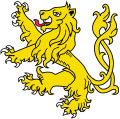 Lion with crossed tail (reverse)
 -
 Lion with tail nowed


.svg)

Variants
[edit]In addition to the attitudes it is depicted in, a certain variety is present in heraldic lions regarding the presence of additional physical features. Beyond the presence of double or forked tails, heraldic lions are sometimes depicted with two heads, as in the case of the arms of the Mason of Birmingham, from whom they were passed to the University of Birmingham. Alternatively, a lion may be depicted with one head connected to two distinct bodies, in which case it its termed bicorporated. If the conjoined bodies are three, the lion is instead termed tricorporated. These multi-bodied lions, however, are very rare.[23] Also, the claws and tongue of the lion may be described as a different tincture than a "proper" lion. If the claws are a different color, it is said to be armed of that tincture, and if the tongue is a different color it is langued of that tincture. For example, the blazon of the monarch of Scotland is Or, a lion gules, within a double tressure flory counter-flory of the same, armed and langued azure.
The arms of the Cinque Ports depict lions dimidiated with the hulks of ships, incorporating the front half of the lion and the rear of the vessel. This was originally the result of the joining of the lions or of the royal arms of England with the ships argent of the arms of the townships of the Ports. Over time, the conjoined figure came to be considered as a single heraldic charge in itself, and granted as such as new charges.[23]
Winged lions are depicted in arms as both passant and, more commonly, sejant, and also appear as supporters. This figure is commonly referred to as the Lion of Saint Mark, although Arthur Fox-Davies defined as a Lion of Saint Mark one present in a specifically religious context and depicted with a halo.[23] The winged lion is the traditional symbol of Venice, whose patron saint is Mark the Evangelist.[24]
A sea-lion, also called a morse, is depicted with the tail of a fish replacing its hindquarters, hind legs and tail. It is described as naiant when depicted horizontally, and as resurgent when rising from water. They typically appear as supporters, but are also known as charges and crests. The lion-dragon is a lion with the lower body, hind legs, wings and tail of a wyvern, although Fox-Davies doubted the existence of this figure outside of heraldry books and reported not to know of any actual use of it. The man-lion, also called a lympago, possesses a human face.[23]
Lions vs. leopards
[edit]
Both lions and leopards may have been among the earliest beasts to appear in heraldry. The Oxford Guide to Heraldry notes that the earliest English treatise on heraldry, a late-13th or early-14th century Anglo-Norman manuscript titled De Heraudrie,[25] mentions the crow, eagle, griffin, heron, leopard, lion, martlet, popinjay, and swan.[26] Citing Bado Aureo, the Oxford Guide further suggests that the leopard, said to be "borne of an adulterous union between a lioness and a pard", and like a mule incapable of reproducing, may be an appropriate charge for a person born of adultery or barred from reproducing (such as an abbot).[27]
As a general rule, English heralds tend to identify lions as rampant (upright, in profile facing dexter), and leopards as passant guardant (walking, head turned to full face), but the heraldic distinction between lions and leopards is often ambiguous and in some cases may be controversial (as in the case of the royal arms of England, discussed below). Part of the confusion arises from international differences in translation or in the defining characteristics of each, particularly in charges that show some characteristics of each.
English herald Arthur Charles Fox-Davies asserted in 1909 that the leopard, denoting a lion passant guardant, was a term of French origin that had "long since become obsolete in English armory. In French blazon, however, the old distinction is still observed." Fox-Davies continued, "[French heralds] term our lion passant a léopard-lionné [literally a 'lioned' leopard] and our lion rampant guardant is their lion-léopardé [literally a 'leoparded' lion]."[28] Dutch heraldist Johannes Rietstap, however, defined a Léopard lionné as a lion rampant guardant (i.e., upright like a lion with its head turned to full face like a leopard) and a Lion léopardé as a lion passant (i.e., walking like a leopard with its head facing dexter like a lion).[29] German-American heraldist Carl-Alexander von Volborth agrees with Rietstap's translations, in contrast to those of Fox-Davies as stated above.[30]
As if to clarify the situation, English heraldist Hugh Clark wrote in his Introduction to Heraldry (1829):
The true heraldic lion, according to French authors, is always to be represented in profile, or, as the ancient heralds say, showing but one eye and one ear. His attitude, also, should always be rampant or ravaging. When passant and full-faced, they blazoned him a leopard, vide Lion Leopardé: in England, however, the lions in the royal and other achievements have always been blazoned as lions, however depicted since the time of Henry III, in whose reign they were called "Leopards". Lion Leopardé ... is a French term for what the English call a Lion passant gardant. The word leopard is always made use of by the French heralds to express in their language, a lion full-faced, or gardant. Thus, when a lion is placed on an escutcheon in that attitude which we call rampant gardant, the French blazon it a Lion Leopardé. When he is passant only, they call him leopard lioné.[31]
English heraldist Charles Boutell wrote in 1890 that the lions of England were generally termed leopards until the end of the 14th century, including in the roll of arms of Henry III of England, and in a statute of Edward I of England, dating to 1300, which made reference to "signée de une teste de leopart—marked with the King's lion."[32] In English Heraldry (1867), Boutell explained:
Only when he was in this rampant attitude did the early Heralds consider any Lion to be a Lion, and blazon him by his true name. A lion walking and looking about him, the early Heralds held to be acting the part of a leopard: consequently, when he was in any such attitude, they blazoned him as "a leopard". The animal bearing that name bore it simply as an heraldic title, which distinguished a Lion in a particular attitude. These heraldic "leopards" were drawn in every respect as other heraldic "lions", without spots or any leopardish distinction whatever. This explains the usage, retained until late in the 14th century, which assigned to the Lions of the Royal Shield of England the name of "leopards". They were so called, not by the enemies of England for derision and insult, as some persons, in their ignorance of early Heraldry, have been pleased both to imagine and to assert; but the English Kings and Princes, who well knew their "Lions" to be Lions, in blazon styled them "leopards", because they also knew that Lions in the attitude of their "Lions" were heraldic "leopards".[33]
In Heraldry: Sources, Symbols and Meaning (1976), German heraldist Ottfried Neubecker explained:
When the blazon does not specifically mention a position, the lion may be assumed to be rampant. If he is in a different position, other terminology must be used, referring to the position of his head and limbs. An early heraldic convention found in medieval blazons uses the distinction between a lion and a leopard previously employed by the ancient Greeks. In antiquity, the lion, having a heavy mane, was generally shown in profile, while the leopard, having less hair, was shown looking towards the observer. A lion looking towards the observer therefore came to be given the name of the animal usually shown in that pose.[34]
According to Neubecker, what in Old French is termed a léopard is always guardant (head turned toward the observer), thus the modern English heraldic terms "lion passant guardant", "lion passant", and "lion rampant guardant" correlate to the Old French terms léopard, lion léopardé, and léopard lionné, respectively.[35]
-
 A lion.
 -
 A lion léopardé.
 -
 A leopard.
 -
 A leopard lionné.
 -
 Coat of arms of Dalmatia, showing three crowned lions guardant ("leopards")


.png)
Gallery
[edit] | This section contains an excessive or unencyclopedic gallery of images. (January 2024) |
 | This section needs additional citations for verification. (October 2018) |
Lions as heraldic charge
[edit]Lions rampant
[edit]A small group of examples is depicted listed below.
-
 Coat of arms of Flanders (based on the comital coat of arms, 12th century)
 -
 Arms of Belgium and of the former province of Brabant (based on the arms of the Duchy of Brabant, 12th century)
 -
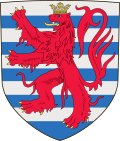 Escutcheon (without crest and supporters, which are different) of the Grand-Duchy of Luxembourg and since 1839 of the Belgian Province of Luxembourg
 -
 Canting coat of arms of the Kingdom of León with the royal crest, based on the royal arms (12th century)
 -
 Small coat of arms of the Czech Republic (1992, based on the coat of arms of the Kingdom of Bohemia, 13th century)
 -
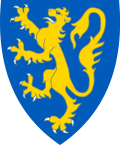 Ruthenian lion, coat of arms of the Kingdom of Ruthenia (13th – 14th century, later adopted by West Ukrainian People's Republic)
 -
 Coat of arms of Norway (13th century, 1992 design shown)
 -
 Barry lion in the arms of the German state of Hesse. The state of Thuringia uses a nearly identical coat of arms, both derived from the Ludovingian coat of arms (13th century).
 -
 Shield from the coat of arms of the Kingdom of Scotland (13th century). Currently appears as the second quarter of the Royal coat of arms of the United Kingdom (or the 1st and 3rd quarters in Scotland).
 -
-
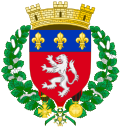
 Coat of arms of the Philippines (1946, the lion being derived from that of León)
 -
 The Lion of Judah on the municipal emblem of Jerusalem (1949)
 -
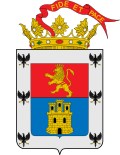 Emblem of Cartago Province, Costa Rica's first capital (1821)
 -
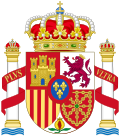
-
 Coat of arms of the Territory of the Saar Basin (1920–1935)
 -
 Current Coat of arms of Saarland
 -

-
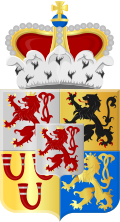
 Coat of arms of the Duchy of Limburg (1101–1795 and 1839–1866)
 -
-

-
-
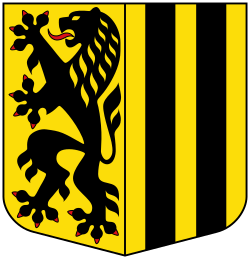
-
 Coat of arms of Leipzig, Germany
 -
 Coat of arms of Liepāja, Latvia. The lion being derived from that of the Duchy of Courland and Semigallia (1925, based on the 17th-century coat of arms)


.svg)


Lions passant
[edit]-
 Royal Arms of England, based on the 12th-century Plantagenet coat of arms
 -
 Coat of arms of Denmark, based on the 12th-century Estridsen coat of arms
 -
 Arms of Llywelyn the Great (13th century), used by the Prince of Wales since 1911.
 -
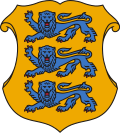 Coat of arms of Estonia (based on the Estridsen coat of arms, variants in use since the 13th century)
 -
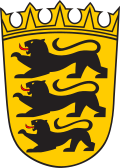 Coat of arms of Baden-Württemberg (1954, derived from the 13th-century Hohenstaufen coat of arms)
 -
 Coat of arms of Montenegro (2004, the lion ultimately derived from the Lion of Saint Mark used by the Republic of Venice)


Lions couchant
[edit]-
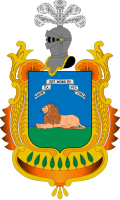
-
 Arms of Belgorod Oblast, Russia, showing a lion couchant Or (1727)
 -
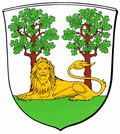 Arms of the Burgdorf district in Hanover, showing a lion couchant guardant (1940)
 -
 Arms of Rødøy Municipality in Norway, showing a lion couchant gules (1988)[37]
.svg)

.png)

Lions in crest
[edit]-
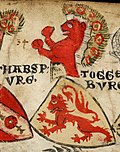 Noble arms of the Habsburgs, from Zürcher Wappenrolle (c. 1340)
 -
 Shield, helmet and crest of Edward, the Black Prince, suspended over his tomb in Canterbury Cathedral
 -
 Coat of arms of Philip I of Castile (1506) with the symbol representing the Leonese kingdom, along with a castle, imperially crowned in the top (chivalric design proper of Golden Fleece Roll), Medieval Spain
 -
 Royal arms of the United Kingdom: A lion statant guardant on the crest
 -
 Crest of the royal arms of Scotland (1837), a lion sejant affrontée Gules, imperially crowned Or, holding in the dexter paw a sword and in the sinister paw a scepter both erect and Proper.
 -
![Noble arms of the Polish Wieniawa family[year needed]](//upload.wikimedia.org/wikipedia/commons/thumb/e/ee/POL_COA_Wieniawa.svg/120px-POL_COA_Wieniawa.svg.png) Noble arms of the Polish Wieniawa family[year needed]
Noble arms of the Polish Wieniawa family[year needed] -
 Coat of arms of the British South Africa Company (19th century)


.svg)
.svg)
.svg)
![Noble arms of the Polish Wieniawa family[year needed]](https://en.wikipedia.org/wiki/File:POL_COA_Wieniawa.svg)

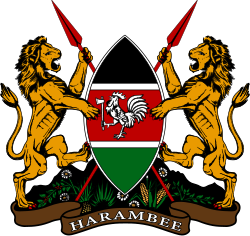
Lions as supporters
[edit]-
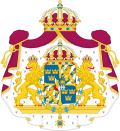 Coat of arms of Sweden (15th century)
 -
 Royal coat of arms of the United Kingdom, Scottish version (1837)
 -

-

-
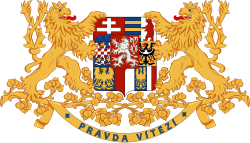
-

-
-
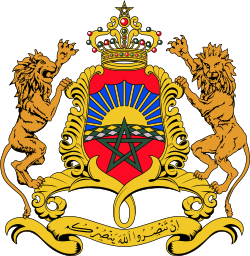 Coat of arms of Morocco (1957)
 -
 Coat of arms of Armenia (1992)
 -
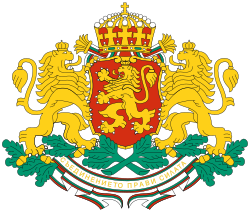 Coat of arms of Bulgaria (1997, based on 19th-century coat of arms)
 -
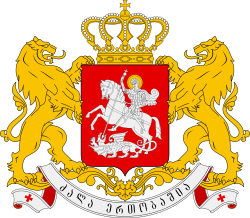 Coat of arms of Georgia (2004, based on 18th-century royal coats of arms)
 -
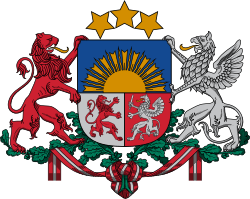 Coat of arms of Latvia (1921)
 -

-
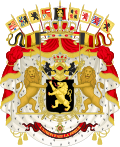 Great coat of arms of Belgium
 -
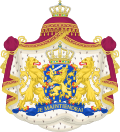 Royal coat of arms of The Netherlands


.svg)

.svg)


Western depictions
Heraldic lions have also found their way onto municipal or county seals in the United States.
Eastern depictions
[edit]Outside of classical heraldry, lions have also found their way onto the coats of arms or emblems used by modern states in Asia, often based on traditional depictions of lions in the respective cultures or regions.
-
 Imperial Standard of Mughal Empire
 -
 Coat of arms of the Kingdom of Iraq (1932-1959), depicting the lion and horse
 -
 Emblem of India (1950), depicting the lions of the Pillars of Ashoka
 -
![Emblem of Tibet with a pair of snow lions (1959[citation needed], based on the 1906 Flag of Tibet)](//upload.wikimedia.org/wikipedia/commons/thumb/8/86/Emblem_of_Tibet.svg/250px-Emblem_of_Tibet.svg.png)
-
 Emblem of Sri Lanka (1972)
 -
 Coat of arms of Tajikistan, 1992–1993
 -
 Royal arms of Cambodia (1993)

.svg)

![Emblem of Tibet with a pair of snow lions (1959[citation needed], based on the 1906 Flag of Tibet)](https://en.wikipedia.org/wiki/File:Emblem_of_Tibet.svg)


See also
[edit]

Notes
[edit]- ^ "[Animal style designs] have also been explained as totems venerated by the various clans of nomads as ancestors. Their transformation into clan symbols would have followed naturally and easily. The heraldic beasts of medieval chivalry, which include many deer and felines like those on the British royal coat of arms, may certainly be traces back to emblematic devices of later barbarian tribes from central Asia."[3]
- ^ Hopingius, De Insigniis (1642) claimed that the use of the red lion as an emblem goes back to the Picts[12]
- ^ The actual etymology of León is Legion (Λεγίων).[citation needed]
- ^ Accorded to the city, gifted by Charles V in 1554. The year number is encoded in the biblical motto, Absorta est mors in victoria, from Corinthians 15:54[36]
References
[edit]- ^ Garai (1973), p. [page needed]
- ^ Onians (2004), p. 58
- ^ Honour & Fleming (2005), p. 166
- ^ Shanzer & Mathisen (2013), p. 322
- ^ Fox-Davies (1909), p. 62
- ^ Stothard (1817), plate 2
- ^ Pastoureau (1997), p. 18
- ^ Woodward & Burnett (1892), p. 32
- ^ a b Fox-Davies (1909), pp. 173–174
- ^ Pastoureau (1997), p. 59
- ^ Woodward & Burnett (1892), p. 37
- ^ as cited in Nisbet (1816), p. 265
- ^ Nisbet (1816), p. 290
- ^ a b Fox-Davies (1909), p. 172
- ^ Fox-Davies (1909), p. 176
- ^ "Segreant". Dictionary of Heraldry. Archived from the original on 2011-07-10. Retrieved 2009-03-14.
- ^ a b c Fox-Davies (1909), p. 183
- ^ a b Fox-Davies (1909), p. 181
- ^ Fox-Davies (1909), p. 182
- ^ a b Fox-Davies (1909), p. 184
- ^ a b Fox-Davies (1909), p. 185
- ^ Fox-Davies (1909), p. 180
- ^ a b c d Fox-Davies (1909), pp. 179–186
- ^ "Flags of the World : Venice". Retrieved 2018-11-10.
- ^ Woodcock & Robinson (1988), p. 51
- ^ Woodcock & Robinson (1988), p. 63
- ^ Woodcock & Robinson (1988), p. 64
- ^ Fox-Davies (1909), p. 173
- ^ Rietstap (1884), p. XXV
- ^ von Volborth (1983), p. 27
- ^ Clark & Planché (1866), p. 156
- ^ Boutell & Aveling (1890), p. 79
- ^ Boutell (1867), pp. 84–85
- ^ Neubecker (1976), pp. 111–2
- ^ Neubecker (1976), p. 112
- ^ García Farrán, F.M.; Erbez, José Manuel. "Arahal". Símbolos de Sevilla (in Spanish).
- ^ "Rødøy". Heraldry of the World. Retrieved 2019-12-15.
Bibliography
[edit]- Boutell, Charles (1867). English Heraldry. London and New York: Cassell, Petter and Galpin – via Internet Archive.
- Boutell, Charles; Aveling, S. T. (1890). Heraldry, Ancient and Modern: Including Boutell's Heraldry. London: Frederick Warne. OCLC 6102523 – via Internet Archive.
- Clark, Hugh; Planché, J. R. (1866). An Introduction to Heraldry (18th ed.). London: Bell & Daldy. OL 14015165M.
- Fox-Davies, Arthur Charles (1909). A Complete Guide to Heraldry. London: T. C. and E. C. Jack. OL 7101030M. Also at – via Wikisource.
- Garai, Jana (1973). The Book of Symbols. New York: Simon & Schuster. ISBN 0-671-21773-9.
- Honour, Hugh; Fleming, John (2005). A World History of Art. Laurence King. ISBN 9781856694513.
- Neubecker, Ottfried (1976). Heraldry: Sources, Symbols and Meaning. New York: McGraw-Hill. ISBN 9780070463080.
- Nisbet, Alexander (1816). A system of heraldry: Speculative and practical. Vol. 1. Edinburgh: W. Blackwood. OCLC 847960765.
- Onians, John (2004). Atlas of World Art. Laurence King Publishing. ISBN 9781856693776.
- Pastoureau, Michel (1997). Heraldry: An Introduction to a Noble Tradition. Abrams Discoveries. Harry N. Abrams. ISBN 9780810928305.
- Rietstap, Johannes (1884). Armorial Général (in French). Gouda: G. B. van Goor Zonen.
- Shanzer, Danuta; Mathisen, Ralph W. (2013). Romans, Barbarians, and the Transformation of the Roman World: Cultural Interaction and the Creation of Identity in Late Antiquity. Ashgate Publishing. ISBN 9781409482093.
- Stothard, C. A. (1817). Monumental Effigies of Great Britain. plate 2.; as illustrated in Wagner, Anthony; Herald, Richmond (1946). Heraldry in England. Penguin. plate I.
- von Volborth, Carl-Alexander (1983). Heraldry: Customs, Rules and Styles. Dorset: Blandford Press. ISBN 0-7137-0940-5. LCCN 81670212.
- Woodcock, Thomas; Robinson, John Martin (1988). The Oxford Guide to Heraldry. Oxford: Oxford University Press. ISBN 0-19-211658-4.
- Woodward, John; Burnett, George (1892) [1884]. A treatise on heraldry, British and foreign: with English and French glossaries. Edinburgh: W. & A. B. Johnson. LCCN 02020303 – via Internet Archive.
| Types | |||||||||||||||
|---|---|---|---|---|---|---|---|---|---|---|---|---|---|---|---|
| Topics | |||||||||||||||
| Achievement | |||||||||||||||
| Charges | |||||||||||||||
| Tinctures |
| ||||||||||||||
| Applications | |||||||||||||||
| Related | |||||||||||||||
| |||||||||||||||


Lion (heraldry)
View on GrokipediaIntroduction
Definition and Characteristics
The lion stands as one of the most prevalent and esteemed charges in heraldry, representing a stylized depiction of the big cat known as the king of the beasts, typically rendered in profile or three-quarter view to emphasize its majestic form on a shield or escutcheon.[5] Introduced as a heraldic element around the 12th century during the early development of armory in medieval Europe, the lion's adoption reflected its ancient reputation for sovereignty and ferocity, quickly becoming a staple in noble and royal bearings.[5] Visually, the heraldic lion prioritizes simplicity and recognizability over naturalistic accuracy, with exaggerated features that ensure clarity at a distance, such as a prominent, flowing mane on male lions to denote maturity and power, a tufted or forked tail that adds a distinctive flourish, and extended claws and bared teeth that convey readiness and strength.[5] These elements are often rendered with bold lines and minimal shading, adhering to the heraldic principle of stark contrast against the field, while the lion's body maintains a quadrupedal form with powerful limbs, avoiding anatomical precision in favor of symbolic potency.[5] In terms of tinctures, the lion is conventionally blazoned in or (gold) to signify nobility and purity, especially when unspecified, though gules (red) variants evoke martial valor and are common in warrior lineages, as seen in early royal examples.[5] The claws and tongue, termed "armed" and "langued" respectively, default to gules for added emphasis but may shift to azure or other hues for contrast against the primary tincture, ensuring the charge remains visually dominant.[5]Symbolic Importance
In heraldry, the lion primarily symbolizes bravery, nobility, strength, and sovereignty, often regarded as the "king of beasts" due to its majestic and dominant presence in medieval iconography.[6] This emblematic role underscores its association with royalty and valor, qualities that elevated it as a charge representing the bearer's noble status and martial prowess.[7] The lion's symbolic depth draws heavily from ancient and biblical sources, particularly the Physiologus and medieval bestiaries, which interpreted its behaviors through Christian allegory. Vigilance is exemplified by the belief that lions sleep with their eyes open, signifying Christ's watchful divinity even in death on the cross, as described in Psalm 121:4.[8] Ferocity and protective power are highlighted in tales of the lion erasing its tracks with its tail to evade hunters, symbolizing Jesus concealing his divine nature from unbelievers (Revelation 5:5), while its roar revives prey, denoting resurrection.[9] The motif of resurrection further ties to lore where lion cubs are born lifeless and revived by the father's breath on the third day, paralleling Christ's entombment and rising, a narrative rooted in Genesis 49:9 and elaborated in bestiaries to emphasize eternal life and redemption.[9][10] Nationally and dynastically, the lion denotes power and heritage in various arms. In England, the three lions passant guardant in pale or, adopted by the Plantagenet dynasty under Richard I around 1198, embody royal authority and English sovereignty, possibly influenced by continental European heraldry to assert dominance.[7] Scotland's red lion rampant, featured in the royal arms since the 12th century, represents the kingdom's fierce independence and monarchical strength.[11] Similarly, the purple lion of León, Spain, appearing on coins of Alfonso VII (1126–1157), symbolizes the bravery and imperial ambition of the Asturian-Leonese rulers, linking the beast directly to the kingdom's name and identity.[12] In Bohemia, the silver double-tailed lion rampant on a red field, from the 12th century onward, signifies courage, pride, and the Přemyslid dynasty's sovereignty.[13] The lion's meaning evolved from pagan associations with raw strength and kingship in classical antiquity to layered medieval Christian interpretations, where its ferocity and nobility allegorized divine virtues over temporal power.[1] Though rare negative connotations persisted—such as biblical depictions of the lion as the devil, a roaring predator seeking to devour the faithful (1 Peter 5:8)—these were largely overridden in heraldry by positive emblems of resurrection and vigilance, ensuring the lion's dominance as a virtuous royal symbol.[14][10]Historical Development
Origins in Medieval Heraldry
The lion motif predates the emergence of formal heraldry in Europe, appearing in various artistic and symbolic contexts that likely informed its later heraldic adoption. In Roman mosaics, such as those from the 3rd century CE discovered in central Italy, lions were frequently depicted in hunting scenes to represent imperial power, ferocity, and dominion over nature.[15] Similarly, in Viking-era carvings on Norwegian stave churches from the 12th century, lions symbolized strength and rulership, often intertwined with Christian iconography to evoke both biblical references and royal authority.[16] Norman seals from the early 12th century in Sicily also featured lions passant guardant as badges, predating systematic armorial use and reflecting influences from Eastern Mediterranean traditions.[17] The formal integration of the lion into heraldry occurred in the mid-12th century, with the Angevin dynasty playing a pivotal role. The earliest surviving example is the enamel effigy on the tomb shield of Geoffrey Plantagenet, Count of Anjou, dating to approximately 1150 and housed in the Musée de Tessé in Le Mans, France; it displays several lions (the exact number disputed, often described as six) or on an azure field, marking one of the first instances of repeatable, inheritable armorial bearings.[18] This design is thought to have drawn inspiration from Crusader encounters in the Holy Land, where lions appeared prominently in Islamic and Byzantine art as symbols of sovereignty, as evidenced by motifs in the Melisende Psalter produced in Jerusalem around 1131–1143.[19] Byzantine influences, including lion imagery adopted by Norman rulers in Sicily, further facilitated the motif's transmission to Western Europe through trade and military campaigns.[20] Upon his ascension to the English throne in 1154, Henry II, son of Geoffrey Plantagenet, adopted lions as his primary emblem, initially perhaps two on a red field, though evidence from early seals is ambiguous. This adoption solidified the lion's status within the Angevin realm, spreading rapidly through equestrian seals and tournament banners among the nobility in France and the Holy Roman Empire during the late 12th century. Primary sources from this period, including royal and noble seals rather than formalized rolls of arms (which emerged later in the 13th century), document the lion's proliferation as a charge denoting courage and lineage. Additionally, the rising popularity of Arthurian legends in 12th-century literature reinforced the lion's chivalric connotations, with figures like King Arthur associated with leonine imagery in romances that idealized knightly valor.[21]Evolution and Spread Across Europe
During the 13th and 14th centuries, the depiction of the lion in heraldry underwent significant standardization, with the rampant attitude emerging as the dominant posture, symbolizing strength and readiness for combat. Prior to the mid-13th century, lions were often shown in more static, upright forms, but by the latter half of the century, the rampant pose—characterized by the lion rearing on its hind legs with forepaws extended—became prevalent across European armorials, reflecting a shift toward dynamic representations of nobility and valor.[5] This standardization facilitated its adoption beyond royal houses, including by families claiming descent from ancient English kingdoms to evoke historical prestige.[22] The lion's proliferation across Europe was propelled by dynastic marriages, conquests, and emerging international heraldic practices. In Denmark, King Canute VI adopted three blue lions passant guardant on gold around 1194, as evidenced by his royal seal, likely influenced by Hohenstaufen imperial symbolism during periods of Danish fealty to the Holy Roman Empire; this design spread to Sweden through royal succession, with kings Erik XI and Valdemar adopting similar triune lions in the 13th century.[7] In Iberia, the Kingdom of León adopted a red lion rampant on silver around the mid-12th century, symbolizing royal authority and spreading through dynastic ties during the Reconquista.[23] Conquests further disseminated the motif, as seen in England's integration of Norman lions following the 1066 invasion, evolving into Richard I's three lions passant guardant by 1198, which combined with continental influences during his Third Crusade captivity.[7] Marriages amplified this exchange, exemplified by Otto IV of Germany's union with Matilda, granddaughter of Henry II, blending English lions with imperial eagles in the early 13th century.[7] By the 14th century, international gatherings of heralds and the compilation of armorials like the Gelre Armorial (1370–1414) standardized and circulated these designs across courts, embedding the lion in pan-European noble identity.[24] In the Renaissance period, particularly from the 15th century onward, lion heraldry in Italy and Germany shifted toward more naturalistic styles, influenced by humanist scholarship and classical revival. Italian humanists like Lorenzo Valla critiqued earlier stylized forms, advocating for vivid, lifelike depictions—such as red lions roaring and tearing prey—to align with ancient sources like Virgil and Herodotus, as seen in Este family arms where lions integrated with eagles and lilies to denote alliances.[25] In Germany, heraldic imagination evolved similarly around 1480–1560, with artists emphasizing anatomical detail, such as sinews and dynamic poses, in armorials and literature, moving away from medieval abstraction toward realistic integration with charges like crowns and chains for enhanced symbolic depth.[26] By the 15th century, the lion's ubiquity—evident in the Gelre Armorial's depiction of numerous European coats of arms featuring lions—diminished its novelty among lesser nobility due to overuse, prompting some houses to adopt more distinctive variants.[24] Nonetheless, it persisted as a core element in royal arms, retaining its associations with sovereignty and Christian clemency amid evolving moral symbolism in late medieval art.[22]Forms and Positions
Standard Attitudes
In heraldry, the attitudes of the lion refer to its standard positional depictions, which convey different aspects of strength and vigilance through stylized poses. These positions are essential to blazoning, the formal language used to describe coats of arms, and are derived from medieval conventions where the lion, as the king of beasts, symbolized courage and royalty. The most prevalent attitudes include rampant, passant, and couchant, while others like dormant appear less frequently.[27][28] The rampant attitude depicts the lion rearing upright on its left hind leg (sinister), with the right hind leg bent and the forepaws raised as if in combat, head facing dexter (to the viewer's left) in profile. This pose emphasizes power and aggression, making it the most common lion attitude in European heraldry. A classic example is the Royal Arms of Scotland, blazoned as "or, a lion rampant gules armed and langued azure within a double tressure flory-counter-flory of the second," adopted by King William I around 1165.[27][4][28] The passant attitude shows the lion walking to the dexter, with the right forepaw raised and the other three paws on the ground, tail elevated, and head in profile. It suggests steady progress and guardianship. An early example appears in the arms of the Strange family, blazoned as "argent, two lions passant in pale gules."[27] Closely related is the passant guardant, where the lion is passant but turns its head to face the viewer (guardant), combining motion with direct confrontation; in English heraldry, this is often termed a "leopard" to distinguish it from the profile lion. The Royal Arms of England feature three such lions, blazoned as "gules, three lions passant guardant in pale or armed and langued azure," originating in the late 12th century under Richard I.[27][29][7] The statant attitude portrays the lion standing still with all four paws on the ground, forepaws close together, and head erect, denoting alertness without aggression. It is used in crests, such as the English Royal crest blazoned "a lion statant guardant or crowned."[27] In the sejant attitude, the lion sits on its haunches with forepaws on the ground and tail visible, evoking composure; when the forelegs are raised (sejant erect), it gains a more dynamic quality. An example is found in crests like "a lion sejant erect affronté gules," where the lion faces forward.[27][28] The couchant attitude has the lion lying down with head raised and forepaws extended, symbolizing watchful repose. It contrasts with the rarer dormant attitude, where the lion lies with head resting on forepaws and eyes closed, indicating sleep or peace, as in the Lloyd arms blazoned with "lions dormant." Dormant lions are among the least common attitudes, appearing sparingly in historical arms compared to more active poses.[27][28]Specialized Variants
In heraldry, anatomical variants of the lion often involve modifications to the tail, such as the double-queued form, where the lion is depicted with two distinct tails emerging from the base, as seen in the arms of Sebastian Schärtlin von Burtenbach (gules, a lion double-queued or).[5] Another common alteration is the queue-fourchée, featuring a single tail forked at its midpoint, exemplified in the arms of Simon de Montfort, Earl of Leicester (gules, a lion rampant queue-fourchée argent).[5] In the greater coat of arms of Sweden, the royal supporters are two lions regardant, crowned, with forked tails (queue-fourchée) or, armed and langued gules, emphasizing regality and vigilance.[5] The sea-lion, a rarer variant primarily from the 16th century, combines the head, forepaws, and upper body of a lion with the tail and lower body of a fish, often blazoned as naiant or sejant; it appears as a charge or supporter, symbolizing maritime prowess.[5] Hybrid forms integrate the lion with elements of other creatures, creating chimerical beasts. The winged lion, or lion of Saint Mark, represents the Evangelist Mark and serves as the primary emblem of Venice, depicted sejant with wings displayed, a halo, and often holding an open book inscribed "Pax tibi Marce evangelista meus"; it forms the central charge in the arms of the Republic of Venice (azure, a winged lion or with halo, holding a book argent inscribed as above).[5][30] Other hybrids include the lion-dragon, with the lion's upper body joined to a wyvern's tail, though documented examples are scarce, and chimeras such as the German schimäre, featuring lion forequarters and goat hindquarters with a dragon's tail.[5] Lion-headed eagles, inverting the griffin's form, appear infrequently as custom monsters in continental arms, blending the lion's head and forelegs with an eagle's body and wings to denote combined ferocity and vigilance.[31] Multi-bodied lions, though uncommon, convey amplified strength through conjoined forms. The bicorporated lion features one head with two bodies, as in the arms of Attewater (or, two lions bicorporated counter-passant guardant gules).[5] A rarer tricorporated variant has three bodies emerging from one head, registered in Ulster's Office during the reign of Charles II (circa 1660s), often blazoned rampant to symbolize unity in multiplicity.[5] Conjoined lions, such as two rampant combatant facing each other, appear in fighting postures to denote combativeness, with examples in 14th-century English rolls like those of the Fitzhamon family (argent, a lion rampant guardant or, sometimes doubled in combatant pairs).[5] Color and attribute variants enhance the lion's symbolism, particularly in 14th-century continental arms where crowns and specific tinctures for the tongue (langued) denote sovereignty. The incensed or flammant lion, with flames issuing from the mouth and ears, represents passionate resolve, as in the arms of the Pickering family (ermine, a lion rampant azure crowned and langued or, incensed proper).[32] Crowned lions, often in or or argent with gules tongue and claws (armed gules), include the Bohemian arms (gules, a lion rampant double-queued argent, crowned, armed, and langued or), adopted by the 12th century and prominent in 14th-century seals.[5] Similarly, the arms of Henry de Lacy, Earl of Lincoln (or, a lion rampant purpure crowned or, langued gules), from the late 13th to early 14th century, exemplify tincture variations for imperial distinction in English-continental alliances.[5]Terminology and Distinctions
Blazoning Conventions
In heraldry, the blazon for a lion follows a structured linguistic format that begins with the number and arrangement if multiple, followed by the attitude, tincture, and any additional qualifiers such as armed (claws) or langued (tongue) features.[5] A basic example is "a lion rampant or," where the lion is gold and in its default upright pose.[33] More complex instances might specify orientation, such as "three lions passant guardant in pale or," indicating three walking lions with heads turned toward the viewer, arranged vertically in gold.[34] Defaults streamline blazoning by assuming standard attributes unless otherwise stated. The attitude defaults to rampant, depicting the lion rearing on its left hind leg with the right foreleg raised, facing the viewer's right (dexter side).[27] The tincture defaults to or (gold), a common choice for its symbolic nobility, though variations like gules (red) or argent (silver) are specified when needed.[35] Gender is presumed male unless denoted as a lioness, which historically included subtle differentiations like a smoother mane but now typically omits explicit genital references in modern practice.[36] Historical terminology for lions drew heavily from Old French influences, leading to shifts in usage over time. In medieval English blazons, "leopard" often described a lion in the passant guardant attitude—walking with the head facing forward—reflecting French conventions where "léopard" denoted this pose, while "lion" strictly meant rampant.[27] This interchangeable use appears in early rolls like Glover's Roll circa 1250, but by the 19th century, English standards clarified distinctions, standardizing "lion" for all attitudes with explicit descriptors to avoid ambiguity.[37] Complex blazons frequently integrate lions into quartered arms, as seen in the royal arms of the United Kingdom, which combine England's gules three lions passant guardant in pale or with Scotland's or a lion rampant gules armed and langued azure within a double tressure flory-counter-flory gules.[38] This structure quarters the shield to reflect union, with the English lions in the first and fourth quarters and the Scottish lion in the second, encircled by the third quarter's harp of Ireland, all surmounted by the royal crest and supporters.[39]Differences from Leopards and Similar Beasts
In English heraldry, the term "leopard" specifically denotes a lion depicted in the passant guardant attitude, that is, walking with the dexter forepaw raised, the head turned to face the viewer.[27] This distinction arose from French heraldic conventions, where the lion (lion rampant) represents an erect, profile-facing beast, while the leopard signifies the walking, full-faced form; conversely, the English lion passant would be termed a léopard-lionné in French blazonry.[27] Over time, British usage largely abandoned this separation, treating all such figures as lions regardless of position, though the "leopard" nomenclature persists in historical contexts.[40] The historical evolution of this terminology traces to the 12th and 13th centuries, when French armorial rolls, such as Glover's Roll (c. 1250), blazoned the English royal arms as "Gules, three leopards or" for lions passant guardant, reflecting an early conflation of the beasts based on perceived behavioral similarities like prowling.[27] This led to variant terms like "lion leopardé" in English heraldry for lions with added spotting to evoke the natural leopard's markings, though such embellishments remained exceptional.[41] In contrast, true naturalistic leopards—depicted as spotted cats without leonine manes—appear rarely, primarily in colonial arms influenced by exotic fauna, such as those of some British overseas territories.[40] Heraldic lions are further distinguished from other feline-like beasts by their non-fantastic nature and prominent mane. The tiger, for instance, is rarer and identified by its striped pattern or an addorsed (doubled-back) tail, symbolizing ferocity without the lion's regal associations.[42] Panthers, often blazoned as "incensed," feature multicolored spots and flames issuing from the mouth and ears, drawing from medieval bestiaries to represent a savage yet alluring creature, unlike the unadorned lion.[40] Wyverns, resembling dragons with two legs, bat-like wings, and barbed tails, diverge entirely as mythical reptiles, lacking the mammalian form and symbolic nobility of the lion.[43]Applications in Heraldry
As Principal Charges
In heraldry, the lion frequently serves as the principal charge, dominating the escutcheon and often determining its overall composition due to its size and prominence. Placement typically follows standard ordinaries: lions may be arranged in pale for vertical alignment, as seen in the three lions of England stacked one above the other; in bend for diagonal positioning; or in fess for horizontal arrangement across the center. This adherence to ordinaries ensures clarity and balance, with the principal lion or group of lions occupying the chief position after the field is described in the blazon.[44][45] Multiple lions as principal charges exemplify simplicity and power, particularly in royal arms where they convey sovereignty without additional ordinaries. The royal arms of England, gules three lions passant guardant or, have been in use since the late 12th century, appearing on the second great seal of King Richard I around 1198, and they effectively divide the shield into implicit vertical sections through their pale arrangement. For heirs and cadets, these arms are differenced using cadency marks, such as a label of three points azure placed over the lions to denote the eldest son, allowing distinction while preserving the core design.[46][47] A single lion provides compositional economy, emphasizing the charge's symbolic weight on a plain field. Belgium's coat of arms features a single lion rampant or armed and langued gules on a sable field, derived from the Duchy of Brabant's heraldry and adopted as the national emblem in 1837 to represent unity and strength. Similarly, the arms of the Netherlands center on the Dutch lion rampant or, crowned and armed gules, on an azure field semy of golden billets, a design rooted in the 16th-century Union of Utrecht that unifies provincial elements under one dominant charge.[48].html) Notable historical instances highlight the lion's influence on shield division and layering. In practical terms, lions function as brisures—small cadency marks or overlays—added to existing fields or charges to denote lineage branches, such as a diminutive lion cub placed in the corner of a paternal shield without disrupting the principal layout.[49]In Crests, Supporters, and Other Elements
In heraldry, the lion frequently appears in crests, where it is depicted as a full body or demi-lion issuant from a coronet or torse atop a helmet, symbolizing vigilance and nobility. This usage became particularly popular in the 14th century, evolving from tournament helmet ornaments such as fan-shaped crests featuring lions passant or statant, often crafted from lightweight materials like leather or wood for ceremonial display rather than combat. For instance, seals from the period, like that of Thomas de Mowbray (1389), illustrate crested helmets with leopards or lions modified by royal patents.[50] British peerage crests commonly employ lions, such as the demi-lion rampant, to denote lineage and authority; an early example is the lion passant holding a cross-crosslet fitchy in the crest of John Adams, reflecting heraldic traditions carried to America. In the context of orders of chivalry like the Order of the Garter, the English royal crest—a lion statant guardant or imperially crowned proper—is integrated into achievements, encircling the arms with the garter for knights and dames.[51] As supporters, lions are typically paired to flank the shield, posed rampant or guardant for balance and to evoke strength, a privilege often reserved for peers, royalty, or institutions. In Sweden's Great Coat of Arms, two crowned lions with forked tails or, armed and langued gules, stand as supporters, a design formalized in the 1908 Act but rooted in late 16th-century practice to distinguish from earlier Folkung dynasty motifs. Similarly, the arms of Lord Butler of Brockwell feature two lions argent armed and langued azure, each holding a lymphad, granted in 2003 to underscore personal and national heritage.[52][53] Beyond crests and supporters, lions appear in other elements such as badges, seals, and mantling, serving as emblems of identity in non-shield contexts. Badges often feature a lion's head or full figure for quick recognition, while seals may emboss lions from crests or supporters onto documents; for example, medieval seals like Richard I's (1198) show a lion passant on a helmet-derived ornament. In mantling, lions occasionally form decorative extensions from the helmet, though this is less common than abstract flourishes. Rare instances include female lions in crests, distinguished by a lack of mane or a "w"-shaped tuft, used in matrilineal inheritances to honor female lines, as seen in select European noble achievements where the lioness replaces the standard lion to signify maternal descent.[50][54]Regional and Cultural Variations
Western European Traditions
In Western European heraldry, the depiction and usage of the lion vary significantly by region, reflecting local artistic traditions and historical contexts. In England, the lion is characteristically rendered in a naturalistic style, emphasizing anatomical detail and lifelike posture, particularly in the attitude of passant guardant—walking with the right forepaw raised and head turned to face the viewer. This approach is exemplified in the royal arms, which feature three golden lions on a red field, adopted in the 12th century during the reign of Richard I (1189–1199) and symbolizing the unity of the English realm under the Angevin dynasty.[55][7] By contrast, French heraldry and that of the Low Countries favor a more stylized lion, often with exaggerated features and a bifurcated tail known as double-queued or queue forchée, which imparts a sense of heraldic abstraction and symmetry. This motif is prominently displayed in the arms of Luxembourg—barry of ten argent and azure with a red double-queued lion rampant crowned and armed or—dating to the 13th century under Henry V, Count of Luxembourg, and exerting influence on neighboring regions like Brabant, where similar double-tailed lions appear in ducal arms to denote shared Carolingian heritage.[56][57] Scandinavian traditions prioritize the rampant posture for the lion, conveying vigilance and power, as seen in Norway's national arms: a crowned golden lion holding an axe on a red field, originating in the 13th century with the House of Sverre and retained as a symbol of royal authority..html) In Iberian heraldry, particularly that of the Kingdom of León, the lion serves as a core emblem, often in purple on silver to represent sovereignty, drawing from legends such as that associating the symbol with King Pelayo in the 8th century.[58][12] These regional styles have persisted into the modern era, with lions retained in state arms following 19th-century national consolidations; for instance, Belgium adopted the black-crowned golden lion of Brabant (sable, a lion or armed and langued gules, crowned or) in its 1831 constitution as a unifying emblem for the new kingdom, drawing from Low Countries precedents.[59] Heraldic societies, such as the Heraldry Society in England and international bodies like the Académie Internationale d'Héraldique, have contributed to standardization by promoting consistent blazoning and artistic guidelines to preserve these traditions amid evolving national identities.Eastern and Non-European Depictions
In Eastern heraldry, lions often incorporate symbolic enhancements drawn from Byzantine and Orthodox Christian traditions, diverging from the more naturalistic Western forms. The winged lion associated with Saint Mark the Evangelist, a key emblem in Venetian heraldry, traces its origins to Eastern influences, including the Greek Orthodox Patriarchate of Alexandria and Byzantine artistic motifs inspired by biblical visions such as Ezekiel's four winged creatures.[30] This depiction typically features the lion with wings signifying spiritual elevation, a halo denoting holiness, and an open book representing the Gospel, reflecting Orthodox iconographic styles that emphasize divine authority over secular prowess.[30] Armenian heraldry further exemplifies these Eastern adaptations, prominently featuring a red lion as a symbol of royal strength, as seen in the arms attributed to King Leo I of the Cilician Kingdom from the late 12th century onward.[60] These lions, often rendered in vivid gules on a field, blend local Near Eastern motifs with emerging Western heraldic conventions through dynastic ties, such as those with the Lusignans of Cyprus, highlighting a hybrid style rooted in Orthodox cultural heritage.[60] In some Armenian contexts, the lion appears in paired or supportive roles, evoking protective duality, as in chained lion sculptures at sites like Geghard Monastery that symbolize resilience and guardianship.[61] In Asian and Islamic heraldic traditions, the lion motif frequently integrates astronomical and imperial symbolism, as exemplified by the Persian lion-and-sun emblem, which originated as an astrological zodiacal sign representing the constellation Leo and solar divinity, evolving into a secular symbol of kingship by the 12th century.[62] This design, depicting a lion wielding a sword beneath a radiant sun, influenced broader regional iconography and was adapted in non-Persian contexts, such as the crowned golden lion on Bulgaria's coat of arms, which emerged in the 14th century under Tsar Ivan Shishman and signifies national sovereignty with echoes of Eastern imperial motifs.[63] In the Indian subcontinent, princely states under British colonial influence incorporated Asiatic lions—native to regions like Gujarat—into their arms, often in British heraldic styles; for instance, Junagadh's emblem featured a lion amid a mountainous landscape with a fort and rising sun, symbolizing territorial dominion, while Bhavnagar displayed a crimson lion on gold in its canton.[64][65] Modern non-European adoptions of the lion in heraldry often stem from colonial introductions filling pre-existing symbolic voids, particularly in Africa, where indigenous traditions lacked formalized blazonry. Ethiopia's imperial coat of arms, used by the Solomonic dynasty from the 19th century, centers on the crowned Lion of Judah—a golden lion rampant holding a cross or scepter—asserting descent from King Solomon and the Queen of Sheba, as first legally defined in the early 20th century under Emperor Menelik II.[66][67] Similarly, Sri Lanka's national flag, adopted in 1951 but rooted in ancient Sinhalese iconography, displays a gold lion passant wielding a kastane sword against a maroon field, representing the warrior heritage of the Sinhala people and incorporating bo leaves as Buddhist symbols, though its stylized form draws from 19th-century European heraldic influences amid colonial legacies.[68][69] Stylistically, Eastern and non-European lion depictions emphasize fluidity and integration with cultural elements, contrasting Western rigidity with more curvaceous lines and symbiotic motifs. In Persian and Indian contexts, lions often appear entwined with solar discs or floral scrolls, as in the lion-and-sun's radiant extensions evoking divine light, while Armenian and Ethiopian variants incorporate Orthodox halos or imperial crowns with ornate, flowing contours that blend animal ferocity with spiritual grace.[62] In Sri Lankan and broader Asian heraldry, such as Chinese-influenced designs, lions may feature exaggerated manes or paired with jewels and vegetation, prioritizing symbolic harmony over anatomical precision, as seen in 19th- and 20th-century state emblems where floral borders frame the beast to denote prosperity and protection.[70][71]References
- https://en.wikisource.org/wiki/A_Complete_Guide_to_Heraldry/Chapter_11
- https://en.wikisource.org/wiki/A_Complete_Guide_to_Heraldry/Chapter_12
- https://en.wikisource.org/wiki/A_Complete_Guide_to_Heraldry/Chapter_13
- https://en.wikisource.org/wiki/A_Complete_Guide_to_Heraldry/Chapter_21
- https://commons.wikimedia.org/wiki/Category:Double-tailed_lion_of_Luxemburg_in_heraldry