


Community hub
Long March 2F
View on Wikipedia
 The Long March 2F rocket with Shenzhou 13 spacecraft mounted on the top | |
| Function | Medium-lift launch vehicle |
|---|---|
| Manufacturer | China Academy of Launch Vehicle Technology |
| Country of origin | China |
| Size | |
| Height | 62 m (203 ft)[1] |
| Diameter | 3.35 m (11.0 ft)[1] |
| Mass | 464,000 kg (1,023,000 lb)[1] |
| Stages | 2 |
| Capacity | |
| Payload to LEO | |
| Mass | 8,400 kg (18,500 lb)[1] |
| Associated rockets | |
| Family | Long March 2 |
| Launch history | |
| Status | Active |
| Launch sites | Jiuquan Satellite Launch Center |
| Total launches | 28 |
| Success(es) | 28 |
| First flight | 19 November 1999 |
| Last flight | 7 February 2026 (most recent) |
| Carries passengers or cargo | Shenzhou Tiangong-1 Tiangong-2 Reusable experimental spacecraft |
| Boosters | |
| No. boosters | 4 |
| Height | 15.3 m (50 ft) |
| Diameter | 2.3 m (7 ft 7 in) |
| Empty mass | 3,200 kg (7,100 lb) |
| Gross mass | 41,000 kg (90,000 lb) |
| Powered by | 1 YF-20B per booster |
| Maximum thrust | 814 kN (183,000 lbf) |
| Total thrust | 3,256 kN (732,000 lbf) |
| Specific impulse | 291 s (2.85 km/s) |
| Burn time | 128 seconds |
| Propellant | N2O4 / UDMH |
| First stage | |
| Height | 23.7 m (78 ft) |
| Diameter | 3.4 m (11 ft) |
| Empty mass | 9,500 kg (20,900 lb) |
| Gross mass | 196,500 kg (433,200 lb) |
| Powered by | 4 YF-20B |
| Maximum thrust | 3,256 kN (732,000 lbf) |
| Specific impulse | 291 s (2.85 km/s) |
| Burn time | 166 seconds |
| Propellant | N2O4 / UDMH |
| Second stage | |
| Height | 13.5 m (44 ft) |
| Diameter | 3.4 m (11 ft) |
| Empty mass | 5,500 kg (12,100 lb) |
| Gross mass | 91,500 kg (201,700 lb) |
| Powered by | 1 YF-24B |
| Maximum thrust | 831 kN (187,000 lbf) |
| Specific impulse | 289 s (2.83 km/s) |
| Burn time | 300 seconds |
| Propellant | N2O4 / UDMH |
The Long March 2F (Chinese: 长征二号F火箭 Changzheng 2F), also known as the CZ-2F, LM-2F and Shenjian (神箭, "Divine Arrow"),[1] is a Chinese orbital carrier rocket, part of the Long March 2 rocket family. Designed to launch crewed Shenzhou spacecraft, the Long March 2F is a human-rated two-stage version of the Long March 2E rocket, which in turn was based on the Long March 2C launch vehicle.[2] It is launched from complex SLS at the Jiuquan Satellite Launch Center. The Long March 2F made its maiden flight on 19 November 1999, with the Shenzhou 1 spacecraft. After the flight of Shenzhou 3, CPC General Secretary and President Jiang Zemin named the rocket "Shenjian", meaning "Divine Arrow".[3]
On 29 December 2002, a Long March 2F launched Shenzhou 4 for a final uncrewed test of the Shenzhou spacecraft for the upcoming flight of the first crewed mission. Until then, all missions were uncrewed.
On 15 October 2003, a Long March 2F launched Shenzhou 5, China's maiden crewed mission and achieved its first human spaceflight. Since then, the rocket has launched twenty more missions into orbit with the latest being the Shenzhou 20 spacecraft.[4][5][6][7]
Differences from the Long March 2E
[edit]Externally, the rocket is similar to the Long March 2E from which it was derived. Most of the changes involve the addition of redundant systems to improve safety, although there are some structural modifications that allow the rocket to support the heavier fairing required by the Shenzhou capsule. The rocket is also capable of lifting heavier payloads with the addition of extra boosters to the first stage.[8]
The rocket also has an "advanced fault monitoring and diagnosis system to help the astronauts escape in time of emergency" (in other words, a launch escape system), and is the first Chinese made rocket to be assembled and rolled out to its launch site vertically.[9]
Derivatives
[edit]-
 Long March 2 F/G version
 -
 Long March 2 F/T version


A derivative called Long March 2F/G, first launched in 2011, was made to replace the existing 2F variant. For uncrewed launches, Long March 2F/T was designed, which launched space laboratories such as Tiangong-1 and Tiangong-2. It dispenses with the launch escape system and supports a larger fairing to accommodate the bulkier payloads.[10] For launching payloads like reusable experimental spacecraft, the Long March 2F/G's fairing has bumps added to enclose parts of the payload (such as wingtips) without using a larger fairing.[11][12][13]
Vibration issues
[edit]During the Shenzhou 5 flight, Yang Liwei became unwell due to heavy vibrations from the rocket. Although the problem was reduced somewhat by modifications to the rocket, vibrations were reported again in Shenzhou 6 necessitating further changes. According to Jing Muchun, chief designer of the Long March 2F "We made changes to the pipelines of the rocket engine, adjusting its frequency. A new design for the pressure accumulator produced evident results. The vibration has now been reduced by more than 50%".[14] During the launch preparations for the Shenzhou 14 mission chief designer Gao Xu said incremental improvements made to the rocket's design mean vibrations felt by the taikonauts would be similar to that felt in a car driven on a highway.[15]
The predecessor Long March 2E had also been known for vibration. During two launches, excessive vibration caused the collapse of the payload fairing, destroying the Optus B2 and Apstar 2 satellites.[16] After the payload fairing was redesigned, excessive vibration also damaged the AsiaSat 2 satellite during launch. After its successful launch of the Echostar 1 satellite on 28 December 1995 the rocket was officially retired from service.[17]
-
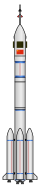 Long March 2F rocket schematics
 -
 The Long March 2F rocket with folded grid fins carrying Shenzhou 12 mission spacecraft, inscribed with "Divine Arrow" (神箭) in Chinese
 -
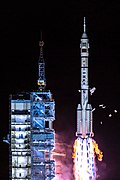 Launch of Shenzhou 13
 -
 Shenzhou 15 before liftoff


Launch statistics
[edit]- Failure
- Partial failure
- Success
- Planned
List of launches
[edit]| Flight number | Serial number | Date (UTC) | Version | Launch site | Payload | Orbit | Crew | Result | Remarks |
|---|---|---|---|---|---|---|---|---|---|
| 1 | Y1 | 19 November 1999 22:30 |
2F | LA-4/SLS-1, JSLC | Shenzhou 1 | LEO | N/A | Success | First uncrewed test of the Shenzhou spacecraft |
| 2 | Y2 | 9 January 2001 17:00 |
2F | LA-4/SLS-1, JSLC | Shenzhou 2 | LEO | N/A | Success | Second uncrewed test of the Shenzhou spacecraft, carried live animals. |
| 3 | Y3 | 25 March 2002 14:15 |
2F | LA-4/SLS-1, JSLC | Shenzhou 3 | LEO | N/A | Success | Third uncrewed test of the Shenzhou spacecraft. |
| 4 | Y4 | 29 December 2002 16:40 |
2F | LA-4/SLS-1, JSLC | Shenzhou 4 | LEO | N/A | Success | Final uncrewed test of the Shenzhou spacecraft prior to flying with crew. |
| 5 | Y5 | 15 October 2003 01:00 |
2F | LA-4/SLS-1, JSLC | Shenzhou 5 | LEO |  Yang Liwei Yang Liwei
|
Success | China's first crewed spaceflight. |
| 6 | Y6 | 12 October 2005 01:00 |
2F | LA-4/SLS-1, JSLC | Shenzhou 6 | LEO | Fei Junlong Nie Haisheng
|
Success | Second crewed spaceflight, first with two taikonauts. |
| 7 | Y7 | 25 September 2008 13:10 |
2F | LA-4/SLS-1, JSLC | Shenzhou 7 | LEO | Zhai Zhigang Liu Boming Jing Haipeng
|
Success | First flight with three crew members, first to feature extravehicular activity. |
| 8 | T1 | 29 September 2011 13:16 |
2F/T | LA-4/SLS-1, JSLC | Tiangong 1 | LEO | N/A | Success | The first Chinese space station. Modified version Long March 2F/G with larger payload fairing.[10] |
| 9 | Y8 | 31 October 2011 21:58 |
2F/G | LA-4/SLS-1, JSLC | Shenzhou 8 | LEO | N/A | Success | Uncrewed spaceflight to test automatic rendezvous and docking with Tiangong-1 |
| 10 | Y9 | 16 June 2012 10:37 |
2F/G | LA-4/SLS-1, JSLC | Shenzhou 9 | LEO | Jing Haipeng Liu Wang Liu Yang
|
Success | Three crew members, to test rendezvous and docking with Tiangong-1. |
| 11 | Y10 | 11 June 2013 09:38 |
2F/G | LA-4/SLS-1, JSLC | Shenzhou 10 | LEO | Nie Haisheng Zhang Xiaoguang Wang Yaping
|
Success | Three crew members; rendezvous and docking with Tiangong-1. |
| 12 | T2 | 15 September 2016 14:04 |
2F/T | LA-4/SLS-1, JSLC | Tiangong 2 | LEO | N/A | Success | Second Chinese space laboratory Tiangong-2, launched by 2F/G variant. |
| 13 | Y11 | 16 October 2016 23:30 |
2F/G | LA-4/SLS-1, JSLC | Shenzhou 11 | LEO | Jing Haipeng Chen Dong
|
Success | Two crew members;[18] rendezvous and docking with Tiangong-2 for a 30-day mission. |
| 14 | T3 | 4 September 2020 07:30 |
2F/T | LA-4/SLS-1, JSLC | Reusable Experimental Spacecraft[19] | LEO | N/A | Success | Test flight of a reusable experimental spacecraft.[19][20] |
| 15 | Y12 | 17 June 2021 01:22 |
2F/G | LA-4/SLS-1, JSLC | Shenzhou 12 | LEO | Nie Haisheng Liu Boming Tang Hongbo
|
Success | Three crew members; first visit to Tianhe, the first module of the Chinese Space Station, for a three-month mission. |
| 16 | Y13 | 15 October 2021 16:23 |
2F/G | LA-4/SLS-1, JSLC | Shenzhou 13 | LEO | Zhai Zhigang Wang Yaping Ye Guangfu
|
Success | Three crew members; visited Tianhe to continue construction of the space station for a six-month mission.[21] |
| 17 | Y14 | 5 June 2022 02:44 |
2F/G | LA-4/SLS-1, JSLC | Shenzhou 14 | LEO | Chen Dong Liu Yang Cai Xuzhe
|
Success | Three crew members; rendezvous and docking with the Chinese space station for a six-month mission.[22] |
| 18 | T4 | 4 August 2022 16:00 |
2F/T | LA-4/SLS-1, JSLC | Reusable Experimental Spacecraft | LEO | N/A | Success | Second test flight of a reusable experimental spacecraft.[23][24] |
| 19 | Y15 | 29 November 2022 15:08 |
2F/G | LA-4/SLS-1, JSLC | Shenzhou 15 | LEO | Fei Junlong Deng Qingming Zhang Lu
|
Success | Three crew members; rendezvous and docking with the Chinese space station for a six-month mission.[25] |
| 20 | Y16 | 30 May 2023 01:31 |
2F/G | LA-4/SLS-1, JSLC | Shenzhou 16 | LEO | Jing Haipeng Zhu Yangzhu Gui Haichao
|
Success | Three crew members; rendezvous and docking with the Chinese space station for a six-month mission. |
| 21 | Y17 | 26 October 2023 03:13 |
2F/G | LA-4/SLS-1, JSLC | Shenzhou 17 | LEO | Tang Hongbo Tang Shengjie Jiang Xinlin
|
Success | Three crew members; rendezvous and docking with the Chinese space station for a six-month mission. |
| 22 | T5 | 14 December 2023 14:12 |
2F/T | LA-4/SLS-1, JSLC | Reusable Experimental Spacecraft | LEO | N/A | Success | Third test flight of a reusable experimental spacecraft.[26] |
| 23 | Y18 | 25 April 2024 12:59 |
2F/G | LA-4/SLS-1, JSLC | Shenzhou 18 | LEO | Ye Guangfu Li Cong Li Guangsu
|
Success | Three crew members; rendezvous and docking with the Chinese space station for a six-month mission. |
| 24 | Y19 | 29 October 2024 20:27 |
2F/G | LA-4/SLS-1, JSLC | Shenzhou 19 | LEO | Cai Xuzhe Song Lingdong Wang Haoze
|
Success | Three crew members; rendezvous and docking with the Chinese space station for a six-month mission. |
| 25 | Y20 | 24 April 2025 09:17 |
2F/G | LA-4/SLS-1, JSLC | Shenzhou 20 | LEO | Chen Dong Chen Zhongrui Wang Jie
|
Success | Three crew members; rendezvous and docking with the Chinese space station for a six-month mission. |
| 26 | Y21 | 31 October 2025 15:44 |
2F/G | LA-4/SLS-1, JSLC | Shenzhou 21 | LEO | Zhang Lu Wu Fei Zhang Hongzhang
|
Success | Three crew members; rendezvous and docking with the Chinese space station for a six-month mission. |
| 27 | Y22 | 25 November 2025 04:11 |
2F/G | LA-4/SLS-1, JSLC | Shenzhou 22 | LEO | N/A | Success | Replacement Spacecraft for return Shenzhou 21 crew. |
| 28 | T6 | 7 February 2026 03:57 |
2F/T | LA-4/SLS-1, JSLC | Reusable Experimental Spacecraft | LEO | N/A | Success | 4th flight of the reusable spacecraft. |
| 29 | Y23 | April 2026 | 2F/G | LA-4/SLS-1, JSLC | Shenzhou 23 | LEO | TBA TBA TBA
|
Planned | Three crew members; rendezvous and docking with the Chinese space station for a six-month mission. |
| 30 | Y24 | October 2026 | 2F/G | LA-4/SLS-1, JSLC | Shenzhou 24 | LEO | TBA TBA TBA
|
Planned | Three crew members; rendezvous and docking with the Chinese space station for a six-month mission. |
| 31 | Y25 | April 2027 | 2F/G | LA-4/SLS-1, JSLC | Shenzhou 25 | LEO | TBA TBA TBA
|
Planned | Three crew members; rendezvous and docking with the Chinese space station for a six-month mission. |
| 32 | Y26 | October 2027 | 2F/G | LA-4/SLS-1, JSLC | Shenzhou 26 | LEO | TBA TBA TBA
|
Planned | Three crew members; rendezvous and docking with the Chinese space station for a six-month mission. |
See also
[edit]
References
[edit]- ^ a b c d e Mark Wade. "CZ-2F". Encyclopedia Astronautica. Archived from the original on 17 March 2002. Retrieved 2 May 2008.
- ^ "LM-2F - Launch Vehicle". CGWIC. Archived from the original on 21 July 2011. Retrieved 13 December 2010.
- ^ "CZ". Astronautix.com. Archived from the original on 11 June 2009. Retrieved 13 December 2010.
- ^ 刘光博, ed. (5 August 2022). "我国成功发射可重复使用试验航天器" (in Chinese). 新华社酒. Archived from the original on 14 August 2022.
- ^ "China launches 3 astronauts to oversee construction of new Tiangong space station". Space.com. 5 June 2022. Retrieved 5 June 2022.
- ^ "Shenzhou 13 astronauts begin China's longest mission ever at space station module (video)". Space.com. 17 October 2021. Retrieved 6 November 2021.
- ^ "China to launch Shenzhou 7 spacecraft on Thursday". news.xinhuanet.com. English Xinhua. 24 September 2008. Archived from the original on 5 July 2009. Retrieved 13 December 2010.
- ^ "Long March 2F - Summary". spaceandtech.com. 20 November 1999. Archived from the original on 4 June 2011. Retrieved 13 December 2010.
- ^ "ChangZheng 2F (Long March 2F) Space Launch Vehicle". www.sinodefence.com. 14 May 2007. Archived from the original on 23 May 2008.
- ^ a b Jones, Morris (27 January 2016). "Last Launch for Long March 2F/G". Space Daily. Retrieved 7 April 2016.
The principal difference between the Shenzhou-launching Long March 2F and its 2F/G cousin is easy to spot. The 2F/G carries a very different payload fairing at its top. This accounts. for the larger dimensions of the Tiangong laboratory, which wouldn't fit inside the standard payload fairing for the 2F.
It also lacks an emergency escape system. With no astronauts on board, the escape rocket and stabilizer panels that help Shenzhou spacecraft to separate from their rocket in a launch failure are not needed. This simplifies the design and also reduces the weight of the rocket. That's critical. Tiangong modules weigh more than Shenzhou spacecraft, so this helps to keep the overall launch mass within performance limits. - ^ @CNSAWatcher (14 August 2022). "Fairing of CZ2F rocket which launched CSSHQ on Aug 5 being openly exhibited in Henan Jiyuan No.1 middle school. If the bumps are spare spaces for wings, CSSHQ's wingspan could be larger than fairing's diameter 4.2m" (Tweet). Archived from the original on 14 August 2022 – via Twitter.
- ^ @Kedrskie (14 August 2022). "ミニシャトルを載せてたんでないかと噂されている、8/5に打ち上げられた長征2号F/T。そのフェアリングに大きな張り出しが設けられていて、シャトルの翼端を納める為のものでは?というツイート。張り出しの裏側が見えるコマを切り出して明度を上げると、確かに内側は空洞になってる。" (Tweet) (in Japanese). Archived from the original on 14 August 2022 – via Twitter.
- ^ @CNSpaceflight (14 August 2022). "The leaked footage of #CZ2F fairing suggests the Chinese reusable spaceplane may be X-37B alike. 👇Here are some dimensions overlay (each floor brick measures ~600x600mm). The distance & angle between wings and tail fins "exactly" match that of X-37B. The fairing measures 4.2m..." (Tweet). Archived from the original on 14 August 2022 – via Twitter.
- ^ "New mission for CZ-2F rocket". China Central Television. 25 September 2008. Archived from the original on 26 September 2008. Retrieved 29 April 2022.
- ^ "Improvements make Shenzhou-14 spaceship safer and more comfortable". 5 June 2022.
- ^ Zinger, Kurtis J. (2014). "An Overreaction that Destroyed an Industry: The Past, Present, and Future of U.S. Satellite Export Controls" (PDF). University of Colorado Law Review. 86 (1). Archived (PDF) from the original on 25 June 2022.
- ^ Harvey, Brian (2013). CZ-2E Space Launch Vehicle. doi:10.1007/978-1-4614-5043-6. ISBN 978-1-4614-5042-9.
- ^ Huang, Jin (8 March 2016). "Why will Shenzhou-11 carry only two astronauts to space?". People's Daily Online. Retrieved 10 March 2016.
- ^ a b "我国成功发射可重复使用试验航天器" [My country successfully launched a reusable experimental spacecraft]. Xinhuanet. 4 September 2020. Archived from the original on 4 September 2020. Retrieved 4 September 2020.
- ^ "Experimental spaceplane - CZ-2F - Jiuquan LC43/91 - Sept. 4 2020 (~07:30 UTC)".
- ^ Davenport, Justin (15 October 2021). "Shenzhou 13 launch first long-duration Chinese Space Station crew". NASASpaceFlight.com. Retrieved 15 October 2021.
- ^ "长征二号F • 神舟十四号载人飞船(2022年待定)" [Long March 2F • Shenzhou-14 (2022 TBD)]. spaceflightfans.cn (in Chinese). 21 April 2021. Archived from the original on 4 August 2021. Retrieved 30 April 2021.
- ^ "Experimental spaceplane (F2) - CZ-2F/T4 - JSLC LC43/91 - 4 Aug 2022 ~16:00 UTC".
- ^ "我国成功发射可重复使用试验航天器". 5 August 2022.
- ^ "长征二号F • 神舟十五号载人飞船(2022年待定)" [Long March 2F • Shenzhou-15 (2022 TBD)]. spaceflightfans.cn (in Chinese). 21 April 2021. Archived from the original on 4 August 2021. Retrieved 30 April 2021.
- ^ "China launches mystery reusable spaceplane for third time". SpaceNews. 14 December 2023. Retrieved 14 December 2023.

| Rockets |  | |
|---|---|---|
| Launch sites | ||
| Manufacturers | ||
| Designers | ||
| Components |
| ||||
|---|---|---|---|---|---|
| Spaceflights |
| ||||
| Rockets | |||||
| Sites and facilities | |||||
| Precursors |
| ||||
| |||||

Long March 2F
View on GrokipediaDevelopment and Origins
Historical Background
The development of the Long March 2F rocket began in 1992 under the China Academy of Launch Vehicle Technology (CALT), as a key component of China's Shenzhou program aimed at enabling manned spaceflight capabilities.[1][8] This initiative was approved that same year, marking the start of efforts to create a reliable human-rated launch vehicle derived from the broader Long March family, specifically evolving from the Long March 2E design.[9] Key milestones in the rocket's development included a series of ground tests conducted by CALT in late 1998 and early 1999, culminating in the successful integration of the Long March 2F with the Shenzhou spacecraft by mid-1999.[10] The vehicle's maiden flight occurred on November 20, 1999, launching the uncrewed Shenzhou 1 mission into low Earth orbit, validating its performance for crewed operations.[1] This paved the way for China's first successful manned launch on October 15, 2003, when a Long March 2F carried the Shenzhou 5 spacecraft with astronaut Yang Liwei, achieving independent human spaceflight.[9] Strategically, the Long March 2F drew from the heritage of China's DF-5 intercontinental ballistic missile, adapting military rocket technology to support national goals of autonomous orbital manned missions by the early 2000s.[11] The program emphasized enhanced reliability and safety features tailored for human spaceflight, positioning China as a major space power capable of sustaining crewed operations without foreign dependence.[1]Design Evolution from Long March 2E
The Long March 2F carrier rocket evolved from the Long March 2E through targeted modifications to achieve human-rating for crewed Shenzhou missions, prioritizing enhanced safety and reliability.[1] Development began in 1992 as part of China's manned space program, adapting the 2E's baseline configuration for orbital insertion while incorporating systems to protect human crews.[12] A primary adaptation was the integration of a launch escape system, featuring a tower mounted atop the payload fairing with solid-propellant motors capable of rapidly separating the Shenzhou capsule from the rocket during ascent anomalies.[13] This system includes deployable grid fins on the payload fairing for aerodynamic stabilization and orientation control during abort trajectories, ensuring safe parachute deployment and landing.[14] Structural reinforcements focused on the upper stage and core vehicle to withstand the added mass of the escape tower and the larger 921-series fairing enclosing the manned spacecraft, including thicker propellant tank walls and bolstered interfaces to manage dynamic loads from human-rated payloads.[13] These changes addressed potential vibration and stress issues inherent in the 2E design, elevating the overall structural integrity for crew safety. Avionics upgrades emphasized redundancy across flight control, guidance, navigation, and telemetry subsystems, with duplicated computers and sensors to provide fault-tolerant operation and real-time monitoring of vehicle health during manned flights.[13] Integrated abort logic enables automatic activation of the escape system based on predefined failure thresholds, such as excessive acceleration or propulsion anomalies.[15] To certify the 2F for human spaceflight, the China Academy of Launch Vehicle Technology conducted extensive qualification, including uncrewed development and validation tests from 1999 to 2002, encompassing component-level trials, full-vehicle simulations, and the Shenzhou 1 through 4 missions, to achieve high reliability for human spaceflight.[14][13]Technical Design
Stage Configuration and Propulsion
The Long March 2F launch vehicle employs a two-stage configuration augmented by four liquid-propellant strap-on boosters, all utilizing hypergolic bipropellant propulsion systems based on dinitrogen tetroxide (N₂O₄) as the oxidizer and unsymmetrical dimethylhydrazine (UDMH) as the fuel. This architecture provides the necessary thrust for human-rated missions to low Earth orbit, with the boosters and core stage forming the first stage assembly. The total propellant load across all stages approximates 436 metric tons, enabling the vehicle's overall liftoff mass of 498 metric tons.[13][16] The four identical boosters, each measuring 15.33 meters in length and 2.5 meters in diameter, are equipped with a single YF-20B engine delivering 740 kilonewtons of sea-level thrust (816 kilonewtons in vacuum). These engines operate in a gas-generator cycle, achieving a specific impulse of 261 seconds at sea level and 291 seconds in vacuum, with a burn duration of 128 seconds per booster. The central core stage, 23.7 meters long and 3.35 meters in diameter, incorporates four YF-20B engines arranged in a YF-21B cluster, producing a combined sea-level thrust of approximately 2,960 kilonewtons. This core burns for 166 seconds, also using N₂O₄/UDMH propellants loaded to about 187 metric tons. The booster separation occurs shortly after their burnout at approximately 128 seconds into flight, facilitated by pyrotechnic bolts that release the attachments to the core, ensuring clean jettison without interference to the continuing ascent.[13][16][1] At liftoff, the combined thrust from the eight YF-20B engines yields a total of approximately 5,886 kilonewtons (equivalent to 600 tons of thrust), resulting in a thrust-to-weight ratio calculated as:Human-Rating Features and Safety Systems
The Long March 2F rocket features a dedicated launch escape system (LES) to protect the crew in the Shenzhou capsule during launch emergencies, consisting of four-stage solid rocket motors that deliver a total thrust of 680 kN for rapid separation from the vehicle.[12] This system enables a 4g acceleration pull-up maneuver, allowing the capsule to achieve a downrange distance of up to 50 km to ensure a safe landing site away from the launch area.[17] Abort triggers are integrated across mission phases to activate the LES or other safety protocols automatically. Ground abort is available pre-liftoff for issues like propulsion anomalies detected during countdown, while ascent abort covers the period from 0 to 120 seconds using the boosters for separation if needed. Post-burnout abort occurs after tower jettison at approximately 150 seconds, relying on the capsule's independent systems for safe return.[18] Crew protection systems mitigate environmental hazards during ascent, including vibration dampers installed in the payload fairing to reduce structural oscillations transmitted to the capsule. Acoustic shielding limits internal noise levels to below 120 dB, preventing hearing damage from the rocket's high-decibel exhaust, while redundant oxygen and nitrogen supplies in the Shenzhou provide breathable air for up to several hours post-abort.[17] Full-scale abort tests validated these systems, with a key demonstration during the Shenzhou 3 mission in 2002 to confirm LES performance.[19] To achieve human-rating certification, reliability modeling targeted a failure probability of less than 1 in 1,000, accomplished through Monte Carlo simulations analyzing 10,000 randomized trajectories to account for uncertainties in propulsion, guidance, and environmental factors.[20]Specifications and Performance
Physical Dimensions and Mass
The Long March 2F rocket stands 58.34 meters tall, including the payload fairing, with a core diameter of 3.35 meters and each of the four strap-on boosters measuring 2.5 meters in diameter.[1] The vehicle's gross liftoff mass totals 498,000 kg.[1] The payload fairing features a maximum diameter of 3.8 meters (extendable to 4.2 meters for Tiangong payloads) to accommodate the Shenzhou spacecraft.[1]| Parameter | Value |
|---|---|
| Overall height | 58.34 m |
| Core diameter | 3.35 m |
| Booster diameter | 2.5 m |
| Gross liftoff mass | 498,000 kg |
| Fairing diameter | 3.8 m (up to 4.2 m) |