


Community hub
Recent from talks
Contribute something
Nothing was collected or created yet.
M16 mine
View on Wikipedia | This article has multiple issues. Please help improve it or discuss these issues on the talk page. (Learn how and when to remove these messages)
|


The M16 mine is a United States-made bounding anti-personnel mine. It was based on captured plans of the World War II era German S-mine and has similar performance.
Key Information


Description
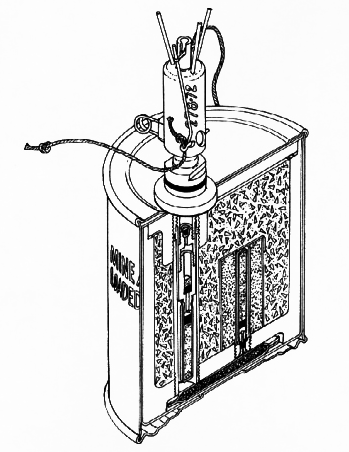
[edit]The mine consists of a cast iron body in a thin steel sleeve. A central fuze well on the top of the mine is normally fitted with a pronged M605 pressure/tension (tripwire) fuze. Sufficient pressure on the prongs or tension on an attached tripwire causes the release of a striker. The freed striker is forced into a percussion cap which ignites a short pyrotechnic delay. The purpose of this delay is to allow the victim to move off the top of the mine, to prevent its upward movement from being blocked. Once the delay has burned through, a 4.5-gram black powder charge is ignited, which launches the inner iron body of the mine up into the air (leaving behind the steel outer sleeve). The charge also ignites a second pair of pyrotechnic delays.
The mine rises to a height of 0.3 to 1.7 meters[1] before one or both of the pyrotechnic delays detonates the main charge of the mine, which sprays high-speed metal fragments 360° around the point of detonation. These metal fragments have an expected casualty radius of 27 meters for the M16 and M16A1 mines, and out to 30 meters for the M16A2 mine.[2]
The M16 and M16A1 mines are similar; the M16A1 has redesigned detonators and boosters but remains largely the same. The M16A2 is considerably different, having an offset fuse well and only a single pyrotechnic delay element. This change reduces the weight of the mine considerably (2.83 kilograms) while allowing it to carry a slightly larger main charge (601 grams)
Use
[edit]According to the United States Army, one platoon of combat engineers assisted by a hauling vehicle was expected to be able to emplace 300 M-16 mines in 120 minutes, creating a minefield 300 meters long and 50 meters wide with a linear density of one mine per meter of front.[3]
The mines were sold widely and copies were produced in several countries including Greece, India, Myanmar, South Korea and Turkey. They can be found in the 'wild' in Angola, Burma, Cambodia, Chile, Cyprus, Eritrea, Ethiopia, Iran, Iraq, Korea, Lebanon, Laos, Malawi, Mozambique, Myanmar, Oman, Rwanda, Somalia, Thailand, Vietnam, the Western Sahara, and Zambia. The United States retains stocks of M16A2 mines for use in any resumption of war in Korea.[4]
Variants
[edit]- M16
- M16A1 – Redesigned detonator and delay elements
- M16A2 – Single bounding delay element, reducing the weight
- KM16A2 – South Korean produced version of the M16A2
Demining
[edit]When emplaced, most of an M16 mine is buried underground so it can be extremely difficult to spot them visually, particularly in areas of long grass, heavy undergrowth or other debris. The M16 contains large amounts of metal, so is very easy to detect using a mine detector, but the act of moving the detection head over the ground may strike the prongs and trigger the mine. In any case, other minimum metal mines may have been planted near to an M16 in order to protect it from mine clearance personnel. If long tripwires are fitted, the M16 may "see" the deminers before they find it. When tracking the path of tripwires fitted to any bounding mine, great care must be taken: it is possible that additional antipersonnel blast mines (e.g. the M14) may have been buried beneath its path. An extra complicating factor is that some M16 mines may have been fitted with an anti-handling device e.g. placing an M26 grenade underneath it with an M5 pressure-release boobytrap firing device screwed into it.[5] Deliberately triggering the mines from cover, using some form of grappling hook attached to a long rope, may be useful in some situations and provide an initial way into the minefield before further clearance work begins.
See also
[edit]- Valmara 59 – (Italy)
- Valmara 69 – (Italy)
- PROM-1 – (Yugoslavia)
- OZM – (Soviet Union)
- Ottawa Treaty
References
[edit]
- ^ OPERATOR'S AND UNIT MAINTENANCE MANUAL Technical Manual 9-1345-203-12. Headquarters, Department of the Army. 1995.
- ^ "M14 / M16 Anti-Personnel (AP) Mines". GlobalSecurity.org. Retrieved 6 May 2012.
- ^ Handbook of Employment Concepts for Mine Warfare Systems. (1986). United States: U.S. Army Engineer Center and School. Pg 53
- ^ "Landmine and Cluster Munition Monitor, Section: Stockpiling". icbl.org. Retrieved 4 May 2015.
- ^ "The Minefield: An Australian Tragedy in America's Vietnam War". japanfocus.org. Retrieved 4 May 2015.
- Jane's Mines and Mines Clearance 2005–2006
- Brassey's Essential Guide to Anti-personnel Landmines, Eddie Banks
- M16 at ORDATA
- M16A1 at ORDATA
- M16A2 at ORDATA
M16 mine
View on GrokipediaDevelopment and History
Origins from World War II Influences
The bounding anti-personnel mine concept central to the M16 originated with the German Schrapnellmine 35 (S-mine), developed in the 1930s and deployed extensively by Wehrmacht forces during World War II. Upon triggering via pressure fuze or tripwire, the S-mine ejected a submunition to a height of about 1 to 1.5 meters before detonating, dispersing steel fragments over a 60-meter radius to target exposed infantry legs and torsos, thereby complicating evasion and medical evacuation.[3] This design proved highly effective in defensive layouts, such as in North African campaigns where it earned the Allied nickname "Bouncing Betty" for its vertical launch and casualty-inflicting pattern.[4] U.S. and Allied troops faced substantial losses from S-mines in theaters including Tunisia, Italy, and Normandy, with ordnance reports documenting their role in channeling assaults and denying terrain through psychological deterrence and physical maiming. Post-1945 technical evaluations of captured German munitions, including blueprints and field-tested samples, highlighted the S-mine's mechanical simplicity—relying on a propellant charge beneath the main explosive body—and its fragmentation efficiency, which outperformed contemporary U.S. static mines like the M6A2 in area denial.[5] These analyses, conducted by Army ordnance engineers, identified the bounding principle as a superior counter to advancing infantry formations, influencing early conceptual work on enhanced anti-personnel systems.[6] By adapting the S-mine's core propulsion and fragmentation mechanics while addressing reliability issues observed in wartime recoveries—such as corrosion-prone components and inconsistent ejection heights—the U.S. military laid the groundwork for the M16's design in the late 1940s and 1950s. This incorporation reflected a pragmatic assimilation of Axis innovations, prioritizing empirical battlefield lessons over origin, as evidenced in declassified engineering assessments that praised the S-mine's causal effectiveness in disrupting unarmored advances.[6][3]Post-War Development and Standardization
The M16 bounding anti-personnel mine underwent significant refinement in the years following World War II, as the U.S. military adapted captured German S-mine technology to produce a more reliable version suited to American manufacturing and tactical needs. This development emphasized enhancing the propelling charge and fragmentation body to achieve a lethal radius of up to 20 meters upon detonation at waist height, addressing limitations in earlier prototype designs influenced by wartime exigencies.[1] Standardization of the initial M16 model proceeded in the early 1950s, establishing it as the U.S. Army's primary bounding fragmentation mine for defensive operations and area denial. Subsequent iterations, including the M16A1, incorporated improvements to the fuze assembly for greater resistance to moisture and accidental activation, while the M16A2 featured a strengthened steel casing to optimize fragment velocity and pattern. These variants maintained core dimensions of approximately 10.5 cm in height and 10 cm in diameter, with a weight of about 3.8 kg, ensuring compatibility with existing deployment equipment.[7] Production scaled up through the Cold War, with the design remaining in active service across conflicts including Korea and Vietnam, reflecting its tactical value despite evolving mine warfare doctrines. By 1990, the U.S. Army procured nearly 80,000 M16A1 units as the final batch of non-self-destructing anti-personnel mines, prior to policy directives limiting persistent munitions outside specific theaters like the Korean Peninsula. This procurement underscored the mine's enduring standardization until international pressures prompted phased restrictions in the late 1990s.[8]Production and Deployment Timeline
The M16 mine was fielded by the United States military in the early 1960s as a standardized bounding anti-personnel munition.[7] Initial production focused on variants like the M16 and M16A1, with manufacturing occurring primarily through the 1950s and 1960s to build stockpiles for potential European theater use against massed infantry threats.[9] Deployment escalated during the Vietnam War, where U.S. and allied forces, including Australians, laid extensive M16 minefields starting around 1967 to channel enemy movements and protect bases; conservative estimates indicate these caused dozens of friendly casualties due to repositioning errors between May 1967 and November 1971 alone.[9] The mine's production tapered off by the mid-1970s, though the M16A1 variant saw a final procurement of nearly 80,000 units by the U.S. Army in 1990, marking the last acquisition of non-self-destructing antipersonnel mines before policy shifts toward restrictions.[10] Post-Vietnam, M16 series mines remained in U.S. stockpiles into the 21st century, with shelf lives extending approximately 36 years before battery degradation; non-Korean Peninsula holdings faced destruction mandates under evolving anti-landmine policies, though exact demilitarization timelines for M16 variants were not publicly detailed beyond general stockpile reductions.[10] The M16A2, featuring updated fuzing for improved reliability, entered limited production and deployment in later decades but did not alter the overall phase-out trajectory for persistent bounding mines.[7]Design and Specifications
Physical Construction and Materials
The M16 mine employs a cylindrical sheet-steel body that serves as both the container for internal components and the primary source of fragmentation upon detonation. This construction allows the mine to bound upward approximately 1 to 2 meters when triggered, enhancing its lethal radius by dispersing steel fragments in a near-vertical pattern. The body resembles a large tin can with a crimped upper edge and a threaded central fuze cavity for installing the detonator.[11][1] Internally, the mine houses a main charge of trinitrotoluene (TNT) explosive, weighing approximately 0.52 kilograms (1.15 pounds) in the original model, surrounded by the steel casing to maximize shrapnel production. A separate propelling charge, typically composed of black powder derivatives, is positioned at the base beneath a steel separation plate, providing the impetus for the bounding action via rapid gas expansion. The total weight of the assembled mine, including fuze, is about 3.6 kilograms (7.9 pounds), with dimensions of roughly 102 millimeters (4 inches) in diameter and 194 millimeters (7.6 inches) in height when the fuze is installed.[11][1] Materials emphasize durability and functionality for burial in soil or camouflage: the steel body resists corrosion to some extent while ensuring reliable fragmentation into hundreds of lethal pieces, each capable of penetrating light cover. No plastic components are integral to the core structure, distinguishing it from later non-metallic designs aimed at detection evasion; the M16's metallic construction facilitates electromagnetic detection but prioritizes mechanical reliability in varied terrains. Boosters and secondary charges incorporate tetryl or similar high explosives for initiation, integrated within the fuze well to bridge the propelling and main charges.[12][11]Fuzing and Detonation Mechanism
The M16 series antipersonnel mine utilizes the M605 combination mechanical fuze, which is threaded into the central fuze well extending to the base of the mine body.[13][12] This fuze supports dual activation modes: direct pressure applied to its three prongs, requiring 8 to 45 pounds of force, or tension via tripwires demanding 3 to 15 pounds of pull on the release pin ring.[13][12] Arming involves removing the locking and positive safety pins after installation, with the fuze's slider mechanism securing the firing pin until actuation.[13] Upon triggering, pressure or pull displaces the prongs or pin ring, releasing the restrained firing pin to strike an M42 primer containing 0.34 grains of PA-101 composition.[12] The primer ignites a delay composition (Type II, approximately 7 grains), which burns to activate a relay charge and subsequently a flash igniter charge of 10 grains of A5 black powder.[12] This sequence fires the propelling charge—70 grains of black powder located at the mine's base—ejecting the cast-iron projectile body upward to a height of 0.3 to 1.7 meters.[13][12] As the projectile ascends, ejection activates a secondary delay mechanism within the body, consisting of 4.2 grains of black powder followed by a 10.8-grain detonator.[12] This initiates tetryl boosters totaling approximately 915 grains and the main 1.15-pound TNT bursting charge, causing aerial fragmentation of the projectile's serrated cast-iron casing.[12] The overall process ensures detonation occurs in mid-air, maximizing the lethal fragmentation pattern.[13]Lethality and Fragmentation Pattern
The M16 mine's lethality derives from its bounding fragmentation design, which propels the main body upward via a black powder expelling charge before detonating the primary explosive, dispersing steel fragments horizontally at an optimal height of approximately 1.5 to 2 meters to engage standing personnel over a wide area.[1] The 3.5-pound TNT main charge fragments the 5.5-pound steel body, producing hundreds of high-velocity metal shards capable of penetrating clothing and light cover, with fragment speeds exceeding those of hand grenades for greater wounding potential.[14] This mechanism prioritizes area denial over direct blast effects, making it effective against dismounted infantry in open or semi-open terrain.[15] Fragmentation occurs omnidirectionally upon airburst, with the body's pre-notched or serrated casing engineered to yield uniform fragments averaging 1-2 grams each, optimizing lethality by balancing fragment density and range.[13] Military testing establishes a casualty radius—defined as the distance within which 50% or more of exposed personnel suffer incapacitating injuries—of 27 meters for the M16 and M16A1, increasing to 30 meters for the M16A2 due to improved body design and propellant.[1] [15] Beyond this, fragments retain wounding capability up to 75 meters in some field reports, though effectiveness diminishes with distance and cover.[16] A danger radius of 183 to 200 meters accounts for low-probability long-range fragments or misfires, necessitating clearance protocols during operations to mitigate risks to friendly forces.[15] [14] Empirical data from Vietnam-era deployments confirm high casualty rates within the primary radius, attributed to the mine's ability to simulate aerial fragmentation patterns from artillery, though soil conditions and prong sensitivity can influence bounding reliability and thus pattern consistency.[12]Operational Deployment
Laying and Arming Procedures
The M16 mine is typically emplaced in firm soil by digging a hole 6 to 10 inches deep and 5 inches in diameter to provide stability and camouflage.[13] The mine body is positioned upright in the hole with the fuze well facing upward, ensuring that the subsequently installed fuze prongs will extend just above the ground surface for pressure detection or be configured for tripwire use.[13] Surface emplacement is possible but less common due to reduced concealment.[12] Prior to laying, the mine undergoes visual inspection for defects such as dents, cracks, or corrosion, with any compromised units discarded to prevent premature detonation.[13] The shipping plug is removed from the fuze well using wrench M25, and the M605 combination fuze—verified for undamaged prongs and free-moving safety pins—is threaded into the well and secured with the wrench, incorporating a rubber gasket for sealing.[13][12] For extended field use, silicone grease G-697 is applied to the fuze bushing, base, and prongs to mitigate environmental degradation.[13] Arming commences after emplacement and fuze installation, beginning with the removal of the locking safety pin, followed by the positive safety pin, while avoiding direct pressure on the fuze's circular depression to prevent accidental initiation.[13][12] In pressure mode, the exposed prongs detect downward force between 8 and 45 pounds, triggering the bounding mechanism. For tripwire mode, non-metallic wires are attached to the fuze's release-pin ring and anchored to stakes approximately 10 meters apart, with deliberate slack to avoid tension from ground settlement, requiring 3 to 15 pounds of lateral pull for activation.[13][12] Personnel must maintain distance and seek cover during arming verification, as a misfire could project fragments.[13] These procedures apply uniformly to M16 series variants and emphasize trained handlers to minimize handling risks.[13]Tactical Applications in Conflicts
The M16 bounding anti-personnel mine was tactically deployed by United States and allied forces primarily in defensive configurations to deny terrain to enemy infantry, channel attackers into prepared kill zones, and protect static positions such as fire support bases and outposts.[17] Its activation via pressure prongs or tripwires allowed integration into mixed obstacle belts alongside barbed wire, anti-tank mines, and covering fires, creating layered defenses that disrupted dismounted assaults and complicated breaching attempts.[17] In tactical minefields, clusters of M16s were emplaced at 6-meter intervals in rows spaced to achieve specific effects, such as a 50% enemy encounter probability across a 250-meter front and 100-meter depth for disruption, or higher densities exceeding 1.1 mines per meter for blocking advances.[17] During the Vietnam War (1965–1973), the M16 saw extensive use by U.S. Army and Marine Corps engineers to safeguard perimeters against nocturnal probes and sapper attacks by Viet Cong and North Vietnamese Army forces, with mines hand-emplaced in protective fields around bases to cover dead space and avenues of approach.[18] Australian forces under the First Task Force similarly laid over 20,000 M16s from May 1967 to November 1971 in Phuoc Tuy Province, employing them in static defenses and ambush setups to inflict casualties on guerrilla units, often averaging six per mine detonation due to the 27–30 meter casualty radius from airborne fragmentation.[19] [9] These deployments emphasized rapid arming post-emplacement, with tripwires extended up to 10 meters for sensitivity in jungle terrain, though the mine's bounding mechanism proved vulnerable to enemy capture and reverse employment as improvised offensive weapons by North Vietnamese forces.[9] In broader U.S. military doctrine, as outlined in field manuals, M16s supplemented maneuver elements by fixing or turning enemy formations in constricted areas like defiles or urban environments, where they could be concealed in backyards or on rooftops for omnidirectional shrapnel coverage up to 183 meters.[17] Nuisance applications involved scattering mines in rear areas to delay logistics, such as cratered roads or bridges, forcing enemy resupply convoys into predictable patterns for interdiction.[17] Earlier conflicts like the Korean War saw limited bounding mine use in similar protective roles, but Vietnam marked the peak of M16 tactical reliance, with over 2 million U.S. antipersonnel mines expended overall, though post-war evaluations highlighted risks of prolonged fields contributing to unintended civilian hazards after U.S. withdrawal.[20]Training Protocols for Handlers
Training protocols for M16 mine handlers in the US military, as detailed in technical manuals such as TM 9-1345-203-12, emphasize safe assembly, emplacement, arming, and disarming through progressive use of inert aids and regulated live exercises to build operational proficiency.[13] The primary training device is the M16A1 inert mine, which lacks explosive fillers and incorporates the M605 inert fuze to replicate handling without detonation risk.[13] Initial handling instruction requires unpacking and inspecting the mine for defects, followed by fuze installation using wrench M25 to secure the M605 with its rubber gasket for airtight sealing; silicone grease G-697 is applied to components for extended field emplacements.[13] Emplacement training simulates tactical deployment by digging a 6-inch-deep hole, positioning the mine so fuze prongs protrude above ground, staking for stability, and attaching tripwires or pressure activators before camouflaging the site in accordance with FM 20-32 procedures.[13] Arming drills involve verifying clearance, then withdrawing safety pins to activate the fuze, while disarming protocols mandate pin reinsertion under controlled conditions; any damaged or suspect mines are destroyed in place via remote means rather than manual neutralization to avert hazards.[13] Practice variants like the M8 or M8A1 mines, fitted with spotting charges or smoke producers, enable detonation simulation during exercises, with personnel positioned under cover to account for propelled fragments.[13] Safety measures stipulate treating every mine as live to foster habitual caution, prohibiting pressure on the fuze's sensitive circular depression and requiring finger-pulled pin removal to reduce impact shock.[13] Live-mine training demands the positive safety pin remain inserted in the M605 fuze at all times to preclude accidental functioning, with boobytrapping confined to personnel who have completed specialized instruction.[21] Unit-level proficiency is sustained via recurring drills aligned with Soldier's Manual standards, incorporating both simulator and live demonstrations to ensure handlers appreciate the mine's 96- to 139-month service life and fragmentation mechanics under combat conditions.[13][1]Variants and Evolutions
M16A1 Improvements
The M16A1 variant of the bounding anti-personnel mine incorporated modifications primarily to the fuze assembly, featuring redesigned detonators and boosters compared to the original M16 model.[7] These changes addressed potential vulnerabilities in the ignition sequence, enhancing the overall reliability of the delay and propulsion mechanisms without altering the mine's core operational principles or physical dimensions.[7] The redesign aimed to mitigate inconsistencies in the pyrotechnic delay elements, which could previously lead to premature or failed bounding in field conditions, though specific quantitative improvements in failure rates were not publicly detailed in declassified documentation. Despite these fuze enhancements, the M16A1 retained the same cast-iron fragmentation body, steel sleeve, and 27-meter casualty radius as its predecessor, ensuring compatibility with existing deployment procedures and logistical systems.[7] The modifications did not introduce new materials or significantly reduce weight, maintaining the mine's approximate 3.8-kilogram mass and tripwire- or pressure-activated triggering via the M605 fuze.[22] Operational testing post-modification confirmed sustained lethality through omnidirectional steel fragment dispersion following a 1- to 2-meter vertical launch, with no reported degradation in performance metrics relative to the M16.[7] These incremental updates reflected iterative engineering refinements rather than a comprehensive overhaul, as the M16A1 remained fundamentally analogous to the baseline design in tactical application.[22] Subsequent variants like the M16A2 would build further by simplifying the delay system into a single element for weight reduction, but the A1's focus stayed narrowly on fuze robustness to support reliable deployment in diverse terrains.[7] No major safety enhancements for handlers or environmental adaptations were incorporated, preserving the mine's emphasis on area denial effectiveness.Related Bounding Mine Designs
The M16 mine's bounding mechanism drew direct inspiration from the German Schrapnellmine 35 (S-mine), a World War II-era anti-personnel device developed in the 1930s that propelled its fragmentation body 1-2 meters into the air via a small black powder charge before detonating to maximize shrapnel dispersal over open terrain.[5] The S-mine encased approximately 360 steel balls in a sheet-steel body filled with 135 grams of TNT-equivalent explosive, achieving a casualty radius of up to 20 meters, and its captured blueprints informed U.S. engineers in adapting the concept for the M16 during the late 1940s and early 1950s.[5] This design emphasized psychological impact through maiming wounds rather than instant kills, influencing subsequent bounding mines' focus on elevated fragmentation patterns.[5] Post-World War II developments produced several analogous bounding designs by other nations. Germany's DM-31, manufactured from 1962 to 1967 by Industriewerke Karlsruhe, featured a cylindrical steel body with 510 grams of high explosive surrounded by 1.18 kg of pre-formed fragments, launching to about 1.5 meters upon tripwire or pressure activation for a 25-meter lethal radius.[23][24] An upgraded DM-41 variant retained the core body but incorporated improved fuzing for enhanced reliability against tampering.[25] Similarly, the Soviet OZM series, evolving from wartime improvisations, included the OZM-72—a cast-iron bounding mine with 660 grams of TNT, tripwire or pressure fuzing, and a fragmentation radius exceeding 20 meters, designed for manual or mechanical laying in defensive arrays.[26][27] Other examples include Italy's Valmara 69, an evolution of the V-59 introduced in the 1960s, which used a plastic body for reduced detectability, a propelling charge to elevate 500 grams of explosive and steel fragments, and mechanical fuzing compatible with anti-handling devices.[28] France's pre-war Modèle 1939 bounding mine, deployed at the outset of World War II, employed a similar elevation-and-detonate principle with a TNT charge and radial fragments, though limited production curtailed its influence compared to later models.[29] These designs shared the M16's tactical intent for area denial in infantry approaches but varied in materials, fuzing sophistication, and export adaptations to counter evolving demining technologies.[29]Export and Foreign Adaptations
The M16 mine was supplied to U.S. allies during the Cold War, including Australia, where it was deployed by Australian forces alongside American troops in the Vietnam War, as evidenced by preserved examples in military collections. Exports extended to other nations through military aid programs, contributing to its presence in conflict zones such as Vietnam, Cambodia, and Angola, where unexploded ordnance persists as a hazard.[16] Several countries produced licensed or unlicensed copies of the M16 design, adapting it for domestic production to meet local defense needs without relying on imports. These adaptations were reported in Greece, India, South Korea, and Turkey, where manufacturing focused on replicating the bounding fragmentation mechanism while potentially incorporating minor modifications for fuzing compatibility or material sourcing.[16] In Chile, U.S.-origin M16 mines from historical transfers required specialized demolition techniques, such as synchronized explosive charges to crush the mine body and neutralize the propulsion charge, highlighting adaptations in demining rather than operational variants.[16] No significant redesigns or evolutionary foreign variants beyond basic replication have been documented in open sources, with production ceasing in many cases following international restrictions on anti-personnel mines under treaties like the Ottawa Convention, though non-signatories retained stockpiles.[16]Performance Evaluation
Field Effectiveness Data
The M16 bounding anti-personnel mine achieves its primary effect through a propulsion charge that elevates the main fragmentation body to approximately waist height before detonation, dispersing steel fragments to produce casualties within a radius of 27 meters for the standard M16 and M16A1 variants, extending to 30 meters for the M16A2.[30] This fragmentation pattern, consisting of a steel body loaded with 680 grams of Composition B explosive and pre-notched segments for enhanced lethality, is intended to incapacitate or kill exposed infantry in a 360-degree pattern, with effectiveness dependent on terrain openness and target density.[16] Field trials and design specifications indicate a high probability of severe wounding or fatality within the primary lethal zone, though empirical data on precise hit probabilities against human targets remains limited in declassified evaluations.[7] In operational deployment during the Vietnam War, the M16 demonstrated area-denial utility in static defensive positions, with U.S. and allied forces, including Australian 1st Task Force, emplacing over 20,000 units in a single extensive barrier minefield near Nui Dat in 1967 to interdict Viet Cong infiltration routes.[19] However, confirmed enemy casualty figures attributable specifically to M16 detonations are sparse; documented incidents include isolated contacts where the mine contributed to killing two Viet Cong fighters in a bunker during Australian operations.[9] Broader assessments highlight that enemy sappers routinely detected, neutralized, and repurposed M16s—lifting an estimated 5,000 from one major field—reducing net effectiveness against determined adversaries skilled in countermine tactics.[31] Conversely, unintended friendly casualties underscore practical limitations: between May 1967 and November 1971, conservative estimates attribute at least 55 Australian fatalities and numerous wounds to re-laid or disturbed M16s, comprising over 50% of 1ATF's total casualties at peak periods and up to 80% in specific phases.[9][9] These incidents reflect causal factors such as incomplete breaching resistance, environmental degradation of tripwires in humid terrain, and enemy exploitation, which eroded the mine's reliability as a persistent barrier despite its theoretical fragmentation yield. U.S. Army employment concepts emphasized integration with obstacles to amplify effects, yet post-conflict analyses indicate bounding mines like the M16 yielded inconsistent results in guerrilla warfare compared to conventional fronts.[32][7]Reliability and Malfunction Rates
The M16 series mines, utilizing the M605 mechanical combination fuze, demonstrate high activation reliability under standard conditions, with field manuals noting that mechanical failures occur rarely when proper laying procedures and maintenance are followed.[33] The fuze requires 3.6 to 9 kilograms of pressure on prongs or the top plate to initiate, propelling the mine 1 to 2 meters into the air for fragmentation dispersal.[7] Environmental factors significantly influence performance, particularly the bounding mechanism's ability to launch effectively. In compacted, rocky, or frozen soil, the initial propelling charge may fail to elevate the mine adequately, causing a ground-level detonation that reduces the casualty radius from the designed 27-30 meters to a more localized blast pattern.[34] Documented field incidents, such as during Australian operations in Vietnam on March 23, 1967, recorded cases where an M16 failed to bound and exploded in place, injuring handlers due to altered fragmentation.[9] Moisture infiltration poses another malfunction risk, potentially neutralizing the igniter or main charge explosives, leading to duds; this is mitigated through storage protocols but remains a concern in humid or rainy deployment areas like Southeast Asian jungles.[17] Damaged casings or jammed fuzes from rough handling or transport can also prevent arming or functioning, necessitating pre-use inspections by ordnance personnel.[14] Quantitative dud or malfunction rates from operational data are not publicly disclosed in declassified reports, unlike self-destructing systems which achieve 99.99% deactivation reliability; the M16's persistent design prioritizes simplicity over timed failure safeguards, potentially elevating long-term unexploded ordnance risks in contested terrains.[35] Older M605 fuzes manufactured before 1957 exhibit unspecified safety and reliability deficiencies, prohibiting their use in training to avoid inadvertent functioning. Improvements in the M16A1 and A2 variants addressed some fuze sensitivities, enhancing overall serviceability under surveillance testing.Comparative Analysis with Other Mines
The M16 mine's bounding mechanism, which launches its fragmentation body to a height of approximately 1.8 meters upon actuation, enables a broader dispersion of steel fragments at chest height, yielding a casualty radius of 27 to 30 meters.[15][30] This contrasts with static fragmentation mines like the Soviet POMZ-2, a stake-mounted design that releases pre-formed fragments from near ground level, resulting in a narrower effective lethal radius—typically under 20 meters due to limited vertical spread and greater susceptibility to terrain absorption of projectiles.[32] The M16's elevated burst thus provides superior area denial against advancing infantry, as fragments maintain higher velocity and penetrate softer cover more effectively than the POMZ-2's ground-hugging pattern.[11] Compared to its conceptual predecessor, the German World War II S-mine, the M16 retains the core bounding fragmentation principle but benefits from refined engineering, including a more robust steel casing and updated fuze assembly for reduced misfire rates in varied soil conditions.[7] The S-mine, weighing about 4 kg with roughly 190 grams of TNT, achieved a primary lethality range of 20 meters and potential wounding out to 100 meters via 360 steel balls, closely mirroring the M16's 3.5 kg weight and 450 grams of explosive for a 27-30 meter radius.[36][30] However, the S-mine's simpler construction led to higher dud rates in wet environments, a vulnerability addressed in the M16 through waterproofing and mechanical improvements, enhancing reliability in prolonged field deployment.[15] The Italian Valmara 69 represents a post-war evolution similar to the M16, employing a plastic outer casing to evade metal detectors while bounding to disperse chopped steel fragments, but its lower launch height of about 0.5 meters limits optimal fragment trajectory compared to the M16's 1.8 meters.[25] At 3.2 kg with 420 grams of Composition B explosive, the Valmara 69 delivers a lethal radius of approximately 25 meters, slightly narrower than the M16's due to reduced burst elevation, which can result in more fragments impacting low foliage or soil rather than personnel.[37][30] Both mines prioritize victim-initiated pressure or tripwire fuzing for ambush tactics, yet the M16's all-metal construction, while more detectable, offers greater durability against environmental degradation, as evidenced by its sustained use in fortified positions like the Korean Demilitarized Zone.[7]| Aspect | M16 | S-mine | Valmara 69 |
|---|---|---|---|
| Type | Bounding fragmentation | Bounding fragmentation | Bounding fragmentation |
| Weight | 3.5 kg | ~4 kg | 3.2 kg |
| Explosive Charge | 450 g TNT | ~190 g TNT | 420 g Composition B |
| Bound Height | 1.8 m | ~1 m | 0.5 m |
| Casualty Radius | 27-30 m | 20 m (lethal) | 25 m |