Hubbry Logo
Magnetic resonance angiographyMagnetic resonance angiographyMain
Open search
Magnetic resonance angiography
Community hub
Magnetic resonance angiography
logo
8 pages, 0 posts
0 subscribers
Be the first to start a discussion here.
Magnetic resonance angiography
from Wikipedia
Magnetic resonance angiography
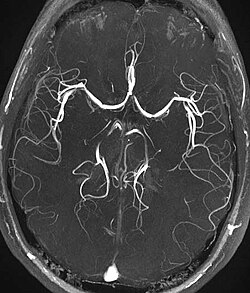
Time-of-flight MRA at the level of the Circle of Willis.
MeSHD018810
OPS-301 code3-808, 3-828
MedlinePlus007269

Magnetic resonance angiography (MRA) is a group of techniques based on magnetic resonance imaging (MRI) to image blood vessels. Magnetic resonance angiography is used to generate images of arteries (and less commonly veins) in order to evaluate them for stenosis (abnormal narrowing), occlusions, aneurysms (vessel wall dilatations, at risk of rupture) or other abnormalities. MRA is often used to evaluate the arteries of the neck and brain, the thoracic and abdominal aorta, the renal arteries, and the legs (the latter exam is often referred to as a "run-off").

Acquisition

[edit]

A variety of techniques can be used to generate the pictures of blood vessels, both arteries and veins, based on flow effects or on contrast (inherent or pharmacologically generated). The most frequently applied MRA methods involve the use of intravenous contrast agents, particularly those containing gadolinium to shorten the T1 of blood to about 250 ms, shorter than the T1 of all other tissues (except fat). Short-TR sequences produce bright images of the blood. However, many other techniques for performing MRA exist, and can be classified into two general groups: 'flow-dependent' methods and 'flow-independent' methods.[citation needed]

Flow-dependent angiography

[edit]

One group of methods for MRA is based on blood flow. Those methods are referred to as flow dependent MRA. They take advantage of the fact that the blood within vessels is flowing to distinguish the vessels from other static tissue. That way, images of the vasculature can be produced. Flow dependent MRA can be divided into different categories: There is phase-contrast MRA (PC-MRA) which utilizes phase differences to distinguish blood from static tissue and time-of-flight MRA (TOF MRA) which exploits that moving spins of the blood experience fewer excitation pulses than static tissue, e.g. when imaging a thin slice.[citation needed]

Time-of-flight (TOF) or inflow angiography, uses a short echo time and flow compensation to make flowing blood much brighter than stationary tissue. As flowing blood enters the area being imaged it has seen a limited number of excitation pulses so it is not saturated, this gives it a much higher signal than the saturated stationary tissue. As this method is dependent on flowing blood, areas with slow flow (such as large aneurysms) or flow that is in plane of the image may not be well visualized. This is most commonly used in the head and neck and gives detailed high-resolution images. It is also the most common technique used for routine angiographic evaluation of the intracranial circulation in patients with ischemic stroke.[1]

Phase-contrast MRA

[edit]
Vastly undersampled Isotropic Projection Reconstruction (VIPR) of a Phase Contrast (PC) MRI sequence of a 56-year-old male with dissections of the celiac artery (upper) and the superior mesenteric artery (lower). Laminar flow is present in the true lumen (closed arrow) and helical flow is present in the false lumen (open arrow).[2]

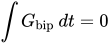
Phase-contrast (PC-MRA) can be used to encode the velocity of moving blood in the magnetic resonance signal's phase.[3] The most common method used to encode velocity is the application of a bipolar gradient between the excitation pulse and the readout. A bipolar gradient is formed by two symmetric lobes of equal area. It is created by turning on the magnetic field gradient for some time, and then switching the magnetic field gradient to the opposite direction for the same amount of time.[4] By definition, the total area (0th moment) of a bipolar gradient, , is null:

(1)

The bipolar gradient can be applied along any axis or combination of axes depending on the direction along which flow is to be measured (e.g. x).[5] , the phase accrued during the application of the gradient, is 0 for stationary spins: their phase is unaffected by the application of the bipolar gradient. For spins moving with a constant velocity, , along the direction of the applied bipolar gradient:

(2)

The accrued phase is proportional to both and the 1st moment of the bipolar gradient, , thus providing a means to estimate . is the Larmor frequency of the imaged spins. To measure , of the MRI signal is manipulated by bipolar gradients (varying magnetic fields) that are preset to a maximum expected flow velocity. An image acquisition that is reverse of the bipolar gradient is then acquired and the difference of the two images is calculated. Static tissues such as muscle or bone will subtract out, however moving tissues such as blood will acquire a different phase since it moves constantly through the gradient, thus also giving its speed of the flow. Since phase-contrast can only acquire flow in one direction at a time, 3 separate image acquisitions in all three directions must be computed to give the complete image of flow. Despite the slowness of this method, the strength of the technique is that in addition to imaging flowing blood, quantitative measurements of blood flow can be obtained.

Flow-independent angiography

[edit]

Whereas most of techniques in MRA rely on contrast agents or flow into blood to generate contrast (Contrast Enhanced techniques), there are also non-contrast enhanced flow-independent methods. These methods, as the name suggests, do not rely on flow, but are instead based on the differences of T1, T2 and chemical shift of the different tissues of the voxel. One of the main advantages of this kind of techniques is that we may image the regions of slow flow often found in patients with vascular diseases more easily. Moreover, non-contrast enhanced methods do not require the administration of additional contrast agent, which have been recently linked to nephrogenic systemic fibrosis in patients with chronic kidney disease and kidney failure.

Contrast-enhanced magnetic resonance angiography uses injection of MRI contrast agents and is currently the most common method of performing MRA.[2][6] The contrast medium is injected into a vein, and images are acquired both pre-contrast and during the first pass of the agent through the arteries. By subtraction of these two acquisitions in post-processing, an image is obtained which in principle only shows blood vessels, and not the surrounding tissue. Provided that the timing is correct, this may result in images of very high quality. An alternative is to use a contrast agent that does not, as most agents, leave the vascular system within a few minutes, but remains in the circulation up to an hour (a "blood-pool agent"). Since longer time is available for image acquisition, higher resolution imaging is possible. A problem, however, is the fact that both arteries and veins are enhanced at the same time if higher resolution images are required.

Subtractionless contrast-enhanced magnetic resonance angiography: recent developments in MRA technology have made it possible to create high quality contrast-enhanced MRA images without subtraction of a non-contrast enhanced mask image. This approach has been shown to improve diagnostic quality,[7] because it prevents motion subtraction artifacts as well as an increase of image background noise, both direct results of the image subtraction. An important condition for this approach is to have excellent body fat suppression over large image areas, which is possible by using mDIXON acquisition methods. Traditional MRA suppresses signals originating from body fat during the actual image acquisition, which is a method that is sensitive to small deviations in the magnetic and electromagnetic fields and as a result may show insufficient fat suppression in some areas. mDIXON methods can distinguish and accurately separate image signals created by fat or water. By using the 'water images' for MRA scans, virtually no body fat is seen so that no subtraction masks are needed for high quality MR venograms.

Non-enhanced magnetic resonance angiography: Since the injection of contrast agents may be dangerous for patients with poor kidney function, others techniques have been developed, which do not require any injection. These methods are based on the differences of T1, T2 and chemical shift of the different tissues of the voxel. A notable non-enhanced method for flow-independent angiography is balanced steady-state free precession (bSSFP) imaging which naturally produces high signal from arteries and veins.

2D and 3D acquisitions

[edit]
3D rendered MRA to identify an aberrant subclavian artery.

For the acquisition of the images two different approaches exist. In general, 2D and 3D images can be acquired. If 3D data is acquired, cross sections at arbitrary view angles can be calculated. Three-dimensional data can also be generated by combining 2D data from different slices, but this approach results in lower quality images at view angles different from the original data acquisition. Furthermore, the 3D data can not only be used to create cross sectional images, but also projections can be calculated from the data. Three-dimensional data acquisition might also be helpful when dealing with complex vessel geometries where blood is flowing in all spatial directions (unfortunately, this case also requires three different flow encodings, one in each spatial direction). Both PC-MRA and TOF-MRA have advantages and disadvantages. PC-MRA has fewer difficulties with slow flow than TOF-MRA and also allows quantitative measurements of flow. PC-MRA shows low sensitivity when imaging pulsating and non-uniform flow. In general, slow blood flow is a major challenge in flow dependent MRA. It causes the differences between the blood signal and the static tissue signal to be small. This either applies to PC-MRA where the phase difference between blood and static tissue is reduced compared to faster flow and to TOF-MRA where the transverse blood magnetization and thus the blood signal are reduced. Contrast agents may be used to increase blood signal – this is especially important for very small vessels and vessels with very small flow velocities that normally show accordingly weak signal. Unfortunately, the use of gadolinium-based contrast media can be dangerous if patients suffer from poor renal function. To avoid these complications as well as eliminate the costs of contrast media, non-enhanced methods have been researched recently.

Non-enhanced techniques in development

[edit]

Flow-independent NEMRA methods are not based on flow, but exploit differences in T1, T2 and chemical shift to distinguish blood from static tissue.

Gated subtraction fast spin-echo: An imaging technique that subtracts two fast spin echo sequences acquired at systole and diastole. Arteriography is achieved by subtracting the systolic data, where the arteries appear dark, from the diastolic data set, where the arteries appear bright. Requires the use of electrocardiographic gating. Trade names for this technique include Fresh Blood Imaging (Toshiba), TRANCE (Philips), native SPACE (Siemens) and DeltaFlow (GE).

4D dynamic MR angiography (4D-MRA): The first images, before enhancement, serve as a subtraction mask to extract the vascular tree in the succeeding images. Allows the operator to divide arterial and venous phases of a blood-groove with visualisation of its dynamics. Much less time has been spent researching this method so far in comparison with other methods of MRA.

BOLD venography or susceptibility weighted imaging (SWI): This method exploits the susceptibility differences between tissues and uses the phase image to detect these differences. The magnitude and phase data are combined (digitally, by an image-processing program) to produce an enhanced contrast magnitude image which is exquisitely sensitive to venous blood, hemorrhage and iron storage. The imaging of venous blood with SWI is a blood-oxygen-level dependent (BOLD) technique which is why it was (and is sometimes still) referred to as BOLD venography. Due to its sensitivity to venous blood SWI is commonly used in traumatic brain injuries (TBI) and for high resolution brain venographies.

Similar procedures to flow effect based MRA can be used to image veins. For instance, Magnetic resonance venography (MRV) is achieved by exciting a plane inferiorly while signal is gathered in the plane immediately superior to the excitation plane, and thus imaging the venous blood which has recently moved from the excited plane. Differences in tissue signals, can also be used for MRA. This method is based on the different signal properties of blood compared to other tissues in the body, independent of MR flow effects. This is most successfully done with balanced pulse sequences such as TrueFISP or bTFE. BOLD can also be used in stroke imaging in order to assess the viability of tissue survival.

Artifacts

[edit]

MRA techniques in general are sensitive to turbulent flow, which causes a variety of different magnetized proton spins to lose phase coherence (intra-voxel dephasing phenomenon), resulting in a loss of signal. This phenomenon may result in the overestimation of arterial stenosis. Other artifacts observed in MRA include:

  • Phase-contrast MRA: Phase wrapping caused by the underestimation of maximum blood velocity in the image. The fast-moving blood about maximum set velocity for phase-contrast MRA gets aliased and the signal wraps from pi to -pi instead, making flow information unreliable. This can be avoided by using velocity encoding (VENC) values above the maximum measured velocity. It can also be corrected with the so-called phase-unwrapping.
  • Maxwell terms: caused by the switching of the gradients field in the main field B0. This causes the over magnetic field to be distort and give inaccurate phase information for the flow.
  • Acceleration: accelerating blood flow is not properly encoded by phase-contrast technique, which can lead to errors in quantifying blood flow.
  • Time-of-flight MRA:
  • Saturation artifact due to laminar flow: In many vessels, blood flow is slower near the vessel walls than near the center of the vessel. This causes blood near the vessel walls to become saturated and can reduce the apparent caliber of the vessel.
  • Venetian blind artifact: Because the technique acquires images in slabs (as in Multiple overlapping thin-slab acquisition, MOTSA), a non-uniform flip angle across the slab can appear as horizontal stripe in the composed images.[8]

Visualization

[edit]
Maximum intensity projection of an MRA covering from the aortic arch to just below the circle of Willis

Occasionally, MRA directly produces (thick) slices that contain the entire vessel of interest. More commonly, however, the acquisition results in a stack of slices representing a 3D volume in the body. To display this 3D dataset on a 2D device such as a computer monitor, some rendering method has to be used. The most common method is maximum intensity projection (MIP), where the computer simulates rays through the volume and selects the highest value for display on the screen. The resulting images resemble conventional catheter angiography images. If several such projections are combined into a cine loop or QuickTime VR object, the depth impression is improved, and the observer can get a good perception of 3D structure. An alternative to MIP is direct volume rendering where the MR signal is translated to properties like brightness, opacity and color and then used in an optical model.

Clinical use

[edit]

MRA has been successful in studying many arteries in the body, including cerebral and other vessels in the head and neck, the aorta and its major branches in the thorax and abdomen, the renal arteries, and the arteries in the lower limbs. For the coronary arteries, however, MRA has been less successful than CT angiography or invasive catheter angiography. Most often, the underlying disease is atherosclerosis, but medical conditions like aneurysms or abnormal vascular anatomy can also be diagnosed.

An advantage of MRA compared to invasive catheter angiography is the non-invasive character of the examination (no catheters have to be introduced in the body). Another advantage, compared to CT angiography and catheter angiography, is that the patient is not exposed to any ionizing radiation. Also, contrast media used for MRI tend to be less toxic than those used for CT angiography and catheter angiography, with fewer people having any risk of allergy. Also far less is needed to be injected into the patient. The greatest drawbacks of the method are its comparatively high cost and its somewhat limited spatial resolution. The length of time the scans take can also be an issue, with CT being far quicker. It is also ruled out in patients for whom MRI exams may be unsafe (such as having a pacemaker or metal in the eyes or certain surgical clips).

MRA procedures for visualizing cranial circulation are no different from the positioning for a normal MRI brain. Immobilization within the head coil will be required. MRA is usually a part of the total MRI brain examination and adds approximately 10 minutes to the normal MRI protocol.

See also

[edit]

References

[edit]
[edit]
Revisions and contributorsEdit on WikipediaRead on Wikipedia
from Grokipedia
Magnetic resonance angiography (MRA) is a noninvasive technique that utilizes (MRI) to visualize blood vessels, including arteries and veins, throughout the body without the need for catheters, , or agents in many cases. It produces high-resolution, three-dimensional images of vascular structures by exploiting the properties of blood flow and , enabling the detection of abnormalities such as narrowing, blockages, or aneurysms. Developed as an alternative to conventional catheter-based angiography, MRA has become a cornerstone in vascular assessment due to its safety profile and detailed anatomical information. The fundamental principles of MRA rely on the differential signal intensities between stationary tissues and flowing within an MRI scanner's strong . Non-contrast techniques, such as time-of-flight (TOF) angiography, leverage the inflow of unsaturated into a saturation band to enhance vessel visibility, making it particularly effective for high-flow areas like intracranial arteries. In contrast, phase-contrast (PC) MRA quantifies and direction by measuring phase shifts in the MRI signal caused by moving , which is useful for evaluating slower flows in veins or quantifying shunts. Contrast-enhanced MRA (CE-MRA) involves the intravenous administration of gadolinium-based agents to shorten the T1 relaxation time of , allowing rapid acquisition of bright vessel images with minimal artifacts from flow . MRA is widely applied in clinical practice to assess vascular conditions across multiple anatomical regions, including the for evaluation, the carotid arteries for stenosis, the aorta and pulmonary vessels for aneurysms or dissections, renal arteries for hypertension causes, and peripheral vessels for occlusive disease. It is particularly valuable in patients where must be minimized, such as children or pregnant individuals. However, MRA requires patients to remain still for extended periods—often 30 minutes to over an hour—which can introduce motion artifacts, and it may require special protocols or be contraindicated in patients with non-MR-conditional implants such as older pacemakers, or those with severe . Additionally, although rare, use in CE-MRA historically carried risks of in patients with severe renal impairment ( <30 mL/min/1.73 m²); however, with modern macrocyclic agents, this risk is negligible, though renal function assessment is recommended. Advancements in MRA continue to expand its utility, with innovations like non-contrast methods such as quiescent-interval single-shot (QISS) and four-dimensional PC-MRA improving visualization of slow-flow vessels and enabling dynamic flow assessment without contrast. These developments, combined with faster MRI hardware, have enhanced and reduced scan times, positioning MRA as a preferred diagnostic tool in modern for both screening and detailed vascular mapping.

Overview

Definition and principles

Magnetic resonance angiography (MRA) is a group of noninvasive imaging techniques derived from (MRI) that visualize the arterial and venous systems by exploiting differences in signal from blood vessels compared to surrounding tissues. Unlike conventional , MRA does not require or invasive catheterization, making it safer for repeated use in clinical settings. It can employ either endogenous flow-related signal changes or exogenous contrast agents, such as gadolinium-based agents, to enhance vascular depiction. The fundamental principles of MRA rely on the interaction of hydrogen protons in tissues and with a strong external (B₀), radiofrequency (RF) pulses, and applied gradients. RF pulses excite protons, causing them to precess at the Larmor frequency and produce a detectable signal upon relaxation, characterized by T1 (longitudinal) and T2 (transverse) relaxation times that determine signal intensity. Spatial encoding is achieved through gradients that vary the strength across the volume, allowing localization of signals in three dimensions. In vascular , flowing generates high signal intensity in specific sequences due to inflow effects, where fresh, unsaturated from outside the slice enter the excited region, avoiding saturation of stationary tissues, or through phase shifts induced by motion in gradients. A key distinction in MRA principles lies between time-of-flight (TOF) effects and phase-contrast velocity encoding. In TOF methods, the inflow of unsaturated into the slice produces bright signal from vessels, as stationary tissues are repeatedly saturated by RF pulses and yield low signal. In contrast, phase-contrast techniques encode velocity information directly into the phase of the MRI signal, enabling quantitative measurement of flow direction and speed without reliance on inflow. In phase-contrast MRA, the phase shift (φ) due to flowing is given by the equation: ϕ=γG[v](/page/Velocity)dt\phi = \gamma \int \mathbf{G} \cdot \mathbf{[v](/page/Velocity)} \, dt where γ is the , G is the vector, is the vector of the , and the is over the duration of the application. This arises from the fact that moving experience a position-dependent variation during application, leading to cumulative phase accrual proportional to their ; stationary accumulate no net phase shift under balanced (bipolar) . To derive this, consider traversing a under a : the local field perturbation δB = G · r(t), where r(t) = v t for constant , so the phase φ = γ ∫ δB dt = γ v · ∫ G t dt, which simplifies to the first-order moment of the waveform. Interpretation involves acquiring two datasets with opposite polarities, subtracting them to isolate the -induced phase (while canceling background phase from field inhomogeneities), and mapping phase values to , typically scaled such that a -encoding limit (VENC) corresponds to a π phase shift for optimal . This principle allows phase-contrast MRA to differentiate arterial from venous flow and quantify , though it is sensitive to higher beyond VENC.

Historical development

The historical development of magnetic resonance angiography (MRA) originated in the early , building on the recognition of flow-induced signal variations in MRI. Initial demonstrations of time-of-flight (TOF) MRA, a flow-dependent technique, were achieved by Wehrli et al. in 1986 using two-dimensional gradient-echo sequences that exploited inflow enhancement to visualize vessels without contrast agents. This approach marked the foundation for non-invasive vascular imaging, enabling selective depiction of flowing blood against stationary tissue backgrounds. During the late and into the , key advancements expanded MRA's capabilities. Dumoulin introduced three-dimensional TOF techniques in , improving spatial coverage and resolution for intracranial and carotid vessel evaluation. Concurrently, phase-contrast MRA, also pioneered by Dumoulin in 1986 and further refined by et al. in 1994 through optimized velocity encoding strategies, allowed quantitative assessment of blood flow direction and speed, addressing limitations of TOF in complex flow patterns. The decade culminated in the introduction of gadolinium-enhanced MRA by Prince et al. in 1994, which utilized intravenous contrast to produce high-fidelity angiograms independent of flow dynamics, significantly boosting clinical adoption for peripheral and aortic applications. The 2000s brought milestones in non-contrast methods to mitigate risks associated with , particularly in patients with renal impairment. Balanced steady-state free (bSSFP) techniques emerged around 2002, providing robust arterial signal with reduced saturation artifacts compared to traditional TOF, especially in abdominal and peripheral vessels. In October 2025, the FDA approved ferumoxytol (marketed as Ferabright) for use as a in , including vascular applications, offering prolonged vascular enhancement suitable for pediatric and renal-compromised populations. A pivotal shift occurred from predominantly flow-dependent to balanced and flow-independent methods, driven by the need to minimize artifacts like in-plane saturation and turbulence-induced signal loss. Post-2010, integration with higher field strengths such as and 7T scanners enhanced signal-to-noise ratios and resolution, enabling finer depiction of small vessels while managing challenges like B1 inhomogeneity.

Acquisition Techniques

Flow-dependent methods

Flow-dependent methods in magnetic resonance angiography (MRA) exploit the intrinsic motion of to generate contrast, relying on the differential signal behavior between stationary tissues and flowing spins without the need for exogenous contrast agents. These techniques primarily include time-of-flight (TOF) angiography and phase-contrast MRA (PC-MRA), both of which enhance vascular visibility through flow-related effects while suppressing background signals from static tissues. By using short repetition times (TR) and gradient-echo sequences, these methods achieve high sensitivity to arterial flow, making them suitable for non-invasive vascular imaging in various anatomical regions. Time-of-flight (TOF) utilizes multi-slice two-dimensional (2D) or three-dimensional (3D) gradient-echo sequences to produce angiographic images based on the inflow of unsaturated blood spins into the imaging volume. In this approach, repeated radiofrequency (RF) pulses saturate the longitudinal magnetization of stationary tissues within the slice or slab, leading to low signal from background structures, while fresh, fully magnetized blood flowing into the volume from outside the saturated region retains high signal intensity due to its lack of prior RF exposure. To optimize contrast, the sequence employs a short TR, typically less than the blood transit time across the slice (often 20-50 ms), ensuring that incoming blood remains unsaturated while stationary spins are progressively depleted. Saturation bands, spatially selective RF pulses applied outside the imaging volume, further enhance specificity by suppressing signals from unwanted vessels or tissues. A specific limitation of TOF MRA is signal dropout in the V3 segment of the vertebral artery. The primary mechanism is in-plane flow saturation, where the horizontal portion of the V3 segment lies parallel to the axial imaging slices, causing repeated RF excitation of the same spins without fresh inflow, resulting in signal loss that mimics stenosis or occlusion. Secondary factors include turbulent and complex flow due to vessel tortuosity, leading to intravoxel dephasing and further signal reduction. This artifact is not indicative of true pathology and can be confirmed with contrast-enhanced MRA, CT angiography (CTA), or digital subtraction angiography (DSA). Phase-contrast MRA (PC-MRA) encodes blood directly into the phase of the MR signal using velocity-sensitive bipolar gradients applied in one or more directions, enabling both qualitative and quantitative flow measurements. The technique involves acquiring two or more datasets: a image with flow-compensating gradients (zero first-order moment) and flow-encoded images where bipolar gradients impart a phase shift proportional to the velocity component to the direction. Encoding occurs through the application of these gradients along the desired axis (e.g., frequency-encode, phase-encode, or slice-select directions), with the phase difference between and encoded images isolating the velocity-induced phase: Δϕ=γΔm1[v](/page/V.)\Delta \phi = \gamma \Delta m_1 [v](/page/V.), where γ\gamma is the , Δm1\Delta m_1 is the difference in the first moment between acquisitions, and [v](/page/V.)[v](/page/V.) is the . Decoding reconstructs the map by computing this phase difference, yielding magnitude images for and phase images for quantification. For three-dimensional vector assessment, gradients are applied sequentially in three orthogonal directions, typically requiring four acquisitions to fully characterize flow. The encoding (VENC), defined as the producing a π\pi phase shift (VENC=πγΔm1\mathrm{VENC} = \frac{\pi}{\gamma \Delta m_1}, where Δm1GδTE\Delta m_1 \approx G \delta \mathrm{TE} for a bipolar with strength GG, duration δ\delta, and echo time TE), is operator-selected to match expected peak velocities (e.g., 20-100 cm/s), balancing sensitivity and avoiding . Within these acquisition techniques, directional saturation bands in TOF MRA enable selective suppression of arterial or venous signals; for instance, a band placed superior to the imaging slab suppresses downward-flowing , while one placed inferior suppresses upward-flowing in peripheral vessels, allowing targeted visualization of specific vascular territories. PC-MRA inherently provides directional flow information through velocity encoding, facilitating differentiation between arterial and venous structures based on flow direction and magnitude. However, both methods exhibit limitations in regions of slow flow, where inflow enhancement in TOF diminishes and saturation effects reduce signal, or in areas of , such as stenoses or aneurysms, where intravoxel leads to signal loss and overestimation of lesion severity. These constraints are particularly pronounced in distal or low-velocity vessels, necessitating careful parameter optimization or complementary techniques for accurate depiction.

Flow-independent methods

Contrast-enhanced magnetic resonance angiography (CE-MRA) utilizes intravenous administration of gadolinium-based contrast agents to shorten the T1 relaxation time of , producing bright signal in arteries during the first pass of the bolus. This technique employs three-dimensional gradient-echo sequences, such as fast low-angle shot (FLASH), to capture high-resolution images of the vascular tree with minimal saturation effects. The timing of the contrast bolus is critical, synchronized with the arterial phase to maximize enhancement while avoiding venous overlap; optimal infusion rates and delays are determined via test boluses or automated triggering. Scan duration is governed by the equation Scan time=TR×Npe×Nph×NEX\text{Scan time} = \text{TR} \times N_{pe} \times N_{ph} \times \text{NEX}, where TR is the repetition time, NpeN_{pe} and NphN_{ph} are the number of phase-encoding steps in the frequency- and phase-encoding directions, and NEX is the number of excitations, typically optimized for breath-hold acquisitions under 20 seconds to reduce motion artifacts. Introduced in the , CE-MRA revolutionized vascular by providing high-contrast arterial depictions without reliance on flow-related signal variations. Gadolinium's T1-shortening effect enhances signal intensity by up to 10-fold during the arterial window, enabling sub-millimeter resolution for applications like abdominal and peripheral . Parallel and further accelerate acquisitions, improving spatial coverage while maintaining diagnostic accuracy comparable to . Steady-state methods, such as balanced steady-state free precession (bSSFP, also known as TrueFISP), generate bright blood signal through equilibrium magnetization that is largely independent of , relying instead on T2/T1 weighting for vessel conspicuity. These non-contrast techniques use rapid gradient-echo pulses with balanced gradients to refocus transverse magnetization, yielding high (SNR) and excellent background suppression in regions like the renal and . bSSFP sequences achieve steady-state conditions quickly, with TR values around 3-5 ms, allowing free-breathing scans in under 5 minutes for whole-body coverage. Fat suppression is often incorporated via spectral presaturation to enhance vessel-to-tissue contrast, making it suitable for patients with contraindications to . Hybrid approaches combine contrast enhancement with time-resolved acquisitions, such as time-resolved CE-MRA (TRCE-MRA), to capture dynamic vascular filling across multiple phases including arterial, capillary, and venous. Techniques like 3D time-resolved imaging of contrast kinetics (TRICKS) employ keyhole and view-sharing to achieve temporal resolutions of 2-5 seconds per frame, facilitating separation of overlapping arterial and venous signals in complex pathologies. This enables real-time assessment of flow dynamics, such as in arteriovenous malformations, with reduced contrast dose compared to single-phase methods. TRCE-MRA maintains high (around 1 mm isotropic) while providing functional information, enhancing diagnostic confidence in neurovascular and peripheral evaluations.

Spatial and temporal encoding

Spatial and temporal encoding in magnetic resonance angiography (MRA) refers to the methods used to localize signals in and capture dynamic changes over time, enabling the visualization of vascular structures with varying resolutions and scan efficiencies. Two-dimensional (2D) acquisitions employ slice-selective excitation to generate individual image planes, achieving high in-plane typically in the range of 0.5-1 mm, which is particularly useful for detailed depiction of small vessels. This approach allows for faster acquisition times compared to volumetric methods but results in lower (SNR) due to the thinner slices and reduced averaging, making it suitable for time-sensitive applications such as time-of-flight (TOF) MRA of intracranial vessels. In contrast, three-dimensional (3D) acquisitions utilize volumetric encoding through slab-selective excitation, where a thicker volume is excited and partitioned into multiple thin slices via phase encoding in the slab direction, yielding isotropic resolutions of 1-2 mm across all dimensions. This configuration provides higher SNR through increased signal averaging within the slab, though it requires longer scan times to fill the extended k-space. To optimize contrast in flow-sensitive sequences, k-space filling strategies such as centric ordering are employed, where central k-space lines—containing low-frequency contrast information—are acquired first to capture peak arterial enhancement during contrast injection. Temporal encoding extends 3D MRA into four-dimensional (4D) by incorporating a time to resolve dynamic blood flow, often using techniques like keyhole or view-sharing to central k-space data across time frames and achieve subsecond temporal resolutions of approximately 200-500 ms. These methods enable the observation of patterns and collateral pathways in conditions like arteriovenous malformations. To further accelerate acquisitions and maintain high spatiotemporal fidelity, parallel is integrated, where the acceleration factor RR is defined as the ratio of fully sampled k-space lines NfullN_{\text{full}} to the reduced number acquired NreducedN_{\text{reduced}}: R=NfullNreducedR = \frac{N_{\text{full}}}{N_{\text{reduced}}} This undersampling reduces scan time while leveraging multi-channel coils to reconstruct aliased signals, with typical factors of 2-4 applied in 4D-MRA to balance resolution and temporal sampling.

Emerging non-contrast techniques

Emerging non-contrast techniques in magnetic resonance angiography (MRA) have advanced significantly since 2015, focusing on reducing scan times, improving image quality, and enabling detailed hemodynamic assessments without gadolinium-based agents. These innovations build on phase-contrast and labeling principles to provide robust alternatives for patients with renal impairment or contrast allergies, emphasizing volumetric data acquisition and quantitative flow analysis. One key development is 4D flow MRI, which extends traditional phase-contrast MRI to acquire three-dimensional velocity data across the , yielding full volumetric vector fields of blood flow. This technique allows for comprehensive quantification of complex , including , which is calculated using metrics like turbulent kinetic energy to assess energy dissipation in pathological flows such as aortic valve disease. Recent advancements incorporate (CS) reconstruction, achieving acceleration factors of 5 to 10 times compared to conventional sequences, thereby reducing scan times from over 10 minutes to under 2 minutes while maintaining moderate agreement in flow measurements. For instance, CS-accelerated 4D flow has demonstrated systematic underestimation of peak velocities by less than 10% in aortic applications, enabling feasible clinical use for mapping in intracranial and cardiovascular vessels. Arterial spin labeling (ASL)-based MRA represents another perfusion-driven approach, where is magnetically tagged upstream to label flowing spins without exogenous contrast, enabling non-invasive through subtraction . A prominent variant, quiescent-interval single-shot inversion recovery (QISS), optimizes this by incorporating a delay period during to minimize venous contamination, particularly suited for peripheral vessels. Clinical evaluations show QISS yielding good to excellent arterial visualization in 80% to 96% of lower extremity segments, with high sensitivity (87%–90%) for detecting stenoses in patients with , including diabetics, while avoiding nondiagnostic scans. This technique streamlines workflows compared to earlier non-contrast methods, offering balanced accuracy and efficiency for runoff vessel assessment. Integrations of (AI) and have further enhanced these techniques by addressing motion artifacts and resolution limitations inherent in non-contrast sequences. models, such as those employing convolutional neural networks for reconstruction, enable motion correction through end-to-end frameworks that estimate non-rigid displacements, reducing blurring in free-breathing acquisitions. Studies from 2020 onward report scan time reductions of up to 42% in accelerated non-contrast MRA via super-resolution, transforming low-resolution inputs into high-fidelity images with preserved vessel sharpness. For example, combined with CS has facilitated thoracic aorta MRA protocols with 8-fold acceleration while improving vessel depiction over traditional methods. Additionally, ferumoxytol, an initially approved by the FDA in 2009 for treatment, has emerged as a safe non-gadolinium blood-pool alternative for contrast-enhanced MRA; its 2025 FDA approval for brain MRI expands in vascular imaging, providing prolonged enhancement without risks. Parallel imaging techniques like and , when fused with CS, have also propelled non-contrast MRA efficiency, exploiting multi-coil arrays to undersample k-space and reconstruct via sparsity constraints. In time-of-flight MRA, compressed achieves acceleration factors up to 8, shortening brain imaging from 5–7 minutes to under 1 minute with minimal artifact increase in 100-patient cohorts. These hybrid methods preserve signal-to-noise ratios better than standalone parallel imaging, supporting high-resolution peripheral and without contrast. Overall, such integrations underscore a shift toward faster, patient-friendly protocols that enhance diagnostic yield in diverse vascular pathologies.

Artifacts and Corrections

Sources of artifacts

Magnetic resonance angiography (MRA) images are susceptible to various artifacts that can degrade vessel visualization and lead to misinterpretation. These artifacts primarily arise from the complex interplay between blood flow dynamics, patient motion, and MRI hardware limitations, often resulting in signal loss, distortions, or spurious signals unique to vascular imaging. Flow-related artifacts are among the most common in MRA, particularly in flow-dependent techniques. In time-of-flight (TOF) MRA, signal loss occurs due to saturation of slow-flowing or turbulent blood, where spins experience multiple radiofrequency pulses before reaching the imaging slice, leading to diminished enhancement in distal or stenotic vessels. A specific example is signal dropout in the V3 segment of the vertebral artery, primarily due to in-plane flow saturation, as the horizontal portion of V3 lies parallel to axial slices, causing repeated RF excitation without fresh spin inflow and resulting in signal loss that mimics stenosis or occlusion. Secondary mechanisms include turbulent or complex flow from tortuosity leading to intravoxel dephasing and further signal loss. This is not indicative of true pathology and can be confirmed by contrast-enhanced MRA, CTA, or DSA. For example, large slab thicknesses exacerbate this in peripheral vessels, reducing contrast between blood and stationary tissue. In phase-contrast (PC) MRA, intravoxel dephasing causes signal voids from velocity dispersion within a voxel, where blood elements at different speeds accumulate varying phase shifts across the applied gradients. This dephasing results from velocity dispersion within the voxel, leading to signal cancellation, particularly at higher velocities or larger voxels, or at vessel curvatures or stenoses. Motion artifacts further compromise MRA quality, manifesting as ghosting or blurring. Pulsatile flow in arteries produces periodic signal modulations, creating ghost artifacts along the phase-encoding direction, especially at bifurcations where flow is unsteady. Patient movement, such as respiration or involuntary shifts, induces similar ghosting, displacing vessel signals and mimicking stenoses. Susceptibility artifacts from air-tissue interfaces, like those near the base or sinuses, cause local field distortions and signal dropout in adjacent vessels, more pronounced in gradient-echo sequences used in MRA. Additional artifact sources include saturation effects in multi-slice TOF acquisitions, where repeated excitations upstream saturate inflowing spins, particularly in 2D sequences with thick slices, leading to inhomogeneous vessel signal. artifacts appear as overshoot oscillations at sharp vessel edges due to finite , potentially simulating irregularities like . At higher field strengths such as and above, field inhomogeneities induce geometric distortions and signal loss, exacerbated by increased susceptibility differences in vascular regions near or air. These artifacts collectively reduce (SNR), with flow voids scaling as SNR 1/BW\propto 1 / \sqrt{\mathrm{BW}}
Add your contribution
Related Hubs
User Avatar
No comments yet.