.svg/250px-Flag_of_Canada_(Pantone).svg.png)


.svg/2000px-Flag_of_Canada_(Pantone).svg.png)
Community hub
Recent from talks
Contribute something
Nothing was collected or created yet.
Flag of Canada
View on Wikipedia
.svg) | |
The Canadian Flag
| |
| Use | National flag, civil and state ensign    |
|---|---|
| Proportion | 1∶2 |
| Adopted | February 15, 1965 |
| Design | A vertical triband of red (hoist-side and fly-side) and white (double width) with one red maple leaf centred on the white band. |
| Designed by | George F. G. Stanley |
The national flag of Canada,[a] popularly referred to as the Maple Leaf,[b] consists of a red field with a white square at its centre in the ratio of 1∶2∶1, in which is featured one stylized, red, 11-pointed maple leaf charged in the centre.[2] It is the first flag to have been adopted by both houses of Parliament and officially proclaimed by the Canadian monarch as the country's official national flag.[3] The flag has become the predominant and most recognizable national symbol of Canada.
In 1964, Prime Minister Lester B. Pearson formed a committee to resolve the ongoing issue of the lack of an official Canadian flag, sparking a debate about a flag change to replace the Union Flag. Out of three choices, the maple leaf design by Mount Allison University historian George Stanley,[4] based on the flag of the Royal Military College of Canada, was selected. The flag officially appeared on February 15, 1965; the date is now celebrated annually as National Flag of Canada Day.
Before 1965, the Canadian Red Ensign had been in unofficial use since the 1860s and was later officially approved by a 1945 Order in Council for use "wherever place or occasion may make it desirable to fly a distinctive Canadian flag".[5][6] Also, the Royal Union Flag remains an official flag in Canada, to symbolize Canada's allegiance to the monarch and membership in the Commonwealth of Nations.[7] There is no law dictating how the national flag is to be treated, but there are conventions and protocols to guide how it is to be displayed and its place in the order of precedence of flags, which gives it primacy over the aforementioned and most other flags.
Many different flags created by Canadian officials, government bodies, and military forces contain the maple leaf motif in some fashion, either by having the Canadian flag charged in the canton or by including maple leaves in the design. The Canadian flag also appears on the government's wordmark.
Origins and design
[edit].svg)
The flag is horizontally symmetric, so the obverse and reverse sides appear identical. The width of the Maple Leaf flag is twice the height. The white field is a Canadian pale (a central band occupying half the width of a vertical triband flag, rather than a third of the width, named for its use in this flag);[8] each bordering red field is exactly half its size[9] and it bears a stylized red maple leaf at its centre. In heraldic terminology, the flag's blazon as outlined on the original royal proclamation is "gules on a Canadian pale argent a maple leaf of the first".[10][12]
The maple leaf has been a Canadian emblem since the 19th century.[13] It was first used as a national symbol in 1868 when it appeared on the coat of arms of both Ontario and Quebec.[14] In 1867, Alexander Muir composed the patriotic song "The Maple Leaf Forever", which became an unofficial anthem in English-speaking Canada.[15] The maple leaf was later added to the Canadian coat of arms in 1921.[14] From 1876 until 1901, the leaf appeared on all Canadian coins and remained on the penny after 1901.[16] The use of the maple leaf by the 100th (Prince of Wales's Royal Canadian) Regiment of Foot as a regimental symbol extended back to 1860.[17] During the First and Second World Wars, badges of the Canadian forces were often based on a maple leaf design.[18] The maple leaf would eventually adorn the tombstones of Canadian military graves.[19]

.svg)
By proclaiming the Royal Arms of Canada, King George V in 1921 made red and white the official colours of Canada; the former came from Saint George's Cross and the latter from the French royal emblem since King Charles VII.[20] These colours became "entrenched" as the national colours of Canada upon the proclamation of the Queen's personal Canadian flag in 1962.[21] The Department of Canadian Heritage has listed the various colour shades for printing ink that should be used when reproducing the Canadian flag; these include:[9]
- FIP red: General Printing Ink, No. 0-712;
- Inmont Canada Ltd., No. 4T51577;
- Monarch Inks, No. 62539/0
- Rieger Inks, No. 25564
- Sinclair and Valentine, No. RL163929/0.
The number of points on the leaf has no special significance;[22] the number and arrangement of the points were chosen after wind tunnel tests showed the current design to be the least blurry of the various designs when tested under high-wind conditions.[23]
The image of the maple leaf used on the flag was designed by Jacques Saint-Cyr;[24] Jack Cook claims that this stylized eleven-point maple leaf was lifted from a copyrighted design owned by a Canadian craft shop in Ottawa.[25] The colours 0/100/100/0 in the CMYK process, PMS 032 (flag red 100%), or PMS 485 (used for screens) in the Pantone colour specifier can be used when reproducing the flag.[9] For the Federal Identity Program, the red tone of the standard flag has an RGB value of 255–0–0 (web hexadecimal #FF0000).[26] In 1984, the National Flag of Canada Manufacturing Standards Act was passed to unify the manufacturing standards for flags used in both indoor and outdoor conditions.[27]
| Scheme | Red | White |
|---|---|---|
| Pantone (Paper) | 032 C | White |
| Web colours |
#EF3340 | #FFFFFF |
| RGB |
239, 51, 64 | 255, 255, 255 |
| CMYK |
0%, 79%, 73%, 6% | 0%, 0%, 0%, 0% |
The flag of Canada is represented as the Unicode emoji sequence U+1F1E8 🇨 REGIONAL INDICATOR SYMBOL LETTER C, U+1F1E6 🇦 REGIONAL INDICATOR SYMBOL LETTER A.[28]
History
[edit]Early flags
[edit]
The Saint George's Cross was carried by John Cabot when he reached the later-named Newfoundland in 1497. In 1534, Jacques Cartier planted a cross in Gaspé bearing the French royal coat of arms with the fleurs-de-lis. The Royal Banner of France or "Bourbon Flag" held a position of some prominence in New France, with the evolving variations of French military flags being used over time.[29][30][31][32][33]

As the de facto British national flag, the Union Flag (commonly known as the "Union Jack") was used similarly in Canada from the time of British settlement in Nova Scotia after 1621.[34][35] Its use continued after Canada's legislative independence from the United Kingdom in 1931 until the adoption of the current flag in 1965.[6][36] The United Empire Loyalist flag, that is very similar to the Union Jack, was used by immigrants who remained loyal to the British crown during the American Revolutionary War. In present-day Canada, the United Empire Loyalist flag continues to be used as symbol of pride and heritage for loyalist townships and organizations.[37]
Shortly after Canadian Confederation in 1867, the need for distinctive Canadian flags emerged. The first Canadian flag was then used as the flag of the governor general of Canada, a Union Flag with a shield in the centre bearing the quartered arms of Ontario, Quebec, Nova Scotia, and New Brunswick, surrounded by a wreath of maple leaves.[38] In 1870, the Red Ensign, with the addition of the Canadian composite shield in the fly, began to be used unofficially on land and sea[39] and was known as the Canadian Red Ensign. As new provinces joined the Confederation, their arms were added to the shield. In 1892, the British admiralty approved the use of the Red Ensign for Canadian use at sea.[39]

The composite shield was replaced with the coat of arms of Canada upon its grant in 1921, and in 1924, an Order in Council approved its use for Canadian government buildings abroad.[6] In 1925, Prime Minister William Lyon Mackenzie King established a committee to design a flag to be used at home, but it was dissolved before the final report could be delivered. Despite the failure of the committee to solve the issue, public sentiment in the 1920s was in favour of fixing the flag problem for Canada.[40] New designs were proposed in 1927,[41] 1931,[42] and 1939.[43]
By the Second World War, the Red Ensign was viewed as Canada's de facto national flag. A joint committee of the Senate and House of Commons was appointed on November 8, 1945, to recommend a national flag to officially adopt. It received 2,409 designs from the public and was addressed by the director of the Historical Section of the Canadian Army, Archer Fortescue Duguid, who pointed out that red and white were Canada's official colours and there was already an emblem representing the country: three joined maple leaves seen on the escutcheon of the Canadian coat of arms.[39] By May 9 the following year, the committee reported back with a recommendation "that the national flag of Canada should be the Canadian red ensign with a maple leaf in autumn golden colours in a bordered background of white". The Legislative Assembly of Quebec had urged the committee not to include any of what it deemed as "foreign symbols", including the Union Flag, and Mackenzie King, then still prime minister, declined to act on the report;[20][38][44] fearing it may lead to political instability. As a result, the Union Flag was kept as a national flag, and the order to fly the Canadian Red Ensign at government buildings was maintained.[3]
Great Flag Debate
[edit].svg)
By the 1960s, the debate for an official Canadian flag intensified and became controversial, culminating in the Great Flag Debate of 1964.[45] In 1963, the minority Liberal government of Lester B. Pearson gained power and decided to adopt a flag through parliamentary debate. The principal political proponent of the change was Pearson. He had been a significant broker during the Suez Crisis of 1956, for which he was awarded the Nobel Peace Prize.[46] During the crisis, Pearson was disturbed when the Egyptian government objected to Canadian peacekeeping forces because the Canadian flag (the Red Ensign) contained the same symbol (the Union Flag) also used by the United Kingdom, one of the belligerents.[46] Pearson's goal was to create a flag that was distinctive and unmistakably Canadian. The main opponent to changing the flag was John Diefenbaker, leader of the opposition and former prime minister, who eventually made the subject a personal crusade.[47]

In 1961, when Leader of the Opposition, Pearson asked John Ross Matheson, a fellow Liberal MP, to begin researching what it would take for Canada to have a new flag. By April 1963, Pearson was prime minister in a minority government and risked losing power over the issue. He formed a 15-member multi-party parliamentary committee in 1963 to select a new design, despite opposition leader Diefenbaker's demands for a referendum on the issue.[48] On May 27, 1964, Pearson's cabinet introduced a motion to parliament for the adoption of his favourite design, presented to him by Alan Beddoe, an artist and heraldic advisor,[39] of a "sea to sea" (Canada's motto) flag with blue borders and three conjoined red maple leaves on a white field. This motion led to weeks of acrimonious debate in the House of Commons, and the design came to be known as the "Pearson Pennant",[49] derided by the media and viewed as a "concession to Quebec".[39]
.svg)
A new all-party committee was formed in September 1964, comprising seven Liberals, five Conservatives, one New Democrat, one Social Crediter, and one Créditiste, with Herman Batten as chairman, while John Matheson acted as Pearson's right-hand man.[39] Among those who gave their opinions to the group was Duguid, expressing the same views as he had in 1945, insisting on a design using three maple leaves; Arthur R. M. Lower, stressing the need for a distinctly Canadian emblem; Marcel Trudel, arguing for symbols of Canada's founding nations, which did not include the maple leaf (a thought shared by Diefenbaker); and A. Y. Jackson, providing his own suggested designs.[39] A steering committee also considered about 2,000 suggestions from the public, in addition to 3,900 others that included, according to Library and Archives Canada, "those that had accumulated in the Department of the Secretary of State and those from a parliamentary flag committee of 1945–1946".[39] Through six weeks of study with political manoeuvring, the committee took a vote on the two finalists: the Pearson Pennant (Beddoe's design) and the current design. Believing the Liberal members would vote for the prime minister's preference, the Conservatives voted for the single-leaf design. The Liberals, though, all voted for the single-leaf design, as did the members from the other two parties, giving a unanimous 15 to 0 vote[39] for the option created by George Stanley and inspired by the flag of the Royal Military College of Canada (RMC) in Kingston, Ontario.[50]

There, near the parade square, in March 1964, while viewing the college flag atop the Mackenzie Building, Stanley, RMC's Dean of Arts, first suggested to Matheson that the RMC flag should form the basis of the national flag. The suggestion was followed by Stanley's memorandum of March 23, 1964, on the history of Canada's emblems,[51] in which he warned that any new flag "must avoid the use of national or racial symbols that are of a divisive nature" and that it would be "clearly inadvisable" to create a flag that carried the Union Flag or a fleur-de-lis. According to Matheson, Pearson's "paramount and desperate objective" in introducing the new flag was keeping Quebec in Canada.[52] It was Stanley's idea that the new flag should be red and white and that it should feature the single maple leaf; his memorandum included the first sketch of what would become the flag of Canada. Stanley and Matheson collaborated on a design that was, after six months of debate and 308 speeches,[39] passed by a majority vote in the House of Commons on December 15, 1964. Just after this, at 2 am, Matheson wrote to Stanley: "Your proposed flag has just now been approved by the Commons 163 to 78. Congratulations. I believe it is an excellent flag that will serve Canada well."[53] The Senate added its approval two days later.[20]
Proclamation
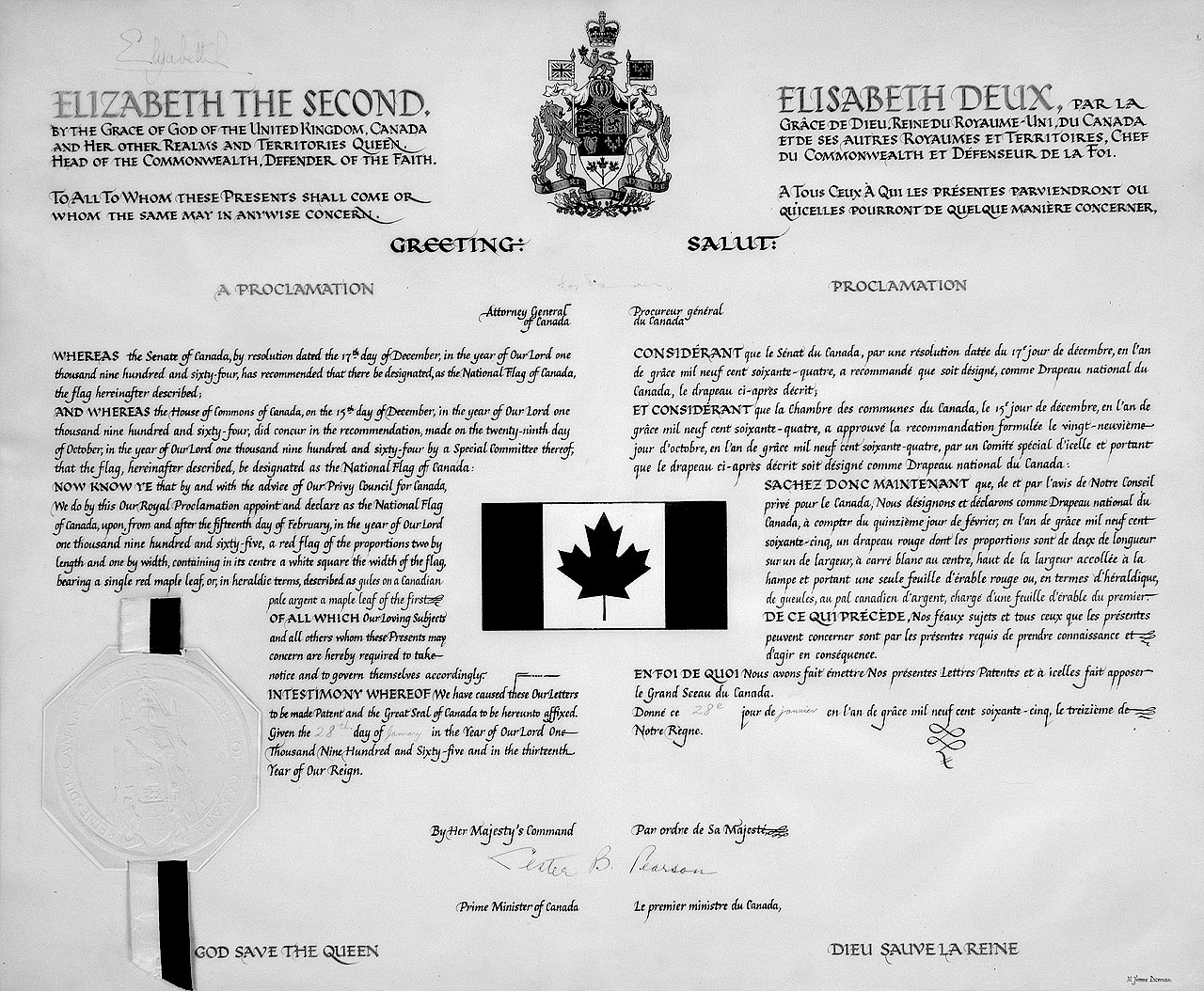
[edit]After the resolutions proposing a new national flag for Canada were passed by the two houses of parliament, a proclamation was drawn up for signature by the Queen of Canada. This was created in the form of an illuminated document on vellum, with calligraphy by Yvonne Diceman and heraldic illustrations. The text was rendered in black ink, using a quill, while the heraldic elements were painted in gouache with gilt highlights. The Great Seal of Canada was embossed and secured by a silk ribbon.[54]
.jpg)
This parchment was signed discreetly by the calligrapher but was made official by the signatures of Queen Elizabeth II (given on January 28, 1965[20]), Prime Minister Lester Pearson, and Attorney General Guy Favreau. In order to obtain these signatures, the document was flown to the United Kingdom (for the Queen's royal sign-manual) and to the Caribbean (for the signature of Favreau, who was on vacation). This transport to different climates, combined with the quality of the materials with which the proclamation was created and the subsequent storage and repair methods (including the use of Scotch Tape), contributed to the deterioration of the document: The gouache was flaking off, leaving gaps in the heraldic designs, most conspicuously on the red maple leaf of the flag design in the centre of the sheet, and the adhesive from the tape had left stains. A desire to have the proclamation as part of a display at the Canadian Museum of Civilization marking the flag's 25th anniversary led to its restoration in 1989. The proclamation is today stored in a temperature and humidity-controlled plexiglass case to prevent the vellum from changing dimensionally.[54]
Adoption
[edit].jpg)
The new national flag was inaugurated on February 15, 1965, at an official ceremony held on Parliament Hill in Ottawa, in the presence of Governor General Major-General Georges Vanier, the Prime Minister, other members of the Cabinet, and Canadian parliamentarians. The Red Ensign was lowered at the stroke of noon, and the new maple leaf flag was raised. The crowd sang "O Canada" followed by "God Save the Queen".[55] Of the flag, Vanier said "[it] will symbolize to each of us—and to the world—the unity of purpose and high resolve to which destiny beckons us".[56] Maurice Bourget, Speaker of the Senate, said: "The flag is the symbol of the nation's unity, for it, beyond any doubt, represents all the citizens of Canada without distinction of race, language, belief, or opinion."[55] Yet there was still opposition to the change, and Stanley's life was even threatened for having "assassinated the flag". Despite this, Stanley attended the flag-raising ceremony.[57]
At the time of the 50th anniversary of the flag in 2015, the government—held by the Conservative Party—was criticized for the lack of an official ceremony dedicated to the date; accusations of partisanship were levelled.[56] Minister of Canadian Heritage Shelly Glover denied the charges, and others, including Liberal Members of Parliament, pointed to community events taking place around the country.[56] Governor General David Johnston did, though, preside at an official ceremony at Confederation Park in Ottawa, integrated with Winterlude. He said, "[t]he National Flag of Canada is so embedded in our national life and so emblematic of our national purpose that we simply cannot imagine our country without it."[58] Queen Elizabeth II stated: "On this, the 50th anniversary of the National Flag of Canada, I am pleased to join with all Canadians in the celebration of this unique and cherished symbol of our country and identity."[59] A commemorative stamp and coin were issued by Canada Post and the Royal Canadian Mint, respectively.[58]
Alternative flags
[edit]As a symbol of the nation's membership in the Commonwealth of Nations and allegiance to the Crown, the Royal Union Flag is an official Canadian flag and is flown on certain occasions.[60] Regulations require federal installations to fly the Royal Union Flag beside the national flag when physically possible, using a second flagpole, on the following days: Commonwealth Day (the second Monday in March), Victoria Day (the same date as the Canadian sovereign's official birthday), and the anniversary of the Statute of Westminster (December 11). The Royal Union Flag can also be flown at the National War Memorial or at other locations during ceremonies that honour Canadian involvement with forces of other Commonwealth nations during times of war. The national flag always precedes the Royal Union Flag, with the former occupying the place of honour.[60]
The Royal Union Flag is also part of the provincial flags of Ontario and Manitoba, forming the canton of these flags; a stylized version is used on the flag of British Columbia and the flag of Newfoundland and Labrador.[60] Several of the provincial lieutenant governors formerly used a modified union flag as their flags of office. The last to abolish this design was the lieutenant governor of Nova Scotia in 2024.[61][60]
The sovereign's flag for Canada (banner of arms) is an official flag introduced May 6, 2023, and first flown at Government House, Halifax, that day.[62]
The Red Ensign is occasionally still used, including official use at some ceremonies. It was flown at the commemorations of the Battle of Vimy Ridge in 2007.[63][64] This decision elicited criticism from those who believed it should not have been given equal status to the Canadian flag and received praise from people who believed that it was important to retain the ties to Canada's past.[63][64] The Royal Union Flag and Red Ensign are still flown in Canada by veterans' groups and others who continue to stress the importance of Canada's British heritage and the Commonwealth connection.[60]
In Quebec, the provincial flag (a white cross on a field of blue with four fleurs-de-lis) can be considered a national flag along with the Maple Leaf flag, as is the Acadian flag in the Acadian regions of the Maritime provinces.[24][65][66] Public display of Canadian flags is rare in Quebec, with most Quebecers preferring to fly the flag of Quebec instead.[67][68][69] Display of the flag is also contentious, with the Quebec provincial government ordering that the Quebec flag be given seniority over the Canadian one in the province,[70][71] and many Quebec government facilities, such as the Quebec City Hall, the headquarters of the Sûreté du Québec and SAAQ, and the Quebec Parliament, refusing to fly the Canadian flag at all.[72][73][74]
-
 A Canadian Red Ensign, Royal Union Flag, and the flag of Canada flown next to a cenotaph in Cartwright, Manitoba
 -
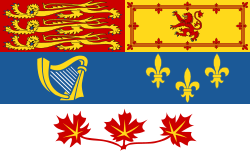 Sovereign's flag for Canada (used by Charles III, King of Canada)
 -

-


Protocol
[edit]
No law dictates the proper use of the Canadian flag. Canadian Heritage has released rules for flying the National Flag of Canada alone and with other flags. The rules deal with the order of precedence in which the Canadian flag is placed, where the flag can be used, how it is used, and what people should do to honour the flag. The suggestions, titled National Flag of Canada Etiquette, were published by Canadian Heritage online and last updated on February 24, 2022.[75] Canadian Forces also have a unique protocol for folding the Canadian flag for presentations, such as during a funeral ceremony; CF does not recommend this method for everyday use.[76]
The flag can be displayed on any day at buildings operated by the Government of Canada, airports, military bases, diplomatic offices, and citizens during any time of the day. When flying the flag, it should be flown using its pole and should not be inferior to other flags, save for, in descending order, the sovereign's flag for Canada, the governor general's flag, any of the personal flags of members of the Canadian Royal Family, or flags of the lieutenant governors.[77] The Canadian flag is flown at half-mast in Canada to indicate a period of mourning.
Promoting the flag
[edit]
Since the Canadian flag was adopted in 1965, the Canadian government has sponsored programs to promote it. Examples include the Canadian Parliamentary Flag Program of the Department of Canadian Heritage and the flag program run by the Department of Public Works. These programs increased the exposure of the flag and the concept that it was part of the national identity. To raise awareness of the new flag, the Parliamentary Flag Program was set up in December 1972 by the Cabinet and, beginning in 1973,[78] allowed members of the House of Commons to distribute flags and lapel pins in the shape of the Canadian flag to their constituents. Full-size flags that have been flown on Peace Tower and four other locations on Parliament Hill are packaged by the Department of Public Works and offered to the public free of charge. As of March 2019, the program has a waiting list of over 100 years for both Peace Tower flags, which are 2.3 by 4.6 metres (7.5 by 15 ft) in size, and for flags from the other four locations (one on each side of Centre Block and one each over East and West Blocks), which are 1.4 by 2.7 metres (4.5 by 9 ft).[79]
Since 1996, February 15 has been commemorated as National Flag of Canada Day.[55] In 1996, Minister of Canadian Heritage Sheila Copps instituted the One in a Million National Flag Challenge.[80] Canadian Heritage put the expenses at $15.5 million, with approximately a seventh of the cost offset by donations.[81]
In February 2025, in the lead up to the 60th anniversary of the Canadian maple leaf flag, former prime ministers Kim Campbell, Jean Chrétien, Joe Clark, Stephen Harper and Paul Martin encouraged Canadians to show national pride and fly the flag "like never before" in the light of "threats and insults" against Canadian Sovereignty by United States President Donald Trump.[82][better source needed]
See also
[edit].svg)

Notes
[edit]References
[edit]- ^ "National flag of Canada". Government of Canada. September 11, 2017.
- ^ Matheson 1980, p. 177
- ^ a b "The history of the National Flag of Canada". www.canada.ca. Government of Canada. February 4, 2020. Retrieved June 13, 2022.
- ^ Richard Foot (February 13, 2014). "The Stanley Flag". The Canadian Encyclopedia. Archived from the original on July 25, 2017.
- ^ Stacey, C. P., ed. (1972). "19. Order in Council on the Red Ensign, 1945". Historical documents of Canada. Vol. 5. New York City: St. Martin's Press. p. 28. ISBN 0-7705-0861-8.
- ^ a b c "First "Canadian flags"". Department of Canadian Heritage. September 24, 2007. Archived from the original on December 20, 2008.
- ^ Ken Reynolds (April 21, 1965). "Royal Union Flag (Union Jack)". The Canadian Encyclopedia.
- ^ Nelson, Phil (January 2, 2010). "Dictionary of Vexillology". Flags Of The World website. CANADIAN PALE.
- ^ a b c "The National Flag of Canada: Colours Specification". Department of Canadian Heritage. January 1, 2003. Archived from the original on December 20, 2008.
- ^ "Description of the Proclamation by Her Majesty Elizabeth the Second which formalized the National Flag of Canada in 1965". Department of Canadian Heritage. December 13, 2013. Archived from the original on February 15, 2015. Retrieved February 15, 2015.
- ^ "Registration of the National Flag of Canada". The Public Register of Arms, Flags and Badges of Canada. Queen's Printer for Canada. March 15, 2005. Archived from the original on July 27, 2016. Retrieved May 18, 2010.
- ^ The flag was later registered with the Canadian Heraldic Authority on March 15, 2005 as "Gules on a Canadian pale Argent a maple leaf Gules".[11]
- ^ James Minahan (2009). The Complete Guide to National Symbols and Emblems: Volume 2. Greenwood Press. p. 17. ISBN 978-0-313-34500-5.
- ^ a b Jeanette Hanna; Alan C. Middleton (2008). Ikonica: A Field Guide to Canada's Brandscape. Douglas & McIntyre. pp. 79–. ISBN 978-1-55365-275-5.
- ^ Caren Irr (1998). The Suburb of Dissent: Cultural Politics in the United States and Canada During the 1930s. Duke University Press. p. 69. ISBN 0-8223-2192-0.
- ^ W. K. Cross (2011). Canadian Coins: Collector and Maple Leaf Issues. Charlton Press. p. intro. ISBN 978-0-88968-342-6.
- ^ Tim Herd (2012). Maple Sugar: From Sap to Syrup: The History, Lore, and How-To Behind This Sweet Treat. Storey Publishing, LLC. p. 69. ISBN 978-1-61212-211-3. Archived from the original on July 4, 2014.
- ^ J. L. Granatstein (2011). Canada's Army: Waging War and Keeping the Peace. University of Toronto Press. p. 39. ISBN 978-1-4426-1178-8. Archived from the original on July 4, 2014.
- ^ "Understanding the Cemeteries and Monuments" (PDF). Canadian Military History (Wilfrid Laurier University). 2005. Archived (PDF) from the original on April 18, 2014.
- ^ a b c d "Birth of the Canadian flag". Department of Canadian Heritage. Archived from the original on February 24, 2010. Retrieved December 16, 2008.
- ^ Tidridge, Nathan (2011). Thompson, Allister (ed.). Canada's Constitutional Monarchy. Toronto: Dundurn Press. p. 222. ISBN 9781554889808.
- ^ "You were asking..." Department of Canadian Heritage. Archived from the original on April 30, 2010. Retrieved April 13, 2008.
- ^ Matheson 1980
- ^ a b Archbold 2002
- ^ "The Eleven Point Maple Leaf". Canada's Four Corners. Archived from the original on February 11, 2012. Retrieved March 9, 2012.
- ^ "Government of Canada FIP Signature". Industry Canada. Archived from the original on July 28, 2012. Retrieved August 7, 2012.
- ^ "National Flag of Canada Manufacturing Standards Act". Government of Canada. December 31, 2002. Archived from the original on December 20, 2016. Retrieved December 3, 2016.
- ^ "🇨🇦 Flag for Canada Emoji". Emojipedia. Archived from the original on June 6, 2017.
- ^ New York State Historical Association (1915). Proceedings of the New York State Historical Association with the Quarterly Journal: 2nd-21st Annual Meeting with a List of New Members. The Association.
It is most probable that the Bourbon Flag was used during the greater part of the occupancy of the French in the region extending southwest from the St. Lawrence to the Mississippi, known as New France... The French flag was probably blue at that time with three golden fleur-de-lis ....
- ^ "Fleur-de-lys | The Canadian Encyclopedia". www.thecanadianencyclopedia.ca.
At the time of New France (1534 to the 1760s), two flags could be viewed as having national status. The first was the banner of France—a blue square flag bearing three gold fleurs-de-lys. It was flown above fortifications in the early years of the colony. For instance, it was flown above the lodgings of Pierre Du Gua de Monts at Île Sainte-Croix in 1604. There is some evidence that the banner also flew above Samuel de Champlain's habitation in 1608.... the completely white flag of the French Royal Navy was flown from ships, forts and sometimes at land-claiming ceremonies.
- ^ "INQUINTE.CA | CANADA 150 Years of History ~ The story behind the flag". inquinte.ca.
When Canada was settled as part of France and dubbed 'New France,' two flags gained national status. One was the Royal Banner of France. This featured a blue background with three gold fleurs-de-lis. A white flag of the French Royal Navy was also flown from ships and forts and sometimes flown at land-claiming ceremonies.
- ^ W. Stewart Wallace (1948). The Encyclopedia of Canada. Vol. II. Toronto: University Associates of Canada. pp. 350–351.
During the French régime in Canada, there does not appear to have been any French national flag in the modern sense of the term. The 'Banner of France', composed of fleur-de-lys on a blue field, came nearest to being a national flag, since it was carried before the king when he marched to battle, and thus in some sense symbolized the kingdom of France. During the later period of French rule, it would seem that the emblem ... was a flag showing the fleur-de-lys on a white ground.... as seen in Florida. There were, however, 68 flags authorized for various services by Louis XIV in 1661; and a number of these were doubtless used in New France
- ^ "National Flag and Emblems". Portrait of Québec. Government of Quebec. October 12, 2006. Archived from the original on June 11, 2008. Retrieved April 20, 2008.
- ^ "Foreign flags in Canada". Government of Canada. May 8, 2018. Retrieved January 15, 2021.
- ^ "Royal Union Flag". The Flags of Canada. Retrieved January 15, 2021.
- ^ "Early flags". Government of Canada. August 28, 2017. Retrieved January 15, 2021.
- ^ "The Loyalist Flag". UELAC. December 6, 2021. Retrieved December 26, 2024.
- ^ a b Fraser, Alistair B. (January 30, 1998). "A Canadian Flag for Canada". The flags of Canada. Archived from the original on September 15, 2008. Retrieved April 20, 2008.
- ^ a b c d e f g h i j "National Flag of Canada". The Canadian Encyclopedia. Historica Canada. Archived from the original on February 14, 2015. Retrieved February 13, 2015.
- ^ Archbold 2002, p. 61
- ^ "Proposed Flag for Canada: Anatole Vanier, 1927". Office of the Governor General of Canada: Canadian Heraldic Authority. March 20, 2008.
- ^ "Proposed Flag for Canada: Gérard Gallienne, 1931". Office of the Governor General of Canada: Canadian Heraldic Authority. March 20, 2008.
- ^ "Proposed Flag for Canada: Ephrem Côté". Office of the Governor General of Canada: Canadian Heraldic Authority. March 20, 2008.
- ^ "The Flag Debate". Mount Allison University. Archived from the original on April 24, 2008. Retrieved April 17, 2008.
- ^ "The Great Flag Debate". CBC. Archived from the original on December 23, 2008. Retrieved April 13, 2008.
- ^ a b Thorner 2003, p. 524
- ^ "The Great Canadian Flag Debate". CBC. Archived from the original on April 4, 2008. Retrieved March 31, 2008.
- ^ Ron Corbett (June 30, 2013). "Flag designer recalls how he came up with the Maple Leaf design". Toronto Sun. Archived from the original on October 5, 2013. Retrieved October 4, 2013.
- ^ Iain Reeve (May 21, 2007). "Wrong turns on the road of symbolism". The Peak. Archived from the original on February 25, 2012. Retrieved April 13, 2008.
- ^ "Canadian Heritage Flags". Canadian Heritage. Archived from the original on November 2, 2011. Retrieved October 31, 2011.
- ^ "George F.G. Stanley's Flag Memorandum to John Matheson, 23 March 1964 (includes Dr. Stanley's original sketches for the Canadian Flag)". Archived from the original on March 9, 2014. Retrieved March 26, 2008.
- ^ Eva Mackey (2002). The House of Difference. Toronto: University of Toronto Press. p. 56.
- ^ "Dr. George F.G. Stanley". St Francis Xavier University. Archived from the original on March 3, 2016. Retrieved March 10, 2012.
- ^ a b Grace, John (1990). Library and Archives Canada (ed.). "Conserving the Proclamation of the Canadian Flag". The Archivist. National Archives of Canada. Archived from the original on October 21, 2012. Retrieved February 16, 2011.
- ^ a b c "The National Flag of Canada; A symbol of Canadian Identity". Department of Canadian Heritage. Archived from the original on April 15, 2012. Retrieved February 15, 2007.
- ^ a b c Milewiski, Terry (February 15, 2015). "Canada's flag debate flaps on, 50 years later". Canadian Broadcasting Corporation. Archived from the original on February 15, 2015. Retrieved February 15, 2015.
- ^ "The real story behind the Canadian Flag". The National. February 16, 2015. Archived from the original on March 31, 2016 – via YouTube.
- ^ a b "Governor General to Celebrate the 50th Anniversary of the National Flag of Canada". Office of the Governor General of Canada. February 15, 2015. Archived from the original on February 16, 2015.
- ^ "Message from Her Majesty The Queen on the Occasion of the 50th Anniversary of the National Flag of Canada". Office of the Governor General of Canada. February 15, 2015. Archived from the original on February 16, 2015. Retrieved September 9, 2023.
- ^ a b c d e "The Royal Union Flag". Department of Canadian Heritage. January 1, 2003. Archived from the original on May 6, 2006.
- ^ "Symbols of Office". Lieutenant Governor of Nova Scotia. August 6, 2014. Retrieved February 14, 2025.
- ^ "Did You Know?". Canada's Constitutional Monarchy.
- ^ a b "Globe Editorial: Red Ensign". The Globe and Mail. March 31, 2007. Archived from the original on January 9, 2008. Retrieved March 2, 2014.
- ^ a b Peritz, Ingrid (July 9, 2007). "Dallaire slams decision to fly Red Ensign". The Globe and Mail. Retrieved April 13, 2008.
- ^ "Flag and emblems of Québec, An Act respecting the, R.S.Q. D-12.1". CanLii. September 1, 2004. Archived from the original on March 7, 2008. Retrieved March 25, 2008.
- ^ McGinn, Dave (2011). "Why don't more Canadians fly the flag?". The Globe and Mail. Archived from the original on July 6, 2012. Retrieved July 6, 2012.
Newfoundland and Labrador Premier Danny Williams ordered Canadian flags taken down from provincial government buildings to protest against a deal with the federal government on sharing offshore royalties.
- ^ Pellerin, Brigitte (February 25, 2022). "When the Quebec and Canadian flags fly together at a protest, there's something strange in the wind". The Ottawa Citizen. Ontario.
I'm from Quebec City and I can tell you how rare it is to see a Canadian flag there.
- ^ "QUEBEC'S ATHLETES BLAME FLAG FOR OLYMPIC 'DISTRESS'". South Florida Sun-Sentinel. Florida. March 14, 1998. Archived from the original on July 17, 2023.
Quebeckers have never particularly warmed to the Maple Leaf, which is not widely displayed in the province dominated by French-speakers.
- ^ "Am I the only one ..." Our Heritage. Canada: University of Lethbridge. Archived from the original on July 17, 2023. Retrieved July 17, 2023.
In some parts of Quebec you can't fly a Canadian flag, that's okay
- ^ "Position of honour of the National Flag of Canada". August 15, 2017. Archived from the original on September 12, 2017.
Quebec has decreed that on all buildings under its authority within the province of Quebec, whether it be those of government departments, boards, schools or others, as well as on city halls, the provincial flag of Quebec is given precedence over the National Flag of Canada and must occupy the place of honour.
- ^ "Montreal isn't properly following Quebec's flag protocol: complainants". The Canadian Press. Canada: Global News. June 7, 2018.
- ^ Mignacca, Franca G. "Sûreté du Québec flies pride flag outside their headquarters for first time". CBC News. Archived from the original on August 10, 2019. Retrieved August 9, 2019.
- ^ DePalma, Anthony (November 26, 1997). "Quebec Journal; To Some Canadians, the Maple Leaf Is a Red Flag". The New York Times. Archived from the original on May 27, 2015.
Jean-Paul L'Allier[ has] prohibited the Canadian Maple Leaf from officially flying in front of City Hall since 1990. It was a symbolic retaliation for the defeat, by the rest of Canada, of a constitutional amendment that would have recognized Quebec's special place within the Canadian confederation.
- ^ "1701 Rue Parthenais · 1701 Rue Parthenais, Montréal, QC H2K 4S8, Canada".
- ^ "National Flag of Canada etiquette". Canada.ca. February 24, 2022.
- ^ "Process for the Ceremonial Folding of the National Flag of Canada". Directorate of History and Heritage – National Defence Canada. April 23, 2008. Archived from the original on November 18, 2011. Retrieved September 17, 2009.
- ^ "The Honours, Flags and Heritage Structure of the Canadian Forces" (PDF). Department of National Defence. Archived from the original (PDF) on March 25, 2009. Retrieved March 25, 2008.
- ^ "Administration of the Parliamentary Flag Program". Department of Canadian Heritage. January 1, 2003. Archived from the original on December 20, 2008. Retrieved May 20, 2006.
- ^ "Request a flag online (new request) - Canada's Parliamentary Precinct". Government of Canada. March 21, 2019. Retrieved March 21, 2019.
- ^ Dee, Duncan (February 19, 1996). "Heritage Minister Sheila Copps Launches "One In A Million National Flag" Campaign". Department of Canadian Heritage. Archived from the original on March 12, 2007.
- ^ Arnsby, Julia (February 15, 1997). "Canadians Meet the "One in a Million National Flag" Challenge". Department of Canadian Heritage. Archived from the original on May 16, 2007.
- ^ Colley, Mark (February 12, 2025). "Five Former Prime Ministers Say Canada Is Worth Fighting for in Face of Donald Trump's 'Threats and Insults' Ahead of Flag Day". Toronto Star. Retrieved February 15, 2025.
Bibliography
[edit]- Archbold, Rick (2002). I Stand for Canada. Macfarlane Walter & Ross. ISBN 1-55199-108-X.
- Levine, Allan. "The Great Flag Debate". Canada's History 94#6 (2014–15): 32–37.
- Matheson, Col. John R. (1980). Canada's Flag: A Search for a Country. Mika Publishing Company. ISBN 0-919303-01-3.
- Stanley, George F. G. (1965). The Story of Canada's Flag: A Historical Sketch. Ryerson Press.
- Thompson, Hugh (2002). Canada. Dorling Kindersley. ISBN 0-7894-9561-9.
- Thorner, Thomas (2003). A Country Nourished on Self-Doubt: Documents in Post-Confederation Canadian History. Broadview Press. ISBN 1-55111-548-4.
External links
[edit]

- National Flag of Canada – Department of Canadian Heritage
- National Flag of Canada etiquette – Department of Canadian Heritage
- Flags (Heritage Minutes) – Historica Canada
- George F.G. Stanley's Flag Memorandum to John Matheson – St. Francis Xavier University
- John Matheson's postcard to George Stanley – St. Francis Xavier University
- Royal Proclamation – Library and Archives Canada
- Canada at Flags of the World
- The Great Canadian Flag Debate – CBC Digital Archives
- "The People's Choice: Seeking the origins of the Maple Leaf flag, finding the soul of our nation" – W5 (CTV)
- "The Maple Leaf Forever?" – The Agenda (TVO)