Hubbry Logo
MasqueMasqueMain
Open search
Masque
Community hub
Masque
logo
8 pages, 0 posts
0 subscribers
Be the first to start a discussion here.
Masque
Masque
from Wikipedia
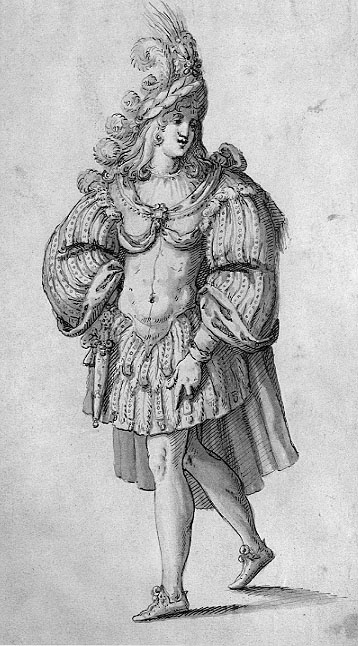
Costume for a Knight, by Inigo Jones: the plumed helmet, the "heroic cuirass" in armour and other conventions were still employed for opera seria in the 18th century.

The masque was a form of festive courtly entertainment that flourished in 16th- and early 17th-century Europe, though it was developed earlier in Italy, in forms including the intermedio (a public version of the masque was the pageant). A masque involved music, dancing, singing and acting, within an elaborate stage design, in which the architectural framing and costumes might be designed by a renowned architect, to present a deferential allegory flattering to the patron. Professional actors and musicians were hired for the speaking and singing parts. Masquers who did not speak or sing were often courtiers: the English queen Anne of Denmark frequently danced with her ladies in masques between 1603 and 1611, and Henry VIII and Charles I of England performed in the masques at their courts.[citation needed] In the tradition of masque, Louis XIV of France danced in ballets at Versailles with music by Jean-Baptiste Lully.[1]

Development

[edit]

The masque tradition developed from the elaborate pageants and courtly shows of ducal Burgundy in the late Middle Ages. Masques were typically a complimentary offering to the prince among his guests and might combine pastoral settings, mythological fables, and the dramatic elements of ethical debate. There would invariably be some political and social application of the allegory. Such pageants often celebrated a birth, marriage, change of ruler or a royal entry and invariably ended with a tableau of bliss and concord.

Masque imagery tended to be drawn from Classical rather than Christian sources, and the artifice was part of the Grand dance. Masque thus lent itself to Mannerist treatment in the hands of master designers like Giulio Romano or Inigo Jones.

The New Historians, in works like the essays of Bevington and Holbrook's The Politics of the Stuart Court Masque (1998),[2] have pointed out the political subtext of masques. At times, the political subtext was not far to seek: The Triumph of Peace, put on with a large amount of parliament-raised money by Charles I, caused great offence to the Puritans. Catherine de' Medici's court festivals, often even more overtly political, were among the most spectacular entertainments of her day, although the "intermezzi" of the Medici court in Florence could rival them.

Dumbshow

[edit]

In English theatre tradition, a dumbshow is a masque-like interlude of silent mime usually with allegorical content that refers to the occasion of a play or its theme, the most famous being the dumbshow played out in Hamlet (III.ii). Dumbshows might be a moving spectacle, like a procession, as in Thomas Kyd's The Spanish Tragedy (1580s), or they might form a pictorial tableau, as one in the Shakespeare collaboration, Pericles, Prince of Tyre (III.i)—a tableau that is immediately explicated at some length by the poet-narrator, Gower.

Dumbshows were a medieval element that continued to be popular in early Elizabethan drama, but by the time Pericles (c. 1607–08) or Hamlet (c. 1600–02) were staged, they were perhaps quaintly old-fashioned: "What means this, my lord?" is Ophelia's reaction. In English masques, purely musical interludes might be accompanied by a dumbshow.

Origins

[edit]

The masque has its origins in a folk tradition where masked players would unexpectedly call on a nobleman in his hall, dancing and bringing gifts on certain nights of the year, or celebrating dynastic occasions. The rustic presentation of "Pyramus and Thisbe" as a wedding entertainment in Shakespeare's A Midsummer Night's Dream offers a familiar example. Spectators were invited to join in the dancing. At the end, the players would take off their masks to reveal their identities. In 1377, 130 men came "disguisedly apparelled", their faces covered with vizards to entertain Richard II of England.[3]

Court masques in England and Scotland

[edit]

In England, Tudor court masques developed from earlier guisings, where a masked allegorical figure would appear and address the assembled company—providing a theme for the occasion—with musical accompaniment.[4] Costumes were designed by professionals, including Niccolo da Modena.[5] Elizabeth of York paid for costumes for "disguysings" in June and December 1502. Minstrels were dressed in white and green Tudor livery.[6] Henry VIII came to Catherine of Aragon's chamber disguised as Robin Hood in January 1510, perhaps causing initial uneasiness, and there was dancing.[7][8][9]

Hall's Chronicle explained the new fashion of Italian-style masque at the English court in 1512.[10] The essential feature was the entry of disguised dancers and musicians to a banquet. They would appear in character and perform, and then dance with the guests, and then leave the venue.[11] At the meeting at Lille in October 1513, when the ladies were dancing after a banquet, Henry VIII and eleven other dancers entered "richely appareled with bonettes of gold". At the conclusion of their performance they gave their masque costumes to the audience.[12]

On 1 May 1515, Henry VIII and Catherine of Aragon rode from Greenwich Palace to have breakfast in an arbour constructed in a wood at Shooter's Hill. Catherine and her ladies were dressed in Spanish-style riding gear, Henry was in green velvet. The royal guard appeared in disguise as Robin Hood and his men. There was a pageant chariot or car with Lady May and Lady Flora, followed by a masque and dancing.[13]

According to George Cavendish, in January 1527 Henry VIII came to Cardinal Wolsey's Hampton Court or York Place, by boat "in a masque with a dozen of other maskers all in garments like shepherds made of fine cloth of gold and fine crimson satin paned, and caps of the same with visors", wearing false beards, accompanied with torch bearers and drummers. Their arrival at the palace water gate was announced by cannon fire. The King's part of the entertainment was organised by William Sandys and Henry Guildford. The masquers played a dice game called mumchance before dancing.[14][15] Edward Hall described similar masques involving the king's disguised appearance.[16]

In the play Henry VIII, by Fletcher and Shakespeare, Wolsley's masques were recalled when Henry in shepherd's disguise meets Anne Boleyn.[17][18][19] Anne Boleyn and seven ladies in "maskyng apparel of straunge fashion" performed for Henry VIII and Francis I of France at Calais on 27 October 1532.[20] Some of the costume, supplied by the yeoman of the revels Richard Gibson, was described as "masking gere".[21]

Masques at Elizabeth I's court emphasized the concord and unity between Queen and Kingdom. A descriptive narrative of a processional masque is the masque of the Seven Deadly Sins in Edmund Spenser's The Faerie Queene (Book i, Canto IV). A particularly elaborate masque, performed over the course of two weeks for Queen Elizabeth, is described in the 1821 novel Kenilworth, by Sir Walter Scott. Queen Elizabeth was entertained at country houses during her progresses with performances like the Harefield Entertainment.[22]

In Scotland, masques were performed at court, particularly at wedding celebrations, and the royal wardrobe provided costumes.[23] At a banquet at the tournament of the Wild Knight and the Black Lady in 1507, the Black Lady came into the hall at Holyroodhouse with Martin the Spaniard who was equipped with an archery bow and dressed in yellow.[24] A cloud descended from the roof and swept them both away.[25][26]

Performers at a wedding masque at Castle Campbell in 1562 dressed as shepherds.[27] Mary, Queen of Scots, Henry Stuart, Lord Darnley, and David Rizzio took part in a masque in February 1566.[28] Mary attended the wedding of her servant Bastian Pagez, and it was said she wore male costume for the masque, "which apparel she loved often times to be in, in dancings secretly with the King her husband, and going in masks by night through the streets".[29] James VI and Anne of Denmark wore masque costumes to dance at weddings at Alloa Tower and Tullibardine Castle.[30] At Tullibardine, James VI and his valet, probably John Wemyss of Logie, wore taffeta costumes and Venetian masks.[31]

After James and Anne became king and queen of England at the Union of the Crowns in 1603, narrative elements of the masque at their court became more significant. Plots were often on classical or allegorical themes, glorifying the royal or noble sponsor. At the end, the audience would join with the actors in a final dance. Ben Jonson wrote a number of masques with stage design by Inigo Jones. Their works are usually thought of as the most significant in the form. Samuel Daniel and Sir Philip Sidney also wrote masques.

William Shakespeare included a masque-like interlude in The Tempest, understood by modern scholars to have been heavily influenced by the masques of Ben Jonson and the stagecraft of Inigo Jones. There is also a masque sequence in his Romeo and Juliet and Henry VIII. John Milton's Comus (with music by Henry Lawes) is described as a masque, though it is generally reckoned a pastoral play.

There is a detailed, humorous, and malicious (and possibly completely fictitious) account by Sir John Harington in 1606 of a masque of Solomon and Sheba at Theobalds.[32] Harington was not so much concerned with the masque itself as with the notoriously heavy drinking at the Court of King James I; "the entertainment went forward, and most of the presenters went backward, or fell down, wine did so occupy their upper chambers". As far as we can ascertain the details of the masque, the Queen of Sheba was to bring gifts to the King, representing Solomon, and was to be followed by the spirits of Faith, Hope, Charity, Victory and Peace. Unfortunately, as Harington reported, the actress playing the Queen tripped over the steps of the throne, sending her gifts flying; Hope and Faith were too drunk to speak a word, while Peace, annoyed at finding her way to the throne blocked, made good use of her symbolic olive branches to slap anyone who was in her way.[33]

Francis Bacon paid for The Masque of Flowers to celebrate the marriage of Robert Carr, 1st Earl of Somerset and Frances Howard, Countess of Somerset.[34] James Hay, 1st Earl of Carlisle, was a performer and sponsor of court masques. He wrote about the tight-fitting costumes, that it was the fashion "to appear very small in the waist, I remember was drawn up from the ground by both hands whilst the tailor with all his strength buttoned on my doublet".[35]

Reconstructions of Stuart masques have been few and far between. Part of the problem is that only texts survive complete; there is no complete music, only fragments, so no authoritative performance can be made without interpretive invention. By the time of the English Restoration in 1660, the masque was passé, but the English semi-opera which developed in the latter part of the 17th century, a form in which John Dryden and Henry Purcell collaborated, borrows some elements from the masque and further elements from the contemporary courtly French opera of Jean-Baptiste Lully.

In the 18th century, masques were even less frequently staged. "Rule, Britannia!" started out as part of Alfred, a masque about Alfred the Great co-written by James Thomson and David Mallet with music by Thomas Arne which was first performed at Cliveden, country house of Frederick, Prince of Wales. Performed to celebrate the third birthday of Frederick's daughter Augusta, it remains among the best-known British patriotic songs up to the present, while the masque of which it was originally part is remembered by only specialist historians.

Legacy

[edit]

The most outstanding humanists, poets and artists of the day, in the full intensity of their creative powers, devoted themselves to producing masques; and until the Puritans closed the English theatres in 1642, the masque was the highest art form in England. But because of its ephemeral nature, not a lot of documentation related to masques remains, and much of what is said about the production and enjoyment of masques is still part speculation.

17th- and 18th-century masques

[edit]

While the masque was no longer as popular as it was at its height in the 17th century, there are many later examples of the masque. During the late 17th century, English semi-operas by composers such as Henry Purcell had masque scenes inset between the acts of the play proper. In the 18th century, William Boyce and Thomas Arne, continued to utilize the masque genre mostly as an occasional piece, and the genre became increasingly associated with patriotic topics. Acis and Galatea (Handel) is another successful example. There are isolated examples throughout the first half of the 19th century.

Later masques

[edit]

With the renaissance of English musical composition during the late 19th and early 20th century (the so-called English Musical Renaissance), English composers turned to the masque as a way of connecting to a genuinely English musical-dramatic form in their attempts to build a historically informed national musical style for England. Examples include those by Arthur Sullivan, George Macfarren, and even Edward Elgar, whose imperialistic The Crown of India was the central feature at the London Coliseum in 2005. Masques also became common as scenes in operettas and musical theatre works set during the Elizabethan period.

In the 20th century, Ralph Vaughan Williams wrote several masques, including his masterpiece in the genre, Job, a masque for dancing which premiered in 1930, although the work is closer to a ballet than a masque as it was originally understood. His designating it a masque was to indicate that the modern choreography typical when he wrote the piece would not be suitable. Vaughan Williams' protégé Elizabeth Maconchy composed a masque, The Birds (1967–68), an "extravaganza" after Aristophanes.

Constant Lambert also wrote a piece he called a masque, Summer's Last Will and Testament, for orchestra, chorus and baritone. His title he took from Thomas Nash, whose masque[36] was probably first presented before the Archbishop of Canterbury, perhaps at his London seat, Lambeth Palace, in 1592.

List of notable masques

[edit]

17th-century masques

[edit]

18th-century masques

[edit]

Notes

[edit]

References

[edit]
[edit]
Revisions and contributorsEdit on WikipediaRead on Wikipedia
from Grokipedia
The masque was an elaborate form of courtly entertainment that flourished in England from the late 16th to the mid-17th century, blending elements of drama, music, dance, and poetry in allegorical spectacles featuring masked performers portraying mythological figures, abstract virtues, or historical personages. Typically staged in royal palaces or noble households to honor monarchs or commemorate events, masques involved noble participants who, after presenting a scripted antimasque of disorder followed by a harmonious main masque, engaged the audience in unscripted revels dances. These productions emphasized lavish costumes, mechanical stage effects, and scenic transformations, often designed to glorify the sovereign and reinforce political or moral themes through symbolic narratives. Masques evolved from Italian intermedi and earlier European traditions but reached their peak under the Stuart monarchs James I and Charles I, where they served as vehicles for and absolutist ideology, with courtiers—sometimes including the king or queen—taking central roles to embody ideals of harmony and divine order. The genre's most influential exponents included librettist , who crafted intricate verse texts prioritizing poetic wit and classical allusions, and architect , whose innovations in perspective scenery, lighting, and movable sets introduced continental theatrical techniques to , elevating masques into proto-operatic spectacles. Jonson's masques, such as The Masque of Queens (1609), exemplified the form's structure with chaotic antimasques contrasting resolved masques, while Jones's designs for productions like (1605) featured extravagant machinery and illusions that captivated audiences but sparked debates over whether spectacle overshadowed literary merit. Though costly and exclusive to elite circles, masques advanced English stagecraft, influencing later developments in and public theater, before declining with the and the Interregnum's Puritan suppression of courtly excesses.

Definition and Characteristics

Core Elements of the Masque

The masque integrated , , , and scenic spectacle within an allegorical framework designed to exalt the and courtly order. Poetic scripts, frequently authored by , supplied dialogue, prologues, and epilogues that advanced mythological or symbolic narratives, emphasizing themes of harmony restored under royal auspices. Music and song permeated the production, with compositions by musicians like Alfonso Ferrabosco underscoring transitions and emotional peaks, though vocal elements were sometimes subdued amid the event's clamor. Dance constituted a pivotal feature, involving geometric choreographies executed by courtiers and occasionally the sovereign, such as Charles I in Love’s Triumph through Callipolis (1631), progressing to revels where masquers selected partners from the audience for unstructured social dances. The standard structure commenced with an anti-masque—depicting disorder through figures and antics performed by professionals—followed by the main masque's revelation of noble masquers in harmonious , symbolizing the triumph of cosmic and political stability. This underscored the genre's ideological core, with the anti-masque's chaos yielding to the masque's resolution. Visual opulence defined the form, featuring ornate costumes and visors that masked participants' identities, alongside Inigo Jones's innovative scenery employing hydraulic machinery for shifts like simulated seas or aerial descents, as in The Masque of Blackness (1605). Performers drawn from nobility reinforced the event's elitist character, blending amateur courtiers with hired specialists to glorify aristocratic patronage and divine-right legitimacy. The English masque differed from earlier folk practices such as mummery and disguising, which involved spontaneous masked intrusions into feasts for gift-giving and rudimentary dances using improvised costumes from household items, by developing scripted poetic dialogues, professional of music and , and intricate scenic machinery introduced by from 1605 onward. These precursors lacked the masque's allegorical depth and technical spectacle, focusing instead on brief, unstructured revelry without narrative resolution or audience integration beyond the initial entry. In comparison to , which emerged later in as a through-composed form emphasizing continuous and without spoken elements, the masque retained substantial spoken verse by authors like to advance plot and compliment patrons, interspersing songs and dances as episodic enhancements rather than the dominant mode. This hybrid structure reflected the masque's roots in courtly diversion over operatic dramatic continuity, though post-1650s adaptations blurred lines as masque elements influenced early English . Unlike , a formalized prioritizing choreographic expression and professional execution, the masque subordinated to a broader ceremonial framework, where noble amateurs performed measured steps in the main entry to symbolize , followed by unstructured "revels" pairing masquers with spectators in general dancing that dissolved performer-audience boundaries. Pageants, by contrast, were public, processional spectacles tied to civic or royal entries with static platforms and emblematic displays, whereas masques unfolded indoors via transformative stages and personal royal participation. The masque's antimasque, featuring professional grotesques in chaotic routines to contrast the harmonious main masque, further set it apart from uniform dramatic forms by embodying deliberate structural tension resolved through monarchical intervention.

Origins and Early Influences

Italian and Continental Roots

The intermedi, elaborate musical interludes inserted between acts of spoken comedies in , provided a foundational model for the masque's integration of spectacle, music, and . These performances, prominent in courts like under the Medici, featured mythological themes, intricate costumes, hydraulic stage effects, and perspective scenery to evoke divine or cosmic wonders. A landmark example occurred in 1589 during the wedding celebrations of and Christine of Lorraine, where six intermedi accompanied Giovan Battista Cinzio's La Pellegrina; designed transformative sets, including clouds parting to reveal sirens and mechanical sirens emerging from the sea, accompanied by music from composers such as Cristofano Malvezzi and Emilio de' Cavalieri. These elements, disseminated through engravings and traveling artists, influenced English designers like , who adapted Italian scenic innovations for court masques, emphasizing grandeur over narrative continuity. Continental France contributed through the ballets de cour, courtly ballets that fused Italian intermedi techniques with French poetic and choreographic traditions, emphasizing aristocratic participation and thematic unity. Introduced by Catherine de Médicis, who brought Italian musicians and dancers to the Valois court, these evolved into cohesive spectacles blending verse, song, dance, and machinery. The Ballet comique de la reine (1581), commissioned for the marriage of the Duc de Joyeuse to Margaret of Lorraine, marked a pivotal development: choreographed by Balthazar de Beaujoyeux with by Jean-Antoine de Baïf, it depicted Circe's enchantments in a single allegorical arc, lasting over five hours with 200 participants and innovative revolving stages. A printed edition reached via Sir Henry Brooke, facilitating direct transmission of its structural and visual ideas to Stuart masquers, who incorporated similar grand entries and moral symbolism while prioritizing spoken dialogue. These Italian and French precedents shaped the masque's hybrid form by prioritizing sensory opulence and political flattery, though English adaptations subordinated continental machinery to native dramatic verse, reflecting differing emphases on text versus visual effect. Italian carnivals and dances further informed the masque's masked revels and elements, as seen in the adoption of stock characters for comic relief.

Introduction to British Courts

The masque first appeared in British courts during the early , primarily as an extension of medieval disguising traditions where masked performers—often courtiers or nobles—interrupted banquets with dances, plays, and gift-giving to honor the host. These entertainments, known as "disguisings" or "mummings," emphasized spectacle and revelry over scripted narrative, with participants donning elaborate costumes and masks to represent mythological or exotic figures. By the reign of (1509–1547), such performances had become formalized courtly events, frequently held during , , or diplomatic occasions, blending English folk customs like seasonal festivals with rudimentary continental elements. Henry VIII actively promoted and participated in masques, using them to display royal magnificence and foster courtly unity; records indicate he performed in at least a dozen such events, often leading dances or portraying heroic roles. A notable early instance occurred on March 1, 1522, when debuted at court in a disguising titled The Golden Arbour, featuring eight women in gold cloth attire symbolizing a forested bower, which captivated the king and foreshadowed her rise. These Tudor masques typically involved 10–20 performers executing choreographed measures before mingling with spectators in revels, with costs ranging from £100 to £500 per event in period currency, funded by the or noble patrons. Under (1558–1603), masques evolved toward greater allegorical content and occasional Italianate scenery, such as perspective sets introduced via court artists like Niccolò da Modena, though still rooted in native disguising forms rather than fully operatic intermedii. Performances at or Greenwich palaces served political purposes, reinforcing the queen's image as a virtuous ruler through themes of and triumph; for example, the 1579 The Masque of Indian and China Knights celebrated her avoidance of marriage alliances. This period laid groundwork for the genre's expansion, with annual masques numbering 5–10 during festive seasons, before Scottish influences under further integrated pastoral and antimasque elements post-1603. Early English masques prioritized participatory revels over passive spectatorship, distinguishing them from more static continental precedents until technical innovations in the .

Peak Development in the Early 17th Century

Jacobean Masques under James I

The Jacobean masques, performed during the reign of James I from 1603 to 1625, marked a significant evolution in court entertainment, characterized by elaborate scenic designs, music, , and allegorical poetry. Approximately 37 masques were staged over this period, often at Palace's , to celebrate events such as , weddings, and diplomatic occasions. These productions served to reinforce royal authority through flattery and symbolism, blending with contemporary politics. Ben Jonson emerged as the preeminent librettist, authoring more than 20 masques, beginning with on 6 January 1605, which featured Queen Anne and her ladies as Ethiopian nymphs seeking beauty's restoration under James's rule. Jonson's innovations included the introduction of the antimasque in The Masque of Queens on 2 February 1609, contrasting grotesque, chaotic elements with the harmonious main masque to heighten dramatic effect and moral contrast. Collaborating closely with , who handled scenic architecture, costumes, and machinery, Jonson elevated the form's intellectual depth while Jones drew on Italian influences like perspective scenery and mechanical transformations, first prominently displayed in the 1605 production. Jones's technical advancements, including revolving stages and cloud machines, transformed masques into visually spectacular events, costing thousands of pounds per performance and involving professional actors alongside courtiers. Notable later examples include Oberon, the Fairy Prince in 1611, which repeated in subsequent seasons, and Pleasure Reconciled to Virtue in 1618, reflecting Jonson's emphasis on ethical themes amid courtly revelry. These masques often repeated for multiple nights, extending their impact, though their high expense drew occasional scrutiny amid James's financial pressures. By the end of James's reign, the form had solidified as a cornerstone of Stuart court culture, influencing subsequent Caroline developments.

Caroline Masques under Charles I

The Caroline masques, staged primarily between 1625 and 1640 during Charles I's reign, built upon Jacobean precedents but emphasized greater royal involvement, with Charles and Queen Henrietta Maria frequently performing as chief masquers to embody ideals of Platonic love and harmonious rule. Unlike James I, who rarely danced, Charles actively participated, reinforcing his self-image as a divine monarch, knight, and lover through allegorical roles that mirrored Stuart ideology of absolute kingship. Inigo Jones continued as the principal designer of scenery, costumes, and machinery, creating opulent, illusionistic spectacles that blurred stage and reality to symbolize cosmic order under the crown. Librettos shifted from Ben Jonson's dominance to , whose works like The Temple of Love (1634) and Britannia Triumphans (1638) integrated antimasques of chaos—featuring professional actors as disorderly figures—with main masques where restored harmony, often portraying as a heroic unifier. Other notable productions included Chloridia (1631), which elevated Britain to a heavenly realm under Charles's god-like authority, and The Triumph of Peace (1634) by , costing approximately £20,000 and sponsored by the to affirm loyalty amid political strains. These events, held at Whitehall's , served propagandistic functions, using mythology to depict the king's triumph over dissent while promoting themes of peace and divine right, though escalating costs and civil unrest foreshadowed their end. The final Caroline masque, Davenant's Salmacida Spolia (January 21, 1640), featured as Philogenes, the "lover of his people," banishing furies of rebellion in a lavish display costing £2,000–£3,000, yet it marked the genre's culmination before the halted court entertainments. Despite their artistic peaks in scenic innovation and musical integration—often with compositions by Henry Lawes—the masques reflected growing detachment from broader society, prioritizing elite symbolism over accessibility and contributing to criticisms of royal extravagance.

Key Contributors and Innovations

Literary and Textual Innovations

elevated the literary quality of English masques by integrating sophisticated verse, classical allusions, and moral allegory into their scripts, transforming them from primarily visual spectacles into intellectually rigorous entertainments. His texts featured structured dialogues, poetic speeches, and songs that emphasized thematic depth, often drawing on ancient sources like and to underscore virtues of harmony and order under royal patronage. This approach contrasted with earlier masques, which relied more on dumb shows and minimal spoken elements, as Jonson's innovations prioritized verbal wit and rhetorical precision to engage courtly audiences beyond mere pageantry. A pivotal textual innovation was Jonson's formal introduction of the antimasque in The Masque of Queens, performed at Whitehall Palace on February 2, 1609, where he elaborated a binary structure pitting , chaotic figures—such as witches and hags—against the noble, harmonious presenters of the main masque. This device served not only dramatic contrast but also symbolic resolution, with disorder yielding to regal authority, thereby enhancing the masque's allegorical potency as a literary form. Jonson accompanied the published text with an "Argument" and extensive annotations, explicating mythological references and interpretive layers, which positioned the masque as a readable work akin to classical rather than ephemeral performance. Jonson's later masques, such as (1611) and Love Restored (1612), further refined textual structure by varying the antimasque's integration, sometimes embedding it more fluidly to heighten narrative progression and critique folly through satirical verse. These developments encouraged subsequent masquers to adopt similar literary frameworks, though Jonson's emphasis on authorship—evident in his prefaces claiming interpretive control—distinguished his works amid collaborative court productions. By publishing over twenty masques during James I's reign (1603–1625), Jonson established them as durable literary artifacts, influencing the genre's evolution toward greater emphasis on poetic innovation and etymological play to evoke temporal and political resonance.

Scenic and Technical Advancements

pioneered the introduction of Italian-inspired perspective scenery to English masques, marking a departure from the simpler, non-illusory backdrops of earlier disguisings and Tudor entertainments. Drawing on treatises by and Nicola Sabbatini, Jones employed angled flats, wings, and shutters to create depth and illusionistic vistas, first evident in (1605), where a darkened oceanic scene transitioned via mechanical means to reveal ethereal realms. This innovation elevated masques from participatory folk-like revels to architecturally sophisticated spectacles, with arches framing the action as in The Triumph of Peace (1634). Stage machinery advanced concurrently, incorporating winches, pulleys, and wheeled platforms for rapid scene changes, flights of deities, and descending clouds, adapting Sabbatini's designs to the Banqueting House's temporary setups. Examples include cloud machines in Luminalia (1608) and transformations in Tethys' Festival (1610), where hydraulic-like effects simulated rising waters, costing thousands in materials and labor. These mechanisms, often elevated on four-foot-high, forty-foot-square stages wheeled into position, enabled antimasque chaos to yield to ordered main masques, symbolizing royal harmony through visible engineering prowess. Lighting techniques enhanced scenic depth by dimming the hall's ambient light while illuminating the stage with strategically placed chandeliers, torches, and reflectors, creating dramatic contrasts as in the shadowy unveilings of . designs complemented these, featuring mechanically layered fabrics in silks, velvets, and gold braiding—exemplified by the £2,000 expenditure on trims for Tethys' Festival—allowing for transformative reveals during dances. By the , such as in Britannia Triumphans (1638), Jones integrated multi-level periaktoi-inspired rotators for seamless shifts, establishing masques as precursors to staging despite their ephemeral nature.

Musical and Choreographic Elements

The musical components of Stuart court masques encompassed vocal songs, duets, and instrumental ensembles that underscored the dramatic progression from antimasque to main masque, often drawing on court composers to create harmonized accompaniments for scenic transformations and allegorical speeches. Alfonso Ferrabosco the younger, a principal composer, received £20 for the songs in Ben Jonson's Oberon, the Faery Prince (January 1, 1611), while Thomas Lupo and each earned £5 for musical arrangements, reflecting the collaborative scale of production. further contributed lute pieces and airs, such as those in earlier Jacobean works, distilling complex textures to treble-bass formats suitable for courtly performance. Nicholas Lanier composed surviving songs for The Masque of Augurs (1622), exemplifying the shift toward more integrated operatic elements in Caroline masques under Charles I. Choreography integrated professional dancers for the antimasque's rustic or satirical routines—featuring vigorous steps like galliards and corantos—with courtiers executing the main masque's stately entries and measures, which emphasized geometric formations and symbolic harmony reflective of royal order. Dance masters, including Jerome Herne and Thomas Giles, trained participants in Italian-influenced styles such as those from Fabritio Caroso's treatises, adapting sequences like "Il Canario" for masque contexts. The revels phase followed, comprising eight formal "old measures" (slow, processional dances) succeeded by athletic improvisations, during which masquers paired with spectators to dissolve stage-audience boundaries and affirm courtly unity. This structure, evident in masques like (1605), intertwined movement with music to amplify thematic contrasts between chaos and resolution, though surviving notations remain sparse due to reliance on ephemeral practices.

Content, Themes, and Symbolism

Allegorical Structures and Antimasques

English court masques typically employed allegorical frameworks to depict the triumph of order, , and royal authority over chaos and , often drawing on mythological figures to symbolize the monarch's divine or cosmic role in restoring harmony. In these structures, the main masque presented noble masquers—usually courtiers—as embodiments of idealized qualities like or , engaging in measured dances that represented cosmic or social equilibrium. This progression culminated in the revels, where masquers paired with members, blurring the boundary between performance and participation to affirm hierarchical unity under the sovereign. The antimasque, formalized by in The Masque of Queens on February 2, 1609, introduced a contrasting episode of disorder immediately preceding the main masque, heightening the allegorical contrast between vice and virtue. Featuring professional actors rather than courtiers, antimasques portrayed grotesque or rustic figures—such as witches, baboons, or personifications of ignorance and passion—through acrobatic, irregular dances that evoked or moral corruption. In The Masque of Queens, twelve witches in the antimasque invoked "Hecate's power" to sow discord, only to be dispelled by the entry of twelve heroic queens representing historical virtues, symbolizing the suppression of by civilized order. This binary structure served to underscore causal realism in : chaos inherently yielded to monarchical intervention, as the sovereign's presence or proxy in the masque enacted resolution without narrative ambiguity. Antimasques thus amplified the masque's propagandistic function, portraying threats like factionalism or superstition as transient follies inevitably overcome by royal harmony, a motif recurrent in Jacobean works like Jonson's Masque of Blackness (1605, with proto-antimasque elements) and extending into Caroline productions. By the 1630s, however, some antimasques incorporated courtiers, blurring professional-amateur lines and occasionally subverting pure for satirical commentary on courtly excess.

Mythological and Moral Narratives

Masques commonly drew upon Greco-Roman mythology to construct narratives that emphasized moral virtues such as temperance, honor, and the restoration of cosmic order, often allegorizing the monarch's role in achieving harmony between conflicting forces. Deities like , the god of , or figures such as nymphs and heroes appeared to symbolize ideals of union, beauty, and heroic resolve, with stories structured to resolve disorder into disciplined unity under royal auspices. These elements served didactic purposes, portraying vice as chaotic and transient while , embodied by the masquers, prevailed enduringly. In Ben Jonson's The Masque of Queens (1609), the narrative invoked legendary queens—drawing from historical and mythic exemplars like and —as embodiments of "," who dispel an antimasque of witches representing ignorance and discord. The moral arc culminated in the queens' orderly , signifying the triumph of rational and feminine fortitude over primal malice, with Jonson's annotations underscoring virtues like and valor as antidotes to . Similarly, in Pleasure Reconciled to Virtue (1618), guides the mythic to subordinate the riotous figure of (personifying excess) to disciplined enjoyment, reconciling sensual delight with ethical restraint in a ladder-like ascent from base appetites to enlightened moderation. Jonson's framework here reflected a moral imagination prioritizing self-mastery, where entertainment yields to "hours by Virtue spared." Caroline masques extended these motifs, integrating mythological agents like Fame or oceanic deities to narrate moral renewal under I's imagined providence, as in Aurelian Townshend's Albion's Triumph (1632), where the sun-god Phoebus aids the king's surrogate in subduing nocturnal vices through celestial hierarchy. Narratives often moralized kingship as a bulwark against or , with antimasque grotesques—evoking furies or chaotic sprites—yielding to masquers' geometric dances symbolizing providential and communal virtue. This pattern reinforced causal realism in moral terms: disorder stemmed from unchecked passions, resolved causally by authoritative wisdom rather than mere spectacle.

Political Dimensions and Criticisms

Role in Royal Propaganda and Hierarchy

Court masques under the Stuart monarchs James I and Charles I served as elaborate instruments of royal propaganda, designed to affirm the and the absolute authority of the crown. These entertainments, often scripted by and featuring scenic designs by , portrayed the monarch as a semi-divine figure central to cosmic and social harmony, with the king's mere presence resolving chaos depicted in the antimasque into ordered unity in the main masque. This structure symbolically reinforced James I's political philosophy, as articulated in his writings like (1599), where the king positioned himself as God's lieutenant on earth, a theme echoed in masques such as The Masque of Queens (1609), where heroic virtues triumphed under royal auspices. The hierarchical organization of masques mirrored and upheld the rigid social order of the court, with the monarch and consort elevated at the spectacle's core, surrounded by noble masquers whose roles affirmed their subordinate yet privileged status. Costumes and machinery by , drawing on Vitruvian principles of proportion, symbolized the correspondence between divine architecture, natural order, and monarchical rule, as seen in productions like Oberon, the Fairy Prince (1611), where escalating scenic transformations culminated in the revelation of the king's wisdom. Participation by courtiers in dances further integrated the elite into this , binding their loyalty through shared while visually delineating ranks via elaborate attire and positioning. Under Charles I, masques intensified this hierarchical symbolism amid growing political tensions, emphasizing personal royal virtue and the court's separation from parliamentary disorder, as in Chloridia (1631), which celebrated the king's pacific rule against external threats. These spectacles, costing thousands of pounds—such as the £3,000 expended on The Temple of Love (1635)—projected fiscal magnificence as evidence of divine favor, though critics like later decried them as emblematic of absolutist excess. By staging an idealized monarchy, masques not only propagandized domestic audiences but also impressed foreign ambassadors, underscoring Stuart claims to European precedence in cultural patronage.

Contemporary Oppositions and Debates

Puritan critics in the 1630s condemned Caroline masques as emblematic of moral decay and fiscal profligacy, arguing that their elaborate spectacles diverted funds from pressing national needs such as military preparedness during the Bishops' Wars. William Prynne's Histriomastix (1633), a voluminous anti-theatrical polemic, explicitly targeted court entertainments like masques for fostering idolatry, luxury, and effeminacy, while asserting that expenditures on them surpassed allocations for warfare—a charge that implicitly likened Charles I to Nero. Prynne further decried the participation of women, including Queen Henrietta Maria, in masque performances as scandalous violations of gender norms and Protestant decorum, equating such displays with professional acting's purported lewdness. These attacks elicited harsh reprisals from the Caroline regime, underscoring the political stakes of cultural critique. Prynne faced trial in in 1634, where he was fined £5,000, sentenced to the pillory, imprisoned in the , and subjected to cropping of his ears for . Similar fates befell fellow Henry Burton and John Bastwick in 1637, whose writings assailed episcopal innovations and courtly excesses, including theatrical pomp, as popish corruptions; they endured mutilation and exile alongside Prynne, whose re-arrest amplified perceptions of royal intolerance. Critics like Prynne contended that masques, with costs running into thousands of pounds per production—such as the opulent machinery and costumes for events like The Triumph of Peace (1634)—exacerbated England's financial woes amid levies and Scottish conflicts. Debates persisted over masques' legitimacy, with proponents viewing them as benign affirmations of divine-right harmony, while opponents framed them as tools of absolutist that masked underlying tyrannies. Although antimasques within the form ritually contained disorder to exalt royal order, external Puritan voices rejected this as contrived, insisting the genre's very existence contravened scriptural prohibitions on graven images and vain pastimes. These contentions, peaking in the late 1630s, fed broader grievances against Charles's , contributing to the polarization that erupted in the by 1642, when Parliament ordered the suppression of all stage plays and masques as "heathenish and unlawful."

Decline and Evolution

Effects of Civil War and Puritanism

The , commencing in August 1642, disrupted the Stuart court's tradition of masquing, which had flourished under James I and Charles I as vehicles for royal spectacle and allegory. The final pre-war court masque, Salmacida Spolia by with designs by , premiered on January 21, 1640, at Whitehall Palace, featuring themes of imperial triumph amid growing political tensions that foreshadowed conflict. As hostilities escalated, the royal court fragmented, with Charles I's relocation and financial strains rendering elaborate productions untenable; masques, reliant on costly scenery, costumes, and professional musicians, became casualties of wartime austerity and displacement. Parliament's Ordinance for the Closing of Theatres on September 2, 1642, explicitly banned all stage plays and public performances to redirect resources toward military efforts and curb perceived moral distractions during national crisis. This edict encompassed masques, which shared theatrical elements like scripted dialogue, dancing, and scenic machinery, leading to the demolition of playhouses and suppression of actors; violators faced imprisonment, fines, or . Puritan parliamentarians, dominant in the , condemned masques as emblematic of courtly vice—promoting luxury, idolatry, and gender blurring through female performers and disguisings—contrary to scriptural simplicity and antithetical to their campaign against perceived monarchical absolutism. Under the Interregnum (1649–1660), following Charles I's execution on January 30, 1649, and the establishment of the , masques vanished entirely with the abolition of the court itself. Oliver Cromwell's (1653–1658) intensified Puritan reforms, enforcing Sabbath observance and prohibiting "superstitious" festivals like , while viewing entertainments as fomenting disorder and popish excess; even limited allowances for music in private homes were scrutinized, precluding public masquing. This era's extended to cultural artifacts, with masques' association to Stuart —often depicting the king as divine order incarnate—rendering them targets of ideological erasure. The combined shocks of and eroded the institutional , skilled artificers, and aristocratic audiences essential to masques, stunting the genre's development and shifting surviving elements toward private or adapted forms. Post-1640 innovations in machinery and were lost, and the embedded in Puritan writings, such as those decrying theater's "sham" spectacles, delegitimized masquing as incompatible with reformed . By 1660, the Restoration inherited a fractured , with masques' revival tempered by these precedents of suppression.

17th- and 18th-Century Transformations

Following the Restoration of the monarchy in 1660, the elaborate court masques of the Stuart era did not resume in their original private format, as changing tastes and the shift to public theaters diminished their exclusivity. Instead, masque elements transformed into semi-operas, hybrid works blending spoken drama with inserted musical interludes, dances, and scenic spectacles derived from earlier court traditions. These adaptations emphasized magical narratives, balletic pantomimes, and mechanical stage transformations, fusing English allegorical structures with French-influenced choreography. Henry Purcell's compositions, such as King Arthur (premiered 1691) and The Fairy Queen (premiered 1692), exemplified this evolution, incorporating masque-style sequences with choruses, arias, and dances that advanced from courtly symbolism to more theatrical spectacle for broader audiences. By the , standalone masques had largely declined, yielding to , , and in plays, though sporadic commissions for aristocratic or royal events preserved vestiges of the form. Thomas Arne's Alfred, premiered on August 1, 1740, at Cliveden House before , and his , marked a notable instance, featuring patriotic on Alfred the Great's defense against Viking invaders, with , , and the premiere of "Rule, Britannia!" by librettists James Thomson and David Mallet. Revivals of 17th-century masques, including adaptations of Ben Jonson's works, appeared occasionally in theaters, such as a 1775 production running 63 nights with added scenes, indicating lingering appeal amid the era's preference for narrative-driven entertainments like and . This period's transformations thus diluted the masque's ritualistic hierarchy into accessible, hybrid genres, prioritizing scenic innovation and public engagement over courtly propaganda.

Enduring Legacy

Influence on Opera and Modern Theater

The English court masque's fusion of spoken verse, music, , and elaborate spectacle directly contributed to the emergence of semi-opera during the Restoration period, a hybrid form that interpolated musical masques into spoken plays. This evolution is evident in early works such as William Davenant's The Siege of Rhodes (1656), often regarded as the first English , which adapted masque elements like scenic machinery and choral interludes to advance dramatic narrative through and song. Similarly, Richard Flecknoe's Deserted by (1654) incorporated masque-derived theatricality, including themes and visual effects, to create a more emotive operatic idiom suited to post-Interregnum audiences. Henry Purcell's semi-operas exemplify this influence, with self-contained masques providing musical climaxes separate from the plot, as in King Arthur (1691), where allegorical sequences of song and dance echo Jacobean precedents while glorifying Stuart monarchy through spectacle. Purcell's Dido and Aeneas (1689), building on John Blow's masque-like Venus and Adonis (c. 1680), marked a pivotal step toward fully sung opera by integrating continuous music with dramatic action, drawing on the masque's precedent for orchestral accompaniment and machinist's effects. These forms persisted into the early 18th century, bridging to Italian-influenced Baroque opera while retaining English emphasis on scenic transformation and ensemble dance. Inigo Jones's innovations in masque scenery, including perspective vistas and changeable sets introduced from Italian models around 1605, established standards for operatic that emphasized illusionistic depth and mechanical shifts, influencing designers in both English and continental theaters. The masque's legacy in modern theater manifests in the prioritization of spectacle and allegorical pageantry, informing 20th-century revivals and adaptations that blend , projection, and narrative, as seen in experimental productions reinterpreting Stuart masques for contemporary stages to explore power dynamics. Its structural dichotomy of ordered main masque and chaotic antimasque prefigures contrasts in modern musical theater, where integrated songs and dances heighten thematic tensions, though diluted by commercial demands unlike the original court's ritualistic intent.

19th- to 21st-Century Revivals and Adaptations

Interest in masques waned after the but saw sporadic revivals in the , often adapted for contemporary spectacle or national celebrations rather than faithful reconstructions. John Milton's Comus (1634), originally a masque, became a staple of the Victorian stage, with productions at major theaters like and , as well as in , , Bath, and provincial venues, emphasizing its music and dance over the original text. Adaptations incorporated new scores, such as those by in John Dalton's version, which transformed it into a popular afterpiece blending pastoral allegory with pantomime elements. Ben Jonson's Masque of Flowers (1613) was revived at in 1887 to commemorate Queen Victoria's , highlighting the genre's ties to monarchical pomp. The late 19th and early 20th centuries marked a broader masque revival linked to English national identity, particularly from 1860 to 1920, where composers and producers repurposed masques to evoke imperial heritage amid cultural shifts. Groups like the Mermaid Society staged Jonson's Haddington Masque (1608) multiple times between 1902 and 1911, and The Vision of Delight (1617) in 1908 and 1911, often in intimate settings with simplified staging to suit amateur performers. Henry Purcell's semi-operas, derived from masques, gained traction through the early music revival; The Fairy Queen (1692), an adaptation of Shakespeare's A Midsummer Night's Dream, was rediscovered in the early 20th century and received full-length recordings from the 1970s onward, with stage productions like Glyndebourne's emphasizing its baroque spectacle. In the mid- to late 20th century, academic and festival contexts drove further adaptations, prioritizing historical accuracy in choreography and music. Jonson's Chloridia (1616) appeared at London's Regent's Park Open Air Theatre in 1935, featuring dancer Nini Theilade, while Oberon (1611) was reconstructed at Case Western Reserve University in 1993 with period dance. Purcell's King Arthur (1691) saw tercentennial revivals around 1991, followed by productions like the Boston Early Music Festival's 2016 staging, which integrated Dryden's text with Purcell's score for authenticity. 21st-century efforts blend scholarship with theater, often in educational or heritage settings. The Royal Shakespeare Company mounted at in 2016–2017, restoring elements of its origins. Jonson's works continued with Love Freed from Apollo and the Muses (1613) at in 2011, featuring professional singers and dancers, and The Magnificent Entertainment (1604) at in 2004, repeated at the . These productions underscore masques' influence on modern and performance, though challenges in replicating original machinery and courtly scale persist.

References

Add your contribution
Related Hubs
User Avatar
No comments yet.