


Community hub
Recent from talks
Contribute something
Nothing was collected or created yet.
Mazda3
View on Wikipedia
| Mazda3 | |
|---|---|
 | |
| Overview | |
| Manufacturer | Mazda |
| Also called | Mazda Axela (Japan and China, 2003–2019)[1] |
| Production | 2003[2]–present |
| Body and chassis | |
| Class | Compact car (C) |
| Body style | |
| Layout | Front-engine, front-wheel-drive Front-engine, four-wheel-drive[3] |
| Chronology | |
| Predecessor | Mazda 323/Mazda Familia/Mazda Protegé |
The Mazda3 is a compact car manufactured by Mazda since 2003 over four generations. The body styles have been a 5-door hatchback and 4-door sedan across all generations. It was sold as the Mazda Axela (Japanese: マツダ・アクセラ, Hepburn: Matsuda Akusera)[a] in China and Japan until 2019.
The first generation was produced in Japan from June 2003 until November 2008 and replaced the Familia (also known as the 323 or Protegé) as Mazda's C-segment model. It was sold in North America for the 2004-2009 model years. It was also produced in Colombia from 2004 until 2014, in Iran from 2006 until 2010, and in China from 2007 until 2013.
The second-generation Mazda3 for the 2009 model year was unveiled in late 2008, with the sedan premiering at the Los Angeles Auto Show and the hatchback at the Bologna Motor Show. For the 2012 model year, Mazda began offering the Mazda3 with their newly developed Skyactiv technology, including a more rigid body, a new direct-injection engine, and a new 6-speed transmission.[5]
The third generation was introduced in mid-2013 for the 2014 model year. The third-generation model is the first Mazda3 to adopt the "Kodo" design language and a more complete Skyactiv range of technologies and the first to be made by Mazda independently.
The fourth-generation Mazda3 for the 2019 model year was unveiled in November 2018 at the Los Angeles Auto Show.[6] For the 2019 model, the all-new Mazda3 is equipped with the updated Skyactiv technologies, including a spark-controlled compression ignition engine marketed as the Skyactiv-X.[7][8]
A performance-oriented version of the Mazda3 was marketed until 2013 as the Mazdaspeed3 in North America, Mazdaspeed Axela in Japan, and the Mazda3 MPS in Europe and Australia.
The Mazda3 became one of Mazda's fastest-selling vehicles, with cumulative sales in January 2019 of over 6 million units.[7]
First generation (BK; 2003)
[edit]| First generation | |
|---|---|
.jpg) Mazda Axela Sport 23S (pre-facelift, Japan) | |
| Overview | |
| Model code | BK |
| Production |
|
| Model years | 2004–2009 2007–2013 (China) 2006–2010 (Iran) 2004–2014 (Colombia) |
| Assembly |
|
| Designer | Hasip Girgin (2001)[16] |
| Body and chassis | |
| Platform | Ford C1 platform |
| Related | |
| Powertrain | |
| Engine | |
| Transmission | |
| Dimensions | |
| Wheelbase | 2,639 mm (103.9 in) |
| Length | 4,506–4,540 mm (177.4–178.7 in) (sedan) 4,485–4,491 mm (176.6–176.8 in) (hatchback) |
| Width | 1,750 mm (68.9 in) |
| Height | 1,500 mm (59.1 in) |
| Curb weight | 1,340 kg (2,954 lb) |
The BK series Mazda3 was first unveiled at the 60th Frankfurt Motor Show on 10 September 2003, and launched in Japan in October 2003 as the Axela. The model was well received by the automotive press for its performance, handling, styling and interior, with some describing it as feeling like a more expensive sports sedan/saloon despite its value-oriented price.[17] Some criticisms have included fuel economy and crash test results (only receiving four out of a maximum five stars from the Euro NCAP Safety Testing Programme) the latter of which was rectified by making six airbags standard.[18][19] In 2006, the Mazda3 was the second best-selling car in Canada and the best selling car in Israel during 2005–2007.[20][21]
-
 Hatchback (pre-facelift)
 -
 Sedan (pre-facelift)
 -
 Interior
_Neo_hatchback_(2011-11-17).jpg)
_SP23_sedan_01.jpg)

Design
[edit]The Mazda3 is based on the Ford global C1 platform, shared with the latest European Ford Focus and Volvo S40. Previewed by the MX-Sportif concept car, the first-generation Mazda3 was available in two body styles, a four-door fastback sedan/saloon, marketed as a "4-door coupé style" in Europe, and a five-door hatchback, branded the Sport version in Canada, Japan, and the United States. Design work began under chief designer Hideki Suzuki in 1999 at three Mazda design centres in California, United States; Frankfurt, Germany; and Hiroshima, Japan. By 2001, Hasip Girgin's design was chosen as a finalist. Girgin was sent to work in Hiroshima for 6 months, after which the final design was frozen for scheduled 2003 production.
The front suspension comprises MacPherson struts, with coil springs and an anti-roll bar. The rear suspension is a Ford-designed "E-link" multi-link suspension, with four locating links per wheel and an anti-roll bar, suspended on coil springs that are mounted inboard of the shock absorbers to reduce suspension intrusion into the cargo area. The first generation Mazda3 has been known to have spontaneous piston failure in the form of the piston itself cracking which is a result of manufacturing anomalies that has plagued a small percentage of the normally reliable car. Four-wheel Disc brakes are fitted, with 300 mm (12 in) discs in the front and 279 mm (11.0 in) discs in the rear; ABS and electronic brake force distribution are available as standard, depending on the model. Wheel and tire sizes vary with model, from 15-inch on base models to optional 17-inch wheels on upper-level models. The Mazda3 was used as a regular police patrol car by the Public Security Police Force of Macau alongside the Toyota Corolla and the Honda Civic police cars in Macau, China.
When first introduced, United States-market Mazda3 models were available in only two trim levels, i and s, with the 2.0 L and 2.3 L engines, respectively. Since then Mazda has introduced additional models under the Touring and Grand Touring labels. British Mazda3s are offered in S, TS, TS2, Sport, and a top end 2.3 L turbocharged Mazda3 MPS (Mazda Performance Series) models. Since April 2008, when there was a mainly cosmetic facelift of the Mazda3, there have been some changes to the trim designations for UK cars, with the models now being the entry-level S, then Takara (which replaces TS and TS2), the Tamura Special Edition and the Sport and MPS as before.
All three models use the inline-4 Mazda MZR engine, with various types, displacements and outputs including the MZ-CD turbo-diesel, depending on model and market. Transmissions are a five-speed manual transmission and a four-speed automatic transmission; since the 2006 model year, a five-speed automatic is optional on models with the 2.3 L engine. This transmission has now been made standard on the 2.0 L engine in Japan (FWD models only), as part of a minor facelift in early 2008 which includes different front/rear bumper designs, new wheel designs and body colors, stiffened chassis, and better interior materials. The MPS / Mazdaspeed version is only available with a six-speed manual.
Engines
[edit]The Mazda3 features the following engines:
Japanese market (JIS ratings):
- 1.5 L: 118 PS (87 kW), 140 N⋅m (103 lb⋅ft)
- 2.0 L: 150 PS (110 kW), 183 N⋅m (135 lb⋅ft)
- 2.3 L: 171 PS (126 kW), 214 N⋅m (158 lb⋅ft)
European market (ECE ratings):
- 1.4 L: 84 PS (62 kW), 122 N⋅m (90 lb⋅ft)
- 1.6 L: 105 PS (77 kW), 145 N⋅m (107 lb⋅ft)
- 2.0 L: 150 PS (110 kW), 187 N⋅m (138 lb⋅ft)
- 2.3 L MZR DISI Turbo: 260 PS (191 kW), 380 N⋅m (280 lb⋅ft)
- 1.6 L MZ-CD common-rail diesel: 109 PS (80 kW), 240 N⋅m (177 lb⋅ft)
- 2.0 L MZR-CD common-rail diesel: 143 PS (105 kW), 360 N⋅m (266 lb⋅ft)
- 2.2 L MZR-CD common-rail diesel: 185 PS (136 kW), 400 N⋅m (295 lb⋅ft)
American and Canadian markets (SAE net ratings):
- 2.0 L: 148 bhp (110 kW), 135 lbf·ft (183 N·m) (04–05) PZEV engine: 145 bhp (108 kW) (04–06), 144 bhp (107 kW) (07–); 132 lbf·ft (179 N·m) (all years)
- 2.3 L: 160 bhp (120 kW), 150 lbf·ft (203 N·m) PZEV engine: 153 bhp (114 kW), 149 lbf·ft (202 N·m) (2006 only)
- 2.3 L MZR DISI Turbo: Mazdaspeed3: 263 bhp (196 kW), 280 lbf·ft (380 N·m)
Mazda changed the rating for US and Canadian markets 2007 2.3 L naturally aspirated engine:
- 2.3 L: 160 bhp (120 kW), 150 lbf·ft (203 N·m) PZEV engine: 151 bhp (113 kW), 149 lbf·ft (202 N·m) (07–)
Asian markets (DIN ratings):
- 1.6 L: 110 bhp (82 kW), 107 lbf·ft (145 N·m)
- 2.0 L: 148 bhp (110 kW) and 138 lbf·ft (187 N·m)
Australian market (ADR net ratings):
- 2.0 L: 145 bhp (108 kW), 134 lbf·ft (182 N·m)
- 2.3 L: 154 bhp (115 kW), 150 lbf·ft (203 N·m)
- 2.3 L: DISI MZR: 260 bhp (190 kW), 280 lbf·ft (380 N·m)
- 2.0 L MZR-CD common-rail diesel: 143 PS (105 kW), 360 N⋅m (266 lb⋅ft)
South African market (DIN net ratings):
- 1.6 L: 109 bhp (81 kW), 108 lbf·ft (146 N·m)
- 2.0 L: 140 bhp (100 kW), 134 lbf·ft (182 N·m)
- 2.3 L: 154 bhp (115 kW), 150 lbf·ft (203 N·m)
- 2.3 L: DISI MZR: 260 bhp (190 kW), 280 lbf·ft (380 N·m)
Performance
[edit]Official performance figures for the European Mazda3 1.4 S, the lowest-powered model, are 0–100 km/h (0–62 mph) in 14.3 seconds, with a maximum speed of 170 km/h (110 mph). Wheels magazine reported an 8.7-second 0–100 km/h time for the Australian 2.0 model in its May 2004 issue.
The 1.6 CiTD 80 kW diesel (as sold in Europe) with a five-speed manual does 0–100 km/h (0–62 mph) in 11.6 seconds and has a top speed of 182 km/h (113 mph) according to the official Mazda specifications.
In test results for the 2012 Mazda3 Maxx Sport five-door 2.0-litre engine, it has been reported as having a 0–100 km/h (0–62 mph) acceleration time of 9.2 seconds and a top speed of 190 km/h (120 mph).
In its test results for the 2004 Mazda3 five-door with the 2.3-litre engine, Car and Driver magazine reported a 0–60 mph (0–97 km/h) acceleration time of 7.4 seconds and a governor-limited top speed of 190 km/h (120 mph).
Car and Driver documented the acceleration of a 2007 Mazda3 four-door sedan. Equipped with a 2.3-litre engine and 5-speed manual transmission, the Mazda3 has a 0−60 mph (−97 km/h) time of 7.3 seconds and completes the quarter mile in 15.8 seconds at 88 mph (142 km/h).[22]
The fuel consumption of these models averages in the 10 L/100 km (24 mpg‑US; 28 mpg‑imp), with the 2-litre 2008 Mazda3 automatic-transmission model scoring a 10 L/100 km (24 mpg‑US; 28 mpg‑imp)/7.6 L/100 km (31 mpg‑US; 37 mpg‑imp) city/highway United States Environmental Protection Agency (EPA) rating.
2006
[edit]For the 2006 model year, Mazda added variable valve timing and variable-length intake runners to the 2.0-litre engine resulting in a power increase to 150 bhp (112 kW; 152 PS). The automatic transmission used in the S trim Mazda3 with the 2.3-litre engine was changed from a four-speed to a five-speed design. The larger engine was now PZEV-certified (Partial Zero Emissions Vehicle) for vehicles sold in California and other states that have adopted California automotive emission standards. The smaller engine had already been PZEV-certified. The color palette was also simplified in 2006, with the deletion of Canary Yellow and Lava Orange Mica.[23][24]
2007
[edit]The 3 received a minor cosmetic facelift for the 2007 model year with minimal exterior, interior and mechanical changes. On base models, the black plastic at the top of the grille became body-colored. The front fascia and bumper were changed with a floating foglight design and the lower air intake opening was reshaped to better resemble the typical "Mazda five-point face." All Mazda3 sedans and five-doors gained the same "Axela" clear-lens style rear tail-lights as the SP23 model, which in 2007, Mazda brought out the Mazda Axela similar to the Mazda6 Atenza. In addition, the Grand Touring trim also featured LED brake lights. The LED brake lights were added to compete with the growing trend of higher-end vehicles using LED tail lamps for more visible light output. The range of alloy wheels were redesigned, featuring a 17-inch alloy wheel for the Grand Touring version. The rear fascia was slightly changed adding a notch on the bumper cover of the sedan. Several new exterior colors were added, phantom blue, a copper red metallic (April 2008), Aurora Blue and dark cherry. The Titanium Gray color was replaced with a darker Galaxy Gray color.[24]
The interior of the Mazda3 was offered with several new color choices and an audio jack in the centre console, allowing the use of digital music players. Also, Takara models, which were introduced in the 2008 upgrade, added climate control and 6-CD autochanger to the TS specification.[24]
The 2007 model also includes less visible mechanical changes. The keyless entry system was improved. Reinforcements to the body shell improve overall chassis rigidity. The front dampers of the MacPherson strut suspension have been re-tuned to quicken steering response and reduce understeer. The hydraulic dampers of the multi-link rear suspension were also re-tuned to match the front suspension changes. Mazda engineers and designers addressed concerns regarding cabin noise level by redesigning or changing multiple systems and adding sound-deadening material to the roof lining and hood panel.[24]
The bumper-to-bumper warranty was reduced to 36 months / 36,000 miles while the powertrain warranty was increased to 60 months / 60,000 miles in most markets. In the UK, all Mazda3s have a 3-year unlimited mileage warranty, 3-year roadside assistance and 12 year anti perforation warranty as standard.[24][25]
Canadian-spec Mazda3s received standard seat-mounted side-airbags and body-shell-mounted side-curtain airbags across the model range. Previously, both airbag types were not available.[24]
-
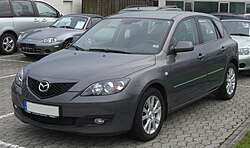 Hatchback (facelift)
 -
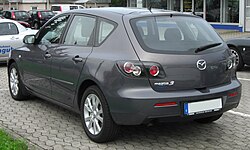 Hatchback (facelift)
 -
 Sedan (facelift)
 -
 Mazda3 Sport (facelift)


_Maxx_Sport_sedan_(2011-03-10).jpg)

2008
[edit]An additional trim level included the Sport GX with a 2.0 L engine, previously all Sport hatchbacks had a 2.3 L engine and came only in GS or GT trims. Compared to the GX sedan, the GX hatchback has body-colored door handles, and fog lamps. Options for the Sport GX include air conditioning, a convenience package containing power accessories and 15-inch alloys, and a rear trunk spoiler.[24]
The GS sedan received standard 16-inch alloy wheels, previously only available with the moonroof option, while the GX had 15-inch alloy wheels added to the convenience package (which includes steering-wheel mounted audio controls, power windows, power locks, and remote entry). The GS hatchback now comes with factory-installed air conditioning. GT models received standard xenon headlights, previously part of the leather package.[24]
In the U.S., the i Touring trim level was replaced by the i Touring Value model. This new model added a body-color front grille, fog lights and 17-inch alloy wheels, giving it a very similar appearance to the more expensive s models. The interior also received leather-covered steering wheel and shift knob from the s model. Anti-lock brakes and side-impact airbags, previously optional, were now standard.[24]
2009
[edit]Initial news reports indicated the 2009 model year would receive a minor facelift by the end of the year with exterior design modifications that included chrome door handles, a new roof spoiler, expanded use of black moldings on the rear bumper, and new alloy-wheel options.[26] This turned out to not occur in the US or Canadian market. The 2009 model year was only a few months long as production ceased in November 2008.[20][24]
Philippines
[edit]In the Philippines, the BK3 replaced the (BH) 323 in 2004. There are three trim levels, "1.6S", "1.6V and " 2.0R".[27] The "1.6V" is powered by Mazda's 1.6L inline-four engine mated to a 4-speed automatic transmission respectively. It came with four speakers and 6 CD audio system, central locking among other features.[28] The top spec "2.0R" is powered by Mazda's 2.0L MZR engine mated to a 4 speed automatic transmission with activematic. It came with side skirts, sunroof, remote keyless entry, immobilizer and leather interior.[27]
In 2007, the entry level "1.6S" received a minor update. Updates includes new gauge clusters, cloth seats and door linings, MP3 ready sound system, and a redesigned grill.[29]
Australia
[edit]In Australia, the BK 3 replaced the 323 (BJ) in January 2004. The original iteration came in several guises, "Neo", "Maxx", "Maxx Sport" and "SP23". The base "Neo" guise came with remote central locking, a four speaker sound system with a CD Player among other features. Building upon the Neo, the "Maxx" offered power windows and mirrors, alloy wheels, remote keyless central locking, six speakers and an in-dash sound system. The "Maxx Sport" added primarily cosmetic features, with that including a body kit, front fog lamps and larger alloy wheels. The "SP23" gained a larger engine as well as other smaller luxury features.[30]
In July 2006, Mazda introduced its Series II 3. Updates included refreshed front and rear light fixtures, as well updated alloy wheels and a new fog light configuration. A high performance "MPS" Hatch was introduced into the lineup within this update.[31]
The 3 continuously sold well throughout the BK generation, reaching 4th in Australian sales within 2006. The following table lists sales throughout its tenancy.
| Year | Yearly Sales | Total |
|---|---|---|
| 2004 | 22,046 | 166,615 |
| 2005 | 32,570 | |
| 2006 | 32,432 | |
| 2007 | 34,394 | |
| 2008 | 33,755 | |
| 2009 (Jan-Apr) | 11,418 |
Safety
[edit]| Test | Score | Rating |
|---|---|---|
| Adult occupant: | 33 |  
|
| Child occupant: | 32 |
|
| Pedestrian: | 15 |
|
ANCAP
[edit]Second generation (BL; 2008)
[edit]| Second generation | |
|---|---|
 Hatchback (pre-facelift) | |
| Overview | |
| Model code | BL |
| Production | November 2008 – June 2013[35] |
| Model years | 2010–2013 |
| Assembly |
|
| Designer | Kunihiko Kurisu (2006)[38] |
| Body and chassis | |
| Platform | Ford C1 platform |
| Related | |
| Powertrain | |
| Engine | |
| Transmission | |
| Dimensions | |
| Wheelbase | 2,640 mm (103.9 in) |
| Length | 4,595 mm (180.9 in) (sedan) 4,505 mm (177.4 in) (hatchback) |
| Width | 1,755 mm (69.1 in) |
| Height | 1,470 mm (57.9 in) |
| Curb weight | 1,260 kg (2,777.8 lb) |
In development from 2004 and designed under Kunihiko Kurisu from early 2005 to August 2006, in November 2008 Mazda debuted the second-generation Mazda3 with restyled exterior. Two engines were offered in the US and Canadian markets, the 2.0-litre petrol engine offered in the previous generation and a new 2.5 L inline-four shared with the second-generation Mazda6.[39]
The C1 architecture, a collaboration of Ford, Mazda, and Volvo,[40] is carried over from the previous generation[41] though marginally wider, longer and lighter than the previous generation. The 2.3L engine was replaced with a 2.5L engine that produces 167 bhp (125 kW; 169 PS) and 167 lb⋅ft (226 N⋅m) of torque in North American specs. In other markets, more engines are offered including a new 2.2 L turbo-diesel engine.[42] A 2010 Mazda3 with a 2.5 L engine and 6-speed manual transmission accelerates from 0–60 mph (0–97 km/h) in 7.4 seconds and completes the quarter mile in 15.7 seconds at 87 mph (140 km/h).[43]
-
 Hatchback (pre-facelift)
 -
 Sedan (pre-facelift)
 -
 Interior

_Neo_sedan_(2018-09-17)_02.jpg)

2010
[edit]Mazda unveiled the 2010 Mazda3 sedan/saloon at the Los Angeles Auto Show on 19 November 2008. The second-generation Mazda3 is slightly larger than the older Mazda3 and was available in "i" and "s" versions. The "i" (GX or GS in Canada) is powered by a 148 bhp (110 kW) 2.0 L engine while the "s" (GT in Canada) is powered by a 167 bhp (125 kW) 2.5 L engine adapted from the Mazda6.[44] Both engines are also available in PZEV versions in the US, the 2.0 L producing 144 bhp (107 kW) and the 2.5 L producing 165 bhp (123 kW).[45] The 3s Grand Touring trim level adds leather seats, power driver's seat, rain-sensing windshield wipers, dual-zone automatic climate control, and steerable active bi-xenon headlights as standard equipment.[44] The hatchback was unveiled a few weeks after the sedan/saloon at the Bologna Motor Show.
The European model includes a start-stop system with the 2.0L DISI engine with an estimated increase fuel economy in city cycle by roughly 12%.[46]
Midway through 2010, features including side mirrors with integrated turn signals, footwell lighting, and power seat memory functions were removed.[citation needed]
Mazdaspeed3
[edit]Full details and images of the high-powered Mazdaspeed3 (known as the Mazda3 MPS in Europe or Mazdaspeed Axela in Japan) were released at the Geneva Motor Show in March 2009.[47] Like the previous generation, the Mazda3 hatchback variant has been selected as the basis for the second generation Mazdaspeed3.
2012 update
[edit]The 2012 Mazda3 with Skyactiv powertrain was unveiled at the Canadian International Auto Show in Toronto, February 2011. It comes with Mazda's Skyactiv-G 2.0-litre, direct-injection petrol engine, and Skyactiv-Drive 6-speed automatic or Skyactiv-MT 6-speed manual transmission.[48] The chassis rigidity was increased with the use of additional high tensile steel most significantly in the centre floor pan and B-pillar where reinforcement was extended 7 inches.[49] Additionally, Mazda increased the number of spot welds to join suspension crossmembers to improve handling and stability.[50] There are minor exterior updates: revised grille and air intakes, and a reshaped rear valance panel. Skyactiv models receive a blue ring around the projectors in the headlamps, a Sky Blue engine cover, as well as an optional Skyactiv specific paint color known as Sky Blue.[51] Car and Driver reported that such a Mazda3 can reach estimated EPA fuel-economy ratings of 30 mpg city and 39 to 40 highway.[52]
-
 Hatchback (facelift)
 -
 Hatchback (facelift)
 -
 Sedan (facelift)

_Neo_hatchback_(2016-04-07)_02_(2).jpg)
_SP20_SKYACTIV_sedan_(2018-10-01)_02.jpg)
Engines
[edit]| Model | Type | Power, torque@rpm | CO2 emissions (g/km) |
|---|---|---|---|
| Japanese models | |||
| ZY-VE | 1,498 cc (91.4 cu in) I4 | 111 PS (82 kW; 109 hp) at 6000, 140 N⋅m (103 lb⋅ft) at 4500 | |
| LF-VDS | 1,999 cc (122.0 cu in) I4 | 150 PS (110 kW; 148 hp) at 6200, 186 N⋅m (137 lb⋅ft) at 4500 | |
| LF-VE | 1,999 cc (122.0 cu in) I4 | 143 PS (105 kW; 141 hp) at 6500, 179 N⋅m (132 lb⋅ft) at 4000 | |
| L3-VDT | 2,261 cc (138.0 cu in) I4 turbo | 264 PS (194 kW; 260 hp) at 5500, 380 N⋅m (280 lb⋅ft) at 3000 | |
| European models | |||
| 1.6 DOHC | 1,598 cc (97.5 cu in) I4 | 105 PS (77 kW; 104 hp) at 6000, 145 N⋅m (107 lb⋅ft) at 4000 | 149 |
| 2.0 DOHC w/ AT | 1,999 cc (122.0 cu in) I4 | 150 PS (110 kW; 148 hp) at 6500, 187 N⋅m (138 lb⋅ft) at 4000 | 175 |
| 2.0 DOHC DISI w/i-stop | 1,999 cc (122.0 cu in) I4 | 151 PS (111 kW; 149 hp) at 6200, 191 N⋅m (141 lb⋅ft) at 4500 | 159 |
| MPS DOHC DISI | 2,261 cc (138.0 cu in) I4 turbo | 260 PS (191 kW; 256 hp) at 5500, 380 N⋅m (280 lb⋅ft) at 3000 | 224 |
| 1.6 8V SOHC | 1,560 cc (95 cu in) I4 diesel | 85 kW (116 PS; 114 hp) at 3600, 270 N⋅m (199 lb⋅ft) at 1750–2500 | 114 |
| 2.2 DOHC | 2,184 cc (133.3 cu in) I4 diesel | 150 PS (110 kW; 148 hp) at 3500, 360 N⋅m (266 lb⋅ft) at 1800 | 144 |
| 2.2 DOHC | 2,184 cc (133.3 cu in) I4 diesel | 185 PS (136 kW; 182 hp) at 3500, 400 N⋅m (295 lb⋅ft) at 1800 | 149 |
| US models | |||
| 4-door i | 1,999 cc (122.0 cu in) I4 | 150 hp (112 kW; 152 PS) at 6500, 183 N⋅m (135 lb⋅ft) at 4500 | |
| Skyactiv-G 2.0 | 1,999 cc (122.0 cu in) I4 | 157 hp (117 kW; 159 PS) at 6000, 201 N⋅m (148 lb⋅ft) at 4100 | |
| 4-door i PZEV | 1,999 cc (122.0 cu in) I4 | 146 hp (109 kW; 148 PS) at 6500, 179 N⋅m (132 lb⋅ft) at 4500 | |
| 4/5-door s | 2,488 cc (151.8 cu in) I4 | 169 hp (126 kW; 171 PS) at 6000, 228 N⋅m (168 lb⋅ft) at 4000 | |
| 4-door s PZEV | 2,488 cc (151.8 cu in) I4 | 167 hp (125 kW; 169 PS) at 6000, 226 N⋅m (167 lb⋅ft) at 4000 | |
| MAZDASPEED3 | 2,261 cc (138.0 cu in) I4 turbo | 267 hp (199 kW; 271 PS) at 5500, 380 N⋅m (280 lb⋅ft) at 3000 | |
| Canadian models | |||
| 4-door GX, GS | 1,999 cc (122.0 cu in) I4 | 150 hp (112 kW; 152 PS) at 6500, 183 N⋅m (135 lb⋅ft) at 4500 | |
| 4-door GT | 2,488 cc (151.8 cu in) I4 | 169 hp (126 kW; 171 PS) at 6000, 228 N⋅m (168 lb⋅ft) at 4000 | |
| 5-door GX | 1,999 cc (122.0 cu in) I4 | 150 hp (112 kW; 152 PS) at 6500, 183 N⋅m (135 lb⋅ft) at 4500 | |
| 5-door GS, GT | 2,488 cc (151.8 cu in) I4 | 169 hp (126 kW; 171 PS) at 6000, 228 N⋅m (168 lb⋅ft) at 4000 | |
| 5-door GS-SKY | 1,999 cc (122.0 cu in) I4 | 157 hp (117 kW; 159 PS) at 6000, 201 N⋅m (148 lb⋅ft) at 4100 | |
| MAZDASPEED3 | 2,261 cc (138.0 cu in) I4 turbo | 267 hp (199 kW; 271 PS) at 5500, 380 N⋅m (280 lb⋅ft) at 3000 | |
| Thailand models | |||
| 1.6 Groove / Groove Sports / Spirit / Spirit Sports | 1,598 cc (97.5 cu in) I4 | 105 PS (77 kW; 104 hp) at 6000, 145 N⋅m (107 lb⋅ft) at 4000 | 149 |
| 2.0 Maxx / Maxx Sports | 1,999 cc (122.0 cu in) LF-VD I4 | 150 PS (110 kW; 148 hp) at 6500, 187 N⋅m (138 lb⋅ft) at 4000 | 175 |
| Australian models | |||
| Neo/Maxx (Sport) | 1,999 cc (122.0 cu in) I4 | 110 kW (148 hp) at 6500, 183 N⋅m (135 lb⋅ft) at 4500 | |
| SP20 (2012) | 1,999 cc (122.0 cu in) I4 | 114 kW (153 hp) at 6000, 194 N⋅m (143 lb⋅ft) at 4100 | |
| Diesel | 2,183 cc (133.2 cu in) I4 | 110 kW (148 hp) at 3500, 360 N⋅m (266 lb⋅ft) at 1800–3000 | |
| SP25 | 2,488 cc (151.8 cu in) I4 | 124 kW (166 hp) at 6000, 228 N⋅m (168 lb⋅ft) at 4000 | |
| MPS | 2,261 cc (138.0 cu in) I4 turbo | 190 kW (255 hp) at 5500, 380 N⋅m (280 lb⋅ft) at 3000 | |
Safety
[edit]| Test | Points | % |
|---|---|---|
| Overall: |
| |
| Adult occupant: | 30.8 | 86% |
| Child occupant: | 41 | 84% |
| Pedestrian: | 18.2 | 51% |
| Safety assist: | 5 | 71% |
Starting with the 2009 facelift and ever since, the Mazda3 has received a 5/5 star ANCAP rating.[54]
Third generation (BM/BN/BY; 2013)
[edit]| Third generation | |
|---|---|
_SKYACTIV_hatchback_(2014-03-15)_01.jpg) Hatchback (pre-facelift) | |
| Overview | |
| Model code | BM / BN / BY |
| Production | June 2013 – 2018 |
| Model years | 2014–2018 |
| Assembly |
|
| Designer | Koichi Tabata (2011) |
| Body and chassis | |
| Related | Mazda CX-5 (KF) |
| Powertrain | |
| Engine |
|
| Electric motor | AC synchronous motor |
| Transmission |
|
| Hybrid drivetrain | Power-split hybrid (Mazda3 Hybrid) |
| Battery | 1.3 kWh Nickel-metal hydride |
| Dimensions | |
| Wheelbase | 2,700 mm (106.3 in) |
| Length | 4,580 mm (180.3 in) (sedan) 4,460 mm (175.6 in) (hatchback) |
| Width | 1,795 mm (70.7 in) |
| Height | 1,455 mm (57.3 in) |
| Curb weight | 1,300–1,315 kg (2,866–2,899 lb) |
The third-generation 2014 Mazda3 was revealed in Australia on 26 June 2013.[57] It now sits atop the new Skyactiv chassis, no longer sharing the Ford C1 platform.[58] It is the third vehicle to adopt Mazda's 'Kodo' design language, after the CX-5 and the Mazda6. It is the first Mazda3 to not be produced under Ford's ownership of Mazda.
It has a drag coefficient (Cd) of 0.26 for the sedan/saloon, slightly higher for the hatchback.[59] Combined with the Skyactiv technology, this produces a rating from the U.S. EPA of 30 mpg‑US (36 mpg‑imp; 7.8 L/100 km) city and 41 mpg‑US (49 mpg‑imp; 5.7 L/100 km) highway for the 2-litre sedan, and one less mpg highway for the 5-door hatchback.[60]
Two Skyactiv engines are offered in North American markets, the 2.0-litre (with 155 hp (116 kW) and 150 lb⋅ft (200 N⋅m) of torque) and the 2.5-litre (with 184 hp and 185 lb-ft of torque). The 2014 Mazda3 equipped with a 2.5-litre engine and 6-speed automatic transmission accelerates from 0-60 mph (97 km/h) in 6.9 seconds and finishes the quarter mile in 15.2 seconds at 95 mph (153 km/h).[61]
The 2.0-litre engine with the 6-speed manual transmission accelerates from 0–60 mph (0–97 km/h) in 7.8 seconds and finishes the quarter-mile in 16.1 seconds.[62] Initially the 6-speed manual gearbox was only for the 2.0-litre cars, and automatic transmission was standard on the 2.5, or available for the 2.0. In its first-drive review of the 2014 Mazda3, the auto enthusiast weblog Jalopnik stated that "once the 2.5 comes with a manual transmission, there is really no reason to buy anything else in this class."[63]
-
 Hatchback (pre-facelift)
 -
 Sedan
Sedan -
 Interior


2015
[edit]For the 2015 model year in North America, the 2.5-litre cars are also offered with manual gearbox. Model trim levels for the U.S. market are SV (2.0 Sedan only), Sport (2.0 Sedan and Hatchback), Touring, and Grand Touring (available in all body styles with either engine). The 2014 model ranked number one among Affordable Small Cars in U.S. News & World Report's rankings.[64] In the 2014 Canadian Car of the Year rankings Mazda3 was chosen as the Best New Small Car.[65] Canadian magazine The Car Guide chose Mazda3 as the Best Compact Car in its Best Buys car rankings for 2015 and 2016.[66]
In Europe, three Skyactiv-G (petrol) engines are offered, one 1.5L and two 2.0L (at two different power ratings, 120 and 165 PS (88 and 121 kW)); and a 2.2L Skyactiv-D (Diesel) engine is available. Availability of hatchback and sedan/saloon body styles and their combinations with engines varies amongst European markets. In 2014, the Mazda3 made it to the finals of the European Car of the Year competition. For the UK market, the Mazda3 Sedan was marketed as a fastback.
Thailand models of Mazda3 went on sale on 18 March 2014.[67][68]
A concept version of the Mazda3, with an engine powered by compressed natural gas, was unveiled in 2013 at the Tokyo Motor Show.[69][70][71][72]
In Malaysia, the third-generation Mazda3 was first launched in March 2014 fully imported from Japan and was available with a sole 2.0L sedan variant.[73] In April 2015, locally assembled versions of the Mazda3 became available for purchase.[74] In April 2017, the facelift version was launched with 3 offerings, the Sedan GL, Sedan High and Hatchback.[75]
Mazda3 Skyactiv-Hybrid
[edit]The Mazda3 Skyactiv-Hybrid is a version of the Mazda3 with Skyactiv-G 2.0 engine with 14:1 compression and electric-petrol drive. The vehicle was unveiled at the 2013 Tokyo Motor Show.[69][70]
Production
[edit]Taiwan models of the Mazda3 were produced by Ford Lio Ho Motor Co., Ltd.[76][77]
Production of the US market Mazda3 sedan at Mazda de Mexico Vehicle Operation (MMVO) in Salamanca, Guanajuato began on 7 January 2014, as the factory's first production vehicle model.[78][79]
As of 22 January 2014, cumulative production of the Mazda3 production reached four million units since June 2003.[80][81]
Production of Thailand market Mazda3 at AutoAlliance (Thailand) Co., Ltd. (AAT) began on 14 March 2014.[67][68] Within months of release, the 3 was the 15th best-selling car in Thailand.
2016 facelift
[edit]The facelifted model of the Mazda3 was introduced in August 2016, bearing the BN model code. Changes include a new dashboard layout, new front and rear exterior styling (the latter, only in the hatchback), new first-of-its-kind G-Vectoring Control and the removal of the diesel engine option. Safety and driver assistance features were also improved, adding a traffic sign-recognition sensor[82] and pedestrian detection with the pre-collision braking system.[83]
This facelift debuted in North America for the 2017 model year. In the United States, the "i" and "s" monikers were dropped, leaving the Sport (2.0), Touring (2.5), and Grand Touring (2.5) trim levels.
-
 Mazda3 hatchback (facelift)
 -
 Mazda Axela Sport (facelift)
_1X7A7263.jpg)

Powertrains
[edit]| Model | Type | Power, torque @rpm | CO2 emissions (g/km) |
|---|---|---|---|
| European models | |||
| G100 | 1,496 cc (91.3 cu in) I4 | 100 PS (74 kW; 99 hp), 150 N⋅m (111 lb⋅ft) @4000 | 119 |
| G120 | 1,998 cc (121.9 cu in) I4 | 120 PS (88 kW; 118 hp), 210 N⋅m (155 lb⋅ft) @4000 | 119 |
| G120 AT | 1,998 cc (121.9 cu in) I4 | 120 PS (88 kW; 118 hp), 210 N⋅m (155 lb⋅ft) @4000 | 129 |
| G165 | 1,998 cc (121.9 cu in) I4 | 165 PS (121 kW; 163 hp), 210 N⋅m (155 lb⋅ft) @4000 | 135 |
| CD150 | 2,191 cc (133.7 cu in) I4 diesel | 150 PS (110 kW; 148 hp), 380 N⋅m (280 lb⋅ft) @1800 | 107 |
| CD150 AT | 2,191 cc (133.7 cu in) I4 diesel | 150 PS (110 kW; 148 hp), 380 N⋅m (280 lb⋅ft) @1800 | 127 |
| Australian models | |||
| Neo, Maxx, Touring | 1,998 cc (121.9 cu in) I4 | 114 kW (153 hp), 200 N⋅m (148 lb⋅ft) @4000 | N/A |
| SP25, SP25 GT, Astina | 2,488 cc (151.8 cu in) I4 | 137 kW (184 hp), 251 N⋅m (185 lb⋅ft) @3250 | N/A |
| Astina diesel | 2,191 cc (133.7 cu in) I4 diesel | 129 kW (173 hp), 420 N⋅m (310 lb⋅ft) @2000 | N/A |
| American models | |||
| i SV (2014-2015), i Sport, i Touring, i Grand Touring | 1,998 cc (121.9 cu in) I4 | 155 hp (116 kW) @6000, 150 lb⋅ft (203 N⋅m) @4000 | N/A |
| s Touring, s Grand Touring | 2,488 cc (151.8 cu in) I4 | 184 hp (137 kW) @5700, 185 lb⋅ft (251 N⋅m) @3250 | N/A |
| Canadian models | |||
| G, GX, GS, SE, 50th Anniv. Ed. (limited) | 1,998 cc (121.9 cu in) I4 | 155 hp (116 kW) @6000, 150 lb⋅ft (203 N⋅m) @4000 | N/A |
| GT | 2,488 cc (151.8 cu in) I4 | 184 hp (137 kW) @5700, 185 lb⋅ft (251 N⋅m) @3250 | N/A |
| Thai models | |||
| Entry (E), Core (C), High (S), High Plus (SP) | 1,998 cc (121.9 cu in) I4 | 163 hp (165 PS; 122 kW) @6000, 155 lb⋅ft (210 N⋅m) @4000 | N/A |
Safety
[edit]| Test | Points | % |
|---|---|---|
| Overall: |
| |
| Adult occupant: | 33.8 | 93% |
| Child occupant: | 42.4 | 86% |
| Pedestrian: | 23.7 | 65% |
| Safety assist: | 7.3 | 81% |
In 2016 the Mazda3 received a 5/5 ANCAP rating.[85]
Fourth generation (BP; 2019)
[edit]| Fourth generation | |
|---|---|
 Hatchback | |
| Overview | |
| Model code | BP |
| Production | 2019–present |
| Model years | 2019–present |
| Assembly |
|
| Designer | Yasutake Tsuchida (2016)[89] |
| Body and chassis | |
| Platform | Small Product Group |
| Related | |
| Powertrain | |
| Engine |
|
| Electric motor | 6.5 PS Integrated starter motor generator |
| Transmission |
|
| Hybrid drivetrain | MHEV (e-Skyactiv G and e-Skyactiv X) |
| Battery | 24 V lithium-ion |
| Dimensions | |
| Wheelbase | 2,725 mm (107.3 in) |
| Length | 4,660 mm (183.5 in) (sedan) 4,460 mm (175.6 in) (hatchback) |
| Width | 1,795 mm (70.7 in) |
| Height | 1,440–1,445 mm (56.7–56.9 in) (sedan) 1,435–1,440 mm (56.5–56.7 in) (hatchback) |
An early design prototype of the fourth-generation Mazda3 hatchback was revealed at the 2007 Los Angeles Auto Show on 17 November 2007. The prototype was sculpted live during the event from clay, based on a design by University of Notre Dame industrial design student Mallory McMorrow. The prototype was the winning entry in the Mazda Design Challenge, in which Mazda teamed up with Facebook to seek design input from college students.[92][93][94]
The fourth-generation Mazda3 hatchback and sedan were officially unveiled at the 2018 Los Angeles Auto Show on 28 November 2018, and global sales began in early 2019, as the 2019 model year in North America.[95] The model was previously previewed by the Kai Concept, first shown in October 2017. With the release of the fourth generation model, the "Axela" nameplate was no longer used in the Japanese domestic market as part of Mazda's standardized global naming structure.[96]
Designed from 2015 to late 2016 under the lead of Yasutake Tsuchida, the model is slightly lower and longer than before, with its wheelbase stretched by 25 mm (1.0 in). The exterior design of the sedan and hatchback models are heavily differentiated, with both models only sharing the hood and headlights, while front wing fenders and front doors are designed uniquely for each body styles. Its body uses an increased amount of ultra-high-strength steel 980 MPa or higher to 30 percent of the vehicle body, an increase over the 3 percent in the prior generation.[97]
Mazda has swapped the more sophisticated multilink independent rear suspension from its predecessor for a cheaper and more compact torsion beam setup which is claimed to improve the car's quietness, along with the added sound deadening materials.[97] To enhance the vehicle's NVH, Mazda included a 'two-wall' structure that leaves space between the body and carpeting on the floor.[97] The model is also equipped with an updated version of the torque vectoring system marketed as the G-Vectoring Control Plus.[98]
Interior materials are upgraded with a stitched dash pad, metal trim for the climate control knobs and central infotainment controller, a new steering wheel design, and a newly developed 8.8-inch display screen with a redesigned Mazda Connect system interface. A dark red leather upholstery color is offered for the hatchback model.[98]
Production of the model in Thailand at the AutoAlliance Thailand in Rayong started on 28 August 2019.[99]
-
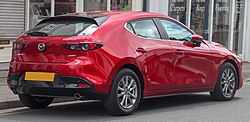 Rear view (hatchback)
 -
 Mazda3 sedan
 -
 Rear view (sedan)
 -
 Interior


Markets
[edit]Asia
[edit]Brunei
[edit]The Mazda3 was launched in Brunei on 27 July 2019, in both hatchback and sedan body styles, each is available in Core and High trim levels. Engine options include a 1.5-litre (for the Core trim) and 2.0-litre (for the High trim) Skyactiv-G petrol engines.[100]
Indonesia
[edit]The Mazda3 was officially launched in Indonesia at the 27th Gaikindo Indonesia International Auto Show on 18 July 2019, in both hatchback and Sedan bodystyles, each in a sole variant powered by a 2.0-litre Skyactiv-G petrol engine.[101]
Japan
[edit]The Mazda3 went on sale in Japan on 24 May 2019, in both hatchback and sedan body styles. At launch, the trim levels were: Standard, Touring, Proactive, Proactive Touring Selection, L Package, and Burgundy Selection. Four engine options were available: 1.5-litre Skyactiv-G petrol (15S), 2.0 Skyactiv-G petrol (20S), 1.8 Skyactiv-D diesel (XD), and a 2.0 Skyactiv-X petrol (X) released at a later date.[102] All powertrains have the option of all wheel drive available from February 2020.[103]
In April 2023, the minor facelift saw the Mazda3 range restructured to three trim levels: Smart Edition, Proactive Touring Selection, and Black Tone Edition. The 1.5-litre Skyactiv-G petrol (15S) and 2.0 Skyactiv-X petrol (X) only available for the hatchback, the latter option become exclusively all wheel drive.[104]
Malaysia
[edit]The Mazda3 was launched in Malaysia on 17 July 2019, in both hatchback and sedan body styles, with three variants available at launch: 1.5, 2.0 High (only for sedan), and 2.0 High Plus. It is available with either 1.5-litre and 2.0-litre Skyactiv-G petrol engines.[105] The Ignite Edition based on the 2.0 High Plus variant only for the hatchback was introduced in March 2022.[106]
In October 2023, the Mazda3 range was revised with updated equipment and a simplified line-up, with the 1.5 Skyactiv-G petrol engine dropped. Four variants are available: High sedan, High Plus sedan, High Plus hatchback, and Ignite Edition hatchback.[107]
Philippines
[edit]The Mazda3 was launched in the Philippines on 14 August 2019, in both hatchback (as 'Sportback') and sedan body styles, with 3 trim levels available at launch: Elite, Premium, and Speed (only for Sportback), it is available with either 1.5-litre and 2.0-litre Skyactiv-G petrol engines.[108] The mild hybrid versions of the Mazda3 were introduced as the e-Skyactiv-G in October 2021.[109]
Singapore
[edit]The Mazda3 was launched in Singapore by Eurokars on 20 July 2019, in both hatchback and sedan body styles, with three trim levels available: Classic (only for the sedan), Elegance, and Astina, it is powered by a 1.5-litre Skyactiv-G petrol engine with M Hybrid technology.[110]
Thailand
[edit]The Mazda3 was launched in Thailand on 18 September 2019, in both hatchback (marketed as Fastback/Sports) and sedan body styles, with 3 trim levels: C, S, and SP, it is powered by a 2.0-litre Skyactiv-G petrol engine. It is locally assembled at the AutoAlliance Thailand plant in Rayong.[111] The Carbon Edition was introduced for both hatchback and sedan in October 2022.[112]
Vietnam
[edit]The Mazda3 was launched in Vietnam on 4 November 2019, in both hatchback (as 'Sport'), and sedan body styles, with 3 trim levels available at launch: Deluxe, Luxury, and Premium. Engine options include a 1.5-litre and 2.0-litre Skyactiv-G petrol engines. Both bodystyles are locally assembled at Truong Hai Auto Corporation plant in Quảng Nam Province.[113] In September 2022, Mazda dropped the 2.0-litre Skyactiv-G petrol engine option in Vietnam, with the trim levels remain unchanged.[114]
Cambodia
[edit]The Mazda3 is officially distributed in Cambodia through Mazda Cambodia, with authorized showrooms located in Phnom Penh, including branches on Monivong Boulevard and Hun Sen Boulevard.[115] The model was launched on 9 August 2019 and is available in both sedan and hatchback body styles, featuring trim levels and specifications aligned with regional offerings. Engine options include the 1.5-litre and 2.0-litre Skyactiv-G petrol engines, paired with automatic transmissions.[116]
Unlike in Vietnam, the Mazda3 is not locally assembled in Cambodia; instead, it is imported as a completely built-up (CBU) unit from regional manufacturing hubs. As of 2025, the Mazda3 remains a popular model in the Cambodian market, with both new and used units widely available through official dealerships and online platforms.[117]
Europe
[edit]The Mazda3 made its European debut in March 2019, in both hatchback and sedan body styles. Three engines were available at launch: 1.8-litre Skyactiv-D diesel, 2.0-litre Skyactiv-G mild hybrid petrol, and a 2.0-litre Skyactiv-X petrol. The AWD option was available except for the 1.8 Skyactiv-D.[118]
Mexico
[edit]The Mazda3 was launched in Mexico in February 2019, the first country to make its global debut in both hatchback and sedan body styles. At launch, three trim levels were available: i (only for Sedan), i Sport and i Grand Touring. All variants are powered by a 2.5-litre Skyactiv-G petrol engine.[119] For Mexico, the Mazda3 is locally built at the Mazda de México Vehicle Operation (MMVO).
In July 2020, the 2.5-litre turbocharged petrol engine was added to the range, it came only as a Hatchback body style, it is available in two trim levels: i Grand Touring and Signature.[120]
In January 2022, the Mazda3 Sedan receives the turbocharged engine option for the Signature trim, and the e-Skyactiv-G mild hybrid petrol for the i-Sport trim.[121]
North America
[edit]The Mazda3 made its North American debut in March 2019, in both hatchback (as 'Sport' in Canada) and sedan body styles. Two engines were available at launch: 2.0-litre Skyactiv-G petrol (not available in US) and 2.5-litre Skyactiv-G petrol, with the option of all wheel drive for the first time. For the US market, there were three packages available: Select, Preferred, and Premium.[122] For Canadian market, there were three trim levels available: GX, GS, and GT. There were Convenience, Luxury, and Premium packages available solely for each trim.[123] In 2020, for the 2021 model year, the 2.5-litre turbo petrol engine was made available, with standard all-wheel drive.[124]
Oceania
[edit]Australia
[edit]The Mazda3 went on sale in Australia in April 2019, firstly as a hatchback, with five trim levels: Pure, Evolve, Touring, GT, and Astina. It is available with either 2.0-litre (G20) and 2.5-litre (G25) Skyactiv-G petrol engines.[125] The sedan version followed in May 2019, with the same trim levels and engine line-up as the hatchback.[126] The Skyactiv-X petrol (X20) was made available for the Astina trim in September 2020.[127] The 2.0 Skyactiv-G mild hybrid petrol (G20e) was made available for the Evolve trim in November 2021.[128] In July 2023, mild hybrid Skyactiv-G, Skyactiv-X and manual transmission options for the Mazda3 range were axed.[129]
New Zealand
[edit]The Mazda3 went on sale in New Zealand on 1 June 2019, in both hatchback and sedan body styles, with three trim levels available at launch: GSX, GTX, and Limited. It is available with either 2.0-litre and 2.5-litre Skyactiv-G petrol engines.[130] The Skyactiv-X petrol in the Takami trim was added in October 2020.[131]
Africa
[edit]South Africa
[edit]The Mazda3 was launched in South Africa on 17 July 2019, in both hatchback and sedan body styles, with four trim levels available at launch: Active, Dynamic, Individual and Astina. It is available with either 1.5-litre and 2.0-litre Skyactiv-G petrol engines.[132] The sedan bodystyle was discontinued in South Africa in September 2021, as Mazda South Africa stated that South Africans prefer compact crossovers and SUVs over sedans.[133] In August 2023, the Mazda3 range was simplified from six to three variants, with the discontinuation of the Active and Individual trim levels but engine options remain the same.[134]
Powertrain
[edit]In some markets, the fourth-generation Mazda3 can be equipped with a homogeneous charge compression ignition engine called the Skyactiv-X. The 2.0-litre Skyactiv-X engine initially produced 132.5 kW (178 hp; 180 PS) and 224 N⋅m (165 lb⋅ft) of torque, though its updated version, dubbed e-Skyactiv-X, and launched at the beginning of 2021, produces 140 kW (188 hp; 190 PS) in Japan and 137 kW (184 hp; 186 PS) in other markets, with the torque being augmented to 240 N⋅m (177 lb⋅ft).
The 1.5-, 2.0- and 2.5-litre versions of the current Skyactiv petrol engine line are offered, as well as the 1.8-litre Skyactiv-D diesel engine. Transmission options consist of the 6-speed Skyactiv-MT manual and the Skyactiv-Drive automatic.[135] Initial release in North America only included the 2.5-litre petrol engine.[98]
Mazda introduced an all-wheel drive version of the 2.5-litre turbocharged petrol engine for model year 2021 which is exclusively mated to a six-speed automatic transmission.[136] In the Australian market, the fourth-generation Mazda3 along with the CX-30 are available with the e-SkyActiv G MHEV engine, for improved acceleration and fuel economy.[137]
Safety
[edit]The Mazda3 has disc brakes on all wheels.[138]
Euro NCAP
[edit]| Test | Points | % |
|---|---|---|
| Overall: |
| |
| Adult occupant: | 37.5 | 98% |
| Child occupant: | 43 | 87% |
| Pedestrian: | 39.2 | 81% |
| Safety assist: | 9.5 | 73% |
IIHS
[edit]The 2022 Mazda3 was tested by the Insurance Institute for Highway Safety (IIHS) and received a Top Safety Pick+ award:[140]
| Small overlap front (Driver) | Good | |||
| Small overlap front (Passenger) | Good | |||
| Moderate overlap front | Good | |||
| Side (original test) | Good | |||
| Side (updated test) | Good | |||
| Roof strength | Good | |||
| Head restraints and seats | Good | |||
| Headlights |
|
varies by trim/option. Specifically the auto-leveling LED headlights upped the rating from Acceptable to Good. | ||
| Front crash prevention (Vehicle-to-Vehicle) | Superior | |||
| Front crash prevention (Vehicle-to-Pedestrian, day) | Superior | |||
| Child seat anchors (LATCH) ease of use | Good+ |
In 2024, Mazda3 was likewise named one of the safest cars available in the US, according to IIHS ratings.[141]
ANCAP
[edit]| Test | Points | % |
|---|---|---|
| Overall: |
| |
| Adult occupant: | 37.5 | 98% |
| Child occupant: | 43.8 | 89% |
| Pedestrian: | 39.2 | 81% |
| Safety assist: | 9.9 | 76% |
Motorsports
[edit] | This section may need to be rewritten to comply with Wikipedia's quality standards. (November 2020) |
- The Mazda3 was introduced to the Speed World Challenge in 2009.
- Team Sahlen entered a Mazda3 in the Continental Tire Sports Car Challenge Street Tuner class in 2010.[143]
- Mazda South Africa, in conjunction with MFC (a vehicle finance house) entered two Mazda3 MPS models into Class-T of the South African Production Car Championship from 2007 to 2010.
- Mazda3 is used in the seed category NASCAR Stock V6 Series in Mexico.[144]
- The 2020 Mazda3 TCR program was announced in October 2019[145] but canceled in August 2020 due to the COVID-19 pandemic.[146]
Awards
[edit]The fourth generation Mazda3 won the World Car Design of the Year award in 2020, granted by the World Car Awards (WCA).[147]
In 2024, the Mazda3 was one of four compact cars listed on Car and Driver's Editors' Choice.[148]
Sales
[edit]| Year | Japan[149] | U.S.[150][151] | Europe[i][152] | Canada[153] | Australia | China[154] | Thailand[155] | Vietnam | Mexico[156] | Generation |
|---|---|---|---|---|---|---|---|---|---|---|
| 2003 | 5,474 | 2,081 | 5,841 | 1st Gen. (2003 - 2008) | ||||||
| 2004 | 29,921 | 76,080 | 68,604 | 22,046 | ||||||
| 2005 | 26,331 | 97,388 | 85,267 | 32,570 | 534 | |||||
| 2006 | 24,200 | 94,438 | 74,802 | 32,432 | 1,186 | 4,750 | ||||
| 2007 | 22,909 | 120,291 | 68,291 | 34,394 | 35,844 | 6,939 | ||||
| 2008 | 16,647 | 109,957 | 49,355 | 33,755 | 29,225 | 9,502 | ||||
| 2009 | 26,761 | 96,466 | 53,096 | 46,943 | 35,298 | 48,228 | 9,217 | 2nd Gen. (2008 - 2013) | ||
| 2010 | 26,509 | 106,353 | 49,175 | 47,740 | 39,003 | 68,616 | 12,016 | |||
| 2011 | 18,859 | 102,417 | 34,983 | 37,224 | 41,429 | 50,647 | 13,559 | |||
| 2012 | 16,229 | 123,361 | 25,027 | 39,295 | 44,128 | 20,878 | 11,202 | |||
| 2013 | 17,158 | 104,713 | 24,796 | 40,466 | 42,082 | 12,044 | 12,315 | |||
| 2014 | 42,527 | 104,985 | 48,096 | 40,974 | 43,313 | 42,927 | 8,937 | 20,130 | 3rd Gen. (2013 - 2019) | |
| 2015 | 25,102 | 107,884 | 49,766 | 34,811 | 38,644 | 94,108 | 7,143 | 29,982 | ||
| 2016 | 26,343 | 95,567 | 45,889 | 27,689 | 36,107 | 132,784 | 4,121 | 24,611 | ||
| 2017 | 25,837 | 75,018 | 43,794 | 27,862 | 32,690 | 142,498 | 4,979 | 20,742 | ||
| 2018 | 17,767 | 64,638 | 38,514 | 26,728 | 31,065 | 121,051 | 5,255 | 1,038 | 20,433 | |
| 2019 | 30,729 | 50,741 | 34,874 | 21,276 | 24,939 | 98,553 | 4,717 | 7,648 | 22,520 | 4th Gen. (2019- |
| 2020 | 19,215 | 33,608 | 26,458 | 14,788[157] | 14,663 | 85,191 | 2,903 | 9,148 | 16,485 | |
| 2021 | 16,361 | 37,653 | 22,554 | 11,804[157] | 14,126 | 88,774 | 1,982 | 5,333[158] | 16,560 | |
| 2022 | 14,020 | 27,767 | 15,316 | 8,044[159] | 9,639[160] | 60,029[161] | 1,553[162] | 9,812[163] | 13,042[164] | |
| 2023 | 14,310 | 30,531 | 10,880[165] | 9,079[166] | 49,419[161] | 884[167][168] | 6,718[169] | 26,589[170] | ||
| 2024 | 11,804 | 38,877[171] | 10,263[172] | 10,528[173] | 29,563[174] | 487[175] | 4,958[176] | 24,632 |
- ^ Europe: 2020 EU 27 + UK + Switzerland + Norway + Iceland
References
[edit]- ^ "【マツダ3 新型】丸本社長「全ての領域をしっかり磨いた」…新車名の他車種展開は未定". レスポンス(Response.jp). 25 May 2019.
- ^ "Mazda begins production of fourth new generation product". media.ford.com. Archived from the original on 23 January 2013. Retrieved 26 May 2012.
- ^ "Mazda 3[Axela] Japanese product page". Archived from the original on 17 May 2013. Retrieved 30 March 2013.
- ^ "「アクセラ」が教習車に選ばれる理由とは?!その秘密にせまります! - 【MAZDA】マツダ公式ブログ (Mazda Japan naming inspiration)". Zoom-Zoom Blog.
- ^ "Mazda Launches Second SkyActiv Model". mazda.com. 27 September 2011. Retrieved 28 September 2012.
- ^ "Mazda 3 (2019) : la nouvelle génération dévoilée au salon de Los Angeles". Auto moto. 28 November 2018.
- ^ a b "Mazda Reveals All-New Mazda3". mazda.com. 28 November 2018. Retrieved 8 February 2019.
- ^ "The All-New Mazda3 Marks A New Era For Mazda". eurokarsgroup.com. 10 January 2019. Retrieved 8 February 2019.
- ^ "Mazda3 Starts Second Generation: Company spiffs up its best seller for LA Auto Show". Oncars.com. Retrieved 25 November 2013.
- ^ "Major production facilities in Japan". Archived from the original on 29 December 2010. Retrieved 5 January 2011.
- ^ "Facilities | Ford Motor Company Newsroom". Media.ford.com. Retrieved 6 December 2010.
- ^ "Mazda3经典款". Mazda3sedan.com.cn. Retrieved 6 December 2010.
- ^ a b c d "Major production facilities overseas". Mazda.com. Retrieved 5 January 2011.
- ^ "Bahman Group". Bahman Group. Archived from the original on 6 December 2010. Retrieved 6 December 2010.
- ^ Sarne, Vernon (27 June 2012). "Ford makes 'business decision' to stop manufacturing cars in PH". Top Gear Philippines. Archived from the original on 10 May 2013. Retrieved 3 June 2013.
- ^ [1] [dead link]
- ^ "Edmunds.com Mazda3 2009 review". Retrieved 6 March 2010.
- ^ "AutoWeek review". Archived from the original on 5 December 2008. Retrieved 26 March 2008.
- ^ "U.S. News & World Report Best Cars & Trucks ranking". Retrieved 26 March 2008.
- ^ a b 2009 Mazda MAZDA3 Review by Cars.com
- ^ "Used 2008 Mazda 3 Review & Ratings - Edmunds". Edmunds.
- ^ "The Quickest Cars of 2007: Less than $20,000". Car and Driver. Hearst Corporation. April 2007. Retrieved 25 June 2014.
- ^ "2006 Mazda Mazda3". TopSpeed.com. 24 May 2006. Retrieved 9 February 2019.
- ^ a b c d e f g h i j "Mazda3 First generation". motor-car.net. Retrieved 24 March 2019.
- ^ "Technical Specifications: 2007 Mazda 3 Touring Edition". auto123.com. 2007. Retrieved 9 February 2019.
- ^ "2009 Mazda3 / Axela Facelift Debuts In Japan". CarScope. Archived from the original on 25 July 2011. Retrieved 28 August 2008.
- ^ a b Co, Brent (31 August 2007). "Mazda 3 2.0R". autoindustriya.
- ^ Morte, Jude P. (21 August 2004). "Mazda 3 1.6V". autoindustriya.
- ^ Morte, Jude P. (31 August 2007). "2007 Mazda 3 1.6S". autoindustriya.
- ^ "Used Mazda 3 review: 2004-2009". carsguide. Retrieved 22 March 2019.
- ^ "First look: Mazda's upgraded Three". GoAuto. Retrieved 5 April 2019.
- ^ https://cdn.euroncap.com/media/8734/euroncap_mazda_3_2006_4stars.pdf
- ^ "ANCAP results for Mazda 3 variants with side & curtain airbags". ancap.com.au. 2004.
- ^ "ANCAP results for Mazda 3 sedans with side and curtain airbags". ancap.com.au. 2004.
- ^ Radu, Mihnea (29 August 2013). "Mazda Hofu Factory Celebrates 10 Millionth Car Produced". autoevolution.
- ^ "Facilities | Ford Motor Company Newsroom". media.ford.com. Archived from the original on 8 December 2010. Retrieved 6 December 2010.
- ^ "Mazda South Africa – Mazda3". Mazda.co.za. Retrieved 6 December 2010.
- ^ "Mazda: Okay Golf, outside now!". motoring.com.au.
- ^ Ludwick, Tom (October 2008). "2010 Mazda3". Car and Driver. Retrieved 9 October 2008.
- ^ Kiino, Ron (February 2004). "Volvo S40 – First Drive Review". Car and Driver.
- ^ Quiroga, Tony (November 2008). "2010 Mazda3 – First Drive Review". Car and Driver. Retrieved 6 March 2010.
- ^ "Sneak Peek: 2009 Mazda3". Detroit News. Retrieved 14 November 2007.
- ^ Yanca, Jon. "Aesthetics aside, it's nearly perfect". Car and Driver. Hearst Corporation. Retrieved 25 June 2014.
- ^ a b "2010 Mazda3 sedan test drive". About.com. Archived from the original on 24 August 2011. Retrieved 20 November 2008.
- ^ "2010 Mazda3 sedan test drive: Details and specs". About.com. Archived from the original on 7 March 2016. Retrieved 20 November 2008.
- ^ "Mazda i-stop Technology – saves gas at red lights |". 4 February 2009.
- ^ "AUSmotive.com – 2009 Mazda3 MPS image gallery". ausmotive.com.
- ^ "Mazda3 Maxx Sport Review". Caradvice.com.au. 2012. Retrieved 8 February 2012.
- ^ Smitty (8 November 2011). "2012 Mazda 3 Body Structure (Stronger B-Pillar)". Boron Extrication. Retrieved 14 January 2021.
- ^ "New York 2011: Mazda's refreshed 2012 Mazda3 looks to the sky". Autoblog. 21 April 2011. Retrieved 14 January 2021.
- ^ Nordlicht, Donny (17 February 2011). "2012 Mazda3 Available With Direct-Injection SkyActiv Engine". Automobile magazine. Archived from the original on 13 May 2012. Retrieved 19 February 2011.
- ^ Vanderwerp, Dave (August 2010). "Mazda Sky-G and Sky-D Engines". Car and Driver.
- ^ https://www.euroncap.com/en/results/mazda/3/11048
- ^ "Mazda 3". ANCAP.com. Retrieved 17 July 2025.
- ^ "ANCAP results for Mazda 3 5 door hatches with side and side curtain airbags". ancap.com.au. 2009.
- ^ "Mazda Releases Updated Axela (2016/07/14)". Mazda News Release. Retrieved 1 October 2016.
- ^ "Mazda Reveals All-New 3 Hatchback". Top Gear Philippines. 27 June 2013. Retrieved 1 July 2013.
- ^ "2014 Mazda Mazda3 Pricing". Edmunds.
- ^ "12 slipperiest cars". Motorburn. 14 January 2014. Retrieved 4 September 2015.
- ^ "Fuel economy of Mazda3 sedan". U.S. Dept of Energy. Retrieved 4 September 2015.
- ^ Davis, John. "Episode 3314". MotorWeek. Retrieved 25 June 2014.
- ^ "Mazda MAZDA3 Review – Motor Trend". Motor Trend Magazine. Archived from the original on 6 November 2015. Retrieved 2 October 2015.
- ^ Okulski, Travis (11 July 2013). "The 2014 Mazda3 Will Make You Wonder Why People Buy Anything Else". Retrieved 2 October 2015.
- ^ "Best Affordable Small Cars Rankings – U.S. News Best Cars". rankingsandreviews.com.
- ^ "AJAC – Canadian Car of the Year Winners (by Year)". www.ajac.ca. Archived from the original on 25 March 2010. Retrieved 2 October 2015.
- ^ "The Car Guide's 2015 Best Buys". 2015.guideautoweb.com. Archived from the original on 22 April 2019. Retrieved 2 October 2015.
- ^ a b "MAZDA:Mazda Begins Production of the All-new Mazda3 in Thailand – News Releases". mazda.com. 5 May 2019.
- ^ a b "マツダ、タイで新型「Mazda3」の生産を開始". mazda.com. 5 May 2019.
- ^ a b Miersma, Seyth (21 November 2013). "Mazda3 Skyactiv-Hybrid and CNG Concept shown in Japan". Autoblog.
- ^ a b Ross, Jeffrey N. (22 October 2013). "Mazda3 to showcase CNG, Hybrid versions in Tokyo". Autoblog.
- ^ "マツダ、東京モーターショーに新型「アクセラ」を出品". mazda.com. 5 May 2019.
- ^ "MAZDA:Mazda to Exhibit All-New Mazda3 at Tokyo Motor Show – News Releases". mazda.com. 5 May 2019.
- ^ "2014 Mazda 3 2.0 Sedan launched in Malaysia - CBU, RM139k". Paul Tan's Automotive News. 19 March 2014. Retrieved 22 November 2018.
- ^ "Mazda 3 CKD launched in Malaysia, RM106k-121k". Paul Tan's Automotive News. 8 April 2015. Retrieved 22 November 2018.
- ^ "2017 Mazda 3 facelift launched in Malaysia - now with G-Vectoring Control; three variants, from RM111k". Paul Tan's Automotive News. 27 April 2017. Retrieved 22 November 2018.
- ^ "MAZDA:Mazda to Reinforce Sales Structure in Taiwan – News Releases". mazda.com. 5 May 2019.
- ^ "マツダ、台湾における販売体制を強化". mazda.com. 5 May 2019.
- ^ "MAZDA:Mazda Starts Production at New Plant in Mexico – News Releases". mazda.com. 5 May 2019.
- ^ "マツダ、メキシコ新工場での量産開始". mazda.com. 5 May 2019.
- ^ "MAZDA:Global Production of Mazda3 Reaches Four Million Units – News Releases". mazda.com. 5 May 2019.
- ^ "「マツダ アクセラ」が世界累計生産400万台を達成". mazda.com. 5 May 2019.
- ^ "What Does the Mazda Traffic Sign Recognition System Do?". Mazdaoflodi.com. 13 September 2016. Retrieved 21 October 2018.
- ^ "2018 Mazda 3 Sedan - Design & Performance Features | Mazda USA". Mazdausa.com. Retrieved 21 October 2018.
- ^ https://www.euroncap.com/en/results/mazda/3/8875
- ^ "ANCAP". ancap.com. Retrieved 15 July 2025.
- ^ "ANCAP results for Mazda 3 all petrol variants". ancap.com.au. 2014.
- ^ "ANCAP results for Mazda 3 all sedan variants". ancap.com.au. 2016.
- ^ "ANCAP results for Mazda 3 all hatch variants". ancap.com.au. 2016.
- ^ モーターファン別冊・ニューモデル速報 Vol.585 マツダ MAZDA3のすべて". モーターファン. 585. 16 July 2019.
- ^ Tudose, Sergiu (5 March 2019). "All-New Mazda CX-30 Slots Between CX-3 And CX-5, Because We Can't Get Enough SUVs". Carscoops. Retrieved 7 March 2019.
- ^ Dorian, Drew (15 November 2021). "2023 Mazda CX-50". Car and Driver. Retrieved 15 November 2021.
- ^ "Zoom Zoom — The Emotion of Motion" (PDF). Mazda USA. 1 July 2008. Retrieved 30 October 2025.
- ^ Jurnecka, Rory (11 December 2007). "2018 Mazda3 design competition winner featured at LA show". Motor Trend. Retrieved 30 October 2025.
- ^ Gilroy, William (20 December 2007). "Senior "zoom, zoom, zooms" to top of Mazda design competition". University of Notre Dame. Retrieved 30 October 2025.
- ^ "Mazda Reveals All-New Mazda 3 Hatchback and Sedan". Mazda USA Newsroom.
- ^ "Ever Wondered Why Mazda Dropped the "Axela" Name for the 2019 Mazda3?". CarGuide.ph. 15 June 2019. Retrieved 18 July 2019.
- ^ a b c Huetter, John (29 November 2018). "2019 Mazda3 gets new architecture, is 30% 980+ MPa steel". Repairer Driven News. Retrieved 8 August 2022.
- ^ a b c Capparella, Joey (28 November 2018). "The New 2019 Mazda 3 Is Beautiful Inside and Out and Available with AWD". Car and Driver. Retrieved 8 August 2022.
- ^ "Mazda Thailand already begins production of all-new Mazda 3 at Rayong plant". MarkLines Automotive Industry Portal. 30 August 2019. Retrieved 8 August 2022.
- ^ Kon, James (26 July 2019). "All-new Mazda3 to debut in Brunei". Media Permata.
- ^ Rizqi Pradana, Muhammad (18 July 2019). "All-New Mazda 3 Resmi Mengaspal di GIIAS, Harga Tembus Setengah Miliar Rupiah!". GridOto (in Indonesian).
- ^ "新世代商品第一弾、「MAZDA3」の国内販売を開始". Mazda Newsroom Japan (in Japanese). 24 May 2019.
- ^ "マツダ、「MAZDA3」 2.0LガソリンモデルにAWD車追加". Mazda Newsroom Japan (in Japanese). 13 February 2020.
- ^ "「MAZDA3」を商品改良". Mazda Newsroom Japan (in Japanese). 6 April 2023.
- ^ Lye, Gerard (17 July 2019). "2019 Mazda 3 launched in Malaysia – hatchback and sedan; three variants; price from RM140k to RM160k". Paul Tan Automotive News.
- ^ H Tong, Matthew (28 March 2022). "2022 Mazda 3 Ignite Edition launched in Malaysia – 2.0L Hatchback High Plus only, CBU, priced at RM165k". Paul Tan Automotive News.
- ^ Lye, Gerard (11 October 2023). "2023 Mazda 3 IPM now in Malaysia – 1.5L dropped; new 10.25-inch screen, Bose, USB-C ports; fr RM156k". Paul Tan Automotive News.
- ^ De Guzman, Marcus (14 August 2019). "2020 Mazda3 is now here, starts at Php 1.295M". Auto Industriya.
- ^ Grecia, Leandre (22 October 2021). "Mazda PH launches mild-hybrid versions of the 3 and the CX-30". Top Gear Philippines.
- ^ "Eurokars launches the brand new Mazda3 in Singapore". SGCarMart. 20 July 2019.
- ^ "เปิดตัว ALL NEW MAZDA3 ปี 2019 รถยนต์เจเนอเรชั่นใหม่". Mazda City Thailand (in Thai). 19 September 2019.
- ^ "ราคาอย่างเป็นทางการ Mazda 3 Carbon Edition (Sedan / Fastback) : 1,210,000 บาท". Headlight Mag (in Thai). 17 October 2022.
- ^ "MAZDA3 2019 GIÁ CAO NHẤT 939 TRIỆU CHÍNH THỨC RA MẮT TẠI VIỆT NAM". Auto Daily (in Vietnamese). 4 November 2019.
- ^ Dung, Hoang (10 September 2022). "Mazda3 bỏ bản 2.0L tại Việt Nam: Giá trần chỉ còn 789 triệu đồng, rẻ hơn Altis Hybrid và Civic RS". TôQuôc (in Vietnamese).
- ^ "Welcome to Mazda Cambodia". Mazda Cambodia.
- ^ "The seventh generation all-new Mazda3". Phnom Penh Post.
- ^ "New and Used Mazda Mazda3 Cars For Sale in Phnom Penh, Cambodia". Khmer24.
- ^ Lye, Gerard (19 February 2019). "2019 Mazda 3 for Europe – specifications and gallery". Paul Tan Automotive News.
- ^ Sánchez Díaz, Salvador (20 February 2019). "MAZDA 3 2019, LO MANEJAMOS Y AHORA LO DESEAMOS MÁS QUE NUNCA". Autos y Moda México (in Spanish).
- ^ García, Gerardo (27 January 2020). "El Mazda 3 Sedán 2022 ya tiene precio en México: dos nuevos motores se suman a la gama". Motorpasión México (in Spanish).
- ^ Hoyo, Rubén (3 July 2020). "Mazda3 Turbo 2021 llega a México, AWD y con 310 lb de torque". Autocosmos (in Spanish).
- ^ "2019 MAZDA3: LEADING MAZDA INTO A BOLD NEW ERA". Mazda Media USA. 23 January 2019.
- ^ "MAZDA CANADA ANNOUNCES PRICING FOR THE ALL-NEW MAZDA3". Mazda Media Canada. 17 January 2019.
- ^ "2021 MAZDA3 2.5 TURBO FULL REVEAL". Mazda Media USA. 4 August 2020.
- ^ Fraser, Tom (2 April 2019). "2019 Mazda 3: everything you need to know". Which Car? Australia.
- ^ Rae, Alex (20 May 2019). "2019 Mazda 3 sedan pricing and specification". Which Car? Australia.
- ^ Zachariah, Ben (3 July 2020). "2021 Mazda 3, CX-30 'SkyActiv-X M Hybrid' prices announced". DRIVE Australia.
- ^ Stopford, Wlilliam (10 November 2021). "2022 Mazda 3 price and specs". CarExpert Australia.
- ^ Quick, Jack (4 June 2023). "2023 Mazda 3 price and specs". CarExpert Australia.
- ^ Linklater, David (29 May 2019). "There's more to the new Mazda3 than meets the eye". iStuff Motoring.
- ^ "Mazda's Skyactiv-X engine lands in NZ". AA Motoring New Zealand. 23 September 2020.
- ^ Lilleike, Gero (17 July 2019). "Mazda3 (2019) Launch Review". Cars.co.za.
- ^ Du Toit, Albert (2 September 2021). "RIP Mazda 3 Sedan". TopAuto.
- ^ Taylor, Michael (14 August 2023). "Mazda 3 line-up simplified in South Africa – The details". TopAuto.
- ^ Lee, Kristen (27 November 2018). "The 2019 Mazda 3 Doesn't Let the Enthusiasts Down". Jalopnik. Gizmodo Media Group. Retrieved 28 November 2018.
- ^ Collie, Scott (5 July 2020). "Mazda 3 Turbo to Have 170kW/420Nm, All-Wheel Drive". CarExpert. Retrieved 5 July 2020.
- ^ "Mazda 3, CX-30 get 2.0L e-Skyactiv G mild hybrid engine, Level 2 semi-autonomous driving in Australia - paultan.org".
- ^ García, Gerardo (25 April 2022). "Mazda 3 Sedán turbo, a prueba: rápido no es sinónimo de deportivo, ni cómodo de desabrido". Motorpasión México.
- ^ https://www.euroncap.com/en/results/mazda/3/35876
- ^ "2022 Mazda 3 4-door sedan". IIHS-HLDI crash testing and highway safety.
- ^ Lingeman, Jake (27 February 2024). "Safest Cars and SUVs in America Named by IIHS". Newsweek.com.
- ^ "ANCAP results for Mazda 3". ancap.com.au. 2019.
- ^ "Event Information – Entry List". Grand-am.com. 10 January 2010. Archived from the original on 11 July 2011. Retrieved 16 March 2010.
- ^ "Mazda de México participará en la NASCAR Corona Series". Portal Automotriz. 9 April 2010. Archived from the original on 5 March 2016. Retrieved 16 May 2012.
- ^ "Mazda unveils Mazda3 TCR". Mazda USA. 1 December 2019.
- ^ "Mazda3 TCR Race Car Program Axed Due To Coronavirus Pandemic". Motor 1. 15 August 2020.
- ^ "MAZDA3 WINS 2020 WORLD CAR DESIGN OF THE YEAR". Mazda USA Newsroom. Retrieved 30 August 2024.
- ^ "2024 Editors' Choice: The Best New Cars, Trucks, SUVs, and Minivans". Car and Driver. 31 January 2024. Retrieved 16 June 2024.
- ^ "マツダ3(アクセラ) 新車販売台数の推移 - クルマを買う!". kuru-ma.com (in Japanese). Retrieved 13 July 2022.
- ^ "Sales News Archives - Inside Mazda". Inside Mazda.
- ^ "Mazda3 US car sales figures". carsalesbase.com. Retrieved 14 January 2018.
- ^ "Mazda3 European sales figures". carsalesbase.com. 4 February 2014. Retrieved 8 August 2019.
- ^ "Sales News". Mazda News.
- ^ "Mazda China auto sales figures". carsalesbase.com. 12 March 2015. Retrieved 24 November 2019.
- ^ "Thailand car sales report". 29 January 2018.
- ^ "Venta al público y producción de vehículos ligeros por marca, modelo, segmento y país origen". Instituto Nacional de Estadística, Geografía e Informática (INEGI) (in Mexican Spanish). Retrieved 28 October 2021.
- ^ a b Comments, Chris Tulumba·Top Level Reports·2 (27 July 2021). "2021 Canada Vehicle Sales Figures By Model". GCBC. Retrieved 4 July 2022.
{{cite web}}: CS1 maint: numeric names: authors list (link) - ^ "Mazda 3 - Sales in Vietnam". chinamobil.ru. Retrieved 12 November 2024.
- ^ "Mazda Canada Reports Sales for December and Full Year 2022".
- ^ Fallah, Alborz (5 January 2023). "Mazda sales in Australia in 2022". CarExpert.
- ^ a b "马自达3 昂克赛拉销量详情". xl.16888.com. Retrieved 22 January 2024.
- ^ "Sales Report สรุปยอดขาย C-Segment เดือน มกราคม – ธันวาคม 65 : Honda Civic ครองแชมป์". HeadLight Magazine. 13 January 2023.
- ^ Phong, Nam (16 January 2023). "Xe bán chạy nhất tại Việt Nam năm 2022: Xe nhỏ đấu quyết liệt, xe cỡ lớn không bất ngờ". AutoPro Vietnam (in Vietnamese).
- ^ García, Gerardo (6 January 2023). "Los 371 autos más vendidos de México en 2022: el ranking completo con todos los modelos". Motorpasión México (in Spanish). Retrieved 27 January 2023.
- ^ "Mazda Canada Reports Sales for December and Full Year 2023". Mazda Canada Media. 4 January 2024.
- ^ Costello, Mike (4 January 2024). "VFACTS 2023: All-time Australian sales record, Ford Ranger tops charts". CarExpert.
- ^ Teerapat A, Moo (19 December 2023). "Sales Report ยอดขาย C-Segment เดือน พฤศจิกายน 66 : Honda Civic ครองแชมป์ 67.6%". AutoLifeThailand.tv (in Thai).
- ^ Teerapat A, Moo (27 January 2024). "Sales Report ยอดขาย C-Segment เดือน ธันวาคม 66 : Honda Civic ครองแชมป์ 77.7%". AutoLifeThailand.tv (in Thai).
- ^ Lam, Bao (11 January 2024). "Xpander là vua doanh số tại Việt Nam năm 2023, Vios mất ngôi vương, bán thua cả Ranger". AutoPro Vietnam (in Vietnamese).
- ^ García, Gerardo (10 January 2024). "Los autos más vendidos en México en 2023: así queda el ranking con los 389 modelos". Motorpasión México (in Spanish).
- ^ "Mazda Reports December Sales and Full-Year 2024 Sales Results". Mazda USA Newsroom. Retrieved 10 January 2025.
- ^ "MAZDA CANADA REPORTS SALES FOR DECEMBER AND FULL YEAR 2024". Mazda Canada. Retrieved 10 January 2025.
- ^ Spinks, Jez (8 January 2025). "Top 100 most popular cars in Australia in 2024: best-selling vehicles Top 100 most popular cars in Australia in 2024: best-selling vehicles". Chasing Cars. Retrieved 2 March 2025.
- ^ "December, 2024 auto sales of Mazda _in China - Gasgoo". autonews.gasgoo.com. Retrieved 21 February 2025.
- ^ A, Moo Teerapat (7 February 2025). "สรุปยอดขาย C-Segment ปี 2024 / 2567 รวม 16,553 คัน : Honda Civic ครองแชมป์ ส่วนแบ่งตลาด 63.9%" [Summary of C-Segment sales in 2024 / 2024, total 16,553 cars: Honda Civic is the champion, market share 63.9%]. Autolifethailand.tv (in Thai). Retrieved 2 March 2025.
- ^ Lâm, Bảo (11 January 2025). "Bộ đôi VinFast lần đầu đứng top doanh số, Vios vượt Accent và những xáo trộn khác trong 10 xe bán chạy nhất năm 2024 tại Việt Nam". AutoPro (in Vietnamese). Retrieved 2 March 2025.
External links
[edit]
- Official website (sedan)
- Official website (hatchback)
Mazda3
View on GrokipediaOverview
Development History
The Mazda3 originated in the early 2000s as Mazda's compact car designed to succeed the Mazda 323, also known as the Familia or Protegé in various markets, with a primary emphasis on delivering sporty handling characteristics alongside an affordable price point.[8][9] Development leveraged Mazda's collaboration with Ford, utilizing the C1 platform to create a vehicle that prioritized engaging driving dynamics over outright power, marking a shift toward a more premium-feeling compact segment contender.[9] The first-generation model, internally coded BK, was unveiled at the 2003 Frankfurt Motor Show and entered production in June 2003 for the 2004 model year, quickly establishing the Mazda3 as a benchmark for fun-to-drive compact cars.[10] Subsequent generations followed iterative development cycles that refined the core formula. The second-generation BL model began development in 2004 and was designed under chief designer Kunihiko Kurisu from early 2005 through 2006, debuting in November 2008 for the 2009 model year with evolutionary updates to styling and chassis tuning while retaining the Ford C1 platform roots. The third generation, introduced in mid-2013 for the 2014 model year, integrated Mazda's Skyactiv technologies for improved efficiency and performance, alongside the debut of the "Kodo" design language that emphasized fluid, soulful aesthetics.[11] The fourth generation arrived in 2018 for the 2019 model year, shifting toward a more upscale positioning with refined interiors, standard advanced features, and a higher base price to compete in the premium compact arena, produced on Mazda's own Skyactiv Vehicle Architecture platform.[12][13] Throughout its evolution, the Mazda3 has been shaped by Mazda's "Zoom-Zoom" philosophy, introduced in the early 2000s to encapsulate the joy of driving through responsive chassis dynamics and efficient power delivery, influencing each generation's focus on balanced handling and driver engagement over raw speed.[14][15] This approach has driven iterative enhancements, such as stiffer suspensions and aerodynamic refinements, to maintain the model's reputation as an enthusiast-oriented compact without compromising everyday usability.[8] As of late 2025, Mazda's planning for post-2025 updates to the Mazda3 includes hints at greater electrification integration, aligning with the company's "Sustainable Zoom-Zoom 2030" vision that prioritizes multi-solution powertrains like mild hybrids and plug-in options, though no full hybrid commitment for the Mazda3 has been confirmed yet, with the current generation expected to continue through at least 2029.[16][17][18]Design Philosophy and Platforms
The Mazda3's design philosophy centers on the Japanese concept of Jinba Ittai, which translates to "rider and horse as one," emphasizing a harmonious unity between driver and vehicle to deliver intuitive, responsive handling and an engaging driving experience.[19] This principle has guided the model's evolution from a sporty compact car in its early generations to a more premium-oriented sedan and hatchback, prioritizing dynamic performance and human-centric ergonomics over mere utility.[20] Mazda engineers and designers apply Jinba Ittai through features like optimized seating positions and visibility to enhance driver connection, ensuring the car feels like an extension of the driver's intentions.[21] Throughout its generations, the Mazda3 has maintained consistent body styles, offering a 4-door sedan and a 5-door hatchback to cater to diverse preferences for practicality and sportiness. Dimensional growth has accompanied this consistency, with the wheelbase expanding from 103.9 inches (2,640 mm) in the first generation to 107.3 inches (2,725 mm) in the fourth, allowing for improved interior space and stability without compromising its compact footprint.[22] This progression reflects Mazda's aim to balance agility with comfort, evolving the model into a versatile daily driver.[23] The Mazda3's technical platforms have also evolved to support its design goals. The first and second generations utilized the Ford C1 platform, a collaborative architecture shared with models like the Ford Focus, which provided a solid foundation for nimble handling and efficient packaging.[24] Starting with the third generation, Mazda transitioned to its proprietary Skyactiv Vehicle Architecture, which enhances structural rigidity, optimizes weight distribution, and integrates advanced chassis technologies like G-Vectoring Control to amplify the Jinba Ittai sensation through better road feedback and reduced body roll.[25] This architecture prioritizes lightweight high-strength steel and strategic reinforcements, contributing to a more planted and precise driving dynamic.[26] Aesthetically, the Mazda3 shifted from angular, aggressive lines in its initial generations—characterized by bold creases and a taut, athletic stance—to the Kodo "Soul of Motion" design language introduced in the third generation. Kodo draws inspiration from the fluid grace of animal movement, using sculpted surfaces and a low, wide profile to convey energy and elegance even at rest, marking a departure toward more emotive and premium visuals.[27] This evolution has refined the model's presence, blending sportiness with sophistication across subsequent updates.[28] Interior design has progressed from functional layouts with durable but basic materials in early models to upscale environments featuring premium touches. In the fourth generation, this includes soft leather upholstery, suede accents, and intuitive digital interfaces like a central infotainment screen integrated seamlessly into the dashboard, fostering a cockpit-like ambiance that aligns with Jinba Ittai by minimizing distractions and enhancing driver focus.[23] These refinements elevate perceived quality, using high-grade textiles and ambient lighting to create a more inviting and luxurious cabin without excess.[28]First Generation (BK; 2003–2009)
Introduction and Body Styles
The first-generation Mazda3, internally designated as the BK series, was unveiled at the 60th Frankfurt Motor Show on September 10, 2003, and launched in Japan as the Mazda Axela in October 2003. It debuted in North America and other markets as a 2004 model year vehicle, serving as the successor to the Mazda 323/Protegé/Familia in the compact car segment. The model emphasized sporty handling and a premium feel, with features like optional xenon HID headlights and leather interiors available in higher trims, distinguishing it from competitors.[29] The Mazda3 was offered in two body styles: a four-door sedan measuring approximately 178.0 inches in length with 103.9-inch wheelbase, and a five-door hatchback at about 174.9 inches long on the same wheelbase. Both provided agile proportions for urban driving and responsive dynamics, with the hatchback offering greater cargo versatility at 17.1 cubic feet behind the rear seats. Trims included the base "i" with essential features and the sportier "s" with enhanced styling and performance options. The design featured flowing lines and a bold front fascia, contributing to its immediate popularity as Mazda's best-selling model.[30][31] Production occurred primarily at Mazda's Hofu Plant in Japan, with additional assembly in facilities in South Africa, Thailand, and Colombia to serve global markets. This strategy supported strong sales, with the first generation exceeding expectations in refinement and driver engagement.Powertrains and Performance
The first-generation Mazda3 utilized front-wheel-drive architecture with naturally aspirated inline-four engines. In North America, the base "i" trim featured a 2.0-liter MZR engine producing 148 horsepower and 135 pound-feet of torque, while the "s" trim upgraded to a 2.3-liter MZR engine delivering 160 horsepower and 150 pound-feet. In Japan and other markets, options included a 1.5-liter engine (110 hp) and a high-performance 2.3-liter DISI turbocharged variant (260 hp, 280 lb-ft) in the Mazdaspeed3/Axela 23S model. European versions added diesel options, such as the 2.0-liter MZR-CD turbodiesel (143 hp, 266 lb-ft). No all-wheel-drive was available.[30][31] Transmissions comprised a five-speed manual standard on most models (the Mazda G-series, specifically the G25M-R for models with the 2.0L engine and the G35M-R for those with the 2.3L engine, as in 2008 production), paired with a four-speed automatic on base trims until 2006, when a five-speed automatic became available for improved efficiency. Performance was engaging for the class, with the 2.3-liter "s" manual achieving 0-60 mph in about 7.3 seconds and a top speed of 130 mph. Fuel economy for the 2.0-liter was rated at 26 mpg city and 34 mpg highway with the manual, emphasizing balanced dynamics over outright power. The suspension, with MacPherson struts front and multi-link rear, delivered precise steering and composed handling, earning praise for its "zoom-zoom" character.[32][33]Model Year Updates
The first-generation Mazda3 launched for 2004 with initial trims and powertrains, including standard ABS and dual front airbags. The 2005 model year introduced minor refinements, such as updated audio systems in higher trims. For 2006, the five-speed automatic transmission expanded availability, enhancing drivability on the 2.3-liter engine. The 2007 model year brought a significant facelift, featuring a revised front grille, headlights, and taillights for a more aggressive look, along with interior updates like improved materials and optional Bluetooth connectivity. Dynamic Stability Control (DSC) and tire pressure monitoring became available on select trims, improving safety and handling.[30][34] In 2008, equipment levels increased, with more standard features like cruise control on base models. The 2009 model year standardized side-impact and curtain airbags across the lineup, along with ABS, boosting safety compliance. These updates maintained the model's appeal through its run, ending production in 2009.[32]Regional Variants
In Australia, the first-generation Mazda3 was configured for right-hand drive to suit local driving conventions and offered in distinct trim levels including the entry-level Neo, the mid-range Maxx, the sportier Maxx Sport, and the performance-oriented SP23, which featured a 2.3-liter engine and unique alloy wheels. These variants emphasized value and sporty appeal, with the SP23 providing enhanced suspension tuning for Australian road conditions.[35] In the Philippines, the Mazda3 was locally assembled at Ford's Santa Rosa, Laguna plant starting in 2004, enabling adaptations for the tropical climate such as reinforced air conditioning systems to handle high humidity and temperatures. The model was available with 1.6-liter and 2.0-liter engines, primarily paired with manual transmissions to align with local preferences for affordability and driver engagement, though some automatic options were offered later in the run.[36] European markets received diesel powertrain options to meet demand for fuel economy and torque, including the 2.0-liter MZR-CD common-rail turbodiesel engine delivering 143 PS (105 kW) and 360 N⋅m of torque, designed for compliance with Euro 4 emissions standards. This engine was paired with a six-speed manual transmission in hatchback and sedan forms, providing better highway efficiency compared to gasoline counterparts. Higher trim levels in Europe also incorporated advanced features like stability control earlier than in other regions to satisfy stringent safety regulations.[31] In North America, the Mazda3 focused on gasoline engines with no V6 option despite early industry rumors of a potential higher-displacement variant, which Mazda ultimately did not pursue to maintain the model's compact positioning and cost efficiency. The available Sport package enhanced the base models with 17-inch alloy wheels, fog lamps, and a rear spoiler for improved aesthetics and cornering grip on varied U.S. and Canadian roads.[37] In Asia, particularly Japan where it was badged as the Mazda Axela, the first-generation model emphasized compact sizing with a 2,639 mm wheelbase ideal for congested urban environments, incorporating engine tuning for superior city-cycle fuel efficiency influenced by Japan's strict efficiency standards. The Axela variants prioritized lightweight construction and responsive handling, with options like the 2.0-liter engine achieving around 7.5 L/100 km in mixed urban driving per Japanese testing cycles.[31]Safety Features and Ratings
The third-generation Mazda3 (BM/BN; 2013–2019) included standard dual front airbags, side-impact airbags, side curtain airbags, antilock brakes (ABS) with electronic brake-force distribution, brake assist, Dynamic Stability Control (DSC), traction control, and tire pressure monitoring system. The Skyactiv body structure utilized high-strength steel and advanced materials for enhanced crash energy management. Higher trims and packages offered i-ACTIVSENSE technologies, including blind-spot monitoring, rear cross-traffic alert, lane-keep assist, forward sensing, and autonomous emergency braking.[38] The vehicle featured advanced power door lock and security systems. Power door locks were operated via the driver's door switch to lock or unlock all doors and the liftgate when closed. Individual doors could be locked from inside by pressing the door-lock knob down and unlocked by pulling it outward, with a red indicator visible when unlocked. Automatic locking engaged when vehicle speed exceeded 20 km/h (12 mph), and automatic unlocking occurred when the ignition was switched off (adjustable via settings). Lock-out prevention automatically unlocked all doors if a door was open during power locking. The keyless entry system (or advanced keyless entry) locked or unlocked all doors via the transmitter or request switches, confirmed by hazard light flashes (once for lock, twice for unlock) and beeps.[38] In crash testing, the 2013 Mazda3 earned a five-star overall rating from Euro NCAP. The IIHS awarded "Good" ratings in small overlap front, moderate overlap front, side, roof strength, and head restraint tests for 2014–2018 models, achieving Top Safety Pick status in several years. NHTSA assigned five-star overall ratings to the 2017 Mazda3 in frontal, side, and rollover tests.[39][40][41]Second Generation (BL; 2009–2013)
Introduction and Body Styles
The second-generation Mazda3 (BL) was unveiled in late 2008, with the sedan premiering at the Los Angeles Auto Show in November and the hatchback at the Bologna Motor Show in December. It arrived in U.S. showrooms as a 2010 model year vehicle, replacing the first-generation model and growing in size for improved interior space and refinement while retaining the sporty character. The design featured a more mature, less angular appearance than its predecessor, including a controversial "smiley face" front grille, and emphasized Mazda's "Jinba Ittai" philosophy of harmonious driver-vehicle interaction. The sedan measured 180.1 inches in length with a 103.9-inch wheelbase, while the hatchback was slightly shorter at 177.4 inches but shared the same wheelbase, offering 11.8 cubic feet of cargo space behind the rear seats (expanding to 43.8 cubic feet with seats folded).[42][43] Available in four-door sedan and five-door hatchback body styles, the Mazda3 provided versatility for different buyer needs, with the hatchback appealing to those prioritizing cargo flexibility. Trims in the U.S. included the base i Sport, mid-level i Touring, and upscale s Grand Touring for the 2.3-liter models, with features like optional leather seats, navigation, and a moonroof on higher trims. The interior used higher-quality materials than the first generation, including soft-touch surfaces, though some critics noted the rear seating remained tight for adults. Production primarily took place at Mazda's Hofu Plant in Japan, supporting global markets with efficient assembly.[44][45] Initial reception praised the Mazda3 for its engaging handling and value, positioning it as a fun alternative to rivals like the Honda Civic and Ford Focus, though the styling divided opinions. Starting prices were around $15,700 for the base sedan, making it accessible in the compact segment.[43]Powertrains and Performance
The second-generation Mazda3 offered two gasoline inline-four engines in the U.S. market: a base 2.0-liter MZR unit producing 148 horsepower and 135 pound-feet of torque, and a 2.3-liter MZR in s models delivering 165 horsepower and 167 pound-feet. Both were paired with front-wheel drive and available with a five-speed manual or five-speed automatic transmission, with the automatic featuring a sport mode for manual shifting. No diesel or all-wheel-drive options were available in North America. From the 2012 model year, an optional Skyactiv-G 2.0-liter direct-injection engine was introduced, rated at 155 horsepower and 148 pound-feet, paired exclusively with a six-speed manual or six-speed automatic for improved efficiency.[46][47] Performance emphasized agile handling with a sport-tuned suspension, achieving 0-60 mph times of about 8.5 seconds for the base 2.0-liter automatic and 7.5 seconds for the 2.3-liter manual. The Skyactiv variant improved to around 8.0 seconds while prioritizing fuel economy, with EPA ratings up to 40 mpg highway for the manual sedan— a segment-leading figure at the time. Overall efficiency ranged from 22 mpg city/29 mpg highway for the 2.3-liter to 25/33 for the base 2.0-liter automatic. Braking from 70 mph required about 180 feet, aided by standard disc brakes on all wheels.[43][48] The chassis incorporated electric power steering for precise control, and the multilink rear suspension (hatchback) or torsion beam (sedan) provided a balance of ride comfort and cornering grip, earning praise for its responsive dynamics without the harshness of some sporty compacts.[42]Mazdaspeed3 Variant
The Mazdaspeed3 served as the high-performance variant of the second-generation Mazda3, debuting for the 2010 model year and carrying over the turbocharged powertrain from its 2007 predecessor while integrating into the updated BL platform. It employed a 2.3-liter direct-injection turbocharged inline-four engine rated at 263 horsepower and 280 lb-ft of torque, distinguishing it significantly from the base model's naturally aspirated options.[49][50] Exclusive to the five-door hatchback body style, the Mazdaspeed3 featured front-wheel drive augmented by a limited-slip differential, a six-speed manual transmission, and a sport-tuned suspension with enlarged stabilizer bars and multi-link rear setup for sharper handling. Standard equipment included 18-inch alloy wheels with high-performance summer tires, larger ventilated disc brakes, and Recaro sport seats, emphasizing its hot-hatch character over everyday practicality.[51][49] In performance testing, the Mazdaspeed3 achieved 0-60 mph acceleration in 6.2 seconds and a quarter-mile time of 14.5 seconds at 98 mph, with an electronically limited top speed of 155 mph; fuel economy stood at 18 mpg city and 25 mpg highway.[52][53] The 2012 update brought minor cosmetic revisions, such as revised front grille and taillights, along with standard navigation and a technology package, but core mechanicals were unchanged. Production ended after 2013 as Mazda redirected resources toward its efficient Skyactiv lineup amid a strategic pivot to premium branding and tightening global emissions standards.[54][55][56] Among enthusiasts, the Mazdaspeed3 gained a dedicated following for its raw power delivery, precise steering, and affordable thrills, frequently benchmarking against the Subaru WRX in hot-hatch rivalries where it excelled in outright acceleration and chassis balance.[57][58]Model Year Updates
The second-generation Mazda3 launched for the 2010 model year with its refined design and powertrains, available from spring 2009 in some markets. Initial features included standard Bluetooth hands-free capability on higher trims and an optional blind-spot monitoring system.[43] For 2011, updates were minor, focusing on expanded standard equipment like HD radio and rain-sensing wipers on Grand Touring models, along with new color options to maintain competitiveness.[59] The 2012 model year introduced a significant facelift, featuring a revised front fascia with a bolder grille and projector-beam headlights for a more aggressive look, plus updated taillights and interior accents. Mazda's Skyactiv technology debuted in the U.S. with the 2.0-liter Skyactiv-G engine option, available on i Touring and Grand Touring trims, enabling up to 40 mpg highway and paired with a lighter chassis for better dynamics. The infotainment system gained a 5.8-inch touchscreen option with navigation.[46][47] In 2013, the final year, changes were limited to new wheel designs and the addition of Pandora internet radio compatibility via USB, while the Mazdaspeed3 received cosmetic tweaks. Overall, the generation emphasized incremental improvements in efficiency and tech without major overhauls.[60]Safety Features and Ratings
The second-generation Mazda3 included standard antilock disc brakes (ABS) and traction control on all models from launch, with electronic stability control (ESC) becoming standard for 2010 per U.S. regulations. Optional safety features encompassed side-impact door beams, front side-impact airbags, and side curtain airbags for front and rear occupants, available on Touring and Grand Touring trims. A rearview camera was added as an option in 2012, integrated with the navigation system.[43][61] In crash testing, the 2010-2013 Mazda3 sedan earned the Insurance Institute for Highway Safety (IIHS) Top Safety Pick award for models from 2011 onward, with "Good" ratings in moderate overlap front, side, roof strength, and head restraints tests; the 2010 hatchback missed due to lacking ESC standard initially. The National Highway Traffic Safety Administration (NHTSA) awarded a five-star overall rating for 2010-2013 models, including five stars in frontal and side crashes and four stars in rollover. No major recalls affected safety structures, though some involved fuel system components.[62][61][63]Third Generation (BM/BN; 2013–2019)
Introduction and Body Styles
The third-generation Mazda3 was unveiled at the 2013 Frankfurt Motor Show in September for the European market and at the Los Angeles Auto Show in November for North America, debuting as a 2014 model year vehicle. It marked Mazda's full implementation of Skyactiv technologies across the lineup, emphasizing lightweight construction, efficient powertrains, and the new Kodo "Soul of Motion" design language with flowing, athletic lines. The generation used the BM chassis code for the sedan and BN for the hatchback, shifting toward a more premium positioning in the compact segment while retaining sporty dynamics.[64][65] Available in four-door sedan and five-door hatchback body styles, the Mazda3 offered versatility for urban and family use. The sedan measured 183.5 inches in length, 70.7 inches in width, and 57.9 inches in height, with a 106.3-inch wheelbase for stable handling. The hatchback was slightly shorter at 175.2 inches long but shared the same width, height, and wheelbase, providing 12.4 cubic feet of cargo space behind the rear seats, expandable to 47.1 cubic feet with seats folded. Both styles featured a driver-focused cockpit with high-quality materials, including available leather-trimmed seats and a 7-inch touchscreen infotainment system.[66][67] Trims included the base i Sport, mid-level i Touring and s Touring, and top s Grand Touring, with the "i" denoting the 2.0-liter engine and "s" the 2.5-liter. Standard features encompassed Mazda's i-Activsense safety suite on higher trims, Bluetooth connectivity, and a rearview camera. The hatchback appealed to those needing practicality, while the sedan targeted a more traditional aesthetic. Production began at Mazda's Hofu Plant in Japan, with assembly shifting to the new Salamanca plant in Mexico starting in 2014 to serve the Americas. Initial reception praised the Mazda3's refined ride, precise steering, and upscale interior, positioning it as a strong alternative to the Honda Civic and Volkswagen Golf. Starting prices were around $16,800 for the sedan.[68][69]Powertrains and Performance
The third-generation Mazda3 utilized front-wheel drive exclusively, paired with Skyactiv-G naturally aspirated inline-four engines focused on efficiency and responsiveness. The base 2.0-liter engine produced 155 horsepower at 6,000 rpm and 150 pound-feet of torque at 4,000 rpm, suitable for commuting with smooth power delivery and 0-100 km/h acceleration of approximately 9 seconds. In select markets such as Japan (marketed as Axela), a 1.5-liter Skyactiv-G engine was available, producing around 118 horsepower with 0-100 km/h acceleration around 10-11 seconds. The optional 2.5-liter engine offered 184 horsepower at 5,700 rpm and 185 pound-feet at 3,250 rpm, providing stronger acceleration for highway use. No diesel or turbocharged options were available in the U.S., though Skyactiv-D diesels were offered in Europe and Asia.[70][68][71] Transmission choices included a six-speed Skyactiv-MT manual standard on most trims for engaging shifts, or the six-speed Skyactiv-Drive automatic with manual mode and Sport shift option for broader appeal. The automatic featured a torque converter optimized for quick response and fuel savings. Performance figures included 0-60 mph times of about 8.0 seconds for the 2.0-liter automatic sedan and 7.0 seconds for the 2.5-liter, with agile handling from a lighter curb weight of around 2,800 pounds for the sedan. Fuel economy was a highlight: the 2.0-liter sedan with automatic achieved EPA estimates of 30 mpg city and 41 mpg highway, while the 2.5-liter rated 28 city/39 highway; hatchback figures were slightly lower at 29/41 for the 2.0-liter. These efficiencies stemmed from Skyactiv's high 13:1 compression ratio and direct injection. The fuel tank capacity was 13.2 gallons. For the 2018 model year, horsepower remained 155 hp for the 2.0L base and 184 hp for the 2.5L, with estimated EPA ranges of approximately 356 miles city and 475 miles highway on a full tank for typical configurations such as the 2.5L automatic sedan.[65][72][73][74] The chassis incorporated Skyactiv-Chassis tuning with electric power steering for precise feedback, and a suspension setup of MacPherson struts in front and a multi-link rear (hatchback) or torsion beam (sedan in some markets) for balanced ride quality. Critics noted the Mazda3's fun-to-drive nature, with minimal body roll and confident cornering, though rear headroom was tighter in the sedan. No all-wheel drive was offered, keeping the focus on lightweight, front-drive dynamics.[75]Skyactiv Technologies
Skyactiv Technologies represented a holistic engineering approach debuted fully in the third-generation Mazda3 (2013–2019), optimizing fuel efficiency, performance, and safety through innovations in powertrain, body, and chassis without relying on turbocharging or hybridization. Central to this were the Skyactiv-G engines with a high 13:1 compression ratio—the highest for a non-hybrid gasoline engine at the time—enabled by refined combustion and direct injection to improve thermal efficiency to 40% or more, extracting greater energy from fuel while reducing emissions. Dual sequential valve timing and variable valve lift minimized pumping losses for smoother operation.[25][68] Skyactiv-D diesel engines, available outside North America, used piezoelectric injectors for precise fuel delivery and low-friction internals to achieve clean emissions and high torque. Transmissions like the Skyactiv-MT manual and Skyactiv-Drive automatic reduced friction by up to 50% via low-viscosity fluids and optimized gear designs, supporting seamless shifts. The Skyactiv-Body used 30% more ultra-high-tensile steel for 30% greater torsional rigidity and a 10% weight reduction compared to the prior generation, enhancing crash safety and handling. Complementary features included i-stop idle-stop technology to cut fuel use at stops and i-ELOOP regenerative braking, which charged a capacitor to power accessories, improving city efficiency by up to 10%. These elements enabled EPA ratings up to 41 mpg highway, blending environmental goals with Mazda's "Jinba Ittai" driving philosophy.[76][65]Model Year Updates
The third-generation Mazda3 launched for 2014 with full Skyactiv integration and Kodo styling, available immediately in both sedan and hatchback forms. Early models emphasized connectivity with standard Bluetooth and optional navigation, alongside the 7-inch MZD Connect infotainment system using a rotary dial controller. Headlight options included xenon HID on Grand Touring trims for better visibility.[64] For 2015, minor enhancements included available SiriusXM radio and a rear parking sensor on higher trims, with no major mechanical changes. The 2016 model added standard LED taillights across the lineup and expanded i-Activsense availability, such as blind-spot monitoring on Touring trims. Fuel economy remained consistent, with ongoing refinements to reduce noise, vibration, and harshness (NVH) for a more premium feel.[77] The 2017 facelift introduced a revised front grille, new LED headlights on select trims, and an updated steering wheel with paddle shifters standard on automatics. Infotainment received a software update for faster response, and new colors like Machine Grey were added. Engine outputs stayed the same, but cylinder deactivation was refined for the 2.5-liter in some markets to boost efficiency. Safety features expanded with standard rearview cameras on all models. The 2018 model year carried over these updates with minimal changes, focusing on packaging revisions like the addition of a Club trim in some regions for a sportier aesthetic. Production continued until mid-2019, transitioning to the fourth generation.[78][34]Safety Features and Ratings
The third-generation Mazda3 featured Mazda's i-Activsense advanced driver-assistance systems on higher trims, including blind-spot monitoring, rear cross-traffic alert, and adaptive cruise control with forward collision warning and automatic emergency braking. Standard safety included six airbags, stability control, and anti-lock brakes; a rearview camera became standard from 2018. The body structure utilized Skyactiv-Body with extensive high-strength steel for improved rigidity and energy absorption in crashes.[79][68] In testing, the 2014 Mazda3 earned an overall five-star rating from the National Highway Traffic Safety Administration (NHTSA), with five stars in frontal and side crashes and four in rollover. The Insurance Institute for Highway Safety (IIHS) awarded it Top Safety Pick+ status for 2014-2018, achieving "Good" ratings in moderate overlap front, side, roof strength, and head restraints, plus "Superior" for front crash prevention with optional systems. Small overlap frontal tests rated "Good" from 2014, with strong occupant protection. Euro NCAP gave it five stars in 2013 testing. Recalls were minor, including a 2014 fuel tank issue addressed via free repairs, with no widespread safety concerns reported.[80][81]Fourth Generation (BP; 2019–present)
Introduction and Body Styles
The fourth-generation Mazda3 debuted at the 2018 Los Angeles Auto Show as the 2019 model year vehicle, marking a significant evolution in Mazda's compact car lineup with its emphasis on premium styling and driving dynamics.[3] The sedan variant arrived first in early 2019, followed by the hatchback later that year, initially marketed as a 2020 model in some regions to align with production timelines.[82] This generation shifted the Mazda3 toward a more upscale positioning, blending sporty aesthetics with refined interiors to appeal to buyers seeking alternatives to entry-level luxury compacts. The design adopted a refined iteration of Mazda's Kodo "Soul of Motion" philosophy, featuring sleek, flowing lines that evoke a sense of elegance and motion even when stationary. The sedan adopted a coupe-like profile with a fastback roofline for a more dynamic silhouette, measuring 183.5 inches in length, while the hatchback offered a slightly more compact stance at 175.6 inches long, both sharing a 107.3-inch wheelbase for balanced proportions and agile handling.[83] These body styles provided versatility: the sedan for those prioritizing a sophisticated four-door form, and the hatchback for added practicality with its liftgate and 20.1 cubic feet of cargo space behind the rear seats.[84] At launch, the Mazda3 was available in four primary trims—Base, Preferred, Premium, and Select (sedan-only)—with later expansions including the Carbon Edition for a sportier aesthetic and the Turbo variant exclusive to all-wheel-drive models, offering enhanced performance through a 2.5-liter turbocharged engine. The Base trim provided essential features like an 8.8-inch infotainment display and Apple CarPlay/Android Auto compatibility, while higher trims added leather upholstery, a Bose audio system, and adaptive headlights. LED daytime running lights (DRLs) are standard on all trims and models of the fourth generation (2019–present), including the 2025 model year in markets such as Germany, featuring integrated non-replaceable LED units rather than halogen bulbs.[85] All-wheel drive (i-Activ AWD) became available across trims, a first for the Mazda3 in North America, enhancing traction without compromising the rear-wheel-drive-biased handling.[86] Initial reception positioned the Mazda3 as a premium rival to the Audi A3, praised for its exceptional handling, high-quality materials like soft-touch surfaces and available Nappa leather, and engaging driving experience that felt more refined than typical compact cars. Critics lauded its precise steering and composed ride, often comparing it favorably to European rivals for chassis tuning, though the infotainment system's rotary-dial control remained divisive for its less intuitive interface compared to touchscreen competitors.[87] Overall, the model earned high marks for value, with starting prices around $21,200 for the sedan, blending luxury cues and performance at a more accessible price point.[88] Production for the Americas primarily occurred at Mazda's Salamanca plant in Mexico, enabling efficient supply to North and South American markets, while vehicles for Asia were assembled at the Hofu Plant in Japan to meet regional demands and maintain quality standards. This global manufacturing strategy supported the Mazda3's broad availability and contributed to its strong initial sales momentum.Powertrains and Performance
The fourth-generation Mazda3 features the e-Skyactiv-G 2.5-liter inline-four engine as its primary powerplant, available in both naturally aspirated and turbocharged configurations. The naturally aspirated version delivers 186-191 horsepower (varying by model year, with 186 hp from 2019-2022 and 191 hp from 2023 onward) and 186 pound-feet of torque, providing responsive acceleration suitable for daily driving while emphasizing efficiency.[12][89] The turbocharged variant boosts output to 250 horsepower and 320 pound-feet of torque when using premium fuel, enabling quicker performance without compromising the model's compact character; on regular fuel, it produces 227 horsepower and 310 pound-feet. No diesel engines are offered in the United States market, aligning with regional fuel preferences and emissions standards.[2] The fuel tank capacity is 13.2 US gallons for front-wheel-drive models and 12.7 US gallons for all-wheel-drive models.[90] Transmissions include a standard six-speed SKYACTIV-Drive automatic with manual-shift capability and Sport mode across all models, prioritizing smooth shifts and fuel economy. A six-speed SKYACTIV-MT manual transmission remains available on select front-wheel-drive hatchback trims, appealing to enthusiasts seeking greater driver engagement. All-wheel drive is equipped with i-Activ AWD, which proactively monitors wheel slip and road conditions to distribute torque—up to 50% to the rear axle—enhancing traction on slippery surfaces without traditional off-road capabilities.[91] Performance metrics highlight the Mazda3's balance of agility and refinement, with the base engine achieving 0-60 mph in approximately 7.0 seconds in front-wheel-drive configuration. The turbocharged model accelerates from 0-60 mph in as little as 5.6 seconds with all-wheel drive, offering spirited highway passing and merging. Fuel economy for the naturally aspirated non-turbo models with front-wheel drive is typically 26-28 mpg city, 35-36 mpg highway, and 30 mpg combined, with all-wheel-drive versions slightly lower; the turbo version achieves 23 mpg city and 32 mpg highway. Estimated EPA driving range is approximately 340-370 miles city and 460-475 miles highway on a full tank for non-turbo front-wheel-drive models (e.g., 343/462 miles for 2019 models), varying by model, drivetrain, and conditions. These figures underscore Mazda's focus on efficient power delivery through technologies like cylinder deactivation.[12][92][93] Driving dynamics are enhanced by G-Vectoring Control Plus, a system that subtly adjusts engine torque during cornering to reduce understeer and improve stability, creating a more planted feel on winding roads. The suspension setup, with MacPherson struts up front and a torsion-beam rear (sedan) or multilink (hatchback), delivers a premium ride quality that absorbs imperfections while maintaining sharp handling. i-Activ AWD further contributes by predicting and preempting traction loss through sensor data from the vehicle's stability control system.[94] From 2021 onward, select markets receive electrification via a 24-volt mild-hybrid system integrated into the e-Skyactiv-G engines, which assists during starts and low-speed maneuvers for smoother operation and minor efficiency gains—though not available in the U.S. This setup uses regenerative braking to charge a small battery, supporting accessories and reducing engine load without full hybrid propulsion.[95]Model Year Updates
The fourth generation Mazda3, launched in 2019 as a sedan, saw the introduction of the hatchback body style for the 2020 model year, expanding the lineup with a more practical five-door configuration while maintaining the model's premium design language. Wireless charging was added as an optional feature on select trims, enabling Qi-compatible smartphones to charge inductively in the center console.[96][97] For the 2021 model year, mild hybrid technology became standard on certain engines in international markets, such as the e-Skyactiv-X 2.0-liter unit, pairing a 24-volt system with the combustion engine to improve fuel economy and low-end torque without compromising performance. The infotainment system was revised for better usability, retaining the console-mounted rotary dial for precise navigation of menus while adding support for wireless Apple CarPlay and Android Auto on higher trims.[98][99] The 2022 model year introduced new exterior colors like Platinum Quartz Metallic to broaden aesthetic choices.[100] In 2023, G-Vectoring Control Plus was updated with refined software algorithms for enhanced stability during cornering and lane changes, reducing body roll and improving driver confidence in varied conditions. Traffic Jam Assist was introduced as part of the i-Activsense safety suite, providing low-speed steering and acceleration support in congested traffic to ease driver fatigue.[101] The 2024 and 2025 model years introduced an entry-level 2.5 S hatchback trim, making the versatile body style more accessible with standard features like automatic emergency braking and Apple CarPlay integration starting at a lower price point. New technology included the Mazda Connected Services app for remote vehicle monitoring, lock/unlock, and diagnostics via smartphone, as well as Amazon Alexa integration on higher trims for voice-activated control of navigation, climate, and entertainment; the Greige interior option was discontinued in favor of black and white leatherette alternatives. Enhanced cornering performance was achieved through software updates to the G-Vectoring system, optimizing torque distribution for sharper turn-in and better grip.[102][103][104][105] For the 2026 model year, the lineup was simplified by removing the Carbon Turbo trim, while base models received upgraded standard equipment including the Mazda Harmonic Acoustics eight-speaker stereo system and additional safety features such as Cruising & Traffic Support for highway driving assistance, 360° View Monitor with front and rear parking sensors, and Smart Brake Support-Reverse. These changes aimed to enhance accessibility and technology without major redesigns.[6]Regional Markets
In North America, the fourth-generation Mazda3 prioritizes turbocharged 2.5-liter engines paired with all-wheel drive (AWD) to appeal to buyers in varied climates and terrains, while the hatchback variant has gained significant popularity for its cargo flexibility and sporty handling compared to the sedan.[83][84] Base pricing for AWD-equipped models begins around $24,000, positioning it as a premium option in the compact segment.[106] Europe's adaptation of the Mazda3 emphasizes mild-hybrid e-Skyactiv-G powertrains to comply with strict CO2 emissions regulations, with integrated 24-volt systems enhancing efficiency without full electrification; residual diesel variants persist in limited markets for fleet buyers seeking torque.[107][108] Right-hand drive configurations are standard in the UK to suit local driving norms, often bundled with adaptive LED headlights and advanced driver aids for urban navigation.[109] In Asia, the Mazda3—known as the Axela in Japan—focuses on the compact sedan body style to align with preferences for efficient, maneuverable vehicles in dense cities, supported by local assembly operations in Thailand and Vietnam that reduce import costs and enable customized features like enhanced air conditioning for tropical climates.[110][111] For Oceania and Australia, AWD systems are highlighted to handle challenging roads and off-road excursions, with region-specific trims such as the G20 Pure offering a balance of affordability and essential tech like Apple CarPlay integration, starting under AU$30,000.[112][113] Mexico benefits from local production at Mazda's Salamanca facility, which lowers pricing to around MXN 500,000 for entry models and positions the country as an export hub to Latin America, though turbocharged variants are reserved for higher trims to maintain accessibility.[114] In South Africa, similar local assembly strategies ensure competitive entry pricing near ZAR 400,000, but turbo options remain scarce, limited to premium imports amid a focus on naturally aspirated engines for fuel economy.[114] Rumors circulate of the sedan body style being phased out in select markets by 2025, driven by a strategic pivot toward crossover SUVs like the CX-30 amid shifting consumer demand and declining sedan sales.[115] This trend has contributed to uneven global sales performance for the Mazda3.[116]Safety Features and Ratings
The fourth-generation Mazda3 incorporates Mazda's i-Activsense suite of advanced driver-assistance systems (ADAS), which includes the 360° View Monitor for providing a bird's-eye view around the vehicle to aid in parking and maneuvering.[79] This system uses multiple cameras to generate a composite image, enhancing visibility in tight spaces. Additionally, rear cross-traffic braking automatically applies the brakes if an approaching vehicle is detected while reversing, reducing the risk of low-speed collisions in parking lots.[117] Adaptive LED headlights adjust illumination dynamically based on speed and steering input, improving nighttime visibility by swiveling the beam up to 25 degrees and extending low-beam range at lower speeds.[118] The vehicle's body structure emphasizes crashworthiness through extensive use of high-strength materials, with 30% of the body constructed from ultra-high-tensile steel rated at 980 MPa or higher, up from 3% in the previous generation, to enhance rigidity and energy absorption during impacts.[119] This design contributes to better occupant protection by directing deformation away from the passenger compartment. The Skyactiv-G engine's cylinder deactivation technology, which seamlessly switches between four- and two-cylinder operation for fuel efficiency, indirectly supports safety by maintaining stable power delivery, though early implementations faced software issues that could lead to stalling and increased crash risk.[120] In crash testing, the 2019 Mazda3 earned a five-star overall rating from Euro NCAP, with maximum points for pedestrian protection in leg and pelvis impact areas.[121] It has consistently achieved IIHS Top Safety Pick+ status from 2020 through 2025, including superior ratings in updated moderate overlap front and side crash tests, as well as advanced performance in pedestrian crash prevention.[122] The National Highway Traffic Safety Administration (NHTSA) awarded it a five-star overall rating for the 2020 model year, with five stars in frontal and side crash categories, a designation carried forward to the 2025 model. Regarding recalls, certain 2019-2020 Mazda3 vehicles were affected by a software glitch in the Smart Brake Support (SBS) system, part of i-Activsense, which could cause false obstacle detection and unintended emergency braking while driving.[123] Mazda addressed this through a free software update at dealerships, with no reported injuries; over-the-air (OTA) update capabilities were later introduced for select infotainment and safety features in 2024-2025 models to facilitate remote fixes.[124] For the 2025 model year, enhancements to pedestrian detection in the SBS system improve performance in low-light conditions, allowing the vehicle to avoid collisions with pedestrians at speeds up to 25 mph using low beams, as verified in IIHS testing.[122]Production and Sales
Manufacturing Locations
The Mazda3 has been primarily manufactured at Mazda's facilities in Japan since its introduction in 2003, with the Hiroshima Plant's Ujina district serving as a key site for vehicle assembly and engine production across all generations. The Hofu Plant in Yamaguchi Prefecture has also been instrumental, particularly for hatchback variants in early generations, contributing to the model's global output through advanced assembly lines that emphasize Skyactiv technologies.[125][126][127] Starting with the second generation in 2008, production expanded to the Mazda de Mexico Vehicle Operation (MMVO) plant in Salamanca, Guanajuato, Mexico, which began assembling the Mazda3 in 2014 to serve the North American market efficiently. This facility became the primary production hub for the fourth generation (2019–present) models destined for the Americas, including sedans and crossovers, with an annual capacity of approximately 230,000 units across Mazda models. MMVO's output supports regional demand while incorporating local content to optimize costs, and Mazda has indicated plans to adapt the plant for electric vehicle production in the coming years.[128][129][130] In Asia and Oceania, the third and fourth generations of the Mazda3 are produced at the AutoAlliance Thailand (AAT) facility in Rayong, Thailand, a joint venture between Mazda and Ford established in 1995, with assembly commencing in 2011 and expanding in 2014 for local and export markets. This plant handles over 100,000 Mazda vehicles annually, focusing on right-hand-drive configurations suited to the region. Additionally, complete knock-down (CKD) assembly of the Mazda3 occurs in Vietnam at the THACO Mazda plant in Chu Lai Industrial Park for domestic sales, enabling cost-effective localization. In China, the Mazda3 is assembled by Changan Mazda in Nanjing for the local market.[110][131][132][133] The Mazda3's supply chain relies heavily on Japanese-sourced engines and transmissions from the Hiroshima Plant, ensuring quality consistency across global facilities, while emerging market plants like those in Thailand and Vietnam incorporate local sourcing for components such as interiors and chassis parts to reduce logistics costs and comply with regional trade requirements.[134][135]Global Sales Figures
Since its introduction in 2003, the Mazda3 has achieved cumulative global sales exceeding 6 million units as of 2019, establishing it as one of Mazda's most successful models. Production milestones underscore this, with the model reaching 3 million units in 2011 and 5 million by 2016, closely tracking sales volumes.[136][126] Sales by generation reflect evolving market dynamics. The first generation (2003–2009) sold approximately 1.5 million units worldwide, laying the foundation for the model's popularity. The second generation (2009–2013) increased to around 1.8 million, benefiting from expanded global availability. The third generation (2014–2018) peaked at about 2 million units, capturing broader appeal with refined design and performance. The fourth generation (2019–present) has sold over 1 million units by 2025, though at a slower pace amid shifting preferences.[137][138] Regionally, the United States has averaged about 100,000 annual sales across all generations through the mid-2010s, with a peak of 134,636 units in 2012, but has since declined to around 30,000–40,000 per year. China and Japan remain strong markets for sedan variants, where the Mazda3 continues to attract buyers seeking compact, efficient vehicles. Post-2020, global sales have trended downward due to intense competition from crossover SUVs, which have captured a larger share of the compact segment; for instance, Mazda3 deliveries fell 47% in July 2025 alone.[137][139][140][141][142] For 2025, global sales are projected at approximately 250,000 units, supported by growth in North American hatchback variants amid renewed marketing efforts. Despite challenges, the model retains a loyal customer base in Asia and Europe, where sedan demand persists.[138][116][143]| Year | Global Sales (units) | Key Notes |
|---|---|---|
| 2014 | ~350,000 | Peak year, third generation launch; ~30% of Mazda's total volume.[144][145] |
| 2020 | ~150,000 | Onset of SUV shift impact.[137] |
| 2024 | 173,719 | Slight decline; CX-5 and CX-30 outperform.[138] |
| 2025 (proj.) | ~250,000 | Hatchback rebound in NA offsets sedan weakness.[146] |