Hubbry Logo
Mazda BongoMazda BongoMain
Open search
Mazda Bongo
Community hub
Mazda Bongo
logo
8 pages, 0 posts
0 subscribers
Be the first to start a discussion here.
Mazda Bongo
Mazda Bongo
from Wikipedia
Mazda Bongo
Fourth-generation Mazda Bongo Van DX (SLP2V) with dual sliding door
Overview
Manufacturer
Also called
Production1966–present
Assembly
Body and chassis
ClassLight commercial vehicle
Body style
Layout
RelatedKia Bongo

The Mazda Bongo (Japanese: マツダ・ボンゴ, Hepburn: Matsuda Bongo), also known as Mazda E-Series, Eunos Cargo, and the Ford Econovan, is a cabover van and pickup truck manufactured by the Japanese automobile manufacturer Mazda since 1966. The Bongo name was also used for the Bongo Friendee, which is not a cabover design.

It has been built with rear-, middle-, as well as front-mounted engines. It also formed the basis for the long-running Kia Bongo range. It is named for the African Bongo, a type of antelope.

First generation (1966–1975)

[edit]
First generation Mazda Bongo

Mazda first introduced its small van, the Bongo, in May 1966. It featured a rear-mounted 782 cc water-cooled OHV SA 4-stroke engine driving the rear wheels. The rear-engined Bongo was produced in two versions from 1968, as the F800 was joined by the bigger-engined F1000. This has a 987 cc PB overhead valve inline-four engine with 48 PS (35 kW) at 5500 rpm.[7] The chassis code for the 1-litre model is FPA. Its dimensions were 3,770 mm (148 in) long, 1,500 mm (59 in) wide, 1,700 mm (67 in) height, with a wheelbase of 2,000 mm (79 in), and Vehicle weight of 885 kg (1,951 lb) (commercial delivery van) 910 kg (2,006 lb) (passenger coach), and 775 kg (1,709 lb) (cab-over truck). Mazda also showed an electrically powered version of the van, which could reach 75 km/h (47 mph), and with a 60 km (37 mi) range.[7] but wasn't put into production, and remained a prototype. The engines were shared with Mazda's Familia small car range. Production ended in 1975, due to Mazda suffering serious economic troubles, and upcoming stricter emissions regulations for 1976, influenced by the original United States Federal Clean Air Act of 1963. This model retained the same body shape for its 10-year production life, the later models fitted with inertia-reel seat belts, and separate front parking indicator lights.

The rear-engined Bongos had a full chassis (using the same Mazda 1000 engine as other variants mounted to a four-speed transaxle at the rear), and were very strong, and due to the low gearing, able to carry half a ton. Due to rust and poor maintenance, these Bongos are now rare. The 1000 pickup which was built for commercial uses, and the cargo and passenger vans all used a double wishbone and coil spring suspension for the front wheels, and a trailing-arm suspension and coil springs at the rear wheels.

Due to the popularity of the Bongo, Mazda decided to manufacture a minibus, called the Mazda Parkway starting in 1974 until 1997, shared with the larger Mazda Titan truck platform.

Second generation (1977–1983)

[edit]
Second generation Mazda Bongo (pre-facelift)
Second generation Mazda E2200 (facelift)

After a two-year hiatus, the next Bongo van appeared in September 1977. It was a mid-engine rear wheel drive vehicle. Ford sold this version of the van as the Ford Econovan, while Mazda sold it for export as the E1300, E1400, and E1600, depending on engine size. Beginning in October 1979 a 2.2-litre diesel engine was also available in commercial versions, sold in export as the E2200. This appeared in the passenger version "Bongo Multi Wagon" in February 1980.[8] The Bongo Multi Wagon had originally been sold with a 1.8-liter petrol engine only. This model went on sale in Great Britain in 1982 as the E1600, only a year before it was replaced by the next generation. The British market only received the long wheelbase 1-tonne panel van version with small, twinned rear wheels, and a five-speed manual gearbox with a column-mounted shifter.[9]

This generation was also manufactured by Kia in South Korea, as the Kia Bongo and Ceres. The Bongo/Ceres underwent a number of facelifts, and was still available as late as 1999.

The original version has round headlights, and no grille; after a January 1981 facelift the second generation Bongo/E-series had rectangular headlights, and a more traditional grille.[8] The first generation of the Bongo was the best-selling Mazda vehicle from its introduction until 1981, when it was surpassed by the front-wheel drive Mazda Familia.

In Australia, rebadged versions were sold as the Ford Econovan as a SWB petrol van (with and without side windows), LWB petrol van (with and without side windows), and LWB diesel van guises (windowless). SWB and LWB window petrol vans also sold in passenger-carrying Ford Econowagon form.[10] Luxury-oriented passenger models were sold under the Ford Spectron name as high-roof eight-seaters.[11] The Spectron name was also introduced for the Japanese market in 1981, on the facelifted version of the second generation Bongo.[12]

Engines

[edit]
  • 1977–October 1979 1,272 cc TC, 60 PS (44 kW) / 77 PS (57 kW) JIS (Japan) – BA2T8
  • 1977–1983 1,586 cc NA, 80 or 82 PS (59 or 60 kW) JIS (Japan) – BA2N9
  • October 1978–198? 1,769 cc VC, 95 PS (70 kW) JIS (Japan) – BA2V8/BA2V9
  • October 1979 – 1983 1,415 cc UC, 70 PS (51 kW) / 76 PS (56 kW) JIS (Japan) – BA2U9
  • October 1979 – 1983 2,209 cc S2, 66 PS (49 kW) / 70 PS (51 kW) JIS (Japan) - BA2S9

Third generation (1983–1999)

[edit]
Third generation Mazda E2000 (export-market name for the Bongo)

The Bongo was updated in September 1983 with the third generation, which also received new engines. The third generation was redesigned in November 1986, with a new front end with lower, wider headlamps. For Japanese buyers, the 1.8 petrol was replaced with a 2-litre version of the same, while a diesel-engined 4WD version was new (previously, 4WD had only been available with the petrol engine). Also new was a mid-height roof, only available on the 2WD models.[13]

The Bongo was also sold by Ford in Asia as the "Spectron" (passenger version) or as the "J80" (cargo model). In Australia, as in most of Mazda's export markets, the Bongo was sold by Mazda as the E-series. In Australia Ford also retailed the Bongo, with the commercial version known as the "Ford Econovan" and the passenger version as the "Ford Spectron" (1983–1990). From 1994 onwards, the Bongo was also sold by Nissan as the Vanette. In South Korea this was built as the Kia Wide Bongo. In South Africa, it was sold as the Ford Spectron.

During the 1980s, Toyota, Nissan, and Mitsubishi all sold versions of their utility vans in the United States, however none achieved any real market success and so Mazda decided not to bring the Bongo to the US. Instead, they created the more passenger car-like MPV for the American market.

Australia

[edit]

In Australia, it was sold as the Mazda E-series and the Mazda Traveller[14] and also as the Ford Econovan and Ford Spectron. The entry-level Econovan offered a 4-metre (13.1 ft) length, 1.8-litre petrol engine, five-speed manual of four-speed automatic, single rear wheels, in three-seater steel-sided or six seater XL window-sided forms.[15] Prior to 1986, there was also a 1.4-litre engine and five-speed manual option available as a steel-sided van with single- or dual-rear wheels, and as a passenger-carrying XL van with single-rear wheels.[16][17]

The 4.4-metre (14.4 ft) long Econovan Maxi offered a high roof, 2.0-litre petrol engine with five-speed manual or four-speed automatic, single rear wheels, and three-seater steel-sided or six seater XL window-sided forms.[15] Dual rear wheels were available for the 2.0-litre petrol or a 2.2-litre diesel, both with five-speed manual and as steel-sided vans.[15]

The 4.7-metre (15.4 ft) long Econovan Maxi van was also high roofed, but steel-sided only.[15] Powertrain and rear wheel setups were the same as the 4.4-metre Maxi.[15] In 1986, four-wheel drive became an option for the 4.7-metre long model in conjunction with the windowed body work, manual transmission, and 2.0-litre engine.[18] A cab chassis version was offered on the 4.7-metre chassis, with 2.0-litre petrol engine with five-speed manual.[15] It was available as a two-door, three-seater model with 1.5-tonne (3,300 lb) payload and as a four-door, six-seater "Crew Cab" with 1.4-tonne (3,100 lb) payload.[15]

In December 1985, Ford updated the Econovan in Australia to upgrade the engines for unleaded petrol.[19] The petrol engine fitted to 4.0-metre Econovan increased in displacement from 1.4 to 1.8 litres, and the 4.4-metre Maxi had its petrol engine increased from 1.8 to 2.0 litres.[19] The 4.0- and 4.4-metre Econovan also gained the availability of four-speed automatic, previously fitted only to the Spectron vans.[19] The 4.7-metre Maxi van, previously available only with dual rear wheels, was now also available with single rear wheels, although crew cab and cab chassis models remained as dual rear wheel propositions.[19] Ford stated that all petrol manuals and the 4.4-metre petrol automatic Maxi were designed to run on both leaded and unleaded fuel, although the 4.0-metre petrol automatic will run only on unleaded.[19] At the same time as these powertrain updates, Ford also made some cosmetic changes to the Spectron.[19] The low-roof Spectron added colour-keyed bumpers and a new side stripe, matched to a new beige cloth interior trim, and on the XLT the old beige interior colour switched to grey.[19]

Engines

[edit]

Petrol

  • 1984 - 1985 1,415 cc UC
  • 1984 - 1994 1,490 cc D5
  • 1984 - 1999 1,789 cc F8
  • 1984 - 1988 1,998 cc FE

Diesel

  • 1984–1995 1,998 cc Diesel
  • 1984–1995 2,184 cc R2 Diesel
  • 1984–1995 1,998 cc RF Diesel

Bongo Brawny

[edit]

A new long-wheelbase version known as the Bongo Brawny was also introduced, three months before the regular Bongo. The Brawny was larger than the regular Bongo in by all key measures (wheelbase, length, width, height, and weight). In export markets this model was again sold as the E-series. In Australia, Ford differentiated the long-wheelbase versions with the "Econovan Maxi" identifier. In Korea, it is also known as Kia Wide Bongo for truck variant and Kia Besta for van variant

Fourth generation (SK/SL; 1999–2020)

[edit]
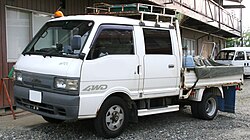
Mazda Bongo Van with single sliding door
Mazda Bongo Van DX with dual sliding door
Mazda Bongo Truck
Interior

In June 1999, a new generation of Bongo vans and trucks went on sale, which were also rebadged as the Mazda E-series, Ford Econovan, Mitsubishi Delica Van/Truck, and Nissan Vanette. This model adopted the SK platform which was based on the previous generation SS/SE model. This was sold at various Mazda, Mazda Anfini and Mazda Autozam dealers.[20] On August 20, 2010, an upgraded Bongo truck/van were officially released in Japan.[21]

Mazda's difficult business environment at the time meant they could not afford to build a full brand new platform. A petrol 1.8-litre EGI F8-E with 90 PS (66 kW) and a diesel 2.2-litre R2 with 79 PS (58 kW) were available. Mazda announced that this is the last generation of in-house designed Bongo vans and trucks in March 2012. Mazda discontinued the Bongo in 2020 and it will focus on fuel efficient passenger cars.

  • November 1999: the Mitsubishi Delica Cargo was Rebadged and released in Japan only.
  • December 2003: A new common rail direct fuel injection diesel model was introduced.
  • November 2005: Minor updates on exterior lighting.
  • 2006: the Australian-market E1800 (SKW0) is discontinued.
  • August 2007: DPF introduced for diesel engine models. Power windows and central locking were also introduced for all truck models.
  • May 2009: due to Nissan's in-house NV200 Vanette, sales of the 2WD petrol models were stopped.
  • August 2010: Minor updates for the entire range include the introduction of a new 1.8-litre L8 petrol engine. This required a larger center console box which reduced seating capacity. New model codes (SKP2T/SKP2L) were applied.
  • 2011: The New Zealand market E1800 (SKW0) was discontinued.
  • October 2011: The rebadged Mitsubishi Delica model was discontinued, with the nameplate shifted onto the Nissan NV200 Vanette in an OEM deal.
  • March 2012: Mazda announced that this would be the last generation of in-house designed Bongo vans and trucks, with the company withdrawing from commercial vehicle production to focus on fuel efficient passenger cars.[22]
  • June 2012: Minor safety updated. Rear decal renewed. MAZDA decal deleted (van only).
  • February 2016: Minor updated. New engine tune-up and increase fuel economy, Auto now became five-speed, dual-rear wheels model discontinued, 4W-ABS and Keyless entry for all models, new model codes SLP2V/SLP2M applied.

Bongo Brawny (SK; 1999–2010)

[edit]

The longer version of the Bongo, the Bongo Brawny was released in June 1999. This model also adopted the SK platform which is based on previous generation SS/SE model. Like the previous generation, the Bongo Brawny was larger in all key dimensions. It was available in both regular 2400 mm and long 2600 mm wheelbases. The Brawny retained many of the parts of the previous generation, such as the sliding side doors, and looks rather similar to the previous generation model. The E-series label continued to be used in export markets, although they were now fewer than before. The Bongo Brawny was discontinued in August 2010.

  • November 1999: the Mitsubishi Delica Cargo was Rebadged and released in Japan only.
  • October 2000: The truck model was discontinued due to the introduction of the Mazda Titan Dash 1-ton.
  • December 2004: Minor changes include the introduction of a new Common rail direct injection diesel 2.0 RF-CDT engine and new model codes SKF6 applied for diesel models.
  • November 2005: Minor updates include the addition of exterior lighting.
  • 2006: The E2000 MWB (SKX0) and E2000 LWB (SKY0) is discontinued in Australia.
  • August 2007: 4WD and GL Super trim levels are discontinued.
  • August 2010: The New Zealand-market Bongo Brawny, E2000 (LWB), a rebadged Mitsubishi Delica Cargo, was discontinued.

Bongo Friendee (1995–2005)

[edit]
Mazda Bongo Friendee with Auto Free Top
Mazda Bongo Friendee facelift
Ford Freda

The Bongo Friendee was introduced in June 1995, based on the SG platform. It was an eight-seater minivan, and was also sold on the Japanese home market as the Ford Freda.[23]

It was usually, but not exclusively, available with an automatic transmission, and came in 2WD (SGL3), and 4WD (SGL5) versions. The 2.5-litre turbo-diesel was common in Japan, although a 2.5-litre V6 petrol version was available.

The Mazda Bongo Friendee was an eight-seater minivan. Some had Mazda factory-fitted kitchens. Many were imported to the UK, and converted to camper vans. All of them had fold-down seats downstairs to make a double bed, and on many models there was an "Auto Free Top" elevating roof which could sleep two more people. Flat-top versions were also available in Hong Kong, and sold by official dealers.

In September 2001, a facelifted version appeared, with a revised body style and different engines, although the 2.5 turbo-diesel continued unchanged. Air conditioning and climate control was fitted as standard, while electronic blinds and electric side door were commonly fitted options.

Engines

[edit]

Petrol

Diesel

Fifth generation

[edit]

Bongo Brawny (H200; 2019–present)

[edit]

The Bongo Brawny name was reintroduced in April 2019 in Japan as a badge engineered fifth-generation Toyota HiAce.[4] Unlike the previous model, it is intended to be a larger commercial van as opposed to a passenger van.

Bongo Van and Bongo Truck (S400; 2020–present)

[edit]

The Bongo nameplate was reintroduced in July 2020 in Japan and based on the Daihatsu Gran Max.[24][25] It is available in van and truck model.

References

[edit]
[edit]
Revisions and contributorsEdit on WikipediaRead on Wikipedia
from Grokipedia
The is a light commercial van and manufactured by the Japanese automaker , renowned for its innovative rear-engine layout that facilitates a low-floor design and spacious cargo or passenger areas. Launched in May 1966 as the first-generation F800/F1000 model, it featured a water-cooled 800 cc overhead-valve engine mounted at the rear, enabling versatile body configurations including an 8-seater coach, route van, cargo van, and variants tailored for urban delivery and multi-purpose transport in post-war . Spanning five generations over its 54-year production run, the Bongo evolved to meet changing market demands, incorporating advancements in engine technology, safety features, and body styles while maintaining its core cab-forward architecture for maneuverability in tight spaces. The second generation, introduced in 1977, expanded options with front-engine configurations and larger displacements up to 1.4 liters, while the third generation (1983–1999) added the rugged Bongo Brawny variant under the E-Series designation, featuring dual rear wheels for heavier payloads and export sales under names like Ford Spectron. The fourth generation, debuting in 1999, adopted a more aerodynamic 1.3-liter box-style design with flexible seating for up to eight passengers and optional LPG engines, enhancing its appeal for family and commercial use. Notable passenger-oriented variants included the 1995 Bongo Friendee , equipped with innovative features like a power-sliding rooftop for and hyper-slide seats for easy reconfiguration, positioning it as a leisure-focused model. Later updates to the fourth generation emphasized efficiency and drivability; for instance, it received a 1.8-liter DOHC in 2010, along with improved suspension and standard antilock brakes in a 2005 refresh. The fifth generation, introduced in 2019, consists of the Bongo Brawny, a badge-engineered version of the . ceased in-house production of its original Bongo models in 2020, though the Bongo Brawny variant has continued, cementing its legacy as one of 's longest-running vehicles and a symbol of reliable Japanese engineering for global markets.

Overview

Introduction and Naming

The Mazda Bongo is a long-running line of cabover vans and light trucks produced by the Japanese automaker , initially introduced in May 1966 as the company's first dedicated cabover designed primarily for urban delivery and passenger transport in post-war . This model filled a critical need for compact, maneuverable vehicles in densely populated areas, featuring a rear-engine layout in its early iterations to maximize cargo and seating space. The name "Bongo" is derived from the bongo, a species of large forest native to , chosen to evoke the vehicle's agile and versatile qualities. In export markets, it has been marketed under various designations, including the E-Series (such as E2000 and E2200 for certain generations) and the Bongo Friendee for passenger-oriented variants, reflecting adaptations for international regulations and preferences. Originally classified as a kei vehicle in to qualify for tax and size incentives, the Bongo evolved from a domestic and van into a globally recognized platform, serving roles in , trades, and even recreational use. The line continues into the fifth generation (2019–present), with models like the Bongo Brawny being badge-engineered versions of the . Production has spanned from 1966 to present (as of 2025), achieving monthly sales of around 5,000 units at its peak in the late , making it Mazda's top-selling in at the time.

Design Philosophy and Key Features

The Mazda Bongo's design philosophy prioritizes functionality and versatility in a compact package, exemplified by its configuration that places the driver's compartment directly over the front axle to optimize cargo capacity while maintaining a short overall length for superior maneuverability in urban settings. This layout, pioneered in the model's debut, established the Bongo as a lightweight one-box van, influencing subsequent commercial vehicles by emphasizing space efficiency without compromising drivability. A core evolution in the Bongo's involved transitioning from a rear-engine, rear-wheel-drive setup in the initial generation to front mid-engine layouts in later iterations, with the positioned under the front seats to streamline the and enhance overall vehicle balance. This shift supported broader adaptability across body types while preserving the model's compact footprint. Key features underscore the Bongo's focus on accessibility and practicality, including an ultra-low floor height—measuring approximately mm in van variants and 460 mm in truck versions for the first generation—facilitating easy entry and loading for users in commercial or roles. The design incorporates modular body configurations, enabling seamless adaptations between cargo vans, flatbed trucks, and multi-seat passenger setups to meet diverse operational demands. Built for enduring commercial use, the Bongo emphasizes robust construction with simple, durable components to withstand heavy-duty applications over multiple generations. In terms of and , later Bongo models integrated advancements like diesel particulate filters (DPF) for reduced emissions, marking a class-first compliance with stringent Japanese standards, alongside ongoing refinements for fuel economy. These elements, combined with the inherent kei-inspired compactness of early designs, tailored the vehicle for economical operation within regulatory constraints.

First Generation (1966–1975)

Body Styles and Chassis

The first-generation Mazda Bongo was launched in May 1966 as a with a rear-engine layout, enabling an ultra-low floor height of approximately 450–460 mm for easy loading and spacious interiors. It utilized a with at all four wheels, providing improved ride comfort and handling for urban use. The chassis codes were F800 for the initial model and F1000 from 1968 onward. Body styles included a cargo , passenger (route ), 8-seater coach/, and open-bed (cab truck), all in a compact configuration tailored for Japan's narrow streets and delivery needs. Overall dimensions were approximately 3,770 mm in length, 1,500 mm in width, 1,700 mm in height, and a of 2,000 mm. Payload capacities ranged from 400 kg for vans to around 600 kg for truck variants.

Engines and Drivetrain

The first-generation Bongo featured a rear-mounted, water-cooled overhead-valve (OHV) inline-four driving the rear wheels. The initial F800 model used an 782 cc SA producing 33–37 PS (24–27 kW) at around 5,000 rpm. In 1968, the F1000 variant introduced a larger 987 cc PB delivering 48–52 PS (35–38 kW) at 5,500 rpm, offering better performance for heavier loads. The drivetrain consisted of rear-wheel drive (RWD) paired with a four-speed manual transaxle integrated at the rear, emphasizing simplicity and reliability for commercial applications. No automatic or all-wheel-drive options were available during this generation.

Second Generation (1977–1983)

Body Styles and Chassis

The second-generation Mazda Bongo was introduced in September 1977 after a two-year production hiatus, featuring a mid-engine, configuration with the engine mounted under the cab for improved weight distribution and maneuverability. It utilized a ladder-frame for robustness in commercial applications, supporting various body styles including cargo , 8-passenger coaches, and flatbed pickup trucks. Many variants, particularly trucks, employed dual rear wheels to handle payloads of up to 1,000 kg, with overall vehicle lengths around 4.0 meters for urban suitability. The design adopted a flatter front end compared to the first generation, enhancing visibility and aesthetics. Suspension was independent at the front with coil springs and leaf springs at the rear for load-bearing capacity. A column-shifted 4-speed was standard, with a 5-speed option available later. In 1981, the model received a facelift with rectangular dual headlights. For markets, it was sold as the E1300, E1400, or E2200, and badge-engineered as the Ford Econovan.

Engines and Drivetrain

The second generation offered a range of inline-four engines to meet emission regulations and market needs. Petrol options included the 1.3 L TC engine (1,272 cc) producing 60–77 hp (44–57 kW) and torque of 105 Nm, and the 1.4 L UC engine (1,415 cc) delivering 70 hp (51 kW). Diesel variants comprised the 1.8 L PC (1,998 cc) at 62 hp (46 kW), the 2.0 L RF (1,998 cc) at 67 hp (49 kW), and the 2.2 L R2 (2,182 cc) at 71 hp (52 kW), providing better for heavy loads. All models were with no all-wheel-drive option in this generation. The emphasized reliability for delivery and transport, paired with the 4- or 5-speed manual gearbox. Fuel efficiency varied from 10–15 km/L depending on engine and load.

Third Generation (1983–1999)

Body Styles and Chassis

The third-generation Bongo, part of the E-Series, was launched in September with a front-engine, design emphasizing durability and versatility for commercial use. It utilized a ladder-frame constructed from high-tensile to enhance rigidity and collision safety, differing from the unibody approach of later generations. The platform supported (RWD) as standard, with (4WD) options introduced in 1985 for select models to improve traction in varied conditions. Body styles included passenger wagons seating up to 9 with high-roof options and full-flat reclining seats, cargo vans for 3 or 6 passengers, and flatbed . Overall lengths ranged from 4.2 to 4.7 meters, accommodating urban and rural applications. Payload capacities varied from 600 to 1,000 kg for standard vans and up to 1,500 kg for truck variants. The initial design featured boxy styling for maximum interior space, with later minor changes in adding and improved seat belts as standard. Suspension consisted of independent front suspension and springs at the rear for load handling.

Engines and Drivetrain

The third-generation Bongo offered a range of inline-four engines suited for efficiency and reliability in light commercial duties. Petrol options included a 1.4-liter (1,490 cc) unit producing 67 horsepower and a 1.8-liter (1,789 cc) developing around 90 horsepower. Diesel engines comprised a 2.0-liter (1,998 cc) with 58–72 horsepower and a 2.2-liter (2,207 cc) variant outputting 71 horsepower, available in naturally aspirated form. Transmissions included 4- or 5-speed manual gearboxes standard, with 4-speed automatics optional for models. Drivetrain configurations were primarily RWD, but 4WD became available from 1985/1986 on longer-wheelbase and Brawny variants, paired with manual transmissions and 2.0-liter engines for enhanced off-road capability. ranged from 10–15 km/L depending on engine and load, supporting Japan's regulations for smaller models. The Bongo was exported as the Ford Spectron () and Econovan (cargo).

Bongo Brawny Variant

The Bongo Brawny, introduced in 1983 alongside the third-generation Mazda Bongo, served as a long-wheelbase variant (model codes including SKE series) specifically tailored for demanding applications in and rural environments. Classified within Japan's small despite its robust build, it provided enhanced utility through a reinforced designed to support payloads ranging from 1 to 1.5 tons, enabling it to navigate challenging work sites effectively. Key to its rugged orientation was the integration of four-wheel-drive (4WD) systems, which became available starting in 1985, along with a higher ground clearance of 195 mm to improve over uneven terrain. The variant featured a specialized suspension setup optimized for load-bearing and off-road stability, including options for automatic transmissions to ease operation in varied conditions. Standard 4WD configurations contributed to its all-wheel-drive capability, making it a staple for utility tasks requiring superior traction. It often included dual rear wheels for heavier payloads. Available in short-wheelbase pickup and body styles with angular, durable exterior styling for practicality and resilience, the Bongo Brawny maintained production through 1999, incorporating protective elements like skid plates under the and optional winches for recovery in remote areas. Its towing capacity reached 1,500 kg, underscoring its role in heavy-duty hauling, while locking differentials were standard on 4WD models to enhance performance on loose or slippery surfaces. The variant drew from the third-generation engine lineup, including 2.0-liter and diesel options for reliable power delivery. This model laid the groundwork for the fourth-generation Brawny, which evolved with refined off-road enhancements.

Fourth Generation (1999–2020)

Body Styles and Chassis

The fourth-generation Mazda Bongo, launched in 1999, featured a front-engine layout with options for (FWD), (RWD), and part-time all-wheel drive (AWD) configurations, utilizing the SK/SL codes. This platform employed unibody construction, which contributed to reduced weight and improved compared to the ladder-frame of prior generations. The emphasized collision through an impact-absorbing frame integrated into the body structure. Body styles included mid-roof and high-roof for or use, as well as flatbed trucks, with overall lengths ranging from 4.2 to 4.7 meters to accommodate various commercial needs. Payload capacities varied from 1,000 to 1,500 kg depending on the variant, with trucks typically rated at 850–1,000 kg for standard bodies and higher for extended configurations. The initial 1999 models adopted rounded, aerodynamic styling with large bumpers and enhanced visibility through expansive windshields and side windows. Subsequent facelifts in 2005 and 2010 refined the and features; the 2005 update made antilock braking systems (ABS) standard on single-tire rear models, while later iterations around 2010 introduced (ESC) on select AWD variants for enhanced handling. suspension consisted of independent double-wishbone setup at the front and leaf springs at the rear across most models, though AWD versions incorporated all-around to improve stability and off-road capability. The lineup continued seamlessly from the third generation, maintaining compatibility with existing RF-series units. Additionally, the Bongo Friendee served as a passenger-oriented with similar body and foundations.

Engines and Drivetrain

The fourth-generation Mazda Bongo was powered by inline-four engines, with and diesel options available from launch. The initial lineup included a 1.8 L (1,798 cc) F8 SOHC producing 90 PS (66 kW) at 5,000 rpm and 13.8 kg⋅m (135 N⋅m) at 2,500 rpm, and a 2.0 L (1,998 cc) R2 delivering 79 PS (58 kW) at 4,250 rpm and 14.1 kg⋅m (138 N⋅m) at 2,000 rpm. These were paired with either a five-speed manual or four-speed , depending on the variant. Drivetrain configurations included (RWD) as standard, with part-time (4WD) available featuring a remote free-wheel hub system for improved traction. A 2010 update introduced a 1.8 L DOHC for enhanced and . The powertrains focused on reliability for commercial use, with diesel variants emphasizing for urban delivery and the petrol options providing smoother operation. varied by configuration, typically achieving 10–15 km/L in mixed cycles for petrol models and slightly better for diesels, as of early 2000s testing.

Bongo Friendee Variant

The Mazda Bongo Friendee was introduced in June 1995 as a dedicated passenger variant of the Bongo lineup, positioned as a versatile family emphasizing leisure and comfort for groups of friends and relatives. Developed on an extended of 2,920 mm to enhance interior space, it offered seating for up to eight passengers in flexible configurations, including reclining and sliding second-row seats known as Hyper Slide Seats for improved accessibility and comfort during long trips. Key features included power sliding side doors for easy entry and exit, dual-zone climate control to maintain a pleasant cabin environment, and innovative elements like the Auto Free Top—a motorized pop-up that created an upper loft space for two adults, ideal for or resting. Production of the Bongo Friendee spanned from 1995 to 2005, with notable updates including a 1999 limited-edition City Runner trim that introduced sportier styling and a 2001 facelift featuring revised front grille, headlights, and minor interior refinements for enhanced and usability. Higher trim levels, such as the Aero and City Runner variants, catered to family-oriented buyers with options like 15-inch alloy wheels for better road presence, integrated systems including CD players and optional , and Power Roll Curtains for privacy and light control in the spacious atrium-like interior. was a priority, with the model earning Japan's highest AAA collision rating in 1999, bolstered by standard driver and front passenger airbags as part of the supplemental restraint system, along with reinforced body structures. The Bongo Friendee shared engine and drivetrain options with the standard fourth-generation Bongo from 1999 onward, including inline-four petrol and diesel units for reliable performance in urban and highway settings, though higher trims offered a 2.5 L V6 (160 PS). Production ceased in 2005, marking the end of this family-centric variant with no direct successor in the Bongo lineup.

Fifth Generation (2019–present)

Bongo Brawny (H200)

The Brawny (H200) was launched in April 2019 as the rugged variant within the fifth-generation Bongo series, exclusively for the Japanese market, featuring a badge-engineered platform derived from the H200 to emphasize durability and versatility in demanding environments. This model prioritizes enhanced off-road capabilities, including a ground clearance of approximately 200 mm, which allows it to handle uneven terrain more effectively than standard vans. Building on the rugged legacy of the fourth-generation Bongo Brawny, the H200 series introduces refinements tailored for commercial and recreational off-road applications. The body configurations include compact pickup and styles, both equipped with modular cargo beds that support customizable load setups for tools, equipment, or materials, facilitating easy adaptation to various hauling needs. (4WD) is optionally available across the lineup, incorporating low-range gearing for improved distribution and traction on slopes or loose surfaces, making it suitable for construction sites, rural deliveries, and light . Payload capacities range from 900 to 1,200 kg, depending on the body variant and , enabling efficient transport without compromising stability. Key features underscore its robust design, such as LED lighting for better visibility in low-light conditions, digital dashboards providing real-time vehicle data like and terrain mode status, and reinforced bumpers to withstand impacts from rough usage. It utilizes diesel engines shared with the , focusing on for heavy-duty tasks, such as the 2.0 L (100 hp) or 2.8 L (134-163 hp) options.

Bongo Van and Bongo Truck (S400)

The Mazda Bongo Van and Bongo Truck of the S400 series were introduced in September 2020 as the fifth generation's primary urban commercial vehicles, replacing the fourth-generation models with updated designs optimized for city delivery and light hauling. These models feature electric power , enhancing handling precision and reducing driver fatigue in tight urban environments. The Bongo Van and Truck are based on the platform. Offered in short and long configurations ranging from 2,260 mm to 3,060 mm, the body styles include a for enclosed cargo transport and a drop-side for open loading, with capacities reaching up to 1,350 kg to support diverse commercial applications. The S400 series incorporates eco-friendly interior materials, such as recycled fabrics and low-VOC components, aligning with Mazda's goals. Connectivity is integrated via the MyMazda app, enabling remote status checks, tracking, and service alerts for . The S400 shares core drivetrain elements with the broader commercial vehicle lineup for consistent performance across the fifth generation, featuring Daihatsu-sourced engines such as the 1.5 L petrol (92 hp) or 1.4 L diesel.

Engines and Drivetrain

The fifth generation Mazda Bongo lineup features powertrain options from partner manufacturers, emphasizing efficiency and performance for commercial use. The Bongo Brawny uses Toyota's 2.0 L 1KD-FTV or 2.8 L 1GD-FTV turbo diesel engines, delivering 100-163 horsepower depending on configuration. The Bongo Van and Truck (S400) use Daihatsu's 1.5 L 3SZ-VE petrol engine (92 hp) or 1.4 L diesel options. The drivetrain lineup includes a standard six-speed for smooth shifting and efficiency, with a manual option offered for operators preferring direct control; all models support optional all-wheel drive with predictive control that anticipates terrain changes using sensors and adjusts distribution proactively. Performance metrics highlight the powertrains' balance of utility and sustainability, achieving of approximately 10–15 km/L in mixed urban and highway cycles, depending on load and variant.

Markets and Exports

Japan Domestic Market

The Mazda Bongo serves as a cornerstone of the , functioning primarily as a light commercial van and favored by small es for its compact design and reliability in urban delivery operations. Its classification as a light vehicle qualifies it for reduced acquisition taxes at 3% for use, compared to 5% for standard private vehicles, enhancing affordability for fleet operators. In the JDM lineup, the Bongo features specialized variants such as short-bed trucks for maneuverability in tight city spaces and high-roof for increased cargo height and volume, making it a preferred choice for delivery fleets handling everything from parcels to equipment. These adaptations underscore its enduring appeal in Japan's sector, where narrow streets and parking constraints demand versatile, low-floor configurations. Stricter emissions regulations, including Japan's 2005 new long-term standards, have influenced Bongo development, with models certified as low-emission vehicles and a gradual shift from traditional diesel engines to more efficient powertrains by the 2020s to comply with updated environmental requirements. Culturally, the Bongo embodies practicality for Japan's small enterprises, often seen as an iconic workhorse supporting local commerce and trades. This legacy was commemorated in with the model's 50th anniversary, marking five decades since its 1966 debut and highlighting its contributions to domestic mobility.

International Markets

The Mazda Bongo was exported to international markets primarily under the E-Series designation, with the model known as the E2000 in from the late through the early . These exports began in earnest during the 1970s, targeting commercial users in the UK and other European countries with cabover van and pickup configurations suited to urban delivery needs. In regions like , the Bongo was adapted for right-hand drive operation, with sales commencing in to align with local traffic regulations and preferences for light commercial vehicles. Market-specific modifications included left-hand drive conversions for left-side driving countries such as those in , enabling broader accessibility without major redesigns. While base engines remained similar to Japanese domestic models, some export versions incorporated larger displacement options, such as 2.0-liter units, to meet regional performance and regulatory demands in the EU. The vehicle found strong demand in and the , where its compact size, reliability, and versatility supported logistics and small business operations in diverse terrains. Exports to tapered off by the late , with the E2000 variant effectively discontinued around 2010 amid tightening emissions standards that the aging platform struggled to comply with under Euro 5 regulations. The Bongo series achieved significant international exports, reflecting its enduring appeal in emerging economies. The fifth-generation models, introduced in 2019, emphasized penetration into developing markets in and the through updated safety features and fuel-efficient drivetrains tailored for export compliance, prior to production ceasing in August 2020.

Legacy and Cultural Impact

Production Milestones

The Mazda Bongo series achieved a significant manufacturing milestone when cumulative production reached one million units during the , primarily at Mazda's Plant, which served as the main production site from the model's launch in 1966 until 2020. This accomplishment underscored the Bongo's role as a staple in Mazda's lineup, with assembly also occurring overseas in at the PT. National Assemblers facility in , , from 1996 to 2005 to support regional markets. Production faced notable challenges during key economic and natural events. The severely impacted Mazda's operations, leading to a temporary halt in Bongo manufacturing from 1975 to 1977 as the company grappled with fuel efficiency demands and financial strain from its investments. Similarly, the disrupted supply chains and halted output at the Hiroshima Plant from March 11 to March 16, 2011 (several days), affecting Bongo assembly alongside other models and contributing to a broader decline in Japanese automotive production that year. By the end of its fourth generation in 2020, the Bongo had accumulated approximately 2.96 million units produced globally, reflecting steady demand in domestic and export markets despite evolving challenges. The introduction of the fifth generation in 2019 marked a shift toward rebadged platforms from and affiliates, with the models continuing production as of 2025 primarily for the Japanese market; annual output was around 20,000 units as of the early , where sales peaked in the late and early 1990s.

Influence and Reception

The Mazda Bongo has earned a reputation as a in , serving as the quintessential workhorse for small and medium-sized enterprises (SMEs) due to its compact design and adaptability for urban delivery and light commercial duties. Its enduring presence in Japanese society is reflected in numerous television advertisements from the and , which portrayed the Bongo Friendee variant as a versatile family and leisure vehicle, emphasizing its spacious interior and innovative features like the . Critical reception of the Bongo has been largely positive, particularly for its reliability and ease of use in both commercial and camper conversions. Automotive reviewers have praised its durable and smooth handling, with describing it as "hugely spacious and versatile, and easy and comfortable to drive," making it a favorite among JDM enthusiasts for short-trip applications. However, in export markets during the , the traditional layout drew some criticism for feeling outdated compared to emerging conventional-cab competitors, limiting its appeal in regions favoring larger, more modern van designs. The Bongo's influence extends to the broader , where its platform served as the basis for badge-engineered models like the and , helping standardize compact commercial vans in and contributing to Mazda's expertise in efficient, multi-purpose vehicles. This legacy has solidified Mazda's position in the commercial segment, with the Bongo lineup continuing to embody practical innovation. In its modern iteration, the Bongo aligns with global sustainability trends through Mazda's multi-solution electrification strategy, which emphasizes fuel-efficient updates and reduced emissions across its vehicle portfolio by 2025.

References

Add your contribution
Related Hubs
User Avatar
No comments yet.