


Community hub
Recent from talks
Contribute something
Nothing was collected or created yet.
Flash (photography)
View on Wikipedia | This article needs additional citations for verification. (June 2018) |

A flash is a device used in photography that produces a brief burst of light (lasting around 1⁄200 of a second) at a color temperature of about 5500 K[1][citation needed] to help illuminate a scene. The main purpose of a flash is to illuminate a dark scene. Other uses are capturing quickly moving objects or changing the quality of light. Flash refers either to the flash of light itself or to the electronic flash unit discharging the light. Most current flash units are electronic, having evolved from single-use flashbulbs and flammable powders. Modern cameras often activate flash units automatically.
Flash units are commonly built directly into a camera. Some cameras allow separate flash units to be mounted via a standardized accessory mount bracket (a hot shoe). In professional studio equipment, flashes may be large, standalone units, or studio strobes, powered by special battery packs or connected to mains power. They are either synchronized with the camera using a flash synchronization cable or radio signal, or are light-triggered, meaning that only one flash unit needs to be synchronized with the camera, and in turn triggers the other units, called slaves.
Types
[edit]Flash-lamp/Flash powder
[edit]
Studies of magnesium by Bunsen and Roscoe in 1859 showed that burning this metal produced a light with similar qualities to daylight. The potential application to photography inspired Edward Sonstadt to investigate methods of manufacturing magnesium so that it would burn reliably for this use. He applied for patents in 1862 and by 1864 had started the Manchester Magnesium Company with Edward Mellor. With the help of engineer William Mather, who was also a director of the company, they produced flat magnesium ribbon, which was said to burn more consistently and completely so giving better illumination than round wire. It also had the benefit of being a simpler and cheaper process than making round wire.[2] Mather was also credited with the invention of a holder for the ribbon, which formed a lamp to burn it in.[3] A variety of magnesium ribbon holders were produced by other manufacturers, such as the Pistol Flashmeter,[4] which incorporated an inscribed ruler that allowed the photographer to use the correct length of ribbon for the exposure they needed. The packaging also implies that the magnesium ribbon was not necessarily broken off before being ignited.

An alternative to magnesium ribbon was flash powder, a mixture of magnesium powder and potassium chlorate, was introduced by its German inventors Adolf Miethe and Johannes Gaedicke in 1887. A measured amount was put into a pan or trough and ignited by hand, producing a brief brilliant flash of light, along with the smoke and noise that might be expected from such an explosive event. This could be a life-threatening activity, especially if the flash powder was damp.[5] An electrically triggered flash lamp was invented by Joshua Lionel Cowen in 1899. His patent describes a device for igniting photographers' flash powder by using dry cell batteries to heat a wire fuse. Variations and alternatives were touted from time to time and a few found a measure of success, especially for amateur use. In 1905, one French photographer was using intense non-explosive flashes produced by a special mechanized carbon arc lamp to photograph subjects in his studio,[6] but more portable and less expensive devices prevailed. On through the 1920s, flash photography normally meant a professional photographer sprinkling powder into the trough of a T-shaped flash lamp, holding it aloft, then triggering a brief and (usually) harmless bit of pyrotechnics.
Flashbulbs
[edit]
The use of flash powder in an open lamp was replaced by flashbulbs; magnesium filaments were contained in bulbs filled with oxygen gas, and electrically ignited by a contact in the camera shutter.[7] Manufactured flashbulbs were first produced commercially in Germany in 1929.[8] Such a bulb could only be used once, and was too hot to handle immediately after use, but the confinement of what would otherwise have amounted to a small explosion was an important advance. A later innovation was the coating of flashbulbs with a plastic film to maintain bulb integrity in the event of the glass shattering during the flash. A blue plastic film was introduced as an option to match the spectral quality of the flash to daylight-balanced colour film. Subsequently, the magnesium was replaced by zirconium, which produced a brighter flash.
There was a significant delay after ignition for a flashbulb to reach full brightness, and the bulb burned for a relatively long time, compared to shutter speeds required to stop motion and not display camera shake. Slower shutter speeds (typically from 1⁄10 to 1⁄50 of a second) were initially used on cameras to ensure proper synchronization and to make use of all the bulb's light output. Cameras with flash sync triggered the flashbulb a fraction of a second before opening the shutter to allow it to reach full brightness, allowing faster shutter speeds. A flashbulb widely used during the 1960s was the Press 25, the 25-millimetre (1 in) flashbulb often used by newspapermen in period movies, usually attached to a press camera or a twin-lens reflex camera. Its peak light output was around a million lumens. Other flashbulbs in common use were the M-series, M-2, M-3 etc., which had a small ("miniature") metal bayonet base fused to the glass bulb. The largest flashbulb ever produced was the GE Mazda No. 75, being over eight inches long with a girth of 4 inches, initially developed for nighttime aerial photography during World War II.[9][10]
The all-glass PF1 bulb was introduced in 1954.[11] Eliminating the metal base and the multiple manufacturing steps needed to attach it to the glass bulb cut the cost substantially compared to the larger M series bulbs. The design required a fibre ring around the base to hold the contact wires against the side of the glass base. An adapter was available allowing the bulb to fit into flash guns made for bayonet-capped bulbs. The PF1 (along with the M2) had a faster ignition time (less delay between shutter contact and peak output), so it could be used with X synch below 1⁄30 of a second—while most bulbs require a shutter speed of 1⁄15 on X synch to keep the shutter open long enough for the bulb to ignite and burn. A smaller version which was not as bright but did not require the fibre ring, the AG-1, was introduced in 1958; it was cheaper, and rapidly supplanted the PF1.
-
 The AG-1 flashbulb, introduced in 1958, used wires protruding from its base as electrical contacts; this eliminated the need for a separate metal base.
 -
 Flashbulbs have ranged in size from the diminutive AG-1 to the massive No. 75.
 -
 Kodak Brownie Hawkeye with "Kodalite Flasholder" and Sylvania P25 blue-dot daylight-type flashbulb


Flashcubes, Magicubes and Flipflash
[edit]
In 1965 Eastman Kodak of Rochester, New York replaced the individual flashbulb technology used on early Instamatic cameras with the Flashcube developed by Sylvania Electric Products.[12][13]
A flashcube was a module with four expendable flashbulbs, each mounted at 90° from the others in its own reflector. For use it was mounted atop the camera with an electrical connection to the shutter release and a battery inside the camera. After each flash exposure, the film advance mechanism also rotated the flashcube 90° to a fresh bulb. This arrangement allowed the user to take four images in rapid succession before inserting a new flashcube.
The later Magicube (or X-Cube) by General Electric retained the four-bulb format, but did not require electrical power. It was not interchangeable with the original Flashcube. Each bulb in a Magicube was set off by releasing one of four cocked wire springs within the cube. The spring struck a primer tube at the base of the bulb, which contained a fulminate, which in turn ignited shredded zirconium foil in the flash. A Magicube could also be fired using a key or paper clip to trip the spring manually. X-cube was an alternate name for Magicubes, indicating the appearance of the camera's socket.
Other common flashbulb-based devices were the Flashbar and Flipflash, which provided ten flashes from a single unit. The bulbs in a Flipflash were set in a vertical array, putting a distance between the bulb and the lens, eliminating red eye. The Flipflash name derived from the fact that once half the flashbulbs had been used, the unit had to be flipped over and re-inserted to use the remaining bulbs. In many Flipflash cameras, the bulbs were ignited by electrical currents produced when a piezoelectric crystal was struck mechanically by a spring-loaded striker, which was cocked each time the film was advanced.
-
 Undersides of Flashcube (left) and Magicube (right) cartridges
 -
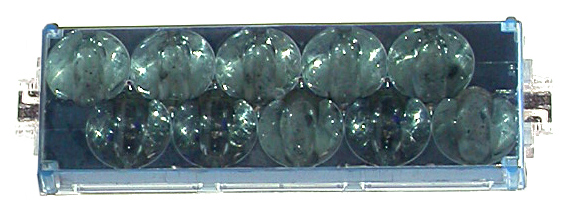 "Flip flash" type cartridge


Electronic flash
[edit]
The electronic flash tube was introduced by Harold Eugene Edgerton in 1931.[14] The electronic flash reaches full brightness almost instantaneously, and is of very short duration. Edgerton took advantage of the short duration to make several iconic photographs, such as one of a bullet bursting through an apple. The large photographic company Kodak was initially reluctant to take up the idea.[15] Electronic flash, often called "strobe" in the US following Edgerton's use of the technique for stroboscopy, came into some use in the late 1950s, although flashbulbs remained dominant in amateur photography until the mid 1970s. Early units were expensive, and often large and heavy; the power unit was separate from the flash head and was powered by a large lead-acid battery carried with a shoulder strap. Towards the end of the 1960s electronic flashguns of similar size to conventional bulb guns became available; the price, although it had dropped, was still high. The electronic flash system eventually superseded bulb guns as prices came down. Already in the early 1970s, amateur electronic flashes were available for less than $100.

A typical electronic flash unit has electronic circuitry to charge a high-capacitance capacitor to several hundred volts. When the flash is triggered by the shutter's flash synchronization contact, the capacitor is discharged rapidly through a permanent flash tube, producing an immediate flash lasting typically less than 1⁄1000 of a second, shorter than shutter speeds used, with full brightness before the shutter has started to close, allowing easy synchronization of maximum shutter opening with full flash brightness, unlike flashbulbs which were slower to reach full brightness and burned for a longer time, typically 1⁄30 of a second.
A single electronic flash unit is often mounted on a camera's accessory shoe or a bracket; many inexpensive cameras have an electronic flash unit built in. For more sophisticated and longer-range lighting several synchronised flash units at different positions may be used.
Ring flashes that fit to a camera's lens can be used for shadow free portrait and macro photography; some lenses have built-in ring-flash.[16]
In a photographic studio, more powerful and flexible studio flash systems are used. They usually contain a modelling light, a lamp close to the flash tube; the continuous illumination of the modelling light lets the photographer visualize the effect of the flash. LED lamps are replacing the previous incandescent light bulbs in new designs, modelling lights typically being proportionately variable to flash power require dimmable LEDs and suitable circuitry in the head. Multiple flashes may be synchronised for multi-source lighting.
The strength of a flash device is often indicated in terms of a guide number designed to simplify exposure setting. The energy released by larger studio flash units, such as monolights, is indicated in watt-seconds.
Canon names its electronic flash units Speedlite, and Nikon uses Speedlight; these terms are frequently used as generic terms for electronic flash units designed to be mounted on, and triggered by, a camera hot shoe.
High speed flash
[edit]
An air-gap flash is a high-voltage device that discharges a flash of light with an exceptionally short duration, often much less than one microsecond. These are commonly used by scientists or engineers for examining extremely fast-moving objects or reactions, famous for producing images of bullets tearing through light bulbs and balloons (see Harold Eugene Edgerton). An example of a process by which to create a high speed flash is the exploding wire method.
Multi-flash
[edit]A camera that implements multiple flashes can be used to find depth edges or create stylized images. Such a camera has been developed by researchers at the Mitsubishi Electric Research Laboratories (MERL). Successive flashing of strategically placed flash mechanisms results in shadows along the depths of the scene. This information can be manipulated to suppress or enhance details or capture the intricate geometric features of a scene (even those hidden from the eye), to create a non-photorealistic image form. Such images could be useful in technical or medical imaging.[17]
Flash intensity
[edit]Unlike flashbulbs, the intensity of an electronic flash can be adjusted on some units. To do this, smaller flash units typically vary the capacitor discharge time, whereas larger (e.g., higher power, studio) units typically vary the capacitor charge. Color temperature can change as a result of varying the capacitor charge, making color correction necessary. Constant-color-temperature flash can be achieved by using appropriate circuitry.[18]
Flash intensity is typically measured in stops or in fractions (1, 1⁄2, 1⁄4, 1⁄8 etc.). Some monolights display an "EV Number", so that a photographer can know the difference in brightness between different flash units with different watt-second ratings. EV10.0 is defined as 6400 watt-seconds, and EV9.0 is one stop lower, i.e. 3200 watt-seconds.[19]
Flash duration
[edit]Flash duration is commonly described by two numbers that are expressed in fractions of a second:
- t0.1 is the length of time the light intensity is above 0.1 (10%) of the peak intensity
- t0.5 is the length of time the light intensity is above 0.5 (50%) of the peak intensity
For example, a single flash event might have a t0.5 value of 1⁄1200 and t0.1 of 1⁄450. These values determine the ability of a flash to "freeze" moving subjects in applications such as sports photography.
In cases where intensity is controlled by capacitor discharge time, t0.5 and t0.1 decrease with decreasing intensity. Conversely, in cases where intensity is controlled by capacitor charge, t0.5 and t0.1 increase with decreasing intensity due to the non-linearity of the capacitor's discharge curve.
Flash LED used in phones
[edit]
High-current flash LEDs are used as flash sources in camera phones, although they are less bright than xenon flash tubes. Unlike xenon tubes, LEDs require only a low voltage, eliminating the need of a high-voltage capacitor. They are more energy-efficient, and very small. The LED flash can also be used for illumination of video recordings or as an autofocus assist lamp in low-light photography; it can also be used as a general-purpose non-photographic light source.
Focal-plane-shutter synchronization
[edit]Electronic flash units have shutter speed limits with focal-plane shutters. Focal-plane shutters expose using two curtains that cross the sensor. The first one opens and the second curtain follows it after a delay equal to the nominal shutter speed. A typical modern focal-plane shutter on a full-frame or smaller sensor camera takes about 1⁄400 s to 1⁄300 s to cross the sensor, so at exposure times shorter than this only part of the sensor is uncovered at any one time.
The time available to fire a single flash which uniformly illuminates the image recorded on the sensor is the exposure time minus the shutter travel time. Equivalently, the minimum possible exposure time is the shutter travel time plus the flash duration (plus any delays in triggering the flash).
For example, a Nikon D850 has a shutter travel time of about 2.4 ms.[20] A full-power flash from a modern built-in or hot shoe mounted electronic flash has a typical duration of about 1ms, or a little less, so the minimum possible exposure time for even exposure across the sensor with a full-power flash is about 2.4 ms + 1.0 ms = 3.4 ms, corresponding to a shutter speed of about 1⁄290 s. However some time is required to trigger the flash. At the maximum (standard) D850 X-sync shutter speed of 1⁄250 s, the exposure time is 1⁄250 s = 4.0 ms, so about 4.0 ms − 2.4 ms = 1.6 ms are available to trigger and fire the flash, and with a 1 ms flash duration, 1.6 ms − 1.0 ms = 0.6 ms are available to trigger the flash in this Nikon D850 example.
Mid- to high-end Nikon DSLRs with a maximum shutter speed of 1⁄8000 s (roughly D7000 or D800 and above) have an unusual menu-selectable feature which increases the maximum X-Sync speed to 1⁄320 s = 3.1 ms with some electronic flashes. At 1⁄320 s only 3.1 ms − 2.4 ms = 0.7 ms are available to trigger and fire the flash while achieving a uniform flash exposure, so the maximum flash duration, and therefore maximum flash output, must be, and is, reduced.
Contemporary (2018) focal-plane shutter cameras with full-frame or smaller sensors typically have maximum normal X-sync speeds of 1⁄200 s or 1⁄250 s. Some cameras are limited to 1⁄160 s. X-sync speeds for medium format cameras when using focal-plane shutters are somewhat slower, e.g. 1⁄125 s,[21] because of the greater shutter travel time required for a wider, heavier, shutter that travels farther across a larger sensor.
In the past, slow-burning single-use flash bulbs allowed the use of focal-plane shutters at maximum speed because they produced continuous light for the time taken for the exposing slit to cross the film gate. If these are found they cannot be used on modern cameras because the bulb must be fired *before* the first shutter curtain begins to move (M-sync); the X-sync used for electronic flash normally fires only when the first shutter curtain reaches the end of its travel.
High-end flash units address this problem by offering a mode, typically called FP sync or HSS (High Speed Sync), which fires the flash tube multiple times during the time the slit traverses the sensor. Such units require communication with the camera and are thus dedicated to a particular camera make. The multiple flashes result in a significant decrease in guide number, since each is only a part of the total flash power, but it is all that illuminates any particular part of the sensor. In general, if s is the shutter speed, and t is the shutter traverse time, the guide number reduces by √s / t. For example, if the guide number is 100, and the shutter traverse time is 5 ms (a shutter speed of 1/200s), and the shutter speed is set to 1⁄2000 s (0.5 ms), the guide number reduces by a factor of √0.5 / 5, or about 3.16, so the resultant guide number at this speed would be about 32.
Current (2010) flash units frequently have much lower guide numbers in HSS mode than in normal modes, even at speeds below the shutter traverse time. For example, the Mecablitz 58 AF-1 digital flash unit has a guide number of 58 in normal operation, but only 20 in HSS mode, even at low speeds.
Technique
[edit]

As well as dedicated studio use, flash may be used as the main light source where ambient light is inadequate, or as a supplementary source in more complex lighting situations. Basic flash lighting produces a hard, frontal light unless modified in some way.[22] Several techniques are used to soften light from the flash or provide other effects.
Softboxes, diffusers that cover the flash lamp, scatter direct light and reduce its harshness. Reflectors, including umbrellas, flat-white backgrounds, drapes and reflector cards are commonly used for this purpose (even with small hand-held flash units). Bounce flash is a related technique in which flash is directed onto a reflective surface, for example a white ceiling or a flash umbrella, which then reflects light onto the subject. It can be used as fill-flash or, if used indoors, as ambient lighting for the whole scene. Bouncing creates softer, less artificial-looking illumination than direct flash, often reducing overall contrast and expanding shadow and highlight detail, and typically requires more flash power than direct lighting.[22] Part of the bounced light can be also aimed directly on the subject by "bounce cards" attached to the flash unit which increase the efficiency of the flash and illuminate shadows cast by light coming from the ceiling. It is also possible to use one's own palm for that purpose, resulting in warmer tones on the picture, as well as eliminating the need to carry additional accessories.
Fill flash or "fill-in flash" describes flash used to supplement ambient light in order to illuminate a subject close to the camera that would otherwise be in shade relative to the rest of the scene. The flash unit is set to expose the subject correctly at a given aperture, while shutter speed is calculated to correctly expose for the background or ambient light at that aperture setting. Secondary or slave flash units may be synchronized to the master unit to provide light from additional directions. The slave units are electrically triggered by the light from the master flash. Many small flashes and studio monolights have optical slaves built in. Wireless radio transmitters, such as PocketWizards, allow the receiver unit to be around a corner, or at a distance too far to trigger using an optical sync.
To strobe, some high end units can be set to flash a specified number of times at a specified frequency. This allows action to be frozen multiple times in a single exposure.[23]
Colored gels can also be used to change the color of the flash. Correction gels are commonly used, so that the light of the flash is the same as tungsten lights (using a CTO gel) or fluorescent lights.
Open flash, free flash or manually-triggered flash refers to modes in which the photographer manually triggers the flash unit to fire independently of the shutter.[24]
Drawbacks
[edit]

Using on-camera flash will give a very harsh light, which results in a loss of shadows in the image, because the only lightsource is in practically the same place as the camera. Balancing the flash power and ambient lighting or using off-camera flash can help overcome these issues. Using an umbrella or softbox (the flash will have to be off-camera for this) makes softer shadows.
A typical problem with cameras using built-in flash units is the low intensity of the flash; the level of light produced will often not suffice for good pictures at distances of over 3 metres (10 ft) or so. Dark, murky pictures with excessive image noise or "grain" will result. In order to get good flash pictures with simple cameras, it is important not to exceed the recommended distance for flash pictures. Larger flashes, especially studio units and monoblocks, have sufficient power for larger distances, even through an umbrella, and can even be used against sunlight at short distances. Cameras which automatically flash in low light conditions often do not take into account the distance to the subject, causing them to fire even when the subject is several tens of metres away and unaffected by the flash. In crowds at sports matches, concerts and so on, the stands or the auditorium can be a constant sea of flashes, resulting in distraction to the performers or players and providing absolutely no benefit to the photographers.

The "red-eye effect" is another problem with on camera and ring flash units. Since the retina of the human eye reflects red light straight back in the direction it came from, pictures taken from straight in front of a face often exhibit this effect. It can be somewhat reduced by using the "red eye reduction" found on many cameras (a pre-flash that makes the subject's irises contract). However, very good results can be obtained only with a flash unit that is separated from the camera, sufficiently far from the optical axis, or by using bounce flash, where the flash head is angled to bounce light off a wall, ceiling or reflector.
On some cameras the flash exposure measuring logic fires a pre-flash very quickly before the real flash. In some camera/people combinations this will lead to shut eyes in every picture taken. The blink response time seems to be around 1⁄10 of a second. If the exposure flash is fired at approximately this interval after the TTL measuring flash, people will be squinting or have their eyes shut. One solution may be the FEL (flash exposure lock) offered on some more expensive cameras, which allows the photographer to fire the measuring flash at some earlier time, long (many seconds) before taking the real picture. Many camera manufacturers do not make the TTL pre-flash interval configurable.
Flash distracts people, limiting the number of pictures that can be taken without irritating them. Photographing with flash may not be permitted in some museums even after purchasing a permit for taking pictures. Flash equipment may take some time to set up, and like any grip equipment, may need to be carefully secured, especially if hanging overhead, so it does not fall on anyone. A small breeze can easily topple a flash with an umbrella on a lightstand if it is not tied down or sandbagged. Larger equipment (e.g., monoblocks) will need a supply of AC power.
Gallery
[edit]-
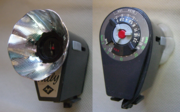 Front and back views of an Agfa Tully flash attachment for AG-1 flashbulbs, 1960
 -
 Metz 171 mecablitz - Compact electronic flash. Made in Germany, Metz-Werke GmbH & Co. KG, 1967
 -
 Metz 171 mecablitz - compact electronic flash disassembled
 -
 Bauer E 251 - Compact automatic flash with built-in rechargeable battery Made in Germany, Robert Bosch Photokino GMBH, 1969
 -
 Bauer E 251 electronic flash disassembled
 -
 Front and back views of a Minolta Auto 28 electronic flashlamp ca 1978


See also
[edit]References
[edit]- ^ Jones, Lou (2013-06-19). Speedlights & Speedlites: Creative Flash Photography at the Speed of Light. Taylor & Francis. ISBN 978-1-136-09821-5.
- ^ McNeil, Ian (2002). An Encyclopaedia of the History of Technology. Routledge. pp. 113–114. ISBN 978-1-134-98165-6. Archived from the original on 2018-05-02.
- ^ Chapman, James Gardiner (1934). Manchester and Photography. Manchester: Palatine Press. pp. 17–18.
- ^ Fisher, Maurice. "History of Flash and Ilford Flashguns". www.photomemorabilia.co.uk.
- ^ Jayon, Bill. "Dangers in the Dark". Archived from the original on May 4, 2015. Retrieved 25 July 2014.
- ^ "Taking instantaneous photographs by electric light". Popular Mechanics. 7 (2). Hearst Magazines: 233. February 1905.
- ^ Solbert, Oscar N.; Newhall, Beaumont; Card, James G., eds. (November 1953). "The First Flash Bulb" (PDF). Image, Journal of Photography of George Eastman House. 2 (6): 34. Archived from the original (PDF) on 14 July 2014. Retrieved 26 June 2014.
- ^ Wightman, Dr. Eugene P. "Photoflash 62 Years Ago" (PDF). Image, Journal of Photography of George Eastman House. IV (7): 49–50. Archived from the original (PDF) on 9 August 2014. Retrieved 4 August 2014.
- ^ "Flash Bulbs - the Lowdown!". 23 July 2018.
- ^ Anderson, Christopher. "Photoflash bulbs". Darklight Imagery. Archived from the original on 28 August 2014. Retrieved 23 October 2014.
The largest flashbulb, the mammoth GE Mazda Type 75, was initially developed to be used as a source of light for night time aerial photography during world war II. The Mazda 75 measured over eight inches long and had a girth of over four inches.
- ^ "flashbulbs.com - philips - page 6". www.flashbulbs.com. Archived from the original on 2 May 2018. Retrieved 2 May 2018.
- ^ "Kodak Unveils 8 'Flashcube' Camera Types", Democrat and Chronicle (Rochester NY), July 9, 1965, pC-1
- ^ "Flashcube, Cameras Introduced", Chicago Tribune, July 10, 1965, pp. 2-5.
- ^ Ivan Tolmachev (19 January 2011). "A Brief History of Photographic Flash". Https. Archived from the original on 25 February 2018. Retrieved 24 February 2018.
- ^ Stephen Dowling (23 July 2014). "Harold Edgerton: The man who froze time". BBC. Archived from the original on 30 January 2018. Retrieved 24 February 2018.
- ^ For example, the Nikon Medical Nikkor Lens Archived 2015-07-29 at the Wayback Machine
- ^ Nicholls, Kyle. "Non-photorealistic Camera". Photo.net. Archived from the original on 25 January 2012. Retrieved 28 December 2011.
- ^ "Studio Flash Explained: Flash Duration". Paul C. Buff, Inc. Retrieved 19 November 2022.
- ^ "Einstein – User Manual/Operation Instructions" (PDF). Paul C. Buff, Inc. p. 13. Archived from the original (PDF) on 1 July 2013. Retrieved 5 July 2013.
- ^ "How fast is the Nikon 850 electronic shutter?". Jim Kasson. 30 October 2017. Retrieved 4 December 2018.
- ^ "Fujifilm GFX 50R Specifications". Fujifilm. Retrieved 4 December 2018.
- ^ a b Langford, Michael (2000). Basic Photography (7th ed.). Focal Press/Butterworth Heinemann. p. 117. ISBN 978-0-240-51592-2.
- ^ "Stobe Tips". Addendum. June 12, 2010.
- ^ George, Chris (2008). Mastering Digital Flash Photography: The Complete Reference Guide. Lark Books. pp. 102–. ISBN 9781600592096. Archived from the original on 2018-05-02.
Further reading
[edit]- Wood, Deloris (1975). The Importance of Artificial Light in the Development of Night Photography (PDF). Annual Meeting of the Association for Education in Journalism (Ottawa,Canada, August 1975).
- Hallett, Michael (1986). "Early magnesium light portraits". History of Photography. 10 (4): 299–301. doi:10.1080/03087298.1986.10443745.
- Davenport, Alma (1991). The History of Photography: An Overview. UNM Press. pp. 26–. ISBN 978-0-8263-2076-6.
- Ward, Gerald W. R. (2008). The Grove Encyclopedia of Materials and Techniques in Art. Oxford University Press. pp. 490–. ISBN 978-0-19-531391-8.
- Hannavy, John (2013). Encyclopedia of Nineteenth-Century Photography. Routledge. pp. –84. ISBN 978-1-135-87327-1.
- Peres, Michael R. (2013). The Focal Encyclopedia of Photography. Taylor & Francis. pp. 754–. ISBN 978-1-136-10614-9.
External links
[edit]
- "Flash Photography with Canon EOS Cameras – Part I". PhotoNotes.org. 12 December 2010.
- "A Minolta/Sony Alpha Flash Compendium". Fotografie.
- "Photographic Cheat Sheet" (PDF). Archived from the original (PDF) on 2015-05-29. Retrieved 2006-09-19. (87.2 KB). Gordon McKinney.
- List of flashbulbs models. David L. Brittain.
- Flash comparison chart Archived 2016-03-03 at the Wayback Machine. Bart Zieba Photography.
| International | |
|---|---|
| National | |

Flash (photography)
View on GrokipediaHistory
Early flash methods
The earliest methods of photographic flash relied on chemical reactions to produce intense, brief illumination for capturing images in low-light conditions. In 1887, German chemists Adolf Miethe and Johannes Gaedicke invented flash powder, a mixture of fine magnesium powder and potassium chlorate, which revolutionized indoor and night photography by enabling exposures in dark environments that were previously impossible with ambient light alone.[6][7] Flash powder was typically ignited in a simple flash-lamp mechanism, consisting of a metal tray or pan attached to the camera, where the photographer would pour a measured amount of the powder and trigger it manually using a fuse, friction striker, or later an electric spark. The composition burned rapidly upon ignition, reaching temperatures around 4,800 K and producing a brilliant white light for approximately 1/30 of a second, sufficient to expose slow photographic plates without excessive motion blur. However, this process carried significant risks, including sudden explosions from uneven burning or static sparks, which could ignite clothing, set studios ablaze, or injure operators with flying debris and intense heat.[8][9][10] One of the first notable applications in journalism came in the late 1880s, when photographer Jacob Riis used flash powder to document poverty in New York City's tenements, capturing stark portraits of immigrants and the urban underclass in dimly lit interiors that highlighted social issues. These early uses were limited by the one-time nature of each ignition—requiring careful reloading after every shot—and persistent fire hazards, which often filled rooms with acrid smoke and demanded vigilant safety measures from photographers.[11][12] A major advancement arrived in 1929 with the introduction of the flashbulb by German inventor Johannes Ostermeier, who patented a single-use glass bulb filled with oxygen and shredded magnesium or aluminum foil that ignited via a filament. This design, commercialized as the Vacu-Blitz, eliminated the open-flame risks of powder while delivering similar intense bursts, though still limited to one exposure per bulb. During World War II, larger variants like the GE Mazda No. 75—over eight inches long and designed for aerial reconnaissance—provided 180,000 lumen-seconds of light, underscoring the technology's evolution toward more reliable, though disposable, chemical illumination. By the mid-20th century, these methods began transitioning toward electronic flashes in the 1930s, which offered reusability without combustion hazards.[13][14][15]Development of modern flashes
The development of modern flash technology marked a shift from single-use chemical methods to reusable electronic systems, beginning with the invention of the electronic flash by American electrical engineer Harold Eugene Edgerton in 1931. Edgerton created a repeatable, short-duration stroboscopic light using xenon-filled tubes, which produced high-intensity illumination capable of freezing ultra-fast motion that was previously impossible to capture.[16][17] This innovation enabled reusable flashes, eliminating the hazards and limitations of early chemical powders while providing consistent, powerful output for scientific and artistic applications.[18] Edgerton's stroboscopic techniques revolutionized high-speed photography, most notably through images like his 1964 capture of a .30-caliber bullet piercing an apple, which demonstrated the flash's ability to halt projectiles in mid-flight and reveal dynamic details invisible to the naked eye.[19] Post-World War II, the 1950s and 1960s saw rapid commercialization of compact electronic strobes, with Honeywell's Strobonar series—introduced via the Heiland Research Corporation and later acquired by Honeywell—offering portable, battery-powered units that integrated guide number controls for easier exposure management.[20] By the 1970s, these advancements facilitated deeper integration with SLR cameras, allowing flashes to mount directly on hot shoes and sync more reliably with shutter mechanisms for professional studio and field use.[21] The 1980s and 1990s brought automated metering innovations, including Honeywell's pioneering automatic electronic flashes from 1965, which used photocells to measure reflected light and terminate the burst for precise exposure.[21] Through-the-lens (TTL) metering for flashes emerged around 1974 with systems like Olympus's TTL OTF, enabling cameras to measure light directly off the film plane during exposure for more accurate results.[22] Dedicated flash units proliferated, such as Minolta's Program Flash 2000 in the late 1980s, a compact auto-exposure model designed specifically for Minolta AF cameras with guide number 20 (ISO 100) and bounce capabilities to simplify on-camera lighting.[23] Wireless flash systems transformed multi-light setups in the late 1990s and early 2000s, with Canon's introduction of optical wireless control via the Speedlite 550EX in 1998, allowing a master flash to trigger and meter remote units without cables for flexible off-camera positioning.[24] Nikon followed in 2003 with its Creative Lighting System (CLS), debuting alongside the SB-800 Speedlight, which used i-TTL metering and infrared communication to support up to three remote groups with balanced fill-flash algorithms.[25] The 2010s emphasized high-speed synchronization (HSS), enabling flash use at shutter speeds beyond traditional limits by pulsing the light continuously across the sensor plane, a feature refined in professional units like Canon's Speedlite 600EX-RT for outdoor portraits with wide apertures.[26] By 2025, HSS in professional gear routinely supports sync speeds up to 1/8000 second, as seen in Godox V860III and Nikon SB-5000 systems, allowing precise control of ambient light and motion freeze in bright conditions.[27] In the 2020s, AI integration has enhanced flash automation, with Canon's EOS R5 Mark II (2024) using neural network processing for predictive exposure compensation and subject-aware flash adjustments in real-time scenes.[28]Types of Flash Devices
Chemical flashes
Chemical flashes represent one of the earliest methods for providing artificial illumination in photography, relying on the rapid combustion of chemical compounds to produce intense, brief bursts of light. These non-reusable devices evolved from hazardous open-air powders to more controlled bulb-based systems, but were ultimately supplanted by safer electronic alternatives.[9] Flash powder, the precursor to modern flashes, consisted primarily of finely ground magnesium mixed with an oxidizer such as potassium chlorate, which burned intensely when ignited to produce a brilliant white light approximating daylight. Ignition typically occurred via an open flame or a percussive device like a pistol, creating a short-duration flash lasting about 1/10th of a second suitable for early slow shutters.[29][30] The light output stemmed from the high-temperature combustion of magnesium, which emitted a spectrum close to sunlight, though the process was unpredictable and posed significant fire risks due to airborne embers.[31] Subtypes of flash powder systems included open tray pans, where the powder was placed in a shallow metal holder and lit manually, allowing photographers to control the amount for varying intensities but often resulting in uneven burns. Enclosed lamps, developed in the late 19th century, contained the powder within a glass or metal chamber to mitigate some dispersal risks, though they still required external ignition and produced substantial smoke.[8][30] Flashbulbs improved upon powder by confining the reaction within a sealed glass envelope, typically evacuated or filled with pure oxygen to facilitate complete combustion without external air. The core element was a thin ribbon or foil of magnesium or aluminum foil, which ignited upon heating to produce a peak light output in milliseconds.[32] Firing was achieved via a low-voltage filament—often a fine wire—powered by a 3V battery or capacitor discharge, which heated the foil to its ignition point around 900°C.[32] Variants of flashbulbs included clear types, which emitted light at approximately 3800K ideal for black-and-white or tungsten-balanced films, and blue-coated versions that shifted the color temperature to 5500K for daylight color film, though at a reduced intensity of about one stop. Bulb sizes ranged from miniature M2 (2-1/4 inches diameter, for compact cameras) to professional FP (1-3/8 inches, for high-output needs), with exposure determined by guide numbers based on bulb type, film speed, and subject distance—for instance, an M2 bulb provided 25-30 foot-candles at 10 feet on ASA 100 film.[32][32] Accessories extended the usability of flashbulbs through multi-bulb units. The flashcube, developed by Sylvania in 1965 and adopted by Kodak for its Instamatic cameras, was a rotating plastic cube housing four bulbs, automatically advancing after each exposure via a camera's hot shoe mechanism for sequential firing without manual reloading.[33] Magicubes, introduced in the 1970s, eliminated the need for battery contacts in the hot shoe by using a piezoelectric striker in the cube itself to ignite the bulbs mechanically.[33] Flipflash, a 1970s Polaroid innovation, featured a linear array of 8 to 10 bulbs in a double-sided bar, flipping to the unused side after exhausting one row to enable rapid successive shots.[34] These chemical systems began to decline in the 1970s and were largely phased out by the 1980s, as electronic flashes offered reusability, reduced fire hazards from combustion, and greater convenience without the need for disposable bulbs or complex synchronization to account for ignition delays.[35]Electronic flashes
Electronic flashes, also known as speedlights or strobes, are high-intensity light sources used in photography to provide instantaneous illumination for capturing images in low-light conditions or to freeze motion. These devices generate a brief, powerful burst of light through electrical discharge in a gas-filled tube, offering precise control over exposure compared to earlier flash methods. They are integral to both amateur and professional photography, enabling techniques like fill flash and high-speed sync.[36] The core components of an electronic flash unit include a xenon gas-filled tube, a capacitor bank for energy storage, and a transformer for high-voltage charging. The xenon tube serves as the light-emitting element, where ionized gas produces a bright plasma arc when triggered. The capacitor bank, typically charged to 300-500 volts, stores the electrical energy needed for the discharge, ensuring a rapid and consistent output. The transformer steps up the low voltage from the power source to charge the capacitor efficiently.[17][37][38] Operation begins with charging the capacitor through the transformer until it reaches full voltage, a process that takes seconds depending on the unit's power. Triggering occurs via a sync cord, hot shoe contact on the camera, or wireless signal, ionizing the xenon gas with a high-voltage pulse from a secondary coil. This initiates a plasma discharge across the tube, releasing stored energy as a short burst of light at a color temperature of 5,000-6,000 K, approximating daylight for accurate color rendition. The discharge lasts about 1/1,000 second, after which the capacitor recharges for the next use. High-speed variants allow durations as short as 1/40,000 second to freeze rapid motion.[39][40] Electronic flashes come in several types tailored to different applications. On-camera units include built-in pop-up flashes integrated into the camera body or shoe-mounted speedlights that attach via the hot shoe for portability. Off-camera strobes, such as studio packs from manufacturers like Profoto, provide higher power for controlled environments and are often powered by external packs for multiple heads. Ring flashes encircle the lens to deliver even, shadow-free illumination, commonly used in macro and portrait photography.[41] Power for electronic flashes typically comes from AA batteries for portable units or AC adapters for studio setups, with recycling times ranging from 1 to 10 seconds based on battery capacity and flash power output. Higher-capacity batteries, like lithium-ion packs, reduce recycle times to under 2 seconds at full power, enabling faster shooting sequences. The guide number (GN) measures a unit's power, calculated as the distance in meters to properly expose a subject at f/1 aperture and ISO 100; for example, a GN of 20 indicates effective range up to 20 meters under those conditions. Many units feature an adjustable zoom head to match lens focal lengths, providing coverage from 24mm to 105mm for optimal light distribution without waste.[36][42][43][40]LED and smartphone flashes
LED flashes in photography represent a compact, energy-efficient illumination solution, particularly suited for integration into mobile devices. These systems typically employ arrays of white light-emitting diodes (LEDs), often numbering 4 to 10 in modern smartphones, to provide burst illumination for still images and continuous light for video recording. Powered directly by the device's battery, LED flashes operate at a color temperature of approximately 5,500 K, mimicking daylight to ensure natural color rendition in photographs.[44][45] The evolution of LED flashes began in the mid-2000s as camera phones sought affordable low-light capabilities. The Nokia N90, released in 2005, marked one of the earliest commercial implementations with a single LED flash paired to its 2-megapixel camera, enabling basic illumination without the bulk of traditional systems. By the early 2010s, multi-LED configurations emerged, transitioning from single units in devices like early Nokia models to dual-LED setups for improved coverage. In the 2020s, advancements include ring-shaped arrays and adaptive technologies, such as Apple's True Tone flash introduced in the iPhone 5s (2013) and refined in later models, which uses four LEDs to dynamically adjust color temperature from around 1,700 K (warm incandescent-like) to 6,500 K (cool daylight) for better white balance matching ambient conditions.[46][47] Smartphone integration has transformed LED flashes into multifunctional tools beyond mere still photography. They support auto-HDR modes by providing consistent exposure in mixed lighting, serve as video lights for extended recording sessions, and enable computational photography features. For instance, Google's Pixel series from 2018 onward incorporates Night Sight (later Night mode), which leverages LED flash in tandem with multi-frame processing and AI algorithms to enhance low-light images without overexposure, reducing noise and preserving details. These flashes also double as emergency torches or autofocus aids, drawing minimal power from the phone's battery.[48][49] As of 2025, LED flashes offer key advantages for mobile photography, including continuous output suitable for up to 30 minutes of video illumination without significant battery drain or heat buildup, making them ideal for social media creators and vloggers. Their low thermal output prevents discomfort during prolonged use, unlike hotter alternatives. However, limitations persist in intensity, with guide number equivalents typically ranging from 5 to 10—far below dedicated xenon systems—restricting effective range to close subjects (about 1-2 meters at ISO 100). Recent innovations in flagship devices, such as micro-LED implementations for superior light diffusion and uniformity, address diffusion issues but do not fully bridge the power gap for extreme low-light stills compared to xenon flashes.[50][51]Operational Principles
Flash characteristics
Flash intensity in photography is quantified using the guide number (GN), which represents the flash's effective output and is calculated as GN = distance × f-number at ISO 100.[52] This metric allows photographers to determine proper exposure by adjusting aperture or distance from the subject.[53] Flash power can be adjusted in fractional increments, typically from full power (1/1) down to 1/128, reducing output exponentially while conserving energy.[54] Light intensity from a flash follows the inverse square law, where illuminance decreases proportionally to the square of the distance from the source (intensity ∝ 1/d², with d as distance), leading to rapid falloff beyond close ranges.[55] Flash duration refers to the time the flash emits light, measured in two standard ways: t0.5, the duration at 50% of peak intensity, and t0.1, the duration at 10% of peak intensity.[56] For typical electronic flashes at full power, t0.5 is around 1/500 second, while t0.1 is longer, often around 1/200 to 1/300 second depending on the model, enabling the flash to freeze motion of fast-moving subjects that ambient light alone cannot capture.[56] Shorter durations at lower power settings further enhance motion-freezing capabilities, making flashes suitable for action photography when synchronized with the camera shutter. The color temperature of flash light typically ranges from 5,000 K to 6,500 K, approximating daylight and producing neutral tones on color film or digital sensors without correction.[57] This spectrum is cooler and more balanced than incandescent sources (around 2,800 K), reducing color casts in mixed lighting scenarios.[57] Adjustments can be made using color correction gels to match ambient conditions, such as warming to 3,200 K for tungsten-lit scenes. Flash output is also measured in lumens for total light emitted or lux for illuminance at a distance, with professional studio strobes often exceeding 10,000 lumens at peak.[58] Recycling time, the interval required to recharge capacitors for the next full-power discharge, serves as a practical limitation, typically 2 seconds or more at maximum output depending on battery type and unit design.[42]Synchronization
Synchronization in flash photography refers to the precise timing of the flash firing relative to the camera's shutter operation, ensuring the sensor or film receives even illumination during exposure. In cameras with focal-plane shutters, the maximum synchronization speed, often denoted as X-sync, is typically around 1/200 second, where the flash fires at full power when the shutter is fully open. This limit arises because the shutter curtains must fully uncover the frame before the flash pulses, and the sync speed is calculated as the reciprocal of the time required for the second curtain to begin closing after the first has fully opened, usually dictated by the mechanical travel time of the curtains across the sensor plane.[59] For cameras equipped with leaf shutters, such as those in medium-format or large-format lenses, synchronization is achieved via M-sync, allowing flash firing up to 1/500 second or higher, as the blades open and close centrally without the sequential travel of focal-plane curtains. This design permits full-frame exposure at faster speeds without the need for compensatory techniques. Focal-plane shutters introduce challenges at speeds exceeding X-sync; in first-curtain synchronization, the flash fires immediately upon the first curtain's opening, potentially causing motion blur trails to appear in front of moving subjects during longer exposures. Conversely, second-curtain (or rear-curtain) synchronization delays the flash until just before the second curtain closes, positioning blur trails naturally behind subjects and enhancing the perception of motion, a technique particularly effective for conveying speed in dynamic scenes like vehicle photography.[60] To overcome X-sync limitations and enable flash use at high shutter speeds—up to 1/8000 second—high-speed sync (HSS) mode pulses the flash repeatedly in a stroboscopic manner, mimicking continuous light and avoiding the need for full shutter openness. This method, supported by systems from manufacturers like Nikon and Canon, reduces effective flash power but allows shallow depth of field in bright conditions, such as outdoor portraits with wide apertures. Flash duration in these modes contributes to freezing subject motion, complementing the sync timing for sharp results amid ambient light.[61][62][63] Flash synchronization is facilitated through various connection methods, evolving from wired to wireless technologies. The hot shoe mount provides direct electrical contact for on-camera flashes, while the PC sync cord offers a reliable wired alternative for off-camera setups up to several meters. Optical slave triggers, introduced in the 1970s, use light-sensitive sensors to fire remote flashes upon detecting the main flash pulse, enabling cordless multi-light arrangements without line-of-sight issues in early implementations. Radio wireless systems, pioneered in the 1990s by devices like the PocketWizard, transmit signals via 2.4 GHz frequencies for robust, interference-resistant control over distances exceeding 300 meters, supporting TTL metering and multiple channels. Bluetooth-enabled triggers such as the Godox X2T series integrate with mirrorless cameras via smartphone apps, allowing remote adjustment of flash power, groups, and sync modes for seamless workflow in hybrid shooting environments.[59][24][64][65]Usage Techniques
Basic techniques
Direct flash, where the flash unit is mounted on the camera and pointed straight at the subject, produces a harsh, high-contrast light with prominent shadows, often resulting in unflattering portraits. To mitigate this, photographers commonly employ bounce flash by angling the flash head—typically at 45 degrees upward toward a neutral ceiling or wall—to reflect and diffuse the light, creating a softer, more natural illumination that mimics overhead lighting. Diffusion accessories such as softboxes or umbrellas can further soften direct flash by scattering the light output, reducing specular highlights and shadows when attached to the flash head.[66][67][68] Fill flash involves using the on-camera flash at low power during daylight conditions to illuminate shadowed areas, particularly under the subject's eyes or chin, without overpowering the ambient light. A typical ratio for subtle fill is 4:1, where ambient exposure dominates and flash provides just enough fill to balance contrasts, preventing underexposed shadows in bright scenes. Through-the-lens (TTL) metering automates this adjustment by measuring light reflected off the subject during a pre-flash, with Canon's E-TTL system introduced in 1995 enabling precise, camera-specific exposure control.[69][70][71] In manual mode, flash exposure is calculated using the guide number (GN), a measure of the flash's output at ISO 100, where the maximum subject distance equals GN divided by the lens aperture (f-number); for example, a GN of 36 allows a 12-foot distance at f/2.8. Bouncing the flash incurs a light loss of approximately 1-2 stops due to reflection inefficiency and increased path length, requiring higher power or closer positioning to compensate. A foundational rule for mixed lighting is to first expose the camera for the background ambient light, then add flash to properly light the foreground subject, ensuring balanced overall exposure.[52][72][73] Basic setups often incorporate accessories like reflectors to bounce light onto the subject from below or the side, enhancing dimension without additional units, and color correction gels placed over the flash head to match the flash's daylight-balanced output (around 5500K) to warmer ambient sources, such as tungsten interiors. These techniques form the foundation for single-flash use, with off-camera positioning offering further creative options in more advanced applications.[74][75]Advanced techniques
High-speed flash techniques enable the capture of ultra-fast motion by employing stroboscopic flashes with durations as short as 1/1,000,000 second, freezing subjects like bullets piercing balloons or apples, as pioneered by Harold Edgerton in the 1930s and 1940s.[76] These electronic strobes, unlike continuous lighting, provide repeatable bursts synchronized precisely with the shutter, allowing photographers to visualize phenomena invisible to the naked eye, such as the deformation of a milk drop upon impact.[77] Multi-flash setups utilize multiple flash units to create complex lighting ratios, enhancing depth and dimension in portraits or product shots. For instance, a key light provides primary illumination, a fill light softens shadows at a ratio like 4:1 relative to the key, and rim lights outline the subject from behind or the sides to separate it from the background.[78] Modeling lights in these units allow real-time preview of shadows and highlights before exposure.[79] Off-camera wireless flashing expands creative control through radio or optical triggers, organizing units into groups (such as A, B, and C in Nikon and Canon systems) to adjust power ratios independently for balanced illumination.[80] This setup facilitates techniques like drag-the-shutter, where a slow shutter speed (e.g., 1/4 second) captures ambient light trails while the flash freezes the subject, blending motion blur with sharp details in low-light scenarios such as event or street photography.[81] Rear-curtain synchronization fires the flash at the end of the exposure, ideal for depicting trailing light effects in moving subjects like car headlights, ensuring the blur follows naturally behind the frozen form rather than preceding it.[82] Complementing this, leaf shutter lenses in medium-format cameras like Hasselblad's XCD series achieve flash synchronization at speeds up to 1/2000 second, surpassing focal-plane shutter limits and enabling wider apertures in bright conditions without high-speed sync modes.[83]Advantages and Limitations
Benefits
Flash photography excels in illumination control, enabling captures in low-light environments without the noise associated with high ISO settings. By supplementing ambient light, flash allows photographers to maintain lower ISO levels, preserving image quality and dynamic range that would otherwise be compromised by sensor amplification in dim conditions.[84] This added light source also facilitates shorter effective exposure times through the flash's brief pulse, often achieving motion-freezing equivalents to 1/1000 second or faster—far surpassing what ambient light alone can accomplish at typical shutter speeds, thus sharply halting subject movement like splashing water or flying insects.[56] The portability and adaptability of flash units provide significant versatility across photographic genres, serving as compact power sources for on-the-go events such as weddings or parties, where they illuminate subjects reliably amid unpredictable surroundings. In portraiture, flash empowers creative manipulation, producing dramatic shadows with direct positioning or ethereal high-key effects via diffusion and bouncing techniques that soften and redirect light for artistic depth.[85] Unlike the fluctuating nature of natural light influenced by time, weather, or location, flash delivers consistent, repeatable output that ensures uniform exposure and color across a series of images. When paired with automatic exposure modes like TTL metering, it minimizes technical errors by dynamically adjusting power to match scene demands, streamlining workflow for both novices and professionals.[86][85] In specialized applications like macro work, flash mitigates shallow depth-of-field challenges by permitting smaller apertures such as f/8 or f/11, which expand the plane of focus to encompass intricate details without introducing motion blur from prolonged exposures. LED flashes, prevalent in contemporary devices, enhance energy efficiency for extended shoots, drawing less power per burst than traditional xenon systems and supporting prolonged battery life during intensive sessions.[87][88] By 2025, computational flash integration in smartphones further refines these benefits, algorithmically blending flash illumination with ambient capture to render natural skin tones, countering issues like overexposure while preserving tonal accuracy across diverse complexions.[89]Drawbacks and safety
While flash photography provides illumination in low-light conditions, it introduces several technical drawbacks that can compromise image quality. The red-eye effect occurs when the camera's flash reflects off the retina's blood vessels, appearing as a red glow in subjects' eyes due to pupil dilation in dim environments. This is exacerbated by direct on-camera flash, which also produces flat, harsh lighting that eliminates natural shadows and contours, resulting in unnatural and unflattering portraits without the use of modifiers like diffusers or softboxes. Additionally, repeated high-power bursts drain camera batteries rapidly and extend recycle times—the interval between flashes—potentially causing missed shots during action sequences, as full-power use can increase recycle from 1-2 seconds to over 5 seconds depending on battery capacity.[90][91] Early flash technologies posed significant environmental and operational risks. Prior to the 1980s, disposable flashbulbs, often made of glass filled with magnesium foil or wire, generated substantial waste as each bulb was single-use and non-recyclable, contributing to landfill accumulation in an era of widespread amateur photography. Xenon-filled electronic flash tubes, while reusable, produce intense heat during discharge—reaching temperatures over 10,000°C internally—which can cause burns if mishandled immediately after firing, as the tube remains hot for several seconds.[92] Safety concerns with flash devices include potential eye damage from intense light exposure. Historical flash powders, used from the late 19th century, were highly volatile and caused numerous explosions, injuring or killing photographers due to uncontrolled ignition; for instance, incidents in the early 1900s involved burns and shrapnel from overheated mixtures. Flashbulbs introduced in the 1930s reduced some risks but still occasionally exploded under faulty conditions, leading to documented injuries among press photographers covering events in low light. Modern electronic and LED flashes carry risks of retinal damage from blue light wavelengths (400-500 nm), which can cause photochemical injury if stared at directly; the International Electrotechnical Commission (IEC) standard 62471 classifies such sources and recommends limits to mitigate photobiological hazards, including blue light exposure based on ICNIRP guidelines. For prolonged viewing (>100 s), regulations cap blue-light weighted irradiance at 0.1 mW/cm² (1 W/m²) at the cornea to prevent retina damage.[93][94][35][95] Bystanders, especially children or those with light-sensitive conditions, face similar risks from continuous LED sources, prompting warnings against direct viewing. However, photographic flashes pose minimal risk due to their short pulse durations (<1 ms), which fall below photochemical damage thresholds per ICNIRP scaling for brief exposures.[95] These drawbacks can be mitigated through established techniques and precautions. Red-eye is commonly reduced using pre-flash modes, where a series of low-intensity bursts before the main exposure constricts pupils, minimizing reflection; many cameras automate this via built-in settings. Flat lighting is softened with diffusers or bounce techniques to spread and redirect light, creating more dimensional results. For battery and recycle issues, high-capacity NiMH batteries or external packs extend performance, while limiting bursts preserves power. Safety protocols include avoiding direct eye exposure to intense continuous light sources and adhering to IEC guidelines for LED output; historical risks like powder explosions were largely eliminated by the shift to electronic systems in the mid-20th century. For flashes, advise averting eyes during firing as a general precaution, though no special measures are typically needed.[96][90][91][92][95]References
- https://camera-wiki.org/wiki/Strobonar