


Community hub
Recent from talks
Contribute something
Nothing was collected or created yet.
Needlework
View on Wikipedia | The examples and perspective in this article deal primarily with Western culture and do not represent a worldwide view of the subject. (March 2022) |

Needlework refers to decorative sewing and other textile handicrafts that involve the use of a needle.[1] Needlework may also include related textile crafts like crochet (which uses a hook), or tatting, (which uses a shuttle).
Similar abilities often transfer well between different varieties of needlework, such as fine motor skill and knowledge of textile fibers. Some of the same tools may be used in several different varieties of needlework.
Background
[edit]
In the Italian Renaissance, needlework—particularly embroidery—was often used to demonstrate the feminine ideal within the domestic sphere. Women and girls of all classes practiced rows of different types of stitches and knots using long band samplers. However, needlework was emphasized in education for women of higher economic status, who were concerned with becoming wives and mothers rather than working class women, who focused on learning practical sewing for housework.[2]
Needlework was an important fact of women's identity during the Victorian age, including embroidery, netting, knitting, crochet, and Berlin wool work. A growing middle class had more leisure time than ever before; printed materials offered homemakers thousands of patterns. Women were still limited to roles in the household, and under the standards of the time a woman working on needle work while entertaining the parlor was considered beautiful. According to one publication from 1843: "Never is beauty and feminine grace so attractive as, when engaged in the honorable discharge of household duties, and domestic cares."[3]
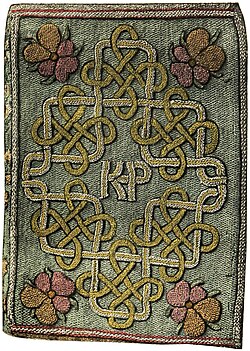
Fancy work was distinguished from plain sewing and it was a mark of a prosperous and well-managed home to display handmade needlework. While plain sewing was often handed over to servants, even in middle class households, fancy work would often be done while entertaining guests, in the afternoons, evenings, or on Sundays. The types of goods that could be decorated with needlework techniques was limited only by the imagination: knitted boots, embroidered book covers, footstools, lampshades, sofa cushions, fans and on and on.[3]
Types
[edit]- Appliqué
- Bead weaving: loom and off-loom
- Braiding and tassel making
- Crochet
- Embroidery
- Knitting
- Lace-making/Needle lace
- Lucet
- Macramé
- Needlepoint
- Quilting
- Sewing
- Tapestry
- Tatting
See also
[edit]References
[edit]- ^ "Needlework". The Free Dictionary By Farlex. Retrieved 2012-05-23.
- ^ Lennard, Frances (June 2016). "The Eye of the Needle: English Embroideries from the Feller Collection (Oxford, The Ashmolean Museum, 1 August–12 October 2014). Catalogue; by Mary M.Brooks, ElizabethFeller, and JacquelineHoldsworth, Micheál & Elizabeth Feller: The Needlework Collection, 2 vols. Hascombe: Needleprint, 2011 (Vol. 1) and 2012 (Vol. 2). £108.00. ISBN Vol. 1: 978-0955208652 (hb); ISBN Vol. 2: 978-0955208669 (hb)". Renaissance Studies. 30 (3): 451–456. doi:10.1111/rest.12134. ISSN 0269-1213.
- ^ a b Ledbetter, Kathryn (2012). Victorian Needlework.
External links
[edit]


- Art in Needlework: A Book about Embroidery by Mary Buckle and Lewis F. Day, available through Project Gutenberg
- Beeton's Book of Needlework by Isabella Mary Beeton, available through Project Gutenberg
- Encyclopedia of Needlework by Therese de Dillmont, available through Project Gutenberg
| Fundamentals |  | |
|---|---|---|
| History of ... | ||
| Regional and ethnic | ||
| Related | ||
| Glossaries | ||


 | This article about textiles is a stub. You can help Wikipedia by expanding it. |