


Community hub
Recent from talks
Contribute something
Nothing was collected or created yet.
Victorian era
View on Wikipedia
| Victorian era | |||
|---|---|---|---|
| 1837–1901 | |||
| |||
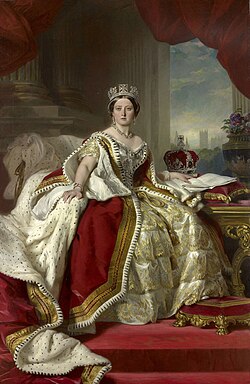
 Painting of Queen Victoria by Franz Xaver Winterhalter (1859) | |||
| Monarch | Victoria | ||
| Leaders | |||


| History of the United Kingdom |
|---|
 |
 United Kingdom portal United Kingdom portal |
| English history |
|---|
| Timeline |
| History of Scotland |
|---|
  |
 Scotland portal Scotland portal |
In the history of the United Kingdom and the British Empire, the Victorian era was the reign of Queen Victoria, from 20 June 1837 until her death on 22 January 1901. Slightly different definitions are sometimes used. The era followed the Georgian era and preceded the Edwardian era, and its later half overlaps with the first part of the Belle Époque era of continental Europe.
Various liberalising political reforms took place in the UK, including expanding the electoral franchise. The Great Famine caused mass death in Ireland in the mid 1840s. Britain had peaceful relations with the other great powers. It participated in various military threats and conflicts mainly against minor powers. The Crimean War of the 1850s was against Russia. It was seen as a major threat to the Ottoman ally and to India. The British Empire expanded during this period and the Royal Navy was predominant power in the world.
Victorian society valued a high standard of personal conduct across all sections of society. The emphasis on morality gave impetus to social reform but also placed restrictions on certain groups' liberty. Prosperity rose during the period, but debilitating undernutrition persisted. Literacy and childhood education became near universal in Great Britain for the first time. Whilst some attempts were made to improve living conditions, slum housing and disease remained a severe problem.
The period saw significant scientific and technological development. Britain was advanced in industry and engineering in particular, but somewhat less developed in art and education. Great Britain's population increased rapidly, while Ireland's fell sharply.
Terminology
[edit]In the strictest sense, the Victorian era covers the duration of Victoria's reign as Queen of the United Kingdom of Great Britain and Ireland, from her accession on 20 June 1837—after the death of her uncle, William IV—until her death on 22 January 1901, after which she was succeeded by her eldest son, Edward VII. Her reign lasted 63 years and seven months, a longer period than any of her predecessors. The term 'Victorian' was in contemporaneous usage to describe the era.[1] The era can also be understood in a more extensive sense—the 'long Victorian era'—as a period that possessed sensibilities and characteristics distinct from the periods adjacent to it,[note 1] in which case it is sometimes dated to begin before Victoria's accession—typically from the passage of or agitation for (during the 1830s) the Reform Act 1832, which introduced a wide-ranging change to the electoral system of England and Wales.[note 2] Definitions that purport a distinct sensibility or politics to the era have also created scepticism about the worth of the label 'Victorian', though there have also been defences of it.[2]
Victorian subperiods
[edit]The interwar period between the Napoleonic Wars (1815) and World War I (1914) is often broadly seen as an age of peace, progress, and political liberalism. However, the Queen's 64-year reign created an illusion of continuous uniformity, masking significant shifts in ideas, manners, and values. Michael Sadleir was insistent that "in truth, the Victorian period is three periods, and not one".[3] He distinguished early Victorianism—the socially and politically unsettled period from 1837 to 1850[4]—and late Victorianism (from 1880 onwards), with its new waves of aestheticism and imperialism,[5] from the Victorian heyday: mid-Victorianism, 1851 to the 1870s. He saw the middle period as characterised by a distinctive mixture of prosperity, domestic prudery, and complacency[6]—what G. M. Trevelyan called the 'mid-Victorian decades of quiet politics and roaring prosperity'.[7] Harold Schultz has summarized the typical three part periodization used by scholars.[8]
Early Victorianism (1815-1850) Driven by the revolutionary ideas from America and France, as well as the convictions of English utilitarians and Evangelicals, Britain began a process of gradual democratization. The national government and society adapted to absorb this "democratic radicalism." Simultaneous with this political change, England became a world leader in both opinion and, more practically, in industrialization and manufactured goods production. By mid-century, Britain was approaching its peak of power, confident that its economic prosperity, founded on free trade and parliamentary institutions, would ensure happiness and peace.[9]
Mid-Victorianism (1850-1870s) This was the height of Victorian self-assurance, characterized by a strong sense of duty and unwavering belief in political Liberalism. British industrial and naval power was frequently used to promote liberalism abroad, while domestically, the focus was on individual freedom. Though some contemporary critics attacked the era's bourgeois values and easy supremacy, the prevailing faith in the inevitability of progress remained firm, assuring the nation its problems would be solved and its greatness maintained. For an educated Englishman, holding a seat in Parliament represented the highest possible aspiration.[10][11]
Late Victorianism (1880-1914) The unchallenged supremacy that defined the mid-century began to erode. Britain's industrial and commercial dominance faced new competition, and the Pax Britannica (British Peace) was jeopardized by militarism and industrial rivalry from other nations that had not embraced free trade or parliamentary democracy. As a result, core mid-Victorian values—such as liberalism, free trade, political compromise, and moral rectitude—were undermined. They failed to guarantee security for the average English citizen in a world now defined by aggressive nationalism and impersonal economic forces. This search for new direction led to a rejection of ancient values and institutions. Powerful new social and political movements, including trade unionism and the demand for woman suffrage, rose to prominence and demanded recognition.[12]
Politics, diplomacy and war
[edit]
The Reform Act,[note 3] which made various changes to the electoral system including expanding the franchise, had been passed in 1832.[13] The franchise was expanded again by the Second Reform Act[note 4] in 1867.[14] The Third Reform Act in 1884 introduced a general principle of one vote per household. All these acts and others simplified the electoral system and reduced corruption. Historian Bruce L Kinzer describes these reforms as putting the United Kingdom on the path towards becoming a democracy. The traditional aristocratic ruling class attempted to maintain as much influence as possible while gradually allowing the middle- and working-classes a role in politics. However, all women and a large minority of men remained outside the system into the early 20th century.[15]
Cities were given greater political autonomy and the labour movement was legalised.[16] From 1845 to 1852, the Potato Famine caused mass starvation, disease and death in Ireland, sparking large-scale emigration.[17] The Corn Laws were repealed in response to this.[18] Across the British Empire, reform included rapid expansion, the complete abolition of slavery in the African possessions and the end of transportation of convicts to Australia. Restrictions on colonial trade were loosened and responsible (i.e. semi-autonomous) government was introduced in some territories.[19][20]

Throughout most of the 19th century Britain was the most powerful country in the world.[21] The period from 1815 to 1914, known as the Pax Britannica, was a time of relatively peaceful relations between the world's great powers. This is particularly true of Britain's interactions with the others.[22] The only war in which the British Empire fought against another major power was the Crimean War, from 1853 to 1856.[23][19] There were various revolts and violent conflicts within the British Empire,[19][20] and Britain participated in wars against minor powers.[24][19][20] It also took part in the diplomatic struggles of the Great Game[24] and the Scramble for Africa.[19][20]
In 1840, Queen Victoria married her German cousin Prince Albert of Saxe-Coburg and Gotha. The couple had nine children, who themselves married into various royal families, and the queen thus became known as the 'grandmother of Europe'.[25][16] In 1861, Albert died.[24] Victoria went into mourning and withdrew from public life for ten years.[16] In 1871, with republican sentiments growing in Britain, she began to return to public life. In her later years, her popularity soared as she became a symbol of the British Empire. Queen Victoria died on 22 January 1901.[25]
Society and culture
[edit]Family life
[edit]The Victorian era saw a rapidly growing middle class who became an important cultural influence, to a significant extent replacing the aristocracy as British society's dominant class.[26][27] A distinctive middle-class lifestyle developed that influenced what society valued as a whole.[26][28] Increased importance was placed on the value of the family, and the idea that marriage should be based on romantic love gained popularity.[29][30] A clear separation was established between the home and the workplace, which had often not been the case before.[28] The home was seen as a private environment,[28] where housewives provided their husbands with a respite from the troubles of the outside world.[29] Within this ideal, women were expected to focus on domestic matters and to rely on men as breadwinners.[31][32] Women had limited legal rights in most areas of life, and a feminist movement developed.[32][33] Parental authority was seen as important, but children were given legal protections against abuse and neglect for the first time towards the end of the period.[34] Access to education increased rapidly during the 19th century. State-funded schools were established in England and Wales for the first time. Education became compulsory for pre-teenaged children in England, Scotland and Wales. Literacy rates increased rapidly, and had become nearly universal by the end of the century.[35][36] Private education for wealthier children, boys and more gradually girls, became more formalised over the course of the century.[35]
Religion and social issues
[edit]The growing middle class and strong evangelical movement placed great emphasis on a respectable and moral code of behaviour. This included features such as charity, personal responsibility, controlled habits,[note 5] child discipline and self-criticism.[27][37] As well as personal improvement, importance was given to social reform.[38] Utilitarianism was another philosophy that saw itself as based on science rather than on morality, but also emphasised social progress.[39][40] An alliance formed between these two ideological strands.[41] The reformers emphasised causes such as improving the conditions of women and children, giving police reform priority over harsh punishment to prevent crime, religious equality, and political reform in order to establish a democracy.[42] The political legacy of the reform movement was to link the nonconformists (part of the evangelical movement) in England and Wales with the Liberal Party.[43] This continued until the First World War.[44] The Presbyterians played a similar role as a religious voice for reform in Scotland.[45]
Religion was politically controversial during this era, with Nonconformists pushing for the disestablishment of the Church of England.[46] Nonconformists comprised about half of church attendees in England in 1851,[note 6][47] and gradually the legal discrimination that had been established against them outside of Scotland was removed.[48][49][50][51] Legal restrictions on Roman Catholics were also largely removed. The number of Catholics grew in Great Britain due to conversions and immigration from Ireland.[46] Secularism and doubts about the accuracy of the Old Testament grew among people with higher levels of education.[52] Northern English and Scottish academics tended to be more religiously conservative, whilst agnosticism and even atheism (though its promotion was illegal)[53] gained appeal among academics in the south.[54] Historians refer to a 'Victorian Crisis of Faith', a period when religious views had to readjust to accommodate new scientific knowledge and criticism of the Bible.[55]
Popular culture
[edit]A variety of reading materials grew in popularity during the period, including novels,[56] women's magazines,[57] children's literature,[58] and newspapers.[59] Much literature, including chapbooks, was distributed on the street.[60][61] Music was also very popular, with genres such as folk music, broadsides, music halls, brass bands, theater music and choral music having mass appeal. What is now called classical music was somewhat undeveloped compared to parts of Europe but did have significant support.[62] Many sports were introduced or popularised during the Victorian era.[63] They became important to male identity.[64] Examples included cricket,[65] football,[66] rugby,[67] tennis[68] and cycling.[69] The idea of women participating in sport did not fit well with the Victorian view of femininity, but their involvement did increase as the period progressed.[70]
For the middle classes, many leisure activities such as table games could be done in the home while domestic holidays to rural locations such as the Lake District and Scottish Highlands were increasingly practical.[71] The working classes had their own culture separate from that of their richer counterparts, various cheaper forms of entertainment and recreational activities provided by philanthropy. Trips to resorts such as Blackpool were increasingly popular towards the end of period.[72] Photography became an increasingly accessible and popular part of everyday life.[73] Initially the industrial revolution increased working hours, but over the course of the 19th century a variety of political and economic changes caused them to fall back down to and in some cases below pre-industrial levels, creating more time for leisure.[74]
-
 Recreation of a Victorian parlour at Nidderdale Museum, Yorkshire
 -
 Cheap meals for poor children in East London (1870)
 -
 Leisure Hours (1855), depiction of a man resting by George Hardy


Newspapers
[edit]According to Andrew Marr, four major transitions in the Victorian era created modern British journalism. The stamp tax on every paper sold was removed, enabling newspapers to become profitable by selling advertising. Secondly, new industrial technology enabled the overnight printing of hundreds of thousands of copies for rapid distribution by the new railway system to the entire nation. Next the educational system was enlarged from a small elite enabling most people to read newspapers. And finally Victorians developed mass democracy that made public opinion relevant to the formation of public policy.[75]
By the early 19th century, there were 52 London papers and over 100 other titles. As stamp, paper and other duties were progressively reduced from the 1830s onwards (all duties on newspapers were gone by 1855) there was a massive growth in overall circulation as major events and improved communications developed the public's need for information. The Daily Universal Register began life in 1785 and was later to become known as The Times from 1788. This was the most significant newspaper of the first half of the 19th century, but from around 1860 there were a number of more strongly competitive titles, each differentiated by its political biases and interests.[76]
Economy, industry, and trade
[edit]
Before the Industrial Revolution, daily life had changed little for hundreds of years. The 19th century saw rapid technological development with a wide range of new inventions. This led Great Britain to become the foremost industrial and trading nation of the time.[77] Historians have characterised the mid-Victorian era (1850–1870) as Britain's 'Golden Years',[78][79] with national income per person increasing by half. This prosperity was driven by increased industrialisation, especially in textiles and machinery, along with exports to the empire and elsewhere.[80] The positive economic conditions, as well as a fashion among employers for providing welfare services to their workers, led to relative social stability.[80][81] The Chartist movement for working-class men to be given the right to vote, which had been prominent in the early Victorian period, dissipated.[80] Government involvement in the economy was limited.[81] Only in the post-World War II period, around a century later, did the country experience substantial economic growth again.[79] But whilst industry was well developed, education and the arts were mediocre.[81] Wage rates continued to improve in the later 19th century: real wages (after taking inflation into account) were 65 per cent higher in 1901 compared to 1871. Much of the money was saved, as the number of depositors in savings banks rose from 430,000 in 1831 to 5.2 million in 1887, and their deposits from £14 million to over £90 million.[82]
Child labour
[edit]
Children had always played a role in economic life but exploitation of their labour became especially intense during the Victorian era. Children were put to work in a wide range of occupations, but particularly associated with this period are factories. Employing children had advantages, as they were cheap, had limited ability to resist harsh working conditions, and could enter spaces too small for adults. Some accounts exist of happy upbringings involving child labour, but conditions were generally poor. Pay was low, punishments severe, work was dangerous and disrupted children's development (often leaving them too tired to play even in their free time). Early labour could do lifelong harm; even in the 1960s and '70s, the elderly people of industrial towns were noted for their often unusually short stature, deformed physiques, and diseases associated with unhealthy working conditions.[83] Reformers wanted the children in school; in 1840 only about 20 per cent of the children in London had any schooling.[84] By the 1850s, around half of the children in England and Wales were in school (not including Sunday school).[85] From the 1833 Factory Act onwards, attempts were made to get child labourers into part time education, though this was often difficult to achieve.[86] Only in the 1870s and 1880s did children begin to be compelled into school.[85] Work continued to inhibit children's schooling into the early 20th century.[83]
Housing and public health
[edit]19th-century Britain saw a huge population increase accompanied by rapid urbanisation stimulated by the Industrial Revolution.[87] In the 1901 census, more than three out of every four people were classified as living in an urban area, compared to one in five a century earlier.[88] Historian Richard A. Soloway wrote that "Great Britain had become the most urbanized country in the West."[89] The rapid growth in the urban population included the new industrial and manufacturing cities, as well as service centres such as Edinburgh and London.[88][90] Private renting from housing landlords was the dominant tenure. P. Kemp says this was usually of advantage to tenants.[91] Overcrowding was a major problem with seven or eight people frequently sleeping in a single room. Until at least the 1880s, sanitation was inadequate in areas such as water supply and disposal of sewage. This all had a negative effect on health, especially that of the impoverished young. For instance, of the babies born in Liverpool in 1851, only 45 per cent survived to age 20.[92] Conditions were particularly bad in London, where the population rose sharply and poorly maintained, overcrowded dwellings became slum housing. Kellow Chesney wrote of the situation:[93]
Hideous slums, some of them acres wide, some no more than crannies of obscure misery, make up a substantial part of the metropolis... In big, once handsome houses, thirty or more people of all ages may inhabit a single room
Hunger and poor diet was a common aspect of life across the UK in the Victorian period, especially in the 1840s, but the mass starvation seen in the Great Famine in Ireland was unique.[94][92] Levels of poverty fell significantly during the 19th century from as much as two thirds of the population in 1800 to less than a third by 1901. However, 1890s studies suggested that almost 10% of the urban population lived in a state of desperation lacking the food necessary to maintain basic physical functions. Attitudes towards the poor were often unsympathetic and they were frequently blamed for their situation. In that spirit, the Poor Law Amendment Act 1834 had been deliberately designed to punish them and would remain the basis for welfare provision into the 20th century. While many people were prone to vices, not least alcoholism, historian Bernard A. Cook argues that the main reason for 19th century poverty was that typical wages for much of the population were simply too low. Barely enough to provide a subsistence living in good times, let alone save up for bad.[92]
Improvements were made over time to housing along with the management of sewage and water eventually giving the UK the most advanced system of public health protection anywhere in the world.[95] The quality and safety of household lighting improved over the period with oil lamps becoming the norm in the early 1860s, gas lighting in the 1890s and electric lights beginning to appear in the homes of the richest by the end of the period.[96] Medicine advanced rapidly during the 19th century and germ theory was developed for the first time. Doctors became more specialised and the number of hospitals grew.[95] The overall number of deaths fell by about 20%. The life expectancy of women increased from around 42 to 55 and 40 to 56 for men.[note 7][89] In spite of this, the mortality rate fell only marginally, from 20.8 per thousand in 1850 to 18.2 by the end of the century. Urbanisation aided the spread of diseases and squalid living conditions in many places exacerbated the problem.[95] The population of England, Scotland and Wales grew rapidly during the 19th century.[97] Various factors are considered contributary to this, including a rising fertility rate (though it was falling by the end of the period),[89] the lack of a catastrophic pandemic or famine in the island of Great Britain during the 19th century for the first time in history,[98] improved nutrition,[98] and a lower overall mortality rate.[98] Ireland's population shrank significantly, mostly due to emigration and the Great Famine.[99]
-
 Slum area in Glasgow (1871)
 -
![Buildings originally built as Llanfyllin workhouse, a state-funded home for the destitute which operated from 1838 to 1930[100][101]](//upload.wikimedia.org/wikipedia/commons/thumb/6/67/Llanfyllin_Workhouse_-_geograph.org.uk_-_3098623.jpg/500px-Llanfyllin_Workhouse_-_geograph.org.uk_-_3098623.jpg) Buildings originally built as Llanfyllin workhouse, a state-funded home for the destitute which operated from 1838 to 1930[100][101]
Buildings originally built as Llanfyllin workhouse, a state-funded home for the destitute which operated from 1838 to 1930[100][101] -
 Photograph of a mother and baby by Alfred Capel-Cure (c. 1850s or 60s)

![Buildings originally built as Llanfyllin workhouse, a state-funded home for the destitute which operated from 1838 to 1930[100][101]](https://en.wikipedia.org/wiki/File:Llanfyllin_Workhouse_-_geograph.org.uk_-_3098623.jpg)

Knowledge
[edit]Science
[edit]
The professionalisation of scientific study began in parts of Europe following the French Revolution but was slow to reach Britain. William Whewell coined the term 'scientist' in 1833 to refer to those who studied what was generally then known as natural philosophy, but it took a while to catch on. Having been previously dominated by amateurs with a separate income, the Royal Society admitted only professionals from 1847 onwards.[102] The British biologist Thomas Henry Huxley indicated in 1852 that it remained difficult to earn a living as a scientist alone.[54] Scientific knowledge and debates such as that about Charles Darwin's On the Origin of Species (1859), which sought to explain biological evolution by natural selection, gained a high profile in the public consciousness. Simplified (and at times inaccurate) popular science was increasingly distributed through a variety of publications which caused tension with the professionals.[102] There were significant advances in various fields of research, including statistics,[103] elasticity,[104] refrigeration,[105] natural history,[54] electromagnetism,[106] and logic.[107]
Industry
[edit]
Known as the 'workshop of the world', Britain was uniquely advanced in technology in the mid-19th century.[108] Engineering, having developed into a profession in the 18th century, gained new profile and prestige in this period.[109] The Victorian era saw methods of communication and transportation develop significantly. In 1837, William Fothergill Cooke and Charles Wheatstone invented the first telegraph system. This system, which used electrical currents to transmit coded messages, quickly spread across Britain, appearing in every town and post office. A worldwide network developed towards the end of the century. In 1876, an American patented the telephone. A little over a decade later, 26,000 telephones were in service in Britain. Multiple switchboards were installed in every major town and city.[77] Guglielmo Marconi developed early radio broadcasting at the end of the period.[110] The railways were important economically in the Victorian era, allowing goods, raw materials, and people to be moved around, stimulating trade and industry. They were also a major employer and industry in their own right.[111]
Moral standards
[edit]
Expected standards of personal conduct changed in around the first half of the 19th century, with good manners and self-restraint becoming much more common.[112] Historians have suggested various contributing factors, such as Britain's major conflicts with France during the early 19th century, meaning that the distracting temptations of sinful behaviour had to be avoided in order to focus on the war effort, and the evangelical movement's push for moral improvement.[113] There is evidence that the expected standards of moral behaviour were reflected in action as well as rhetoric across all classes of society.[114][115] For instance, an analysis suggested that less than 5% of working class couples cohabited before marriage.[115]
Historian Harold Perkin argued that the change in moral standards led by the middle of the 19th century to 'diminished cruelty to animals, criminals, lunatics, and children (in that order)'.[112] Legal restrictions were placed on cruelty to animals.[116][117][118] Restrictions were placed on the working hours of child labourers in the 1830s and 1840s.[119][120] Further interventions took place throughout the century to increase the level of child protection.[121] Use of the death penalty also decreased.[112] Crime rates fell significantly in the second half of the 19th century. Sociologist Christie Davies linked this change to attempts to morally educate the population, especially at Sunday schools.[122]
Sexual behaviour
[edit]Contrary to popular belief, Victorian society understood that both men and women enjoyed copulation.[123] Chastity was expected of women, whilst attitudes to male sexual behaviour were more relaxed.[124] The development of police forces led to a rise in prosecutions for illegal sodomy in the middle of the 19th century.[125] Male sexuality became a favourite subject of medical researchers' study.[126] For the first time, all male homosexual acts were outlawed.[127] Concern about sexual exploitation of adolescent girls increased during the period, especially following the white slavery scandal, which contributed to the increasing of the age of consent from 13 to 16.[128]
At a time when job options for women were limited and generally low-paying, some women, particularly those without familial support, took to prostitution to support themselves. Attitudes in public life and among the general population to prostitution varied. Evidence about prostitutes' situation also varies. One contemporary study argues that the trade was a short-term stepping stone to a different lifestyle for many women, while another, more recent study argues they were subject to physical abuse, financial exploitation, state persecution, and difficult working conditions. Due to worries about venereal disease, especially among soldiers, women suspected of prostitution were for a period between the 1860s and 1880s subject to spot compulsory examinations for sexually transmitted infections, and detainment if they were found to be infected. This caused a great deal of resentment among women in general due to the principle underlying the checks, that women had to be controlled in order to be safe for sexual use by men, and the checks were opposed by some of the earliest feminist campaigning.[128]
See also
[edit]- 19th-century London
- Political and diplomatic history of the Victorian era
- Society and culture of the Victorian era
- Religion in Victorian England.
- History of public health in the United Kingdom
- Theatre in the Victorian era
- Victorian burlesque
- Victorian fashion
- Victorian house
- Victorian jewellery
- Victorian masculinity
- Victorian morality
- Victorian painting
- Women in the Victorian era
Notes
[edit]- ^ This is the term used for the period covered by Patrick Leary's international academic mailing-list VICTORIA 19th-century British culture & society.
- ^ A Scottish Reform Act and Irish Reform Act were passed separately.
- ^ A Scottish Reform Act and Irish Reform Act were passed separately.
- ^ See Representation of the People (Ireland) Act 1868 and Representation of the People (Scotland) Act 1868 for equivalent reforms made in those jurisdictions
- ^ Avoiding addictions such as alcoholism and excessive gambling
- ^ They were a clear majority in Wales. Scotland and Ireland had separate religious cultures.
- ^ These life expectancy figures are rounded to the nearest whole.
References
[edit]- ^ Plunkett 2012, p. 2.
- ^ Hewitt, Martin (Spring 2006). "Why the Notion of Victorian Britain Does Make Sense". Victorian Studies. 48 (3): 395–438. doi:10.2979/VIC.2006.48.3.395. ISSN 0042-5222. S2CID 143482564. Archived from the original on 30 October 2017. Retrieved 23 May 2017.
- ^ Sadleir, Michael (1945). Trollope. p. 17.
- ^ Sadleir, Michael (1945). Trollope. pp. 18–19.
- ^ Sadleir, Michael (1945). Trollope. pp. 13 and 32.
- ^ Michael, Sadleir (1945). Trollope. pp. 25–30.
- ^ Trevelyan, George Macaulay (1926). History of England. Longmans, Green and Co. p. 650. OCLC 433219629.
- ^ Harold J. Schultz, History of England (1971) pp.288–289.
- ^ Joanna Innes, "When did the Victorian Age begin? Reflections on Richard Price's British Society 1680–1880." Journal of Victorian Culture 11.1 (2006): 147–154. online
- ^ G. M. Young, "Mid-Victorianism." History Today 1.1 (1951) p.17+.
- ^ W. L. Burn, The Age of Equipoise : A Study of the Mid-Victorian Generation (1968)
- ^ Barbara Caine, "When did the Victorian period end? Questions of gender and generation." Journal of Victorian Culture 11.2 (2006): 317–325. online
- ^ Swisher, Clarice (2000). Victorian England. San Diego: Greenhaven Press. pp. 248–250. ISBN 9780737702217.
{{cite book}}: CS1 maint: publisher location (link) - ^ Anstey, Thomas Chisholm (1867). Notes Upon "the Representation of the People Act, '1867.'" (30 & 31 Vict. C. 102.): With Appendices Concerning the Antient Rights, the Rights Conferred by the 2 & 3 Will. IV C. 45, Population, Rental, Rating, and the Operation of the Repealed Enactments as to Compound Householders. W. Ridgway. Archived from the original on 11 May 2023. Retrieved 11 May 2023.
- ^ Kinzer, Bruce L (2011). "Elections and the Franchise". In Mitchell, Sally (ed.). Victorian Britain An Encyclopedia. Routledge. pp. 253–255. ISBN 9780415669726.
- ^ a b c National Geographic (2007). Essential Visual History of the World. National Geographic Society. pp. 290–292. ISBN 978-1-4262-0091-5.
- ^ Kinealy, Christine (1994). This Great Calamity. Gill & Macmillan. p. xv. ISBN 9781570981401.
- ^ Lusztig, Michael (July 1995). "Solving Peel's Puzzle: Repeal of the Corn Laws and Institutional Preservation". Comparative Politics. 27 (4): 393–408. doi:10.2307/422226. JSTOR 422226.
- ^ a b c d e Livingston Schuyler, Robert (September 1941). "The Cambridge History of the British Empire. Volume II: The Growth of the New Empire, 1783-1870". Political Science Quarterly. 56 (3): 449. doi:10.2307/2143685. ISSN 0032-3195. JSTOR 2143685.
- ^ a b c d Benians, E. A. (1959). The Cambridge History of the British Empire Vol. iii: The Empire – Commonwealth 1870–1919. Cambridge University Press. pp. 1–16. ISBN 978-0521045124.
{{cite book}}: ISBN / Date incompatibility (help) - ^ Sandiford, Keith A. (2011). "Foreign relations". In Mitchell, Sally (ed.). Victorian Britain An Encyclopedia. Routledge. pp. 307–309. ISBN 9780415669726.
- ^ Holland, Rose, John (1940). The Cambridge history of the British empire: volume II: the growth of the new empire, 1783-1870. pp. x–vi. OCLC 81942369.
{{cite book}}: CS1 maint: multiple names: authors list (link) - ^ Taylor, A. J. P. (1954). The Struggle for Mastery in Europe: 1848–1918. Mumbai: Oxford University Press. pp. 60–61.
- ^ a b c Swisher, Clarice (2000). Victorian England. Greenhaven Press. pp. 248–250. ISBN 9780737702217.
- ^ a b "Queen Victoria: The woman who redefined Britain's monarchy". BBC Teach. Archived from the original on 27 November 2020. Retrieved 12 October 2020.
- ^ a b Houghton, Walter E. (2008). The Victorian Frame of Mind. New Haven: Yale University Press. doi:10.12987/9780300194289. ISBN 9780300194289. S2CID 246119772.
- ^ a b Halévy, Élie (1924). A history of the English people ... T. F. Unwin. pp. 585–595. OCLC 1295721374.
- ^ a b c Wohl, Anthony S. (1978). The Victorian family: structure and stresses. London: Croom Helm. ISBN 9780856644382.
: Cited in: Summerscale, Kate (2008). The suspicions of Mr. Whicher or the murder at Road Hill House. London: Bloomsbury. pp. 109–110. ISBN 9780747596486. (novel) - ^ a b Hoppen, Theodore K. (30 June 2000). The Mid-Victorian Generation 1846-1886. Oxford University Press. p. 316. ISBN 978-0-19-254397-4. OCLC 1016061494.
- ^ Boston, Michelle (12 February 2019). "Five Victorian paintings that break tradition in their celebration of love". USC Dornsife. University of Southern California. Archived from the original on 10 February 2021. Retrieved 18 December 2020.
- ^ Robyn Ryle (2012). Questioning gender: a sociological exploration. Thousand Oaks, Calif.: SAGE/Pine Forge Press. pp. 342–343. ISBN 978-1-4129-6594-1.
- ^ a b Rubinow., Gorsky, Susan (1992). Femininity to feminism: women and literature in the Nineteenth century. Twayne Publishers. ISBN 0-8057-8978-2. OCLC 802891481.
{{cite book}}: CS1 maint: multiple names: authors list (link) - ^ Gray, F. Elizabeth (2004). ""Angel of the House" in Adams, ed". Encyclopedia of the Victorian Era. 1: 40–41.
- ^ Bilston, Barbara (4 July 2010). "A history of child protection". Open University. Archived from the original on 24 June 2021. Retrieved 12 June 2022.
- ^ a b Lloyd, Amy (2007). "Education, Literacy and the Reading Public" (PDF). University of Cambridge. Archived (PDF) from the original on 20 May 2021. Retrieved 27 January 2022.
- ^ "The 1870 Education Act". UK Parliament.
- ^ Young, G. M. (1936). Victorian England: Portrait of an Age. pp. 1–6.
- ^ Briggs, Asa (1957). The Age of Improvement 1783–1867. pp. 236–285.
- ^ Roach, John (1957). "Liberalism and the Victorian Intelligentsia". The Cambridge Historical Journal. 13 (1): 58–81. doi:10.1017/S1474691300000056. ISSN 1474-6913. JSTOR 3020631. Archived from the original on 2 September 2020. Retrieved 2 September 2020.
- ^ Young, G. M. Victorian England: Portrait of an Age. pp. 10–12.
- ^ Halevy, Elie (1924). A History Of The English People In 1815. pp. 585–95.
- ^ Woodward, Llewellyn (1962). The Age of Reform, 1815–1870 (2nd ed.). Oxford University Press. pp. 28, 78–90, 446, 456, 464–465.
- ^ Bebbington, D. W. (1982). The Nonconformist Conscience: Chapel and Politics, 1870–1914. George Allen & Unwin, 1982.
- ^ Glaser, John F. (1958). "English Nonconformity and the Decline of Liberalism". The American Historical Review. 63 (2): 352–363. doi:10.2307/1849549. JSTOR 1849549.
- ^ Wykes, David L. (2005). "Introduction: Parliament and Dissent from the Restoration to the Twentieth Century". Parliamentary History. 24 (1): 1–26. doi:10.1111/j.1750-0206.2005.tb00399.x.
- ^ a b Chadwick, Owen (1966). The Victorian church. Vol. 1. A. & C. Black. pp. 7–9, 47–48. ISBN 978-0334024095.
- ^ Johnson, Dale A. (2011). "Nonconformism". In Mitchell, Sally (ed.). Victorian Britain An Encyclopedia. Routledge. pp. 546–547. ISBN 9780415669726.
- ^ Machin, G. I. T. (1979). "Resistance to Repeal of the Test and Corporation Acts, 1828". The Historical Journal. 22 (1): 115–139. doi:10.1017/s0018246x00016708. ISSN 0018-246X. S2CID 154680968.
- ^ Davis, R. W. (1966). "The Strategy of "Dissent" in the Repeal Campaign, 1820–1828". The Journal of Modern History. 38 (4): 374–393. doi:10.1086/239951. JSTOR 1876681. S2CID 154716174.
- ^ Anderson, Olive (1974). "Gladstone's Abolition of Compulsory Church Rates: a Minor Political Myth and its Historiographical Career". The Journal of Ecclesiastical History. 25 (2): 185–198. doi:10.1017/s0022046900045735. ISSN 0022-0469. S2CID 159668040.
- ^ Bowen, Desmond (1979). "Conscience of the Victorian State, edited by Peter Marsh". Canadian Journal of History. 14 (2): 318–320. doi:10.3138/cjh.14.2.318. ISSN 0008-4107.
- ^ "Coleridge's Religion". victorianweb.org. Archived from the original on 30 March 2023. Retrieved 10 August 2022.
- ^ Chadwick, Owen (1966). The Victorian Church. Vol. 1: 1829–1859. pp. 487–489.
- ^ a b c Lewis, Christopher (2007). "Chapter 5: Energy and Entropy: The Birth of Thermodynamics". Heat and Thermodynamics: A Historical Perspective. United States of America: Greenwood Press. ISBN 978-0-313-33332-3.
- ^ Eisen, Sydney (1990). "The Victorian Crisis of Faith and the Faith That was Lost". In Helmstadter, Richard J.; Lightman, Bernard (eds.). Victorian Faith in Crisis: Essays on Continuity and Change in Nineteenth-Century Religious Belief. Palgrave Macmillan UK. pp. 2–9. doi:10.1007/978-1-349-10974-6_2. ISBN 9781349109746. Archived from the original on 19 October 2022. Retrieved 18 October 2022.
- ^ "Aspects of the Victorian book: the novel". British Library. Archived from the original on 24 May 2018. Retrieved 23 October 2020.
- ^ "Aspects of the Victorian book: Magazines for Women". British Library. Archived from the original on 3 February 2020. Retrieved 23 October 2020.
- ^ McGillis, Roderick (6 May 2016). "Children's Literature - Victorian Literature". Oxford Bibliographies. Archived from the original on 31 October 2020. Retrieved 28 October 2020.
- ^ Weiner, Joel H. (2011). "Press, Popular". In Mitchell, Sally (ed.). Victorian Britain An Encyclopedia. Routledge. pp. 628–630. ISBN 9780415669726.
- ^ Richardson, Ruth (15 May 2014). "Street literature". British Library. Archived from the original on 22 April 2022. Retrieved 22 April 2022.
- ^ Richardson, Ruth (15 May 2014). "Chapbooks". British Library. Archived from the original on 22 April 2022. Retrieved 22 April 2022.
- ^ Mitchell, Sally (2011). "Music". Victorian Britain An Encyclopedia. Routledge. pp. 518–520. ISBN 9780415669726.
- ^ Baker, William J. (1983). The state of British sport history. Vol. 10. Journal of Sport History. pp. 53–66.
- ^ Maguire, Joe (1986). "Images of manliness and competing ways of living in late Victorian and Edwardian Britain". International Journal of the History of Sport. 3 (3): 265–287. doi:10.1080/02649378608713604.
- ^ Sandiford, Keith A. P. (2011). "Cricket". In Mitchell, Sally (ed.). Victorian Britain An Encyclopedia. Routledge. pp. 199–200. ISBN 9780415669726.
- ^ Seiler, Robert M. (2011). "Soccer". In Mitchell, Sally (ed.). Victorian Britain An Encyclopedia. Routledge. pp. 728–729. ISBN 9780415669726.
- ^ Sandiford, Keith A. P. (2011). "Rugby football". In Mitchell, Sally (ed.). Victorian Britain An Encyclopedia. Routledge. p. 685. ISBN 9780415669726.
- ^ Blouet, Olwyn M. (2011). "Tennis". In Mitchell, Sally (ed.). Victorian Britain An Encyclopedia. Routledge. p. 791. ISBN 9780415669726.
- ^ Richard, Maxwell (2011). "Bicycle". In Mitchell, Sally (ed.). Victorian Britain An Encyclopedia. Routledge. pp. 74–75. ISBN 9780415669726.
- ^ Kathleen E., McGrone (2011). "Sport and Games, Women". In Mitchell, Sally (ed.). Victorian Britain An Encyclopedia. Routledge. pp. 750–752. ISBN 9780415669726.
- ^ Scheuerle H., William (2011). "Amusements and Recreation: Middle class". In Mitchell, Sally (ed.). Victorian Britain An Encyclopedia. Routledge. pp. 17–19. ISBN 9780415669726.
- ^ Waters, Chris (2011). "Amusements and Recreation: Working class". In Mitchell, Sally (ed.). Victorian Britain An Encyclopedia. Routledge. pp. 19–20. ISBN 9780415669726.
- ^ "Photocollages Reveal Wit and Whimsy of the Victorian Era in Metropolitan Museum Exhibition Opening February 2". Metropolitan Museum of Art. 27 January 2010. Retrieved 18 November 2024.
- ^ Cook, Bernard A. (2011). "Working hours". In Mitchell, Sally (ed.). Victorian Britain An Encyclopedia. Routledge. pp. 878–879. ISBN 9780415669726.
- ^ Andrew Marr, My Trade: A Short History of British Journalism (2004) pp. 13 - 25. online
- ^ George Boyce et al., Newspaper History from the 17th century to the Present Day (Constable,1978). pp.98-116, 226-294.
- ^ a b Atterbury, Paul (17 February 2011). "Victorian Technology". BBC History. Archived from the original on 6 November 2020. Retrieved 13 October 2020.
- ^ Porter, Bernard (1994). "Chapter 3". Britannia's Burden: The Political Evolution of Modern Britain 1851–1890.
- ^ a b Hobsbawn, Eric (1995). "Chapter Nine: The Golden Years". The Age of Extremes: The Short Twentieth Century 1914-1991. Abacus. ISBN 9780349106717.
- ^ a b c Thompson, F. M. L. (1988). Rise of Respectable Society: A Social History of Victorian Britain, 1830–1900. pp. 211–214.
- ^ a b c Porter, K; Hoppen, Theodore. "Chapters 1 to 3". The Mid-Victorian Generation: 1846–1886. pp. 9–11.
- ^ Marriott, J. A. R. (1948). Modern England: 1885–1945 (4th ed.). p. 166.
- ^ a b Smith, W. John (2011). "Child Labor". In Mitchell, Sally (ed.). Victorian Britain An Encyclopedia. Routledge. pp. 136–137. ISBN 9780415669726.
- ^ "Child Labor". victorianweb.org. Archived from the original on 23 January 2023. Retrieved 28 April 2023.
- ^ a b Lloyd, Amy (2007). "Education, Literacy and the Reading Public" (PDF). University of Cambridge. Archived (PDF) from the original on 20 May 2021. Retrieved 27 January 2022.
- ^ May, Trevor (1994). The Victorian Schoolroom. Great Britain: Shire Publications. pp. 3, 29.
- ^ Marriott, J. A. R. (1948). Modern England: 1885–1945 (4th ed.). p. 166.
- ^ a b Chapman Sharpe, William (2011). "Cities". In Mitchell, Sally (ed.). Victorian Britain An Encyclopedia. Routledge. pp. 162–164. ISBN 9780415669726.
- ^ a b c Soloway, Richard A. (2011). "Population and demographics". In Mitchell, Sally (ed.). Victorian Britain An Encyclopedia. Routledge. pp. 617–618. ISBN 9780415669726.
- ^ Theerman, Paul (2011). "Edinburgh". In Mitchell, Sally (ed.). Victorian Britain An Encyclopedia. 9780415669726. pp. 237–238. ISBN 9780415669726.
- ^ Kemp, P. (1982). "Housing landlordism in late nineteenth-century Britain". Environment and Planning A. 14 (11): 1437–1447. Bibcode:1982EnPlA..14.1437K. doi:10.1068/a141437. S2CID 154957991.
- ^ a b c Cook, Bernard A. (2011). "Poverty". In Mitchell, Sally (ed.). Victorian Britain An Encyclopedia. Routledge. pp. 622–625. ISBN 9780415669726.
- ^ "Poverty and Families in the Victorian Era". www.hiddenlives.org.uk. Archived from the original on 6 December 2008. Retrieved 28 April 2023.
- ^ Goodman, Ruth (2013). "Chapter 6: Breakfast: Hunger". How to be a Victorian. Penguin. ISBN 978-0-241-95834-6.
- ^ a b c Robinson, Bruce (17 February 2011). "Victorian Medicine – From Fluke to Theory". BBC History. Archived from the original on 8 November 2020. Retrieved 13 October 2020.
- ^ Loomis, Abigail A. (2011). "Lighting". In Mitchell, Sally (ed.). Victorian Britain An Encyclopedia. Routledge. pp. 452–453. ISBN 9780415669726.
- ^ Jefferies, Julie (2005). "The UK population: past, present and future" (PDF). webarchive.nationalarchives.gov.uk. pp. 3 to 4. Archived (PDF) from the original on 29 April 2023. Retrieved 29 April 2023.
- ^ a b c Szreter, Simon (1988). "The importance of social intervention in Britain's mortality decline c.1850–1914: A re-interpretation of the role of public health". Social History of Medicine. 1: 1–37. doi:10.1093/shm/1.1.1. S2CID 34704101. (subscription required)
- ^ "Ireland – Population Summary". Homepage.tinet.ie. Archived from the original on 28 July 2011. Retrieved 10 August 2010.
- ^ "Llanfyllin, Montgomeryshire". Archived from the original on 7 May 2023. Retrieved 30 May 2023.
- ^ "Llanfyllin and district – The Union Workhouse – A Victorian prison for the poor". Victorian Powys. Archived from the original on 25 April 2023. Retrieved 30 May 2023.
- ^ a b Yeo, Richard R. (2011). "Science". In Mitchell, Sally (ed.). Victorian Britain An Encyclopedia. Routledge. pp. 694–696. ISBN 9780415669726.
- ^ Katz, Victor (2009). "Chapter 23: Probability and Statistics in the Nineteenth Century". A History of Mathematics: An Introduction. Addison-Wesley. pp. 824–830. ISBN 978-0-321-38700-4.
- ^ Kline, Morris (1972). "28.7: Systems of Partial Differential Equations". Mathematical Thought from Ancient to Modern Times. United States of America: Oxford University Press. pp. 696–7. ISBN 0-19-506136-5.
- ^ Lewis, Christoper (2007). "Chapter 7: Black Bodies, Free Energy, and Absolute Zero". Heat and Thermodynamics: A Historical Perspective. United States of America: Greenwood Press. ISBN 978-0-313-33332-3.
- ^ Baigrie, Brian (2007). "Chapter 8: Forces and Fields". Electricity and Magnetism: A Historical Perspective. United States of America: Greenwood Press. ISBN 978-0-313-33358-3.
- ^ Katz, Victor (2009). "21.3: Symbolic Algebra". A History of Mathematics: An Introduction. Addison-Wesley. pp. 738–9. ISBN 978-0-321-38700-4.
- ^ Buchanan, R. A. (2011). "Technology and invention". In Mitchell, Sally (ed.). Victorian Britain An Encyclopedia. Routledge. pp. 784–787. ISBN 9780415669726.
- ^ Buchanan, R. A. (2011). "Engineering". In Mitchell, Sally (ed.). Victorian Britain An Encyclopedia. Routledge. pp. 265–267. ISBN 9780415669726.
- ^ Baigrie, Brian (2007). "Chapter 10: Electromagnetic Waves". Electricity and Magnetism: A Historical Perspective. United States of America: Greenwood Press. ISBN 978-0-313-33358-3.
- ^ Ranlett, John (2011). "Railways". In Mitchell, Sally (ed.). Victorian Britain An Encyclopedia. Routledge. pp. 663–665. ISBN 9780415669726.
- ^ a b c Perkin, Harold (1969). The Origins of Modern English Society. Routledge & Kegan Paul. p. 280. ISBN 9780710045676.
- ^ Briggs, Asa (1959). The Age of Improvement: 1783–1867. Longman. pp. 66–74, 286–87, 436. ISBN 9780582482043.
{{cite book}}: ISBN / Date incompatibility (help) - ^ Bradley, Ian C. (2006). The Call to Seriousness: The Evangelical Impact on the Victorians. Lion Hudson Limited. pp. 106–109. ISBN 9780224011624.
- ^ a b Probert, Rebecca (September 2012). "Living in Sin". BBC History Magazine.
- ^ "London Police Act 1839, Great Britain Parliament. Section XXXI, XXXIV, XXXV, XLII". Archived from the original on 24 April 2011. Retrieved 23 January 2011.
- ^ McMullan, M. B. (1 May 1998). "The Day the Dogs Died in London". The London Journal. 23 (1): 32–40. doi:10.1179/ldn.1998.23.1.32. ISSN 0305-8034. Archived from the original on 4 June 2021. Retrieved 31 March 2023.
- ^ Rothfels, Nigel, ed. (2002), Representing Animals, Indiana University Press, p. 12, ISBN 978-0-253-34154-9. Chapter: 'A Left-handed Blow: Writing the History of Animals' by Erica Fudge
- ^ "Cooper, Anthony Ashley, seventh Earl of Shaftesbury (1801–1885)". Oxford Dictionary of National Biography. 2018. doi:10.1093/odnb/9780192683120.013.6210.
- ^ Kelly, David; et al. (2014). Business Law. Routledge. p. 548. ISBN 9781317935124.
- ^ Litzenberger, C. J.; Eileen Groth Lyon (2006). The Human Tradition in Modern Britain. Rowman & Littlefield. pp. 142–143. ISBN 978-0-7425-3735-4.
- ^ Davies, Christie (1992). "Moralization and Demoralization: A Moral Explanation for Changes in Crime". In Anderson, Digby (ed.). The Loss of Virtue: Moral Confusion and Social Disorder in Britain and America. Social Affairs Unit. pp. 5, 10. ISBN 978-0907631507.
- ^ Draznin, Yaffa Claire (2001). Victorian London's Middle-Class Housewife: What She Did All Day (#179). Contributions in Women's Studies. Westport, Connecticut: Greenwood Press. pp. 95–96. ISBN 978-0-313-31399-8.
- ^ Goodman, Ruth (2013). "Chapter 15: Behind the bedroom door". How to be a Victorian. Penguin. ISBN 978-0-241-95834-6.
- ^ Sean Brady, Masculinity and Male Homosexuality in Britain, 1861–1913 (2005).
- ^ Crozier, I. (5 August 2007). "Nineteenth-Century British Psychiatric Writing about Homosexuality before Havelock Ellis: The Missing Story". Journal of the History of Medicine and Allied Sciences. 63 (1): 65–102. doi:10.1093/jhmas/jrm046. ISSN 0022-5045. PMID 18184695.
- ^ Smith, F. B. (1976). "Labouchere's amendment to the Criminal Law Amendment bill". Historical Studies. 17 (67): 165–173. doi:10.1080/10314617608595545. ISSN 0018-2559.
- ^ a b Clark, Anna (2011). "Prostitution". In Mitchell, Sally (ed.). Victorian Britain An Encyclopedia. Routledge. pp. 642–645. ISBN 9780415669726.
Bibliography
[edit]- Briggs, Asa. The Age of Improvement: 1783–1867 (1959) online
- Plunkett, John, ed. (2012). Victorian Literature: A Sourcebook. Houndmills, Basingstoke: Palgrave Macmillan. ISBN 9780230551756.
Further reading
[edit]External links
[edit] Quotations related to Victorian era at Wikiquote
 Media related to Victorian era at Wikimedia Commons


| Politics and diplomacy |
|
|---|---|
| Economy, society and knowledge | |


| International | |
|---|---|
| National | |
| Other | |

Victorian era
View on GrokipediaDefinition and Chronology
Terminology and Periodisation
The Victorian era is periodised as the duration of Queen Victoria's reign over the United Kingdom, commencing with her accession on 20 June 1837 following the death of her uncle William IV, and concluding with her death on 22 January 1901, spanning 63 years and 7 months.[8][9] This chronological alignment reflects the historiographical convention of anchoring British history to the stability provided by a single long-serving monarch amid rapid societal transformations, distinguishing it from preceding Georgian and succeeding Edwardian eras.[4] The terminology "Victorian" originates from Victoria's regnal name and extends beyond mere chronology to encapsulate a cultural paradigm defined by empirical progress in industry, a emphasis on personal morality and domestic propriety, and the consolidation of imperial authority, which justified its use as a discrete historical category despite some scholarly preference for broader nineteenth-century framing.[10] This nomenclature underscores causal continuity under monarchical consistency, enabling analysis of endogenous developments without abrupt dynastic interruptions, though it risks teleological overemphasis on the sovereign's personal influence absent direct governance.[4] Sub-periodisation within the era typically delineates an early phase (1837–1851) oriented toward domestic reforms and adaptation to industrial shifts; a mid-Victorian phase (1851–1870) associated with peak economic optimism and global exhibitionism, as symbolized by the 1851 Great Exhibition; and a late phase (1870–1901) characterized by fin-de-siècle introspection and imperial strains, culminating in conflicts like the Boer Wars.[11][12] These divisions, grounded in pivotal events and thematic shifts rather than arbitrary midpoints, facilitate granular historiographical examination while preserving the overarching regnal unity as a marker of sustained national coherence.[11]Political Framework
Constitutional Developments
The Victorian era marked the further entrenchment of Britain's constitutional monarchy, where the sovereign's role transitioned toward ceremonial duties above partisan politics, building on precedents from the early 19th century. Queen Victoria, ascending the throne in 1837, initially exercised personal influence in government formation, as seen in the Bedchamber Crisis of 1839, when she refused Prime Minister Robert Peel's request to replace Whig-appointed ladies of her bedchamber, prompting Peel's resignation and the return of the Whig ministry under Lord Melbourne.[13] This episode highlighted the monarch's residual prerogatives in appointments but also demonstrated the overriding need for ministerial responsibility to Parliament, reinforcing conventions that limited royal intervention to scenarios without clear parliamentary majorities.[8] Parliamentary reforms during the period expanded electoral representation incrementally, prioritizing stability over radical overhaul in response to urbanization and demands for inclusion. The Second Reform Act of 1867 enfranchised all male householders in borough constituencies and lodgers paying at least £10 annually in rent, effectively doubling the electorate from about 1.1 million to over 2 million voters in England and Wales.[14] This measure addressed imbalances from the 1832 Reform Act by incorporating segments of the urban working class, yet retained property qualifications that preserved middle-class dominance and aristocratic sway through the House of Lords.[15] Subsequent legislation built on this foundation, introducing mechanisms to enhance electoral integrity and extend franchise further without upending the constitutional balance. The Ballot Act of 1872 mandated secret voting, curtailing bribery and intimidation that had plagued open polling.[15] The Third Reform Act of 1884 applied household suffrage to rural counties, combined with the Redistribution of Seats Act of 1885, which equalized constituency sizes based on population, raising voter eligibility to roughly two-thirds of adult males by the era's end.[16] These reforms, enacted amid alternating Liberal and Conservative governments, reflected a bipartisan commitment to gradual democratization that upheld rule of law, property rights, and parliamentary sovereignty, distinguishing Britain's path from the revolutionary disruptions on the Continent in 1848 and 1871.[17] The interplay between reformist pressures and conservative restraint ensured that expansions of suffrage coexisted with institutional checks, such as the Lords' delaying powers and unwritten conventions on ministerial accountability. This evolutionary approach mitigated risks of mob rule or class warfare, fostering a system where emerging democratic elements integrated into the existing framework of limited government and individual liberties.[18]Major Political Figures and Reforms
Robert Peel, serving as Prime Minister from 1841 to 1846, spearheaded the repeal of the Corn Laws on June 25, 1846, dismantling protective tariffs on imported grain amid the Irish potato famine and pressure from manufacturers advocating free trade.[19] This decision, opposed by much of his Conservative Party's landed interests, fractured the Tories and aligned Peelites with Whigs, prioritizing economic efficiency over agrarian protectionism to avert famine and stimulate industrial growth.[20] Peel's pragmatic shift underscored a commitment to empirical responses to scarcity, fostering long-term prosperity through market liberalization despite short-term political costs.[21] Benjamin Disraeli, Conservative Prime Minister in 1868 and from 1874 to 1880, exemplified "one nation" conservatism by acquiring 176,602 shares in the Suez Canal Company on November 29, 1875, for £4 million—equivalent to about 44% of the company's stock—from Egypt's Khedive Ismail Pasha, financed via a loan from Lionel de Rothschild.[22] This strategic maneuver secured British influence over a vital imperial trade route without conquest, balancing fiscal caution with opportunistic expansion to protect commercial interests amid European rivalries.[23] Disraeli's approach integrated traditional Tory defense of empire with appeals to working-class stability, averting radical disruptions through paternalistic reforms. William Gladstone, Liberal Prime Minister in four terms (1868–1874, 1880–1885, 1886, 1892–1894), advanced fiscal prudence via balanced budgets yielding surpluses, such as £5 million in 1860, while addressing Irish agrarian unrest through the Landlord and Tenant (Ireland) Act 1870, which legalized tenant improvements and compensation for eviction, and the Land Law (Ireland) Act 1881, establishing courts for fair rent arbitration via the "three Fs" (fixity of tenure, fair rent, free sale).[24][25] These measures responded to empirical evidence of tenant exploitation and land wars, promoting stability through legal mechanisms rather than wholesale redistribution, though they strained landlord finances and fueled ongoing nationalist demands.[25] Legislative reforms emphasized practical safeguards over ideological overhauls. The Factory Act of 1833 prohibited employment of children under nine in textile mills, mandated six hours daily for ages nine to thirteen, and appointed four inspectors to enforce ventilation and education provisions, addressing documented abuses like stunted growth from excessive hours driven by evangelical reformers and utilitarian calculations of productivity.[26] Subsequent acts extended limits: the 1844 Act required fencing machinery and half-time for young workers, while 1847 capped women's and children's days at ten hours, reflecting incremental responses to industrial accidents and labor exhaustion without undermining factory output.[27] The Elementary Education Act 1870, introduced by William Forster, created elected school boards in deficient districts to provide secular elementary schooling for ages five to twelve, funding via local rates and voluntary subscriptions, thereby filling gaps in voluntary church schools to equip a literate workforce amid urbanization's demands.[28] Conservative and Liberal parties navigated ideological tensions through compromise, with Tories upholding aristocratic traditions, Anglican establishment, and imperial cohesion against radicalism, while Liberals, evolving from Whig free-traders, favored restrained state intervention to expand commerce and individual opportunity.[16] This duality prevented class antagonism by alternating governance—evident in Peel's 1846 defection enabling Whig reforms and Disraeli's 1867 expansion of the electorate to 2.5 million urban males—channeling pressures into parliamentary channels that preserved order and incentivized enterprise.[16]Imperial Expansion and Foreign Affairs
Growth of the British Empire
During Queen Victoria's reign, the British Empire expanded territorially and administratively, incorporating diverse regions that amplified Britain's global influence through trade networks, resource mobilization, and the dissemination of legal and technological frameworks. At her accession in 1837, the Empire already spanned significant holdings including India, parts of North America, Australia, and southern Africa; by 1901, it encompassed nearly 11.9 million square miles, reflecting acquisitions in Africa and the Pacific amid the late-century scramble for territory.[29] This growth positioned the Empire as a conduit for exporting British industrial products to colonial markets while importing raw materials essential for sustaining domestic manufacturing. The Government of India Act 1858 marked a pivotal administrative shift, dissolving the East India Company's territorial powers and vesting direct Crown control over India, thereby integrating its 1.8 million square miles and 250 million inhabitants into the imperial structure under a viceroy.[30] In India and princely states covering 40% of the subcontinent, indirect rule preserved local monarchies under British residents who enforced policy through advisory oversight, minimizing administrative costs while extracting revenues for imperial purposes such as railway construction and debt servicing.[31] This system, rooted in pragmatic governance over heterogeneous societies, enabled resource flows like Indian cotton to British mills, fueling textile exports that reached £100 million annually by the 1890s. In settler dominions such as Canada (confederated in 1867) and Australia (federated in 1901), colonial policy favored large-scale British emigration, with over 3 million settlers arriving between 1837 and 1901, establishing self-governing entities modeled on Westminster parliamentary systems and common law traditions.[32] These white-majority territories exemplified settler colonialism, where British institutions supplanted indigenous structures, promoting agricultural development and mineral extraction—Australia's gold rushes alone yielded £300 million in exports from 1851 to 1900—while fostering cultural continuity through English education and Protestant missions.[33] In Africa, protectorates like those in Nigeria (Lagos annexed in 1861, expanded inland by the 1880s) applied hybrid administration blending indirect rule with Company-led advances, securing palm oil and groundnuts for British trade without full settler displacement. Imperial integration relied on infrastructural innovations leveraging British engineering prowess, with colonial railways totaling 40,000 miles by 1900, including India's 25,000-mile network built post-1853 to transport troops, goods, and famine relief, thereby interconnecting markets and reducing internal transit times from months to days.[34] Telegraph lines, spanning 200,000 miles empire-wide by the 1890s, formed precursors to the All Red Line cable system completed in 1902, enabling instantaneous coordination of trade and governance across hemispheres.[35] These developments, financed partly by colonial revenues, underscored the Empire's role in advancing civilizational standards through standardized weights, legal uniformity, and technological diffusion, legacies evident in enduring rail and communication grids in successor states, countering claims of unmitigated extraction by demonstrating mutual economic embedding.Key Diplomatic Events and Wars
The First Opium War erupted in 1839 when Qing authorities, seeking to curb opium imports that reversed China's favorable trade balance by draining silver reserves, confiscated British opium stocks and ships at Canton, prompting British retaliation to enforce commercial access.[36] Britain's naval dominance secured victories, culminating in the Treaty of Nanking on August 29, 1842, which ceded Hong Kong Island, opened five treaty ports to British trade, and imposed indemnities, addressing the Qing's monopolistic restrictions that had confined foreign commerce to Canton and blocked balanced exchange.[37] These measures countered the Qing's intransigence, which prioritized internal control over reciprocal trade, thereby safeguarding British economic interests tied to Indian exports. The Second Opium War, or Arrow War, began in October 1856 after Chinese seizure of the British-registered lorcha Arrow in Canton, escalating unresolved grievances over treaty enforcement and missionary protections, with Britain allying France to demand further concessions.[38] Allied forces captured Canton in 1857 and Beijing in 1860, forcing the Treaty of Tianjin (June 1858, ratified 1860), which legalized opium, opened ten more ports including Kowloon, legalized Christianity, and permitted foreign legations in Beijing, expanding trade amid persistent Qing resistance to equal footing.[39] This conflict strategically neutralized barriers to Anglo-French commerce in a vast market, where Qing policies had otherwise perpetuated imbalances favoring silver hoarding over mutual exchange. Britain's involvement in the Crimean War from March 1854 to February 1856 stemmed from Russian encroachments on Ottoman territories, including demands for protectorate over Orthodox Christians and occupation of the Danubian Principalities, threatening the Ottoman buffer against Russian advances toward the Mediterranean and British routes to India.[40] Allying with France and the Ottomans, Britain deployed 98,000 troops, suffering 22,000 deaths mostly from disease, which exposed supply chain failures but catalyzed reforms like the Army Medical Department overhaul and railway logistics innovations.[41] The Treaty of Paris on March 30, 1856, demilitarized the Black Sea, returned territories to the Ottomans, and affirmed their integrity, checking Russian naval threats and preserving the European balance essential for British imperial security. Diplomatic efforts peaked at the Congress of Berlin from June 13 to July 13, 1878, convened by Bismarck to revise the Russian-favorable Treaty of San Stefano following the Russo-Turkish War, with Prime Minister Disraeli securing British interests by curbing Slavic states that could extend Russian influence toward the Straits.[42] The resulting Treaty of Berlin reduced Bulgaria's size, granted autonomy to Serbia, Montenegro, and Romania, and internationalized Ottoman reforms, maintaining the "sick man of Europe" as a counterweight to Russian expansion and protecting overland access to India.[43] The late-Victorian Scramble for Africa, accelerating after 1880, involved British diplomacy to claim resource-rich zones amid French, German, and Belgian rivalries, formalized at the Berlin Conference of 1884–1885, which required effective occupation for recognition and free navigation of the Congo and Niger rivers to avert interstate clashes while advancing extraction of minerals and raw materials.[44] This competition underpinned the First Boer War (December 1880–August 1881), triggered by Transvaal Boers rebelling against 1877 British annexation to consolidate South African holdings against Dutch settler independence, ending with Boer victory at Majuba Hill and Pretoria Convention restoring self-rule under British suzerainty.[45] The Second Boer War (October 1899–May 1902) arose from escalating tensions over uitlander rights in gold-rich Witwatersrand, discovered in 1886 yielding 25% of global output, and British aims to control diamond fields, involving 450,000 imperial troops against 60,000 Boers in a protracted guerrilla campaign that secured Transvaal and Orange Free State annexation for strategic mineral dominance.[46]Economic Progress
Industrial Revolution and Innovation
The Victorian era witnessed the culmination of the First Industrial Revolution and the onset of the Second, characterized by rapid technological advancements that boosted productivity and enabled Britain to escape traditional Malthusian constraints through sustained capital accumulation and inventive breakthroughs. Key innovations included refinements to the steam engine, which powered expanded manufacturing and transport sectors following James Watt's foundational improvements in the late 18th century.[47] The Bessemer process, patented by Henry Bessemer in 1856, allowed for the efficient mass production of steel by blowing air through molten iron to remove impurities, drastically reducing costs and enabling applications in railways, ships, and machinery.[48] Precursors to electrification, such as early dynamos and arc lighting demonstrated by Michael Faraday in the 1830s, laid groundwork for later electrical innovations, though widespread adoption occurred post-Victorian.[49] Railway expansion exemplified this era's infrastructure boom, with track mileage growing from about 1,775 miles in 1840 to approximately 22,000 miles by 1900, facilitated by steel rails and steam locomotives that integrated national markets and lowered transport costs.[50] This network not only spurred coal and iron industries but also exemplified how private enterprise, under relatively laissez-faire policies, drove investment without heavy state direction, as government intervention remained limited to basic regulation rather than planning.[51] Patent activity surged, reflecting entrepreneurial dynamism, with annual grants rising from hundreds in the early 19th century to thousands by the 1850s onward, incentivized by intellectual property protections that encouraged risk-taking inventors.[52] Economic output reflected these innovations, with real GDP per capita growing at an average annual rate of about 1.6% from 1848 to 1873, contributing to overall Victorian-era expansion that lifted Britain above subsistence levels.[53] Economic historian Robert C. Allen notes that real wages stagnated during the early industrial phase but began rising post-1850, as productivity gains from mechanization outpaced population growth, allowing workers to benefit from higher output despite initial disruptions.[54] This progress stemmed from market-driven incentives, where competition and profit motives channeled savings into machinery and R&D, fostering self-reinforcing cycles of innovation over reliance on state subsidies.[55]Trade, Finance, and Global Commerce
The repeal of the Corn Laws in 1846 dismantled protective tariffs on grain imports, ushering in an era of freer trade that spurred import surges and export growth by reducing domestic food costs and expanding market access for British manufactures.[56] This policy shift, driven by figures like Prime Minister Robert Peel amid the Irish Potato Famine, lowered wheat prices by approximately 20-30% in the subsequent decade, enhancing affordability for urban workers and stimulating industrial demand.[19] Complementing this, the Navigation Acts—mercantilist regulations mandating British ships for colonial trade—were fully repealed in 1849, eliminating shipping restrictions and fostering competitive global commerce.[57] These reforms positioned Britain as the preeminent trading power, with exports of cotton goods and machinery dominating international flows and integrating peripheral economies into a Britain-centered system.[58] London emerged as the unrivaled global financial capital during this period, channeling capital through an expanding network of joint-stock banks, such as the London Joint Stock Bank founded in 1836, which facilitated larger-scale lending and international investment.[59] The Bank Charter Act of 1844 centralized note issuance under the Bank of England, requiring reserves backed by gold reserves to curb overissuance and stabilize currency fluctuations, thereby underpinning the gold standard's role in maintaining convertibility and investor confidence.[60] This framework supported Britain's hegemony by enabling low-interest sterling loans to fund imperial infrastructure and trade, with the City of London's bill market handling a disproportionate share of world acceptances by the 1870s.[61] The British Empire amplified these dynamics by supplying essential raw materials—cotton from American plantations and Indian territories accounted for over 90% of Britain's imports by the 1860s—and providing captive markets that absorbed surplus output, generating trade surpluses in manufactures.[62] Freer imports of colonial foodstuffs and commodities drove down overall price levels, with wheat and meat costs falling 40-50% between 1850 and 1890, empirically correlating with improved caloric intake and height gains among the working population as evidenced by anthropometric data.[63] This global division of labor, rooted in comparative advantage rather than coercion alone, yielded net economic gains through efficiency, though it exposed domestic agriculture to competition.[56]Labor Market and Social Mobility
The Victorian era witnessed a profound transformation in Britain's labor market, driven by industrialization, which shifted the workforce from agriculture to manufacturing and services. In 1851, approximately 22% of the occupied population was engaged in agriculture, declining to about 9% by 1901 as urban industrial employment expanded.[64] The urban workforce grew rapidly, with the proportion of the population living in urban areas rising from around 50% in 1851 to over 70% by 1901, reflecting migration to factory centers and doubled urban labor pools in key industrial regions.[5] This reallocation spurred economic efficiency, as labor moved to higher-productivity sectors, though initial conditions featured long hours—typically 12-14 per day, six days a week, equating to 72-84 hours—prevalent in early factories.[65] Real wages began rising steadily from the 1850s, with annual growth averaging around 1-2% through 1900, outpacing population increases and enabling broader access to consumer goods and savings for working families.[66] This wage progression, alongside expanding opportunities in trade and clerical roles, facilitated social mobility, as evidenced by intergenerational occupational data showing total mobility rates of about 50% and upward mobility of 27% between 1851 and 1881 for males.[67] Such movement was not uniform but empirically linked to skill acquisition and industrial demand, allowing many from laborer backgrounds to ascend to skilled artisan or supervisory positions without relying on inheritance.[68] Child labor was widespread in pre-1840s factories, comprising roughly 20-30% of the workforce in textiles, often driven by household income needs in nascent industrial economies where family units pooled earnings for survival.[69] Reforms responded empirically to documented hazards: the Mines Act of 1842 prohibited underground employment for boys under 10 and all females, directly reducing child exposure in collieries where minors had formed up to 50% of some workforces.[70] Subsequent Factory Acts capped hours for pauper apprentices and younger workers, while the 1870 Education Act established universal elementary schooling, correlating with a decline in child factory employment as attendance requirements indirectly curbed exploitative practices by 1880.[71] These measures mitigated abuses without stifling growth, as adult wage gains absorbed displaced youth into education pathways that enhanced long-term productivity. Trade unions emerged to channel worker grievances into structured bargaining, with the Trade Union Congress (TUC) formed in 1868 to coordinate independent unions and advocate principles like orderly negotiation.[72] This followed the 1824-1825 repeal of repressive Combination Acts, which had criminalized collective action, allowing unions to focus on wage disputes and conditions rather than outright disruption.[73] Union density grew modestly to 4-10% by century's end, promoting stability by negotiating within expanding markets, thus supporting mobility through skill premiums and dispute resolution without derailing industrial incentives.[64]Social Organization
Class Structure and Middle Class Emergence
The Victorian class structure was broadly tripartite, comprising a small aristocracy of landowners and nobility whose political and economic dominance waned amid electoral reforms and the rise of commercial wealth; an expanding middle class of professionals, merchants, and manufacturers; and a large working class encompassing laborers, factory operatives, and domestic servants that formed the societal base.[74][75] The aristocracy, once central to governance through control of Parliament and patronage, saw its influence diminish following the Reform Act of 1832, which enfranchised more middle-class voters and redistributed seats away from rotten boroughs, alongside agricultural depression eroding land rents after the 1870s.[75] The middle class emerged as a dynamic force, fueled by industrialization and imperial trade, encompassing bankers, engineers, clerks, and entrepreneurs who prioritized education, enterprise, and moral discipline over inherited privilege. By the late 19th century, this group constituted approximately 15-20% of the population, up from smaller proportions earlier in the era, reflecting occupational shifts documented in census data toward white-collar and supervisory roles.[76] Their ethos, as articulated in Samuel Smiles' Self-Help (1859), emphasized thrift, perseverance, and character as pathways to success, rejecting dependency and promoting voluntary mutual aid societies and philanthropy—such as mechanics' institutes and friendly societies—that fostered community resilience without relying on state intervention.[77][78] This self-reliant culture underpinned broader national stability, channeling individual ambition into productive investments and innovation rather than entitlement. Contrary to portrayals of rigid hierarchy, empirical evidence reveals notable intergenerational social mobility, with census-linked studies showing total occupational mobility rates around 50% from 1851 to 1881, including 27% upward movement for sons of manual workers entering non-manual professions via expanded access to competitive examinations, such as the 1855 Northcote-Trevelyan reforms opening civil service posts on merit.[67] Such advancements, often through elementary schooling and apprenticeships, enabled laborers' offspring to ascend into clerical or entrepreneurial roles, demonstrating how market incentives and personal initiative disrupted static inheritance patterns more than aristocratic gatekeeping alone would suggest.[79] This mobility, while uneven and concentrated in urban areas, reinforced the middle class's role in diffusing values of diligence and foresight that sustained economic vitality amid population growth from 20.8 million in 1851 to 37 million by 1901.[67]Family, Gender, and Domestic Life
The Victorian nuclear family served as a core stabilizing institution amid rapid industrialization, characterized by defined gender roles under the ideology of separate spheres, where men pursued public economic activities as providers and women managed the private domestic realm to cultivate moral and household order.[80] This division empirically supported low marital dissolution, with divorce rates remaining negligible following the Matrimonial Causes Act of 1857; annual petitions granted stayed below 300 until the 1880s, representing far less than 0.1% of extant marriages given over 200,000 annual unions.[81] Illegitimacy rates hovered around 5% of total births, markedly lower than modern figures exceeding 40% in many Western nations, reflecting social norms that reinforced familial legitimacy and discipline.[82] Large family sizes, averaging five to six children per married woman in mid-century England, facilitated population expansion essential for industrial labor demands, bolstered by a post-1870s decline in infant mortality from approximately 156 deaths per 1,000 live births in 1870 to 138 per 1,000 by 1890, attributable to improved sanitation and nutrition despite persistent urban challenges.[83][84] Domestic life emphasized virtues of thrift, hygiene, and child-rearing efficiency, as codified in influential guides like Isabella Beeton's Book of Household Management (1861), which sold over 60,000 copies in its first year and prescribed structured homemaking to elevate middle-class standards and family cohesion.[85] While adhering to complementary roles that causal analysis links to societal stability through high fertility and low relational breakdown, women achieved incremental educational advances, such as the founding of Girton College in 1869 by Emily Davies as Britain's first residential institution for women's higher learning, enabling limited access to university-level study without disrupting domestic primacy.[86] These dynamics, rooted in empirical outcomes rather than prescriptive oppression narratives, underpinned reproductive rates that grew England's population from 16.8 million in 1831 to 32.5 million by 1901, sustaining economic vitality.[83]Urbanization, Migration, and Demographics
The population of England and Wales expanded from 13.9 million in 1831 to 32.5 million by the 1901 census, reflecting sustained natural increase amid falling mortality rates and the pull of urban industrial employment that drew rural migrants to cities for factory work.[87][88][89] This shift accelerated urbanization, with urban districts encompassing 77% of the population by 1901, as economic opportunities in manufacturing and services concentrated labor in expanding conurbations like Manchester and Birmingham.[88] London's population alone swelled to 6.2 million, underscoring the capital's role as a magnet for internal migration driven by commerce and administration rather than heavy industry.[90] Migration patterns included substantial inflows from Ireland, exacerbated by the potato famine of 1845-1852, where blight devastated a staple crop sustaining an overpopulated rural populace dependent on subsistence agriculture; approximately 1 million Irish emigrated during this period, with hundreds of thousands settling in British cities like Liverpool and Glasgow, bolstering low-wage labor supplies but intensifying urban overcrowding and prompting parliamentary reforms such as the 1847 Poor Law Extension Act to address destitution.[91][92] Pre-famine overreliance on potatoes had masked underlying demographic pressures from high birth rates outpacing arable land productivity, making the crisis a catalyst for mass exodus rather than isolated crop failure.[93] Counterbalancing domestic growth, emigration served as a valve for excess population, with over 10 million departures from the UK between 1815 and 1914—many during the Victorian years—to destinations including North America and empire colonies like Australia and Canada, exporting unskilled labor amid rural displacement and urban saturation while importing return remittances and imperial resources that sustained Britain's economy.[94] This outward flow, peaking in the 1880s with annual figures exceeding 200,000, mitigated wage depression and housing shortages in industrial heartlands, illustrating a self-regulating demographic mechanism where global opportunities absorbed surplus without state intervention.[94] By 1901, net migration dynamics had stabilized urban expansion, preventing unchecked Malthusian strains despite the era's rapid population doubling.[88]Cultural Developments
Literature, Arts, and Architecture
Victorian literature shifted toward realism, portraying social conditions and moral dilemmas with empirical detail rather than the emotional excesses of Romanticism preceding it. Charles Dickens's Oliver Twist, serialized from 1837 to 1839, exposed the harsh realities of workhouses and urban poverty through vivid depictions of institutional failures, influencing public awareness of social inequities.[95] The Brontë sisters, including Charlotte's Jane Eyre published in 1847, explored individual resilience and ethical struggles amid class constraints, emphasizing personal agency grounded in observable human behavior.[96] George Eliot's Middlemarch (1871–1872) dissected provincial life and psychological motivations with psychological depth, prioritizing causal analysis of character flaws over idealized heroism. Alfred Lord Tennyson, appointed Poet Laureate in 1850, addressed themes of doubt, loss, and national duty in works like In Memoriam A.H.H. (1850), reflecting an empirical grappling with scientific progress and faith.[4] In the visual arts, the Pre-Raphaelite Brotherhood, founded in 1848 by John Everett Millais, Dante Gabriel Rossetti, and William Holman Hunt, rejected the Royal Academy's mannered conventions in favor of precise, nature-based realism to convey spiritual and moral truths.[97] Their paintings, such as Hunt's The Hireling Shepherd (1851), featured meticulous detail drawn from direct observation, aiming to restore authenticity and counteract the abstraction of contemporary academic art, thereby aligning with an empirical aesthetic that prioritized verifiable representation over romantic sentimentality. This movement reinforced national pride through biblical and literary subjects that evoked Britain's cultural heritage, fostering a visual language of moral clarity and historical continuity. Architecture during the era embraced the Gothic Revival, which symbolized moral and national continuity by reviving medieval forms associated with Christian ethics and constitutional traditions, in contrast to neoclassical styles seen as overly rational or foreign. The Palace of Westminster (Houses of Parliament), redesigned after the 1834 fire, featured Charles Barry as principal architect for the overall structure, with Augustus Welby Northmore Pugin providing intricate Gothic detailing from 1840 onward, completing major phases by 1870.[98] This project, spanning over three decades, integrated pointed arches, ribbed vaults, and ornate tracery to embody Victorian values of organic hierarchy and spiritual depth. The Great Exhibition of 1851, housed in the Crystal Palace designed by Joseph Paxton—a modular iron-and-glass structure spanning 564 meters—displayed industrial designs, sculptures, and crafts from Britain and its empire, attracting over six million visitors and underscoring technological mastery intertwined with artistic ingenuity.[99]Education, Literacy, and Intellectual Pursuits
Literacy rates in England rose substantially during the Victorian period, from approximately 60% for men and 40% for women around 1800 to nearly 97% for both sexes by 1900, driven primarily by voluntary initiatives rather than state mandates.[100] Sunday schools, established from the late 18th century and expanding rapidly in the early 19th, provided basic reading instruction to working-class children, often emphasizing biblical literacy alongside rudimentary arithmetic, with over 2 million attendees by the 1850s.[101] Mechanics' institutes, founded from the 1820s onward, catered to adult workers seeking self-improvement through evening classes in science, mathematics, and technical skills, fostering practical knowledge without reliance on government funding and reaching tens of thousands across industrial cities.[101] These private and philanthropic efforts prioritized individual agency and moral formation over centralized control, enabling literacy to empower economic mobility and personal advancement amid industrialization. State involvement remained limited until the Elementary Education Act of 1870, which created elected school boards in deficient districts to provide non-denominational elementary schooling for children aged 5 to 12, though attendance was not yet compulsory and fees persisted in many cases.[28] The Act supplemented rather than supplanted existing voluntary schools, which comprised about 80% of provision, and aimed to standardize basic instruction in reading, writing, and arithmetic while preserving denominational options; by 1880, it had spurred construction of over 2,000 new board schools, contributing to further literacy gains without diluting the classical and moral emphases of earlier systems.[28] Compulsory attendance followed in piecemeal fashion, with the 1880 Mundella Act enforcing regular schooling and the 1891 Act abolishing fees, yet the era's educational expansion retained a focus on disciplined self-reliance over egalitarian uniformity. Higher education saw parallel growth through civic institutions like Owens College in Manchester, founded in 1851 to offer non-sectarian instruction in arts, sciences, and medicine to middle- and working-class students, evolving into the University of Manchester by 1903 as part of the "redbrick" universities emphasizing practical curricula alongside traditional scholarship.[102] At Oxford and Cambridge, reforms gradually dismantled Anglican exclusivity: the 1854 Oxford University Act permitted non-Anglicans to matriculate but retained tests for degrees and fellowships, fully abolished by the 1871 Universities Tests Act, which opened professorships and scholarships to dissenters and broadened access without imposing state-directed ideologies.[103] These changes preserved the universities' classical rigor—Latin and Greek remained central to curricula—while accommodating religious pluralism, with student numbers at Oxford rising from about 1,000 in 1830 to over 3,000 by 1900. Intellectual pursuits flourished in voluntary associations, including literary and philosophical societies, debating clubs, and public lecture series hosted by mechanics' institutes, where topics like Darwin's theory of evolution sparked rigorous, evidence-based contention free from official censorship.[104] The 1860 Oxford debate between Thomas Huxley and Bishop Samuel Wilberforce exemplified this ferment, with Huxley's defense of natural selection drawing on empirical observations to challenge literal biblical interpretations, influencing public discourse on science and theology without governmental fiat.[105] Such forums, attended by thousands in urban centers, promoted causal reasoning from first observations—e.g., fossil records and species variation—over dogmatic authority, underscoring the era's commitment to intellectual autonomy amid expanding literacy.[104] ![Faraday delivering a Christmas lecture at the Royal Institution, c. 1850s][float-right]Leisure, Sports, and Popular Entertainment
The Victorian era witnessed a transformation in leisure activities, shifting from unstructured pastimes to organized pursuits that emphasized discipline, community, and moral improvement amid industrialization's demands. Sports such as football and cricket gained prominence through codified rules, fostering physical fitness and social cohesion without promoting excess. The Football Association, established in October 1863 at the Freemasons' Tavern in London, standardized the game by prohibiting handling the ball, drawing from public school traditions to create a unified code that spread rapidly among working-class clubs.[106][107] Cricket, already established, saw professionalization with county competitions emerging in the 1870s, attracting participants across classes and encouraging teamwork over individual indulgence.[106] Popular entertainment venues like music halls proliferated from the 1850s, offering affordable variety shows with songs, comedy, and acrobatics to urban audiences seeking respite from factory labor. By 1866, London hosted over 200 small halls and about 30 larger ones seating up to 3,500, evolving from tavern singing rooms into dedicated theaters that provided structured amusement.[108][109] The Bank Holidays Act of 1871, introduced by Sir John Lubbock, formalized days off—such as Easter Monday and the first Monday in August—allowing banks and workers brief pauses for recreation, which boosted attendance at these events and sports matches.[110][111] Railway expansion facilitated mass excursions to seaside resorts, with Brighton becoming a prime destination after direct lines from London opened in the 1840s, enabling day trips for health benefits like sea bathing among the middle and working classes.[112] Temperance movements, advocating sobriety, influenced leisure by promoting alternatives to pub culture; organizations urged total abstention from alcohol, viewing it as a barrier to productive recreation and family stability.[113] While class divisions persisted—cricket often pitted "gentlemen" against "players"—sports like football enabled some inter-class participation, as public school codes adapted to industrial communities, building shared identity through competition rather than segregation.[106]Scientific and Technological Advances
Major Scientific Discoveries
The Victorian era marked a pivotal shift toward empirical methodologies in science, with discoveries challenging dogmatic views on origins and natural processes while often accommodating religious frameworks through interpretations of divine natural laws. Breakthroughs emphasized observable data and repeatable experiments over a priori assumptions, fostering a causal realism grounded in evidence.[114] Charles Lyell's Principles of Geology (1830–1833) articulated uniformitarianism, asserting that Earth's features formed through slow, uniform processes like erosion and sedimentation observable today, applied over vast timescales, rather than sudden biblical catastrophes. This empirical approach influenced contemporaries by prioritizing geological evidence from strata and fossils, undermining flood geology while allowing for theistic direction of steady laws.[115][116] Michael Faraday's 1831 experiments demonstrated electromagnetic induction, wherein a varying magnetic field generates electric current in a nearby conductor, established via iron ring setups that produced measurable deflections in galvanometers. This discovery unified electric and magnetic forces empirically, without reliance on speculative fluids, and Faraday's ongoing Victorian-era refinements highlighted induction's dependence on motion and field change.[117][114] In thermodynamics, William Thomson (later Lord Kelvin) proposed the absolute temperature scale in 1848, defining zero as the point of molecular standstill, derived from Carnot's efficiency principles and Joule's heat-work equivalence data. His 1851 contributions to the second law posited heat's unidirectional flow from hot to cold bodies absent external work, formalized through entropy concepts and empirical engine studies, resolving prior caloric theories.[118] Charles Darwin's On the Origin of Species by Means of Natural Selection (November 24, 1859) synthesized biogeographical, fossil, and anatomical evidence to argue species descent with modification via heritable variation and environmental selection pressures. Though igniting debates on human origins and divine creation, many Victorian scientists and theologians reconciled it through theistic evolution, viewing natural selection as God's mechanism within designed laws rather than random chance.[119][120][121] Louis Pasteur's 1860s swan-neck flask experiments empirically disproved spontaneous generation, showing broth remained sterile when air access was filtered by curvature trapping contaminants, but decayed upon breakage allowing microbial entry. This biogenesis confirmation, rooted in controlled sterilization and observation, ended reliance on abiogenetic assumptions for microbes, affirming life's continuity from prior organisms via causal airborne transmission.[122][123]Engineering and Infrastructure Innovations
The expansion of Britain's railway network exemplified private enterprise's role in Victorian infrastructure, with joint-stock companies investing heavily to meet industrial transport needs. By 1845, over 2,400 miles of track were operational, growing to approximately 6,600 miles by 1850 through speculative ventures during the Railway Mania.[124] These projects, financed by private capital totaling around £40 million in shares and loans by the mid-1840s, delivered initial dividends often exceeding 10% on successful lines, justifying further investment despite risks of overextension.[125] Standardization via the Railway Regulation (Gauge) Act 1846 mandated a 4 feet 8½-inch gauge for new passenger lines in England and Scotland, resolving inefficiencies from competing broad-gauge systems and enabling seamless national connectivity.[126] Urban engineering addressed sanitation crises through ambitious public works, though execution relied on innovative private-sector expertise. Joseph Bazalgette, as chief engineer for the Metropolitan Board of Works, oversaw the London Main Drainage system from 1859 to 1865, featuring 82 miles of large intercepting sewers and 1,100 miles of peripheral brick-lined pipes to divert waste from the Thames.[127] This £3 million project, prompted by the 1858 Great Stink, incorporated egg-shaped tunnels for self-cleansing flow and pumping stations, demonstrating empirical design principles that prioritized capacity over minimal cost.[128] Communication infrastructure advanced via the electric telegraph, patented by William Fothergill Cooke and Charles Wheatstone in 1837 as Britain's first practical system using electromagnetic needles to indicate letters over wires. Initially deployed along railways for signaling—such as the 13-mile Great Western line in 1839—it expanded commercially, with private companies laying over 2,000 miles by 1850, slashing coordination costs for freight and passengers.[129] Maritime engineering paralleled these gains, with the launch of HMS Warrior in 1860 marking the Royal Navy's first ocean-going ironclad warship, armored with 4½-inch iron plates over a wooden hull and powered by steam engines yielding 20 knots.[130] The 1869 opening of the Suez Canal, though engineered by Ferdinand de Lesseps with French capital, amplified British trade efficiency by shortening Europe-Asia routes from 10,000 to 6,000 nautical miles, reducing coal consumption and voyage times by up to two months for steamships.[131] British firms, holding 44% of shares by 1875 after initial skepticism, benefited from doubled tonnage transiting annually by the 1880s, underscoring infrastructure's causal link to imperial commerce without direct state construction.[132] Overall, these innovations yielded measurable returns, with railways alone contributing to GDP growth through lowered transport costs, though aggregate return on capital employed averaged 4-5% post-1870 amid competition.[133]Applications in Medicine and Public Health
The recurrent cholera epidemics of the 19th century, including major outbreaks in 1831–1832, 1848–1849, 1853–1854, and 1866, which killed tens of thousands in England, demonstrated the causal link between contaminated water supplies and disease mortality, prompting empirical investigations like John Snow's 1854 analysis of the Broad Street pump in London that identified waterborne transmission.[134][135] These events, coupled with Edwin Chadwick's 1842 report on sanitary conditions among the laboring population, led to the Public Health Act of 1848, which established a General Board of Health and empowered local boards to enforce basic sanitation measures such as drainage and water supply improvements.[136][137] The consolidated Public Health Act of 1875 further mandated urban and rural sanitary authorities to construct sewers, regulate water supplies, and abate nuisances, resulting in widespread adoption of filtration and sewage systems that sharply reduced cholera incidence after 1866.[136] In surgery and hospital practice, the gradual acceptance of germ theory—initially advanced by Louis Pasteur's experiments in the 1860s—manifested through Joseph Lister's introduction of antiseptic techniques in 1867, using carbolic acid to sterilize wounds and instruments, which reduced postoperative infection rates from over 50% to under 10% in controlled trials at Glasgow Royal Infirmary.[138][139] This data-driven shift from miasma theory to microbial causation emphasized causal interventions over symptomatic treatments, though full adoption lagged due to resistance from established medical authorities favoring humoral explanations.[138] Smallpox control advanced via legislative mandates rooted in Edward Jenner's 1796 vaccination discovery, with the Vaccination Act of 1853 requiring inoculation for infants within three months of birth, followed by extensions in 1867 and 1871 that imposed fines for non-compliance and aimed at universal coverage.[140][141] These measures, enforced through local boards despite public resistance, drove smallpox cases down from annual epidemics to near-elimination by the 1890s, as evidenced by falling mortality rates in vaccinated populations versus unvaccinated controls.[140][142] Hospital care expanded primarily through private philanthropy, with voluntary institutions like those in London relying on subscriptions, donations, and charitable bequests rather than direct government funding, which remained minimal until the 20th century; by the 1890s, over 200 such hospitals operated, treating millions annually while prioritizing empirical outcomes over expansive state welfare.[143][144] These sanitation, antiseptic, and vaccination reforms contributed to measurable gains in public health, with average life expectancy at birth in England rising from approximately 40 years for males in 1841 to 45 years by 1901, attributable chiefly to declines in infant and infectious disease mortality rather than broad socioeconomic redistribution.[145][146]Religious and Ethical Norms
Religious Composition and Movements
The Church of England remained the established church throughout the Victorian era, with its parishes covering the nation and providing ecclesiastical infrastructure for roughly half the population of England and Wales by mid-century, as indicated by seating capacities in the 1851 census of religious worship.[147] Actual Sunday attendance, however, revealed lower engagement, with Anglicans accounting for about 54% of morning services but only 27% of evening ones, while overall participation hovered around 60% of the population across all denominations.[148] Nonconformist groups, including Methodists, Baptists, and Congregationalists, represented a rising share, comprising nearly half of churchgoers by 1851 and demonstrating particular strength in urban and industrial areas through voluntary associations and chapel-building.[149] Roman Catholics, bolstered by Irish immigration and the Roman Catholic Relief Act of 1829—which removed key civil disabilities, enabling Catholics to vote, hold office, and sit in Parliament—formed a minority of about 8-10% of attenders, concentrated in England and Scotland, though facing residual prejudice.[150] Judaism persisted as the primary non-Christian faith, with small but established communities in major cities. Evangelicalism emerged as the predominant strain within both Anglican and Nonconformist circles, emphasizing personal conversion, scriptural authority, and moral renewal, which permeated religious practice and voluntary organizations without reliance on state enforcement.[151] This movement, peaking in influence during the era, fostered interdenominational cooperation in philanthropy and education, shaping the religious ethos through persuasion rather than compulsion. The Oxford Movement, originating in 1833 with Tractarians like John Henry Newman, John Keble, and Edward Pusey, sought to restore pre-Reformation rituals and doctrines within Anglicanism, countering perceived liberal dilutions and prompting debates over ecclesiology that led to increased liturgical emphasis and, in some cases, conversions to Roman Catholicism, such as Newman's in 1845.[152] These internal dynamics highlighted tensions between low-church evangelical simplicity and high-church sacramentalism, yet both contributed to a revitalized Anglican identity amid broader Protestant pluralism. Victorian Britain exported its Christian fervor through missionary societies, with organizations like the Church Missionary Society (founded 1799) and London Missionary Society (1795) dispatching thousands of personnel to colonies in Africa, India, and the Pacific, converting millions and intertwining evangelism with imperial expansion by the era's end.[153] Secular alternatives, including freethought and atheism, remained marginal, with figures like Charles Bradlaugh advocating rationalism but attracting limited adherents in a society where overt unbelief invited social ostracism; census data and contemporary accounts affirm Christianity's overwhelming dominance, with skepticism often channeled into liberal theology rather than outright rejection.[154] This religious landscape underscored a commitment to empirical faith—tolerating inquiry grounded in evidence while prioritizing orthodox proclamation.Moral Standards and Social Discipline
The Victorian era's moral standards were profoundly shaped by Evangelical Christianity, which emphasized personal piety, self-restraint, and communal responsibility as bulwarks against vice. This influence manifested in rigorous Sabbath observance, enforced through longstanding laws like the 1781 Sunday Observance Act and parliamentary debates reinforcing restrictions on Sunday trading and labor to preserve the day for worship and rest.[155][156] Evangelical reformers, such as Anthony Ashley-Cooper, 7th Earl of Shaftesbury, channeled these principles into practical charity and social reforms, including advocacy for factory legislation to limit child labor hours and improvements in lunatic asylums, thereby reducing exploitation and promoting moral order among the working classes.[157][158] Social discipline was bolstered by institutional measures intertwined with moral imperatives, notably the establishment of the Metropolitan Police Force under the 1829 Metropolitan Police Act, which introduced preventive policing focused on deterrence rather than mere reaction. This contributed to a marked decline in crime rates during the second half of the century, with violent offenses in London decreasing due to factors including professional policing, shifting attitudes toward honor, and cultural restraints on impulsivity.[159][160][161] Empirical records indicate overall crime fell significantly post-1850, halving in some metrics like juvenile convictions, as moral campaigns against vice complemented police efficacy in fostering self-control and community vigilance.[162][163] Temperance societies, rooted in Evangelical ethics, actively curbed alcoholism by promoting abstinence and limiting public house hours, leading to higher abstainer rates—reaching 42% by 1939, with roots in Victorian campaigns that reduced per capita consumption from mid-century peaks.[164] These efforts aligned with Max Weber's analysis of the Protestant work ethic, wherein ascetic self-denial and industriousness—hallmarks of Victorian morality—drove economic productivity by linking diligence to divine favor and material success, contrasting with less disciplined norms elsewhere.[165] Family stability reflected these standards, with divorce exceedingly rare before and after the 1857 Matrimonial Causes Act, which formalized procedures but yielded only hundreds of decrees annually in a population exceeding 20 million, enforcing lifelong marital commitments that minimized dissolution and supported child-rearing amid industrialization.[166][167] Such discipline causally mitigated social ills, as evidenced by correlated drops in crime, intemperance, and family breakdown, underscoring how enforced moral codes enhanced societal cohesion and output relative to eras of greater relativism.[168]Sexuality, Vice, and Reform Efforts
Sexual norms in Victorian Britain emphasized restraint and chastity outside marriage, contributing to declining illegitimacy rates from about 6.8% of births in the 1840s to 3.9% by the end of the century, as social stigma and moral education deterred premarital relations.[169] This prudery, rooted in evangelical influences, also correlated with lower general population exposure to venereal diseases compared to military cohorts, where syphilis cases numbered over 4,000 annually in the navy by 1865, prompting targeted interventions.[170] Average age at first marriage rose to around 25 for women and 27 for men by mid-century, reflecting economic pressures and cultural delays in family formation that reinforced marital fidelity.[171] Prostitution persisted as an underground vice despite public repression, with estimates suggesting tens of thousands of women engaged in London alone, fueling venereal disease transmission primarily among soldiers and sailors.[172] The Contagious Diseases Acts of 1864, 1866, and 1869 addressed this by authorizing police to detain suspected prostitutes in port and garrison towns for compulsory medical examinations and confinement in lock hospitals if infected, aiming to curb syphilis and gonorrhea spread to troops but applying only to women.[173] These measures faced opposition from reformers like Josephine Butler, who argued they institutionalized vice and violated civil liberties, leading to their partial suspension in 1883 and full repeal in 1886 amid campaigns highlighting selective enforcement.[174] Male homosexuality remained criminalized under the 1885 Labouchere Amendment to the Criminal Law Amendment Act, which prohibited "gross indecency" between men, extending beyond traditional sodomy statutes.[175] The 1895 trials of Oscar Wilde exemplified enforcement, as he was convicted on multiple counts of gross indecency based on evidence of relations with young men, resulting in two years' hard labor and illustrating the era's intolerance for such acts despite private occurrences.[176] Divorce remained exceedingly rare, with fewer than 300 granted annually even after the 1857 Matrimonial Causes Act introduced civil proceedings, as adultery alone sufficed for men but required additional proofs like cruelty for women, underscoring institutional barriers to marital dissolution.[81] Reform efforts focused on prevention through moral instruction and support networks, as seen in the Young Women's Christian Association (YWCA), established in 1855 to provide lodging, education, and guidance shielding young women from urban temptations like prostitution.[177] YWCA programs emphasized personal virtue and social hygiene, aligning with broader initiatives that linked sexual self-control to public health and order, though underground vices persisted amid uneven enforcement.[178] These measures, while imperfect, empirically tied to reduced illegitimacy and stabilized family structures by incentivizing restraint over indulgence.[169]Assessments and Influences
Achievements and Contributions
The Victorian era marked a period of substantial economic expansion in Britain, with real per capita GDP exhibiting robust growth rates, averaging 1.6441% annually from 1848 to 1873 during the height of the industrial boom.[53] This prosperity stemmed from advancements in manufacturing, trade, and finance, elevating living standards for a growing middle class and contributing to Britain's status as the world's leading industrial power by mid-century.[53] Under British imperial administration, reforms addressed entrenched social ills in colonies, notably the abolition of slavery empire-wide via the Slavery Abolition Act of 1833, which emancipated over 800,000 enslaved individuals and established a precedent for global anti-slavery efforts through naval suppression of the transatlantic trade.[179] In India, Victorian governance reinforced the prohibition of sati—immolation of widows—initially regulated in 1829 but systematically curtailed thereafter, alongside campaigns against thuggee and female infanticide, fostering legal protections aligned with Western norms of individual rights.[180] Infrastructure legacies, such as the introduction of railways in India starting in 1853, expanded to approximately 25,000 miles by 1900, integrating markets and facilitating resource distribution that outlasted colonial rule.[181] Victorian social structures exemplified family stability, with divorce rates remaining negligible—totaling just 80 cases in 1880 amid a population exceeding 35 million—due to stringent matrimonial laws and cultural emphasis on lifelong unions.[81] Marriage rates were high, with over 90% of adults eventually wedding, supporting demographic growth and intergenerational wealth transfer that underpinned societal resilience.[182] These patterns offered empirical models for enduring familial bonds, contrasting with subsequent eras' higher dissolution rates and informing debates on causal factors in marital durability.[81]Criticisms and Challenges
Critics of the Victorian era have frequently highlighted the prevalence of child labor in factories and mines, where children as young as five worked up to 16 hours daily under hazardous conditions for minimal pay, often less than one-eighth of adult wages.[69] [183] However, such practices stemmed from pre-industrial family survival strategies amid subsistence-level incomes, with child labor rates declining sharply after legislative interventions like the Factory Acts of 1833, 1844, and 1878, which restricted hours and ages, alongside rising real wages that enabled families to forgo child contributions; by 1881, textile child employment had fallen significantly from mid-century peaks as prosperity grew.[69] [184] Urban overcrowding and squalor drew condemnation for fostering disease outbreaks, with cholera epidemics in 1831-32, 1848-49, and 1866 killing tens of thousands due to contaminated water and waste accumulation in industrial cities.[185] Detractors argued this reflected systemic capitalist neglect, yet empirical responses included the Public Health Act of 1848, establishing local boards to enforce sanitation, and the 1875 Act, mandating sewers, clean water supplies, and inspectors, which halved urban mortality rates by century's end through causal improvements in hygiene infrastructure rather than mere philanthropy.[136] Regarding the Irish Potato Famine (1845-1852), which caused over one million deaths from blight-induced crop failure exacerbated by population pressures and monoculture dependence, charges of British governmental neglect overlook relief efforts including £8 million in aid (equivalent to billions today), soup kitchens sustaining three million daily in 1847, and Corn Laws repeal in 1846 to import cheaper grain, though aid's workhouse conditions and export continuations reflected Malthusian policy limits rather than intentional starvation.[186] [187] Marxist interpretations portrayed Victorian capitalism as inherently exploitative, predicting proletarian immiseration via surplus value extraction and stagnant wages, as articulated in Karl Marx's Capital (1867).[188] This view is refuted by data showing real wages for British workers rising approximately 50-100% from 1830 to 1900, with post-1819 acceleration driven by productivity gains and market competition, enabling broader access to food, housing, and education that contradicted claims of inevitable pauperization.[184] [189] [190] Imperial policies faced accusations of brutality, including forced opium trade in China (1839-1842, 1856-1860) and suppression in India, though events like the 1919 Amritsar massacre occurred post-Victoria's 1901 death. Balancing this, the Royal Navy's West Africa Squadron, operational from 1808, seized over 1,600 slave ships and freed approximately 150,000 Africans by 1867, at the cost of 1,600 British sailors' lives, demonstrating active causal intervention against the transatlantic trade that persisted elsewhere.[191] [192] Such efforts underscore how market-driven abolition and naval enforcement, rather than conquest alone, curtailed slavery's scale, challenging narratives of unmitigated oppression.[193]Long-term Legacy
The Victorian era's institutional frameworks, particularly its advancements in common law jurisprudence and market-oriented economic policies, profoundly shaped the legal and commercial systems exported to British colonies and dominions, forming the bedrock of stability in the modern Commonwealth and influencing American legal traditions. English common law, refined through Victorian judicial precedents emphasizing property rights and contractual obligations, was systematically adopted in settler colonies such as Canada, Australia, and New Zealand, where it provided a predictable framework for dispute resolution and economic exchange that persisted beyond independence.[194] In the United States, colonial inheritance of these principles, bolstered by Victorian-era trade and migration patterns, reinforced a legal culture prioritizing individual liberties within structured governance, contributing to sustained economic growth and institutional resilience.[195] This export of ordered liberty—balancing personal initiative with enforceable norms—fostered environments where capital accumulation and innovation thrived without descending into the arbitrary rule or collectivist disruptions observed in non-Anglophone empires.[196] Voluntary associations and philanthropic networks prevalent during the period laid proto-welfare mechanisms that emphasized self-reliance and mutual aid, prefiguring state systems while averting dependency traps inherent in top-down redistribution. Friendly societies and charitable organizations, numbering over 20,000 by 1870 with millions of members providing sickness and burial benefits, demonstrated how decentralized, incentive-aligned support could mitigate poverty without eroding work ethic, influencing later hybrid models in successor states.[197] [198] These structures, rooted in Protestant moral discipline, contrasted with continental absolutism and contributed to Britain's evasion of the revolutionary upheavals that plagued France and Russia, as empirical comparisons of per capita income and social mobility in common-law jurisdictions attest. Progressive historiography, often biased toward narratives of exploitation, has understated this causal link between Victorian restraint and 20th-century avoidance of totalitarian excesses, yet post-1990s reassessments highlight how such discipline enabled adaptive capitalism amid industrialization's strains.[199] Ultimately, the era's synthesis of moral rigor with economic liberty yielded compounding advantages in global influence, as evidenced by the enduring prosperity of Anglosphere nations—boasting higher GDP per capita and lower conflict rates than counterparts lacking similar inheritances—validating first-principles causality where structured freedoms outperform unchecked egalitarianism or laissez-faire anarchy.[200] This legacy underscores resilience against ideological overreach, informing contemporary debates on governance without reliance on post-1901 events.[201]References
- https://en.wikisource.org/wiki/The_New_York_Times/1901/9/1/The_Population_of_London