Hubbry Logo
OctocoralliaOctocoralliaMain
Open search
Octocorallia
Community hub
Octocorallia
logo
8 pages, 0 posts
0 subscribers
Be the first to start a discussion here.
Octocorallia
Octocorallia
from Wikipedia

Octocorallia
Temporal range: Ordovician–recent
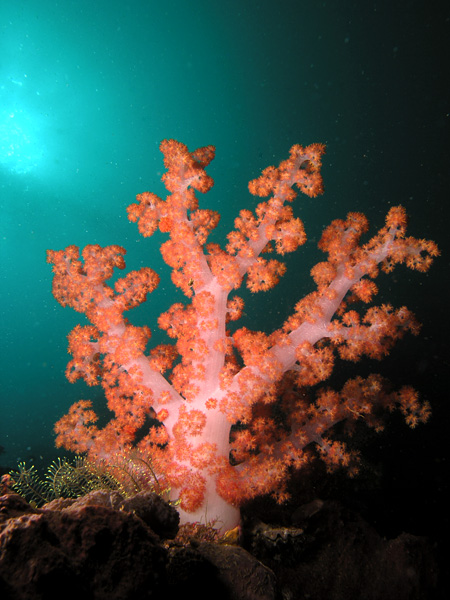
Dendronephthya klunzingeri
Scientific classification Edit this classification
Kingdom: Animalia
Phylum: Cnidaria
Subphylum: Anthozoa
Class: Octocorallia
Haeckel, 1866
Orders

Octocorallia, along with Hexacorallia, is one of the two extant classes of Anthozoa.[1] It comprises over 3,000 species of marine and brackish animals consisting of colonial polyps with 8-fold symmetry, commonly referred to informally as "soft corals". It was previously known by the now unaccepted scientific names Alcyonacea[2] and Gorgonacea,[3] both deprecated c. 2022, and by the also deprecated name of Alcyonaria, in earlier times.[4][5]

Its only two orders are Malacalcyonacea and Scleralcyonacea, which include corals such as those under the common names of blue corals, sea pens, and gorgonians (sea fans and sea whips).[4] These animals have an internal skeleton secreted by their mesoglea, and polyps with typically eight tentacles and eight mesenteries. As is the case with all cnidarians, their complex life cycle includes a motile, planktonic phase (a larva called planula), and a later characteristic sessile phase.

Octocorals have existed at least since the Ordovician period, as shown by Maurits Lindström's findings in the 1970s.[6] A 2023 work suggested that the Cambrian fossil Pywackia may represent a Cambrian octocoral,[7][8][9] and molecular techniques have even pointed to a Precambrian origin for Octocorallia. For instance, a 2021 study built a time-calibrated phylogenetic tree that has placed the origin of Octocorallia in the Ediacaran (578 Mya).[10]

Biology

[edit]
Full corallum of Tubipora musica.

Octocorals resemble the stony corals in general appearance and in the size of their polyps, but lack the distinctive stony skeleton. Also unlike the stony corals, each polyp has only eight tentacles, each of which is feather-like in shape, with numerous side-branches, or pinnules.

Octocorals are colonial organisms, with numerous tiny polyps embedded in a soft matrix that forms the visible structure of the colony. The matrix is composed of mesogleal tissue, lined by a continuous epidermis and perforated by numerous tiny channels. The channels interconnect the gastrovascular cavities of the polyps, allowing water and nutrients to flow freely between all the members of the colony. The skeletal material, called coenenchyme, is composed of living tissue secreted by numerous wandering amoebocytes. Although it is generally soft, in many species it is reinforced with calcareous or horny material.[11]

The polyp is largely embedded within the colonial skeleton, with only the uppermost surface, including the tentacles and mouth, projecting about the surface. The mouth is slit-like, with a single ciliated groove, or siphonoglyph, at one side to help control water flow. It opens into a tubular pharynx that projects down into a gastrovascular cavity that occupies the hollow interior. The pharynx is surrounded by eight radial partitions, or mesenteries, that divide the upper part of the gastrovascular cavity into chambers, one of which connects to the hollow space inside each tentacle. The gonads are located near the base of each mesentery.[11] Octocorals have high phenotypic plasticity from adapting to dynamic environments where temperature, pH, and other parameters are in constant flux[12] and have shown high recruitment rates post-die-off events caused by El Niño events.[13]

Bioluminescence is found in 32 genera, a trait estimated to have evolved 540 million years ago, the earliest timing of emergence of bioluminescence in the marine environment.[14]

Phylogeny

[edit]

Octocorallia is considered to be monophyletic, meaning that all contained species are descended from a common ancestor, but the relationships between subdivisions are not well known. The sea pens (Pennatulacea) and blue coral (Helioporacea) continue to be assigned separate orders, whereas the current order Alcyonacea was historically represented by four orders: Alcyonacea, Gorgonacea, Stolonifera and Telestacea.

Unplaced taxa

[edit]

The following taxa are unplaced within Octocorallia according to the World Register of Marine Species as of April 2024:[15]

Families:

Genera:

References

[edit]
[edit]
Revisions and contributorsEdit on WikipediaRead on Wikipedia
from Grokipedia
Octocorallia is a class of the subphylum within the phylum , encompassing approximately 3,500 species of exclusively marine, mostly colonial cnidarians commonly referred to as octocorals. These organisms include diverse forms such as soft corals, gorgonians (sea fans and sea whips), sea pens, and blue corals, all characterized by polyps with eight-fold radial symmetry, featuring eight pinnate tentacles and eight complete mesenteries. Their skeletons typically consist of spicules embedded in a fleshy coenenchyme, with some groups like gorgonians possessing an additional horny or axis for support. Recent phylogenomic studies have revised the of Octocorallia, dividing the subclass into two main orders: Scleralcyonacea, which includes sea pens, blue corals, and certain deep-water gorgonians, and Malacalcyonacea, comprising soft corals, stoloniferans, and many shallow-water gorgonians. This classification, guided by comprehensive molecular analyses, resolves long-standing uncertainties in octocoral and highlights the group's evolutionary history, with identification often relying on microscopic sclerite morphology due to the challenges of external colonial variation. While most are colonial, a single known solitary exception exists in deep waters. Octocorals inhabit a wide range of marine environments, from intertidal zones to depths exceeding 4,000 meters, with highest diversity in tropical coral reefs and deep-sea habitats below 50 meters. As passive suspension feeders, they capture using their tentacles, and many shallow-water species harbor symbiotic photosynthetic dinoflagellates () that provide energy, enhancing their growth in sunlit areas. Reproduction occurs both sexually, through broadcast spawning of eggs and sperm leading to free-swimming larvae, and asexually via fragmentation or , allowing rapid expansion. Ecologically, octocorals play crucial roles in benthic communities, forming complex "animal forests" and coral gardens that support by providing and refuge for numerous and . In the , arborescent octocorals have proliferated in recent decades, often dominating reefs following declines in scleractinian hard corals due to , bleaching, and storms, thereby shifting structure toward octocoral-dominated "forests." This resilience underscores their increasing ecological importance amid global environmental pressures.

Overview

Description

Octocorallia is a subclass of the class within the phylum , consisting of marine organisms formed by colonies of polyps that exhibit 8-fold radial , referred to as octomery. These anthozoans are distinguished by their colonial nature and are commonly known as soft corals, sea fans, gorgonians, sea pens, and sea whips. The general of octocorals involves interconnected polyps linked by a living tissue layer known as coenenchyme or by slender stolons, typically forming flexible colonies without a massive (except in blue corals), unlike the rigid structures of stony corals. This construction allows for varied growth forms, from encrusting mats to branching fans, adapted to diverse marine environments. A key feature distinguishing Octocorallia from the related subclass is the consistent presence of eight tentacles and eight mesenteries per polyp, embodying their octomeric symmetry, in contrast to the sixfold arrangement typical of hexacorals. Historically termed Alcyonaria, the modern nomenclature Octocorallia reflects this defining symmetrical trait.

Diversity

Octocorallia comprises over 3,500 valid , mostly colonial anthozoans, with ongoing taxonomic revisions and discoveries in remote habitats suggesting the total exceeds this estimate. Recent phylogenomic studies as of 2022 have revised the into two main orders: Scleralcyonacea (including sea pens, blue corals, and certain deep-water gorgonians) and Malacalcyonacea (comprising soft corals, stoloniferans, and many shallow-water gorgonians). The subclass encompasses diverse groups such as soft corals, gorgonians, sea pens, blue corals, and uncommon deep-sea forms like those in the subfamily Anthomastinae, which include mushroom-like soft corals adapted to abyssal environments. These groups highlight the subclass's , with alone representing the majority of species diversity due to its varied skeletal and colonial architectures. Morphological diversity within Octocorallia is extensive, spanning encrusting colonies that form low-lying mats on substrates, erect fans and whips that create branching structures up to several meters tall, and burrowing forms like sea pens that anchor into soft sediments via a polyp-derived peduncle. This variety in growth forms—classified into at least seven broad categories, including massive, digitate, and reticulate types—supports a range of ecological functions, from provision to flow modulation. Species exhibit both photosynthetic lifestyles, through with algae () that provide energy via , and heterotrophic strategies, capturing with eight-pinnate tentacles, allowing occupation of light-variable niches. Octocorals are predominantly distributed in tropical and temperate marine realms worldwide, with highest species richness in the , though they extend across all ocean basins. Their depth range is vast, from intertidal zones and shallow coral reefs to abyssal plains exceeding 5,000 meters, where deep-sea species dominate in terms of abundance and form dense "gardens" on seamounts and continental slopes. This broad habitat tolerance stems from adaptations to diverse substrates, including hard rocky outcrops, soft muds, and even nodules, facilitated by flexible sclerite-based skeletons that enable attachment and resilience to currents. In shallow-water species, the mutualistic with enhances survival by supplementing nutrition in nutrient-poor environments, contributing to the subclass's ecological success and ubiquity in benthic communities.

Classification

Taxonomy

Octocorallia is classified as a class within the phylum and subphylum , encompassing colonial anthozoans characterized by eight-fold symmetry in their polyps. It currently includes two monophyletic orders: Malacalcyonacea (encompassing former , such as soft corals, stoloniferans, and shallow-water gorgonians) and Scleralcyonacea (encompassing former Pennatulacea, Helioporacea, and Anthomastigophora, such as sea pens and blue corals). The group was first established as a subclass by in 1866 under the name Octocorallia, distinguishing it from the six-fold symmetric based on polyp morphology and symmetry; an earlier informal grouping as Alcyonaria dates to the but was formalized by Haeckel. By 1896, Haeckel further refined the classification in his systematic phylogeny, emphasizing sclerite-based traits. Modern has undergone significant revision, elevating Octocorallia to class rank and redefining orders through phylogenomic analyses that integrate molecular data with morphology, replacing prior divisions into three or more orders. Within Malacalcyonacea, prominent families include Alcyoniidae (leather corals, e.g., genus Alcyonium) and Gorgoniidae (sea fans, e.g., genus Gorgonia). Scleralcyonacea features families such as Pennatulidae (sea pens, e.g., genus Pennatula) and Helioporidae (blue corals, e.g., genus Heliopora). Several genera remain unplaced as Octocorallia incertae sedis, reflecting unresolved positions pending further study. Taxonomic challenges persist due to high levels of cryptic diversity, often masked by in colony form and sclerite structure, which complicates morphological identification. Ongoing revisions driven by have revealed numerous sibling species and prompted re-evaluations of traditional boundaries, with integrative approaches combining and morphology essential for accurate delimitation. Approximately 3,500 of Octocorallia have been described, though estimates suggest potential for over 5,000 including undescribed cryptic forms, particularly in deep-sea and habitats.

Phylogeny

Octocorallia first appeared in the fossil record during the period, approximately 485 million years ago, with the earliest known specimens consisting of calcified holdfasts and possible skeletal elements from sites in and western . These early fossils represent primitive forms akin to modern gorgonians, marking the initial diversification of anthozoans in shallow marine environments. Within the class , Octocorallia forms a to , a relationship robustly supported by analyses of 18S rRNA sequences and complete mitochondrial genomes, which highlight shared ancestral traits such as eight-partite tentacles and pinnule arrangements. The of Octocorallia is consistently confirmed across molecular datasets, including mitochondrial protein-coding genes like ND2 and msh1. Internally, the phylogeny of Octocorallia reveals debated relationships among orders, with molecular evidence positioning Anthomastigophora as a basal lineage and + Pennatulacea as more derived groups. A seminal study by McFadden et al. (2006) analyzed mitochondrial sequences from 103 genera across 28 families, establishing three primary subclades: Holaxonia (gorgonian sea fans with scleroprotein axes), Scleraxonia (gorgonians with scleritic axes), and Alcyoniina (soft corals lacking a distinct axis). Recent phylogenomic approaches in the , utilizing hundreds of ultraconserved loci and data from over 185 taxa, have further refined these relationships, particularly for deep-sea lineages such as those in Calcaxonia, revealing evolutionary gains and losses in skeletal structures. The fossil record of Octocorallia remains sparse, primarily due to the non-calcified or lightly scleritized nature of most species, which hinders preservation; notable exceptions include gorgonian-like forms with calcareous sclerites from the and periods.

Anatomy and Physiology

Morphology

Octocorallia polyps exhibit octagonal , characterized by eight pinnate tentacles arranged around the and eight complete mesenteries that extend from the body wall into the gastrovascular cavity. These mesenteries divide the gastrovascular cavity into eight chambers and bear retractor muscles composed of myoepithelial cells, enabling polyp contraction and extension. The gastrovascular cavity, lined by gastrodermis, facilitates nutrient distribution and waste removal within the polyp. In colonial species, polyps are interconnected through a shared coenenchyme, a fleshy mesogleal tissue that embeds the polyps and contains anastomosing solenia—entodermal canals that link the gastrovascular cavities of individual polyps for fluid exchange and nutrient transport. This organization supports dimorphic polyp types: autozooids, which are larger feeding polyps with fully developed tentacles for capturing prey, and siphonozooids, smaller polyps specialized for via prominent siphonoglyphs, enhancing colony circulation and sometimes . Examples include in Malacalcyonacea, where coenenchyme integration varies from loose stolons in stoloniferous forms to highly fused structures in massive colonies. Skeletal support in Octocorallia derives from microscopic sclerites embedded within the , providing rigidity without forming a continuous . These sclerites vary in form, including simple rods, complex spindles, capstans, and multiradiate plates, often with uni- to octomorphic configurations based on ray numbers and ornamentation such as tubercles or warts; their shape, size, and distribution are diagnostic for identification. Sclerites are secreted by scleroblasts and contribute to mechanical strength, with abundance correlating to colony robustness. Morphological variations occur across orders; in many gorgonians (primarily in Malacalcyonacea), an internal of gorgonin—a horny, proteinaceous material—forms a central rod or fan-like structure, often reinforced by fused sclerites, supporting erect like sea fans. In Scleralcyonacea (sea pens), the primary axial polyp (oozooid) forms a bulbous peduncle for anchoring in , while secondary polyps enable reorientation and movement across the seafloor. Coloration in Octocorallia arises from pigments in sclerites, host tissues, and symbiotic dinoflagellates like , which concentrate in polyp tissues and impart greens, browns, or reds via and polyenes. Some species display through luciferin-luciferase reactions, producing blue-green flashes for defense, while others exhibit under UV light, enhancing visibility or . For instance, conjugated polyenals in species like Leptogorgia punicea contribute to reddish hues detectable via .

Reproduction and Development

Octocorallia exhibit both asexual and , with asexual modes prevalent in colonial species to facilitate rapid expansion and local persistence. primarily occurs through fragmentation, where portions of the break off and regenerate into new individuals; fission, involving the longitudinal or transverse division of polyps; and , which produces new polyps that develop into daughter colonies. These processes are particularly common in tropical families such as Alcyoniidae and Xeniidae, allowing for efficient colonization of suitable substrates without reliance on dispersal. Sexual reproduction in Octocorallia is diverse, with most being gonochoristic, possessing separate sexes, while a smaller proportion are simultaneous hermaphrodites. Approximately 89% of studied are gonochoristic, and hermaphroditism occurs in about 9%, often in specific genera like Heteroxenia. release typically involves broadcast spawning, where eggs and sperm are released into the water column for , accounting for 49% of ; alternatively, brooding—either internal or external on the colony surface—occurs in 40% and 11% of , respectively, protecting developing embryos until larval release. Oocytes are generally large, averaging 686 μm in diameter, supporting yolk-based nourishment. Following fertilization, Octocorallia produce lecithotrophic larvae that rely on internal reserves for nutrition rather than feeding externally. These larvae develop over days to weeks, with broadcast-spawned planulae often completing embryogenesis in 2–4 days, while brooded larvae may remain protected longer. In species like Rhytisma fulvum fulvum, planulae exhibit staged development, transitioning from pre-metamorphosed to advanced forms with formation over 20–35 days. Settlement of larvae is influenced by environmental cues, including chemical signals from bacterial biofilms and light conditions, leading to attachment on hard substrates such as rocks or . Upon settlement, larvae undergo , forming a primary polyp that serves as the founder for new colonies through subsequent ; this process typically completes within 1–2 weeks, though pelagic metamorphosis without settlement can occur in some cases. In brooding , settlement often happens near the parent colony, enhancing local . Life history strategies in Octocorallia vary by , with deep-sea frequently employing internal brooding to protect larvae in low-food, stable environments, as seen in Anthomastus ritteri. In contrast, tropical shallow-water forms often participate in annual mass spawning events synchronized to lunar cycles, typically occurring shortly after full moons to optimize fertilization success and larval dispersal. These variations reflect adaptations to environmental pressures, such as temperature and photoperiod.

Ecology and Distribution

Habitats

Octocorallia species exhibit a broad depth distribution, ranging from shallow intertidal zones to abyssal depths exceeding 6,000 meters. While the greatest diversity occurs in shallow waters between 0 and 50 meters, particularly on coral reefs, many taxa extend into mesophotic (30–150 meters) and deeper habitats, with records of sea pens (Pennatulacea) reaching up to 6,260 meters and certain chrysogorgiids (Chrysogorgiidae) down to 4,492 meters. Deep-water forms are adapted to low light levels, , and low temperatures, often forming dense assemblages on continental slopes and seamounts. Geographically, Octocorallia are cosmopolitan, occurring in all major ocean basins from polar to tropical regions, with the highest concentrated in the , where approximately 70% of known species are found. Temperate species inhabit colder waters of the North Atlantic and , while tropical forms dominate Indo-West Pacific reefs from the to . This distribution reflects adaptations to varied oceanic conditions, though gaps exist in polar extremes and some deep-sea basins. Substrate preferences vary among Octocorallia, with most species attaching via holdfasts or encrusting bases to hard surfaces such as rocks, coral rubble, or carbonate platforms; however, some, like sea pens, embed in soft sediments, and others grow epizoically on sponges or other invertebrates. Colonial growth forms, typically branching or encrusting, facilitate attachment and expansion across these substrates, enabling colonization of heterogeneous seafloors. Free-living or weakly attached species are less common but occur in mobile sediments. Octocorallia demonstrate varying environmental tolerances, with many species eurythermal (0–30°C) and , tolerating salinities as low as 15 PSU in brackish-influenced areas, though most thrive in full marine conditions (32–36 PSU). They are generally sensitive to rapid temperature fluctuations, elevated sedimentation, and low oxygen, with shallow-water forms particularly vulnerable to such changes. Deep-sea taxa show greater resilience to stable, low-oxygen environments but limited tolerance for undersaturated conditions. Zonation patterns in Octocorallia reflect habitat gradients, with dense assemblages on crests and buttresses in shallow, high-energy zones (0–13 ), sparser forms in protected lagoons, and specialized deep-water in low-, environments. In regions like the , distinct bathymetric zonation occurs, with shallow dominating sunlit reefs and deeper ones (up to 859 ) adapted to aphotic conditions on steep substrates. These patterns underscore adaptations to , current, and variations across and open-ocean settings.

Ecological Roles

Octocorallia, commonly known as soft corals and sea fans, play pivotal roles in marine ecosystems by providing structural habitats that support diverse assemblages of . Their arborescent and fan-like morphologies create three-dimensional frameworks, offering shelter, nurseries, and attachment sites for , such as annelids and amphipods, and , which collectively enhance local on coral reefs and other benthic environments. For instance, gorgonian octocorals form complex structures that harbor communities with high , including seeking refuge from predators. This provisioning is particularly vital in shallow tropical reefs, where octocorals can dominate following phase shifts from scleractinian coral decline, maintaining ecosystem complexity and supporting trophic webs. In terms of trophic dynamics, many octocoral species function as primary consumers through their symbiosis with dinoflagellates (), which conduct to supply the host with up to twice its carbon requirements via translocated photosynthates, thereby contributing to reef . Autotrophic species like the sea fan exhibit productivity-to-respiration ratios exceeding 1.5, underscoring their role in energy fixation. Complementing this autotrophy, octocorals are heterotrophic feeders, capturing as herbivores and detritivores, which facilitates benthic-pelagic coupling and nutrient transfer from to seafloor communities. This dual strategy allows them to thrive in varied light regimes and bolsters overall ecosystem productivity. Octocorals engage in diverse symbiotic interactions that further integrate them into marine food webs. They serve as hosts to epibionts, including sponges, like Endozoicomonas (comprising up to 96% of microbial communities in some ), and such as copepods, which utilize the coral surface for settlement without necessarily harming the host. Mutualistic relationships with fishes are also common, where seek protection within octocoral branches, potentially benefiting the coral through control or enhanced water circulation. These associations enhance resilience and highlight octocorals' centrality in symbiotic networks. As engineers, octocorals influence physical processes by stabilizing sediments through their rooting structures and modifying near-bottom water flows via drag on currents, which reduces erosion and promotes particle deposition. In mixed assemblages, they contribute to framework development by adding and structural relief, fostering conditions for associated . Additionally, their sensitivity to environmental stressors positions them as indicator ; for example, exposure to and warming elevates stress biomarkers like heat shock proteins and antioxidants in such as Veretillum cynomorium, signaling broader degradation before widespread impacts occur.

Conservation and Threats

Human Impacts

Human activities pose significant threats to Octocorallia populations through direct exploitation and indirect environmental alterations. , primarily driven by anthropogenic , has led to ocean warming that induces bleaching in octocorals by disrupting their symbiotic relationships with , resulting in tissue loss and mortality. For instance, a 1998 heatwave in Japanese waters caused a 99% decline in octocoral cover. , resulting from increased CO₂ absorption, further compromises octocoral health by dissolving their sclerites, which reduces skeletal integrity, growth rates, and overall cover; experimental studies in high-CO₂ environments, such as Milne Bay, , have shown decreased octocoral richness and abundance. Pollution and sedimentation from coastal development, including dredging and runoff, smother octocoral colonies, impairing polyp feeding and respiration while reducing larval recruitment and settlement success. In the Great Barrier Reef, octocorals exhibit lower abundance in areas of high turbidity and sediment load, with some species tolerating moderate levels better than scleractinians but still suffering chronic stress. Chemical pollutants, such as copper from antifouling paints and oil dispersants, exacerbate tissue necrosis and bioaccumulation in octocoral skeletons, as observed in Caribbean sea fans exposed to combined stressors. Overexploitation through harvesting for the aquarium trade targets soft corals and anemones, with unmonitored collection depleting local populations; for example, the live trade in species like Eunicea spp. contributes to habitat degradation in the . Gorgonians, particularly red coral (Corallium rubrum), have been heavily harvested for jewelry and curios, leading to endangered status in the Mediterranean due to historical since the 19th century. Destructive fishing practices, such as , physically damage gorgonian forests in deep-sea habitats, fragmenting colonies and hindering slow recovery rates that can span decades. Human-mediated introductions via shipping and aquaculture facilitate invasive species and disease outbreaks in octocorallia assemblages. Pathogens, including those causing gorgonian labyrinthulomycosis, are transported ballastically in ship hulls, leading to mass mortalities; a ~49% colony death rate was recorded in Brazilian populations of Phyllogorgia dilatata. Pollution-linked outbreaks, such as aspergillosis in sea fans, increase susceptibility, with elevated nutrient loads promoting opportunistic infections. Invasive octocorals like Unomia stolonifera, likely introduced through aquarium releases, outcompete native species in the , rapidly colonizing disturbed reefs and altering community structure; as of 2025, it has spread to , where eradication efforts removed over 40% of detected populations in . These impacts have resulted in substantial population declines, with octocoral cover in some tropical systems dropping 30-50% since the due to cumulative stressors. Specific cases include up to 95% reduction in Dendronephthya australis populations in Australia's Port Stephens and 50% declines in Mediterranean red coral stocks. Deep-sea octocorals face emerging threats from polymetallic nodule , where plumes induce , tissue loss, and metal , potentially disrupting vast gorgonian habitats at depths exceeding 1,000 meters. The 2023-2024 global marine heatwaves caused drastic declines in octocoral cover, exceeding 50% in some surveyed sites as of early 2024.

Conservation Efforts

Conservation efforts for Octocorallia focus on establishing protected areas, conducting targeted , implementing measures, and developing ex-situ strategies to mitigate threats and enhance resilience. Marine protected areas (MPAs) play a central role, with examples including the Parc natural del Cap de Creus and Parc natural del Montgrí, les Illes Medes i Baix Ter along the Catalan coast, which cover thousands of hectares and include no-take zones to restrict harvesting and promote population recovery of habitat-forming species like Paramuricea clavata and Corallium rubrum. In , the Coral & Sponge Conservation Strategy designates closures such as the NAFO Coral Protection Zone (14,040 km²) and Flemish Cap zones (10,488 km²), prohibiting bottom-contact gear to safeguard octocoral communities. While proposals have been made to list Corallium spp. under Appendix II, they are not currently listed; trade is instead regulated under frameworks such as the EU (Annex V) and Bern Convention (Appendix III). Research and monitoring efforts emphasize genetic studies to assess resilience and inform restoration. Population genetics analyses in MPAs reveal genetic structure and diversity in octocorals, identifying connectivity hotspots like the Medes Islands and proposing management units to preserve adaptive potential against climate stressors. Restoration techniques, such as the Direct Substrate Attachment (DSA) method, enable transplantation of octocoral fragments (Paramuricea grayi and Leptogorgia sarmentosa) with 95% initial attachment success and 75% long-term survival, facilitating habitat recovery in the NE Atlantic. Policy measures include bans on destructive fishing gear, like spear guns and traps, to protect susceptible octocoral-associated species and enhance reef resilience to climate-induced mortality, as demonstrated in Kenyan and Papua New Guinean reefs. Climate adaptation plans incorporate assisted evolution approaches, accelerating for heat-tolerant genotypes through , though primarily tested on scleractinian corals with potential extension to octocorals. Ex-situ conservation involves captive breeding and cryopreservation to preserve genetic diversity. Programs for aquarium-traded octocorals support sustainable propagation, with ex-situ culture enabling monthly reproduction cycles in brooding species to bolster source populations for restoration. Cryobanking of sclerites and oocytes aids taxonomic studies and biomineralization research, with lipid analyses informing cryopreservation protocols for gorgonians to maintain viability post-thawing. Success stories include recovery in no-take zones, where octocoral populations like Antillogorgia americana exhibit rapid regrowth post-hurricane disturbance, and protected areas reduce disease prevalence by fourfold compared to fished sites. In 2024-2025, U.S. Navy-led efforts in Hawaii eradicated over 40% of invasive Unomia stolonifera in Pearl Harbor, aiding native octocoral recovery. However, challenges persist in deep-sea protections, where limited ecological knowledge, vulnerability to bottom trawling, and emerging threats like mining hinder effective conservation, underscoring the need for expanded monitoring and international safeguards.

References

Add your contribution
Related Hubs
User Avatar
No comments yet.