Hubbry Logo
Chirality (chemistry)Chirality (chemistry)Main
Open search
Chirality (chemistry)
Community hub
Chirality (chemistry)
logo
8 pages, 0 posts
0 subscribers
Be the first to start a discussion here.
Chirality (chemistry)
from Wikipedia
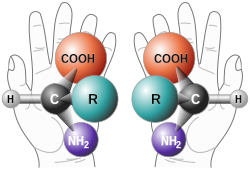
Two enantiomers of a generic amino acid that are chiral
(S)-Alanine (left) and (R)-alanine (right) in zwitterionic form at neutral pH

In chemistry, a molecule or ion is called chiral (/ˈkrəl/) if it cannot be superposed on its mirror image by any combination of rotations, translations, and some conformational changes. This geometric property is called chirality (/kˈrælɪti/).[1][2][3][4] The terms are derived from Ancient Greek χείρ (cheir) 'hand'; which is the canonical example of an object with this property.

A chiral molecule or ion exists in two stereoisomers that are mirror images of each other,[5] called enantiomers; they are often distinguished as either "right-handed" or "left-handed" by their absolute configuration or some other criterion. The two enantiomers have the same chemical properties, except when reacting with other chiral compounds. They also have the same physical properties, except that they often have opposite optical activities. A homogeneous mixture of the two enantiomers in equal parts, a racemic mixture, differs chemically and physically from the pure enantiomers.

Chiral molecules will usually have a stereogenic element from which chirality arises. The most common type of stereogenic element is a stereogenic center, or stereocenter. In the case of organic compounds, stereocenters most frequently take the form of a carbon atom with four distinct groups attached to it in a tetrahedral geometry. Less commonly, other atoms like N, P, S, and Si can also serve as stereocenters, provided they have four distinct substituents (including lone pair electrons) attached to them.

A given stereocenter has two possible configurations (R and S), which give rise to stereoisomers (diastereomers and enantiomers) in molecules with one or more stereocenter. For a chiral molecule with one or more stereocenter, the enantiomer corresponds to the stereoisomer in which every stereocenter has the opposite configuration. An organic compound with only one stereogenic carbon is always chiral. On the other hand, an organic compound with multiple stereogenic carbons is typically, but not always, chiral. In particular, if the stereocenters are configured in such a way that the molecule can take a conformation having a plane of symmetry or an inversion point, then the molecule is achiral and is known as a meso compound.

Molecules with chirality arising from one or more stereocenters are classified as possessing central chirality. There are two other types of stereogenic elements that can give rise to chirality, a stereogenic axis (axial chirality) and a stereogenic plane (planar chirality). Finally, the inherent curvature of a molecule can also give rise to chirality (inherent chirality). These types of chirality are far less common than central chirality. BINOL is a typical example of an axially chiral molecule, while trans-cyclooctene is a commonly cited example of a planar chiral molecule. Finally, helicene possesses helical chirality, which is one type of inherent chirality.

Chirality is an important concept for stereochemistry and biochemistry. Most substances relevant to biology are chiral, such as carbohydrates (sugars, starch, and cellulose), all but one of the amino acids that are the building blocks of proteins, and the nucleic acids. Naturally occurring triglycerides are often chiral, but not always. In living organisms, one typically finds only one of the two enantiomers of a chiral compound. For that reason, organisms that consume a chiral compound usually can metabolize only one of its enantiomers. For the same reason, the potencies or effects of enantiomers of a pharmaceutical can differ sharply.

Definition

[edit]

The chirality of a molecule is based on the molecular symmetry of its conformations. A conformation of a molecule is chiral if and only if it belongs to the Cn, Dn, T, O, or I point groups (the chiral point groups). However, whether the molecule itself is considered to be chiral depends on whether its chiral conformations are persistent isomers that could be isolated as separated enantiomers, at least in principle, or the enantiomeric conformers rapidly interconvert at a given temperature and timescale through low-energy conformational changes (rendering the molecule achiral). For example, despite having chiral gauche conformers that belong to the C2 point group, butane is considered achiral at room temperature because rotation about the central C–C bond rapidly interconverts the enantiomers (3.4 kcal/mol barrier). Similarly, cis-1,2-dichlorocyclohexane consists of chair conformers that are nonidentical mirror images, but the two can interconvert via the cyclohexane chair flip (~10 kcal/mol barrier). As another example, amines with three distinct substituents (R1R2R3N:) are also regarded as achiral molecules because their enantiomeric pyramidal conformers rapidly undergo pyramidal inversion.

However, if the temperature in question is low enough, the process that interconverts the enantiomeric chiral conformations becomes slow compared to a given timescale. The molecule would then be considered to be chiral at that temperature. The relevant timescale is, to some degree, arbitrarily defined: 1000 seconds is sometimes employed, as this is regarded as the lower limit for the amount of time required for chemical or chromatographic separation of enantiomers in a practical sense. Molecules that are chiral at room temperature due to restricted rotation about a single bond (barrier to rotation ≥ ca. 23 kcal/mol) are said to exhibit atropisomerism.

A chiral compound can contain no improper axis of rotation (Sn), which includes planes of symmetry and inversion center. Chiral molecules are always dissymmetric (lacking Sn) but not always asymmetric (lacking all symmetry elements except the trivial identity). Asymmetric molecules are always chiral.[6]

The following table shows some examples of chiral and achiral molecules, with the Schoenflies notation of the point group of the molecule. In the achiral molecules, X and Y (with no subscript) represent achiral groups, whereas XR and XS or YR and YS represent enantiomers. Note that there is no meaning to the orientation of an S2 axis, which is just an inversion. Any orientation will do, so long as it passes through the center of inversion. Also note that higher symmetries of chiral and achiral molecules also exist, and symmetries that do not include those in the table, such as the chiral C3 or the achiral S4.

Molecular symmetry and chirality
Rotational
axis (Cn)
Improper rotational elements (Sn)
  Chiral
no Sn
Achiral
mirror plane
S1 = σ
Achiral
inversion center
S2 = i
C1
C1

Cs

Ci
C2
C2
(Note: This molecule has only one C2 axis:
perpendicular to line of three C, but not in the plane of the figure.)

C2v

C2h
Note: This also has a mirror plane.

An example of a molecule that does not have a mirror plane or an inversion and yet would be considered achiral is 1,1-difluoro-2,2-dichlorocyclohexane (or 1,1-difluoro-3,3-dichlorocyclohexane). This may exist in many conformers (conformational isomers), but none of them has a mirror plane. In order to have a mirror plane, the cyclohexane ring would have to be flat, widening the bond angles and giving the conformation a very high energy. This compound would not be considered chiral because the chiral conformers interconvert easily.

An achiral molecule having chiral conformations could theoretically form a mixture of right-handed and left-handed crystals, as often happens with racemic mixtures of chiral molecules (see Chiral resolution#Spontaneous resolution and related specialized techniques), or as when achiral liquid silicon dioxide is cooled to the point of becoming chiral quartz.

Stereogenic centers

[edit]
Here, swapping of the two groups a and b leads to a molecule that is a stereoisomer of the original. Hence, the central carbon atom is a stereocenter.

A stereogenic center (or stereocenter) is an atom such that swapping the positions of two ligands (connected groups) on that atom results in a molecule that is stereoisomeric to the original. For example, a common case is a tetrahedral carbon bonded to four distinct groups a, b, c, and d (Cabcd), where swapping any two groups (e.g., Cbacd) leads to a stereoisomer of the original, so the central C is a stereocenter. Many chiral molecules have point chirality, namely a single chiral stereogenic center that coincides with an atom. This stereogenic center usually has four or more bonds to different groups and may be carbon (as in many biological molecules), phosphorus (as in many organophosphates), silicon, or a metal (as in many chiral coordination compounds). However, a stereogenic center can also be a trivalent atom whose bonds are not in the same plane, such as phosphorus in P-chiral phosphines (PRR′R″) and sulfur in S-chiral sulfoxides (OSRR′), because a lone-pair of electrons is present instead of a fourth bond.

1,1′-Bi-2-naphthol is an example of a molecule with a stereogenic axis.

Similarly, a stereogenic axis (or plane) is defined as an axis (or plane) in the molecule such that the swapping of any two ligands attached to the axis (or plane) gives rise to a stereoisomer. For instance, the C2-symmetric species 1,1′-bi-2-naphthol (BINOL) and 1,3-dichloroallene have stereogenic axes and exhibit axial chirality, while (E)-cyclooctene and many ferrocene derivatives bearing two or more substituents have stereogenic planes and exhibit planar chirality.

Chirality can also arise from isotopic differences between substituents, such as in the deuterated benzyl alcohol PhCHDOH; which is chiral and optically active ([α]D = 0.715°), even though the non-deuterated compound PhCH2OH is not.[7]

If two enantiomers easily interconvert, the pure enantiomers may be practically impossible to separate, and only the racemic mixture is observable. This is the case, for example, of most amines with three different substituents (NRR′R″), because of the low energy barrier for nitrogen inversion.

When the optical rotation for an enantiomer is too low for practical measurement, the species is said to exhibit cryptochirality.

Chirality is an intrinsic part of the identity of a molecule, so the systematic name includes details of the absolute configuration (R/S, D/L, or other designations).

Manifestations of chirality

[edit]

In biochemistry

[edit]

Many biologically active molecules are chiral, including the naturally occurring amino acids (the building blocks of proteins) and sugars.

The origin of this homochirality in biology is the subject of much debate.[13] Most scientists believe that Earth life's "choice" of chirality was purely random, and that if carbon-based life forms exist elsewhere in the universe, their chemistry could theoretically have opposite chirality. However, there is some suggestion that early amino acids could have formed in comet dust. In this case, circularly polarised radiation (which makes up 17% of stellar radiation) could have caused the selective destruction of one chirality of amino acids, leading to a selection bias which ultimately resulted in all life on Earth being homochiral.[14][15]

Enzymes, which are chiral, often distinguish between the two enantiomers of a chiral substrate. One could imagine an enzyme as having a glove-like cavity that binds a substrate. If this glove is right-handed, then one enantiomer will fit inside and be bound, whereas the other enantiomer will have a poor fit and is unlikely to bind.

L-forms of amino acids tend to be tasteless, whereas D-forms tend to taste sweet.[13] Spearmint leaves contain the L-enantiomer of the chemical carvone or R-(−)-carvone and caraway seeds contain the D-enantiomer or S-(+)-carvone.[9] The two smell different to most people because our olfactory receptors are chiral.

Chirality is important in context of ordered phases as well, for example the addition of a small amount of an optically active molecule to a nematic phase (a phase that has long range orientational order of molecules) transforms that phase to a chiral nematic phase (or cholesteric phase). Chirality in context of such phases in polymeric fluids has also been studied in this context.[16]

In inorganic chemistry

[edit]
Delta-ruthenium-tris(bipyridine) cation

Chirality is a symmetry property, not a property of any part of the periodic table. Thus many inorganic materials, molecules, and ions are chiral. Quartz is an example from the mineral kingdom. Such noncentric materials are of interest for applications in nonlinear optics.

In the areas of coordination chemistry and organometallic chemistry, chirality is pervasive and of practical importance. A famous example is tris(bipyridine)ruthenium(II) complex in which the three bipyridine ligands adopt a chiral propeller-like arrangement.[17] The two enantiomers of complexes such as [Ru(2,2′-bipyridine)3]2+ may be designated as Λ (capital lambda, the Greek version of "L") for a left-handed twist of the propeller described by the ligands, and Δ (capital delta, Greek "D") for a right-handed twist (pictured). dextro- and levo-rotation (the clockwise and counterclockwise optical rotation of plane-polarized light) uses similar notation, but shouldn't be confused.

Chiral ligands confer chirality to a metal complex, as illustrated by metal-amino acid complexes. If the metal exhibits catalytic properties, its combination with a chiral ligand is the basis of asymmetric catalysis.[18]

Methods and practices

[edit]

The term optical activity is derived from the interaction of chiral materials with polarized light. In a solution, the (−)-form, or levorotatory form, of an optical isomer rotates the plane of a beam of linearly polarized light counterclockwise. The (+)-form, or dextrorotatory form, of an optical isomer does the opposite. The rotation of light is measured using a polarimeter and is expressed as the optical rotation.

Enantiomers can be separated by chiral resolution. This often involves forming crystals of a salt composed of one of the enantiomers and an acid or base from the so-called chiral pool of naturally occurring chiral compounds, such as malic acid or the amine brucine. Some racemic mixtures spontaneously crystallize into right-handed and left-handed crystals that can be separated by hand. Louis Pasteur used this method to separate left-handed and right-handed sodium ammonium tartrate crystals in 1849. Sometimes it is possible to seed a racemic solution with a right-handed and a left-handed crystal so that each will grow into a large crystal.

Liquid chromatography (HPLC and TLC) may also be used as an analytical method for the direct separation of enantiomers and the control of enantiomeric purity, e.g. active pharmaceutical ingredients (APIs) which are chiral.[19][20]

Miscellaneous nomenclature

[edit]
  • Any non-racemic chiral substance is called scalemic. Scalemic materials can be enantiopure or enantioenriched.[21]
  • A chiral substance is enantiopure when only one of two possible enantiomers is present so that all molecules within a sample have the same chirality sense. Use of homochiral as a synonym is strongly discouraged.[22]
  • A chiral substance is enantioenriched or heterochiral when its enantiomeric ratio is greater than 50:50 but less than 100:0.[23]
  • Enantiomeric excess or e.e. is the difference between how much of one enantiomer is present compared to the other. For example, a sample with 40% e.e. of R contains 70% R and 30% S (70% − 30% = 40%).[24]

Computational prediction of chiral properties

[edit]

The prediction of chiral properties using computational methods has emerged as an important area in modern stereochemistry[25][26], complementing experimental techniques for characterizing and separating enantiomers. These approaches leverage machine learning algorithms and molecular representations to predict various chiral-specific behaviors, including chromatographic retention, optical rotation, and stereochemical assignments[27].

Molecular representations for chirality

[edit]

Computational methods for representing molecular chirality must encode three-dimensional stereochemical information in a format suitable for machine learning algorithms. SMILES (Simplified Molecular Input Line Entry System) notation incorporates stereochemistry through the use of @ and @@ symbols at chiral centers, where @ typically denotes anticlockwise and @@ denotes clockwise configuration when viewing the chiral center along the bond from the center to the first atom in the SMILES string[28][29].

Traditional molecular descriptors used in computational chemistry, such as circular fingerprints (Extended Connectivity Fingerprints or ECFP[30]), can encode structural information including stereochemical features. These descriptors represent molecules as fixed-length binary vectors that capture local atomic environments and connectivity patterns. However, conventional fingerprints may not optimally capture the subtle three-dimensional differences between enantiomers.

Neural network-based molecular representations can be derived from SMILES strings. Variational autoencoders and heteroencoders trained on large databases of molecular structures can generate latent space vectors (LSVs) that encode molecular properties in a continuous, lower-dimensional space[31]. These methods calculate difference vectors between the descriptor of a molecule and that of its enantiomer, or between the original descriptor and one derived from a stereochemistry-depleted SMILES string. Such difference descriptors can amplify the stereochemical information relevant to chiral properties while reducing noise from other structural features[32].

Machine Learning applications

[edit]

Machine learning models trained on these molecular representations have been applied to predict various chirality-related properties. One practical application is forecasting the elution order of enantiomers in chiral chromatography. Models trained on experimental retention data from chiral stationary phases can learn structure-retention relationships[27]. Random Forest and other ensemble methods have been applied to predict which enantiomer elutes first on columns such as Chiralpak AD-H using both traditional circular fingerprints and neural network-derived descriptors[32].

Another application is the prediction of optical rotation, a fundamental chiral property. Machine learning models have been developed to predict specific rotation values for chiral molecules based on their structure, with applications to both organic compounds and specialized classes such as chiral fluorinated molecules[25][26]. These predictions can assist in structural characterization and quality control in pharmaceutical development.

While these machine learning approaches show promise, several limitations remain. Model accuracy depends heavily on training data quality and coverage of chemical space. Neural network architectures, particularly Transformers, face inherent challenges in learning stereochemical features from string-based representations like SMILES[33]. These models tend to recognize partial molecular structures early in training but require significantly longer to accurately distinguish between enantiomers, sometimes exhibiting periods of confusion where @ and @@ tokens are frequently interchanged. The interpretability of neural network-based descriptors is often limited compared to traditional physically-motivated descriptors. Additionally, these methods typically perform best for compounds structurally similar to training data and may not generalize well to novel scaffolds or unusual stereochemical arrangements.

History

[edit]

The rotation of plane polarized light by chiral substances was first observed by Jean-Baptiste Biot in 1812,[34] and gained considerable importance in the sugar industry, analytical chemistry, and pharmaceuticals. Louis Pasteur deduced in 1848 that this phenomenon has a molecular basis.[35][36] The term chirality itself was coined by Lord Kelvin in 1894.[37] Individual enantiomers or diastereomers of a compound were formerly called optical isomers due to their distinct optical properties.[38] At one time, chirality was thought to be restricted to organic chemistry, but this misconception was overthrown by the resolution of a purely inorganic compound, a cobalt complex called hexol, by Alfred Werner in 1911.[39]

In the early 1970s, various groups established that the human olfactory organ is capable of distinguishing chiral compounds.[9][40][41]

See also

[edit]

References

[edit]

Further reading

[edit]
[edit]
Revisions and contributorsEdit on WikipediaRead on Wikipedia
from Grokipedia
In chemistry, chirality refers to the geometric property of a rigid object or that is non-superimposable on its due to the absence of improper elements, such as a plane or inversion center. This property arises from the spatial arrangement of atoms, resulting in stereoisomers known as enantiomers, which are of each other and exhibit identical physical properties except for their interaction with plane-polarized light and other chiral entities. The concept was first experimentally demonstrated in 1848 by , who manually separated enantiomeric crystals of sodium ammonium tartrate, revealing that molecular underlies optical activity in solutions. Chirality manifests in various forms, including central chirality at a tetrahedral atom (often a carbon) bonded to four different substituents, axial chirality along a restricted axis as in or biaryls, planar chirality in molecules with asymmetric planes like certain cyclophanes, and helical chirality in structures such as helicenes. These stereogenic units enable the existence of chiral molecules without requiring a single asymmetric center, as seen in inorganic complexes or supramolecular assemblies. The study of chirality, or , is fundamental to understanding molecular recognition and reactivity, with nomenclature systems like the Cahn-Ingold-Prelog (CIP) rules assigning R or S configurations to chiral centers based on priority sequences. The implications of chirality extend profoundly into biology and medicine, where most biomolecules—such as , sugars, and nucleic acids—are chiral and predominantly occur in one enantiomeric form (e.g., L- in proteins). In pharmaceuticals, enantiomers can differ dramatically in pharmacological activity, toxicity, and metabolism; for instance, one enantiomer of alleviates while the other causes severe birth defects, underscoring the regulatory emphasis on developing single-enantiomer drugs since the . Advances in asymmetric synthesis and chiral separation techniques continue to drive innovations in , ensuring efficacy and safety by controlling molecular .

Basic Concepts

Definition of Chirality

In chemistry, refers to the geometric property of a or object that renders it non-superimposable on its , much like a left hand cannot be perfectly overlaid with a right hand. This arises from the three-dimensional arrangement of atoms, distinguishing chiral entities from their enantiomeric counterparts. Chirality is fundamentally tied to dissymmetry, defined as the absence of axes (such as planes, centers, or alternating axes of ) that would allow on a , rather than complete , which implies the lack of all elements beyond the identity operation. Dissymmetric structures are inherently chiral, though some may retain proper axes; in contrast, fully asymmetric objects are also chiral but represent a stricter . This distinction underscores that chirality does not require total lack of but only the exclusion of reflective elements. Non-molecular analogies illustrate this concept clearly: a with right-handed threading cannot be superimposed on its (a left-handed ), and similarly, a chiral point in a —such as a central atom surrounded by four distinct substituents in a tetrahedral arrangement—exhibits this non-superimposability without delving into specific atomic identities. In molecular chemistry, such leads to enantiomers, pairs of s that are s with identical connectivity but distinct spatial orientations, often resulting in different behaviors in chiral environments like biological systems.

Enantiomers and Diastereomers

In , enantiomers are defined as a pair of stereoisomers that are non-superimposable mirror images of each other. These molecules share identical connectivity of atoms but exhibit opposite configurations at one or more chiral centers, resulting in identical physical properties—such as , , and —in achiral environments. However, enantiomers differ in their interactions with chiral reagents or environments, notably rotating plane-polarized light in opposite directions (dextrorotatory and levorotatory). A classic example is the pair of enantiomers formed by : (R)-lactic acid and (S)-lactic acid, which have the same molecular formula (C₃H₆O₃) and connectivity but opposite spatial arrangements around the chiral carbon. Diastereomers, in contrast, are stereoisomers that are not mirror images of each other and thus possess different physical and chemical properties even in achiral environments. They typically arise in molecules with two or more chiral centers where the configurations at these centers differ in a non-mirror fashion, leading to distinct boiling points, solubilities, and reactivities. For instance, in (C₄H₆O₆), the (2R,3R)- and (2S,3S)-forms are enantiomers, while the (2R,3S)-form is a diastereomer to both. The relationship between chirality and these stereoisomers stems from the number of chiral centers: a single chiral center in a molecule produces a pair of enantiomers, as the mirror images cannot be superimposed. With multiple chiral centers, the total number of stereoisomers is 2ⁿ (where n is the number of chiral centers), including both enantiomers and diastereomers; however, if the molecule possesses a plane of symmetry, certain diastereomers may be meso compounds, which are achiral despite having chiral centers. The meso form of , for example, is a diastereomer that is optically inactive due to its internal , distinguishing it from the chiral enantiomeric pair.

Sources of Molecular Chirality

Tetrahedral Stereogenic Centers

A tetrahedral stereogenic center, also known as a or , is defined as a tetrahedral atom—typically carbon—where the interchange of any two attached substituents results in a stereoisomer. This property arises from the sp³ hybridization of the central atom, which adopts a tetrahedral with bond angles of approximately 109.5°, preventing free rotation and allowing for non-superimposable mirror images when the substituents differ. In , the focus is on carbon atoms bearing four distinct substituents, as this configuration ensures the molecule lacks an improper axis of rotation, rendering it chiral. The criterion for a tetrahedral carbon to serve as a stereogenic center is that it must be bonded to four different groups or atoms, denoted generally as C(a b c d), where a, b, c, and d are constitutionally distinct. A classic example is the carbon at position 2 in (\ceCH3CHBrCH2CH3\ce{CH3-CHBr-CH2CH3}), which is attached to a atom, a hydrogen atom, a methyl group (\ceCH3\ce{CH3}), and an ethyl group (\ceCH2CH3\ce{CH2CH3}); interchanging any two of these yields a stereoisomer. Such centers produce pairs of enantiomers, which are mirror images of each other. Exceptions to the standard chiral tetrahedral center include pseudo-asymmetric centers, where a tetrahedral carbon is bonded to four different substituents, but two of these are enantiomeric pairs of the same constitution, resulting in an achiral molecule overall despite the local asymmetry. For instance, in the meso form of 2,3,4-pentanetriol ((2R,3r,4S)-pentane-2,3,4-triol), the central carbon at position 3 exhibits pseudo-asymmetry because swapping substituents does not produce enantiomers but diastereomers. Prochiral centers represent another exception; these are tetrahedral atoms that are not stereogenic but become chiral upon replacement of one substituent with a different group of higher priority. In (\ce(CH2O)3\ce{(CH2O)3}), the central carbon is chiral, but related prochiral examples, such as the in , illustrate how enzymatic reactions can selectively differentiate identical hydrogens (pro-R or pro-S) to generate chirality. Tetrahedral stereogenic centers dominate as the primary source of molecular chirality in due to the ubiquity of sp³-hybridized carbons in aliphatic and alicyclic structures. This prevalence is particularly evident in pharmaceuticals, where approximately 56% of marketed drugs are chiral, with most featuring one or more tetrahedral carbon centers that influence and .

Axial, Planar, and Other Chirality Types

Axial chirality refers to a form of molecular arising from restricted rotation about a stereogenic axis, resulting in enantiomers that are non-superimposable mirror images without the presence of a traditional stereogenic center. This restriction typically stems from steric hindrance or electronic factors that create a significant energy barrier to rotation, often exceeding 20-30 kcal/mol to ensure configurational stability at . Unlike tetrahedral centered at an atom, is more prevalent in extended molecular frameworks, such as biaryls or unsaturated systems, and is less common in simple small organic molecules. A classic example of occurs in , which feature cumulated double bonds (C=C=C) where the two terminal π bonds lie in planes due to the sp-hybridized central carbon atom. In chiral of the general form R¹R²C=C=CR³R⁴ (where R¹ ≠ R² and R³ ≠ R⁴), the orthogonal π orbitals prevent free rotation, leading to with (P) and (M) configurations analogous to right- and left-handed screws. This arrangement can be visualized as the substituents on one terminal carbon occupying a plane orthogonal to those on the other, enforcing . Another prominent example is biphenyl atropisomers, where bulky ortho substituents on the two phenyl rings sterically impede rotation about the aryl-aryl bond, stabilizing the chiral axis. Compounds like BINOL derivatives exemplify this, widely used in asymmetric due to their stable . Planar chirality emerges when a possesses a chiral plane—a plane of broken by asymmetric substitution or arrangement, rendering the chiral without a stereogenic or axis. This type requires specific geometric constraints, such as strained rings or bridged systems, to prevent inversion through the plane. Cyclophanes, particularly [2.2]paracyclophanes, serve as representative examples, where two rings are connected by bridges in a configuration, creating a chiral plane if the rings bear unsymmetric substituents or orientations. In these , the proximity of the aromatic rings (typically 2.5-3.0 Å apart) induces strain that locks the planar , leading to enantiomers designated as (Rp) or (Sp). Planar is often observed in larger, macrocyclic and contrasts with axial types by relying on two-dimensional rather than rotational barriers. Other forms of chirality extend beyond axes and planes to include helical and topological variants, each demanding intricate molecular architectures for stability. Helical chirality, as seen in helicenes—ortho-fused polycyclic aromatic hydrocarbons forming a screw-like twist—arises from the inherent strain in the non-planar π-system, with at least six fused rings needed for stable enantiomers. These molecules exhibit (P)- and (M)-helicity due to the directional curvature, often stabilized by π-π interactions, and are valued for their strong chiroptical properties in materials science. Topological chirality, conversely, originates from the knotted or linked connectivity of molecular components, independent of conformational flexibility. Catenanes, consisting of mechanically interlocked rings, and molecular knots display this chirality when their topology prevents mirror-image superposition, as in trefoil knots with three crossings. Such structures require synthetic strategies like template-directed assembly to control handedness, and they are typically found in supramolecular chemistry rather than routine organic synthesis. Overall, these non-tetrahedral chiralities highlight the diversity of stereogenic elements in larger molecules, where geometric or topological constraints supplant localized atomic asymmetry.

Physical Manifestations

Optical Activity

Optical activity is the property of chiral molecules to rotate the of passing through them. This rotation occurs because chiral substances interact differently with the electric field components of the , distinguishing them from achiral molecules, which do not cause such . The direction and extent of provide a key physical manifestation of molecular , with enantiomers exhibiting equal but opposite rotations. The mechanism underlying optical activity stems from circular birefringence, where the chiral medium exhibits different refractive indices for left-circularly polarized (LCP) and right-circularly polarized (RCP) light. Plane-polarized light can be resolved into equal superpositions of LCP and RCP components; in a chiral environment, these components propagate at slightly different velocities due to the refractive index disparity, resulting in a phase shift that rotates the overall polarization plane. This differential interaction arises from the molecule's asymmetric electric polarizability, which couples more strongly to one circular polarization over the other. The observed rotation angle, denoted as α\alpha, is used to calculate the specific rotation [α][\alpha], a standardized measure characteristic of the compound under defined conditions: [α]λT=αc×l[\alpha]_\lambda^T = \frac{\alpha}{c \times l} where α\alpha is the rotation in degrees, cc is the concentration in g/, ll is the path length in decimeters (dm), λ\lambda indicates the (often the sodium D-line at 589 nm), and TT is the temperature in °C. The sign of [α][\alpha] determines whether the enantiomer is levorotatory (l- or -, rotating light counterclockwise) or dextrorotatory (d- or +, rotating ); for example, (R)- has [α]D20=3.8[\alpha]_D^{20} = -3.8^\circ, while its (S)- has +3.8°. Optical rotation varies with several factors, including wavelength—showing dispersion where rotation increases toward shorter wavelengths ()—as well as and , which can alter molecular interactions and effects. For instance, the of decreases from +66.5° at 20°C to +59.2° at 87°C in . This phenomenon was first discovered by in 1815, who observed rotation in organic liquids like using a .

Chiroptical Spectroscopy

Chiroptical spectroscopy encompasses a suite of techniques that measure the differential interaction of chiral molecules with circularly polarized light, providing insights into their three-dimensional structures that are inaccessible through achiral . These techniques exploit the fact that enantiomers interact differently with left- and right-circularly polarized light, arising from the molecule's inherent asymmetry. Building on the foundational phenomenon of optical activity, chiroptical methods extend to electronic and vibrational transitions, enabling detailed analysis of molecular conformation and . Circular dichroism (CD) is a primary electronic chiroptical technique that quantifies the difference in absorption between left- and right-circularly polarized light across the ultraviolet-visible (UV-Vis) spectrum. This differential absorption, denoted as Δε = ε_L - ε_R, arises from electronic transitions in chiral chromophores and is particularly sensitive to the secondary structure of biomolecules, such as α-helices and β-sheets in proteins. CD spectra typically exhibit characteristic bands in the 180–250 nm range for bonds, allowing researchers to monitor folding and conformational changes. (ORD), closely related to CD via the Kramers-Kronig transform, measures the wavelength-dependent variation in the rotation angle of plane-polarized light. ORD reveals anomalous dispersion known as the , where the rotation changes sign near an absorption band, providing complementary data on transition energies and ; for instance, a positive Cotton effect at a given indicates a specific helical sense in chiral compounds. Vibrational chiroptical spectroscopies extend these principles to the and Raman regimes, probing vibrational modes to elucidate finer structural details. Vibrational (VCD) measures the differential absorption of circularly polarized IR light, yielding spectra analogous to conventional IR but with sign patterns that reflect the and conformational preferences of chiral molecules. Raman optical activity (ROA), the vibrational Raman counterpart, detects differences in scattered intensities for left- and right-circularly polarized light, offering advantages in aqueous solutions where bands obscure VCD signals. Both techniques provide stereochemical fingerprints, with VCD and ROA spectra often computed theoretically for validation using . In applications, chiroptical spectroscopy is invaluable for determining absolute configurations and analyzing biomolecular structures, such as in peptides where identifies helical content, while VCD and ROA distinguish diastereomeric conformations and assign stereocenters. For example, VCD spectra of cyclic dipeptides exhibit distinct band patterns that correlate with (R) or (S) configurations at key residues, enabling unambiguous assignment without . These methods have been pivotal in studying pathways and chiral drug enantiomers, with ROA particularly useful for glycoproteins due to its sensitivity to carbohydrate chirality.

Applications in Chemistry

Organic Chemistry

In , chirality arises most commonly from tetrahedral carbon atoms with four distinct substituents, serving as the foundational stereogenic units in countless molecules. Natural products exemplify this, with and alkaloids frequently occurring as enantiopure entities due to biosynthetic pathways that enforce . Sesquiterpenes, a subclass of , are chiral and often produced in nature as single enantiomers, although enantiomeric pairs also occur, contributing to their diverse biological roles. Plant-derived alkaloids, such as those in traditional medicines, are similarly isolated as chiral compounds, providing enantiopure building blocks for synthetic applications. The pharmaceutical realm highlights chirality's critical role in organic compounds, where mismatches between enantiomers and biological targets can yield profound consequences. Approximately 60% of approved drugs are chiral, with many marketed as single enantiomers to optimize and safety following regulatory shifts post-1990s. The disaster of the 1950s–1960s exemplifies the perils of administering racemates; the (R)- provided benefits, but the (S)- caused severe teratogenic effects, leading to thousands of birth defects worldwide before the drug's withdrawal. Chirality profoundly influences reactivity in organic transformations, particularly through stereoselective mechanisms. Enantioselective reactions, often mediated by chiral catalysts or auxiliaries, preferentially generate one over the other, enabling the construction of stereodefined targets essential for drug synthesis and materials. Diastereoselectivity emerges in substrates with pre-existing chiral centers, where diastereomeric transition states differ in energy, favoring one product and streamlining multi-step syntheses. A classic illustration is the , which inverts configuration at a tetrahedral chiral center via backside nucleophilic attack, a phenomenon termed Walden inversion after its discovery in 1896 through interconversions of optically active malic acid derivatives. Advancements in organocatalysis have transformed asymmetric synthesis in , offering metal-free alternatives for enantiocontrol. In 2024, bifunctional organocatalysts enabled highly enantioselective desymmetrizations of prochiral substrates, achieving up to 99% enantiomeric excess in cascade reactions for alkaloid-like scaffolds. By early 2025, innovations in iminium-based organocatalysis facilitated asymmetric multicomponent assemblies, producing complex chiral heterocycles with high , broadening access to enantiopure analogs. also plays a role in synthesis, where chiral monomers yield optically active materials with tailored properties.

Inorganic Chemistry

In , chirality frequently arises from the geometric arrangements of ligands around a central rather than from atoms, leading to non-superimposable mirror images known as Δ and Λ isomers. A classic example is the octahedral tris(ethylenediamine) complex, [Co(en)3]3+, where three bidentate (en) ligands wrap around the cobalt center in a propeller-like fashion, resulting in helical . The Δ isomer features a right-handed , while the Λ isomer is left-handed, and these exhibit distinct chiroptical properties due to the fixed . Beyond simple octahedral complexes, chirality manifests in more complex inorganic structures such as polyoxometalates (POMs) and metal . In POMs, propeller chirality emerges from the helical arrangement of metal-oxygen polyhedra, as seen in diphosphine-induced nanocluster-POM hybrids where bidentate ligands enforce a chiral propeller configuration around the cluster core. Chiral metal nanoclusters, such as atomically precise or silver clusters protected by chiral thiolates, display intrinsic chirality from the asymmetric distribution of metal atoms and ligands, often amplified in nanoscale assemblies. These structures highlight how inorganic chirality can originate from supramolecular or cluster-based geometries without organic stereocenters. The physical manifestations of inorganic chirality, particularly optical activity, are influenced by ligand field effects that split d-orbitals and couple with transitions to produce . In chiral-at-metal complexes like [Co(en)3]3+, the field modulates electronic transitions, leading to intense chiroptical signals in the visible and ultraviolet regions, distinct from the weaker intrinsic contributions. in these systems often occurs via twist mechanisms, such as the Bailar twist (trigonal prismatic intermediate) or Ray-Dutt twist (square pyramidal intermediate), which allow interconversion of Δ and Λ forms without dissociation, as evidenced by activation parameters in and complexes. In applications, chiral inorganic complexes serve as catalysts in asymmetric synthesis, exemplified by manganese(III) salen complexes developed by Jacobsen, where the chiral N,N'-bis(salicylidene)ethylenediamine ligand imposes helical distortion on the metal center to enable enantioselective epoxidation of unfunctionalized olefins with high ee values (>90%). These catalysts operate via a metal-oxo intermediate, with ligand field stabilization enhancing selectivity, and have been extended to hydrolytic kinetic resolutions. Such systems underscore the utility of metal-centered chirality in promoting stereocontrol in inorganic-mediated reactions.

Biological and Biochemical Relevance

Amino Acids and Proteins

In biological systems, is fundamental to the structure and function of , the building blocks of proteins. Of the 20 standard proteinogenic , 19 are chiral molecules with an asymmetric α-carbon atom, while is achiral due to its two identical hydrogen substituents. All chiral proteinogenic exhibit the L-configuration, defined relative to L-glyceraldehyde in the convention, where the amino group is positioned on the left side of the when the group is at the top and the at the bottom. This uniform L-homochirality ensures consistent stereochemical interactions during protein synthesis and folding. The prevalence of L-amino acids enables the formation of stable secondary structures in proteins, such as right-handed α-helices and β-sheets, which rely on precise hydrogen bonding patterns that are only feasible with homochiral monomers. Proteins composed of D-amino acids, or mirror-image versions of natural proteins, fail to fold into these functional conformations and exhibit no in chiral environments designed for L-enantiomers, as demonstrated by synthetic all-D proteins that do not interact with natural L-based enzymes or receptors. This homochirality amplifies the three-dimensional specificity required for protein tertiary and structures. Exceptions to L-homochirality occur in certain biological contexts, notably in bacterial cell walls where D-amino acids such as D-alanine and D-glutamic acid are incorporated into , the cross-linked polymer providing structural rigidity. These D-amino acids enhance resistance to host peptidases and contribute to peptidoglycan remodeling during bacterial growth and stress responses. The origin of this L-preference in terrestrial remains a subject of investigation, with hypotheses suggesting extraterrestrial delivery of enantiomerically enriched via meteorites, such as the , which contains L-enriched isovaline and other potentially seeding prebiotic . Other proposed mechanisms include amplification of slight initial imbalances through physical processes like circularly polarized light or geochemical sorting on . Recent research as of 2025 has explored mechanisms like autocatalytic in prebiotic networks and of precursors on magnetic surfaces to explain the emergence of from racemic mixtures. Chirality is crucial for enzyme-substrate interactions, where enzymes exhibit , binding and catalyzing reactions only with substrates of the correct due to complementary chiral active sites. Consequently, racemic mixtures of chiral substrates are biologically ineffective, as enzymes process only one , leaving the other untouched and rendering the mixture inactive for specific metabolic pathways.

Carbohydrates and Nucleic Acids

Carbohydrates exhibit chirality primarily through multiple stereogenic centers in their carbon chains, leading to a vast array of stereoisomers that underpin their biological roles. In the D-series, which predominates in nature, the configuration at the highest numbered chiral carbon has the hydroxyl group on the right in the , as exemplified by D-glucose, an aldohexose with four chiral centers at carbons 2, 3, 4, and 5. The L-series counterparts, such as , are mirror images and rare in biology, highlighting the of living systems. The presence of multiple chiral centers in carbohydrates results in diastereomers known as epimers, which differ in configuration at only one stereocenter; for instance, D-glucose and D-mannose are C2-epimers, differing solely at carbon 2 while sharing the same D-configuration at the other centers. This epimeric diversity contributes to functional specificity in metabolic pathways. For aldopentoses, which possess three chiral centers, there are four possible stereoisomers in the D-series, including and , illustrating how chirality amplifies structural variety from a modest number of carbon atoms. In their cyclic forms, carbohydrates introduce additional chirality at the anomeric carbon, the former carbonyl carbon that becomes a new upon ring closure. For D-glucose, this yields α-D-glucopyranose and β-D-glucopyranose, diastereomers that interconvert via ring opening and reclosure in a process called , which equilibrates the in solution. This anomeric stereochemistry is crucial for formation in . Nucleic acids incorporate chirality through their sugar-phosphate backbones, where deoxyribose in DNA is 2-deoxy-D-ribose locked in the β-D-furanose conformation, featuring chiral centers at carbons 1', 3', and 4' (with carbon 2' lacking a hydroxyl). The β-D configuration orients the base above the ring plane, essential for the right-handed helical structure of B-DNA. In RNA, D-ribose adopts a similar β-D-furanose form, with an additional chiral center at C2'. Glycosidic bonds in nucleic acids, formed between the anomeric C1' of the sugar and the nitrogenous base, enforce by fixing the β-anomeric configuration, which dictates the anti conformation of nucleosides and ensures proper base pairing and backbone rigidity. This homochiral arrangement is vital for the fidelity of genetic information transfer. The RNA world hypothesis posits that early life relied on as both catalyst and genetic material, where achieving in was a prerequisite for efficient and function, as mixed chirality would disrupt helical stability and replication.

Techniques and Methods

Chirality Determination

Chirality determination in chemistry involves experimental techniques to identify the presence of chiral centers, assign absolute configurations, and quantify enantiomeric purity in molecular samples. These methods exploit differences in physical properties between enantiomers, such as interactions with polarized light, diffraction patterns, or selective binding in analytical separations. Classical approaches like provide initial indications of optical activity, while advanced spectroscopic and chromatographic tools enable precise structural elucidation and enantiomer discrimination. Polarimetry measures the rotation of plane-polarized by chiral molecules in solution, serving as a primary indicator of optical activity and enantiomeric composition. The instrument, known as a , consists of a source (typically sodium D-line at 589 nm), a , a sample cell, an analyzer, and a detector to quantify the angle of α\alpha. [α][\alpha] is calculated as [α]=αcl[\alpha] = \frac{\alpha}{c \cdot l}, where cc is concentration in g/mL and ll is path length in dm; pure enantiomers exhibit equal but opposite rotations, while racemates show none. This technique is widely used for routine monitoring in due to its simplicity and non-destructive nature. X-ray crystallography determines through the Bijvoet method, which relies on anomalous dispersion of X-rays by atoms in a . In this approach, intensities of Bijvoet pairs (reflections hklhkl and hkl-h -k -l) differ due to the phase shift from anomalous , typically near absorption edges of heavy atoms like or . The method was first demonstrated on sodium rubidium , confirming the of the (+)-. Modern implementations use for enhanced anomalous signals, enabling reliable assignment even in light-atom structures with Flack parameter analysis to validate (Flack x0x \approx 0 for pure enantiomers, x0.5x \approx 0.5 for racemates). This technique provides definitive three-dimensional structural data but requires . Nuclear magnetic resonance (NMR) spectroscopy distinguishes enantiomers by inducing chemical shift differences through chiral auxiliaries. Chiral shift reagents, such as lanthanide complexes like Eu(hfbc)3_3 (where hfbc is 3-heptafluorobutyrylcamphorate), form diastereomeric complexes with enantiomers, causing nonequivalent shifts in proton or other nuclei signals. Alternatively, derivatization with chiral reagents like Mosher's acid ( α\alpha-methoxy-α\alpha-(trifluoromethyl)phenylacetic acid) converts enantiomers to diastereomers, whose distinct NMR spectra allow configuration assignment via Δδ\Delta\delta values. These methods are sensitive for small samples and provide configurational information without crystallization, though they require pure reagents and may involve covalent modification. Chromatographic methods, particularly chiral (HPLC) and (GC), separate and quantify enantiomers using stationary phases with chiral selectors. In chiral HPLC, polysaccharide-based phases like coated cellulose tris(3,5-dimethylphenylcarbamate) form transient diastereomeric complexes via ππ\pi-\pi interactions, hydrogen bonding, and , leading to differential retention times. Chiral GC employs derivatives as stationary phases for volatile analytes, offering high resolution for or . These techniques are essential for determining enantiomeric ratios in complex mixtures, with detection via UV or , and have evolved to include superficially porous particles for faster separations. Enantiomeric excess (ee) quantifies the purity of a chiral sample, defined as the percentage excess of one enantiomer over the other. It is calculated using the formula: ee=[R][S][R]+[S]×100%\text{ee} = \frac{|[R] - [S]|}{[R] + [S]} \times 100\% where [R][R] and [S][S] are the concentrations or peak areas of the respective enantiomers, often measured via the above techniques. An ee of 100% indicates a pure enantiomer, while 0% denotes a racemate; this metric is crucial for assessing in reactions. Recent advances include vibrational circular dichroism (VCD) spectroscopy, which measures differential absorption of left- and right-circularly polarized infrared light by chiral vibrations, suitable for non-crystalline samples in solution. VCD spectra provide absolute configuration assignments comparable to X-ray methods, with computational support from density functional theory for band interpretation. Developments since 2020 emphasize its application to biomolecules and pharmaceuticals, enhancing sensitivity through quantum cascade lasers and enabling in situ monitoring of conformational chirality.

Chiral Synthesis and Resolution

Chiral synthesis, also known as asymmetric synthesis, involves the creation of enantiomerically enriched compounds from achiral precursors using chiral reagents, catalysts, or auxiliaries to control stereoselectivity. One prominent approach employs chiral auxiliaries, which are temporary stereogenic groups attached to the substrate to induce diastereoselectivity in reactions. The oxazolidinone auxiliaries developed by David A. Evans in 1981 represent a seminal example, enabling highly diastereoselective aldol additions and alkylations with enantiomeric excesses often exceeding 95%. In these methods, the auxiliary is acylated to form an enolate, which undergoes stereocontrolled reaction before cleavage to yield the enantiopure product and recyclable auxiliary. Catalytic asymmetric synthesis avoids stoichiometric auxiliaries by using small amounts of chiral catalysts to achieve high enantioselectivity. The , introduced in 1980, exemplifies this for allylic alcohols, employing titanium tetraisopropoxide, tert-butyl hydroperoxide, and a chiral to produce epoxy alcohols with up to 96% enantiomeric excess. Similarly, the (AD), first reported in 1988, uses with a to convert alkenes to syn-diols, achieving enantioselectivities greater than 90% for a wide range of substrates and serving as a key step in syntheses like and taxol. These catalytic processes leverage -accelerated , where the chiral directs the approach of reagents to the substrate. Resolution techniques separate racemic mixtures into s, often serving as complementary methods when direct asymmetric synthesis is inefficient. Classical resolution relies on formation by reacting the racemate with a chiral resolving agent, such as cinchonine, which was pioneered by in 1853 for separating racemic salts via selective crystallization based on differing solubilities. This method, though simple, typically yields only 50% of each per cycle and requires recycling of the resolving agent for efficiency. Kinetic resolution exploits differential reaction rates of enantiomers with a chiral or , enriching the slower-reacting enantiomer. Enzymatic kinetic resolution, particularly using , has become widely adopted for its mild conditions and high selectivity. , such as Candida antarctica lipase B, catalyze the enantioselective or esterification of racemic alcohols or esters, often achieving enantiomeric excesses over 99% at 50% conversion, as demonstrated in early applications for secondary alcohol resolutions. For instance, Pseudomonas cepacia lipase selectively hydrolyzes one enantiomer of racemic esters, enabling scalable production of chiral building blocks. Biocatalysis extends kinetic resolution through engineered enzymes that enhance selectivity and substrate scope. Lipases remain central, offering operational stability in non-aqueous media and compatibility with industrial processes, such as the resolution of profens like ibuprofen where E-values (selectivity factors) exceed 100. Dynamic kinetic resolution variants, combining enzymatic resolution with in situ racemization, can theoretically yield up to 100% of a single enantiomer, though enzyme-metal hybrid systems are still emerging for broader application. Despite these advances, chiral synthesis faces challenges in , including catalyst recovery, reagent costs, and maintaining enantioselectivity at larger volumes, which often limits transition from lab to industrial production. Recent progress in 2025 has focused on to address these issues, with chiral organic photocatalysts enabling visible-light-driven asymmetric transformations like [2+2] cycloadditions with up to 99% enantiomeric excess under mild conditions, improving energy efficiency and substrate tolerance. Heterogeneous chiral photocatalysts, such as metal-organic frameworks, further enhance recyclability and for continuous-flow processes.

Nomenclature

Cahn-Ingold-Prelog Rules

The Cahn-Ingold-Prelog (CIP) rules provide a systematic method for assigning to in chiral molecules by establishing a priority order for substituents based on atomic composition. These rules, developed to eliminate ambiguity in stereochemical , begin by assigning priorities to the atoms or groups directly attached to the stereocenter, with higher priority given to those with higher atomic numbers at the first point of difference. For substituents with identical atomic numbers at the attachment point, the comparison extends to the atoms attached to those substituents, again prioritizing higher atomic numbers, and this process continues outward until a difference is found. To handle multiple bonds, the CIP rules treat them as if the doubly or triply bonded atoms are duplicated or triplicated into "" or "phantom" atoms, effectively expanding the for priority evaluation; for example, a (=O) is considered as if the carbon is attached to two oxygen atoms via single bonds. In cases of ties after comparing s along the chains, the rules break the tie by considering , particularly for s where the heavier receives higher priority. This priority sequence can be formalized as follows: for two s A and B attached to a , A has higher priority than B if, in the expanded digraph representation, the (or for s) at the first differing position satisfies ZA>ZBZ_A > Z_B, where ZZ denotes the . Once priorities are assigned (1 for highest, 4 for lowest), the R/S designation is determined by orienting the molecule such that the lowest-priority (priority 4) points away from the viewer, then observing the sequence of the remaining substituents from highest to lowest priority (1 to 2 to 3). If this sequence traces a path, the configuration is labeled (from Latin rectus, meaning right); if counterclockwise, it is (from Latin sinister, meaning left). For instance, in (R)-2-butanol (CH₃-CH(OH)-CH₂CH₃), the priorities are OH (1, due to oxygen's ), CH₂CH₃ (2), CH₃ (3), and H (4); with H away, the 1-2-3 sequence is . The CIP rules extend beyond tetrahedral stereocenters to other forms of chirality, such as alkenes, where they assign E (entgegen, opposite) or Z (zusammen, together) descriptors to double bonds by comparing priorities on each carbon of the double bond and determining if high-priority groups are on the same or opposite sides. Similarly, for axial chirality in systems like allenes or atropisomeric biphenyls, the rules apply to the substituents along the chiral axis, using a comparable priority scheme to designate P or M configurations based on the helical sense. A key limitation of the CIP rules is that they specify absolute configuration without predicting the sign of optical rotation ([α]), as the direction of rotation for a given R or S enantiomer varies unpredictably with molecular structure and cannot be derived from the priority assignment alone.

Relative and Absolute Configuration

In stereochemistry, absolute configuration refers to the precise three-dimensional arrangement of substituents around a chiral center, unambiguously specified using the Cahn-Ingold-Prelog (CIP) priority rules to assign R or S descriptors. This notation distinguishes enantiomers by their actual spatial orientation, independent of any reference compound. In contrast, relative configuration describes the stereochemical relationship between multiple chiral centers in a molecule without specifying the absolute arrangement at each center; it is reflection-invariant and useful for distinguishing diastereomers. For instance, when the absolute configuration is unknown, IUPAC recommends labeling chiral centers as R* or S*, where the first cited center (typically the lowest locant) is arbitrarily assigned R*, and others are denoted relative to it. Relative configuration is commonly denoted using descriptive prefixes for specific structural motifs. In cyclic compounds, such as disubstituted cycloalkanes or alkenes, cis/trans nomenclature indicates whether substituents are on the same side (cis) or opposite sides (trans) of the ring or double bond plane, reflecting their relative orientation without absolute specification. For acyclic compounds with two adjacent chiral centers, the erythro/threo system is applied, particularly in Fischer projections: erythro designates configurations where similar substituents are on the same side (analogous to erythrose), while threo indicates they are on opposite sides (analogous to threose). This system is especially useful for compounds like 2,3-dibromobutane, where it differentiates diastereomers based on their relative stereochemistry. However, IUPAC recommends using the R*, S* or like/unlike (l, u) systems for general cases, as erythro/threo is limited to compounds with two contiguous stereogenic centers bearing similar substituents. Special cases highlight nuances in relative configuration. Meso compounds, which contain two or more chiral centers but are achiral overall due to an internal plane of , exhibit relative configurations that make them superimposable on their mirror images; for example, (2R,3S)- is meso and thus has no optical activity despite its stereocenters. Racemates, consisting of equal mixtures of enantiomers, are denoted with the prefix (±) or rac-, indicating a 1:1 blend where the relative configuration between the enantiomeric pair results in no net chirality or . These notations emphasize relationships rather than absolute handedness. A prominent relative configuration system in biomolecules is the D/L Fischer convention, established by in the late 19th century. It assigns D or L based on the configuration at the penultimate chiral carbon in a , compared to the reference compound : D if the hydroxyl group is on the right (as in (+)-, now known as (R)-), and L if on the left. Importantly, this designation reflects structural similarity to the reference, not sign, as D and L compounds can be either dextrorotatory or levorotatory. In applications, the D-series predominates in natural sugars (e.g., D-glucose has the same configuration at C5 as D-), facilitating biochemical classification, whereas the CIP R/S system is preferred in for specifying absolute configurations during asymmetric reactions.

Historical Development

Early Observations

In the early , French physicists and initiated the study of optical activity, a key phenomenon in understanding chirality. In 1811, Arago discovered that crystals rotate the plane of polarized light when traversed along their optic axis, observing distinct colors between crossed polarizers in sunlight. Biot expanded on this in 1812, confirming the rotation of the polarization plane and identifying optical rotatory dispersion, where the rotation varies with light , as the cause of the observed colors. Biot's investigations continued, revealing in 1815 that organic liquids like also exhibit , indicating the property extended beyond crystalline solids to fluid substances. By 1818, he observed that naturally occurs in two varieties—dextrorotatory and levorotatory—that rotate polarized in opposite directions, and he quantified the angle as inversely proportional to the square of the . These findings, conducted amid early 19th-century explorations of polarization following Malus's 1808 discovery of polarization, predated atomic theory and initially attributed the effect to the geometric arrangement in rather than molecular . A landmark advancement came in 1848 with Louis Pasteur's work on tartrates, marking the first recognition of molecular chirality. While studying sodium ammonium tartrate—a compound known since 1832 for its optical activity in pure form but inactivity in the racemic "paratartrate"—Pasteur examined its crystals under a . He identified subtle hemihedral facets on the crystals, which appeared as non-superimposable mirror images, differing from the symmetric forms expected. Using fine , Pasteur manually sorted these hemihedral crystals into two piles based on the orientation of their facets, a labor-intensive process that separated the enantiomers. When dissolved separately, one pile rotated plane-polarized light to the right (dextrorotatory) and the other to the left (levorotatory), while their mixture reproduced the optically inactive racemate. This resolution demonstrated that the paratartrate's inactivity arose from equal amounts of oppositely active components. Pasteur concluded that the crystal's dissymmetry mirrored an intrinsic molecular dissymmetry, suggesting that the tartrate molecules themselves existed in handed forms responsible for the optical effects. Presented to the in 1848, this insight connected macroscopic crystal properties to unseen molecular asymmetry, influencing later despite the era's limited structural knowledge.

Modern Advances

In 1874, proposed the tetrahedral arrangement of carbon atoms with four substituents, providing a structural basis for explaining optical activity in organic compounds and laying the groundwork for . Independently in the same year, Joseph Achille Le Bel advanced a similar model, emphasizing the atom as the origin of molecular without invoking fixed bond angles. These proposals marked a pivotal shift from planar structural formulas to three-dimensional models, enabling the rational prediction of chiral isomers. The mid-20th century saw the standardization of stereochemical nomenclature through the Cahn-Ingold-Prelog (CIP) rules, developed collaboratively by Robert Sidney Cahn, Christopher Kelk Ingold, and . Initially outlined in 1956 for specifying at chiral centers, the rules were expanded in subsequent publications to handle complex cases, including multiple stereocenters and unsaturated systems, using atomic number-based priority assignments. By the 1966 comprehensive formulation, the CIP system became the international standard for designating R/S configurations, resolving ambiguities in earlier ad hoc naming conventions and facilitating precise communication in synthetic chemistry. The 1970s introduced (HPLC) with chiral stationary phases, revolutionizing enantiomer separation in the . Pioneering work by researchers like William H. Pirkle demonstrated the use of brush-type phases for baseline resolution of racemates, enabling scalable purification of chiral drugs and shifting regulatory emphasis toward enantiopure therapeutics. This technology addressed the limitations of classical resolution methods, allowing efficient analysis and isolation of with high enantioselectivity, and by the 1980s, it had become indispensable for in . A landmark in chiral synthesis came with the 2001 Nobel Prize in Chemistry, awarded to William S. Knowles, Ryoji Noyori, and K. Barry Sharpless for their development of catalytic asymmetric synthesis. Knowles and Noyori's chiral and catalysts enabled highly enantioselective hydrogenations, while Sharpless's epoxidation and methods provided reliable routes to chiral alcohols and epoxides from achiral precursors. These innovations dramatically improved the efficiency of producing enantiopure compounds, influencing for pharmaceuticals like antidepressants and anti-cancer agents. Post-2000 advances have expanded chirality beyond organic molecules into inorganic and supramolecular domains. In inorganic chemistry, the synthesis of chiral nanostructures, such as helical nanowires and plasmonic nanoparticles, has revealed novel chiroptical properties, including strong circular dichroism in the visible range, driven by symmetry breaking without organic templates. These materials, often templated by biomolecules or external fields, enable applications in chiral sensing and spintronics. Supramolecular chirality has advanced through chiral metal-organic frameworks (MOFs), where enantiopure ligands induce helical pores for enantioselective adsorption and . Seminal designs since the early 2000s, such as those using amino acid-derived linkers, achieve enantioselective separations for racemic drugs, with recent frameworks incorporating dynamic helices for switchable . These porous structures outperform traditional zeolites in selectivity, supporting green separations in pharma. Biocatalysis has seen transformative progress in chiral synthesis, with engineered enzymes like ketoreductases and transaminases enabling multi-step cascades for complex pharmaceuticals. techniques have expanded substrate scopes, achieving >99% in industrial-scale productions, such as sitagliptin synthesis by Merck, reducing waste by over 80% compared to chemical routes. Recent integrations with computational design have accelerated variant screening, positioning biocatalysis as a core tool in sustainable manufacturing. Quantum effects in chiroptics have emerged as a frontier, with studies revealing spin-orbit coupling enhancements in chiral metamaterials and nanostructures. Post-2020 research on attosecond spectroscopy has probed ultrafast electron dynamics in chiral systems, uncovering non-reciprocal light-matter interactions. These quantum insights, observed in hybrid organic-inorganic assemblies, promise advancements in quantum sensing and enantioselective .

References

Add your contribution
Related Hubs
User Avatar
No comments yet.