Hubbry Logo
PropadienePropadieneMain
Open search
Propadiene
Community hub
Propadiene
logo
8 pages, 0 posts
0 subscribers
Be the first to start a discussion here.
Propadiene
Propadiene
from Wikipedia
Propadiene
Stereo structural formula of propadiene with explicit hydrogens
Spacefill model of propadiene
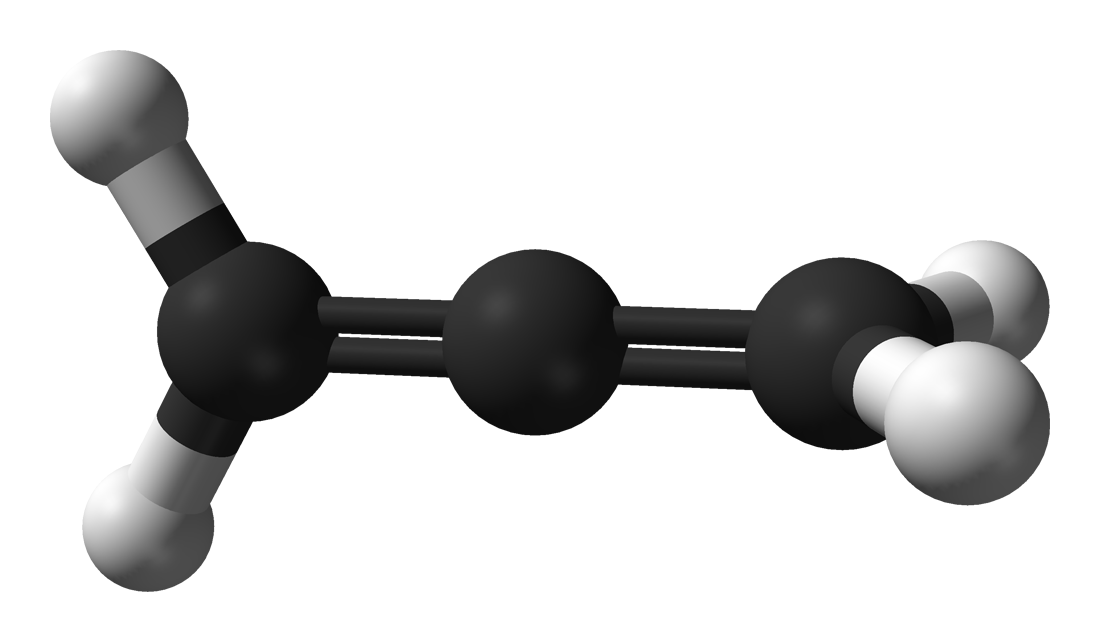
Ball and stick model of propadiene
Names
Preferred IUPAC name
Propadiene[1]
Other names
Allene[1]
Propadiene
Identifiers
3D model (JSmol)
1730774
ChEBI
ChEMBL
ChemSpider
ECHA InfoCard 100.006.670 Edit this at Wikidata
EC Number
  • 207-335-3
860
MeSH Propadiene
UNII
UN number 2200
  • InChI=1S/C3H4/c1-3-2/h1-2H2 checkY
    Key: IYABWNGZIDDRAK-UHFFFAOYSA-N checkY
  • C=C=C
Properties
C3H4
Molar mass 40.065 g·mol−1
Appearance Colorless gas
Melting point −136 °C (−213 °F; 137 K)
Boiling point −34 °C (−29 °F; 239 K)
log P 1.45
Hazards
GHS labelling:
GHS02: Flammable[2]
Danger
H220[2]
P210, P377, P381, P410+P403[2]
NFPA 704 (fire diamond)
NFPA 704 four-colored diamondHealth 0: Exposure under fire conditions would offer no hazard beyond that of ordinary combustible material. E.g. sodium chlorideFlammability 4: Will rapidly or completely vaporize at normal atmospheric pressure and temperature, or is readily dispersed in air and will burn readily. Flash point below 23 °C (73 °F). E.g. propaneInstability 3: Capable of detonation or explosive decomposition but requires a strong initiating source, must be heated under confinement before initiation, reacts explosively with water, or will detonate if severely shocked. E.g. hydrogen peroxideSpecial hazards (white): no code
0
4
3
Explosive limits 13%
Safety data sheet (SDS) External MSDS
Except where otherwise noted, data are given for materials in their standard state (at 25 °C [77 °F], 100 kPa).
checkY verify (what is checkY☒N ?)

Propadiene (/prpəˈdn/) or allene (/ˈæln/) is the organic compound with the formula H2C=C=CH2. It is the simplest allene, i.e. a compound with two adjacent carbon double bonds.[3] As a constituent of MAPP gas, it has been used as a fuel for specialized welding.

Production and equilibrium with methylacetylene

[edit]

Propadiene exists in equilibrium with methylacetylene (propyne) and the mixture is sometimes called MAPD for methylacetylene-propadiene:

H3C−C≡CH ⇌ H2C=C=CH2

for which Keq = 0.22 at 270 °C or 0.1 at 5 °C.

MAPD is produced as a side product, often an undesirable one, of dehydrogenation of propane to produce propene, an important feedstock in the chemical industry. MAPD interferes with the catalytic polymerization of propene.[4]

Occurrence in Space

[edit]

In 2019 it was announced that propadiene had been detected in the atmosphere of Saturn's moon Titan using the NASA Infrared Telescope Facility.[5] This was the first time that propadiene had been detected in space, and the second structural isomeric pair (paired with propyne) detected in Titan's atmosphere, after HCN-HNC.[6][7]

References

[edit]
Revisions and contributorsEdit on WikipediaRead on Wikipedia
from Grokipedia
Propadiene, also known as allene, is the simplest featuring cumulated double bonds, with the molecular formula C₃H₄ and H₂C=C=CH₂. It appears as a colorless, flammable gas at standard conditions, with a detectable , a molecular weight of 40.07 g/mol, a of -34.4 °C, a of -136 °C, a liquid of 657.5 kg/m³ at its , and an auto-ignition temperature of approximately 454 °C. Propadiene is notable for its orthogonal π-bonds, which impart unique reactivity and to substituted derivatives, making it a key building block in for pharmaceuticals, agrochemicals, and materials. In industrial production, propadiene is primarily obtained as a by-product from the high-temperature () of hydrocarbons such as , , or , often mixed with (methylacetylene), necessitating efficient separation techniques like selective adsorption using microporous metal-organic frameworks to achieve high-purity streams. Its reactivity, stemming from the strained cumulated system, allows for cycloadditions, polymerizations, and other transformations, though it requires stabilization to prevent instability or decomposition under pressure or heat. While not highly toxic, propadiene poses risks of asphyxiation due to oxygen displacement and flammability, and is classified as a simple asphyxiant.

Nomenclature and Structure

Chemical Identity

Propadiene is the simplest member of the allene family, a class of organic compounds featuring two adjacent carbon-carbon double bonds in a cumulated arrangement. The for this compound is propadiene, while its systematic name is propa-1,2-diene. The common name "allene" specifically denotes propadiene and has been extended to the entire class of cumulated dienes due to its prototypical . The molecular formula of propadiene is C₃H₄, with a of 40.06 g/mol. Its , H₂C=C=CH₂, illustrates the central carbon atom bonded to two methylene groups via double bonds, resulting in a linear arrangement of the carbon with planes of the terminal CH₂ groups. The allene class was first synthesized in by B. S. Burton and H. von Pechmann, who prepared a substituted , marking the initial recognition of this unique bonding motif; propadiene itself, as the parent compound, was subsequently isolated and characterized in pure form.

Bonding and Geometry

Propadiene exhibits a distinctive pattern typical of , where the central carbon atom is sp-hybridized, forming two linear bonds with the terminal carbons using its sp hybrid orbitals, while the two unhybridized p orbitals on the central carbon participate in perpendicular π bonds. The terminal carbon atoms are sp²-hybridized, with their sp² orbitals forming bonds to the central carbon and the two atoms, and their p orbitals forming the π bonds with the central carbon. This hybridization scheme is supported by quantum chemical calculations and spectroscopic data. The geometric consequences of this hybridization are a linear C=C=C backbone with bond angles of 180° at the central carbon, ensuring optimal overlap for the . At the terminal carbons, the H-C-H bond angles are approximately 118°, reflecting the trigonal planar arrangement expected for sp² hybridization. The π bonds are orthogonal, with one lying in the plane defined by one terminal CH₂ group and the central C-C , and the other perpendicular to that plane, resulting in the two terminal CH₂ groups occupying mutually perpendicular planes. This orthogonal geometry arises directly from the perpendicular p orbitals on the sp-hybridized central carbon and has been confirmed by and studies. Experimental bond lengths for the cumulated double bonds in propadiene are approximately 1.30 for the C=C linkages, slightly shorter than the 1.34 typical of isolated alkenes due to the sp hybridization enhancing s-character in the sigma framework. The perpendicular π-bond orientation in imparts to derivatives where the two substituents on each terminal carbon differ, as rotation around the cumulated system is restricted, leading to stable enantiomers without a plane of symmetry. For instance, in chiral like (P)-2,3-pentadiene, specific rotations have been measured, with values such as [α]_{589} ≈ +18° in the gas phase, demonstrating the optical activity arising from this structural feature.

Physical and Thermodynamic Properties

Phase Behavior and Solubility

Propadiene appears as a colorless gas under standard temperature and pressure conditions. Its phase behavior is characterized by a melting point of −136.3 °C and a boiling point of −34.4 °C, indicating it remains gaseous at ambient temperatures but liquefies under moderate cooling or compression. The liquid density is 0.647 g/cm³ near its boiling point, while the gaseous form has a density of approximately 1.79 g/L at 0 °C and 1 atm, reflecting its relatively low molecular weight compared to air (vapor density relative to air: 1.42). The critical temperature is 120.7 °C, above which propadiene cannot be liquefied regardless of pressure, with a corresponding critical pressure of 52.49 bar. Propadiene exhibits low solubility in water, approximately 2.15 g/L, classifying it as sparingly soluble and limiting its dissolution in aqueous environments. In contrast, it is fully miscible with common organic solvents such as , , , and , facilitating its use in nonpolar media. The (log P) of 1.45 underscores its moderate , suggesting preferential partitioning into phases over . The compound's high of 6795 mm Hg at 21 °C contributes to its volatility and ease of vaporization. Propadiene is extremely flammable, with limits in air ranging from a lower limit of 2.1 vol% to an upper limit of 13 vol%, posing significant fire hazards in confined or oxygen-rich environments.

Spectroscopic Characteristics

Propadiene exhibits distinctive spectroscopic features arising from its cumulated system, which influences vibrational, magnetic resonance, and electronic transitions. These signatures are essential for its identification in and astrophysical contexts. Infrared (IR) spectroscopy reveals characteristic absorptions for the cumulated double bonds. The asymmetric stretch of the C=C=C moiety appears as a strong band at approximately 1950 cm⁻¹, a hallmark of that distinguishes propadiene from isomeric . C-H stretching modes for the terminal methylene groups occur in the 3000–3100 cm⁻¹ region, with specific bands at 3015 cm⁻¹ (symmetric a₁), 3007 cm⁻¹ (antisymmetric b₂), and 3086 cm⁻¹ (degenerate e). Other notable vibrations include the CH₂ scissoring at 1443 cm⁻¹ (a₁) and 1398 cm⁻¹ (b₂), and the symmetric C=C=C stretch at 1073 cm⁻¹ (a₁), though the latter is IR-inactive due to . Nuclear magnetic resonance (NMR) provides insights into the molecular and hybridization. In ¹H NMR, the four equivalent terminal methylene protons appear as two closely spaced singlets between δ 4.6 and 5.0 ppm, reflecting the perpendicular planes of the CH₂ groups and lack of to adjacent hydrogens. The ¹³C NMR features two signals due to symmetry: the equivalent terminal sp² (methylene) carbons at approximately 75 ppm and the central sp carbon at ≈210 ppm (indicative of the cumulene hybridization). Ultraviolet-visible (UV-Vis) spectroscopy shows weak absorptions attributed to π→π* transitions in the far-UV region, with a continuum extending from about 260 nm to 193 nm and a structured band around 185 nm, consistent with the isolated nature of the double bonds without extended conjugation. Mass spectrometry under electron ionization yields a molecular ion at m/z 40 (C₃H₄⁺), often the base peak, with prominent fragments at m/z 39 from loss of a hydrogen atom and m/z 26 corresponding to C₂H₂⁺, reflecting cleavage of the cumulene framework. Raman spectroscopy complements IR by highlighting symmetric modes inactive in the former. The symmetric C=C=C stretch appears at ≈1070 cm⁻¹ as a strong band, aiding in confirmation of the allene alongside the IR-active asymmetric counterpart.

Chemical Reactivity

General Reactivity Patterns

Propadiene exhibits pronounced reactivity stemming from its cumulated system, which introduces strain and electronic asymmetry due to the orthogonal π-bonds in the H₂C=C=CH₂ . This configuration renders the molecule highly susceptible to nucleophilic and electrophilic attacks, with electrophilic additions occurring preferentially at the terminal sp²-hybridized carbons, leading to allylic intermediates that can be trapped by nucleophiles. Such arises from the electron density distribution, where the central sp-hybridized carbon exerts a withdrawing effect, polarizing the bonds toward the ends. In reactions, propadiene engages in [2+2] processes with alkenes or dienes, yielding cyclobutane products where one of the allene double bonds participates as the two-carbon unit. These or catalyzed cycloadditions exploit the cumulated system's ability to adopt a reactive conformation, often proceeding with high to form cis-fused rings or substituted cyclobutanes. For instance, reactions with electron-deficient alkenes enhance the rate due to favorable orbital interactions between the allene's HOMO and the alkene's LUMO. Hydrogenation of propadiene proceeds stepwise, with selective addition of one equivalent of H₂ across one to form propene as the primary product, while full yields . catalysts, such as or , facilitate this transformation under mild conditions, with selectivity controlled by reaction temperature and to favor the monoene intermediate. Propadiene displays a strong tendency toward under acidic or radical initiation, resulting in polyallenes with conjugated cumulated backbones. Acid-catalyzed processes involve at terminal carbons to generate carbocations that propagate growth, while radical mechanisms, often initiated by peroxides or light, add to the s to form vinyl radical intermediates. These polymers exhibit interesting optical and mechanical properties but are typically amorphous due to the nonlinear . Regarding thermal stability, propadiene remains intact below 500 °C but undergoes at higher temperatures, primarily fragmenting into and via C-C bond cleavage and hydrogen migration. This pathway is observed in experiments and surface studies, highlighting the molecule's limits in high-heat applications.

Equilibrium

Propadiene, also known as allene (\ceH2C=C=CH2\ce{H2C=C=CH2}), undergoes to propyne (\ce{CH3C#CH}), represented by the equilibrium \ce{H2C=C=CH2 ⇌ CH3C#CH}. This reversible reaction is catalyzed by bases, such as hydroxides, or transition metals, including , , and supported on frameworks like silica or metal-organic structures. The K_\text{eq} = \frac{[\ce{H2C=C=CH2}]}{[\ce{CH3C#CH}]} is 0.125 at (approximately 25 °C) in the gas phase, shifting to favor propadiene at elevated temperatures with Keq0.25K_\text{eq} \approx 0.25 at 280 °C, where the mixture contains about 20% propadiene. At lower temperatures, KeqK_\text{eq} is smaller, reflecting the exothermic nature of the forward reaction (propadiene to ) and the influence of favoring the more symmetric propadiene structure at higher temperatures. Thermodynamically, is more stable than propadiene by approximately 4.2 kJ/mol (1.0 kcal/mol) at 298 , as determined from their standard enthalpies of formation (ΔfH=189.95±0.23\Delta_f H^\circ = 189.95 \pm 0.23 kJ/mol for propadiene and 185.74±0.25185.74 \pm 0.25 kJ/mol for ). This energy difference arises primarily from the greater bond strength in the alkyne's sp-hybridized compared to the cumulative double bonds in propadiene, though the gap narrows with temperature due to differences in vibrational . In industrial contexts, the mixture of methylacetylene () and is stabilized with to form , preventing excessive or during storage and use as a high-temperature . The interconversion exhibits significant kinetic barriers, with activation energies typically exceeding 200 kJ/mol in the absence of catalysts, rendering the reaction slow at ambient conditions and necessitating catalytic or for practical rates.

Synthesis and Production

Industrial Processes

Propadiene is produced as a side product in various petrochemical es, including catalytic dehydrogenation of to (e.g., the UOP Oleflex ) and of hydrocarbons. In the endothermic dehydrogenation reaction, (C₃H₈) is converted over platinum-based s at temperatures around 550–650 °C, yielding (C₃H₆) and as main products, while propadiene (H₂C=C=CH₂) and (CH₃C≡CH) arise from further dehydrogenation of . The Oleflex employs a series of moving-bed reactors with continuous regeneration to maintain selectivity, minimizing unwanted byproducts like propadiene through optimized operating conditions. Yields of propadiene in the are typically low, ranging from 0.001 to 0.1 wt% as part of the methylacetylene-propadiene (MAPD) fraction, reflecting the high selectivity of modern catalysts toward (85–90%). In contrast, higher concentrations—up to 5–6 wt% in the C₃ cut—are observed in processes, where at 750–900 °C in the presence of generates a broader range of unsaturated C₃ s, including propadiene as an undesirable byproduct. The MAPD fraction is generated on a multimillion-metric-ton scale annually from global cracking (approximately 500 million metric tons per year), but most is hydrogenated to or used as fuel, with purified propadiene comprising a small portion. These streams from either dehydrogenation or cracking require to meet specifications, often limiting propadiene recovery. Purification of propadiene involves to separate it from , , and in the C₃ mixture, typically under cryogenic conditions to exploit small differences in boiling points. However, the equilibrium between propadiene and , which favors propyne with K ≈ 0.1 (ratio ≈1:10 propadiene:) at 298 K, complicates clean separation and increases energy demands, sometimes necessitating adsorption or steps instead. Current global production of purified propadiene is minor compared to the multimillion-ton scale of the MAPD byproduct, largely tied to petrochemical refining streams where it is isolated from MAPD that is often converted to higher-value propylene. In petroleum refining, the total MAPD fraction—including propadiene—is generated on a multimillion-metric-ton scale annually but is predominantly not isolated as pure propadiene.

Laboratory Preparations

Another established route is the anodic of itaconate in , where oxidative at a generates propadiene through the loss of and subsequent rearrangement. This electrochemical method operates at potentials of 1.5–2.0 V versus SCE, with current densities around 0.1 A/cm², affording propadiene in yields up to 60% after trapping and purification, though side products such as require chromatographic separation. A widely used modern preparation entails the of 2,3-dichloropropene using dust in a mixture of and under conditions. In this procedure, 2,3-dichloropropene is added dropwise to a stirred suspension of activated , leading to sequential elimination of HCl to form propadiene, which is distilled and at low temperature (–70°C using Dry Ice-acetone) to prevent ; yields reach 80%, with purity exceeding 97% after between –34°C and 10°C. Overall, syntheses of propadiene typically achieve 50–80% yields but demand cryogenic to isolate the reactive gas, as it tends to dimerize or polymerize at ambient conditions. Recent advances in allene synthesis include palladium-catalyzed coupling reactions, such as the β-hydrogen elimination from sp²-carbons in vinyl halides or diazo compounds, which enable efficient formation of substituted ; these protocols are adaptable to unsubstituted propadiene by using appropriate propargylic or vinylic precursors under mild conditions ( to 80°C) with Pd(0) or Pd(II) catalysts and ligands, often delivering high and yields above 70% for analogs.

Natural Occurrence

Detection in Space

Propadiene (H₂C=C=CH₂), also known as allene, has not been directly detected in interstellar or circumstellar environments despite predictions from astrochemical models suggesting its presence as a minor species. Its highly symmetric structure results in a permanent dipole moment of zero, rendering it undetectable via radio or millimeter-wave , the dominant technique for identifying gas-phase molecules in space. Astrochemical simulations of dense molecular clouds predict propadiene as a trace component formed primarily through neutral-neutral gas-phase reactions. A key pathway involves the reaction of atomic carbon with : C(³P) + C₂H₄ → C₃H₄, which can yield propadiene as one of the C₃H₄ isomers alongside , though subsequent H-abstraction or addition reactions favor the latter in observed abundances. Searches for propadiene in carbon-rich stellar envelopes have focused on potential signatures tied to its spectroscopic characteristics, such as vibrational modes in the mid-IR, but no confirmed detections have been reported as of 2025. These efforts leverage the molecule's predicted role in chemistry leading to more complex organics, though upper limits remain consistent with model predictions rather than firm identifications.

Presence in Planetary Atmospheres

Propadiene has been detected in the of Titan, Saturn's largest moon, marking the first confirmed observation of this molecule in any astronomical environment. The detection was achieved through high-resolution using the Texas Echelle Cross-Echelle Spectrograph (TEXES) on NASA's Telescope Facility (IRTF) during observations on July 11, 2017. Analysis of the spectral data revealed emission lines consistent with propadiene at 13.17 μm, with a volume mixing ratio of (6.9 ± 0.8) × 10^{-10} at an altitude of 175 km, assuming a vertically increasing profile. This abundance corresponds to approximately one-tenth that of its , with an observed ratio of to propadiene of 8.2 ± 1.1 at around 150 km, based on complementary Cassini Composite Spectrometer (CIRS) measurements from April 2017. The presence of propadiene in Titan's atmosphere arises primarily from photochemical processes driven by solar ultraviolet radiation and ion chemistry. In the upper atmosphere (400–800 km), the dominant production pathway involves the reaction of atomic with the propargyl radical (H + C₃H₃ → CH₂CCH₂), where both precursors originate from the dissociation of and subsequent ion-molecule reactions in the . Lower in the (below 200 km), photolysis of propene (C₃H₆ + hν → CH₂CCH₂ + 2H) contributes significantly, with propene itself formed from earlier chemistry involving and methyl radicals. These processes occur within Titan's nitrogen-methane layers, where ion chemistry enhances the formation of C₃ hydrocarbons through pathways like CH₅⁺ + C₂H₂ → C₃H₅⁺ + H₂, followed by neutralization and rearrangement. Loss mechanisms include back to smaller fragments and abstraction reactions, maintaining a steady-state distribution. Propadiene plays a potential role as a precursor in the prebiotic chemistry of outer solar system bodies, particularly on Titan, where its accumulation contributes to the synthesis of more complex organic molecules. As part of the C₃ family, it can participate in reactions or addition pathways leading to polycyclic aromatic hydrocarbons (PAHs) and nitrile-containing compounds, which are building blocks for particles and surface tholins—analogous to early prebiotic materials. Titan's organic-rich atmosphere serves as a natural laboratory for such processes, with propadiene's detection underscoring the diversity of reactive intermediates that could facilitate the formation of biomolecules under reducing conditions. Photochemical models of Titan's atmosphere predict propadiene's steady-state concentrations based on ultraviolet flux, ion production rates, and vertical transport, aligning closely with observed abundances. These models, incorporating over 400 reactions among 80+ neutral and ionic species, simulate production rates peaking in the upper stratosphere and diffusion downward, with sensitivities to atomic hydrogen abundance and methane photolysis yields. Updated models incorporating the 2019 detection refine predictions for isomer ratios and haze formation, confirming propadiene's integration into broader hydrocarbon networks. While no confirmed detections exist beyond Titan, such models suggest trace amounts could form transiently in cometary comae via similar dissociation of parent volatiles like propane or propyne, though spectroscopic limits from missions like Rosetta on 67P/Churyumov-Gerasimenko remain inconclusive.

Applications

Industrial Uses

The original formulation of MAPP gas, a stabilized fuel mixture consisting of methylacetylene (), propadiene, and (with a typical early composition of approximately 48% propyne, 23% propadiene, and 27% propane), was discontinued in 2008. Modern MAPP-like gases, such as MAP-Pro, often contain lower levels of propadiene (e.g., around 14% in some formulations) along with and other hydrocarbons, providing a safer alternative to pure for high-heat applications due to greater stability at higher pressures. In oxy-fuel processes, , when combined with oxygen, generates a flame temperature reaching 2925 °C, facilitating efficient , , , preheating, and cutting of various metals. Its use in specialized torches supports tasks in , repair, and fabrication industries, where the balanced burn characteristics enhance safety and portability compared to traditional fuels. Propadiene also serves as a minor industrial feedstock for organic chemical production, notably in catalytic processes such as ruthenium-mediated hydrocarboxylation of allene-propadiene mixtures to yield unsaturated carboxylic acids without prior separation. As the parent allene, it contributes to synthesis routes for functionalized compounds in and pharmaceutical precursors. Commercially, propadiene is mainly recovered as a from the methylacetylene-propadiene (MAPD) fraction in operations for production, with its market demand linked to the and cutting sectors via MAPP gas formulations as well as other chemical uses. In MAPP gas, propadiene exists in equilibrium with , influencing the mixture's overall reactivity.

Role in Organic Chemistry

Propadiene serves as a versatile building block in synthetic due to its cumulated double bonds, which enable unique reactivity patterns such as cycloadditions and oligomerizations. One prominent application is its role as a dienophile in Diels-Alder reactions, where substituted derivatives like (phenylsulfonyl)propadiene undergo site- and regioselective cycloadditions with dienes to yield allene-containing heterocycles. These adducts can be further functionalized via , providing access to complex scaffolds with preserved allene functionality for subsequent transformations. In metal-catalyzed processes, propadiene participates in nickel-catalyzed cooligomerizations with alkynes, leading to the formation of 1,3-dienes through regioselective coupling. Using bis(η³-allyl) complexes as catalysts, propadiene and electron-deficient alkynes such as diethyl acetylenedicarboxylate react to produce conjugated s in good yields, with the reaction accelerated by . This methodology leverages propadiene's general reactivity in nickel(0)-mediated insertions, allowing for stereocontrolled assembly of units useful in precursors and analogs. Propadiene-derived scaffolds are employed in the synthesis of chiral , which find utility in asymmetric as ligands or catalysts. For instance, optically active allene-phosphines derived from propadiene units have been utilized in enantioselective reactions, such as allylic alkylations, due to their imparting high stereocontrol. These chiral allenes enhance reaction efficiency in palladium-catalyzed processes, demonstrating propadiene's value in constructing stereogenic elements for catalytic applications. Propadiene features as a structural subunit in allenic s with properties, such as scorodonin, an allenyne isolated from fungal sources exhibiting antibacterial and activity. The allene moiety in scorodonin contributes to its bioactivity, and synthetic routes to this compound highlight propadiene's role in assembling the key allenic fragment via enantioselective coupling. Recent advancements include gold-catalyzed cyclizations of propadiene-containing substrates to generate bioactive heterocyclic scaffolds, as seen in the 2022 synthesis of cyclopentenone derivatives via intramolecular [3+2] cycloadditions, which mimic cores and show promise for pharmaceutical development.

Safety and Environmental Considerations

Health Hazards

Propadiene poses health risks primarily as a simple asphyxiant, where high concentrations in confined spaces can displace oxygen, leading to rapid suffocation, , and . Exposure occurs mainly through , and monitoring oxygen levels to at least 19% is recommended in areas with potential accumulation. As a highly flammable gas, propadiene has an of approximately 454 °C, increasing the risk of fire or upon ignition, which can exacerbate hazards through burns or of products. It is classified under the Globally Harmonized System (GHS) as "Danger" with the hazard statement H220: "Extremely flammable gas," reflecting its wide flammable range in air (approximately 1.7% to 13% by volume). Propadiene exhibits low and is primarily hazardous as a simple asphyxiant rather than being inherently poisonous. However, at elevated concentrations, it acts as an irritant to the eyes, skin, and , potentially causing redness, discomfort, or frostbite-like burns from the liquefied form due to rapid . Regarding chronic effects, propadiene has no known carcinogenic potential in animals, though some studies suggest potential mutagenicity in cells. Its high volatility results in minimal in biological systems. No significant long-term effects have been identified from repeated exposure, though data on reproductive or developmental remain limited, with limited evidence of effects in animals.

Handling and Storage

Propadiene is typically stored as a under its own in high-strength cylinders designed for compressed gases, with the addition of stabilizers or inhibitors to prevent spontaneous and ensure stability during prolonged storage or transport. Cylinders must be kept in cool, dry, well-ventilated areas away from direct , sources, and incompatible materials such as strong oxidizers, with temperatures not exceeding 52°C to avoid buildup that could lead to rupture. Secure fastening is essential to prevent cylinders from falling or rolling, and protection caps should remain in place when not in use. Safe handling requires operations in well-ventilated environments or under local exhaust ventilation to minimize exposure to vapors, which can displace oxygen and pose an asphyxiation risk in confined spaces. All ignition sources, including sparks, open flames, , and hot surfaces, must be strictly avoided due to the gas's extreme flammability; non-sparking tools and explosion-proof equipment are recommended. Propadiene is compatible with and certain alloys but is highly corrosive to , (containing more than 65% copper), mercury, and silver, necessitating the use of appropriate materials for valves, fittings, and piping to prevent leaks or degradation. The (NFPA) 704 hazard rating for propadiene, as per recent SDS, indicates a health hazard of 0 (minimal), flammability of 4 (burns readily with intense ), and reactivity of 0 (stable). In case of a spill or leak, immediately evacuate the area upwind at least 100 meters for large releases, eliminate all ignition sources, and provide maximum ventilation to disperse vapors; do not attempt to disperse the gas cloud manually, as this increases risk—instead, if the leaking gas ignites and it is safe to do so, allow controlled burning until the leak can be stopped, rather than extinguishing and allowing re-ignition. Propadiene exhibits a short atmospheric lifetime of about 1 day, dominated by rapid reaction with hydroxyl (OH) radicals (rate constant k ≈ 2.3 × 10^{-11} cm³ molecule^{-1} s^{-1} at 298 K), with photolysis playing a secondary role due to its UV absorption characteristics. Its ozone depletion potential is negligible (ODP = 0), as it lacks capable of catalytic destruction in the . Under U.S. (DOT) regulations, stabilized propadiene is classified as a Division 2.1 flammable gas and shipped under UN 2200, with restrictions on passenger aircraft transport; mixtures with methylacetylene are handled under UN 1060.

References

Add your contribution
Related Hubs
User Avatar
No comments yet.