


Community hub
Recent from talks
Contribute something
Nothing was collected or created yet.
Overprint
View on Wikipedia


An overprint is an additional layer of text or graphics added to the face of a postage or revenue stamp, postal stationery, banknote or ticket after it has been printed.[2][3] Post offices most often use overprints for internal administrative purposes such as accounting but they are also employed in public mail. Well-recognized varieties include commemorative overprints which are produced for their public appeal and command significant interest in the field of philately.[4]
Surcharges
[edit]The term "surcharge" in philately describes any type of overprint that alters the price of a stamp.[5] Surcharges raise or lower the face value of existing stamps when prices have changed too quickly to produce an appropriate new issue, or simply to use up surplus stocks.
Any overprint which restates a stamp's face value in a new currency is also described as a surcharge.[5] Some postal systems have resorted to surcharge overprints when converting to a new national monetary system, such as Sierra Leone did when the British Commonwealth converted to decimal currency in the 1960s.[6]
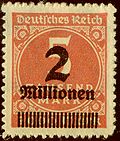
Stamps have occasionally been overprinted multiple times. A famous example of repeated surcharging happened during the German hyperinflation of 1921–1923. Prices rose so fast and dramatically that postage stamps which cost five or ten pfennigs in 1920 were overprinted for sale in the values of thousands, millions, and eventually billions of marks.[7]
-
 Victoria, 1873: Penny stamp overprinted to new value of halfpenny
 -
 Guatemala 1881: 1 centavo surcharge on 1/4 real
 -
 Ceylon, 1888: Stamp surcharged by a "double inverted" overprint
 -
 Uruguay, 1892: 1c provisional surcharge on 20c issue of 1889–1901
 -

-


Commemorative overprints
[edit]Overprints have often been used as commemoratives, providing a faster and lower-cost alternative to designing and issuing special stamps or postmarks. The United States, which historically has issued relatively few commemorative overprints, did this in 1928 for issues celebrating Molly Pitcher and the discovery of Hawaii. British stamps heralding the 1966 FIFA World Cup were reissued after England's victory with the overprint "England Winners". Similarly, Guyana issued a set of 32 stamps showing team pictures of all the participants in the 1998 World Cup – after the tournament eight of these were reissued with an overprint announcing France's win.
In some rare cases, commemorative overprints have been applied to souvenir sheets. When these postal commodities are overprinted, they are always very carefully positioned for aesthetic appeal, usually on the blank outer border ("selvage") of the paper.
-
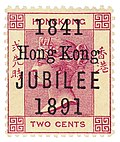 Hong Kong, 1891: Definitive postage stamp overprinted to commemorate the 50th anniversary of British administration
 -
 United States, 1928: The mythic American revolutionary war hero "Molly Pitcher" was honored with an overprint.
 -
 Soviet Union, 1935: Aviator Sigizmund Levanevsky with red overprint for his North Pole flight, August 1935. Also includes 1 rouble surcharge.
 -
 Soviet Union, 1945: Overprint marking Victory Day
 -
 Great Britain, 1957: For use in UK postal agencies in Morocco, commemorating the centenary of the British postal office in Tangier
 -


Change of function overprints
[edit]Regular stamps were also overprinted to indicate exclusive usage for a special function or combination of functions; intended for airmail, official mail, newspapers, postage due, special delivery, telegraph and so on. The official stamps of some countries like Great Britain had an overprint which defined the specific official usage; for inland revenue, government parcels, office of works, military, admiralty, war tax (see below). The opposite occurs as well, in this case special function stamps are overprinted to serve as regular stamps.
-
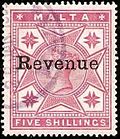 Malta, 1899: 5s, 1886 issue, overprinted 'Revenue'
 -
 Great Britain, 1900: British 1/2d stamp overprinted 'ARMY TELEGRAPHS'
 -
 Nicaragua, 1901: A postage due stamp overprinted for use as regular stamp
 -
 Austria, 1918: Austro-Hungarian Empire stamps overprinted 'FLUGPOST' for airmail. Also surcharged.
 -
 Soviet Union, 1924: regular 1918 issue overprinted 'DOPLATA' for postal duty. Also 1 kopeck surcharge.
 -
 Great Britain, 1942: British 2d stamp overprinted 'M.E.F.' ('Middle Eastern Forces'), for military use
 -
 Soviet Union, 1944: regular 30-kopeck stamp overprinted "AVIAPOCHTA" for airmail, and value increased to 1 ruble


Security measures
[edit]Overprints have been used as security measures to deter misuse and theft.[8] In the nineteenth century, Mexico was plagued by thefts of stamps on their way to remote post offices. To address this, stamps were shipped from Mexico City to the local districts where they were overprinted with the district name – they were not valid for postage without the overprint.
In El Salvador a significant quantity of stamps was stolen from the San Salvador post office in 1874. As a result all remaining stock was officially overprinted 'Contrasello' preventing usage of the non-overprinted stamps.[9]
The United States used a similar strategy to deal with thefts in Kansas and Nebraska in 1929, overprinting the current definitive issue with "Kans." and "Nebr." before they were shipped from Washington, to make it more difficult to sell stolen stamps outside the indicated state.
-
 Mexico, 1856: Guanajuato district overprint
 -
 El Salvador, 1874: Contrasello overprint
 -
 Great Britain: Victorian stamps of 1891 overprinted for use only on government parcels
 -
 United States, 1929: Kansas state overprint
 -


Colonial overprints
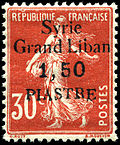
[edit]Nations overprinted stamps for use in their colonies mainly for the same reasons as for their domestic use. Due to poor planning, supply problems, faster than anticipated changing postal rates, changes in currency or other reasons they ran out of stamps, and demand had to be met. Some overprints were used to establish the first stage of postal service in a new territorial possession or colony however. If preparations had not been made, the controlling nation's regular homeland stamps would be overprinted with a local name, local currency or 'abroad' indication. In a similar fashion a nation's domestic stamps may be overprinted for use in foreign post offices under that power's control. For example, from 1919 to 1922 the United States overprinted 18 postage stamps at double value and marked for its office in Shanghai, China.
-
 Italy 1874: Overprinted 'ESTERO' (abroad) for use in the Italian post offices abroad
 -
 Austria 1886: Local currency (para) overprint for the Austrian post offices in the Ottoman Empire, due to transition from Soldi to Piaster currency
 -
 United States, 1899: postage due stamp overprinted for use in Puerto Rico
 -
 United States, 1899: overprinted for use in Guam
 -
 Germany, 1900: Overprinted for use in Caroline Islands
 -
 United States, 1903: Overprinted for use in the Philippines
 -
-

-
 Great Britain, 1957: Overprinted for use in Qatar


Provisional overprints
[edit]Provisional stamps are postage issue made for temporary ad hoc usage to meet demands until regular issues are reintroduced.[10]
Transitional government overprints
[edit]New states or states in transition have sometimes found it necessary to recirculate stocks of stamps printed by a previous government. Some historical perspective may be gleaned from the study of such stamps: some transitional government overprints blend neatly with their predecessors' designs, while others attempt to totally obscure or even deface the older markings. In several European nations in 1944–45, Nazi occupational stamps were overprinted for the provisional governments, and those which depicted Adolf Hitler were most heavily overprinted, obliterating his face.
-

-
![Ukraine, 1918–1923: Kyiv[11] trident overprint on 7 rouble Russian Imperial stamp for the Ukrainian People's Republic](//upload.wikimedia.org/wikipedia/commons/thumb/f/f4/KievIIee7rub.jpg/120px-KievIIee7rub.jpg) Ukraine, 1918–1923: Kyiv[11] trident overprint on 7 rouble Russian Imperial stamp for the Ukrainian People's Republic
Ukraine, 1918–1923: Kyiv[11] trident overprint on 7 rouble Russian Imperial stamp for the Ukrainian People's Republic -
![Armenia 1920: Framed HP monogram on 10 rouble Russian Imperial stamp. This overprint type was introduced at Erivan (now Yerevan).[12]](//upload.wikimedia.org/wikipedia/commons/thumb/9/91/Armenia_1920_149TE5.jpg/120px-Armenia_1920_149TE5.jpg) Armenia 1920: Framed HP monogram on 10 rouble Russian Imperial stamp. This overprint type was introduced at Erivan (now Yerevan).[12]
Armenia 1920: Framed HP monogram on 10 rouble Russian Imperial stamp. This overprint type was introduced at Erivan (now Yerevan).[12] -
 Lithuanian postage stamps with overprints of Central Lithuania (Środkowa Litwa), 1920
 -
 Ireland, 1922: British stamp overprinted for Provisional Government of the Irish Free State
 -
 Latvia, 1993: Soviet stamp overprinted for independent Latvia
 -
 The first definitive issue of postage stamps of Sharjah (UAE), 1 riyal, 1963 and 1965, with Saqr bin Sultan Al Qasimi obscured following the coup

![Ukraine, 1918–1923: Kyiv[11] trident overprint on 7 rouble Russian Imperial stamp for the Ukrainian People's Republic](https://en.wikipedia.org/wiki/File:KievIIee7rub.jpg)
![Armenia 1920: Framed HP monogram on 10 rouble Russian Imperial stamp. This overprint type was introduced at Erivan (now Yerevan).[12]](https://en.wikipedia.org/wiki/File:Armenia_1920_149TE5.jpg)
,_1920.jpg)


Wartime overprints
[edit]During times of war, many nations have issued war tax stamps. Before new stamps could be printed, older stamps were frequently overprinted with surcharges or a simple inscription such as "War Tax".
In actual combat zones, the replenishment of stamp stocks is generally low on a military's list of priorities. In contested or occupied areas, captured local stamps are often expediently overprinted by the occupying forces.
-
 Belgium, World War I: German postage stamp overprinted with "Belgium" for use during the German occupation
 -
 Malta, 1918: Postage stamp with wartime taxation applied
 -
 Russian Civil War, Wrangel 1921: Russian Imperial stamp of 1908–1918 overprinted for the posts of Wrangel's army and civilian refugees
 -
 City of Fiume and environs (Fiume-Kupa), 1941: Yugoslavian stamp overprinted for the Italian occupation
 -
 Philippines 1942: Japan occupation overprint of US PI stamp for the "First Anniversary of the Great East Asia War", December 8, 1942 (FD/CDS)
 -
 Australia, 1946: Surplus kookaburra stamp from 1937 overprinted for use by the British Commonwealth Occupation Force in Japan


Precancels
[edit]Any stamp that is cancelled by postal authorities before it is sold is described as "precancelled":[13] the precancellation mark is an overprint. This is usually only done when stamps are sold in large bulk quantities to businesses or other large organizations: the postal service will save the labor of cancelling each individual stamp by precancelling the entire purchased quantity.[14] The overprints also help prevent theft or misuse because they usually include the name of the city or region in which they are to be used. Unlike standard cancellation marks, they usually do not give a specific date, affording the bulk purchaser time to use them at their discretion. In some situations, however, months or years may be included in the overprint to indicate an expiration.
Precancels for official government use are fastidiously prepared, but other kinds are almost always "heavy cancels" which deliberately obliterate much of a stamp's design.
Since the 1980s, many modern postal systems no longer use overprints to indicate bulk purchases. Bulk mail is franked using barcodes on pre-printed envelopes or on blank adhesive labels. The USPS introduced a new standard of barcode cancellation in 2011.
-
 Canada, 1870: Early heavy cancel for bulk purchase
 -

-
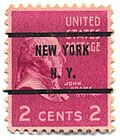 United States, 1938: Business precancel marked for New York City.


Private overprints
[edit]Any overprint that does not originate from a stamp-issuing authority is considered a private overprint or private cancellation. Such overprints almost always invalidate a stamp for postal use. Most countries treat unofficial overprints the same way the United States Post Office does: the USPS Domestic Mail Manual states that stamps "overprinted with an unauthorized design, message or other marking" are not valid for postage.[15]
Private overprints generally remain outside the formal realm of philately, although individual issues can achieve notoriety through their popularity or aesthetic appeal. Private overprints are typically political messages or commercial promotion, but can also originate from speculative philatelic purposes produced deliberately with a view to selling them to unsuspecting collectors.
Stamps owned by commercial entities have sometimes privately overprinted the backs of their purchased stamps. These overprints are usually made as control marks or accounting information. Such overprinting does not invalidate a stamp unless it shows through the front.
-
 Suriname, 1873: A private speculative surcharge
 -
 Dutch East Indies, 1881: Moquette private overprint
 -
 Germany, 1926: A private commercial overprint


Specimen overprints
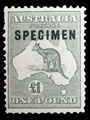
[edit]Some stamps are never valid for postal use. They are made for use in promotional displays or as reference material by postal authorities and the Universal Postal Union (UPU). Still others are manufactured by printers for color matching throughout successive printings. In all such cases, the stamps will display the word "specimen" (or "cancelled") on its face. Occasionally, the word may be uniquely handwritten by a postal authority or, much more elaborately, punched through the stamp paper in a method known as perfin. Most often, though, specimen markings are applied as a prominent overprint.[5]


Overprints on currency
[edit]The design and printing of valid paper currency is rarely done hastily and overprints are extremely rare, but in times of crisis such measures have been taken. After World War I, the various successor states of the Austro-Hungarian Empire made multilingual overprints to their old Imperial currency until new notes could be designed and circulated.
Currency overprints were also used during World War II to mark all United States dollars in the Hawaiian islands. These Hawaii overprint notes were made in case the islands were captured and the invading forces gained control of the money.[16]
Another unusual overprinting situation involving U.S. notes occurred when limited numbers of series 1935A silver certificate dollar bills were overprinted with either a red "R" or an "S". This indicated they were made of "regular" or "synthetic" paper and was a test of their wearing qualities.[17]
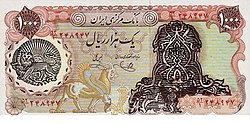
The Haitian Gourde was overprinted after the unexpectedly rapid fall of the Baby Doc Duvalier regime.[18] The overprint consisted of a red circle with a slash across it with the date of the end of the Duvalier regime (7 February 1986) printed below in red. The symbol obscured the images of Baby Doc and Papa Doc until they were replaced with images of figures from Haitian history. Something similar was done in Iran in 1979 when the Shah's picture was covered by an intricate design.
-
 Austria, 1919: Austro-Hungarian Imperial krone restricting circulation to the new Republic of Austria
 -

-
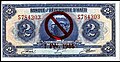 Haiti, 1986: Duvalier portrait obscured with prohibition sign
 -
 An overprinted Series 1974 counterfeit $100 bill, marked 'Contrefaçon' (counterfeit in French) to indicate its status as a fake banknote
 -
 5 Yen note from 1938 with cancel marks. These were repurposed for military use in China.
 -
 5 Yen note (1938) overprinted reverse


Overprint errors
[edit]Overprint errors are widespread. Known are double, inverted, misspelled, wrong, partly or entirely missing overprints.
-
 Uruguay, 1880–1882: block of four with double overprint 'OFICIAL'
 -
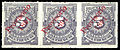 Uruguay, 1891: 5c overprint error, middle stamp with 'Provisorio 1391' instead of 'Provisorio 1891'
 -
 Jind, 1886–1899: Half anna Queen Victoria overprinted 'JHIND STATE' inverted
 -
 Barbados, 1916: Stamps overprinted for revenue usage with missing tail to y of 'Penny'
 -
 Czechoslovakia, 1920: Inverted 28Kc airmail overprint


See also
[edit]- Precancel
- Specimen stamp
- Countermark, an equivalent to an overprint found on coins
- Where's George, U.S. Currency bill tracking project involving overprinted dollar bills
References and sources
[edit]- References
- ^ "1897 Red Revenue Small One Dollar" stamp sells for $970,000 at auction". News.com.au. 3 July 2013.
- ^ Reinfeld, p. 36.
- ^ Williams & Williams, p. 256.
- ^ Klug, Janet (3 June 2002). "Surcharges and overprints make a difference". Linn's. Retrieved 3 September 2011.
- ^ a b c Williams & Williams, p. 258.
- ^ Klug, Janet (2008). Guide to Stamp Collecting. New York: HarperCollins. p. 45. ISBN 9780061341397.
- ^ Schenk, Robert (2011). "A Case of Inflation". Saint Joseph's College Economics Dept. Retrieved 3 September 2011.
- ^ Williams & Williams, p. 253.
- ^ Gallegos, GF (2002). "El Salvador Handbook - Chapter 3: 1874 - 'Contrasello' Issue". Archived from the original on 16 June 2019. Retrieved 16 June 2019.
- ^ Miller, Rick (2011). "Lines of stamp classifications have blurred". Linn's World Stamp Almanac. Archived from the original on 25 June 2008. Retrieved 3 September 2011.
- ^ Ceresa, Dr. R.J. (May 1986). The Postage Stamps of Russia, 1917-23. Vol. 2. Ukraine. Part 9/13. The Trident Issues of Kyiv Types I, II and II. Russian Philatelic Desk Top Publications, Felpham, Great Britain. p. 170. ASIN B0007BFS90.
- ^ Ceresa, Dr. R.J. (August 1978). The Postage Stamps of Russia, 1917-23. Vol. 1. Armenia. Part 3. The Large sized Framed HP Monogram Overprints. Russian Philatelic Desk Top Publications, Felpham, Great Britain. pp. 62–63. ASIN B0007BFS90.
- ^ Reinfeld, p.37.
- ^ Williams & Williams, p. 257.
- ^ USPS (2010). "Domestic Mail Manual" (PDF). United States Postal Service. Retrieved 3 September 2011.
- ^ "Bills Stamped with Hawaii". Infoplease. 1944-10-21. Retrieved 3 September 2011.
- ^ Special issue $1 notes
- ^ "Haitian Currency". Traveling Haiti.com. 2011. Retrieved 3 September 2011.
- Sources
- Reinfeld, F. (1976). Stamp Collectors' Handbook. USA: Doubleday. ISBN 0-385-11682-9.
- Williams, L.N.; Williams, M. (1956). The Postage Stamp: Its History and Recognition. UK: Pelican Books. OCLC 3269097.
- GBOS. Bogus overprints. Website Great Britain Overprints Society. Online article

External links
[edit]- The GB Overprints Society, specializing in British overprints
- Alphabetilately, essay on postal overprints
Overprint
View on GrokipediaDefinition and Fundamentals
Definition and Purposes
In philately, an overprint is the addition of text, numerals, or graphics printed onto the surface of an already produced postage or revenue stamp, typically after its initial issuance by the postal authority.[3][8] This process modifies the stamp's original design to create a variant with altered characteristics, such as a new denomination or usage restriction, without necessitating a full reprint.[5] Official overprints are authorized by the issuing postal administration to ensure validity for franking mail or other fiscal purposes, distinguishing them from unauthorized alterations or counterfeits.[5] Overprints serve multiple practical purposes, primarily to adapt existing stamp stocks to changing economic or administrative needs. A common function is surcharging to adjust face values, often in response to inflation, currency shifts, or shortages of specific denominations, allowing postal services to repurpose surplus inventory and avoid waste from obsolete issues.[9][2][3] For example, during periods of rapid devaluation, such as in post-World War I Europe, overprints enabled quick value increases on printed stamps to match new monetary realities.[10] Beyond value changes, overprints indicate shifts in function or jurisdiction, such as converting postage stamps for revenue, official, or military use, or marking territorial control after geopolitical events like occupations or independences.[10][11] They also facilitate commemorative or provisional applications, adding event-specific inscriptions when time constraints prevent new stamp production, as in the United States' 1928 overprint honoring Molly Pitcher on a George Washington definitive.[12] In wartime or emergency scenarios, overprints provide security markings or enable use in specific regions, such as British stamps overprinted for agencies in Morocco or China.[5][11]Production Methods and Techniques
Overprints on postage stamps are produced by applying an additional layer of ink to pre-existing printed stamps, typically using surface printing methods to modify value, purpose, or designation without reprinting entire issues. The primary technique historically employed is letterpress printing, also known as typography, where raised metal type or plates are inked and impressed directly onto the stamp surface under pressure. This method allows for efficient adaptation of stamp stocks, as seen in early 20th-century precancel and overprint production, where sheets were fed through specialized presses like the Stickney model, followed by gum drying ovens to set the overprint ink and prevent smudging.[13] In provisional scenarios, such as during shortages or political transitions, handstamping techniques predominate, involving manual application of inked rubber or metal devices to individual stamps or small sheets, often resulting in irregularities like offset positioning or varying ink density due to human error. These hand-applied overprints, common in 19th-century district or emergency issues, enabled rapid issuance but frequently produced varieties including doubles, inversions, or partial impressions, as evidenced in early Mexican and Central American provisionals.[14] For larger-scale or more precise operations, offset lithography has been adapted in modern contexts, transferring ink from a plate to a rubber blanket before impressing it onto the stamp, yielding uniform results suitable for commemorative or surcharge overprints on high-volume runs. However, letterpress remains characteristic of many classic overprints due to its compatibility with the gummed, fragile nature of early stamp paper, minimizing damage during application. Production errors, such as inverted or double overprints, arise from misfeeds in mechanical presses or misalignment in hand processes, often commanding premium value among collectors for illustrating the technique's limitations.[15]Historical Development
Origins in Early Philately
Overprints originated in the mid-1850s as postal systems in newly stamp-issuing nations adapted pre-printed adhesives to local administrative or security requirements, predating widespread philatelic documentation but coinciding with the global spread of uniform postage. Mexico's 1856 Hidalgo issue represents one of the earliest systematic applications, where the federal government produced a national definitive series featuring the independence leader Miguel Hidalgo y Costilla in denominations from ½ real to 8 reales. To combat forgery, ensure traceability, and restrict reuse across districts, each of the approximately 19 postal districts manually applied handstamped overprints bearing the district name, such as "GUANAJUATO" or "MEXICO," often in sans-serif capitals measuring 10-15 mm wide. These provisional markings, executed with inked typeset letters or numerals on a basic press, were not centrally controlled, leading to variations in alignment, ink color (predominantly black), and impression quality.[16][17] This Mexican model of district-specific overprinting addressed causal challenges in decentralized federal systems, where centralized printing in Mexico City could not immediately supply remote areas amid political instability following the 1857 Constitution and Reform War. Usage records indicate overprints appeared as early as late 1856, with documented examples from Guanajuato district on 1-real yellow stamps postmarked December 1856, validating their role in facilitating immediate postal operations without delaying service for new printings. The approach proved effective for short-term needs, influencing similar provisional practices in other Latin American republics facing comparable fiscal and logistical constraints.[17] By the early 1860s, overprinting extended beyond security to surcharges for value adjustments, as seen in subsequent Mexican issues and early colonial adaptations, though European powers initially favored new designs over modifications due to advanced printing infrastructure. Philatelists later recognized these early Mexican overprints as foundational, with varieties like double strikes or inverted impressions commanding premiums for their rarity and historical insight into nascent postal mechanics.[3]Expansion During Imperial and Wartime Eras
During the height of European imperial expansion in the late 19th and early 20th centuries, overprinting proliferated as a practical expedient for adapting existing stamp stocks to the diverse fiscal and administrative needs of colonies and protectorates. Britain, overseeing over 70 jurisdictions by the Edwardian era, frequently overprinted Indian or metropolitan stamps with territorial designations or local currency surcharges to expedite postal operations in remote holdings. For example, stamps of British India received the "British Somaliland" overprint starting in 1903 for use in the Horn of Africa protectorate, bridging the gap until purpose-designed issues appeared in 1904.[18] This technique conserved resources amid rapid territorial acquisitions, such as mandates post-World War I, where Nauru stamps were overprinted under British administration from 1916 until Australian oversight in 1924.[19] Overprints also accommodated hybrid economic zones, as with British stamps surcharged for Morocco Agencies from 1907 onward—initially in Spanish pesetas for Tangier and later French francs—serving postal agencies established amid Britain's North African trade interests dating to 1857.[19] Such applications extended to commemorative territorial milestones, underscoring overprinting's versatility in projecting imperial authority without full redesigns. Wartime exigencies further accelerated overprint usage, enabling provisional adaptations when supply chains faltered or new denominations were urgently required for inflation, taxes, or occupied zones. In the interwar period, Germany's post-World War I hyperinflation necessitated overprints escalating values dramatically, such as affixing millions of marks to base stamps in 1923 to sustain postal viability amid currency collapse.[8] Similarly, during the Russian Civil War, tsarist-era 3-kopeck stamps were overprinted to 50 kopecks in 1919 for provisional use in Siberia under anti-Bolshevik forces. World War II saw allied powers overprint for military theaters; Britain applied "M.E.F." overprints to King George VI definitives in 1942 for Middle Eastern Forces operations across Ethiopia, Eritrea, Cyrenaica, and the Dodecanese Islands, while "E.A.F." variants served East African campaigns in Somalia.[19] These measures exemplified overprinting's causal utility in preserving communication infrastructure under conflict-induced scarcity, often prioritizing functionality over aesthetic uniformity.Modern Applications and Adaptations
In contemporary philately, overprints are infrequently employed by major postal administrations due to advancements in lithographic and digital printing technologies, which enable the swift production of entirely new stamp designs in response to rate changes, commemorations, or territorial needs. This shift has rendered traditional overprinting—applied post-production to existing stocks—largely obsolete for high-volume issues, as evidenced by the absence of overprints in issuances from entities like the United States Postal Service or Royal Mail since the late 20th century.[20][3] However, provisional overprints persist in select developing nations facing supply disruptions, currency fluctuations, or administrative transitions, where reprinting full runs proves impractical. In Bangladesh, for instance, privately printed overprinted stamps were issued from 2018 to 2023 to meet urgent postal demands amid shortages of standard stock, adapting the technique for localized, hand-applied modifications to base issues.[21] Similar adaptations appear in low-circulation surcharges for inflation-hit economies, though documented cases post-2000 remain sparse and often tied to fiscal expediency rather than routine practice. These instances highlight overprinting's enduring utility as a cost-effective stopgap, albeit vulnerable to counterfeiting risks due to rudimentary application methods.[10] Modern adaptations also extend to philatelic collecting and authentication, where overprints serve as varieties for study, including inverted or double impressions created inadvertently during limited runs. Collectors value these for their scarcity, with recent auction realizations underscoring demand; for example, error overprints from transitional issues command premiums, reflecting an evolution from functional postal tools to speculative assets. Security enhancements, such as microprinted overprints integrated with holographics, represent experimental adaptations in revenue stamps, though pure postage examples are rare. Overall, the technique's role has contracted to niche, reactive applications, supplanted by proactive design in stable postal systems.[22]Functional Overprints
Surcharge Overprints
Surcharge overprints consist of printed modifications to the face value of an existing postage stamp, enabling postal administrations to adjust denominations in response to rate changes, currency reforms, or shortages of specific values without issuing new designs.[3][12] These overprints typically include numerals or bars obscuring the original value, sometimes accompanied by text indicating the new amount.[9] While surcharges can increase or decrease the value, the term often implies an upward adjustment to meet higher rates.[20] Early surcharge overprints appeared in the 1870s, with the United Kingdom applying a "ONE HALF" overprint in 1873 to convert 1d stamps to ½d for use in local postage.[3] Guatemala followed in 1881 by surcharging ¼ real stamps to 1 centavo amid currency transitions.[20] Such provisional measures became widespread in colonial and developing postal systems facing rapid economic shifts. During economic crises, surcharges proliferated dramatically; Germany's hyperinflation from 1921 to 1923 necessitated repeated overprints on existing issues, transforming low-value stamps into denominations reaching millions or billions of marks, as seen in a 1923 example where a 5,000-mark stamp was surcharged to 2,000,000 marks.[20][9] Similar exigencies occurred elsewhere, such as in China in 1897, where 3-cent stamps were surcharged to $1 to accommodate higher international rates under the Treaty Ports system.[20] These adaptations highlight surcharges' role in maintaining postal functionality amid fiscal instability, though they often produced varieties prized by collectors for errors like inverted or double prints.[3] In modern contexts, surcharges have been used less frequently due to advanced printing capabilities, but instances persist in transitional economies or for provisional needs, such as Russia's 1919 overprint of a 3-kopeck tsarist stamp to 50 kopecks during Siberian civil war disruptions.[20] Philatelic catalogs distinguish surcharges from other overprints by their explicit value alteration, emphasizing their economic utility over commemorative intent.[12]Commemorative Overprints
Commemorative overprints apply markings to existing postage stamps to denote special events, anniversaries, or milestones, enabling postal services to produce timely issues without the expense and delay of entirely new designs.[9] These differ from functional overprints like surcharges, as their primary intent is symbolic recognition rather than altering denomination or usage. Such overprints became feasible with advancements in printing technology during the late 19th century, allowing governments to adapt stock stamps for limited commemorative runs targeted at collectors and the public.[12] One of the earliest notable instances occurred in Hong Kong on January 22, 1891, when British colonial authorities overprinted Queen Victoria definitives with "JUBILEE" to celebrate the 50th anniversary of the territory's cession to Britain under the Treaty of Nanking.[23] The issue comprised values from 2 cents to $1, printed by De La Rue with overprints applied by Noronha & Sons, marking Hong Kong's first commemorative stamp and reflecting imperial administrative practices.[24] In the United States, commemorative overprints were rare, with the 1928 issue on the 2-cent George Washington definitive representing a key example; it featured overprints honoring Revolutionary War figure Molly Pitcher and the 150th anniversary of Hawaii's discovery by Captain James Cook.[12] This approach, applied to the carmine stamp, underscored occasional U.S. Postal Service use of overprints for historical tributes amid a preference for dedicated commemorative series. The Soviet Union employed overprints for wartime and postwar events, such as the 1945 Victory Day markings on the Victory Parade series (e.g., Scott #966 overprinted for the occasion), commemorating the Allied victory over Nazi Germany on May 9.[25] Similarly, British postal agencies used overprints for localized anniversaries, including the April 1, 1957, issue in Tangier, where Great Britain stamps from ½d to 10s received "1857-1957 TANGIER" overprints to mark the centenary of the British Post Office there.[26] These examples highlight how commemorative overprints served propaganda, colonial, and administrative purposes across diverse regimes.[27]Change of Function Overprints
Change of function overprints adapt existing postage stamps for specialized non-postal or restricted postal purposes, such as revenue taxation, airmail transmission, military or official correspondence, and telegraph services, thereby extending the utility of prior issues amid shortages or administrative needs.[2][28] This method contrasts with surcharges, which primarily alter denomination, by imprinting text like "Revenue," "Airmail," or service-specific abbreviations to enforce the new role and prevent misuse.[3] Such overprints emerged prominently in the late 19th and early 20th centuries, driven by colonial expansions, wartime exigencies, and fiscal reforms requiring rapid repurposing of stamp stocks.[29] A common application converted general postage stamps to revenue stamps for tax collection on documents or goods. In 1899, Malta's 5-shilling stamp from the 1886 series received a "Revenue" overprint to serve fiscal duties under British administration.[2] Similarly, in 1898, the United States overprinted 1-cent Benjamin Franklin postage stamps with "I.R." (Internal Revenue) in red to fund wartime taxes during the Spanish-American War.[30] Across British Africa, including regions later known as Kenya and Uganda, postage stamps were routinely overprinted "Revenue" to handle inland fiscal demands where dedicated revenue issues lagged.[31] Military and official uses frequently necessitated function shifts during conflicts. Great Britain in 1900 overprinted ½-penny stamps with "ARMY TELEGRAPHS" for exclusive wartime communication by field forces.[2] By 1942, amid World War II, British 2-penny stamps bore "M.E.F." (Middle Eastern Forces) overprints for postal services restricted to Allied troops in the region, ensuring controlled distribution in operational theaters.[28] France initiated military franchise overprints in 1901 with "F.M." (Franchise Militaire) on standard issues, enabling free or reduced-rate mail for troops abroad, a practice that persisted through subsequent wars.[32] Airmail conversions highlighted technological adaptations. In 1918, Austria overprinted Austro-Hungarian Empire stamps with "FLUGPOST" (airmail), often alongside value surcharges, to designate them for nascent aerial routes during post-World War I instability.[2] The Soviet Union in 1944 applied "AVIAPOCHTA" overprints to 30-kopeck stamps, raising their value to 1 ruble for airmail, supporting urgent wartime logistics.[28] Other shifts included Nicaragua's 1901 overprint of postage-due stamps for regular postage use and Great Britain's 1891 Victorian issues marked for government parcels only, illustrating provisional efficiencies in administrative transitions.[2] These overprints, while pragmatic, introduced collectible varieties prone to errors like inversions or misalignments, valued in philately for their historical specificity.[29]Security Overprints
Security overprints on postage stamps serve to restrict usage to authorized contexts, thereby deterring theft, fraud, or unauthorized resale by rendering the stamps identifiable and non-redeemable in standard postal or fiscal systems. These overprints, often applied by governments or private entities, mark stamps for official administrative, military, or commercial purposes where accountability is paramount. Unlike provisional or commemorative varieties, security overprints prioritize functionality in controlled environments, such as preventing postal employees from pilfering undefaced stamps for personal gain.[33] In official government applications, security overprints frequently appear on stamps designated for military or departmental use. For instance, Great Britain issued stamps overprinted "ARMY TELEGRAPHS" in 1900 for exclusive employment in military communication networks, ensuring that such stamps could not be circulated or redeemed outside secure channels. Similarly, during World War II, British stamps bore "M.E.F." (Middle Eastern Forces) overprints from 1942 onward, confining their validity to Allied forces in the region and mitigating risks of diversion to civilian or enemy hands. These measures aligned with broader wartime protocols to safeguard postal resources amid logistical vulnerabilities.[11] Private and commercial security overprints, typically initiated by businesses or fiscal authorities, deface standard postage stamps to preclude employee misuse. In India, circa 1888, the Jaipur Public Works Department applied "RAJ / Service" overprints to 1a brown-purple stamps, allowing tracked official correspondence while voiding potential private redemption. Such practices extended to fiscal contexts, as evidenced by British Machin definitives overprinted for duty under the Stamp Duty Act, where the markings prevented reclamation of unused values by overprinting agencies. These overprints underscore a pragmatic response to internal risks, with philatelists classifying them distinctly from propaganda or territorial variants due to their anti-fraud intent.[34][11] Modern iterations incorporate advanced anti-counterfeiting elements, such as iridescent overprints on backing paper beneath the laminate, introduced by Royal Mail on Machin stamps in 2021 to verify authenticity against forgeries. This evolution reflects ongoing adaptations to technological threats, yet retains the core principle of embedding verifiable markers to enforce legitimate use. Historical security overprints, while simpler in execution, established precedents for these safeguards, influencing global philatelic standards for controlled stamp issuance.[35]Provisional and Territorial Overprints
Colonial Overprints
Colonial overprints involved applying additional text or markings to postage stamps issued by a metropolitan power to adapt them for use in overseas territories, primarily to denote the colony's name, adjust values to local currencies, or specify restricted usage. This practice emerged as an economical provisional measure, allowing rapid establishment of postal services without the delay and cost of producing entirely new stamps. Overprints facilitated administrative control and fiscal adaptation in expansive empires during the 19th and early 20th centuries.[9] In the British Empire, which spanned numerous colonies, overprints were frequently applied to United Kingdom or other imperial stamps for local application. For instance, stamps were overprinted for use in British post offices abroad, such as in Morocco's Tangier agency, where a 1957 issue commemorated the centenary of the British postal office with overprints on British stamps. Similarly, in Ceylon (modern Sri Lanka), an 1888 surcharge overprint, sometimes appearing double-inverted due to printing errors, adapted existing issues for colonial needs. Hong Kong saw overprints on definitive stamps in 1891 to mark 50 years of British rule, blending territorial identification with commemorative elements. These adaptations underscored the empire's decentralized postal management, prioritizing efficiency over uniformity.[19][12] French colonial overprints similarly repurposed metropolitan stamps for territories in Africa and Asia, often indicating the colony or adjusting denominations. Dutch and Portuguese empires employed comparable methods, overprinting home-country stamps for East Indies or African holdings to meet immediate postal demands. German colonies, prior to World War I, used overprints on Reich stamps to reflect local currencies like the pesa in East Africa by 1893. This widespread reliance on overprints highlighted the logistical challenges of imperial expansion, where existing stamp stocks were swiftly localized to support governance and communication.[36] The use of colonial overprints declined with decolonization and improved printing technologies post-World War II, as independent nations issued sovereign stamps. However, they remain significant in philately for illustrating imperial postal evolution and occasional varieties like inverted or double overprints, which command premiums due to scarcity. Authenticity verification is crucial, as forgeries were common to exploit collector interest in these historical artifacts.[12]Transitional Government Overprints
Transitional government overprints are provisional markings applied to existing postage stamps by newly established or interim administrations during abrupt political shifts, enabling continued postal functionality while signaling the change in authority. These overprints typically include text denoting the new regime, dates of transition, or national symbols, applied hastily to avoid service disruptions amid events like depositions, independence movements, or civil conflicts. Such measures bridge the gap until custom stamps can be produced, reflecting the urgency of maintaining infrastructure in unstable times.[5] In Hawaii, following the January 17, 1893, deposition of Queen Liliuokalani, the Provisional Government overprinted Royal Portrait issue stamps (Scott 53-73) with "PROVISIONAL GOVT. 1893" in red or black ink across four printings from April 1893 onward, with public sales commencing May 20, 1893. These adaptations removed monarchical imagery and affirmed the interim regime's control, overseen by Postmaster General Joseph Oat, amid efforts toward U.S. annexation.[37] During the Irish Civil War era, the Provisional Government, established under the 1921 Anglo-Irish Treaty, issued overprints on Great Britain stamps reading "Provisional Government of Ireland 1922" starting February 17, 1922 (Scott 1-8), to legitimize postal operations in the emerging Irish Free State. Similarly, in Ukraine's 1917-1921 independence struggle, the Ministry of Posts overprinted Russian Imperial stamps with the trident (tryzub) emblem, a national symbol adopted to denote sovereignty, applied across numerous values from 1918.[5][38] In the Russian Civil War, Admiral Alexander Kolchak's anti-Bolshevik Provisional All-Russian Government in Siberia overprinted tsarist-era Russian Empire stamps in 1919, such as surcharging a 3-kopeck to 50 kopecks for regional use, with at least 10 values adapted to sustain services in Omsk-controlled territories until the regime's collapse. The Independent State of Croatia, formed April 10, 1941, after Axis occupation of Yugoslavia, promptly overprinted Yugoslav stamps from April 12 with "NEZAVISNA DRŽAVA HRVATSKA" and vertical bars obscuring prior inscriptions, converting 12 values to the new kuna currency. These examples illustrate how overprints facilitated administrative continuity, though many varieties attract forgeries due to their scarcity and historical value.[39][40]Wartime Overprints
Wartime overprints on postage stamps emerged as provisional measures during conflicts to repurpose existing stocks for new denominations, territorial control, or military communications when printing new issues was impractical due to supply disruptions or urgency. These overprints facilitated continued postal operations in occupied areas, by armed forces, or under provisional administrations, often incorporating surcharges, territorial indicators, or functional changes like war taxes.[10] Common during World War I and II, they reflect the logistical imperatives of warfare, with designs applied via handstamps, type, or lithography on base stamps from the issuing or occupied nation.[8] In World War I, German forces overprinted their 1906-1911 Germania definitives with new values and "Belgien" inscriptions for use in occupied Belgium from 1914 to 1915, enabling postal services under military administration amid the invasion.[10] British occupation of Bushire in Persia during 1918-1919 involved overprinting 1915 Persian coronation stamps with "Bushire" and British-Indian values to assert control over local mail.[41] Ukrainian nationalists applied trident ("tryzub") overprints to Russian Empire stamps starting in 1918 to symbolize independence efforts during the chaotic post-tsarist period overlapping with the war's end and ensuing civil strife.[38] French military overprints with "F.M." (Franchise Militaire) on regular stamps, initiated in 1901 but extensively used in WWI theaters, provided free franking for soldiers' correspondence.[32] World War II saw widespread application, including Allied Military Government (AMG) overprints on Italian stamps in 1943-1944 for liberated southern Italy, such as the AMG Bari series produced by Richter and Company in Naples using various colors on local stocks.[42] The Italian Social Republic, a German puppet state from 1943 to 1945, overprinted Kingdom of Italy stamps with republican symbols and values to sustain postal functions in northern Italy amid civil war and Allied advances.[43] British stamps received "M.E.F." overprints for Middle Eastern Forces use from 1942, adapting Edward VIII and George VI issues for military mail in theaters like Egypt and Palestine without new production delays.[8] In the Russian Civil War's Siberian front, 1919 overprints on tsarist 3-kopeck stamps raised values to 50 kopecks for anti-Bolshevik forces, exemplifying provisional fiscal adjustments in ongoing conflict.[8] Soviet stamps bore Victory Day overprints in 1945, marking the war's European end with thematic additions on existing issues.[8] German occupations, such as in Poland's General Government from 1939, featured overprints on pre-war Polish stamps to enforce administrative control.[44] These overprints often led to varieties from hasty production, including inverted, double, or offset errors, prized by collectors but challenging authenticity due to wartime forgeries mimicking control markings.[8] Their historical value lies in documenting territorial shifts and logistical adaptations, with scarcity driven by limited print runs and destruction in combat zones.[41]Specialized Overprints
Precancels
Precancels, also known as precanceled stamps, are postage stamps that have been canceled or marked prior to affixing to mail, typically to prevent reuse by thieves or unauthorized persons and to expedite processing for bulk mailings such as advertising circulars.[45] [46] This practice originated informally in the mid-19th century, with early examples predating widespread adhesive stamp use; for instance, private express companies like Hale & Co. applied markings to their local stamps as early as 1844 in the United States to deter pilferage.[47] Official authorization for precancels emerged later, with the United States Post Office Department granting permission in 1887 for postmasters to precancel stamps using devices bearing the office's name, often in straight-line or barred formats, to facilitate second-class mail rates for periodicals and printed matter.[48] [49] The evolution of precancels accelerated in the early 20th century due to rising volumes of bulk mail. In 1916, the U.S. Post Office contracted the Bureau of Engraving and Printing to produce 4,000,000 precanceled stamps each for cities including Augusta, Maine, and New Orleans, Louisiana, introducing standardized "bureau precancels" printed directly during stamp production with city names in sans-serif type.[50] These differed from local precancels applied by post offices via handstamps or machines. By the 1920s, precancel use expanded to include coils and booklets, with varieties featuring guide lines for vending machine alignment or experimental inks to distinguish official issues.[51] Production peaked during the Great Depression for unemployment relief printing programs, but declined post-World War II as metering and permit systems supplanted them; the last U.S. bureau precancels were issued in the 1950s.[52] Precancels are categorized by application method and design, including town-name types (e.g., "NEW YORK N.Y." in wavy or straight lines), bar-only cancels for anonymity, and specialized forms like coil waste precancels from trimmed rolls or rewound machine-applied types.[53] [54] Collectors distinguish bureau issues—printed in-house with uniform ink and paper— from local ones, which vary by postmaster discretion and may include errors like inverted or double impressions.[52] While most prevalent in the U.S., where the American Precancel Society catalogs over 1,000 types across denominations from 1¢ to 10¢, similar practices occurred elsewhere; Great Britain issued printed precancels from 1910 to 1922, limited to low values for parcel post.[51] Authentication relies on ink analysis, paper fluorescence under UV light, and catalog verification, as forgeries mimic common types like the 1908 1¢ Washington issue.[52]Private Overprints
Private overprints, also known as commercial overprints, refer to additional printing applied to postage stamps, postal stationery, or revenue stamps by entities other than the official issuing postal authority.[19] These overprints serve primarily as security measures to deter theft by employees, functioning similarly to perfins by marking stamps as proprietary to a business or agency, thereby reducing the incentive for resale or personal use.[19] Businesses and government departments applied them to bulk-purchased stamps, often incorporating company names, logos, or codes visible on the front or back. Beyond security, private overprints have been used for promotional, propagandistic, or speculative philatelic purposes, though these are less common and sometimes lack postal validity.[9] In the late 19th and early 20th centuries, individuals or firms produced them to capitalize on collector interest, such as speculative surcharges altering denominations without official sanction. For instance, in Suriname in 1873, private entities applied unauthorized surcharges to existing stamps amid currency fluctuations, aiming to create rarities for the market. Such practices were driven by economic pressures or entrepreneurial opportunism rather than postal needs. Notable examples include the overprints by Jean Pierre Moquette in the Dutch East Indies around 1881, where he applied "Moquette Soerabaya Stampimp(ort)" markings to 5-cent postal cards and stamps as part of his philatelic experiments and promotions for agricultural events.[55] In Germany, a 1926 private overprint on the 40-pfennig airmail stamp commemorated the 9th Leipzig Stamp Dealers' Fair (IX Leipziger Briefmarken-Handlermesse), held March 7–9, serving as a promotional label for participants rather than postage.[56] These non-official markings often raise authenticity concerns, as forgeries mimicking them have proliferated among collectors.[57] While security-focused private overprints were widespread in Britain and other nations during the early 20th century—appearing on fiscal and postage stamps to control internal accounting—they do not invalidate the stamp's postal usability unless the overprint obscures the design excessively. Collectors value them for their scarcity and historical insight into commercial practices, but distinguishing genuine examples requires verification against known plates or inks, given the prevalence of speculative reproductions.[19]Specimen Overprints
Specimen overprints are markings applied to postage stamps, typically the word "SPECIMEN" or its equivalent in other languages such as "MUESTRA" or "SAGGIO," to designate them as non-postally valid samples distributed for official reference purposes. These overprints, often accompanied by perforations or punch holes, render the stamps invalid for franking mail while allowing postal authorities to familiarize themselves with new issues' designs, colors, and security features. The practice originated in the mid-19th century, with early British examples from 1847 involving handstamped "SPECIMEN" on one-shilling stamps sent to postmasters to prevent fraudulent use.[58] The primary purpose of specimen overprints is to facilitate international and domestic recognition of legitimate postage stamps among postal administrations, particularly through exchanges coordinated by the Universal Postal Union (UPU), established in 1874. UPU member countries began systematically supplying overprinted specimens to each other around 1879–1880, with the International Bureau in Bern serving as a central repository; these distributions continued until the mid-20th century, after which the practice largely shifted to photographic reproductions or digital sharing. In the United States, the Post Office Department initiated specimen overprints in 1875 for internal distribution to postmasters, applying diagonal black overprints to prevent misuse. Nationally, specimens also served for training postal clerks, archiving in official records, and evaluation by printing contractors, ensuring consistency in production without risking circulation of unused stock.[59][60][61] Historically, specimen overprinting techniques evolved from irregular handstamping in the 1840s–1860s to standardized machine-applied overprints by the late 19th century. For British Empire issues, overprints were used from 1884 to 1928 in various type-set forms, transitioning to punch-hole patterns resembling "SPECIMEN" from 1928 to 1948 for enhanced security. French colonies and mandates often employed "SPECIMEN" or "ANNULÉ" overprints on issues from the 1890s onward, with two distinct "ANNULÉ" types documented for training purposes rather than UPU exchange. Rarity varies: UPU specimens from smaller issuing entities, such as Pacific islands or African colonies, command higher philatelic value due to limited distribution—typically 50–100 copies per issue—while domestic specimens like U.S. #216SN (1889, 5¢ Liberty, overprinted in black) are scarcer for earlier series. Authentication relies on verifying overprint alignment, ink composition, and under-lying stamp genuineness, as forgeries occasionally mimic these to exploit collector demand.[62][63][64]Extensions to Other Media
Overprints on Currency
Overprints on currency consist of additional printed text, symbols, or graphics applied to existing banknotes, typically to enhance security, localize circulation, indicate provisional validity, or facilitate invalidation in emergencies such as wartime occupation risks. This practice parallels overprinting on postage stamps but is rarer on paper money due to the higher production standards and security features of modern currency. Overprints have historically been employed during economic disruptions, regime transitions, or military threats to repurpose existing stocks efficiently without full redesign and printing.[65] A key historical example is the United States' Hawaii overprint notes, introduced as emergency currency following the Japanese attack on Pearl Harbor on December 7, 1941. The Bureau of Engraving and Printing overprinted standard $1, $5, $10, and $20 Silver Certificates and [Federal Reserve](/page/Federal Reserve) Notes already in circulation, adding "HAWAII" in large, bold letters—twice on the obverse and prominently arched across the reverse—to distinguish them for use solely within the Hawaiian Islands. This measure, authorized by the Federal Reserve Bank of San Francisco and implemented from July 21, 1942, aimed to prevent enemy forces from using captured notes in broader U.S. transactions; in the event of invasion, the overprinted bills could be declared void while sparing mainland currency. Approximately 140 million notes were produced and distributed, replacing regular circulation in Hawaii by late 1942, and they remained legal tender until December 31, 1947.[66][67][65] Other instances include the 1921 overprinting of Guernsey banknotes with "BRITISH" in red-bordered lettering to differentiate them from earlier local issues amid post-World War I currency alignment with the United Kingdom, ensuring compatibility in British banking systems. Similarly, during the U.S. Civil War era, second-issue fractional currency notes (1863–1869), denominated in 5- to 50-cent values to address coin shortages, bore surcharges such as "18-63" or alphabetic markers (e.g., "A" or "S") printed on the reverse for series identification and anti-counterfeiting, reflecting the era's resource constraints and the need to validate low-value emergency tender. In occupied territories, such as Japanese-controlled areas in World War II, standard yen notes were occasionally overstamped to designate them as military issue currency before dedicated designs were available. These overprints underscore currency's adaptability in crises but also introduce authentication challenges, as alterations could be mimicked by forgers.[68][69]Anomalies and Authenticity Issues
Overprint Errors
Overprint errors in philately refer to printing defects occurring during the application of overprints to postage stamps, which alter the stamp's value, purpose, or designation after initial production. These errors arise from mechanical mishaps such as misaligned plates, inverted settings, or incomplete impressions, often during provisional or wartime issuances when haste prevailed.[70] Such flaws contrast with intentional overprints, rendering affected stamps rarities prized for their unintended uniqueness.[71] Principal types encompass inverted overprints, where the added text or numeral appears upside-down relative to the base stamp design; omitted overprints, lacking the required addition entirely; and double impressions, featuring offset duplicate layers.[70] Misaligned overprints shift the overlay incorrectly, while damaged type manifests as breaks, missing letters, or distorted characters in the overprint due to worn printing elements.[72] Wrong overprints apply markings meant for different denominations or issues.[73] These varieties typically emerge in small quantities, verifiable only against normal counterparts, especially for omissions.[2] Notable examples include the Canal Zone's seventh series (1909–1921), where Type II black overprints reading upward on the 2-cent stamp represent a major error, distinct from downward norms and valued highly in collections.[74] In Ceylon's 1888 surcharges, double inverted overprints on base stamps produced scarce inverted pairs, exemplifying compounded misalignment errors during colonial adjustments. Irish Free State overprints from 1922 onward exhibited repeatable damaged types, such as missing stems or crossbars, traceable to flawed stereos.[75] Haiti’s 1906 overprints included reversed applications, highlighting inversion risks in early 20th-century provisional printing.[76] These errors command premiums in the market due to their scarcity and the precision required for authentication, often necessitating expert verification to distinguish from forgeries. Philatelic catalogs document them as constant varieties when platable, aiding collectors in identification.[71] Production contexts, like resource constraints in transitional governments, amplified error incidences without deliberate intent.[70]Forgeries and Counterfeits
Forged overprints on postage stamps typically involve the application of counterfeit text, numerals, or designs to genuine base stamps or entirely fabricated stamps mimicking official surcharges, commemoratives, or provisional markings, primarily to deceive collectors rather than postal authorities. These philatelic forgeries proliferated in the early 20th century, driven by the premium value of scarce overprinted issues from provisional governments, occupations, or fiscal adaptations. Notable forger François Fournier (1846–1917), operating from Geneva, Switzerland, mass-produced such fakes between approximately 1900 and 1914, including overprints for colonies and small nations like the Marshall Islands, where he replicated local surcharges to evade legal repercussions for postal counterfeits by selling them openly as reprints or facsimiles.[77] Fournier's output encompassed thousands of varieties, often indistinguishable to the untrained eye without magnification, and remains prevalent in the secondary market today.[78] Specific instances highlight the scale of the problem. In Hawaiian stamps, the 1893 Provisional Government overprints—such as "Provisional Govt. 1893" on the 2-cent Numeral issue—have documented forgeries numbering over 30 types, including crude lithographed imitations with irregular spacing and ink inconsistencies, as cataloged by experts Meyer and Harris.[79] Similarly, United States Registered Foreign (R.F.) overprints on airmail stamps from the 1920s and 1930s suffer from an abundance of fakes exceeding genuine examples, with falsified "R.F." markings applied post-production to common issues, valued at $300–$750 per used cover in catalogs despite authenticity doubts.[57] Persian overprints prior to 1925, often involving Shah surcharges or provisional values, feature widespread forgeries identifiable by the American Philatelic Society through typographic anomalies like uneven lettering or mismatched fonts.[80] These counterfeits undermine market trust, with forged overprints on Admiral issues of Canada and Natal's early values also rampant, as detailed in specialized forgery indices.[81][82] Postal counterfeits, intended to defraud mail services, are rarer for overprints but include wartime propaganda efforts, such as Nazi Germany's 1944 forgeries of British stamps with boxed overprints mimicking George VI definitives, produced to disrupt Allied communications and now collectible despite their illicit origins.[22] Occupied territories like Szeged in post-World War I Hungary saw extensive counterfeits of green-ink overprints, detectable via chemical analysis of ink composition deviating from originals.[83] Comprehensive indices list hundreds of forged overprint types worldwide, emphasizing scrutiny for issues from fluid political eras, such as Fiume/Rijeka or Siberian surcharges, where side-by-side expert comparisons reveal micro-printing flaws or perforation mismatches.[84][85]Authentication and Verification Methods
Authentication of overprinted postage stamps relies primarily on expert examination to detect forgeries, which are common due to the relative simplicity of applying fraudulent text or surcharges to genuine base stamps.[86] Philatelic experts evaluate key attributes including overprint alignment, typeface consistency, ink penetration into the paper, and positional relationship to design elements or cancellations, often using magnification to identify discrepancies such as irregular spacing or anachronistic printing techniques.[87] Genuine overprints typically exhibit precise registration and period-appropriate inks that may fluoresce or absorb differently under ultraviolet light compared to modern reproductions.[88] Scientific verification methods enhance traditional inspection by employing non-destructive forensic tools, such as video spectral comparators (VSC) for ink and paper analysis, alongside spectroscopic techniques including X-ray diffraction (XRD), energy-dispersive X-ray (EDX) spectroscopy, Fourier-transform infrared (FT-IR) spectroscopy, and Raman microscopy to confirm material compositions matching historical production standards.[89] These approaches can reveal synthetic pigments or adhesives absent in originals, particularly useful for surcharges where forgers often fail to replicate the original printing process's chemical profile.[88] Certification services from reputable organizations provide formal verification; for instance, the Philatelic Foundation issues certificates of opinion after multi-phase review by committees, declaring items genuine, fake, or uncertain based on comparative study with authenticated specimens.[90] Similarly, the American Philatelic Society's APEX program and Professional Stamp Experts (PSE) offer expertization focused on U.S. and worldwide issues, emphasizing condition and authenticity to mitigate risks in high-value transactions.[91] [92] Collectors should cross-reference with specialized catalogs listing known forgery indicators, such as inverted or doubled overprints in issues from China 1897 or Russia 1919, and prioritize expertized items for rarities to ensure provenance.[93]References
- https://commons.wikimedia.org/wiki/File:Moquette_ovp_NVPH7.jpg