Hubbry Logo
Pagurus bernhardusPagurus bernhardusMain
Open search
Pagurus bernhardus
Community hub
Pagurus bernhardus
logo
8 pages, 0 posts
0 subscribers
Be the first to start a discussion here.
Pagurus bernhardus
Pagurus bernhardus
from Wikipedia

Pagurus bernhardus
Scientific classification Edit this classification
Kingdom: Animalia
Phylum: Arthropoda
Class: Malacostraca
Order: Decapoda
Suborder: Pleocyemata
Infraorder: Anomura
Family: Paguridae
Genus: Pagurus
Species:
P. bernhardus
Binomial name
Pagurus bernhardus
Synonyms [1]
  • Bernhardus typicus Dana, 1851
  • Cancer bernhardus Linnaeus, 1758
  • Eupagurus bernhardus (Linnaeus, 1767)
  • Pagurus streblonyx Leach, 1815
  • Pagurus ulidianus Bell, 1845

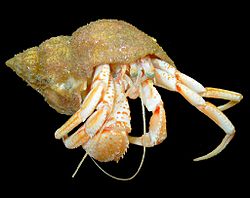
Pagurus bernhardus is the common marine hermit crab of Europe's Atlantic coasts. It is sometimes referred to as the common hermit crab or soldier crab. Its carapace reaches 3.5 centimetres (1.4 in) long,[2] and is found in both rocky and sandy areas, from the Arctic waters of Iceland, Svalbard and Russia as far south as southern Portugal, but its range does not extend as far as the Mediterranean Sea. It can be found in pools on the upper shore and at the mean tide level down to a depth of approximately 140 metres (460 ft), with smaller specimens generally found in rock pools around the middle shore and lower shore regions, with larger individuals at depth. P. bernhardus is an omnivorous detritivore[3][4] that opportunistically scavenges for carrion,[5] and which can also filter feed when necessary.[6]

Illustration by Augusta Foote Arnold.

Pagurus bernhardus uses shells of a number of gastropod species for protection, including Littorina littorea, Littorina obtusata, Nassarius reticulatus, Gibbula umbilicalis, Nucella lapillus and Buccinum.[7][8] In the warmer parts of its range, the sea anemone Calliactis parasitica is often found growing on the shell occupied by Pagurus bernhardus. In colder waters, this role is filled by Hormathia digitata. Hermit crabs fight one another for gastropod shells and have a preference for shells of certain species.[8]

References

[edit]
[edit]
Revisions and contributorsEdit on WikipediaRead on Wikipedia
from Grokipedia
Pagurus bernhardus, commonly known as the common or Bernhard's hermit crab, is a decapod in the family , characterized by its asymmetrical, soft, coiled that it protects by inhabiting empty gastropod shells such as those of Littorina spp. or . Adults typically reach a carapace length of up to 35 mm and exhibit a reddish-brown coloration, with males possessing larger right chelae featuring rows of large protrusions for shell manipulation and defense. This species plays a key ecological role as a and , contributing to nutrient cycling in marine benthic communities. Native to the northeastern , P. bernhardus ranges from the in the north to and the in the south, including the Azorean Islands, with a latitudinal extent from 72°N to 35°N and longitudinal span from 11°W to 36°E. It inhabits a variety of coastal and sublittoral substrata, including rocky, sandy, gravelly, and silty bottoms, as well as beds, from the down to depths of 500 m, though it is most abundant between 0 and 140 m on hard substrates. The species prefers full marine salinities of 32-33‰ but can tolerate down to 20-22‰, avoiding low-salinity estuaries. Ecologically, P. bernhardus is omnivorous, feeding on organic , , mollusks, crustaceans, and dead animal matter through scooping, filtering, and scavenging behaviors, processing up to 100-300 cm³ of per day. It forms loose nocturnal communities and engages in shell-fighting contests to acquire optimal gastropod shells, which are crucial for , growth, , and survival, as suboptimal shells increase predation risk from fish like and wolf-fish, , birds, and other crabs. Reproduction occurs year-round with peaks in January-February in shallow waters, where berried females carry 200-1,200 eggs for about 43 days at 8-10°C before larvae undergo four zoeal stages and a glaucothoe stage over roughly 60 days. Growth is influenced by shell availability and , with more frequent in warmer months, and the species exhibits behavioral plasticity, including distinct "personalities" in activity and boldness. Although not formally assessed by the IUCN, P. bernhardus faces indirect threats from disturbances like in fisheries, yet it remains abundant in European coastal ecosystems.

Taxonomy

Classification

Pagurus bernhardus is classified within the kingdom Animalia, phylum Arthropoda, subphylum Crustacea, class , order Decapoda, infraorder , family , genus Pagurus, and species bernhardus. This hierarchical placement positions it among the decapod crustaceans, a diverse group characterized by ten legs and a . As a member of the family, Pagurus bernhardus exemplifies the hermit crabs, which differ from true crabs in the infraorder Brachyura primarily through their asymmetrical abdomen and reliance on gastropod shells for abdominal protection rather than a fully calcified, symmetrical pleon tucked beneath the . This distinction highlights the adaptive morphology of pagurids, enabling shell occupancy as a protective strategy absent in brachyurans. Phylogenetically, the infraorder , to which Pagurus bernhardus belongs, represents a monophyletic group within Decapoda, with evolutionary adaptations for shell use evolving multiple times among its lineages, including independent transitions to asymmetrical forms that facilitate dextral shell habitation in paguroid hermit crabs. These adaptations underscore Anomura's morphological disparity, contrasting with the more uniform carcinization in Brachyura, and reflect parallel evolutionary paths toward protective exoskeletal strategies.

Nomenclature

Pagurus bernhardus was originally described by in 1758 as Cancer bernhardus in his , based on specimens from the Southern . The species has undergone several taxonomic reclassifications, reflecting changes in , and is now firmly placed within the genus Pagurus in the family . A number of synonyms have been proposed over time, many of which are junior subjective synonyms or superseded combinations. These include Bernhardus streblonyx Dana, 1852; Bernhardus typicus McLaughlin, 1974 (nomen nudum); Cancer bernhardus Linnaeus, 1758 (superseded combination); Eupagurus bernhardus (Linnaeus, 1758) (superseded combination); Pagurus araneiformis Fabricius, 1775; Pagurus bernhardus var. granulata Brandt, 1851; Pagurus eblanensis Kinahan, 1860; Pagurus streblonyx Leach, 1815; Pagurus ulidianus Bell, 1846; and Pagurus Ulidiae Thompson, 1844 (nomen nudum). Common names for Pagurus bernhardus vary by region and language, reflecting its widespread recognition in coastal communities. In English, it is known as the common , Bernhard's , soldier , or large ; in Dutch as gewone heremietkreeft; in French as Bernard-l'ermite commun; and in German as Gemeiner Einsiedlerkrebs or Bernhardskrebs.

Description

Morphology

Pagurus bernhardus exhibits an asymmetrical body typical of , consisting of a hard covered by a calcified and a soft, coiled, asymmetrical that is protected by a borrowed . The , which encases the , can reach a maximum of 3.5 cm and comprises three layers: the epicuticle, exocuticle, and endocuticle. The is uncalcified, soft, and spirally coiled to the right, allowing it to fit snugly within the shell for protection. The species possesses five pairs of thoracic appendages adapted for its lifestyle. The first pair functions as chelipeds, with the right cheliped being larger than the left, particularly in males, and featuring a bristly surface with tubercles on the convex propodus for manipulation and support. The second and third pairs serve as walking legs, enabling forward locomotion rather than the sideways movement seen in many other . The fourth and fifth pairs are reduced in size and act as struts to brace against the inner walls of the shell, aiding in stability and cleaning. Additional morphological features include stalked compound eyes positioned between the antennae for visual detection, and antennae equipped with aesthetascs that provide chemosensory capabilities for detecting environmental cues. Respiration occurs via gills located in the branchial cavity, ventilated by water currents generated through body and pleopod movements. On the abdomen, uropods function as hooks that anchor to the shell's , securing the crab within its shelter. Key adaptations for a shell-dwelling existence include the reduced of the , which enhances flexibility for coiling inside shells, and in females, hook-like pleopods on the left side of the used for brooding eggs. These features, such as the abdominal uropods and reduced pereiopods, facilitate rapid withdrawal into the shell for defense.

Coloration and size

Pagurus bernhardus exhibits a size range typical of larger species, with adults reaching a total body length of 8-10 cm including the occupied shell and a length of up to 3.5 cm. Juveniles are notably smaller, often with lengths under 1 cm. These dimensions reflect growth influenced by shell availability, with larger sizes correlating to access to appropriately sized gastropod shells. The of Pagurus bernhardus displays a reddish-brown to orange-red coloration on the dorsal surface, transitioning to a paler underside, which enhances against rocky and sandy substrates. Juveniles initially exhibit a green-brown hue, shifting to the more vibrant red-yellow tones in adults once the exceeds 20 mm in length. The chelipeds contribute to the species' overall cryptic patterning that reduces visibility to predators in intertidal environments. Adult Pagurus bernhardus preferentially occupy shells of the whelk for protection, as these provide optimal space and durability; juveniles, in contrast, utilize smaller shells such as those of periwinkle snails (Littorina spp.) or moon snails (). Shell selection directly impacts growth rates and predation vulnerability, with suboptimal shells limiting expansion and increasing exposure risks. Sexual dimorphism in Pagurus bernhardus is pronounced, particularly in the chelipeds, where males possess a larger right cheliped that can reach up to twice the body width, adapted for agonistic displays and resource competition. Females exhibit a broader to accommodate brooding, though overall body size remains similar between sexes. This dimorphism underscores the role of chelipeds in male-male interactions, as noted in broader morphological studies.

Distribution and habitat

Geographic range

Pagurus bernhardus is primarily distributed across the Northeast , extending from the in at approximately 72°N in the north to at around 35°N in the south, with additional occurrences in the and along the coasts of the Islands. The species is absent from the and the , reflecting its strict Atlantic affinity. Historical records include the lectotype collected from the Southern North Sea, underscoring its long-documented presence in northwestern European waters. Population densities vary regionally, with the species being particularly abundant in the coastal waters of the , , , and , where it can reach mean densities of up to 10 individuals per square meter in suitable areas. In contrast, it is rarer in the deeper extensions of the , with lower abundances reported compared to its northern Atlantic strongholds. Migration patterns in P. bernhardus are limited, with juveniles dispersing via planktonic larvae to facilitate range occupancy, while adults remain largely sedentary within established home ranges. This distribution overlaps with benthic habitats from s to depths of up to 500 meters.

Environmental preferences

Pagurus bernhardus inhabits a range of depths from the to approximately 140–200 m, with smaller juveniles predominantly occupying shallow rocky pools at 0–50 m and larger adults favoring subtidal sandy or silty sediments. This distribution reflects ontogenetic shifts, where early life stages seek protected, wave-sheltered microhabitats to minimize predation and risks, while adults exploit deeper, more stable environments. The species prefers diverse substrata including rocky shores, shell gravel, firm sands, and silty sediments, often among () beds, but avoids soft mud which impedes mobility and burrowing. These preferences support , access, and shell stability, with higher densities observed on heterogeneous bottoms like shingle or where spaces provide refuge. As a temperate marine species, Pagurus bernhardus thrives in waters with salinities of 20–35‰, preferring full marine conditions around 32–33‰, and temperatures between 5–20°C, demonstrating tolerance to brackish conditions near estuaries (down to approximately 20‰) by retreating into shells during osmotic stress. Such adaptability allows persistence in fluctuating coastal environments, though optimal larval development occurs at 30–35‰ and 8–12°C. Availability of empty gastropod shells, such as those from Littorina or Buccinum species, is a critical , with dense populations correlating to abundant shell resources that facilitate growth, molting, and predator avoidance. Shell scarcity in certain habitats can constrain local abundance, emphasizing the role of gastropod co-occurrence in supporting .

Life history

Reproduction

Pagurus bernhardus exhibits a polygynandrous , in which both males and females mate with multiple partners during the reproductive period. involves prolonged precopulatory mate guarding, where males grasp and carry receptive females by their shells for several hours or even days, followed by a ritual of mutual tapping with chelipeds. Copulation itself is brief, typically lasting 4-6 minutes outside the shells, after which the pair remains together for up to 10 minutes. This behavior is not tied to molting cycles and relies on tactile and chemical cues for partner recognition. Reproduction in P. bernhardus is seasonal in shallow, littoral populations, occurring primarily from November to May and peaking in January-February, while deeper-water populations breed year-round. The timing is triggered by low water temperatures (8-12°C) and short photoperiods, as well as the availability of suitable gastropod shells, which are essential for protecting developing eggs. Females typically mate once per reproductive cycle, releasing any mature eggs prior to copulation and extruding a new clutch shortly thereafter. Fecundity varies with female size, but smaller individuals (shield length ~3 mm) produce clutches of 200-300 deep black eggs, which are fertilized internally and attached to the female's pleopods for brooding. These eggs, initially ~0.5 mm in diameter, develop through seven stages over approximately 43 days at 8-10°C before . The eggs possess natural properties that help protect against bacterial infections during brooding.

Development and lifespan

The development of Pagurus bernhardus begins with , during which brooding females carry fertilized eggs attached to their pleopods for approximately 43 days (ranging from 36 to 51 days) at temperatures of 8–10°C until . This period encompasses seven embryonic stages, with the duration influenced by environmental conditions such as and oxygenation levels. Hatching produces planktonic zoeal larvae that undergo four sequential zoeal stages over a total of 39–47 days at 10°C and salinities of 30–35‰, during which they are dispersive and feed primarily on and small . Larval dispersal occurs over 1-10 km, with settlement typically from March to June. These stages are characterized by shrimp-like morphology, including a prominent rostral spine, and increasing body size with each molt. The zoeal phase is succeeded by the glaucothoe (megalopal) stage, lasting 13–17 days, in which the larva transitions to a benthic , actively settling on substrates and seeking an initial for protection during to the juvenile form. Post-metamorphosis, juveniles exhibit rapid growth through frequent molts, often changing shells multiple times as their soft expands, with growth increments varying by individual size, sex, and shell adequacy. is typically attained at about 1 year of age. After maturity, growth rates slow, and molting frequency reduces to 1–2 times per year, primarily in spring and summer. In the wild, P. bernhardus has a lifespan of 4-10 years, significantly influenced by shell quality, which affects molting success and vulnerability to predation. Suboptimal shells can lead to suppressed growth, increased mortality during , and overall reduced survival.

Behavior

Foraging and diet

Pagurus bernhardus functions as an omnivorous and within its intertidal and subtidal habitats, primarily consuming dead , small , and to fulfill its nutritional needs. This flexible trophic role enables the species to exploit a wide range of resources, contributing to the of organic material and nutrient recycling in marine ecosystems. The diet of P. bernhardus is diverse and opportunistic, incorporating mollusks such as bivalves and gastropods, polychaete worms, small crustaceans, diatoms, , plant detritus, and microbes. Stomach content analyses indicate that crustaceans, polychaetes, and mollusks form significant portions of the ingested material, with the exact composition varying based on local availability following environmental disturbances like . During periods of scarcity, individuals may resort to opportunistic , consuming conspecifics to supplement their intake. Foraging in P. bernhardus typically occurs during diurnal periods of heightened activity, allowing the crabs to explore sediments and empty shells in search of carrion and while minimizing predation risk. The employs its chelipeds to tear apart larger food items and scoop from the substrate, combining deposit-feeding with occasional filter-feeding to capture suspended particles like . Foraging efficiency is notably influenced by shell weight; heavier shells reduce mobility and limit the distance crabs can travel to locate food, thereby constraining overall feeding rates. Nutritional adaptations in P. bernhardus include the production of gut enzymes capable of breaking down complex substrates such as from exoskeletons and from material, facilitating efficient of its varied diet.

Social interactions

Pagurus bernhardus exhibits primarily diurnal activity patterns, with peak and movement occurring during daylight hours, often synchronized with tidal cycles to access intertidal zones. During the day, individuals actively explore their environment, while at night they tend to retreat into shells or crevices for protection, reducing exposure to visual predators. This rhythm is influenced by environmental factors such as light intensity and substrate type, with studies showing higher activity in natural daylight compared to nocturnal periods. Individuals form loose, non-hierarchical aggregations rather than structured colonies, often clustering around resource-rich areas such as sources or shell middens where empty gastropod shells accumulate. These groupings are mediated by shell quality, with crabs in optimal shells preferring proximity to a single conspecific under ambient conditions, potentially facilitating shell exchanges. Aggregations provide benefits like diluted predation risk through collective vigilance, though they also heighten competition for limited resources. Exposure to anthropogenic noise, such as ship sounds, can disrupt these preferences, leading to altered grouping decisions independent of shell fit. Aggression in P. bernhardus primarily manifests during shell contests, where dominant individuals, often larger males, initiate fights to evict occupants from desirable shells using their chelipeds for rapid, repeated on the defender's shell. These interactions are ritualized, involving displays like cheliped to assess opponents and minimize injury, with vigor of signaling stamina and resource-holding potential. Successful attackers persist longer in bouts, leading to higher rates, while defenders may signal submission to end contests. Tactile communication, including antennal tapping, and chemical cues released during agonistic encounters further modulate these interactions. Territoriality is limited, with no defense of fixed burrows; instead, crabs maintain a flexible personal space around their occupied shell, particularly to the front, and exhibit dominance hierarchies in high-density areas. Home ranges are nomadic, reflected in monthly displacements averaging 150 m, varying seasonally from about 148 m in winter to 174 m in summer, allowing exploration across intertidal habitats without strict boundaries. This mobility supports loose community formation while enabling resource defense through aggressive displays rather than spatial exclusivity.

Ecology

Predators and threats

Pagurus bernhardus faces predation from a variety of marine organisms, including such as cod (Gadus morhua), haddock (Melanogrammus aeglefinus), whiting (Merlangius merlangus), witch flounder (Hippoglossoides platessoides), Atlantic wolffish (Anarhichas lupus), and grey gurnard (Eutrigla gurnardus), as well as (Labrus bergylta). Other predators include sharks and rays like the (Raja clavata), brachyuran crabs such as the shore crab () and species in the genus Cancer, octopuses, , and sea birds like that attack stranded individuals by dropping them to crack their shells. These crabs are particularly vulnerable to predation during molting, when the new requires at least four days to harden, impairing their ability to fight, feed, or locomote effectively, and during shell evacuations when they temporarily lack full protection. To mitigate predation risks, Pagurus bernhardus employs several behavioral strategies, including rapid withdrawal into its shell via abdominal contraction upon detecting danger, which provides a primary refuge for its soft . The species also adjusts its coloration, reducing crypticity under high predation threat to become more conspicuous and thus more likely to be seen and avoided by predators. Additionally, the enlarged right cheliped serves as a defensive "shield" against predators, with males exhibiting larger chelipeds that enhance their ability to ward off attacks compared to females. While primarily diurnal, these may drop from surfaces in response to shadows or sudden movements to evade detection. Anthropogenic activities pose significant threats to Pagurus bernhardus populations, including direct exploitation as after shell removal, which can lead to local depletions in heavily fished coastal areas. Bottom trawling and beam trawling disturb benthic habitats, damaging shell resources essential for protection and altering feeding patterns, thereby increasing vulnerability to predators. Pollution from , such as , accumulates in coastal sediments and is readily taken up by the crabs, disrupting social behaviors, reproduction, and decision-making processes that affect larval viability. Additionally, microplastic impairs shell assessment and selection, leading to suboptimal choices that heighten vulnerability. Climate change exacerbates these pressures on Pagurus bernhardus, with warming waters projected to facilitate northward range shifts, potentially allowing expansion beyond current northern limits in regions like . , through reduced , impairs shell assessment and selection behaviors, leading to suboptimal shell choices that compromise and increase predation risk, while also affecting overall resource decision-making.

Symbiotic relationships

Pagurus bernhardus engages in several symbiotic relationships that enhance its survival and contribute to benthic community dynamics. A prominent mutualism occurs with the Calliactis parasitica, which attaches to the crab's occupied . The anemone's nematocysts deter predators such as and other crustaceans, providing protection to the crab, while the mobile host transports the anemone to richer feeding grounds and shares dislodged food particles. This association is facultative, with crabs actively carrying anemones but capable of surviving without them. Other epibionts colonize the shells, including the hydrozoan Hydractinia echinata, which encrusts the shell interior and exterior, potentially offering chemical defenses against invaders through its stinging cells. and acorn ( spp.) grow on the shell surface, aiding against visual predators in subtidal habitats, though their added weight can reduce the crab's agility and increase energy expenditure during locomotion. worms and protozoans also serve as epibionts, utilizing the shell as a stable substrate without apparent harm to the host. Commensal interactions involve shell-sharing with small invertebrates that benefit from the protected habitat. Amphipods such as Gammaropsis nitida and Stenula latipes inhabit the shell, feeding on and while occasionally grooming the crab, removing parasites or fouling organisms in a quasi-cleaning role. Certain polychaetes, including syllids, attach epibiotically, deriving shelter and mobility without significantly impacting the crab. Parasitic commensals like rhizocephalan (Peltogaster paguri) occur at low prevalence (around 1-2%), occasionally inducing castration in male hosts but rarely affecting population levels. In its ecological role, P. bernhardus functions as a , scavenging and to facilitate in soft-sediment ecosystems. The planktonic zoea larvae integrate into the pelagic as prey for invertebrate predators like chaetognaths and copepods, supporting higher trophic levels. By preferentially occupying and transporting gastropod shells, the crabs maintain shell availability for conspecifics and other pagurids, acting as ecosystem engineers that promote epifaunal diversity on otherwise unstructured seabeds. Broader human interactions with P. bernhardus are minimal and non-detrimental. The poses no significant pest concerns in marine environments. It serves educational value in public aquaria, where its shell-changing behavior demonstrates , and is occasionally harvested as bait for fisheries targeting bass and , though this does not notably deplete populations due to its abundance.

References

Add your contribution
Related Hubs
User Avatar
No comments yet.