Hubbry Logo
Pickled herringPickled herringMain
Open search
Pickled herring
Community hub
Pickled herring
logo
8 pages, 0 posts
0 subscribers
Be the first to start a discussion here.
Pickled herring
Pickled herring
from Wikipedia
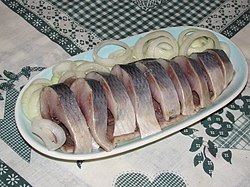
Pickled herring with onions

Pickled herring is a traditional way of preserving herring as food by pickling or curing.

Most cured herring uses a two-step curing process: it is first cured with salt to extract water; then the salt is removed and the herring is brined in a vinegar, salt, and sugar solution, often with peppercorn, bay leaves, raw onions, and so on. Additional flavourings include sherry, mustard and dill, while other non-traditional ingredients have also begun being included in recent years.

Pickled herring remains a popular food or ingredient to dishes in many parts of Europe including Scandinavia, Great Britain, the Baltic, Eastern and Central Europe, as well as the Netherlands. It is also popular in parts of Canada such as British Columbia, Newfoundland, and the Maritimes. It is also associated with Ashkenazi Jewish cuisine, becoming a staple at kiddushes and social gatherings. Pickled herring is one of the twelve dishes traditionally served at Christmas Eve in Russia, Poland, Lithuania, and Ukraine. Pickled herring is also eaten at the stroke of midnight on New Year's Eve to symbolize a prosperous New Year in Poland, the Czech Republic, Germany, and parts of Scandinavia.[1] Pickled herring with tahini is a popular dish in Egypt usually eaten in the spring holiday of Sham Ennessim.[2][3]

History

[edit]

Pickled herrings have been a staple in Northern Europe since medieval times, being a way to store and transport fish, especially necessary in meatless periods like Lent. The herrings would be prepared, then packed in barrels for storage or transportation. In 1801 Dutch fishermen amongst the prisoners of war in the Norman Cross Prison were sent to Scotland to teach the Scottish herring fishermen how to cure fish using the Dutch method.[4]

Geographic distribution

[edit]
Pickled herring with sour cream, chives, potatoes and egg
A German Fischbrötchen, consisting of pickled herring served in a roll with lettuce and onion

In the Nordic countries, once the pickling process is finished and depending on which of the dozens of herring flavourings (mustard, onion, garlic, lingonberries etc.) are selected, it is eaten with dark rye bread, crisp bread, sour cream, or potatoes. This dish is common at Christmas, Easter, and Midsummer, where it is frequently accompanied by spirits like akvavit.

Soused herring (maatjesharing or just maatjes in Dutch) is an especially mild salt herring, which is made from young, immature herrings. The herrings are ripened for a couple of days in oak barrels in a salty solution, or brine. In English, a "soused herring" can also be a cooked marinated herring.[5]

Rollmops are pickled herring fillets rolled (hence the name) into a cylindrical shape around a piece of pickled gherkin or an onion. They are thought to have developed as a special treat in 19th century Berlin,[6] and the word borrowed from the German.

Fish cured through pickling or salting have long been consumed in the British Isles. Like jellied eel, it was primarily eaten by, and is sometimes associated with, the working class. Kipper is a dish eaten in Great Britain, Ireland, and parts of Canada. It consists of a split open herring, pickled or salted, and cold-smoked.

Red herring is similar to kippers but is whole and ungutted; it is more heavily salted and is smoked for 2–3 weeks.[7] The main UK export markets are Europe and West Africa.[8]

Pickled herring, especially brined herring, is common in Russia and Ukraine, where it is served cut into pieces and seasoned with sunflower oil and onions, or can be part of herring salads, such as dressed herring (Russian: Сельдь под шубой, Ukrainian: Оселедець під шубою, lit. 'herring under a fur coat'), which are usually prepared with vegetables and seasoned with mayonnaise dressing.

Brined herring is common in Ashkenazi Jewish cuisine, perhaps best known for vorschmack salad known in English simply as "chopped herring" and as schmaltz herring in Yiddish. In Israel it is commonly known as dag maluach which means "salted fish".

Pickled herring can also be found in the cuisine of Hokkaidō in Japan, where families traditionally preserved large quantities for winter.

In Nova Scotia, Canada, pickled herring with onions is called "Solomon Gundy" (not to be confused with the Jamaican pickled fish pâté of the same name).

"Bismarck herring" (German Bismarckhering) is the common name for pickled herring in Germany, and the product is sometimes sold elsewhere under that name. There are various theories as to why the product is associated with Bismarck.

Nutritional content

[edit]

Pickled herring is rich in tyramine and thus should be avoided in the diet of people being treated with an antidepressant monoamine oxidase inhibitor.[9]

As with fresh herring, pickled herring is an excellent natural source of both vitamin D3 and omega-3 fatty acids.[10][11] It is also a good source of selenium and vitamin B12. 100 grams may provide 680 IU of vitamin D, or 170% of the DV, as well as 84% of the DV for selenium, and 71% of the DV for vitamin B12.[12][13]

See also

[edit]

Citations

[edit]
  1. ^ "Lucky Foods for the New Year". Smithsonian.com. Retrieved 2019-10-18.
  2. ^ "Pickled Herring". 21 April 2014.
  3. ^ "Egyptians celebrate Sham El-Nessim in parks with pickled fish - Politics - Egypt".
  4. ^ "Extract of a letter". Aberdeen Press and Journal. 4 August 1802. p. 3.
  5. ^ Slater, Nigel (2011-04-09). "Classic Soused mackerel". The Guardian. Retrieved 10 April 2011.
  6. ^ Erich Urban, Das Alphabet der Küche, Berlin 1929, Artikel Rollmops, S. 201
  7. ^ "The Herring".
  8. ^ "Red Herring". 11 February 2019.
  9. ^ Brown, Candace S.; Bryant, Stephen G. (March 1988). "Monoamine Oxidase Inhibitors: Safety and Efficacy Issues". Drug Intelligence & Clinical Pharmacy. 22 (3): 232–235. doi:10.1177/106002808802200311. ISSN 0012-6578. PMID 3284731. S2CID 10898067.
  10. ^ Holub, B. J. (2002). "Clinical nutrition: 4. Omega-3 fatty acids in cardiovascular care". Canadian Medical Association Journal. 166 (5): 608–615. PMC 99405. PMID 11898942.
  11. ^ Aro, T. L.; Larmo, P. S.; Bäckman, C. H.; Kallio, H. P.; Tahvonen, R. L. (2005). "Fatty acids and fat-soluble vitamins in salted herring (Clupea harengus) products". Journal of Agricultural and Food Chemistry. 53 (5): 1482–88. Bibcode:2005JAFC...53.1482A. doi:10.1021/jf0401221. PMID 15740028.
  12. ^ "Fish, herring, Atlantic, pickled Nutrition Facts & Calories". Retrieved 23 March 2017.
  13. ^ "Foods highest in Vitamin D". Retrieved 23 March 2017.

General and cited references

[edit]
Revisions and contributorsEdit on WikipediaRead on Wikipedia
from Grokipedia
Pickled herring is a traditional preserved fish dish made from herring (Clupea harengus), a small oily fish typically measuring 8 to 10 inches in length, which is cured in a brine solution of salt, vinegar, sugar, and various spices to create a tangy, sweet-sour flavor profile that extends its shelf life without refrigeration. This preparation method transforms the fresh fish into a versatile delicacy, often served cold as fillets or whole, and is renowned for its nutritional value, including high levels of protein and omega-3 fatty acids. The history of pickled herring dates back to medieval times in Northern Europe, where abundant herring stocks along the North Atlantic coasts necessitated preservation techniques to store the seasonal catch for year-round consumption and trade. Archaeological evidence, such as herring bones in Scandinavian Neolithic burial mounds, indicates its dietary role for centuries, while innovations like Dutch "gibbing"—a 14th-century technique removing the gills and guts while retaining flavor-enhancing organs—revolutionized the industry during the Golden Age, fueling economic powers like the Hanseatic League. By the 15th century, salted and pickled forms reached Ashkenazi Jewish communities via Dutch exports, becoming a staple for Eastern European Jews who peddled it door-to-door. Culturally, pickled herring holds profound significance across and beyond, symbolizing abundance and good fortune in traditions like Swedish midsummer feasts, Dutch Vlaggetjesdag celebrations, and German Baltic festivals, where it underscores regional identities tied to fishing heritage. In , it features prominently in and holidays, often prepared as chopped salads or layered dishes, preserving culinary customs amid historical migrations. Despite modern challenges like , it remains a vital resource for small-scale fisheries and a testament to sustainable practices in coastal communities. Preparation varies by region but generally involves cleaning and filleting fresh , soaking in a for about an hour to firm the flesh, then marinating in a spiced solution with ingredients like mustard seeds, bay leaves, , onions, and for 2 to 4 days to develop flavors. Common variations include Scandinavian mustard- or curry-flavored types, Dutch Hollandse Nieuwe with at least 16% fat content, and German Bismarckhering in sweet-sour , often accompanied by boiled potatoes, , or .

Overview

Definition and Characteristics

Pickled herring is a preserved product derived from the Atlantic herring (Clupea harengus), a small, abundant in the and , where the fish is first salted to draw out moisture and then immersed in a - or brine-based solution to extend and develop a distinctive tangy flavor. This method leverages the fish's natural high content of polyunsaturated fatty acids, which are susceptible to oxidation, by creating an environment that stabilizes the product for months or longer. Physically, pickled herring exhibits firm yet tender white to pinkish flesh, with a smooth, flaky texture that results from the tenderizing effects of and salt, often retaining a cylindrical form due to traditional packing in barrels. The skin, if left intact, maintains a silvery sheen, while the overall appearance shifts from the translucent quality of fresh to an opaque state post-pickling. The flavor profile is characterized by a sharp tanginess from acetic and pronounced saltiness, complemented by subtle fishy undertones. The preservation science behind pickled herring involves reducing pH to 3.7–4.2 using (providing acetic acid) or from controlled , alongside salt, which collectively inhibit spoilage bacteria like Listeria monocytogenes by disrupting cellular processes and establishing anaerobic conditions that limit microbial proliferation and lipid oxidation. Sensorially, this yields a vinegary aroma with mild fishy notes, and a that balances crispness from the firm structure with tenderness from acid penetration.

Types and Variations

Pickled herring exhibits a wide range of types and variations influenced by regional traditions and preparation styles, primarily categorized by their form, medium, and flavor profiles. Major types include inlagd sill, a Swedish staple featuring fillets marinated in a sweet-sour with onions, carrots, , and bay leaves, resulting in a tangy, aromatic profile. Another prominent variety is , common in , where fresh is lightly soaked in a mild or solution, often with minimal spices, yielding a subtler, fresher taste compared to more intensely pickled forms. The German rollmops consists of deboned fillets rolled around fillings like onions, gherkins, or olives and secured with toothpicks before in a -based solution, creating a compact, savory with a crisp texture from the embedded . Variations in pickling media further diversify the product, with vinegar-based methods producing an acidic, clear that imparts a sharp, bright tang, as seen in many European recipes using white or spirit diluted with water and sweetened for balance. In contrast, salt-brine fermented approaches rely on a milder, cloudy solution where salt draws out moisture and encourages , resulting in a softer, more nuanced flavor without the overt acidity of . Regional subtypes highlight this diversity; Dutch zure haring involves lightly pickled raw in a sour , emphasizing the fish's natural freshness with subtle onion accents. Flavor and texture differences among these variations range from sweet-sour profiles enhanced by , , and sugar for a balanced, aromatic bite, to spicy iterations coated in for added heat and creaminess, or plain salted versions that preserve the herring's briny essence with minimal additives. These distinctions allow pickled herring to adapt to diverse palates while maintaining its core role as a preserved .

Preparation

Ingredients

The primary ingredient in pickled herring is fresh , typically from the Atlantic herring species (Clupea harengus) or , selected for its size of approximately 20-30 cm and higher fat content during seasonal catches, which contributes elevated levels of omega-3 fatty acids. These fish are chosen for their oily texture, which enhances the final product's richness after preservation. Core preservatives include salt, used in curing brines at concentrations of 10-20% to draw out moisture and inhibit , and , typically a 5-10% acetic acid solution that acidifies the mixture to a below 4.6 for safe preservation. Salt is often applied in a saturated brine ratio of one part salt to 3.5 parts prior to acidification, while serves as the primary acidulant in the solution. Flavor enhancers commonly added are onions for sharpness, dill for herbal notes, and mustard seeds for warmth, and bay leaves for subtle aroma, with incorporated in sweet varieties to balance acidity. These elements infuse the during immersion, contributing to its characteristic tangy and aromatic profile. Optional additives include water to form the base, as an alternative acidulant to in some formulations, or wine in sousing variants for a milder, fermented tang.

Pickling Process

The pickling process for typically begins with the initial preparation of fresh . To ensure safety, freeze the at -20°C (-4°F) for at least 7 days or at -35°C (-31°F) for 15 hours before processing to kill parasites. Gutting involves removing the viscera immediately after catch to prevent enzymatic degradation, followed by thorough cleaning under cold running water to remove blood, scales, and debris. The are then filleted by splitting along the backbone, removing the head, tail, and fins, resulting in boneless or semi-boneless pieces suitable for packing. This step ensures and facilitates even curing. Following cleaning, the fillets undergo dry-salting to firm the flesh and extract excess moisture via , a process where salt draws out of the tissue, concentrating proteins and inhibiting . Approximately 20-35 pounds of salt per 100 pounds of are layered alternately with the fillets in a , allowing the mixture to at cool temperatures (around 4-10°C) for 24-48 hours, depending on size and fat content; fatter require more salt to achieve proper . After salting, the fillets are rinsed to remove surface salt and often soaked in or weak (1 cup salt per gallon of ) for 1-12 hours to partially desalt and rehydrate slightly, preparing them for the next phase. The brining phase involves submerging the prepared fillets in a vinegar-salt solution to achieve a low pH (typically 3.5-4.0) for microbial safety, as acidity below 4.6 prevents the growth of pathogens like . The is prepared by dissolving (about 2.5 cups per gallon of ) and adding distilled white (5% acetic acid) in ratios such as 2 parts to 1 part , often with for balance; the mixture is heated to dissolve components, cooled, and poured over the in crocks or jars. Fillets are fully immersed and refrigerated at for 3-7 days, allowing acid penetration to denature proteins and preserve texture. Once d, the fish enter the packing and maturation stage, where fillets are layered with spices (e.g., , mustard seeds, bay leaves, peppercorns, and sliced onions) in barrels, glass jars, or crocks to infuse flavors. The assembly is covered with additional or fresh solution, sealed, and aged at 4-10°C for 1-4 weeks to allow enzymatic breakdown and flavor development, resulting in a tender yet firm texture. Home methods emphasize cold without heat to retain delicate flavors, while both home and commercial products require constant for safety and quality.

History

Origins and Development

The origins of pickled herring trace back to early preservation techniques developed in to combat the rapid spoilage of the abundant yet perishable ( harengus) in the and Baltic regions. Archaeological evidence from DNA analysis of bones at trading sites, such as Truso in modern-day , indicates that large-scale trade began around 800 CE, some 400 years earlier than previously thought. This trade relied on curing methods like salting or smoking to enable long-distance transport and storage, essential for Viking voyages and settlements across the Baltic and beyond. The fatty nature of necessitated such preservation to prevent rancidity, supporting economic exchanges where served as a staple protein source in regions with limited alternative fisheries. While salting dominated early methods, vinegar-based pickling, combining brine with spiced vinegar, sugar, and aromatics like onions and dill, developed in medieval to create the tangy profiles associated with modern pickled herring. Medieval advancements in the revolutionized preservation, particularly in the , where the became a cornerstone of economic power. In the late , Dutch fishermen, building on earlier techniques from in , developed the practice of gibbing at , traditionally credited to Beukelszoon of Biervliet around 1380, which involved gutting the fish immediately after capture, removing the gills and most internal organs, and packing it in salt to draw out remaining fluids and inhibit . This method extended dramatically compared to whole salting, allowing Dutch vessels to process catches at and enabling mass exports to famine-prone areas in . The innovation spurred the construction of specialized busses—large, stable ships designed for extended fishing trips—and transformed the Dutch industry into a dominant force, generating significant wealth through trade with the and beyond. Subsequent technological milestones further propelled the global spread of preserved herring. In the , improvements in barrel construction and packing techniques, using watertight oak barrels filled with alternating layers of salted and brine, facilitated reliable long-distance exports from ports to markets across and the Atlantic. This era saw Dutch herring fleets exporting hundreds of thousands of barrels annually, underpinning colonial trade routes. These developments were driven by the economic imperatives of fisheries, where shoals provided seasonal abundance but demanded effective preservation to sustain year-round trade and for coastal communities.

Geographic Distribution

Pickled herring production is primarily concentrated in , with core hubs in (including , , and ), the , and , where the fish is sourced mainly from the North Atlantic and stocks. The stands out as a historical and ongoing center, leveraging its coastal access and preservation techniques to process into pickled forms for domestic and international markets. Key processing occurs in these regions, supported by the European Union's management of fisheries, with the total allowable catch (TAC) for Atlanto-Scandian set at 401,794 tonnes for 2025 across coastal states including the EU, , and others. Trade in pickled herring expanded significantly from the 16th to 18th centuries through Baltic and routes dominated by Dutch exporters, who supplied preserved herring to , , and Baltic ports via the Hanseatic League's networks, enabling widespread distribution across . This commerce built on Dutch innovations in gutting and salting, which extended and fueled . In contemporary trade, European producers continue exporting to global markets, including the and , with prepared shipments from countries like reaching nearly 7,800 metric tons in recent years, reflecting sustained demand in diverse regions. Regional adaptations highlight the dish's versatility, particularly in where features matjasy—mild, young pickled herring fillets marinated lightly for a tender texture, often served as a staple in traditional meals. This variation echoes Dutch matjes but incorporates local flavors, remaining a dietary mainstay during periods and holidays. In the , communities from have adapted pickled herring into deli staples, preserving recipes like cream herring or forshmak to maintain cultural ties in urban centers such as New York. Current herring stocks in the North Atlantic face pressures from historical , leading to fluctuations in wild populations and prompting enhanced sustainable practices in production leaders like and . International agreements, such as those setting 2025 TACs and allocating quotas (e.g., receiving 64.2% of certain shares), aim to rebuild stocks through regulated catches and monitoring by bodies like the International Council for the Exploration of the Sea (ICES). While herring aquaculture is not widespread due to the species' migratory nature, focus remains on wild to prevent further declines and support long-term supply for pickled products.

Cultural and Culinary Role

Traditional Uses

Pickled herring has long been a staple in Nordic cuisines, particularly as a central element of the smorgasbord in , where it features prominently during celebrations alongside new potatoes and . In the , soused or lightly pickled herring is consumed in the traditional haringhappen street-eating custom, often held by the tail and eaten raw with onions during festivals like Vlaggetjesdag in . These practices highlight its role as an accessible, preserved integral to communal meals and seasonal rituals in fishing-dependent regions. In festive contexts, pickled carries auspicious connotations, especially in , where it is eaten at on —known as Glückshering—to invoke good fortune and abundance for the coming year, symbolizing the fish's silvery scales as . In Scandinavian coastal communities, has historically symbolized abundance and economic survival, with communal preparation reinforcing social bonds during peak seasons. Traditionally, pickled herring is paired with , boiled potatoes, and to balance its tangy flavor, as seen in Swedish smorgasbord spreads. In kosher-observant Jewish contexts, it adheres to rules allowing fish with dairy accompaniments like .

Modern Consumption and Serving

In contemporary , pickled herring is commonly served in salads incorporating ingredients like apples, beets, and for a balanced sweet-tangy flavor profile, often as a starter or light meal. It is also enjoyed on crackers or , paired with cheeses or mustard sauces, and available in ready-to-eat jars for convenient snacking. Typical portion sizes range from 100 to 200 grams per serving, providing a quick protein-rich option. Modern adaptations reflect global influences, with fusion dishes such as Jamaican-style pickled herring featuring spicy vegetables and served with avocado, or Scandinavian-inspired canapés combining it with goat cheese and green apples. In plant-based innovations, vegan alternatives mimic the texture and brininess using eggplant or mushrooms marinated in vinegar, nori for umami, and accompanied by beets or gherkins to replicate traditional salads. These adaptations cater to diverse dietary preferences while maintaining the dish's acidic essence. Market trends show pickled herring widely available in through vacuum-sealed packs and jars, supporting its growth as a convenient product. The global pickled herring market is projected to expand from USD 3.9 billion in 2025 to USD 5.6 billion by 2035, at a CAGR of 3.6%, driven by demand in and . Annual per capita consumption varies regionally, with at approximately 430 grams of herring (much of it pickled) and at 2.8 kilograms, highlighting its staple status in Northern European diets. Health-conscious consumers increasingly opt for low-sodium versions, such as those reduced by up to 90% through adjusted processes, to mitigate risks associated with high salt intake. These variants are often paired with greens like potatoes or salads to create balanced, nutrient-dense meals that emphasize omega-3 benefits without excess sodium.

Nutritional Content

Composition

Pickled herring's macronutrient profile per 100 g serving provides approximately 262 kcal of energy, with 14.2 g of protein, 18.2 g of total fat—including about 1.5 g of omega-3 fatty acids such as 0.9 g EPA and 0.6 g DHA—and 9.6 g of carbohydrates, though unsweetened varieties often contain less than 1 g of carbohydrates. The salting involved in preparation elevates sodium levels to 800-1200 mg per 100 g. Key micronutrients in pickled herring per 100 g include at around 2.8 µg (112 IU), at 4.3 µg, and at 59 µg, contributing to daily requirements for these nutrients. The process alters the composition by incorporating acetic acid at 1-2% concentration in the , which helps preserve the fish alongside salt. Commercial products may also contain preservatives like to extend and maintain quality. Fat content exhibits variability based on seasonal factors, with summer herring reaching up to 20% fat compared to about 10% in winter-caught specimens, influencing the overall nutritional density.

Health Benefits and Considerations

Pickled herring offers several health benefits primarily derived from its nutrient profile, including omega-3 fatty acids, , and protein. The omega-3 fatty acids, such as EPA and DHA, in pickled herring support cardiovascular health by reducing and lowering triglyceride levels, with studies on fish consumption indicating reductions of 20-30% in triglycerides among regular consumers. content aids bone health by promoting calcium absorption and maintaining . Additionally, the high-quality protein in a typical 3-ounce serving—around 12 grams—contributes to muscle maintenance and repair, supporting overall physical function and recovery. However, there are important considerations for consumption. Pickled herring is high in sodium due to the process, which can elevate and increase risk; experts recommend limiting intake to 1-2 servings per day to mitigate this. Poorly processed pickled herring may contain elevated levels from bacterial activity, potentially triggering allergy-like symptoms such as , , or in sensitive individuals. Research highlights positive associations between regular pickled herring intake and reduced health risks. Cohort studies from Nordic populations in the 2010s, including those adhering to diets rich in fatty fish like herring, linked higher consumption to a 14% lower risk, attributed to omega-3 anti-inflammatory effects. Mercury levels in herring remain low, typically under 0.1 ppm (with a mean of 0.078 ppm), posing minimal contamination concerns compared to larger . Dietary guidelines position pickled herring as a suitable component of Mediterranean-style diets, where fatty intake twice weekly supports heart health, though moderation is advised for those with due to its moderate-to-high content, which can exacerbate uric acid buildup.

References

Add your contribution
Related Hubs
User Avatar
No comments yet.