


Community hub
Recent from talks
Contribute something
Nothing was collected or created yet.
Piyaz
View on Wikipedia | |
| Type | Salad |
|---|---|
| Place of origin | Iraq, Iran, Turkey |
| Main ingredients | Boiled beans, vegetables |

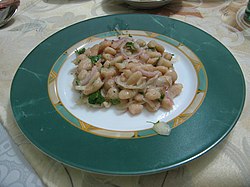
Piyaz (Turkish: piyaz, Persian: پیاز, Kurdish: pivaz, piyaz[1] for "onion" or salad) is a bean salad or meze in Turkish cuisine and Persian cuisine that is made from any kind of boiled beans with raw onion, parsley and sumac. Optionally, a boiled egg can be added to this dish.
The name of "piyaz" derives from old Iranian word of "pidāz" for onion,[2] later on this name was adopted for salads or mezes made with onion.
In Antalya province of Turkey it is prepared differently from other regions with other ingredients such as tarator sauce based on tahini (crushed sesame seeds). In Antalya, piyaz is not considered a salad but a main dish.[3]
There are also versions of piyaz made of other beans. Mung beans piyaz (maş piyazı) is famous in Gaziantep and, like Antalya piyaz, is registered with the Turkish Patent and Trademark Office. It is made by combining boiled mung beans with onion, parsley, red pepper flakes, olive oil, salt and pomegranate syrup, topped with walnuts. It can be decorated with red pepper flakes and pomegranate seeds. Instead of pomegranate syrup, grape syrup or lemon juice can be used.[4]
Piyaz can be also made of chickpeas (nohut piyazı) and green lentils (mercimek piyazı).[5]
In southern provinces like Adana, the word "piyaz" is used to refer to an onion and sumac salad.[citation needed] During the Ottoman period, piyaz was also made from artichoke, pea, chickpea, broad bean and potato, which were introduced to Turkey in the last quarter of the 19th century.[citation needed]
See also
[edit]
References
[edit]- ^ Foreign Language Study (8 April 2019). "Kurdish Phrasebook". Retrieved 28 July 2021.
- ^ Nişanyan, Sevan. "piyaz - Nişanyan Sözlük". Retrieved 28 July 2021.
- ^ "Antalya Piyazı". Turkish Patent and Trademark Office.
- ^ "Gaziantep/Antep Maş Piyazı". Turkish Patent and Trademark Office.
- ^ Ozan, Özcan (1998). The sultan's kitchen: A Turkish cookbook. Boston : Periplus Editions. p. 133. ISBN 9625932232.
{{cite book}}: CS1 maint: publisher location (link)
External links
[edit]


 | This Turkish cuisine-related article is a stub. You can help Wikipedia by adding missing information. |
Piyaz
View on GrokipediaDescription
Core Ingredients
The core of piyaz, a traditional Turkish bean salad, revolves around boiled white beans, which serve as the protein-rich base providing a creamy texture and nutty flavor after being soaked overnight and cooked until tender. Varieties such as cannellini, Great Northern, or navy beans are commonly used, with canned options offering convenience while maintaining authenticity when rinsed and drained.[1][4] Raw red onions, thinly sliced to add sharpness and crunch, are another essential component, often soaked in cold water to reduce bitterness and enhance their mild sweetness. Fresh parsley, roughly chopped, contributes herbal freshness, vibrant green color, and a peppery note that balances the dish's richness. Diced or wedged tomatoes introduce juiciness and subtle acidity, complementing the beans' earthiness in many standard recipes.[1][4][5] Sumac, a tangy crimson spice, is sprinkled over the onions or incorporated into the dressing to impart a lemony zest that defines the salad's refreshing profile. The standard dressing is a simple vinaigrette made from olive oil, lemon juice, vinegar, and sumac for brightness. In some Turkish preparations, particularly from regions like Antalya, a tahini-based dressing adds creaminess, blended with lemon juice, vinegar, garlic, and olive oil for zest and emulsification.[1][6] Hard-boiled eggs, sliced or quartered, and black olives may be included as optional toppings, offering additional protein and briny depth, though they are not universal to every version.[6]Preparation Method
To prepare Piyaz, begin by cooking the white beans, which form the base of the dish along with onions. For dried white beans, soak them overnight in plenty of water to rehydrate, then drain and boil in fresh water for 45 to 60 minutes until tender but still holding their shape.[7] As a quicker alternative, use canned white beans, which should be drained, rinsed under cold water, and patted dry to remove excess sodium.[6] For the standard dressing, whisk together olive oil, lemon juice, vinegar (such as red wine, grape, or apple cider), minced garlic (optional), salt, pepper, and sumac until emulsified; quantities may vary but typically include about ¼ cup oil, juice of 1 lemon, and 2-5 tablespoons vinegar. In the Antalya variation, incorporate 2 tablespoons tahini with the juice of half a lemon, 1 tablespoon vinegar, 1-2 minced garlic cloves, a pinch of salt, and 2 to 4 tablespoons water, whisking vigorously for about 30 seconds until smooth and pourable.[1][7][6] For assembly, slice the red onions thinly and optionally soak in cold water for 5 minutes to mellow; combine with the cooked beans, tomato wedges, and chopped flat-leaf parsley in a bowl, then toss with the dressing and sprinkle sumac over the top. Alternatively, layer the ingredients on a serving platter for presentation: onions at the bottom, followed by beans, tomatoes, and parsley. If using optional toppings like hard-boiled eggs or olives, add them last.[2][8] Finally, cover the assembled Piyaz and refrigerate for at least 30 minutes to allow the flavors to meld and the onions to soften slightly in the dressing, or serve immediately at room temperature.[2]History and Etymology
Linguistic Origins
The term "piyaz" originates from the Persian word piyāz (پیاز), meaning "onion," which underscores the dish's prominent use of raw onions as a key ingredient.[9] This etymon traces back to Middle Persian forms and has cognates in other Iranian languages, such as Sogdian piyāk.[10] The word entered Turkic languages through Persian cultural and trade influences starting around the 9th century CE, replacing native terms like soğan in regions of close contact.[9] In Ottoman Turkish, piyaz was adopted and evolved semantically from simply denoting onions to referring to a prepared salad, often incorporating onions with other elements like legumes, as noted in historical accounts from the period.[3] Cognates appear in related languages, including Zazaki piyaz for "onion," reflecting shared Iranian roots, and Uyghur piyaz, where the Persian borrowing supplanted the indigenous Turkic word soqon due to Persian-Turkic linguistic exchanges in Central Asia.[11][10] Despite geographical overlaps in the Middle East and Anatolia, the etymology of piyaz shows no direct derivation from Arabic (baṣal) or Greek (kremmū́dion), maintaining its distinct Iranian lineage.[9]Historical Development
The roots of piyaz trace back to ancient Anatolian and Persian culinary traditions, where onions formed the basis of simple salads and mezes predating the Ottoman era. Onions have been cultivated in the Near East since around 5000 BC, serving as dietary staples in regional cuisines.[3] The term itself derives from the ancient Persian word pidāz, meaning onion, which evolved to denote onion-centric preparations in regional cuisines.[3] During the Ottoman period from the 15th to 19th centuries, piyaz underwent significant evolution, transitioning from a basic onion salad to a more structured meze incorporating boiled legumes such as beans or chickpeas. Historical accounts from the Ottoman period indicate this addition, reflecting the empire's diverse influences. Traditional variations included ingredients like artichokes, peas, and broad beans, with New World introductions such as potatoes and tomatoes further expanding options in later centuries. This development positioned piyaz as a versatile dish in imperial kitchens and urban eateries, blending Anatolian simplicity with multicultural elements.[3] In the 20th century, piyaz gained widespread popularity in Turkey, particularly in Antalya starting from the 1930s, where family-run eateries like Piyazcı Sami established it as a local specialty through guarded recipes passed down generations. These establishments, some dating to 1933, elevated the dish from a humble side to a celebrated main course, drawing on Ottoman foundations while adapting to regional tastes.[12][13] Piyaz shares roots in Persian traditions and spread across the Middle East through cultural exchanges, appearing in variations in Iraqi and Levantine cuisines that retain the onion core while incorporating local elements like chickpeas or fava beans. In Persian contexts, it serves as a refreshing summer salad, while similar legume-onion pairings feature as everyday fare in Iraq.[14]Regional Variations
Turkish Versions
In Turkey, piyaz exhibits diverse regional adaptations, all centered on boiled white beans as the foundational ingredient, which are typically soaked overnight and simmered until tender.[7] The Antalya-style version, known as tahinli piyaz, stands out for its rich tahini-based dressing blended with garlic, vinegar, and lemon juice, creating a creamy, tangy sauce that coats the beans, sliced onions, tomatoes, and parsley.[6] This preparation often incorporates hard-boiled eggs for added protein and texture, and it is commonly paired with grilled meats like köfte or kebabs to balance the dish's cool freshness against smoky flavors.[15] In contrast, variations from the Aegean region, particularly around Izmir, favor a lighter profile with abundant lemon juice and sumac for bright acidity and a citrusy tang, while minimizing heavier elements like tahini.[16] These versions may include green peppers for subtle crunch or olives for brininess, alongside the essential beans, onions, and parsley, resulting in a vibrant, herb-forward salad suited to the coastal climate.[17] Nationwide, piyaz serves as a staple meze, almost always featuring beans as the core component, and is frequently enjoyed as a side to köfte, grilled fish, or doner kebab in both casual eateries and home settings.[1] Certain recipes, such as Anatolian piyaz, have gained formal recognition, officially registered by the Turkish Patent Institute to preserve traditional methods and ingredients.[18] Piyaz has been served in Antalya establishments since at least 1933, such as Piyazci Sami Ahmet, and has evolved into a ubiquitous restaurant staple, appearing on meze platters in lokantas and featured in family recipes passed down through generations.[12]Persian and Other Adaptations
In Persian cuisine, piyaz refers to an onion-based salad, often lighter and refreshing, prioritizing seasonal produce such as sliced red onions seasoned with sumac, reflecting its etymological roots in the word for "onion." The bean-inclusive version developed later during the Ottoman era as it spread to Anatolia. Modern interpretations sometimes feature cooked white beans with onions, ripe tomatoes, and curly parsley, dressed in a simple vinaigrette of lemon juice, vinegar, olive oil, sumac, salt, and pepper.[14] This version contrasts with denser preparations by emphasizing chilled serving to enhance its cooling qualities during hot weather, often presented on a bed of green lettuce for visual appeal. Historical influences trace back to Ottoman-era bean dishes, with modern adaptations incorporating optional additions like artichokes or chickpeas while avoiding canned beans to preserve texture.[14] In neighboring Iraqi and Levantine traditions, similar bean salads often use fava beans or broad beans as the primary legume, known as ful medames, combined with abundant chopped parsley, diced tomatoes, onions, garlic, cumin, olive oil, and lemon juice to create a vibrant, parsley-dominant mixture.[19][20] These versions are prepared without creaminess, relying on the beans' natural earthiness and fresh herbs for flavor, and are commonly served cold as a light appetizer or mezze alongside pita bread. The emphasis on fava beans reflects local agricultural availability, distinguishing them from white bean-focused salads in other areas by their herbaceous profile and simplicity. Contemporary global interpretations of Piyaz often incorporate vegan-friendly modifications, utilizing convenient canned white beans rinsed and tossed with red onions, tomatoes, parsley, sumac, and a lemon-olive oil dressing for quick assembly.[1][16] These adaptations highlight accessibility in Western kitchens, sometimes including Ottoman-inspired elements like boiled potatoes for added substance, while maintaining a focus on tangy, herb-forward profiles. Unlike traditional Turkish renditions that may feature tahini for creaminess, these emphasize bright acidity from sumac and citrus, with seasonal herbs taking precedence to accentuate freshness.Cultural Role
In Turkish Cuisine
Piyaz holds a prominent place as a meze in Turkish cuisine, where it facilitates communal dining by being shared among groups, fostering social interaction during meals and gatherings. As a versatile side dish, it embodies the tradition of meze platters that encourage lingering conversations and bonding over food.[21][22] Nutritionally, piyaz provides substantial plant-based protein from its white beans, complemented by vitamins and antioxidants from onions and parsley, making it a healthful option that aligns with the Mediterranean diet's emphasis on legumes, fresh vegetables, and olive oil. This composition supports digestive health through high fiber content and offers a low-fat, nutrient-dense addition to meals.[23][24][25] The dish gains popularity in summer for its light, refreshing qualities, ideal for warm weather, and has long been a street vendor staple in Antalya, with establishments serving it dating back to the 1930s.[26][27] Piyaz pairs seamlessly with raki in traditional settings, as well as grilled kebabs and seafood, highlighting its role in balanced Anatolian meals that prioritize unadorned, wholesome flavors as a symbol of regional simplicity.[28][29][21][18]In Broader Middle Eastern Contexts
In the broader Middle Eastern culinary landscape, Piyaz exemplifies a shared tradition of simple, protein-rich bean salads that emphasize fresh vegetables, herbs, and tangy dressings, often served as part of meze platters in communal dining. The dish's name derives from the Persian word piyâz (پیاز), meaning "onion," which spread through Turkic languages via historical Persian influence and became associated with onion-centric preparations across the region.[10] This linguistic root underscores Piyaz's role in highlighting onions as a foundational ingredient in everyday salads from Iran to the Levant. During the Ottoman period (spanning the 14th to early 20th centuries), Piyaz evolved as a versatile meze with regional adaptations, incorporating elements like chickpeas or potatoes alongside white beans, reflecting the empire's fusion of Persian, Arab, and Anatolian flavors.[23] In contemporary Levantine cuisines, such as Lebanese and Syrian, analogous white bean salads—known as salatat fasoulia or simply bean salad—mirror Piyaz's composition, featuring cooked white beans (often cannellini or butter beans), chopped onions, tomatoes, parsley, mint, and a dressing of olive oil, lemon juice, garlic, and spices like cumin or za'atar.[1][30] These variations serve as refreshing, vegetarian sides to grilled meats or dips, providing nutritional balance in hot climates and aligning with the Mediterranean diet's emphasis on legumes.[31] Piyaz and its equivalents play a cultural role in fostering social gatherings across the Middle East, where bean salads symbolize affordability, seasonality, and hospitality; they are staples at iftar meals during Ramadan in Arab countries and everyday mezze in Iranian and Levantine homes, promoting shared plates that encourage conversation and community.[32] In Iraq and other Ottoman-influenced areas, similar onion-and-bean preparations appear in local repertoires, adapting to available ingredients while retaining the dish's light, zesty profile.[33]References
- https://diq.wiktionary.org/wiki/piyaz