Hubbry Logo
UrapUrapMain
Open search
Urap
Community hub
Urap
logo
8 pages, 0 posts
0 subscribers
Be the first to start a discussion here.
Urap
Urap
from Wikipedia
Urap
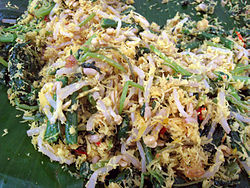
Vegetable urap
Alternative namesUrab, Urap-urap, krawu
CourseSide dish
Place of originIndonesia
Region or stateCentral Java and Yogyakarta
Serving temperatureMostly served with main course
Main ingredientsSteamed vegetable salad, shredded coconut dressing
  •   Media: Urap
Urap (bottom right) as part of a nasi kuning dish.

Urap, oerap, krawu, urab or in its plural form urap-urap is a salad dish of steamed or boiled vegetables mixed with seasoned and spiced grated coconut for dressing.[1] It is commonly found in Indonesian cuisine, more precisely Javanese cuisine. Urap can be consumed on its own as a salad for vegetarian meals[2] or as a side dish. Urap is usually found as a prerequisite side dish of Javanese tumpeng, a cone-shaped rice mound surrounded with assorted dishes, as well as part of a nasi kuning dish. In Balinese cuisine, it is known as urab sayur.

Ingredients

[edit]

The vegetables which are usually used in urap are spinach, water spinach, young cassava leaf, papaya leaf, Chinese long beans, bean sprouts, and cabbage. To acquire a rich taste, most recipes insist on using freshly shredded old coconut flesh or serundeng, instead of leftovers. The shredded coconut is seasoned with ground shallot, garlic, red chili pepper, tamarind juice, galangal, salt, and coconut sugar.

See also

[edit]

References

[edit]
[edit]
Revisions and contributorsEdit on WikipediaRead on Wikipedia
from Grokipedia
Urap, also known as urap sayur, is a traditional Indonesian salad originating from ancient , with roots tracing back to the Medang Palace era as documented in the Linggasutan Inscription (929 AD), consisting of lightly steamed or boiled mixed with a flavorful dressing made from grated seasoned with spices such as , shallots, chilies, and lime leaves. The dish typically features a medley of including long beans, water spinach, , bean sprouts, leaves, and , which are blanched to retain their crispness before being tossed with the toasted coconut mixture. This vibrant side dish is a staple in and holds cultural significance, often accompanying rice-based meals like during celebrations, ceremonies, and communal gatherings. Variations exist across , particularly in where it is called urab and may incorporate local greens or be part of offerings, enhancing its role in both everyday meals and traditional rituals. The preparation emphasizes fresh, seasonal ingredients, making urap a nutritious, vegan option rich in fiber and vitamins, with the spiced providing a balance of savory, spicy, and slightly sweet flavors.

Introduction and Overview

Definition and Characteristics

Urap, also known as urap sayur or urab, is a traditional Indonesian originating from , consisting of blanched or steamed vegetables mixed with a dressing of spiced and grated . This Javanese dish, with roots in ancient culinary practices, emphasizes fresh produce and aromatic seasonings to create a balanced vegetarian option central to local meals. The flavor profile of urap is characterized by the earthy notes of the , enhanced by the coconut dressing's harmonious blend of sweet, sour, and spicy elements derived from ingredients like , lime, chilies, and . Fragrant spices such as and kaffir lime leaves further contribute to its savory and aromatic depth, making it a vibrant yet subtle complement to heavier dishes. In terms of texture, urap provides a pleasing contrast between the crisp-tender quality of the lightly cooked and the creamy, often toasted consistency of the grated . It is typically served at as a , known as lauk, alongside in everyday meals or as part of ceremonial platters like , though it can also stand alone as a nutritious vegetarian main.

Origins and Etymology

The term urap derives from the , where it signifies "to mix" or "to toss," encapsulating the core technique of blending blanched vegetables with a spiced grated dressing to create a harmonious dish. This linguistic root underscores the dish's emphasis on integration of simple, fresh ingredients, a hallmark of Javanese culinary philosophy that prioritizes balance and accessibility. Urap's historical origins lie in ancient Javanese agricultural traditions, deeply tied to the island's fertile volcanic soil and reliance on vegetable cultivation for sustenance and rituals. The dish's precursor, kuluban—a preparation of boiled vegetables—appears in the Rukam inscription from 907 CE, during the Hindu-Buddhist Medang Mataram kingdom, evidencing early vegetable-based salads as part of everyday and ceremonial fare in . This reference highlights urap's place within a broader continuum of Javanese , which leveraged abundant local produce like long beans and long before colonial influences. Over centuries, urap evolved from these ancient foundations, adapting to cultural shifts while retaining its vegetable-centric form. During the Hindu-Buddhist era of the Mataram and subsequent kingdoms (8th–15th centuries), such dishes likely featured in temple rituals as simple, sattvic offerings symbolizing purity and gratitude, influencing their widespread adoption across and beyond. With Islam's arrival in the 13th–15th centuries and its establishment as the dominant faith, urap aligned seamlessly with vegetarian traditions that emphasized , plant-based meals, becoming a fixture in communal feasts and daily diets in Muslim-majority .

Ingredients and Components

Vegetables Used

Urap traditionally features a selection of fresh, blanched that provide texture, color, and nutritional balance, with common choices including long beans (kacang panjang), (bayam) or water spinach (kangkung), (kol), mung bean sprouts (taugeh), and cassava leaves (daun singkong). These are chosen for their ability to hold shape after brief cooking, ensuring a crisp yet tender consistency in the final dish. The total quantity of in a standard recipe for 2-4 servings typically ranges from 200 to 500 grams, creating a substantial yet light and allowing for generous portions without overwhelming the spiced coconut topping. For instance, recipes often specify around 50 to 140 grams each of long beans and bean sprouts, paired with 50 to 225 grams of leafy greens like or cassava leaves, adjusted based on availability. Selection emphasizes fresh, seasonal produce to maintain vibrancy and prevent sogginess; should be young and crisp, with overripe items avoided as they release excess moisture during blanching. Long beans are picked firm and unblemished, or water spinach with tender leaves, tightly packed and free of wilt, bean sprouts white and spry without brown tails, and leaves young and non-bitter. Proportions are balanced to enhance visual appeal and nutritional variety, with a mix of leafy greens, beans, sprouts, and other elements for texture and flavor. This mix ensures a harmonious combination where no single vegetable dominates, promoting even distribution of colors from green to white. In traditional settings, these are sourced from local Indonesian markets or home gardens, prioritizing organically grown varieties for purity and freshness that reflect the dish's agrarian roots. Community markets in and offer abundant, affordable seasonal options, supporting sustainable practices in everyday cooking.

Coconut and Seasoning Elements

The spiced coconut dressing, known as sambal urap, is the hallmark of urap, providing a rich, textured topping that contrasts with the blanched . At its core is freshly grated mature , typically 150 to 250 grams for a standard recipe serving 2-4, which is lightly toasted to develop a subtle nuttiness and enhance its creamy . This base absorbs the flavors of the seasonings while maintaining a slightly chewy consistency that defines the dish's appeal in traditional . The seasonings form a vibrant paste that infuses the coconut with layered aromatics and tastes, drawing from staple Indonesian pantry elements. Common components include 3-8 shallots (bawang merah) for pungent depth, 2-4 cloves of for savory backbone, 2-8 bird's eye or red chilies to deliver adjustable heat, 1-2 cm of fresh or kencur for its warm, earthy grounding, 2-8 kaffir lime leaves to impart a citrusy, fragrance, 1 teaspoon of paste for tangy sourness (optional in some recipes), 1-2 teaspoons of salt to sharpen the profile, and 1-2 teaspoons of to mellow and round out the sweetness. These quantities represent variations in standard preparations for 2-4 servings, though adjustments are made based on regional preferences and desired intensity. This combination achieves a harmonious flavor balance: the inherent sweetness of the and tempers the bold spice from the chilies, while the sour notes of and the zesty lime leaves cut through for brightness; or kencur contributes an underlying earthy warmth that ties the elements together. In authentic preparations, the spices are first pounded into a coarse paste using a traditional Indonesian ulekan , which releases essential oils more effectively than modern blenders, before being thoroughly incorporated with the toasted . This paste-coconut mixture is often briefly steamed or sautéed to meld the flavors without overcooking. The resulting dressing is then tossed with the during assembly to ensure even coating.

Preparation Methods

Vegetable Preparation

The preparation of for urap emphasizes techniques that maintain their vibrant colors, crisp textures, and nutritional integrity, typically involving brief exposure to heat followed by rapid cooling. The primary method is blanching, where are immersed in salted for short durations—generally 1 to 2 minutes depending on the type—to partially cook them while preserving freshness. This approach, common in traditional , inactivates enzymes that cause discoloration and without fully softening the produce. Immediately after blanching, the are shocked in an ice bath to halt the cooking process, ensuring they retain a tender-crisp bite suitable for mixing with the coconut dressing. Timing during blanching is critical to avoid overcooking, with more delicate leafy greens like blanched for about 30 seconds to 1 minute, while tougher varieties such as long beans or green beans require up to 2 minutes. Bean sprouts, another common component, are typically blanched for just 30 seconds to preserve their crunch. Vegetables are prepared separately or in sequence starting from the lightest-colored (like bean sprouts) to the darkest (like ) to prevent color bleeding in the shared blanching . Adding a pinch of salt to the enhances flavor retention and firmness. An alternative to blanching is steaming the over water, which takes slightly longer—around 3 to 5 minutes—for a softer texture often preferred in home or regional variations. This method uses less water and can better retain water-soluble nutrients, though it may result in a less vibrant appearance compared to blanching. After cooking, whether blanched or , the must be thoroughly drained and patted dry with a clean cloth or to remove excess moisture, preventing sogginess when combined with the seasoned . This step ensures the final dish achieves the desired balance of textures, with the vegetables remaining distinct and not diluted.

Seasoning Assembly

The seasoning assembly for urap begins with sautéing a spice paste composed of shallots, , chilies, and in approximately 1 tablespoon of oil over medium heat until fragrant, typically taking 1 to 2 minutes. This step infuses the oil with aromatic flavors from the paste, which serves as the base for the coconut mixture. Next, the grated is added to the sautéed paste in the pan, where it is briefly toasted for about 2 minutes, stirring continuously to prevent burning and to allow the coconut to absorb the spices evenly. This toasting enhances the nutty texture and integrates the seasoning elements without overcooking the . The warm coconut mixture is then sprinkled over the blanched vegetables as a topping to distribute the flavors uniformly. This technique preserves the crispness of the vegetables while allowing the spiced coconut to coat them lightly. After assembly, the urap is allowed to rest for 10 to 15 minutes at room temperature, permitting the flavors to meld and intensify before serving. This process yields approximately 4 servings as a side dish, though it can be scaled up for larger gatherings by adjusting ingredient proportions proportionally.

Variations and Regional Adaptations

Javanese and Balinese Styles

In the Javanese style of urap, particularly from , the dish emphasizes steamed vegetables such as and long beans, which are blanched or steamed to preserve their texture and nutrients, then tossed with a spiced grated coconut dressing featuring minimal chilies for a milder heat profile. This preparation highlights a balance of flavors, incorporating to impart a subtle sweetness that distinguishes it from spicier regional variants. Often served as a side to , a fragrant , the Javanese urap reflects everyday and ceremonial dining traditions in and surrounding areas. The Balinese adaptation, known as urab sayur, incorporates additional aromatic elements like lemongrass and salam leaves into the seasoning, creating a more layered profile influenced by local spice pastes such as base genep. This version tends to be hotter, drawing from the raw, fiery notes of sambal matah with its emphasis on fresh chilies, shallots, and lemongrass, while kaffir lime leaves and juice add a prominent citrusy brightness. In Balinese culture, urab sayur holds ritual significance, frequently prepared as part of ceremonial offerings in events or family rituals to symbolize abundance and harmony. Key differences between the styles lie in their flavor balances: the Javanese urap leans sweeter due to generous use of , tempering the spices for a harmonious, less intense taste, whereas the Balinese urab sayur is more aromatic and citrus-forward, with heightened heat from chilies enhancing its vibrant, fresh character. The Javanese version of urap predates Balinese adaptations, tracing its roots to ancient dishes like kuluban from the Mataram Kingdom around the 9th century, as referenced in historical inscriptions. Balinese variations emerged through cultural exchanges, particularly during the 16th-century migrations of Hindu-Javanese elites to fleeing Islamic expansion in , which carried culinary traditions across the islands and influenced local adaptations.

Modern and International Twists

In contemporary culinary scenes, urap has gained traction as a fully plant-based dish, aligning seamlessly with vegan diets due to its core ingredients of steamed vegetables and spiced coconut dressing. Recipes in 2020s plant-based cookbooks emphasize its natural vegan compatibility, often simplifying preparation by substituting desiccated coconut for fresh grated coconut, which is toasted to replicate traditional flavors while ensuring accessibility in non-tropical regions. For instance, Australian-Vietnamese chef Hetty McKinnon's 2020 cookbook features urap as part of a vegan Indonesian meal, pairing it with yellow rice to highlight its fresh, spiced profile in modern plant-based cooking. Some adaptations incorporate tamarind concentrate in the coconut topping for a tangy depth, offering a subtle twist on the classic lime or kaffir lime leaf acidity while maintaining authenticity. International fusions have extended urap's reach beyond , particularly in diaspora communities where it integrates with local or complementary elements. In the , home to a significant Indonesian diaspora from colonial ties, these adaptations reflect tempeh's deep roots in the region, where the first European production began in the among Indonesian immigrants, evolving urap into a hearty side for multicultural meals. Since around , urap has appeared on menus in fusion restaurants worldwide, blending its coconut-vegetable profile with global influences, and gaining visibility through English-language platforms like , which cataloged it as a traditional Javanese salad in its database around 2020.

Cultural and Culinary Significance

Role in Indonesian Cuisine

Urap holds a prominent place as a staple side dish in Javanese households, where it is commonly enjoyed year-round alongside steamed rice and proteins like fried tempeh or tofu to provide textural and flavor balance in everyday meals. This accessibility makes it a frequent feature in home cooking, warungs, and markets, often served for breakfast or lunch as a wholesome vegetarian option that reflects Indonesia's agrarian traditions. In ceremonial contexts, urap plays a key role in both Javanese and Balinese rituals, symbolizing gratitude, unity, and the earth's abundance. Among Javanese communities, it is a traditional component of slametan feasts—communal gatherings held for life-cycle events like births or harvests—and mitoni ceremonies marking the seventh month of pregnancy, where it fosters social harmony and spiritual benevolence when shared with rice and simple accompaniments. In Bali, known locally as urab, it features in offerings and family rituals, including those during , the , where it complements dishes like entil sayur to honor tradition and balance. Urap's pairings enhance its integration into broader Indonesian dining, often accompanied by for heat, crackers for crunch, and refreshing , while its inclusion in rijsttafel-style multi-course meals highlights its adaptability in both traditional and Dutch-influenced settings. As a naturally vegan dish rooted in Java's plant-based culinary heritage, urap supports vegetarian practices in Muslim-majority regions by offering a ritual-friendly alternative that aligns with fasting and community values, contributing to its rising presence in urban eateries since the early amid growing interest in sustainable, local foods.

Nutritional and Health Aspects

Urap offers a nutrient-dense profile, primarily from its steamed vegetables and spiced grated coconut components. A typical serving yields approximately 280 calories, with about 21g of fats mainly from the coconut, including medium-chain triglycerides that provide quick energy. The dish is rich in dietary fiber at around 7g per serving, sourced from vegetables like long beans, cabbage, spinach, and bean sprouts, which promote satiety and gut health. Key micronutrients include vitamins A, C, and K, abundant in the leafy greens and cruciferous elements; for instance, contributes high levels of (over 400% DV per 100g) for bone and blood health, while and bean sprouts add for immune support. The content supports by aiding regular bowel movements and preventing , while antioxidants from spices like (curcumin) help reduce inflammation and . Urap's low , driven by non-starchy vegetables and (GI around 45), assists in stable blood sugar control, making it suitable for metabolic health. Potential concerns include elevated sodium levels, often 300-400mg per serving from seasonings, which can rise if oversalted and contribute to in excess. The coconut's saturated fats (about 8g per serving) should be moderated, as they may increase LDL despite raising beneficial HDL. As a plant-based dish without animal products or , urap is naturally vegan and gluten-free, fitting seamlessly into restrictive diets. Its emphasis on , , and unsaturated fat sources aligns with Mediterranean-style eating patterns, which emphasize whole for cardiovascular benefits.

References

Add your contribution
Related Hubs
User Avatar
No comments yet.