


Community hub
Recent from talks
Contribute something
Nothing was collected or created yet.
Rivet
View on Wikipedia |


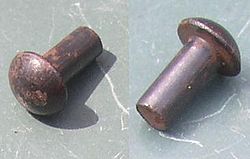
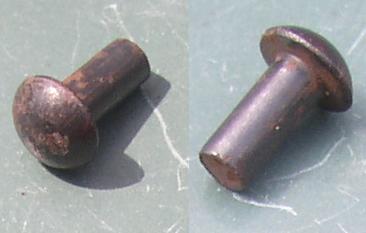
A rivet is a permanent mechanical fastener. Before being installed, a rivet consists of a smooth cylindrical shaft with a head on one end. The end opposite the head is called the tail. On installation, the deformed end is called the shop head or buck-tail.
Because there is effectively a head on each end of an installed rivet, it can support tension loads. However, it is much more capable of supporting shear loads (loads perpendicular to the axis of the shaft).
Fastenings used in traditional wooden boat building, such as copper nails and clinch bolts, work on the same principle as the rivet but were in use long before the term rivet was introduced and, where they are remembered, are usually classified among nails and bolts respectively.
History
[edit]_(14783765532).jpg)

Solid rivets are one of the oldest and most reliable types of fasteners, having been found in archaeological findings dating back to the Bronze Age.[1] Rivet holes have been found in Egyptian spearheads dating back to the Naqada culture of between 4400 and 3000 B.C. Archeologists have also uncovered many Bronze Age swords and daggers with rivet holes where the handles would have been. The rivets themselves were essentially short rods of metal, which metalworkers hammered into a pre-drilled hole on one side and deformed on the other to hold them in place.
High-strength bolts have largely replaced structural steel rivets. Indeed, the latest steel construction specifications published by AISC (the 14th Edition) no longer cover their installation. The reason for the change is primarily due to the expense of skilled workers required to install high-strength structural steel rivets.
Installation
[edit]There are several methods for installing solid rivets.
- Manually with hammer and handset or bucking bar
- Pneumatic hammers
- Handheld squeezers
- Riveting machines
- Pin hammer, rivet set
Rivets small and soft enough are often bucked. The term bucked comes from a name for one of the two parts of a rivet. The head of the rivet is one part, and is the part that the air-hammer strikes. The other part is referred to as the bucktail, and is the part that the bucking bar is held against. Hence the terms bucking bar, bucked, and buck-man.[2] In this process, the installer places a rivet gun against the factory head and holds a bucking bar against the tail or a hard working surface. The bucking bar is a specially shaped solid block of metal. The rivet gun provides a series of high-impulse forces that upsets and work hardens the tail of the rivet between the work and the inertia of the bucking bar. Rivets that are large or hard may be more easily installed by squeezing instead. In this process, a tool in contact with each end of the rivet clinches to deform the rivet.
Rivets may also be upset by hand, using a ball-peen hammer. The head is placed in a special hole made to accommodate it, known as a rivet-set. The hammer is applied to the buck-tail of the rivet, rolling an edge so that it is flush against the material.

Until relatively recently, structural steel connections were either welded or riveted. Whereas two relatively unskilled workers can install and tighten high-strength bolts, it normally takes four skilled workers to install rivets (warmer, catcher, holder, basher).
At a central location near the areas being riveted, a furnace was set up. Rivets were placed in the furnace and heated to approximately 900 °C (1,700 °F) or "cherry red." The rivet warmer or cook used tongs to remove individual rivets and throw them to a catcher stationed near the joints to be riveted. The catcher (usually) caught the rivet in a leather or wooden bucket with an ash-lined bottom. The catcher inserted the rivet into the hole to be riveted, then quickly turned to catch the next rivet. The holder up or holder on would hold a heavy bucking bar or dolly or another (larger) pneumatic jack against the round "shop head" of the rivet, while the riveter (sometimes two riveters) applied a hammer or pneumatic rivet hammer with a "rivet set" to the tail of the rivet, making it mushroom against the joint forming the "field head" into its final domed shape. Alternatively, the buck is hammered more or less flush with the structure in a counter-sunk hole. On cooling, the rivet contracted axially exerting the clamping force on the joint.[3] Before the use of pneumatic hammers, e.g. in the construction of RMS Titanic, the person who hammered the rivet was known as the "basher".[1]
Types
[edit]Solid rivets
[edit]Solid rivets consist simply of a shaft and head that are deformed with a hammer or rivet gun. A rivet compression or crimping tool can also deform this type of rivet. This tool is mainly used on rivets close to the edge of the fastened material since the tool is limited by the depth of its frame. A rivet compression tool does not require two people and is generally the most foolproof way to install solid rivets.
Solid rivets are used in applications where reliability and safety count. A typical application for solid rivets can be found within the structural parts of aircraft. Hundreds of thousands of solid rivets are used to assemble the frame of a modern aircraft. Such rivets come with rounded (universal) or 100° countersunk heads. Typical materials for aircraft rivets are aluminium alloys (2017, 2024, 2117, 7050, 5056, 55000, V-65), titanium, and nickel-based alloys (e.g., Monel). Some aluminium alloy rivets are too hard to buck and must be softened by solution treating (precipitation hardening) prior to being bucked. "Ice box" aluminium alloy rivets harden with age, and must likewise be annealed and then kept at sub-freezing temperatures (hence the name "ice box") to slow the age-hardening process. Steel rivets can be found in static structures such as bridges, cranes, and building frames.
The setting of these fasteners requires access to both sides of a structure. Solid rivets are driven using a hydraulically, pneumatically, or electromagnetically actuated squeezing tool or even a handheld hammer. Applications where only one side is accessible require "blind" rivets.
Solid rivets are also used by some artisans in the construction of modern reproduction of medieval armour, jewellery and metal couture.
Semi-tubular rivets
[edit]
Semi-tubular rivets (also known as tubular rivets) are similar to solid rivets, except they have a partial hole (opposite the head) at the tip. The purpose of this hole is to reduce the amount of force needed for application by rolling the tubular portion outward. The force needed to apply a semi-tubular rivet is about 1/4 of the amount needed to apply a solid rivet. Tubular rivets are sometimes preferred for pivot points (a joint where movement is desired) since the swelling of the rivet is only at the tail. The type of equipment used to apply semi-tubular rivets ranges from prototyping tools to fully automated systems. Typical installation tools (from lowest to highest price) are hand set, manual squeezer, pneumatic squeezer, kick press, impact riveter, and finally PLC-controlled robotics. The most common machine is the impact riveter and the most common use of semi-tubular rivets is in lighting, brakes, ladders, binders, HVAC duct-work, mechanical products, and electronics. They are offered from 1/16-inch (1.6 mm) to 3/8-inch (9.5 mm) in diameter (other sizes are considered highly special) and can be up to 8 inches (203 mm) long. A wide variety of materials and platings are available, most common base metals are steel, brass, copper, stainless, aluminum and the most common platings are zinc, nickel, brass, tin. Tubular rivets are normally waxed to facilitate proper assembly. An installed tubular rivet has a head on one side, with a rolled-over and exposed shallow blind hole on the other.
Blind rivets
[edit]


Blind rivets, commonly referred to as "pop" rivets (POP is the brand name of the original manufacturer, now owned by Stanley Engineered Fastening, a division of Stanley Black & Decker) are tubular and are supplied with a nail-like mandrel through the center which has a "necked" or weakened area near the head. The rivet assembly is inserted into a hole drilled through the parts to be joined and a specially designed tool is used to draw the mandrel through the rivet. The compression force between the head of the mandrel and the tool expands the diameter of the tube throughout its length, locking the sheets being fastened if the hole was the correct size. The head of the mandrel also expands the blind end of the rivet to a diameter greater than that of the drilled hole, compressing the fastened sheets between the head of the rivet and the head of the mandrel. At a predetermined tension, the mandrel breaks at the necked location. With open tubular rivets, the head of the mandrel may or may not remain embedded in the expanded portion of the rivet, and can come loose at a later time. More expensive closed-end tubular rivets are formed around the mandrel so the head of the mandrel is always retained inside the blind end after installation. "Pop" rivets can be fully installed with access to only one side of a part or structure.[4]
Prior to the invention of blind rivets, installation of a rivet typically required access to both sides of the assembly: a rivet hammer on one side and a bucking bar on the other side. In 1916, Royal Navy reservist and engineer Hamilton Neil Wylie filed a patent for an "improved means of closing tubular rivets" (granted May 1917).[5] In 1922 Wylie joined the British aircraft manufacturer Armstrong-Whitworth Ltd to advise on metal construction techniques; here he continued to develop his rivet design with a further 1927 patent[6] that incorporated the pull-through mandrel and allowed the rivet to be used blind. By 1928, the George Tucker Eyelet Company, of Birmingham, England,[7] produced a "cup" rivet based on the design. It required a separate GKN mandrel and the rivet body to be hand-assembled prior to use for the building of the Siskin III aircraft. Together with Armstrong-Whitworth, the Geo. Tucker Co. further modified the rivet design to produce a one-piece unit incorporating a mandrel and rivet.[8] This product was later developed in aluminium and trademarked as the "POP" rivet. The United Shoe Machinery Co. produced the design in the U.S. as inventors such as Carl Cherry and Lou Huck experimented with other techniques for expanding solid rivets.
They are available in flat head, countersunk head, and modified flush head with standard diameters of 1⁄8, 5⁄32, and 3⁄16 inch (3.2, 4.0, and 4.8 mm). Blind rivets are made from soft aluminum alloy, steel (including stainless steel), copper, and Monel.
There are also structural blind rivets, which are designed to take shear and tensile loads.[9]
The rivet body is normally manufactured using one of three methods: wire (the most common method), tube (common in longer lengths, not normally as strong as wire) and sheet (least popular and generally the weakest option).[citation needed]
There is a vast array of specialty blind rivets that are suited for high strength or plastic applications. Typical types include:
- TriFold: a rivet that splits into three equal legs like a molly bolt. Typically used in soft plastics where a wide footprint is needed at the rear surface. Used in automotive interiors and vinyl fences
- Structural rivet(a): an "external" mechanically locked structural blind rivet that is used where a watertight, vibration resistant connection is of importance. Typically used in manufacture or repair of truck bodies. A special nosepiece is required to apply this rivet
- Structural rivet(b): an "internal" mechanically locked structural blind rivet that is used where a watertight, vibration resistant connection is of importance. Typically used in manufacture or repair of truck bodies
Internally and externally locked structural blind rivets can be used in aircraft applications because, unlike other types of blind rivets, the locked mandrels cannot fall out and are watertight. Since the mandrel is locked into place, they have the same or greater shear-load-carrying capacity as solid rivets and may be used to replace solid rivets on all but the most critical stressed aircraft structures.
The typical assembly process requires the operator to install the rivet in the nose of the tool by hand and then actuate the tool. However, in recent years automated riveting systems have become popular in an effort to reduce assembly costs and repetitive disorders. The cost of such tools ranges from US$1,500 for auto-feed pneumatics to US$50,000 for fully robotic systems.
While structural blind rivets using a locked mandrel are common, there are also aircraft applications using "non-structural" blind rivets where the reduced, but still predictable, strength of the rivet without the mandrel is used as the design strength. A method popularized by Chris Heintz of Zenith Aircraft uses a common flat-head (countersunk) rivet which is drawn into a specially machined nosepiece that forms it into a round-head rivet, taking up much of the variation inherent in hole size found in amateur aircraft construction. Aircraft designed with these rivets use rivet strength figures measured with the mandrel removed.[10]
Oscar rivets
[edit]
Oscar rivets are similar to blind rivets in appearance and installation but have splits (typically three) along the hollow shaft. These splits cause the shaft to fold and flare out (similar to the wings on a toggle bolt's nut) as the mandrel is drawn into the rivet. This flare (or flange) provides a wide bearing surface that reduces the chance of rivet pull-out. This design is ideal for high-vibration applications where the back surface is inaccessible.
A version of the Oscar rivet is the Olympic rivet which uses an aluminum mandrel that is drawn into the rivet head. After installation, the head and mandrel are shaved off flush resulting in an appearance closely resembling a brazier head-driven rivet. They are used in the repair of Airstream trailers to replicate the look of the original rivets.
Drive rivet
[edit]
A drive rivet is a form of blind rivet that has a short mandrel protruding from the head that is driven in with a hammer to flare out the end inserted in the hole. This is commonly used to rivet wood panels into place since the hole does not need to be drilled all the way through the panel, producing an aesthetically pleasing appearance. They can also be used with plastic, metal, and other materials and require no special setting tool other than a hammer and possibly a backing block (steel or some other dense material) placed behind the location of the rivet while hammering it into place. Drive rivets have less clamping force than most other rivets. Drive screws, possibly another name for drive rivets, are commonly used to hold nameplates into blind holes. They typically have spiral threads that grip the side of the hole.[11]
Friction-lock rivet
[edit]These resemble an expanding bolt except the shaft snaps below the surface when the tension is sufficient. The blind end may be either countersunk ('flush') or dome-shaped.
One early form of blind rivet that was the first to be widely used for aircraft construction and repair was the Cherry friction-lock rivet. Originally, Cherry friction locks were available in two styles, hollow shank pull-through and self-plugging types. The pull-through type is no longer common; however, the self-plugging Cherry friction-lock rivet is still used for repairing light aircraft.
Cherry friction-lock rivets are available in two head styles, universal and 100-degree countersunk. Furthermore, they are usually supplied in three standard diameters, 1/8, 5/32 and 3/16 inch.
A friction-lock rivet cannot replace a solid shank rivet, size for size. When a friction lock is used to replace a solid shank rivet, it must be at least one size larger in diameter because the friction-lock rivet loses considerable strength if its center stem falls out due to vibrations or damage.
Self-piercing rivets
[edit]Self-pierce riveting (SPR) is a process of joining two or more materials using an engineered rivet.[12] Unlike solid, blind and semi-tubular rivets, self-pierce rivets do not require a drilled or punched hole.[13]
SPRs are cold-forged to a semi-tubular shape and contain a partial hole to the opposite end of the head. The end geometry of the rivet has a chamfered poke that helps the rivet pierce the materials being joined. A hydraulic or electric servo rivet setter drives the rivet into the material, and an upsetting die provides a cavity for the displaced bottom sheet material to flow. The SPR process is described in here SPR process.
The self-pierce rivet fully pierces the top sheet material(s) but only partially pierces the bottom sheet. As the tail end of the rivet does not break through the bottom sheet it provides a water or gas-tight joint. With the influence of the upsetting die, the tail end of the rivet flares and interlocks into the bottom sheet forming a low profile button.
Rivets need to be harder than the materials being joined.[14] they are heat treated to various levels of hardness depending on the material's ductility and hardness. Rivets come in a range of diameters and lengths depending on the materials being joined; head styles are either flush countersunk or pan heads.
Depending on the rivet setter configuration, i.e. hydraulic, servo, stroke, nose-to-die gap, feed system etc., cycle times can be as quick as one second. Rivets are typically fed to the rivet setter nose from tape and come in cassette or spool form for continuous production.
Riveting systems can be manual or automated depending on the application requirements; all systems are very flexible in terms of product design and ease of integration into a manufacturing process.
SPR joins a range of dissimilar materials such as steel, aluminum, plastics, composites and pre-coated or pre-painted materials.[15][16] Benefits include low energy demands, no heat, fumes, sparks or waste and very repeatable quality.
Compression rivets
[edit]Compression rivets are commonly used for functional or decorative purposes on clothing, accessories, and other items. They have male and female halves that press together, through a hole in the material. Double cap rivets have aesthetic caps on both sides. Single cap rivets have caps on just one side; the other side is low profile with a visible hole. Cutlery rivets are commonly used to attach handles to knife blades and other utensils.
Surface finish
[edit]A flush rivet is used primarily on external metal surfaces where good appearance and the elimination of unnecessary aerodynamic drag are important. A flush rivet takes advantage of a countersunk or dimpled hole; they are also commonly referred to as countersunk rivets. Countersunk or flush rivets are used extensively on the exterior of aircraft for aerodynamic reasons such as reduced drag and turbulence. Additional post-installation machining may be performed to perfect the airflow.
Flush riveting was invented in America in the 1930s by Vladimir Pavlecka and his team at Douglas Aircraft.[17][18] The technology was used by Howard Hughes in the design and production of his H-1 plane, the Hughes H-1 Racer.
Materials
[edit]| Alloy type | Alphabetical letter | Driven condition | Marking on head |
|---|---|---|---|
| PLAIN | |||
| 2117 | AD | 2117T3 | Dimple |
| 5056 | B | 5056H32 | Raised cross |
| 2017 | D | 2017T31 | Raised dot |
| 2024 | DD | 2024T31 | Two raised dashes |
| 7050 | E (or KE per NAS) | 7050T73 | Raised ring |
The last commonly used high-strength structural steel rivets were designated ASTM A502 Grade 1 rivets.[19]
Such riveted structures may be insufficient to resist seismic loading from earthquakes if the structure was not engineered for such forces, a common problem of older steel bridges. This is because a hot rivet cannot be properly heat treated to add strength and hardness. In the seismic retrofit of such structures, it is common practice to remove critical rivets with an oxygen torch, precision ream the hole, then insert a machined and heat-treated bolt.
Sizes
[edit]The main official standards relate more to technical parameters such as ultimate tensile strength and surface finishing than physical length and diameter. They are:
| Abbreviation | Issuing authority |
|---|---|
| AIA / NASM | Aerospace Industries Association (AIA) Imperial Standard, NASM is an acronym for National Aerospace Standards, MIL-STD. |
| AN / MS | United States Military Standard used by the USA army, navy, or air force is Imperial. |
| ASME / ANSI | The American Society of Mechanical Engineers (ASME) 18-digit PIN code Imperial system is approved by ANSI and adopted by the U.S. Department of Defense. |
| BS / BSI | British Standards Institution. provides four-figure BS numbers for Imperial standards and also provides similar BS numbers for official translations into English for the Internal market of the European Union (see below: DIN or SI) |
| SAE | The Society of Automotive Engineers is a worldwide organization that provides (mostly Imperial) specifications for design and testing for components used in the automotive industry. |
| JIS | Japanese Industrial Standard (JIS) is a metric system largely based on DIN with some minor modifications to meet the needs of the Japanese market, notably used in Japanese electronic equipment. |
| DIN | Deutsches Institut für Normung is the German national metric standard used in most European countries because it closely resembles the newer International Standards Organizations (ISO) specifications. DIN fasteners use a DIN style identifier plus the material and the finish or plating (if any). |
| ISO | International Organization for Standardization (ISO) is a worldwide metric standard. Clarified ISO standards for (metric) fasteners are rapidly gaining international recognition in preference to the similar DIN, on which SI was originally based. |
Rivet diameters are commonly measured in 1⁄32-inch increments[20] and their lengths in 1⁄16-inch increments, expressed as "dash numbers" at the end of the rivet identification number. A "dash 3 dash 4" (XXXXXX-3-4) designation indicates a 3⁄32-inch diameter and 4⁄16-inch (or 1⁄4-inch) length. Some rivets lengths are also available in half sizes, and have a dash number such as –3.5 (7⁄32 inch) to indicate they are half-size. The letters and digits in a rivet's identification number that precede its dash numbers indicate the specification under which the rivet was manufactured and the head style. On many rivets, a size in 32nds may be stamped on the rivet head. Other makings on the rivet head, such as small raised or depressed dimples or small raised bars indicate the rivet's alloy. To become a proper fastener, a rivet should be placed in a hole ideally 4–6 thousandths of an inch larger in diameter. This allows the rivet to be easily and fully inserted, then setting allows the rivet to expand, tightly filling the gap and maximizing strength.
Rivet diameters and lengths are measured in millimeters. Conveniently, the rivet diameter relates to the drill required to make a hole to accept the rivet, rather than the actual diameter of the rivet, which is slightly smaller. This facilitates the use of a simple drill-gauge to check both rivet and drill are compatible. For general use, diameters between 2 mm – 20 mm and lengths from 5 mm – 50 mm are common. The design type, material and any finish is usually expressed in plain language (often English).
Applications
[edit]


Before welding techniques and bolted joints were developed, metal-framed buildings and structures such as the Eiffel Tower, Shukhov Tower and the Sydney Harbour Bridge were generally held together by riveting, as were automobile chassis. Riveting is still widely used in applications where light weight and high strength are critical, such as in an aircraft. Sheet metal alloys used in aircraft skins are generally not welded, because the aircraft in high-speed flight skins will be stretched, extrusion may occur deformation and change in material properties. Riveting can reduce the vibration transmission between joints, thereby reducing the risk of cracking. The firmness is better and more reliable against such repeated stress changes. In order to reduce air resistance, countersunk rivets are generally used in aircraft skins.[21]
A large number of countries used rivets in the construction of armored tanks during World War II, including the M3 Lee (General Grant) manufactured in the United States. However, many countries soon learned that rivets were a large weakness in tank design since if a tank was hit by a large projectile it would dislocate the rivets and they would fly around the inside of the tank and injure or kill the crew, even if the projectile did not penetrate the armor. Some countries such as Italy, Japan, and Britain used rivets in some or all of their tank designs throughout the war for various reasons, such as lack of welding equipment or inability to weld very thick plates of armor effectively.
Blind rivets are used almost universally in the construction of plywood road cases.
Common but more exotic uses of rivets are to reinforce jeans and to produce the distinctive sound of a sizzle cymbal.
Joint analysis
[edit]The stress and shear in a rivet are analyzed like a bolted joint. However, it is not wise to combine rivets with bolts and screws in the same joint. Rivets fill the hole where they are installed to establish a very tight fit (often called an interference fit). It is difficult or impossible to obtain such a tight fit with other fasteners. The result is that rivets in the same joint with loose fasteners carry more of the load—they are effectively stiffer. The rivet can then fail before it can redistribute load to the other loose-fit fasteners like bolts and screws. This often causes catastrophic failure of the joint when the fasteners unzip. In general, a joint composed of similar fasteners is the most efficient because all fasteners reach capacity simultaneously.
Testing
[edit]
A hammer is also used to "ring" an installed rivet, as a non-destructive test for tightness and imperfections. The inspector taps the head (usually the factory head) of the rivet with the hammer while touching the rivet and base plate lightly with the other hand and judges the quality of the audibly returned sound and the feel of the sound traveling through the metal to the operator's fingers. A rivet tightly set in its hole returns a clean and clear ring, while a loose rivet produces a recognizably different sound.
A blind rivet has strength properties that can be measured in terms of shear and tensile strength. Occasionally rivets also undergo performance testing for other critical features, such as pushout force, break load and salt spray resistance. A standardized destructive test according to the Inch Fastener Standards is widely accepted.[22][23]
The shear test involves installing a rivet into two plates at specified hardness and thickness and measuring the force necessary to shear the plates. The tensile test is basically the same, except that it measures the pullout strength. Per the IFI-135 standard, all blind rivets produced must meet this standard. These tests determine the strength of the rivet, and not the strength of the assembly. To determine the strength of the assembly a user must consult an engineering guide or the Machinery's Handbook.[24]
See also
[edit]- Boiler – Closed vessel in which fluid is heated
- Cleco – Holds parts together before final assembly
- Clinker (boat building) – Method of constructing boats and ships
- Rivet nut – Kind of threaded insert
- Rosie the Riveter – Cultural icon of the US during World War II
References
[edit]- ^ Stead, Ian (1998). "rivet". The British Museum. Retrieved 2025-03-13.
- ^ https://www.vintagetrailersupply.com/blog/buck-riveting-basics-tools-and-techniques/
- ^ "Three workers securing a rivet". NYPL Digital Collections. Archived from the original on 2014-10-06.
- ^ Blind Rivets, August 1942, Popular Science Archived 2018-01-26 at the Wayback Machine early article that explains how they work
- ^ Improved means of closing tubular rivets. United Kingdom Patent GB106169
- ^ Improvements in and relating to rivets and riveting – United Kingdom Patent GB286471
- ^ "George Tucker Eyelet Co". Graces Guide. Archived from the original on 8 July 2020. Retrieved 8 July 2020.
- ^ Emhart News June 2011 GB
- ^ Smith (1990), p. 159.
- ^ Heintz, Chris (2010). Flying On Your Own Wings. Trafford. ISBN 978-1425188283. Archived from the original on 2017-07-10.
- ^ "Hanson Rivet". Archived from the original on 18 January 2013. Retrieved 18 April 2013.
- ^ Haque, R. and Durandet, Y.,"Strength prediction of self-pierce riveted joint in cross-tension and lap-shear," Materials & Design, Vol. 108, No. 2016, pp. 666–78, doi:10.1016/j.matdes.2016.07.029.
- ^ Ang, Hua Qian (2021-01-04). "An Overview of Self-piercing Riveting Process with Focus on Joint Failures, Corrosion Issues and Optimisation Techniques". Chinese Journal of Mechanical Engineering. 34 (1) 2. Bibcode:2021ChJME..34....2A. doi:10.1186/s10033-020-00526-3. ISSN 1000-9345.
- ^ Haque, R. and Durandet, Y.,"Investigation of self-pierce riveting (SPR) process data and specific joining events," Journal of Manufacturing Processes, Vol. 30, No. 2017, pp. 148–60, doi:10.1016/j.jmapro.2017.09.018.
- ^ Haque, R. (2018). Residual stress in self-piercing riveting (SPR) joints – A review. Materials Performance and Characterization, 7(4) doi:10.1520/MPC20170109
- ^ Haque, R.,"Quality of self-piercing riveting (SPR) joints from cross-sectional perspective: A review," Archives of Civil and Mechanical Engineering, Vol. 18, No. 1, 2018, pp. 83–93, doi:10.1016/j.acme.2017.06.003.
- ^ "Countersunk Rivet Method is Patented For Airplanes" (PDF). The New York Times. March 9, 1941. Archived (PDF) from the original on January 21, 2022. Retrieved January 20, 2021.
- ^ Lee Payne (January 1, 1982). "The Great Jet Engine Race... And How We Lost". Air Force Magazine. Air Force Association. Archived from the original on November 24, 2020. Retrieved January 16, 2021.
- ^ Segui, William T. (2007). Steel Design (4th ed.). Toronto: Thomson. ISBN 978-0-495-24471-4.
- ^ "Straight Facts on Blind Rivets". machinedesign.com. Archived from the original on 2012-09-02.
- ^ Hongwei Zhao, Jiangjing Xi, Kailun Zheng, Zhusheng Shi, Jianguo Lin, Kamran Nikbin, Shihui Duan et Binwen Wang (2020). "A review on solid riveting techniques in aircraft assembling". Manufacturing Review. 7: 40. Bibcode:2020ManRv...7...40Z. doi:10.1051/mfreview/2020036. hdl:10044/1/85434. Archived from the original on 2023-11-27. Retrieved 2023-10-22.
{{cite journal}}: CS1 maint: multiple names: authors list (link) - ^ "Industrial Fasteners Institute". Industrial-fasteners.org. Archived from the original on 2002-09-13. Retrieved 2012-04-28.
- ^ IFI, Industrial Fasteners Institute (2003). Inch Fastener Standards (7th ed.). Industrial Fasteners Institute: Industrial Fasteners Institute.
- ^ Heald, Oberg, Jones, Ryffel, McCauley and Heald (2008). Machinery's Handbook (28th ed.). Industrial Press: Industrial Press. ISBN 978-0-8311-2828-9.
{{cite book}}: CS1 maint: multiple names: authors list (link)
Bibliography
[edit]- Smith, Carroll (1990). Carroll Smith's Nuts, Bolts, Fasteners, and Plumbing Handbook. MotorBooks/MBI Publishing Company. p. 112. ISBN 978-0-87938-406-7.
External links
[edit]
- . Encyclopædia Britannica. Vol. 23 (11th ed.). 1911.
- Popular Science, November 1941, "Self-Setting Explosive Rivet Speeds Warplane Building" system used by both the US and Germany in World War Two for aircraft assembly – see bottom half of page
- Four Methods of Flush Riveting, film made by Disney Studios during World War Two
- "Hold Everything", February 1946, Popular Science new rivet types developed during World War Two
- "Blind Rivets they get it all together". Popular Science, October 1975, pp. 126–128.
- "RMS Titanic Remembered" – The Lads in the Shipyard
| International | |
|---|---|
| National | |

Rivet
View on GrokipediaIntroduction and Basic Principles
Definition and Components
A rivet is a permanent mechanical fastener consisting of a smooth cylindrical shaft with a head on one end, used to join two or more materials by inserting it through aligned holes and deforming the opposite end to form a second head, thereby creating a secure, non-threaded connection.[5] This deformation process clamps the materials together, distributing load through shear or tension without relying on threads or removable components.[6] The primary components of a rivet include the shank, which forms the main cylindrical body that passes through the materials; the manufactured head, a pre-formed end providing initial bearing surface; and the shop head, the deformed tail created during installation to secure the joint.[7] In certain rivet designs, such as blind rivets, an additional mandrel—a removable stem or pin—runs through the shank to enable deformation from one side by pulling it to expand the tail.[8] The manufactured head's shape varies for functional and aesthetic purposes: a round or button head offers a low-profile dome for general use; a flat head sits flush against the surface; and a countersunk head tapers to blend seamlessly into the material, reducing aerodynamic drag in applications like aerospace.[5] Unlike temporary fasteners such as bolts or screws, which employ threads for assembly and disassembly, rivets form an irreversible bond intended for long-term structural integrity, making them ideal where disassembly is unnecessary or undesirable.[5] This permanence distinguishes rivets in high-vibration or load-bearing environments, though it requires precise hole preparation to ensure proper fit and strength.[9]Working Mechanism
The working mechanism of a rivet involves the plastic deformation of its shank and tail to form a permanent mechanical interlock between joined materials. The process begins with the insertion of the rivet into precisely aligned holes drilled through the materials to be fastened. Force is then applied to the protruding tail end—typically via hammering, squeezing, or pneumatic tools—causing it to upset and expand radially. This deformation, often increasing the tail diameter to approximately 1.5 times the hole size, creates a second head that locks the materials in place, providing resistance through the rivet's shear and tensile strength.[6][10] The clamping action arises from the radial expansion of the rivet shank during deformation, which generates a compressive force that squeezes the joined plates together. This axial clamping prevents relative movement or separation under load, enhancing joint stability and friction between the surfaces. The magnitude of this clamping force depends on the rivet's material properties and the applied deformation, often reaching levels on the order of the material's yield stress divided by four for cold-driven rivets.[11] Rivets primarily handle shear loads, where forces act parallel to the shank, as well as tensile loads perpendicular to it, and exhibit resistance to fatigue from cyclic loading. In shear, the rivet acts as a dowel, transferring loads across the joint via its deformed structure. For basic shear strength assessment, the shear stress is calculated as , where is the applied shear force and is the cross-sectional area of the shank (, with as the nominal diameter). This formula derives from the fundamental definition of average shear stress under uniform force distribution over the effective area, assuming single shear conditions.[12][13]Historical Development
Ancient and Pre-Industrial Origins
The earliest evidence of rivets appears in ancient Egypt around 3000 BCE, where they served as a fundamental fastening method derived from earlier nail-like technologies, primarily for assembling tools, objets d'art, and structural components. Copper and bronze rivets were used to secure handles to bronze mirrors and other artifacts, demonstrating early mastery of malleable metals in joinery. Wooden variants, hammered into place, facilitated the construction of fishing boats and large caravan carts, enabling reliable transport along the Nile and beyond. These innovations marked a significant advancement in pre-industrial engineering, relying entirely on hand-forging techniques without mechanical aids.[14] In subsequent ancient civilizations, rivets found widespread pre-industrial applications across diverse contexts. The Romans employed lead and copper rivets—or similar clamps poured with molten lead—to secure stone blocks in monumental structures, including aqueducts that spanned vast distances to deliver water to cities.[15] In ancient Greece, bronze helmets like the Corinthian type from the 5th century BCE incorporated silver rivets to join plates, providing durable protection in warfare while showcasing metallurgical precision. By the medieval period, Viking shipbuilders utilized hand-forged iron rivets, often numbering in the thousands per vessel, to clench overlapping oak planks in longships, allowing flexibility for open-sea voyages. Materials remained centered on malleable options: copper and bronze for their ductility in antiquity, transitioning to iron as smelting techniques improved.[16][17] Rivets played a pivotal role in the cultural and economic fabric of these societies, underscoring advancements in metallurgy and facilitating extensive trade networks. In Egypt, the extraction and working of copper from Sinai mines and bronze alloys supported not only practical applications but also elite craftsmanship, as seen in riveted gold and bronze elements in New Kingdom artifacts, such as daggers and pectorals that symbolized pharaonic power. These fastenings enabled the creation of intricate jewelry and ceremonial items, reflecting social hierarchies and religious beliefs tied to divine kingship. The proliferation of rivet technology across the Mediterranean and Northern Europe highlights its contribution to interconnected trade routes, where metals were exchanged as vital commodities, fostering technological diffusion from the Bronze Age onward.[18]Industrial and Modern Evolution
During the Industrial Revolution in the late 18th and 19th centuries, rivets experienced mass adoption as a critical fastening method in the construction of steam boilers, bridges, and railroads, enabling the assembly of large-scale iron and steel structures. The first mechanical rivet manufacturing machine was invented in 1836 by boiler-maker Antoine Durenne, allowing for mass production that revolutionized engineering applications. The first widespread modern use of rivets occurred in boiler making, where their flexible joints accommodated thermal expansion and contraction, providing durable seals essential for steam engine efficiency.[2] Rivets were pivotal in landmark projects like the Eiffel Tower, completed in 1889, which incorporated approximately 2.5 million rivets to join 18,038 iron parts into its iconic lattice design.[19] In the railway sector, rivets secured components of steam locomotives and expansive steel bridges, facilitating the rapid expansion of rail networks across Europe and North America.[20] The era also saw the introduction of machine-powered riveting tools, including steam riveters, which enhanced assembly speed and joint uniformity compared to manual hammering.[21] In the 20th century, rivet technology advanced significantly through wartime demands and material innovations. World War II marked a peak in mass production, with the "Rosie the Riveter" campaign symbolizing the recruitment of over six million women into factories to rivet aircraft, ships, and munitions, dramatically scaling output to support Allied efforts.[22] A pivotal shift occurred in aviation, where aluminum rivets replaced heavier iron variants to construct lightweight airframes, as seen in iconic warplanes like the B-17 Flying Fortress and P-51 Mustang, which relied on riveted aluminum panels for aerodynamic efficiency and structural strength.[23] This transition, accelerated by flush riveting techniques patented in the 1930s, reduced aircraft weight while maintaining integrity under high stresses, influencing post-war commercial aviation designs.[24] Post-2000 innovations have focused on adapting rivets to lightweight and multi-material applications amid demands for fuel efficiency and electrification. Self-piercing rivets (SPR) gained prominence in the automotive industry for joining aluminum sheets and dissimilar materials without pre-drilling, enabling vehicle lightweighting that reduces emissions and improves range in electric models.[25] By the 2010s, SPR became the dominant method for aluminum-intensive body structures, as evidenced in mixed-material designs from major manufacturers.[26] In electric vehicles, rivets are increasingly integrated with composite materials, such as thermoplastic composites in chassis assembly, to balance strength and weight reduction.[27] Aerospace has seen the rise of automated robotic riveting systems, evolving from manual processes to AI-enhanced precision installation, which supports complex assemblies and reduces human error in high-stakes manufacturing.[28]Types of Rivets
Solid Rivets
Solid rivets consist of a fully solid shank without any hollow sections, providing a robust and straightforward design for permanent fastening applications. The head of a solid rivet is pre-formed on one end and can vary in style to suit different structural needs, including button heads for general use, flat heads for flush mounting, round heads for added bearing surface, or countersunk heads for aerodynamic or aesthetic purposes.[29][30][31] These rivets offer the highest shear and tensile strength among rivet types, making them ideal for high-load structural joints where maximum load-bearing capacity is essential. Their solid construction ensures superior resistance to vibration and environmental stresses, outperforming tubular variants in demanding scenarios.[32][33][30] Installation of solid rivets requires access to both sides of the materials being joined, typically involving a rivet gun to upset the shank on one side while a bucking bar supports the opposite side to form the second head through controlled deformation. This two-sided process ensures a tight, permanent clinch but limits use to accessible assemblies.[34][35][36] Historically, solid rivets dominated construction in early aircraft and bridges, where their strength was critical for assembling large-scale metal frameworks before welding became prevalent. For proper fit, the grip length of a solid rivet is calculated to account for material thicknesses and deformation allowance, given by the formula: where is the rivet length, and are the thicknesses of the joined plates, and is the rivet diameter.[34][33][2][37][38]Semi-Tubular Rivets
Semi-tubular rivets feature a shank that is partially hollow at one end, with the hole depth typically up to 1.12 times the shank diameter, which facilitates easier deformation compared to fully solid rivets. This partial hollowing reduces the amount of material at the tail end, allowing the rivet to form a secondary head through controlled upsetting without requiring the full expansion of a solid shank. The design ensures the rivet maintains a solid core for load-bearing while the hollow portion enables efficient installation in pre-drilled holes.[39][4][40] One key advantage of semi-tubular rivets is the reduced installation force needed, typically about 60-75% less than that required for solid rivets, due to the partial hollow end that deforms more readily under compression. This makes them ideal for medium-strength joints, particularly in applications involving thinner or softer materials like sheet metal or plastics, where high ductility and lower assembly pressures are beneficial. In deformation mechanics, the partial upset at the hollow end curls the thin walls inward to create a flared or button-like second head, providing significant shear strength, typically lower than solid rivets due to the partial hollow design while minimizing material stress during forming.[41][42][43] These rivets find widespread use in HVAC systems for securing ductwork and components, as well as in electronics enclosures for assembling lightweight housings and panels. Their balance of strength and ease of installation supports efficient production in consumer appliances and automotive interiors. For proper sizing, the diameter of the prepared hole in the joined materials should match the shank diameter to ensure a secure fit without excessive interference.[5][44][45]Blind Rivets
Blind rivets, also known as pop rivets, are mechanical fasteners designed for installation from one side of a joint, making them ideal for applications where access to the opposite side is restricted or impossible.[39] The core design features a tubular body, or shank, with a hollow interior that houses a solid mandrel running through its center. The mandrel has an enlarged head at one end and a break point near the opposite end, allowing it to be pulled during installation to deform the shank and create a secondary "blind" head that secures the materials together.[8] This one-sided setting process distinguishes blind rivets from other types, such as semi-tubular rivets, which require access to both sides for full deformation.[46] Blind rivets come in several variants tailored to specific performance needs. Standard blind rivets are the most common, offering general-purpose fastening for non-critical loads in materials like sheet metal or composites. Waterproof blind rivets incorporate seals or coatings to prevent moisture ingress, suitable for outdoor or humid environments. Structural blind rivets provide higher load-bearing capacity through mechanisms like interlock or bulbing of the shank, ensuring greater shear and tensile strength for demanding applications. For enhanced corrosion resistance, particularly in marine or chemical exposure scenarios, Monel blind rivets—made from a nickel-copper alloy—are frequently used, as Monel exhibits superior resistance to saltwater and acidic conditions compared to steel or aluminum alternatives.[47][48] The grip range of a blind rivet, frequently termed the "material thickness range" or listed under "For Material Thickness" by suppliers such as McMaster-Carr, specifies the range of combined thicknesses of the materials being joined that the rivet can effectively secure. For proper installation and performance, the total material thickness must fall within this specified range. Standard blind rivets generally accommodate narrower ranges, while multi-grip or wide-thickness variants are designed to handle significantly broader ranges of combined material thicknesses, providing greater flexibility in applications where thicknesses vary or cannot be precisely controlled. Examples include ranges such as 0.032" to 0.125" for many standard types and up to 0.032" to 0.675" or wider for multi-grip variants.[49][50] The primary advantages of blind rivets include their rapid installation using a handheld rivet gun, which applies pulling force to the mandrel without needing specialized skills or heavy equipment, reducing assembly time in high-volume production. They are vibration-resistant once set, providing a permanent joint that does not loosen over time, and their lightweight design minimizes added mass in assemblies. Common applications encompass automotive interior trim panels, where one-sided access is typical during vehicle assembly, and signage fabrication, where they secure lightweight metal or plastic components to frames efficiently.[51][52] In terms of mechanics, installation begins by inserting the rivet into aligned holes in the materials to be joined, with the mandrel head positioned against the accessible side. A rivet tool grips the mandrel tail and applies tensile force, causing the mandrel head to pull against the inner wall of the shank, radially expanding the blind end to form a bulbous head that clamps the materials. As force increases, the shank deforms until the mandrel reaches its predetermined break point and snaps off, leaving the formed rivet in place. The pull force required to achieve this breakage, , is determined by the tensile yield strength of the mandrel material and its cross-sectional area at the break groove. Specifically, , where is the yield strength (in units like MPa) and is the effective cross-sectional area (in mm²). This equation derives from the fundamental definition of engineering stress, , rearranged to solve for the force at the onset of yielding, ensuring the mandrel breaks consistently to indicate proper setting without over-stressing the joint. The deformation force on the shank itself depends on the materials' ductility, but the break point governs the process completion.[46][53]Drive Rivets
Drive rivets consist of a hollow tubular body containing a solid or semi-solid center pin that is driven to expand the shank and secure the joint. The design features a pre-formed head on one end of the body and an extended pin that protrudes from the opposite end, allowing the rivet to be inserted into a pre-drilled hole before the pin is hammered to flare and deform the tail, creating radial expansion for clamping.[54][55][56] Installation involves aligning the rivet in a matching hole through the materials to be joined, then using a hammer or basic impact tool to drive the pin flush with the body, which expands the hollow shank against the hole walls without requiring access to the opposite side. This process provides a similar one-sided fastening capability to blind rivets but relies on simple mechanical deformation rather than pulling mechanisms.[54][55][56] These rivets offer advantages such as requiring no specialized tools beyond a hammer and backing block, making them cost-effective for light-duty applications where quick assembly is prioritized. The expansion mechanism delivers a vibration-resistant hold suitable for non-structural fastening.[54][55] Common applications include securing gutters, signage, and decorative panels in construction and electronics, as well as attaching thin metal sheets or plastic components in light machinery, where the radial clamping ensures reliable retention without high shear demands.[54][55][56] Limitations of drive rivets include their lower shear and tensile strength compared to blind rivets, restricting use to light-duty scenarios and pre-drilled holes, as they are not ideal for heavy loads or applications needing full material penetration.[55][56]Other Specialized Rivets
Oscar rivets represent a specialized variant of blind rivets tailored for aerospace environments demanding high vibration resistance. These two-part fasteners consist of a rivet body with a split hollow shank and a mandrel that expands the splits during installation to form a locking collar effect, pressing the shank against the hole walls for permanent securement. Access is required from only one side, making them ideal for aircraft assembly where backside access is limited, and their design ensures durability under intense vibrational loads.[57] Friction-lock rivets, exemplified by the Cherrylock series, feature a two-part construction with a hollow shank sleeve and an internal stem that fractures during setting, followed by swaging of a friction-grip locking collar into the rivet head for mechanical retention. Developed for aircraft applications, they provide superior fatigue resistance through high sheet clamp-up and residual preload, outperforming standard blind rivets in high-vibration zones like double-dimpled joints. Their conformance to NAS standards (e.g., NAS1740) ensures reliability in structural aerospace fastening, with bulbed variants further enhancing shear and tensile strength.[58] Self-piercing rivets (SPR) are semi-tubular fasteners that join sheet materials, particularly aluminum in automotive body structures, without pre-drilling by driving the rivet through the upper sheet and partially into the lower one. The process relies on a punch to apply force, causing the rivet to pierce the top layer while a countersunk die induces flaring of the rivet tail in the bottom sheet, forming a mechanical interlock without full penetration. This cold-forming technique accommodates dissimilar materials and thicknesses from 0.3 to 6 mm, offering high joint strength and process efficiency in high-volume production. The piercing force scales with material hardness and rivet diameter, approximately as , where represents hardness and the diameter, reflecting indentation resistance; for instance, forces range from 26 to 28 kN for 1.5 mm thick ultra-high-strength steel with 5.5-6.5 mm diameters.[59][60][61] In the 2020s, SPR has emerged as a key innovation for electric vehicle (EV) battery assembly, enabling secure joining of cell stacks to lateral braces using mixed materials like aluminum and steel while maintaining electrical conductivity for grounding. This application leverages the process's cold nature to avoid heat-induced degradation or hazardous vapors, supporting lightweight designs and collision protection with precise, traceable cycles.[62] Compression rivets utilize orbital forming, a non-impact cold process where a rotating tool at a fixed angle applies sweeping pressure to deform the rivet shank axially without heat, minimizing delamination or fiber damage in composite materials. This method achieves strong, uniform joints in aerospace and automotive composites by progressively forming the rivet head, using only 20% of the force required by traditional compression techniques and accommodating thickness variations for reliable assembly.[63]Materials and Manufacturing
Common Materials
Rivets are predominantly manufactured from metals due to their superior mechanical properties, though non-metallic options serve niche applications. Steel, particularly carbon and alloy variants, is widely used for its high strength and durability in structural applications, offering tensile strengths typically ranging from 400 to 1000 MPa depending on the alloy and heat treatment.[64] These steels exhibit excellent ductility, enabling deformation during installation without fracturing, and are selected for environments requiring load-bearing capacity.[65] Aluminum alloys, such as 5056, provide a lightweight alternative with good corrosion resistance, making them ideal for aerospace and automotive uses where weight reduction is critical; their tensile strength generally falls between 200 and 400 MPa.[66] Stainless steel, especially grade 316, enhances corrosion resistance in harsh conditions like marine environments, with tensile strengths around 500-600 MPa and superior resistance to pitting and crevice corrosion.[67] Titanium alloys are employed in high-temperature scenarios, boasting tensile strengths exceeding 450 MPa and exceptional heat resistance, with recent applications in hypersonic vehicles as of 2025 to withstand extreme aerodynamic heating.[68][69] Non-metallic materials like nylon plastics are chosen for low-load, non-conductive fastening in electronics and consumer goods, offering tensile strengths below 100 MPa but inherent resistance to corrosion and electrical insulation.[70] Composites, often reinforced polymers, find use in advanced aerospace assemblies for their high strength-to-weight ratios and tailored ductility, though they require precise matching to operational stresses.[5] Material selection prioritizes compatibility with the joined components to prevent galvanic corrosion, where dissimilar metals in conductive environments accelerate degradation; for instance, aluminum rivets are avoided with stainless steel bases without protective coatings.[71] Key factors include the required tensile strength for load support, corrosion resistance for longevity, and ductility to ensure reliable deformation during riveting.[72]Production Processes and Surface Finishes
Rivets are primarily manufactured through cold heading, a cold forming process that shapes metal wire into the desired form without heating, enabling high-volume production of precise components. In this method, coiled wire is fed into a machine, cut to length, and then progressively deformed using dies and punches to form the shank and head, often incorporating extrusion to elongate the shank or create hollow sections in tubular rivets.[73][74] This process is efficient for materials like steel, aluminum, and brass, producing solid and semi-tubular rivets with minimal material waste and enhanced grain flow for improved strength.[75] For larger steel rivets used in structural applications, hot forging is employed, where the metal is heated to a plastic state—typically 1200–1300°C—before being hammered or pressed between dies to form the rivet shape. This technique allows for the handling of thicker sections and achieves a homogenized grain structure, increasing ductility and eliminating internal defects common in cast materials.[76][77] Hot forging is particularly suited for high-strength rivets in heavy industries, though it requires careful control to avoid oxidation during heating.[78] Specialized processes adapt to rivet types; for semi-tubular and blind rivets, extrusion within the cold heading sequence creates the partial hollow in the shank, while upsetting or rolling operations form rounded or countersunk heads by compressing the wire end.[79] Precision machining may supplement these forming methods for custom rivets requiring tight geometries, such as threaded or slotted variants, ensuring exact dimensions through cutting or grinding.[80] In recent developments, additive manufacturing, particularly metal 3D printing techniques like laser powder bed fusion, has emerged for producing custom rivets in the 2020s, allowing complex geometries and small-batch runs that traditional forging cannot achieve economically. This approach is gaining traction in aerospace for lightweight, tailored fasteners, though it remains limited to prototypes due to higher costs compared to cold heading.[81] Surface finishes are applied post-manufacturing to enhance corrosion resistance and durability, tailored to the base material. Zinc plating, an electrolytic process depositing a thin zinc layer, provides sacrificial corrosion protection for steel rivets, often followed by chromate conversion for added barrier properties in humid environments.[82] Aluminum rivets undergo anodizing, an electrochemical treatment that grows a durable oxide layer, improving wear resistance and enabling decorative coloring while preventing galvanic corrosion.[83] For stainless steel rivets, passivation involves chemical treatment to remove free iron and promote a chromium oxide film, enhancing natural corrosion resistance without altering appearance.[82] In harsh environments, such as marine or chemical settings, organic coatings like epoxy or polyurethane are applied over metal finishes for superior barrier protection against abrasion and chemicals.[82] Quality control in rivet production emphasizes tight tolerances to ensure fit and performance, with diameter variations typically held to ±0.05 mm through automated inspection and process monitoring in cold heading machines. This precision prevents assembly issues in applications like aviation, where even minor deviations can compromise joint integrity.[84][85]Dimensions and Standards
Size Specifications
Rivet diameters typically span a wide range to accommodate various applications, from 0.5 mm to 50 mm, with common imperial sizes starting at 1/16 inch (1.6 mm) and extending up to 1 inch (25.4 mm), and metric equivalents from 1.6 mm to 25 mm.[86][87] Larger diameters, up to 50 mm (approximately 2 inches), are used in heavy structural contexts.[88] The length of a solid rivet is determined based on the total grip, which is the combined thickness of the materials being joined, plus an additional 1.5 times the rivet diameter to provide material for forming the shop head during installation. This formula, Rivet length = total grip + 1.5 × d (where d is the diameter), ensures the rivet deforms properly to create a secure joint without the shank bottoming out in the hole.[37][36] Head dimensions vary by type, but for button head solid rivets, the protrusion height is generally 0.5d, where d is the shank diameter, balancing strength and clearance. For blind rivets, the grip range (often referred to as the "material thickness range" or "rivet's material thickness range" in supplier catalogs such as McMaster-Carr, typically listed under "For Material Thickness" or "For Material Thick.") is the range of combined thicknesses of the materials being joined that the rivet can effectively secure. The combined material thickness must fall within this specified range for proper installation. This range depends on the specific size; for instance, a 1/8-inch (3.2 mm) diameter blind rivet often supports a grip range of 0.063 to 0.188 inches (1.6 to 4.8 mm). Multi-grip or wide-thickness rivets are designed to accommodate a much wider range of material thicknesses compared to standard blind rivets, with examples including ranges such as 0.032" to 0.5" or 0.062" to 0.675".[36][89][90][49] Variations in sizing include oversized rivets, which feature diameters 0.005 to 0.010 inches larger than standard to fit worn or slightly enlarged holes, maintaining joint integrity without redrilling. Micro-rivets for electronics applications extend the lower end of the diameter range, with sizes as small as 0.2 mm available for precision assemblies like printed circuit boards.[91][92]Industry Standards
Industry standards for rivets are established by several key organizations to ensure safety, interoperability, and performance across sectors such as aerospace, construction, and manufacturing. The American Society of Mechanical Engineers (ASME) develops specifications for rivet dimensions, materials, and general usage, including ASME B18.1.1 for small solid rivets up to 1/2 inch and ASME B18.1.2 for large solid rivets, which cover dimensional data and performance requirements.[93] The International Organization for Standardization (ISO) provides global benchmarks, notably ISO 15977 for open-end blind rivets with break-pull mandrels and protruding heads, widely applied in aerospace for mechanical and application characteristics.[94] For military applications, the National Aerospace Standards Manual (NASM) governs rivets, such as NASM20470 for solid aluminum alloy rivets and NASM8814 for mechanically expanded blind rivets used in nonstructural military aircraft attachments.[95][96] Key specifications include strength classes, tolerance levels, and marking requirements to verify compliance and facilitate installation. ASTM A502 defines three grades of steel structural rivets, with Grade 1 being carbon steel for general-purpose applications.[97] Tolerance levels, often detailed in military specifications like NASM47196, ensure precise hole diameters and spacings, with allowances for enlargement up to the next rivet size if tolerances are exceeded during preparation.[98] Marking requirements mandate manufacturer's identification on rivet heads for diameters of 0.125 inches and larger, as per NASM20470, to confirm material and compliance.[99] Recent updates emphasize regulatory alignment with safety and environmental goals. The Federal Aviation Administration (FAA) outlines standards for aircraft rivets in Advisory Circular 43.13-1B, specifying acceptable materials, coatings like zinc chromate for corrosion resistance, and installation practices to meet airworthiness requirements.[100] In the European Union, the Restriction of Hazardous Substances (RoHS) Directive enforces lead-free materials in rivets, with 2025 revisions adopted on September 8 refining Annex III exemptions for lead in solders and alloys, extending some until 2027 while promoting sustainable alternatives to reduce environmental impact.[101] Compliance involves rigorous certification processes, including shear testing as per ASTM F606, which establishes mechanical properties for rivets through procedures like single-shear testing for fasteners up to 1 inch in diameter, ensuring they meet tensile, proof, and hardness criteria.[102] These tests, applicable to both threaded and non-threaded rivets, verify load-bearing capacity and are essential for certification in high-stakes industries.[103]Installation Techniques
Manual Methods
Manual methods for installing rivets involve hand tools and direct physical application of force, making them accessible for repairs, prototypes, or low-volume assembly without requiring power equipment. These techniques are particularly common in aviation, construction, and metalworking fields where access to both sides of the workpiece may be limited or machinery unavailable.[104][105] For solid rivets, essential tools include a riveting hammer and a bucking bar, which acts as a portable anvil to support the rivet tail. The installation process starts with drilling a precisely sized hole through the materials to be joined, followed by inserting the rivet shank into the hole until the manufactured head sits flush against the surface. One operator then positions the bucking bar firmly against the protruding tail on the opposite side, while the second operator strikes the manufactured head repeatedly with the hammer to deform and upset the tail, forming a second head that clamps the materials together securely. This two-person coordination ensures even deformation and prevents the rivet from shifting during hammering.[105][106] Blind rivets, designed for single-sided access, are installed using a hand riveter tool or, in simpler cases, pliers to pull the mandrel. The procedure involves drilling a hole sized to match the rivet body, inserting the rivet from the accessible side until the head contacts the material, and then gripping the mandrel with the hand riveter's jaws before squeezing the handles repeatedly to draw the mandrel inward. This action expands the rivet tail on the blind side, clamping the materials, after which the mandrel snaps or is cut off, leaving a permanent fastener. For installations without a dedicated riveter, pliers can grip and pull the mandrel while a secondary tool like a vise or hammer supports the head, though this requires careful control to avoid damaging the rivet.[107][108] Safety measures are critical in manual riveting to mitigate risks from flying debris, tool slippage, or material stress; operators must wear eye protection, such as safety glasses, and gloves to shield against sharp edges and impacts, while also verifying hole alignment and rivet seating before applying force to prevent joint failures or injuries. Additionally, work in well-ventilated areas and secure the workpiece to avoid movement during hammering or pulling.[109][110] These manual approaches are labor-intensive, demanding physical effort and precise coordination, which limits their efficiency to small-scale tasks or on-site repairs rather than large production runs better handled by automated tools.[111]Automated and Specialized Installation
Automated riveting installation employs pneumatic and hydraulic rivet guns, which use compressed air or fluid pressure to drive rivets into materials with controlled force, enabling faster and more repeatable operations than manual methods.[112] These tools are widely integrated into production lines for their ability to handle high-volume assembly tasks. In advanced applications, such as aircraft manufacturing, robotic arms equipped with end effectors perform precise riveting; for instance, Boeing's Fuselage Automated Upright Build (FAUB) system (2015–2019) used multiple robotic arms to install over 60,000 rivets per 777 fuselage section, automating drilling and fastening to enhance efficiency before its discontinuation due to reliability issues.[113][114][115] Key processes in automated installation include orbital riveting, which is particularly suited for composite materials due to its cold-forming action that applies rotational force via a conically inclined tool to deform the rivet tail without generating excessive heat.[116] This method ensures uniform deformation and is commonly used in aerospace for joining lightweight structures. Squeeze riveting, another prevalent technique in aircraft assembly, compresses the rivet between two dies to form the joint, offering high precision for flush installations on fuselages and wings.[117] Automated systems can achieve installation rates with typical cycle times of 1–5 seconds per rivet, significantly accelerating production compared to manual approaches.[112][118] Specialized techniques address challenges with sensitive materials, such as electromagnetic riveting (EMR), which uses electromagnetic pulses to drive a punch without mechanical impact, resulting in stable rivet forming and uniform hole expansion ideal for composites and dissimilar material joints.[119] EMR's high loading rate and lack of vibration make it suitable for applications requiring minimal distortion. Emerging laser-assisted riveting, advanced in recent developments, preheats or pierces materials with laser energy to facilitate self-piercing rivet insertion, improving joint quality in hybrid assemblies like carbon fiber-reinforced plastics (CFRP) and high-strength steels with enhanced precision up to 0.01 mm accuracy.[120][121] These automated and specialized methods provide advantages including consistent rivet quality across production runs, as robots maintain uniform force and positioning without human variability.[122] They also reduce operator fatigue by eliminating repetitive manual exertion, improving workplace ergonomics in high-volume settings. Calibration of force control in these systems, often via sensors and feedback loops, ensures precise deformation tailored to material properties, minimizing defects and enhancing joint reliability.[28][123]Applications
Traditional Uses
Rivets played a pivotal role in 19th-century construction, particularly for assembling structural steel elements in bridges and buildings. They were used to join beams, girders, and plates, enabling the creation of robust frameworks capable of supporting immense loads. The Brooklyn Bridge, completed in 1883, exemplifies this application, where rivets secured the steel trusses and towers, contributing to its status as a groundbreaking suspension structure spanning the East River.[124] Similarly, the Statue of Liberty, erected in 1886, incorporated approximately 300,000 copper rivets to fasten the statue's copper sheets to its internal iron pylon, demonstrating rivets' versatility in combining dissimilar metals while ensuring long-term durability.[125] In the maritime sector, rivets were indispensable for building ship hulls and boilers from the mid-19th century through the early 20th century. Solid rivets, often driven hot to expand and fill holes tightly, formed overlapping seams in steel plating to achieve watertight integrity essential for seaworthiness. This technique was standard in constructing vessels like ironclads and steamships, where rivets withstood the stresses of ocean travel and boiler pressures.[126] Early aviation also relied on rivets for assembling metal components in aircraft, marking the transition from wood-dominated designs to more robust metal integrations.[127] Within manufacturing, solid rivets were the predominant choice for fabricating metal furniture and machinery frames, providing permanent, vibration-resistant connections. They were hammered into place to unite frame members in items like industrial cabinets and equipment housings, ensuring stability under operational loads. Iconic projects like the Statue of Liberty highlight the scale of traditional rivet use, with millions deployed across similar era-defining structures to form reliable, load-bearing assemblies.[127][125]Modern and Emerging Applications
In the aerospace industry, rivets play a critical role in joining carbon fiber reinforced polymer (CFRP) composites, as exemplified by the Boeing 787 Dreamliner, which incorporates approximately 50% composites in its airframe to achieve significant weight reductions. Self-piercing rivets are particularly suited for these materials, enabling direct mechanical fastening of CFRP to aluminum alloys without pre-drilling, which minimizes damage to the composite fibers and enhances joint integrity under high-stress conditions.[128][129] In the automotive sector, rivets are essential for assembling aluminum-intensive bodies in electric vehicles (EVs), such as those produced at Tesla's Gigafactory, where rivet bonding techniques secure lightweight panels to improve structural rigidity while reducing overall vehicle mass. For instance, Tesla's Model 3 employs aluminum in its body structure, with riveting processes used alongside adhesives to join components efficiently during high-volume manufacturing. This approach supports the shift toward aluminum in EVs for better energy efficiency and range extension.[130][131] In electronics, micro-rivets—typically 2 mm in diameter and made from aluminum—facilitate precise assembly of printed circuit boards (PCBs), providing reliable electrical and mechanical connections in compact devices without requiring access to both sides of the board. These blind breakstem rivets are designed specifically for PCB manufacturers, allowing for quick installation in high-density applications like consumer gadgets and industrial controls.[132] Medical applications leverage biocompatible rivets for implant fixation, such as absorbable polymer rivets reinforced with carbon fibers for cranial and facial bone repair, which degrade over time to avoid secondary surgeries. Magnesium-based rivet screws, with diameters around 2.4 mm, are also used in orthopedic implants due to their biodegradability and mechanical properties matching human bone, promoting tissue integration.[133][134] Emerging uses include sustainable riveting in wind turbines, where high-strength blind rivet nuts secure thin-walled components against harsh environmental conditions, supporting longer service life and recyclability in renewable energy structures. In space exploration, NASA has advanced 3D-printed metal components as of 2024 to enable manufacturing in remote environments, as demonstrated by parts on the Perseverance Mars rover, reducing launch mass for missions. Additionally, as of 2025, AI-optimized riveting in automated assembly lines determines optimal sequences to cut cycle times and enhance precision.[135][136][137] A key advantage of rivets in these modern contexts is their contribution to lightweighting, as materials like aluminum and magnesium rivets enable the use of lighter structures in vehicles and aircraft compared to steel alternatives, improving fuel efficiency and extending operational range in both aerospace and automotive sectors.[138][139]Design and Analysis
Joint Mechanics
Riveted joints are classified into two primary types: lap joints and butt joints. In a lap joint, two plates overlap each other, and rivets are inserted through the overlapping section to secure them together, allowing for simple alignment and installation. Butt joints, in contrast, position the plates edge-to-edge, with rivets passing through additional cover plates or straps on one or both sides to bridge the connection, providing greater strength for high-load applications. These configurations influence the overall joint performance, with lap joints being more prone to eccentricity due to offset plate centers.[140] The efficiency of a riveted joint, denoted as , where is the strength of the riveted joint and is the strength of the equivalent solid plate, typically ranges from 60% to 80%, depending on factors such as the number of rivet rows and joint type. This metric quantifies the joint's ability to transfer load relative to an unperforated plate, with multi-row arrangements in butt joints often achieving higher efficiencies by distributing forces more uniformly. To mitigate eccentricity-induced bending in lap joints, multi-row rivet patterns are employed, ensuring balanced load sharing across rivets and reducing uneven stress concentrations.[141] Bearing stress in riveted joints arises from the compressive interaction between the rivet and the plate material, calculated as , where is the applied force, is the rivet diameter, and is the plate thickness; this formula derives from the force distributed over the projected contact area of the rivet hole. Key design factors include rivet spacing, with a minimum of 3d to avoid overlapping stress fields, and edge distance, at least 1.5d from the plate edge to the rivet center to prevent edge tearing. While failure modes such as rivet shearing, plate tearing, or bearing crush can occur, their detailed analysis falls under stress considerations. For complex joints, finite element analysis simulates load paths and optimizes rivet placement, enabling precise prediction of deformation and stress under various loading conditions.[140][142][143][144]Stress and Failure Considerations
Rivets in structural applications are subjected to various stress types that can compromise joint integrity over time. Fatigue stress, particularly from cyclic vibrations, is prevalent in high-movement environments such as aircraft fuselages, where repeated loading leads to crack initiation at the rivet hole edges. Creep, another critical stress type, occurs under sustained high-temperature or constant loads, causing gradual deformation in materials like aluminum alloys used in aerospace rivets. Common failure modes in riveted joints include shear tear-out, where the rivet shank fails by shearing through the plate material under transverse loads; head pull-through, in which the rivet head deforms and embeds into the connected plate due to excessive axial tension; and corrosion cracking, often initiated by environmental exposure leading to stress corrosion in susceptible alloys. Prevention of these modes relies on selecting appropriate alloys, such as corrosion-resistant 7050 aluminum for aerospace applications, which exhibit improved resistance to environmental degradation. Analysis of rivet durability often involves determining the endurance limit through S-N curves, which plot the number of cycles to failure (N) against applied stress amplitude (S), revealing the fatigue threshold below which infinite life is expected. A key equation for estimating fatigue life in riveted joints adapts Basquin's law from high-cycle fatigue theory: the relationship derives from empirical logarithmic plotting of stress range versus cycles, where the slope b and constant C are material-specific parameters fitted from experimental data on rivet specimens under cyclic loading. To mitigate these stresses and failures, engineers employ redundant riveting, installing multiple rivets in overlapping patterns to distribute loads and prevent catastrophic single-point failure. Recent 2025 studies on composite materials highlight increased delamination risks in hybrid riveted joints, where polymer matrix composites fail at interfaces under fatigue, prompting updated design guidelines for enhanced interlayer bonding.Testing and Quality Control
Inspection Methods
Visual inspection is the primary and most common method for verifying the quality of rivet installations, focusing on surface-level attributes such as head formation, flushness, and the presence of cracks or deformities. For solid rivets, inspectors check that the driven head achieves a height of approximately 0.5 times the rivet shank diameter and a width of at least 1.5 times the shank diameter, ensuring proper deformation without excessive mushrooming or cracking.[100] In blind rivet applications, where access is limited, tools like borescopes or video scopes are employed to examine the internal head formation and tail expansion without disassembly, detecting issues such as incomplete setting or misalignment.[145] Non-destructive testing (NDT) techniques extend inspection beyond visual limits to identify internal flaws or surface defects without compromising the joint. Ultrasonic testing uses high-frequency sound waves to detect voids, cracks, or incomplete filling within the rivet shank or surrounding material, particularly effective for self-piercing rivets in aerospace structures.[146] Dye penetrant inspection, suitable for non-porous surfaces, involves applying a liquid penetrant that seeps into surface-breaking defects like cracks around the rivet head, followed by developer application to reveal indications under visible or ultraviolet light; this method is widely used for aluminum and titanium rivets to ensure no fatigue-prone surface discontinuities exist.[147] Eddy current testing is another NDT approach for riveted assemblies, scanning for subsurface flaws or corrosion by inducing electromagnetic fields that detect variations in conductivity caused by defects beneath the rivet.[148] Destructive sampling involves periodic pull-out tests on representative batches to validate overall installation integrity, where a tensile load is applied to extract the rivet and measure its holding strength against specified thresholds. These tests, conducted on a subset of installed rivets, assess factors like grip range and material deformation, following standards such as ISO 14589, which outlines procedures for blind rivet tensile testing to confirm compliance with design loads.[149] In manufacturing, visual inspection is performed on 100% of rivets to ensure immediate post-installation quality, while advanced NDT methods like ultrasonic or dye penetrant are applied selectively to installations in critical aerospace applications to balance thoroughness with efficiency, often in accordance with quality management systems such as AS9100.[150] Emerging AI vision systems, leveraging convolutional neural networks, are increasingly adopted for automated rivet inspection, achieving high accuracy in detecting defects such as cracks or improper seating in real-time on production lines as of 2025.[151] These methods primarily target potential failure modes like cracking or loose fits, as detailed in joint stress analyses.Performance Evaluation
Performance evaluation of rivets and riveted joints relies on standardized laboratory tests to quantify strength, durability, and reliability under diverse loading and environmental conditions, ensuring compliance with industry requirements for safety-critical applications. These evaluations distinguish between destructive mechanical tests for ultimate performance and non-destructive precursors like inspections, but focus here on load-based assessments for certification. Universal testing machines, such as electromechanical or hydraulic systems, are commonly employed to apply precise forces and record data, enabling precise measurement of failure modes and variability through digital logging systems. Shear testing, a primary method for assessing transverse load resistance, is performed in single shear—where the rivet experiences force across one plane—or double shear, involving two parallel planes for higher load distribution, often in lap joint configurations. These tests determine the ultimate shear load, the maximum force the rivet sustains before shearing, using procedures outlined in standards like NASM1312-4 for single-lap shear and NASM1312-13 for double shear setups on fasteners. For example, in aerospace rivet qualification, double shear tests on titanium rivets have demonstrated ultimate loads exceeding 50 kN, highlighting their suitability for high-stress environments. Data logging captures force-displacement curves to analyze variability, with coefficients of variation typically below 5% for consistent manufacturing quality.[153][154] Tensile testing evaluates axial load capacity by pulling the rivet or joint until failure, measuring ultimate tensile strength and ductility via percentage elongation—the extension before fracture. Ductility metrics require elongation greater than 20% for many structural rivets, ensuring adequate deformation without cracking during installation and service, as specified in fastener standards like ASTM F606 for proof loading and elongation assessment. In practice, aluminum alloy rivets often achieve 22-25% elongation, confirming their formability in demanding joints.[102][155] Fatigue cycling tests simulate repeated loading to predict long-term endurance, applying cyclic tensile or shear stresses until crack initiation or failure, with metrics including cycles to failure under specified stress amplitudes. Conducted per NASM1312-11 for tension fatigue and NASM1312-12 for shear fatigue, these tests use universal machines with servo-hydraulic actuators for controlled frequencies up to 10 Hz. Riveted joints in aircraft structures, for instance, endure over 10^6 cycles at 50% of ultimate load without failure, underscoring their fatigue resistance. Variability is logged via strain gauges and software, allowing statistical analysis for reliability predictions.[156][157] Environmental testing, particularly for corrosion-prone settings, employs salt spray exposure under ASTM B117, where riveted specimens are subjected to a 5% sodium chloride fog for durations like 1000 hours, followed by shear or tensile re-testing to quantify degradation. This reveals ultimate shear load reductions of less than 10% for coated steel rivets, validating protective measures. In aerospace, the NASM1312 series integrates these with mechanical tests for holistic qualification, including data logging to track exposure-induced variability.[158] Recent developments in automotive applications incorporate simulated crash tests for self-piercing rivets, using finite element models to replicate high-velocity impacts per 2024 virtual testing protocols in frameworks like Euro NCAP's crashworthiness assessments. These simulations evaluate joint integrity under dynamic loads up to 50 km/h, with rivet failures predicted via interlock separation criteria.[159][160] Joint efficiency validation compares experimental outcomes to theoretical expectations using the equation: where is the efficiency, is the measured load at failure from tests like shear or tensile, and is the design-predicted load based on material properties and geometry. Values approaching 0.9 confirm model accuracy, as seen in validated self-piercing rivet crash simulations.[161]References
- https://ntrs.[nasa](/page/NASA).gov/api/citations/19900009424/downloads/19900009424.pdf