Hubbry Logo
NeumeNeumeMain
Open search
Neume
Community hub
Neume
logo
8 pages, 0 posts
0 subscribers
Be the first to start a discussion here.
Neume
Neume
from Wikipedia
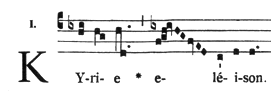
A sample of Kýrie Eléison XI (Orbis Factor) from the Liber Usualis. Listen to it interpreted.

A neume (/njm/; sometimes spelled neum)[1][2][3] is the basic element of Western and some Eastern systems of musical notation prior to the invention of five-line staff notation.

The earliest neumes were inflective marks that indicated the general shape but not necessarily the exact notes or rhythms to be sung. Later developments included the use of heightened neumes that showed the relative pitches between neumes, and the creation of a four-line musical staff that identified particular pitches. Neumes do not generally indicate rhythm, but additional symbols were sometimes juxtaposed with neumes to indicate changes in articulation, duration, or tempo. Neumatic notation was later used in medieval music to indicate certain patterns of rhythm called rhythmic modes, and eventually evolved into modern musical notation. Neumatic notation remains standard in modern editions of plainchant.

Etymology

[edit]

The word neume entered the English language in the Middle English forms newme, nevme, neme in the 15th century, from the Middle French neume, in turn from either medieval Latin pneuma or neuma, the former either from ancient Greek πνεῦμα pneuma ('breath') or νεῦμα neuma ("sign"),[4][5] or else directly from Greek as a corruption or an adaptation of the former.[6][citation needed]

Early history

[edit]

Although chant was probably sung since the earliest days of the church, for centuries it was transmitted only orally.

The earliest known systems involving neumes are of Aramaic origin and were used to notate inflections in the quasi-emmelic (melodic) recitation of the Christian holy scriptures. As such they resemble functionally a similar system used for the notation of recitation of the Qur'an, the holy book of Islam. This early system was called ekphonetic notation, from the Greek ἐκφώνησις ekphonesis meaning quasi-melodic recitation of text.

Around the 9th century neumes began to become shorthand mnemonic aids for the proper melodic recitation of chant.[7] A prevalent view is that neumatic notation was first developed in the Eastern Roman Empire.[citation needed] This seems plausible given the well-documented peak of musical composition and cultural activity in major cities of the empire (now regions of southern Turkey, Syria, Lebanon and Israel) at that time. The corpus of extant Byzantine music in manuscript and printed form is far larger than that of the Gregorian chant, due in part to the fact that neumes fell into disuse in the west after the rise of modern staff notation and with it the new techniques of polyphonic music, while the Eastern tradition of Greek orthodox church music and the reformed neume notation remains alive today.

Slavic neume notations ("Znamenny Chant") are on the whole even more difficult to decipher and transcribe than Byzantine or Gregorian neume notations.[citation needed]

Western plainchant

[edit]
"Iubilate deo universa terra" shows psalm verses in unheightened cheironomic neumes.
Digraphic neumes in an 11th-century manuscript from Dijon. Letter names for individual notes in the neume are provided.

The earliest Western notation for chant appears in the 9th century. These early staffless neumes, called cheironomic or in campo aperto, appeared as freeform wavy lines above the text. Various scholars see these as deriving from cheironomic hand-gestures, from the ekphonetic notation of Byzantine chant, or from punctuation or accent marks.[8] Each syllable of the text had a corresponding neume that indicated the note pattern to be sung. This could simply be a single note, or one of a number of melodic patterns. Cheironomic neumes indicated changes in pitch and duration within each syllable, but did not specify the pitches of individual notes, the intervals between pitches within a neume, or the relative starting pitches of different syllables' neumes. They were mnemonics, reminding singers of how the melody was sung, but do not contain enough information to reconstruct the actual music. For this reason, a significant quantity of early western plainchant, such as the Mozarabic chant of the Iberian peninsula, can only be reconstructed conjecturally because it survives only as cheironomic neumes.[9]

There is evidence that the earliest Western musical notation, in the form of neumes in campo aperto (without staff-lines), was created at Metz around 800, as a result of Charlemagne's desire for Frankish church musicians to retain the performance nuances used by the Roman singers.[10]

Presumably these were intended only as mnemonics for melodies learned by ear. The earliest extant manuscripts (9th–10th centuries) of such neumes include:

Cistercian neumes, St. Denis/St. Evrault, North France, 12th century. (Quon)iam prevenisti eum in benedictione and Offertorium. In omnem terram exivit sonus. Variation of the letter F to the left of each line.

In the early 11th century, Beneventan neumes (from the churches of Benevento in southern Italy) were written at varying distances from the text to indicate the overall shape of the melody; such neumes are called heightened or diastematic neumes, which showed the relative pitches between neumes. Despite this limitation, there have been recent advances in the interpretation of Beneventan neumes which hold out the possibility of at least tentative reconstruction of the chants.[11] A few manuscripts from the same period use digraphic notation in which note names are included below the neumes. Shortly after this, one to four staff lines—an innovation traditionally ascribed to Guido d'Arezzo—clarified the exact relationship between pitches. One line was marked as representing a particular pitch, usually C or F. These neumes resembled the same thin, scripty style of the chironomic notation. By the 11th century, chironomic neumes had evolved into square notation.[12] In Germany, a variant called Gothic neumes continued to be used until the 16th century. This variant is also known as Hufnagel notation, as the used neumes resemble the nails (Hufnägel in German) one uses to attach horseshoes.[13]

"Gaudeamus omnes", from the Graduale Aboense, was scripted using square notation.

By the 13th century, the neumes of Gregorian chant were usually written in square notation on a staff with four lines and three spaces and a clef marker, as in the 14th–15th century Graduale Aboense shown here. In square notation, small groups of ascending notes on a syllable are shown as stacked squares, read from bottom to top, while descending notes are written with diamonds read from left to right. In melismatic chants, in which a syllable may be sung to a large number of notes, a series of smaller such groups of neumes are written in succession, read from left to right. A special symbol called the custos, placed at the end of a system, showed which pitch came next at the start of the following system. Special neumes such as the oriscus, quilisma, and liquescent neumes, indicate particular vocal treatments for these notes. This system of square notation is standard in modern chantbooks.

Solesmes notation

[edit]

Various manuscripts and printed editions of Gregorian chant, using varying styles of square-note neumes, circulated throughout the Catholic Church for centuries. Some editions added rhythmic patterns, or meter, to the chants. In the 19th century the monks of the Benedictine abbey of Solesmes, particularly Dom Joseph Pothier (1835–1923) and Dom André Mocquereau (1849–1930), collected facsimiles of the earliest manuscripts and published them in a series of 12 publications called Paléographie musicale [fr]. They also assembled definitive versions of many of the chants, and developed a standardized form of the square-note notation that was adopted by the Catholic Church and is still in use in publications such as the Liber Usualis (although there are also published editions of this book in modern notation).

As a general rule, the notes of a single neume are sung to one syllable of the text. All three pitches of a three-note neume, for example, must all be sung on the same syllable. There may be cases where neumes are used to notate polyphonic music; Richard Crocker has argued that in the special case of the early Aquitanian polyphony of the St. Martial school, neumes must have been "broken" between syllables to facilitate the coordination of parts.[14] However, a single syllable may be sung to so many notes that several neumes in succession are used to notate it. The single-note neumes indicate that only a single note corresponds to that syllable. Chants that primarily use single-note neumes are called syllabic; chants with typically one multi-note neume per syllable are called neumatic, and those with many neumes per syllable are called melismatic.

Rhythmic interpretation

[edit]

The Solesmes monks also determined performance practice for Gregorian chant based on their research. Because of the ambiguity of medieval musical notation, the question of rhythm in Gregorian chant is contested by scholars. Some neumes, such as the pressus, do indicate the lengthening of notes.[contradictory] Common modern practice, following the Solesmes interpretation, is to perform Gregorian chant with no beat or regular metric accent, in which time is free, allowing the text to determine the accent and the melodic contour to determine phrasing. By the 13th century, with the widespread use of square notation, it is believed that most chant was sung with each note getting approximately an equal value, although Jerome of Moravia cites exceptions in which certain notes, such as the final notes of a chant, are lengthened.[15]

The Solesmes school, represented by Dom Pothier and Dom Mocquereau, supports a rhythm of equal values per note, allowing for lengthening and shortening of note values for musical purposes. A second school of thought, including Wagner, Jammers, and Lipphardt, supports different rhythmic realizations of chant by imposing musical meter on the chant in various ways.[16] Musicologist Gustave Reese said that the second group, called mensuralists, "have an impressive amount of historical evidence on their side" (Music in the Middle Ages, p. 146), but the equal-note Solesmes interpretation has permeated the musical world, apparently due to its ease of learning and resonance with modern musical taste.[17]

Illustrations

[edit]

Examples of neumes may be seen here: "Basic & Liquescent Aquitanian Neumes" (archive from 10 June 2006, accessed 12 September 2014), [1], [2].

Clefs

[edit]

Neumes are written on a four-line staff on the lines and spaces, unlike modern music notation, which uses five lines. Chant does not rely on any absolute pitch or key; the clefs are only to establish the half and whole steps of the hexachord: "ut", "re", "mi", "fa", "sol", "la". The clef bracketing a line indicates the location "ut" in the case of the C clef, or "fa" in the case of the F clef as shown:

C clef
F clef

Single notes

[edit]
Punctum ("point")
Virga ("rod")
Bipunctum ("two points")

The virga and punctum are of identical length. The virga is used to indicate a note within a group on which the main stress – the ictus – falls.[18] Scholars disagree on whether the bipunctum indicates a note twice as long, or whether the same note should be re-articulated. When this latter interpretation is favoured, it may be called a repercussive neume.

Two notes

[edit]
Clivis ("by slope") Two notes descending
Podatus or Pes ("foot") Two notes ascending

When two notes are one above the other, as in the podatus, the lower note is always sung first.

Three notes

[edit]
Scandicus

("climbing")

Three notes ascending
Climacus

("climactic")

Three notes descending
Torculus

("twisted")

down-up-down
Porrectus

("raised")

up-down-up

The fact that the first two notes of the porrectus are connected as a diagonal rather than as individual notes seems to be a scribe's shortcut.

Compound neumes

[edit]

Several consecutive neumes can be grouped together for a single syllable, and some of these combinations have specific names. These are two examples:

Praepunctis a note appended to the beginning is praepunctis; this example is a podatus pressus because it involves a repeated note
Subpunctis One or more notes appended at the end of a neume; this example is a scandicus subbipunctis

Other basic markings

[edit]
Flat Same meaning as modern flat; only occurs on B, and is placed before the entire neume, or group of neumes, rather than immediately before the affected note. Its effect typically lasts the length of a word and is reinserted if needed on the next word.
Custos This mark occurs at the end of a staff. It indicates what the first note of the next staff will be, as an aid to singers.
Mora Like a dot in modern notation, lengthens the preceding note, typically doubling it

Interpretive marks

[edit]

The interpretation of these markings is the subject of great dispute among scholars.

Vertical episema
(vertical stroke)
Indicates a subsidiary accent when there are five or more notes in a neume group. This marking was an invention of the Solesmes interpreters, rather than a marking from the original manuscripts.
Horizontal episema
(horizontal stroke)
Used over a single note or a group of notes (as shown), essentially ignored in the Solesmes interpretation; other scholars treat it as indicating a lengthening or stress on the note(s).
Liquescent neume
(small note)
Can occur on almost any type of neume pointing up or down; usually associated with certain letter combinations such as double consonants, consonant pairs, or diphthongs in the text. For example, in the Agnus Dei of the plainchant Missa XI (Missa Orbis factor), the first syllables of the words tollis and mundi are notated using liquescent neumes. So the second note of the neume would be used to sing the second 'l' of tollis and the 'n' of mundi.[19]
Quilisma
(squiggly note)
Always as part of a multi-note neume, usually a climacus, this sign is a matter of great dispute; the Solesmes interpretation is that the preceding note is to be lengthened slightly.

Other interpretations of the quilisma:

  • Shake or trill—William Mahrt of Stanford University supports this interpretation. This interpretation is also put into practice by the Washington Cappella Antiqua, under the direction of Patrick Jacobson.
  • Quarter-tone or accidental. The support for this interpretation lies in some early digraphic manuscripts that combine chironomic neumes with letter-names. In places where other manuscripts have quilismas these digraphs often have a strange symbol in place of a letter, suggesting to some scholars the use of a pitch outside the solmization system represented by the letter names.[citation needed]

There are other uncommon neume shapes thought to indicate special types of vocal performance, though their precise meaning is a matter of debate:[20]

  • The trigon.[21] The orthodox Solesme interpretation of this obscure three-note neume is a unison plus a third below, but there are other possibilities.[22] It appears to have originated at St. Gall, though it is also widespread in French chant sources from the 10th and 11th centuries.[23] It has been proposed that it may have a microtonal meaning, but there is "an admitted lack of conclusiveness in the arguments in favor of notes smaller than a semitone."[24]
  • The distropha and tristropha are groups of two and three apostrophes, usually of the same pitch. They probably differed from normal repeated notes (virgae or puncta) in the way they were sung. Although there is some doubt on the matter, most modern writers accept Aurelian of Réôme's description of a staccato reiteration.[25]
  • The oriscus is a single-note neume, usually found added as an auxiliary note to another neume. The name may derive from either the Greek horos (limit) or ōriskos (little hill). Its intended manner of performance is not clear. Although a microtonal interpretation has been suggested, there is possible contradicting evidence in the Dijon tonary, Montpellier H. 159.[26]
  • The pressus is a compound neume, usually involving an initial neume followed by an oriscus and a punctum. The initial neume may be a virga (in which case the virga + oriscus may be together called a virga strata), in which case the pressus indicates three notes; if the initial neume is a pes, then the compound indicates a four-note group. Just as with the oriscus itself, the interpretation is unsure. When chant came to be notated on a staff, the oriscus was normally represented as having the same pitch as the immediately preceding note.[27]

There are also litterae significativae in many manuscripts, usually interpreted to indicate variations in tempo, e.g. c = celeriter (fast), t = tenete (hold) (an early form of the tenuto), a = auge (lengthen, as in a tie). The Solesmes editions omit all such letters.

Other functions

[edit]

Neumes were used for notating other kinds of melody than plainchant, including troubadour and trouvère melodies, monophonic versus and conductus, and the individual lines of polyphonic songs. In some traditions, such as the Notre Dame school of polyphony, certain patterns of neumes were used to represent particular rhythmic patterns called rhythmic modes.

Other types

[edit]

Digital notation

[edit]

Because notation software usually focuses on modern European music notation, software that allows the user to use neumes is rare.

  • Gregorio is a software especially written for that purpose. With its own GABC-Syntax and together with LuaTeX it provides high quality output of square notation neumes and also St. Gall neumes.
  • Finale can be enhanced with Medieval 2, a third-party package devoted to early music and especially neumes.[29][30]
  • Lilypond is able to produce output using neumes.[31]
  • Some open fonts[32][33][34] for neumes are available, which can be used by common office software or scorewriters.

See also

[edit]

Notes

[edit]

References

[edit]
[edit]
Revisions and contributorsEdit on WikipediaRead on Wikipedia
from Grokipedia
A neume is an early form of used in medieval to represent the melodic contour of plainchant, serving primarily as a mnemonic aid for singers familiar with the oral tradition of , where each symbol denotes one or more successive pitches without specifying exact rhythm or height. Originating around 800 CE during the , neumes emerged as part of efforts to standardize amid diverse regional practices, evolving from earlier prosodic signs in Greco-Roman texts and ekphonetic notation for biblical readings, with significant influence from Byzantine musical traditions introduced to in the 7th–8th centuries. Initially adiastematic—lacking a staff and focusing on the rise and fall of the voice through graphic shapes like strokes (virga for ascending tones) or dots (punctum for single notes)—neumes later became diastematic in the 9th–10th centuries by aligning with guide lines or staves to indicate relative pitches, facilitating broader transmission of sacred music in manuscripts such as antiphonaries and graduals. Regional variations proliferated, including the precise St. Gall system in and the more fluid Aquitanian neumes in , each comprising compound forms like the clivis (two descending notes) or scandicus (three ascending notes), often grouped to reflect syllabic, neumatic, or melismatic styles where multiple neumes might accompany a single . By the 12th century, neumes transitioned into square notation on four-line staves, paving the way for modern mensural notation, though their ornamental and interpretive elements—such as liquescent neumes for vocal transitions—retained interpretive flexibility tied to performance practice until the standardization of the Editio Vaticana in 1903.

Etymology and Origins

Etymology

The term "neume" originates from the Greek word pneuma, meaning "breath" or "spirit," which alludes to the fluid, inflective, and breath-like nature of early chant melodies, often consisting of groups of notes sung to a single syllable. This etymological root underscores the oral and gestural qualities of plainchant performance, where neumes served as visual cues for melodic contour rather than precise pitches. The word was Latinized as neuma in medieval texts during the , particularly within Carolingian manuscripts, where it initially denoted extended melismatic passages in liturgical . One of the earliest documented uses appears in the writings of Amalar of (c. 780–850), who described the neuma triplex—a elaborate threefold —in his liturgical commentaries around 813–831, marking a key moment in the term's application to musical elements. By the late , the term had evolved in monastic scholarship to refer more broadly to the graphic signs representing these melodic inflections, as seen in the works of Notker of St. Gall (c. 840–912), who around 860–880 adapted neuma to describe the untexted melismas to which he added syllabic texts in his sequences. This adoption of neuma in was influenced by Byzantine Greek terminology during the (c. 780–900), a period of cultural revival under that incorporated Eastern liturgical and musical practices, including ekphonetic notation systems that paralleled the breath-oriented concept of . The term's integration into Latin texts facilitated the transition from purely oral traditions to written melodic guides in monastic scriptoria.

Early History

The origins of neumes can be traced to cheironomic practices in late antique and early medieval monasteries, where hand gestures directed singers during the performance of chants, particularly in the 6th to 8th centuries. These gestures, rooted in Byzantine and Oriental traditions, facilitated the oral transmission of within monastic communities, serving as visual cues for melodic inflection without fixed written forms. By the mid-8th century, such practices began influencing the development of notation in , bridging oral and written traditions. The transition to written neumes occurred around 800–900 AD in Frankish and Anglo-Saxon scriptoria, where adiastematic marks—simple inflective accents placed above the text—emerged to capture the general shape of melodies. One of the earliest surviving examples is Codex 359 from the Abbey of St. Gall, dating to the late (c. 922–926), which features these neumes as visual indicators of melodic contour for solo chants like graduals and tracts, rather than specifying exact pitches. This manuscript, produced in a Swiss monastic center, exemplifies the initial stage of notation as a mnemonic aid derived from cheironomic gestures. The Carolingian reforms under played a pivotal role in standardizing neumatic writing during the late 8th and early 9th centuries, aiming to achieve liturgical unity across the Frankish Empire by propagating a Gregorian repertoire. These efforts, driven by the need to disseminate Roman traditions, encouraged the adoption of neumes in scriptoria to support consistent performance in monasteries and churches. Early neumes had significant limitations, primarily indicating the general rise and fall of the voice to outline melodic direction, without denoting durations, absolute pitches, or precise intervals, thus depending heavily on singers' oral memory and familiarity with the tradition. This adiastematic approach preserved the fluid, interpretive nature of but required communal knowledge for accurate rendition.

Neumes in Western Plainchant

Role in Plainchant

Neumes served as the primary notational system for Western plainchant, most notably in the repertory compiled during the 9th and 10th centuries, where they indicated melodic contours over Latin liturgical texts. These symbols grouped notes into cohesive units, accommodating both syllabic styles—where closely follows the text's —and florid or melismatic elaborations that extended vocal lines for expressive effect. By visually representing the rise and fall of pitches without specifying exact intervals or durations, neumes facilitated the preservation and transmission of monophonic sacred music across monastic and communities. As mnemonic devices, neumes functioned as aids for performers steeped in , prompting recall of familiar melodies rather than providing standalone instructions. In syllabic passages, such as those in psalmody, a single neume typically aligned with one to maintain textual clarity and simplicity. Conversely, melismatic sections, exemplified by alleluias, featured multiple neumes per , enabling extended, ornate flourishes that heightened emotional and spiritual intensity. This approach reinforced the interplay between word and sound, with neumes placed directly above the text to guide singers in matching melodic arcs to linguistic accents and phrasing. In the liturgical framework of the and Divine , neumes were indispensable for standardizing performance, promoting uniformity after the Carolingian reforms while omitting precise rhythmic notation to preserve the genre's fluid, non-mensural character. This allowed for a natural, speech-like flow influenced by , where and phrasing adapted to the solemnity of worship. The notation's inherent ambiguity encouraged interpretive within established melodic outlines, bridging written records and living oral practices to ensure the chants' enduring vitality in sacred contexts.

Historical Development

The evolution of neumes in Western plainchant transitioned from adiastematic forms, which indicated only melodic contour, to diastematic notations in the 10th and 11th centuries, where symbols were heighted to show relative pitches more precisely through the addition of one to three staff lines. This shift enhanced the notation's utility for transmitting chant melodies beyond alone. A prominent early example is the Winchester Troper (c. 1000 AD), an English manuscript featuring heighted neumes often aligned with a single guiding line to denote pitch relationships in tropes and two-voice . By the , square notation began to emerge in and as a refinement of earlier rounded neumes, adopting angular, block-like shapes for improved legibility on four-line staves introduced by Guido d'Arezzo in the early 11th century. This form standardized pitch representation and facilitated wider dissemination of plainchant across monastic centers. In contrast, Gothic neumes—characterized by their lozenge-shaped, diamond-like forms—persisted in German-speaking regions until the 16th century, serving as the basis for Hufnagel (horseshoe-nail) notation in sources for and early polyphonic compositions. During the 12th and 13th centuries, the in introduced further refinements to heighted neumes, incorporating subtle variations in placement and form to suggest modal rhythms in and conductus, thereby bridging neumatic practices with the emerging systems of . These adaptations allowed for more structured rhythmic interpretation within plainchant frameworks, influencing composers like and . The widespread adoption of the five-line staff in the 15th century, particularly in polyphonic music, ultimately contributed to the decline of neumes as the primary notation, rendering them insufficient for complex durational precision; however, neumes continued to be retained in specialized chant books to preserve traditional monophonic performance.

Notation Systems and Reforms

Solesmes Notation

The Solesmes Congregation, a Benedictine monastic community dedicated to liturgical restoration, was refounded in 1833 by Dom at the Abbey of Solesmes in , with a particular emphasis on reviving authentic through paleographic research. Guéranger's efforts initiated a systematic study of medieval manuscripts beginning in the 1850s, involving key figures such as Dom Joseph Pothier, who produced an influential 1903 edition of chant books, and Dom André Mocquereau, who introduced rhythmic interpretive signs in the in 1896. This reform movement sought to purify chant performance from post-medieval alterations, drawing on over 600 manuscript facsimiles published in the Paléographie Musicale series starting in 1889 under Mocquereau's direction. Central to the Solesmes notation was the adoption of square-headed neumes placed on a four-line staff, modeled after 10th- to 12th-century diastematic manuscripts to recapture the fluid, ornamental quality of early plainchant while eliminating rhythmic corruptions introduced during the , such as those in the 16th-century Medicean editions. This system preserved the neumes' melodic contours without imposing a fixed metrical structure, allowing for a natural, speech-like flow in performance; precursors in medieval square notation from the 12th century informed this approach but were refined to align more closely with earlier unheighted neume traditions. To convey rhythmic nuances, Solesmes scholars developed subtle interpretive symbols integrated into the notation, including the horizontal episema—a short line above or below a note indicating slight lengthening for emphasis—and the vertical episema, which denotes a brief pause for phrasing. Additionally, ictic accents marked points of natural or stress, grouping notes into binary or ternary patterns to guide subtle dynamic expression without rigid bar lines or equal note values, as detailed in Mocquereau's rhythmic . These signs aimed to restore the chant's lyrical intent, evident in manuscripts like Laon 239 and St. Gall codices, fostering a style that emphasized textual prosody over measured time. The reform gained official Vatican endorsement through Pope Pius X's Tra le Sollecitudini on November 22, 1903, which mandated the restoration of and established a commission incorporating Solesmes research to produce a standardized edition. This culminated in the Editio Vaticana, released in 1908 as the authoritative chant book, featuring the Solesmes square notation and rhythmic signs for widespread liturgical use. The Solesmes notation profoundly impacted modern chant practice by providing scholas and choirs with accessible, manuscript-based resources that revived neumatic reading and performance authenticity, influencing the liturgical reforms of the Second Vatican Council in the 1960s, which reaffirmed Gregorian chant's primacy while allowing vernacular adaptations.

Regional Variations

Neume notation in medieval developed distinct regional styles, shaped by local scribal practices, liturgical traditions, and graphical conventions that influenced how melodic contours were visually represented above the text. These variations, primarily from the 9th to 12th centuries, highlight the diversity of early Western notation before broader efforts, with differences in neume shapes, heighting for pitch indication, and integration with scripts or staves. While all shared a common adiastematic or early diastematic foundation to convey general melodic direction, regional dialects emerged in key monastic and centers. St. Gall notation, centered in the Swiss monastery of St. Gall from the 9th to 11th centuries, is renowned for its angular, heighted neumes that introduced early diastematic features through vertical positioning to suggest relative pitches, as seen in foundational manuscripts like St. Gallen, Stiftsbibliothek, MS 359. This style emphasized precise melodic gestures for Gregorian chant, with neumes such as the oriscus rendered in a half-circle form to indicate sustained notes, and was widely disseminated through the abbey's scriptorium, preserving hundreds of examples that exemplify the transition from symbolic to pitch-specific notation. The angular script, often vertically oriented, distinguished it from more fluid regional forms, aiding performers in recalling familiar chants with subtle rhythmic cues. Aquitanian notation, prevalent in southwestern during the 10th to 12th centuries, features rounded and flowing neume shapes that lent a graceful, quality to the notation, particularly in troped s where melodic extensions were elaborated. These neumes, often diastematic and placed above the text without initial staff lines in early examples, evolved to include in some later sources, facilitating the notation of complex versus and sequences in regional liturgies. The style's wavy forms, as in the salicus neume for rising movements, reflected a performative emphasis on smooth vocal flow, and it persisted in manuscripts from abbeys like Moissac and , underscoring Aquitaine's role in elaboration. Breton notation, unique to northwest around the , is characterized by highly stylized neumes with angular, broken-line configurations that visually segmented pitch ascents and descents, adapted specifically for local breviaries and antiphonaries in Breton ecclesiastical contexts. This regional , influenced by insular and Frankish elements, used compact groupings like the podatus in jagged forms to denote melodic breaks, distinguishing it from smoother continental styles and tying it closely to the area's distinct liturgical customs. Surviving examples, such as those in Chartres-related codices, reveal its limited geographic scope, where neume shapes like the oriscus and quilisma often overlapped graphically but were interpreted through contextual pitch relations. Beneventan notation, developed in during the 11th century, employs compact, script-like neumes that integrate fluidly with the regional Beneventan minuscule script, creating a seamless visual in manuscripts from centers like Montecassino and . These neumes, often non-diastematic initially but heighted in later forms, supported the local Beneventan chant tradition with abbreviated, cursive strokes for efficiency in liturgical books, as evidenced in antiphonals with fine minuscule text. The style's gothic-influenced compactness allowed for dense notation in southern codices, emphasizing melodic recitation over elaborate tropes and preserving a distinct Italian variant amid broader European influences. English Winchester notation, from the 10th to 11th centuries, stands out for its innovative early use of staff lines combined with neumes, enabling more precise pitch notation in the context of polyphonic experiments documented in the Troper (Cambridge, Corpus Christi College, MS 473). This Anglo-Saxon style featured heighted neumes alongside two- or three-line staves to support additions to plainchant, reflecting Cathedral's advanced musical culture before the . Its influence extended to post-1066 reforms, as Norman scribes adapted these techniques in hybrid notations, bridging monophonic and emerging polyphonic practices in English sources.

Types of Neumes

Simple Neumes

Simple neumes represent the foundational elements of early Western musical notation, consisting of single marks that denote individual notes without groupings. These neumes emerged in the 9th and 10th centuries as adiastematic signs—lacking precise pitch height indication—and evolved into diastematic forms by the , where their vertical placement on rudimentary staves began to convey relationships. The punctum, a dot-like mark resembling a small square or , indicates a single note, typically representing a basic, relatively low pitch in monophonic plainchant. Often positioned on or between staff lines, it serves as the simplest building block for syllabic chants, where one note aligns with each , emphasizing textual clarity over melodic elaboration. In St. Gall manuscripts, such as Codex 359, the punctum frequently appears as a baseline note in recitations, underscoring unaccented s with a light, quick execution. The , an ascending stroke or apostrophe-shaped mark, denotes a single higher note, often signaling emphasis or a shift to an elevated register within the . Functioning primarily in syllabic contexts, it provides a standard duration aligned with natural speech rhythm, distinguishing it from the punctum's lighter quality. Examples in St. Gall notations, like those in Codex 381, use the virga for introductory motifs, such as on accented words like "rex" or "cor," where it may combine with interpretive signs for slight prolongation. Overall, simple neumes like the punctum and facilitated monophonic notation in plainchant, transitioning from accentual cues in adiastematic scripts to pitch-specific indicators in diastematic systems, as seen in preserved St. Gall examples that prioritize melodic contour over rhythmic precision.

Compound Neumes

Compound neumes represent melodic gestures comprising two or more notes sung on a single , distinguishing them from simple neumes by their ability to convey stepwise motion, arches, or scalar runs in plainchant melodies. These neumes became prominent in the with the advent of heighted notation on , enabling scribes to depict relative pitches more accurately and supporting the melismatic style of , where syllables are extended with elaborate vocalizations. In this system, compound neumes facilitate fluid expression of textual prosody and emotional nuance, often combining basic punctum and elements into cohesive units. Liquescent neumes, such as the cephalicus (a small-headed note indicating a , passing tone), modify compound forms for smoother phrasing. The podatus, also known as the pes or "foot," is a basic two-note compound neume where the lower pitch precedes the higher one in an ascending motion, usually a second. It serves to initiate upward melodic steps. This neume appears frequently at the beginnings of phrases, providing a foundational ascending that builds toward higher melodic peaks. In contrast, the clivis, or flex, denotes two descending notes, with the higher pitch sung first followed by a stepwise fall to the lower one. It is particularly employed at phrase endings to create a of resolution or gentle closure, reflecting the natural of speech in liturgical texts. Three-note compound neumes introduce more dynamic contours. The torculus traces a down-up-down arch, starting on a note, rising to a higher one, and returning to the starting pitch or lower, thereby imitating the undulating of spoken and adding expressiveness to syllabic sections. Similarly, the porrectus, characterized by a horizontal stroke linking its notes, follows an up-down-up pattern, often spanning a wider range; this "stretched" form ensures connections in melismas, promoting seamless transitions across pitches. Scalar compound neumes handle linear motion over multiple notes. The scandicus consists of three or more consecutively ascending notes, typically used in jubilus passages of alleluias to evoke ascending fervor and climactic intensity. Its descending counterpart, the climacus, mirrors this with a series of stepwise descents, aiding in melodic resolution and descent from high points in the chant.

Rhythmic and Melodic Interpretation

Rhythmic Modes

In early neumatic notation, spanning the 9th to 12th centuries, plainchant was characterized by a free that was non-mensural, aligning primarily with the prosody of the Latin text and breathing patterns rather than fixed temporal divisions. This approach treated neumes as mnemonic aids for melodic contour, allowing performers interpretive flexibility without specified durations, as the notation focused on pitch direction over precise timing. By the 13th century, the in introduced rhythmic modes to neumatic notation, particularly in , marking a shift toward more structured temporal organization. Composers such as and applied six distinct modes—derived from classical poetic feet, such as the trochaic (long-short) pattern—to sequences of neumes, using ligatures to indicate repeating rhythmic patterns that enhanced the complexity of sacred . These modes provided a framework for proportional durations in performance, applied especially to compound neumes in two- or three-voice compositions. The development of these modes reflected broader influences from Aristotelian theories of proportion and duration, transmitted through Boethius' 6th-century treatise De institutione musica, which emphasized numerical ratios for musical elements without imposing a strict metrical grid. ' integration of Greek concepts, including Ptolemaic and Aristotelian ideas on harmonious proportions, informed medieval theorists' views of rhythm as relational and qualitative rather than absolutely measured. Interpretations of neumatic sparked ongoing debates between equalism, which posits all as equal in length for a fluid, oratorical flow, and inegalism, advocating varied durations to reflect textual emphasis and melodic phrasing. The Solesmes Congregation, in the late 19th and early 20th centuries, sought to resolve this through a method incorporating subtle ictus points to guide nuanced inequality, preserving the free 's essence while adding gentle hierarchical pulses for ensemble coherence. Neumes served as precursors to in the 14th-century , where ligatures and mode patterns evolved into symbols denoting specific note values and proportional relationships, enabling greater rhythmic precision in polyphonic works by composers like . This transition marked the decline of modal interpretation in favor of fixed mensuration, bridging medieval plainchant practices with emerging conventions.

Interpretive Symbols

Interpretive symbols in neume notation consist of auxiliary marks and modified neume forms added to the basic melodic shapes to guide performers in nuances of phrasing, articulation, and vocal treatment, without changing the fundamental pitch sequence. These symbols emerged as chant notation evolved, allowing scribes to convey subtle expressive elements derived from . Liquescent neumes, such as the quilisma and oriscus, denote light, passing vocal effects often associated with over consonants or brief grace notes. The quilisma appears as a wavy or form, typically sung as a rapid, trembling or light oscillation on a single syllable to add fluidity and expressiveness. The oriscus, characterized by a small hook or curve, indicates a softened, contracted note that passes quickly, facilitating smooth transitions in text declamation or melodic flow. The episema serves to modify duration and emphasis within neumes. A horizontal episema, depicted as a straight line above or below a neume, signals a slight lengthening or expressive prolongation of the affected note(s) for heightened phrasing. In the Solesmes method of interpretation, a vertical episema functions as an ictus, marking a metrical accent or point of division to structure rhythm, though this usage builds on earlier horizontal forms. The apostrophus is a , comma-shaped mark appended to neumes, indicating a brief release, breath, or articulation to separate phrases or syllables crisply. It often appears at cadences or in melismatic passages to prevent blending and ensure textual clarity. The punctum deminutum, a smaller or diminished form of the basic punctum (single-note neume), specifies a shortened duration within longer melismas, helping to vary rhythmic intensity and avoid monotony in extended vocalizations. Collectively, these symbols enhance the performer's ability to convey emotional depth and textual nuance in plainchant, preserving the melody's integrity while accommodating regional performance practices. They were primarily introduced during the 10th and 11th centuries, coinciding with the refinement of neumatic scripts in Frankish and Italian centers, to address interpretive variations arising from diverse oral traditions. In modal rhythmic contexts, they provide micro-level adjustments that support broader patterns of phrasing.

Visual and Symbolic Elements

Clefs and Staff

In the initial phase of neumatic notation during the 9th and 10th centuries, systems were adiastematic, lacking a staff and using the shapes of neumes to suggest melodic contour without specifying heights. The staff emerged in the 10th century as a single line designated for the pitch F (fa), offering a visual anchor for positioning neumes more precisely within the diatonic framework of . By the 11th century, this developed into staves with three or four lines to encompass the full , incorporating additional colored lines—such as yellow for C (do)—to guide pitch identification and neume alignment. Clefs played a crucial role in anchoring these staves, with the F-clef fixed to denote the bass fa and the movable C-clef indicating the position of do, allowing adaptation to specific modes and vocal ranges. Positioned at the start of each staff line, these clefs enabled singers to orient neumes relative to key reference pitches, enhancing accuracy in performance. By the , the reliance on colored lines diminished, giving way to uncolored paired with black square neume notation, which provided greater legibility while preserving the staff's function as a pitch grid. This notation remained inherently modal and excluded chromatic elements, with clefs facilitating transposition across books to suit different liturgical contexts or needs without altering the underlying modal structure.

Examples of Neume Shapes

Neumes exhibit a variety of graphical forms that convey melodic through simple strokes, curves, and groupings on the staff. The punctum represents the most basic neume shape, appearing as a small square or placed directly on the line or space of the four-line staff, symbolizing a single, stable tone without directional emphasis. The podatus, a two-note neume indicating ascent, features two stacked note heads where the lower one is offset to the left beneath the higher one, often rendered with the upper note as a slanted for visual flow. In contrast, the torculus depicts a ternary melodic motion with a low-high-low contour, shaped like a curved hook that dips down from the first note, rises to a central peak, and descends again, resembling a or an inverted arc connecting three note heads. The quilisma serves as an ornamental neume, characterized by a zigzag or wavy line that undulates across three pitches, with the middle note elevated, evoking a trill or quavering effect through its irregular, serpentine path. Regional variations highlight the graphical evolution of these shapes, with Aquitanian neumes featuring softer, rounded curves and fluid connections, as seen in manuscripts like the , while St. Gall neumes adopt more angular, stroke-like forms with sharper angles and distinct episemata for emphasis.

Neumes in Eastern Traditions

Byzantine Notation

Byzantine notation originated in the ekphonetic system of the 8th and 9th centuries, which employed interpunction signs adapted from Greek grammatical accents to guide the tonal of scriptural readings during liturgical services. This rudimentary notation, focused on prosodic emphasis rather than precise , marked the initial step toward musical documentation in the Eastern Orthodox tradition. Over time, it evolved into the Middle Byzantine notation system, prevalent from the 12th to the 19th centuries, where neumes transitioned to an interval-based framework capable of conveying melodic contours with greater specificity. This development reflected the need to preserve the oral chant repertoire amid the empire's cultural expansions and production. Key symbols in Middle Byzantine notation include the ison, which directs the performer to sustain the current pitch; the oligon, indicating a modest ascent of one diatonic step; the petastē, signifying an ascending step with a subtle ornamental lift; and the kentēmata, representing short, ascending notes spanning a third while maintaining brevity. These neumes, often combined or modified, form the building blocks for notating hymns in the eight-mode system (ēchoi), allowing for nuanced expression within modal constraints. Their prioritizes melodic flow over rhythmic precision, relying on performer interpretation for and phrasing. The notation functions relationally, with each neume specifying the interval relative to the immediately preceding note rather than absolute pitches on a staff. The ison serves as the primary tonal , grounding the within the established mode and providing stability amid interval progressions. This approach presumes familiarity with the modal framework, enabling singers to reconstruct pitches orally while the neumes outline directional changes. Surviving manuscripts illustrate the notation's application, beginning with 9th-century examples like the Kontakarion, a collection of kontakia hymns notated with early neumes positioned above Greek or Slavonic text to aid cantors. Subsequent akoluthai volumes from the Middle Byzantine era extended this practice to comprehensive liturgical books, integrating neumes with rubrics for the full divine office. These codices, often produced in monastic scriptoria, preserved the chant's evolution across regions influenced by Byzantine liturgy. In performance, Byzantine notation facilitates isonantal polyphony characteristic of the rite, wherein a sustained drone on the ison pitch underpins the principal melodic line, fostering a resonant, layered sonic texture. This drone practice enhances modal depth without harmonic progression, distinguishing it from Western . Complementing the written symbols are oral microtonal traditions, which introduce subtle intervallic variations—such as quarter-tones within the modes—transmitted through master-apprentice training to enrich interpretive nuance.

Other Eastern Systems

In non-Byzantine Eastern Christian traditions, several neume-like systems emerged, adapting principles of melodic guidance to local liturgical practices. The Slavic Znamenny notation, originating in Kievan Rus' during the 11th century, employed kondakarian neumes characterized by hooks (kryuki) and commas to denote pitches and melodic contours in Russian Orthodox . This system evolved from Byzantine influences but developed distinct forms, with a significant reform in 17th-century Kiev led by Aleksandr Mezenets, who introduced supplementary signs (priznaki) for precise pitch indication to facilitate printing and standardization. The Armenian khaz notation, dating to the 8th-9th centuries and refined by figures like Stepanos Syunetsi, utilized circular and linear neumes placed above liturgical texts in medieval such as the 1322 Armenian Hymnaire to guide modal melodies in sacred music. These signs indicated ascending and descending intervals, rhythmic nuances, and expressive elements within an octoechos-based modal framework, preserving the oral nuances of Armenian chant in manuscripts like the 1679 . In the Georgian (Iberian) tradition, neumes known as nishnebi appeared by the in Mravaltavi manuscripts—multi-volume hymnaries compiling liturgical texts—and featured table-like symbols to specify , note lengths, and ornaments in compositions. These notations, as seen in works by hymnographers like Mikael Modrekili (fl. 970), supported complex three-part by marking pitch shifts and performance details relative to the text, predating similar developments in other regions. These systems share common traits with Byzantine notation, such as text-relative placement and interval-based indications of melodic direction rather than absolute pitches, yet incorporate regional modal scales tailored to local traditions, including the Armenian variants. Their preservation relied on an oral-written hybrid approach, where neumes served as mnemonic aids for singers trained in oral transmission, rendering them less dependent on staff lines compared to Western developments.

Modern and Digital Applications

Digital Typesetting Tools

The Gregorio project, initiated in 2006, is an suite designed for typesetting scores in square neume notation. It employs GABC, an ASCII-based input format that allows users to describe neume shapes and melodic contours using simple text characters, which are then compiled into high-quality PDF or outputs via the GregorioTeX engine. The tool fully supports Solesmes notation conventions, including rhythmic signs and interpretive symbols, making it a preferred choice for liturgical publications by monastic communities and scholars. Unicode provides standardized encoding for Eastern neumes through the block (U+1D000 to U+1D0FF), introduced in version 4.1 in 2005. This block encompasses 246 characters representing ekphonetic and neume-based notations from traditions, facilitating digital rendering in fonts such as those developed for scholarly transcription. By enabling input of these symbols, it supports cross-platform compatibility and integration into web-based or print media without . Among other digital tools, offers built-in extensions for , allowing users to create custom neume ligatures and staff configurations through its Scheme scripting language and predefined engravers like Vaticana_ligature_engraver. Similarly, Steinberg's Dorico music notation software introduced the Cantorum font in 2024, which permits plainchant input via alphanumeric codes—such as letters for pitches and numbers for neume types—streamlining the creation of square notation scores within a modern environment. These tools extend beyond basic to enable editable, scalable outputs for both Western and adapted Eastern styles. The Neumz mobile application, developed in the and launched publicly around , serves as a comprehensive digital database of , featuring over 9,000 hours of live recordings by Benedictine communities. Users can search and access chants by scanning neume notation from physical scores via the app's optical recognition, linking audio performances to digitized images for study and practice. Despite these advances, digital encoding of neumes faces significant challenges, particularly in handling complex ligatures—where multiple neume elements fuse into single glyphs—and microtonal intervals prevalent in Eastern systems like Byzantine or Armenian notation. Standards such as the Music Encoding Initiative (MEI) in XML format address these through specialized modules for neume components, but inconsistencies in rendering microtonal pitches and ligature hierarchies persist, complicating scholarly editions and interoperability across tools. Ongoing refinements in MEI guidelines aim to resolve these issues by prioritizing symbolic over visual encoding for greater precision in digital archives.

Contemporary Uses

Following the reforms of the Second Vatican Council, neumes have experienced a liturgical revival in both Catholic and Orthodox services, where they continue to convey the melodic contours of plainchant despite the introduction of vernacular languages and simplified notations. In the Roman Catholic tradition, the 1974 Graduale Romanum, edited by the monks of and published under Vatican authority, incorporates simplified square neumes alongside modern staff notation to facilitate the singing of Mass propers, aligning with the Council's emphasis on preserving as a "treasury of sacred music." Similarly, in Eastern Orthodox , Byzantine neumes remain integral to contemporary performance of chants, as seen in resources from the Greek Orthodox Archdiocese that promote their use in divine services for maintaining melodic authenticity. Scholarly editions have further sustained neumes through digital archives that enable comparative analysis of historical manuscripts. The database, initiated in the late 1980s and expanded since the 1990s, indexes over 500,000 chant records from more than 200 manuscripts (as of recent estimates), including detailed transcriptions of neumatic notations such as Volpiano and Beneventan styles, supporting musicological research on melodic variants and transmission. These resources facilitate interdisciplinary studies, allowing scholars to trace neume evolution across regions without relying on physical access to fragile originals. In 2025, the Repertorium project unearthed approximately 4,000 previously lost chants, integrating them into digital databases like Neumz to enhance access to neume-based repertoires. Educational initiatives emphasize hands-on learning of neumes to bridge ancient notation with modern . At , annual Gregorian chant sessions, such as the 2025 program, offer workshops on reading and interpreting neumes through practical singing and liturgical participation, drawing participants from global communities to study the Solesmes method. For Eastern traditions, apps like Neanes provide tools for transcribing and practicing Byzantine neumes, enabling users to compose and playback chants digitally while learning symbolic elements like ison and petasti. These tools democratize access, often integrating to teach in neumatic systems. Recordings and media have popularized neume-based performances, reconstructing rhythms implied by the notation. Founded in 1982, Ensemble Organum has produced influential recordings of medieval chants, employing neumatic analysis to revive isorhythmic and modal structures from sources like Old Roman and Gallican repertoires, influencing contemporary ensembles. Online platforms complement this with tutorials on Gregorio ABC (GABC), a for encoding neumes, as demonstrated in video guides that teach users to generate scores from medieval manuscripts for personal or choral practice. Despite these advancements, contemporary uses of neumes face challenges in balancing historical authenticity with practical accessibility, particularly in and transcription. Debates persist over rhythmic interpretation—such as equalism versus Solesmes' subtle phrasing—highlighting how modern notations can obscure neumatic nuances, leading to calls for hybrid systems that preserve symbolic intent without alienating learners. Ecumenical exchanges between Western and Eastern traditions, including joint workshops on shared neumatic origins, address these tensions by fostering on melodic reconstruction, though differences in symbolic conventions complicate unified approaches.

References

Add your contribution
Related Hubs
User Avatar
No comments yet.