Hubbry Logo
Koklass pheasantKoklass pheasantMain
Open search
Koklass pheasant
Community hub
Koklass pheasant
logo
8 pages, 0 posts
0 subscribers
Be the first to start a discussion here.
Koklass pheasant
Koklass pheasant
from Wikipedia

Koklass pheasant
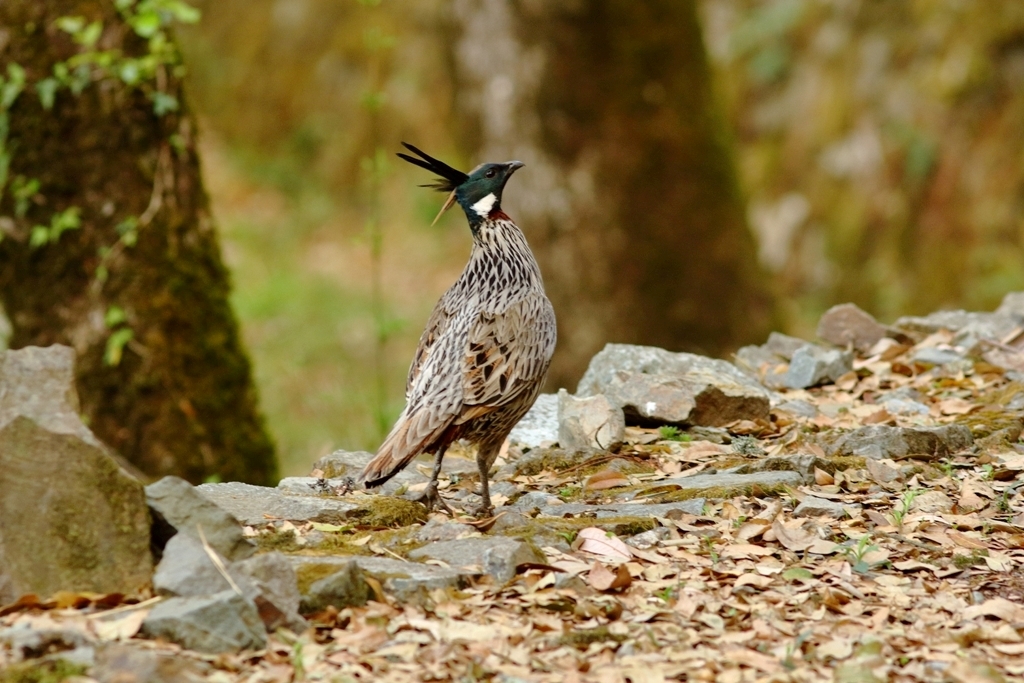
Male at Pangot, Uttarakhand, India
Female at Yichang, Hubei, China
Scientific classification Edit this classification
Kingdom: Animalia
Phylum: Chordata
Class: Aves
Order: Galliformes
Family: Phasianidae
Subfamily: Phasianinae
Genus: Pucrasia
G.R. Gray, 1841
Species:
P. macrolopha
Binomial name
Pucrasia macrolopha
(Lesson, 1829)

The koklass pheasant (Pucrasia macrolopha) is a species of gamebird, being closely related to progenitive grouse that lived during the Miocene. They are distantly related to pheasants and are most closely related to grouse and turkeys. Koklass are the only species in the monotypic genus Pucrasia. Both the words koklass and pucrasia have been onomatopœically derived from the bird's territorial call.[2]

Koklass are boreal adapted species which separate into three distinct species groups. They are one of the few gamebirds that regularly fly uphill and are capable of sustained flights of many miles. They are monogamous with a slight tendency toward social polyandry. Both parents rear the chicks. Koklass are largely vegetarian for much of the year consuming pine nuts, pine shoots, bamboo shoots and seeds. They are highly insectivorous during the warmer months that coincide with nesting and chick-rearing. During this phase of their life cycle they live almost exclusively on ants but also are documented consuming catkins, pollen and fruit.

P. m. xanthospila
Female koklass pheasant (Pucrasia macrolopha)

The koklass pheasant is a polytypic species, with nine recognized subspecies:[3]

This entry deals with the subspecies P. m. biddulphi, which ranges from Kashmir to Kullu in India. With exception of the subspecies P. m. nipalensis, P. m. castanea and P. m. macrolopha, which are endemic to the southern side of northwest and western Himalaya, the other five are confined to China and Mongolia.

The koklass pheasant is a medium-sized elusive bird confined to high altitude forests from Afghanistan to central Nepal, and in northeastern Tibet to northern and eastern China. Upper parts of male koklass pheasant are covered with silver-grey plumage streaked velvety-black down the centre of each feather, and it has the unique feature of a black head, chestnut breast and prominent white patches on the sides of neck. The females differ from males in above characters and instead their upper parts are covered with pale brown plumage. Both sexes, however, have distinct elongated tails tipped with pale feathers. The males are known to weigh about 1135–1415 g and the females, about 1025–1135 g, with the body length varying from 58 to 64 cm and 18–22 cm respectively. Immature and juveniles resemble adult females in plumage pattern.

Like the western tragopan, it does not extend its range above the tree line. One of the less colourful pheasants, the koklass exhibits moderate sexual dimorphism. Though they skulk under bushes, which makes direct sighting difficult, they give loud chorus/predawn calls during the breeding season and during autumn, revealing their presence and allowing the populations to be estimated.[4] They remain in pairs or small family groups throughout the year. They nest on the ground and spend the nights roosting on trees, or under rock overhangs.

[edit]

References

[edit]
Revisions and contributorsEdit on WikipediaRead on Wikipedia
from Grokipedia
The Koklass pheasant (Pucrasia macrolopha) is a medium-sized, ground-dwelling gamebird in the family , notable for its and elusive behavior in forested mountain habitats. Adult males measure 58–64 cm in length and weigh 1,135–1,415 g, featuring a striking silvery-grey body plumage with a breast stripe, a prominent white neck patch, and a long, dark greenish-black crest that stands erect when alarmed; females are smaller at 52.5–56 cm and 930–1,135 g, with camouflaged streaky brown feathers, a shorter crest, and a faint white neck patch. Native to the Himalayan and adjacent mountain ranges, the species has a broad distribution spanning approximately 6.6 million km² across eastern , Pakistan, India, , , northern , and central to eastern , from 1,350 m up to 4,000 m elevation. It prefers dense temperate and subalpine coniferous forests with thick cover, acting as an altitudinal migrant by descending to lower elevations (as low as 370 m) during winter to avoid snow. Koklass pheasants are shy and primarily terrestrial, often foraging singly, in pairs, or in small family groups while scratching the for food, though they can fly strongly uphill when flushed. Their omnivorous diet includes matter such as seeds, pine nuts, berries, , and tubers, supplemented by , grubs, and worms, particularly during breeding season. Despite a global of unknown but estimated to be decreasing overall, the faces localized declines from due to and a 1.5% loss of tree cover within its range over the past three generations, compounded by heavy for and ; it is classified as Least Concern on the (as of 2024).

Taxonomy and systematics

Etymology and naming

The "koklass" is an onomatopoeic derivation from the male's loud, ringing territorial call, which sounds like "kok-kok-lass," and is also reflected in local names such as "pokrass" in . This name has been adopted in English ornithological literature since the , drawing from indigenous Himalayan languages where similar vocal imitations describe the . The scientific name Pucrasia macrolopha was originally described as Satyra macrolopha by French naturalist René Primevère Lesson in 1829, based on specimens from the Hills in Kumaon (then part of British India). The genus Pucrasia was later established by British zoologist in 1831, latinizing a vernacular onomatopoeic term from the bird's cry, akin to "pukras" in local dialects. The specific epithet macrolopha derives from "makros" (long) and "lophos" (crest), referring to the prominent elongated crest on the male's head. The koklass pheasant occupies the monotypic genus Pucrasia within the family and order , representing a basal lineage among pheasants. Phylogenetic analyses place it as the to the comprising turkeys and , with evolutionary roots tracing to ancestral phasianids from the epoch, around 23–5 million years ago.

Subspecies

The Koklass pheasant (Pucrasia macrolopha) is a polytypic comprising nine recognized that exhibit geographic variation in coloration, pattern intensity, and minor differences in size and crest structure, reflecting adaptations to diverse high-altitude environments across . These variations include differences in the extent of , , and tones on the upperparts and underparts, as well as tail markings, though detailed genetic studies on subspecific boundaries remain limited. The subspecies are distributed from the western Himalayas eastward to central and eastern China, with the following delineations based on modern taxonomic assessments:
  • P. m. castanea: Found in eastern and adjacent northwestern (including ). This subspecies features deep tones over the ventral and mantle, with reduced on the , increased pigmentation on the back, and sides and flanks.
  • P. m. biddulphi: Occurs in the of (extending to parts of northern ). It is characterized by extending over the hindneck to form a collar, darker maroon ventral with margins, rufous-buff , and sides and flanks.
  • P. m. macrolopha (nominate): Inhabits the from central () to western . The nominate form displays the standard with a long buff-and-dark-green crest, glossy dark green head and neck, white lateral neck patch, upperparts, a ventral line, and outer feathers tipped with and white; the underparts are with on the mantle and on the secondaries and rectrices.
  • P. m. nipalensis: Restricted to west-central . This shows intense with dorsal edged in , on the mantle and hindneck, and nearly sides and flanks.
  • P. m. meyeri: Distributed in south-central , from western and southwestern to northwestern , with historical occurrence (now extinct) in southeastern . variations include reddish tones in some populations, though specific traits are less documented compared to Himalayan forms.
  • P. m. ruficollis: Occurs in central , from southern and to western . It is distinguished by a collar and browner overall tones relative to western subspecies.
  • P. m. xanthospila: Found in northeastern , from southern northeastward to southwestern . This subspecies exhibits yellow-spotted markings in the , contributing to paler or more contrasted patterns.
  • P. m. joretiana: Limited to central-eastern in southwestern . It shows browner with reduced tones compared to the nominate.
  • P. m. darwini: Inhabits central and eastern , from to (extinct in northwestern and northern ). This form is noted for slightly larger body size and variations in color intensity, including darker or more saturated hues.
These subspecific distinctions, primarily based on early 20th-century observations and recent range mapping, highlight the species' clinal variation without clear genetic demarcation in available studies.

Physical description

Plumage and sexual dimorphism

The male Koklass pheasant (Pucrasia macrolopha) displays a silver-grey body characterized by lanceolate feathers with central black shaft-streaks, creating a patterned appearance. The head and are glossy dark greenish-black, featuring prominent white crescent-shaped patches on the sides of the , a maroon breast band, and an elongated tail with pale buff tips and dark cross-bars. A distinctive dark greenish-black crest adorns the crown, and the bare and orbital is red, though the face itself is fully feathered, unlike many other pheasants. In contrast, the female exhibits cryptic pale brown overall, marked with buff streaks and barring that provide effective in forested environments. She has a shorter crest than the male and retains red orbital skin, but lacks the vibrant colors and bold patterns of the male. Juveniles closely resemble adult s in but appear duller, with less distinct streaking. The Koklass pheasant shows moderate , with males possessing more ornate and contrasting relative to the subdued tones of females. Both sexes undergo a seasonal molt in late summer, replacing worn feathers post-breeding. This dimorphism has adaptive significance: the male's conspicuous coloration and patterns facilitate visual displays for mate attraction and territorial defense, while the female's muted, disruptive patterning enhances concealment during nesting and in dense vegetation.

Size, weight, and measurements

The Koklass pheasant exhibits in size, with males generally larger than females. Adult males measure 58–64 cm in total length, including a of 22–28 cm, and weigh 1135–1415 g. Adult females are smaller, with a total length of 52.5–56 cm, a of 17–19.5 cm, and a weight of 930–1135 g.
MeasurementMalesFemales
Total length58–64 cm52.5–56 cm
Tail length22–28 cm17–19.5 cm
Wing length23.5–25.5 cm21.5 cm
(expanse)73–76 cm70–72.5 cm
1135–1415 g930–1135 g
The bill measures approximately 2.5–3 cm from tip to , while the tarsus is 6–7 cm long, contributing to the species' robust build and strong legs suited for terrestrial . Variations in these measurements are minimal across populations, though high-altitude , such as those in the , tend to be slightly larger overall.

Distribution and habitat

Geographic range

The Koklass pheasant (Pucrasia macrolopha) is native to the and adjacent ranges, spanning from northeastern eastward through , northern (including states such as Jammu and Kashmir, , , , and ), , , and into (particularly , , , , , and eastern provinces like , , and ), with historical marginal occurrence in northern . Subspecies distributions contribute to this broad pattern, with western forms like P. m. macrolopha and P. m. castanea confined to the Hindu Kush-Himalaya region, while eastern forms such as P. m. meyeri and P. m. xanthospila extend into northern and southern . The species occupies elevations from 370 m to 4,000 m, with records extending up to 4,500 m in some areas. It is an altitudinal migrant, with seasonal downslope movements of up to 1,000 m to lower elevations in winter in response to snow cover and resource availability, though it does not undertake long-distance migrations. Populations are isolated between the western (Afghanistan-Pakistan-Nepal-Bhutan-India) and eastern (China-Myanmar) segments of the range, reflecting geographic barriers and subspecies boundaries. The historical range closely matches the current distribution, which remains stable in overall extent at approximately 6,600,000 km² as of 2023 but has become increasingly fragmented due to human-induced alterations like , agricultural expansion, and development.

Habitat preferences

The Koklass pheasant (Pucrasia macrolopha) primarily inhabits moist temperate coniferous forests dominated by species such as (silver fir), Picea smithiana (West Himalayan spruce), and (blue pine), often intermixed with broadleaf trees like Quercus spp. (oaks) including Quercus floribunda and Quercus semecarpifolia. These forests feature a dense of shrubs such as cotinifolium, lycium, and , along with thickets that provide essential cover. The species avoids open grasslands or heavily disturbed areas, favoring closed-canopy environments with thick vegetation layers for concealment and protection. Typically found at elevations between 2,200 and 3,400 meters in breeding areas, the Koklass pheasant selects steep slopes (up to 72°) and rugged terrain with rocky outcrops and cliffs for roosting and escape cover. Ground cover in preferred sites includes leaf litter, , ferns, and grasses such as , which support while maintaining humidity and camouflage. These conditions are most prevalent in the Himalayan foothills and mid-mountain zones, where the bird's distribution aligns with forested slopes extending from through and to . Within these forests, the Koklass pheasant favors microhabitats at forest edges, natural clearings with fallen logs, and glades featuring dense undergrowth or scrub up to 3-4 meters tall. It shows sensitivity to canopy closure, with higher suitability in areas exceeding 70% cover, where thick overhead branches offer roosting sites and reduce predation risk. Seasonally, individuals shift to lower altitudes (down to as low as 370 m, though typically 1,350–1,600 m) during winter to access snow-free areas with milder conditions and available food resources.

Behavior and ecology

Daily activity and social behavior

The Koklass pheasant (Pucrasia macrolopha) is a diurnal species with peak activity in the early morning, when males vocalize from elevated perches between 5 and 7 a.m., followed by foraging on forested slopes. It displays shy and elusive behavior, preferring to skulk in dense undergrowth and cover while avoiding open areas, with pairs or individuals feeding slowly uphill from water sources. When flushed by potential threats, it typically runs rapidly into cover or takes a short, dropping flight downhill, though it demonstrates capability for sustained and skillful flight through trees when necessary. Socially, the species is generally monogamous, with pairs maintaining strong bonds year-round and exhibiting little attraction to form large flocks. During the non-breeding season, small family groups may form, consisting of parents and offspring that associate until early spring before dispersing into pairs; observed mean group sizes range from 1.4 to 1.7 individuals, predominantly solitary, paired, or mixed-sex groupings of up to three or more post-monsoon. At night, Koklass pheasants roost in trees, often deep within , returning to favored perches and occasionally sharing sites as pairs during the breeding season; they may also use rock overhangs for cover. Anti-predator strategies emphasize wariness and concealment, with individuals freezing in place, running into thick cover, or ascending to trees upon detection of danger, supplemented by sharp warning calls to alert companions.

Diet and foraging

The Koklass pheasant (Pucrasia macrolopha) is primarily herbivorous, with plant matter forming the majority of its diet throughout the year. Key food sources include pine nuts, , seeds, berries, tubers, and green shoots such as those from and understory vegetation. Fecal analyses from Himalayan populations confirm that dominate, with major and minor contributions from species like , mosses, , Arundinella nepalensis, and various ferns, comprising over 90% of identifiable items across seasons. During warmer months, particularly summer and the breeding season, the diet shifts to include a substantial insectivorous component for protein, with such as , beetles, worms, caterpillars, grubs, grasshoppers, and small moths making up 10-20% or more of intake. Gut contents and observations indicate higher consumption of these items to support reproductive demands, while winter foraging relies more heavily on persistent nuts, seeds, and tubers when insect availability declines. Foraging occurs mainly on the ground, where individuals scratch and dig deep scrapes—up to a foot into , turf, or leaf litter—to uncover , often in pairs or small family groups with the male leading. Activity peaks at dawn and dusk, focusing on dense undergrowth or open forest clearings without the use of tools, and grit is ingested to aid of tough material.

Reproduction and breeding

The Koklass pheasant (Pucrasia macrolopha) exhibits a breeding season that typically spans to in its northern range and March to May in the southern portions of its distribution, often triggered by at higher elevations. This timing aligns with the onset of warmer conditions in the Himalayan forests where the species resides. The is monogamous, with pairs forming lasting bonds that persist year-round, facilitating coordinated reproductive efforts. Courtship involves males performing displays to attract and maintain pair bonds, though detailed observations are limited due to the ' secretive nature in dense undergrowth. Nests are constructed as simple ground scrapes, typically hidden in thick near boulders, tree trunks, or under bushes, and lined with available grass, leaves, or turf debris for and insulation. Clutch sizes average 5–7 eggs, ranging exceptionally up to nine, with eggs being pale yellowish to deep buff in color and marked with reddish-brown spots or blotches; measurements average about 52 mm × 37 mm. Incubation is carried out primarily by the female over a period of 26–27 days in , though wild durations may vary slightly; the male remains nearby to provide during this phase. Upon , the precocial chicks are mobile and follow both parents, which share responsibilities for brooding and leading to foraging areas rich in essential for early growth. Both parents contribute to chick-rearing until independence, typically achieved after several months, though specific fledging timelines are not well-documented.

Vocalizations and communication

The male Koklass pheasant produces a distinctive territorial call, typically delivered from an elevated arboreal at dawn during the breeding season, consisting of a rhythmic series of 4–5 harsh, explosive notes often rendered as "kok-kok-kok" or "kok-kok-kar-kuk," which can last up to 50 minutes in choruses. This call, from which the species name is onomatopoeically derived, serves primarily for defense and mate attraction, echoing through forested habitats to establish dominance and signal availability. These vocalizations are also employed in spring call counts for population monitoring, allowing researchers to estimate densities in remote Himalayan regions without direct . Alarm calls in the Koklass pheasant include sharp, barked notes such as an explosive "karrh-kar" or vocalizations, used by males to deter predators or intruders, while females may produce softer clucking sounds to communicate with chicks for group coordination and protection. These calls function to alert the group to threats, facilitating evasion in dense environments. Acoustically, Koklass pheasant calls feature a broad frequency range of 0.2–8.6 kHz, with male territorial notes exhibiting lower pitches suited for long-distance through humid, temperate forests, while sex-specific variations in pitch help distinguish roles in communication. These traits enhance signal clarity amid , supporting both social cohesion and .

Conservation status

Population and IUCN assessment

The Koklass pheasant (Pucrasia macrolopha) is assessed as Least Concern on the (as of 2016), a classification that has remained unchanged since 2000. This status reflects its extensive geographic range of over 6,600,000 km² across the and extends into parts of , where the population does not meet the criteria for Vulnerable categories, such as a small population size or rapid decline exceeding 30% over three generations. Consequently, the species faces no immediate risk of in the wild. The global remains unquantified, though the is regarded as widespread and reasonably common throughout its range. Regional estimates provide some insight; for instance, in , the is approximated at 100–10,000 breeding pairs (as of 2009). Populations of specific , such as P. m. joretiana and P. m. darwini, are estimated to number fewer than individuals each (as of 2002). Overall population trends are suspected to be decreasing, driven primarily by habitat loss, at a slow rate of less than 5% over the past three generations. Declines appear more significant in unprotected areas of the , where human pressures are intensifying, while populations in core Chinese ranges remain relatively stable. In optimal moist habitats, density estimates from field surveys range from 2.1 birds per km² in the western Himalayas to approximately 3.6 calls per km² in parts of , with monitoring typically relying on auditory call counts during the breeding season to assess abundance without direct disturbance. Recent surveys, such as those in 2023 by the World Pheasant Association in Machiara National Park, , recorded 52 individuals, indicating ongoing local monitoring efforts.

Threats

The Koklass pheasant faces significant habitat loss primarily due to from and fuelwood collection, which degrade the moist temperate forests essential for its survival. Livestock grazing further exacerbates this by reducing vegetation, limiting cover and opportunities. Tree cover within its range has declined by 1.5% over three generations, reflecting ongoing . Illegal and pose a major threat, particularly in and , where the bird is targeted for , , and traditional uses such as feathers in local . These activities, often conducted near human settlements, contribute to localized population reductions despite legal protections. development, including roads and large , fragments forests and disrupts migration corridors, increasing collision risks and isolation. For instance, projects like the Diamer Bhasha and Dassu in overlap substantial suitable areas, leading to alterations in key valleys. Climate change is projected to alter the by shifting suitable to higher altitudes, with potential loss of up to 72.85% by 2070 under severe scenarios, particularly affecting breeding grounds. These pressures contribute to suspected overall declines, though rates remain below 5% over three generations. Threats are more intense in the western range, from through and , due to higher rates of , infrastructure expansion, and human encroachment, compared to relatively protected eastern areas in and where national parks mitigate some pressures.

Conservation measures

The Koklass pheasant (Pucrasia macrolopha) receives legal protection under Appendix III, which regulates international and includes listings in countries such as and to prevent exploitation. In , it is safeguarded by the Wildlife Protection Act of 1972, prohibiting and , while in , it falls under the National Parks and Wildlife Conservation Act of 1973, which bans illegal capture and imposes penalties for violations. Nationally in , the species is classified under second-class state protection, restricting and habitat disturbance. Significant portions of the Koklass pheasant's range are encompassed by protected areas, including the in , where the species inhabits temperate forests between 1,800 and 3,200 meters elevation. In , it occurs within multiple sites such as Annapurna Conservation Area, , , , and Shey-Phoksundo National Park, which collectively support habitat management and monitoring. In , the Qomolangma National Park in protects high-altitude forest habitats essential for the species, contributing to overall range coverage where approximately 68% of the mapped area falls within Key Biodiversity Areas. Conservation efforts emphasize habitat restoration through reforestation and control of degradation factors like forest fires and overgrazing, particularly in Nepal's community forests and protected areas, with allocated budgets for managing degraded grasslands. Anti-poaching patrols are conducted in collaboration with local law enforcement in India and Nepal, including mobilization of community-based organizations to curb illegal hunting and trade. Community awareness programs in Nepal and Bhutan promote eco-tourism, local training in birdwatching and organic farming, and stewardship to reduce habitat pressures, while research initiatives utilize habitat suitability modeling to identify priority areas for intervention. A 2024 study on habitat suitability in moist temperate forests recommended increased awareness and stricter enforcement of legal protections to address ongoing threats. Internationally, monitors the species through its DataZone (updated 2024), identifying seven Key Biodiversity Areas and supporting broader conservation via partnerships. The World Pheasant Association contributes to global programs, including surveys and action plans that integrate Koklass pheasant protection with other , such as the 2023 monitoring in . remains limited, with exploratory programs in assessing feasibility for ex-situ conservation, though no large-scale reintroduction efforts are currently implemented. Future recommendations include stricter enforcement of bans across range countries, expansion of protected areas to enhance connectivity, and integration of strategies into management plans to address shifting suitability due to warming trends.

References

Add your contribution
Related Hubs
User Avatar
No comments yet.