Hubbry Logo
PylorusPylorusMain
Open search
Pylorus
Community hub
Pylorus
logo
8 pages, 0 posts
0 subscribers
Be the first to start a discussion here.
Pylorus
Pylorus
from Wikipedia
Pylorus
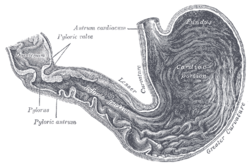
Inside of the stomach (pylorus labeled at center left)
Details
SynonymPyloric region, pyloric part
Identifiers
Latinpylorus
Greekπυλωρός
MeSHD011708
TA98A05.5.01.017
TA22930
FMA14581
Anatomical terminology

The pylorus (/pˈlɔːrəs/ or /pɪˈlrəs/) connects the stomach to the duodenum. The pylorus is considered as having two parts, the pyloric antrum (opening to the body of the stomach) and the pyloric canal (opening to the duodenum). The pyloric canal ends as the pyloric orifice, which marks the junction between the stomach and the duodenum. The orifice is surrounded by a sphincter, a band of muscle, called the pyloric sphincter. The word pylorus comes from Greek πυλωρός, via Latin. The word pylorus in Greek means "gatekeeper", related to "gate" (Greek: pyle) and is thus linguistically related to the word "pylon".[1]

Structure

[edit]
Diagram from cancer.gov:
1. Body of stomach
2. Fundus
3. Anterior wall
4. Greater curvature
5. Lesser curvature
6. Cardia
9. Pyloric sphincter
10. Pyloric antrum
11. Pyloric canal
12. Angular incisure
13. Gastric canal
14. Rugal folds

The pylorus is the furthest part of the stomach that connects to the duodenum. It is divided into two parts, the antrum, which connects to the body of the stomach, and the pyloric canal, which connects to the duodenum.[2]

Antrum

[edit]

The antrum also called the gastric antrum or the pyloric antrum is the initial portion of the pyloric region. It is near the bottom of the stomach, proximal to the pyloric sphincter, which separates the stomach and the duodenum. It may temporarily become partially or completely shut off from the remainder of the stomach during digestion by peristaltic contraction of the prepyloric sphincter; it is demarcated, sometimes, from the pyloric canal by a slight groove.

Canal

[edit]

The pyloric canal (Latin: canalis pyloricus) is the opening between the stomach and the duodenum.[3] The wall thickness of the pyloric canal is up to 3 millimeters (mm) in infants younger than 30 days,[4] and up to 8 mm in adults.[5]

Sphincter

[edit]

The pyloric sphincter, surrounding the pyloric orifice is a strong ring of smooth muscle at the end of the pyloric canal which lets food pass from the stomach to the duodenum. It acts as a valve, controlling the outflow of gastric contents into the duodenum[6] and release of chyme. Its function is modulated by both the central and enteric nervous systems.[7] It receives sympathetic innervation from the celiac ganglion.

Histology

[edit]
Microscopic cross-section of the pylorus

Under microscopy, the pylorus contains numerous glands, including gastric pits, which constitute about half the depth of the pyloric mucosa. They consist of two or three short closed tubes opening into a common duct or mouth. These tubes are wavy, and are about one-half the length of the duct. The duct is lined by columnar cells, continuous with the epithelium lining the surface of the mucous membrane of the stomach, the tubes by shorter and more cubical cell which are finely granular. The glands contain mucous cells and G cells that secrete gastrin.[8]

The pylorus also contains scattered parietal cells and neuroendocrine cells. These endocrine cells include D cells, which release somatostatin,[9] responsible for shutting off acid secretion. (There is a second hormone-sensitive population near the fundus.) Unstriated muscles, which are entirely involuntary, are located at the pylorus.

Function

[edit]

The pylorus is one component of the gastrointestinal tract. Food from the stomach, as chyme, passes through the pylorus to the duodenum. The pylorus, through the pyloric sphincter, regulates entry of food from the stomach into the duodenum.

Clinical significance

[edit]

In such conditions as stomach cancer, tumours may partly block the pyloric canal. A special tube can be implanted surgically to connect the stomach to the duodenum so as to facilitate the passage of food from one to the other. The surgery to place this tube is called a gastroduodenostomy.

Stenosis

[edit]

Pyloric stenosis refers to a pylorus that is narrow. This is due to congenital hypertrophy of the pyloric sphincter. The lumen of the pylorus is narrower, and less food is able to pass through. This problem is often detected in the early weeks of life. When it is present, a newborn baby may projectile vomit after eating, but despite vomiting remain hungry. Pyloric stenosis may be managed by the insertion of a stent, or through surgical cutting of the pyloric sphincter, a pyloromyotomy.[10]

Other

[edit]
  • Pyloric tumors
    • Pyloric gland adenoma[11]

Additional images

[edit]

See also

[edit]

References

[edit]
[edit]
Revisions and contributorsEdit on WikipediaRead on Wikipedia
from Grokipedia
The pylorus is the distal, funnel-shaped portion of the that connects the gastric antrum to the , the first part of the , and is characterized by the pyloric , a ring of that controls the regulated release of —partially digested food mixed with gastric juices—into the . The pyloric functions as both a and , allowing the passage of liquids and small particles (typically less than 2 mm in size) while retaining larger solids for further grinding by antral , thereby preventing backflow and optimizing nutrient absorption in the . Anatomically, the pylorus features a thickened muscularis layer, primarily composed of circular smooth muscle continuous with the antrum but distinct from the duodenum, forming a high-pressure zone that maintains basal tone. This structure is supported by a reduced network of (ICC), which generate slow-wave electrical activity to coordinate contractions, and is innervated by the via the as well as extrinsic vagal pathways. Physiologically, pyloric function is modulated by a balance of excitatory neurotransmitters like and tachykinins, which promote contraction, and inhibitory agents such as , which facilitate relaxation during gastric emptying; vagal stimulation enhances outflow by reducing resistance, while disruptions like can impair this process. The pylorus plays a critical role in overall gastric , adapting outflow to physiological needs by responding to factors like meal composition—emptying liquids faster than solids—and hormonal signals, ensuring efficient and preventing conditions such as when dysfunctional.

Anatomy

Gross structure

The pylorus is the distal portion of the , serving as the region that connects the to the through the pyloric orifice. It is anatomically divided into three primary components: the pyloric antrum, the pyloric , and the pyloric sphincter. The pyloric antrum represents the funnel-shaped proximal widening of this region, transitioning from the broader gastric body. The pyloric forms a narrow channel distal to the antrum, measuring approximately 3 to 4 cm in length in adults. Its muscular wall thickness ranges from 3 to 8 mm in normal adults, compared to up to 3 mm in infants. The pyloric sphincter consists of a thickened ring of circular that encircles the distal end of the , regulating passage into the . Positioned between the gastric body superiorly and the first part of the inferiorly, the pylorus lies at the level of the (approximately L1 vertebral level). Anteriorly, it relates to the liver (specifically the left lobe and quadrate lobe) and the anterior . Posteriorly, it is adjacent to the head of the , the , and the . The drapes over its anterior surface, while the attaches nearby along the lesser curvature. The arterial blood supply to the pylorus arises primarily from the gastroduodenal artery, a branch of the , with contributions from the right gastro-omental (gastroepiploic) artery. Venous drainage follows the arterial supply, ultimately converging into the . Lymphatic drainage occurs via vessels that accompany the arteries, flowing to the suprapyloric and subpyloric lymph nodes before reaching the celiac nodes.

Microscopic structure

The pyloric mucosa is characterized by shallow gastric pits and short, branched glands, distinguishing it from the deeper pits and longer glands of the gastric body. The surface is lined by a composed primarily of mucous surface cells that secrete a protective layer. Within the glands, mucous neck cells predominate, producing alkaline for lubrication and protection, while parietal cells are present in reduced numbers compared to the fundic region, contributing limited secretion. Chief cells, which secrete pepsinogen, are also fewer in number, reflecting the pylorus's primary role in production rather than . Enteroendocrine cells include prominent G cells that secrete to stimulate production and D cells that release to inhibit release, both concentrated in the antrum and pyloric region. The submucosa underlying the pyloric mucosa consists of rich in blood vessels, lymphatics, and the submucosal (Meissner's) , which provides parasympathetic innervation to regulate glandular secretions and local blood flow. The muscularis externa of the pylorus features three distinct layers of : an inner oblique layer, a prominent middle circular layer that is significantly thickened to form the pyloric , and an outer longitudinal layer. This thickening of the circular muscle, which can appear as reinforced bundles in histological sections, enables controlled contraction to regulate chyme passage into the . , distributed throughout the muscularis layers particularly around the myenteric (Auerbach's) , serve as pacemaker cells to coordinate spontaneous electrical slow-wave activity and . The outermost serosa is a thin layer of visceral consisting of simple squamous overlying a subserosal layer, providing lubrication and attachment within the . Unique to the pylorus compared to the gastric body are the absence of prominent , resulting in a smoother mucosal surface, and a focus on protective mucous secretions over enzymatic activity. In the sphincter region, the muscularis can exhibit enhanced layering in histological models, sometimes described as up to three to four bundled strata for reinforced function. Species variations exist, notably in models where the pylorus shows fewer prominent G cells and overall reduced - and somatostatin-secreting cells compared to humans, affecting endocrine studies.

Development

Embryonic origins

The pylorus originates from the posterior foregut endoderm during the fourth week of gestation, when the primitive gut tube differentiates into foregut, midgut, and hindgut regions, and the stomach begins as a fusiform dilation at the caudal end of the foregut. This initial formation involves endodermal proliferation and surrounding splanchnic mesoderm, establishing the foundational junction between the developing stomach and duodenum. Subsequent elongation and rotation occur primarily between weeks 5 and 7, as the stomach rotates 90 degrees clockwise around its longitudinal axis, positioning the pyloric region superiorly and to the right while the duodenum assumes a C-shaped configuration around the pancreas; this process refines the stomach-duodenum junction and orients the pylorus for its role in gastric outflow. Key genetic factors guide pyloric specification, with Sonic hedgehog (Shh) expressed in the endodermal playing a central role in signaling to the adjacent to pattern the pyloric sphincter through induction of downstream targets like BMP4 and transcription factors. Shh promotes mesenchymal proliferation and differentiation, ensuring proper epithelial-mesenchymal interactions for sphincter formation, as evidenced by reduced circular thickness and pyloric defects in Shh knockout mouse models. Complementing this, the Foxf1 gene, a downstream effector of Shh signaling, contributes to mesenchymal development in the derivatives, including the and pylorus, by regulating and differentiation in the splanchnic . The antrum, pyloric canal, and emerge through differential mesodermal growth, where localized proliferation of precursors in the caudal leads to thickening of the circular muscle layer by the eighth week of , distinguishing the pyloric region from the proximal stomach. This process involves epithelial signals like Shh directing mesodermal , forming a functional at the gastro-duodenal junction. Pyloric initiates during the fetal period, with measurable thickening observed in embryos as early as 5 mm and continuing through the third trimester, though it reaches peak density postnatally in normal development. Developmental anomalies, such as congenital pyloric , arise from arrested canalization or failed recanalization of the between weeks 5 and 12, often linked to genetic disruptions in epithelial-mesenchymal signaling; similarly, malrotation results from incomplete 270-degree counterclockwise rotation of the during weeks 6 to 10, potentially affecting pyloric positioning. Early descriptions of pyloric embryology trace to the late , with Wilhelm His's seminal work in the using serial sectioning of human embryos to document gut tube differentiation and regionalization, laying foundational observations on foregut-derived structures like the . Modern insights, derived from models, have elucidated molecular mechanisms, such as Shh knockouts revealing pyloric agenesis and muscular due to impaired hedgehog-mediated patterning, highlighting conserved pathways across vertebrates.

Postnatal changes

Following birth, the pyloric muscle typically measures 2-3 mm in thickness, but in cases of infantile hypertrophic pyloric stenosis (IHPS), a common postnatal condition, it progressively thickens to 4-5 mm by 3-6 weeks of age, leading to gastric outlet obstruction before regressing to normal dimensions after surgical intervention such as pyloromyotomy. This transient hypertrophy affects approximately 2-5 per 1,000 live births globally, with higher incidence in Western populations (2-3 per 1,000 births) compared to Asian and African regions (less than 1 per 1,000), as reported in studies from 2020-2023 analyzing administrative health data across Europe and the United States. The pyloric canal undergoes steady elongation during infancy and childhood, growing from about 1 cm in newborns to 1-2 cm in adults, reflecting overall gastrointestinal maturation and accommodating increased digestive demands. tone, which governs the pylorus's contractile function, matures by around 6 months, transitioning from the relatively relaxed state in neonates—where neuronal expression is elevated—to a more coordinated adult-like pattern that supports regulated gastric emptying. Nutritional influences play a key role in early adaptations; formula feeding, for instance, is linked to a 4- to 5-fold increased of transient pyloric compared to exclusive , possibly due to differences in protein composition and feeding volume that irritate the pyloric . In adulthood and aging, the pylorus experiences gradual structural modifications, including reduced elasticity of the surrounding connective tissues and potential mild of the muscularis layer, which can contribute to delayed gastric emptying observed in up to 30-40% of individuals over 65 years. These changes are often compounded by , affecting pyloric motility without significant obstruction in most cases. Long-term follow-up of resolved IHPS cases, including 2022 cohort analyses of over 200 patients post-pyloromyotomy, demonstrates no persistent structural alterations in the pylorus, with muscle thickness normalizing to ranges (3-4 mm on average) and no increased risk of gastrointestinal disorders into or beyond.

Physiology

Role in gastric emptying

The pylorus serves as a critical regulator of gastric emptying, acting as a selective barrier that controls the passage of from the to the while facilitating the mechanical processing of ingested food. Through coordinated contractions and relaxations, it ensures that gastric contents are appropriately mixed, ground, and delivered in a controlled manner to prevent overwhelming the and to optimize . In the process of grinding and sieving, antral contractions propel toward the pylorus, where the typically constricts postprandially to retropulse larger food particles back into the antrum for further . This mechanism grinds solids into smaller particles, allowing only liquefied portions or particles smaller than 2 mm to pass through during transient relaxations, while larger solids are retained for additional mixing with gastric secretions. Liquids and fine particles empty more rapidly than solids, which require this sieving to achieve suitable consistency before duodenal entry. The pylorus exerts precise rate control over gastric emptying, typically delivering at 1-4 kcal/min for liquids and nutrient-poor meals, with slower rates for high-fat or high-protein content due to feedback inhibition that prevents duodenal overload. This tonic and phasic activity maintains a steady flow, coordinating with antral to propel small boluses through the open pylorus while avoiding rapid dumping. By maintaining a baseline tonic contraction, the pylorus prevents duodenogastric , acting as a one-way that inhibits the retrograde flow of duodenal contents, such as and pancreatic secretions, back into the acidic gastric environment. This barrier function is enhanced during periods of increased duodenal pressure or acidification. The pylorus contributes to pH regulation by retaining acidic chyme in the stomach until partial neutralization occurs in the duodenum, with contractions triggered reflexively following duodenal acidification to modulate outflow and protect the proximal small intestine from excessive acidity. Gastric emptying via the pylorus integrates with the cephalic, gastric, and intestinal phases of digestion, where cephalic vagal stimulation initiates relaxation for initial liquid emptying, gastric antral peristalsis (occurring at 3 cycles per minute in the fed state) drives periodic openings, and intestinal feedback hormones fine-tune frequency to match duodenal processing capacity. Quantitatively, normal gastric emptying exhibits a of approximately 10-30 minutes for non-nutrient liquids and 60-120 minutes for mixed meals, influenced by factors such as meal volume, caloric density, and composition, with solids displaying a lag phase before linear emptying.

Neural and hormonal regulation

The neural regulation of pyloric involves both extrinsic and intrinsic components of the . The provides parasympathetic innervation, exerting primarily excitatory effects on the pyloric through release from postganglionic fibers, which promotes contraction and facilitates coordinated gastric emptying. Sympathetic input from the celiac and superior mesenteric ganglia, via noradrenergic fibers, generally inhibits pyloric relaxation, thereby maintaining sphincter tone during periods of low digestive activity. The (ENS), embedded within the of the pylorus, orchestrates local reflexes; excitatory neurons release and to drive contractions, while inhibitory nitrergic neurons express neuronal (nNOS) to produce , enabling sphincter relaxation essential for passage. (ICC) serve as pacemakers in the pyloric region, generating electrical slow waves at approximately 3 cycles per minute that propagate through the layers to synchronize . Hormonal regulation modulates pyloric tone in response to luminal contents and digestive phases. , secreted by G cells in the gastric antrum and , enhances antral contractions and facilitates pyloric relaxation, thereby supporting gastric emptying during the fed state. Cholecystokinin (CCK), released from duodenal I cells in response to fats and proteins, inhibits gastric emptying by promoting pyloric contraction while relaxing the proximal , with indirect modulation via release from D cells. , produced by D cells throughout the and , exerts tonic inhibition on pyloric motility by suppressing excitatory neurotransmitter release and hormone secretion, maintaining baseline sphincter tone. , originating from duodenal M cells, promotes phase III contractions of the during fasting, accelerating pyloric opening to clear residual contents. At the molecular level, pyloric motility is governed by coordinated electrical and in ICC and cells. ICC networks generate slow waves through rhythmic calcium transients, initiated by activation and sustained by intracellular store release via ryanodine and IP3 receptors, coupled with store-operated calcium entry; these waves, at 3 cycles per minute in the pylorus, drive and contraction in adjacent . in amplifies these waves via L-type channels, enabling phasic contractions. Recent findings highlight the specialized roles of the pylorus's three muscle layers in : the inner oblique layer contributes to mixing by generating oblique forces that churn , the thick circular layer enforces closure and propulsion during ejection, and the outer longitudinal layer shortens the canal to facilitate coordinated transit. Helicobacter pylori infection disrupts pyloric regulation by inducing chronic inflammation in the , leading to hypomotility through impaired ENS function and reduced nNOS expression in nitrergic neurons, as observed in studies from the early . Feedback loops from the fine-tune pyloric inhibition to prevent overload. Duodenal sensors detect osmolality, acidity, and nutrient density, triggering enterogastrone release (e.g., CCK, , and GLP-1) that inhibits vagal efferents and enhances pyloric tone, slowing emptying to a rate of 1-3 kcal/min and allowing intestinal processing.

Clinical Aspects

Congenital and acquired disorders

The pylorus can be affected by both congenital and acquired disorders, leading to , altered motility, or mucosal damage. Congenital disorders primarily manifest in infancy, while acquired conditions often develop in adulthood due to infectious, inflammatory, or neoplastic processes. These pathologies disrupt normal pyloric function, resulting in symptoms such as , , and , which differ from body-of-stomach issues by their more localized impact on gastric emptying. Hypertrophic pyloric stenosis (HPS) is the most common congenital disorder of the , characterized by thickening of the pyloric muscle that obstructs gastric outflow. It has an incidence of 1 to 3.5 per 1,000 live births, with a male-to-female of approximately 4:1. Symptoms typically emerge between 2 and 8 weeks of age, including progressive, nonbilious after feeding, leading to , poor , and electrolyte imbalances such as hypochloremic, hypokalemic . The is multifactorial, involving (e.g., familial clustering and associations with chromosomal loci) and environmental factors; early postnatal exposure to erythromycin, particularly between days 3 and 13 of life, increases the risk nearly eightfold by acting as a motilin agonist that may disrupt pyloric relaxation. Epidemiologically, HPS incidence has declined in recent decades, with rates nearly halving between 2005 and 2017 in some populations, potentially due to changes in infant feeding practices such as increased , which reduces risk compared to bottle-feeding (up to 4.6-fold higher odds with ). Recent data from 2020 to 2025 indicate continued decreases, including a stable or slightly lower incidence in regions like and parts of , attributed to reduced early use and optimized feeding guidelines. Acquired disorders of the pylorus encompass a range of conditions, including peptic ulcers, neoplasms, dysfunctions, and mechanical obstructions. Peptic ulcers in the pyloric region, often causing or narrowing, are primarily linked to infection and (NSAID) use. Chronic infection induces antral and pyloric channel narrowing through inflammatory cascades; strains positive for the cytotoxin-associated gene A (cagA) are particularly associated with severe outcomes like peptic ulceration due to their ability to inject CagA protein into gastric epithelial cells, promoting inflammation and mucosal damage. NSAID-related pyloric ulcers arise from inhibition, leading to reduced mucosal protection and ; chronic use increases ulcer risk 10- to 30-fold, with benign peptic disease accounting for most adult cases. Epidemiology shows adult pyloric ulcer prevalence tied to risk factors like (higher gastric ulcer odds in obese individuals) and NSAID exposure, with 15-35% of peptic complications attributable to these agents. Symptoms include epigastric pain, postprandial , and , often mimicking functional dyspepsia but progressing to obstruction if untreated. Pyloric tumors, though rare, include benign adenomas and malignant carcinomas that can cause . Pyloric gland adenomas are rare neoplasms, with several hundred cases reported in the literature, typically presenting as small lesions (<3.5 cm) in the antrum or pylorus and carrying a low malignant potential. Distal gastric carcinomas, often involving the pylorus, are common, comprising approximately 30-60% of non-cardia gastric cancers depending on the region and have an overall gastric cancer incidence of about 8 per 100,000 annually; these tumors often lead to outlet obstruction in advanced stages. Risk factors overlap with broader gastric cancer epidemiology, including H. pylori and chronic , but pyloric-specific tumors show no distinct prognostic differences from proximal gastric lesions. Symptoms such as early , , and predominate, with obstruction more common than in non-pyloric sites. Pyloric dysfunction, often manifesting as hypomotility or impaired relaxation, is a key feature of acquired conditions like , particularly in patients. contributes via hyperglycemia-induced loss of neuronal (nNOS) expression in the pyloric , impairing nitrergic relaxation and leading to delayed gastric emptying without mechanical obstruction. This nNOS deficiency, observed in diabetic models, mirrors findings in genetic knockouts and is reversible with insulin therapy, which restores nNOS levels and pyloric function. links diabetic gastroparesis to long-standing type 1 or 2 , with pyloric involvement exacerbating symptoms like , , and . Other acquired motility issues may stem from opioids or idiopathic causes, but remains a primary driver. Less common acquired pathologies include bezoars and foreign bodies, which can mechanically obstruct the pylorus, and rare syndromes like Ménétrier's disease. Gastric bezoars, compact masses of indigestible material, accumulate in the stomach and impact at the pylorus, causing outlet obstruction; they are associated with risk factors like prior gastric surgery or poor mastication. Foreign bodies may similarly lodge in the pyloric channel, leading to inflammation or erosion. Ménétrier's disease, a hypertrophic gastropathy, rarely involves the pylorus but can cause outlet obstruction through massive mucosal folds and protein-losing enteropathy, though it typically spares the antrum. These conditions present with vomiting, pain, and weight loss, with epidemiology reflecting low incidence tied to predisposing factors like medication nonadherence or H. pylori in Ménétrier's cases.

Diagnosis and imaging

Diagnosis of pyloric disorders begins with a thorough clinical history and , particularly in infants presenting with non-bilious projectile , which is a hallmark of hypertrophic (HPS). During examination, of the may reveal a firm, olive-shaped mass in the right upper quadrant, indicative of pyloric , with a sensitivity of up to 80% in experienced hands. Laboratory evaluation often includes assessment of electrolytes, where , , and are common findings in cases of due to prolonged and loss. Ultrasound serves as the first-line imaging modality for suspected HPS, offering a non-invasive, radiation-free assessment of pyloric structure with high diagnostic accuracy. Key criteria include a pyloric muscle thickness exceeding 3-4 mm and a pyloric channel length greater than 15-19 mm, which yield a sensitivity of approximately 95% and specificity of 90-100% for confirming HPS. Dynamic during fluid administration can further evaluate for the "target " or elongation of the pylorus, enhancing diagnostic confidence. Endoscopy provides direct visualization of the pylorus and is particularly useful for evaluating adult-onset disorders such as peptic ulcers, tumors, or Helicobacter pylori-associated gastritis affecting the pyloric region. During upper gastrointestinal endoscopy, the pyloric canal can be inspected for narrowing, erosions, or mass lesions, with biopsy capabilities allowing histopathological confirmation of H. pylori infection via rapid urease testing or histology, which has a sensitivity of 90-95%. Contrast radiography, such as the meal study, remains a valuable adjunct for delineating functional pyloric obstruction, especially when is inconclusive. The classic "string sign" or elongated tapering of the pyloric channel observed during passage indicates , though its use has declined due to concerns. Computed tomography (CT) and (MRI) are employed for more complex cases involving suspected tumors or extrinsic compression, with CT providing detailed cross-sectional views of pyloric wall thickening or masses and MRI offering superior contrast without , albeit at higher cost. Manometry assesses pyloric by measuring intraluminal s, revealing abnormal patterns such as elevated basal s or absent relaxation in motility disorders. High-resolution manometry, with advancements in the incorporating topographic mapping, detects subtle hypomotility or uncoordinated contractions in the pylorus, aiding diagnosis of or functional dyspepsia with over 85% accuracy in specialized centers. evaluates gastric emptying rates through serial imaging after ingestion of a radiolabeled , quantifying pyloric outflow delays with a sensitivity of 80-90% for delayed emptying syndromes. Differential diagnosis of pyloric pathology includes conditions mimicking obstruction, such as with vomiting or cow's milk protein allergy in infants, necessitating targeted testing to distinguish from true . Limitations of these modalities include the ionizing radiation risk associated with barium studies and CT (effective dose 2-5 mSv for upper GI series), as well as the higher cost and limited availability of MRI and advanced manometry, which may restrict their routine use.

Treatment approaches

Treatment of pyloric disorders primarily involves medical stabilization, endoscopic interventions, surgical procedures, and emerging therapies, tailored to the underlying cause such as hypertrophic pyloric stenosis (HPS) in infants, peptic ulcers, or malignancies. For H. pylori-associated pyloric ulcers, eradication therapy is the cornerstone, with the 2024 American College of Gastroenterology (ACG) guidelines recommending optimized bismuth-based quadruple therapy for 14 days as first-line treatment in treatment-naïve patients, consisting of a (PPI) twice daily, or subsalicylate four times daily, 500 mg four times daily, and 500 mg three to four times daily. This regimen achieves eradication rates exceeding 90% in per-protocol analyses, particularly in regions with high antibiotic resistance. inhibitors, such as omeprazole or , are used adjunctively to promote ulcer healing by suppressing secretion. In infantile HPS, preoperative medical management focuses on correcting and imbalances with intravenous fluids, typically an initial 20 mL/kg crystalloid bolus followed by maintenance fluids at 1.5-2 times the normal rate, often with 5% dextrose in 0.45% saline and potassium supplementation. Endoscopic approaches are preferred for benign acquired in adults, where through-the-scope balloon dilation effectively relieves obstruction by gradually widening the pyloric channel, serving as first-line therapy with low immediate complication rates. For pyloric tumors, endoscopic polypectomy allows removal of benign or early malignant lesions, minimizing invasiveness while achieving complete resection in suitable cases. Surgical interventions remain definitive for most pyloric disorders. In infantile HPS, the Ramstedt —incising the hypertrophied pyloric muscle down to the without entering the mucosa—is the standard procedure, increasingly performed laparoscopically, with utilization rising from 30.9% in 2019 to 36.4% in 2021 and continuing to trend upward through 2025. Laparoscopic offers equivalent outcomes to open , including reduced time to full feeds by approximately 2 hours, with overall recurrence rates below 1.2%. For peptic ulcers causing pyloric obstruction, widens the pyloric opening, often via a Heineke-Mikulicz technique, to facilitate gastric emptying and is commonly combined with . In cases of pyloric malignancy, partial with is indicated for curative intent, particularly in . Emerging therapies include endoscopic (Botox) injection into the pyloric sphincter for functional or refractory benign , particularly in adults, where it provides symptomatic relief for several months with limited but promising data from case series showing reduced and improved emptying. Potassium-competitive acid blockers like vonoprazan, approved for H. pylori eradication and peptic treatment in the by 2023, offer superior acid suppression compared to PPIs, achieving higher eradication rates (up to 94%) in dual-resistant strains and faster healing in H. pylori-positive pyloric ulcers. Outcomes for HPS treatment are excellent, with cure rates approaching 98% following and minimal long-term sequelae into adulthood, as evidenced by 2022 cohort studies showing no increased risk of gastrointestinal disorders. Complications are infrequent, including in about 2% of cases and postoperative in 5%, with occurring in less than 1% during laparoscopic procedures. Guidelines recommend surgical intervention for HPS after 3 weeks of symptoms once stabilized, while mild acquired stenoses may initially be managed conservatively with dilation or medical therapy before escalating to .

References

Add your contribution
Related Hubs
User Avatar
No comments yet.