
.svg/250px-Rochester_Institute_of_Technology_Seal_(2018).svg.png)


.svg/2000px-Rochester_Institute_of_Technology_Seal_(2018).svg.png)
Community hub
Recent from talks
Contribute something
Nothing was collected or created yet.
Rochester Institute of Technology
View on Wikipedia
The Rochester Institute of Technology (RIT) is a private research university in Henrietta, New York, a suburb of Rochester. It was founded in 1829. It is one of only two institutes of technology in New York state, the other being the New York Institute of Technology.
Key Information

.svg)


RIT enrolls about 19,000 students, of whom 16,000 are undergraduate and 3,000 are graduate students. These students come from all 50 states in the United States and more than 100 countries. The university has more than 4,000 faculty and staff. It also has branches abroad in Croatia, Kosovo, Albania, and United Arab Emirates. The university is classified among "R2: Doctoral Universities – High research activity".[6]
History
[edit]The university began as a result of an 1891 merger between Rochester Athenæum, a struggling literary society founded in 1829 by Colonel Nathaniel Rochester and associates, and The Mechanics Institute, a Rochester school of practical technical training for local residents founded in 1885 by a consortium of local businessmen including Captain Henry Lomb, co-founder of Bausch & Lomb. The name of the merged institution at the time was called Rochester Athenæum and Mechanics Institute (RAMI). The Mechanics Institute was considered as the surviving school and took over The Rochester Athenæum's 1829 founding charter. From the time of the merger until 1944, many of its students, administration and faculty staff alike, not only celebrated the former Mechanics Institute's 1885 founding charter, but its former name as well. In 1944, the school changed its name to Rochester Institute of Technology, re-established The Athenæum's 1829 founding charter and became a full-fledged research university.

The university originally resided within the city of Rochester, New York, proper, on a block bounded by the Erie Canal, South Plymouth Avenue, Spring Street, and South Washington Street (approximately 43°09′09″N 77°36′55″W / 43.152632°N 77.615157°W). Its art department was originally located in the Bevier Memorial Building. By the middle of the twentieth century, RIT began to outgrow its facilities, and surrounding land was scarce and expensive; additionally, in 1959, the New York Department of Public Works announced a new freeway, the Inner Loop, was to be built through the city along a path that bisected the university's campus and required demolition of key university buildings. In 1961, a donation of $3.27 million from local Grace Watson, for whom RIT's dining hall was later named, allowed the university to purchase land for a new 1,300-acre (5.3 km2) campus several miles south along the east bank of the Genesee River in suburban Henrietta. Upon completion in 1968, the university moved to the new suburban campus, where it resides today.[7][8]
In 1966, RIT was selected by the federal government to be the site of the newly founded National Technical Institute for the Deaf (NTID).[9] NTID admitted its first students in 1968, concurrent with RIT's transition to the Henrietta campus.[10]
In 1979, RIT took over Eisenhower College, a liberal arts college located in Seneca Falls, New York.[11] Despite making a 5-year commitment to keep Eisenhower open, RIT announced in July 1982 that the college would close immediately. One final year of operation by Eisenhower's academic program took place in the 1982–83 school year on the Henrietta campus. The final Eisenhower graduation took place in May 1983 back in Seneca Falls.[12]
The microelectronic engineering program, created in 198
| University rankings | |
|---|---|
| Global – Overall | |
| QS World[13] | 951-1000 (2026) |
2 and the only ABET-accredited undergraduate program in the country,[14] was the nation's first Bachelor of Science program specializing in the fabrication of semiconductor devices and integrated circuits. In 1990, RIT started its first PhD program, in imaging science – the first PhD program of its kind in the U.S.[12] The information technology program was the first nationally recognized IT degree, created in 1993.[15] In 1996, RIT became the first college in the U.S. to offer a Software Engineering degree at the undergraduate level.[16]
Campus
[edit]

The main campus is housed on a 1,300 acres (5.3 km2) property. This property is largely covered with woodland and fresh-water swamp making it a very diverse wetland that is home to a number of somewhat rare plant species. The campus comprises 237 buildings and 5.1 million square feet (470,000 m2) of building space. The nearly universal use of bricks in the campus's construction – estimated at 15,710,693 bricks as of August 6, 2018[17] – prompted students to give it the semi-affectionate nickname "Brick City," reflected in the name of events such as the annual "Brick City Homecoming." Though the buildings erected in the first few decades of the campus's existence reflected the architectural style known as brutalism, the warm color of the bricks softened the impact somewhat. More recent additions to the campus have diversified the architecture while still incorporating the traditional brick colors. The main campus was listed as a census-designated place in 2020.[18]
In 2009, the campus was named a "Campus Sustainability Leader" by the Sustainable Endowments Institute.[19]
The residence halls and the academic side of campus are connected with a walkway called the "Quarter Mile". Along the Quarter Mile, between the academic and residence hall side are various administration and support buildings. On the academic side of the walkway is a courtyard, known as the Infinity Quad due to a striking polished stainless steel sculpture (by Jose' de Rivera, 1968, 19'×8'×21⁄2') of a continuous ribbon-like Möbius strip (commonly referred to as the infinity loop because if the sun hits the strip at a certain angle it will cast a shadow in the shape of an infinity symbol on the ground) in the middle of it; on the residence hall side is a sundial and a clock. Standing near the Administration Building and the Student Alumni Union is The Sentinel, a steel structure created by the acclaimed metal sculptor, Albert Paley. Reaching 70 feet (21 m) high and weighing 110 tons, the sculpture is the largest on any American university campus. There are four RIT-owned apartment complexes: Global Village, Perkins Green, Riverknoll, and University Commons.
Along the Quarter Mile is the Gordon Field House, a 160,000 sq ft (15,000 m2), two-story athletic center. Opened in 2004 and named in honor of Lucius "Bob" Gordon and his wife Marie, the Field House hosts numerous campus and community activities, including concerts, career fairs, athletic competitions, graduations, and other functions. Other facilities between the residence halls and academic buildings include the Hale-Andrews Student Life Center, Student Alumni Union, Ingle Auditorium, Clark Gymnasium, Frank Ritter Memorial Ice Arena, and the Schmitt Interfaith Center.
Art on campus
[edit]The RIT Art Collection, part of the RIT Archive Collections at RIT Libraries, comprises thousands of works, including hundreds by RIT faculty, students, and alumni. The collection grows every year through the Purchase Prize Program, which enables the university to purchase select art works from students in the School of Art and Design, the School for American Crafts, and the School of Photographic Arts and Sciences.[20]
Many pieces from the collection are on public display around campus, including:
- Sentinel – a 73-foot-tall sculpture created by the acclaimed metal sculptor, Albert Paley, located on Administration Circle.[21]
- Growth and Youth – a set of two murals by Josef Albers located in the lobby of the George Eastman Building.[22]
- Principia – a mural by Larry Kirkland that is etched into the black granite floor of the atrium in the College of Science (Gosnell Hall).[23] The work features illustrations, symbols, formulae, quotes, and images representing milestones in the history of science.[24]
- Three Piece Reclining Figure No. 1 – a bronze sculpture by English artist Henry Moore located in Eastman Kodak Quad.[25]
- Grand Hieroglyph – a 24-foot-long tapestry by Shiela Hicks located in the George Eastman Building.
- Sundial – a sculpture by Alistair Bevington located on the Residence Quad.[26]
- The Monument to Ephemeral Facts – a mixed media sculpture by Douglas Holleley located in Wallace Library.[27]
- Unity – a 24-foot-tall stainless steel sculpture sited between the College of Art and Design, the College of Engineering Technology, and the College of Engineering.[28]
Demographics
[edit]The RIT campus was listed as a census-designated place (CDP) in the 2020 U.S. census[29] with a population of 7,322 at the 2020 census.[30]
| Race / Ethnicity (NH = Non-Hispanic) | Pop 2020[31] | % 2020 |
|---|---|---|
| White alone (NH) | 4,728 | 64.57% |
| Black or African American alone (NH) | 384 | 5.24% |
| Native American or Alaska Native alone (NH) | 14 | 0.19% |
| Asian alone (NH) | 1,232 | 16.83% |
| Native Hawaiian or Pacific Islander alone (NH) | 0 | 0.00% |
| Other race alone (NH) | 45 | 0.61% |
| Mixed race or Multiracial (NH) | 357 | 4.88% |
| Hispanic or Latino (any race) | 562 | 7.68% |
| Total | 7,322 | 100.00% |
Organization and administration
[edit]![[icon]](https://en.wikipedia.org/wiki/File:Wiki_letter_w_cropped.svg) | This section needs expansion. You can help by adding to it. (August 2018) |
As of July 2025, the president is William H. Sanders, formerly the dean of the College of Engineering at Carnegie Mellon University. Sanders, the university's eleventh president, replaced David C. Munson, who retired after serving eight years at RIT.[32] Prabu David, formerly vice provost at Michigan State University, was named provost in August 2023.[33] He replaced Ellen Granberg, the first woman to serve in that role at RIT.
The school is also a member of the Association of Independent Technological Universities.
Colleges
[edit]

RIT has nine colleges:[34]
- College of Art and Design
- Saunders College of Business
- Golisano College of Computing and Information Sciences
- Kate Gleason College of Engineering
- College of Engineering Technology
- College of Health Sciences and Technology
- College of Liberal Arts
- National Technical Institute for the Deaf
- College of Science
There are also two smaller academic units that grant RIT degrees but do not have full college faculties:
- Golisano Institute for Sustainability
- School of Individualized Study
In addition to these colleges, RIT operates four branch campuses in Europe and one in the Middle East:
- RIT Croatia (formerly the American College of Management and Technology) in Dubrovnik and Zagreb, Croatia
- RIT Kosovo (formerly the American University in Kosovo) in Pristina, Kosovo
- RIT Tirana in Tirana, Albania
- RIT Dubai in Dubai, United Arab Emirates[35]
Academics
[edit]
The university is chartered by the New York state legislature and accredited by the Middle States Association of Colleges and Schools.[36][37] The university offers more than 200 academic programs, including seven doctoral programs across its nine constituent colleges.[38][39] In 2008–2009, RIT awarded 2,483 bachelor's degrees, 912 master's degrees, 10 doctorates, and 523 other certificates and diplomas.[40]
The four-year, full-time undergraduate program constitutes the majority of enrollments at the university and emphasizes instruction in the "arts & sciences/professions."[6] RIT is a member of the Rochester Area College consortium, which allows students to register at other colleges in the Rochester metropolitan area without tuition charges.[39] RIT's full-time undergraduate and graduate programs used to operate on an approximately 10-week quarter system with the primary three academic quarters beginning on Labor Day in early September and ending in late May.[39] In August 2013, RIT transitioned from a quarter system to a semester system.[41] The change was hotly debated on campus, with a majority of students opposed according to an informal survey; Student Government also voted against the change.[42]
Among the eight colleges, 6.8% of the student body is enrolled in the Saunders College of Business, 15.0% in the Kate Gleason College of Engineering, 4.3% in the College of Liberal Arts, 25.4% in the College of Applied Science and Technology, 18.0% in the B. Thomas Golisano College of Computing and Information Sciences, 13.9% in the College of Imaging Arts and Science, 5.7% in the National Technical Institute for the Deaf, and 9.2% in the College of Science.[43] The five most commonly awarded degrees are in Business Administration, Engineering Technology, School of Photographic Arts & Sciences, School of Art and Design, and Information Technology.[44]
RIT has struggled with student retention, although the situation has improved during president Destler's tenure. 91.3% of freshmen in the fall of 2009 registered for fall 2010 classes, which Destler noted as a school record.[45]
Student body
[edit]| Undergraduate | Graduate | U.S. census | |
|---|---|---|---|
| African American | 6.1% | 4.9% | 12.6% |
| Asian American | 6.9% | 6.9% | 4.8% |
| White American | 76.5% | 80.4% | 63.7% |
| Hispanic American | 7.3% | 6.0% | 16.4% |
| Multiple Races | 2.9% | 1.4% | 2.9% |
| Native American | 0.2% | 0.4% | 0.9% |
| International student | 778 | 1,472 | N/A |
RIT enrolled 13,711 undergraduate and 3,131 graduate students in fall 2015.[43] Admissions are characterized as "more selective, higher transfer-in" by the Carnegie Foundation.[6] RIT received 12,725 applications for undergraduate admission in Fall 2008, 60% were admitted, 34% enrolled, and 84% of students re-matriculated as second-year students. The interquartile range on the SAT was 1630–1910. 26% of students graduated after four years and 64% after six years.[48] As of 2013, the 25th–75th percentile SAT scores are 540–650 Critical Reading, 570–680 Math, and 520–630 Writing—the average composite score being 1630–1960.
| Academic rankings | |
|---|---|
| National | |
| Forbes[49] | 217 |
| U.S. News & World Report[50] | 88 |
| Washington Monthly[51] | 218 |
| WSJ/College Pulse[52] | 161 |
| Global | |
| THE[53] | 601-800 |
| U.S. News & World Report[54] | 645 |
Rankings
[edit]| Biological Sciences | 119 |
| Business | 112 |
| Computer Science | 77 |
| Engineering | 63 |
| Fine Arts | 23 |
| Health Care Management | 65 |
| Online MBA | 9 |
| Photography | 6 |
| Physician Assistant | 188 |
| Physics | 78 |
In the 2026 edition of U.S. News & World Report, RIT was ranked No. 88 among National Universities.[56] Business Insider ranked RIT No. 14 in Northeast aofd No. 36 in the country for Computer Science.[57][58] RIT was ranked among the top 50 national universities in a national survey of "High School Counselors Top College Picks".[59] RIT's Saunders College of Business ranked No. 26 in the United States for "Best Online MBA Programs" for the online executive MBA program by U.S. News & World Report.[60] Times Higher Education/The Wall Street Journal ranked the MBA program at Saunders College of Business No. 54 among business colleges and universities around the world for the year 2019.[61] RIT was ranked among the top 20 universities recognized for excellent co-operative learning and internship programs.[62] It was further placed at No. 24 in the top 30 universities for Computer Science with the best Returns on Investment (ROI) in the US.[63]
The Princeton Review ranked RIT's game design and development program No. 6 nationally at the undergraduate level and No. 10 at the graduate level in 2025.[64] Among the top 75 universities for Video Game Design in the US, RIT was ranked No. 4.[65]
Co-op program
[edit]RIT's co-op program, which began in 1912, is the fourth-oldest in the world. It is also the fifth-largest in the nation,[66] with approximately 3,500 students completing a co-op each year at over 2,000 businesses.[67] The program requires (or allows, depending on major) students to work in the workplace for up to five quarters alternating with quarters of class. The amount of co-op varies by major, usually between 3 and 5 three-month "blocks" or academic quarters. Many employers prefer students to co-op for two consecutive blocks, referred to as a "double-block co-op". During a co-op, the student is not required to pay tuition to the school and is still considered a "full time" student.

Library and special collections
[edit]RIT library services are based in the Wallace Library. The Cary Graphic Arts Collection contains books, manuscripts, printing-type specimens, letterpress printing equipment, documents, and other artifacts related to the history of graphic communication.[68] RIT Archives document more than 180 years of the university's history, and students in the Museum Studies program frequently work with these artifacts and help create exhibitions.[69] The RIT/NTID Deaf Studies Archive preserves and illustrates the history, art, culture, technology, and language of the Deaf community.[70] The RIT Art Collection contains thousands of works showcasing RIT's visual arts curriculum.[20]
Vignelli Center for Design Studies
[edit]
The Vignelli Center for Design Studies was established in 2010 and houses the archives of Italian designers Massimo and Lella Vignelli.[71] The center is a hub for design education, scholarship and research.[72]
ESL Global Cybersecurity Institute
[edit]
Founded in 2020, the Global Cybersecurity Institute was funded in part by a $50 million gift from RIT alumnus Austin McChord.[73] The gift also funded four named endowments for students and cybersecurity researchers.[74] In 2022, the Institute received a $3 million naming gift from ESL Federal Credit Union, a Rochester-area company that provides banking and wealth management services.[75]
Research
[edit]

The total value of research grants to university faculty for fiscal year 2022 totaled $92 million.[76] The university currently offers twelve PhD programs: Imaging science,[77] Microsystems Engineering,[78] Computing and Information Sciences,[79] Color science,[80] Astrophysical Sciences and Technology,[81] Sustainability,[82] Electrical and Computer Engineering,[83] Biomedical and Chemical Engineering,[84] Business Administration,[85] Physics,[86] and Mathematical Modeling.[87]
In 1986, RIT founded the Chester F. Carlson Center for Imaging Science, and started its first doctoral program in Imaging Science in 1989. The Imaging Science department also offers the only Bachelors (BS) and Masters (MS) degree programs in imaging science in the country. The Carlson Center features a diverse research portfolio; its major research areas include Digital Image Restoration, Remote Sensing, Magnetic Resonance Imaging, Printing Systems Research, Color Science, Nanoimaging, Imaging Detectors, Astronomical Imaging, Visual Perception, and Ultrasonic Imaging.
The Center for Advancing the Study of CyberInfrastructure (CASCI) is a multidisciplinary center housed in the College of Computing and Information Sciences. The Departments of Computer science, Software Engineering, Information technology, Computer engineering, Imaging Science, and Bioinformatics collaborate in a variety of research programs at this center. RIT was the first university to launch a Bachelor's program in Information technology in 1991, the first university to launch a Bachelor's program in Software Engineering in 1996, and was also among the first universities to launch a Computer science Bachelor's program in 1972. RIT helped standardize the Forth programming language, and developed the CLAWS software package.
RIT has collaborated with many industry players in the field of research as well, including IBM,[88] Xerox,[89] Rochester's Democrat and Chronicle,[90] Siemens,[91] NASA,[92][93] and the Defense Advanced Research Projects Agency (DARPA).[94] In 2005, it was announced by Russell W. Bessette, Executive Director New York State Office of Science Technology & Academic Research (NYSTAR), that RIT will lead the University at Buffalo and Alfred University in an initiative to create key technologies in microsystems, photonics, nanomaterials, and remote sensing systems and to integrate next generation IT systems. In addition, the collaboratory is tasked with helping to facilitate economic development and tech transfer in New York State. More than 35 other notable organizations have joined the collaboratory, including Boeing, Eastman Kodak, IBM, Intel, SEMATECH, ITT, Motorola, Xerox, and several Federal agencies, including as NASA.[95]
In 2017, the U.S. Department of Energy selected RIT to lead its Reducing Embodied-Energy and Decreasing Emissions (REMADE) Institute aimed at forging new clean energy measures through the Manufacturing USA initiative.[96]
Athletics
[edit]

RIT was a long-time member of the Empire 8, an NCAA Division III athletic conference, but moved to the Liberty League beginning with the 2011–2012 academic year. All of RIT's teams compete at the Division III level, with the exception of the men's and women's ice hockey programs. Those teams play at the Division I level in Atlantic Hockey America, formed after the 2023–24 season by the merger of the Tigers' former hockey homes of the men-only Atlantic Hockey Association and the women-only College Hockey America. In 2010, the men's ice hockey team was the first ever from the Atlantic Hockey Association to reach the NCAA tournament semi-finals: The Frozen Four.[97]
In 2011–2012, the RIT women's ice hockey team had a regular season record of 28–1–1, and won the NCAA Division III national championship, defeating the defending champion Norwich University 4–1. The women's team had carried a record of 54–3–3 over their past two regular seasons leading up to that point.[98] The women's hockey team then moved from Division III to Division I. Starting in the 2012–2013 season, the women's team played in the College Hockey America conference. In 2014–2015, the team became eligible for NCAA Division I postseason play.[99]
In 2021, the RIT men's lacrosse team beat Salisbury in double overtime to take the NCAA Division III national championship.[100] In 2022, the RIT men's lacrosse team won a second national title, following a 12–10 victory over Union College.[101]
RIT's Alpine Ski Club competes at United States Collegiate Ski & Snowboard Association (USCSA), which uses NCAA II competition and academic standards.[102] The varsity Alpine Ski Team competes at the USCSA Mid East Region.[103]
Tom Coughlin, coach of the NFL's 2008 and 2012 Super Bowl champion New York Giants, taught physical education and was the head coach of the RIT Men's Varsity Football team for four seasons in the early 1970s. Overseeing RIT football's transition from a club sport to an NCAA Division III team, this was the first head coaching job of Coughlin's career with him calling his time at RIT "a great experience."[104]
Since 1968 RIT's hockey teams played at Frank Ritter Memorial Ice Arena on campus. In 2010, RIT began raising money for a new arena.[105] In 2011, B. Thomas Golisano and the Polisseni Foundation donated $4.5 million for the new arena, which came to be named the Gene Polisseni Center.[106]
Mascot
[edit]
RIT's athletics nickname is the "Tigers", a name given following the undefeated men's basketball season of 1955–56. Prior to that, RIT's athletic teams were called the "Techmen" and had blue and silver as the sports colors. In 1963, RIT students fundraised using ‘Tigershares’ to buy a rescued Bengal tiger cub that became the university's mascot, named SpiRIT which stands for Student Pride in RIT. Ambitious students were trained as the Tiger Cubs handlers and took him to most sport events until 1964. It was then discovered that the cub was ill and eventually he was put down due to these health complications.[107] The original tiger's pelt now resides in the RIT Archive Collections at RIT Libraries.[108] RIT helped the Seneca Park Zoo purchase a new tiger shortly after SpiRIT's death, but it was not used as a school mascot. A bronze sculpture by D.H.S. Wehle in the center of the Henrietta campus now provides an everlasting version of the mascot.[109]

A costumed tiger mascot named RITchie was later introduced, appearing at a variety of campus events. The name was selected as part of a student contest in 1989.[110]
Student life
[edit]

In addition to its academic and athletic endeavors, RIT has over 150 student clubs, 10 major student organizations, an interfaith center and 30 different Greek organizations.[111]
Reporter magazine, founded in 1951,[112] is the university's primary student-run magazine.[113] RIT also has its own ambulance corps, bi-weekly television athletics program RIT SportsZone, pep band, radio station, and tech crew.
The university's Gordon Field House and Activities Center is home to competitive and recreational athletics and aquatics, a fitness center, and an auditorium hosting frequent concerts and other entertainment. Its opening in late 2004 was inaugurated by concerts by performers including Kanye West and Bob Dylan.[114][115] It is the second-largest venue in Monroe County.[116]
Deaf and hard-of-hearing students
[edit]One of RIT's unique features is the large presence of deaf and hard-of-hearing students, who make up 8.8% of the student body.[117] The National Technical Institute for the Deaf, one of RIT's nine colleges, provides interpreting and captioning services to students for classes and events. Many courses' lectures at RIT are interpreted into American Sign Language or captioned in real-time for the benefit of hard-of-hearing and deaf students. There are several deaf and hard-of-hearing professors and lecturers, too; an interpreter can vocalize their lectures for hearing students. This significant portion of the RIT population provides another dynamic to the school's diversity, and it has contributed to Rochester's high number of deaf residents per capita.

Fraternities and sororities
[edit]RIT's campus is host to thirty fraternities and sororities (eighteen fraternities and twelve sororities),[111] that make up 6.5% of the total RIT population. RIT and Phi Kappa Psi alumni built six large buildings for Greek students on the academic side of campus next to the Riverknoll apartments.[118]
Special Interest Houses
[edit]RIT's dormitories are home to five[119] "Special Interest Houses" — Computer Science House,[120] Engineering House, House of General Science, House of the Arts, and Unity House — that provide an environment to live immersed in a specific interest, such as art, engineering, or computing. Members of a special-interest house share their interests with each other and the rest of campus through academic focus and special activities. Special Interest Houses are self-governing and accept members based on their own criteria.[121] In the early 2000s, RIT had a Special Interest House called "Business Leaders for Tomorrow", but it no longer exists.[122] Prior to the 2022–2023 academic year, RIT had a Special Interest House called "International House", but it no longer exists.[123] Prior to 2025, RIT had an "Art House" and a "Photo House".[124] These two Special Interest Houses were merged to form House of the Arts.
ROTC programs
[edit]RIT is the host of the Air Force ROTC Detachment 538 "Blue Tigers"[125] and the Army ROTC "Tiger Battalion".[126] RIT students may also enroll in the Naval ROTC program based at the University of Rochester.
In 2009, the "Tiger Battalion" was awarded the Eastern Region's Outstanding ROTC Unit Award, given annually by the Order of the Founders and Patriots of America.[127] In 2010, it was awarded the National MacArthur Award for 2nd Brigade.[128]
Reporter Magazine
[edit]Reporter magazine (Reporter) is a completely student-run organization. The magazine is a 32-page full-color issue distributed on the first Monday of the month for the duration of the academic year, supplemented with regular online content.
Reporter began as a newspaper in 1951 and changed to a magazine format in 1969 to better showcase the talents of students enrolled in programs at the College of Imaging Arts & Sciences.[citation needed] The first magazine issue was released on January 10, 1969.[129] The magazine continued to be released on a weekly cycle until 2013.
K2GXT – RIT Amateur Radio Club
[edit]Students interested in amateur radio can join K2GXT, the RIT amateur radio club. It is the oldest club on campus, founded in 1952 at the original downtown Rochester campus. The club maintains a UHF and VHF amateur radio repeater system operating on the 2 meter band, and the 70 centimeter band. The repeater system serves the campus and surrounding areas.[130]
WITR 89.7
[edit]An FM radio station run by students at RIT, WITR 89.7 broadcasts various music genres, RIT athletic events, and several talk radio programs.[131]
College Activities Board
[edit]The College Activities Board, frequently abbreviated as CAB, is a student-run organization responsible for providing "diverse entertainment and activities to enhance student life on the RIT campus." CAB is responsible for annual concerts, class trips, movie screenings, and other frequent events.[132]
Imagine RIT
[edit]
An annual festival, publicized as "Imagine RIT", was initiated in May 2008 to showcase innovative and creative activity at RIT. It is one of the most prominent changes brought to RIT by former university president, William Destler.[133]
An open event, visitors to Imagine RIT have an opportunity to tour the RIT campus and view new ideas for products and services, admire fine art, explore faculty and student research, examine engineering design projects, and interact with hundreds of hands-on exhibits. Theatrical and musical performances take place on stages in many locations on the RIT campus. Intended to appeal to visitors of all ages, including children, the festival features a variety of exhibits. More than 17,000 people attended the inaugural festival on May 3, 2008, and ten years later the number of people attending has doubled, reaching almost 35,000.[133]
Rochester Game Festival
[edit]Sponsored by RIT's MAGIC Center, ROC Game Dev, and the Irondequoit Library, the Rochester Game Festival is an annual convention that showcases video games and tabletop games produced by students and by independent developers in the surrounding region. More than 1,300 people attended the festival in 2019.[134]
RIT Ambulance
[edit]RIT Ambulance (RITA) is a community run, 9-1-1 dispatched New York State Certified Basic Life Support Ambulance agency.
Public Safety
[edit]RIT Public Safety is the primary agency responsible for the protection of students, staff, and property, as well as enforcement of both college policies and state laws. Officers are NYS Licensed Security Guards who possess an expanded scope of authority under NYS Education Law, and many Officers have prior law enforcement backgrounds. In 2016, it was announced that RIT Public Safety will deploy officers armed with long guns to respond to active shooter incidents.[135] Public Safety Officers operate both a dispatch center and various types of patrol units on campus and at off-campus holdings (such as The Inn and Conference Center) and also manage the Call Box System. Activating a call box will automatically place the user in touch with an Officer in the dispatch center who will direct Patrol Officers to respond to the location; if necessary, Officers will summon the Monroe County Sheriff's to respond as well. As the college does not have 24/7 on campus crisis intervention counselors, in the event of a mental or behavioral health incident during hours where a counselor is not available, Public Safety Officers are also trained to act as mediators until an on-call counselor can be summoned.[136]
Spiritual life
[edit]Schmitt Interfaith Center, located along the Quarter Mile, serves as the main spiritual focal point on campus. The Center provides office, meeting, lounge, kitchen, and worship space for some fifteen chaplaincies, including those within Buddhist; Christian; Hindu; Interfaith, Non-Religious, and Secular; Jewish; Muslim; and Pagan communities, and numerous student spiritual clubs.
There are two additional spaces on campus that serve Jewish students, including Hillel House and the Chabad House.
Dining services
[edit]RIT Dining Services manages a large number of restaurants and food shops, along with the sole dining hall on campus. There are multiple cafeterias and small retail locations throughout the campus, including near the Residence Halls, in the Student Alumni Union, Global Village, and in certain academic buildings. Dining Services at RIT is completely internal and run through the university. RIT Dining Services also provides opportunities for international students to work on campus.[137] In early 2019 the campus started providing food from a Hydroponic farm on campus that supplied lettuce, kale, and other crops. [138]
Governance
[edit]RIT is governed under a shared governance model. The shared governance system is composed of the Student Government, the Staff Council, and the Academic Senate. The University Council brings together representatives from all three groups and makes recommendations to the president of the university. Once the University Council has made a recommendation, the president makes the final decision.[139]
Student Government
[edit]The Student Government consists of an elected student senate and a cabinet appointed by the president and vice president. Elections for academic and community senators occur each spring, along with the elections for the president and vice president. The cabinet is appointed by the president and vice president.
The Student Government is an advocate for students and is responsible for basic representation as well as improving campus for students. The Student Government endorses proposal that are brought before the University Council.[140]
Academic Senate
[edit]The Academic Senate is responsible for representing faculty within the shared governance system. The Academic Senate has 43 senators.[141]
Staff Council
[edit]The Staff Council represents staff in the shared governance system.[142]
Notable alumni
[edit]RIT has over 125,000 alumni worldwide.[118] Eleven RIT alumni, affiliates, and faculty members have been recipients of the Pulitzer Prize, winning a total of 15 prizes.[143]
Notable alumni include Fredericka Douglass Sprague Perry, a philanthropist, a pioneer in the welfare of Black children, and the granddaughter of Frederick Douglass;[144][145] Bob Duffy, former New York Lieutenant Governor; Tom Curley, former president and CEO of the Associated Press; Daniel Carp, former chairman of the Eastman Kodak Company; John Resig, software developer and creator of jQuery;[146] N. Katherine Hayles, critical theorist; Austin McChord, founder and CEO of Datto; Jack Van Antwerp, former director of photography for The Wall Street Journal; and photojournalist Bernie Boston.
-
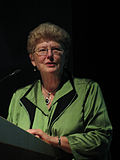 Katherine Hayles; James B. Duke Distinguished Professor Emerita of Literature at Duke University. (BS 1966)
 -

-
 Robert J. Duffy; Lieutenant governor of New York from 2011 to 2014 and the 65th mayor of Rochester, New York, from 2006 to 2010. (BS 1993)
 -
 Steven Van Slyke; Invented organic light-emitting diode. (MS)
 -
 Austin McChord; Founder and CEO of Datto. (BS)
 -
 Fiona Ma; California State Treasurer since January 2019. (BS)


Presidents and provosts
[edit]In the decades prior to the selection of RIT's first president, the university was administered primarily by the board of trustees.[12]
|
|
In addition to the ten official presidents, Provost Thomas R. Plough served as acting president twice: once, in February 1991 when M. Richard Rose was on sabbatical with the CIA, and again in 1992 between Rose's retirement and Albert J. Simone's installation.[170][171]
See also
[edit]References
[edit]- ^ "Investment Performance". RIT. 2024. Retrieved March 5, 2025.
- ^ a b c d e "About RIT". 2024. Archived from the original on March 1, 2024. Retrieved March 28, 2024.
- ^ RIT Color Palette. Retrieved April 18, 2019.
- ^ "RIT – Prospectus" (PDF). Rochester Institute of Technology. Archived from the original (PDF) on April 11, 2008. Retrieved April 3, 2008.
- ^ "RIT – RIT Archives – Spirit of RIT". Rochester Institute of Technology. Archived from the original on October 12, 2007. Retrieved April 3, 2008.
- ^ a b c "Carnegie Classifications". The Carnegie Foundation for the Advancement of Teaching. Archived from the original on November 27, 2021. Retrieved September 13, 2020.
- ^ Gordon, Dane R. (2007). Rochester Institute of Technology: Industrial Development and Educational Innovation in an American City, 1829–2006. RIT Cary Graphic Arts Press. ISBN 978-1-933360-23-2.
- ^ Rochester Institute of Technology. "RIT Timeline". Archived from the original on February 26, 2008. Retrieved December 26, 2007.
- ^ "ROCHESTER TO GET U.S. DEAF COLLEGE". The New York Times. November 15, 1966. p. 22.
- ^ Marschark, Marc; Lang, Harry G. (2002). Educating Deaf Students: From Research to Practice. New York City: Oxford University Press. p. 35. ISBN 978-0-19-512139-1. OCLC 45668968.
- ^ "Eisenhower College, I Learn, Has Been Acquired". The New York Times. August 4, 1979. ISSN 0362-4331. Retrieved May 28, 2024.
- ^ a b c "History of RIT". Archived from the original on December 2, 2010. Retrieved February 14, 2009.
- ^ "QS World University Rankings".
- ^ "25 Years of Microelectronic Engineering Education", Santosh K. Kurinec, et al., 16th Biennial University Government Industry Microelectronics Symposium Proceedings, San Jose State University, San Jose, CA, June 2006.
- ^ American College of Management and Technology. "RIT Overview". Archived from the original on December 10, 2007. Retrieved December 26, 2007.
- ^ "Software Engineering @ RIT". Department of Software Engineering. RIT. Archived from the original on August 23, 2010. Retrieved September 6, 2010.
- ^ "Creating Brick City". Rochester Institute of Technology. Archived from the original on March 4, 2022. Retrieved March 4, 2022.
- ^ "State of New York Census Designated Places – Current/BAS20 – Data as of January 1, 2019". tigerweb.geo.census.gov. Archived from the original on September 26, 2020. Retrieved February 24, 2020.
- ^ "RIT Named Campus Sustainability Leader". Rit.edu. October 8, 2009. Archived from the original on June 5, 2010. Retrieved July 24, 2010.
- ^ a b "RIT Art Collection | RIT Archive Collections". library.rit.edu. Archived from the original on August 2, 2017. Retrieved July 13, 2017.
- ^ "The Sentinel – RIT: Art on Campus". artoncampus.rit.edu. Archived from the original on February 2, 2022. Retrieved July 13, 2017.
- ^ "Growth and Youth – RIT: Art on Campus". artoncampus.rit.edu. Archived from the original on February 2, 2022. Retrieved July 13, 2017.
- ^ "Principia – RIT: Art on Campus". artoncampus.rit.edu. Archived from the original on February 2, 2022. Retrieved July 13, 2017.
- ^ "Principia: A Guide to the Atrium Floor" (PDF). Rochester Institute of Technology. Archived from the original (PDF) on April 15, 2019. Retrieved July 13, 2017.
- ^ "Three Piece Reclining Figure No. 1 – RIT: Art on Campus". artoncampus.rit.edu. Archived from the original on February 2, 2022. Retrieved July 13, 2017.
- ^ "Sundial – RIT: Art on Campus". artoncampus.rit.edu. Archived from the original on February 2, 2022. Retrieved July 13, 2017.
- ^ "The Monument to Ephemeral Facts – RIT: Art on Campus". artoncampus.rit.edu. Archived from the original on February 2, 2022. Retrieved July 13, 2017.
- ^ "Unity – RIT: Art on Campus". artoncampus.rit.edu. Archived from the original on February 2, 2018. Retrieved January 30, 2018.
- ^ "2020 Geography Changes". United States Census Bureau.
- ^ "Rochester Institute of Technology CDP, New York". United States Census Bureau. Retrieved March 13, 2022.
- ^ "P2 HISPANIC OR LATINO, AND NOT HISPANIC OR LATINO BY RACE – 2020: DEC Redistricting Data (PL 94-171) – Rochester Institute of Technology CDP, New York". United States Census Bureau. Archived from the original on May 25, 2023. Retrieved July 23, 2023.
- ^ "William H. Sanders named RIT's 11th president". Rochester Institute of Technology. Retrieved July 10, 2025.
- ^ a b McGrain, Vienna (June 21, 2023). "RIT names Prabu David as provost and senior vice president for Academic Affairs". University News. Rochester, New York. Archived from the original on January 11, 2024. Retrieved January 11, 2024.
- ^ "Colleges". RIT. Archived from the original on February 8, 2022. Retrieved February 8, 2022.
- ^ Bob Finnerty (December 5, 2007). "RIT to Open Dubai Campus in Fall 2008". Archived from the original on March 20, 2019. Retrieved December 27, 2007.
- ^ "History, Accreditation, Legacy". Rochester Institute of Technology. Archived from the original on January 6, 2010. Retrieved December 4, 2009.
- ^ "Statement of Accreditation Status – Rochester Institute of Technology". Middle States Commission on Higher Education. Archived from the original on November 13, 2009. Retrieved December 9, 2009.
- ^ "Colleges". Rochester Institute of Technology. Archived from the original on May 27, 2010. Retrieved December 4, 2009.
- ^ a b c "Registration Guide 2009–2010" (PDF). Archived from the original (PDF) on July 20, 2011. Retrieved December 4, 2009.
- ^ "Fast Facts". Rochester Institute of Technology. Archived from the original on January 6, 2010. Retrieved December 4, 2009.
- ^ "Message from President Destler Concerning Change in RIT's Academic Calendar". Rochester Institute of Technology. Archived from the original on February 13, 2010. Retrieved February 10, 2010.
- ^ "ReporterMag.com". reportermag.com. Archived from the original on August 26, 2011. Retrieved March 27, 2011.
- ^ a b "RIT in Brief". Rochester Institute of Technology. Archived from the original on January 29, 2019. Retrieved March 4, 2014.
- ^ "Degree Certifications by College and Department, 2008–2009" (PDF). Institutional Research and Policy Studies, Rochester Institute of Technology. Archived (PDF) from the original on June 24, 2010. Retrieved December 4, 2009.
- ^ Destler, Bill. "President Destler's 2010–2011 Welcome Back Address". RIT University News. Archived from the original on September 7, 2010. Retrieved August 31, 2010.
- ^ "Fall Enrollment by Race/Ethnicity (All)" (PDF). Institutional Research and Policy Studies, Rochester Institute of Technology. Archived from the original (PDF) on March 5, 2014. Retrieved March 4, 2014.
- ^ See Demographics of the United States for references.
- ^ "College Navigator – Rochester Institute of Technology". National Center for Education Statistics, U.S. Department of Education. Archived from the original on August 14, 2016. Retrieved December 4, 2009.
- ^ "America's Top Colleges 2025". Forbes. September 6, 2025. Retrieved October 3, 2025.
- ^ "2025-2026 Best National Universities Rankings". U.S. News & World Report. September 23, 2025. Retrieved October 3, 2025.
- ^ "2024 National University Rankings". Washington Monthly. August 25, 2024. Retrieved August 29, 2024.
- ^ "2025 Best Colleges in the U.S." The Wall Street Journal/College Pulse. September 4, 2025. Retrieved October 3, 2025.
- ^ "World University Rankings 2025". Times Higher Education. October 9, 2024. Retrieved June 19, 2025.
- ^ "2025-2026 Best Global Universities Rankings". U.S. News & World Report. June 17, 2025. Retrieved June 17, 2025.
- ^ "Rankings and Recognition". Archived from the original on May 31, 2023. Retrieved July 5, 2023.
- ^ McGrain, Vienna (September 23, 2025). "RIT rises to No. 88 nationally in 'U.S. News' best colleges ranking". RIT. Retrieved September 23, 2025.
{{cite web}}: CS1 maint: url-status (link) - ^ Cometta, Michelle. "'Business Insider' ranks RIT 14th in the Northeast and 36th in the country". B. Thomas Golisano College of Computing & Information Sciences. RIT. Archived from the original on May 18, 2019. Retrieved May 17, 2019.
- ^ Martin, Emmie; Gould, Skye (July 29, 2015). "The 50 best computer science and engineering schools in the US". Business Insider India. Archived from the original on May 17, 2019. Retrieved May 17, 2019.
- ^ "High School Counselors top 50 college picks". Archived from the original on May 17, 2019. Retrieved May 17, 2019.
- ^ "Best Online MBA Programs". RIT. Archived from the original on May 13, 2019. Retrieved May 17, 2019.
- ^ "THE ranking for top business schools around the world". RIT. Archived from the original on May 13, 2019. Retrieved May 17, 2019.
- ^ "Top 20 universities for excellent co-operative learning and internship programs". RIT. Archived from the original on May 13, 2019. Retrieved May 17, 2019.
- ^ "Top 30 Computer Science universities with best Returns on Investment". RIT. July 21, 2020. Archived from the original on May 4, 2019. Retrieved May 19, 2019.
- ^ Bureau, Scott (March 19, 2025). "RIT ranked a top-10 university for game designers and developers". RIT. Archived from the original on March 19, 2025. Retrieved March 19, 2025.
{{cite web}}:|last=has generic name (help) - ^ "Top 75 Schools in the US for Video Game Design-2019". RIT. March 11, 2017. Archived from the original on May 15, 2019. Retrieved May 17, 2019.
- ^ Middle States Self-study report Archived September 26, 2007, at the Wayback Machine, March 21–23, 2007.
- ^ Flanigan, Robin L. (July 2007). "Beyond the Cap and Gown". US Airways Magazine. pp. 172–176. Archived from the original on July 5, 2007. Retrieved July 3, 2007.
- ^ "About the Cary Collection | Cary Graphic Arts Collection". library.rit.edu. Archived from the original on August 2, 2017. Retrieved July 13, 2017.
- ^ "RIT Archives". library.rit.edu. Archived from the original on August 2, 2017. Retrieved July 13, 2017.
- ^ "RIT/NTID Deaf Studies Archive". library.rit.edu. Archived from the original on August 2, 2017. Retrieved July 13, 2017.
- ^ "vignelli center for design studies opens". DesignBoom. September 30, 2010. Archived from the original on May 19, 2021. Retrieved September 7, 2019.
- ^ "Vignelli Center grand opening Sept. 16". Rochester Institute of Technology. September 9, 2010. Archived from the original on August 18, 2019. Retrieved September 7, 2019.
- ^ "Overview | ESL Global Cybersecurity Institute". www.rit.edu. Archived from the original on October 17, 2023. Retrieved October 12, 2023.
- ^ "Alumnus Austin McChord creates endowed awards for creative RIT students and professors". RIT. Retrieved October 12, 2023.
- ^ "ESL Federal Credit Union makes $3 million commitment to name ESL Global Cybersecurity Institute". www.rit.edu. Archived from the original on October 17, 2023. Retrieved October 12, 2023.
- ^ Rochester Institute of Technology. "Research". Archived from the original on October 20, 2008. Retrieved October 11, 2023.
- ^ Rochester Institute of Technology Offices of Part-time and Graduate Enrollment Services. "RIT – Programs of Study – Doctor of Philosophy in Imaging Science". Archived from the original on April 16, 2011. Retrieved April 2, 2011.
- ^ Rochester Institute of Technology Offices of Part-time and Graduate Enrollment Services. "RIT – Programs of Study – Doctor of Philosophy in Microsystems Engineering". Archived from the original on April 16, 2011. Retrieved April 2, 2011.
- ^ Rochester Institute of Technology Offices of Part-time and Graduate Enrollment Services. "RIT – Programs of Study – Doctor of Philosophy in Computing and Information Sciences". Archived from the original on April 16, 2011. Retrieved April 2, 2011.
- ^ Rochester Institute of Technology Offices of Part-time and Graduate Enrollment Services. "RIT – Programs of Study – Doctor of Philosophy in Color Science". Archived from the original on November 16, 2011. Retrieved April 2, 2011.
- ^ Rochester Institute of Technology Offices of Part-time and Graduate Enrollment Services. "RIT – Programs of Study – Doctor of Philosophy in Astrophysical Sciences and Technology". Archived from the original on April 29, 2011. Retrieved April 2, 2011.
- ^ Rochester Institute of Technology Offices of Part-time and Graduate Enrollment Services. "RIT – Programs of Study – Doctor of Philosophy in Sustainability". Archived from the original on April 16, 2011. Retrieved April 2, 2011.
- ^ "Electrical and Computer Engineering Ph.D." RIT. Archived from the original on October 17, 2023. Retrieved October 12, 2023.
- ^ "Biomedical and Chemical Engineering Ph.D." RIT. Archived from the original on October 17, 2023. Retrieved October 12, 2023.
- ^ "Business Administration Ph.D." RIT. Archived from the original on October 17, 2023. Retrieved October 12, 2023.
- ^ "Physics Ph.D." RIT. Retrieved October 12, 2023.
- ^ "RIT – Offices of Graduate & Part-time Enrollment Services". RIT. Archived from the original on January 16, 2017. Retrieved January 13, 2017.
- ^ "RIT collaborates with IBM on genomic research". scienceblog.com. January 2003. Archived from the original on June 14, 2011. Retrieved September 27, 2010.
- ^ "Xerox Commits $2 Million to RIT Targeting Education and Research in Sustainability". Green at Work. April 25, 2008. Archived from the original on May 11, 2008. Retrieved July 24, 2010.
- ^ "D&C joins RIT in printing industry research" (PDF). RIT. Archived (PDF) from the original on June 8, 2011. Retrieved September 27, 2010.
- ^ "Siemens and RIT announce research partnership". Controlglobal.com. Archived from the original on July 8, 2011. Retrieved July 24, 2010.
- ^ "NASA Awards Grant to RIT to Develop New Polymer Foam Packaging for Lunar Missions". Rit.edu. January 9, 2009. Archived from the original on June 1, 2010. Retrieved July 24, 2010.
- ^ "RIT Effort Could Extend NASA Science Capabilities for Planetary Applications". Azooptics.com. May 16, 2008. Archived from the original on July 22, 2023. Retrieved July 24, 2010.
- ^ "Microsystems Technology Office-Wide Broad Agency Announcement DARPA-BAA-09-25". FedBizOpps.gov. April 14, 2010. Archived from the original on July 21, 2011. Retrieved March 14, 2011.
- ^ "Speeches – Partnerships and Collaborations: A New Research Paradigm". Nystar.state.ny.us. May 4, 2005. Archived from the original on July 23, 2011. Retrieved July 24, 2010.
- ^ "RIT named by U.S. Dept. of Energy to lead new Manufacturing USA Institute on clean energy". RIT. Archived from the original on January 13, 2017. Retrieved January 12, 2017.
- ^ "RIT – RIT downs UNH, reaches Frozen Four". .espn.com. March 28, 2010. Archived from the original on March 31, 2010. Retrieved March 28, 2010.
- ^ "RIT Women's Hockey wins NCAA Division III National Title". RIT Athletics. Archived from the original on May 29, 2013. Retrieved March 30, 2012.
- ^ "RIT Women's Hockey Making Move To Division I". RIT Athletics. Archived from the original on May 29, 2013. Retrieved March 30, 2012.
- ^ "Twice is nice for RIT men's lacrosse champions". RIT. Retrieved October 12, 2023.
- ^ "Campus celebrates men's lacrosse second NCAA national championship". RIT. Retrieved October 12, 2023.
- ^ "USCSA – Home". USCSA – United States Collegiate Ski and Snowboard Association. Archived from the original on January 27, 2021. Retrieved December 27, 2020.
- ^ "RIT Alpine Ski Team". RIT Alpine Ski Team. Archived from the original on July 29, 2016. Retrieved December 27, 2020.
- ^ "Sept. 25 – RIT football opens 2nd season under Tom Coughlin". Rochester Democrat and Chronicle. Archived from the original on October 20, 2020. Retrieved February 18, 2019.
- ^ "RIT Power Play Campaign". Rochester Institute of Technology. Archived from the original on January 30, 2016. Retrieved March 30, 2012.
- ^ "Future RIT Hockey Arena to Become the Gene Polisseni Center". Archived from the original on June 15, 2012. Retrieved November 12, 2011.
- ^ "RIT – 175 Year Anniversary". .rit.edu. Archived from the original on June 20, 2010. Retrieved July 24, 2010.
- ^ "Highlights | RIT Archive Collections". library.rit.edu. Archived from the original on August 2, 2017. Retrieved June 26, 2017.
- ^ "RIT Bengal Tiger – RIT: Art on Campus". artoncampus.rit.edu. Archived from the original on February 2, 2022. Retrieved June 26, 2017.
- ^ Peterson, Liz (February 5, 2016). "RITchie: Inside the Suit". Reporter. Retrieved November 9, 2023.
- ^ a b Rochester Institute of Technology. "RIT – Center for Campus Life". Archived from the original on August 22, 2007. Retrieved January 21, 2008.
- ^ RIT Digital Media Repository – Reporter Magazine (December 17, 2010). "Reporter Magazine". Archived from the original on June 19, 2013. Retrieved February 19, 2011.
- ^ "RIT Brick City Ambassadors – The Reporter: Past & Present". October 12, 2010. Archived from the original on July 1, 2012. Retrieved February 19, 2011.
- ^ Silandara Bartlett (November 4, 2004). "Bob Dylan at RIT Nov. 13". Archived from the original on February 26, 2008. Retrieved January 21, 2008.
- ^ Bartlett, Silandara (September 29, 2004). "Brick City Festival Brings Kanye West and David Spade to RIT". Archived from the original on February 26, 2008. Retrieved January 21, 2008.
- ^ "Real Estate News". BTRCA. Archived from the original on June 2, 2013. Retrieved August 17, 2013.
- ^ Rochester Institute of Technology. "Cluster: Diversity/Deaf Culture and Language". Archived from the original on December 26, 2007. Retrieved January 21, 2008.
- ^ a b Rochester Institute of Technology. "Fast Facts". Archived from the original on January 17, 2008. Retrieved January 21, 2008.
- ^ "Special Interest Housing | Housing | RIT". Archived from the original on February 8, 2023. Retrieved February 8, 2023.
- ^ "Computer Science House | RIT". Archived from the original on March 23, 2025. Retrieved March 26, 2025.
- ^ Rochester Institute of Technology. "Special Interest & Lifestyle Floors | Housing Operations". Archived from the original on March 6, 2017. Retrieved March 5, 2017.
- ^ Rochester Institute of Technology. "RIT – Housing Operations : Special Interest Houses". Archived from the original on March 5, 2008. Retrieved January 21, 2008.
- ^ "Special Interest Housing | Housing | RIT". Archived from the original on August 1, 2021.
- ^ "Special Interest Housing | Housing | RIT". Archived from the original on September 9, 2024. Retrieved March 26, 2025.
- ^ "Air Force ROTC Detachment 538". January 26, 2011. Archived from the original on February 23, 2009. Retrieved February 19, 2011.
- ^ "RIT Army ROTC". Archived from the original on March 9, 2011. Retrieved February 19, 2011.
- ^ "RIT Army ROTC Battalion Selected for Outstanding ROTC Unit Award". February 3, 2010. Archived from the original on January 22, 2011. Retrieved September 29, 2010.
- ^ "Top Army ROTC units receive MacArthur Award". February 3, 2010. Archived from the original on July 22, 2011. Retrieved September 29, 2010.
- ^ "100th Anniversary by Reporter Magazine". issuu.com. Issuu. April 29, 2010. Archived from the original on August 26, 2022. Retrieved August 26, 2022.
- ^ "K2GXT – RIT's Amateur Radio Club". RIT. Archived from the original on February 8, 2019. Retrieved January 20, 2019.
- ^ "WITR 89.7". Rochester Institute of Technology. Archived from the original on March 21, 2014. Retrieved March 12, 2014.
- ^ "RIT College Activities Board – About". Rochester Institute of Technology. Archived from the original on May 17, 2022. Retrieved March 12, 2014.
- ^ a b "Imagine RIT: Innovation and Creativity Festival". Rochester Institute of Technology. Archived from the original on January 7, 2010. Retrieved February 19, 2010.
- ^ "About". Rochester Game Festival. May 6, 2018. Archived from the original on March 19, 2022. Retrieved November 18, 2020.
- ^ Guerrein, Jordan (November 30, 2016). "Public Safety Officers at RIT will soon be armed". Archived from the original on May 22, 2018. Retrieved February 27, 2018.
- ^ "RIT – Counseling Center – FAQs". RIT. Archived from the original on September 24, 2015. Retrieved October 4, 2013.
- ^ "RIT Dining Services Locations". Archived from the original on March 5, 2014. Retrieved March 4, 2014.
- ^ "Hydroponic Farm | Dining Services". RIT Dining Services. Archived from the original on September 14, 2019. Retrieved September 18, 2019.
- ^ "About the Council". Archived from the original on July 14, 2015. Retrieved July 7, 2015.
- ^ "RIT Student Government". Archived from the original on May 14, 2014. Retrieved July 7, 2015.
- ^ "RIT – Academic Senate". Archived from the original on June 17, 2015. Retrieved July 7, 2015.
- ^ "RIT Staff Council – It is Staff Council's vision to be the respected collective voice of Staff within RIT's shared governance process". Archived from the original on July 14, 2015. Retrieved July 7, 2015.
- ^ "About RIT – Key Facts". RIT. Archived from the original on October 7, 2018. Retrieved May 18, 2019.
- ^ Peebles-Wilkins, Wilma (July 26, 2016). "Black Women and American Social Welfare: The Life of Fredericka Douglass Sprague Perry". Affilia. 4 (1): 33–44. doi:10.1177/088610998900400104. S2CID 143984557.
- ^ "Renaming NRH to Fredericka Douglass Sprague Perry Hall". RIT. Archived from the original on September 5, 2023. Retrieved October 9, 2023.
- ^ "John Resig – Research". ejohn.org. Archived from the original on February 5, 2016. Retrieved February 14, 2016.
- ^ "RIT to Hunt President To Succeed Ellingson". Democrat and Chronicle. Rochester, New York. December 12, 1968. p. 1B.
- ^ a b "N. Carolina Educator New RIT President". Democrat and Chronicle. Rochester, New York. June 26, 1969. p. 1B.
- ^ "Kellogg Foundation appoints 2 part-time program consultants". Battle Creek Enquirer. Battle Creek, Michigan. November 29, 1978. p. B-7.
- ^ "New RIT head was tough-minded at Alfred U". Democrat and Chronicle. Rochester, New York. September 19, 1978. p. 1B.
- ^ "RIT chief cites CIA ties in his decision to retire". Democrat and Chronicle. Rochester, New York. September 4, 1991. p. 1A.
- ^ "Simone picked RIT to have 'fun'". Honolulu Star-Bulletin. Honolulu, Hawaii. May 19, 1992. p. A-3.
- ^ "Replacing Simone a tall order". Democrat and Chronicle. Rochester, New York. May 18, 2006. p. 3B.
- ^ "New leader wants RIT, its students to innovate". Democrat and Chronicle. Rochester, New York. March 17, 2007. p. 3B.
- ^ "RIT's Destler to retire in 2017". Democrat and Chronicle. Rochester, New York. May 10, 2016. p. 1A.
- ^ "Munson promising a broad vision for RIT". Democrat and Chronicle. Rochester, New York. January 26, 2017. p. 1A.
- ^ "RIT President David Munson announces plans to step down in 2025". RIT. Retrieved January 28, 2025.
- ^ "RIT's Next President, William H. Sanders". RIT. Retrieved January 28, 2025.
- ^ Gordon, Dane R. (2007), Rochester Institute of Technology: Industrial Development and Educational Innovation in an American City, 1829–2006 (1 ed.), Henrietta, New York: RIT Press, p. 301, ISBN 978-1-933360-24-9, OCLC 80360669
- ^ "New job challenge to an RIT official". Democrat and Chronicle. Rochester, New York. June 14, 1980. p. 5B.
- ^ Gordon, Dane R. (2007), Rochester Institute of Technology: Industrial Development and Educational Innovation in an American City, 1829–2006 (1 ed.), Henrietta, New York: RIT Press, p. 381, ISBN 978-1-933360-24-9, OCLC 80360669
- ^ "RIT appoints Thomas Plough to new position as provost". Democrat and Chronicle. Rochester, New York. May 28, 1984. p. 3B.
- ^ a b "A leadership shuffle at RIT". Democrat and Chronicle. Rochester, New York. August 3, 1994. p. 1B.
- ^ a b "RIT professor named provost". Democrat and Chronicle. Rochester, New York. November 8, 1995. p. 2B.
- ^ "Provost heartens RIT grads". Democrat and Chronicle. Rochester, New York. May 24, 2008. p. 1B.
- ^ "RIT hires a senior academic affairs VP". Democrat and Chronicle. Rochester, New York. March 11, 2008. p. 1B.
- ^ Rosen, Ellen (January 18, 2018). "RIT provost stepping down for a new opportunity". University News. Rochester, New York. Archived from the original on January 11, 2024. Retrieved January 11, 2024.
- ^ Carter, Diana Louise (July 13, 2018). "First female provost to start at RIT in August". Rochester Business Journal. Rochester, New York. Archived from the original on September 7, 2018. Retrieved September 7, 2018.
- ^ Munson, David (January 11, 2023). "Provost Ellen Granberg to begin new post in nation's capital on July 1". University News. Rochester, New York. Archived from the original on January 11, 2024. Retrieved January 11, 2024.
- ^ "A leadership shuffle at RIT". Democrat and Chronicle. Rochester, New York. August 3, 1994. p. 1B.
He had served as acting president of RIT twice—first, when former President M. Richard Rose took a sabbatical to work for the CIA in 1991, and again when Rose retired in 1992.
- ^ "RIT picks its next president". Democrat and Chronicle. Rochester, New York. May 19, 1992. p. 1A.
Further reading
[edit]- Austin, Bruce A. (2018). Imagine This! : RIT's Innovation + Creativity Festival. Rochester, N.Y.: RIT Press. ISBN 9781939125484. OCLC 1015269738.
- Gordon, Dane R. (2007). Rochester Institute of Technology: Industrial Development and Educational Innovation in an American City, 1829–2006. Rochester, N.Y.: RIT Press. ISBN 9781933360232. OCLC 80360669.
- McCarthy, James K. (2018). A Shining Beacon: Fifty Years of the National Technical Institute for the Deaf. Rochester, N.Y.: RIT Press. ISBN 9781939125491. OCLC 1019854198.
- Simmons, Becky (2018). Transforming the Landscape: Fifty years on the New RIT Campus. Rochester, N.Y.: RIT Press. ISBN 9781939125576. OCLC 1031423376.
External links
[edit]


| International | |
|---|---|
| National | |
| Other | |
