Hubbry Logo
Reciprocity (photography)Reciprocity (photography)Main
Open search
Reciprocity (photography)
Community hub
Reciprocity (photography)
logo
8 pages, 0 posts
0 subscribers
Be the first to start a discussion here.
Reciprocity (photography)
from Wikipedia
The specified times apply to black/white film.
Note that the times are approximate, and vary between different films and ASA numbers, but the table shows in general how the exposure time is adjusted.

In photography, reciprocity is the inverse relationship between the intensity and duration of light that determines the reaction of light-sensitive material. Within a normal exposure range for film stock, for example, the reciprocity law states that the film response will be determined by the total exposure, defined as intensity × time. Therefore, the same response (for example, the optical density of the developed film) can result from reducing duration and increasing light intensity, and vice versa.

The reciprocal relationship is assumed in most sensitometry, for example when measuring a Hurter and Driffield curve (optical density versus logarithm of total exposure) for a photographic emulsion. Total exposure of the film or sensor, the product of focal-plane illuminance times exposure time, is measured in lux seconds.

History

[edit]

The idea of reciprocity, once known as Bunsen–Roscoe reciprocity, originated from the work of Robert Bunsen and Henry Roscoe in 1862.[1][2][3]

Deviations from the reciprocity law were reported by Captain William de Wiveleslie Abney in 1893,[4] and extensively studied by Karl Schwarzschild in 1899.[5][6][7] Schwarzschild's model was found wanting by Abney and by Englisch,[8] and better models have been proposed in subsequent decades of the early twentieth century. In 1913, Kron formulated an equation to describe the effect in terms of curves of constant density,[9][10] which J. Halm adopted and modified,[11] leading to the "Kron–Halm catenary equation"[12] or "Kron–Halm–Webb formula"[13] to describe departures from reciprocity.

In chemical photography

[edit]

In photography, reciprocity refers to the relationship whereby the total light energy – proportional to the total exposure, the product of the light intensity and exposure time, controlled by aperture and shutter speed, respectively – determines the effect of the light on the film. That is, an increase of brightness by a certain factor is exactly compensated by a decrease of exposure time by the same factor, and vice versa. In other words, there is under normal circumstances a reciprocal proportion between aperture area and shutter speed for a given photographic result, with a wider aperture requiring a faster shutter speed for the same effect. For example, an EV of 10 may be achieved with an aperture (f-number) of f/2.8 and a shutter speed of 1/125 s. The same exposure is achieved by doubling the aperture area to f/2 and halving the exposure time to 1/250 s, or by halving the aperture area to f/4 and doubling the exposure time to 1/60 s; in each case the response of the film is expected to be the same.

Reciprocity failure

[edit]

For most photographic materials, reciprocity is valid with good accuracy over a range of values of exposure duration, but becomes increasingly inaccurate as this range is departed from: this is reciprocity failure (reciprocity law failure, or the Schwarzschild effect).[14] As the light level decreases out of the reciprocity range, the increase in duration, and hence of total exposure, required to produce an equivalent response becomes higher than the formula states; for instance, at half of the light required for a normal exposure, the duration must be more than doubled for the same result. Multipliers used to correct for this effect are called reciprocity factors (see model below).

At very low light levels, film is less responsive. Light can be considered to be a stream of discrete photons, and a light-sensitive emulsion is composed of discrete light-sensitive grains, usually silver halide crystals. Each grain must absorb a certain number of photons in order for the light-driven reaction to occur and the latent image to form. In particular, if the surface of the silver halide crystal has a cluster of approximately four or more reduced silver atoms, resulting from absorption of a sufficient number of photons (usually a few dozen photons are required), it is rendered developable. At low light levels, i.e. few photons per unit time, photons impinge upon each grain relatively infrequently; if the four photons required arrive over a long enough interval, the partial change due to the first one or two is not stable enough to survive before enough photons arrive to make a permanent latent image center.

This breakdown in the usual tradeoff between aperture and shutter speed is known as reciprocity failure. Each different film type has a different response at low light levels. Some films are very susceptible to reciprocity failure, and others much less so. Some films that are very light sensitive at normal illumination levels and normal exposure times lose much of their sensitivity at low light levels, becoming effectively "slow" films for long exposures. Conversely some films that are "slow" under normal exposure duration retain their light sensitivity better at low light levels.

For example, for a given film, if a light meter indicates a required EV of 5 and the photographer sets the aperture to f/11, then ordinarily a 4-second exposure would be required; a reciprocity correction factor of 1.5 would require the exposure to be extended to 6 seconds for the same result. Reciprocity failure generally becomes significant at exposures of longer than about 1 sec for film, and above 30 sec for paper.

Reciprocity also breaks down at extremely high levels of illumination with very short exposures. This is a concern for scientific and technical photography, but rarely to general photographers, as exposures significantly shorter than a millisecond are only required for subjects such as explosions and in particle physics, or when taking high-speed motion pictures with very high shutter speeds (1/10,000 sec or faster).

Schwarzschild law

[edit]

In response to astronomical observations of low intensity reciprocity failure, Karl Schwarzschild wrote (circa 1900):

"In determinations of stellar brightness by the photographic method I have recently been able to confirm once more the existence of such deviations, and to follow them up in a quantitative way, and to express them in the following rule, which should replace the law of reciprocity: Sources of light of different intensity I cause the same degree of blackening under different exposures t if the products are equal."[5]

Unfortunately, Schwarzschild's empirically determined 0.86 coefficient turned out to be of limited usefulness.[15] A modern formulation of Schwarzschild's law is given as

where E is a measure of the "effect of the exposure" that leads to changes in the opacity of the photosensitive material (in the same degree that an equal value of exposure H = It does in the reciprocity region), I is illuminance, t is exposure duration and p is the Schwarzschild coefficient.[16][17]

However, a constant value for p remains elusive, and has not replaced the need for more realistic models or empirical sensitometric data in critical applications.[18] When reciprocity holds, Schwarzschild's law uses p = 1.0.

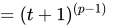
Since the Schwarzschild's law formula gives unreasonable values for times in the region where reciprocity holds, a modified formula has been found that fits better across a wider range of exposure times. The modification is in terms of a factor the multiplies the ISO film speed:[19]

Relative film speed

where the t + 1 term implies a breakpoint near 1 second separating the region where reciprocity holds from the region where it fails.

Simple model for t > 1 second

[edit]

Some models of microscope use automatic electronic models for reciprocity failure compensation, generally of a form for correct time, Tc, expressible as a power law of metered time, Tm, that is, Tc=(Tm)p, for times in seconds. Typical values of p are 1.25 to 1.45, but some are low as 1.1 and high as 1.8.[20]

The Kron–Halm catenary equation

[edit]

Kron's equation as modified by Halm states that the response of the film is a function of , with the factor defined by a catenary (hyperbolic cosine) equation accounting for reciprocity failure at both very high and very low intensities:

where I0 is the photographic material's optimum intensity level and a is a constant that characterizes the material's reciprocity failure.[21]

Quantum reciprocity-failure model

[edit]

Modern models of reciprocity failure incorporate an exponential function, as opposed to power law, dependence on time or intensity at long exposure times or low intensities, based on the distribution of interquantic times (times between photon absorptions in a grain) and the temperature-dependent lifetimes of the intermediate states of the partially exposed grains.[22][23][24]

Baines and Bomback[25] explain the "low intensity inefficiency" this way:

Electrons are released at a very low rate. They are trapped and neutralised and must remain as isolated silver atoms for much longer than in normal latent image formation. It has already been observed that such extreme sub-latent image is unstable, and it is postulated that ineffiency is caused by many isolated atoms of silver losing their acquired electrons during the period of instability.

Astrophotography

[edit]

Reciprocity failure is an important effect in the field of film-based astrophotography. Deep-sky objects such as galaxies and nebulae are often so faint that they are not visible to the un-aided eye. To make matters worse, many objects' spectra do not line up with the film emulsion's sensitivity curves. Many of these targets are small and require long focal lengths, which can push the focal ratio far above f/5. Combined, these parameters make these targets extremely difficult to capture with film; exposures from 30 minutes to well over an hour are typical. As a typical example, capturing an image of the Andromeda Galaxy at f/4 will take about 30 minutes; to get the same density at f/8 would require an exposure of about 200 minutes.

When a telescope is tracking an object, every minute is difficult; therefore, reciprocity failure is one of the biggest motivations for astronomers to switch to digital imaging. Electronic image sensors have their own limitation at long exposure time and low illuminance levels, not usually referred to as reciprocity failure, namely noise from dark current, but this effect can be controlled by cooling the sensor.

Holography

[edit]

A similar problem exists in holography. The total energy required when exposing holographic film using a continuous wave laser (i.e. for several seconds) is significantly less than the total energy required when exposing holographic film using a pulsed laser (i.e. around 20–40 nanoseconds) due to a reciprocity failure. It can also be caused by very long or very short exposures with a continuous wave laser. To try to offset the reduced brightness of the film due to reciprocity failure, a method called latensification can be used. This is usually done directly after the holographic exposure and using an incoherent light source (such as a 25–40 W light bulb). Exposing the holographic film to the light for a few seconds can increase the brightness of the hologram by an order of magnitude.

References

[edit]
[edit]
Revisions and contributorsEdit on WikipediaRead on Wikipedia
from Grokipedia
In photography, the reciprocity law states that the total exposure to a photosensitive material, which determines the of the resulting image, is the product of light intensity (I) and exposure time (t), expressed as E = I × t. This linear relationship holds for typical exposure durations between approximately 1/500 second and 1 second, allowing photographers to adjust and interchangeably while maintaining consistent results. However, at extreme light intensities—particularly low levels requiring exposures longer than 1 second—the breaks down, a phenomenon known as reciprocity failure or low-intensity reciprocity failure (LIRF). This failure occurs because the photochemical process in emulsions becomes less efficient at forming stable latent s over extended periods, as the time between absorptions increases, reducing the overall sensitivity of the film. As a result, the effective decreases, requiring longer exposure times than predicted by the to achieve the same , and it can also alter contrast and, in color films, introduce color shifts that necessitate corrections. Reciprocity failure is most relevant in scenarios involving dim lighting, such as , photomicrography, or night landscapes, where exposures may extend to minutes or hours. Film manufacturers provide specific compensation data, often using an exponent factor (p) in the formula T_c = T_m^p (where T_c is the corrected time and T_m is the metered time) to adjust for different emulsions; for example, HP5+ requires a factor of 1.31 for exposures around 10 seconds. While digital sensors exhibit minimal reciprocity effects due to electronic capture, the concept remains fundamental to understanding analog behavior and exposure calculations in low-light conditions.

Fundamentals

Definition and Basic Principle

In photography, the reciprocity law describes the inverse relationship between the intensity of (illuminance) and the duration of exposure required to produce a given photographic effect on light-sensitive s. This principle states that the total exposure EE, which determines the or response of the , is the product of illuminance II (measured in ) and exposure time tt (measured in seconds), expressed as E=I×tE = I \times t. Under normal conditions, such as exposure times ranging from 1 to 1 second, this linear relationship holds true, allowing photographers to achieve equivalent results by adjusting these parameters inversely. The unit of exposure in this context is lux-seconds, representing the cumulative incident on the ; for instance, one lux-second equates to the received one meter from a standard for one second. The ideal reciprocity law originates from the Bunsen-Roscoe law, formulated in 1862 by chemists Robert Bunsen and Henry Roscoe during their studies of photochemical reactions. They established that in photochemical processes, such as the darkening of light-sensitive substances, the effect is proportional solely to the total energy dose delivered, independent of how the intensity and duration are distributed, provided the product remains constant. This foundational concept was quickly applied to early photography, where it underpins the predictability of exposure calculations for capturing images. In everyday photographic practice, reciprocity enables the creation of equivalent exposures by balancing changes in aperture, shutter speed, and sometimes ISO sensitivity while maintaining the same I×tI \times t product. For example, an exposure of f/8 at 1/250 second, which allows a certain amount of light through the lens, can be equivalently rendered at f/11 at 1/125 second: closing the aperture one stop reduces light intensity by half, but doubling the exposure time compensates exactly under the reciprocity law. Such adjustments are routine in manual mode, allowing photographers to prioritize depth of field, motion control, or other creative aspects without altering the overall exposure. While this law assumes ideal conditions, deviations known as reciprocity failure can occur at extremes of intensity or duration, requiring compensation in specialized scenarios.

In Chemical Photography

In chemical photography, the reciprocity principle manifests as a practical reciprocal relationship between and , allowing equivalent exposures on by adjusting one to compensate for changes in the other while keeping the total light exposure constant. For instance, increasing the from 1/30 second to 1/60 second requires opening the from f/8 to f/5.6, as the halved exposure time is offset by doubling the light-gathering area of the lens. This equivalence stems from the underlying exposure , where total exposure EE equals light intensity II multiplied by exposure time tt, or E=I×tE = I \times t. Silver halide crystals embedded in film emulsions exhibit a linear response to light under standard exposure conditions, meaning the density of the developed image is directly proportional to the total photons absorbed, provided the intensity-duration product remains constant. This linearity forms the basis for ISO ratings, which quantify the emulsion's sensitivity assuming reciprocity holds, enabling consistent exposure calculations across different lighting scenarios without needing to alter film development for normal shots. The principle applies reliably to short and normal exposures in chemical , typically from 1/1000 second up to about 1 second, where no compensatory adjustments are required for accurate results. In practice, photographers rely on this reciprocity when using light meters, which deliver aperture-shutter speed recommendations calibrated for ISO under the assumption of linear response, or consulting exposure tables that list equivalent combinations for various scene illuminances.

Historical Development

Early Observations

The discovery of the in dates to the mid-19th century, primarily through the collaborative experiments of German chemist and British chemist Henry Enfield Roscoe. Between 1855 and 1862, they systematically studied the effects of light on using a newly developed to measure light intensity accurately. Their key 1862 publication detailed how the photochemical decomposition of was proportional to the total exposure energy, expressed as the product of light intensity (I) and exposure duration (t), or E = I × t, holding true for relatively short exposures under controlled conditions. Roscoe's contributions were instrumental in these investigations, as he helped establish the quantitative foundations of during his time working with Bunsen at the University of Heidelberg. By the late 1860s and 1870s, the reciprocity principle began influencing early photographic practices, as photographers implicitly relied on the inverse relationship between light intensity and exposure time to achieve consistent results with emerging materials like daguerreotypes and wet collodion plates. This empirical validation extended into the 1880s and 1890s, when the law was more rigorously tested in photographic contexts. In 1890, Swiss chemist Ferdinand Hurter and British scientist Vero Charles Driffield conducted pioneering sensitometric studies on gelatine dry plates, confirming reciprocity through their analysis of photographic density versus exposure curves; they assumed that equal exposure products yielded equivalent densities across a range of intensities, building directly on the photochemical groundwork for practical application in plate sensitometry. As photographic experimentation advanced in the , initial hints of the law's boundaries surfaced without formal recognition of systematic failure. In 1893, British scientist William de Wiveleslie Abney documented deviations in photographic responses at extreme light intensities, observing that the product I × t did not always produce proportional chemical effects in emulsions, particularly under very bright or prolonged conditions. These findings, reported in the Photographic Journal, marked an early empirical note on the limits of reciprocity in real-world , though Abney attributed them to experimental variables rather than inherent material properties. This period from the 1860s to the thus laid the observational groundwork for understanding reciprocity's role in light-sensitive materials.

Key Theoretical Advances

In 1899, introduced the concept of non-linear effects in photographic , recognizing that the response of light-sensitive materials deviates from the classical under varying light intensities, particularly at low levels typical of astronomical observations. His investigations at the Kuffner Observatory in quantified these intensity-dependent deviations, showing that the effective exposure is not simply the product of intensity and time but follows a power-law relationship where the exponent depends on the illumination level. This early theoretical framework laid the foundation for understanding reciprocity failure as an inherent property of emulsion chemistry rather than experimental error. During the , significant progress was made in modeling these deviations through the development of the Kron-Halm equation, a -based formulation that describes the emulsion's response to exposure under non-reciprocal conditions. Guido Kron initially proposed an equation in 1913 to fit curves of constant in reciprocity failure data, which Jakob Halm refined in his 1915 analysis of photographic magnitudes for stellar photometry. Halm's modification incorporated the function to better capture the asymptotic behavior of blackening at extreme intensities, providing a practical tool for correcting astronomical plate calibrations. This equation represented a shift toward empirical-mathematical models that bridged classical photometry with the complexities of grain interactions. Post-World War II advancements shifted toward quantum mechanical interpretations of reciprocity failure, emphasizing probabilistic models of photon absorption and latent image formation in individual silver halide grains. Building on the pre-war Gurney-Mott theory of 1938, which posited that latent image specks form via electron trapping and silver ion migration, researchers like J. F. Hamilton in 1949 explored low-intensity reciprocity failure, analyzing quantum inefficiencies in latent image formation based on statistical models of light absorption and electron trapping. In the 1950s, Loyd A. Jones at advanced these ideas by quantifying the critical incubation period for stable latent image growth, demonstrating through low-temperature experiments that thermal agitation influences the transition from unstable to developable specks, thus linking reciprocity deviations to quantum yield variations. These probabilistic frameworks marked a departure from classical additive models, incorporating stochastic processes in grain sensitization. Key figures such as Halm, Kron, Hamilton, and Jones drove this era of theoretical refinement, with their work influencing the evolution of photographic from 1900 to the . By the mid-20th century, these advances informed international standards, including those from the (ISO), founded in 1947, which incorporated reciprocity assumptions into evaluations like ISO 6 (first published in 1974, with roots in earlier DIN and ASA methods from the 1930s–1950s) to ensure consistent measurements under standard exposure conditions near reciprocity limits. This timeline of progress transformed reciprocity from an empirical observation into a cornerstone of modern emulsion theory, enabling precise corrections in both scientific imaging and commercial .

Reciprocity Failure

Causes in Photographic Materials

Reciprocity failure in photographic materials, particularly emulsions, arises from inefficiencies in the formation process, where the absorption of leads to the creation of developable silver specks. At low light intensities, corresponding to long exposure times (typically beyond 1 second), the failure manifests as reduced sensitivity because the arrival of is spaced out over time. Each absorbed by a crystal generates an -hole pair, with the reducing a to form a neutral silver atom. However, a requires an aggregate of at least 4 silver atoms to serve as a development center, necessitating multiple (often 4-10 in ideal conditions, though losses increase this to tens or more). If subsequent arrive too slowly, the initial silver atoms can thermally decompose or recombine with atoms, preventing the formation of a speck and thus lowering the quantum efficiency of the process. At high light intensities, involving very short exposures (typically under 1 ), reciprocity occurs due to the rapid generation of electrons that outpace the migration of silver ions to the trapping sites. The high flux of photoelectrons leads to their repulsion and increased likelihood of recombination with positive holes ( radicals) before neutral silver atoms can aggregate effectively at the same site. This results in a more dispersed distribution of silver atoms across the grain, reducing the efficiency of centers and causing uneven development, often described as a migration-induced inefficiency in silver atom clustering. The extent of reciprocity failure is influenced by temperature and emulsion composition. Higher temperatures accelerate thermal decay of unstable silver specks in low-intensity scenarios, exacerbating failure by shortening the lifetime of intermediate species, while lower temperatures can introduce additional traps that hinder electron mobility in high-intensity cases. Emulsions composed primarily of silver bromide exhibit less pronounced high-intensity failure compared to those incorporating iodide (e.g., silver iodobromide), as iodide ions increase internal sensitivity but also heighten electron recombination rates, lowering the failure threshold for short exposures. Overall, quantum efficiency—the probability that an absorbed contributes to a developable —drops significantly outside the optimal exposure range of about 1 millisecond to 1 second, where the balance between photon arrival rates and atomic migration allows efficient formation. In low-intensity regimes, the inefficiency stems from the low probability of accumulating sufficient silver atoms before decay, while in high-intensity regimes, it arises from spatial dispersion and recombination losses that prevent concentrated growth.

Effects and Practical Compensation

Reciprocity failure primarily affects exposure by reducing the effective sensitivity of photographic at extremes of intensity and duration, necessitating additional light to achieve correct . For long exposures exceeding 1 second, exhibit low-intensity reciprocity failure, requiring photographers to increase exposure time or beyond meter readings. In Professional Tri-X 400 , for instance, a metered 1-second exposure demands +1 stop compensation (equivalent to 2 seconds), while a 10-second exposure requires +2 stops (50 seconds total). Short exposures below 1/1,000 second lead to high-intensity failure with speed loss, though this is rarer in conventional use. Beyond exposure adjustments, reciprocity failure degrades image quality. Black-and-white films show increased graininess at long exposures due to uneven latent image formation and the need for reduced development, which can amplify apparent grain in shadows. Color films suffer uncorrectable color shifts, as red, green, and blue-sensitive layers exhibit differing failure rates, resulting in casts like or dominance. Long exposures also promote through spontaneous silver halide reduction or environmental influences, elevating base density and compressing shadow detail. Thresholds for noticeable failure vary by film type but generally begin at exposures longer than 1 second or shorter than 1 millisecond. Black-and-white films like Tri-X primarily experience contrast loss and grain issues starting around 1 second, while color films show pronounced effects from 1 second onward, with color imbalances becoming evident by 10 seconds. Practical compensation relies on manufacturer-provided charts for exposure and development tweaks; for Tri-X, development times decrease by 10% at 1 second, 20% at 10 seconds, and 30% at 100 seconds to maintain contrast. Pre-exposure fogging, or latensification, applies a brief low-intensity flash to boost sensitivity centers, reducing the impact of low-intensity failure without significant fog addition. Multiple short exposures can simulate a long one by staying within the linear reciprocity range, summing total light additively while minimizing failure—useful for scenes allowing intermittent illumination. Color shifts in films may require compensating filters, such as CC10Y at 10 seconds. Photographers often prioritize wider apertures over extended times to stay below failure thresholds.

Mathematical Models of Reciprocity Failure

Schwarzschild Law

The Schwarzschild law provides an empirical power-law model for reciprocity failure in chemical , particularly at low intensities and long exposure times. Formulated by in 1899 following experiments on gelatine photographic plates, it generalizes the Bunsen-Roscoe reciprocity law—which posits that the photographic effect (blackening or density) depends solely on the product of light intensity II and exposure time tt, such that I×t=I \times t = constant for a fixed effect—by accounting for observed deviations where longer exposures yield disproportionately lower sensitivity. Schwarzschild's work demonstrated that equal blackening requires I×tp=I \times t^p = constant, with the exponent p<1p < 1 reflecting the reduced efficiency of the photochemical process at low intensities. The core equation of the law is I×tp=kI \times t^{p} = k where kk is a constant specific to the desired photographic effect, II is the illuminance (light intensity), tt is the exposure time, and pp is the Schwarzschild exponent (typically 0.7<p<10.7 < p < 1). For low-intensity conditions, pp values around $0.9arecommonforexposuresnear10seconds,whileSchwarzschildreportedare common for exposures near 10 seconds, while Schwarzschild reportedp \approx 0.86forhistestedplates.Thisformulationimpliesaneffectiveexposurefor his tested plates. This formulation implies an effective exposureE = I \times t^{p},meaningthattoachievethesameeffectasunderreciprocityconditions,theactualexposuretimemustincreasebeyondthesimpleinverseofintensity,as, meaning that to achieve the same effect as under reciprocity conditions, the actual exposure time must increase beyond the simple inverse of intensity, as t_{\text{req}} = (k / I)^{1/p}$. Schwarzschild derived the law from controlled exposures of photographic plates to varying intensity-time combinations, measuring resulting densities via densitometry and analyzing deviations in log-log plots of density versus I×tI \times t. These experiments, conducted at the Kuffner Observatory, revealed systematic non-linearity at low intensities (below typical daylight levels), generalizing the Bunsen-Roscoe law by introducing the exponent pp to fit the data across a range of conditions relevant to astronomical imaging. The model thus offered a practical tool for correcting exposures in scenarios where reciprocity holds less well. For exposures t>1t > 1 second, a simple linear approximation simplifies computations: p1klog10(t)p \approx 1 - k \log_{10}(t), where kk is an emulsion-dependent constant (typically $0.05 to &#36;0.1). This allows estimation of exposure multipliers m=treq/tmeter=tmeter(1/p)1m = t_{\text{req}} / t_{\text{meter}} = t_{\text{meter}}^{(1/p) - 1}, assuming the meter follows reciprocity (p=1p=1). For example, with k=0.1k=0.1 and tmeter=10t_{\text{meter}}=10 s (log10(t)=1\log_{10}(t)=1, p0.9p \approx 0.9), m100.1111.29m \approx 10^{0.111} \approx 1.29, so treq12.9t_{\text{req}} \approx 12.9 s. For tmeter=100t_{\text{meter}}=100 s (log10(t)=2\log_{10}(t)=2, p0.8p \approx 0.8), m1000.253.16m \approx 100^{0.25} \approx 3.16, so treq316t_{\text{req}} \approx 316 s. Such calculations guide practical compensation without full curve fitting. The model performs best for intensities around 1–10 , common in low-light scenarios like indoor or , but loses accuracy at extreme high intensities (where p1p \to 1) due to saturation effects in the . It applies primarily to classical silver-halide materials and does not extend well to very short exposures or modern emulsions with additives that mitigate failure.

Kron–Halm Catenary Equation

The Kron–Halm equation provides a for reciprocity failure in photographic materials, characterizing the nonlinear response of emulsions to variations in light intensity II and exposure time tt through catenary-derived functions that produce S-shaped curves in density versus logarithmic exposure plots. Originally formulated by Guido Kron in 1913 to describe constant- contours in the log-intensity versus log-time plane, the equation was refined by Julius Halm around 1915 to better accommodate experimental observations of failure at both high and low intensities. The core form expresses the photographic DD as D=aebI1ebI+1D = a \frac{e^{bI} - 1}{e^{bI} + 1}, a hyperbolic tangent variant that approximates the shape and models the emulsion's sensitivity saturation or deficiency at intensity extremes, where aa scales the maximum density and bb governs the transition sharpness. In practice, this equation fits experimental data from films by adjusting parameters to predict the effective reciprocity exponent pp, which typically ranges from 0.8 to 1.2 across intensity extremes, allowing photographers to compensate exposures in scenarios like where low intensities prevail. Compared to the precursor Schwarzschild law's power-law assumption, the Kron–Halm model excels in capturing non-power-law behaviors, particularly in color emulsions where layered sensitivities introduce complex nonlinearities.

Quantum Reciprocity-Failure Model

The quantum reciprocity-failure model interprets reciprocity failure through the lens of , focusing on the probabilistic processes governing absorption and dynamics within individual grains. Unlike empirical curve-fitting approaches, this model emphasizes the discrete nature of light quanta and the arrival of photoelectrons, leading to deviations from the classical particularly at low intensities. The foundational insight is that the formation of a developable requires not a single but a sequence of absorptions to build a metallic silver speck, with intermediate states vulnerable to decay if subsequent photons arrive too infrequently. A key aspect of the model is the exposure η=1eqt\eta = 1 - e^{-qt}, where qq represents the (probability of generating a usable per incident ) and tt is the exposure time. This expression describes the probability that at least one effective interaction occurs within the exposure duration, but in low-light conditions—where arrival follows a —the overall response becomes sub-linear because multiple interactions are needed for stability. For instance, if the inter-photon interval exceeds the lifetime of an intermediate species (typically on the order of milliseconds to seconds), the partially formed subimage destabilizes, reducing and necessitating longer exposures to achieve equivalent . This sub-linearity manifests as a downward shift in the characteristic curve at prolonged times, directly attributable to the quantum discreteness of light. Central to grain sensitivity in this framework is the Gurney-Mott theory, which posits that the emerges from a multi-step process: initial absorption liberates an into the conduction band, which is trapped at a sensitivity site; subsequent silver ions migrate to this trap, forming atomic silver aggregates only after several (typically 3–10) such cycles. Stability factors, including the thermal for ion migration (around 0.5–1 eV) and the lifetime of trapped electrons or atoms, determine the window for successful aggregation; failures occur via recombination or away from the site, with the probability of success scaling with the rate of arrivals. This requirement for multiple photons inherently ties reciprocity to intensity, as low prolongs the time to accumulate the necessary hits, increasing the chance of loss through unstable intermediates. Post-1960s refinements have enhanced the model's by integrating dependence and recombination losses. affects decay rates exponentially via Arrhenius-like terms, shifting the reciprocity curve toward higher intensities at elevated temperatures (e.g., activation energies of 0.2–0.4 eV for recombination processes), as faster thermal agitation promotes loss of intermediates. Recombination losses are modeled as competing pathways where freed pair with photoholes before reaching traps, with rates proportional to carrier concentration; this introduces non-radiative traps and shallow states, further curving the at both low and high intensities. Seminal extensions, such as probabilistic queueing analyses of electron arrival at traps, unify these effects into comprehensive simulations of response. The model's predictions illuminate differences between chemical and electronic imaging systems: digital sensors, relying on direct electron-hole pair generation and immediate charge accumulation without multi-photon aggregation or chemical stability constraints, maintain near-linear reciprocity over wide dynamic ranges, exhibiting negligible failure even at exposures exceeding 100 seconds. In contrast, silver halide grains' reliance on sequential quantum events and susceptible intermediates amplifies failure, underscoring the model's utility in explaining material-specific behaviors.

Applications

Astrophotography

In , reciprocity failure poses significant challenges for capturing faint deep-sky objects such as galaxies and nebulae, which require extended exposures to accumulate sufficient . During long exposures, typically lasting minutes or hours, photographic lose sensitivity, necessitating additional exposure time beyond what the reciprocity law predicts; for instance, changing to a slower like f/8 from f/4 requires quadrupling the time under ideal conditions, but reciprocity failure demands even longer exposures due to reduced efficiency in low-intensity conditions. This effect not only prolongs sessions but also increases the risk of trailing from imperfect tracking and amplifies background fog, degrading the in the final . The limitations of film reciprocity failure accelerated the transition from analog to in during the 1990s and early 2000s. While films like Technical Pan and Fuji transparency stocks improved reciprocity characteristics through the and —reducing failure rates for exposures up to several minutes— they still demanded hypersensitization techniques, such as gas exposure or cooling, to maintain sensitivity during hour-long sessions. Early (CCD) cameras offered a linear response without reciprocity failure, enabling more predictable results for faint objects, though they required cooling to manage ; this shift became widespread among amateurs by the late 1990s as CCD quantum efficiency surpassed film's 1-2% to reach 50-90%. To compensate for reciprocity failure in film-based , practitioners often employed stacking multiple shorter sub-exposures, such as 5-minute frames, which could be combined via scanning and digital compositing to approximate a longer total exposure without invoking severe failure. For films like Fujichrome RTP II (64T Type II), a transparency stock favored for its tungsten-balanced color rendition in low-light setups, reciprocity factors include +1/2 stop compensation at 64 seconds, though longer exposures are not recommended. These methods, combined with preflashing or dry purging to reduce , allowed effective imaging of deep-sky targets despite the film's inherent limitations. In the modern context through 2025, cooled sensors have largely supplanted and early CCDs in , eliminating true reciprocity failure while addressing residual noise issues through . Although sensors maintain linear light response across exposure durations, thermal-generated dark current can introduce noise patterns resembling reciprocity effects in uncooled setups during exposures exceeding 5-10 minutes; thermoelectric cooling to -20°C or lower reduces this dark current by factors of 10-100, preserving for deep-sky imaging. Devices like the ZWO ASI series exemplify this, with cooled enabling low-noise stacking of sub-exposures up to 30 minutes for high-resolution nebulae captures.

Holography

In holographic recording, reciprocity failure becomes particularly pronounced during exposures, where short pulse durations under 1 μs result in high-intensity illumination that disrupts the normal response of photographic emulsions. This leads to a significant reduction in sensitivity, often necessitating an overexposure factor of 4 to 6 times the energy required for equivalent continuous-wave exposures to achieve adequate efficiency. For example, with pulses from Nd:YAG lasers (5-15 ns at 532 nm), Agfa 8E56 plates demand 120-130 μJ/cm² compared to 33 μJ/cm² for argon-ion exposures, highlighting the inefficiency in formation under such conditions. To mitigate this failure, specialized fine-grain emulsions like plates (e.g., 8E56 and 10E56) are employed, paired with adjusted developers such as those optimized for higher temperatures (e.g., 76°F) to enhance development and recover sensitivity. Latensification techniques, involving post-exposure treatment with or chemical vapors, further boost the emulsion's response by amplifying sublatent images, while pre-fogging—exposing the plate to uniform low-level prior to recording—helps linearize the reciprocity curve. These methods, along with chemical sensitizers that incorporate dyes or other agents to improve migration, were key historical fixes developed in the 1970s and 1980s to extend the usable reciprocity range for pulsed applications like and structural analysis. The quantum reciprocity-failure model briefly explains this pulse inefficiency as arising from insufficient time for stable electron trapping and recombination in the grains during high-intensity, short-duration exposures. By the 2020s, practices have shifted toward , which largely bypasses chemical reciprocity issues through computational recording and reconstruction, minimizing reliance on traditional s. However, hybrid systems combining pulsed analog recording with digital processing still encounter residual failure in components, addressed via modern alternatives like Slavich VRP-M plates and on-site production to maintain high-resolution output.

Digital Photography

In digital photography, reciprocity refers to the principle that the total exposure, defined as the product of light intensity (I) and exposure time (t), determines the sensor's response, such that equivalent exposures yield identical outputs regardless of how intensity and time are balanced. Unlike chemical-based media, and CCD sensors in digital cameras exhibit near-perfect adherence to this law, maintaining over a wide range of conditions, including exposures up to several hours. This linearity arises from the electronic charge accumulation process in photodiodes, where generated electrons are proportional to the incident photons without the non-linear sensitivities seen in grains. Tests on consumer-grade digital cameras, such as those using external shutter control, confirm that output signals overlap for equivalent exposures varied by or time, validating reciprocity without significant deviation. However, practical limitations emerge in very long exposures exceeding 30 minutes, where dark current—thermally generated electrons in the —and associated thermal accumulate independently of incident light, potentially mimicking reciprocity failure by adding unwanted signal. Dark current is linear with exposure duration at constant but increases exponentially with , leading to hot pixels and elevated floors in uncooled s during extended captures. Recent evaluations of sensors highlight that while the light-response remains reciprocal, dark current non-uniformity can degrade image quality, necessitating cooling or subtraction techniques for exposures beyond typical limits. In contrast to chemical media, where reciprocity failure stems from reduced sensitivity, digital issues are additive rather than multiplicative non-linearity. Digital sensors' adherence to reciprocity enables key advantages, such as precise image stacking, where multiple short exposures are aligned and averaged to simulate longer ones without the inefficiencies of chemical processing or prolonged single-frame noise buildup. This technique reduces random noise by a factor proportional to the of the stack size, enhancing while preserving reciprocity in the combined output. Modern mirrorless cameras, exemplified by the Sony A7 series, further benefit from ISO invariance, where low read noise allows underexposed images at base ISO to be brightened in post-processing with minimal quality loss, effectively extending in low-light scenarios without violating exposure reciprocity. For instance, the Sony A7III demonstrates invariance across ISO 100–500 and 640–51,200 ranges, allowing flexible reciprocity adjustments. Recent research underscores the robustness of reciprocity in low-light conditions, with advancements in quantum efficiency (QE) minimizing deviations even at photon-starved levels. Studies from 2023 highlight ultra-low-light sensors achieving high QE (>80% in near-infrared) and low read noise (<2 electrons), enabling near-reciprocal responses in photon-counting regimes without significant failure. For example, backside-illuminated designs in scientific arrays maintain linearity down to single-photon detection thresholds, supporting applications requiring precise exposure control. These developments, including in-pixel temperature compensation for dark current, affirm digital sensors' superior reciprocity over chemical alternatives while addressing thermal limitations through hardware innovations.

References

Add your contribution
Related Hubs
User Avatar
No comments yet.