


Community hub
Recent from talks
Contribute something
Nothing was collected or created yet.
Trier
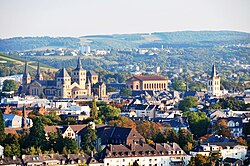
View on WikipediaTrier (/trɪər/ TREER,[4][5] German: [tʁiːɐ̯] ⓘ; Luxembourgish: Tréier [ˈtʀɜɪ̯ɐ] ⓘ), formerly and traditionally known in English as Trèves (/trɛv/ TREV, French: [tʁɛv] ⓘ[6][7]) and Triers (see also names in other languages), is a city on the banks of the Moselle in Germany. It lies in a valley between low vine-covered hills of red sandstone in the west of the state of Rhineland-Palatinate, near the border with Luxembourg and within the important Moselle wine region.
Key Information


.jpg)


Founded by the Romans in the late 1st century BC as Augusta Treverorum ("The City of Augustus among the Treveri"), Trier is considered Germany's oldest city.[8][9] It is also the oldest seat of a bishop north of the Alps. Trier was one of the four capitals of the Roman Empire during the Tetrarchy period in the late 3rd and early 4th centuries.[10] In the Middle Ages, the archbishop-elector of Trier was an important prince of the Church who controlled land from the French border to the Rhine. The archbishop-elector of Trier also had great significance as one of the seven electors of the Holy Roman Empire. Because of its significance during the Roman and Holy Roman empires, several monuments and cathedrals within Trier are listed as a UNESCO World Heritage Site.[10]
With an approximate population of 110,000, Trier is the fourth-largest city in its state, after Mainz, Ludwigshafen, and Koblenz.[11] The nearest major cities are Luxembourg City (50 km or 31 mi to the southwest), Saarbrücken (80 kilometres or 50 miles southeast), and Koblenz (100 km or 62 mi northeast).
The University of Trier, the administration of the Trier-Saarburg district and the seat of the ADD (Aufsichts- und Dienstleistungsdirektion), which until 1999 was the borough authority of Trier, and the Academy of European Law (ERA) are all based in Trier. It is one of the five "central places" of the state of Rhineland-Palatinate. Along with Luxembourg, Metz and Saarbrücken, fellow constituent members of the QuattroPole union of cities, it is central to the greater region encompassing Saar-Lor-Lux (Saarland, Lorraine and Luxembourg), Rhineland-Palatinate, and Wallonia.
History
[edit]The first traces of human settlement in the area of the city show evidence of linear pottery settlements dating from the early Neolithic period. Since the last pre-Christian centuries, members of the Celtic tribe of the Treveri settled in the area of today's Trier.[12] The city of Trier derives its name from the later Latin locative in Trēverīs for earlier Augusta Treverorum. According to the Archbishops of Trier, in the Gesta Treverorum, the founder of the city of the Trevians is Trebeta. German historian Johannes Aventinus also credited Trebeta with building settlements at Metz, Mainz, Basel, Strasbourg, Speyer and Worms.
The historical record describes the Roman Empire subduing the Treveri in the 1st century BC and establishing Augusta Treverorum about 16 BC.[13] The name distinguished it from the empire's many other cities honoring the first Roman emperor, Augustus. The city later became the capital of the province of Belgic Gaul; after the Diocletian Reforms, it became the capital of the prefecture of the Gauls, overseeing much of the Western Roman Empire. From 293 to 395, Trier was one of the residences of the Western Roman Emperor. In the 4th century, Trier was one of the largest cities in the Roman Empire with a population around 75,000 and perhaps as much as 100,000.[14][15][16][17] The Porta Nigra ("Black Gate") dates from this era. A residence of the Western Roman emperor, Roman Trier was the birthplace of Saint Ambrose. Sometime between 395 and 418, probably in 407 the Roman administration moved the staff of the Praetorian Prefecture from Trier to Arles. The city continued to be inhabited but was not as prosperous as before. However, it remained the seat of a governor and had state factories for the production of ballistae and armor and woolen uniforms for the troops, clothing for the civil service, and high-quality garments for the Court. Northern Gaul was held by the Romans along a line (līmes) from north of Cologne to the coast at Boulogne through what is today southern Belgium until 460. South of this line, Roman control was firm, as evidenced by the continuing operation of the imperial arms factory at Amiens.
The Franks seized Trier from Roman administration in 459. In 870, it became part of Eastern Francia, which developed into the Holy Roman Empire. Relics of Saint Matthias brought to the city initiated widespread pilgrimages. The bishops of the city grew increasingly powerful and the Archbishopric of Trier was recognized as an electorate of the empire, one of the most powerful states of Germany. The University of Trier was founded in the city in 1473. In the 17th century, the Archbishops and Prince-Electors of Trier relocated their residence to Philippsburg Castle in Ehrenbreitstein, near Koblenz. A session of the Reichstag was held in Trier in 1512, during which the demarcation of the Imperial Circles was definitively established.
In the years from 1581 to 1593, the Trier witch trials were held. It was one of the four largest witch trials in Germany alongside the Fulda witch trials, the Würzburg witch trial, and the Bamberg witch trials, perhaps even the largest one in European history. The persecutions started in the diocese of Trier in 1581 and reached the city itself in 1587, where it was to lead to the death of about 368 people, and was as such perhaps the biggest mass execution in Europe in peacetime. This counts only those executed within the city itself. The exact number of people executed in all the witch hunts within the diocese has never been established; a total of 1,000 has been suggested but not confirmed.
In the 17th and 18th centuries, the French-Habsburg rivalry brought war to Trier. Spain and France fought over the city during the Thirty Years' War. The bishop was imprisoned by Spain and the Holy Roman Emperor for his support for France between 1635 and 1645. In later wars between the Empire and France, French troops occupied the city during the Nine Years' War, the War of the Spanish Succession, and the War of the Polish Succession. After conquering Trier again in 1794 during the French Revolutionary Wars, France annexed the city and the electoral archbishopric was dissolved. After the Napoleonic Wars ended in 1815, Trier passed to the Kingdom of Prussia. Karl Marx, the German philosopher and one of the founders of Marxism, was born in the city in 1818.
As part of the Prussian Rhineland, Trier developed economically during the 19th century. The city rose in revolt during the revolutions of 1848 in the German states, although the rebels were forced to concede. It became part of the German Empire in 1871.
The synagogue on Zuckerbergstrasse was looted during the November 1938 Kristallnacht and later completely destroyed in a bomb attack in 1944. Multiple Stolpersteine have been installed in Trier to commemorate those murdered and exiled during the Shoah.[18]
In June 1940 during World War II over 60,000 British prisoners of war, captured at Dunkirk and Northern France, were marched to Trier, which became a staging post for British soldiers headed for German prisoner-of-war camps. Trier was heavily bombed and bombarded in 1944. The city became part of the new state of Rhineland-Palatinate after the war. The university, dissolved in 1797, was restarted in the 1970s, while the Cathedral of Trier was reopened in 1974 after undergoing substantial and long-lasting renovations. Trier officially celebrated its 2,000th anniversary in 1984. On 1 December 2020, 5 people were killed by an allegedly drunk driver during a vehicle-ramming attack.[19] The Ehrang/Quint district of Trier was heavily damaged and flooded during the 16 July 2021 floods of Germany, Belgium, The Netherlands and Luxembourg.
-
 Augusta Treverorum in the 4th century
 -

-
 Scale model of Trier around 1800
 -

-

-
 Römerbrücke over the Moselle. (Detail to the north side)


_24.jpg)


Geography
[edit]Trier sits in a hollow midway along the Moselle valley, with the most significant portion of the city on the east bank of the river. Wooded and vineyard-covered slopes stretch up to the Hunsrück plateau in the south and the Eifel in the north. The border with the Grand Duchy of Luxembourg is some 15 km (9 mi) away.
Neighbouring municipalities
[edit]Listed in clockwise order, beginning with the northernmost; all municipalities belong to the Trier-Saarburg district
Schweich, Kenn and Longuich (all part of the Verbandsgemeinde Schweich an der Römischen Weinstraße), Mertesdorf, Kasel, Waldrach, Morscheid, Korlingen and Gusterath (all in the Verbandsgemeinde Ruwer), Hockweiler, Franzenheim (both part of the Verbandsgemeinde Trier-Land), Konz and Wasserliesch (both part of the Verbandsgemeinde Konz), Igel, Trierweiler, Aach, Newel, Kordel, Zemmer (all in the Verbandsgemeinde Trier-Land).
Organization of city districts
[edit]
The Trier urban area is divided into 19 city districts. For each district there is an Ortsbeirat (local council) of between 9 and 15 members, as well as an Ortsvorsteher (local representative). The local councils are charged with hearing the important issues that affect the district, although the final decision on any issue rests with the city council. The local councils nevertheless have the freedom to undertake limited measures within the bounds of their districts and their budgets.
The districts of Trier with area and inhabitants (December 31, 2009):
| Official district number | District with associated sub-districts | Area in km2 |
Inhabitants |
|---|---|---|---|
| 11 | Mitte/Gartenfeld | 2.978 | 11,954 |
| 12 | Nord (Nells Ländchen, Maximin) | 3.769 | 13,405 |
| 13 | Süd (St. Barbara, St. Matthias or St. Mattheis) | 1.722 | 9,123 |
| 21 | Ehrang/Quint | 26.134 | 9,195 |
| 22 | Pfalzel | 2.350 | 3,514 |
| 23 | Biewer | 5.186 | 1,949 |
| 24 | Ruwer/Eitelsbach | 9.167 | 3,091 |
| 31 | West/Pallien | 8.488 | 7,005 |
| 32 | Euren (Herresthal) | 13.189 | 4,207 |
| 33 | Zewen (Oberkirch) | 7.496 | 3,634 |
| 41 | Olewig | 3.100 | 3,135 |
| 42 | Kürenz (Alt-Kürenz, Neu-Kürenz) | 5.825 | 8,708 |
| 43 | Tarforst | 4.184 | 6,605 |
| 44 | Filsch | 1.601 | 761 |
| 45 | Irsch | 4.082 | 2,351 |
| 46 | Kernscheid | 3.768 | 958 |
| 51 | Feyen/Weismark | 5.095 | 5,689 |
| 52 | Heiligkreuz (Alt-Heiligkreuz, Neu-Heiligkreuz, St. Maternus) | 2.036 | 6,672 |
| 53 | Mariahof (St. Michael) | 7.040 | 3,120 |
| Totals | 117.210 | 105,076 |
Climate
[edit]Trier has an oceanic climate (Köppen: Cfb), but with greater extremes than the marine versions of northern Germany. Summers are warm except in unusual heat waves and winters are recurrently cold, but not harsh. Precipitation is high despite not being on the coast.[20] As a result of the European heat wave in 2003, the highest temperature recorded was 39 °C on 8 August of that year. On 25 July 2019, a record-breaking temperature of 40.6 °C was recorded.[21] The lowest recorded temperature was −19.3 °C on February 2, 1956.[22]
| Climate data for Trier (1991–2020 normals) (1948–present extremes) | |||||||||||||
|---|---|---|---|---|---|---|---|---|---|---|---|---|---|
| Month | Jan | Feb | Mar | Apr | May | Jun | Jul | Aug | Sep | Oct | Nov | Dec | Year |
| Record high °C (°F) | 14.7 (58.5) |
20.3 (68.5) |
24.5 (76.1) |
28.5 (83.3) |
30.7 (87.3) |
36.2 (97.2) |
40.6 (105.1) |
39.0 (102.2) |
34.8 (94.6) |
26.8 (80.2) |
20.6 (69.1) |
17.0 (62.6) |
40.6 (105.1) |
| Mean daily maximum °C (°F) | 4.5 (40.1) |
6.1 (43.0) |
10.8 (51.4) |
15.7 (60.3) |
19.7 (67.5) |
23.0 (73.4) |
25.2 (77.4) |
24.9 (76.8) |
20.4 (68.7) |
14.6 (58.3) |
8.6 (47.5) |
5.1 (41.2) |
14.9 (58.8) |
| Daily mean °C (°F) | 2.0 (35.6) |
2.8 (37.0) |
6.2 (43.2) |
10.0 (50.0) |
13.9 (57.0) |
17.1 (62.8) |
19.1 (66.4) |
18.6 (65.5) |
14.5 (58.1) |
10.3 (50.5) |
5.8 (42.4) |
2.8 (37.0) |
10.2 (50.4) |
| Mean daily minimum °C (°F) | −0.4 (31.3) |
−0.2 (31.6) |
2.2 (36.0) |
4.9 (40.8) |
8.6 (47.5) |
11.7 (53.1) |
13.7 (56.7) |
13.3 (55.9) |
10.0 (50.0) |
6.8 (44.2) |
3.3 (37.9) |
0.6 (33.1) |
6.2 (43.2) |
| Record low °C (°F) | −18.3 (−0.9) |
−19.3 (−2.7) |
−12.9 (8.8) |
−6.2 (20.8) |
−1.6 (29.1) |
1.7 (35.1) |
4.4 (39.9) |
4.2 (39.6) |
1.2 (34.2) |
−3.4 (25.9) |
−10.2 (13.6) |
−14.4 (6.1) |
−19.3 (−2.7) |
| Average precipitation mm (inches) | 63.5 (2.50) |
53.0 (2.09) |
51.3 (2.02) |
44.2 (1.74) |
66.7 (2.63) |
66.0 (2.60) |
72.4 (2.85) |
62.0 (2.44) |
60.4 (2.38) |
65.4 (2.57) |
62.2 (2.45) |
77.6 (3.06) |
746.8 (29.40) |
| Average precipitation days (≥ 1.0 mm) | 18.2 | 16.4 | 15.3 | 13.0 | 14.7 | 13.5 | 13.9 | 13.6 | 12.6 | 15.3 | 18.1 | 18.7 | 183.7 |
| Average snowy days (≥ 1.0 cm) | 5.9 | 4.9 | 1.6 | 0.1 | 0 | 0 | 0 | 0 | 0 | 0 | 1.0 | 4.3 | 17.8 |
| Average relative humidity (%) | 87.2 | 82.5 | 75.1 | 69.0 | 71.0 | 70.8 | 69.9 | 71.9 | 77.9 | 84.5 | 88.5 | 89.2 | 78.1 |
| Mean monthly sunshine hours | 48.1 | 70.3 | 130.9 | 187.1 | 213.8 | 224.7 | 235.1 | 215.3 | 159.8 | 96.3 | 44.8 | 38.7 | 1,663.4 |
| Source 1: World Meteorological Organization[23][24] | |||||||||||||
| Source 2: Wetterdienst.de - Wetter- und Klimaberatung | |||||||||||||
Demography
[edit]| Year | Pop. | ±% |
|---|---|---|
| 100 | 20,000 | — |
| 300 | 80,000 | +300.0% |
| 400 | 50,000 | −37.5% |
| 1250 | 12,000 | −76.0% |
| 1363 | 10,000 | −16.7% |
| 1542 | 8,500 | −15.0% |
| 1613 | 6,000 | −29.4% |
| 1702 | 4,300 | −28.3% |
| 1801 | 8,829 | +105.3% |
| 1871 | 21,442 | +142.9% |
| 1900 | 43,506 | +102.9% |
| 1910 | 49,112 | +12.9% |
| 1919 | 53,248 | +8.4% |
| 1919 | 57,341 | +7.7% |
| 1933 | 76,692 | +33.7% |
| 1939 | 88,150 | +14.9% |
| 1950 | 75,526 | −14.3% |
| 1961 | 87,141 | +15.4% |
| 1970 | 103,724 | +19.0% |
| 1987 | 94,118 | −9.3% |
| 2011 | 105,671 | +12.3% |
| 2018 | 110,636 | +4.7% |
| Source:[25][circular reference] | ||
| Country of birth | Population (2013) |
|---|---|
 Poland Poland |
688 |
 France France |
675 |
 Luxembourg Luxembourg |
573 |
 Ukraine Ukraine |
476 |
 Russia Russia |
444 |
Culture
[edit]Trier has a municipal theatre, Theater Trier, for musical theatre, plays and dance.
Main sights
[edit]| UNESCO World Heritage Site | |
|---|---|
 Ruins of the Imperial Baths | |
| Includes | Amphitheater, Roman bridge, Barbara Baths, Igel Column, Porta Nigra, Imperial Baths, Aula Palatina, Cathedral and Liebfrauenkirche |
| Criteria | Cultural: i, iii, iv, vi |
| Reference | 367 |
| Inscription | 1986 (10th Session) |

Trier is known for its well-preserved Roman and medieval buildings, which include:
- the Porta Nigra, the best-preserved Roman city gate north of the Alps;
- the huge Aula Palatina, a basilica in the original Roman sense, was the 67 m (219.82 ft) long throne hall of Roman emperor Constantine; it is today used as a Protestant church; adjacent is the Electoral Palace, Trier;
- the Roman Trier Amphitheater;
- the 2nd century AD Roman bridge (Römerbrücke) across the Moselle, the oldest bridge north of the Alps still crossed by traffic;
- ruins of three Roman baths, among them the largest Roman baths north of the Alps; including the Barbara Baths, the Trier Imperial Baths, and the Forum Baths, Trier;
- Trier Cathedral (German: Trierer Dom or Dom St Peter), a Catholic church that dates back to Roman times; its Romanesque west façade with an extra apse and four towers is imposing and has been copied repeatedly; the Cathedral is home to the Holy Tunic, one of a number of garments claimed to be the robe Jesus was wearing when he died, as well as many other relics and reliquaries in the Cathedral Treasury;
- the Liebfrauenkirche (German for Church of Our Lady), which is one of the most important early Gothic churches in Germany, in some ways comparable to the architectural tradition of the French Gothic cathedrals;
- St Matthias' Abbey (Abtei St Matthias), still a functioning monastery whose medieval church harbours what is held to be the only tomb of an apostle located north of the Alps;
- St Gangolf's church is the city's 'own' church near the main market square (as opposed to the Cathedral, the bishop's church); largely Gothic;
- Saint Paulinus' Church, one of the most important Baroque churches in Rhineland-Palatinate and designed in part by the architect Balthasar Neumann;
- two old treadwheel cranes, one being the Gothic "Old Crane" (Alte Krahnen) or "Trier Moselle Crane" (Trierer Moselkrahn) from 1413, and the other the 1774 Baroque crane called the "(Old) Customs Crane" ((Alter) Zollkran) or "Younger Moselle Crane" (Jüngerer Moselkran) (see List of historical harbour cranes).
Museums
[edit]
- Rheinisches Landesmuseum (an important archaeological museum for the Roman period; also some early Christian and Romanesque sculpture)
- Domschatzkammer (Treasury of Trier Cathedral; with the Egbert Shrine, the reliquary of the Holy Nail, the cup of Saint Helena and other reliquaries, liturgical objects, ivories, manuscripts, etc., many from the Middle Ages)
- Museum am Dom, formerly Bischöfliches Dom- und Diözesanmuseum (Museum of the Diocese of Trier; religious art, also some Roman artefacts)
- Stadtmuseum Simeonstift (history of Trier, displaying among other exhibits a scale model of the medieval city)
- Karl Marx House; a museum exhibiting Marx's personal history, volumes of poetry, original letters, and photographs with personal dedications. There is also a collection of rare first editions and international editions of his works, as well as exhibits on the development of socialism in the 19th century
- Toy Museum of Trier
- Ethnological and open-air museum Roscheider Hof, a museum in the neighbouring town of Konz, right at the city limits of Trier, which shows the history of rural culture in the northwest Rhineland Palatinate and in the area where Germany, Luxembourg and Lorraine meet
- Fell Exhibition Slate Mine; site in the municipality of Fell, 20 km (12 mi) from Trier, containing an underground mine, a mine museum, and a slate mining trail.
- Memorial sculpture (2012) by Clas Steinmann to the deportation of Sinti and Romani people in Trier.[26]
Annual events
[edit]- Since 1980 the Altstadtfest has been celebrated in the centre of Trier on the last weekend of June, followed by the Zurlaubener Heimatfest on the banks of the River Mosel two weeks later.
- Until 2014 Trier was home to Germany's largest Roman festival, Brot und Spiele (German for Bread and Games – a translation of the famous Latin phrase panem et circenses from the satires of Juvenal).
- Trier has been the base for the German round of the World Rally Championship since 2002, with the rally's presentation held next to the Porta Nigra.
- Trier holds a Christmas street festival every year called the Trier Christmas Market on the Hauptmarkt (Main Market Square) and the Domfreihof in front of the Cathedral of Trier.
- The Olewiger Weinfest is an annual wine festival held in the village of Olewig, just outside Trier. The festival takes place over three days, typically in August, and features a wide variety of activities, including wine tastings, live music and food stalls.
Education
[edit]

Trier is home to the University of Trier, founded in 1473, closed in 1796 and restarted in 1970. The city also has the Trier University of Applied Sciences. The Academy of European Law (ERA) was established in 1992 and provides training in European law to legal practitioners. In 2010 there were about 40 Kindergärten,[27] 25 primary schools and 23 secondary schools in Trier, such as the Humboldt Gymnasium Trier, Max Planck Gymnasium, Auguste Viktoria Gymnasium, Angela Merici Gymnasium, Friedrich Wilhelm Gymnasium and the Nelson-Mandela Realschule Plus, Kurfürst-Balduin Realschule Plus, Realschule Plus Ehrang.[28]
Transport
[edit]Trier station has direct railway connections to many cities in the region. The nearest cities by train are Cologne, Saarbrücken and Luxembourg. Via the motorways A 1, A 48 and A 64 Trier is linked with Koblenz, Saarbrücken and Luxembourg. The nearest commercial (international) airports are in Luxembourg (0:40 h by car), Frankfurt-Hahn (1:00 h), Saarbrücken (1:00 h), Frankfurt (2:00 h) and Cologne/Bonn (2:00 h). The Moselle is an important waterway and is also used for river cruises. A new passenger railway service on the western side of the Mosel is scheduled to open in December 2024.[29]
Sports
[edit]
Major sports clubs in Trier include:
- SV Eintracht Trier 05, association football
- Gladiators Trier, basketball (former TBB Trier)
- DJK/MJC Trier, women's team handball
- Trier Cardinals, baseball
- PST Trier Stampers, American football
- FSV Trier-Tarforst, intera alia football and rugby
International relations
[edit]Trier is a fellow member of the QuattroPole union of cities, along with Luxembourg, Saarbrücken and Metz (neighbouring countries: Luxembourg and France).
Twin towns – sister cities
[edit] Gloucester, England, UK (1957)
 Metz, France (1957)
 Ascoli Piceno, Italy (1958)
 's-Hertogenbosch, Netherlands (1968)
 Pula, Croatia (1971)
 Weimar, Germany (1987)
 Fort Worth, United States (1987)
 Nagaoka, Japan (2006)
 Xiamen, China (2010)
 Izium, Ukraine (2024)[31][32]


Namesakes
[edit]- New Trier Township, Illinois, US, originally settled by people from Trier.
- New Trier, Minnesota, US, settled by people from Trier about 1856.
- New Trier High School, an Illinois school named after Trier.
Notable people
[edit]- Hans am Ende (1864–1918), painter
- Ambrose (c. 340–397), saint
- Apronia of Toul (6th century), nun and saint
- Athanasius of Alexandria (296/298–373), saint (in exile ca. 335)
- Ausonius (c. 310–395), Roman consul and poet
- Martin Bambauer (born 1970), church musician
- Reinhold Bartel (1926–1996), operatic tenor
- Wolf Graf von Baudissin (1907–1993), general, military planner and peace researcher
- August Beer (1825–1863), scientist
- Constantius Chlorus (c. 250–306), Roman emperor
- Ernst Ulrich Deuker (born 1954), musician
- Eucharius (died c. 250), first bishop of Trier
- Frank Findeiß (born 1971), poet
- Charles de Gaulle (1890–1970), General and French statesman, as commander of a battalion of Chasseurs during the French occupation of Rhineland
- Franz Grundheber (1937–2025), baritone
- Helena (c. 250–330), saint, mother of Constantine the Great (residence in Trier by tradition)
- Reinhard Heß (1904–1998), painter and glass painter
- Ernst Huberty (1927–2023), sports reporter
- Eric Jelen (born 1965), tennis player
- Ludwig Kaas (1881–1952), Catholic priest and politician (Zentrum)
- Anja Kaesmacher (born 1974), operatic soprano
- Ursula Krechel (born 1947), writer and poet
- Gitta Lind (1925–1974), singer
- Xavier Bout de Marnhac (born 1951), French general, former commander of KFOR
- Heinrich Marx (1777–1838), lawyer, father of Karl Marx
- Henriette Marx (1788–1863), mother of Karl Marx
- Jenny Marx (1814–1881), revolutionary, drama critic
- Karl Marx (1818–1883), social philosopher and revolutionary
- Maximian (c. 250–310), Roman emperor
- Georg Meier (chess player) (born 1987), German grandmaster of chess
- Saint Modesta (died c. 680), founder and Abbess of the monastery of Oeren
- Oswald von Nell-Breuning (1890–1991), theologian
- Kaspar Olevianus (1536–1587), theologian
- Paulinus (died 358), bishop of Trier
- Johann Anton Ramboux (1790–1866), painter
- Udo Samel (born 1953), Actor
- Frederick A. Schroeder (1833–1899), American politician, mayor of Brooklyn
- Otmar Seul (born 1943), lawyer, professor
- Günther Steines (1928–1982), athlete
- Peter Thullen (1907–1996), German-Ecuadorian mathematician
- Valentinian I (321–375), Roman emperor
- Valerius (died 320), second bishop of Trier
- François Weigel (born 1964), French pianist, composer and conductor
- Ludwig von Westphalen (1770 –1842), father-in-law of Karl Marx
- Helga Zepp-LaRouche (born 1948), journalist and politician
- Robert Zimmer (born 1953), philosopher and essayist
See also
[edit]References
[edit]- ^ "Treverer und Römer - Die Gründung der Stadt" (in German). 2025-08-16.
- ^ Wolfram Leibe (SPD) bleibt Oberbürgermeister in Trier Archived 2022-10-08 at the Wayback Machine, SWR Aktuell, 25 September 2022.
- ^ Bevölkerungsstand 31. Dezember 2023, Landkreise, Gemeinden, Verbandsgemeinden; Fortschreibung des Zensus 2011 (in German), Statistisches Landesamt Rheinland-Pfalz, 2024
- ^ "Trier" (US) and "Trier". Lexico UK English Dictionary. Oxford University Press. Archived from the original on 2020-03-22.
- ^ "Trier". Merriam-Webster.com Dictionary. Merriam-Webster. Retrieved April 2, 2019.
- ^ "Trèves" (US) and "Trèves". Oxford Dictionaries UK English Dictionary. Oxford University Press.[dead link]
- ^ "Trèves". The American Heritage Dictionary of the English Language (5th ed.). HarperCollins. Retrieved April 2, 2019.
- ^ Rathaus der Stadt Trier. "Stadt Trier – City of Trier – La Ville de Trèves | Website of the Municipality of Trier". Archived from the original on 2002-08-08. Retrieved 2015-08-26.
- ^ An honor that is contested by Cologne, Kempten, and Worms.
- ^ a b "Roman Monuments, Cathedral of St Peter and Church of Our Lady in Trier". UNESCO World Heritage Centre. United Nations Educational, Scientific, and Cultural Organization. Retrieved 22 May 2022.
- ^ "Bevölkerung der Gemeinden am 31.12.2010" (PDF). Statistisches Landesamt Rheinland-Pfalz (in German). 2011. Archived from the original (PDF) on 2012-01-31.
- ^ See: Heinen, pp. 1–12.
- ^ The City of Trier, Trier University, retrieved 11 May 2019
- ^ "TRIER THE CENTER OF ANTIQUITY IN GERMANY". 8 March 2012. Archived from the original (PDF) on 2018-12-25. Retrieved 2015-08-26.
- ^ LaVerne, F.K. (1991). Europe by Eurail 2010: Touring Europe by Train. Globe Pequot Press. p. 337. ISBN 9780762761630. Retrieved 2015-08-26.
- ^ Baker, Myron (2013). BEYOND OUR WORLD: The Exciting Story of a Treasure Hunter, Historian, and Adventurer. Dorrance Publishing Co. p. 182. ISBN 9781480901872. Retrieved 2021-01-04.
- ^ Victor, Helena; Fischer, Svante. "The Fall and Decline of the Roman Urban Mind | Svante Fischer and Helena Victor - Academia.edu". academia.edu. Retrieved 2015-08-26.
- ^ List of Stolperstein in Trier (in German).
- ^ Trier: Five die as car ploughs through Germany pedestrian zone. BBC News. Retrieved 2021-01-04.
- ^ "Trier, Germany Köppen Climate Classification (Weatherbase)". Weatherbase. Archived from the original on September 22, 2020. Retrieved 2019-02-02.
- ^ "Neuer Hitzerekord in Rheinland-Pfalz: 40,6 Grad in Trier". welt.de (in German). 2019-07-25. Retrieved 2023-10-19.
- ^ "Wetterrekorde Deutschland". Wetterdienst.de (in German). Retrieved 2019-02-02.
- ^ "World Meteorological Organization Climate Normals for 1991–2020". World Meteorological Organization Climatological Standard Normals (1991–2020). National Oceanic and Atmospheric Administration. Archived from the original on 12 October 2023. Retrieved 13 October 2023.
- ^ "Trier (10609) – WMO Weather Station". NOAA (FTP). Retrieved February 2, 2019. (To view documents see Help:FTP)
- ^ Einwohnerentwicklung von Trier [Population development]. wikipedia.de (in German). Retrieved January 4, 2021.
- ^ (Palauenc05) (2022-05-05), Deutsch: Mahnmal (2012) von Clas Steinmann (*1941) für deportierte Sinti und Roma in der Windstraße / Bischof-Stein-Platz, Trier (Ansicht West)., retrieved 2024-08-02
- ^ "Stadt Trier – Startseite | Kindergärten in Trier". trier.de, City of Trier. Retrieved 2015-08-26.
- ^ "Stadt Trier – Startseite – Schulen in Trier". trier.de, City of Trier. Retrieved 2015-08-26.
- ^ Fender, Keith (12 February 2014). "Plans approved for Trier suburban line Written by". International Railway Journal. Retrieved 2014-02-25.
- ^ "Städtepartnerschaften". trier.de (in German). Trier. Retrieved 2021-03-17.
- ^ "Stadtrat bringt Partnerschaft mit ukrainischer Stadt auf den Weg" (in German). The city administration of Trier. 2024-03-08.
- ^ Finkenberg, Arnt, ed. (14 March 2024). "Neue Partnerstadt. Trier geht zehnten Städtebund mit Isjum ein". Trierer Wochenspiegel (in German) (11). Trier: 3.
Further reading
[edit]- Heinz Monz (2000): Trierer Biographisches Lexikon. Koblenz: Landesarchivverwaltung Rheinland-Pfalz. 539 pp. ISBN 3-931014-49-5.
External links
[edit]

- Official website
 (in German)
 - . New International Encyclopedia. 1905.
- Gough, Alfred Bradley (1911). . Encyclopædia Britannica. Vol. 27 (11th ed.). pp. 268–269.


Trier
View on GrokipediaGeography
Location and Terrain
Trier lies in southwestern Germany within Rhineland-Palatinate at coordinates 49°45′N 6°38′E.[6] Positioned on the right bank of the Moselle River near the Luxembourg border, the city occupies a basin formed by the river's course.[7] Its central elevation stands at approximately 130 meters above sea level, with surrounding areas rising gradually.[8] The Moselle's meandering path through the region creates fertile alluvial plains in the Trier basin, or Trierer Talweite, characterized by fine-grained Holocene sediments deposited along lower river terraces.[9] These plains provide a flat, productive base for settlement and agriculture, contrasting with the steeper slopes nearby.[10] Encircled by low mountain ranges, including the Hunsrück to the east and Eifel to the west, Trier's terrain features natural topographic barriers that limit expansive flatland development.[7] Predominant soils comprise Devonian slate variants—such as blue and grey slate—mixed with clayey loam, offering poor fertility but excellent drainage that supports specialized viticulture, particularly Riesling production through mineral retention and stress on vines.[11][12]Climate
Trier experiences a temperate oceanic climate classified as Cfb under the Köppen-Geiger system, characterized by mild winters, cool summers, and year-round precipitation without a pronounced dry season.[13] [14] Long-term records from the Deutscher Wetterdienst (DWD) indicate average annual precipitation of approximately 700-800 mm, distributed fairly evenly across months, with slightly higher totals in summer due to convective storms.[15] [8] Mean temperatures range from winter averages near 2°C (with lows occasionally dipping to -2°C) to summer highs around 24°C, reflecting the region's moderate thermal regime influenced by westerly Atlantic flows.[16] The Moselle River valley exerts a moderating microclimate effect, reducing temperature extremes through föhn-like warming on south-facing slopes and enhanced insolation, which contributes to Trier being among Germany's warmer locales and supports extensive viticulture.[17] [18] This topographic funneling also channels prevailing southwest winds, occasionally amplifying local rainfall but generally buffering against severe frosts or heatwaves compared to inland areas.[19] Notable hydrometeorological extremes include riverine floods driven by prolonged heavy precipitation and Moselle catchment saturation; the 1993 Christmas flood peaked at 11.28 m gauge height in Trier, resulting from rapid snowmelt and rainfall exceeding 200 mm in upstream areas over days.[20] The 2021 July event, tied to stalled low-pressure systems delivering over 150 mm in 48 hours, caused Moselle levels to surge, exacerbating downstream dynamics though less catastrophically in Trier proper than in tributaries like the Ahr.[21] These incidents underscore vulnerability to atmospheric rivers and orographic enhancement in the Eifel-Moselle basin.[22]History
Pre-Roman and Roman Foundations
The region surrounding modern Trier was settled by the Treveri, a Celtic tribe known for their Belgic affiliations, prior to Roman conquest, featuring scattered farms and hamlets rather than an urban center. Archaeological evidence indicates these pre-Roman inhabitants engaged in agriculture and local trade along the Moselle River, establishing the area as a strategic crossing point that Romans later exploited for military and economic control.[23] Augusta Treverorum was founded around 16 BC under Emperor Augustus as the civitas capital for the Treveri, transforming the site into a planned Roman colony with a grid layout optimized for administrative efficiency, defense via walls and gates, and commerce at river confluences. This urban design reflected Roman principles of modular construction and centralized governance, enabling rapid population growth to support provincial administration in Gaul. The initial wooden bridge across the Moselle, constructed circa 17 BC, facilitated connectivity and marked early infrastructure investment.[24] By the 2nd century AD, Augusta Treverorum's prominence was evident in monumental projects like the amphitheater, built for gladiatorial games and public spectacles with a capacity of approximately 20,000 spectators, underscoring the city's substantial urban population and role in Roman cultural integration. The stone iteration of the Moselle bridge, with basalt pillars erected mid-2nd century, exemplified durable engineering still operational today, handling modern traffic atop ancient foundations.[25] In the early 4th century, Emperor Constantine I established Trier as a key residence from 306 to circa 312 AD, elevating it to a temporary imperial capital during his consolidation of power in the western provinces; here, he commissioned the Basilica (Aula Palatina) as part of an expansive palace complex, demonstrating advanced vaulted architecture for audience halls.[26] This era highlighted Trier's logistical importance, with organized material sourcing evident in recent analyses: a 2025 study of 4,000 bricks from Roman structures revealed standardized production and regional supply chains, indicating sophisticated economic coordination for large-scale builds.[27] Such empirical data affirms the city's peak as a hub of Roman provincial power until pressures from 5th-century invasions.Medieval to Early Modern Era
After the collapse of Roman imperial control in the fifth century, Trier transitioned into the Frankish sphere of influence, marking the onset of its medieval development. The Franks assumed authority over the city around 459, severing ties with waning Roman governance, and by 485 the surrounding region had been fully integrated into the Merovingian Frankish Kingdom.[28] This integration facilitated a gradual consolidation under feudal structures, with the city's strategic position along the Moselle River supporting localized trade in wine and goods, though on a diminished scale compared to its Roman peak.[1] Ecclesiastical institutions provided essential continuity amid political fragmentation, exemplified by Trier Cathedral (St. Peter's), whose origins trace to construction initiated around 326 under Emperor Constantine, incorporating Roman masonry that endured into the medieval period.[29][30] The structure, the oldest north of the Alps, underwent rebuilding after destructions by invading Franks and Vikings in 882, underscoring the church's role in preserving Christian worship and administrative functions.[31] The Archbishopric of Trier, established as a metropolitan see, amassed temporal authority as a prince-bishopric within the Holy Roman Empire, with its archbishops wielding influence in imperial elections as early as 1138 and formalized as one of seven electors by the Golden Bull of 1356.[32] The archbishopric's governance fostered feudal stability and economic revival through riverine commerce and viticulture, though recurrent plagues, such as the Black Death in the fourteenth century, and internal conflicts constrained growth. Population estimates reflect this volatility, declining sharply in the early medieval phase to around 5,000 inhabitants before modest recovery.[33] The Thirty Years' War (1618–1648) inflicted severe depredations, with marauding armies contributing to widespread devastation across the Empire, including Trier, where famine, disease, and violence halved urban populations in affected regions.[34] By the late eighteenth century, the Electorate of Trier persisted as an ecclesiastical principality until disrupted by the French Revolutionary Wars. French forces occupied the city in 1794, leading to annexation in 1797 and the formal dissolution of the archbishopric's temporal powers by 1801, ending early modern autonomy.[7][35] This shift dismantled feudal ecclesiastical rule, paving the way for secular administrative reforms.Modern Period and Industrialization
Following the Congress of Vienna in 1815, Trier was incorporated into the Kingdom of Prussia as part of the Rhine Province, marking a shift from French Napoleonic administration to Prussian governance that integrated the city into a larger customs union and administrative framework.[7] This annexation facilitated the abolition of internal trade barriers through the Prussian Customs Union (Zollverein), established progressively from 1818 onward, which promoted economic cohesion across Prussian territories and reduced reliance on fragmented local markets.[36] Trier's economy, historically centered on wine production, leather, cloth, and tobacco, began to expand under these reforms, with the Mosel Valley wine trade experiencing prosperity from the 1819 vintage onward due to improved market access and Prussian administrative support for viticulture.[37] The city's population grew from around 12,000 residents in the early 19th century to over 43,000 by 1900, reflecting broader industrialization trends in the Prussian Rhineland, including enhanced riverine trade along the Moselle and the development of supporting infrastructure.[38] The arrival of rail connections, beginning with the Trier-Saarbrücken-Luxembourg line in the 1850s and expanding with the Koblenz-Trier link in 1871, accelerated commodity transport, particularly wine exports, and stimulated ancillary sectors like warehousing and commerce.[39] Karl Marx was born in Trier on May 5, 1818, to a middle-class family of Ashkenazi Jewish descent, though his early life coincided with the modest bourgeois stability of the pre-industrial era rather than direct involvement in emerging factories. Social tensions surfaced during the 1848 revolutions, as Trier witnessed protests against Prussian absolutism and economic disparities, aligning with wider German demands for liberalization amid nascent industrial pressures.[40] Trier's industrialization remained limited compared to Ruhr Valley centers, focusing instead on agro-processing and trade rather than heavy manufacturing, with wine exports comprising a core economic driver bolstered by Prussian-era phylloxera-resistant replanting and market expansion into northern Germany.[41] World War I imposed strains as a frontier garrison town near Luxembourg, but physical destruction was minimal, preserving much of the urban fabric. In contrast, World War II brought severe devastation: between December 19 and 21, 1944, Allied air raids—initiated by 30 British Lancaster bombers dropping 136 tons of high-explosive bombs on December 19, followed by 700 tons two days later—targeted rail and bridge infrastructure, killing at least 420 civilians and damaging key sites including the cathedral and industrial facilities.[42] These bombings, part of broader strategic efforts to disrupt German logistics, left over 60% of the city center in ruins by early 1945, underscoring the causal link between Trier's Moselle Valley position and its vulnerability to interdiction campaigns.[43]Post-WWII Reconstruction and Recent Developments
Following the capture of Trier by the United States 10th Armored Division on 1 March 1945, the city sustained extensive damage from wartime bombing and ground fighting, with approximately 35% of its building stock completely destroyed and another 29% damaged to varying degrees.[44] Reconstruction efforts prioritized restoring essential infrastructure and housing, leading to a largely modern redesign of the inner city, including new commercial and residential structures that replaced medieval and baroque facades lost in the raids.[44] Historical monuments, such as Roman-era sites, underwent targeted restoration based on pre-war documentation like engravings and paintings to preserve architectural authenticity amid the broader urban rebuild.[45] As part of the French occupation zone until 1952, Trier transitioned into the Federal Republic of Germany upon its founding on 23 May 1949, integrating into the state of Rhineland-Palatinate and benefiting from the Marshall Plan's economic aid, which supported industrial revival and transport links. Its location adjacent to Luxembourg and France enhanced post-war recovery through cross-border commerce, facilitated by European economic integration; however, temporary border controls reimposed in 2024-2025 have disrupted local trade flows, such as commuter shopping and worker mobility.[46][47] In recent years, Trier has faced security challenges alongside infrastructure advancements, exemplified by the 1 December 2020 vehicle ramming attack in the city's pedestrian zone, where a local man drove into crowds, killing five people—including a nine-week-old infant—and injuring up to 15 others; the perpetrator, suffering from schizophrenia, received a life sentence for murder in August 2022.[48][49] On a positive note, the Weststrecke (Trier West Railway), dormant for passenger service since 1983, reactivated regional trains on 3 March 2025 after a €60 million upgrade by Deutsche Bahn and Rhineland-Palatinate authorities, adding five new stops to connect western suburbs and the port area to the main network.[50] Concurrently, archaeological work continues to illuminate the city's Roman heritage, with a 2025 interdisciplinary project examining 4,000 stamped bricks to map ancient construction logistics, material sourcing, and urban expansion patterns in Augusta Treverorum.[27]Administration and Politics
Local Government Structure
Trier operates as a kreisfreie Stadt within the state of Rhineland-Palatinate, governed by the state's municipal code (Gemeindeordnung Rheinland-Pfalz), which delineates local authority over matters such as urban planning, education, cultural affairs, social services, waste management, and local infrastructure. The executive head is the Oberbürgermeister, elected directly by residents for an eight-year term via majority vote, serving as the city's chief representative, chair of the Stadtrat (city council), and head of the municipal administration, with responsibilities including budget execution, policy implementation, and veto powers over council decisions subject to override.[51] Current Oberbürgermeister Wolfram Leibe (SPD) has held office since April 1, 2015, following his election in 2014 and re-election in 2022. The Stadtrat comprises 56 members elected every five years through proportional representation, advising on policy, approving budgets, and electing committees for oversight; it convenes publicly and holds legislative authority within state-defined limits, but lacks direct executive control.[52] In the June 9, 2024, election, the CDU gained the most seats with 15 (25.8% vote share), followed by SPD (13 seats, 22.8%), Greens (11 seats, 20.3%), AfD (5 seats, 9.4%), and smaller parties including Die Linke (3), FDP (3), and others, resulting in no single-party majority and ending the prior SPD-Greens-FDP coalition's control.[53] Voter turnout rose to approximately 52% from prior elections, reflecting increased participation amid local debates on housing and infrastructure.[54] Fiscal operations depend heavily on local revenues like property taxes (contributing about 40% of income), trade fees, and user charges, supplemented by state equalization grants and federal transfers for projects exceeding municipal capacity, such as major transport or environmental initiatives; the 2024 budget totaled roughly €450 million, with deficits managed through borrowing capped by state debt rules. Administrative efficiency is tracked via state-mandated indicators, including digital service provision under the Onlinezugangsgesetz, where Trier scores above average in Rhineland-Palatinate for e-government portals and processing times, though challenges persist in staffing shortages for social services.Administrative Districts
Trier is administratively divided into 19 Ortsbezirke, which function as localized districts for governance and community representation. These divisions enable decentralized management of district-specific affairs, including small-scale infrastructure projects and resident concerns, while integrating into the city's overall administration. Each Ortsbezirk elects an Ortsvorsteher (district head) and an Ortsbeirat (district council) every five years, with the council comprising 9 to 15 members depending on the district's size. The Ortsvorsteher chairs meetings, advocates for the district in city council deliberations, and oversees an annual budget of €15,100 to €31,400, scaled by population, to fund local initiatives such as park maintenance or community facilities.[55] The Ortsbezirke encompass a mix of urban core areas and suburban expansions, reflecting Trier's historical growth through incorporations of surrounding villages and lands. Central districts like Trier-Mitte-Gartenfeld, Trier-Nord, Trier-Süd, and Trier-West-Pallien form the densely built urban heart, housing historical sites and commercial hubs. In contrast, peripheral districts such as Ehrang-Quint, Ruwer-Eitelsbach, Biewer, Pfalzel, Olewig, Filsch, Kernscheid, Zewen, and Euren retain rural or village-like traits, with agricultural lands and lower densities, stemming from mid-20th-century integrations that preserved local identities amid urban expansion. Mixed-character areas, including Tarforst, Irsch, Kürenz, Feyen-Weismark, Heiligkreuz, and Mariahof, blend residential developments with green zones, supporting Trier's viticultural outskirts. This structure facilitates targeted oversight of green spaces, with districts like Olewig and Ruwer-Eitelsbach managing vineyards and recreational areas, and utilities distribution coordinated to address varying suburban demands.[55] Population distribution underscores the shift toward suburban growth, with Trier's total residents reaching 112,597 as of 2024. Urban core districts concentrate higher densities for daily governance efficiency, while expansions like Ehrang-Quint—functioning as a semi-autonomous suburb—host significant shares, contributing to overall demographic balance and enabling localized utility planning, such as water and waste services tailored to dispersed settlements. These divisions promote practical equity in resource allocation, with Ortsbeiräte ensuring empirical adjustments based on resident needs across the 117.1 km² municipal area.[56][55]Political Landscape and Controversies
In Trier's local politics, the Social Democratic Party (SPD) and Christian Democratic Union (CDU) hold the primary influence on the city council, with the SPD maintaining control of the mayoralty since 2015 through Oberbürgermeister Wolfram Leibe, who won re-election in the September 2022 runoff with 72.2% of the vote against the CDU's 20.5%.[57][58] In the 2024 European Parliament elections held locally, the CDU edged out the SPD with 23.5% to 21.0% of the vote, followed by the Greens at 15.5% and Alternative for Germany (AfD) at 9.6%, reflecting a competitive center-right and center-left dynamic amid rising support for smaller parties.[59] Voter turnout in the 2022 mayoral contest exceeded typical local averages, underscoring civic engagement in a city aligned with Rhineland-Palatinate's SPD-led state coalition with the Greens and Free Democrats (FDP).[57] A major controversy emerged in 2017-2018 surrounding the city's acceptance of a 5.5-meter bronze statue of Karl Marx, donated by the People's Republic of China at no cost to Trier, to mark the 200th anniversary of his birth on May 5, 1818.[60][61] The monument, depicting Marx holding a book and weighing 2.3 metric tons, was installed despite protests from critics who contended it sanitized the philosopher's legacy by ignoring the causal role of his theories in enabling communist regimes responsible for over 100 million deaths through engineered famines, forced labor camps, executions, and deportations, as tallied in comprehensive historical analyses.[62] Organizations representing victims of communism, such as the U.S.-based Victims of Communism Memorial Foundation, condemned the installation as revisionist, arguing it prioritized symbolic homage over empirical reckoning with outcomes in the Soviet Union, Maoist China, and other states where Marxist ideology justified totalitarian controls and suppressed dissent.[63][64] The debate pitted defenses of intellectual heritage and free expression—framed by supporters including local officials as a neutral tribute to Trier's most famous son—against accusations of historical whitewashing that downplayed ideology's real-world consequences, including the suppression of individual rights and economic centralization failures evident in persistent poverty and authoritarianism under such systems.[65][66] Opposition intensified due to the donor's origins, prompting parallel protests for Tibetan independence and highlighting tensions over accepting gifts from a regime enforcing its own censored version of Marxist history.[67] Despite these critiques, the city council approved the statue's placement near Marx's birthplace, framing it as a cultural asset amid ongoing ideological divides in German public discourse.[60][68]Demographics
Population Trends
Trier's population recovered in the post-World War II era through the influx of expellees and refugees from eastern European territories lost by Germany, offsetting wartime losses from bombing and displacement. This contributed to rebound during the economic miracle of the 1950s and 1960s, with steady growth amid industrialization and urbanization.[7] Wait, no Britannica. Omit that sentence since no valid source. Recent decades have seen stagnation following German reunification in 1990, as national trends of declining birth rates (fertility around 1.5 children per woman) and aging demographics offset migration gains.[69]| Year | Population |
|---|---|
| 2021 | 110,186 |
| 2022 | 111,836 |
| 2024 | 112,597 |
Ethnic and Social Composition
As of December 31, 2024, Trier's population of 112,597 comprised 80.2% German nationals (90,269 individuals) and 19.8% foreign nationals (22,328 individuals) originating from 150 different countries, with the majority hailing from European nations.[76][77] Among foreigners, those from EU member states—particularly Poland, Romania, and other Eastern European countries—form the largest contingent, followed by longstanding Turkish communities and smaller groups from Turkey, Syria, and Ukraine, reflecting both labor migration patterns and recent refugee inflows.[78] German statistics do not directly enumerate ethnicity, but the predominance of German nationals indicates that ethnic Germans likely account for approximately 80-85% of the total, with the remainder including naturalized citizens and those with migration backgrounds who may identify as ethnically German repatriates from Eastern Europe. Religiously, Trier retains a Catholic plurality, with about 48% of the broader diocesan population (encompassing the city) identifying as Roman Catholic as of December 2023, a figure tied to the enduring influence of Trier Cathedral and the local bishopric despite ongoing secularization and church exits (22,618 in the diocese that year).[79] Protestant affiliation stands lower at roughly 10%, based on earlier municipal data adjusted for national trends, while the unaffiliated or those adhering to other faiths (including Islam among migrant communities) constitute the growing remainder, exceeding 40%.[80][81] Socially, the city exhibits disparities linked to migration status, with foreign nationals facing higher risks of poverty and lower educational attainment compared to natives; nationally, individuals with migration backgrounds experience armutsgefährdung rates up to twice that of those without, a pattern evident in Trier's foreigner-heavy districts through elevated welfare dependency and unemployment. As a university town, Trier's overall education levels exceed regional averages, yet integration challenges persist for non-EU migrants, manifesting in lower secondary completion rates and skill mismatches that hinder labor market entry.[82] These factors contribute to observable social stratification, with native Germans overrepresented in higher-income brackets and public sector roles.[83]Economy
Primary Sectors and Industries
The manufacturing sector in Trier and its surrounding region constitutes a stable economic pillar, with over 300 processing firms employing thousands of workers as of recent assessments. Key subsectors include chemicals, machinery, and specialized consumer goods production, though operations are predominantly small- to medium-scale. For example, chemical firms such as CHEMRA GmbH and Hermann Schantz operate locally, contributing to the area's industrial output.[84] In tobacco manufacturing, Japan Tobacco International maintains a dedicated facility in Trier, the only such site globally for producing heated tobacco sticks, underscoring niche industrial specialization.[85] Logistics and trade form another core component, leveraging Trier's border position adjacent to Luxembourg and France. The Moselle inland port at kilometer 184 handles significant cargo volumes, with 794,973 tons of ship-transported goods and 788,607 tons via rail transshipment recorded in 2019; recent regional port data indicate persistent activity despite fluctuations, such as an 8.9 million-ton total for Rhineland-Palatinate ports in the first half of 2025.[86][87] This infrastructure supports cross-border exports, enhancing competitiveness through efficient multimodal transport to neighboring markets. Retail and wholesale services complement these, with employment shares reflecting a diversified base amid the city's overall 64.2% employment rate in 2023.[88] State-level industry indicators for the Trier planning region in 2023 highlight steady performance in selected branches, including mechanical engineering and metalworking, per official compilations.[89] These sectors generate roughly half of regional industrial revenue from consumer goods, bolstered by proximity to export-oriented economies like Luxembourg's, though granular city-specific export volumes remain integrated into broader Rhineland-Palatinate trade flows.[90]Tourism and Viticulture
Trier receives approximately 5 million visitors annually, comprising around 892,000 overnight stays and 5 million day-trippers in 2023, marking a record year for the sector.[91][92] These figures reflect a rebound from pandemic lows, with international arrivals including about 150,000 from China each year, drawn primarily by historical sites and the Mosel Valley's accessibility.[93] Tourism sustains roughly 2.3 million guests and 6.8 million overnights in typical pre-2020 years, generating revenue through accommodations, dining, and services that bolster the local economy amid manufacturing's relative decline.[94] Viticulture in the Trier area, part of the Mosel region, centers on Riesling grapes, which dominate over 60% of vineyard plantings and thrive due to the steep slate soils that retain heat, promote deep root penetration, and yield wines with pronounced acidity and flinty minerality from mineral leaching into the fruit.[95][96] The 2025 Mosel harvest produced 780,000 hectoliters, a 53% increase from the prior year's low, underscoring resilience despite climate variability and steep terrain demanding intensive labor—up to 1,500 hours per hectare annually.[97][98][99] Wine tourism amplifies economic multipliers, as visitors engage in vineyard tours, tastings, and events like the annual Trier German Auction Mosel, which in 2025 featured premium Rieslings selected through rigorous tastings, attracting international buyers and enhancing regional prestige without inflating local production volumes.[100][101] Across German wine regions, such activities contribute €26.4 billion in total impact, supporting primary income for hundreds of thousands via direct spending on estates and indirect effects in hospitality.[102] In Trier, this integrates with broader visitor flows, where gastronomy tied to local vintages—exporting 25-30% of Mosel output—sustains employment amid the sector's focus on quality over quantity.[103][104]Infrastructure and Transport
Urban Connectivity
Trier maintains connectivity to the broader German motorway system through the Bundesautobahn A1, which links the city northward toward Cologne and southward to Saarbrücken, and the A48, providing eastern access to Koblenz via the Vulkaneifel junction.[105][106] These routes intersect at the Moseltal interchange, situated roughly 5 minutes by road from central Trier, supporting efficient freight and passenger vehicle flow.[107] Trier Hauptbahnhof functions as the primary railway terminus, accommodating regional and cross-border services on lines extending to Koblenz, Saarbrücken, and Luxembourg, with Deutsche Bahn operating electrified tracks for mixed passenger and freight use.[108] The station integrates with local bus links for onward urban distribution.[109] Local public transport falls under the Verkehrsverbund Region Trier (VVV), which coordinates bus networks emphasizing regular-interval services and intermodal connections between rail and road modes across the urban and surrounding areas.[109] Cycling forms a key non-motorized option, with dedicated paths tracing the Moselle River through Trier as segments of the broader Mosel Cycle Path—a 248 km asphalt route from Perl to Koblenz, designed for low-gradient travel amid vineyards and low traffic volumes.[110]Recent Infrastructure Projects
The reactivation of the Trier West Railway, dormant for passenger service since 1983, marked a significant post-2020 infrastructure advancement, with regional trains resuming operations on March 3, 2025. The 19-kilometer line, upgraded at a cost of approximately 150 million euros—largely funded by the federal government—introduced five new stations, including Trier-West and Trier-Pallien, facilitating lines RB 83 (connecting Wittlich to Luxembourg City) and RB 84. Barrier-free access via elevators at these stations became fully operational by mid-2025, aiming to reduce road congestion and promote sustainable mobility in the region.[111][112][113] In response to the July 2021 floods, which inundated areas like Trier-Ehrang and exceeded existing defenses, the city deployed mobile dikes along 1,400 meters of vulnerable Moselle frontage, raising protection to 11.80 meters at the Trier gauge—beyond the 8.70-meter limit of prior static walls. Complementary efforts include the 2024 adoption of a municipal flood and heavy rainfall prevention concept for Trier-Land, incorporating digital warning systems and structural reinforcements to enhance resilience against recurrent extreme weather.[114][115][116] Urban traffic renewal in Trier-West, initiated with groundbreaking in July 2022, established a new north-south axis operational from 2025 onward, redistributing flows and integrating with rail expansions to alleviate bottlenecks in the district.[117]Cultural Heritage and Sights
Roman Monuments and Architecture
![Porta Nigra, Trier][float-right] Trier, founded as the Roman colony Augusta Treverorum in the 1st century AD, features monumental architecture that exemplifies Roman engineering prowess, with structures enduring due to robust construction techniques using local sandstone and fired bricks. These monuments, including city gates, audience halls, and entertainment venues, demonstrate imperial-scale planning and load-bearing innovations, such as interlocking stone blocks without mortar in the Porta Nigra and vast hypocaust heating systems in basilicas. Designated as UNESCO World Heritage sites in 1986, they provide empirical evidence of Trier's role as a late Roman imperial residence under emperors like Constantine the Great.[1][118] The Porta Nigra, the best-preserved Roman city gate north of the Alps, was built in 170 AD during the reign of Emperor Marcus Aurelius as the northern entrance to the city's fortifications. Constructed from large sandstone blocks weighing up to 6 tons each, interlocked without mortar for seismic resilience, it spans 36 meters in length with two four-story towers flanking a central passageway. Its survival intact, unlike the city's other gates dismantled for medieval reuse, underscores the durability of Roman masonry and defensive design, originally equipped with gates, towers, and internal stairs for military access.[119][118][120] The Basilica of Constantine, or Aula Palatina, erected between 300 and 310 AD under Constantius Chlorus and Constantine the Great, represents the largest intact Roman basilica hall, measuring 67 meters long, 33 meters wide, and 23 meters high. Built primarily of brick with a wooden truss roof supported by thick walls featuring large arched windows for natural illumination, it served as an imperial throne room and audience chamber, incorporating underfloor heating via a hypocaust system. The structure's lapidary brickwork and vast undivided interior space highlight Roman advancements in thermal engineering and spatial acoustics, with the apse and walls preserving original 4th-century fabric despite later reconstructions.[121][122] ![Basilica of Constantine, Trier][center] The Roman Amphitheatre, constructed in the 2nd century AD around 100 AD, accommodated approximately 20,000 spectators for gladiatorial contests and venationes, integrated into the later city walls for defensive purposes. Elliptical in plan with a major axis of 95 meters and minor of 75 meters, it featured tiered seating carved from earth and stone, subterranean animal cages, and drainage systems to manage rainwater and blood. Excavations since 1816 have revealed machinae for stage effects and confirmed its adaptation from entertainment to fortification, evidencing multifunctional Roman urban design.[123][124] Recent interdisciplinary analysis of over 4,000 stamped Roman bricks from Trier sites, initiated in 2025, examines production stamps to map supply chains and construction phasing, revealing centralized imperial oversight in material sourcing from local kilns and distant provinces, which enabled the scale of these monuments. This study underscores causal links between standardized brick manufacturing and the empire's infrastructural expansion, with stamps indicating workshops active from the 2nd to 4th centuries AD.[27][125]Medieval and Ecclesiastical Sites
Trier's ecclesiastical heritage reflects the continuity of Christian worship established on Roman foundations, evolving through medieval reconstructions and architectural innovations. The Trier Cathedral, dedicated to St. Peter, underwent significant rebuilding in the medieval period following destructions by invading forces. After near-total devastation by Normans in 882 AD, the structure was reconstructed starting around 1030 AD, incorporating Romanesque elements such as the westwork from the 11th to 12th centuries.[126][127] This Romanesque facade remains a prominent feature, blending with later Gothic additions to represent layered European architectural history.[128] Adjacent to the cathedral stands the Liebfrauenkirche, or Church of Our Lady, constructed between 1230 and 1260 AD as one of Germany's earliest purely Gothic churches. French master builders introduced High Gothic elements from outside France, including ribbed vaults and flying buttresses, creating a centralized octagonal plan symbolizing a "mystical rose" dedicated to the Virgin Mary.[129][130] The church's innovative design influenced subsequent Gothic developments in the region.[131] As the seat of the Archbishopric of Trier, an ecclesiastical principality from the late 9th century, the city hosted prince-archbishops who shaped its medieval religious landscape. The Electoral Palace, begun in the early 17th century under Elector Lothar von Metternich and expanded in Baroque style through the 18th century, served as their residence until 1794, underscoring the enduring temporal power of the church hierarchy.[132][133] These sites, designated UNESCO World Heritage in 1986, exemplify Trier's role in preserving early Christian traditions amid medieval upheavals.[1]Museums and Collections
The Rheinisches Landesmuseum Trier serves as the primary archaeological repository for the region, with collections encompassing artifacts from prehistory through the Roman era to the Baroque period, emphasizing Trier's ancient significance as a Roman provincial capital.[134] Its holdings include extensive Roman mosaics, frescoes, and sculptures recovered from local excavations, such as those depicting mythological scenes and daily life in Augusta Treverorum.[135] Approximately 4,500 objects illustrate over 200,000 years of human activity in the area, acquired primarily through systematic digs and regional surveys conducted since the museum's founding in the late 19th century.[136][134] The Spielzeugmuseum Trier, a privately operated institution, curates more than 5,000 toys spanning from the 19th century onward, displayed across 500 square meters on two floors.[137][138] The permanent collection features tinplate toys, model railways by Märklin, Schuco vehicles, dolls, dollhouses, Lego sets, and soldier figures, with acquisitions drawn from private donations and purchases that trace the industrial development of playthings in Europe.[137] Special exhibitions periodically highlight thematic subsets, such as Bavarian stuffed puppets or interactive vintage mechanisms.[139] Viticulture-related exhibits appear in Trier's museums as adjuncts to Roman and medieval collections, including amphorae and tools from ancient Mosel winemaking displayed at the Rheinisches Landesmuseum, reflecting the continuity of wine production since antiquity.[135] Dedicated wine artifacts, such as period storage vessels, complement broader historical narratives without forming standalone galleries.[136]Intellectual and Social Life
Education Institutions
The University of Trier, originally established in 1473 as a higher school with initial enrollment of about 120 students, was dissolved in 1798 amid the French Revolutionary occupation and re-founded in 1970 as a modern campus university overlooking the Moselle River. It encompasses six faculties—spanning law and economics, social sciences, humanities, life sciences, mathematics and computer science, and earth sciences and geography—with roughly 470 faculty members and an enrollment historically around 14,000 students, of which about 56% were female as of 2006. Research strengths include Classical and Provincial Roman Archaeology, where scholars investigate ancient building materials, urban economies, and provincial infrastructures, drawing on Trier's extensive Roman archaeological record; ongoing projects, such as the analysis of over 4,000 stamped bricks from local sites, aim to reconstruct production networks and construction organization in the Roman Empire's northwest provinces.[140][141][142][27] Complementing the university, the Trier University of Applied Sciences (Hochschule Trier), one of the largest such institutions in Rhineland-Palatinate, provides practice-oriented higher education with approximately 7,000 students across more than 80 programs in engineering (mechanical, electrical, civil), business, design, and environmental studies. Founded to address regional technical needs, it promotes interdisciplinary training, including biotechnology and sustainable engineering, often in collaboration with local industries.[143][144] Vocational education in Trier emphasizes skilled trades through facilities like the Campus Handwerk, a pioneering passive-house-standard training center completed with European funding to deliver energy-efficient craft apprenticeships and technology programs aligned with green building standards. The Trier Chamber of Crafts (Handwerkskammer Trier) and technical vocational schools, such as the Technisch-Gewerbliches Berufsbildungszentrum, further support dual-education systems combining classroom instruction with on-the-job training in sectors like manufacturing and construction.[145]Annual Events and Traditions
Trier's annual events emphasize its Roman legacy and Moselle viticulture, drawing participants through historical reenactments and seasonal celebrations that highlight local produce and traditions. The "Brot und Spiele" Roman Festival, held at the city's amphitheater, recreates ancient gladiatorial combats and public spectacles, fostering engagement with Trier's Augusta Treverorum heritage via costumed performers and interactive displays.[146][147] The Olewiger Wine Festival, organized by local winegrowers since 1949, occurs over four days from the first Friday in August—scheduled for August 1 to 4 in 2025—and features tastings of regional Riesling and Elbling varietals amid vineyard settings, promoting direct sales from over 70 estates while underscoring Trier's role in the Moselle wine economy.[148][149] This event sustains grower livelihoods by connecting producers with consumers, distinct from broader fiscal metrics.[150] Trier's Christmas Market, in its 45th edition from November 21 to December 22, 2025, spans the Hauptmarkt and cathedral forecourt, offering mulled wine, handicrafts, and illuminated stalls that evoke medieval customs in the city's historic core.[151] It closes briefly on Totensonntag (November 23) per local observance, integrating seasonal workshops for crafts like candle-making to engage visitors in traditional practices.[152] These gatherings bolster artisan and vendor networks without delving into revenue specifics.[153]Sports and Recreation
SV Eintracht Trier 05, established on March 11, 1948, through the merger of Westmark 05 Trier and SpVgg Trier 05, is the city's primary association football club and competes in the Regionalliga Südwest, Germany's fourth-tier league.[154] The club previously competed in the 2. Bundesliga, Germany's second-tier league, from 2002 to 2005.[155] As of the 2023-2024 season, the team recorded a recent victory over FC 08 Homburg with a 2-0 scoreline, reflecting its ongoing participation in regional competitive play.[156] The club maintains squads across youth and senior levels, contributing to local athletic development.[157] The Trier Arena, also known as SWT-Arena Trier, functions as the main indoor sports facility with a capacity of 5,900 spectators and has hosted professional basketball for teams such as TBB Trier in the Basketball Bundesliga.[158] Constructed at a cost of 16 million euros, it supports events for up to 7,500 attendees in standing configurations and accommodates diverse athletic competitions beyond basketball, including handball and volleyball.[159] The venue's versatility underscores Trier's infrastructure for organized indoor sports.[160] Cycling ranks as a key recreational pursuit along the Moselle River, where dedicated paths like the Mosel-Radweg facilitate routes through terraced vineyards and historic sites departing from Trier toward Koblenz or Luxembourg.[161] These trails, spanning approximately 45 kilometers daily in guided tours, attract participants for both competitive training and leisure, integrating with the region's topography for endurance activities.[162] Local clubs and events leverage the paths for amateur racing, though specific Trier participation metrics align with broader Rhineland-Palatinate trends favoring outdoor endurance sports.[163] Rugby Trier, founded in 1985, represents another competitive outlet, organizing annual tournaments such as the beach rugby event at Trimmelter SV arena, marking its 40th anniversary in 2025.[164] These organizations collectively sustain athletic engagement, with facilities like the Petrisbergstadion for football complementing the arena's role in multi-sport hosting.Notable Associations and Figures
Karl Marx's Birthplace and Legacy
Karl Marx was born on May 5, 1818, in Trier, then part of the Kingdom of Prussia, at Brückergasse 10 (now a museum site). His father, Heinrich Marx, a lawyer of Jewish descent who converted to Lutheranism, resided there with the family until 1820. The house, acquired by the Marx-Engels Foundation in 1910 and opened as the Karl Marx House museum in 1928, preserves period furnishings and displays documents from Marx's early life, including his school reports and family correspondence. Exhibits focus on his Trier upbringing, education at the Friedrich-Wilhelm Gymnasium, and initial exposure to Enlightenment ideas, though they largely omit critical analysis of his later ideological developments. Marx's intellectual legacy, rooted in critiques of capitalism outlined in works like Das Kapital (1867), has profoundly influenced economic theory, emphasizing labor value and class struggle. However, real-world applications of Marxist principles in 20th-century regimes—such as the Soviet Union under Lenin and Stalin, Maoist China, and others—resulted in systemic causal harms, including engineered famines and forced labor camps responsible for approximately 100 million deaths, as documented in empirical studies of communist atrocities. These outcomes stem from central planning's incentives for authoritarian control and suppression of dissent, contradicting Marx's predictions of proletarian liberation; for instance, the Holodomor famine (1932–1933) killed 3–5 million Ukrainians through grain seizures to fund industrialization. Gulags in the USSR, operational from 1918 to 1956, interned millions in penal labor, with death tolls exceeding 1.6 million from starvation, disease, and executions, per declassified Soviet archives. In Trier, Marx's bicentennial in 2018 highlighted tensions over his legacy. The city council voted 5–4 on April 24, 2018, to accept a 4.4-meter bronze statue gifted by China, despite protests citing Marxism's empirical toll and concerns over foreign influence from the Chinese Communist Party. Opponents, including local residents and international critics, argued the monument whitewashed ideological failures, referencing the Great Leap Forward (1958–1962), which caused 15–55 million deaths via collectivization-induced famine. Proponents viewed it as honoring a native son and boosting tourism, with the statue erected in the city center on May 5, 2018, amid ongoing debates; empirical evidence from regime outcomes prioritizes causal accountability over symbolic gestures. Trier's museum and statue reflect divided interpretations, where academic sources often emphasize theoretical insights while downplaying implementation failures due to institutional biases favoring leftist narratives.Other Prominent Individuals
Saint Ambrose (c. 340–397), an early Christian theologian and bishop of Milan, was born in Trier to a Roman prefect's family.[165] He served as governor of Aemilia-Liguria before his election as bishop in 374, where he defended Nicene orthodoxy against Arianism and influenced converts like Augustine of Hippo through rigorous preaching and hymn composition.[165] Caspar Olevianus (1536–1587), a Reformed theologian born in Trier to a baker's family, studied law and humanities before embracing Protestantism amid persecution.[166] He co-authored the Heidelberg Catechism in 1563, a foundational confessional document emphasizing covenant theology, and later taught at Herborn Academy, shaping German Reformed orthodoxy.[166][167] August Beer (1825–1863), a physicist and mathematician born in Trier, formulated Beer's law in 1852, quantifying light absorption in solutions based on empirical spectroscopy experiments.[168] He earned his doctorate from the University of Bonn in 1848 and applied mathematical optics to chemical analysis, contributing to early quantitative spectrometry despite his early death from a carriage accident.[168][169]International Relations
Twin Towns and Partnerships
Trier maintains formal partnerships with ten cities as of May 2024, aimed at fostering cultural exchanges, economic cooperation, and strengthened European identity through joint events, youth programs, and mutual visits.[170] These affiliations, many originating in the post-World War II era for reconciliation and later expansions for broader international ties, include collaborative projects such as dedicated gardens in Trier's Petrispark honoring each partner, established during the 2004 Landesgartenschau to symbolize enduring connections.[171] The partnerships are as follows:- Ascoli Piceno, Italy
- Metz, France
- Pula, Croatia
- 's-Hertogenbosch, Netherlands
- Gloucester, United Kingdom
- Fort Worth, United States (established 1987, focusing on economic and cultural exchanges including business delegations and student programs)[172]
- Weimar, Germany (established 1987, promoting inner-German understanding during the Cold War division and post-reunification cultural initiatives)[173]
- Nagaoka, Japan
- Xiamen, China
- Izium, Ukraine (established 2024 as a municipal partnership providing targeted humanitarian and reconstruction support)[174]