Hubbry Logo
HDCAMHDCAMMain
Open search
HDCAM
Community hub
HDCAM
logo
8 pages, 0 posts
0 subscribers
Be the first to start a discussion here.
HDCAM
HDCAM
from Wikipedia
HDCAM
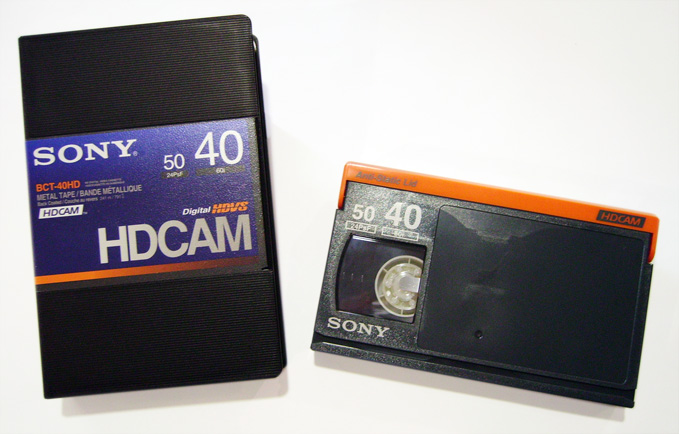
HDCAM small videotape
Media typeMagnetic tape, ½-inch
UsageVideo production
Released1997; 28 years ago (1997)
Sony HDW-F900 CineAlta HDCAM camcorder

HDCAM is a high-definition video digital recording videocassette version of Digital Betacam introduced in 1997 that uses an 8-bit discrete cosine transform (DCT) compressed 3:1:1 recording, in 1080i-compatible down-sampled resolution of 1440×1080, and adding 24p and 23.976 progressive segmented frame (PsF) modes to later models. The HDCAM codec uses rectangular pixels and as such the recorded 1440×1080 content is upsampled to 1920×1080 on playback. The recorded video bit rate is 144 Mbit/s. Audio is also similar, with four channels of AES3 20-bit, 48 kHz digital audio. Like Betacam, HDCAM tapes were produced in small and large cassette sizes; the small cassette uses the same form factor as the original Betamax. The main competitor to HDCAM was the DVCPRO HD format offered by Panasonic, which uses a similar compression scheme and bit rates ranging from 40 Mbit/s to 100 Mbit/s depending on frame rate.

HDCAM is standardized as SMPTE 367M, also known as SMPTE D-11. Like most videotape formats, HDCAM is no longer in widespread use, having been superseded by memory cards, disk-based recording formats, and SSDs. Despite its decline in usage, Sony still manufactures new HDCAM tape stock as of 2025.[1]

SMPTE 367M

[edit]
HDCAM deck
HDCAM L tape

SMPTE 367M, also known as SMPTE D-11, is the SMPTE standard for HDCAM. The standard specifies compression of high-definition digital video. D11 source picture rates can be 24, 24/1.001, 25 or 30/1.001 frames per second progressive scan, or 50 or 60/1.001 fields per second interlaced; compression yields output bit rates ranging from 112 to 140 Mbit/s. Each D11 source frame is composed of a luminance channel at 1920 x 1080 pixels and a chrominance channel at 960 x 1080 pixels. During compression, each frame's luminance channel is subsampled at 1440 x 1080, while the chrominance channel is subsampled at 480 x 1080, meaning 3:1:1 chroma subsampling.[2][3] HDCAM supports recording at 24 FPS for film production applications, but it can be configured for television production. Similar to MPEG IMX, the helical scan head drum is 80 mm in diameter. The helical tracks read by the video heads in the drum, are 22 microns wide. The video heads have a 15.25 degree azimuth. Audio is also recorded on the helical tracks.[4]

HDCAM SR

[edit]
Logo of HDCAM SR
Logo of HDCAM SR
HDCAM SR small tape

HDCAM SR was introduced in 2003 and standardised in SMPTE 409M-2005.[5] It uses a higher particle density tape and is capable of recording in 10 bits 4:2:2 or 4:4:4 RGB with a video bit rate of 440 Mbit/s, and a total data rate of approximately 600 Mbit/s.[6] The increased bit rate (over HDCAM) allows HDCAM SR to capture much more of the full bandwidth of the HD-SDI signal (1920×1080). Some HDCAM SR VTRs can also use a 2× mode with an even higher video bit rate of 880 Mbit/s, allowing for a single 4:4:4 stream at a lower compression or two 4:2:2 video streams simultaneously.[6] HDCAM SR uses MPEG-4 Part 2 Simple Studio Profile[5] for compression, and expands the number of audio channels up to 12 at 48 kHz/24-bit.

There are 12 channels of audio recorded uncompressed at 24 bit 48 kHz sampling. Each channel is capable of recording AES3 non-audio data.

HDCAM SR was used commonly for HDTV television production. In the mid-2000s, many prime-time network television shows used HDCAM SR as a master recording medium,[7] but it is no longer in widespread use.

Some HDCAM VTRs play back older Betacam variants, for example the Sony SRW-5500 HDCAM SR recorder plays back and records HDCAM and HDCAM SR tapes, and with optional hardware also plays and upconverts Digital Betacam tapes to HD format. Tape lengths are the same as for Digital Betacam, up to 40 minutes for S and 124 minutes for L tapes. In 24p mode the runtime increases to 50 and 155 minutes, respectively.

HDCAM tapes are black with an orange lid, and HDCAM SR tapes black with a cyan lid.

440 Mbit/s mode is known as SQ, and 880 Mbit/s mode is known as HQ.

Sony also announced a higher compression mode called SR Lite.[8][9] As with the 440 and 880 mode, SR Lite utilizes the MPEG-4 Part 2 Simple Studio Profile but decreases the bit rate to 220 Mbit/s for 60i and 183 Mbit/s for 50i. SR Lite is locked at 4:2:2 color sampling but still maintains 10 bit pixel depth. It also allows for 50 and 60p at the cost of a doubled data rate (440 Mbit/s for 60p).

The Sony SRW-5800 HDCAM SR VTR has the ability to record both the left eye and right eye of 3D content to a single tape. It syncs the two eyes together and takes up twice as much space on the tape as a normal recording. Other HDSR decks also support 3D such as the SRW-1 HDCAM SR Portable VTR and the SRW-5500/5000 which can play back either channel A or channel B of the Dual Stream 4:2:2 recording.[10]

See also

[edit]

References

[edit]
[edit]
Revisions and contributorsEdit on WikipediaRead on Wikipedia
from Grokipedia
HDCAM is a high-definition digital videocassette recording format developed by and introduced in 1997 as the high-definition successor to the system. It utilizes 1/2-inch wide metal particle tape in small (S) and large (L) cassette sizes, providing recording durations of up to 40 minutes and 124 minutes, respectively, with tapes featuring a distinctive black shell and orange lid. The format employs intra-frame (DCT)-based compression at a fixed of 144 Mbps—60% higher than Digital Betacam (90 Mbps)—to capture 1920×1080 resolution video, supporting both interlaced () and progressive scan () modes across frame rates including 23.98p, , 25p, 29.97p, 50i, 59.94i, and 60i. HDCAM records in 8-bit 4:2:2 color sampling for robust quality suitable for professional broadcast and production workflows, alongside four channels of uncompressed 20-bit/48 kHz AES/EBU digital audio. As part of Sony's initiative, HDCAM was designed to bridge traditional film production with digital high-definition workflows, debuting alongside the HDW-F900 to enable 24-frame progressive recording for cinematic applications. The format quickly became the for HD broadcast television and program production due to its balance of high image quality, cost-effectiveness, and compatibility with existing infrastructure, achieving widespread adoption with no rival tape-based HD format matching its market penetration. It supported key professional features like timecode embedding, options, and robust error correction for reliable playback in environments. HDCAM's technical advantages included a compression ratio of approximately 7:1, which preserved detail while fitting HD data onto compact cassettes, making it ideal for field acquisition in news, documentaries, commercials, and drama. Audio capabilities allowed for high-fidelity recording with support for E encoding on the four channels, enhancing its utility in multi-track . The format's tape formulation featured advanced metal particle media with strengthened binders and lubricants for extended head life, dropout prevention, and long-term archival stability. While HDCAM dominated HD tape-based recording through the early , it was superseded by the higher-bitrate HDCAM SR format in 2003, which offered 440 Mbps or 880 Mbps rates, 10-bit depth, and up to 12 audio channels for more demanding applications like and 4K workflows. Production of HDCAM equipment and tapes ceased around 2016 as file-based and solid-state recording technologies, such as and , became prevalent in professional video. Despite its obsolescence, HDCAM remains significant for , with its tapes requiring specialized decks for playback and migration to digital formats.

Overview

Introduction

HDCAM is a high-definition digital videocassette format developed by as an extension of its Digital Betacam technology. Introduced in 1997, it was designed primarily for professional video recording and playback of high-definition content in broadcasting and production environments. The format utilizes 1/2-inch-wide magnetic tape housed in cassettes, employing helical scanning for data recording. HDCAM cassettes are available in two sizes: small (S) cassettes providing up to 40 minutes of recording time, and large (L) cassettes offering up to 124 minutes. This configuration made HDCAM a versatile medium for high-quality HD workflows in professional settings.

Key Features

HDCAM established itself as a foundational format by supporting resolution, which became the primary HD standard upon its introduction, delivering sharp, detailed imagery suitable for broadcast and production environments. This resolution, at 1920 × 1080 pixels, provided a significant leap in visual fidelity over standard-definition formats, enabling professionals to capture and store content with enhanced clarity for large-screen display and editing. The format's versatility is further highlighted by its compatibility with multiple frame rates, including 1080/60i, 1080/50i, 1080/30p, 1080/25p, and 1080/24p, allowing seamless adaptation to , PAL, and cinematic workflows across global productions. Additionally, HDCAM integrates timecode and metadata embedding, such as (LTC), Vertical Interval Timecode (VITC), user bits, and Unique Material Identifiers (UMID), which facilitate precise synchronization and efficient asset management in pipelines. For dependable operation in demanding professional settings, HDCAM employs robust Reed-Solomon error correction coding alongside a helical-scan track layout on 12.65-mm tape, ensuring stable playback and minimal data loss even under variable conditions. This design contributes to reliable performance during extended recordings and repeated handling, reducing the risk of dropouts and supporting high-stakes applications like live events and archival storage. Moreover, selected HDCAM decks offer backward compatibility with Betacam SX and Digital Betacam formats, enabling mixed-format facilities to integrate legacy tape libraries without additional hardware. As an evolution for more intensive needs, the higher-bandwidth HDCAM SR variant extends these capabilities to advanced tasks.

History

Development and Introduction

In the early , Sony initiated research into high-definition video recording technologies, leveraging the foundation laid by its Digital format, which was introduced in 1993 as a component digital using approximately 2:1 intra-field compression to deliver high-quality standard-definition production. This effort was driven by the need to evolve the established family—widely adopted in professional broadcasting since the —into a high-definition counterpart, responding to the emerging global demand for HDTV content creation as broadcasters prepared for the transition from analog to digital high-resolution formats in the late . Sony introduced HDCAM in 1997, marking the format's market launch as a professional high-definition digital videocassette system compatible with existing workflows. The initial lineup featured the HDW-700, the world's first HDCAM designed for field acquisition with 2/3-inch CCD sensors, and the HDW-2000 series of video tape recorders for studio and use, both supporting 1080-line HD recording on 1/2-inch tape cassettes. HDCAM was strategically positioned by as a robust, tape-based solution for acquisition and , offering reliable linear tape transport and compatibility with legacy equipment at a time when file-based digital workflows were not yet practical for mainstream broadcast production due to storage and limitations. This approach allowed broadcasters to upgrade to HD without overhauling their , filling a critical gap in the transition to . Around the same time, responded with its DVCPRO HD format in 2000, introducing a competing tape-based HD system aimed at similar professional applications.

Standardization

The primary standard defining HDCAM is SMPTE ST 367:2002 (also known as D-11), published on February 28, 2002, which specifies the television digital recording format for compression and data stream structure suitable for tape-based systems. This standard outlines the use of 8-bit intra-frame (DCT) compression applied to a 10-bit source, with 3:1:1 Y'CbCr color sampling (luma at 1440 active samples per line and chroma at 480 active samples per line for resolution), supporting frame rates including 23.98, 24, 25, and 29.97 (PsF), as well as 50 and 59.94 interlaced fields per second. Complementary standards enhance HDCAM's operational framework, including SMPTE RP 188:2017 for the transmission of time code and control code in the space of signals, enabling precise in production workflows. Additionally, SMPTE RP 155:2006 establishes the reference level for recording at -20 , which aligns with HDCAM's audio integration to maintain consistent signal levels across equipment. The adoption of SMPTE ST 367 ensured broad between Sony's proprietary HDCAM recorders and third-party devices, such as editors and converters, by defining a common data stream format that promoted standardized exchange in professional video environments and accelerated HDCAM's global uptake in and production. In contrast, the HDCAM SR variant relies on its own distinct standard, SMPTE ST 409:2005, for higher-bit-depth recording.

Technical Specifications

Video Recording

HDCAM employs an 8-bit (DCT) intra-frame compression scheme, utilizing to efficiently encode data while maintaining quality suitable for professional broadcast and production environments. This compression method processes each frame independently, reducing spatial redundancy without inter-frame dependencies, which facilitates precise at the frame level. The format records video at a native resolution of 1440×1080 pixels, which is upconverted to for output to ensure compatibility with full HD standards. It operates at a fixed total of 144 Mbit/s, with approximately 140 Mbit/s allocated to video data and the remaining approximately 4 Mbit/s dedicated to audio and auxiliary information. This allocation prioritizes video , enabling robust handling of complex scenes with high motion and detail. Recording utilizes a mechanism on a 80 mm , featuring tracks that are 22 microns wide with a 15.25° angle to minimize and enhance playback accuracy. To improve error resilience, HDCAM implements shuffle recording, which disperses video data across multiple tracks, allowing partial recovery of content even if specific track errors occur during playback or . The frame structure supports both interlaced () and progressive ( or , PsF) modes, accommodating various frame rates such as 50i, 60i, , 25p, and 30p to meet international broadcasting requirements. In PsF mode, progressive frames are segmented into interlaced fields for transmission, preserving benefits while leveraging existing interlaced .

Audio Capabilities

HDCAM supports up to eight channels of uncompressed linear (LPCM) audio at a 20-bit depth and 48 kHz sampling rate, utilizing the digital interface for input and output. This configuration provides high-fidelity sound suitable for professional broadcast and production environments, with two AES/EBU stereo pairs enabling balanced, low-noise transmission. The audio data is integrated into the overall HDCAM , which has a total recorded of approximately 144 Mbit/s, sharing bandwidth with video compression while maintaining uncompressed audio quality. Audio tracks are recorded using technology alongside the video signals on the tape, ensuring frame-accurate without the need for separate analog tracks. This method leverages the format's digital structure to embed audio seamlessly within the helical recording process, minimizing timing errors and supporting real-time workflows. Metadata capabilities include recording of audio level information, cue points, and user bits, facilitating precise control and . The audio design emphasizes professional-grade performance, featuring a exceeding 95 dB (with emphasis enabled) and below 0.05% at 1 kHz, resulting in a low ideal for mixing and mastering in studio settings. Wow and flutter are below measurable limits, contributing to the format's reliability for integration in HD video workflows.

Tape and Cassette Formats

HDCAM employs advanced metal particle tape technology, measuring 12.65 mm in width, which aligns with the specifications of the series for consistent handling and performance. This tape composition incorporates a strengthened binder for enhanced cross-linking density, contributing to dropout prevention and long-term archival stability. The format supports two primary cassette variants: small cassettes (S), exemplified by the BCT-40HD model, which provide 40 minutes of recording time in 1080/59.94i mode, and large cassettes (L), such as the BCT-124HDL, offering up to 124 minutes in the same mode. Unlike certain configurations, HDCAM lacks a mid-size cassette option, streamlining production choices while prioritizing extended capacity for large cassettes. HDCAM systems maintain compatibility with Digital tape handling for seamless integration in mixed workflows. Recording occurs via a mechanism, which lays down diagonal helical tracks for video data across the tape surface, supplemented by linear tracks dedicated to audio, control (CTL), timecode, and cue signals. This layout ensures efficient data organization and reliable playback through features like dynamic tracking and supplemental automatic tracking signals. HDCAM tapes are engineered for robust durability, supporting up to 500 passes in continuous operation, akin to SP metal particle formulations, to accommodate repeated and archiving cycles. To optimize longevity, recommends periodic head cleaning using dedicated cassettes like the BCT-HD12CL and storage in environments with controlled (59–77°F) and (40–60%), avoiding exposure to magnetic fields or direct sunlight. Interchangeability among HDCAM recorders and players is notably high, achieved through standardized track pitch, tape tension controls (adjustable between normal and loose settings), and uniform mechanical specifications that minimize misalignment during playback across devices.

HDCAM SR Variant

Introduction and Development

HDCAM SR, or Superior Resolution, represents 's advancement in recording technology, introduced in 2003 to address the growing demand for formats capable of delivering near-uncompressed image quality in professional production environments. Developed as an of the original HDCAM , it incorporated higher bandwidth to support 10-bit depth processing, enabling superior handling of complex visual while maintaining compatibility with existing HDCAM tape infrastructure. The format's launch coincided with the debut of pivotal equipment, including the SRW-5000 (VTR) for studio and workflows, and the HDC-F950 multi-format camera designed for acquisition in demanding scenarios such as . These devices were showcased at the 2003 NAB convention and quickly adopted for high-profile projects, underscoring Sony's focus on elevating HD capabilities for broadcast and industries. A core driver behind HDCAM SR's development was the need to facilitate RGB color sampling, which preserves full chroma information essential for integration and extensive processes in . This addressed limitations in earlier formats during effects-heavy workflows, where maintaining image fidelity during and grading proved critical. The format's lifecycle encountered major hurdles starting with the , which severely impacted Sony's tape manufacturing plant in , , causing prolonged supply disruptions for HDCAM SR media. These challenges, compounded by the industry's transition to file-based workflows, ultimately resulted in the cessation of SR tape production by March 2023.

Technical Differences

HDCAM SR represents a significant advancement over standard HDCAM through its higher data rates and enhanced signal processing, enabling superior image fidelity and color reproduction for professional applications. While standard HDCAM employs more compressed 8-bit 4:2:2 encoding at 144 Mbit/s, HDCAM SR operates at substantially higher bit rates of 440 Mbit/s in Standard Quality (SQ) mode and 880 Mbit/s in High Quality (HQ) mode, allowing for less aggressive compression that approaches the quality of lightly compressed or even uncompressed video. In terms of video parameters, HDCAM SR utilizes 10-bit depth across both modes, a step up from standard HDCAM's 8-bit processing, which reduces quantization artifacts and improves . The SQ mode employs 4:2:2 Y'CbCr sampling for efficient , while the HQ mode supports 10-bit 4:4:4 RGB sampling, including mapping to accommodate wider gamuts such as those used in workflows. This compression is based on the DCT intra-frame method within the MPEG-4 Simple Studio Profile, with HQ achieving a milder 2:1 ratio that preserves finer details and reduces in . Audio capabilities in HDCAM SR are also expanded, supporting up to 12 channels of 24-bit PCM audio at 48 kHz sampling, with optional 96 kHz available for up to six channels in SQ mode or all 12 in HQ mode, compared to standard HDCAM's four channels at 20-bit/48 kHz. These enhancements are formalized in SMPTE ST 409:2005, which specifies increased track density on the tape and adjustments to drum speed for accommodating the elevated data throughput. The higher data rates in HDCAM SR result in reduced recording times on the same physical tape cassettes as standard HDCAM, approximately 25 minutes for S-sized cassettes and 77 minutes for L-sized cassettes in HQ mode at 1080/ (or 20 minutes for S and 62 minutes for L at 1080/60i), prioritizing quality over duration in high-end production environments.

Applications and Adoption

Use in Broadcasting

HDCAM saw early adoption by major broadcasters in the late 1990s and early , particularly for high-definition pilot programs and newsgathering. Japan's , a pioneer in HD technology since the 1964 Tokyo Olympics, placed a significant order with in 2000 for HDCAM camcorders and VTRs to support its BS digital HD broadcasting across stations in and abroad. This marked one of the largest single HD equipment purchases by a broadcaster at the time, enabling enhanced picture quality, sensitivity, and reliability for HD content creation. Similarly, the incorporated HDCAM into its early HD workflows during the , utilizing the format's 1440x1080 resolution for initial experiments and productions. In live production, HDCAM facilitated real-time HD transmission for major events, including the 2000 Olympics, where deployed the format for comprehensive coverage of the games and the accompanying Paraplegic Olympics. The equipment supported electronic newsgathering () operations, allowing broadcasters to capture and relay high-definition footage efficiently during high-stakes international events like the Okinawa Summit. Its application extended to sports coverage, where HDCAM's compact camcorders and robust performance enabled mobile, on-site HD recording for live broadcasts, contributing to the format's role in elevating the visual quality of televised athletics and competitions. HDCAM tapes functioned as master copies for HD broadcasts, providing a reliable medium for archiving high-quality source material before the widespread transition to file-based systems in the late . Broadcasters valued its film-like image quality and durability for preserving program masters, ensuring long-term storage of key content such as segments and event footage. This archival utility was particularly prominent in professional television environments, where HDCAM served as an intermediate or final storage solution for HD deliverables. The format's integration into studio workflows was bolstered by its compatibility with (SDI) standards, allowing seamless connection to existing broadcast infrastructure for signal routing and processing. HDCAM decks featured built-in downconversion capabilities, outputting HD content as SD-SDI signals to accommodate legacy standard-definition equipment and mixed-resolution environments. This flexibility supported efficient and transmission pipelines, enabling broadcasters to maintain operational continuity while transitioning to HD. HDCAM reached peak usage during the , becoming a staple in global broadcast facilities due to its balance of quality and practicality for HD production. By the mid-, it was extensively deployed for mainstream television programming, with widespread installation in studios and mobile units worldwide. For high-end broadcasts, the HDCAM SR variant extended these capabilities, offering uncompressed RGB recording for demanding applications.

Use in Film and

HDCAM gained prominence in film acquisition during the early as part of workflows, enabling high-definition capture that bridged traditional film aesthetics with digital efficiency. For instance, Star Wars: Episode II – Attack of the Clones (2002) was shot entirely on Sony's HDW-F900 recording to HDCAM tape at /24, marking a milestone as the first major Hollywood feature filmed digitally without negative. This approach allowed for immediate playback and review on set, streamlining the transition to 2K processing for editing and integration. In , HDCAM facilitated the creation of and integration with systems through its HD-SDI output, which supported uncompressed 1.5 Gbps video transfer for real-time proxy generation and rough cuts. Producers could ingest HDCAM footage into systems like Avid or , where timecode-accurate clips enabled efficient assembly before conforming to higher-resolution masters. The format's robustness ensured compatibility across workflows, from to online finishing, reducing turnaround times for features and commercials. The HDCAM SR variant, with its 4:4:4 RGB sampling, became particularly valued for and stages due to its uncompressed-like quality and minimal artifacting during . Films such as Star Wars: Episode III – Revenge of the Sith (2005) utilized HDCAM SR decks like the SRW-1 for on-set capture and grading, preserving for intricate VFX sequences involving lightsabers and space battles. This capability allowed colorists to apply precise corrections without introducing banding, enhancing the final film's cinematic look during digital-to-film output. In field production, HDCAM camcorders like the HDW-750 proved versatile for documentaries and (ENG), offering shoulder-mount ergonomics and modes for a natural, film-like image in uncontrolled environments. Its Power HAD CCD sensor delivered reliable performance in low-light scenarios common to wildlife or location shoots, with recordings transferable directly to post facilities via standard HDCAM cassettes. HDCAM's adoption extended globally, with widespread use in for progressive 25p productions and in for HD content creation amid the shift to .

Decline and Legacy

Obsolescence

The transition to file-based workflows in the mid-2000s significantly diminished the reliance on HDCAM tape, as broadcasters and production houses adopted formats like Sony's , which utilized memory cards and solid-state drives (SSDs) for faster, more flexible recording and . This shift was accelerated by such as the 2011 Fukushima disaster, which disrupted HDCAM tape supply chains and prompted widespread adoption of digital alternatives to avoid production bottlenecks. Economic pressures further eroded HDCAM's viability, with high costs for tape media, rental of specialized decks, and ongoing maintenance of video tape recorders (VTRs) proving prohibitive compared to the lower upfront and operational expenses of digital storage solutions like hard drives and cloud-based systems. Sony's decision to cease production and sales of HDCAM SR cassettes by March 2023 exemplified these challenges, driven by declining demand and the dominance of cost-effective file-based media. In contrast, (LTO) formats and SSDs offered storage costs as low as $0.01 per GB, far undercutting the expenses associated with HDCAM-SR VTR operations. By the 2010s, the industry's rapid embrace of 4K and 8K ultra-high-definition (UHD) formats outpaced HDCAM's capabilities, which were confined to resolution and required over nine times the bandwidth for equivalent 4K transmission, rendering it incompatible with emerging standards. Cameras and systems led this adoption, with 4K workflows becoming prevalent despite 's lingering dominance in some areas, further marginalizing tape-based HD systems like HDCAM. As of 2025, HDCAM persists in limited applications for legacy playback and restoration, where specialized equipment like /HDCAM tape players is deployed to digitize archival footage in projects such as preservation efforts. Tape disposal poses environmental hurdles in eco-conscious facilities, as HDCAM cassettes contain non-degradable materials like and that leach toxins into and when landfilled, contributing to long-term without viable widespread options. Production and sales of HDCAM tapes ceased in March 2023.

Successors and Modern Alternatives

One prominent successor to HDCAM was Sony's system, a file-based recording format introduced in 2003 that supported HD and later 4K resolutions using optical Professional Discs and memory cards, enabling nonlinear workflows with immediate file access and editing without tape handling. This shift addressed HDCAM's linear tape limitations by allowing random access to footage, reducing production turnaround times in broadcasting and environments. Other alternatives included Panasonic's P2 system, launched in 2004 as a solid-state memory card-based platform for DVCPRO HD acquisition, which facilitated tapeless recording and direct integration with software for faster ingest compared to HDCAM cassettes. In , cameras like RED's modular systems (introduced in 2007) and ARRI's Alexa series (debuting in 2010) emerged as high-end acquisition tools, offering uncompressed RAW capture and superior that surpassed HDCAM's compressed tape format for film-like production quality. For migrating HDCAM archives, conversion tools and services utilize HD-SDI outputs from VTRs to transcode footage into modern file formats such as or , preserving quality during without generational loss. These workflows often involve professional decks connected to capture hardware like converters, enabling bulk transfers to hard drives or servers. As of 2025, professional has largely transitioned to cloud-based storage solutions and IP workflows, with standards like SMPTE ST 2110 enabling uncompressed, low-latency transport of video, audio, and metadata over managed IP networks for scalable, remote collaboration. This dominance reflects a broader move away from physical media toward hybrid cloud-IP ecosystems that support 4K/8K HDR distribution. Sony maintained legacy support for HDCAM VTRs through repair services until March 2023, after which third-party specialists continue to offer maintenance for operational decks, ensuring access to archived material amid the format's phase-out.

References

Add your contribution
Related Hubs
User Avatar
No comments yet.