


Community hub
Recent from talks
Contribute something
Nothing was collected or created yet.
Ornithischia
View on Wikipedia
| Ornithischia | |
|---|---|
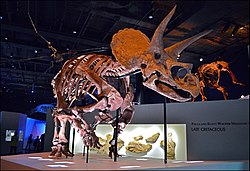
| A collection of ornithischian skeletons (clockwise from top left): Triceratops (Ceratopsia), Heterodontosaurus (Heterodontosauridae), Kentrosaurus (Stegosauria), Stegoceras (Pachycephalosauria), Europelta (Ankylosauria), and Hypacrosaurus (Ornithopoda). | |
Scientific classification 
| |
| Kingdom: | Animalia |
| Phylum: | Chordata |
| Class: | Reptilia |
| Clade: | Dinosauria |
| Clade: | †Ornithischia Seeley, 1888[1] |
| Subgroups[5] | |
| |
| Synonyms | |


Ornithischia (/ˌɔːrnəˈθɪski.ə/) is an extinct clade of mainly herbivorous dinosaurs characterized by a pelvic structure superficially similar to that of birds.[6] The name Ornithischia, or "bird-hipped", reflects this similarity and is derived from the Greek stem ornith- (ὀρνιθ-), meaning "bird", and ischion (ἴσχιον),[a] meaning "hip".[7] However, as theropod dinosaurs, birds are only distantly related to this group.[6]
Ornithischians with well known anatomical adaptations include the ceratopsians or "horn-faced" dinosaurs (e.g. Triceratops), the pachycephalosaurs or "thick-headed" dinosaurs, the armored dinosaurs (Thyreophora) such as stegosaurs and ankylosaurs, and the ornithopods.[8][6] There is strong evidence that certain groups of ornithischians lived in herds,[6][9] often segregated by age group, with juveniles forming their own flocks separate from adults.[10] Some were at least partially covered in filamentous (hair- or feather- like) pelts, and there is much debate over whether these filaments found in specimens of Tianyulong, Psittacosaurus,[11] and Kulindadromeus may have been primitive feathers.[12]
Description
[edit]Ornithischia is a very large and diverse group of dinosaurs, with members known from all continents, habitats, and a very large range of sizes. They are primarily herbivorous browsers or grazers, but some members may have also been opportunistic omnivores.[13] Ornithischians are united by multiple features of the skull, teeth, and skeleton, including especially the presence of a predentary and palpebral, an increased number of sacral vertebrae, the absence of gastralia, and an opisthopubic pubis.[14] Early ornithischians ranged around 1–2 m (3.3–6.6 ft) in length, with them increasing in size over time so that the largest armoured ornithischians were around 7.5 m (25 ft) and 9 t (8.9 long tons; 9.9 short tons), the largest horned ornithischians were around 8.5 m (28 ft) and 11 t (11 long tons; 12 short tons), and the largest crested ornithischians were around 15 m (49 ft) and 13.5 t (13.3 long tons; 14.9 short tons).[13]

Much of the knowledge of early ornithischian anatomy comes from Lesothosaurus, which is a taxon known from multiple skulls and skeletons from the Early Jurassic of Lesotho. The rear of its skull is box-like, while the snout tapers to a point. The nasal opening is small, the antorbital fossa that opens from the side of the skull into the palate is large, shallow and triangular, the orbit is large and round and has a palpebral creating a brow, and the lower jaw has a large mandibular fenestra.[15]
The skulls of Emausaurus and Scelidosaurus, two early members of the armoured group Thyreophora, show similarities in the box-like skull that tapers to the front. The antorbital fossa is smaller and forming an elongate oval in both taxa, and the palpebral which is elongate and slender in Lesothosaurus is widened in Emausaurus and completely incorporated into the skull as a flat bone in Scelidosaurus.[15][16] Skulls in members of the thyreophoran group Stegosauria are much longer and lower, with the width at the back being greater than the height in Stegosaurus. The snout and lower jaw are long and deep, and in some genera the premaxilla does not have any teeth. As in Scelidosaurus, the palpebral forms the top border of the orbit as a flat brow bone, but the antorbital fossa is reduced to the point of absence in some genera.[17]
Ankylosaurs, the other group of armoured ornithischians, have very robust, immobile skulls, with three significant features that separate them from other groups. The antorbital fossa, supratemporal fenestra and mandibular fenestra are all closed, the sutures separating skull bones are almost completely obliterated by surface texturing, and there is bony armour above the orbits, and at the top and bottom corners of the back of the skull. Teeth are sometimes absent from the premaxilla, and both the upper and lower jaws have deeply inset teeth creating large cheeks. Ankylosaurs also have very extensive and complicated network of sinuses, formed by bone growth in the palate.[18]
The skulls are known from many early ornithopods and some heterodontosaurids, showing similar general features. Skulls are relatively tall with shorter snouts, but the snout is elongated in some later taxa like Thescelosaurus. The orbit and antorbital fossa are large, but the nasal opening is small, and while teeth are present in the premaxilla, there is a toothless front tip that likely formed a keratinous beak. The premaxillary teeth and the first lower tooth in Heterodontosaurus are enlarged into sizeable canines.[19] In later ornithopods, the skulls are more elongate and sometimes fully rectangular, with a very large nasal opening, and a thin, elongate palpebral that can extend the entire way across the orbit. Teeth are almost always absent from the premaxilla, the antorbital fossa is reduced and round to slit-like, the tip of the snout is sometimes flared to form a broad beak.[20] Members of the ornithopod family Hadrosauridae show further adaptations, including the formation of dental batteries where teeth are continuously replaced, and in many genera the development of prominent cranial crests formed by multiple different bones of the skull.[21]
Pachycephalosauria, at one time thought to be close to ornithopods and now known to be related instead to ceratopsians, show a unique skull anatomy that is unlike any other ornithischian. The bones of the top of the skull are thickened and in many taxa expanded significantly to form round bony domes as the top of the head, as well as possessing small nodes or elongate spikes along the back edge of the skull. Many taxa are only known from these thick skull domes, which are fused from the frontal and parietal bones. As in many other ornithischians, the snout is short and tapering, the nasal opening is small, the antorbital fossa is sometimes absent, and there are premaxillary teeth, though only three. The two palpebrals are also incorporated into the skull roof as in thyreophorans, rather than free.[22]
Ceratopsians, the sister group to pachycephalosaurs, also display many cranial adaptations, most importantly the evolution of a bone called the rostral that forms the top beak opposite the predentary. The jugal bones flare to the sides to create a pentagonal skull seen from above, the nasal opening is closer to the top of the snout than the teeth, and while the snout tapers in some taxa, it is very deep and short in Psittacosaurus. The ceratopsian palpebral is generally triangular, and the back edge of the skull roof forms a flat frill that is enlarged in more derived ceratopsians.[23] The ceratopsian family Ceratopsidae progresses on these features with the addition of horns above each orbit and on the top of the snout, as well as substantial elongation of the frill and in many genera the development of two large parietal fenestrae forming holes in the frill. The skull and frill elongation makes the skulls of Torosaurus and Pentaceratops the largest of any known terrestrial vertebrate, at over 2 m (6.6 ft) long.[24]
Early ornithischians were relatively small dinosaurs, averaging about 1–2 meters in body length, with a triangular skull that had large circular orbits on the sides. This suggests that early ornithischians had relatively huge eyes that faced laterally. The forelimbs of early ornithischians are considerably shorter than their hindlimbs. A small forelimb such as those present in early ornithischians would not have been useful for locomotion, and it is evident that early ornithischians were bipedal dinosaurs. The entire skeleton was lightly built, with a largely fenestrated skull and a very stout neck and trunk. The tail is nearly half of the dinosaurs' overall length. The long tail presumably acted as a counterbalance and as a compensating mechanism for shifts in the creature's center of gravity. The hindlimbs of early ornithischians show that the tibia is considerably longer than the femur, a feature that suggests that early ornithischians were adapted for bipedality, and were fast runners.[25]
"Bird-hip"
[edit]The ornithischian pelvis was "opisthopubic", meaning that the pubis pointed down and backwards (posterior), parallel with the ischium, while in the saurischian pelvis, the pelvis jutted forwards as in lizards.[6][8] This resulted in a four-pronged pelvic structure. In contrast to this, the saurischian pelvis was "propubic", meaning the pubis pointed toward the head (anterior), as in ancestral reptiles (Figure 1b).[6]
The opisthopubic pelvis independently evolved at least three times in dinosaurs (in ornithischians, birds and therizinosauroids).[26] Some argue that the opisthopubic pelvis evolved a fourth time, in the clade Dromaeosauridae, but this is controversial, as other authors argue that dromaeosaurids are mesopubic.[26] It has also been argued that the opisthopubic condition is basal to maniraptorans (including among others birds, therizinosauroids and dromaeosaurids), with some clades having later experienced a reversal to the propubic condition.[27]
Classification
[edit]History
[edit]

The first recognition of an herbivorous group of dinosaurs was named Orthopoda in 1866 by Edward Drinker Cope,[28] a name that is now recognized as a synonym of Ornithischia.[29] Discussions on the taxonomy of dinosaurs by Othniel Charles Marsh identified two major groups of herbivorous dinosaurs, Ornithopoda and Stegosauria,[30] containing genera from a broad geographic and stratigraphic distribution.[14] While often these groups were placed within Dinosauria, Harry Govier Seeley suggested instead in 1888 that ornithopods and stegosaurs, which shared many features in the skull, limbs, and hip, were unrelated to other dinosaurs, and so he proposed that Dinosauria was an unnatural grouping of two independently-evolved suborders, Saurischia and Ornithischia. It is from the anatomy of the hip that Seeley chose the name Ornithischia, referencing the bird-like anatomy of the ischium bone.[1] Many researchers did not follow the division of Seeley at first, with Marsh naming the group Predentata to unite ornithopods, stegosaurs, and Ceratopsia within Dinosauria,[31] but with additional work and new discoveries the unnatural nature of Dinosauria came to be accepted, and the names Seeley proposed found common use.[32] After further decades, in 1974 Robert T. Bakker and Peter M. Galton provided new evidence in support of the grouping of ornithischians and saurischians together within a natural Dinosauria,[33] which has been supported since.[14]
The first cladistic studies on Ornithischia were published simultaneously in 1984 by David B. Norman, Andrew R. Milner, and Paul C. Sereno. These studies differed somewhat in their results, but found that Iguanodon was closer to hadrosaurs than other ornithopods, followed by Dryosaurus, Hypsilophodon and then Lesothosaurus and its relatives.[34][35][36][37][14] While the study of Norman placed ceratopsians between Hypsilophodon and more derived ornithopods,[35] the study of Sereno placed ceratopsians with ankylosaurs and stegosaurs.[37] It has since been recognized by that ceratopsians are closer to ornithopods than the armoured ankylosaurs and stegosaurs,[4] but the relationships of some groups are still in states of change, with some more consistent results than others.[38][3] An early study that looked at the relationships within Ornithischia with greater detail was that of Sereno in 1986, who provided features that supported the evolution of all ornithischian groups and shared similarities with earlier studies. Sereno found that Lesothosaurus was the most primitive ornithischian, with all other ornithischians united within the clade Genasauria, which has two subgroups. The first subgroup, Thyreophora, unites ankylosaurs and stegosaurs along with more primitive taxa like Scelidosaurus, while the second subgroup, Cerapoda, contained ornithopods, ceratopsians, pachycephalosaurs, and small primitive forms.[4] One group of the small primitive forms considered to be cerapodans by Sereno, Heterodontosauridae, has since been found to be a group of very early ornithischians of similar evolutionary status as Lesothosaurus,[38] although this result is not definitive.[39]
The first large-scale numerical analysis of the phylogenetics of Ornithischia was published in 2008 by Richard J. Butler and colleagues, including many primitive ornithischians and members from all of the major subgroups, to test some of the hypotheses given previously about ornithischian evolution and the relationships of the groups. Thyreophora was found to be a supported group, as well as the clade of pachycephalosaurs and ceratopsians that Sereno named Marginocephalia in 1986. Some taxa considered earlier to be ornithopods, like heterodontosaurids, Agilisaurus, Hexinlusaurus and Othnielia, were instead found to be outside of both Ornithopoda and Ceratopsia, but still closer to those two groups than thyreophorans. The early Argentinian taxon Pisanosaurus was found to be the most primitive ornithischian, but while overall results agreed with earlier studies and showed some stability, areas of the evolutionary tree were found to be problematic, and with potential for later change.[38] In 2021, a new phylogenetic study was published authored by Paul-Emile Dieudonné and colleagues that instead found Heterodontosauridae to nest alongside Pachycephalosauria within Marginocephalia, changing the early evolution of ornithopods considerably, and showing that the evolution of ornithischians was far from definitive.[39] Below are the cladograms of Sereno, Butler and colleagues, and Dieudonné and colleagues, restricted to the major clades of Ornithischia, Heterodontosauridae, Lesothosaurus and Pisanosaurus.
Sereno, 1986[4]
| Ornithischia | |


Butler et al., 2008[38]
| Ornithischia | |
Dieudonné et al., 2021[39]
| Ornithischia | |
Subgroups
[edit]When Ornithischia was first named, Seeley united the orders Ornithopoda and Stegosauria of Marsh's taxonomy within the new group.[1] Ceratopsia was then recognized as a unique group related to ornithopods and stegosaurs by Marsh by 1894, with each of the three suborders still being recognized as distinct groups today.[14][31] Ceratopsians are recognized as group that grew in diversity later in the Cretaceous after evolving in the Late Jurassic, encompassing a diverse array of bodyforms from the small, bipedal Psittacosaurus up to the very large, quadrupedal, horned and frilled ceratopsids like Torosaurus, which has the longest skull of any terrestrial vertebrate.[23][24] Ornithopods, which range from the Early Jurassic in some studies until the end of the Cretaceous with continuous diversity, are generally bipedal and unarmoured, though some later groups like Hadrosauridae evolved complex dental anatomy in the form of batteries of teeth.[19][21] Stegosaurs are comparatively limited, restricted to a primarily Jurassic group of moderate to large, quadrupedal herbivores with two rows of vertical plates ornamenting their spine, which possibly did not go extinct until the Late Cretaceous, though at the time of Marsh Stegosauria was used for all armored and quadrupedal taxa, many of which are now separated into Ankylosauria.[17][18] Ankylosaurs were only recognized as a distinct group from stegosaurs in the 1920s despite many members being known for decades before, with the group now encompassing a broad array of heavy, quadrupedal ornithischians with extensive armour covering their body and skull.[18] The fifth recognized major subgroup of ornithischians is Pachycephalosauria,[14] which was first named in 1974 after being confused for a long time with the theropod Troodon on account of their similarly omnivorous and unique teeth.[40][22] Pachycephalosaurians are unique for their tall, thickened skulls and small, bipedal bauplan, suggesting that their domes were for sexual display or combat in the form of head-butting or flank-butting.[22] Some taxa, particularly those at one point grouped together in the ornithopod family Hypsilophodontidae, are now recognized to not fall within any of the major ornithischian groups, and either be outside Genasauria, or on the basal stem of Neornithischia outside Cerapoda.[38]
Following the publication of the PhyloCode to provide rules and regulations on the use of taxonomic names for groups, the internal classification of Ornithischia was revised by Daniel Madzia and colleagues in 2021 to provide a framework of definitions and taxa for other studies to follow and modify from. They names the new clade Saphornithischia to unite heterodontosaurids with more derived ornithischians to encompass the concept of the well-supported clear ornithischians, as the origins of the group and the relationships of primitive taxa like Pisanosaurus and members of Silesauridae may sometimes be found to be ornithischians outside this core grouping. Madzia and colleagues also provided a composite cladogram of Ornithischia to illustrate the consensus of internal divisions, which can be seen below. Ornithischia has been defined as all taxa closer to Iguanodon than Allosaurus or Camarasaurus. Genasauria has been defined as the smallest clade containing Ankylosaurus, Iguanodon, Stegosaurus, and Triceratops.[3]
| Ornithischia | |


Multiple taxa within Ornithischia fall around the origin of the group, or cannot be classified definitively. Lesothosaurus and Laquintasaura have been found as basal thyreophorans or basal ornithischians, Chilesaurus is either a theropod or a basal ornithischian, Pisanosaurus has been found as a basal ornithischian or a non-ornithischian silesaurid, Eocursor has been a basal ornithischian or a basal member of Neornithischia, Serendipaceratops cannot be classified beyond Ornithischia as it is either an ankylosaur or a ceratopsian, and Alocodon, Fabrosaurus, Ferganocephale, Gongbusaurus, Taveirosaurus, Trimucrodon and Xiaosaurus are dubious ornithischians of uncertain basal classification.[3][2][41][15][42] Depending on the phylogenetic results, Silesauridae could either be a clade within Ornithischia, its members could form an evolutionary gradient, or some members found form a clade while others are part of a gradient.[2][43]
Evolution
[edit]
For a long time, the only understanding of the origins of Ornithischia came from Lesothosaurus and Pisanosaurus, which together represented the best-known Early Jurassic and Triassic ornithischians respectively. Many suggestions of taxa and specimens that could be referred to Ornithischia from the Triassic were based on teeth and jaw bones, as they showed similar adaptations for herbivory. The genera Revueltosaurus, Galtonia, Pekinosaurus, Tecovasaurus, Lucianosaurus, Protecovasaurus, Crosbysaurus, and Azendohsaurus were all at one time considered to be Triassic ornithischians with only their teeth known, but are now recognized to be completely unrelated.[45] The only early ornithischians that were considered to be diagnostic in a 2004 review by Norman and colleagues were Lesothosaurus, Pisanosaurus and Technosaurus, limiting the early ornithischian record to only two Triassic genera from Argentina and the United States and one Early Jurassic genus from South Africa, with all the tooth taxa being considered undiagnostic.[15] Referrals of isolated teeth to Ornithischia based on herbivorous features began to be extensively questioned by William G. Parker and colleagues in 2005 after the discovery of skull and skeleton material clearly from Revueltosaurus showing that the "ornithischian-like" teeth were from an animal more closely related to crocodiles than birds, and there were multiple occurrences of herbivory throughout Triassic reptiles.[45][44] Removing the list of Triassic tooth taxa from Ornithischia, the early diversity of the group was substantially reduced, especially in comparison to the known Triassic diversity of theropods and sauropodomorphs. If Pisanosaurus represented the earliest ornithischian, there would be at least a 20 million year gap in the evolution of Ornithischia until Lesothosaurus and heterodontosaurids. It is possible that the limited early record of ornithischians is due to them inhabiting environments that were less conducive to fossilization, or that the phylogenetics of the group were incorrect and that early ornithischians were already known but identified as members of other groups.[45]
| Possible evolutionary relationships of Ornithischia[2] | |||||||||||||||||||||||||||||||||||||
| |||||||||||||||||||||||||||||||||||||
|
First noted in the 2003 naming of the early taxon Silesaurus, some taxa generally considered non-dinosaurs show similarities to ornithischians in the teeth and jaw anatomy.[46][47] These basal taxa, which were then grouped within Silesauridae and commonly as the sister group to Dinosauria, may instead be the earliest ornithischians. They show adaptations for the evolution of herbivory, and can fill in the gap in early evolution of ornithischians that were otherwise only clearly known since the beginning of the Jurassic. This hypothesis has found support in multiple different phylogenetic analyses,[48][49] but the results are not yet accepted as definitive enough to contradict other possible evolutionary strategies of dinosaurs. Alternatively, and more in line with earlier studies on dinosaur evolution, silesaurids may be the sister taxa to the Saurischia-Ornithischia split, or even other arrangements of the three main dinosaur groups Ornithischia, Sauropodomorpha, and Theropoda.[2] The 2017 phylogenetic study of Matthew G. Baron and colleagues suggested that instead of a Saurischia-Ornithischia split, ornithischians were instead closest to theropods in the clade Ornithoscelida, with sauropodomorphs being outside the grouping. Under this case, the omnivory in the earliest sauropodomorphs and ornithischians would be the ancestral condition for dinosaurs, along with the grasping abilities seen in the earliest ornithischians and theropods.[50] While Ornithoscelida is a possible hypothesis for the evolution of dinosaurs and the close relationships of Ornithischia, follow-up studies have not found it statistically more likely than the traditional dichotomy of Ornithischia and Saurischia, or the third alternative, Phytodinosauria, where ornithischians and sauropodomorphs are closer to each other than theropods.[51][52][53]
Along with Pisanosaurus, which was supported as the earliest ornithischian for a time before being considered just as likely to be a silesaur rather than an ornithischian, an additional problematic taxon is Chilesaurus from the Late Jurassic of Chile. While it was originally named as a derived theropod with unique anatomy, it was found in studies based on Baron and colleagues results to instead be either the basalmost ornithischian, or a sauropodomorph. As the earliest ornithischian, Chilesaurus tied multiple details of ornithischian and theropod anatomy together supporting their union in Ornithoscelida, though when it is not the basalmost ornithischian, a traditional Saurischia is recovered. The problematic nature of Chilesaurus requires further revisiting of its anatomy, but the details of vertebral air pockets, pelvis shape, and hand support it as a theropod.[2] Daemonosaurus, typically a theropod or close relative of herrerasaurs, has also been found as the basalmost ornithischian at times when Ornithoscelida is recovered, but it does not share any unique features with ornithischians and redescribing its anatomy found it fairly confidently to be a basal dinosaur not related closely to Ornithischia.[54]
The phylogenetic analysis of Norman and colleagues in 2022 recovered the members of Silesauridae as forming an ancestral grade within Ornithischia even with the inclusion of Chilesaurus, supporting the earlier results of Müller and Garcia and their evolutionary trends for early ornithischian anatomy. Norman and colleagues used Prionodontia over both Saphornithischia and Genasauria, since all were recovered as encompassing the same node.[2] The earliest ornithischians under this reconstruction were faunivorous, as seen by Lewisuchus, which has typical teeth like theropods. Serrations on teeth become larger for taxa more derived than Asilisaurus, the development of a cingulum in teeth is seen in Technosaurus and later ornithischians, the lower jaw becomes more elongate in taxa above Silesaurus, and core ornithischians are united by the pubic bone angling backwards, and the modification of the ankle joint.[49]

| Dinosauria |
| ||||||||||||||||||||||||||||||||||||||||||||
Palaeoecology
[edit]Ornithischians shifted from bipedal to quadrupedal posture at least three times in their evolutionary history and it has been shown primitive members may have been capable of both forms of movement.[55]
Most ornithischians were herbivorous.[6] In fact, most of the unifying characters of Ornithischia are thought to be related to this herbivory.[6] For example, the shift to an opisthopubic pelvis is thought to be related to the development of a large stomach or stomachs and gut which would allow ornithischians to more effectively digest plant matter.[6] The smallest known ornithischian is Fruitadens haagarorum.[56] The largest Fruitadens individuals reached just 65–75 cm. Previously, only carnivorous, saurischian theropods were known to reach such small sizes.[56] At the other end of the spectrum, the largest known ornithischians reach about 15 meters (smaller than the largest saurischians).[57]
However, not all ornithischians were strictly herbivorous. Some groups, like the heterodontosaurids, were likely omnivores.[58] At least one species of ankylosaurian, Liaoningosaurus paradoxus, appears to have been at least partially carnivorous, with hooked claws, fork-like teeth, and stomach contents suggesting that it may have fed on fish.[59] The members of Genasauria were primarily herbivores.[60] Genasaurians most often had their head at the level of one meter, which suggests they were feeding primarily on "ground-level plants such as ferns, cycads, and other herbaceous gymnosperms."[61]
There is strong evidence that some ornithischians lived in herds.[6][9] This evidence consists of multiple bone beds where large numbers of individuals of the same species and of different age groups died simultaneously.[6][9]
See also
[edit]
Notes
[edit]- ^ plural ischia
References
[edit]- ^ a b c Seeley, H.G. (1888). "On the classification of the fossil animals commonly named Dinosauria". Proceedings of the Royal Society of London. 43 (258–265): 165–171. doi:10.1098/rspl.1887.0117.
- ^ a b c d e f g h Norman, D.B.; Baron, M.G.; Garcia, M.S.; Müller, R.T. (2022). "Taxonomic, palaeobiological and evolutionary implications of a phylogenetic hypothesis for Ornithischia (Archosauria: Dinosauria)". Zoological Journal of the Linnean Society. 196 (4): 1273–1309. doi:10.1093/zoolinnean/zlac062.
- ^ a b c d Madzia, D.; Arbour, V.M.; Boyd, C.A.; Farke, A.A.; Cruzado-Caballero, P.; Evans, D.C. (2021). "The phylogenetic nomenclature of ornithischian dinosaurs". PeerJ. 9 e12362. doi:10.7717/peerj.12362. PMC 8667728. PMID 34966571.
- ^ a b c d Sereno, P.C. (1986). "Phylogeny of the Bird-Hipped Dinosaurs (Ornithischia)". National Geographic Research. 2 (2): 234–256.
- ^ Fonseca, A.O.; Reid, I.J.; Venner, A.; Duncan, R.J.; Garcia, M.S.; Müller, R.T. (2024). "A comprehensive phylogenetic analysis on early ornithischian evolution". Journal of Systematic Palaeontology. 22 (1) 2346577. Bibcode:2024JSPal..2246577F. doi:10.1080/14772019.2024.2346577.
- ^ a b c d e f g h i j k Fastovsky, David E.; Weishampel, David B. (2012). Dinosaurs: A Concise Natural History. Cambridge: Cambridge University Press. ISBN 978-1-107-27646-8.
- ^ Colbert, Edwin H. (Edwin Harris); Knight, Charles Robert (1951). The dinosaur book: the ruling reptiles and their relatives. New York: McGraw-Hill. p. 152.
- ^ a b "Prehistoric Earth". The Ultimate Visual Family Dictionary. New Delhi: DK Pub. 2012. p. 82-83. ISBN 978-0-1434-1954-9.
- ^ a b c Qi, Zhao; Barrett, Paul M.; Eberth, David A. (2007-09-01). "Social Behaviour and Mass Mortality in the Basal Ceratopsian Dinosaur Psittacosaurus (early Cretaceous, People's Republic of China)" (PDF). Palaeontology. 50 (5): 1023–1029. Bibcode:2007Palgy..50.1023Q. doi:10.1111/j.1475-4983.2007.00709.x. ISSN 1475-4983. S2CID 128781816.
- ^ Zhao, Q. (2013). "Juvenile-only clusters and behaviour of the Early Cretaceous dinosaur Psittacosaurus". Acta Palaeontologica Polonica. doi:10.4202/app.2012.0128.
- ^ Mayr, Gerald; Peters, Stefan D.; Plodowski, Gerhard; Vogel, Olaf (2002-08-01). "Bristle-like integumentary structures at the tail of the horned dinosaur Psittacosaurus". Naturwissenschaften. 89 (8): 361–365. Bibcode:2002NW.....89..361M. doi:10.1007/s00114-002-0339-6. ISSN 0028-1042. PMID 12435037. S2CID 17781405.
- ^ Godefroit, P.; Sinitsa, S.M.; Dhouailly, D.; Bolotsky, Y.L.; Sizov, A.V.; McNamara, M.E.; Benton, M.J.; Spagna, P. (2014). "A Jurassic ornithischian dinosaur from Siberia with both feathers and scales" (PDF). Science. 345 (6195): 451–455. Bibcode:2014Sci...345..451G. doi:10.1126/science.1253351. hdl:1983/a7ae6dfb-55bf-4ca4-bd8b-a5ea5f323103. PMID 25061209. S2CID 206556907. Archived from the original (PDF) on 2019-02-09. Retrieved 2016-08-28.
- ^ a b Paul, G.S. (2024). The Princeton Field Guide to Dinosaurs (3rd ed.). Princeton University Press. pp. 261–373. ISBN 978-0-691-23157-0.
- ^ a b c d e f Weishampel, D.B. (2004). "Ornithischia". In Weishampel, D.B.; Osmólska, H.; Dodson, P. (eds.). The Dinosauria (2nd ed.). University of California Press. pp. 323–324. ISBN 0-520-24209-2.
- ^ a b c d Norman, D.B.; Witmer, L.M.; Weishampel, D.B. (2004). "Basal Ornithischia". In Weishampel, D.B.; Osmólska, H.; Dodson, P. (eds.). The Dinosauria (2nd ed.). University of California Press. pp. 325–334. ISBN 0-520-24209-2.
- ^ Norman, D.B.; Witmer, L.M.; Weishampel, D.B. (2004). "Basal Thyreophora". In Weishampel, D.B.; Osmólska, H.; Dodson, P. (eds.). The Dinosauria (2nd ed.). University of California Press. pp. 335–342. ISBN 0-520-24209-2.
- ^ a b Galton, P.M.; Upchurch, P.C. (2004). "Stegosauria". In Weishampel, D.B.; Osmólska, H.; Dodson, P. (eds.). The Dinosauria (2nd ed.). University of California Press. pp. 343–362. ISBN 0-520-24209-2.
- ^ a b c Vickaryous, M.K.; Maryańska, T.; Weishampel, D.B. (2004). "Ankylosauria". In Weishampel, D.B.; Osmólska, H.; Dodson, P. (eds.). The Dinosauria (2nd ed.). University of California Press. pp. 363–392. ISBN 0-520-24209-2.
- ^ a b Norman, D.B.; Sues, H.-D.; Witmer, L.M.; Coria, R.A. (2004). "Basal Ornithopoda". In Weishampel, D.B.; Osmólska, H.; Dodson, P. (eds.). The Dinosauria (2nd ed.). University of California Press. pp. 393–412. ISBN 0-520-24209-2.
- ^ Norman, D.B. (2004). "Basal Iguanodontia". In Weishampel, D.B.; Osmólska, H.; Dodson, P. (eds.). The Dinosauria (2nd ed.). University of California Press. pp. 413–437. ISBN 0-520-24209-2.
- ^ a b Horner, J.R.; Weishampel, D.B.; Forster, C.A. (2004). "Hadrosauridae". In Weishampel, D.B.; Osmólska, H.; Dodson, P. (eds.). The Dinosauria (2nd ed.). University of California Press. pp. 438–463. ISBN 0-520-24209-2.
- ^ a b c Maryańska, T.; Chapman, R.E.; Weishampel, D.B. (2004). "Pachycephalosauria". In Weishampel, D.B.; Osmólska, H.; Dodson, P. (eds.). The Dinosauria (2nd ed.). University of California Press. pp. 464–477. ISBN 0-520-24209-2.
- ^ a b You, H.; Dodson, P.; Weishampel, D.B. (2004). "Basal Ceratopsia". In Weishampel, D.B.; Osmólska, H.; Dodson, P. (eds.). The Dinosauria (2nd ed.). University of California Press. pp. 478–494. ISBN 0-520-24209-2.
- ^ a b Dodson, P.; Forster, C.A.; Sampson, S.D. (2004). "Ceratopsidae". In Weishampel, D.B.; Osmólska, H.; Dodson, P. (eds.). The Dinosauria (2nd ed.). University of California Press. pp. 494–513. ISBN 0-520-24209-2.
- ^ Colbert, E. H. (1981). A primitive ornithischian dinosaur from the Kayenta Formation of Arizona. Museum Northern Arizona Bull. 53, 1-61
- ^ a b Currie, Philip J.; Padian, Kevin (1997-10-06). Encyclopedia of Dinosaurs. Academic Press. pp. 537–538. ISBN 978-0-08-049474-6.
- ^ Holtz, T.R. and Osmólska, H. (2004). "Saurischia." In Weishampel, Dodson and Osmólska (eds.), The Dinosauria, second edition. Berkeley: University of California Press.
- ^ Cope, E.D. (1866). "The anomalous relations existing between the tibia and fibula in certain of the Dinosauria". Proceedings of the Academy of Natural Sciences of Philadelphia. 18: 316–317.
- ^ Kuhn, O. (1946). "Das System der fossilen und rezenten Amphibien und Reptilien". Bericht der Naturforschenden Gesellschaft in Bamberg. 29: 49–67.
- ^ Marsh, O.C. (1881). "Principal characters of the American Jurassic Dinosaurs". American Journal of Science. 21 (3): 417–423.
- ^ a b Marsh, O.C. (1894). "The typical Ornithopoda of the American Jurassic". American Journal of Science. 48 (283): 85–90. Bibcode:1894AmJS...48...85M. doi:10.2475/ajs.s3-48.283.85.
- ^ Romer, A.S. (1966). "Dinosaurs". Vertebrate Paleontology (3rd ed.). University of Chicago Press. pp. 148–163. ISBN 0-7167-1822-7.
- ^ Bakker, R.T.; Galton, P.M. (1974). "Dinosaur Monophyly and a New Class of Vertebrates". Nature. 248 (5444): 168–172. Bibcode:1974Natur.248..168B. doi:10.1038/248168a0.
- ^ Milner, A.R.; Norman, D.B. (1984). "The biogeography of advanced ornithopod dinosaurs (Archosauria: Ornithischia) - a cladistic-vicariance model". In Reif, W.E.; Westphal, F. (eds.). Third Symposium on Mesozoic Terrestrial Ecosystems, Short Papers. ATTEMPTO Verlag. pp. 145–150.
- ^ a b Norman, D.B. (1984). "A systematic reappraisal of the reptile order Ornithischia". In Reif, W.E.; Westphal, F. (eds.). Third Symposium on Mesozoic Terrestrial Ecosystems, Short Papers. ATTEMPTO Verlag. pp. 157–162.
- ^ Norman, D.B. (1984). "On the Cranial Morphology and Evolution of Ornithopod Dinosaurs". In Ferguson, M.W.J. (ed.). The Structure, Development, and Evolution of Reptiles. Vol. 52. Symposia of the Zoological Society of London. pp. 521–547.
- ^ a b Sereno, P.C. (1984). "Thy phylogeny of the Ornithischia : a reappraisal". In Reif, W.E.; Westphal, F. (eds.). Third Symposium on Mesozoic Terrestrial Ecosystems, Short Papers. ATTEMPTO Verlag. pp. 219–226.
- ^ a b c d e Butler, R.J.; Upchurch, P.; Norman, D.B. (2008). "The phylogeny of the ornithischian dinosaurs". Journal of Systematic Palaeontology. 6 (1): 1–40. Bibcode:2008JSPal...6....1B. doi:10.1017/S1477201907002271.
- ^ a b c Dieudonné, P.-E.; Cruzado-Caballero, P.; Godefroit, P.; Tortosa, T. (2021). "A new phylogeny of cerapodan dinosaurs". Historical Biology. 33 (10): 2335–2355. Bibcode:2021HBio...33.2335D. doi:10.1080/08912963.2020.1793979.
- ^ Sternberg, C.M. (1945). "Pachycephalosauridae Proposed for Dome-Headed Dinosaurs, Stegoceras lambei, n. sp., Described". Journal of Paleontology. 19 (5): 534–538.
- ^ Poropat, S.F.; Bell, P.R.; Hart, L.J.; Salisbury, S.W.; Kear, B.P. (2023). "An annotated checklist of Australian Mesozoic tetrapods". Alcheringa: An Australasian Journal of Palaeontology. 47 (2): 129–205. Bibcode:2023Alch...47..129P. doi:10.1080/03115518.2023.2228367. hdl:20.500.11937/96166.
- ^ Sullivan, R.M. (2006). "A taxonomic review of the Pachycephalosauridae (Dinosauria: Ornithischia)". New Mexico Museum of Natural History and Science Bulletin. 35: 347–366.
- ^ Müller, R.T.; Garcia, M.S. (2023). "A new silesaurid from Carnian beds of Brazil flls a gap in the radiation of avian line archosaurs". Scientific Reports. 13 (1): 4981. Bibcode:2023NatSR..13.4981M. doi:10.1038/s41598-023-32057-x. PMC 10090097. PMID 37041170.
- ^ a b Parker, W.G.; Irmis, R.B.; Nesbitt, S.J.; Martz, J.W.; Browne, L.S. (2005). "The Late Triassic pseudosuchian Revueltosaurus callenderi and its implications for the diversity of early ornithischian dinosaurs". Proceedings of the Royal Society B. 272 (1566): 963–969. doi:10.1098/rspb.2004.3047. PMC 1564089. PMID 16024353.
- ^ a b c Irmis, R.B.; Parker, W.G.; Nesbitt, S.J.; Liu, J. (2007). "Early ornithischian dinosaurs: the Triassic record". Historical Biology. 19 (1): 3–22. Bibcode:2007HBio...19....3I. doi:10.1080/08912960600719988.
- ^ Dzik, J. (2003). "A beaked herbivorous archosaur with dinosaur affinities from the early Late Triassic of Poland". Journal of Vertebrate Paleontology. 23 (3): 556–574. Bibcode:2003JVPal..23..556D. doi:10.1671/A1097.
- ^ Ferigolo, J.; Langer, M.C. (2007). "A Late Triassic dinosauriform from south Brazil and the origin of the ornithischian predentary bone". Historical Biology. 19 (1): 23–33. Bibcode:2007HBio...19...23F. doi:10.1080/08912960600845767.
- ^ Cabreira, S.F.; Kellner, A.W.A.; Dias-da-Silva, S.; da Silva, L.R.; Bronzati, M.; Marsola, J.C.A.; Müller, R.T.; Bittencourt, J.S.; Batista, B.J.A.; Raugust, T.; Carrilho, R.; Brodt, A.; Langer, M.C. (2016). "A Unique Late Triassic Dinosauromorph Assemblage Reveals Dinosaur Ancestral Anatomy and Diet". Current Biology. 26 (22): 3090–3095. Bibcode:2016CBio...26.3090C. doi:10.1016/j.cub.2016.09.040. PMID 27839975.
- ^ a b Müller, R.T.; Garcia, M.S. (2020). "A paraphyletic 'Silesauridae' as an alternative hypothesis for the initial radiation of ornithischian dinosaurs". Biology Letters. 16 (8): 1–5. doi:10.1098/rsbl.2020.0417. PMC 7480155. PMID 32842895.
- ^ Baron, M.G.; Norman, D.B.; Barrett, P.M. (2017). "A new hypothesis of dinosaur relationships and early dinosaur evolution". Nature. 543 (7646): 501–506. Bibcode:2017Natur.543..501B. doi:10.1038/nature21700. PMID 28332513.
- ^ Langer, M.C.; Ezcurra, M.D.; Rauhut, O.W.M.; Benton, M.J.; Knoll, F.; McPhee, B.W.; Novas, F.E.; Pol, D.; Brusatte, S.L. (2017). "Untangling the dinosaur family tree". Nature. 551 (7678): E1 – E3. Bibcode:2017Natur.551E...1L. doi:10.1038/nature24011. hdl:1983/d088dae2-c7fa-4d41-9fa2-aeebbfcd2fa3. PMID 29094688.
- ^ Baron, M.G.; Norman, D.B.; Barrett, P.M. (2017). "Baron et al. reply". Nature. 551 (7678): E4 – E5. Bibcode:2017Natur.551E...4B. doi:10.1038/nature24012. PMID 29094705.
- ^ Parry, L.A.; Baron, M.G.; Vinther, J. (2017). "Multiple optimality criteria support Ornithoscelida". Royal Society Open Science. 4 (10) 170833. Bibcode:2017RSOS....470833P. doi:10.1098/rsos.170833. PMC 5666269. PMID 29134086.
- ^ Nesbitt, S.J.; Sues, H.-D. (2021). "The osteology of the early-diverging dinosaur Daemonosaurus chauliodus (Archosauria: Dinosauria) from the Coelophysis Quarry (Triassic: Rhaetian) of New Mexico and its relationships to other early dinosaurs". Zoological Journal of the Linnean Society. 191 (1): 150–179. doi:10.1093/zoolinnean/zlaa080.
- ^ Jeffrey A. Wilson; Claudia A. Marsicano; Roger M. H. Smith (6 October 2009). "Dynamic Locomotor Capabilities Revealed by Early Dinosaur Trackmakers from Southern Africa". PLOS ONE. 4 (10) e7331. Bibcode:2009PLoSO...4.7331W. doi:10.1371/journal.pone.0007331. PMC 2752196. PMID 19806213.
- ^ a b Butler, Richard J.; Galton, Peter M.; Porro, Laura B.; Chiappe, Luis M.; Henderson, Donald M.; Erickson, Gregory M. (2010-02-07). "Lower limits of ornithischian dinosaur body size inferred from a new Upper Jurassic heterodontosaurid from North America". Proceedings of the Royal Society of London B: Biological Sciences. 277 (1680): 375–381. doi:10.1098/rspb.2009.1494. ISSN 0962-8452. PMC 2842649. PMID 19846460.
- ^ Yannan, Ji; Xuri, Wang; Yongqing, Liu; Qiang, Ji (2011-02-01). "Systematics, Behavior and Living Environment of Shantungosaurus Giganteus (Dinosauria: Hadrosauridae)". Acta Geologica Sinica - English Edition. 85 (1): 58–65. Bibcode:2011AcGlS..85...58J. doi:10.1111/j.1755-6724.2011.00378.x. ISSN 1755-6724. S2CID 85351874.
- ^ Barrett, P. M.; Rayfield, E. J. (2006). "Ecological and evolutionary implications of dinosaur feeding behaviour" (PDF). Trends in Ecology & Evolution. 21 (4): 217–224. doi:10.1016/j.tree.2006.01.002. PMID 16701088.
- ^ Ji, Q.; Wu, X.; Cheng, Y.; Ten, F.; Wang, X.; Ji, Y. (2016). "Fish-hunting ankylosaurs (Dinosauria, Ornithischia) from the Cretaceous of China". Journal of Geology. 40: 2.
- ^ Barrett, P. M., & Rayfield, E. J. (2006). Ecological and evolutionary implications of dinosaur feeding behaviour. Trends in Ecology & Evolution, 21(4), 217–224.
- ^ Fastovsky, D. E., & Weishampel, D. B. (2012). Dinosaurs: a concise natural history (2nd ed). Cambridge; New York: Cambridge University Press.
External links
[edit]
- Ornithischia, from Palæos. (cladogram, characteristics)
| |||||||||||||||||
| |||||||||||||||||


| |||||||||||||||||||||||||||||||||||||
| |||||||||||||||||||||||||||||||||||||
| |||||||||||||||||||||||||||||||||||||


Ornithischia
View on GrokipediaAnatomy
Pelvic Girdle
The name Ornithischia derives from the Greek words "ornithos" (bird) and "ischion" (hip joint), reflecting the distinctive orientation of the pubis bone, which points posteriorly parallel to the ischium, in contrast to the forward-directed (anteverted) pubis of saurischians.[2] This opisthopubic ("backward-pointing pubis") configuration defines the clade and superficially resembles the avian condition, though without implying direct phylogenetic ancestry.[4] The ornithischian pelvic girdle consists of three primary bones: the ilium, ischium, and pubis, which articulate to form the acetabulum, a perforate socket that accommodates the femoral head and supports an erect hindlimb posture.[2] The ilium features an expanded, blade-like preacetabular process that projects anteriorly, often with a lateral flare for enhanced muscle attachment, while the postacetabular process is shorter and more robust.[4] The ischium is elongated and rod-like, lying parallel to the pubis and bearing an obturator process that partially bounds the acetabulum ventrally.[4] The pubis is reduced in size relative to saurischians, comprising a prepubic process (anterior projection, sometimes rod-like or plate-like) and a postpubic shaft that extends caudally alongside the ischium; in some taxa, a prepubis forms an additional anterior extension.[2][4] Structural variations in the pelvic girdle reflect locomotor adaptations across ornithischians. In bipedal forms like Hypsilophodon, the pubis remains relatively long and slender, facilitating agility through optimized femoral protraction, while the ilium's anterior process curves laterally to accommodate muscles such as M. ilio-tibialis.[4] Quadrupedal thyreophorans, such as Stegosaurus, exhibit a reinforced pelvis with a broad, laterally flared ilium (preacetabular process forming an inverted C-shape) and robust peduncles on the ischium and pubis, providing greater weight-bearing capacity and stability for supporting armored bodies.[5] The pubis in these forms often shows distal expansion for symphyseal contact, enhancing ventral pelvic enclosure.[5] Functionally, the opisthopubic pelvis supports efficient bipedal or quadrupedal locomotion by providing broad origins for key hindlimb muscles, including the caudofemoralis complex, which inserts on the femoral fourth trochanter to drive femoral retraction.[4] The expanded ilium anchors protractor muscles like M. ilio-trochantericus caudalis, aiding stride initiation, while the parallel pubis and ischium create space for abdominal musculature (e.g., M. rectus abdominis) without compromising hindlimb leverage.[4] This arrangement parallels the avian pelvis in allowing a caudally directed pubis that frees the abdominal cavity, though ornithischian variants emphasize terrestrial support over flight adaptations.[2] A specific example of primitive ornithischian pelvic traits is seen in reconstructions of Pisanosaurus mertii, the earliest known member of the clade from the Late Triassic.[6] Reconstructions of its pelvis suggest a plesiomorphic pubis that may not have been fully retroverted—with the orientation remaining uncertain due to the fragmentary holotype—along with a long acetabulum and broad iliac peduncles, indicating transitional features between basal dinosauriforms and derived ornithischians, such as incipient parallelism between the pubis and ischium.[7]Cranial Features
Ornithischian dinosaurs are distinguished by several unique cranial adaptations that primarily facilitated herbivory, including the predentary bone, a small, U- or V-shaped element that articulates with the tips of the dentaries to form a rostral beak-like structure covered in keratin for cropping vegetation.[8] This bone, absent in other dinosaur clades, enabled efficient shearing of plant material at the front of the mouth, as seen in basal forms like Lesothosaurus where it features short lateral processes and a median ventral keel fitting into the mandibular symphysis.[8] The predentary's morphology varied slightly across ornithischians but consistently supported a rhamphotheca, enhancing the beak's durability for processing tough foliage.[8] Skull morphology in Ornithischia shows considerable variation adapted to dietary needs within major subgroups. In ornithopods, the skull often includes a diastema—a gap between the predentary beak and the tooth row—allowing separation of cropping and grinding functions, as evident in advanced forms like hadrosaurs with their elongated, high-skulled structures.[9] Ceratopsians exhibit a specialized dental battery, where multiple rows of tightly packed, diamond-shaped teeth form a continuous shearing surface for pulverizing fibrous plants, with up to 1,000 teeth in mature individuals replacing worn ones rapidly.[10] In contrast, ankylosaurs possess robust, low and wide skulls with heavily armored, polygonal osteoderms covering the dorsal surface, reducing the orbit size and emphasizing a broad, crushing jaw mechanism suited to low-browsing on coarse vegetation.[11] Many ornithischians feature palpebral bones, slender ossifications that form protective rings or bars across the orbit, shielding the eyes from injury during foraging or intra-specific interactions.[12] In basal ornithischians like Lesothosaurus, a single elongate, rod-like palpebral extends from the prefrontal-lacrimal suture across the anterior orbit, potentially aiding in glare reduction or structural support.[8] This feature is widespread in neornithischians, including ornithopods and ceratopsians, where multiple palpebrals may fuse into a bony arcade, enhancing eye protection in armored or horned taxa.[12] Jaw mechanics in ornithischians are characterized by thecodont dentition, with teeth deeply socketed in the jaw bones for secure anchorage during mastication, a trait shared with other archosaurs but optimized for herbivory through leaf-shaped crowns with denticles.[13] Tooth morphology includes low-crowned (brachydont) forms in basal taxa for puncturing soft plants, evolving into higher-crowned (hypsodont) or ever-growing teeth in advanced groups; some exhibit pleurodont-like implantation in juveniles or acentrodont (no root) replacements in batteries.[14] Evidence for fleshy cheek pouches comes from the medially inset tooth rows, which created lateral recesses filled by soft tissue to retain food during chewing, as inferred from the maxilla's deep buccal emargination in ornithopods and ceratopsians.[9] Heterodontosaurids, early ornithischians from the Lower Jurassic, display particularly distinctive cranial features with heterodont dentition comprising procumbent incisor-like front teeth for cropping, enlarged canine-like tusks for display or defense, and molariform cheek teeth for grinding, indicating a herbivorous diet like most ornithischians but with specialized adaptations for processing tough vegetation.[15] In Heterodontosaurus tucki, the skull's short, deep rostrum and robust coronoid process support powerful jaw adduction, enabling efficient feeding on plant matter.[16] This dental specialization highlights early experimentation in ornithischian feeding strategies.[16]Postcranial Skeleton
The postcranial skeleton of ornithischians exhibits considerable diversity, reflecting adaptations to bipedal, quadrupedal, and facultatively quadrupedal locomotion across the clade. In basal forms, the axial skeleton includes a variable number of presacral vertebrae, typically around 24-28, with the sacrum often comprising four to five fused vertebrae that incorporate one or more dorsosacrals for enhanced stability at the hip region.[8] The caudal series is generally elongated, comprising 30-60 vertebrae, which in bipedal ornithischians such as hadrosaurs served primarily for balance during terrestrial locomotion.[17] Ossified epaxial tendons are a characteristic feature, running parallel to the neural spines and providing rigidity to the vertebral column, particularly in the tail and back.[8] Limb structure varies markedly among ornithischian subgroups, with primitive bipedality giving rise to quadrupedal forms. Forelimbs are typically reduced in bipedal ornithopods, where the humerus is shorter than the femur and the manus is adapted for grasping or manipulation rather than weight-bearing, as seen in forms like Iguanodon.[18] In quadrupedal lineages such as stegosaurs, forelimb length approaches that of the hindlimbs, enabling weight distribution across all four limbs, though the forelimbs remain proportionally shorter than in true graviportal mammals.[19] Hindlimbs show cursorial traits in basal and bipedal ornithischians, with the tibia often longer than the femur and a mesotarsal ankle joint for agile movement; however, in large ceratopsians, the hindlimbs evolved graviportal proportions, featuring robust, pillar-like femora and tibiae to support massive body masses.[8][20] The pes retains a phalangeal formula of 2-3-4-5-0 in most ornithischians, with claw-like unguals transitioning to hoof-like structures in quadrupeds.[21] A defining feature of thyreophorans within Ornithischia is the presence of extensive dermal armor composed of osteoderms, which vary in form and arrangement. In stegosaurs, these include paired dorsal plates arranged in bilateral rows along the presacral region and elongated, keeled spines on the tail for display or defense; the plates are thin and vascularized, suggesting a thermoregulatory role in addition to protection. Ankylosaurs exhibit more comprehensive armor, with polygonal osteoderms covering the entire dorsal surface, including fused skull caps and tail clubs formed by aggregated osteoderms that functioned as impact weapons. Basal thyreophorans display transitional armor, such as scattered keeled scutes along the flanks and tail. Ornithischian body sizes ranged from small, agile forms to gigantic herbivores. Among the smallest known ornithischians is Fruitadens, a heterodontosaurid estimated at 0.65 to 0.75 meters in length and 0.5 to 0.75 kilograms, adapted to forested environments.[23] At the opposite extreme, Shantungosaurus, a late Cretaceous hadrosaurid, reached lengths of 15 meters and body masses estimated at 13.5 metric tons, underscoring the clade's capacity for extreme gigantism among ornithopods.[24] Scelidosaurus, a basal thyreophoran from the Early Jurassic, exemplifies transitional postcranial traits bridging bipedal and quadrupedal ornithischians. Its vertebral column includes 17 dorsals, four sacrals, and about 35 caudals, with short, broad neural spines indicative of early rigidity enhancements.[21] The forelimbs are robust with a bowed humerus bearing a prominent deltopectoral crest, suggesting occasional quadrupedal support, while the hindlimbs retain cursorial features like a pendant fourth trochanter on the femur.[21] Osteoderms form four longitudinal rows along the body and tail, including oval plates with median keels, marking the primitive condition for thyreophoran armor.[21] This configuration highlights Scelidosaurus's facultatively bipedal-quadrupedal posture, with the pelvis contributing to hindlimb support as detailed elsewhere.[21]Classification
History
The taxon Ornithischia was established by British paleontologist Harry Govier Seeley in 1887, when he divided Dinosauria into two orders based on pelvic structure: Ornithischia ("bird-hipped") for dinosaurs with a pubis directed backward, parallel to the ischium, and Saurischia ("lizard-hipped") for those with a forward-directed pubis.[25] Seeley's classification, presented in his paper "On the Classification of the Fossil Animals commonly named Dinosauria," emphasized the retroverted pubis as a key ornithischian synapomorphy, contrasting it with the saurischian condition, though he initially included only a few taxa like Iguanodon and Scelidosaurus.[25] In the early 20th century, classifications of Ornithischia remained largely anatomical and hierarchical, with Alfred Sherwood Romer providing a influential synthesis in 1956. Romer divided Ornithischia into four suborders—Ornithopoda (encompassing bipedal forms like hypsilophodontids and iguanodontids), Stegosauria, Ankylosauria, and Ceratopsia—based on skeletal features such as armor and cranial horns, while treating the group as a cohesive order within Reptilia. This framework, outlined in his book Osteology of the Reptiles, dominated mid-century views but grouped disparate forms without rigorous phylogenetic testing. Mid-20th-century research introduced shifts through new discoveries and taxonomic debates, notably the inclusion of Heterodontosauridae within Ornithischia. In 1974, Alan J. Charig and colleagues described additional heterodontosaurid material from Lesotho and affirmed their placement as basal ornithischians, citing shared dental and pelvic traits like leaf-shaped crowns and a predentary bone, moving them from uncertain theropod or prosauropod affinities to a core ornithischian position. Concurrently, debates arose over Pachycephalosauria's placement; while Romer had subsumed pachycephalosaurs under Ornithopoda, Teresa Maryańska and Halszka Osmólska erected Pachycephalosauria as a distinct suborder in 1974, arguing for their separation based on unique cranial domes and arguing they formed a monophyletic group sister to ceratopsians within Ornithischia.[26] The advent of cladistic methods in the late 20th century solidified Ornithischia's monophyly. Paul C. Sereno's 1984 analysis, using parsimony-based character optimization, identified seven synapomorphies—such as the predentary and a retroverted pubis—for Ornithischia, confirming it as a natural clade and resolving internal relationships with Heterodontosauridae as basal, followed by Thyreophora (stegosaurs and ankylosaurs) and Cerapoda (ornithopods, pachycephalosaurs, and ceratopsians).[27] This reappraisal, presented at the Third Symposium on Mesozoic Terrestrial Ecosystems, marked a shift from phenetic to phylogenetic classification, influencing subsequent studies.[27] Recent refinements continue to adjust subgroup boundaries using expanded datasets. In 2021, Pascal Dieudonné and colleagues conducted a comprehensive phylogenetic analysis of cerapodans (ornithopods, pachycephalosaurs, and ceratopsians), incorporating 342 characters across 72 taxa to refine interrelationships, such as positioning rhabdodontids closer to iguanodontians and clarifying basal ceratopsian divergences, thereby updating Ornithischia's internal topology without challenging overall monophyly.[28]Phylogenetic Hypotheses
The phylogenetic position of Ornithischia within Dinosauria has been a subject of ongoing debate, challenging the traditional division into Saurischia (theropods and sauropodomorphs) and Ornithischia, which originated with Seeley in 1887 and was supported by extensive cladistic analyses throughout the 20th century. A controversial alternative hypothesis, proposed by Baron et al. in 2017, advocates for Ornithoscelida, a clade uniting Ornithischia with Theropoda based on shared features such as asymmetrical antorbital fenestrae and certain manual and pedal traits, rendering Sauropodomorpha the sister group to this clade. This rearrangement has been critiqued for character scoring inconsistencies and limited taxon sampling, with subsequent studies largely reaffirming the traditional Saurischia-Ornithischia dichotomy through broader datasets and refined character states.[29] Basal ornithischians and their stem groups remain pivotal to understanding early dinosaur diversification, with Pisanosaurus mertii from the late Carnian (~230 Ma) of Argentina often considered, though controversially, as the earliest ornithischian, characterized by primitive dentition and postcranial features aligning it just above the dinosauriform threshold.[30] Silesauridae, a Triassic dinosauriform clade including genera like Silesaurus and Asilisaurus, occupies an ambiguous position as either the immediate sister group to Ornithischia or a paraphyletic assemblage of stem ornithischians, with recent analyses suggesting the latter based on shared herbivorous adaptations and pelvic morphology, though this remains unresolved as of 2025. Heterodontosauridae, small bipedal ornithischians from the Late Triassic to Early Cretaceous, have been variably placed as the most basal ornithischians or nested within Cerapoda (ornithopods and marginocephalians), with some recent analyses favoring the latter due to derived cranial and dental features linking them to neornithischians.[31] Cladistic support for Ornithischia as a monophyletic clade rests on several unambiguous synapomorphies, including the presence of a predentary bone—a midline mandibular element facilitating beak-like feeding—and a retroverted pubis parallel to the ischium, which parallels the condition in birds and supports herbivorous lifestyles. These traits, evident in both basal and derived forms, underpin most modern phylogenies, with matrix-based analyses consistently recovering Ornithischia as the sister taxon to Saurischia within Dinosauria. A 2024 study by Fonseca et al. integrates prior datasets to resolve early ornithischian branching, reinforcing Triassic origins through the inclusion of new taxa and characters, and stabilizing the position of heterodontosaurids and silesaurids relative to core ornithischians.[2][32][33]Major Subgroups
Ornithischia encompasses several major monophyletic clades, with Heterodontosauridae representing one of the most basal groups. These small, bipedal dinosaurs, known from the Early Jurassic of southern Africa and possibly omnivorous based on their heterodont dentition featuring differentiated teeth for varied diets, include genera such as Heterodontosaurus and Fruitadens. Heterodontosaurids are characterized by a unique combination of primitive ornithischian traits, including a predentary bone and asymmetrical enamel on teeth, distinguishing them from more derived ornithischians.[34] Genasauria forms a basal grade within Ornithischia, comprising all ornithischians more closely related to Triceratops than to Pisanosaurus, and includes early taxa like Scelidosaurus and Scutellosaurus that exhibit transitional features toward more specialized forms. These basal genasaurians, from the Early Jurassic, display osteoderms and a mix of bipedal and quadrupedal locomotion, serving as stem groups to the two primary genasaurian branches. The clade Genasauria is supported by synapomorphies such as the postorbital-squamosal contact, a key cranial feature linking genasaurians to ornithopods.[31][35] Thyreophora, the armored dinosaurs, diverges early within Genasauria and is defined by the presence of extensive dermal armor, including osteoderms along the body. This clade splits into Stegosauria, featuring iconic dorsal plates and spikes as in Stegosaurus, and Ankylosauria, with comprehensive bony armor, tail clubs, and low-slung quadrupedal builds exemplified by Ankylosaurus. Thyreophorans share a reduced forelimb and robust shoulder girdle, adaptations for quadrupedality and defense.[31][36] Cerapoda, the sister group to Thyreophora within Genasauria, unites advanced ornithischians with beak-like predentaries and complex dental batteries, encompassing Ornithopoda and Marginocephalia. Ornithopoda includes bipedal to quadrupedal herbivores such as iguanodonts like Iguanodon and hadrosaurs like Edmontosaurus, noted for their efficient chewing mechanisms and battery-like tooth replacement. Marginocephalia comprises Ceratopsia, with elaborate horns and frills as in Triceratops for display and defense, and Pachycephalosauria, featuring thickened skull domes in taxa like Pachycephalosaurus potentially used in intraspecific combat.[31][37]Evolutionary History
Origins
The origins of Ornithischia trace back to the Late Triassic, with the earliest potential records represented by Pisanosaurus mertii, a small basal ornithischian discovered in the Ischigualasto Formation of northwestern Argentina. This taxon dates to the Carnian stage, approximately 231 million years ago, and is characterized by primitive features such as a predentary bone and leaf-shaped teeth indicative of herbivory. Recent phylogenetic analyses confirm Pisanosaurus as an early-diverging ornithischian, supporting its role as one of the oldest definitive members of the clade despite ongoing debates about the completeness of the Triassic fossil record.[38] Triassic ornithischian diversity in Gondwana is further evidenced by South African forms, including Lesothosaurus diagnosticus from the Early Jurassic Upper Elliot Formation, which exhibits traits suggesting evolutionary roots in Late Triassic ancestors such as Eocursor parvus from the Lower Elliot Formation. Eocursor, dating to the Norian stage around 210–225 million years ago, represents a primitive bipedal ornithischian adapted to floodplain environments, with slender limbs and a lightweight build suited for agility among early herbivores. These South African taxa highlight a Gondwanan cradle for ornithischians, where small, bipedal forms likely foraged on low vegetation in semi-arid floodplains dominated by seasonal rivers and volcanic activity. A 2024 discovery, Archaeocursor asiaticus from the Late Triassic of Guizhou Province, China, represents the earliest known ornithischian in Asia and an early-diverging member of the clade, suggesting broader Laurasian presence and potential dispersal routes early in ornithischian evolution.[30] Pre-dinosaurian relatives, such as the silesaurids (e.g., Asilisaurus kongwe from the Middle Triassic of Tanzania, approximately 245 million years ago), are debated as possible stem ornithischians or closely related dinosauromorphs. Phylogenetic hypotheses propose silesaurids as a paraphyletic grade leading to core ornithischians, with shared features like asymmetrical teeth and a retroverted pubis suggesting a transitional role in the evolution of herbivorous adaptations. This interpretation addresses gaps in the Triassic record by implying an earlier divergence, potentially in the Middle Triassic, though uncertainties persist due to the fragmentary nature of early fossils and varying dietary inferences from faunivory to omnivory.Diversification
The diversification of Ornithischia accelerated during the Jurassic period, marking a transition from sparse early records to more widespread clade expansions across Laurasia and Gondwana. In the Early Jurassic, basal genasaurians such as Lesothosaurus diagnosticus from southern Africa exhibited evidence of gregarious behavior, as indicated by bone beds preserving multiple individuals from approximately 200 million years ago, suggesting early social structures that may have facilitated survival and dispersal in post-Triassic ecosystems.[39] Concurrently, early thyreophorans like Scelidosaurus harrisonii appeared in Europe, representing one of the earliest armored ornithischians with osteoderms along its back and limbs, adapted for low-level herbivory in coastal environments of the Hettangian-Sinemurian stages.[40] By the Middle to Late Jurassic, significant radiations occurred within major subgroups, enhancing ornithischian ecological roles as herbivores. Stegosaurs underwent a notable diversification, with taxa such as Kentrosaurus aethiopicus in East Africa exemplifying the spread of plated and spiked forms across Gondwanan and Laurasian landmasses during the Kimmeridgian-Tithonian stages, where they occupied niches as mid-sized browsers amid conifer-dominated floras.[41] Parallel to this, ornithopods began to diversify, as seen in Dryosaurus species from North America and Africa, which featured gracile builds suited for bipedal foraging on ferns and cycads, contributing to increased faunal complexity in Morrison Formation-equivalent deposits.[42] The Early Cretaceous witnessed the origins of ankylosaurs and ceratopsians, further broadening ornithischian disparity. Ankylosaurs, such as basal forms from the Barremian, emerged in Asia and North America with enhanced osteodermal armor for defense against predators, marking the initial divergence of this low-slung, quadrupedal lineage.[43] Ceratopsians similarly originated in this interval, with primitive taxa like Aquilops americanus in North America displaying early frill structures, indicating an Asian-North American dispersal route that set the stage for later horned diversity.[44] This period's expansions were driven by the ongoing breakup of Pangaea, which created isolated landmasses promoting endemism and adaptive radiations among ornithischians. Ornithopod diversification peaked in the Late Cretaceous with the hadrosaurid radiation, exemplified by Edmontosaurus annectens in western North America, where duck-billed forms proliferated as dominant megaherbivores in Campanian-Maastrichtian floodplains.[45] This boom was influenced by the rise of angiosperms, whose abundant, nutritious foliage favored the dental batteries and shearing mechanisms of hadrosaurids, enabling efficient processing of diverse vegetation and supporting high population densities.[46] Overall, these Jurassic to mid-Cretaceous events underscore how tectonic fragmentation and vegetational shifts propelled ornithischians to ecological prominence before their Late Cretaceous apex.Extinction
Ornithischians reached a peak in diversity during the mid-Cretaceous, reflecting their successful radiation as dominant herbivores following the diversification of flowering plants.[47] This zenith occurred amid broader dinosaur prosperity, with ornithischian clades like ankylosaurs, ceratopsians, and ornithopods expanding across Laurasia and Gondwana. However, by the late Campanian stage (around 76 million years ago), ornithischian diversity began a marked decline, driven by elevated extinction rates and reduced speciation, particularly affecting major families such as Ankylosauridae, Ceratopsidae, and Hadrosauridae.[48] Ceratopsian species numbers, for instance, dropped from a mid-Campanian peak of about 15 to just 2 by the Maastrichtian, while hadrosaur diversity fell from roughly 20 species in the late Campanian to 13 near the Cretaceous-Paleogene (K-Pg) boundary.[49] In the Late Cretaceous, ornithischian faunas exhibited distinct regional patterns, with several clades facing localized or global extinctions. Stegosaurs, once prominent in Jurassic and Early Cretaceous ecosystems, disappeared by the early Late Cretaceous (Cenomanian-Turonian stages, around 100-90 million years ago), leaving no definitive fossils in subsequent deposits and yielding dominance to more derived herbivores.[41] In North America and Asia, ceratopsians and ornithopods (particularly hadrosaurs) became the prevailing large-bodied ornithischians, filling ecological niches as abundant grazers and browsers in floodplain and coastal environments.[50] This shift highlighted a trend toward morphological convergence among surviving ornithischians, with declining disparity in ceratopsids and hadrosauroids in North America, though Asian hadrosauroids showed relative stability until closer to the boundary.[50] Global cooling events, estimated at 7-10°C, and competitive pressures from hadrosaurs likely exacerbated these declines by altering vegetation and habitat suitability.[49] The terminal extinction of ornithischians occurred during the K-Pg mass extinction event at 66 million years ago, which eradicated all non-avian dinosaurs. This catastrophe was primarily triggered by the Chicxulub asteroid impact in the Yucatán Peninsula, which unleashed immediate effects like wildfires, tsunamis, and a "nuclear winter" from atmospheric dust and sulfate aerosols, disrupting global photosynthesis for years.[51] Concurrently, massive volcanism from the Deccan Traps in India released greenhouse gases and toxins over millennia, contributing to climate instability, ocean acidification, and ecosystem stress that compounded the impact's devastation.[52] Unlike small mammals, which survived through traits like burrowing, nocturnality, and insectivory enabling them to endure prolonged darkness and food scarcity, ornithischians lacked comparable adaptations; even taxa like Thescelosaurus, which exhibited neurological and skeletal features suggestive of semi-fossorial behavior, failed to persist across the boundary, indicating such traits did not confer survival advantages in this context.[53] The final ornithischian records are preserved in uppermost Maastrichtian formations like the Hell Creek Formation of North America, where ceratopsians such as Triceratops horridus and ornithopods including Edmontosaurus annectens represent the last known individuals, comprising the majority of dinosaur fossils just below the K-Pg boundary.[54] No ornithischian remains have been documented in post-boundary Paleocene strata worldwide, confirming their complete extinction alongside other non-avian dinosaurs.[51]Paleobiology
Diet and Feeding
Ornithischian dinosaurs were predominantly herbivorous, with dietary strategies ranging from low-browsing in armored forms like ankylosaurs, which targeted ground-level vegetation using robust jaws and shearing teeth, to high-browsing in large ornithopods such as advanced iguanodontians, which reached elevated foliage akin to sauropod feeding mechanics but with more efficient mastication.[55][56] This herbivory evolved through multiple biomechanical pathways, enabling exploitation of diverse Mesozoic plant communities including ferns, cycads, and conifers.01971-6) Key feeding adaptations included a horny beak supported by the predentary bone in the lower jaw, which facilitated cropping tough plant material without reliance on incisors, as seen across ornithischian clades from basal forms to ceratopsians.[55] Gastroliths, or stomach stones, aided mechanical breakdown of fibrous vegetation in the digestive tract, with concentrations found in taxa like psittacosaurids and some ornithopods to enhance nutrient extraction from cellulose-rich diets.[57] In advanced ornithopods such as hadrosaurs, complex dental batteries formed the pinnacle of these innovations, comprising up to approximately 300 continuously replacing teeth per jaw quadrant, with totals exceeding 1,000 teeth across the jaws that interlocked and wore against each other to create self-sharpening grinding surfaces for processing abrasive foliage.[58][59] Exceptions to strict herbivory occurred in early-diverging ornithischians, notably heterodontosaurids, which exhibited omnivorous tendencies evidenced by heterogeneous dentition including procumbent canines for grasping small prey or insects, alongside leaf-shaped cheek teeth for plant processing, and potential cheek pouches for storing mixed food items. A more controversial case involves Liaoningosaurus paradoxus, a diminutive Early Cretaceous ankylosaurid proposed as carnivorous based on piscivorous denticles, elongated claws, and tail fluke-like structures suggesting aquatic hunting, though this interpretation remains debated due to ontogenetic and preservational biases in the limited specimens. Stable isotope analyses, particularly carbon and nitrogen ratios in tooth enamel and bone collagen, corroborate the prevalence of C3 plant-based diets across ornithischians, with δ¹³C values indicating consumption of ferns, gymnosperms, and early angiosperms, while nitrogen isotopes reflect trophic levels consistent with primary herbivory rather than higher carnivory.[60][61] For instance, microwear patterns on Iguanodon teeth from Jurassic deposits show heavy abrasion from silica-rich ferns and cycads, underscoring selective feeding on abrasive, low-lying vegetation that demanded robust occlusal mechanisms.[62]Locomotion and Behavior
Ornithischian dinosaurs exhibited a range of locomotor strategies, with primitive bipedality characterizing early forms and many ornithopods, while quadrupedality evolved convergently in at least three lineages, including thyreophorans and ceratopsians.[19] This transition from bipedal ancestors involved modifications to the forelimbs and shoulder girdle, enabling weight-bearing on all four limbs without a single evolutionary pathway.[63] Bipedal ornithischians, such as early heterodontosaurids and hadrosaurids, relied on powerful hindlimbs for efficient movement, whereas quadrupedal taxa like stegosaurs and triceratopsids distributed weight more evenly across robust fore- and hindlimbs to support armored bodies or facilitate browsing at various heights.[64] Fossil trackways provide direct evidence of ornithischian gaits and speeds, revealing that small to medium-sized ornithopods could achieve rapid locomotion. For instance, analyses of Cretaceous trackways indicate speeds up to approximately 27 km/h for running ornithopods, based on stride length and foot morphology relative to modern analogs.[65] These estimates derive from ichnological data, where speed is calculated using formulas incorporating hip height and stride, highlighting the agility of unarmored forms in open environments. In the Dakota Formation of Colorado, extensive ornithopod trackways, known as the "Dinosaur Freeway," show parallel paths oriented north-south, suggesting seasonal migrations by herds over long distances, potentially spanning hundreds of kilometers.[66] Behavioral inferences from ornithischian fossils point to gregarious habits and social interactions, supported by mass bone accumulations and anatomical features. Bone beds, such as the Centrosaurus apertus assemblage in the Dinosaur Park Formation of Alberta, contain hundreds of individuals from multiple age classes preserved in river channel deposits, indicating catastrophic mortality events in large herds that facilitated predator avoidance and resource sharing.[67] In ceratopsians, elaborate frills and horns likely served dual roles in display and intraspecific combat, with healed puncture wounds on Triceratops skulls matching horn shapes, evidencing head-to-head clashes for dominance or mating rights.[68] Sensory adaptations in some ornithischians suggest enhancements for group coordination during social activities. Ornithopods like Thescelosaurus neglectus possessed relatively large brains compared to body size, with expanded olfactory and optic regions inferred from endocasts, potentially aiding in detecting conspecifics and navigating in herds.[69] Orbit sizes in ornithischians averaged 20% of skull length, indicating sizable eyes suited for visual signaling in daylight or group vigilance.[70] Recent studies on ankylosaur tail clubs, bony hammer-like structures at the end of the tail in thyreophorans, reveal their role in defense against predators through biomechanical analysis of impacts capable of fracturing theropod bones. However, 2020s paleopathological evidence from healed injuries on ankylosaurid osteoderms and clubs suggests primary use in intraspecific combat, with defensive functions as a secondary adaptation.[71]Reproduction and Growth
Ornithischian dinosaurs exhibited rapid growth rates during juvenile stages, particularly in ornithopod lineages such as hadrosaurs, where bone histology reveals highly vascularized fibrolamellar bone tissue indicative of fast somatic expansion.[72] In Maiasaura peeblesorum, for instance, individuals achieved substantial size increases—reaching up to several times their hatchling mass within the first few years—through continuous deposition of primary bone with minimal interruptions, contrasting with the slower, more seasonal growth seen in many extant reptiles.[72] This pattern of accelerated early growth supported the attainment of large adult body sizes, with growth trajectories showing an S-shaped curve that tapered in later ontogeny.[73] Reproductive strategies in ornithischians are inferred primarily from fossilized nesting sites, which provide evidence of colonial breeding and potential parental investment. In ornithopods like Maiasaura peeblesorum, multiple egg clutches arranged in shallow depressions within nesting colonies suggest communal nesting behaviors, with nests containing 10–40 eggs each and hatchlings preserved alongside subadult remains. These assemblages indicate that parents may have provided care, as the relatively large size of hatchlings (up to 1 meter long) and the presence of regurgitated plant material near nests imply extended post-hatching provisioning, similar to modern precocial birds but with some altricial elements. Such evidence from the Two Medicine Formation in Montana highlights a level of parental care uncommon among reptiles but convergent with avian reproduction.[74] Sexual dimorphism in ornithischians remains debated, with limited unequivocal evidence from skeletal remains. In ceratopsians, variations in frill size and ornamentation have been proposed as potential sexual signals, but geometric morphometric analyses of taxa like Protoceratops andrewsi show no significant differences in frill morphology or overall skull size between presumed sexes, suggesting that such traits may instead reflect ontogenetic or individual variation rather than dimorphism.[75] Similarly, reevaluations of postcranial elements in chasmosaurine ceratopsids, such as Chasmosaurus belli, indicate that earlier claims of size-based dimorphism are likely attributable to age-related differences or sampling biases rather than sexual distinctions.[76] Maturity in ornithischians is assessed through multiple histological and osteological indicators, including lines of arrested growth (LAGs) in long bones for estimating age and the external fundamental system (EFS) for confirming somatic maturity. LAGs, analogous to annual rings in trees, record periodic pauses in growth and allow age estimation in specimens like hadrosaurs, where counts reveal lifespans of 10–20 years to full adulthood.[77] Epiphyseal fusion, the ossification and closure of growth plates at long bone ends, serves as a key marker of skeletal maturity in ornithischians, with fusion patterns in taxa such as Tenontosaurus tillettii indicating the transition to adulthood around 8–12 years, after which longitudinal growth ceases.[73] Sclerotic rings in the orbit, while primarily informative for eye size, have been explored in some ornithischians like Haya griva for potential age-related annuli, though their utility remains secondary to bone-based methods.[78] Recent analyses confirm determinate growth in basal ornithischians, as seen in Psittacosaurus, where bone histology from ontogenetic series reveals an S-shaped growth curve with a distinct deceleration phase leading to asymptotic adult size, unlike the continuous indeterminate growth typical of many reptiles.[79] Studies integrating histological data with body mass estimates for Psittacosaurus mongoliensis show that individuals reached maturity at around 9 years, with maximal growth rates in mid-ontogeny exceeding those of modern crocodilians but aligning with the determinate patterns observed across Dinosauria.[79] This growth strategy underscores the physiological divergence of ornithischians from their reptilian relatives, emphasizing finite skeletal development.[80]References
- https://people.[ohio](/page/Ohio).edu/witmerl/Downloads/2004_Norman_et_al_Basal_Thyreophora.pdf