


Community hub
Recent from talks
Contribute something
Nothing was collected or created yet.
77th United States Congress
View on Wikipedia
| 77th United States Congress | |
|---|---|
76th ← → 78th | |
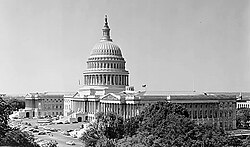
 United States Capitol (1956) | |
January 3, 1941 – January 3, 1943 | |
| Members | 96 senators 435 representatives 4 non-voting delegates |
| Senate majority | Democratic |
| Senate President | John N. Garner (D)[a] (until January 20, 1941) Henry A. Wallace (D) (from January 20, 1941) |
| House majority | Democratic |
| House Speaker | Sam Rayburn (D) |
| Sessions | |
| 1st: January 3, 1941 – January 2, 1942 2nd: January 5, 1942 – December 16, 1942 | |
The 77th United States Congress was a meeting of the legislative branch of the United States federal government, composed of the United States Senate and the United States House of Representatives. It met in Washington, D.C., from January 3, 1941, to January 3, 1943, during the ninth and tenth years of Franklin D. Roosevelt's presidency. The apportionment of seats in the House of Representatives was based on the 1930 United States census.
Both chambers maintained a Democratic majority - with the Senate being a supermajority. With the reelection of President Franklin D. Roosevelt to a then record third term, the Democrats maintained an overall federal government trifecta.
This was the first Congress to have more than one Senate president (John Garner and Henry Wallace) due to the passage of the 20th Amendment in 1933.


Major events
[edit]- January 20, 1941: President Franklin D. Roosevelt began his third term.
- December 7, 1941: Attack on Pearl Harbor
- December 8, 1941: Joint Session of Congress met to hear President Roosevelt deliver his "Day of Infamy" speech
- December 26, 1941: Joint session of the United States Congress met in the Senate chamber for an address by British Prime Minister Winston Churchill.
Major legislation and resolutions
[edit]- March 11, 1941: Lend Lease Act, Pub. L. 77–11, Sess. 1, ch. 11, 55 Stat. 31
- August 18, 1941: Flood Control Act of 1941, Pub. L. 77–228, Sess. 1, ch. 377, 55 Stat. 638
- December 8, 1941: Resolution— War between United States and Japan, Pub. L. 77–328, Sess. 1, ch. 561, 55 Stat. 795
- December 11, 1941: Resolution— War between United States and Germany, Pub. L. 77–331, Sess. 1, ch. 564, 55 Stat. 796
- December 11, 1941: Resolution— War between United States and Italy, Pub. L. 77–332, Sess. 1, ch. 565, 55 Stat. 797
- January 27, 1942: Air Raid Attack Act of 1942, Pub. L. 77–415, Sess. 2, ch. 20, 56 Stat. 19
- January 30, 1942: Emergency Price Control Act of 1942, Pub. L. 77–421, Sess. 2, ch. 26, 56 Stat. 23
- June 5, 1942: Resolution— War between United States and Bulgaria, Pub. L. 77–563, Sess. 2, ch. 323, 56 Stat. 307
- June 5, 1942: Resolution— War between United States and Hungary, Pub. L. 77–564, Sess. 2, ch. 324, 56 Stat. 307
- June 5, 1942: Resolution— War between United States and Romania, Pub. L. 77–565, Sess. 2, ch. 325, 56 Stat. 307
- June 22, 1942: Resolution— United States Flag Code, including recognition of the Pledge of Allegiance, Pub. L. 77–623, Sess. 2, ch. 435, 56 Stat. 377
- October 2, 1942: Stabilization Act of 1942, Pub. L. 77–729, Sess. 2, ch. 578, 56 Stat. 765
Select committees
[edit]Leadership
[edit]Senate
[edit]- President: John Nance Garner (D), until January 20, 1941
- Henry A. Wallace (D), from January 20, 1941
- President pro tempore: Pat Harrison (D), until June 22, 1941
- Carter Glass (D), from July 10, 1941
Majority (Democratic) leadership
[edit]- Majority leader: Alben W. Barkley
- Majority Whip: Lister Hill
- Democratic Caucus Secretary: Joshua B. Lee
Minority (Republican) leadership
[edit]- Minority leader: Charles L. McNary
- Republican Conference Secretary: Wallace H. White Jr.
- National Senatorial Committee Chair: John G. Townsend Jr.
House of Representatives
[edit]- Speaker: Sam Rayburn (D)
Majority (Democratic) leadership
[edit]- Majority leader: John William McCormack
- Democratic Whip: Patrick J. Boland, until May 18, 1942
- Democratic Caucus Chairman: Richard M. Duncan
- Democratic Campaign Committee Chairman: Patrick H. Drewry
Minority (Republican) leadership
[edit]Party summary
[edit]Senate
[edit]
| Party (shading shows control) |
Total | Vacant | |||||
|---|---|---|---|---|---|---|---|
| Democratic (D) |
Farmer– Labor (FL) | Wisconsin Progressive (P) | Republican (R) | Independent (I) |
|||
| End of previous congress | 68 | 1 | 1 | 25 | 1 | 96 | 0 |
| Begin | 66 | 0 | 1 | 28 | 1 | 96 | 0 |
| End | 64 | 30 | |||||
| Final voting share | 66.7% | 0.0% | 1.0% | 31.3% | 1.0% | ||
| Beginning of next congress | 57 | 0 | 1 | 38 | 0 | 96 | 0 |
House of Representatives
[edit]| Party (shading shows control) |
Total | Vacant | ||||||
|---|---|---|---|---|---|---|---|---|
| Democratic (D) |
Farmer– Labor (FL) | American Labor (AL) | Wisconsin Progressive (P) | Republican (R) | Other |
|||
| End of previous congress | 256 | 1 | 1 | 2 | 167 | 1 | 428 | 7 |
| Begin | 268 | 1 | 1 | 3 | 162 | 0 | 435 | 0 |
| End | 254 | 165 | 424 | 11 | ||||
| Final voting share | 59.9% | 0.2% | 0.2% | 0.7% | 38.9% | 0.0% | ||
| Beginning of next congress | 222 | 1 | 1 | 2 | 208 | 0 | 434 | 1 |
Members
[edit]Senate
[edit]Senators are elected statewide every two years, with one-third beginning new six-year terms with each Congress. Preceding the names in the list below are Senate class numbers, which indicate the cycle of their election, In this Congress, Class 2 meant their term ended with this Congress, requiring reelection in 1942; Class 3 meant their term began in the last Congress, requiring reelection in 1944; and Class 1 meant their term began in this Congress, requiring reelection in 1946.
Currently, this is the last congressional session in which the Democratic Party commanded all Senate seats from the South.
Currently, this is the second and last congressional session in which Wyoming sent 3 democrats to Congress (senators Joesph C. O'Mahoney and Harry Schwartz, as well as representative at-large John J. McIntyre).
House of Representatives
[edit]
Changes in membership
[edit]The count below reflects changes from the beginning of this Congress.
Senate
[edit]| State (class) |
Vacated by | Reason for change | Successor | Date of successor's formal installation[b] |
|---|---|---|---|---|
| West Virginia (2) |
Matthew M. Neely (D) | Resigned January 12, 1941, after being elected Governor of West Virginia. Successor was appointed to serve until a special election, which he subsequently lost. In addition, successor took oath of office after the Senate resolved a challenge to the appointment. |
Joseph Rosier (D) | January 13, 1941 |
| Arkansas (2) |
John E. Miller (D) | Resigned March 31, 1941, after being appointed judge for the US District Court for the Western District of Arkansas. Successor was appointed to finish the term. |
G. Lloyd Spencer (D) | April 1, 1941 |
| Texas (2) |
Morris Sheppard (D) | Died April 9, 1941. Successor was appointed to serve until a special election. |
Andrew Jackson Houston (D) | April 21, 1941 |
| Mississippi (2) |
Pat Harrison (D) | Died June 22, 1941. Successor was appointed to serve until a special election. |
James Eastland (D) | June 30, 1941 |
| Texas (2) |
Andrew Jackson Houston (D) | Died June 26, 1941. Successor was elected to finish term. |
W. Lee O'Daniel (D) | August 4, 1941 |
| South Carolina (2) |
James F. Byrnes (D) | Resigned July 17, 1941, after being appointed Associate Justice of the Supreme Court of the United States. Successor was appointed to serve until a special election. |
Alva M. Lumpkin (D) | July 22, 1941 |
| South Carolina (2) |
Alva M. Lumpkin (D) | Died August 1, 1941. Successor was appointed to serve until a special election. |
Roger C. Peace (D) | August 5, 1941 |
| Mississippi (2) |
James Eastland (D) | Appointee did not seek election to finish term. Successor was elected September 28, 1941, to finish term. |
Wall Doxey (D) | September 29, 1941 |
| South Carolina (2) |
Roger C. Peace (D) | Appointee did not seek election to finish term. Successor was elected November 4, 1941, to finish term. |
Burnet R. Maybank (D) | November 5, 1941 |
| Colorado (3) |
Alva B. Adams (D) | Died December 1, 1941. Successor was appointed to serve until the November 3, 1942, special election, which he won. |
Eugene Millikin (R) | December 20, 1941 |
| West Virginia (2) |
Joseph Rosier (D) | Appointee lost election November 17, 1942, to finish the term. Successor was elected to finish term. |
Hugh Shott (R) | November 18, 1942 |
| Minnesota (2) |
Joseph H. Ball (R) | Appointee did not seek election to finish term. Successor was elected November 17, 1942, to finish term. |
Arthur E. Nelson (R) | November 18, 1942 |
| Nevada (1) |
Berkeley L. Bunker (D) | Appointee lost election December 7, 1942, to finish the term. Successor was elected to finish term. |
James G. Scrugham (D) | December 7, 1942 |
House of Representatives
[edit]| District | Vacated by | Reason for change | Successor | Date of successor's formal installation[b] |
|---|---|---|---|---|
| Oklahoma 7th | Sam C. Massingale (D) | Died January 17, 1941 | Victor Wickersham (D) | April 1, 1941 |
| New York 17th | Kenneth F. Simpson (R) | Died January 25, 1941 | Joseph C. Baldwin (R) | March 11, 1941 |
| Alabama 7th | Walter W. Bankhead (D) | Resigned February 1, 1941 | Carter Manasco (D) | June 24, 1941 |
| Maryland 6th | William D. Byron (D) | Died February 27, 1941 | Katharine Byron (D) | May 27, 1941 |
| Virginia 2nd | Colgate Darden (D) | Resigned March 1, 1941, to run for Governor of Virginia | Winder R. Harris (D) | April 8, 1941 |
| New York 42nd | Pius L. Schwert (D) | Died March 11, 1941 | John C. Butler (R) | April 22, 1941 |
| North Carolina 5th | Alonzo D. Folger (D) | Died April 30, 1941 | John H. Folger (D) | June 14, 1941 |
| New York 14th | Morris M. Edelstein (D) | Died June 4, 1941 | Arthur G. Klein (D) | July 29, 1941 |
| Wisconsin 1st | Stephen Bolles (R) | Died July 8, 1941 | Lawrence H. Smith (R) | August 29, 1941 |
| Pennsylvania 15th | Albert G. Rutherford (R) | Died August 10, 1941 | Wilson D. Gillette (R) | November 4, 1941 |
| Colorado 4th | Edward T. Taylor (D) | Died September 3, 1941 | Robert F. Rockwell (R) | December 9, 1941 |
| Mississippi 2nd | Wall Doxey (D) | Resigned September 28, 1941, after being elected to the US Senate | Jamie L. Whitten (D) | November 4, 1941 |
| California 17th | Lee E. Geyer (D) | Died October 11, 1941 | Cecil R. King (D) | August 25, 1942 |
| Massachusetts 7th | Lawrence J. Connery (D) | Died October 19, 1941 | Thomas J. Lane (D) | December 30, 1941 |
| Connecticut 5th | J. Joseph Smith (D) | Resigned November 4, 1941, after being appointed judge for the United States District Court for the District of Connecticut | Joseph E. Talbot (R) | January 20, 1942 |
| Pennsylvania 12th | J. Harold Flannery (D) | Resigned January 3, 1942, after becoming judge of common pleas for Luzerne County, PA | Thomas B. Miller (R) | May 19, 1942 |
| Pennsylvania 33rd | Joseph A. McArdle (D) | Resigned January 5, 1942, after being elected to the Pittsburgh City Council | Elmer J. Holland (D) | May 19, 1942 |
| Pennsylvania 11th | Patrick J. Boland (D) | Died May 18, 1942 | Veronica G. Boland (D) | November 3, 1942 |
| Washington 5th | Arthur D. Healey (D) | Resigned August 1, 1942, after being appointed judge for the United States District Court for the Western District of Washington | Vacant until the next Congress | |
| Massachusetts 8th | Charles H. Leavy (D) | Resigned August 3, 1942, after being appointed judge for the United States District Court for the District of Massachusetts | Vacant until the next Congress | |
| Ohio 15th | Robert T. Secrest (D) | Resigned August 3, 1942, after accepting a commission in the U.S. Navy | Vacant until the next Congress | |
| Ohio 13th | Albert D. Baumhart Jr. (R) | Resigned September 2, 1942, after accepting a commission in the U.S. Navy | Vacant until the next Congress | |
| Iowa 9th | Vincent F. Harrington (D) | Resigned September 5, 1942, after accepting a commission as major in the United States Army | Harry E. Narey (R) | November 3, 1942 |
| California 3rd | Frank H. Buck (D) | Died September 17, 1942 | Vacant until the next Congress | |
| Maryland 2nd | William Purington Cole Jr. (D) | Resigned October 26, 1942, after being appointed judge for the U.S. Customs Court | Vacant until the next Congress | |
| Pennsylvania 25th | Charles I. Faddis (D) | Resigned December 4, 1942, to enter the US Army | Vacant until the next Congress | |
| Illinois 4th | Harry P. Beam (D) | Resigned December 6, 1942, after being elected judge for the municipal court of Chicago | Vacant until the next Congress | |
| Illinois 6th | A. F. Maciejewski (D) | Resigned December 6, 1942 | Vacant until the next Congress | |
| Missouri 6th | Philip A. Bennett (R) | Died December 7, 1942 | Vacant until the next Congress | |
| Nevada at-large | James G. Scrugham (D) | Resigned December 7, 1942, after being elected to the U.S. Senate | Vacant until the next Congress | |
Committees
[edit]Lists of committees and their party leaders for members of the House and Senate committees can be found through the Official Congressional Directory at the bottom of this article. The directory after the pages of terms of service lists committees of the Senate, House (Standing with Subcommittees, Select and Special) and Joint and, after that, House/Senate committee assignments. On the committees section of the House and Senate in the Official Congressional Directory, the committee's members on the first row on the left side shows the chairman of the committee and on the right side shows the ranking member of the committee.
Senate[edit]
|
House of Representatives[edit]
|
Joint committees
[edit]- United States Congress Joint Committee to Arrange the Inauguration for President-elect|Arrange the Inauguration for President-elect (Chairman: Sen. Matthew M. Neely)
- Conditions of Indian Tribes (Special)
- United States Congress Joint Committee on the Disposition of Executive Papers|Disposition of (Useless) Executive Papers
- United States Congress Joint Committee on the Eradication of the Mediterranean Fruit Fly|Eradication of the Mediterranean Fruit Fly
- Forestry (Chairman: Sen. John H. Bankhead II; Vice Chairman: Rep. Hampton P. Fulmer)
- United States Congress Joint Committee on Government Organization (Chairman: Sen. James F. Byrnes)
- The Library (Chairman: Sen. Alben W. Barkley)
- Printing (Chairman: Sen. Carl Hayden; Vice Chairman: Rep. Pete Jarman)
- United States Congress Joint Committee on Reduction of Nonessential Federal Expenditures|Reduction of Nonessential Federal Expenditures
- Taxation (Chairman: Sen. Pat Harrison then Rep. Robert L. Doughton; Vice Chairman: Sen. Walter F. George)
- United States Congress Joint Committee on to Investigate Phosphate Resource of the United States|To Investigate Phosphate Resource of the United States (Chairman: J. Hardin Peterson)
Caucuses
[edit]- Democratic (House)
- Democratic (Senate)
Employees
[edit]Legislative branch agency directors
[edit]- Architect of the Capitol: David Lynn
- Attending Physician of the United States Congress: George Calver
- Comptroller General of the United States: Lindsay C. Warren
- Librarian of Congress: Archibald MacLeish
- Public Printer of the United States: Augustus E. Giegengack
Senate
[edit]- Secretary: Edwin A. Halsey
- Librarian: Ruskin McArdle
- Secretary for the Majority: Leslie Biffle
- Secretary for the Minority: Carl A. Loeffler
- Sergeant at Arms: Chesley W. Jurney
- Parliamentarian: Charles Watkins
- Chaplain: ZeBarney Thorne Phillips (Episcopal), until May 1942
- Frederick Brown Harris (Methodist), after October 10, 1942
House of Representatives
[edit]- Clerk: South Trimble
- Sergeant at Arms: Kenneth Romney
- Parliamentarian: Lewis Deschler
- Reading Clerks: Roger M. Calloway (D) and Alney E. Chaffee (R)
- Doorkeeper: Joseph J. Sinnott
- Postmaster: Finis E. Scott
- Chaplain: James Shera Montgomery (Methodist)
See also
[edit]- 1940 United States elections (elections leading to this Congress)
- 1942 United States elections (elections during this Congress, leading to the next Congress)
Notes
[edit]- ^ U.S. Vice President John N. Garner's term as President of the Senate ended at noon January 20, 1941, when Henry A. Wallace's term began.
- ^ a b When seated or oath administered, not necessarily when service began.
References
[edit]- House of Representatives Session Calendar for the 77th Congress (PDF). Archived from the original (PDF) on September 20, 2018. Retrieved June 6, 2016.
- Official Congressional Directory for the 77th Congress, 1st Session.
- Official Congressional Directory for the 77th Congress, 1st Session (Revision).
- Official Congressional Directory for the 77th Congress, 2nd Session.
- Official Congressional Directory for the 77th Congress, 2nd Session (Revision).
77th United States Congress
View on GrokipediaTerm and Sessions
Session Dates and Structure
The 77th United States Congress convened on January 3, 1941, following the constitutional mandate for new Congresses to assemble at noon on that date in odd-numbered years, and it adjourned sine die on January 3, 1943, yielding to the incoming 78th Congress.[8][1] Like prior Congresses, it operated in two regular annual sessions, with adjournments allowing for recesses but requiring reconvening for unfinished business or special circumstances.[9] These sessions facilitated the passage of legislation amid escalating global conflict, including the U.S. entry into World War II after the December 7, 1941, attack on Pearl Harbor. The first session ran from January 3, 1941, to January 2, 1942, encompassing debates on pre-war preparedness, lend-lease aid to allies, and domestic priorities before the nation's formal belligerency.[10][11] This period included multiple recesses, such as summer adjournments, but maintained legislative continuity through pro forma sessions when needed.| Session | Convening Date | Adjournment Date |
|---|---|---|
| First | January 3, 1941 | January 2, 1942 |
| Second | January 5, 1942 | December 16, 1942 |
Election and Convening Context
The 77th United States Congress was elected during the federal elections of November 5, 1940, which coincided with the presidential contest in which incumbent Democrat Franklin D. Roosevelt won a third term by defeating Republican nominee Wendell Willkie, securing 449 electoral votes to Willkie's 82.[16] These congressional elections followed the 76th Congress, in which Democrats already held substantial majorities amid ongoing economic recovery from the Great Depression and rising international tensions in Europe due to World War II.[17] Voter turnout was high, reflecting the significance of Roosevelt's unprecedented reelection bid and debates over U.S. neutrality versus potential intervention abroad.[18] In the Senate, Democrats retained a strong majority with 66 seats, compared to 28 for Republicans, alongside one Independent and one Progressive; this composition provided Democrats with effective control, including the ability to organize committees and set the legislative agenda.[2] The House of Representatives saw Democrats expand their majority to 267 seats, with Republicans holding 162 and the remaining six seats divided among minor parties (three Progressives, one American Labor, one Farmer-Labor) and one Independent Democrat, ensuring continued Democratic dominance in passing administration priorities such as defense preparedness measures.[19] These results reflected limited Republican gains despite criticisms of Roosevelt's New Deal policies and third-term candidacy, as Democratic incumbents benefited from the president's coattails in key districts and states.[1] The Congress convened for its first session on January 3, 1941, marking the implementation of the Twentieth Amendment's provision to begin new terms on the third day of January following elections, thereby reducing the lame-duck period from the prior practice of convening in December.[8] This timing positioned the 77th Congress to address immediate prewar challenges, including the Lend-Lease Act debates, before the U.S. entry into World War II following the Pearl Harbor attack on December 7, 1941.[20] The session structure included two regular sessions, with the first running from January 3 to August 14, 1941, and the second from January 5 to December 16, 1942, accommodating wartime legislation after the declaration of war.[9]Political Composition
Senate Breakdown
The Senate of the 77th United States Congress, which convened on January 3, 1941, and adjourned on January 3, 1943, consisted of 66 Democrats, 28 Republicans, 1 Independent, and 1 Progressive, totaling 96 members.[2] This composition provided Democrats with a supermajority exceeding two-thirds of the chamber, facilitating passage of legislation requiring such thresholds, such as treaty ratifications.[2]| Party | Seats |
|---|---|
| Democratic | 66 |
| Republican | 28 |
| Independent | 1 |
| Progressive | 1 |
| Total | 96 |
House of Representatives Breakdown
The House of Representatives in the 77th Congress comprised 435 voting members, elected in the 1940 elections. Democrats secured a substantial majority with 267 seats, reflecting continued support for President Franklin D. Roosevelt's New Deal policies amid economic recovery efforts.[19] Republicans held 162 seats, maintaining their position as the primary opposition.[19] Minor parties and independents occupied the remaining six seats: three Progressives, primarily from Wisconsin; one Farmer-Labor representative from Minnesota; one American Labor member from New York; and one Independent Democrat.[19] This composition provided Democrats with effective control, though the onset of World War II following the December 7, 1941, attack on Pearl Harbor influenced subsequent legislative unity across party lines.[19]| Party | Seats |
|---|---|
| Democratic | 267 |
| Republican | 162 |
| Progressive | 3 |
| Farmer–Labor | 1 |
| American Labor | 1 |
| Independent Democrat | 1 |
| Total | 435 |
Ideological and Factional Dynamics
The 77th Congress operated under Democratic majorities, with 66 Democrats, 28 Republicans, one Independent, and one Progressive in the Senate, and 267 Democrats, 162 Republicans, three Progressives, one Farmer-Labor member, and one American Labor representative in the House.[2][1] These majorities afforded President Franklin D. Roosevelt significant leverage, particularly after the Japanese attack on Pearl Harbor unified support for war measures, yet factional tensions shaped legislative outcomes. Prior to December 1941, foreign policy debates highlighted a divide between isolationists, who prioritized neutrality and opposed entangling alliances, and interventionists aligned with the administration's push for aid to Allied nations. Isolationist sentiments, stronger among Republicans and certain Midwestern and Southern Democrats, manifested in resistance to measures like the Lend-Lease Act of 1941, which authorized the President to supply defense materials to countries whose security was deemed vital to U.S. interests. The Lend-Lease bill passed the House on March 11, 1941, by a vote of 317 to 71, and the Senate on the same day by 60 to 31, reflecting bipartisan interventionist support but exposing factional rifts, as most opposition came from Republicans supplemented by conservative Democrats wary of escalating U.S. involvement in European conflicts.[23] Prominent isolationists included Senators Gerald Nye (R-ND) and Burton K. Wheeler (D-MT), who led investigations into perceived war propaganda efforts, such as a 1941 Senate probe into Hollywood's influence on public opinion favoring intervention.[24] Following Pearl Harbor, these divisions largely dissipated on war authorization, with declarations against Japan, Germany, and Italy passing with near-unanimous votes—only one dissenting vote in the Senate against Japan—shifting focus to domestic wartime mobilization. Domestically, ideological fault lines emerged between northern liberal Democrats advocating New Deal expansions, wartime economic controls, and labor protections, and a nascent conservative coalition of southern Democrats and Republicans emphasizing fiscal conservatism, states' rights, and restraint on federal overreach. This coalition, solidified after Roosevelt's 1937 court-packing attempt, influenced opposition to expansive spending and regulatory measures, even amid war priorities, by allying on roll calls to curb union power and limit price controls.[25] Southern Democrats' defection from party lines on such issues foreshadowed broader realignments, though wartime exigencies tempered overt confrontations, enabling passage of key appropriations while factions maneuvered through amendments and committee bottlenecks. Progressives and independents, such as Senator George Norris, occasionally bridged divides by supporting interventionist foreign policy alongside domestic reforms, but their marginal numbers limited systemic impact.Leadership
Senate Leadership
The Senate of the 77th United States Congress (1941–1943) was led by Democrats, who commanded a majority of 66 seats against 28 Republicans and 2 seats held by other parties.[2] Vice President Henry A. Wallace served as President of the Senate, assuming the role upon his inauguration on January 20, 1941, and casting tie-breaking votes as needed during the session. The President pro tempore position, which designated the senator to preside in the Vice President's absence and ranked third in the presidential line of succession, changed during the Congress following the death of incumbent Pat Harrison (D-MS) on June 22, 1941.[26] Harrison had held the office from January 6, 1941. Carter Glass (D-VA) was elected to succeed him on July 10, 1941, and served through the remainder of the Congress until January 3, 1943.[26][27] Alben W. Barkley (D-KY) continued as Majority Leader, a position he had held since 1937, directing the Democratic floor agenda amid escalating international tensions and the U.S. entry into World War II.[3] Charles L. McNary (R-OR) served as Minority Leader, representing Republican priorities including fiscal restraint and isolationist reservations prior to Pearl Harbor.[28] No changes occurred in the party floor leadership roles during the Congress.[28]House Leadership
The Speaker of the House for the 77th Congress was Samuel T. Rayburn, a Democrat from Texas, who was elected to the position on January 3, 1941, at the convening of the session and served through its duration until January 3, 1943.[29] Rayburn, in his fourth term as Speaker, wielded significant influence over legislative priorities, including the coordination of war mobilization efforts following the Japanese attack on Pearl Harbor on December 7, 1941.[3] The Majority Leader was John W. McCormack, a Democrat from Massachusetts, responsible for advancing the Democratic agenda on the House floor, including key measures like Lend-Lease extensions and war declarations against the Axis powers.[30] McCormack's role involved negotiating bipartisan support amid the national emergency, leveraging the Democrats' 267-seat majority out of 435 total members.[3] The Minority Leader was Joseph W. Martin Jr., a Republican from Massachusetts, who led the opposition and critiqued administration policies while cooperating on wartime unity, such as in approving emergency appropriations and military drafts.[1] Martin's tenure emphasized fiscal restraint and isolationist-leaning reservations prior to U.S. entry into World War II, though Republican support solidified post-Pearl Harbor.[1] No changes in these top leadership positions occurred during the Congress.Committees
Senate Committees
The Senate of the 77th Congress maintained a system of approximately 22 standing committees, which conducted hearings, drafted legislation, and provided oversight on executive branch activities, with Democratic majorities ensuring party control of all chairmanships.[31] These committees played a central role in addressing pre-war preparedness, the Lend-Lease program, war declarations following Pearl Harbor on December 7, 1941, and subsequent mobilization efforts, including military expansion and economic financing. Chairmanships shifted due to deaths, such as that of Pat Harrison (D-MS), president pro tempore and initial Finance Committee chair, who died on June 22, 1941, leading to Walter F. George's (D-GA) ascension.[31] Key war-related standing committees included the Committee on Military Affairs, chaired by Robert R. Reynolds (D-NC) after Morris Sheppard's (D-TX) death on March 9, 1941, which oversaw Army procurement, training, and defense spending amid early isolationist debates.[31] [32] The Committee on Naval Affairs, under David I. Walsh (D-MA), handled Navy expansion, shipbuilding, and Pacific strategy, reporting bills for fleet augmentation before and after U.S. entry into World War II.[31] The Committee on Foreign Relations, led by Tom Connally (D-TX) from July 1941 following Walter George's shift to Finance, advanced the Lend-Lease Act (H.R. 1776) on March 11, 1941, and debated neutrality repeal, prioritizing empirical assessments of Axis threats over ideological isolationism.[33] [31]| Committee | Chairman (Party-State) |
|---|---|
| Appropriations | Carter Glass (D-VA)[31] |
| Finance | Walter F. George (D-GA) from June 1941[31] |
| Foreign Relations | Tom Connally (D-TX)[33] |
| Military Affairs | Robert R. Reynolds (D-NC) from March 1941[31] |
| Naval Affairs | David I. Walsh (D-MA)[31] |
House Committees
The House of Representatives organized its 21 standing committees at the convening of the 77th Congress on January 3, 1941, following Democratic majority control with 267 seats to Republicans' 162.[1] Chairmanships were allocated to Democrats via seniority rules, enabling control over bill referrals, hearings, and reporting to the floor, which proved critical for advancing President Roosevelt's pre-war preparedness and post-Pearl Harbor mobilization agendas.[35] Committees played a central role in wartime legislation, including military expansion, fiscal measures, and economic controls, often conducting extensive hearings amid debates over isolationism versus interventionism.[8] Key committees and their chairmen included:| Committee | Chairman | Party-State |
|---|---|---|
| Appropriations | Clarence Cannon | Democrat-Missouri |
| Ways and Means | Robert L. Doughton | Democrat-North Carolina |
| Military Affairs | Andrew J. May | Democrat-Kentucky |
| Naval Affairs | Carl Vinson | Democrat-Georgia |
| Rules | Howard W. Smith | Democrat-Virginia |
| Foreign Affairs | Sol Bloom | Democrat-New York |
| Agriculture | Hampton P. Fulmer | Democrat-South Carolina |
| Interstate and Foreign Commerce | Clarence F. Lea | Democrat-California |
Joint and Select Committees
The joint committees of the 77th Congress included longstanding standing bodies such as the Joint Committee on Printing, responsible for overseeing federal printing and binding operations, and the Joint Committee on the Library, which managed the Library of Congress and related collections. These committees, composed of members from both the House and Senate, focused on administrative and support functions rather than legislative or investigative matters. No major ad hoc joint committees were established specifically for wartime oversight, with investigative roles largely divided between chamber-specific select committees.[42] Select committees, often temporary and targeted at pressing issues, played a prominent role amid pre-war mobilization and the onset of World War II. The Senate Special Committee to Investigate the National Defense Program, commonly known as the Truman Committee, was created by unanimous approval of Senate Resolution 71 on March 1, 1941, to probe defense procurement, contract awards, production delays, and potential waste or profiteering in the expanding military-industrial effort. Chaired by Senator Harry S. Truman (D-MO), the committee held extensive hearings, issued reports exposing inefficiencies—such as inflated costs at military camps—and recommended reforms that reportedly saved taxpayers up to $15 billion over the war. Its work highlighted vulnerabilities in rapid defense scaling under the Roosevelt administration's preparedness programs.[43] In the House, the Select Committee Investigating National Defense Migration, chaired by Representative John H. Tolan (D-CA) and established under House Resolution 63 in June 1940 but active through the 77th Congress, examined the social and economic impacts of wartime population shifts, labor demands, and security concerns. Its 1942 hearings, particularly in West Coast cities, addressed the evacuation and relocation of Japanese Americans following Executive Order 9066, weighing military necessity against civil liberties; the committee's reports supported relocation measures while advocating for humane implementation and eventual resettlement aid.[44] The House Special Committee on Un-American Activities, led by Representative Martin Dies Jr. (D-TX) since its inception in 1938, received extensions into the 77th Congress to continue probing alleged subversive influences, including communist and fascist groups within labor unions, government, and defense industries. Its investigations, often controversial for targeting left-wing organizations amid wartime alliances with the Soviet Union, produced reports citing thousands of potential security risks but drew criticism for partisan overreach and lack of due process.[14] Additionally, the House Select Committee on Small Business, formed in late 1941, investigated how war contracts and procurement policies disadvantaged smaller firms, advocating for set-asides to prevent monopolization by large corporations and promote broader industrial participation in the defense economy.[45]Major Events
Pre-Pearl Harbor Developments
The 77th Congress assembled on January 3, 1941, amid escalating tensions in Europe and Asia, with Democrats retaining majorities in both chambers following the 1940 elections—222 to 213 in the House and 66 to 28 in the Senate, plus two Independents aligned with Democrats.[1] Early sessions centered on bolstering national defense and aiding allies without direct belligerency, reflecting President Franklin D. Roosevelt's push against isolationist opposition from figures like Senator Burton K. Wheeler and the America First Committee.[8] A pivotal early action was the Lend-Lease Act, introduced in the House as H.R. 1776 on January 10, 1941, to enable the transfer of war materials to Britain, China, and other nations resisting Axis aggression.[46] The House approved it on February 8, 1941, by a vote of 260 to 165, followed by Senate passage on March 8, with Roosevelt signing it into law on March 11, authorizing up to $50 billion in aid (initially $7 billion appropriated).[47][48] This legislation marked a departure from strict neutrality, empowering the president to "lend, lease, or dispose" of defense articles, though critics argued it risked entangling the U.S. in foreign wars without congressional oversight.[49] By mid-1941, focus shifted to military manpower as the Selective Training and Service Act of 1940 neared expiration. Congress debated extending the one-year draftee service term and National Guard activations, with isolationists decrying it as a step toward conscription for overseas combat. The House passed H.J. Res. 222 on August 12, 1941, by the razor-thin margin of 203 to 202 after a dramatic speaker vote, while the Senate approved it 45 to 30 on August 14.[50] Roosevelt signed the Service Extension Act of 1941 on August 18, prolonging terms by 18 months and adding $10 monthly pay for enlisted men, thereby sustaining the first peacetime draft in U.S. history amid growing threats from Japan and Germany.[51] These measures, alongside appropriations for naval expansion and hemispheric defense, underscored Congress's incremental alignment with interventionism, though narrow votes highlighted deep partisan and ideological fissures—Republicans largely opposing Lend-Lease and draft extension as provocative.[3] No formal neutrality repeals occurred in this period, but executive actions like the September 11, 1941, convoying of merchant ships built on congressional precedents, intensifying prewar preparations.[8]Pearl Harbor and Immediate War Response
On December 7, 1941, the Imperial Japanese Navy conducted a surprise aerial attack on the U.S. naval base at Pearl Harbor, Hawaii, sinking or damaging 18 ships including eight battleships, destroying 188 aircraft, and causing 2,403 American deaths alongside 1,178 wounded.[52] The assault, executed by 353 aircraft launched from six aircraft carriers, marked Japan's initiation of hostilities against the United States amid broader Pacific expansion.[53] The 77th Congress convened in joint session on December 8, 1941, where President Franklin D. Roosevelt delivered an address requesting a declaration of war, characterizing the previous day's events as "a date which will live in infamy" due to its unprovoked nature.[52] The Senate passed Senate Joint Resolution 116 unanimously by a vote of 82–0, while the House approved it 388–1, with the sole dissenting vote from Representative Jeannette Rankin (R-MT), a lifelong pacifist who had also opposed U.S. entry into World War I.[5][54] Roosevelt signed the resolution into law later that day, formalizing a state of war between the United States and the Empire of Japan.[6] ![Franklin D. Roosevelt signing the declaration of war against Japan][center] Three days later, on December 11, 1941, Germany and Italy—bound by the Tripartite Pact with Japan—declared war on the United States in the Reichstag, citing U.S. support for Britain and the Soviet Union as provocations.[55] Congress immediately reciprocated with declarations against both nations: the Senate approved war on Germany 88–0 and on Italy 90–0, while the House passed both resolutions without opposition, 393–0 for Germany and 399–0 for Italy.[56][55] These actions, enacted within hours of the Axis declarations, unified the legislative and executive branches in expanding U.S. involvement from the Pacific theater to the European and North African fronts, reflecting a swift congressional pivot from prewar debates over neutrality to total war authorization.[1]Ongoing War Mobilization
The 77th Congress advanced wartime mobilization through legislation enhancing executive authority over production, resource allocation, and economic controls. The Emergency Price Control Act, signed by President Roosevelt on January 30, 1942, created the Office of Price Administration to establish maximum prices on goods and rents, allocate scarce materials, and ration commodities such as sugar, coffee, and gasoline, thereby suppressing inflation that had risen 10.3% in 1941.[57][58] The Second War Powers Act, enacted March 27, 1942, expanded presidential powers to requisition private property for defense without prior compensation, compel factories to prioritize military contracts, and regulate railroads and other transportation vital to logistics, building on the First War Powers Act of 1941.[59] This facilitated rapid industrial conversion, with U.S. aircraft production surging from 19,000 in 1941 to over 47,000 in 1942. To fund mobilization, Congress passed the Revenue Act of 1942 on October 21, 1942, which lowered personal exemptions, imposed a 5% Victory Tax on incomes above $624, and broadened the tax base from approximately 4 million to 43 million payers, generating $13.6 billion in additional revenue for fiscal year 1943. Complementary measures empowered the War Production Board—established by executive order but bolstered by congressional acts—to waive antitrust restrictions and direct 90% of certain raw materials like steel to defense uses.[14] Manpower mobilization intensified with the extension of the Selective Service Act and, in November 1942, legislation authorizing the drafting of 18- and 19-year-olds for training, increasing annual inductees to over 2 million by late 1942 while limiting their combat deployment until age 19.[3] These actions aligned industrial output with military demands, converting 50% of the economy to war production by mid-1942.[1]Legislation and Policy Actions
Foreign Aid and Neutrality Repeal
The Lend-Lease Act (H.R. 1776), passed by the 77th Congress and signed into law by President Franklin D. Roosevelt on March 11, 1941, marked a pivotal shift in U.S. foreign policy by authorizing the executive branch to sell, transfer, lend, or lease war materials to any nation whose defense the President determined vital to American security.[23] This legislation circumvented cash-and-carry restrictions under prior Neutrality Acts, enabling indirect support for Britain, the Soviet Union, and other allies facing Axis aggression without requiring immediate payment or risking U.S. vessels in belligerent waters.[49] The House approved the bill on February 8, 1941, by a margin of 260 to 165, reflecting divisions among Republicans, with a majority of Democrats in favor.[47] The Senate concurred on March 8, 1941, passing it 60 to 31, overcoming isolationist opposition that argued it eroded congressional war powers and propelled the nation toward conflict.[23] Subsequent amendments expanded Lend-Lease operations, with Congress appropriating $7 billion initially and additional funds through 1943, facilitating the shipment of over $50 billion in aid by war's end, including tanks, aircraft, and food supplies critical to Allied sustainment.[49] Proponents, including administration officials, framed it as a defensive measure against totalitarianism, while critics such as Senator Arthur Vandenberg warned of its potential to entangle the U.S. in foreign wars absent formal declarations.[23] In parallel, the 77th Congress effectively dismantled core Neutrality Act barriers through amendments enacted in late 1941. On October 17, 1941, the House revoked provisions prohibiting the arming of U.S. merchant ships, permitting defensive armament amid rising German U-boat threats in the Atlantic.[60] This was followed by the repeal of sections 2, 3, and 6 of the 1939 Neutrality Act, approved by Congress on November 13 and signed by the President on November 17, 1941, which lifted the mandatory arms embargo on belligerents and authorized U.S. vessels to enter proclaimed combat zones while carrying arms and passengers.[61] These changes, passed amid reports of Axis advances and attacks on American shipping, enabled greater operational freedom for convoys escorting Lend-Lease cargoes, though they intensified debates over provoking undeclared naval warfare.[62] Isolationist lawmakers, including those aligned with the America First Committee, decried the measures as unconstitutional escalations, but bipartisan majorities prevailed, signaling congressional acquiescence to executive-led interventionism short of full belligerency.[63]War Declarations and Military Measures
Following the Japanese attack on Pearl Harbor on December 7, 1941, the 77th Congress convened in joint session where President Franklin D. Roosevelt requested a declaration of war against Japan.[52] On December 8, 1941, the Senate unanimously approved Senate Joint Resolution 116 declaring war on Japan by a vote of 82-0, while the House passed it 388-1, with Representative Jeannette Rankin casting the sole dissenting vote.[5][53] President Roosevelt signed the resolution into law later that day, formally placing the United States in a state of war with the Empire of Japan.[64] On December 11, 1941, after Germany and Italy declared war on the United States, Congress responded with declarations against both nations. The Senate approved Senate Joint Resolution 119 against Germany unanimously 88-0 and Senate Joint Resolution 120 against Italy 90-0.[65][56] The House concurred on both resolutions that same day, with overwhelming support and minimal opposition.[55] President Roosevelt signed the declarations, expanding U.S. involvement to the European theater.[66] Beyond declarations, the 77th Congress enacted the First War Powers Act on December 18, 1941, granting the President extensive authority to reorganize executive agencies, allocate resources, and seize property essential to the war effort. This legislation, Public Law 77-354, facilitated rapid military mobilization by streamlining bureaucratic processes and enhancing federal control over industrial production for defense needs.[67] In subsequent sessions, Congress authorized additional military measures, including expansions of the Selective Training and Service Act to sustain draft quotas and funding for naval and army expansions critical to ongoing operations.[3] These actions underscored Congress's role in providing constitutional war powers while delegating operational flexibility to the executive during the early phases of World War II.[68]Economic Mobilization and Fiscal Policies
The 77th Congress enacted the Revenue Act of 1941 on September 20, 1941, which permanently extended the temporary tax increases from the prior year, raised individual income tax rates, lowered personal exemptions to $750 for single filers, and increased the excess profits tax rate by 10 percentage points to finance the escalating defense buildup ahead of U.S. entry into World War II.[69][70] This legislation broadened the tax base, incorporating the 10% defense tax into base rates and aiming to generate additional revenue estimated at over $3 billion annually, though it fell short of the administration's initial $3.6 billion target due to compromises with congressional conservatives wary of excessive peacetime taxation.[71] Following the Pearl Harbor attack, the second session prioritized further fiscal expansion, passing supplemental appropriations that elevated total war expenditures for fiscal year 1943 from an initial $67 billion to $74 billion, encompassing vast outlays for military procurement, shipbuilding, and aircraft production.[14] These measures relied heavily on deficit financing through war bond sales and borrowing, with federal debt surging as tax revenues covered only a fraction of the costs; President Roosevelt's January 1942 budget message projected $77 billion in war spending for the current fiscal year, underscoring the shift to mass-scale mobilization funded by unprecedented peacetime deficits.[72] On the mobilization front, Congress passed the First War Powers Act on December 18, 1941, granting the executive broad authority for industrial conversion, including priority contracts, facility seizures if necessary, and streamlined procurement to achieve "all-out industrial mobilization" for war materials.[67] Complementing this, the Emergency Price Control Act of 1942, signed January 30, 1942, established the Office of Price Administration to impose price ceilings, ration scarce goods like gasoline and rubber, and curb wartime inflation, which had already driven consumer prices up 10% in 1941; the act empowered criminal penalties for violations and aimed to stabilize the economy amid resource diversion to defense industries.[8] Executive actions supported by congressional funding included the War Production Board, created via Executive Order 9024 on January 16, 1942, to centralize allocation of raw materials, set production quotas, and de-emphasize civilian goods, converting over 50% of U.S. industrial output to military use by mid-1942.[73] The Stabilization Act of 1942 further amended price controls to extend wage and price freezes, reflecting congressional efforts to balance mobilization demands with inflation risks, though implementation faced criticism for bureaucratic inefficiencies and black-market incentives.[74] Overall, these policies facilitated a tripling of GDP growth from 1941 to 1942, driven by defense contracts, but at the cost of consumer shortages and expanded government intervention in markets.[75]Domestic and Social Legislation
The 77th Congress addressed domestic economic challenges through legislation aimed at controlling inflation and financing the expanding federal government. The Emergency Price Control Act, enacted on January 30, 1942 (Pub. L. 77-421), created the Office of Price Administration to set maximum prices on goods and services, implement rationing of essentials like gasoline and food, and prevent profiteering amid wartime shortages. This measure responded to rising consumer prices, which had increased by approximately 10 percent in 1941, by empowering federal enforcement against black markets and hoarding. Complementing this, the Stabilization Act of 1942, signed October 2, 1942 (Pub. L. 77-729), extended authority to freeze wages and further stabilize prices, directing the President to issue orders limiting increases beyond levels prevailing on May 18, 1942, to preserve purchasing power for civilians.[76] Fiscal policy saw significant action to fund defense without excessive borrowing. The Revenue Act of 1941, approved September 20, 1941 (Pub. L. 77-250), raised individual and corporate income taxes, excise taxes, and estate taxes, increasing federal revenues by an estimated $3.1 billion annually to support pre-Pearl Harbor preparedness. The Revenue Act of 1942, enacted October 21, 1942 (Pub. L. 77-753), represented a more sweeping reform, lowering exemptions to broaden the tax base to include 50 million potential payers, introducing victory tax withholding at source, and raising top marginal rates to 88 percent, thereby shifting a larger share of wartime costs onto higher earners. These acts marked the beginning of mass income taxation in the U.S., with the 1942 law alone projected to yield $8.7 billion in additional revenue. On social fronts, legislative progress was limited amid partisan divides. Efforts to expand Social Security coverage and raise payroll taxes by $2 billion annually, proposed by the Roosevelt administration, failed to pass due to opposition over fiscal burdens and administrative complexities.[77] A bill to repeal poll taxes as voting barriers passed the House on March 3, 1942, by a vote of 254-150 but stalled in the Senate, reflecting Southern Democrats' resistance to federal intervention in state election practices.[78] Similarly, anti-lynching measures encountered filibusters, preventing enactment despite advocacy from Black lawmakers. In labor and gender roles, Congress authorized the Women's Army Auxiliary Corps on May 14, 1942 (Pub. L. 77-290), enabling up to 25,000 women to serve in administrative and technical capacities, a step toward integrating women into military support amid manpower shortages.[79] Agricultural and housing supports, such as amendments to the Bankhead-Jones Farm Tenant Act for rural rehabilitation, received funding but no major overhauls.[8] Overall, domestic enactments prioritized economic controls over expansive social reforms, aligning with the imperative of sustaining war production without domestic unrest.Controversies and Criticisms
Isolationism Versus Interventionism Debate
The isolationism versus interventionism debate dominated the early sessions of the 77th Congress, reflecting broader American divisions over involvement in the European war prior to the Japanese attack on Pearl Harbor. Isolationists, drawing on lessons from World War I and fearing entanglement in foreign conflicts, argued for strict neutrality and opposed measures that could draw the United States into hostilities, emphasizing domestic priorities and the risks of aiding belligerents.[80] Interventionists, led by President Franklin D. Roosevelt and supportive Democrats, contended that providing material aid to allies like Britain was essential to counter Axis aggression and safeguard U.S. security, framing it as a pragmatic defense strategy rather than direct belligerency.[49] A pivotal flashpoint was the Lend-Lease Act (H.R. 1776), introduced on January 10, 1941, which authorized the president to sell, lease, or lend war materials to nations vital to U.S. defense.[23] The measure faced fierce opposition from isolationist lawmakers and groups such as the America First Committee, founded in September 1940 by Yale students and boasting hundreds of thousands of members by early 1941, who warned it would effectively make the U.S. an "arsenal of democracy" for Britain at the risk of provoking war.[80] Prominent critics, including aviator Charles Lindbergh, testified against the bill, arguing it undermined neutrality and echoed pre-World War I entanglements.[23] After two months of congressional hearings and floor debates, the House passed it on February 8, 1941, by 260 to 165, with the Senate approving on March 8; Roosevelt signed it into law on March 11.[23][81] The debate highlighted partisan and regional fissures, with Republicans more inclined toward isolationism—evident in the House vote where opposition was concentrated among GOP members—while Midwestern and Western delegations often aligned against intervention due to agrarian concerns over European markets and war's economic disruptions.[82] Proponents countered that Britain's survival was intertwined with American interests, citing intelligence on Axis threats and the need to bolster hemispheric defense without immediate troop commitments.[4] Following Pearl Harbor on December 7, 1941, and subsequent war declarations, isolationist arguments receded as Congress unified behind full mobilization, though lingering skepticism influenced subsequent policy scrutiny on war aims and alliances.[83]Civil Liberties and Internment Policies
Following the Japanese attack on Pearl Harbor on December 7, 1941, President Franklin D. Roosevelt issued Executive Order 9066 on February 19, 1942, authorizing the Secretary of War and military commanders to designate military areas from which civilians could be excluded for national security reasons.[84] This order, while not naming any ethnic group, facilitated the forced relocation and internment of approximately 120,000 individuals of Japanese ancestry living on the West Coast, including over 75,000 American citizens, without individual hearings or evidence of disloyalty.[85] The 77th Congress responded by enacting Public Law 77-503 on March 21, 1942, which imposed criminal penalties—including fines up to $5,000 or imprisonment for up to one year—for violating restrictions imposed under the executive order, thereby providing legislative enforcement mechanisms and effectively ratifying the policy.[86][87] The legislation passed both chambers with minimal debate or recorded opposition, reflecting broad bipartisan consensus amid wartime fears of espionage, despite subsequent historical assessments finding no documented acts of sabotage by Japanese Americans on the mainland.[88] Introduced by Representative Leland Ford (D-CA), the bill originated from West Coast concerns over perceived threats, with congressional appropriations also funding the War Relocation Authority established by Executive Order 9102 on March 18, 1942, to manage internment camps such as Manzanar and Tule Lake.[89] These camps housed internees under conditions involving property losses estimated in the hundreds of millions of dollars and significant psychological harm, as families were uprooted with only days' notice.[90] Congressional support extended to related measures, including FBI-led roundups of over 5,000 "enemy aliens" of Japanese, German, and Italian descent immediately after Pearl Harbor, though full-scale internment primarily targeted Japanese Americans.[91] Civil liberties concerns arose from the policy's suspension of habeas corpus and due process for U.S. citizens, upheld in Supreme Court decisions like Hirabayashi v. United States (1943), but later repudiated as racially motivated overreach.[85] While some members, such as Senator Robert A. Taft (R-OH), voiced reservations about mass exclusion without evidence, fearing it set precedents for broader erosions of constitutional protections, such dissent did not halt the program's expansion, which affected fewer than 12,000 German and Italian aliens through selective internment.[92] Public opinion polls in 1942 showed 59% support for interning Japanese American citizens, influencing Congress's acquiescence despite isolated protests from figures outside the federal legislature.[93] The 77th Congress's actions prioritized security imperatives over individual rights, contributing to a wartime framework where empirical threats were often conflated with ethnic identity, absent verified intelligence of widespread fifth-column activity.[90]Government Overreach and Fiscal Expansion
The 77th Congress authorized unprecedented fiscal expansion to finance World War II mobilization, with federal outlays surging from approximately $13.6 billion in fiscal year 1941 to over $90 billion by 1943, driven primarily by defense appropriations that exceeded 40% of GDP by mid-war.[94][95] This shift marked a departure from pre-war budgets, where spending hovered below 10% of GDP, as Congress passed supplemental appropriations bills totaling tens of billions, including allocations for aircraft production, shipbuilding, and munitions under the War Production Board established in January 1942.[96] To offset deficits reaching $50 billion annually by 1943, lawmakers enacted the Revenue Act of October 21, 1942, which imposed a 5% Victory Tax on incomes over $624, expanded the income tax base to cover nearly 75% of workers via withholding, and raised corporate taxes, generating an additional $7 billion in revenue while transforming taxation from a class-based system to a mass one.[97][98] Critics within Congress, including conservative Republicans, contended that this fiscal surge entrenched permanent government expansion beyond wartime exigencies, with deficit financing via Treasury bonds swelling the national debt from $49 billion in 1941 to $260 billion by war's end, potentially fostering inflation and dependency on federal spending.[99] Such concerns echoed first-principles arguments against unchecked borrowing, as sustained deficits distorted private investment and risked post-war economic imbalances, though empirical data showed inflation moderated to 5-10% annually under controls.[98] Proponents, led by Democratic majorities, justified the measures as causal necessities for victory, citing empirical successes in rapid industrial output growth from 1941-1943. On the overreach front, Congress delegated broad regulatory powers through the Emergency Price Control Act of January 30, 1942, empowering the Office of Price Administration to impose nationwide ceilings on goods, rents, and wages, affecting millions via rationing boards and fines up to $10,000 for violations, which some viewed as an unconstitutional intrusion into private contracts and property rights.[100] This centralized authority, upheld by the Emergency Court of Appeals, led to bureaucratic proliferation with over 100,000 employees by 1943, drawing criticism from free-market advocates for creating black markets and shortages in commodities like meat and tires, as price distortions incentivized hoarding over production.[101] While academic sources often frame these as effective anti-inflation tools—reducing price rises from projected 20%+ to under 3% in controlled sectors—contemporary detractors, including Senator Robert Taft, highlighted systemic risks of executive dominance, noting the Act's vague delegation bypassed traditional legislative oversight and mirrored New Deal expansions.[102] Mainstream historical narratives, potentially influenced by pro-intervention biases in post-war academia, underemphasize these liberty erosions, but causal analysis reveals how wartime precedents normalized federal economic command, influencing later regulatory growth.[103]Partisan and Regional Divisions
The 77th Congress convened with Democratic majorities in both chambers, reflecting the party's dominance under President Franklin D. Roosevelt's administration. In the Senate, Democrats held 66 seats, Republicans 28, with one Independent and one Progressive comprising the remainder of the 96-member body.[2] The House of Representatives featured 267 Democrats, 162 Republicans, and six members from minor parties or independents among its 435 voting members.[3] This partisan alignment facilitated passage of administration priorities like Lend-Lease and war declarations, yet underlying tensions persisted, particularly on pre-war interventionism and post-Pearl Harbor mobilization scales. Partisan divisions manifested sharply in debates over foreign policy before the Japanese attack on Pearl Harbor on December 7, 1941. Republicans, led by figures such as Senator Robert A. Taft of Ohio, predominantly opposed measures like the Lend-Lease Act of March 1941, which authorized aid to Allied nations; the bill passed the House 317–71 and the Senate 60–31, with Republican defections highlighting ideological resistance to entanglement in European conflicts.[104] While most Democrats aligned with Roosevelt's internationalist stance, intra-party fissures emerged among conservative Southern Democrats, who occasionally joined Republicans in critiquing executive overreach, foreshadowing the conservative coalition that would intensify in later congresses. Post-Pearl Harbor, unity surged on war declarations—Senate approval was unanimous at 82–0 and House near-unanimous at 388–1—though Republicans continued to scrutinize wartime spending and bureaucratic expansions as fiscally imprudent.[105] Regional divisions overlaid partisan lines, with isolationist sentiments strongest in Midwestern and Great Plains states, where agricultural interests and historical neutrality favored non-intervention. Congressional districts in these areas recorded higher opposition to pre-war aid bills, as mapped in analyses of isolationist voting patterns from 1933–1942.[106] In contrast, Eastern and urban districts, often Democratic strongholds, exhibited greater support for repealing neutrality restrictions and mobilizing resources. Southern representatives, predominantly Democratic, bridged regional gaps by backing military preparedness due to economic ties to defense industries, though some resisted domestic extensions of federal power. These cleavages influenced legislative pacing, delaying aspects of economic mobilization until national crisis unified the body. The above visualization illustrates Senate partisan distribution by state, underscoring regional concentrations of Republican opposition in the Midwest.[2]Membership Changes
Senate Vacancies and Replacements
During the 77th Congress, three Senate seats became vacant due to resignation or death, all filled initially by gubernatorial appointment pursuant to state laws and the Seventeenth Amendment, with special elections held where required to complete unexpired terms. In West Virginia, Senator Matthew M. Neely (D) resigned on January 12, 1941, to assume the governorship, creating a vacancy in his Class 1 seat with a term expiring January 3, 1943.[107] A dispute arose over the appointment: outgoing Governor Homer A. Holt designated Rush D. Holt Sr. (D), while Neely, after resigning, named Joseph J. Rosier (D). The Senate Committee on Privileges and Elections investigated the conflicting claims, ultimately seating Rosier on May 13, 1941, after determining Neely's appointment valid under state procedure.[108] Rosier, a college president with no prior elective experience, served the remainder of the term without seeking reelection.[108] In Texas, Senator Morris Sheppard (D) died on April 9, 1941, from a cerebral hemorrhage, vacating his Class 2 seat ending January 3, 1943. Governor Coke R. Stevenson appointed Andrew Jackson Houston (D), son of Sam Houston and aged 86—the oldest person ever to enter the Senate—on June 2, 1941.[109] Houston, a Confederate veteran who had previously sought the seat unsuccessfully, served only 24 days before dying on June 26, 1941.[110] A special election followed, with Wilbert Lee "Pappy" O'Daniel (D), the sitting governor who resigned to run, winning on August 23, 1941, and serving the balance of the term.[109] In Mississippi, Senate President pro tempore Pat Harrison (D) died on June 22, 1941, in Washington, D.C., leaving vacant his Class 2 seat also expiring January 3, 1943.[111] Acting Governor Dennis Murphree appointed James O. Eastland (D), a former state legislator, on June 30, 1941; Eastland stipulated he would not contest the special election.[112] Wall Doxey (D), a House member, won the September 23, 1941, special Democratic primary runoff and the general election on November 4, 1941, assuming office immediately and serving until the term's end.| State | Original Senator (Party) | Date of Vacancy | Reason | Initial Appointee (Party) | Service Dates | Special Election Outcome |
|---|---|---|---|---|---|---|
| West Virginia | Matthew M. Neely (D) | January 12, 1941 | Resignation | Joseph J. Rosier (D) | May 13, 1941–January 3, 1943 | None (term expired) |
| Texas | Morris Sheppard (D) | April 9, 1941 | Death | Andrew J. Houston (D) | June 2–26, 1941 | W. Lee O'Daniel (D) elected August 23, 1941 |
| Mississippi | Pat Harrison (D) | June 22, 1941 | Death | James O. Eastland (D) | June 30–November 4, 1941 | Wall Doxey (D) elected November 4, 1941 |
House Vacancies and Special Elections
During the 77th Congress, four vacancies arose in the House of Representatives: one due to resignation and three due to the deaths of incumbent members. Each was filled through special elections mandated by Article I, Section 2, Clause 4 of the U.S. Constitution, which requires states to issue writs of election to fill House vacancies. Colgate W. Darden Jr., a Democrat representing Virginia's 2nd congressional district, resigned effective March 1, 1941, to assume the office of Governor of Virginia.[114] The resulting special election on April 8, 1941, was won by Democrat W. Irving Evans, who held the seat for the remainder of the Congress. Pius L. Schwert, a Democrat from New York's 42nd congressional district, died in office on July 11, 1941. Republican John C. Butler won the special election held on November 4, 1941, flipping the seat from Democratic to Republican control.[115] Albert G. Rutherford, a Republican from Pennsylvania's 15th congressional district, died on August 10, 1941. Republican George G. Walter secured the special election on November 18, 1941, maintaining Republican representation in the district.[116] Edward T. Taylor, a Democrat from Colorado's 4th congressional district, died on September 3, 1941, after serving since 1909. Republican Robert F. Rockwell won the special election on December 9, 1941, with approximately 19,918 votes, shifting the district to Republican hands for the duration of the Congress.[117] These special elections occurred amid escalating global tensions leading to U.S. entry into World War II, with two resulting in partisan shifts toward Republicans despite the Democratic majority in the House. No further House vacancies were reported during the Congress.Administrative and Support Elements
Key Employees and Staff
In the Senate, Alben W. Barkley (D-KY) served as Majority Leader, guiding Democratic priorities amid wartime mobilization, while Charles L. McNary (R-OR) acted as Minority Leader, often advocating for Republican reservations on expansive federal powers.[28] [28] The President pro tempore was Carter Glass (D-VA), elected on July 10, 1941, to preside in the Vice President's absence; Glass, a fiscal conservative, influenced debates on borrowing limits during the session.[26] Henry A. Wallace (D-IA) held the constitutional role of President of the Senate as Vice President, assuming office on January 20, 1941, following Franklin D. Roosevelt's inauguration, though he cast few tie-breaking votes in the Democratic-majority chamber.[3] The House's elected leadership centered on Sam Rayburn (D-TX) as Speaker, who managed floor proceedings and coalition-building essential for passing Lend-Lease and war declarations; John W. McCormack (D-MA) served as Majority Leader, and Joseph W. Martin Jr. (R-MA) as Minority Leader, the latter critiquing administration overreach in appropriations.[1] [1] [1] Key administrative staff included Clerk South Trimble, responsible for recording proceedings and bill enrollment, and Sergeant at Arms Kenneth Romney, who enforced order and security protocols during heightened national emergencies.[1] [1] These non-partisan officers ensured operational continuity, with Trimble's office handling over 1,200 enrolled bills across the two sessions.[1]Legislative Agency Directors
The directors of principal legislative branch agencies during the 77th United States Congress (1941–1943) oversaw operations critical to congressional functions amid World War II demands, including documentation, auditing, printing, and facility maintenance. These roles, appointed by the President or Congress, supported legislative activities through independent entities like the Library of Congress, Government Accountability Office (predecessor to the modern GAO), Government Printing Office, and Architect of the Capitol. Archibald MacLeish served as Librarian of Congress from October 2, 1939, to December 19, 1944, managing the institution's vast collections and research services for lawmakers during wartime policy deliberations.[118] David Lynn held the position of Architect of the Capitol from August 22, 1923, to September 30, 1954, responsible for maintaining the Capitol complex and grounds, including expansions to accommodate increased congressional and administrative needs.[119] Lindsay C. Warren acted as Comptroller General of the United States from November 1, 1940, to April 30, 1954, leading audits and fiscal oversight of federal expenditures, which intensified with war-related appropriations exceeding $50 billion annually by 1943.[120] Augustus E. Giegengack was Public Printer from July 2, 1934, to March 15, 1948, directing the Government Printing Office's production of congressional records, bills, and wartime materials such as technical manuals and ration stamps, with output value rising 32.5% from 1940 to 1941 amid resource shortages.[121]| Agency | Director | Tenure (Relevant Period) |
|---|---|---|
| Library of Congress | Archibald MacLeish | 1939–1944 |
| Architect of the Capitol | David Lynn | 1923–1954 |
| Government Accountability Office (Comptroller General) | Lindsay C. Warren | 1940–1954 |
| Government Printing Office (Public Printer) | Augustus E. Giegengack | 1934–1948 |