


Community hub
Recent from talks
Contribute something
Nothing was collected or created yet.
Shearwater
View on Wikipedia
| Shearwaters | |
|---|---|

| |
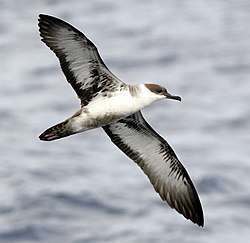
| Great shearwater | |
Scientific classification
| |
| Kingdom: | Animalia |
| Phylum: | Chordata |
| Class: | Aves |
| Order: | Procellariiformes |
| Family: | Procellariidae |
| Diversity | |
| Genera | |
Shearwaters are medium-sized long-winged seabirds in the petrel family Procellariidae. They have a global marine distribution, but are most common in temperate and cold waters, and are pelagic outside the breeding season.
Description
[edit]These tubenose birds fly with stiff wings and use a "shearing" flight technique (flying very close to the water and seemingly cutting or "shearing" the tips of waves) to move across wave fronts with the minimum of active flight. This technique gives the group its English name.[1] Some small species like the Manx shearwater are cruciform in flight, with their long wings held directly out from their bodies.
Behaviour
[edit]Movements
[edit]Many shearwaters are long-distance migrants, perhaps most spectacularly sooty shearwaters, which cover distances in excess of 14,000 km (8,700 mi) from their breeding colonies on the Falkland Islands (52°S 60°W) to as far as 70° north latitude in the North Atlantic Ocean off northern Norway, and around New Zealand to as far as 60° north latitude in the North Pacific Ocean off Alaska. A 2006 study found individual tagged sooty shearwaters from New Zealand migrating 64,000 km (40,000 mi) a year,[2] which gave them the then longest known animal migration ever recorded electronically (though subsequently greatly exceeded by a tagged arctic tern migrating 96,000 km (60,000 mi)[3]). Short-tailed shearwaters perform an even longer "figure of eight" loop migration in the Pacific Ocean from Tasmania to as far north as the Arctic Ocean off northwest Alaska. They are also long-lived: a Manx shearwater breeding on Copeland Island, Northern Ireland, was (as of 2003/2004) the oldest known wild bird in the world; ringed as an adult (when at least 5 years old) in July 1953, it was retrapped in July 2003, at least 55 years old (also now exceeded, by a Laysan albatross). Manx shearwaters migrate over 10,000 km (6,200 mi) to South America in winter, using waters off southern Brazil and Argentina, so this bird had covered a minimum of 1,000,000 km (620,000 mi) on migration alone.
Following the tracks of the migratory Yelkouan shearwater has revealed that this species never flies overland, even if it means flying an extra 1,000 km. For instance, during their seasonal migration towards the Black Sea they would circumvent the entire Peloponnese instead of crossing over the 6 km Isthmus of Corinth.[4]
Breeding
[edit]Shearwaters come to islands and coastal cliffs only to breed. They are nocturnal at the colonial breeding sites, preferring moonless nights to minimize predation. They nest in burrows and often give eerie contact calls on their night-time visits. They lay a single white egg. The chicks of some species, notably short-tailed and sooty shearwaters, are subject to harvesting from their nest burrows for food, a practice known as muttonbirding, in Australia and New Zealand.
Feeding
[edit]Shearwaters feed on fish, squid, and similar oceanic food. Some will follow fishing boats to take scraps, commonly the sooty shearwater; these species also commonly follow whales to feed on fish disturbed by them. Their primary feeding technique is diving, with some species diving to depths of 70 m (230 ft).[2] Shearwaters defecate more often than other seabirds, typically between once every four to ten minutes. They excrete five percent of their body mass every hour, generally done while flying, rather than while resting on water.[5][6]
Taxonomy
[edit]There are about 30 species: a few larger ones in the genera Calonectris and Ardenna and many smaller ones in Puffinus. Recent genomic studies show that Shearwaters form a clade with Procellaria, Bulweria and Pseudobulweria.[7] This arrangement contrasts with earlier conceptions based on mitochondrial DNA sequencing. [8][9][10]
List of species
[edit]The group contains 3 genera with 32 species.[11]
- Puffinus
- Christmas shearwater Puffinus nativitatis
- Manx shearwater Puffinus puffinus
- Yelkouan shearwater Puffinus yelkouan
- Balearic shearwater Puffinus mauretanicus (proposed lump with P. yelkouan)
- Bryan's shearwater Puffinus bryani – first described in 2011
- Black-vented shearwater Puffinus opisthomelas
- Townsend's shearwater Puffinus auricularis
- Newell's shearwater Puffinus newelli (split from Townsend's shearwater)
- Rapa shearwater Puffinus myrtae (split from Newell's shearwater)
- Fluttering shearwater Puffinus gavia
- Hutton's shearwater Puffinus huttoni
- Sargasso shearwater (formerly Audubon's shearwater, before splitting) Puffinus lherminieri
- Persian shearwater Puffinus persicus (split from Audubon's shearwater)
- Tropical shearwater Puffinus bailloni (split from Audubon's shearwater)
- Galápagos shearwater Puffinus subalaris (split from Audubon's shearwater)
- Bannerman's shearwater Puffinus bannermani
- Heinroth's shearwater Puffinus heinrothi
- Little shearwater Puffinus assimilis
- Subantarctic shearwater Puffinus elegans (split from little shearwater)
- Barolo shearwater or Macronesian shearwater Puffinus baroli
- Boyd's shearwater Puffinus boydi (split from Barolo shearwater)
- Calonectris
- Streaked shearwater Calonectris leucomelas
- Scopoli's shearwater Calonectris diomedea (split from Cory's shearwater)
- Cory's shearwater Calonectris diomedea
- Cape Verde shearwater Calonectris edwardsii
- Ardenna
- Wedge-tailed shearwater Ardenna pacifica
- Buller's shearwater Ardenna bulleri
- Sooty shearwater Ardenna grisea
- Short-tailed shearwater Ardenna tenuirostris
- Pink-footed shearwater Ardenna creatopus
- Flesh-footed shearwater Ardenna carneipes
- Great shearwater Ardenna gravis
There are two extinct species that have been described from fossils.
- † Lava shearwater or Olson's shearwater Puffinus olsoni
- † Dune shearwater or Hole's shearwater Puffinus holeae
Phylogeny
[edit]Phylogeny of the shearwaters based on a study by Joan Ferrer Obiol and collaborators published in 2022. Only 14 of the 21 recognised species in the genus Puffinus were included.[12]
References
[edit]- ^ "Shearwaters". Oxford English Dictionary (Online ed.). Oxford University Press. (Subscription or participating institution membership required.)
- ^ a b Shaffer, Scott A.; Tremblay, Yann; Weimerskirch, Henri; Costa, Daniel P. (2006). "Migratory shearwaters integrate oceanic resources across the Pacific Ocean in an endless summer". PNAS. 103 (34): 12799–12802. Bibcode:2006PNAS..10312799S. doi:10.1073/pnas.0603715103. PMC 1568927. PMID 16908846.
- ^ "Arctic tern in record-breaking migration from Farne Islands". BBC. 7 June 2016. Retrieved 10 September 2024.
- ^ CIESM Seabird Project. 2021. https://ciesm.org/marine/programs/seabirds/track-seabirds-migrating-live/
- ^ Preston, Elizabeth (2025-08-18). "These Majestic Seabirds Never Stop Pooping". The New York Times. Retrieved 2025-08-23.
- ^ Uesaka, Leo; Sato, Katsufumi (18 August 2025). "Periodic excretion patterns of seabirds in flight". Current Biology. 35 (16): R795 – R796. doi:10.1016/j.cub.2025.06.058. PMID 40829559.
- ^ Estandia, A; Chesser, RT; James, HF; Levy, MA; Ferrer Obiol, J; Bretagnolle, V; Gonzales-Solis, J; Welch, AJ (July 2021). "Substitution rate variation in a robust procellariiform seabird phylogeny is not solely explained by body mass, flight efficiency, population size or life history traits" (PDF). bioRxiv. doi:10.1101/2021.07.27.453752. S2CID 236502443.
- ^ Bretagnolle, Vincent; Attié, Carole; Pasquet, Eric (1998). "Cytochrome-B evidence for validity and phylogenetic relationships of Pseudobulweria and Bulweria (Procellariidae)" (PDF). The Auk. 115 (1): 188–195. doi:10.2307/4089123. JSTOR 4089123.
- ^ Nunn, Gary B.; Stanley, Scott E. (1998). "Body Size Effects and Rates of Cytochrome b Evolution in Tube-Nosed Seabirds". Molecular Biology and Evolution. 15 (10): 1360–1371. doi:10.1093/oxfordjournals.molbev.a025864. PMID 9787440. Corrigendum
- ^ Austin, Jeremy J. (1996). "Molecular Phylogenetics of Puffinus Shearwaters: Preliminary Evidence from Mitochondrial Cytochrome b Gene Sequences". Molecular Phylogenetics and Evolution. 6 (1): 77–88. Bibcode:1996MolPE...6...77A. doi:10.1006/mpev.1996.0060. PMID 8812308.
- ^ Gill, Frank; Donsker, David; Rasmussen, Pamela, eds. (August 2024). "Petrels, albatrosses". IOC World Bird List Version 14.2. International Ornithologists' Union. Retrieved 10 September 2024.
- ^ Ferrer Obiol, J.; James, H.F.; Chesser, R.T.; Bretagnolle, V.; González-Solís, J.; Rozas, J.; Welch, A.J.; Riutort, M. (2022). "Palaeoceanographic changes in the late Pliocene promoted rapid diversification in pelagic seabirds". Journal of Biogeography. 49 (1): 171–188. Bibcode:2022JBiog..49..171F. doi:10.1111/jbi.14291. hdl:2445/193747.
External links
[edit]- Shearwater videos at the Macauley Library
Shearwater
View on GrokipediaDescription
Physical Characteristics
Shearwaters are medium-sized, long-winged seabirds belonging to the family Procellariidae, with body lengths typically ranging from 25 to 56 cm and weights from 170 to 1100 g, though these measurements vary significantly across species.[4][9] For instance, the smallest species, such as the little shearwater (Puffinus assimilis), measure about 25–30 cm in length and weigh 220–260 g, while larger ones like Cory's shearwater (Calonectris borealis) reach 45–56 cm and 700–1060 g.[10][11] Smaller Puffinus species generally fall at the lower end of this spectrum, contrasting with the bulkier Calonectris genus.[12] Characteristic of the Procellariidae family, shearwaters possess tubular nostrils positioned atop their bills, which facilitate olfaction for detecting prey and navigating over vast ocean expanses.[13] Their bills are strong and hooked at the tip, adapted for grasping fish, squid, and crustaceans from the water's surface or during shallow dives.[13] The feet are fully webbed, enabling efficient propulsion through water as an aid to swimming and foraging in marine environments.[13] Shearwater plumage is generally dull and adapted for life at sea, featuring dark gray to black upperparts and white underparts in most species, though variations occur.[13] Some, like the sooty shearwater (Ardenna grisea), exhibit all-dark plumage, while others display mottled patterns on the head or underwing coverts.[14] Plumage undergoes a complete annual molt, often catastrophically after breeding, replacing feathers over several weeks to maintain waterproofing and insulation during non-breeding migrations.[13] Sexual dimorphism is minimal, with no notable differences in plumage between males and females; however, males are slightly larger in body size and bill dimensions in species such as Cory's shearwater.[13][12] A representative example is the Manx shearwater (Puffinus puffinus), which measures 30–38 cm in length and weighs 350–575 g, with its slender body and long, narrow wings contributing to a cruciform posture in flight, where the wings extend perpendicular to the body for efficient gliding.[15][16]Flight Adaptations
Shearwaters are renowned for their dynamic soaring flight technique, a highly efficient strategy that minimizes wing flapping and conserves energy during long-distance travel over oceans. This method relies on exploiting vertical wind gradients generated by surface waves, where birds execute repeated cycles of ascent into faster headwinds to gain kinetic energy and descent into slower tailwinds to maintain speed. The resulting flight path features horizontal zigzags combined with vertical undulations, typically at heights of 5–20 meters above the water, allowing shearwaters to achieve ground speeds often exceeding 50 km/h while extracting energy from the atmosphere rather than muscular power alone. Observations of species like the sooty shearwater confirm that this adaptation enables non-stop journeys exceeding 10,000 km, such as trans-Pacific migrations, with minimal metabolic cost.[17] Anatomically, shearwaters' long, narrow wings with high aspect ratios—ranging from about 8.4 in smaller species like the little shearwater to over 12 in larger ones like the great shearwater—optimize gliding efficiency by reducing induced drag and enhancing lift-to-drag ratios during sustained soaring. These wings, combined with relatively low wing loadings of 0.3–0.6 g/cm² across procellariiform species, allow for stable, low-energy flight while supporting takeoff from water surfaces. Stiff tail feathers further aid in maintaining balance and control during sharp turns and low-altitude maneuvers in turbulent winds. To cope with seawater intake during foraging, shearwaters possess specialized nasal (supraorbital) salt glands that excrete hypertonic saline solutions, preventing osmotic stress and enabling prolonged marine flights without freshwater dependence.[18][19][20] Olfactory navigation plays a critical role in shearwaters' ability to locate productive foraging areas and return to breeding colonies across vast expanses. These birds detect chemical signatures from upwelling zones, where nutrient-rich waters attract prey, guiding them to distant feeding grounds. Homing experiments with Manx shearwaters displaced hundreds of kilometers demonstrate that individuals with impaired olfaction (via chemical blockage) fail to orient directly homeward, instead following circuitous routes along coastlines and taking significantly longer to return, while controls and those with disrupted magnetic senses perform efficiently. Similar anosmia studies on Scopoli's shearwaters confirm that smell is essential for initial orientation, with affected birds showing reduced path efficiency (0.27 versus 0.56 for controls) before eventually homing via visual landmarks.[21][22] Physiologically, shearwaters exhibit enhanced aerobic capacity in their flight muscles, characterized by high densities of oxidative enzymes and mitochondria that support prolonged endurance through efficient fat metabolism rather than anaerobic bursts. This adaptation is vital for the intermittent flapping required to initiate soaring cycles, with muscle fibers optimized for sustained low-intensity activity over days or weeks. Across species, wing loading values of 0.3–0.6 g/cm² provide a balance between structural strength for wave-riding takeoffs and aerodynamic efficiency for gliding, underscoring the integrated design for transoceanic travel.[23][18]Taxonomy
Phylogeny
Shearwaters belong to the family Procellariidae within the order Procellariiformes, which diverged from other seabird lineages approximately 60 million years ago in the Paleocene, with the crown group emerging around 40 million years ago during the Eocene.[24] The fossil record of procellariiforms begins in the Eocene, but unambiguous shearwater fossils appear in the Oligocene, exemplified by Diomedeoides brodkorbi, a stem-group procellariiform from the early Oligocene (Rupelian) deposits in Germany, indicating early diversification of tubenosed seabirds.[25] Miocene records further document shearwater evolution, including a diminutive species akin to modern Calonectris from the Middle Miocene Calvert Formation in North America, suggesting the development of larger-bodied forms by the Neogene.[26] These fossils highlight shearwaters' ancient origins as pelagic predators adapted to open oceans, with the family contributing the most species to the Neogene procellariiform record.[27] Genomic studies in the 2020s, leveraging whole-genome sequencing and mitochondrial DNA analyses, have resolved the phylogenetic relationships among shearwaters, confirming three main genera: Calonectris (larger Mediterranean species), Ardenna (southern hemisphere medium-to-large forms), and Puffinus (predominantly small species).[28] Traditional classifications rendered Puffinus paraphyletic, as larger species now in Ardenna (e.g., Manx shearwater A. puffinus) nested within it; this led to taxonomic revisions splitting Ardenna to achieve monophyly for Puffinus. Hybridization events further complicate boundaries, such as gene flow between the critically endangered Balearic shearwater (Puffinus mauretanicus) and its sibling species the Yelkouan shearwater (Puffinus yelkouan), which has been shown to enhance survival in hybrid populations through adaptive introgression.[29] The phylogenetic tree reveals a basal divergence between the northern Calonectris clade and the southern Ardenna/Puffinus radiation, with the three genera splitting during the Middle Miocene around 15–10 million years ago, followed by accelerated speciation in the late Pliocene driven by oceanographic shifts like intensified upwelling and cooling currents.[28] Pleistocene glaciation episodes caused range contractions and local extinctions, particularly affecting northern and island populations, as evidenced by fossil remains of extinct species like the Lava shearwater (Puffinus olsoni) from the Canary Islands, where post-glacial warming and sea-level rise contributed to biodiversity loss.[30] These events underscore the role of climatic oscillations in shaping shearwater diversity. The 2024 update to the IOC World Bird List integrates these genomic insights, maintaining recognition of approximately 31 shearwater species across the three genera while incorporating revisions such as elevating subspecies distinctions and renaming Audubon's shearwater to Sargasso shearwater (Puffinus lherminieri) based on phylogenetic evidence.[31]List of Species
Shearwaters comprise approximately 31 extant species distributed across three genera within the family Procellariidae: Calonectris (four large, yellow-billed species primarily in the Atlantic and western Pacific), Ardenna (seven medium to large species with robust bills, mostly in southern oceans), and Puffinus (about 20 small to medium species, often with more slender bills, widespread in tropical and temperate seas).[28] This taxonomy reflects recent genomic studies that separated Ardenna from Puffinus based on phylogenetic divergence, with Calonectris forming a distinct clade.[28] Extinct species, such as the Holocene-era Puffinus olsoni (lava shearwater, known from subfossil remains in the Canary Islands), are included for completeness.[32] Recent taxonomic revisions, including 2024 splits in the Puffinus lherminieri complex (e.g., recognizing distinct species like the Galapagos shearwater P. subalaris), have refined species boundaries using genetic and morphological data.[33] Subspecies are noted where significant, particularly for population estimates and regional endemism; global populations are provided only for well-studied taxa.Genus Calonectris
These species are characterized by their large size (40–56 cm), pale underparts, and breeding in subtropical to temperate islands, with foraging in offshore waters.| Binomial Name | Common Name | IUCN Status | Key Identifiers (Size, Range) | Notes |
|---|---|---|---|---|
| Calonectris borealis | Cory's Shearwater | Least Concern | 45–56 cm; breeds on Macaronesian islands (Azores, Canaries, Madeira), ranges North Atlantic | Split from C. diomedea in 2024 based on vocal and genetic differences; global population ~500,000–1,000,000 breeding pairs. |
| Calonectris diomedea | Scopoli's Shearwater | Least Concern | 45–56 cm; breeds Mediterranean (e.g., Italy, Greece), ranges eastern Atlantic and Mediterranean | Recognized as full species in 2024 split; subspecies include C. d. diomedea (mainland Europe) vs. C. d. alba (Libya); population ~300,000–500,000 breeding pairs.[34] |
| Calonectris edwardsii | Cape Verde Shearwater | Near Threatened | 43–49 cm; endemic breeder to Cape Verde Islands, ranges eastern Atlantic | Monotypic; small population ~3,000–5,000 breeding pairs, vulnerable due to limited range. |
| Calonectris leucomelas | Streaked Shearwater | Near Threatened | 48 cm; breeds Japan and Korea, ranges North Pacific | Monotypic; global population ~500,000 individuals, declining due to fishery bycatch.[35] |
Genus Ardenna
These species are larger (36–51 cm), often with dark plumage and white underwing patches, breeding in southern temperate to subantarctic regions and migrating northward.| Binomial Name | Common Name | IUCN Status | Key Identifiers (Size, Range) | Notes |
|---|---|---|---|---|
| Ardenna bulleri | Buller's Shearwater | Vulnerable | 36–42 cm; breeds New Zealand, ranges North Pacific | Monotypic; population ~50,000–100,000 breeding pairs, threatened by invasive predators.[36] |
| Ardenna carneipes | Flesh-footed Shearwater | Near Threatened | 43–46 cm; breeds Australia, New Zealand, ranges Pacific and Indian Oceans | Monotypic; global population >650,000 individuals, but declining from plastic ingestion.[37] |
| Ardenna creatopus | Pink-footed Shearwater | Vulnerable | 48 cm; breeds Chile (Juan Fernández Islands), ranges eastern Pacific | Monotypic; population ~2,000–4,000 breeding pairs, vulnerable to habitat loss. |
| Ardenna gravis | Great Shearwater | Least Concern | 43–51 cm; breeds Tristan da Cunha (South Atlantic), ranges North Atlantic | Monotypic; abundant, population ~10–20 million individuals.[38] |
| Ardenna grisea | Sooty Shearwater | Near Threatened | 40–46 cm; breeds New Zealand, Australia, Chile, ranges northern hemisphere | Monotypic; global population ~20 million, but declining from overharvesting.[39] |
| Ardenna pacificus | Wedge-tailed Shearwater | Least Concern | 41–46 cm; breeds tropical Pacific and Indian Oceans (e.g., Hawaii, Australia) | Subspecies include dark and light morphs; population >1 million breeding pairs.[40] |
| Ardenna tenuirostris | Short-tailed Shearwater | Least Concern | 39–43 cm; breeds Tasmania and southern Australia, ranges North Pacific | Monotypic; population ~15–20 million, major migrant to Alaska.[6] |
Genus Puffinus
This diverse genus includes smaller species (20–38 cm), many with variable plumage, breeding on remote islands worldwide; recent splits have increased recognized diversity from ~15 to ~20 species.| Binomial Name | Common Name | IUCN Status | Key Identifiers (Size, Range) | Notes |
|---|---|---|---|---|
| Puffinus auricularis | Townsend's Shearwater | Endangered | 30 cm; breeds Revillagigedo Islands (Mexico), ranges eastern Pacific | Subspecies P. a. auricularis; population <300 individuals, captive breeding ongoing. |
| Puffinus bailloni | Tropical Shearwater | Least Concern | 26–29 cm; breeds tropical Indian and Pacific Oceans (e.g., Seychelles, Indonesia) | Complex split in 2024; subspecies include P. b. dichrous (Christmas Island); population stable. |
| Puffinus baroli | Barolo Shearwater | Near Threatened | 25–27 cm; breeds Macaronesia (Azores, Madeira, Canaries), ranges Atlantic | Split from Audubon's complex; subspecies P. b. baroli; population ~2,000–4,000 pairs. |
| Puffinus boydi | Boyd's Shearwater | Data Deficient | 25 cm; breeds New Zealand (possibly extinct on main islands) | Subspecies of little shearwater; limited data, potential split. |
| Puffinus bryani | Bryan's Shearwater | Critically Endangered | 26 cm; breeds possibly Midway Atoll (Hawaii), ranges Pacific | Described 2011 from subfossils; population unknown, presumed <50 individuals.[41] |
| Puffinus bannermani | Bannerman's Shearwater | Vulnerable | 25 cm; breeds Solomon Islands, ranges western Pacific | Monotypic; population ~10,000 pairs, threatened by logging. |
| Puffinus elegans | Elegant Shearwater | Least Concern | 28 cm; breeds Lord Howe Island (Australia), ranges South Pacific | Recently split; population ~20,000 pairs. |
| Puffinus gavia | Fluttering Shearwater | Least Concern | 23–25 cm; breeds Australia and New Zealand, ranges Australasia | Monotypic; abundant, population >1 million. |
| Puffinus heinrothi | Heinroth's Shearwater | Vulnerable | 29 cm; breeds Solomon Islands, ranges western Pacific | Monotypic; population 250–999 individuals. |
| Puffinus huttoni | Hutton's Shearwater | Endangered | 36 cm; breeds New Zealand (South Island), ranges Pacific | Monotypic; population ~40,000 pairs, predation threats.[42] |
| Puffinus lherminieri | Sargasso Shearwater | Least Concern | 27–30 cm; breeds Caribbean, ranges western Atlantic | 2024 split limits to nominate form; subspecies formerly included others; population >100,000. |
| Puffinus mauretanicus | Balearic Shearwater | Critically Endangered | 30–35 cm; breeds Balearic Islands (Spain), ranges western Mediterranean and Atlantic | Monotypic; population ~3,000–7,000 mature individuals, severe decline. |
| Puffinus myrtae | Rapa Shearwater | Data Deficient | 25 cm; breeds Rapa Island (French Polynesia), ranges South Pacific | Described 2020; population unknown. |
| Puffinus nativitatis | Christmas Shearwater | Near Threatened | 36 cm; breeds tropical Pacific (e.g., Hawaii, Line Islands), ranges central Pacific | Subspecies P. n. nativitatis and P. n. juana; population ~20,000–50,000. |
| Puffinus newelli | Newell's Shearwater | Endangered | 30 cm; breeds Hawaiian Islands, ranges North Pacific | Revised in 2024 to include genetic confirmation as distinct; population ~10,000–20,000, light attraction threats.[7] |
| Puffinus opisthomelas | Black-vented Shearwater | Vulnerable | 30 cm; breeds Baja California (Mexico), ranges eastern Pacific | Monotypic; population ~10,000 pairs. |
| Puffinus persicus | Persian Shearwater | Least Concern | 32 cm; breeds Arabian Sea islands (e.g., Socotra), ranges Indian Ocean | Monotypic; population stable. |
| Puffinus puffinus | Manx Shearwater | Least Concern | 30–35 cm; breeds northeast Atlantic (e.g., UK, Ireland), ranges Atlantic | Subspecies P. p. puffinus (Atlantic); population >10 million. |
| Puffinus subalaris | Galapagos Shearwater | Vulnerable | 28 cm; breeds Galapagos Islands, ranges eastern Pacific | Split from Audubon's in 2024; population ~10,000–20,000, invasive species threats. |
| Puffinus yelkouan | Yelkouan Shearwater | Vulnerable | 30–35 cm; breeds central Mediterranean (e.g., Italy), ranges Mediterranean | Split from Manx; population ~12,000–15,000 pairs; P. y. yelkouan vs. Corsican subspecies. |