


Community hub
Recent from talks
Contribute something
Nothing was collected or created yet.
Shinto
View on Wikipedia

Shinto (神道, Shintō; Japanese pronunciation: [ɕiꜜn.toː][2]), also called Shintoism, is a religion originating in Japan. Classified as an East Asian religion by scholars of religion, it is often regarded by its practitioners as Japan's indigenous religion and as a nature religion. Scholars sometimes call its practitioners Shintoists, although adherents rarely use that term themselves. With no unifying doctrine or central authority in control of Shinto, there is much diversity of belief and practice evident among practitioners.
A polytheistic and animistic religion, Shinto revolves around supernatural entities called the kami (神). The kami are believed to inhabit all things, including forces of nature, prominent landscape locations, and even notable historical figures. The kami are worshipped at kamidana household shrines, family shrines, and jinja public shrines. The latter are staffed by priests, known as kannushi, who oversee offerings of food and drink to the specific kami enshrined at that location. This is done to cultivate harmony between humans and kami and to solicit the latter's blessing. Other common rituals include the kagura dances, rites of passage, and kami festivals. Public shrines facilitate forms of divination and supply religious objects, such as amulets, to the religion's adherents. Shinto places a major conceptual focus on ensuring purity, largely by cleaning practices such as ritual washing and bathing, especially before worship. Little emphasis is placed on specific moral codes or particular afterlife beliefs, although the dead are deemed capable of becoming kami. With the kami of the dead, there is the common worship of ancestral kami, whose presence is only in your clan, and Arahitogami, who can have their purification rituals performed by anyone whose life has been impacted by them. The religion has no single creator or specific doctrine, and instead exists in a diverse range of local and regional forms.
Although historians debate at what point it is suitable to refer to Shinto as a distinct religion, kami veneration has been traced back to Japan's Yayoi period (300 BC to 300 AD). Buddhism entered Japan at the end of the Kofun period (300 to 538 AD) and spread rapidly. Religious syncretization made kami worship and Buddhism functionally inseparable, a process called shinbutsu-shūgō. The kami came to be viewed as part of Buddhist cosmology and were increasingly depicted anthropomorphically. The earliest written tradition regarding kami worship was recorded in the 8th-century Kojiki and Nihon Shoki. In ensuing centuries, shinbutsu-shūgō was adopted by Japan's Imperial household. During the Meiji era (1868 to 1912), Japan's nationalist leadership expelled Buddhist influence from kami worship and formed State Shinto, which some historians regard as the origin of Shinto as a distinct religion. Shrines came under growing government influence, and citizens were encouraged to worship the emperor as a kami. With the formation of the Empire of Japan in the early 20th century, Shinto was exported to other areas of East Asia. Following Japan's defeat in World War II, Shinto was formally separated from the state.
Shinto is primarily found in Japan, where there are around 100,000 public shrines, although practitioners are also found abroad. Numerically, it is Japan's largest religion, the second being Buddhism. Most of the country's population takes part in both Shinto and Buddhist activities, especially festivals, reflecting a common view in Japanese culture that the beliefs and practices of different religions need not be exclusive. Aspects of Shinto have been incorporated into various Japanese new religious movements.
Definition
[edit]
There is no universally agreed definition of Shinto.[3] According to Joseph Cali and John Dougill, if there was "one single, broad definition of Shinto" that could be put forward, it would be that "Shinto is a belief in kami", the supernatural entities at the centre of the religion.[4] The Japanologist Helen Hardacre wrote that "Shinto encompasses doctrines, institutions, ritual, and communal life based on kami worship",[5] while the scholar of religion Inoue Nobutaka observed that the term "Shinto" was "often used" in "reference to kami worship and related theologies, rituals and practices".[6] Various scholars have referred to practitioners of Shinto as Shintoists, although this term has no direct translation in the Japanese language.[7]
Scholars have debated at what point in history it is legitimate to start talking about Shinto as a specific phenomenon. The scholar of religion Ninian Smart suggested that one could "speak of the kami religion of Japan, which lived symbiotically with organized Buddhism, and only later was institutionalized as Shinto."[8] While several institutions and practices now associated with Shinto existed in Japan by the 8th century,[9] various scholars have argued that Shinto as a distinct religion was essentially "invented" during the 19th century, in Japan's Meiji era.[10] The scholar of religion Brian Bocking stressed that, especially when dealing with periods before the Meiji era, the term Shinto should "be approached with caution".[11] Inoue Nobutaka stated that "Shinto cannot be considered as a single religious system that existed from the ancient to the modern period",[12] while the historian Kuroda Toshio noted that "before modern times Shinto did not exist as an independent religion".[13]
Categorisation
[edit]Many scholars describe Shinto as a religion,[14] a term first translated into Japanese as shūkyō around the time of the Meiji Restoration.[15] Some practitioners instead view Shinto as a "way",[16] thus characterising it more as custom or tradition,[17] partly as an attempt to circumvent the modern separation of religion and state and restore Shinto's historical links with the Japanese state.[18] Moreover, many of the categories of religion and religiosity defined in Western culture "do not readily apply" to Shinto.[19] Unlike religions familiar in Western countries, such as Christianity and Islam, Shinto has no single founder,[20] nor any single canonical text.[21] Western religions tend to stress exclusivity, but in Japan, it has long been considered acceptable to practice different religious traditions simultaneously.[22] Japanese religion is therefore highly pluralistic.[23] Shinto is often cited alongside Buddhism as one of Japan's two main religions,[24] and the two often differ in focus, with Buddhism emphasising the idea of the cessation of suffering, while Shinto focuses on adapting to life's pragmatic requirements.[25] Shinto has integrated elements from religions imported from mainland Asia, such as Buddhism, Confucianism, Taoism, and Chinese divination practices,[26] and shares features like its polytheism with other East Asian religions.[27]
Some scholars suggest we talk about types of Shintō such as popular Shintō, folk Shintō, domestic Shintō, sectarian Shintō, imperial house Shintō, shrine Shintō, state Shintō, new Shintō religions, etc. rather than regard Shintō as a single entity. This approach can be helpful but begs the question of what is meant by 'Shintō' in each case, particularly since each category incorporates or has incorporated Buddhist, Confucian, Taoist, folk religious and other elements.
Scholars of religion have debated how to classify Shinto. Inoue considered it part of "the family of East-Asian religions".[29] The philosopher Stuart D. B. Picken suggested that Shinto be classed as a world religion,[30] while the historian H. Byron Earhart called it a "major religion".[31] Shinto is also often described as an indigenous religion,[32] although this generates debates over the different definitions of "indigenous" in the Japanese context.[33] The notion of Shinto as Japan's "indigenous religion" stemmed from the growth of modern nationalism between the Edo and Meiji periods;[34] this view promoted the idea that Shinto's origins were prehistoric and that it represented something like the "underlying will of Japanese culture".[35] The prominent Shinto theologian Sokyo Ono, for instance, said kami worship was "an expression" of the Japanese "native racial faith which arose in the mystic days of remote antiquity" and that it was "as indigenous as the people that brought the Japanese nation into existence".[36] Many scholars regard this classification as inaccurate. Earhart noted that Shinto, in having absorbed much Chinese and Buddhist influence, was "too complex to be labelled simply [as an] indigenous religion".[31] In the early 21st century it became increasingly common for practitioners to call Shinto a nature religion,[37] which critics saw as a strategy to disassociate the tradition from controversial issues surrounding militarism and imperialism.[37]
Shinto displays substantial local variation;[38] the anthropologist John K. Nelson noted it was "not a unified, monolithic entity".[33] Different types of Shinto have been identified. "Shrine Shinto" refers to practices centred around shrines,[39] and "Domestic Shinto" to the veneration of kami in the home.[40] Some scholars have used the term "Folk Shinto" to designate localised Shinto practices,[41] or practices outside of an institutionalised setting.[33] In various past eras, there was also a "State Shinto", in which Shinto beliefs and practices were closely interlinked with the Japanese state.[39] In representing "a portmanteau term" for many varied traditions across Japan, the term "Shinto" is similar to the term "Hinduism", used to describe varied traditions across South Asia.[42]
Etymology
[edit]
The term Shinto is often broadly translated into English as "the way of the kami",[43] although its meaning has varied throughout Japanese history.[44] Other terms are sometimes used synonymously with "Shinto"; these include kami no michi (神の道, "the way of the kami"), kannagara no michi (神ながらの道, also written 随神の道 or 惟神の道, "the way of the kami from time immemorial"), Kodō (古道, "the ancient way"), Daidō (大道, "the great way"), and Teidō (帝道, "the imperial way").[45]
The term Shinto derives from the combination of two Chinese characters: shin (神), which means "spirit" or "god", and tō (道), which means "way", "road" or "path".[46] "Shintō" (神道, "the Way of the Gods") was a term already used in the Book of Changes referring to the divine order of nature.[47] Around the time of the spread of Buddhism in the Han dynasty (206 BCE – 220 CE), it was used to distinguish indigenous Chinese religions from the imported religion. Ge Hong used it in his Baopuzi as a synonym for Taoism.[48]
The Chinese term 神道 (MC zyin dawX) was originally adopted into Japanese as Jindō;[49] this was possibly first used as a Buddhist term to refer to non-Buddhist deities.[50] Among the earliest known appearances of the term Shinto in Japan is in the 8th-century text, Nihon Shoki.[51] Here, it may be a generic term for popular belief,[52] or alternatively reference Taoism, as many Taoist practices had recently been imported from mainland Asia.[53] In these early Japanese uses, the word Shinto did not apply to a distinct religious tradition nor to anything uniquely Japanese;[54] the 11th century Konjaku monogatarishui for instance refers to a woman in China practicing Shinto, and also to people in India worshipping kami, indicating these terms were being used to describe religions outside Japan itself.[55]
In medieval Japan, kami-worship was generally seen as being part of Japanese Buddhism, with the kami themselves often interpreted as Buddhas.[56] At this point, the term Shinto increasingly referred to "the authority, power, or activity of a kami, being a kami, or, in short, the state or attributes of a kami."[57] It appears in this form in texts such as Nakatomi no harai kunge and Shintōshū tales.[57] In the Japanese Portuguese Dictionary of 1603, Shinto is defined as referring to "kami or matters pertaining to kami."[58] The term Shinto became common in the 15th century.[59] During the late Edo period, the kokugaku scholars began using the term Shinto to describe what they believed was an ancient, enduring and indigenous Japanese tradition that predated Buddhism; they argued that Shinto should be used to distinguish kami worship from traditions like Buddhism, Taoism, and Confucianism.[60] This use of the term Shinto became increasingly popular from the 18th century.[11] The term Shinto has been commonly used only since the early 20th century, when it superseded the term taikyō ('great religion') as the name for the Japanese state religion.[42] In English, the religion is also called "Shintoism",[61][62][63] although some scholars have argued against the inclusion of the suffix -ism due to Shinto's lack of codified doctrine.[64][65]
Beliefs
[edit]Kami
[edit]
Shinto is polytheistic, involving the veneration of many deities known as kami,[66] or sometimes as jingi (神祇).[67] In Japanese, no distinction is made here between singular and plural, and hence the term kami refers both to individual kami and the collective group of kami.[68] Although lacking a direct English translation,[69] the term kami has sometimes been rendered as "god" or "spirit".[70] The historian of religion Joseph Kitagawa deemed these English translations "quite unsatisfactory and misleading",[71] and various scholars urge against translating kami into English.[72] In Japanese, it is often said that there are eight million kami, a term which connotes an infinite number,[73] and Shinto practitioners believe that they are present everywhere.[5] They are not regarded as omnipotent, omniscient, or necessarily immortal.[74]
The term kami is "conceptually fluid",[75] being "vague and imprecise".[76] In Japanese it is often applied to the power of phenomena that inspire a sense of wonder and awe in the beholder.[77] Kitagawa referred to this as "the kami nature", stating that he thought it "somewhat analogous" to the Western ideas of the numinous and the sacred.[71] Kami are seen to inhabit both the living and the dead, organic and inorganic matter, and natural disasters like earthquakes, droughts, and plagues;[4] their presence is seen in natural forces such as the wind, rain, fire, and sunshine.[78] Accordingly, Nelson commented that Shinto regards "the actual phenomena of the world itself" as being "divine".[79] This perspective has been characterised as being animistic.[80]
In Japan, kami have been venerated since prehistory.[5] During the Yayoi period they were regarded as being formless and invisible,[81] later coming to be depicted anthropomorphically under Buddhist influence.[82] Now, statues of the kami are known as shinzo.[83] Kami are usually associated with a specific place, often a prominent landscape feature such as a waterfall, mountain, large rock, or distinctive tree.[84] Physical objects or places in which the kami are believed to have a presence are termed shintai;[85] objects inhabited by the kami that are placed in the shrine are known as go-shintai.[86] Objects commonly chosen for this purpose include mirrors, swords, stones, beads, and inscribed tablets.[87] These go-shintai are concealed from the view of visitors,[88] and may be hidden inside boxes so that even the priests do not know what they look like.[85]
Kami are deemed capable of both benevolent and destructive deeds;[89] if warnings about good conduct are ignored, the kami can mete out punishment, often illness or sudden death, called shinbatsu.[90] Some kami, referred to as the magatsuhi-no-kami or araburu kami, are regarded as malevolent and destructive.[91] Offerings and prayers are given to the kami to gain their blessings and to dissuade them from destructive actions.[4] Shinto seeks to cultivate and ensure a harmonious relationship between humans and the kami and thus with the natural world.[92] More localised kami may be subject to feelings of intimacy and familiarity from members of the local community that are not directed towards more widespread kami like Amaterasu.[93] The kami of a particular community is referred to it as their ujigami,[94] while that of a particular house is the yashikigami.[95]

Kami are not considered metaphysically different from humanity,[75] with it being possible for humans to become kami.[69] Ancestors and other dead humans are sometimes venerated as kami, being regarded as protectors.[96] For example, Emperor Ōjin was posthumously enshrined as the kami Hachiman, believed to be a protector of Japan and a kami of war.[97] In Western Japan, the term jigami is used to describe the enshrined kami of a village founder.[98] In some cases, living human beings were also viewed as kami;[4] these were called akitsumi kami[99] or arahito-gami.[100] In the State Shinto system of the Meiji era, the emperor of Japan was declared to be a kami,[69] while several Shinto sects have also viewed their leaders as living kami.[69]
Although some kami are venerated only in a single location, others have shrines across many areas.[101] Hachiman for instance has around 25,000 shrines dedicated to him,[78] while Inari has 40,000.[102] The act of establishing a new shrine to a kami who already has one is called bunrei ("dividing the spirit").[103] As part of this, the kami is invited to enter a new place, with the instalment ceremony known as a kanjo.[101] The new, subsidiary shrine is known as a bunsha.[104] Individual kami are not believed to have their power diminished by their residence in multiple locations, and there is no limit on the number of places a kami can be enshrined.[101] In some periods, fees were charged for the right to enshrine a particular kami in a new place.[101] Shrines are not necessarily always designed as permanent structures.[5]
Many kami have messengers, known as kami no tsukai or tsuka washime, that generally take animal forms.[101] Inari's messenger, for example, is a fox (kitsune),[105] while Hachiman's is a dove.[101] Shinto cosmology also includes spirits who cause malevolent acts, bakemono, a category including oni, tengu, kappa, mononoke, and yamanba.[106] Japanese folklore also incorporates belief in the goryō or onryō, unquiet or vengeful spirits, particularly of those who died violently and without appropriate funerary rites.[107] These are believed to inflict suffering on the living, meaning that they must be pacified, usually through Buddhist rites but sometimes through enshrining them as a kami.[107] Other Japanese supernatural figures include the tanuki, animal-like creatures who can take human form.[108]
Cosmogony
[edit]
Although the narratives differ in detail,[109] the origin of the kami and of Japan itself are recounted in two 8th-century texts, Kojiki and Nihon Shoki.[110] Drawing heavily on Chinese influence,[111] these texts were commissioned by ruling elites to legitimize and consolidate their rule.[112] Although never of great importance to Japanese religious life,[113] in the early 20th century the government proclaimed that their accounts were factual.[114]
The Kojiki recounts that the universe started with ame-tsuchi, the separation of light and pure elements (ame, "heaven") from heavy elements (tsuchi, "earth").[115] Three kami then appeared: Amenominakanushi, Takamimusuhi no Mikoto, and Kamimusuhi no Mikoto. Other kami followed, including a brother and sister, Izanagi and Izanami.[116] The kami instructed Izanagi and Izanami to create land on earth. To this end, the siblings stirred the briny sea with a jewelled spear, from which Onogoro Island was formed.[117] Izanagi and Izanami then descended to Earth, where the latter gave birth to further kami. One of these was a fire kami, whose birth killed Izanami.[118] Izanagi descended to yomi to retrieve his sister, but there he saw her body putrefying. Embarrassed to be seen in this state, she chased him out of yomi, and he closed its entrance with a boulder.[119]
Izanagi bathed in the sea to rid himself from the pollution brought about by witnessing Izanami's putrefaction. Through this act, further kami emerged from his body: Amaterasu (the sun kami) was born from his left eye, Tsukuyomi (the moon kami) from his right eye, and Susanoo (the storm kami) from his nose.[120] Susanoo behaved in a destructive manner, to escape him Amaterasu hid herself within a cave, plunging the earth into darkness. The other kami eventually succeeded in coaxing her out.[121] Susanoo was then banished to earth, where he married and had children.[122] According to the Kojiki, Amaterasu then sent her grandson, Ninigi, to rule Japan, giving him curved beads, a mirror, and a sword: the symbols of Japanese imperial authority.[123] Amaterasu remains probably Japan's most venerated kami.[124]
Cosmology and afterlife
[edit]In Shinto, the creative principle permeating all life is known as musubi, and is associated with its own kami.[125] Within traditional Japanese thought, there is no concept of an overarching duality between good and evil.[126] The concept of aki encompasses misfortune, unhappiness, and disaster, although it does not correspond precisely with the Western concept of evil.[127] There is no eschatology in Shinto.[128] Texts such as the Kojiki and Nihon Shoki portray multiple realms in Shinto cosmology.[129] These present a universe divided into three parts: the Plane of High Heaven (Takama-no-hara), where the kami live; the Phenomenal or Manifested World (Utsushi-yo), where humans dwell; and the Nether World (Yomotsu-kuni), where unclean spirits reside.[130] The mythological texts nevertheless do not draw firm demarcations between these realms.[131]
Modern Shinto places greater emphasis on this life than on any afterlife,[132] although it does espouse belief in a human spirit or soul, the mitama or tamashii, which contains four aspects.[133] While indigenous ideas about an afterlife were probably well-developed prior to Buddhism's arrival,[134] contemporary Japanese people often adopt Buddhist afterlife beliefs.[135] Mythological stories like the Kojiki describe yomi or yomi-no-kuni as a realm of the dead,[136] although this plays no role in modern Shinto.[134] Modern Shinto ideas about the afterlife largely revolve around the idea that the spirit survives bodily death and continues to assist the living. After 33 years, it then becomes part of the family kami.[137] These ancestral spirits are sometimes thought to reside in the mountains,[138] from where they descend to take part in agricultural events.[139] Shinto's afterlife beliefs also include the obake, restless spirits who died in bad circumstances and often seek revenge.[140]
Purity and impurity
[edit]A key theme in Shinto is the avoidance of kegare ("pollution" or "impurity"),[141] while ensuring harae ("purity").[142] In Japanese thought, humans are seen as fundamentally pure.[143] Kegare is therefore seen as being a temporary condition that can be corrected through achieving harae.[144] Rites of purification are conducted so as to restore an individual to "spiritual" health and render them useful to society.[145]

This notion of purity is present in many facets of Japanese culture, such as the focus it places on bathing.[146] Purification is for instance regarded as important in preparation for the planting season,[147] while performers of noh theatre undergo a purification rite before they carry out their performances.[148] Among the things regarded as particular pollutants in Shinto are death, disease, witchcraft, the flaying alive of an animal, incest, bestiality, excrement, and blood associated with either menstruation or childbirth.[149] To avoid kegare, priests and other practitioners may engage in abstinence and avoid various activities prior to a festival or ritual.[150] Various words, termed imi-kotoba, are also regarded as taboo, and people avoid speaking them when at a shrine; these include shi (death), byō (illness), and shishi (meat).[151]
A purification ceremony known as misogi involves the use of fresh water, salt water, or salt to remove kegare.[152] Full immersion in the sea is often regarded as the most ancient and efficacious form of purification.[153] This act links with the mythological tale in which Izanagi immersed himself in the sea to purify himself after discovering his deceased wife; it was from this act that other kami sprang from his body.[154] An alternative is immersion beneath a waterfall.[155] Salt is often regarded as a purifying substance;[156] some Shinto practitioners will for instance sprinkle salt on themselves after a funeral,[157] while those running restaurants may put a small pile of salt outside before business commences each day.[158] Fire, also, is perceived as a source of purification.[159] The yaku-barai is a form of harae designed to prevent misfortune,[160] while the oharae, or "ceremony of great purification", is often used for end-of-year purification rites, and is conducted twice a year at many shrines.[161] Before the Meiji period, rites of purification were generally performed by onmyōji, a type of diviner whose practices derived from the Chinese yin and yang philosophy.[162]
Kannagara, morality, and ethics
[edit]
Shinto incorporates morality tales and myths but no codified ethical doctrine,[4] and thus no "unified, systematized code of behaviour".[21] An ethical system nevertheless arises from its practice,[163] with emphasis placed on sincerity (makoto),[164] honesty (tadashii),[165] hard work (tsui-shin),[166] and thanksgiving (kansha) directed towards the kami.[166] Shojiki is regarded as a virtue, encompassing honesty, uprightness, veracity, and frankness.[167] Shinto sometimes includes reference to four virtues known as the akaki kiyoki kokoro or sei-mei-shin, meaning "purity and cheerfulness of heart", which are linked to the state of harae.[168] Attitudes to sex and fertility tend to be forthright in Shinto.[169] Shinto's flexibility regarding morality and ethics has been a source of frequent criticism, especially from those arguing that the religion can readily become a pawn for those wishing to use it to legitimise their authority and power.[170]
In Shinto, kannagara ("way of the kami") is the law of the natural order,[165] with wa ("benign harmony") being inherent in all things.[171] Disrupting wa is deemed bad, while contributing to it is thought good;[172] as such, subordination of the individual to the larger social unit has long been a characteristic of the religion.[173] Throughout Japanese history, the notion of saisei-itchi, or the union of religious authority and political authority, has long been prominent.[174] In the modern world, Shinto has tended toward conservatism,[175] as well as nationalism,[176] an association that results in various Japanese civil liberties groups and neighboring countries regarding Shinto suspiciously.[177] Particularly controversial has been the Yasukuni Shrine in Tokyo, devoted to Japan's war dead. In 1979 it enshrined 14 men who had been declared Class-A defendants at the 1946 Tokyo War Crimes Trials, generating domestic and international condemnation, particularly from China and Korea.[178]

Shinto priests face ethical conundrums. In the 1980s, for instance, priests at the Suwa Shrine in Nagasaki debated whether to invite the crew of a U.S. Navy vessel docked at the port city to their festival celebrations given the sensitivities surrounding the 1945 U.S. use of the atomic bomb on the city.[179] In other cases, priests have opposed construction projects on shrine-owned land;[180] at Kaminoseki in the early 2000s, a priest was pressured to resign after opposing the sale of shrine lands to build a nuclear power plant.[181] In the 21st century, Shinto has increasingly been portrayed as a nature-centred spirituality with environmentalist credentials;[182] several shrines have collaborated with local environmentalist campaigns,[183] while an international interfaith conference on environmental sustainability was held at the Ise shrine in 2014.[184] Critical commentators have characterised the presentation of Shinto as an environmentalist movement as a rhetorical ploy rather than a concerted effort by Shinto institutions to become environmentally sustainable.[185]
Practices
[edit]Shinto focuses on ritual behavior rather than doctrine.[186] The philosophers James W. Boyd and Ron G. Williams stated that Shinto is "first and foremost a ritual tradition",[187] while Picken observed that "Shinto is interested not in credenda but in agenda, not in things that should be believed but in things that should be done."[188] The scholar of religion Clark B. Offner stated that Shinto's focus was on "maintaining communal, ceremonial traditions for the purpose of human (communal) well-being".[189] It is often difficult to distinguish Shinto practices from Japanese customs more broadly,[190] with Picken observing that the "worldview of Shinto" provided the "principal source of self-understanding within the Japanese way of life".[188] Nelson stated that "Shinto-based orientations and values [...] lie at the core of Japanese culture, society, and character".[191]
Jinja shrines
[edit]
Public spaces in which the kami are worshipped are often known under the generic term jinja ("kami-place");[192] this term applies to the location rather than to a specific building.[193] Jinja is usually translated as "shrine" in English,[194] although in earlier literature was sometimes translated as "temple",[7] a term now more commonly reserved for Japan's Buddhist structures.[195] There are around 100,000 public shrines in Japan;[196] about 80,000 are affiliated with the Association of Shinto Shrines,[197] with another 20,000 being unaffiliated.[198] They are found all over the country, from isolated rural areas to dense metropolitan ones.[199] More specific terms are sometimes used for certain shrines depending on their function; some of the grand shrines with imperial associations are termed jingū,[200] those devoted to the war dead are termed shokonsha,[167] and those linked to mountains deemed to be inhabited by kami are yama-miya.[201]
Jinja typically consist of complexes of multiple buildings,[202] with the architectural styles of shrines having largely developed by the Heian period.[203] The inner sanctuary in which the kami lives is the honden.[204] Inside the honden may be stored material belonging to the kami; known as shinpo, this can include artworks, clothing, weapons, musical instruments, bells, and mirrors.[205] Typically, worshippers carry out their acts outside of the honden.[24] Near the honden can sometimes be found a subsidiary shrine, the bekkū, to another kami; the kami inhabiting this shrine is not necessarily perceived as being inferior to that in the honden.[206] At some places, halls of worship have been erected, termed haiden.[207] On a lower level can be found the hall of offerings, known as a heiden.[208] Together, the building housing the honden, haiden, and heiden is called a hongū.[209] In some shrines, there is a separate building in which to conduct additional ceremonies, such as weddings, known as a gishikiden,[210] or a specific building in which the kagura dance is performed, known as the kagura-den.[211] Collectively, the central buildings of a shrine are known as the shaden,[212] while its precincts are known as the keidaichi[213] or shin'en.[214] This precinct is surrounded by the tamagaki fence,[215] with entry via a shinmon gate, which can be closed at night.[216]

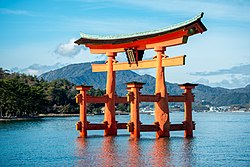
Shrine entrances are marked by a two-post gateway with either one or two crossbeams atop it, known as torii.[217] The exact details of these torii varies and there are at least twenty different styles.[218] These are regarded as demarcating the area where the kami resides;[24] passing under them is often viewed as a form of purification.[219] More broadly, torii are internationally recognised symbols of Japan.[24] Their architectural form is distinctly Japanese, although the decision to paint most of them in vermillion reflects a Chinese influence dating from the Nara period.[220] Also set at the entrances to many shrines are komainu, statues of lion or dog like animals perceived to scare off malevolent spirits;[221] typically these will come as a pair, one with its mouth open, the other with its mouth closed.[222]
Shrines are often set within gardens[223] or wooded groves called chinju no mori ("forest of the tutelary" kami),[224] which vary in size from just a few trees to sizeable areas of woodland.[225] Large lanterns, known as tōrō, are often found within these precincts.[226] Shrines often have an office, known as a shamusho,[227] a saikan where priests undergo forms of abstinence and purification prior to conducting rituals,[228] and other buildings such as a priests' quarters and a storehouse.[219] Various kiosks often sell amulets to visitors.[229] Since the late 1940s, shrines have had to be financially self-sufficient, relying on the donations of worshippers and visitors. These funds are used to pay the wages of the priests, to finance the upkeep of the buildings, to cover the shrine's membership fees of various regional and national Shinto groups, and to contribute to disaster relief funds.[230]
In Shinto, it is seen as important that the places in which kami are venerated be kept clean and not neglected.[231] Through to the Edo period, it was common for kami shrines to be demolished and rebuilt at a nearby location in order to remove any pollutants and ensure purity.[232] This has continued into recent times at certain sites, such as the Ise Grand Shrine, which is moved to an adjacent site every two decades.[233] Separate shrines can also be merged in a process known as jinja gappei,[234] while the act of transferring the kami from one building to another is called sengu.[235] Shrines may have legends about their foundation, which are known as en-gi. These sometimes also record miracles associated with the shrine.[236] From the Heian period on, the en-gi were often retold on picture scrolls known as emakimono.[237]
Priesthood and miko
[edit]
Shrines may be cared for by priests, by local communities, or by families on whose property the shrine is found.[24] Shinto priests are known in Japanese as kannushi, meaning "proprietor of kami",[238] or alternatively as shinshoku or shinkan.[239] Many kannushi take on the role in a line of hereditary succession traced down specific families.[240] In contemporary Japan, there are two main training universities for those wishing to become kannushi, at Kokugakuin University in Tokyo and at Kogakkan University in Mie Prefecture.[241] Priests can rise through the ranks over the course of their careers.[242] The number of priests at a particular shrine can vary; some shrines can have dozens, and others have none, instead being administered by local lay volunteers.[243] Some priests administer to multiple small shrines, sometimes over ten.[244]
Priestly regalia is largely based on the clothes worn at the imperial court during the Heian period.[245] It includes a tall, rounded hat known as an eboshi,[246] and black lacquered wooden clogs known as asagutsu.[247] The outer garment worn by a priest, usually colored black, red, or light blue, is the hō,[248] or the ikan.[151] A white silk version of the ikan, used for formal occasions, is known as the saifuku.[249] Another priestly robe is the kariginu, which is modelled on Heian-style hunting garments.[250] Also part of standard priestly attire is a hiōgi fan,[251] while during rituals, priests carry a flat piece of wood known as a shaku.[252] This regalia is generally more ornate than the sombre garments worn by Japanese Buddhist monks.[245]

The chief priest at a shrine is the gūji.[253] Larger shrines may also have an assistant head priest, the gon-gūji.[254] As with teachers, instructors, and Buddhist clergy, Shinto priests are often referred to as sensei by lay practitioners.[255] Historically, there were female priests although they were largely pushed out of their positions in 1868.[256] During the Second World War, women were again allowed to become priests to fill the void caused by large numbers of men being enlisted in the military.[257] By the late 1990s, around 90% of priests were male, 10% female,[124] contributing to accusations that Shinto discriminates against women.[258] Priests are free to marry and have children.[257] At smaller shrines, priests often have other full-time jobs, and serve only as priests during special occasions.[254] Before certain major festivals, priests may undergo a period of abstinence from sexual relations.[259] Some of those involved in festivals also abstain from a range of other things, such as consuming tea, coffee, or alcohol, immediately prior to the events.[260]
The priests are assisted by jinja miko, sometimes referred to as "shrine-maidens" in English.[261] These miko are typically unmarried,[262] although not necessarily virgins.[263] In many cases they are the daughters of a priest or a practitioner.[261] They are subordinate to the priests in the shrine hierarchy.[264] Their most important role is in the kagura dance, known as otome-mai.[265] Miko receive only a small salary but gain respect from members of the local community and learn skills such as cooking, calligraphy, painting, and etiquette which can benefit them when later searching for employment or a marriage partner.[265] They generally do not live at the shrines.[265] Sometimes they fill other roles, such as being secretaries in the shrine offices or clerks at the information desks, or as waitresses at the naorai feasts. They also assist kannushi in ceremonial rites.[265]
Visits to shrines
[edit]Visits to the shrine are termed sankei,[266] or jinja mairi.[267] Some individuals visit the shrines daily, often on their morning route to work;[267] they typically take only a few minutes.[267] Usually, a worshipper will approach the honden, placing a monetary offering in a box and then ringing a bell to call the kami's attention.[268] Then, they bow, clap, and stand while silently offering a prayer.[269] The clapping is known as kashiwade or hakushu;[270] the prayers or supplications as kigan.[271] This individual worship is known as hairei.[272] More broadly, ritual prayers to the kami are called norito,[273] while the coins offered are saisen.[274] At the shrine, individuals offering prayers are not necessarily praying to a specific kami.[267] A worshipper may not know the name of a kami residing at the shrine nor how many kami are believed to dwell there.[275] Unlike in certain other religions, Shinto shrines do not have weekly services that practitioners are expected to attend.[276]

Some Shinto practitioners do not offer their prayers to the kami directly, but rather request that a priest offer them on their behalf; these prayers are known as kitō.[277] Many individuals approach the kami asking for pragmatic requests.[278] Requests for rain, known as amagoi ("rain-soliciting") have been found across Japan, with Inari a popular choice for such requests.[279] Other prayers reflect more contemporary concerns. For instance, people may ask that the priest approaches the kami so as to purify their car in the hope that this will prevent it from being involved in an accident; the kotsu anzen harai ("purification for road safety").[280] Similarly, transport companies often request purification rites for new buses or airplanes which are about to go into service.[281] Before a building is constructed, it is common for either private individuals or the construction company to employ a Shinto priest to come to the land being developed and perform the jichinsai, or earth sanctification ritual. This purifies the site and asks the kami to bless it.[282]
People often ask the kami to help offset inauspicious events that may affect them. For instance, in Japanese culture, the age 33 is seen as being unlucky for women and the age 42 for men, and thus people can ask the kami to offset any ill-fortune associated with being this age.[283] Certain directions can also be seen as being inauspicious for certain people at certain times and thus people can approach the kami asking them to offset this problem if they have to travel in one of these unlucky directions.[283]

Pilgrimage has long been important in Japanese religion,[284] with pilgrimages to Shinto shrines called junrei.[285] A round of pilgrimages, whereby individuals visit a series of shrines and other sacred sites that are part of an established circuit, is known as a junpai.[285] An individual leading these pilgrims, is sometimes termed a sendatsu.[235] For many centuries, people have also visited the shrines for primarily cultural and recreational reasons, as opposed to spiritual ones.[267] Many of the shrines are recognised as sites of historical importance and some are classified as UNESCO World Heritage Sites.[267] Shrines such as Shimogamo Jinja and Fushimi Inari Taisha in Kyoto, Meiji Jingū in Tokyo, and Atsuta Jingū in Nagoya are among Japan's most popular tourist sites.[181] Many shrines have a unique rubber-stamp seal which visitors can get printed into their stamp book, demonstrating the different shrines they have visited.[286]
Harae and hōbei
[edit]
Shinto rituals begin with a process of purification, or harae.[287] Using fresh water or salt water, this is known as misogi.[152] At shrines, this entails sprinkling this water onto the face and hands, a procedure known as temizu,[288] using a font known as a temizuya.[289] Another form of purification at the start of a Shinto rite entails waving a white paper streamer or wand known as the haraigushi.[290] When not in use, the haraigushi is usually kept in a stand.[288] The priest waves the haraigushi horizontally over a person or object being purified in a movement known as sa-yu-sa ("left-right-left").[288] Sometimes, instead of a haraigushi, the purification is carried out with an o-nusa, a branch of evergreen to which strips of paper have been attached.[288] The waving of the haraigushi is often followed by an additional act of purification, the shubatsu, in which the priest sprinkles water, salt, or brine over those assembled from a wooden box called the 'en-to-oke or magemono.[291]
The acts of purification accomplished, petitions known as norito are spoken to the kami.[292] This is followed by an appearance by the miko, who commence in a slow circular motion before the main altar.[292] Offerings are then presented to the kami by being placed on a table.[292] This act is known as hōbei;[248] the offerings themselves as saimotsu[228] or sonae-mono.[293] Historically, the offerings given the kami included food, cloth, swords, and horses.[294] In the contemporary period, lay worshippers usually give gifts of money to the kami while priests generally offer them food, drink, and sprigs of the sacred sakaki tree.[78] Animal sacrifices are not considered appropriate offerings, as the shedding of blood is seen as a polluting act that necessitates purification.[295] The offerings presented are sometimes simple and sometimes more elaborate; at the Grand Shrine of Ise, for instance, 100 styles of food are laid out as offerings.[292] The choice of offerings will often be tailored to the specific kami and occasion.[205]
Offerings of food and drink are specifically termed shinsen.[205] Sake, or rice wine, is a very common offering to the kami.[296] After the offerings have been given, people often sip rice wine known as o-miki.[292] Drinking the o-miki wine is seen as a form of communion with the kami.[297] On important occasions, a feast is then held, known as naorai, inside a banquet hall attached to the shrine complex.[298]
The kami are believed to enjoy music.[299] One style of music performed at shrines is gagaku.[300] Instruments used include three reeds (fue, sho, and hichiriki), the yamato-koto, and the "three drums" (taiko, kakko, and shōko).[301] Other musical styles performed at shrines can have a more limited focus. At shrines such as Ōharano Shrine in Kyoto, azuma-asobi ("eastern entertainment") music is performed on 8 April.[106] Also in Kyoto, various festivals make use of the dengaku style of music and dance, which originated from rice-planting songs.[302] During rituals, people visiting the shrine are expected to sit in the seiza style, with their legs tucked beneath their bottom.[303] To avoid cramps, individuals who hold this position for a lengthy period of time may periodically move their legs and flex their heels.[304]
Home shrines
[edit]
Having seen their popularity increase in the Meiji era,[305] many Shinto practitioners also have a family shrine, or kamidana ("kami shelf"), in their home.[306] These usually consist of shelves placed at an elevated position in the living room.[307] Kamidana can also be found in workplaces, restaurants, shops, and ocean-going ships.[308] Some public shrines sell entire kamidana.[309]
Along with the kamidana, many Japanese households also have butsudan, Buddhist altars enshrining the ancestors of the family;[310] ancestral reverence remains an important aspect of Japanese religious tradition.[139] In the rare instances where Japanese individuals are given a Shinto funeral rather than a Buddhist one, a tama-ya, mitama-ya, or sorei-sha shrine may be erected in the home in place of a butsudan. This will be typically placed below the kamidana and include symbols of the resident ancestral spirit, for instance a mirror or a scroll.[311]
Kamidana often enshrine the kami of a nearby public shrine as well as a tutelary kami associated with the house's occupants or their profession.[305] They can be decorated with miniature torii and shimenawa and include amulets obtained from public shrines.[305] They often contain a stand on which to place offerings;[219] daily offerings of rice, salt, and water are placed there, with sake and other items also offered on special days.[312] These domestic rituals often take place early in the morning,[313] and prior to conducting them, practitioners often bathe, rinse their mouth, or wash their hands as a form of purification.[314]
Household Shinto can focus attention on the dōzoku-shin, kami who are perceived to be ancestral to the dōzoku or extended kinship group.[315] A small shrine for the ancestors of a household are known as soreisha.[293] Small village shrines containing the tutelary kami of an extended family are known as iwai-den.[316] In addition to the jinja shrines and the household shrines, Shinto also features small wayside shrines known as hokora.[209] Other open spaces used for the worship of kami are iwasaka, an area surrounded by sacred rocks.[317]
Ema, divination, and amulets
[edit]
A common feature of Shinto shrines is the provision of ema, small wooden plaques onto which practitioners will write a wish or desire that they would like to see fulfilled. The practitioner's message is written on one side of the plaque, while on the other is usually a printed picture or pattern related to the shrine itself.[318] Ema are provided both at Shinto shrines and Buddhist temples in Japan;[246] unlike most amulets, which are taken away from the shrine, the ema are typically left there as a message for the resident kami.[236] Those administering the shrine will then often burn all of the collected ema at new year.[236]
Divination is the focus of many Shinto rituals,[319] with various forms of divination used by its practitioners, some introduced from China.[320] Among the ancient forms of divination found in Japan are rokuboku and kiboku.[321] Several forms of divination entailing archery are also practiced in Shintō, known as yabusame, omato-shinji, and mato-i.[322] Kitagawa stated that there could be "no doubt" that various types of "shamanic diviners" played a role in early Japanese religion.[323] A form of divination previously common in Japan was bokusen or uranai, which often used tortoise shells; it is still used in some places.[324]
A form of divination that is popular at Shinto shrines are the omikuji.[325] These are small slips of paper which are obtained from the shrine (for a donation) and which are then read to reveal a prediction for the future.[326] Those who receive a bad prediction often then tie the omikuji to a nearby tree or frame set up for the purpose. This act is seen as rejecting the prediction, a process called sute-mikuji, and thus avoiding the misfortune it predicted.[327]

The use of amulets are widely sanctioned and popular in Japan.[276] These may be made of paper, wood, cloth, metal, or plastic.[276] Ofuda act as amulets to keep off misfortune and also serve as talismans to bring benefits and good luck.[273] They typically comprise a tapering piece of wood onto which the name of the shrine and its enshrined kami are written or printed. The ofuda is then wrapped inside white paper and tied up with a colored thread.[328] Ofuda are provided both at Shinto shrines and Buddhist temples.[273] Another type of amulet provided at shrines and temples are the omamori, which are traditionally small, brightly colored drawstring bags with the name of the shrine written on it.[329] Omamori and ofuda are sometimes placed within a charm bag known as a kinchaku, typically worn by small children.[271]
At new year, many shrines sell hamaya (an "evil-destroying arrows"), which people can purchase and keep in their home over the coming year to bring good luck.[330] A daruma is a round, paper doll of the Indian monk, Bodhidharma. The recipient makes a wish and paints one eye; when the goal is accomplished, the recipient paints the other eye. While this is a Buddhist practice, darumas can be found at shrines, as well. These dolls are very common.[331] Other protective items include dorei, which are earthenware bells that are used to pray for good fortune. These bells are usually in the shapes of the zodiacal animals.[331] Inuhariko are paper dogs that are used to induce and to bless good births.[331] Collectively, these talismans through which home to manipulate events and influence spirits, as well as related mantras and rites for the same purpose, are known as majinai.[332]
Kagura
[edit]
Kagura describes the music and dance performed for the kami;[333] the term may have originally derived from kami no kura ("seat of the kami").[334] Throughout Japanese history, dance has played an important culture role and in Shinto it is regarded as having the capacity to pacify kami.[335] There is a mythological tale of how kagura dance came into existence. According to the Kojiki and the Nihon Shoki, Ame-no-Uzume performed a dance to entice Amaterasu out of the cave in which she had hidden herself.[336]
There are two broad types of kagura.[337] One is Imperial kagura, also known as mikagura. This style was developed in the imperial court and is still performed on imperial grounds every December.[338] It is also performed at the Imperial harvest festival and at major shrines such as Ise, Kamo, and Iwashimizu Hachiman-gū. It is performed by singers and musicians using shakubyoshi wooden clappers, a hichiriki, a kagura-bue flute, and a six-stringed zither.[211] The other main type is sato-kagura, descended from mikagura and performed at shrines across Japan. Depending on the style, it is performed by miko or by actors wearing masks to portray various mythological figures.[339] These actors are accompanied by a hayashi band using flutes and drums.[211] There are also other, regional types of kagura.[211]
Festivals
[edit]
Public festivals are commonly termed matsuri,[340] although this term has varied meanings—"festival", "worship", "celebration", "rite", or "prayer"—and no direct translation into English.[341] Picken suggested that the festival was "the central act of Shinto worship" because Shinto was a "community- and family-based" religion.[342] Most mark the seasons of the agricultural year and involve offerings being directed to the kami in thanks.[343] According to a traditional lunar calendar, Shinto shrines should hold their festival celebrations on hare-no-hi or "clear days", the days of the new, full, and half moons.[344] Other days, known as ke-no-hi, were generally avoided for festivities.[344] However, since the late 20th century, many shrines have held their festival celebrations on the Saturday or Sunday closest to the date so that fewer individuals will be working and will be able to attend.[345] Each town or village often has its own festival, centred on a local shrine.[313] For instance, the Aoi Matsuri festival, held on 15 May to pray for an abundant grain harvest, takes place at shrines in Kyoto,[346] while the Chichibu Night Festival takes place on 2–3 December in Chichibu.[347]
Spring festivals are called haru-matsuri and often incorporate prayers for a good harvest.[344] They sometimes involve ta-asobi ceremonies, in which rice is ritually planted.[344] Summer festivals are termed natsu-matsuri and are usually focused on protecting the crops against pests and other threats.[348] Autumn festivals are known as aki-matsuri and primarily focus on thanking the kami for the rice or other harvest.[349] The Niiname-sai, or festival of new rice, is held across many Shinto shrines on 23 November.[350] The emperor also conducts a ceremony to mark this festival, at which he presents the first fruits of the harvest to the kami at midnight.[351] Winter festivals, called fuyu no matsuri often feature on welcoming in the spring, expelling evil, and calling in good influences for the future.[352] There is little difference between winter festivals and specific new year festivals.[352]

The season of the new year is called shogatsu.[353] On the last day of the year (31 December), omisoka, practitioners usually clean their household shrines in preparation for New Year's Day (1 January), ganjitsu.[354] Many people visit public shrines to celebrate new year;[355] this "first visit" of the year is known as hatsumōde or hatsumairi.[356] There, they buy amulets and talismans to bring them good fortune over the coming year.[357] To celebrate this festival, many Japanese put up rope known as shimenawa on their homes and places of business.[358] Some also put up kadomatsu ("gateway pine"), an arrangement of pine branches, plum tree, and bamboo sticks.[359] Also displayed are kazari, which are smaller and more colourful; their purpose is to keep away misfortune and attract good fortune.[144] In many places, new year celebrations incorporate hadaka matsuri ("naked festivals") in which men dressed only in a fundoshi loincloth engage in a particular activity, such as fighting over a specific object or immersing themselves in a river.[360]
A common feature of festivals are processions or parades known as gyōretsu.[361] These can be raucous, with many participants being drunk;[362] Breen and Teeuwen characterised them as having a "carnivalesque atmosphere".[363] They are often understood as having a regenerative effect on both the participants and the community.[364] During these processions, the kami travel in portable shrines known as mikoshi.[365] In various cases the mikoshi undergo hamaori ("going down to the beach"), a process by which they are carried to the sea shore and sometimes into the sea, either by bearers or a boat.[366] For instance, in the Okunchi festival held in the southwestern city of Nagasaki, the kami of the Suwa Shrine are paraded down to Ohato, where they are placed in a shrine there for several days before being paraded back to Suwa.[367] These sorts of celebrations are often organized largely by members of the local community rather than by the priests themselves.[363]
Rites of passage
[edit]The formal recognition of events is given great importance in Japanese culture.[368] A common ritual, the hatsumiyamairi, entails a child's first visit to a Shinto shrine.[369] A tradition holds that, if a boy he should be brought to the shrine on the thirty-second day after birth, and if a girl she should be brought on the thirty-third day.[370] Historically, the child was commonly brought to the shrine not by the mother, who was considered impure after birth, but by another female relative; since the late 20th century it has been more common for the mother to do so.[370] Another rite of passage, the saiten-sai or seijin shiki, is a coming of age ritual marking the transition to adulthood and occurs when an individual is around twenty.[371] Wedding ceremonies are often carried out at Shinto shrines;[372] these are called shinzen kekkon ("a wedding before the kami").[373] Prior to the Meiji era, weddings were commonly performed in the home,[374] although shrines now regard them as an important source of income.[375]
In Japan, funerals tend to take place at Buddhist temples and involve cremation,[376] with Shinto funerals being rare.[139] Bocking noted that most Japanese people are "still 'born Shinto' yet 'die Buddhist'."[177] In Shinto thought, contact with death is seen as imparting impurity (kegare); the period following this contact is known as kibuku and is associated with various taboos.[377] In cases when dead humans are enshrined as kami, the physical remains of the dead are not stored at the shrine.[378] Although not common, there have been examples of funerals conducted through Shinto rites. The earliest examples are known from the mid-17th century; these occurred in certain areas of Japan and had the support of the local authorities.[379] Following the Meiji Restoration, in 1868 the government recognised specifically Shinto funerals for Shinto priests.[380] Five years later, this was extended to cover the entire Japanese population.[381] Despite this Meiji promotion of Shinto funerals, the majority of the population continued to have Buddhist funeral rites.[379] In recent decades, Shinto funerals have usually been reserved for Shinto priests and for members of certain Shinto sects.[382] After cremation, the normal funerary process in Japan, the ashes of a priest may be interred near to the shrine, but not inside its precincts.[128]
Ancestral reverence remains an important part of Japanese religious custom.[139] The invocation of the dead, and especially the war dead, is known as shōkon.[167] Various rites reference this. For instance, at the largely Buddhist festival of Bon, the souls of the ancestors are believed to visit the living, and are then sent away in a ritual called shōrō nagashi, by which lanterns are inserted into small boats, often made of paper, and placed in a river to float downstream.[383]
Spirit mediumship and healing
[edit]
Shinto practitioners believe that the kami can possess a human being and then speak through them, a process known as kami-gakari.[384] Several new religious movements drawing upon Shinto, such as Tenrikyo and Oomoto, were founded by individuals claiming to be guided by a possessing kami.[385] The takusen is an oracle that is passed from the kami via the medium.[215]
The itako and ichiko are blind women who train to become spiritual mediums, traditionally in Japan's northern Tohoku region.[386] Itako train under other itako from childhood, memorialising sacred texts and prayers, fasting, and undertaking acts of severe asceticism, through which they are believed to cultivate supernatural powers.[386] In an initiation ceremony, a kami is believed to possess the young woman, and the two are then ritually "married". After this, the kami becomes her tutelary spirit and she will henceforth be able to call upon it, and a range of other spirits, in the future. Through contacting these spirits, she is able to convey their messages to the living.[386] Itako usually carry out their rituals independent of the shrine system.[387] Japanese culture also includes spiritual healers known as ogamiya-san whose work involves invoking both kami and Buddhas.[161]
History
[edit]Early development
[edit]
Earhart commented that Shinto ultimately "emerged from the beliefs and practices of prehistoric Japan",[388] although Kitagawa noted that it was questionable whether prehistoric Japanese religions could be accurately termed "early Shinto".[323] It was the Yayoi period of Japanese prehistory which first left traces of material and iconography prefiguring that later included in Shinto.[389] Kami were worshipped at various landscape features during this period; at this point, their worship consisted largely of beseeching and placating them, with little evidence that they were viewed as compassionate entities.[81] Archaeological evidence suggests that dotaku bronze bells, bronze weapons, and metal mirrors played an important role in kami-based ritual during the Yayoi period.[390]
In this early period, Japan was not a unified state; by the Kofun period it was divided among Uji (clans), each with their own tutelary kami, the ujigami.[391] Korean migration during the Kofun period brought Confucianism and Buddhism to Japan.[392] Buddhism had a particular impact on the kami cults.[393] Migrant groups and Japanese who increasingly aligned with these foreign influences built Buddhist temples in various parts of the Japanese islands.[393] Several rival clans who were more hostile to these foreign influences began adapting the shrines of their kami to more closely resemble the new Buddhist structures.[393] In the late 5th century, the imperial dynasty leader Yūryaku declared himself daiō ("great king") and established hegemony over much of Japan.[394] From the early 6th century CE, the style of ritual favored by the Yamato began spreading to other kami shrines around Japan as the Yamato extended their territorial influence.[395] Buddhism was also growing. According to the Nihon Shoki, in 587 Emperor Yōmei converted to Buddhism and under his sponsorship Buddhism spread.[396]
In the mid-7th century, a legal code called Ritsuryō was adopted to establish a Chinese-style centralised government.[397] As part of this, the Jingikan ("Council of Kami") was created to conduct rites of state and coordinate provincial ritual with that in the capital.[398] This was done according to a code of kami law called the Jingiryō,[398] itself modelled on the Chinese Book of Rites.[399] The Jingikan was located in the palace precincts and maintained a register of shrines and priests.[400] An annual calendar of state rites were introduced to help unify Japan through kami worship.[9] These legally mandated rites were outlined in the Yōrō Code of 718,[399] and expanded in the Jogan Gishiki of circa 872 and the Engi Shiki of 927.[399] Under the Jingikan, some shrines were designated as kansha ("official shrines") and given specific privileges and responsibilities.[401] Hardacre saw the Jingikan as "the institutional origin of Shinto".[9]
.png)
In the early 8th century, the Emperor Tenmu commissioned a compilation of the legends and genealogies of Japan's clans, resulting in the completion of the Kojiki in 712. Designed to legitimate the ruling dynasty, this text created a fixed version of various stories previously circulating in oral tradition.[402] The Kojiki omits any reference to Buddhism,[403] in part because it sought to ignore foreign influences and emphasise a narrative stressing indigenous elements of Japanese culture.[404] Several years later, the Nihon shoki was written. Unlike the Kojiki, this made various references to Buddhism,[403] and was aimed at a foreign audience.[405] Both of these texts sought to establish the imperial clan's descent from the sun kami Amaterasu,[403] although there were many differences in the cosmogonic narrative they provided.[406] Quickly, the Nihon shoki eclipsed the Kojiki in terms of its influence.[405] Other texts written at this time also drew on oral traditions regarding the kami. The Sendari kuji hongi for example was probably composed by the Mononobe clan while the Kogoshui was probably put together for the Imbe clan, and in both cases they were designed to highlight the divine origins of these respective lineages.[407] A government order in 713 called on each region to produce fudoki, records of local geography, products, and stories, with the latter revealing more traditions about the kami which were present at this time.[408]
From the 8th century, kami worship and Buddhism were thoroughly intertwined in Japanese society.[190] While the emperor and court performed Buddhist rites, they also performed others to honor the kami.[409] Tenmu for example appointed a virginal imperial princess to serve as the Saiō, a form of priestess, at the Ise Shrine on his behalf, a tradition continued by subsequent emperors.[410] From the 8th century onward up until the Meiji era, the kami were incorporated into a Buddhist cosmology in various ways.[411] One view is that the kami realised that like all other life-forms, they too were trapped in the cycle of samsara (rebirth) and that to escape this they had to follow Buddhist teachings.[411] Alternative approaches viewed the kami as benevolent entities who protected Buddhism, or that the kami were themselves Buddhas, or beings who had achieved enlightenment. In this, they could be either hongaku, the pure spirits of the Buddhas, or honji suijaku, transformations of the Buddhas in their attempt to help all sentient beings.[411]
Nara period
[edit]This period hosted many changes to the country, government, and religion. The capital is moved again to Heijō-kyō (modern-day Nara), in AD 710 by Empress Genmei due to the death of the emperor. This practice was necessary due to the Shinto belief in the impurity of death and the need to avoid this pollution. However, this practice of moving the capital due to "death impurity" is then abolished by the Taihō Code and rise in Buddhist influence.[412] The establishment of the imperial city in partnership with Taihō Code is important to Shinto as the office of the Shinto rites becomes more powerful in assimilating local clan shrines into the imperial fold. New shrines are built and assimilated each time the city is moved. All of the grand shrines are regulated under Taihō and are required to account for incomes, priests, and practices due to their national contributions.[412]
Meiji era and the Empire of Japan
[edit]
Breen and Teeuwen characterise the period between 1868 and 1915, during the Meiji era, as being the "formative years" of modern Shinto.[10] It is in this period that various scholars have argued that Shinto was essentially "invented".[10] Fridell argues that scholars call the period from 1868 to 1945 the "State Shinto period" because, "during these decades, Shinto elements came under a great deal of overt state influence and control as the Japanese government systematically utilized shrine worship as a major force for mobilizing imperial loyalties on behalf of modern nation-building."[413] However, the government had already been treating shrines as an extension of government before Meiji; see for example the Tenpō Reforms. Moreover, according to the scholar Jason Ānanda Josephson, It is inaccurate to describe shrines as constituting a "state religion" or a "theocracy" during this period since they had neither organization, nor doctrine, and were uninterested in conversion.[414]
The Meiji Restoration of 1868 was fuelled by a renewal of Confucian ethics and imperial patriotism among Japan's ruling class.[415] Among these reformers, Buddhism was seen as a corrupting influence that had undermined what they envisioned as Japan's original purity and greatness.[415] They wanted to place a renewed emphasis on kami worship as an indigenous form of ritual, an attitude that was also fuelled by anxieties about Western expansionism and fear that Christianity would take hold in Japan.[415]
In 1868, all shrine priests were placed under the authority of the new Jingikan, or Council of Kami Affairs.[416] A project of forcibly separating kami worship from Buddhism was implemented, with Buddhist monks, deities, buildings, and rituals banned from kami shrines.[415] Much Buddhist material was destroyed.[415] In 1871, a new hierarchy of shrines was introduced, with imperial and national shrines at the top.[417] Hereditary priesthoods were abolished and a new state-sanctioned system for appointing priests was introduced.[418] In 1872, the Jingikan was replaced with the Kyobusho, or Ministry of Edification.[419] This coordinated a campaign whereby kyodoshoku ("national evangelists") were sent through the country to promote Japan's "Great Teaching", which included respect for the kami and obedience to the emperor.[419] This campaign was discontinued in 1884.[419] In 1906, thousands of village shrines were merged so that most small communities had only a single shrine, where rites in honor of the emperor could be held.[420] Shinto effectively became the state cult, one promoted with growing zeal in the build-up to the Second World War.[420]
In 1882, the Meiji government designated 13 religious movements that were neither Buddhist nor Christian to be forms of "Sect Shinto".[38] The number and name of the sects given this formal designation varied;[421] often they merged ideas with Shinto from Buddhism, Christian, Confucian, Daoist, and Western esoteric traditions.[422] In the Meiji period, many local traditions died out and were replaced by nationally standardised practices encouraged from Tokyo.[162]
Post-war
[edit]
During the U.S. occupation, a new Japanese constitution was drawn up. This enshrined freedom of religion and separated religion from the state, a measure designed to eradicate State Shinto.[423] The emperor declared that he was not a kami;[424] Shinto rituals performed by the imperial family became their own private affair.[425] This disestablishment ended government subsidies to shrines and gave them renewed freedom to organise their own affairs.[424] In 1946 many shrines formed a voluntary organisation, the Association of Shinto Shrines (Jinja Honchō).[426] In 1956 the association issued a creedal statement, the keishin seikatsu no kōryō ("general characteristics of a life lived in reverence of the kami"), to summarise what they regarded as Shinto's principles.[213] By the late 1990s around 80% of Japan's Shinto shrines were part of this association.[427]
In the post-war decades, many Japanese blamed Shinto for encouraging the militarism which had led to defeat and occupation.[424] Others remained nostalgic for State Shinto,[428] and concerns were repeatedly expressed that sectors of Japanese society were conspiring to restore it.[429] Various legal debates revolved around the involvement of public officials in Shinto.[430] In 1965, for instance, the city of Tsu, Mie Prefecture, paid four Shinto priests to purify the site where the municipal athletic hall was to be built. Critics brought the case to court, claiming it contravened the constitutional separation of religion and state; in 1971 the high court ruled that the city administration's act had been unconstitutional, although this was overturned by the Supreme Court in 1977.[431]
During the post-war period, Shinto themes often blended into Japanese new religious movements.[432] Of the Sect Shinto groups, Tenrikyo was probably the most successful,[428] although in 1970 it repudiated its Shinto identity.[433] Shinto perspectives also influenced popular culture. The film director Hayao Miyazaki of Studio Ghibli for instance acknowledged Shinto influences on his films such as Spirited Away.[434] Shinto also spread abroad through both emigration and conversion by non-Japanese.[435] The Tsubaki Grand Shrine in Suzuka, Mie Prefecture, was the first to establish a branch abroad: the Tsubaki Grand Shrine of America, initially located in California and then moved to Granite Falls, Washington.[244]
During the 20th century, most academic research on Shinto was conducted by Shinto theologians, often priests,[436] bringing accusations that it often blurred theology with historical analysis.[437] From the 1980s onward, there was a renewed academic interest in Shinto both in Japan and abroad.[438]
Demographics
[edit]
Most Japanese participate in several religious traditions,[439] with Breen and Teeuwen noting that, "with few exceptions", it is not possible to differentiate between Shintoists and Buddhists in Japan.[440] The main exceptions are members of minority religious groups, including Christianity, which promote exclusive worldviews.[441] Determining the proportions of the country's population who engage in Shinto activity is hindered by the fact that, if asked, Japanese people will often say "I have no religion".[441] Many Japanese avoid the term "religion", in part because they dislike the connotations of the word which most closely matches it in the Japanese language, shūkyō. The latter term derives from shū ("sect") and kyō ("doctrine").[442]
Official statistics show Shinto to be Japan's largest religion, with over 80 per cent of its population engaging in Shinto activities.[196][443] Conversely, in questionnaires only a small minority of Japanese describe themselves as "Shintoists".[196] This indicates that a far larger number of people engage in Shinto activities than cite Shinto as their religious identity.[196] There are no formal rituals to become a practitioner of "folk Shinto". Thus, "Shinto membership" is often estimated counting only those who do join organized Shinto sects.[444] Shinto has about 81,000 shrines and about 85,000 priests in the country.[443] According to surveys carried out in 2006[445] and 2008,[446] less than 40% of the population of Japan identifies with an organised religion: around 35% are Buddhists, 30% to 40% are members of Shinto sects and derived religions. In 2008, 26% of the participants reported often visiting Shinto shrines, while only 16.2% expressed belief in the existence of kami in general.[446]
Shinto outside Japan
[edit]
The end of the 19th and beginning of the 20th centuries were marked by the expansion of the Empire of Japan, which also led to the spread of Shinto in the colonized territories.[447] In total, from 1868 to 1945, 1,640 shrines were built in territories under Japanese control.[447][448] In addition, starting in 1885, Japanese began to move to Hawaii, most of whom left Japan for economic reasons; Since 1908, emigration to Brazil also began, where the Japanese worked on coffee plantations. The emigrants built shrines to preserve their culture and worship traditional deities.[449][450]
Jinja outside Japan are termed kaigai jinja ("overseas shrines"), a term coined by Ogasawara Shozo.[451] When the Empire of Japan collapsed in the 1940s, there were over 600 jinja within its conquered territories, many of which were later disbanded.[451] Japanese migrants have also established jinja in countries like Brazil,[452] while Shinto's lack of doctrinal focus has attracted interest from non-Japanese;[453] in the United States, for example, European Americans have played a significant role in introducing Shinto.[453]
In popular culture
[edit]Shinto features in popular culture as folk Shinto or Minkan Shinto.[454]
See also
[edit]


References
[edit]Citations
[edit]- ^ Littleton 2002, pp. 70, 72.
- ^ NHK Broadcasting Culture Research Institute, ed. (24 May 2016). NHK日本語発音アクセント新辞典 (in Japanese). NHK Publishing.
- ^ Bocking 1997, p. viii; Rots 2015, p. 211.
- ^ a b c d e Cali & Dougill 2013, p. 13.
- ^ a b c d Hardacre 2017, p. 1.
- ^ Inoue 2003, p. 1.
- ^ a b Picken 1994, p. xviii.
- ^ Smart 1998, p. 135.
- ^ a b c Hardacre 2017, p. 18.
- ^ a b c Breen & Teeuwen 2010, p. 7.
- ^ a b Bocking 1997, p. 174.
- ^ Inoue 2003, p. 5.
- ^ Kuroda 1981, p. 3.
- ^ Picken 1994, p. xvii; Nelson 1996, p. 26.
- ^ Azegami 2012, p. 68.
- ^ Picken 1994, p. xxiv; Cali & Dougill 2013, p. 13.
- ^ Breen 2010, p. 69.
- ^ Picken 1994, pp. xxiv–xxv.
- ^ Picken 1994, p. xix.
- ^ Offner 1979, p. 191; Littleton 2002, p. 6; Picken 2011, p. 1; Cali & Dougill 2013, p. 13.
- ^ a b Offner 1979, p. 191.
- ^ Picken 1994, p. xxx.
- ^ Picken 2011, p. 48.
- ^ a b c d e Cali & Dougill 2013, p. 7.
- ^ Nelson 1996, p. 30; Littleton 2002, p. 10.
- ^ Kitagawa 1987, p. 139; Cali & Dougill 2013, p. 13.
- ^ Inoue 2003, p. 7.
- ^ Bocking 1997, pp. 173–174.
- ^ Inoue 2003, p. 10.
- ^ Picken 1994, p. xxv.
- ^ a b Earhart 2004, p. 31.
- ^ Kuroda 1981, p. 1; Nelson 1996, p. 7; Rots 2015, p. 211.
- ^ a b c Nelson 1996, p. 7.
- ^ Kuroda 1981, p. 19.
- ^ Kuroda 1981, pp. 1–2.
- ^ Kitagawa 1987, p. xviii.
- ^ a b Rots 2015, p. 210.
- ^ a b Offner 1979, p. 215.
- ^ a b Offner 1979, p. 192; Nelson 1996, p. 7.
- ^ Offner 1979, p. 192.
- ^ Picken 2011, p. 89; Cali & Dougill 2013, p. 14.
- ^ a b Bocking 1997, p. viii.
- ^ Offner 1979, p. 193; Kitagawa 1987, p. 139; Bocking 1997, p. 173; Nelson 2000, p. 14; Earhart 2004, p. 2; Picken 2011, p. 9.
- ^ Kuroda 1981, p. 4; Bocking 1997, pp. viii, 173.
- ^ Picken 1994, p. xxiv; Picken 2011, p. 64.
- ^ Kitagawa 1987, p. 139; Littleton 2002, p. 6; Picken 2011, p. 9.
- ^ Commentary on Judgment about Book of Changes 20, Viewing: "Viewing the Way of the Gods (Shintō), one finds that the four seasons never deviate, and so the sage establishes his teachings on the basis of this Way, and all under Heaven submit to him".
- ^ Herman Ooms. Imperial Politics and Symbolics in Ancient Japan: The Tenmu Dynasty, 650–800. University of Hawaii Press, 2009. ISBN 0824832353. p. 166
- ^ Teeuwen 2002, p. 243.
- ^ Teeuwen 2002, p. 256.
- ^ Teeuwen 2002, p. 236; Hardacre 2017, p. 41.
- ^ Kuroda 1981, pp. 4–5; Teeuwen 2002, p. 237.
- ^ Kuroda 1981, p. 6; Teeuwen 2002, p. 237; Hardacre 2017, p. 42.
- ^ Kuroda 1981, p. 7.
- ^ Kuroda 1981, pp. 9–10.
- ^ Kuroda 1981, pp. 11, 12.
- ^ a b Kuroda 1981, p. 10.
- ^ Kuroda 1981, pp. 10–11.
- ^ Hardacre 2017, p. 42.
- ^ Kuroda 1981, p. 19; Bocking 1997, p. 174.
- ^ "Shintoism". Oxford English Dictionary (Online ed.). Oxford University Press. doi:10.1093/OED/4027165528. Retrieved 26 February 2025. (Subscription or participating institution membership required.)
- ^ "Shinto". Merriam-Webster.com Dictionary. Merriam-Webster. Retrieved 26 February 2025.
- ^ "Shintoism". The American Heritage Dictionary of the English Language (5th ed.). HarperCollins.
- ^ Jensen & Blok 2013, p. 110.
- ^ Loveday 2019, p. 104.
- ^ Littleton 2002, p. 23; Cali & Dougill 2013, p. 13.
- ^ Bocking 1997, p. 70; Hardacre 2017, p. 31.
- ^ Boyd & Williams 2005, p. 35; Cali & Dougill 2013, p. 13.
- ^ a b c d Earhart 2004, p. 8.
- ^ Earhart 2004, p. 2; Cali & Dougill 2013, p. 13.
- ^ a b Kitagawa 1987, p. 36.
- ^ Offner 1979, p. 194; Bocking 1997, p. 84.
- ^ Nelson 1996, p. 29; Littleton 2002, p. 24.
- ^ Boyd & Williams 2005, p. 35; Hardacre 2017, p. 52.
- ^ a b Boyd & Williams 2005, p. 35.
- ^ Offner 1979, p. 194.
- ^ Picken 1994, p. xxi; Boyd & Williams 2005, p. 35.
- ^ a b c Cali & Dougill 2013, p. 14.
- ^ Nelson 1996, p. 26.
- ^ Nelson 1996, p. 7; Picken 2011, p. 40; Cali & Dougill 2013, p. 13.
- ^ a b c Hardacre 2017, p. 19.
- ^ Bocking 1997, p. 180; Hardacre 2017, p. 1.
- ^ Bocking 1997, p. 180.
- ^ Littleton 2002, p. 75; Cali & Dougill 2013, p. 14.
- ^ a b Bocking 1997, p. 172.
- ^ Offner 1979, p. 202; Nelson 1996, p. 144.
- ^ Offner 1979, p. 202; Earhart 2004, pp. 36–37.
- ^ Offner 1979, p. 202; Picken 2011, p. 44.
- ^ Nelson 1996, p. 27; Cali & Dougill 2013, p. 13.
- ^ Bocking 1997, p. 164.
- ^ Bocking 1997, p. 114; Picken 2011, p. 42.
- ^ Earhart 2004, pp. 7–8.
- ^ Nelson 1996, p. 33.
- ^ Bocking 1997, pp. 214–215; Littleton 2002, p. 24.
- ^ Bocking 1997, p. 222.
- ^ Littleton 2002, p. 27; Cali & Dougill 2013, p. 13; Hardacre 2017, p. 1.
- ^ Littleton 2002, pp. 31–32; Cali & Dougill 2013, p. 14.
- ^ Bocking 1997, p. 69.
- ^ Picken 2011, pp. 35–36.
- ^ Picken 2011, p. 42.
- ^ a b c d e f Cali & Dougill 2013, p. 15.
- ^ Picken 2011, p. 92.
- ^ Bocking 1997, p. 13; Picken 2011, p. 57; Cali & Dougill 2013, p. 15.
- ^ Bocking 1997, p. 13; Picken 2011, p. 58.
- ^ Picken 2011, p. 40; Cali & Dougill 2013, p. 15.
- ^ a b Bocking 1997, p. 8.
- ^ a b Bocking 1997, p. 37.
- ^ Bocking 1997, p. 200.
- ^ Hardacre 2017, pp. 48–49.
- ^ Offner 1979, p. 195; Kitagawa 1987, p. 142; Littleton 2002, p. 23; Earhart 2004, p. 32; Cali & Dougill 2013, p. 18.
- ^ Offner 1979, p. 195; Kitagawa 1987, p. 142; Littleton 2002, p. 37; Earhart 2004, p. 33.
- ^ Earhart 2004, pp. 33–34; Cali & Dougill 2013, pp. 18–19.
- ^ Earhart 2004, p. 33.
- ^ Cali & Dougill 2013, p. 19.
- ^ Bocking 1997, p. 5; Picken 2011, p. 38; Cali & Dougill 2013, p. 19.
- ^ Cali & Dougill 2013, p. 19; Hardacre 2017, p. 48.
- ^ Kitagawa 1987, p. 143; Cali & Dougill 2013, pp. 19–20; Hardacre 2017, p. 49.
- ^ Kitagawa 1987, p. 143; Cali & Dougill 2013, p. 20; Hardacre 2017, p. 50.
- ^ Kitagawa 1987, p. 143; Bocking 1997, p. 67; Cali & Dougill 2013, p. 20; Hardacre 2017, p. 50.
- ^ Offner 1979, p. 196; Kitagawa 1987, p. 143; Bocking 1997, p. 67; Cali & Dougill 2013, p. 20; Hardacre 2017, p. 53.
- ^ Offner 1979, pp. 196–197; Kitagawa 1987, p. 144; Bocking 1997, p. 3; Cali & Dougill 2013, p. 21; Hardacre 2017, pp. 53–54.
- ^ Cali & Dougill 2013, p. 22; Hardacre 2017, p. 54.
- ^ Kitagawa 1987, p. 144; Hardacre 2017, p. 57.
- ^ a b Littleton 2002, p. 98.
- ^ Bocking 1997, p. 129; Boyd & Williams 2005, p. 34.
- ^ Littleton 2002, p. 26; Picken 2011, p. 36.
- ^ Picken 2011, p. 36.
- ^ a b Picken 2011, p. 71.
- ^ Doerner 1977, pp. 153–154.
- ^ Kitagawa 1987, p. 143; Bocking 1997, p. 216.
- ^ Kitagawa 1987, p. 143.
- ^ Doerner 1977, p. 153; Littleton 2002, p. 90.
- ^ Hardacre 2017, p. 75.
- ^ a b Littleton 2002, p. 90.
- ^ Littleton 2002, p. 89.
- ^ Littleton 2002, p. 90; Picken 2011, p. 71.
- ^ Littleton 2002, pp. 89–91.
- ^ Littleton 2002, p. 91; Picken 2011, p. 39.
- ^ a b c d Picken 2011, p. 39.
- ^ Littleton 2002, p. 92.
- ^ Bocking 1997, p. 93; Cali & Dougill 2013, p. 20.
- ^ Nelson 1996, p. 101; Bocking 1997, p. 45; Cali & Dougill 2013, p. 21.
- ^ Picken 2011, pp. 45, 82.
- ^ a b Bocking 1997, p. 93.
- ^ Nelson 1996, p. 102.
- ^ Nelson 1996, p. 38.
- ^ Nelson 1996, p. 63.
- ^ Picken 2011, p. 7.
- ^ Offner 1979, p. 206; Nelson 1996, p. 104.
- ^ Bocking 1997, p. 93; Picken 2011, p. 86.
- ^ a b Bocking 1997, p. 58.
- ^ a b Bocking 1997, p. 124.
- ^ Nelson 1996, p. 140.
- ^ Nelson 1996, p. 141; Bocking 1997, p. 124.
- ^ Bocking 1997, p. 124; Picken 2011, p. 45.
- ^ Nelson 1996, p. 141; Earhart 2004, p. 11.
- ^ Nelson 1996, pp. 141–142; Picken 2011, p. 70.
- ^ Picken 2011, p. 6.
- ^ Earhart 2004, p. 11.
- ^ Bocking 1997, p. 219.
- ^ a b Bocking 1997, p. 136.
- ^ a b Breen & Teeuwen 2010, p. 12.
- ^ Picken 2011, pp. 80–81.
- ^ Picken 1994, p. xxiii; Bocking 1997, p. 115; Picken 2011, p. 82.
- ^ a b Picken 1994, p. xxiii.
- ^ a b Picken 2011, p. 83.
- ^ a b c Bocking 1997, p. 182.
- ^ Bocking 1997, p. 157; Picken 2011, pp. 34, 82.
- ^ Picken 2011, pp. 84–85.
- ^ Nelson 1996, p. 198.
- ^ Littleton 2002, p. 58.
- ^ Littleton 2002, pp. 58, 61.
- ^ Littleton 2002, pp. 11, 57.
- ^ Kitagawa 1987, p. xvii.
- ^ Cali & Dougill 2013, p. 10.
- ^ Bocking 1997, p. ix; Cali & Dougill 2013, p. 10.
- ^ a b Bocking 1997, p. ix.
- ^ Nelson 2000, p. 12; Littleton 2002, p. 99; Picken 2011, pp. 18–19.
- ^ Nelson 1996, pp. 66–67.
- ^ Ueda 1979, p. 317; Rots 2015, p. 221.
- ^ a b Rots 2015, p. 221.
- ^ Rots 2015, pp. 205, 207.
- ^ Rots 2015, p. 223.
- ^ Rots 2015, pp. 205–206.
- ^ Rots 2015, p. 208.
- ^ Offner 1979, p. 214; Cali & Dougill 2013, p. 10.
- ^ Boyd & Williams 2005, p. 33.
- ^ a b Picken 1994, p. xxxii.
- ^ Offner 1979, p. 198.
- ^ a b Cali & Dougill 2013, p. 8.
- ^ Nelson 1996, p. 3.
- ^ Picken 1994, p. xviii; Bocking 1997, p. 72; Earhart 2004, p. 36; Cali & Dougill 2013, p. 7.
- ^ Picken 2011, p. 21.
- ^ Earhart 2004, p. 36.
- ^ Earhart 2004, p. 36; Breen & Teeuwen 2010, p. 1.
- ^ a b c d Breen & Teeuwen 2010, p. 1.
- ^ Picken 1994, p. xxxi; Picken 2011, p. 29; Breen & Teeuwen 2010, p. 5; Cali & Dougill 2013, p. 8.
- ^ Picken 2011, p. 29.
- ^ Earhart 2004, p. 36; Cali & Dougill 2013, p. 7.
- ^ Bocking 1997, pp. 71, 72.
- ^ Bocking 1997, p. 220.
- ^ Littleton 2002, p. 68.
- ^ Nelson 1996, p. 93.
- ^ Nelson 1996, p. 92; Littleton 2002, p. 72; Picken 2011, p. 43; Cali & Dougill 2013, p. 7.
- ^ a b c Bocking 1997, p. 170.
- ^ Bocking 1997, p. 9.
- ^ Nelson 1996, p. 92; Bocking 1997, p. 42; Picken 2011, p. 43; Cali & Dougill 2013, p. 7.
- ^ Nelson 1996, p. 92; Bocking 1997, p. 49; Picken 2011, p. 43.
- ^ a b Bocking 1997, p. 54.
- ^ Bocking 1997, p. 34.
- ^ a b c d Bocking 1997, p. 82.
- ^ Bocking 1997, p. 160.
- ^ a b Bocking 1997, p. 94.
- ^ Bocking 1997, p. 166.
- ^ a b Bocking 1997, p. 197.
- ^ Bocking 1997, p. 169.
- ^ Offner 1979, p. 201; Bocking 1997, p. 207; Earhart 2004, p. 36; Cali & Dougill 2013, p. 7.
- ^ Bocking 1997, p. 207; Picken 2011, p. 43.
- ^ a b c Offner 1979, p. 201.
- ^ Picken 2011, p. 20.
- ^ Offner 1979, p. 201; Bocking 1997, p. 104.
- ^ Bocking 1997, p. 104.
- ^ Cali & Dougill 2013, p. 12.
- ^ Rots 2015, p. 211.
- ^ Rots 2015, p. 219.
- ^ Bocking 1997, p. 208.
- ^ Nelson 1996, p. 71; Bocking 1997, p. 72.
- ^ a b Bocking 1997, p. 148.
- ^ Bocking 1997, pp. 72–73.
- ^ Nelson 1996, p. 77.
- ^ Picken 2011, p. 23.
- ^ Nelson 1996, p. 92.
- ^ Nelson 1996, p. 93; Bocking 1997, p. 163; Nelson 2000, p. 4; Hardacre 2017, pp. 79–80.
- ^ Bocking 1997, p. 73.
- ^ a b Bocking 1997, p. 158.
- ^ a b c Bocking 1997, p. 26.
- ^ Bocking 1997, p. 26; Picken 2011, p. 44.
- ^ Bocking 1997, p. 88.
- ^ Bocking 1997, pp. 168, 171.
- ^ Ueda 1979, p. 325; Nelson 1996, p. 29.
- ^ Nelson 1996, p. 29; Bocking 1997, pp. 99, 102.
- ^ Nelson 1996, p. 42.
- ^ Littleton 2002, p. 73; Picken 2011, pp. 31–32.
- ^ a b Picken 2011, p. 32.
- ^ a b Nelson 2000, p. 15.
- ^ a b Bocking 1997, p. 25.
- ^ Bocking 1997, p. 7; Picken 2011, p. 44.
- ^ a b Bocking 1997, p. 53.
- ^ Bocking 1997, pp. 58, 146.
- ^ Bocking 1997, pp. 89–90.
- ^ Bocking 1997, p. 51.
- ^ Bocking 1997, p. 162.
- ^ Offner 1979, p. 212; Nelson 1996, p. 186; Bocking 1997, p. 39; Boyd & Williams 2005, p. 33.
- ^ a b Offner 1979, p. 212.
- ^ Nelson 1996, p. 179.
- ^ Nelson 1996, p. 123.
- ^ a b Nelson 1996, p. 124.
- ^ Picken 2011, p. 84.
- ^ Nelson 1996, p. 43.
- ^ Nelson 1996, p. 141.
- ^ a b Bocking 1997, p. 121.
- ^ Nelson 1996, p. 47; Bocking 1997, p. 121.
- ^ Nelson 1996, p. 47.
- ^ Nelson 1996, pp. 124–125.
- ^ a b c d Nelson 1996, p. 125.
- ^ Bocking 1997, p. 152.
- ^ a b c d e f Cali & Dougill 2013, p. 11.
- ^ Offner 1979, pp. 201–202; Littleton 2002, p. 72; Cali & Dougill 2013, p. 11.
- ^ Offner 1979, p. 204; Breen & Teeuwen 2010, p. 3; Cali & Dougill 2013, p. 11.
- ^ Bocking 1997, pp. 43, 90.
- ^ a b Bocking 1997, p. 96.
- ^ Bocking 1997, p. 42.
- ^ a b c Bocking 1997, p. 135.
- ^ Bocking 1997, p. 149.
- ^ Offner 1979, p. 202; Cali & Dougill 2013, p. 11.
- ^ a b c Earhart 2004, p. 12.
- ^ Bocking 1997, p. 98.
- ^ Nelson 1996, p. 116.
- ^ Bocking 1997, p. 3; Picken 2011, p. 36.
- ^ Nelson 1996, p. 116; Bocking 1997, p. 114; Picken 2011, p. 88.
- ^ Bocking 1997, p. 108; Picken 2011, p. 88.
- ^ Nelson 1996, pp. 190–196; Bocking 1997, p. 68; Picken 2011, p. 88.
- ^ a b Nelson 1996, p. 183.
- ^ Kitagawa 1987, pp. xvii–xviii.
- ^ a b Bocking 1997, p. 80.
- ^ Bocking 1997, p. 192.
- ^ Nelson 1996, p. 39; Bocking 1997, p. 45.
- ^ a b c d Bocking 1997, p. 45.
- ^ Nelson 1996, p. 91.
- ^ Nelson 1996, pp. 39, 46; Bocking 1997, p. 45.
- ^ Bocking 1997, p. 184.
- ^ a b c d e Nelson 1996, p. 40.
- ^ a b Bocking 1997, p. 187.
- ^ Cali & Dougill 2013, pp. 13–14.
- ^ Nelson 1996, p. 64.
- ^ Bocking 1997, p. 150.
- ^ Nelson 1996, p. 53.
- ^ Nelson 1996, pp. 40, 53.
- ^ Nelson 1996, p. 49.
- ^ Nelson 1996, p. 49; Bocking 1997, p. 33.
- ^ Bocking 1997, p. 33.
- ^ Bocking 1997, p. 22.
- ^ Nelson 1996, p. 214.
- ^ Nelson 1996, pp. 214–215.
- ^ a b c Bocking 1997, p. 85.
- ^ Offner 1979, pp. 200; Nelson 1996, p. 184; Littleton 2002, p. 73; Earhart 2004, p. 11.
- ^ Offner 1979, pp. 200–201.
- ^ Bocking 1997, p. 85; Earhart 2004, p. 11.
- ^ Picken 2011, p. 31.
- ^ Bocking 1997, p. 13; Earhart 2004, p. 11.
- ^ Bocking 1997, p. 198.
- ^ Bocking 1997, p. 85; Littleton 2002, p. 74.
- ^ a b Littleton 2002, p. 81.
- ^ Offner 1979, p. 203.
- ^ Bocking 1997, p. 24; Picken 2011, pp. 75–76.
- ^ Bocking 1997, p. 66.
- ^ Bocking 1997, p. 65.
- ^ Bocking 1997, pp. 25–26.
- ^ Cali & Dougill 2013, p. 18.
- ^ Picken 2011, p. 73.
- ^ Cali & Dougill 2013, p. 17.
- ^ Picken 2011, pp. 43, 73.
- ^ a b Kitagawa 1987, p. 39.
- ^ Picken 2011, p. 50.
- ^ Bocking 1997, p. 138; Picken 2011, p. 74.
- ^ Bocking 1997, pp. 137–138.
- ^ Bocking 1997, p. 139; Picken 2011, p. 74.
- ^ Bocking 1997, pp. 135–136.
- ^ Bocking 1997, p. 138.
- ^ Bocking 1997, pp. 43–44.
- ^ a b c Study Group of Shinto Culture (2006). Handy Bilingual Reference For Kami and Jinja 日英対照神社関係用語集. Tokyo: International Cultural Workshop Inc. pp. 39–41. ISBN 978-4907676285.
- ^ Bocking 1997, pp. 114–15.
- ^ Offner 1979, p. 205; Bocking 1997, p. 81.
- ^ Kobayashi 1981, p. 3.
- ^ Kitagawa 1987, p. 23.
- ^ Kitagawa 1987, p. 23; Bocking 1997, p. 81; Picken 2011, p. 68.
- ^ Bocking 1997, p. 81.
- ^ Bocking 1997, pp. 81–82.
- ^ Bocking 1997, pp. 82, 155.
- ^ Littleton 2002, p. 81; Boyd & Williams 2005, p. 36; Picken 2011, pp. 9, 86.
- ^ Bocking 1997, p. 117.
- ^ Picken 1994, p. xxvi.
- ^ Bocking 1997, pp. 117–118; Picken 2011, p. 86.
- ^ a b c d Bocking 1997, p. 46.
- ^ Nelson 1996, p. 224; Earhart 2004, p. 222.
- ^ Bocking 1997, p. 6; Picken 2011, p. 42.
- ^ Picken 2011, p. 59.
- ^ Bocking 1997, p. 132.
- ^ Bocking 1997, p. 2; Picken 2011, p. 35.
- ^ Nelson 1996, p. 170.
- ^ Offner 1979, p. 205.
- ^ a b Bocking 1997, p. 32.
- ^ Bocking 1997, p. 182; Littleton 2002, p. 80.
- ^ Bocking 1997, p. 139.
- ^ Offner 1979, p. 205; Nelson 1996, p. 199; Littleton 2002, p. 80; Breen & Teeuwen 2010, p. 3.
- ^ Bocking 1997, p. 47; Breen & Teeuwen 2010, p. 3.
- ^ Nelson 1996, p. 208.
- ^ Nelson 1996, p. 206; Bocking 1997, p. 163.
- ^ Nelson 1996, p. 206; Bocking 1997, p. 81.
- ^ Bocking 1997, p. 41.
- ^ Bocking 1997, pp. 39–40.
- ^ Offner 1979, p. 205; Nelson 1996, p. 133.
- ^ a b Breen & Teeuwen 2010, p. 4.
- ^ Nelson 1996, p. 134.
- ^ Nelson 1996, p. 140; Bocking 1997, p. 122; Littleton 2002, p. 82; Breen & Teeuwen 2010, p. 4.
- ^ Bocking 1997, p. 43.
- ^ Nelson 1996, pp. 152–154.
- ^ Nelson 1996, p. 34.
- ^ Nelson 1996, p. 161; Bocking 1997, p. 47; Breen & Teeuwen 2010, p. 3; Picken 2011, pp. 87–88.
- ^ a b Bocking 1997, p. 47.
- ^ Nelson 1996, pp. 212–213; Bocking 1997, p. 156.
- ^ Earhart 2004, p. 15.
- ^ Bocking 1997, p. 178; Picken 2011, p. 87.
- ^ Bocking 1997, pp. 178–179.
- ^ Picken 2011, p. 87.
- ^ Littleton 2002, p. 92; Earhart 2004, p. 15.
- ^ Bocking 1997, p. 95.
- ^ Picken 2011, p. 19.
- ^ a b Kenney 2000, p. 241.
- ^ Bocking 1997, p. 187; Kenney 2000, p. 240.
- ^ Kenney 2000, pp. 240–241.
- ^ Bocking 1997, p. 188.
- ^ Bocking 1997, p. 183.
- ^ Bocking 1997, pp. 85–86.
- ^ Bocking 1997, p. 86.
- ^ a b c Bocking 1997, p. 63.
- ^ Bocking 1997, pp. 63–64.
- ^ Earhart 2004, p. 2.
- ^ Littleton 2002, p. 14; Hardacre 2017, p. 18.
- ^ Littleton 2002, p. 15; Hardacre 2017, p. 19.
- ^ Littleton 2002, p. 15; Hardacre 2017, p. 24.
- ^ Hardacre 2017, p. 23.
- ^ a b c Hardacre 2017, p. 24.
- ^ Hardacre 2017, p. 25.
- ^ Hardacre 2017, p. 27.
- ^ Hardacre 2017, p. 28.
- ^ Hardacre 2017, p. 17.
- ^ a b Hardacre 2017, pp. 17–18.
- ^ a b c Hardacre 2017, p. 31.
- ^ Hardacre 2017, p. 33.
- ^ Hardacre 2017, pp. 33–34.
- ^ Hardacre 2017, pp. 47–48.
- ^ a b c Hardacre 2017, p. 64.
- ^ Hardacre 2017, p. 68.
- ^ a b Hardacre 2017, p. 69.
- ^ Hardacre 2017, pp. 57–59.
- ^ Hardacre 2017, pp. 64–45.
- ^ Littleton 2002, p. 43; Hardacre 2017, p. 66.
- ^ Hardacre 2017, p. 72.
- ^ Hardacre 2017, pp. 82–83.
- ^ a b c Kuroda 1981, p. 9.
- ^ a b Richard Pilgrim, Robert Ellwood (1985). Japanese Religion (1st ed.). Englewood Cliffs, NJ: Prentice Hall Inc. pp. 18–19. ISBN 978-0-13-509282-8.
- ^ Wilbur M. Fridell, "A Fresh Look at State Shintō", Journal of the American Academy of Religion 44.3 (1976), 547–561 in JSTOR Archived 7 November 2018 at the Wayback Machine; quote p. 548
- ^ Josephson, Jason Ānanda (2012). The Invention of Religion in Japan. University of Chicago Press. p. 133. ISBN 0226412342.
- ^ a b c d e Breen & Teeuwen 2010, p. 8.
- ^ Breen & Teeuwen 2010, pp. 7–8.
- ^ Breen & Teeuwen 2010, p. 9; Azegami 2012, p. 71.
- ^ Breen & Teeuwen 2010, p. 9.
- ^ a b c Breen & Teeuwen 2010, p. 10.
- ^ a b Breen & Teeuwen 2010, p. 11.
- ^ Bocking 1997, p. 112.
- ^ Littleton 2002, pp. 100–101.
- ^ Ueda 1979, p. 304; Kitagawa 1987, p. 171; Bocking 1997, p. 18; Earhart 2004, p. 207.
- ^ a b c Earhart 2004, p. 207.
- ^ Ueda 1979, p. 304.
- ^ Bocking 1997, p. 75; Earhart 2004, pp. 207–208.
- ^ Bocking 1997, p. 76.
- ^ a b Kitagawa 1987, p. 172.
- ^ Picken 2011, p. 18.
- ^ Bocking 1997, p. 18.
- ^ Ueda 1979, p. 307; Breen 2010, pp. 71–72.
- ^ Nelson 1996, p. 180.
- ^ Bocking 1997, p. 113.
- ^ Boyd & Nishimura 2016, p. 3.
- ^ Picken 2011, p. xiv; Suga 2010, p. 48.
- ^ Bocking 1997, p. 176.
- ^ Hardacre 2017, p. 4.
- ^ Bocking 1997, p. 177.
- ^ Earhart 2004, pp. 4, 214.
- ^ Breen & Teeuwen 2010, p. 2.
- ^ a b Earhart 2004, p. 215.
- ^ Nelson 1996, p. 8.
- ^ a b "宗教団体数,教師数及び信者数". Statistical Yearbook of Japan. Statistics Japan, Ministry of Internal Affairs and Communications. 2015. Archived from the original on 10 December 2015. Retrieved 25 August 2015.
- ^ Williams, Bhar & Marty 2004, pp. 4–5.
- ^ Dentsu Communication Institute, Japan Research Center: Sixty Countries' Values Databook Archived 27 February 2018 at the Wayback Machine (世界60カ国価値観データブック).
- ^ a b "2008 NHK survey of religion in Japan — 宗教的なもの にひかれる日本人〜ISSP国際比較調査(宗教)から〜" (PDF). NHK Culture Research Institute. Archived (PDF) from the original on 12 April 2019. Retrieved 19 October 2017.
- ^ a b Hardacre 2017, pp. 431–432.
- ^ Nakajima 2010, p. 22.
- ^ Picken 2011, pp. 273–274.
- ^ Hardacre 2017, pp. 404–406.
- ^ a b Suga 2010, p. 48.
- ^ Suga 2010, pp. 59–60.
- ^ a b Picken 2011, p. xiv.
- ^ Picken 2011, p. 89, 194.
Sources
[edit]- Azegami, Naoki (2012). "Local Shrines and the Creation of 'State Shinto'". Religion. 42 (1). Translated by Mark Teeuwen: 63–85. doi:10.1080/0048721X.2012.641806. S2CID 219597745.
- Jensen, Casper Bruun; Blok, Anders (2013). "Techno-animism in Japan: Shinto Cosmograms, Actor-network Theory, and the Enabling Powers of Non-human Agencies". Theory, Culture & Society. 30 (2): 84–115. doi:10.1177/0263276412456564. ISSN 0263-2764.
- Bocking, Brian (1997). A Popular Dictionary of Shinto (revised ed.). Richmond: Curzon. ISBN 978-0-7007-1051-5.
- Boyd, James W.; Williams, Ron G. (2005). "Japanese Shinto: An Interpretation of a Priestly Perspective". Philosophy East and West. 55 (1): 33–63. doi:10.1353/pew.2004.0039. S2CID 144550475.
- Boyd, James W.; Nishimura, Tetsuya (2016). "Shinto Perspectives in Miyazaki's Anime Film Spirited Away". Journal of Religion and Film. 8 (33): 1–14. Archived from the original on 1 January 2020. Retrieved 1 January 2020.
- Breen, John (2010). "'Conventional Wisdom' and the Politics of Shinto in Postwar Japan". Politics and Religion Journal. 4 (1): 68–82. doi:10.54561/prj0401068b.
- Breen, John; Teeuwen, Mark (2010). A New History of Shinto. Chichester: Wiley-Blackwell. ISBN 978-1-4051-5515-1.
- Cali, Joseph; Dougill, John (2013). Shinto Shrines: A Guide to the Sacred Sites of Japan's Ancient Religion. Honolulu: University of Hawai'i Press. ISBN 978-0-8248-3713-6.
- Doerner, David L. (1977). "Comparative Analysis of Life after Death in Folk Shinto and Christianity". Japanese Journal of Religious Studies. 4 (2): 151–182. doi:10.18874/jjrs.4.2-3.1977.151-182.
- Earhart, H. Byron (2004). Japanese Religion: Unity and Diversity (fourth ed.). Belmont, CA: Wadsworth. ISBN 978-0-534-17694-5.
- Loveday, Leo (28 June 2019). "Onomastic Configurations within Japanese Shintoism". In Felecan, Oliviu (ed.). Onomastics between Sacred and Profane. Vernon Press. pp. 91–105. ISBN 978-1-62273-557-0.
- Hardacre, Helen (2017). Shinto: A History. Oxford: Oxford University Press. ISBN 978-0-19-062171-1.
- Kenney, Elizabeth (2000). "Shinto Funerals in the Edo Period". Japanese Journal of Religious Studies. 27 (3/4): 239–271. JSTOR 30233666.
- Kitagawa, Joseph M. (1987). On Understanding Japanese Religion. Princeton, New Jersey: Princeton University Press. ISBN 978-0-691-10229-0.
- Kobayashi, Kazushige (1981). "On the Meaning of Masked Dances in Kagura". Asian Folklore Studies. 40 (1). Translated by Peter Knecht: 1–22. doi:10.2307/1178138. JSTOR 1178138.
- Kuroda, Toshio (1981). "Shinto in the History of Japanese Religion". Journal of Japanese Studies. 7 (1). Translated by James C. Dobbins and Suzanne Gay: 1–21. doi:10.2307/132163. JSTOR 132163.
- Inoue, Nobutaka (2003). "Introduction: What is Shinto?". In Nobutaka Inoue (ed.). Shinto: A Short History. Translated by Mark Teeuwan and John Breen. London and New York: Routledge. pp. 1–10. ISBN 978-0-415-31913-3.
- Littleton, C. Scott (2002). Shinto: Origins, Rituals, Festivals, Spirits, Sacred Places. Oxford, NY: Oxford University Press. ISBN 978-0-19-521886-2. OCLC 49664424.
- Nakajima, Michio (2010). "Shinto Deities that Crossed the Sea: Japan's "Overseas Shrines," 1868 to 1945". Japanese Journal of Religious Studies. doi:10.18874/jjrs.37.1.2010.21-46.
- Nelson, John K. (1996). A Year in the Life of a Shinto Shrine. Seattle and London: University of Washington Press. ISBN 978-0-295-97500-9.
- Nelson, John K. (2000). Enduring Identities: The Guise of Shinto in Contemporary Japan. Honolulu: University of Hawai'i Press. ISBN 978-0-8248-2259-0.
- Offner, Clark B. (1979). "Shinto". In Norman Anderson (ed.). The World's Religions (fourth ed.). Leicester: Inter-Varsity Press. pp. 191–218.
- Picken, Stuart D. B. (1994). Essentials of Shinto: An Analytical Guide to Principal Teachings. Westport and London: Greenwood. ISBN 978-0-313-26431-3.
- Picken, Stuart D. B. (2011). Historical Dictionary of Shinto (second ed.). Lanham: Scarecrow Press. ISBN 978-0-8108-7172-4.
- Rots, Aike P. (2015). "Sacred Forests, Sacred Nation: The Shinto Environmentalist Paradigm and the Rediscovery of Chinju no Mori". Japanese Journal of Religious Studies. 42 (2): 205–233. doi:10.18874/jjrs.42.2.2015.205-233.
- Smart, Ninian (1998). The World's Religions (second ed.). Cambridge: Cambridge University Press. ISBN 978-0-521-63748-0.
- Suga, Kōji (2010). "A Concept of "Overseas Shinto Shrines": A Pantheistic Attempt by Ogasawara Shōzō and Its Limitations". Japanese Journal of Religious Studies. 37 (1): 47–74.
- Teeuwen, Mark (2002). "From Jindō to Shintō. A Concept Takes Shape". Japanese Journal of Religious Studies. 29 (3–4): 233–263.
- Ueda, Kenji (1979). "Contemporary Social Change and Shinto Tradition". Japanese Journal of Religious Studies. 6 (1–2): 303–327. doi:10.18874/jjrs.6.1-2.1979.303-327.
- Williams, George; Bhar, Ann Marie B.; Marty, Martin E. (2004). Shinto (Religions of the World). Chelsea House. ISBN 978-0-7910-8097-9.
Further reading
[edit]- Averbuch, Irit (1995). The Gods Come Dancing: A Study of the Japanese Ritual Dance of Yamabushi Kagura. Ithaca, NY: East Asia Program, Cornell University. ISBN 978-1-885445-67-4. OCLC 34612865.
- Averbuch, Irit (1998). "Shamanic Dance in Japan: The Choreography of Possession in Kagura Performance". Asian Folklore Studies. 57 (2): 293–329. doi:10.2307/1178756. JSTOR 1178756.
- Bestor, Victoria, Theodore C. Bestor, & Akiko Yamagata. Routledge Handbook of Japanese Culture and Society. Routledge, 2011. ASIN B004XYN3E4, ISBN 0415436494
- Blacker, Carmen (2003). "Shinto and the Sacred Dimension of Nature". Shinto.org. Archived from the original on 22 December 2007. Retrieved 21 January 2008.
- Bowker, John W (2002). The Cambridge Illustrated History of Religions. New York City: Cambridge University Press. ISBN 978-0-521-81037-1. OCLC 47297614.
- Breen, John; Mark Teeuwen, eds. (2000). Shintō in History: Ways of the Kami. Honolulu: Hawaii University Press. ISBN 978-0-8248-2362-7.
- Ellwood, Robert S. (2008). Introducing Japanese Religion. World Religions. London; New York: Routledge. ISBN 978-0-4157-7425-3.
- Endress, Gerhild (1979). "On the Dramatic Tradition in Kagura: A Study of the Medieval Kehi Songs as Recorded in the Jotokubon". Asian Folklore Studies. 38 (1): 1–23. doi:10.2307/1177463. JSTOR 1177463.
- Engler, Steven; Grieve, Gregory P. (2005). Historicizing "Tradition" in the Study of Religion. Walter de Gruyter, Inc. pp. 92–108. ISBN 978-3-11-018875-2.
- Havens, Norman (2006). "Shinto". In Paul L. Swanson; Clark Chilson (eds.). Nanzan Guide to Japanese Religions. Honolulu: University of Hawaii Press. pp. 14–37. ISBN 978-0-8248-3002-1. OCLC 60743247.
- Herbert, Jean (1967). Shinto The Fountainhead of Japan. New York: Stein and Day.
- Josephson, Jason Ānanda (2012). The Invention of Religion in Japan. Chicago: University of Chicago Press. ISBN 978-0-226-41234-4. OCLC 774867768.
- Kamata, Tōji (2017). Myth and Deity in Japan: The Interplay of Kami and Buddhas. Tokyo: Japan Publishing Industry Foundation for Culture. ISBN 978-4-916055-84-2.
- Kobayashi, Kazushige; Knecht, Peter (1981). "On the Meaning of Masked Dances in Kagura". Asian Folklore Studies. 40 (1): 1–22. doi:10.2307/1178138. JSTOR 1178138.
- Skya, Walter. Japan's holy war: the ideology of radical Shintō ultranationalism. Durham: Duke University Press, 2009.
- Ueda, Kenji (1999). "The Concept of Kami". In John Ross Carter (ed.). The Religious Heritage of Japan: Foundations for Cross-Cultural Understanding in a Religiously Plural World. Portland, OR: Book East. pp. 65–72. ISBN 978-0-9647040-4-6. OCLC 44454607.
- Yamakage, Motohisa (2007). The Essence of Shinto, Japan's Spiritual Heart. Tokyo; New York; London: Kodansha International. ISBN 978-4-7700-3044-3.
External links
[edit] Definitions from Wiktionary
 Media from Commons
 Quotations from Wikiquote
 Texts from Wikisource
 Data from Wikidata


- Shinto at Encyclopedia Britannica
- Jinja Honcho – English – The Official Japanese Organization of 80,000 Shinto Shrines
- Kokugakuin University Encyclopedia of Shinto Archived 3 April 2009 at the Wayback Machine and its Japanese Shinto Jinja Database Archived 30 September 2007 at the Wayback Machine
| Practices and beliefs |  | |
|---|---|---|
| Shinto shrines | ||
| Notable Kami | ||
| Important literature |
| |
| See also | ||


| History |
| ||||||||||||
|---|---|---|---|---|---|---|---|---|---|---|---|---|---|
| Geography | |||||||||||||
| Politics |
| ||||||||||||
| Economy | |||||||||||||
| Society |
| ||||||||||||


Shinto
View on GrokipediaDefinition and Classification
Etymology and Core Terminology
The term Shintō (神道) derives from the Sino-Japanese reading of Chinese characters meaning "way of the divine" or "path of the spirits," with shin (神, from Chinese shén) denoting gods, spirits, or supernatural essences, and tō (道, from dào) signifying a way, path, or doctrine.[8] This compound was adopted in Japan around the 6th century CE, shortly after Buddhism's arrival in 552 CE via Korea, to distinguish native ritual traditions centered on local sacred forces from the systematized Buddhist teachings.[9] Prior to this, no unified label existed for these practices, which were embedded in tribal and agrarian customs without a centralized doctrine or founder.[10] Central to Shintō terminology is kami (神), referring to a broad array of sacred entities, including animistic spirits of natural features like mountains, rivers, and trees; deified ancestors; or forces manifesting awe-inspiring power or virtue.[11] Etymologically, kami traces to ancient Japanese roots evoking "superiority" or "above," as in entities positioned higher in hierarchy or efficacy, rather than omnipotent creators in a monotheistic sense; this aligns with its application to both benevolent and potentially perilous presences requiring ritual propitiation.[12] Unlike Western deities, kami lack a fixed pantheon or anthropomorphic exclusivity, emphasizing localized, contextual reverence over abstract theology.[13] Key ancillary terms include jinja (神社), denoting shrines as enclosures housing kami symbols like mirrors or swords, derived from kami no yashiro ("place of the kami"); torii (鳥居), arched gateways marking sacred precincts, possibly originating from "bird perches" linked to soul-guiding fowl in folklore; and matsuri (祭り), festivals enacting communal harmony with kami through offerings and processions.[14] Purification rites termed harae (祓) underscore ritual cleansing from defilement (kegare), reflecting a core emphasis on restoring natural equilibrium rather than moral atonement. These terms, rooted in pre-literate oral traditions codified in texts like the Kojiki (712 CE), prioritize experiential engagement over doctrinal exegesis.[3]Classification as a Religion or Cultural Practice
Shinto defies conventional classification as a religion owing to its absence of unified doctrines, a founding prophet, or mandatory creedal beliefs, features central to many Western religious traditions.[15] Instead, it prioritizes orthopraxic elements—ritual actions such as purification and offerings to kami—performed to maintain harmony with natural and spiritual forces, irrespective of the practitioner's doctrinal convictions.[16] This focus on practice over belief has led scholars to describe Shinto as an experiential and cultural phenomenon, rooted in intuitive reverence for the land, ancestors, and spirits rather than systematic theology.[15] In Japanese society, Shinto manifests primarily through cultural customs embedded in daily and seasonal life, including shrine visits for New Year's hatsumōde, weddings, and festivals, which the majority undertake as social norms rather than expressions of faith.[17] Official Agency for Cultural Affairs data from 2016 tallied 84.7 million Shinto adherents, exceeding half the population due to overlapping affiliations with Buddhism and lack of exclusive membership, yet a 2024 Pew Research Center survey revealed 61% of adults claim no religious identity.[17][18] Concurrently, 50% affirm belief in kami inhabiting natural elements like mountains and trees, and 70% report recent ancestor veneration rituals, illustrating widespread participation without self-ascribed religiosity.[18] This disparity reflects Shinto's function as an indigenous ethnic tradition intertwined with Japanese identity, often perceived as heritage rather than a distinct faith demanding conversion or exclusivity.[17] Post-1945 constitutional separation of state and religion further reinforced its cultural framing, divesting imperial-era State Shinto of mandatory religious connotations while preserving shrines as public sites.[15] Japanese academics, such as those cited in analyses of its vagueness and non-transcendent orientation, argue it challenges universal definitions of religion, which typically imply organized salvation or moral codification absent in Shinto's emphasis on purity and communal rites.[15][16]Theological Concepts
The Nature of Kami
Kami (神), often translated as "gods," "spirits," or "divine essences," represent the awe-inspiring forces inherent in natural phenomena, objects, and beings that demonstrate exceptional vitality or influence.[19] Unlike the omnipotent, transcendent deities of Abrahamic traditions, kami are immanent presences embedded within the material world, manifesting as energies that generate and sustain phenomena such as mountains, rivers, trees, winds, and even human ancestors or deified historical figures.[20][1] This conceptualization emphasizes kami as multifaceted entities capable of both benevolence and malevolence, reflecting the unpredictable duality of natural processes rather than moral absolutes.[21] The term encompasses a vast array, idiomatically captured in the phrase yaoyorozu no kami (八百万の神), meaning "eight million kami," which poetically denotes an innumerable multitude rather than a literal count of 8,000,000.[22] This expression draws from classical Japanese usage of yaoyorozu to signify countlessness, underscoring the pervasive sacrality in everyday existence—from geological features and celestial bodies to tools that have endured prolonged service or locations of historical significance.[23] Kami are not anthropomorphic creators standing apart from creation but are "of nature," possessing qualities like superior power, purity, or mystery that evoke reverence (畏敬, ikei).[24] The 18th-century scholar Motoori Norinaga (1730–1801) articulated this in his commentaries on ancient texts, defining kami as anything extraordinary that inspires wonder, including potentially fearsome or destructive elements like storms or epidemics.[19] While kami can respond to human supplications and exert influence over natural events or personal fortunes, they lack omniscience or omnipresence, requiring rituals to attract their attention or mitigate their wrath.[19] This relational dynamic fosters a worldview where harmony with kami demands purity, sincerity, and respect, as their favor sustains prosperity and their disfavor invites calamity.[21] Empirical observations of natural potency—such as the enduring vitality of ancient cedars or the generative force of springs—underpin attributions of kami, aligning with Shinto's animistic roots traceable to Yayoi-period (c. 300 BCE–300 CE) artifacts like bronze bells (dōtaku) symbolizing ritual invocation of agrarian spirits.[25] Consequently, kami embody causal realism in Shinto thought: not abstract ideals but tangible potencies observable in the world's operations, demanding ethical reciprocity through offerings and purification to maintain equilibrium.[26]Cosmogony and Mythological Narratives
Shinto cosmogony is primarily detailed in the Kojiki, compiled in 712 CE under imperial order, and the Nihon Shoki, completed in 720 CE, which together form the foundational texts for Japanese mythological narratives.[27][28] These accounts describe the emergence of the cosmos from primordial chaos, the generation of divine beings known as kami, and the formation of the Japanese archipelago, serving to establish the divine origins of the imperial lineage.[29] The narratives emphasize creative acts through divine coupling and ritual purification rather than ex nihilo creation, reflecting an animistic worldview where kami inhabit natural phenomena.[30] In the Kojiki, the process begins with a formless void from which the first kami spontaneously arise, including heaven and earth deities, culminating in the sibling pair Izanagi ("the male who invites") and Izanami ("the female who invites").[27] Commissioned by higher kami, Izanagi and Izanami descend to earth on a celestial bridge and stir the primordial ocean with a jeweled spear, causing droplets to solidify into the island of Onogoro.[29] They circle a pillar and perform a marital rite, but their initial union fails because Izanami speaks first, resulting in deformed offspring that are cast away; correcting the order, they successfully procreate the eight main islands of Japan (Ōyashima) and numerous additional kami representing seas, winds, trees, and rocks.[27][30] The birth of the fire kami Kagutsuchi proves fatal to Izanami, who decays in the underworld realm of Yomi; Izanagi pursues her but flees in horror upon seeing her maggot-ridden form, pursued by Yomi attendants.[29] Sealing the entrance with a boulder, Izanagi undergoes ritual purification (misogi) by washing in a river, from which emerge key deities: Amaterasu from his left eye (goddess of the sun and sovereignty), Tsukuyomi from his right eye (moon god), and Susanoo from his nose (god of storms and seas).[27] This purification motif underscores themes of renewal and separation of pure from impure, foundational to Shinto ritual practice.[28] The Nihon Shoki presents variant accounts, often in classical Chinese style with multiple chronological versions to align with historical chronicles, including influences from Chinese cosmology such as yin-yang dualism.[31] For instance, it records alternative sequences for the primordial gods and emphasizes imperial genealogy, portraying Emperor Jimmu as a descendant of Amaterasu, but retains core elements like the Izanagi-Izanami creation while incorporating rationalizations absent in the more poetic Kojiki.[32] These texts, drawn from oral traditions, were commissioned to unify mythology under the Yamato court, potentially incorporating regional legends to legitimize rule rather than recording verbatim ancient beliefs.[33] Later narratives extend to sibling rivalries among Amaterasu, Tsukuyomi, and Susanoo, explaining celestial separations and the sun's centrality in Japanese cosmology.[30]Cosmology, Afterlife Conceptions, and Ritual Purity
Shinto cosmology emerges from the mythological accounts in the Kojiki (712 CE) and Nihon Shoki (720 CE), depicting the universe's origins not as creation from nothingness by a singular deity, but as a spontaneous manifestation from primordial chaos. The Kojiki describes the initial state as an undifferentiated heaven and earth, from which the first kami arise without external causation, contrasting with Abrahamic ex nihilo narratives.[34] The cosmos organizes into layered realms, including Takamagahara (High Plain of Heaven), abode of celestial kami like those descending to form the imperial lineage, and the terrestrial Ashihara no Nakatsukuni (Central Land of Reed Plains), linked via symbolic structures such as the Heavenly Pillar.[34] This framework integrates kami as immanent forces pervading natural phenomena, rejecting a bifurcated natural-supernatural divide in favor of a holistic reality where divine essence infuses the material world.[35] Shinto conceptions of the afterlife remain underdeveloped and non-dogmatic, prioritizing existential harmony in the present over posthumous judgment or eternal realms. Mythologically, Yomi—the "Land of Darkness" or underworld—appears in the Kojiki as a subterranean domain of decay and pollution, where the deceased Izanami transforms into a ruler of the dead after her demise from childbirth; her consort Izanagi ventures there to retrieve her but seals its entrance with a massive boulder upon witnessing her corrupted form, emphasizing themes of irreversible separation and ritual aversion to decay.[36] Unlike punitive hells in other traditions, Yomi functions more as a narrative device illustrating pollution (kegare) than a universal postmortem destination, exerting limited doctrinal influence on Shinto soteriology.[36] Human spirits, or mitama, endure indefinitely post-death, mirroring the eternal nature of kami, and maintain proximity to the living world—often lingering in familial locales, hometowns, or sites of attachment—where they receive veneration through offerings and rites to secure ongoing protection and benevolence.[37][38] Ancestral spirits may elevate to tutelary kami status via sustained communal rituals, though Buddhist syncretism has overlaid concepts like 33-year transitional periods before full integration as hotoke (enlightened beings), which orthodox Shinto subordinates to this-worldly continuity.[38] Ritual purity constitutes a core prerequisite for kami communion, countering kegare—spiritual defilement accrued from natural exigencies like death, bloodshed, or misfortune—which disrupts cosmic harmony and bars sacred access. Purification traces to Izanagi's post-Yomi ablutions, birthing purifying deities from his washings, establishing cleansing as a causal mechanism to restore equilibrium.[39] Harae, the foundational exorcistic rite, entails a priest intoning norito invocations while brandishing an onusa (paper-straw wand) to siphon kegare onto expendable media like paper effigies or hemp ropes, subsequently incinerated or submerged; adjuncts include salt scattering for absorption or offerings to kami for transference.[39] Complementing this, misogi employs immersive hydrotherapy in pristine waters—rivers, seas, or cascades—to physically and spiritually scour impurities, often amid chants or during festivals, symbolizing rebirth through elemental forces without reliance on intermediaries.[39] Communal variants like Oharae (Great Purification), conducted biannually on the 31st of June and December at major shrines, extend these to collectives, wielding symbolic weapons against accumulated societal tsumi (sins) and kegare to avert calamity, underscoring purity's role in perpetuating societal and divine accord.[39]Ethical and Philosophical Dimensions
Kannagara and Inherent Morality
Kannagara, literally "in the manner of the kami" or "following the divine way," denotes the innate alignment of human life with the natural order governed by kami, emphasizing spontaneous harmony rather than codified doctrines.[14] This concept, rooted in ancient Japanese texts like the Nihon Shoki, portrays morality as an organic extension of cosmic musubi (intercreative force), where ethical conduct arises from intuitive participation in the kami's perpetual renewal and balance.[13] Unlike imported ethical systems such as Confucianism, which impose hierarchical duties, kannagara prioritizes wa (benign harmony) as inherent in all phenomena, with disruptions—through impurity or discord—yielding natural repercussions like misfortune or imbalance.[4] In Shinto philosophy, inherent morality manifests through makoto (sincerity or purity of heart), an unfeigned authenticity that aligns personal actions with the kami's uncontrived essence, eschewing dualistic notions of absolute good and evil.[40] Practitioners achieve this by embodying the kami's modes—reverence in rituals, gratitude in daily life, and avoidance of kegare (defilement)—fostering ethical intuition over prescriptive rules; for instance, ethical lapses are viewed as violations of natural equilibrium, remedied via purification rites rather than judgment.[13] This fluid ethic, evident in practices like misogi (water purification) since prehistoric times, underscores causality in human-divine relations, where moral order self-regulates through alignment with seasonal cycles and communal rites, as documented in Edo-period analyses.[41] Edo scholar Motoori Norinaga (1730–1801), a key Kokugaku figure, reframed kannagara as the primordial Japanese path, drawing from Nihon Shoki Emperor Nintoku narratives to argue it embodies sublime, divine spontaneity unbound by rationalistic foreign morals.[41] His interpretations, prioritizing mono no aware (pathos of things) alongside kannagara, positioned inherent morality as empathetic resonance with nature's flux, influencing modern Shinto's resistance to anthropocentric ethics; yet, critics note this nativism selectively amplified ancient texts, potentially overlooking syncretic historical influences.[14] Empirical observations of Shinto communities, such as shrine-based resolutions to disputes via oracle consultations, affirm kannagara's practical efficacy in sustaining social cohesion without dogmatic enforcement, as harmony restores itself through ritual mediation.[13]Relationship to Social Harmony and Duty
Shinto's ethical framework, while lacking a formalized moral code akin to those in Abrahamic traditions, inherently supports social harmony through the principle of wa (和), which emphasizes interconnectedness among individuals, communities, and the natural order governed by kami. This harmony is cultivated via rituals that reinforce collective purity and sincerity (makoto), ensuring that personal conduct aligns with broader societal equilibrium rather than individual autonomy. Practitioners are encouraged to avoid actions that disrupt communal balance, such as impurity or insincerity, which could invite misfortune from kami and thereby undermine group cohesion.[42][43] Duty in Shinto manifests as obligations to family, ancestors, and local communities, often fulfilled through participation in shrine-based practices that bind participants in shared reverence. For instance, reverence for ancestral kami (such as ujigami, clan deities) instills a sense of filial and communal responsibility, where neglecting rituals risks familial or societal discord. This extends to broader social roles, where individuals prioritize group welfare over personal desires, mirroring the natural harmony observed in ecosystems under kami influence. Historical records from the Nihon Shoki (720 CE) depict early Japanese society maintaining order through such duties, with emperors and clans performing rites to avert calamities affecting the collective.[40][44] Communal festivals (matsuri), central to Shinto practice, exemplify this linkage by mobilizing entire neighborhoods in processions, offerings, and performances that reaffirm social bonds and hierarchical duties. These events, held annually at over 80,000 shrines across Japan as of 2023, serve not only to appease kami but also to resolve latent tensions through collective catharsis and reciprocity, fostering resilience against social fragmentation. In contemporary Japan, where Shinto participation correlates with higher community engagement—evidenced by surveys showing 70% of attendees citing strengthened interpersonal ties—such duties persist as cultural mechanisms for stability, distinct from legal enforcement.[7][3] Unlike Confucian giri (social obligation), which imposes reciprocal debts, Shinto's approach derives from an intuitive alignment with cosmic patterns, where duty emerges from living "in the way of the gods" (kannagara no michi), prioritizing preventive harmony over punitive justice. Disruptions, like ethical lapses leading to impurity, are addressed through purification rites that restore not just individual but communal integrity, underscoring Shinto's causal view that personal failings ripple into societal disarray. This philosophy has empirically sustained low-conflict social structures in rural Japanese communities, where shrine affiliations continue to mediate disputes via mediated rituals rather than adversarial means.[42][40]Ritual and Institutional Practices
Shrines, Priesthood, and Miko Roles
Shinto shrines, known as jinja, serve as the primary loci for kami worship and ritual activity, numbering over 80,000 across Japan as of 2022 according to data from the Agency for Cultural Affairs.[45] These structures typically feature a torii gate at the entrance, symbolizing the transition from profane to sacred space, followed by enclosures marked by fences or walls to demarcate the precinct (keidai).[46] Core architectural elements include the honden, the inner sanctuary housing the kami's symbolic presence (shintai), which remains off-limits to the public; the haiden, a hall where worshippers offer prayers; and occasionally a heiden for presenting offerings.[47] Constructed primarily from wood without nails or mortar, shrines emphasize impermanence and harmony with nature, with styles varying by historical period and region, such as the elevated shinmei-zukuri seen at Ise Jingu.[48] The priesthood, led by kannushi (priests), maintains shrine operations and conducts ceremonies to mediate between kami and humans. Priests undergo formal training at institutions affiliated with the Association of Shinto Shrines (Jinja Honcho), involving scriptural study, ritual practice, and examinations for certification.[49] Their duties encompass daily purifications (misogi), seasonal festivals (matsuri), weddings, and blessings for objects like vehicles, ensuring ritual purity and communal harmony.[49] Hierarchy includes head priests (saishu or guuji) overseeing major shrines, with assistants handling administrative and preparatory roles; succession often follows hereditary lines in prominent sites.[50] Miko, or shrine maidens, traditionally young unmarried women, support priests in ancillary tasks and embody purity in shrine functions. Historically rooted in shamanic practices from the Yayoi period onward, miko once served as oracles channeling kami through spirit possession (kamigakari) and performing divinations or healing rites.[51] During the Edo period, they continued shamanic and folk roles, such as transmitting voices of the departed.[52] By the medieval era, their role shifted toward assistance, including sacred dances (kagura), selling protective charms (omamori), drawing fortunes (omikuji), and shrine maintenance.[53] In the Meiji era under State Shinto, shamanistic practices faced suppression through regulations institutionalizing shrine roles, such as the 1873 Miko Kindanrei edict forbidding certain spiritual activities.[53] This contributed to the near-eradication of traditional shamanic functions during the Showa period, with a post-1945 shift to assistant roles within Jinja Shinto frameworks. In contemporary practice, miko positions exhibit diversity, with a revival amid priest shortages featuring full-time and certified roles alongside part-time engagements by students during festivals or new year periods; practices range from strict adherence to tradition to adaptive measures, focusing on visitor guidance and ceremonial participation rather than independent ritual authority. Gender-specific training persists, as women passing initial kannushi examinations at institutions like Kokugakuin must serve as miko for a year.[54]Purification, Offerings, and Daily Devotions
Purification rituals in Shinto address kegare, a concept denoting spiritual pollution or contamination arising from events such as death, blood, disease, or misfortune, which disrupts harmony with the kami (deities or spirits).[55] These impurities, distinct from moral sin (tsumi), require removal to restore ritual purity and enable interaction with the divine.[39] Harae encompasses general purification ceremonies, often performed by priests using an ōnusa or haraegushi—a wand of paper streamers shaken over participants or objects to dispel impurities symbolically.[56] Misogi, a specific form involving immersion or washing in natural water sources like rivers, waterfalls, or the sea, aims to cleanse body and mind; practitioners chant invocations while enduring cold water to symbolize rebirth and expulsion of defilement.[57] Offerings, known as shinsen for food items or tamagushi for symbolic branches, serve to express gratitude, seek blessings, and nourish the kami. Shinsen typically include uncooked rice, salt, water, sake, mochi (rice cakes), and seasonal fruits or fish, presented fresh to reflect purity and abundance; these are arranged on altars during rituals and later shared among participants.[58] Tamagushi consists of a sakaki tree branch adorned with paper streamers (shide) or cloth, held with leaves upward during presentation: the offerer approaches the altar, bows, waves the branch horizontally and vertically while reciting prayers, then places it before the kami.[59] Such offerings occur in formal shrine ceremonies but extend to personal acts, emphasizing reciprocity between humans and spirits. Daily devotions maintain ongoing connection with the kami, often at household kamidana—miniature altars enshrining local or ancestral deities, mounted high on a wall facing east or south. Practitioners refresh offerings of rice, salt, and water each morning, light incense if available, clap hands twice to summon attention, bow deeply while voicing personal prayers for family welfare or gratitude, then bow once more in farewell.[60] At public shrines, visitors perform temizu—rinsing hands and mouth from a stone basin—before proceeding to the honden (inner sanctuary): tossing a coin into the offering box, bowing twice, clapping twice, and bowing once, accompanied by silent supplications.[61] These routines, rooted in animistic reverence for natural forces, reinforce purity and harmony without requiring doctrinal adherence.[62]Festivals, Kagura Performances, and Divination Methods
Shinto festivals, or matsuri, serve as communal rites to venerate kami through processions, offerings, music, and symbolic reenactments of myths, often drawing large crowds to shrines for purification and renewal. These events emphasize seasonal cycles and local traditions, with over 300,000 matsuri held annually in Japan, varying by region and shrine. Major seasonal festivals include the Spring Festival (Haru Matsuri), typically in March or April to welcome new growth, and the Autumn Festival (Aki Matsuri), from September to November, celebrating harvests with rice offerings and archery contests.[63][64] Prominent examples feature elaborate parades and rituals, such as the Aoi Matsuri on May 15 in Kyoto, where participants in Heian-period attire process to the Kamigamo Shrine with ox carts and halberds to pray for bountiful crops.[65] The Gion Matsuri in July, centered at Yasaka Shrine, includes massive wheeled floats (yamaboko) pulled through streets, originating in 869 CE as a plague-averting rite.[66] New Year's observances (Oshogatsu), spanning December 31 to January 3, involve hatsumode (first shrine visit) for prayers and bell tollings at midnight, with over 3 million visitors annually to Meiji Shrine alone.[67] Shichigosan on November 15 honors children aged three, five, and seven with shrine processions and candy offerings symbolizing growth.[68] Kagura, meaning "god-entertaining" dances, originated as imperial court rituals around the 7th century CE, evolving from miko (shrine maiden) performances to invoke or appease kami through stylized movements mimicking mythological events.[69] Accompanied by gagaku orchestra elements like taiko drums, flutes, and bells, kagura symbolizes purification and cosmic harmony, with performers donning masks and costumes to embody deities.[70] Types include mikagura at major shrines like Ise, featuring 33 dances, and folk variants like sato kagura in villages, performed during matsuri to reenact tales such as Susanoo's slaying of the Yamata no Orochi serpent./01:Dance_History-_Global_Perspectives/1.05:_Asia/1.5.01:_Japanese_Kagura) These dances maintain ritual precision, with steps tracing sacred geometry, and continue in modern contexts like annual shrine anniversaries.[71] Divination in Shinto seeks kami guidance on fortunes or decisions, primarily through omikuji, paper slips drawn randomly after prayer at shrine lots. Visitors select via numbered sticks from a shaking box or canister, revealing prognostications graded from daikichi (great blessing) to daikyo (great curse), covering health, relationships, and travel with poetic advice and remedies like carrying talismans.[72] Bad fortunes are often tied to trees or racks to transfer misfortune to the kami, a practice rooted in Heian-era (794–1185 CE) traditions and yielding about 70% positive outcomes to encourage participation.[73][74] Other methods include arrow-shooting (yabusame or tozuraishi) at targets during festivals, where hits indicate favor, as seen in spring rites at Tsurugaoka Hachimangu Shrine.[74] Less common are shell or bean casting for binary yes/no queries, though omikuji predominates due to accessibility, with millions drawn yearly at sites like Fushimi Inari.[75]Historical Development
Prehistoric Origins and Early Animism
The roots of Shinto trace to the Jōmon period (c. 14,000–300 BCE), characterized by hunter-gatherer societies whose spiritual practices centered on animism and shamanism, venerating spirits in natural elements, animals, and ancestors. Archaeological evidence includes over 20,000 dogū clay figurines, often depicting stylized human forms with exaggerated features suggestive of fertility rites or shamanic intermediaries, many deliberately fragmented in possible ritual depositions. These artifacts indicate beliefs in animistic forces akin to later Shinto kami, though without written records, interpretations rely on material culture from settlement sites.[76][77][78] Transitioning to the Yayoi period (c. 300 BCE–300 CE), continental influences introduced wet-rice agriculture, metallurgy, and social complexity, fostering ritual practices that built upon Jōmon animism with structured ceremonies for harvest and community welfare. Bronze artifacts such as dōtaku bells, numbering around 200 discovered nationwide, served in agricultural festivals to invoke ancestral or natural spirits, often buried after use in depositions mirroring later Shinto purity rites. Weapons and mirrors, imported or crafted locally, featured in elite burials, hinting at proto-kami veneration tied to power and fertility. A notable figure from this era is Himiko, the shaman-queen of Yamatai (c. 3rd century CE), documented in the Chinese Records of Wei, who ruled through divination, rituals, and spiritual authority, exemplifying shamanic leadership and communal practices aligning with animistic traditions transitioning toward structured veneration.[79][80][81][82] These prehistoric practices lacked the formalized shrines of classical Shinto but established a causal foundation in empirical adaptations to environment: Jōmon foraging attuned to forest and sea kami precursors, while Yayoi agrarian shifts emphasized communal rituals for seasonal cycles, evidencing continuity in nature reverence over imported doctrines. Scholarly consensus views this animistic substrate as Shinto's bedrock, distinct from later syncretic layers, supported by consistent artifact patterns across sites like coastal bays rich in resources.[83][84]Nara Period Integration with State and Buddhism
During the Nara period (710–794 CE), the Japanese state formalized Shinto practices within its centralized ritsuryō bureaucracy, establishing the Jingikan (Department of Divinities) in 701 CE under the Taihō Code to integrate and administer kami worship within the centralized ritsuryo bureaucracy, oversee provincial shrines, and conduct imperial rituals such as the seasonal festivals and harvest ceremonies like the Niiname-sai.[85] This integration reinforced the emperor's divine authority, portraying the sovereign as a descendant of the sun goddess Amaterasu, with Shinto rites serving to legitimize political continuity and agricultural prosperity. The Jingikan operated parallel to the Council of State, supervising shrine finances, priest appointments, and oracles, thereby embedding indigenous animistic traditions into the administrative framework amid influences from Chinese legalism.[86] The compilation of foundational texts further solidified this state-Shinto nexus: the Kojiki (712 CE), commissioned by Empress Genmei, recorded myths tracing imperial lineage to Izanagi and Izanami's progeny, emphasizing kami origins without foreign doctrinal overlays.[31] Complementing it, the Nihon Shoki (720 CE), presented in classical Chinese to align with continental historiography, chronicled events from divine creation to historical reigns, portraying Shinto cosmology as integral to dynastic stability while selectively incorporating Buddhist and Confucian elements for governance. These works, produced under court directive, prioritized empirical genealogy and ritual precedent over speculative theology, aiding the Taika Reforms' (645 CE) legacy of imperial sovereignty.[87] Shinto integrated with Buddhism through shinbutsu-shūgō (kami-Buddha amalgamation), accelerating after Buddhism's official adoption in 587 CE but maturing in the classical era as kami were reinterpreted as guardians of the Dharma or provisional manifestations of Buddhas.[88] In Nara, Emperor Shōmu (r. 724–749 CE) erected the Tōdai-ji temple (743 CE) housing the Great Buddha, yet incorporated Shinto purification rites and shrine consultations for its consecration, reflecting pragmatic syncretism where Buddhist institutions adopted kami enshrinement to localize appeal.[89]Heian Period Developments
By the Heian period (794–1185 CE), the Engishiki (927 CE) codified 2,861 shrine classifications and rituals, mandating state funding and emperor-led ceremonies to ensure cosmic harmony and avert disasters.[87] Heian aristocracy patronized combined complexes, such as the Kasuga Shrine (768 CE) linked to Kōfuku-ji temple, where Buddhist monks recited sutras for kami pacification, fostering mutual legitimacy: Shinto provided ritual purity for Buddhist esotericism, while Buddhism offered scriptural cosmology to explain kami hierarchies.[90] This fusion, devoid of doctrinal conflict until later medieval shifts, enabled Buddhism's proliferation—evidenced by over 3,000 temples by 800 CE—without supplanting Shinto's primacy in imperial succession and agrarian rites, as state edicts like the 810 CE suppression of private Buddhist ordinations preserved Shinto's ceremonial autonomy.[91] During this era, fox veneration as divine messengers (shinshi) for Inari kami gained increasing prominence, marking a shift from earlier associations with snakes in certain worship traditions.[92]Edo Period Folk Practices and Isolation
During the Edo period (1603–1868), Japan's sakoku isolation policy, formalized through shogunal edicts between 1633 and 1639, severely limited foreign intercourse to designated ports like Nagasaki, effectively barring missionary activities and foreign ideologies that had previously challenged indigenous beliefs. This seclusion preserved Shinto folk practices by minimizing external disruptions, allowing local customs centered on kami worship to evolve organically within a stable, agrarian society governed by the Tokugawa shogunate. Rural communities maintained rituals tied to agricultural cycles, such as spring planting invocations and harvest thanksgivings at village shrines, while urban growth in cities like Edo (modern Tokyo) spurred adaptations like portable amulets (ofuda) sold at markets for personal protection.[93][94] Folk Shinto during this era was characterized by syncretism with Buddhism, known as shinbutsu-shūgō, where kami were commonly viewed as protective manifestations (gongen) of Buddhist figures, a practical fusion embedded in everyday life rather than elite theology. Commoners participated in rites of passage—birth blessings, coming-of-age ceremonies, and weddings—at combined shrine-temple complexes, often involving purification with salt or water (misogi) to avert misfortune. Household altars (kamidana) proliferated among merchant and samurai classes, featuring daily rice and sake offerings to ancestral or tutelary kami, reflecting a decentralized, participatory piety unburdened by centralized doctrine. This blending persisted despite sporadic domain-level efforts to separate shrines from temples (shinbutsu bunri), as folk adherence prioritized efficacy over purity.[88][95] Mass pilgrimages exemplified the vibrancy of Edo folk devotion, particularly the okage mairi to Ise Grand Shrine, where devotees honored Amaterasu Ōmikami; these events surged in popularity, with estimates of 1–3 million participants per major wave in the 17th–19th centuries, often requiring travel permits but drawing peasants, artisans, and even women in groups. Local festivals (matsuri) animated communities with processions, mikoshi portable shrine carries, and kagura dances invoking kami for prosperity, while divinatory practices like omikuji lots or dream incubation at sacred sites addressed personal anxieties. Isolation reinforced these inward-focused traditions, as restricted information flow from abroad sustained a worldview rooted in animistic harmony with natural forces, unadulterated by global religious currents until the mid-19th century.[96][97][98]Meiji Restoration to WWII: State Shinto and Nationalism
The Meiji Restoration of January 3, 1868, marked the overthrow of the Tokugawa shogunate and the restoration of direct imperial rule under Emperor Meiji, initiating reforms to centralize power and modernize Japan while promoting Shinto as a tool for national unity.[99] In the ensuing months, the government issued decrees separating Shinto shrines from Buddhist institutions—a policy known as shinbutsu bunri—to purify Shinto from foreign influences and position it as the indigenous spiritual foundation of the Japanese state.[100] This separation involved the demolition of thousands of Buddhist elements within shrines and the reassignment of priests, aiming to revive an idealized ancient Shinto untainted by centuries of syncretism.[101] On May 14, 1871, the Meiji government formalized the modern shrine system through ordinances that ranked shrines hierarchically—into imperial (kansha), national (kokuha), and prefectural (kenjisha) categories—and designated them as sites exclusively for state rituals, subordinating local practices to imperial oversight.[102] Shrines were declared to "serve the state," with the emperor positioned as the high priest of a national cult emphasizing his descent from the sun goddess Amaterasu, thereby legitimizing absolute loyalty as a religious duty.[45] This restructuring transformed diverse folk Shinto into a standardized apparatus for inculcating patriotism, with mandatory shrine registrations for citizens from 1871 to 1873 enforcing participation in state ceremonies.[103] State Shinto's nationalist framework intensified after the 1889 Meiji Constitution, which guaranteed religious freedom only insofar as it did not conflict with public order or state interests, allowing the government to promote emperor worship without declaring Shinto the official religion.[104] The 1890 Imperial Rescript on Education further embedded Shinto-derived ethics of filial piety, loyalty, and harmony into schooling, portraying the emperor as a living kami whose divine lineage underpinned Japan's kokutai (national polity).[105] Yasukuni Shrine, established by Emperor Meiji in June 1869 to enshrine spirits of those fallen in the Boshin War and subsequent conflicts, became a focal point for militaristic reverence, glorifying sacrifice for the emperor and fostering a cult of heroic death that extended to wars against China (1894–1895) and Russia (1904–1905).[106] By the early 20th century, under Taishō and early Shōwa emperors, State Shinto evolved into an ideological pillar supporting imperial expansion, intertwining shrine rituals with military mobilization and portraying conquests in Korea (1910), Manchuria (1931), and the Pacific as sacred missions to propagate the imperial way.[107] Shrines nationwide hosted ceremonies honoring war dead, while propaganda equated dissent with impiety, culminating in the pre-World War II era where Shinto orthodoxy justified aggression as divine destiny, with over 2 million souls enshrined at Yasukuni by 1945.[108] This fusion of Shinto with ultranationalism, though a modern political construct rather than an unbroken tradition, provided causal coherence to Japan's authoritarian state until its instrumental role in wartime atrocities prompted Allied scrutiny.[109]Post-1945 Disestablishment and Contemporary Revival
The Shinto Directive, issued on December 15, 1945, by the Supreme Commander for the Allied Powers under General Douglas MacArthur, mandated the disestablishment of State Shinto by requiring the Japanese government to separate Shinto from state control, end all official sponsorship, and prohibit its use for political purposes.[110] This included the revocation of tax exemptions for shrines, the cessation of government funding, and the dismantling of Shinto-based educational and propagandistic activities that had promoted imperial divinity and nationalistic ideology.[107] On January 1, 1946, Emperor Hirohito issued the Humanity Declaration (Ningen Sengen), explicitly renouncing any notion of his personal divinity and affirming that the emperor's status derived from historical tradition rather than supernatural descent, thereby undermining a core tenet of prewar State Shinto.[111] The 1947 Constitution of Japan reinforced this separation through Article 20, which guarantees freedom of religion and prohibits the state from favoring any religion, and Article 89, which bars public funds for religious organizations.[107] In the immediate postwar period, Shinto transitioned to a voluntary, private religious framework, with shrine priests and leaders organizing independently to sustain practices amid economic hardship and occupation reforms. The Association of Shinto Shrines (Jinja Honchō) was established in February 1946 as a voluntary federation to administer shrine affairs, rituals, and priest training without state oversight, eventually encompassing over 80,000 shrines nationwide.[6] This body maintains doctrinal continuity with prewar Shrine Shinto while emphasizing cultural preservation over political ideology, managing festivals, maintenance, and certification of priests who number around 20,000 active practitioners today.[6] Legal challenges persisted, such as debates over shrine funding and imperial rituals, but courts generally upheld the secular framework, treating Shinto elements in public ceremonies as cultural rather than religious when devoid of proselytizing intent. Contemporary Shinto exhibits resilience through cultural embeddedness rather than doctrinal revival, with widespread participation in lifecycle rituals like weddings, funerals, and New Year's shrine visits (hatsumōde), where tens of millions annually seek blessings despite low rates of formal affiliation or weekly devotion.[112] Japan's overall secularization—evidenced by surveys showing under 30% claiming strong religious belief—positions Shinto primarily as a folk tradition reinforcing social harmony, seasonal festivals, and environmental reverence, with about 70% of the population engaging in its practices alongside Buddhism.[112] Post-2011 trends, including the "power spot" phenomenon where natural sites gain popularity for spiritual energy, and a post-COVID uptick in youth shrine visits for solace amid isolation, suggest adaptive vitality, though critics note commercialization and dilution of purity rites as challenges to authenticity.[113] Jinja Honchō promotes ethical education and ecological initiatives, aligning Shinto's animistic principles with modern concerns like sustainability, ensuring its role in national identity persists without state compulsion.[6]Demographics and Global Spread
Participation Rates in Japan
Approximately 87.2 million individuals in Japan were affiliated with Shinto as of 2023, comprising 48.6% of the population according to government-reported data from religious organizations.[114] This figure aligns with earlier Agency for Cultural Affairs statistics indicating around 107 million Shinto identifiers, though such counts often reflect nominal registrations rather than active practice, as affiliations overlap extensively with Buddhism and other traditions.[115] Total religious adherents across all groups reached 182.2 million in 2016, surpassing Japan's population of about 127 million at the time, due to this syncretism where individuals maintain multiple ritual ties without exclusive commitment.[17] Self-reported surveys reveal lower rates of personal identification with Shinto. In a 2023 Pew Research Center study, only 10% of Japanese adults identified with Shinto specifically, while 70% reported that religion plays little or no role in their lives; however, 60% expressed belief in kami (spirits or gods), suggesting cultural participation decoupled from doctrinal adherence.[18] Independent analyses estimate that 20-30% of the population considers itself actively religious, contrasting with organizational overreporting, as Shinto groups register participants based on lifecycle events like births or weddings rather than sustained devotion.[116] This discrepancy arises because Shinto functions more as an embedded cultural practice—manifest in shrine visits for New Year's hatsumōde (first shrine visit), festivals, and purifications—than a confessional faith requiring weekly observance or exclusive belief. Shinto's institutional presence supports broad but episodic engagement, with approximately 80,000 shrines nationwide and around 20,000 priests serving them, many managing multiple sites.[117] The Association of Shinto Shrines oversees about 79,000 of these, facilitating rituals attended by millions annually, particularly during seasonal matsuri (festivals) and hatches like hatsumōde, where major urban shrines draw 3-8 million visitors each.[117] Household kamidana altars, present in an estimated 50-70% of homes based on cultural surveys, enable daily offerings for some, though empirical data on consistent use remains limited and indicates declining maintenance among younger demographics amid urbanization.[118]| Metric | Estimate | Source Notes |
|---|---|---|
| Shinto-Affiliated Population | 87.2 million (48.6%) | 2023 government data; overlaps inflate totals[114] |
| Shrines | ~80,000 | Includes minor sites; ~79,000 under main association[117] |
| Priests | ~20,000 | Often part-time or multi-site roles[117] |
| Self-Identified Shintoists | ~10% | 2023 survey; belief in kami higher at 60%[18] |
| Active Religious Self-Report | 20-30% | Broader religiosity, not Shinto-specific[116] |