


Community hub
Recent from talks
Contribute something
Nothing was collected or created yet.
Transmissometer
View on Wikipedia
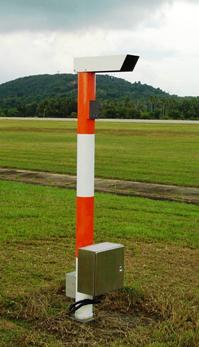
A transmissometer or transmissiometer is an instrument for measuring the extinction coefficient of the atmosphere and sea water, and for the determination of visual range. It operates by sending a narrow, collimated beam of energy (usually a laser) through the propagation medium. A narrow field of view receiver at the designated measurement distance determines how much energy is arriving at the detector, and determines the path transmission and/or extinction coefficient.[1] In a transmissometer the extinction coefficient is determined by measuring direct light transmissivity, and the extinction coefficient is then used to calculate visibility range.[2]
Atmospheric extinction is a wavelength dependent phenomenon, but the most common wavelength in use for transmissometers is 550 nm, which is in the middle of the visible waveband, and allows a good approximation of visual range.[citation needed]
Transmissometers are also referred to as telephotometers, transmittance meters, or hazemeters.
Transmissometers are also used by oceanographers and limnologists to measure the optical properties of natural water.[2] In this context, a transmissometer measures the transmittance or attenuation of incident radiation from a light source with a wavelength of around 660 nm, generally through a shorter distance than in air, as water has a smaller maximum visibility distance.[citation needed]
EMOR - Extended MOR Technology
[edit]Latest generation transmissometer technology makes use of a co-located forward scatter visibility sensor on the transmitter unit to allow for higher accuracies over an Extended Meteorological Optical Range or EMOR. After 10,000 meters the accuracy of transmissometer technology diminishes, and at higher visibilities forward scatter visibility sensor technology is more accurate. The co-location of the two sensors allows for the most accurate technology to be used when reporting current visibility. The forward scatter sensor also enables auto-alignment and auto-calibration of the transmissometer device. Hence it is very useful for oceanography and water optics study.[citation needed][clarification needed]
See also
[edit]References
[edit]- ^ Thomson, Richard E.; Emery, William J. (2014). "Chapter 1 - Data Acquisition and Recording". In Thomson, Richard E.; Emery, Richard E. (eds.). Data Analysis Methods in Physical Oceanography (Third ed.). Elsevier. pp. 1–186. doi:10.1016/B978-0-12-387782-6.00001-6. ISBN 9780123877826.
- ^ a b "Visibility Sensors Information". www.globalspec.com. Engineering 360. Retrieved 25 October 2021.
 | This optics-related article is a stub. You can help Wikipedia by expanding it. |
Transmissometer
View on GrokipediaOverview and Fundamentals
Definition and Purpose
A transmissometer is an optical instrument designed to measure the beam attenuation coefficient, often denoted as , or the extinction coefficient of light propagating through a medium such as air or water along a fixed path length.[2][4] This measurement quantifies the total loss of light intensity due to absorption and scattering by particles and molecules in the medium.[7] Unlike a nephelometer, which specifically assesses light scattering to infer turbidity, a transmissometer directly evaluates the fraction of transmitted light, providing a broader indicator of optical properties.[7][8] The primary purpose of a transmissometer is to determine visual range in atmospheric conditions, assess water clarity in aquatic environments, and monitor particulate concentrations that affect light transmission.[9][10] In aviation, it supports runway visual range (RVR) assessments to ensure safe operations during low-visibility events like fog.[9] For oceanography, it helps evaluate turbidity and beam attenuation to study sediment distribution and water quality.[4] By yielding the extinction coefficient, which relates to visibility via established optical models, the device aids in real-time environmental monitoring without requiring extensive post-processing.[2] Key components include a collimated light source, such as an LED or laser, that emits a narrow beam; a sensitive detector positioned at the end of the fixed baseline to capture transmitted light; and the baseline path itself, typically ranging from several centimeters to several hundred meters depending on the application (e.g., 0.1–1 m for aquatic sensors and 15–150 m for atmospheric ones).[2][10][11] Wavelength selection is critical for accuracy: atmospheric transmissometers often operate at 550 nm to approximate the human eye's peak sensitivity in the green spectrum, while aquatic versions commonly use 660 nm or other red wavelengths to reduce absorption by pure water and focus on particulate effects.[9][2][12]Historical Development
The development of the transmissometer originated in the early 20th century amid efforts to quantify atmospheric visibility for meteorological purposes. In the 1920s, German meteorologist Heinrich Koschmieder laid the theoretical foundation by formulating the relationship between visual range and atmospheric extinction, proposing that visibility is inversely proportional to the extinction coefficient with a contrast threshold of approximately 0.02 for objects against sky backgrounds. This work, published in 1924, provided the conceptual basis for instrumental measurements of light transmission through the atmosphere. By the early 1930s, the first practical transmissometer prototypes emerged, including the Koschmieder-Zeiss Sichtmesser, which used an artificial light source and human eye detection to assess transmission over short baselines, marking the initial shift from subjective observations to objective instrumentation.[11][13] The instrument gained prominence in the 1940s through its adoption for aviation safety, particularly following World War II when improving runway visual range (RVR) became critical for low-visibility landings. In 1940, the U.S. National Bureau of Standards (NBS), under the Civil Aeronautics Administration, initiated development of a dedicated visibility meter, leading to the first operational transmissometer tested in 1941 on Nantucket Island with a 500-foot baseline and modulated light source for calibration. Key contributors included L.L. Young, F.C. Breckenridge, and M.K. Laufer at NBS, who refined designs to minimize scattered light errors and enable airport installations, such as at Indianapolis Municipal Airport and the Naval Air Test Center in Patuxent River by 1945. Post-war advancements at the Landing Aids Experiment Station (1946–1950) introduced automatic controls and shorter baselines (down to 250 feet for Category III operations), with the U.S. Air Force adopting the technology in 1949 for standardized RVR reporting; the first commercial units were produced by Crouse-Hinds Company in 1951, and operational deployment began at Washington National Airport in 1952.[11] Expansion into oceanography occurred in the 1960s, driven by the need to measure water clarity and particulate matter in aquatic environments. Institutions like the Visibility Laboratory of the University of California, San Diego, pioneered submersible transmissometer models for in-situ profiling, adapting atmospheric designs to withstand underwater pressures while quantifying beam attenuation over short paths (typically 0.25–1 meter).[5] Commercial aquatic transmissometers emerged in the late 1970s from SeaTech, Inc., enabling widespread use in pollution monitoring and limnological studies.[14] Subsequent evolution in the 1980s involved transitioning from analog photometers to laser-based systems for enhanced collimation and precision, particularly in forward-scatter variants that complemented traditional transmissometers for aviation and environmental monitoring. By the 1990s, integration with digital data loggers facilitated real-time data acquisition and remote monitoring, as seen in multichannel systems like the PL/OPA transmissometer deployed in 1990 for oil spill research, allowing automated logging of extinction coefficients over extended deployments.[15][16]Operating Principles
Basic Measurement Technique
A transmissometer operates by emitting a collimated beam of light from a source across a fixed, known path length through the medium of interest to a detector, which measures the intensity of the transmitted light compared to the incident light. The light source typically consists of a modulated or chopped light-emitting diode (LED) or laser, such as a red LED at 670 nm for aquatic applications or a 543 nm He-Ne laser for atmospheric measurements, ensuring a narrow beam (e.g., 15 mm diameter with 3 milliradians divergence) to minimize divergence over the path. This setup allows for the quantification of light attenuation due to absorption and scattering by particles or aerosols in the medium, without applying scattering corrections at this stage.[17][18] Data collection begins with the detector, commonly a silicon photodiode (e.g., with a 1 cm² active area sensitive from 400-1100 nm), recording the received light intensity as a voltage output proportional to the photocurrent generated. For enhanced sensitivity in low-light conditions, photomultiplier tubes may be employed, amplifying the signal through electron multiplication. The incident light intensity (I₀) is determined by direct measurement at the source or via reference calibration, while the transmitted intensity (I) is captured after propagation through the path length (L); alignment of the source and detector is critical to ensure the beam remains centered, often achieved using tripods and angular adjustments. Background light subtraction is performed by shielding or synchronous detection techniques, such as chopping the source at a specific frequency to isolate the signal from ambient illumination.[17][18][19] The instrument functions primarily in direct-transmission mode, where the detector accepts only unscattered or minimally scattered light within a small acceptance angle (e.g., rejecting light scattered beyond 18 milliradians via refocusing optics and baffles), though some designs incorporate a limited forward-scatter component due to the detector's field of view. Variations in medium density, such as aerosol concentration in air or particulate matter in water, are accommodated by the fixed path length, which scales the measurement sensitivity—longer paths enhance resolution in clearer media but require precise alignment to avoid beam wander from turbulence. Typical path lengths include 50–200 meters for forward aviation transmissometers to simulate runway visibility conditions, 10–30 meters for short-path designs, and 0.1–0.25 meters for aquatic units, enabling deployment on profiling instruments or underwater vehicles. Baffles or enclosures prevent external light interference, ensuring reliable operation in diverse environments.[17][19][20] This raw transmission data, expressed as the ratio I/I₀, serves as the basis for deriving the extinction coefficient in subsequent processing.[17]Calculation of Extinction Coefficient
The calculation of the extinction coefficient from transmissometer measurements relies on the principles of light attenuation through a medium, governed by Beer's law, which describes the exponential decay of light intensity along a propagation path.[19] The transmitted intensity relates to the incident intensity by the equation where is the beam attenuation coefficient (in units of m), and is the optical path length.[21] Rearranging this expression yields the core equation for : which quantifies the total loss of light due to both absorption and scattering processes along the beam path.[19] In transmissometer applications, is typically determined during calibration in a reference medium (such as pure water or clean air), while is the measured intensity under operational conditions.[22] The beam attenuation coefficient serves as the extinction coefficient , representing the combined effects of absorption (coefficient ) and scattering (coefficient ) by particles and molecules in the medium, such that .[23] This total extinction encapsulates the medium's opacity to the transmitted light wavelength, typically in the visible or near-infrared spectrum for transmissometers.[24] Accurate computation requires precise knowledge of , often fixed by the instrument design (e.g., 0.25 m for aquatic or 50 m for atmospheric), and stable reference values to minimize discrepancies between and .[25] Several error sources can affect the reliability of . Instrumental drift, arising from temporal variations in the light source intensity or detector sensitivity, introduces systematic offsets in and , potentially biasing by up to 10-20% over extended deployments without recalibration.[26] Misalignment of the transmitter and receiver optics leads to incomplete beam capture, underestimating transmission and inflating ; this is particularly pronounced in turbulent environments where vibrations exacerbate the issue.[26] In aquatic applications, window fouling by biofouling or particulates reduces effective transmission, necessitating corrections such as periodic in-situ recalibrations against pure water references or empirical fouling models to adjust raw values.[27] For atmospheric transmissometers, the extinction coefficient is often interpreted to estimate visual range , using the Koschmieder law, which assumes a contrast threshold of 0.02 between an object and its background: where 3.91 derives from .[28] This conversion provides a meteorological optical range relevant for visibility assessments, though it applies primarily to homogeneous conditions and may require adjustments for wavelength-specific scattering.[24]Types and Designs
Atmospheric Transmissometers
Atmospheric transmissometers are specialized optical instruments optimized for quantifying light attenuation in the air over a defined horizontal path, enabling precise assessment of visibility influenced by aerosols, fog, particulates, and other meteorological phenomena. These devices consist of a light transmitter and receiver separated by a fixed baseline, with lengths typically ranging from 25 to 150 meters for runway visual range (RVR) measurements, though configurations up to 250 meters are employed in broader meteorological applications to enhance range and resolution.[29][30] Key design features emphasize durability for continuous outdoor deployment, including rugged aluminum housings with weatherproof seals (often IP65-rated or better) to resist corrosion, wind loads, and extreme temperatures from -40°C to +60°C. Integrated components such as anti-condensation heaters, protective hoods, and high-velocity blowers mitigate environmental challenges; for instance, the Vaisala LT31 model uses a double-mast structure with an outer tube as a wind and solar shield, plus a blower system that generates an air curtain to deflect rain, snow, and dust from optical windows. These transmissometers frequently integrate with automated weather stations via serial or Ethernet interfaces, feeding data into systems like runway monitoring networks or synoptic observation platforms for real-time visibility reporting.[31][31] The instruments primarily utilize a 550 nm wavelength, selected to align with photopic human vision sensitivity, allowing accurate capture of extinction effects from scattering and absorption by fog droplets (typically 5–50 μm in diameter), aerosols, and suspended particulates. This green light band minimizes spectral discrepancies between instrumental readings and perceived visual range, with sensitivity extending to low-visibility conditions dominated by dense fog or high aerosol loading. Examples for airport applications include the Optec LPV series, which supports long baselines (e.g., 486 m in some installations) for extended atmospheric sampling, and forward-scatter transmissometer variants that infer transmission via light scattered at small angles (0.5°–30°). These differ from hazemeters, which evaluate overall haze levels through scattering without a fixed baseline, potentially introducing variability in non-uniform atmospheres.[30][24] Performance limits support reliable operation for visibilities up to 2 km, beyond which signal-to-noise ratios degrade in clear conditions, though some models extend to 10 km with reduced precision. Auto-calibration routines, often executed hourly, detect and correct for dust or contaminant buildup on lenses by referencing internal reference signals, ensuring compliance with standards like ICAO Annex 3 without routine manual adjustments.[31][31]Aquatic Transmissometers
Aquatic transmissometers are specialized optical instruments engineered for submersion in water bodies, featuring compact designs with short optical path lengths typically ranging from 0.05 to 1 meter to facilitate vertical profiling and integration into underwater sensor arrays.[33] These devices employ pressure-resistant housings constructed from materials like titanium or Delrin, capable of withstanding depths up to 6000 meters, ensuring durability in deep-sea environments.[34] To mitigate biofouling from marine organisms, they incorporate anti-fouling coatings such as copper-based treatments or integrated wipers, which help maintain optical clarity during extended deployments.[35][36] These instruments operate at wavelengths in the red or near-infrared spectrum, commonly 650 nm or 715 nm, selected to minimize absorption by pure water while enhancing sensitivity to particulate and dissolved matter.[33] At these wavelengths, the beam attenuation measured reflects contributions from particulate organic matter (POM), such as phytoplankton and detritus, as well as dissolved organic substances, providing insights into water clarity and biogeochemical properties.[37][38] Prominent models include the Sea-Bird Scientific C-Star transmissometer, available in 10 cm or 25 cm path lengths, which integrates seamlessly with conductivity-temperature-depth (CTD) sensors for simultaneous multi-parameter profiling on ocean buoys and rosettes.[39][40] Similarly, WET Labs (now part of Sea-Bird) models like the C-Star are designed for pumped or free-flow applications and can be configured with CTD systems such as the SeaCATplus for real-time data acquisition in marine research.[41] Despite their robustness, aquatic transmissometers exhibit performance limitations, including heightened sensitivity to air bubbles that introduce scattering artifacts and to planktonic fouling that obscures optical windows over time.[42] Long-term deployments thus necessitate frequent cleaning protocols, such as pre- and post-mission rinses with fresh water or deployment of automated wipers, to preserve measurement accuracy.[34][43]Applications
Aviation and Meteorology
In aviation, transmissometers have historically and continue to play a critical role in measuring Runway Visual Range (RVR), which determines safe takeoff and landing conditions during low-visibility events such as fog, haze, or precipitation.[15] These instruments provide real-time data on visibility along the runway, enabling air traffic controllers to issue precise reports that guide pilots in deciding whether to use instrument landing systems (ILS) for approaches. As of 2011, the U.S. Federal Aviation Administration (FAA) prohibits new transmissometer installations or relocations to support Category II and III operations, with forward scattermeters increasingly used for enhanced precision in low RVR conditions.[44] The FAA first implemented transmissometer-based RVR systems in 1952 at Washington National Airport, using technology developed by the National Bureau of Standards in 1942, and expanded requirements for their installation at major airports supporting Category II and III operations starting in the 1970s to enhance safety in adverse weather.[45][29] In meteorology, transmissometers enable continuous monitoring of atmospheric visibility affected by haze, smog, and other particulates, supporting weather forecasting and air quality assessments. These devices quantify light extinction over fixed baselines, typically 250 to 500 feet, to track changes in visibility that impact public safety and environmental conditions. For instance, they are integrated with LIDAR systems to improve pollution tracking by combining transmissometer data on local extinction coefficients with LIDAR's remote profiling of aerosol layers, allowing meteorologists to map haze dispersion more accurately during urban smog events.[46] A notable case study is London Heathrow Airport, one of Europe's busiest and most fog-prone hubs, where transmissometers have been essential for managing operations in low visibility. Such conditions have historically led to significant flight delays, underscoring the device's role in balancing safety and efficiency.[47] Regulatory frameworks emphasize transmissometer reliability, with the International Civil Aviation Organization (ICAO) specifying accuracy within ±10% for systematic errors over the full RVR range of 10 to 2,000 meters to ensure consistent global standards. The FAA aligns with these guidelines, mandating calibration traceable to reference standards and performance targets of 10% systematic and 15% random error for operational use. Atmospheric transmissometers, with their forward-scatter or dual-beam designs, meet these criteria by providing robust measurements in runway environments.[48]Oceanography and Limnology
In oceanography, transmissometers are essential for profiling water column turbidity, enabling researchers to quantify suspended particulate matter that influences sediment transport dynamics and the detection of algal blooms. By measuring beam attenuation, these instruments provide high-resolution data on light scattering and absorption caused by particles, which is critical for understanding coastal and open-ocean processes such as resuspension events and phytoplankton aggregation during blooms.[49][50] For instance, in estuarine environments, transmissometers help map turbidity maxima zones where sediment concentrations peak, informing models of material flux and ecosystem responses.[50] They are commonly deployed on autonomous underwater vehicles (AUVs) and gliders to achieve prolonged, spatially extensive sampling without ship support, allowing real-time tracking of vertical and horizontal turbidity gradients over large scales.[51] In limnology, transmissometers support lake monitoring by assessing water clarity and linking beam transmission data to indicators of nutrient loading, such as elevated particulate levels from runoff or eutrophication. These measurements correlate beam attenuation with chlorophyll concentrations, serving as a proxy for phytoplankton biomass and helping evaluate trophic status in freshwater systems.[52] For example, in oligotrophic lakes, transmissometer-derived attenuation profiles reveal subtle changes in suspended matter that signal nutrient inputs, aiding in the management of clarity trends over time.[53] This approach is particularly valuable for long-term observatories, where continuous data integrate optical properties with biological metrics to track ecosystem health. Key research applications include using beam attenuation as a proxy for particulate organic carbon (POC) in studies of ocean productivity, where transmissometer data quantify carbon export and biogeochemical cycling across diverse regimes.[54] In global initiatives like the GO-SHIP program, transmissometers are integrated into conductivity-temperature-depth (CTD) rosettes for repeat hydrographic sections, providing standardized POC estimates that support carbon budget assessments and reveal basin-scale patterns in particulate matter distribution.[55] These deployments yield datasets that enhance understanding of primary production variability, with attenuation coefficients often calibrated against in situ POC samples to achieve accuracy within 20-30% across oligotrophic to eutrophic waters.[54] Transmissometers also contribute to environmental impact assessments by tracking pollution plumes in marine settings, such as wastewater outfalls, where increased attenuation signals effluent dispersion and mixing.[56] In the context of climate change, they monitor alterations in water optics driven by shifting particulate loads, including those from glacial melt or intensified stratification, which affect light penetration and ecosystem productivity.[57] Such observations, often from moored or profiling platforms, help quantify how warming oceans modify beam attenuation profiles, informing projections of optical habitat changes for marine biota.[57]Industrial Applications
Transmissometers are used in industrial settings for monitoring opacity in smokestacks and exhaust stacks to measure particulate emissions and ensure compliance with air quality regulations. These opacity monitors employ transmissometry principles, sending a light beam across the diameter of the stack or duct and measuring the reduction in light transmission caused by absorption and scattering from particles in the flue gas. The resulting data quantify light extinction over the gas path, similar to atmospheric transmissometers, but are optimized for high-temperature, particulate-laden industrial emissions. Such systems provide continuous real-time measurements of opacity (expressed as a percentage) and are critical for emission control in industries including power generation, manufacturing, and incineration. In the United States, these transmissive opacity monitors are regulated under the Environmental Protection Agency's (EPA) Performance Specification 1 (PS-1), which sets standards for design, installation, calibration, and performance of opacity continuous emission monitoring systems to support regulatory compliance and air pollution control.[58]Advanced Technologies and Calibration
EMOR - Extended MOR Technology
The Extended Meteorological Optical Range (EMOR) technology represents an advanced evolution in transmissometer design, integrating forward-scattering sensors with traditional transmissometry to measure atmospheric visibility over significantly extended distances, up to 80 kilometers. This hybrid approach leverages the precision of light transmission measurements for short-range conditions (typically below 1,000 meters) and forward scatter detection for longer ranges (above 3,000 meters), where an auto-aligning master controller dynamically selects and cross-validates the optimal method to ensure continuous accuracy. By colocating the forward scatter sensor on the transmitter mast, EMOR minimizes alignment errors and enables reliable estimation of the meteorological optical range (MOR) in diverse atmospheric conditions.[59][60] Key features of EMOR include automated alignment mechanisms that eliminate the need for manual adjustments during module replacements, a reduced baseline requirement of approximately 30 meters for optimal low-end performance, and built-in dynamic autocalibration with contamination compensation to maintain signal integrity without frequent interventions. The system employs white light LED flash units for broad-spectrum illumination, achieving a measurement range from 1% to 100% transmissivity, and supports high-resolution 24-bit analog-to-digital conversion with scans every second and reports every 10 seconds. This combination of scattering and transmission data provides hybrid accuracy that adheres to international standards such as ICAO and WMO guidelines.[59][61] Compared to standard transmissometers, EMOR offers distinct advantages, including robust performance in clear-air turbulence where traditional double-ended designs may falter due to misalignment, and near-calibration-free operation across varying weather, reducing maintenance to quarterly checks and extending LED lifespan to over 10^8 flashes (approximately 6 years in low-visibility scenarios). These enhancements result in failsafe redundancy and higher overall reliability, making EMOR suitable for demanding environments requiring uninterrupted visibility data.[60][59] EMOR technology emerged in the late 2000s, with key developments occurring around 2009 by MTECH Systems Pty Ltd, aimed at improving long-range visibility assessments for critical infrastructure. Specific implementations, such as the 5000-200-EMOR model, have been deployed in airport runway visual range (RVR) systems for Category III operations and in solar power plant efficiency monitoring, providing ICAO-certified frangibility and compatibility with legacy sensor networks. Building briefly on foundational MOR principles from historical atmospheric measurements, EMOR extends these capabilities without relying on extended baselines.[60][59]Advanced Aquatic Transmissometers
Recent advances in aquatic transmissometers include hyperspectral models that measure beam attenuation across multiple wavelengths, enabling detailed separation of absorption and scattering by different particle types and dissolved substances. These instruments, such as cost-effective designs developed in the 2010s and refined through 2025, support bio-optical algorithms for estimating particulate organic carbon and phytoplankton biomass with improved accuracy.[62] As of 2025, integration with optical sediment traps represents a key development, allowing in-situ monitoring of sinking marine particles by combining transmissometry with particle imaging and flux measurements. This enhances understanding of carbon export in ocean ecosystems, with deployments on profiling floats and moorings providing long-term data on vertical particle dynamics.[63]Calibration and Maintenance Procedures
Calibration of transmissometers involves establishing zero-offset and span references to ensure accurate measurement of beam attenuation. For atmospheric units, zero-offset is typically performed in a clean, dry medium such as dry nitrogen or uniform air to account for dark current and baseline noise, with the light source blocked or minimized.[64] In aquatic environments, zero-offset calibration uses highly filtered seawater or purified water to subtract inherent water absorption, often by blocking the beam in a clean, dry instrument before deployment.[34] Span checks employ known attenuators, such as neutral density filters with certified transmittance values (e.g., low, mid, and high ranges at 10-90% transmittance), inserted into the beam path to verify linearity across the operational range. Calibration frequency varies by application: for aviation transmissometers, full calibration every six months and prior to the fog season to comply with ICAO standards; for research-grade oceanographic units, factory calibration annually with in-situ verification before and after deployments and as needed (e.g., weekly during extended use).[65][27] Maintenance procedures focus on preserving optical integrity and correcting for environmental impacts. Optics must be regularly cleaned to prevent biofouling or particulate buildup, which can skew readings; for aquatic sensors, this involves gentle wiping with lint-free materials and dilute detergent solutions followed by rinsing in filtered water, while atmospheric units use isopropyl alcohol on lenses.[34][43] Software updates are essential for applying drift corrections, such as temperature compensation algorithms or firmware adjustments to offset sensor baseline shifts over time.[66] Troubleshooting common issues includes realigning transmitter and receiver components if beam misalignment causes signal loss (e.g., angular displacements exceeding 1° can reduce transmission by over 35%), and inspecting for sensor degradation through periodic air-path checks where deviations beyond 100 counts indicate potential lamp or detector failure.[67][43] Standards ensure traceability and precision in measurements. Atmospheric transmissometers adhere to NIST-traceable calibration using certified reference materials for attenuators and lamps, achieving error budgets around ±0.015 in high-transmittance conditions.[64][68] Aquatic units follow ISO protocols, such as ISO 22013:2021 for marine sensor performance testing, with typical error budgets of ±0.005 m⁻¹ for the beam attenuation coefficient (c) in low-turbidity waters.[69][70] Best practices distinguish between in-situ and laboratory calibration to balance accuracy and practicality. In-situ methods, such as pre- and post-deployment air or water checks, validate performance without removal but require integration with reference instruments like nephelometers for cross-validation of scattering-derived extinction values.[43][71] Laboratory calibration, preferred annually, uses controlled clean media and attenuators for comprehensive error assessment, ensuring long-term reliability in field applications.[64]References
- ftp://ftp.cmdl.noaa.gov/aerosol/doc/manuals/transmissometer_92-204.PDF