


Community hub
Recent from talks
Contribute something
Nothing was collected or created yet.
Millipede
View on Wikipedia
| Millipedes | |
|---|---|

| |
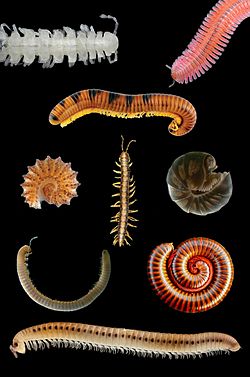
| An assortment of millipedes (not to scale) | |
Scientific classification 
| |
| Kingdom: | Animalia |
| Phylum: | Arthropoda |
| Subphylum: | Myriapoda |
| Class: | Diplopoda Blainville in Gervais, 1844 |
| Subclasses | |
| Diversity | |
| 16 orders, c. 12,000 species | |
Millipedes (originating from the Latin mille, "thousand", and pes, "foot")[1][2] are a group of arthropods that are characterised by having two pairs of jointed legs on most body segments; they are known scientifically as the class Diplopoda, the name derived from this feature. Each double-legged segment is a result of two single segments fused together. Most millipedes have very elongated cylindrical or flattened bodies with more than 20 segments, while pill millipedes are shorter and can roll into a tight ball. Although the name "millipede" derives from Latin for "thousand feet", no species was known to have 1,000 or more until the discovery in 2020 of Eumillipes persephone, which can have over 1,300 legs.[3] There are approximately 12,000 named species classified into 16 orders and around 140 families, making Diplopoda the largest class of myriapods, an arthropod subphylum which also includes centipedes and other multi-legged creatures.
Most millipedes are slow-moving detritivores, eating decaying leaves and other dead plant matter; however, some eat fungi or drink plant fluid. Millipedes are generally harmless to humans, although some can become household or garden pests. Millipedes can be an unwanted nuisance particularly in greenhouses where they can potentially cause severe damage to emergent seedlings. Most millipedes defend themselves with a variety of chemicals secreted from pores along the body, although the tiny bristle millipedes are covered with tufts of detachable bristles. Its primary defence mechanism is to curl into a tight coil, thereby protecting its legs and other vital delicate areas on the body behind a hard exoskeleton. Reproduction in most species is carried out by modified male legs called gonopods, which transfer packets of sperm to females.
First appearing in the Silurian period, millipedes are some of the oldest known land animals. Some members of prehistoric groups, such as Arthropleura, grew to over 2 m (6+1⁄2 ft); the largest modern species reach maximum lengths of 27 to 38 cm (10+1⁄2 to 15 in). The longest extant species is the giant African millipede (Archispirostreptus gigas).
Among myriapods, millipedes have traditionally been considered most closely related to the tiny pauropods, although some molecular studies challenge this relationship. Millipedes can be distinguished from the somewhat similar but only distantly related centipedes (class Chilopoda), which move rapidly, are venomous, carnivorous, and have only a single pair of legs on each body segment.
The scientific study of millipedes is known as diplopodology, and a scientist who studies them is called a diplopodologist.
Etymology and names
[edit]The term "millipede" is widespread in popular and scientific literature, but among North American scientists, the term "milliped" (without the terminal e) is also used.[4] Other vernacular names include "thousand-legger" or simply "diplopod".[5] The study of millipede biology and taxonomy is called diplopodology.[6]
Classification
[edit]
Approximately 12,000 millipede species have been described. Estimates of the true number of species on earth range from 15,000[8] to as high as 80,000.[9] Few species of millipede are at all widespread; they have very poor dispersal abilities, depending as they do on terrestrial locomotion and humid habitats. These factors have favoured genetic isolation and rapid speciation, producing many lineages with restricted ranges.[10]
The living members of the Diplopoda are divided into sixteen orders in two subclasses.[7] The basal subclass Penicillata contains a single order, Polyxenida (bristle millipedes).[11] All other millipedes belong to the subclass Chilognatha consisting of two infraclasses: Pentazonia, containing the short-bodied pill millipedes, and Helminthomorpha (worm-like millipedes), containing the great majority of the species.[12][13]
Outline of classification
[edit]The higher-level classification of millipedes is presented below, based on Shear, 2011,[7] and Shear & Edgecombe, 2010[14] (extinct groups). Recent cladistic and molecular studies have challenged the traditional classification schemes above, and in particular the position of the orders Siphoniulida and Polyzoniida is not yet well established.[9] The placement and positions of extinct groups (†) known only from fossils is tentative and not fully resolved.[9][14] After each name is listed the author citation: the name of the person who coined the name or defined the group, even if not at the current rank.
Class Diplopoda de Blainville in Gervais, 1844
- Subclass Penicillata Latreille, 1831
- Order Polyxenida Verhoeff, 1934
- Subclass †Arthropleuridea (placed in Penicillata by some authors)[14]
- Order †Arthropleurida Waterlot, 1934
- Order †Eoarthropleurida Shear & Selden, 1995
- Order †Microdecemplicida Wilson & Shear, 2000
- Subclass Chilognatha Latreille, 1802
- Order †Zosterogrammida Wilson, 2005 (Chilognatha incertae sedis)[14]
- Infraclass Pentazonia Brandt, 1833
- Order †Amynilyspedida Hoffman, 1969
- Superorder Limacomorpha Pocock, 1894
- Order Glomeridesmida Cook, 1895
- Superorder Oniscomorpha Pocock, 1887
- Order Glomerida Brandt, 1833
- Order Sphaerotheriida Brandt, 1833
- Infraclass Helminthomorpha Pocock, 1887
- Superorder †Archipolypoda Scudder, 1882
- Order †Archidesmida Wilson & Anderson 2004
- Order †Cowiedesmida Wilson & Anderson 2004
- Order †Euphoberiida Hoffman, 1969
- Order †Palaeosomatida Hannibal & Krzeminski, 2005
- Order †Pleurojulida Schneider & Werneburg, 1998 (possibly sister to Colobognatha)[9]
- Subterclass Colobognatha Brandt, 1834
- Order Platydesmida Cook, 1895
- Order Polyzoniida Cook, 1895
- Order Siphonocryptida Cook, 1895
- Order Siphonophorida Newport, 1844
- Subterclass Eugnatha Attems, 1898
- Superorder Juliformia Attems, 1926
- Order Julida Brandt, 1833
- Order Spirobolida Cook, 1895
- Order Spirostreptida Brandt, 1833
- Superfamily †Xyloiuloidea Cook, 1895 (Sometimes aligned with Spirobolida)[15]
- Superorder Nematophora Verhoeff, 1913
- Order Callipodida Pocock, 1894
- Order Chordeumatida Pocock 1894
- Order Stemmiulida Cook, 1895
- Order Siphoniulida Cook, 1895
- Superorder Merocheta Cook, 1895
- Order Polydesmida Pocock, 1887
- Superorder Juliformia Attems, 1926
- Superorder †Archipolypoda Scudder, 1882
Evolution
[edit]Millipedes are among the first animals to have colonised land during the Silurian period.[16] Early forms probably ate mosses and primitive vascular plants. There are two major groups of millipedes whose members are all extinct: the Archipolypoda ("ancient, many-legged ones") which contain the oldest known terrestrial animals, and Arthropleuridea, which contain the largest known land invertebrates. Pneumodesmus newmani is the earliest member of the millipedes from the late Wenlock epoch of the late Silurian around 428 million years ago,[17][18] or early Lochkovian of the early Devonian around 414 million years ago,[19][20] known from 1 cm (1⁄2 in) long fragment and has clear evidence of spiracles (breathing holes) attesting to its air-breathing habits.[14][18][21] Other early fossils of millipedes are Kampecaris obanensis and Archidesmus sp. from 425 millions years ago in the late Silurian.[22] During the Carboniferous, Arthropleura became the largest known land-dwelling invertebrate on record, length exceeding 2 m (6+1⁄2 ft). The reason that Arthropleura was able to achieve this size is not clearly known; early studies posited that it was a result of high atmospheric oxygen levels, while later studies consider that the lack of competition is more probable.[23] Millipedes also exhibit the earliest evidence of chemical defence, as some Devonian fossils have defensive gland openings called ozopores.[14]
Living groups
[edit]_(3405605943).jpg)


The history of scientific millipede classification began with Carl Linnaeus, who in his 10th edition of Systema Naturae, 1758, named seven species of Julus as "Insecta Aptera" (wingless insects).[24] In 1802, the French zoologist Pierre André Latreille proposed the name Chilognatha as the first group of what are now the Diplopoda, and in 1840 the German naturalist Johann Friedrich von Brandt produced the first detailed classification. The name Diplopoda itself was coined in 1844 by the French zoologist Henri Marie Ducrotay de Blainville. From 1890 to 1940, millipede taxonomy was driven by relatively few researchers at any given time, with major contributions by Carl Attems, Karl Wilhelm Verhoeff and Ralph Vary Chamberlin, who each described over 1,000 species, as well as Orator F. Cook, Filippo Silvestri, R. I. Pocock, and Henry W. Brölemann.[9] This was a period when the science of diplopodology flourished: rates of species descriptions were on average the highest in history, sometimes exceeding 300 per year.[8]
In 1971, the Dutch biologist C. A. W. Jeekel published a comprehensive listing of all known millipede genera and families described between 1758 and 1957 in his Nomenclator Generum et Familiarum Diplopodorum, a work credited as launching the "modern era" of millipede taxonomy.[25][26] In 1980, the American biologist Richard L. Hoffman published a classification of millipedes which recognized the Penicillata, Pentazonia, and Helminthomorpha,[27] and the first phylogenetic analysis of millipede orders using modern cladistic methods was published in 1984 by Henrik Enghoff of Denmark.[28] A 2003 classification by the American myriapodologist Rowland Shelley is similar to the one originally proposed by Verhoeff, and remains the currently accepted classification scheme (shown below), despite more recent molecular studies proposing conflicting relationships.[9][14] A 2011 summary of millipede family diversity by William A. Shear placed the order Siphoniulida within the larger group Nematophora.[7]
| Diplopoda |
| ||||||||||||||||||
Fossil record
[edit]In addition to the 16 living orders, there are 9 extinct orders and one superfamily known only from fossils. The relationship of these to living groups and to each other is controversial. The extinct Arthropleuridea was long considered a distinct myriapod class, although work in the early 21st century established the group as a subclass of millipedes.[29][30][31] Several living orders also appear in the fossil record. Below are two proposed arrangements of fossil millipede groups.[9][14] Extinct groups are indicated with a dagger (†). The extinct order Zosterogrammida, a chilognath of uncertain position,[14] is not shown.
| |||||||||
| Alternate hypothesis of fossil relationships[9][30] |
| Diplopoda |
| |||||||||||||||||||||||||||||||||||||||||||||
Relation to other myriapods
[edit]
Although the relationships of millipede orders are still the subject of debate, the class Diplopoda as a whole is considered a monophyletic group of arthropods: all millipedes are more closely related to each other than to any other arthropods. Diplopoda is a class within the arthropod subphylum Myriapoda, the myriapods, which includes centipedes (class Chilopoda) as well as the lesser-known pauropods (class Pauropoda) and symphylans (class Symphyla). Within myriapods, the closest relatives or sister group of millipedes has long been considered the pauropods, which also have a collum and diplosegments.[9]
Distinction from centipedes
[edit]The differences between millipedes and centipedes are a common question from the general public.[32] Both groups of myriapods share similarities, such as long, multi-segmented bodies, many legs, a single pair of antennae, and the presence of postantennal organs, but have many differences and distinct evolutionary histories, as the most recent common ancestor of centipedes and millipedes lived around 450 to 475 million years ago in the Silurian.[33] The head alone exemplifies the differences; millipedes have short, geniculate (elbowed) antennae for probing the substrate, a pair of robust mandibles and a single pair of maxillae fused into a lip; centipedes have long, threadlike antennae, a pair of small mandibles, two pairs of maxillae and a pair of large poison claws.[34]

| Trait | Millipedes | Centipedes |
|---|---|---|
| Legs | Two pairs on most body segments; attached to underside of body | One pair per body segment; attached to sides of body; last pair extends backwards |
| Locomotion | Generally adapted for burrowing or inhabiting small crevices; slow-moving | Generally adapted for running, except for the burrowing soil centipedes |
| Feeding | Primarily detritivores, some herbivores, few carnivores; no venom | Primarily carnivores with front legs modified into venomous fangs |
| Spiracles | On underside of body | On the sides or top of body |
| Reproductive openings | Third body segment | Last body segment |
| Reproductive behaviour | Male generally inserts spermatophore into female with gonopods | Male produces spermatophore that is usually picked up by female |
Characteristics
[edit]

Millipedes come in a variety of body shapes and sizes, ranging from 2 mm (1⁄16 in) to around 35 cm (14 in) in length,[35] and can have as few as eleven to over three hundred segments.[36][37] They are generally black or brown in colour, although there are a few brightly coloured species, and some have aposematic colouring to warn that they are toxic.[5] Species of Motyxia produce cyanide as a chemical defence and are bioluminescent.[38]
Body styles vary greatly between major millipede groups. In the basal subclass Penicillata, consisting of the tiny bristle millipedes, the exoskeleton is soft and uncalcified, and is covered in prominent setae or bristles. All other millipedes, belonging to the subclass Chilognatha, have a hardened exoskeleton. The chilognaths are in turn divided into two infraclasses: the Pentazonia, containing relatively short-bodied groups such as pill millipedes, and the Helminthomorpha ("worm-like" millipedes), which contains the vast majority of species, with long, many-segmented bodies.[12][13]
They have also lost the gene that codes for the JHAMTl enzyme, which is responsible for catalysing the last step of the production of a juvenile hormone that regulates the development and reproduction in other arthropods like crustaceans, centipedes and insects.[39]
Head
[edit]The head of a millipede is typically rounded above and flattened below and bears a pair of large mandibles in front of a plate-like structure called a gnathochilarium ("jaw lip").[9] The head contains a single pair of antennae with seven or eight segments and a group of sensory cones at the tip.[9] Many orders also possess a pair of sensory organs known as the Tömösváry organs, shaped as small oval rings posterior and lateral to the base of the antennae. Their function is unknown,[9] but they also occur in some centipedes, and are possibly used to measure humidity or light levels in the surrounding environment.[40]
Millipede eyes consist of several simple flat-lensed ocelli arranged in a group or patch on each side of the head. These patches are also called ocular fields or ocellaria. Many species of millipedes, including the entire orders Polydesmida, Siphoniulida, Glomeridesmida, Siphonophorida and Platydesmida, and cave-dwelling millipedes such as Causeyella and Trichopetalum, had ancestors that could see but have subsequently lost their eyes and are blind.[35]
Body
[edit]

Millipede bodies may be flattened or cylindrical, and are composed of numerous metameric segments, each with an exoskeleton consisting of four chitinous plates: a single plate above (the tergite), one at each side (pleurites), and a plate on the underside (sternite) where the legs attach. In many millipedes, such as Merocheta and Juliformia, these plates are fused to varying degrees, sometimes forming a single cylindrical ring. The plates are typically hard, impregnated with calcium salts.[36] Because they can't close their permanently open spiracles and most species lack a waxy cuticle, millipedes are susceptible to water loss and with a few exceptions must spend most of their time in moist or humid environments.[41]
The first segment behind the head is legless and known as a collum (from the Latin for neck or collar). The second, third, and fourth body segments bear a single pair of legs each and are known as "haplosegments" (the three haplosegments are sometimes referred to as a "thorax"[18]). The remaining segments, from the fifth to the posterior, are properly known as diplosegments or double segments, formed by the fusion of two embryonic segments. Each diplosegment bears two pairs of legs, rather than just one as in centipedes. In some millipedes, the last few segments may be legless. The terms "segment" or "body ring" are often used interchangeably to refer to both haplo- and diplosegments. The final segment is known as the telson and consists of a legless preanal ring, a pair of anal valves (closeable plates around the anus), and a small scale below the anus.[9][36]
Millipedes in several orders have keel-like extensions of the body-wall known as paranota, which can vary widely in shape, size, and texture; modifications include lobes, papillae, ridges, crests, spines and notches.[5] Paranota may allow millipedes to wedge more securely into crevices, protect the legs, or make the millipede more difficult for predators to swallow.[42]
The legs are composed of seven segments, and attach on the underside of the body. The legs of an individual are generally rather similar to each other, although often longer in males than females, and males of some species may have a reduced or enlarged first pair of legs.[43] The most conspicuous leg modifications are involved in reproduction, discussed below. Despite the common name, no millipede was known to have 1,000 legs until 2021: common species have between 34 and 400 legs, and the record is held by Eumillipes persephone, with individuals possessing up to 1,306 legs – more than any other creature on Earth.[3][44][45]
_with_618_legs_-_ZooKeys-241-077-SP-6-top.jpg)
Internal organs
[edit]Millipedes breathe through two pairs of spiracles located ventrally on each segment near the base of the legs.[32] Each opens into an internal pouch, and connects to a system of tracheae. The heart runs the entire length of the body, with an aorta stretching into the head. The excretory organs are two pairs of malpighian tubules, located near the mid-part of the gut. The digestive tract is a simple tube with two pairs of salivary glands to help digest the food.[36]
Reproduction and growth
[edit]

Millipedes show a diversity of mating styles and structures. In the basal order Polyxenida (bristle millipedes), mating is indirect: males deposit spermatophores onto webs they secrete with special glands, and the spermatophores are subsequently picked up by females.[32] In all other millipede groups, males possess one or two pairs of modified legs called gonopods which are used to transfer sperm to the female during copulation. The location of the gonopods differs between groups: in males of the Pentazonia they are located at the rear of the body and known as telopods and may also function in grasping females, while in the Helminthomorpha – the vast majority of species – they are located on the seventh body segment.[9] A few species are parthenogenetic, having few, if any, males.[46]


Gonopods occur in a diversity of shapes and sizes, and in the range from closely resembling walking legs to complex structures quite unlike legs at all. In some groups, the gonopods are kept retracted within the body; in others they project forward parallel to the body. Gonopod morphology is the predominant means of determining species among millipedes: the structures may differ greatly between closely related species but very little within a species.[47] The gonopods develop gradually from walking legs through successive moults until reproductive maturity.[48]

The genital openings (gonopores) of both sexes are located on the underside of the third body segment (near the second pair of legs) and may be accompanied in the male by one or two penes which deposit the sperm packets onto the gonopods. In the female, the genital pores open into paired small sacs called cyphopods or vulvae, which are covered by small hood-like lids, and are used to store the sperm after copulation.[36] The cyphopod morphology can also be used to identify species. Millipede sperm lack flagella, a unique trait among myriapods.[9]
In all except the bristle millipedes, copulation occurs with the two individuals facing one another. Copulation may be preceded by male behaviours such as tapping with antennae, running along the back of the female, offering edible glandular secretions, or in the case of some pill-millipedes, stridulation or "chirping".[49] During copulation in most millipedes, the male positions his seventh segment in front of the female's third segment, and may insert his gonopods to extrude the vulvae before bending his body to deposit sperm onto his gonopods and reinserting the "charged" gonopods into the female.[43]
Females lay from ten to three hundred eggs at a time, depending on species, fertilising them with the stored sperm as they do so. Many species deposit the eggs on moist soil or organic detritus, but some construct nests lined with dried faeces, and may protect the eggs within silk cocoons.[36] In most species, the female abandons the eggs after they are laid, but some species in the orders Platydesmida and Stemmiulida provide parental care for eggs and young.[32]
The young hatch after a few weeks, and typically have only three pairs of legs, followed by up to four legless segments. As they grow, they continually moult, adding further segments and legs as they do so, a mode of development known as anamorphosis.[34] Some species moult within specially prepared chambers of soil or silk,[50] and may also shelter in these during wet weather, and most species eat the discarded exoskeleton after moulting. The adult stage, when individuals become reproductively mature, is generally reached in the final moult stage, which varies between species and orders, although some species continue to moult after adulthood. Furthermore, some species alternate between reproductive and non-reproductive stages after maturity, a phenomenon known as periodomorphosis, in which the reproductive structures regress during non-reproductive stages.[46] Millipedes may live from one to ten years, depending on species.[36]
Ecology
[edit]Habitat and distribution
[edit]Millipedes occur on all continents except Antarctica, and occupy almost all terrestrial habitats, ranging as far north as the Arctic Circle in Iceland, Norway, and Central Russia, and as far south as Santa Cruz Province, Argentina.[51][52] Typically forest floor dwellers, they live in leaf litter, dead wood, or soil, with a preference for humid conditions. In temperate zones, millipedes are most abundant in moist deciduous forests, and may reach densities of over 1,000 individuals per square metre. Other habitats include coniferous forests, caves, and alpine ecosystems.[32][52] Deserticolous millipedes, species evolved to live in the desert, like Orthoporus ornatus, may show adaptations like a waxy epicuticle and the ability of water uptake from unsaturated air.[53] Some species can survive freshwater floods and live submerged underwater for up to 11 months.[54][55] A few species occur near the seashore and can survive in somewhat salty conditions.[46][56]
Burrowing
[edit]The diplosegments of millipedes have evolved in conjunction with their burrowing habits, and nearly all millipedes adopt a mainly subterranean lifestyle. They use three main methods of burrowing; bulldozing, wedging and boring. Members of the orders Julida, Spirobolida and Spirostreptida, lower their heads and barge their way into the substrate, the collum leading the way. Flat-backed millipedes in the order Polydesmida tend to insert their front end, like a wedge, into a horizontal crevice, and then widen the crack by pushing upwards with their legs, the paranota in this instance constituting the main lifting surface. Boring is used by members of the order Polyzoniida. These have smaller segments at the front and increasingly large ones further back; they propel themselves forward into a crack with their legs, the wedge-shaped body widening the gap as they go. Some millipedes have adopted an above-ground lifestyle and lost the burrowing habit. This may be because they are too small to have enough leverage to burrow, or because they are too large to make the effort worthwhile, or in some cases because they move relatively fast (for a millipede) and are active predators.[5]

Diet
[edit]Most millipedes are detritivores and feed on decomposing vegetation, feces, or organic matter mixed with soil. They often play important roles in the breakdown and decomposition of plant litter: estimates of consumption rates for individual species range from 1 to 11 percent of all leaf litter, depending on species and region, and collectively millipedes may consume nearly all the leaf litter in a region. The leaf litter is fragmented in the millipede gut and excreted as pellets of leaf fragments, algae, fungi, and bacteria, which facilitates decomposition by the microorganisms.[43] Where earthworm populations are low in tropical forests, millipedes play an important role in facilitating microbial decomposition of the leaf litter.[5] Some millipedes are herbivorous, feeding on living plants, and some species can become serious pests of crops. Millipedes in the order Polyxenida graze algae from bark, and Platydesmida feed on fungi.[9] A few species are omnivorous or in Callipodida and Chordeumatida occasionally carnivorous,[57] feeding on insects, centipedes, earthworms, or snails.[36][58] Some species have piercing mouth parts that allow them to suck up plant juices.[32] Cave dwelling species in Julidae, Blaniulidae, and Polydesmidae have specialized mouthparts and appears to be filter feeders, filtering small particles from running water inside caves.[59]
Predators and parasites
[edit]
Millipedes are preyed on by a wide range of animals, including various reptiles, amphibians, birds, mammals, and insects.[9] Mammalian predators such as coatis and meerkats roll captured millipedes on the ground to deplete and rub off their defensive secretions before consuming their prey,[60] and certain poison dart frogs are believed to incorporate the toxic compounds of millipedes into their own defences.[61] Several invertebrates have specialised behaviours or structures to feed on millipedes, including larval glowworm beetles,[62] Probolomyrmex ants,[63] chlamydephorid slugs,[64] and predaceous dung beetles of the genera Sceliages and Deltochilum.[65][66] A large subfamily of assassin bugs, the Ectrichodiinae with over 600 species, has specialised in preying upon millipedes.[67] Parasites of millipedes include nematodes, phaeomyiid flies, and acanthocephalans.[9] Nearly 30 fungal species of the order Laboulbeniales have been found growing externally on millipedes, but some species may be commensal rather than parasitic.[68]
Defence mechanisms
[edit]


Due to their lack of speed and their inability to bite or sting, millipedes' primary defence mechanism is to curl into a tight coil – protecting their delicate legs inside an armoured exoskeleton.[69]
Many species also emit various foul-smelling liquid secretions through microscopic holes called ozopores (the openings of "odoriferous" or "repugnatorial glands"), along the sides of their bodies as a secondary defence. Among the many irritant and toxic chemicals found in these secretions are alkaloids, benzoquinones, phenols, terpenoids, and hydrogen cyanide.[70][71][72][73][74] Some of these substances are caustic and can burn the exoskeleton of ants and other insect predators, and the skin and eyes of larger predators. Primates such as capuchin monkeys and lemurs have been observed intentionally irritating millipedes in order to rub the chemicals on themselves to repel mosquitoes.[75][76][77] Some of these defensive compounds also show antifungal activity.[78]
The bristly millipedes (order Polyxenida) lack both an armoured exoskeleton and odiferous glands, and instead are covered in numerous bristles that in at least one species, Polyxenus fasciculatus, detach and entangle ants.[79]
Other inter-species interactions
[edit]
Some millipedes form mutualistic relationships with organisms of other species, in which both species benefit from the interaction, or commensal relationships, in which only one species benefits while the other is unaffected. Several species form close relationships with ants, a relationship known as myrmecophily, especially within the family Pyrgodesmidae (Polydesmida), which contains "obligate myrmecophiles", species which have only been found in ant colonies. More species are "facultative myrmecophiles", non-exclusively associated with ants, including many species of Polyxenida that have been found in ant nests around the world.[80]
Many millipede species have commensal relationships with mites of the orders Mesostigmata and Astigmata. Many of these mites are believed to be phoretic rather than parasitic, which means that they use the millipede host as a means of dispersal.[81][82]
A novel interaction between millipedes and mosses was described in 2011, in which individuals of the newly discovered Psammodesmus bryophorus was found to have up to ten species living on its dorsal surface, in what may provide camouflage for the millipede and increased dispersal for the mosses.[83][84]
Interactions with humans
[edit]_Mantadia.jpg)
Millipedes generally have little impact on human economic or social well-being, especially in comparison with insects, although locally they can be a nuisance or agricultural pest. Millipedes do not bite, and their defensive secretions are mostly harmless to humans — usually causing only minor discolouration on the skin — but the secretions of some tropical species may cause pain, itching, local erythema, edema, blisters, eczema, and occasionally cracked skin.[85][86][87][88] Eye exposures to these secretions causes general irritation and potentially more severe effects such as conjunctivitis and keratitis.[89] This is called millipede burn. First aid consists of flushing the area thoroughly with water; further treatment is aimed at relieving the local effects.

Some millipedes are considered household pests, including Xenobolus carnifex which can infest thatched roofs in India,[90] and Ommatoiulus moreleti, which periodically invades homes in Australia. Other species exhibit periodical swarming behaviour, which can result in home invasions,[91] crop damage,[92] and train delays when the tracks become slippery with the crushed remains of hundreds of millipedes.[43][93][94] Some millipedes can cause significant damage to crops: the spotted snake millipede (Blaniulus guttulatus) is a pest of sugar beets and other root crops, and as a result is one of the few millipedes with a common name.[46]
Some of the larger millipedes in the orders Spirobolida, Spirostreptida, and Sphaerotheriida are popular as pets.[95] Some species commonly sold or kept include species of Archispirostreptus, Aphistogoniulus, Narceus, and Orthoporus.[96]

Millipedes appear in folklore and traditional medicine around the world. Some cultures associate millipede activity with coming rains.[97] In Zambia, smashed millipede pulp is used to treat wounds, and the Bafia people of Cameroon use millipede juice to treat earache.[97] In certain Himalayan Bhotiya tribes, dry millipede smoke is used to treat haemorrhoids.[98] Native people in Malaysia use millipede secretions in poison-tipped arrows.[97] The secretions of Spirobolus bungii have been observed to inhibit division of human cancer cells.[99] The only recorded usage of millipedes as food by humans comes from the Bobo people of Burkina Faso in West Africa, who consume boiled, dried millipedes belonging to the families Gomphodesmidae and Spirostreptidae[100]: 341 [101] to which they add tomato sauce.[101]
Millipedes have also inspired and played roles in scientific research. In 1963, a walking vehicle with 36 legs was designed, said to have been inspired by a study of millipede locomotion.[102] Experimental robots have had the same inspiration,[103][104] in particular when heavy loads are needed to be carried in tight areas involving turns and curves.[105] In biology, some authors have advocated millipedes as model organisms for the study of arthropod physiology and the developmental processes controlling the number and shape of body segments.[43]
Similar to vermicompost, millipedes can be used to convert plant matter into compost in what has been named millicomposting, which improves the quality of the compost.[106][107]
References
[edit]- ^ "Millipede | Etymology of millipede by etymonline".
- ^ "Millipede".
- ^ a b Marek, Paul E.; Buzatto, Bruno A.; Shear, William A.; Means, Jackson C.; Black, Dennis G.; Harvey, Mark S.; Rodriguez, Juanita (2021). "The first true millipede—1306 legs long". Scientific Reports. 11 (1): 23126. Bibcode:2021NatSR..1123126M. doi:10.1038/s41598-021-02447-0. PMC 8677783. PMID 34916527.
- ^ Hoffman, Richard L. (1990). "Diplopoda". In Dindal, Daniel L. (ed.). Soil Biology Guide. John Wiley & Sons. p. 835. ISBN 978-0-471-04551-9.
Hoffman, Richard L. (2000). "Milliped or Millipede?" (PDF). Bulletin of the British Myriapod Group. 16: 36–37. Archived (PDF) from the original on 2015-02-21. Retrieved 2015-02-21. - ^ a b c d e Ruppert, Edward E.; Fox, Richard, S.; Barnes, Robert D. (2004). Invertebrate Zoology, 7th edition. Cengage Learning. pp. 711–717. ISBN 978-81-315-0104-7.
{{cite book}}: CS1 maint: multiple names: authors list (link) - ^ Cockburn, Harry (2021-12-21). "Millipedes 'as big as cars' once roamed Northern England, fossil discovery reveals". The Independent. Retrieved 2022-03-12.
- ^ a b c d Shear, W. (2011). "Class Diplopoda de Blainville in Gervais, 1844. In: Zhang, Z.-Q. (Ed.) Animal biodiversity: An outline of higher-level classification and survey of taxonomic richness" (PDF). Zootaxa. 3148: 159–164. doi:10.11646/zootaxa.3148.1.32. Archived (PDF) from the original on 2019-07-25. Retrieved 2013-10-14.
- ^ a b Brewer, Michael S.; Sierwald, Petra; Bond, Jason E. (2012). "Millipede taxonomy after 250 years: Classification and taxonomic practices in a mega-diverse yet understudied arthropod group". PLOS ONE. 7 (5) e37240. Bibcode:2012PLoSO...737240B. doi:10.1371/journal.pone.0037240. PMC 3352885. PMID 22615951.
- ^ a b c d e f g h i j k l m n o p q r Sierwald, Petra; Bond, Jason E. (2007). "Current status of the myriapod class Diplopoda (Millipedes): Taxonomic diversity and phylogeny". Annual Review of Entomology. 52 (1): 401–420. doi:10.1146/annurev.ento.52.111805.090210. PMID 17163800.
- ^ Barker, G.M. (2004). Natural Enemies of Terrestrial Molluscs. CABI. pp. 405–406. ISBN 978-0-85199-061-3.
- ^ "Bristle Millipedes (Subclass Penicillata)". iNaturalist. Retrieved 2023-03-07.
- ^ a b Bueno-Villegas, Julián; Sierwald, Petra; Bond, Jason E. "Diplopoda" (PDF). In Bousquets, J. L.; Morrone, J. J. (eds.). Biodiversidad, taxonomia y biogeografia de artropodos de Mexico. pp. 569–599. Archived (PDF) from the original on 2016-12-20. Retrieved 2016-12-18.
- ^ a b Shelley, Rowland M. "Millipedes". University of Tennessee: Entomology and Plant Pathology. Archived from the original on 16 August 2016. Retrieved 17 July 2016.
- ^ a b c d e f g h i Shear, William A.; Edgecombe, Gregory D. (2010). "The geological record and phylogeny of the Myriapoda". Arthropod Structure & Development. 39 (2–3): 174–190. Bibcode:2010ArtSD..39..174S. doi:10.1016/j.asd.2009.11.002. PMID 19944188.
- ^ Hoffman, R. L. (1963). "New genera and species of Upper Paleozoic Diplopoda". Journal of Paleontology. 37 (1): 167–174. JSTOR 1301419.
- ^ Garwood, Russell; Edgecombe, Gregory (2011). "Early terrestrial animals, evolution and uncertainty". Evolution: Education and Outreach. 4 (3): 489–501. doi:10.1007/s12052-011-0357-y.
- ^ Wellman, C.H.; Lopes, G.; McKellar, Z.; Hartley, A. (2023). "Age of the basal 'Lower Old Red Sandstone' Stonehaven Group of Scotland: The oldest reported air-breathing land animal is Silurian (late Wenlock) in age". Journal of the Geological Society. 181. The Geological Society of London. doi:10.1144/jgs2023-138. hdl:2164/22754. ISSN 0016-7649.
- ^ a b c Wilson, Heather M.; Anderson, Lyall I. (2004). "Morphology and taxonomy of Paleozoic millipedes (Diplopoda: Chilognatha: Archipolypoda) from Scotland". Journal of Paleontology. 78 (1): 169–184. Bibcode:2004JPal...78..169W. doi:10.1666/0022-3360(2004)078<0169:MATOPM>2.0.CO;2. S2CID 131201588.
- ^ Suarez, Stephanie E.; Brookfield, Michael E.; Catlos, Elizabeth J.; Stöckli, Daniel F. (2017-06-28). "A U-Pb zircon age constraint on the oldest-recorded air-breathing land animal". PLOS ONE. 12 (6) e0179262. Bibcode:2017PLoSO..1279262S. doi:10.1371/journal.pone.0179262. ISSN 1932-6203. PMC 5489152. PMID 28658320.
- ^ Brookfield, M. E.; Catlos, E. J.; Garza, H. (2024-07-07). "The oldest 'millipede'-plant association? Age, paleoenvironments and sources of the Silurian lake sediments at Kerrera, Argyll and Bute, Scotland". Historical Biology: 1–13. doi:10.1080/08912963.2024.2367554. ISSN 0891-2963.
- ^ "Fossil millipede found to be oldest land creature". CNN. Reuters. Jan 27, 2004. Archived from the original on March 4, 2016. Retrieved December 24, 2021.
- ^ Brookfield, M. E.; Catlos, E. J.; Suarez, S. E. (2021-10-03). "Myriapod divergence times differ between molecular clock and fossil evidence: U/Pb zircon ages of the earliest fossil millipede-bearing sediments and their significance". Historical Biology. 33 (10): 2014–2018. Bibcode:2021HBio...33.2014B. doi:10.1080/08912963.2020.1762593. ISSN 0891-2963. S2CID 238220137.
- ^ Davies, Neil S.; Garwood, Russell J.; McMahon, William J.; Schneider, Joerg W.; Shillito, Anthony P. (2022). "The largest arthropod in Earth history: insights from newly discovered Arthropleura remains (Serpukhovian Stainmore Formation, Northumberland, England)". Journal of the Geological Society. 179 (3). Bibcode:2022JGSoc.179..115D. doi:10.1144/jgs2021-115. ISSN 0016-7649.
- ^ Caroli Linnaei (1758). Systema naturae per regna tria naturae: secundum classes, ordines, genera, species, cum characteribus, differentiis, synonymis, locis. Vol. v.1. Impensis Direct. Laurentii Salvii. pp. 639–640. Archived from the original on 2018-07-12. Retrieved 2018-02-20.
- ^ Shelley, R. M. (2007). "Taxonomy of extant Diplopoda (Millipeds) in the modern era: Perspectives for future advancements and observations on the global diplopod community (Arthropoda: Diplopoda)" (PDF). Zootaxa. 1668: 343–362. doi:10.11646/zootaxa.1668.1.18. Archived (PDF) from the original on 2014-12-26. Retrieved 2014-11-11.
- ^ Shelley, Rowland M.; Sierwald, Petra; Kiser, Selena B.; Golovatch, Sergei I. (2000). Nomenclator generum et familiarum Diplopodorum II: a list of the genus and family-group names in the class Diplopoda from 1958 through 1999. Sofia, Bulgaria: Pensoft. p. 5. ISBN 978-954-642-107-4.
- ^ Hoffman, Richard L. (1980). Classification of the Diplopoda. Geneva, Switzerland: Muséum d'Historie Naturelle. pp. 1–237.
- ^ Enghoff, H. (1984). "Phylogeny of millipedes – a cladistic analysis". Journal of Zoological Systematics and Evolutionary Research. 22 (1): 8–26. doi:10.1111/j.1439-0469.1984.tb00559.x.
- ^ Wilson, Heather M.; Shear, William A. (2000). "Microdecemplicida, a new order of minute arthropleurideans (Arthropoda: Myriapoda) from the Devonian of New York State, U.S.A". Transactions of the Royal Society of Edinburgh: Earth Sciences. 90 (4): 351–375. doi:10.1017/S0263593300002674. S2CID 129597005.
- ^ a b Kraus, O.; Brauckmann, C. (2003). "Fossil giants and surviving dwarfs. Arthropleurida and Pselaphognatha (Atelocerata, Diplopoda): characters, phylogenetic relationships and construction". Verhandlungen des Naturwissenschaftlichen Vereins in Hamburg. 40: 5–50.
- ^ Kraus, O. (2005). "On the structure and biology of Arthropleura species (Atelocerata, Diplopoda; Upper Carboniferous/Lower Permian)". Verhandlungen des Naturwissenschaftlichen Vereins in Hamburg. 41: 5–23.
- ^ a b c d e f g Shelley, Rowland M. (1999). "Centipedes and millipedes with emphasis on North American fauna". The Kansas School Naturalist. 45 (3): 1–16. Archived from the original on 2016-11-12. Retrieved 2013-10-14.
- ^ Brewer, Michael S.; Bond, Jason E. (2013). "Ordinal-level phylogenomics of the arthropod class Diplopoda (Millipedes) based on an analysis of 221 nuclear protein-coding loci generated using next-generation sequence analyses". PLOS ONE. 8 (11) e79935. Bibcode:2013PLoSO...879935B. doi:10.1371/journal.pone.0079935. PMC 3827447. PMID 24236165.
- ^ a b Blower, John Gordon (1985). Millipedes: Keys and Notes for the Identification of the Species. Brill Archive. p. 1. ISBN 978-90-04-07698-3.
- ^ a b Minelli, Alessandro; Golovatch, Sergei I. (2001). "Myriapods" (PDF). In Levin, Simon A. (ed.). Encyclopedia of Biodiversity. Academic Press. pp. 291–303. ISBN 978-0-12-226865-6. Archived from the original (PDF) on 2014-02-21.
- ^ a b c d e f g h Barnes, Robert D. (1982). Invertebrate Zoology. Philadelphia, PA: Holt-Saunders International. pp. 818–825. ISBN 978-0-03-056747-6.
- ^ Marek, Paul E.; Buzatto, Bruno A.; Shear, William A.; Means, Jackson C.; Black, Dennis G.; Harvey, Mark S.; Rodriguez, Juanita (2021-12-16). "The first true millipede—1306 legs long". Scientific Reports. 11 (1): 23126. Bibcode:2021NatSR..1123126M. doi:10.1038/s41598-021-02447-0. ISSN 2045-2322. PMC 8677783. PMID 34916527.
- ^ Marek, Paul E.; Moore, Wendy (2015). "Discovery of a glowing millipede in California and the gradual evolution of bioluminescence in Diplopoda". Proceedings of the National Academy of Sciences. 112 (20): 6419–6424. Bibcode:2015PNAS..112.6419M. doi:10.1073/pnas.1500014112. PMC 4443369. PMID 25941389.
- ^ So, Wai Lok; Nong, Wenyan; Xie, Yichun; Baril, Tobias; Ma, Hai-yao; Qu, Zhe; Haimovitz, Jasmine; Swale, Thomas; Gaitan-Espitia, Juan Diego; Lau, Kwok Fai; Tobe, Stephen S.; Bendena, William G.; Kai, Zhen-Peng; Hayward, Alexander; Hui, Jerome H. L. (2022). "Myriapod genomes reveal ancestral horizontal gene transfer and hormonal gene loss in millipedes". Nature Communications. 13 (1): 3010. Bibcode:2022NatCo..13.3010S. doi:10.1038/s41467-022-30690-0. PMC 9151784. PMID 35637228.
- ^ Lewis, J. G. E. (2008). The Biology of Centipedes (Digitally printed 1st paperback version. ed.). Cambridge: Cambridge University Press. pp. 110–111. ISBN 978-0-521-03411-1.
- ^ Capinera, John L., ed. (2008). "Millipedes". Encyclopedia of Entomology. Springer. pp. 2395–2397. ISBN 978-1-4020-6242-1. Archived from the original on 2016-05-15. Retrieved 2015-10-27.
- ^ Mesibov, Robert. "Paranota". External Anatomy of Polydesmida. Archived from the original on 4 March 2016. Retrieved 30 October 2013.
- ^ a b c d e Hopkin, Stephen P.; Read, Helen J. (1992). The Biology of Millipedes. Oxford University Press. ISBN 978-0-19-857699-0.
- ^ Lu, Donna (16 December 2021). "The first true millipede: new species with more than 1,000 legs discovered in Western Australia". The Guardian. Archived from the original on 16 December 2021. Retrieved 16 December 2021.
- ^ Marek, P.; Shear, W.; Bond, J. (2012). "A redescription of the leggiest animal, the millipede Illacme plenipes, with notes on its natural history and biogeography (Diplopoda, Siphonophorida, Siphonorhinidae)". ZooKeys (241): 77–112. Bibcode:2012ZooK..241...77M. doi:10.3897/zookeys.241.3831. PMC 3559107. PMID 23372415.
- ^ a b c d Blower, J. Gordon (1985). Millipedes: Keys and Notes for the Identification of the Species. London: Published for the Linnean Society of London and the Estuarine and Brackish-Water Sciences Association by E.J. Brill. ISBN 978-90-04-07698-3.
- ^ Mesibov, Robert. "Gonopods". External Anatomy of Polydesmida. Archived from the original on 9 July 2017. Retrieved 27 October 2013.
- ^ Drago, Leandro; Fusco, Giuseppe; Garollo, Elena; Minelli, Alessandro (2011). "Structural aspects of leg-to-gonopod metamorphosis in male helminthomorph millipedes (Diplopoda)". Frontiers in Zoology. 8 (1): 19. doi:10.1186/1742-9994-8-19. PMC 3170261. PMID 21859471.
- ^ Wesener, Thomas; Köhler, Jörn; Fuchs, Stefan; van den Spiegel, Didier (2011). "How to uncoil your partner—"mating songs" in giant pill-millipedes (Diplopoda: Sphaerotheriida)". Naturwissenschaften. 98 (11): 967–975. Bibcode:2011NW.....98..967W. doi:10.1007/s00114-011-0850-8. PMID 21971844. S2CID 12005617.
- ^ Enghoff, Henrik; Akkari, Nesrine (2011). "A callipodidan cocoon (Diplopoda, Callipodida, Schizopetalidae)". International Journal of Myriapodology. 5: 49–53. doi:10.3897/ijm.5.1995.
- ^ Shelley, Rowland M.; Golavatch, Sergei I. (2011). "Atlas of myriapod biogeography. I. Indigenous ordinal and supra-ordinal distributions in the Diplopoda: Perspectives on taxon origins and ages, and a hypothesis on the origin and early evolution of the class". Insecta Mundi. 158: 1–134.
- ^ a b Golovatch, Sergei I.; Kime, R. Desmond (2009). "Millipede (Diplopoda) distributions: a review" (PDF). Soil Organisms. 81 (3): 565–597. Archived from the original (PDF) on 2016-03-03. Retrieved 2014-11-19.
- ^ "Millipede (Diplopoda) distributions: A review" (PDF). Archived (PDF) from the original on 2020-10-08. Retrieved 2020-10-06.
- ^ Adis, Joachim (1986). "An 'aquatic' millipede from a Central Amazonian inundation forest". Oecologia. 68 (3): 347–349. Bibcode:1986Oecol..68..347A. doi:10.1007/BF01036737. PMID 28311777. S2CID 11374324.
- ^ Burrows, F. J.; Hales, D. F.; Beattie, A. J. (1994). "Aquatic millipedes in Australia: a biological enigma and a conservation saga". Australian Zoologist. 29 (3–4): 213–216. doi:10.7882/az.1994.007.
- ^ Barber, A. D., ed. (2013). "World Database of Littoral Myriapoda". World Register of Marine Species. Archived from the original on 7 September 2013. Retrieved 25 October 2013.
- ^ Minelli, Alessandro (September 29, 2015). Treatise on Zoology - Anatomy, Taxonomy, Biology. The Myriapoda, Volume 2. BRILL. ISBN 978-90-04-18827-3. Archived from the original on October 9, 2020. Retrieved October 6, 2020 – via Google Books.
- ^ Barker, G. M. (2004). "Millipedes (Diplopoda) and Centipedes (Chilopoda) (Myriapoda) as predators of terrestrial gastropods". In Barker, G. M. (ed.). Natural Enemies of Terrestrial Molluscs. CAB International. pp. 405–426. ISBN 978-0-85199-061-3.
- ^ Worldwide distribution of cave-dwelling Chelodesmidae (Diplopoda, Polydesmida)
- ^ Weldon, Paul J.; Cranmore, Catherine F.; Chatfield, Jenifer A. (2006). "Prey-rolling behavior of coatis (Nasua spp.) is elicited by benzoquinones from millipedes". Naturwissenschaften. 93 (1): 14–16. Bibcode:2006NW.....93...14W. doi:10.1007/s00114-005-0064-z. PMID 16391932. S2CID 22200949.
- ^ Saporito, R. A.; Donnelly, M. A.; Hoffman, R. L.; Garraffo, H. M.; Daly, J. W. (2003). "A siphonotid millipede (Rhinotus) as the source of spiropyrrolizidine oximes of dendrobatid frogs". Journal of Chemical Ecology. 29 (12): 2781–2786. Bibcode:2003JCEco..29.2781S. doi:10.1023/B:JOEC.0000008065.28364.a0. PMID 14969363. S2CID 4094895. Archived from the original on 2021-03-08. Retrieved 2019-07-07.
- ^ Eisner, T.; Eisner, M.; Attygalle, A. B.; Deyrup, M.; Meinwald, J. (1998). "Rendering the inedible edible: circumvention of a millipede's chemical defence by a predaceous beetle larva". Proceedings of the National Academy of Sciences of the United States of America. 95 (3): 1108–13. Bibcode:1998PNAS...95.1108E. doi:10.1073/pnas.95.3.1108. PMC 18689. PMID 9448293.
- ^ Ito, F. (1998). "Colony composition and specialised predation on millipedes in the enigmatic ponerine ant genus Probolomyrmex (Hymenoptera, Formicidae)" (PDF). Insectes Sociaux. 45 (1): 79–83. doi:10.1007/s000400050070. S2CID 22119946. Archived (PDF) from the original on 2013-11-12. Retrieved 2013-11-12.
- ^ Herbert, D. G. (2000). "Dining on diplopods: remarkable feeding behaviour in chlamydephorid slugs (Mollusca: Gastropoda)". Journal of Zoology. 251 (1): 1–5. doi:10.1111/j.1469-7998.2000.tb00586.x.
- ^ Forgie, Shaun A.; Grebennikov, Vasily V.; Scholtz, Clarke H. (2002). "Revision of Sceliages Westwood, a millipede-eating genus of southern African dung beetles (Coleoptera: Scarabaeidae)". Invertebrate Systematics. 16 (6): 931–955. doi:10.1071/IT01025.
- ^ Larsen, T. H; Lopera, A.; Forsyth, A.; Genier, F. (2009). "From coprophagy to predation: a dung beetle that kills millipedes". Biology Letters. 5 (2): 152–155. doi:10.1098/rsbl.2008.0654. PMC 2665820. PMID 19158030.
- ^ Forthman, M.; Weirauch, C. (2012). "Toxic associations: a review of the predatory behaviors of millipede assassin bugs (Hemiptera: Reduviidae: Ectrichodiinae)" (PDF). European Journal of Entomology. 109 (2): 147–153. doi:10.14411/eje.2012.019. Archived (PDF) from the original on 2014-07-14. Retrieved 2014-07-14.
- ^ Santamaría, Sergi; Enghoff, Henrik; Reboleira, Ana Sofía P.S. (2018). "New species of Troglomyces and Diplopodomyces (Laboulbeniales, Ascomycota) from millipedes (Diplopoda)". European Journal of Taxonomy (429). doi:10.5852/ejt.2018.429.
- ^ Animals: The International Wildlife Magazine. Nigel-Sitwell. 1964. p. 21.
- ^ Blum, Murray S.; Woodring, J. Porter (1962). "Secretion of benzaldehyde and hydrogen cyanide by the millipede Pachydesmus crassicutis (Wood)". Science. 138 (3539): 512–513. Bibcode:1962Sci...138..512B. doi:10.1126/science.138.3539.512. PMID 17753947. S2CID 40193390.
- ^ Kuwahara, Yasumasa; Ômura, Hisashi; Tanabe, Tsutomu (2002). "2-Nitroethenylbenzenes as natural products in millipede defense secretions". Naturwissenschaften. 89 (7): 308–310. Bibcode:2002NW.....89..308K. doi:10.1007/s00114-002-0328-9. PMID 12216861. S2CID 30068731.
- ^ Wood, William F. (1974). "Toluquinone and 2-Methoxy-3-methylbenzoquinone from the Defensive Secretions of Three African Millipedes". Annals of the Entomological Society of America. 67 (6): 988–989. doi:10.1093/aesa/67.6.988.
- ^ Wood, William F.; Shepherd, Julian; Chong, Berni; Meinwald, Jerrold (1975). "Ubiquinone-0 in the defensive spray of an African Millipede". Nature. 253 (5493): 625–626. doi:10.1038/253625a0. PMID 1113850. S2CID 4195891.
- ^ Wood, William F.; Hanke, Frederick J.; Kubo, Isao; Carroll, Jennifer A.; Crews, Phillip (2000). "Buzonamine, a new alkaloid from the defensive secretion of the millipede, Buzonium crassipes". Biochemical Systematics and Ecology. 28 (4): 305–312. Bibcode:2000BioSE..28..305W. doi:10.1016/s0305-1978(99)00068-x. PMID 10725589.
- ^ Weldon, Paul J.; Aldich, Jeffrey R.; Klun, Jerome A.; Oliver, James E.; Debboun, Mustapha (2003). "Benzoquinones from millipedes deter mosquitoes and elicit self-anointing in capuchin monkeys (Cebus spp.)". Naturwissenschaften. 90 (7): 301–305. Bibcode:2003NW.....90..301W. doi:10.1007/s00114-003-0427-2. PMID 12883771. S2CID 15161505. Archived from the original on 2021-02-25. Retrieved 2018-04-29.
- ^ Valderrama, Ximena; Robinson, John G.; Attygalle, Athula B.; Eisner, Thomas (2000). "Seasonal anointment with millipedes in a wild primate: a chemical defense against insects". Journal of Chemical Ecology. 26 (12): 2781–2790. Bibcode:2000JCEco..26.2781V. doi:10.1023/A:1026489826714. S2CID 25147071.
- ^ Birkinshaw, Christopher R. (1999). "Use of millipedes by black lemurs to anoint their bodies". Folia Primatologica. 70 (3): 170–171. doi:10.1159/000021691. PMID 10394067. S2CID 36036598.
- ^ Roncadori, R. W.; Duffey, S. S.; Blum, M. S. (1985). "Antifungal activity of defensive secretions of certain millipedes". Mycologia. 77 (2): 185–191. doi:10.2307/3793067. JSTOR 3793067.
- ^ Eisner, Thomas; Eisner, Maria; Deyrup, Mark (1996). "Millipede defense: use of detachable bristles to entangle ants". Proceedings of the National Academy of Sciences. 93 (20): 10848–10851. Bibcode:1996PNAS...9310848E. doi:10.1073/pnas.93.20.10848. PMC 38244. PMID 8855269.
- ^ Stoev, Pavel; Lapeva-Gjonova, Albena (2005). "Myriapods from ant nests in Bulgaria (Chilopoda, Diplopoda)" (PDF). Peckiana. 4: 131–142. Archived from the original (PDF) on 2016-03-03. Retrieved 2014-06-05.
- ^ Farfan, Monica; Klompen, Hans (2012). "Phoretic mite associates of millipedes (Diplopoda, Julidae) in the northern Atlantic region (North America, Europe)". International Journal of Myriapodology. 7: 69–91. doi:10.3897/ijm.7.3064.
- ^ Swafford, Lynn; Bond, Jason E. (2010). "Failure to cospeciate: an unsorted tale of millipedes and mites". Biological Journal of the Linnean Society. 101 (2): 272–287. doi:10.1111/j.1095-8312.2010.01499.x.
- ^ Martínez-Torres, Shirley Daniella; Daza, Álvaro Eduardo Flórez; Linares-Castillo, Edgar Leonardo (2011). "Meeting between kingdoms: discovery of a close association between Diplopoda and Bryophyta in a transitional Andean-Pacific forest in Colombia". International Journal of Myriapodology. 6: 29–36. doi:10.3897/ijm.6.2187.
- ^ Marshall, Michael (22 September 2011). "Zoologger: Stealth millipede wears living camouflage". New Scientist. Archived from the original on 23 April 2015. Retrieved 26 June 2016.
- ^ Mason, G.; Thompson, H.; Fergin, P.; Anderson, R. (1994). "Spot diagnosis: the burning millipede". Medical Journal of Australia. 160 (11): 718–726. doi:10.5694/j.1326-5377.1994.tb125915.x. PMID 8202008. S2CID 204065414.
- ^ Shpall, S.; Frieden, I. (1991). "Mahogany discoloration of the skin due to the defensive secretion of a millipede". Pediatric Dermatology. 8 (1): 25–27. doi:10.1111/j.1525-1470.1991.tb00834.x. PMID 1862020. S2CID 1725209.
- ^ Radford, A. (1976). "Giant millipede burns in Papua New Guinea". Papua New Guinea Medical Journal. 18 (3): 138–141. PMID 1065155.
- ^ Radford, A. (1975). "Millipede burns in man". Tropical and Geographical Medicine. 27 (3): 279–287. PMID 1103388.
- ^ Hudson, B.; Parsons, G. (1997). "Giant millipede 'burns' and the eye". Transactions of the Royal Society of Tropical Medicine and Hygiene. 91 (2): 183–185. doi:10.1016/S0035-9203(97)90217-0. PMID 9196764.
- ^ Alagesan, P.; Muthukrishnan, J. (2005). "Bioenergetics of the household pest, Xenobolus carnifex (Fabricius, 1775)" (PDF). Peckiana. 4: 3–14. Archived from the original (PDF) on 2016-03-03. Retrieved 2013-11-12.
- ^ Enghoff, Henrik; Kebapći, Ümit (2008). "Calyptophyllum longiventre (Verhoeff, 1941) invading houses in Turkey, with the first description of the male (Diplopoda: Julida: Julidae)". Journal of Natural History. 42 (31–32): 2143–2150. Bibcode:2008JNatH..42.2143E. doi:10.1080/00222930802196055. S2CID 84768307.
- ^ Ebregt, E.; Struik, P. C.; Odongo, B.; Abidin, P. E. (2005). "Pest damage in sweet potato, groundnut and maize in north-eastern Uganda with special reference to damage by millipedes (Diplopoda)". NJAS - Wageningen Journal of Life Sciences. 53 (1): 49–69. doi:10.1016/S1573-5214(05)80010-7. S2CID 54205396.
- ^ Niijima, Keiko (2001). ヤケヤスデ列車を止める [A millipede outbreak (Oxidus gracilis, Koch) stopped trains]. Edaphologia (in Japanese). 68 (68): 43–46. doi:10.20695/edaphologia.68.0_43. ISSN 0389-1445. Archived from the original on 2020-05-10. Retrieved 2020-05-10.
- ^ Peckham, Matt (4 September 2013). "Millipedes – Yes, Millipedes – May Be Responsible for Australian Train Crash". Time Newsfeed. Time Magazine. Archived from the original on 10 November 2013. Retrieved 31 October 2013.
- ^ Stoev, Pavel; Zapparoli, Marzio; Golovatch, Sergei; Enghoff, Henrik; Akkari, Nesrine; Barber, Anthony (2010). "Myriapods (Myriapoda). Chapter 7.2. In: Roques et al. (Eds). Alien terrestrial arthropods of Europe". BioRisk. 4: 97–130. doi:10.3897/biorisk.4.51.
- ^ Lewbart, Gregory A., ed. (2011-09-20). Invertebrate Medicine (2nd ed.). Wiley-Blackwell. p. 255. ISBN 978-0-470-96078-3. Archived from the original on 2022-01-02. Retrieved 2020-10-19.
- ^ a b c Costa Neto, Eraldo M. (2007). "The perception of Diplopoda (Arthropoda, Myriapoda) by the inhabitants of the county of Pedra Branca, Santa Teresinha, Bahia, Brazil". Acta Biológica Colombiana. 12 (2): 123–134. Archived from the original on 2013-11-12. Retrieved 2013-11-12.
- ^ Negi, C. S.; Palyal, V. S. (2007). "Traditional uses of animal and animal products in medicine and rituals by the Shoka tribes of district Pithoragarh, Uttaranchal, India" (PDF). Studies on Ethno-Medicine. 1 (1): 47–54. doi:10.1080/09735070.2007.11886300. S2CID 30993906. Archived (PDF) from the original on 2013-11-12. Retrieved 2013-11-12.
- ^ Jiang, T. L.; Feng, G. W.; Shen, J. H.; Li, L. F.; Fu, X. Q. (1981). "Observation of the effect of Spirobolus bungii extract on cancer cells". Journal of Traditional Chinese Medicine. 1 (1): 34–8. PMID 6926686.
- ^ Halloran, Afton; Flore, Roberto; Vantomme, Paul; Roos, Nanna, eds. (2018). Edible insects in sustainable food systems. Cham: Springer. pp. xvii+479. ISBN 978-3-319-74011-9. OCLC 1036756200.
- ^ a b Enghoff, Henrik; Manno, Nicola; Tchibozo, Sévérin; List, Manuela; Schwarzinger, Bettina; Schoefberger, Wolfgang; Schwarzinger, Clemens; Paoletti, Maurizio G. (2014). "Millipedes as food for humans: their nutritional and possible antimalarial value: a first report". Evidence-Based Complementary and Alternative Medicine. 2014: 1–9. doi:10.1155/2014/651768. PMC 3945075. PMID 24688592.
- ^ "Canada: Money in muskeg?". New Scientist: 198–199. 25 April 1963. ISSN 0262-4079. Archived from the original on 30 November 2016. Retrieved 14 August 2016.
- ^ Avirovik, Dragan; Butenhoff, Bryan; Priya, Shashank (2014). "Millipede-inspired locomotion through novel U-shaped piezoelectric motors". Smart Materials and Structures. 23 (3) 037001. Bibcode:2014SMaS...23c7001A. doi:10.1088/0964-1726/23/3/037001. S2CID 109489932.
- ^ Wakimoto, Shuichi; Suzumori, Koichi; Kanda, Takefumi (2006). "A bio-mimetic amphibious soft cord robot". Nihon Kikai Gakkai Ronbunshu, C Hen/Transactions of the Japan Society of Mechanical Engineers, Part C (in Japanese and English). 72 (2): 471–477. Archived from the original on 2014-11-29. Retrieved 2014-11-18.
- ^ Beattie, Andrew; Ehrlich, Paul (2001). Wild Solutions: How Biodiversity is Money in the Bank (2nd ed.). New Haven: Yale University Press. pp. 192–194. ISBN 978-0-300-10506-3. Archived from the original on 2020-06-02. Retrieved 2015-10-27.
- ^ De Sousa Antunes, Luiz Fernando; Spolador Fernandes, Letícia; De Sousa Vaz, André Felipe; Santos Reis De Andrade Da Silva, Maura; Dos Santos Ferreira, Talita; Teles Dos Santos, Dieini Melissa; Fernandes Correia, Maria Elizabeth (2022). "Millicomposting: Sustainable technique for obtaining organic compost for the cultivation of broccoli seedlings". Cleaner Engineering and Technology. 7 100442. Bibcode:2022CEngT...700442D. doi:10.1016/j.clet.2022.100442. S2CID 246794375.
- ^ Millicompost: an alternate biocompost for forest nurseries
External links
[edit]


- Milli-PEET: The Class Diplopoda – The Field Museum, Chicago
- Millipedes of Australia Archived 2018-06-27 at the Wayback Machine
- Diplopoda: Guide to New Zealand Soil Invertebrates – Massey University
- SysMyr, a myriapod taxonomy database Archived 2020-04-25 at the Wayback Machine
- British Myriapod & Isopod Group
Orders of the class Diplopoda (millipedes) | |||||||||||||||||||||||||||||||||
|---|---|---|---|---|---|---|---|---|---|---|---|---|---|---|---|---|---|---|---|---|---|---|---|---|---|---|---|---|---|---|---|---|---|
| |||||||||||||||||||||||||||||||||
| |||||||||||||||||||||||||||||||||
| |||||||||||||||||||||||||||||||||


| International | |
|---|---|
| National | |
| Other | |

Millipede
View on GrokipediaEtymology and nomenclature
Etymology
The word millipede derives from the Latin mīllipeda, meaning "thousand feet," a compound of mīlle ("thousand") and pēs (genitive pedis, "foot").[5][6] This etymology likely stems from a loan-translation of the Greek khiliopous ("thousand-footed"), reflecting the arthropod's numerous legs.[5] In classical Latin, mīllipeda originally denoted a "wood louse" (an isopod crustacean), but by the early 17th century in English, the term had shifted to describe the many-legged myriapods now classified in the class Diplopoda, emphasizing their leg count—typically far fewer than a thousand, ranging from about 30 to 400 pairs per individual.[5][6] The name underscores their harmless, detritivorous nature and segmented bodies, distinguishing them from more predatory relatives like centipedes.[5] A notable exception to the "thousand feet" exaggeration occurred with the 2021 discovery of Eumillipes persephone, the first millipede species confirmed to have over 1,000 legs (specifically 1,306).[4] Its genus name combines the Greek eu- ("true") with the Latin roots mille and pes, honoring the etymological ideal while highlighting its record-breaking leg count.[4]Common names
Millipedes are commonly known by the English name "millipede," derived from the Latin mille (thousand) and pes (foot), reflecting their numerous legs, though most species have far fewer than 1,000 legs, with one exception exceeding this number. In various regions, they are also referred to as "thousand-leggers" or "wireworms," the latter due to their elongated, cylindrical bodies resembling thin wires (though this name can be confused with the larvae of click beetles). These names are widely used in North American and European contexts to describe members of the class Diplopoda. In some indigenous languages, millipedes have distinct names; for example, in Zulu and Xhosa, they are called shongololo (or iShongololo), derived from "ukushonga," meaning "to roll up," referring to their defensive coiling behavior and highlighting their role in folklore as symbols of resilience.[7]Distinction from centipedes and other myriapods
Millipedes, belonging to the class Diplopoda, are distinguished from centipedes (class Chilopoda) primarily by their body structure and leg arrangement. While centipedes possess a single pair of legs per body segment and exhibit a dorsoventrally flattened form adapted for rapid movement, millipedes feature two pairs of legs per segment—forming diplosegments—and have a cylindrical, more robust body shape.[8][9] This diplosegmentation in millipedes results from the fusion of two embryonic segments, contributing to their higher leg counts, often ranging from 34 to over 1,300 legs in adults.[8] In contrast, centipedes typically have 30 to 382 legs and modified first limbs called forcipules that deliver venom for predation.[8] Ecologically and behaviorally, these differences align with their lifestyles: millipedes are primarily detritivores or herbivores that move slowly, often burrowing or inhabiting damp leaf litter, and defend themselves with chemical secretions such as hydrogen cyanide or benzoquinones rather than speed or venom.[8][10] Centipedes, as agile carnivorous predators, hunt actively in humid environments using venom to subdue invertebrates and occasionally small vertebrates, with a lifespan of 4–6 years compared to the 1–10 years in millipedes.[9][10] Within the subphylum Myriapoda, millipedes also differ markedly from the smaller classes Symphyla and Pauropoda, which are soft-bodied, pale, and minute in size—typically under 10 mm long.[8] Symphylans, with 10–12 pairs of legs, resemble juvenile centipedes but lack forcipules; they are blind soil-dwellers that feed on decaying plant matter and can act as agricultural pests.[9][11] Pauropods, possessing 9–11 pairs of legs and branched antennae, are similarly eyeless or blind, secretive litter inhabitants that consume fungi and organic debris, showing no chemical defenses and a closer phylogenetic affinity to millipedes through shared features like the gnathochilarium.[8][9] Unlike the larger, more diverse Diplopoda (14,232 species (as of 2025) across 16 orders), Symphyla and Pauropoda each comprise only about 200 and 700 species, respectively, in a single order, and are far less studied due to their cryptic habits.[3][9][11]Taxonomy
Classification outline
The class Diplopoda belongs to the kingdom Animalia, phylum Arthropoda, and subphylum Myriapoda.[12] It encompasses 14,232 described species (as of November 2025) distributed across 16 extant orders, organized into two main subclasses: Penicillata and Chilognatha.[3] This classification reflects the group's evolutionary divergence, with Penicillata representing the basal lineage and Chilognatha including the majority of species.[13]Hierarchical Outline
-
Subclass Penicillata (bristle millipedes; ~200 species, characterized by hairy bodies and non-sexually dimorphic legs)
- Order: Polyxenida (single family Polyxenidae; small, soft-bodied forms with bristle-like setae)[13]
-
Subclass Chilognatha (true millipedes; ~14,000 species, with sexually dimorphic leg pairs and more cylindrical bodies)[3]
- Infraclass Pentazonia (pill and slug millipedes; ~500 species, often capable of conglobation for defense)[14]
- Order: Glomerida (northern pill millipedes; widespread in temperate regions)
- Order: Glomeridesmida (dwarf pill millipedes; tropical, soil-dwelling)
- Order: Sphaerotheriida (southern pill millipedes; giant forms in southern Africa)
- Order: Platydesmida (flat-backed millipedes; rare, tropical)
- Infraclass Helminthomorpha (worm-like millipedes; ~13,500 species, elongated bodies with advanced gonopod structures)[3]
- Superorder Nematophora
- Order: Polyzoniida (polyzoniids; small, cylindrical, with unique spiracle arrangements)
- Order: Siphonophorida (siphonophorids; tropical, with elongated trunks)
- Order: Siphoniulida (siphoniulids; rare, with ~20 species, tropical)
- Superorder Merocheta
- Order: Siphonocryptida (siphonocryptids; blind, cave-dwelling forms)
- Superorder Diplocheta
- Order: Callipodida (callipodids; robust, with simple gonopods)
- Order: Stemmiulida (stemmiulids; small, with reduced eyes)
- Superorder Eugnatha (largest group; ~12,000 species, complex gonopods for species differentiation)
- Order: Spirobolida (spirobolids; cylindrical, shiny exoskeletons)
- Order: Spirostreptida (spirostreptids; tropical giants, up to 30 cm long)
- Order: Julida (julids; common in temperate zones, often with chemical defenses)
- Order: Chordeumatida (chordeumatids; small, with short antennae)
- Order: Polydesmida (polydesmids; diverse, often brightly colored)
- Superorder Nematophora
- Infraclass Pentazonia (pill and slug millipedes; ~500 species, often capable of conglobation for defense)[14]
Evolution and phylogeny
Millipedes (class Diplopoda) represent one of the earliest groups of terrestrial arthropods, with their origins dating back to the Late Silurian or Early Devonian period, approximately 420–400 million years ago, during the initial colonization of land by arthropods.[16] This invasion occurred independently from that of insects and arachnids, as myriapods diverged early within the arthropod lineage.[16] Fossil evidence, including trace fossils from the Ordovician and body fossils from the Devonian such as Pneumodesmus newmani (dated to ~414 Ma), supports millipedes as among the first animals to transition to terrestrial habitats, likely as detritivores in moist environments.[17] Their evolutionary success is tied to key adaptations like the diplosegment (fusion of two original segments into one functional unit with two pairs of legs), which emerged in the diplopod stem lineage and facilitated elongated bodies and enhanced burrowing capabilities.[16] Within the subphylum Myriapoda, Diplopoda forms a monophyletic group alongside Chilopoda (centipedes), Pauropoda, and Symphyla. Molecular and morphological phylogenies consistently place Diplopoda as the sister group to Pauropoda, together comprising the taxon Dignatha (or Collifera), characterized by shared traits such as reduced antennal segmentation and specific gnathochilarium structures. This relationship is supported by transcriptomic analyses of over 300 genes across myriapod taxa, which reject alternative groupings like Progoneata (Dignatha + Symphyla) as reconstruction artifacts influenced by outgroup selection. The myriapod ancestor likely originated in the early to middle Cambrian (~530–500 Ma), with diversification into Dignatha occurring by the latest Cambrian to Early Ordovician; diplopod-specific radiation followed in the Middle Ordovician to earliest Silurian. Genomic studies of species like Helicorthomorpha holstii and Trigoniulus corallinus reveal conserved synteny with deuterostomes and relaxed selection on Hox3 genes in the myriapod ancestor, contributing to the extreme segmentation observed in millipedes (up to 750 legs in some species).[16] The internal phylogeny of Diplopoda divides the class into two main subclasses: Penicillata and Chilognatha (with the latter including infraclasses Pentazonia and Helminthomorpha), with 14,232 extant species (as of November 2025) across 16 orders.[3][17] Polyxenida, the basalmost group, is the sister taxon to Chilognatha, distinguished by setose bodies and silk-spinning capabilities but lacking true diplosegments.[17] Pentazonia, including orders like Glomerida and Sphaerotheriida, is the sister group to Helminthomorpha and features volvation (ability to roll into a ball) in several lineages, supported by modifications to the tentorium and tarsal spinning organs.[17] Helminthomorpha, the largest subclass encompassing ~95% of species, further splits into Colobognatha and Eugnatha; Colobognatha (e.g., orders Platydesmida, Polyzoniida) is monophyletic based on protractible mandibles and externally opening salivary glands, while internal relationships remain partially unresolved, with Platydesmida potentially sister to Siphonocryptida or Polyzoniida.[17] Eugnatha includes Juliformia (e.g., Spirobolida, Julida) and other worm-like groups, marked by a divided mandibular base (cardo and stipes) as an autapomorphy.[17] Fossil records from Cretaceous Burmese amber (~99 Ma) document 13 of the 16 orders, with Polydesmida and Polyzoniida predominant, indicating that much of modern diversity was established by the Mesozoic.[17] Evolutionary innovations within Diplopoda include stepwise development of chemical defenses, such as cyanogenic glucosides in basal lineages like Polyxenida and quinone-based secretions in Helminthomorpha, reconstructed via phylogenetic comparative methods across 75 species. Mouthpart evolution shows transitions from biting-chewing in Eugnatha to suctorial feeding in Colobognatha, with intermediate forms in Platydesmida featuring partially internalized mandibles and reduced transverse tendons.[17] The loss and regain of sensory structures like the Tömösváry organ (a hygroreceptor) in Helminthomorpha and select orders (e.g., Chordeumatida) highlight homoplasy driven by subterranean lifestyles.[17] Overall, millipede phylogeny integrates morphological (e.g., tentorial bridges, mandibular sclerites) and molecular data (e.g., mitogenomes, homeobox genes), resolving long-standing debates but underscoring the need for broader taxon sampling to clarify Colobognatha interrelationships.[17]Diversity and living groups
The class Diplopoda encompasses approximately 14,232 described species (as of November 2025), with estimates indicating a total diversity exceeding 80,000 species worldwide, making it the most speciose class within the subphylum Myriapoda.[3][18] These species are distributed across 16 extant orders and roughly 144 families, with the highest diversity concentrated in tropical and temperate regions, particularly in forested habitats where millipedes play key roles as detritivores.[19] The orders vary widely in morphology, ecology, and geographic range, from small, soil-dwelling forms to larger, more mobile species capable of burrowing or rolling into defensive balls. Diplopoda is phylogenetically divided into two main subclasses: Penicillata and Chilognatha. The Penicillata includes only the order Polyxenida, comprising three families and around 200 species of small, soft-bodied millipedes covered in dense setae, often resembling bristly caterpillars; these are primarily tropical and subtropical, with limited dispersal abilities due to their fragile exoskeletons.[18] In contrast, the Chilognatha, which accounts for the vast majority of diplopod diversity, is further subdivided into the infraclasses Pentazonia and Helminthomorpha. Pentazonia encompasses four orders—Glomeridesmida (one family, ~20 species), Glomerida (three families, ~100 species), Sphaerotheriida (two families, ~300 species), and Platydesmida (two families, ~40 species)—characterized by short, compact bodies and the ability to enroll into spherical defensive postures, with Glomerida and Sphaerotheriida often called pill millipedes; these groups are predominantly found in the Northern Hemisphere and southern Africa, respectively.[19] The infraclass Helminthomorpha represents the bulk of diplopod evolutionary radiation, with 12 orders and over 13,500 described species, exhibiting elongated, cylindrical bodies adapted for burrowing and surface locomotion. Within Helminthomorpha, the subclass Colobognatha includes five orders: Platydesmida (two families, ~40 species), Polyzoniida (three families, ~100 species), Siphonocryptida (one family, ~50 species), Siphonophorida (two families, ~150 species), and Siphoniulida (one family, ~20 species), all featuring unique defensive glands and secretive, litter-dwelling habits, mostly in tropical Americas and Asia.[18] The subclass Eugnatha, the most diverse, contains seven orders: Callipodida (six families, ~200 species), Chordeumatida (47 families, ~1,200 species), Julida (15 families, ~1,400 species), Polydesmida (30 families, ~5,000 species), Spirobolida (11 families, ~1,000 species), Spirostreptida (11 families, ~1,500 species), and Stemmiulida (one family, ~30 species). These orders dominate global millipede faunas, with Polydesmida and Chordeumatida being the richest in species and families, often featuring ornate color patterns and specialized genitalia for species recognition; Julida and Spirostreptida include many large, fast-moving forms common in temperate zones, while Spirobolida and Spirostreptida prevail in tropical regions with robust, cylindrical bodies up to 30 cm long.[19] Phylogenetic analyses confirm Juliformia (Julida, Spirobolida, Spirostreptida) as a monophyletic clade, highlighting convergent evolution in body elongation and locomotion across Helminthomorpha.[18]Fossil record
The fossil record of millipedes (class Diplopoda) extends from the Middle Silurian to the Upper Pleistocene, encompassing approximately 217 documented records worldwide.[20] These fossils represent three subclasses—Penicillata, Arthropleuridea, and Chilognatha—and span 25 orders, with preservation modes including 108 amber inclusions, 87 impressions, 68 compressions, and 19 ichnofossils.[20] The record is unevenly distributed, with 156 occurrences in the Paleozoic, 51 in the Mesozoic, and 77 in the Cenozoic, reflecting both genuine scarcity in some eras and taphonomic biases favoring certain environments like coal swamps and amber deposits.[20] Geographically, fossils are global, with significant concentrations in Euramerica (e.g., Scotland, France, UK), North America, and Asia (e.g., Myanmar), alongside recent additions from Mexico.[20] The earliest diplopod body fossils date to the Silurian, approximately 428–425 million years ago, predating the Devonian diversification of terrestrial ecosystems. Kampecaris obanensis, from the Upper Silurian of Kerrera Island, Scotland, represents the oldest confirmed millipede, a small, elongate form about 3 cm long that challenges prior molecular estimates of myriapod origins by suggesting a rapid evolutionary radiation into terrestrial habitats. Trace fossils, such as trackways, extend potential diplopod activity to the Late Ordovician (~445 Ma), though body fossils confirm the group's presence by the mid-Silurian with taxa like Casiogrammus ichthyeros.[20] These early forms exhibit primitive segmentation and indicate millipedes as pioneers in colonizing land, contemporaneous with early vascular plants.[21] The Paleozoic, particularly the Carboniferous and Permian, marks a peak in diplopod diversity and size, with 156 records highlighting the subclass Arthropleuridea. Arthropleura, the largest known terrestrial arthropod, reached lengths of up to 2.5 m and widths of 50 cm, leaving trackways up to 50 cm wide in coal measures.[21] Recent discoveries from the Upper Carboniferous (Kasimovian, ~305 Ma) Montceau-les-Mines Lagerstätte in France have revealed the first complete head of Arthropleura using micro-CT imaging, showing plant-grinding mouthparts and features bridging millipedes (e.g., diplosegmentation) and centipedes (e.g., leg-like maxillae), confirming its placement as a stem-millipede within Pectinopoda. Other notable Paleozoic taxa include archipolypodans like Euarthropleura from the Devonian and Amynilyspes from the Carboniferous, often preserved as compressions in lagoonal deposits.[21] Mesozoic records are sparse, with only 51 entries, primarily from the Triassic and Cretaceous, reflecting a potential bottleneck possibly linked to the Permo-Triassic extinction. Triassic fossils, such as Karaonychus from South Africa's Karoo Basin (~250 Ma), are rare and often associated with tetrapod bone beds, suggesting detritivorous habits in arid environments. Cretaceous Burmese amber (Albian-Cenomanian, ~99 Ma) preserves 13 of 16 extant orders, including the oldest Siphoniulida (Siphoniulus muelleri), indicating modern-like diversity by this time despite the era's overall paucity. Cenozoic fossils, numbering 77, are dominated by amber inclusions that capture fine details of extant-like forms, underscoring stability in diplopod morphology post-Cretaceous. Eocene Baltic and Oligocene-Miocene Mexican ambers (e.g., Simojovel Formation, ~24 Ma) yield diverse Chilognatha, including first fossil records of Polyxenida, Platydesmida, Julida, and families like Sphaeriodesmidae and Trichopolydesmidae, with over 83 specimens from Mexico alone expanding Neotropical paleodiversity.[20] Pleistocene records include impressions and ichnofossils, showing continuity into recent times. Overall, the fragmentary nature of the record—despite its antiquity—highlights millipedes' role as ancient detritivores shaping soil ecosystems, with ongoing discoveries refining phylogenetic placements.[21]Relationships to other myriapods
Millipedes, classified in the class Diplopoda, are one of four extant classes within the arthropod subphylum Myriapoda, alongside Chilopoda (centipedes), Pauropoda (pauropods), and Symphyla (symphylans). Myriapoda is recognized as monophyletic based on shared morphological traits such as a single pair of antennae, unbranched appendages, and a labrum covering the mandibles, as well as molecular evidence from ribosomal RNA and phylogenomic datasets. These arthropods are primarily terrestrial, with adaptations for soil and leaf litter habitats, though their body plans diverge significantly: diplopods feature diplosegmentation with two pairs of legs per segment, chilopods have one pair per segment and are predatory, while pauropods and symphylans are minute, blind soil-dwellers with fewer segments and simplified structures.[22][23] The interrelationships among myriapod classes have been contentious, with morphological and molecular data yielding competing topologies. A prominent hypothesis, supported by phylogenomic analyses of hundreds of genes, positions Diplopoda as sister to Pauropoda within the clade Dignatha; Symphyla then serves as sister to Dignatha, forming the larger Progoneata clade, with Chilopoda as the outgroup to Progoneata. This arrangement reconciles morphological synapomorphies of Progoneata—such as gonopores opening on the third trunk segment (versus the penultimate in Chilopoda), absence of compound eyes, and indirect sperm transfer via spermatophores or telopods—with transcriptomic evidence. Pauropods share with millipedes a similar body elongation and branching antennae, though pauropods are far smaller (typically under 2 mm) and lack the rigid exoskeleton and defensive glands typical of diplopods. Symphylans, while also progoneate, differ in having 12–14 leg-bearing segments and a more centipede-like predatory habit, but align with diplopods in post-embryonic development patterns involving anamorphic addition of segments.[24][25][22] Alternative phylogenies, including one uniting Chilopoda and Diplopoda as sisters to a (Symphyla + Pauropoda) clade, emerge in some unfiltered molecular datasets but are often attributed to artifacts like long-branch attraction; recent filtered analyses favor the Progoneata topology with robust bootstrap support exceeding 90% in multiple matrices. Fossil evidence from the Silurian, such as the millipede-like Pneumodesmus, suggests early divergence of diplopods near the base of Myriapoda, potentially predating other classes and supporting their position within Progoneata. Ongoing debates highlight the need for broader taxon sampling, particularly of understudied pauropods and symphylans, to fully resolve these relationships.[26][27]Morphology and physiology
Head
The head of millipedes (class Diplopoda) forms a compact, sclerotized capsule that integrates the preantennal, antennal, intercalary, mandibular, and maxillary segments, providing structural support for sensory and feeding functions. This capsule is typically rounded or pyriform in shape, often overlapping the collum (the first dorsal shield) posteriorly, and is covered by the epicranium, which fuses with the clypeus and labrum anteriorly. The tentorium, an internal endoskeletal framework, reinforces the head and serves as an attachment site for muscles, including those of the antennae and mouthparts, though its configuration varies across orders—such as being non-swinging in many groups.[28][29] Antennae are the primary sensory appendages, arising dorsally from the head capsule and consisting of seven cylindrical articles in most species, though reduced to six in Sphaerotheriida; they are often curved or club-shaped and feature a retractile tip with four chemosensory cones and mechanoreceptive setae for detecting chemicals, humidity, and touch. Posterior and lateral to the antennae lie the Tömösváry organs, paired hygro- and chemoreceptors that aid in environmental sensing, though absent in some blind groups like Platydesmida. Eyes, when present, appear as lateral clusters of ocelli varying in number from a few to over 30 per side, providing basic light detection; however, many soil-dwelling taxa, including Polydesmida and Platydesmida, are anophthalmic (eyeless).[30][28][31] The mouthparts are adapted primarily for herbivorous feeding, featuring a toothed labrum anteriorly for manipulating food, robust mandibles as the second appendages with a biarticulate base (cardo and stipes) and a toothed gnathal lobe—including an outer tooth, inner tooth, molar plate, and pectinate lamellae—for cutting and grinding vegetation. The first maxillae fuse into the gnathochilarium, a ventral "lower lip" structure with stipital palps, a promentum, and lingual plates bearing sensory pegs for taste; it varies in shape, being entire or bipartite across orders. In specialized colobognathans like Platydesmida, mandibles are narrow and internalized (entognathous), with reduced grinding elements and enhanced pharyngeal dilators enabling a scraping-slurping feeding mode, marking early adaptations toward suctorial habits. The second maxillae form a simple postmaxillary segment without prominent palps.[30][28][31]Body and segmentation
The body of a millipede consists of a distinct head capsule and an elongate trunk, which together form a typically cylindrical or somewhat flattened structure protected by a chitinous exoskeleton often reinforced with calcium carbonate for rigidity.[30] The trunk, the primary body region, is divided into numerous rings or somites that vary in number across species, ranging from about 20 to over 100, allowing for the characteristic high number of legs—up to 750 in some cases. These rings are articulated, enabling flexible movement, and the overall body length spans from a few millimeters to over 30 cm in the largest species. A defining feature of millipedes is their diplosegmentation, where most trunk rings (diplosomites) result from the developmental fusion of two primary segments, leading to two pairs of walking legs per ring rather than the single pair seen in centipedes.[32] The anterior trunk begins with the collum, a legless ring immediately behind the head that serves as a protective shield, followed by 3 thoracic rings each bearing a single pair of legs (haplosegments).[30] Subsequent abdominal rings are diplosegments, each comprising a dorsal tergite, paired pleurites laterally, two sternites ventrally, and four respiratory spiracles, with legs attached to the coxae on the ventral side. In males, the seventh ring's legs are often modified into gonopods for reproduction.[30] Segmentation in millipedes arises from a decoupled process between dorsal and ventral body regions during embryogenesis, where ventral leg-bearing segments form more frequently than dorsal tergites, resulting in the diplopodous condition.[33] This pattern is evident in the telescopic overlap of rings, which provides structural stability while allowing undulating locomotion, and is conserved across most Diplopoda orders except in primitively segmented groups like Polyxenida. The posterior trunk ends in a telson, a non-segmented plate bearing the anus and lacking appendages.[30]Locomotion and legs
Millipedes possess a cylindrical body composed of numerous segments, most of which are fused into diplosegments, each bearing two pairs of legs that project laterally and ventrally to support the body like a hammock.[30] This arrangement results from the embryonic fusion of adjacent segments, distinguishing millipedes from centipedes, which have one pair per segment.[34] The legs are typically short and multi-jointed, with seven podomeres in many species, enabling precise control for walking and burrowing.[35] Locomotion in millipedes relies on a metachronal wave gait, where legs on each side of the body move in a coordinated traveling wave, with adjacent leg pairs stepping in slight phase differences to ensure continuous propulsion.[8] This direct-wave pattern propagates swing movements from posterior to anterior, generating thrust through the collective action of hundreds of legs, which can number from 34 to over 1,300 in species like Eumillipes persephone.[4] The gait is modulated by the central nervous system via local ganglia in each segment, allowing decentralized control that adapts to terrain without requiring centralized signaling for every leg.[36] For burrowing, millipedes combine leg thrust with telescoping body motion, where concentric tubular rings slide relative to one another, powered by longitudinal and oblique muscles to create an accordion-like extension and contraction.[8] This mechanism, coupled with the metachronal leg waves, produces a powerful pushing force against soil or substrate, enabling navigation through narrow crevices and three-dimensional underground matrices.[4] On surfaces, the same gait facilitates climbing and traversing uneven terrain, with the high number of legs distributing weight to minimize sinking in soft media.[37] In load-bearing scenarios, millipedes increase duty ratio and wavelength of the gait to enhance thrust, demonstrating adaptive dynamic control.[38]Internal organs
Millipedes possess a suite of internal organs adapted to their segmented, terrestrial lifestyle, including systems for respiration, circulation, digestion, excretion, nervous coordination, and reproduction. These organs are housed within the hemocoel, the open body cavity characteristic of arthropods, where hemolymph bathes the tissues directly. The respiratory system consists of tracheae, a network of chitinous tubules that deliver oxygen directly to the tissues. Air enters through paired spiracles located ventrally on each body segment near the leg bases, with the number of functional spiracles varying by species and segment—typically fewer on the head and tail regions. These spiracles open into main tracheae that branch extensively into finer tracheoles, facilitating gas exchange without lungs or gills. In some groups like the Glomeridesmida, spiracles are reduced or absent, supplemented by cutaneous respiration through the thin cuticle.[39][40] Circulation is achieved via an open system centered on a dorsal, tubular heart that extends along much of the body length, from the second or third segment to near the telson. The heart, composed of ostia (valved openings) that allow hemolymph entry during diastole, pumps hemolymph anteriorly through a closed arterial system and posteriorly via lateral vessels. Hemolymph, colorless and lacking hemoglobin, returns to the heart through open sinuses, bathing organs directly in the hemocoel. Accessory pulsatile organs in the head and legs aid local circulation, while the system lacks a distinct respiratory pigment, relying on physical diffusion for oxygen transport.[41] The digestive system forms a straight, unbranched tube running the length of the body, divided into foregut, midgut, and hindgut regions of ectodermal and endodermal origins. The foregut includes a pharynx, esophagus, and crop for initial food intake and storage, aided by paired salivary glands that secrete enzymes for breaking down plant material. The midgut, the primary site of digestion and nutrient absorption, features a simple columnar epithelium with microvilli and is often divided into subregions with varying pH and enzyme activity, such as amylases and cellulases adapted for detritivory. The hindgut, including the rectum and anus, reabsorbs water and compacts waste into fecal pellets; in some species, it hosts symbiotic microbes aiding decomposition.[42][43] Excretion occurs primarily through Malpighian tubules, blind-ended structures arising from the midgut-hindgut junction, one or two pairs in adults. These tubules filter hemolymph to remove nitrogenous wastes (mainly uric acid) and ions, which are then processed in the hindgut for reabsorption of water and salts, producing dry feces suited to terrestrial life. Coxal glands on the leg bases may supplement excretion in some taxa, secreting fluids for osmoregulation. The nervous system comprises a centralized brain (syncerebrum) in the head, fusing proto-, deuto-, and tritocerebral neuromeres, connected to a subesophageal ganglion and a ventral nerve cord with segmental ganglia fused in pairs due to diplosegmentation. Each ganglion controls local reflexes, particularly leg movement, while commissures and connectives integrate sensory input from antennae, ocelli, and chemoreceptors. The system supports coordinated locomotion despite the numerous segments, with neurosecretory cells in the brain regulating molting and reproduction via hormones.[44][45] Reproductive organs are paired and lie dorsally along the body. In females, two ovaries extend as tubular sacs producing ova, connected to a vulva on the third body segment (behind the second pair of legs) via oviducts; spermathecae store sperm post-mating. Males possess paired testes similarly positioned, with sperm transferred via gonopods—modified, leg-like appendages on the seventh segment that grasp and deposit spermatophores into the female's gonopore during indirect insemination. Gonadal maturation occurs post-maturity molts, with some species exhibiting parthenogenesis.[46][47]Life history
Reproduction
Millipedes are dioecious, with separate sexes, and reproduction is sexual in the vast majority of species.[48] Males possess specialized appendages known as gonopods, which are modified legs on the seventh body segment used to transfer sperm directly to the female during copulation.[48] Courtship behaviors vary by species but often involve tactile stimulation, such as the male stroking or tapping the female's body, or chemical cues like pheromones to initiate mating.[48] Fertilization is internal, with the male gonopods inserting sperm into the female's genital opening, bypassing external spermatophores common in related myriapods like centipedes.[49] In some polydesmid millipedes, copulation can last several minutes to tens of minutes, during which the male may remain attached to the female.[50][51] Females typically mate multiple times, and sperm storage in spermathecae allows fertilization of eggs over an extended period.[47] After mating, females lay eggs in clutches within burrows, soil, or under decaying leaf litter to provide moisture and protection. Clutch sizes range from a dozen to several hundred eggs, depending on species; for example, some spirostreptid millipedes produce 25–200 eggs per clutch.[52] Eggs are often coated with antimicrobial secretions or fecal material to deter fungal infections and predators, and incubation lasts from weeks to months in moist environments.[48] In most species, there is no parental care post-oviposition, though rare cases of paternal egg guarding occur in some social species such as Brachycybe lecontii.[53][54] Development is anamorphic, meaning juveniles hatch with fewer body segments and legs than adults and add them progressively through molts.[55] Hatchlings typically emerge with three pairs of legs and about seven segments, undergoing 7–10 stadia (instar stages) over 1–2 years to reach maturity, with each molt increasing segment count until the final adult number is attained. Larger species may take up to 5–7 years to mature, reflecting their indeterminate growth pattern.[55] Reproduction often occurs seasonally in autumn or spring, synchronized with moist conditions favorable for egg survival.[56] Parthenogenesis is rare but documented in some species, such as those in the order Polyxenida.[57]Growth and development
Millipedes undergo embryonic development within eggs typically laid in clusters in moist soil or decaying organic matter. In species such as Glomeris marginata, embryogenesis proceeds through stages marked by the formation of a blastoderm, where the head segments (antennal, premandibular, mandibular, maxillary, and postmaxillary) and the first eight trunk segments develop sequentially from a growth zone at the posterior end. Hox genes, including ten identified in G. marginata (Gm-lab, Gm-pb, Gm-Hox3, Gm-Dfd, Gm-Scr, Gm-ftz, Gm-Antp, Gm-Ubx, Gm-abd-A, and Gm-Abd-B), exhibit collinear expression patterns that specify segmental identity along the anterior-posterior axis, with anterior genes like Gm-lab active in head segments and posterior genes like Gm-Abd-B in the growth zone and anal structures.[58] Hatching occurs after approximately 3–4 weeks, depending on environmental conditions, producing juveniles known as pupoids with only three pairs of legs and a limited number of body segments—typically three podous (leg-bearing) rings plus a few apodous (legless) rings. In G. marginata, the initial eight trunk segments are present at hatching, but further segmentation relies on postembryonic processes.[58] Postembryonic growth in millipedes is characterized by anamorphosis, a molting-based process that adds body segments and legs over multiple stadia until maturity or death. Three primary modes of anamorphosis occur: euanamorphosis, in which segments continue to be added indefinitely even after sexual maturity; hemianamorphosis, where segment addition ceases at a pre-adult stadium but molting persists for maturation; and teloanamorphosis, a variant of hemianamorphosis where segment addition stops precisely at the adult stadium with no further molts. The ancestral condition for millipedes is hemianamorphic, while euanamorphosis has evolved in the derived clade Helminthomorpha, with some reversals to hemianamorphosis in groups like certain Juliformia.[59] The "law of anamorphosis" governs segment addition in most ring-forming orders (e.g., Juliformia, Chordeumatida): each apodous ring from one stadium becomes a dipodous (two-legged) ring in the subsequent stadium, while 1–5 new apodous rings are inserted posteriorly near the telson. For example, in the julid Ussuriiulus pilifer, stadium I juveniles have 4 podous + 2 apodous rings, progressing to add 3–5 rings per molt initially (reaching 6 podous + 3 apodous in stadium II), and culminating in 39 podous + 2 apodous rings by stadium X after 9–10 molts. Similarly, Koiulus interruptus follows this pattern, attaining 31 podous + 5 apodous rings by stadium VIII. The total number of stadia varies widely, from 7–10 in hemianamorphic species to over 20 in euanamorphic ones; in Ommatoiulus moreletii (Julida), up to 16 stadia occur, with sexes differentiating at stadium VI.[59] During each pre-molt phase, leg primordia develop beneath the cuticle of apodous rings, forming compact bundles that protrude as transparent, arthrodial-covered structures containing two pairs of nascent legs—each initially wrinkled and comprising up to 6 podomeres. This was detailed in Niponia nodulosa (Niponiida), where 1–3 such protrusions appear on the terminal apodous rings days before ecdysis in the molting chamber; post-molt, these bundles elongate into functional legs as the new segments rigidify. This mechanism supports efficient segment integration and aligns with the law of anamorphosis, differing from epimorphic development in insects where all segments form embryonically. Molting typically occurs in constructed chambers of soil or silk, lasting 5–35 days depending on sex and species, and coincides with overall body size increases following Dyar's rule in some taxa, though deviations occur due to reproductive tissue accumulation in females. Sexual maturity is achieved after 5–15 molts, with males transforming walking legs of the 7th body ring into gonopods during a final maturation molt.[55][59]Ecology
Habitat and distribution
Millipedes (class Diplopoda) are predominantly terrestrial arthropods that thrive in moist, organic-rich environments conducive to their detritivorous lifestyle. They favor humid habitats such as forest floors, leaf litter, and upper soil layers where decaying plant material abounds, allowing them to feed on decomposing vegetation while maintaining necessary moisture levels to avoid desiccation. Calcium-rich soils are essential for their exoskeleton development, influencing their abundance in limestone or base-rich areas, and they often seek shelter under rocks, logs, or bark during the day, emerging nocturnally for activity.[60][61][62] Although most species inhabit temperate, subtropical, and tropical forests, millipedes exhibit adaptability to diverse microhabitats, including caves, riparian zones, marine littorals, and even epiphytic niches in tree canopies or ant/termite nests. In drier ecosystems like deserts or high mountains, they persist by aestivating in protected burrows or utilizing seasonal moisture. Soil properties such as texture, pH, and mineral content, alongside microclimate factors like temperature and humidity, strongly dictate their local distribution and community structure.[63][64][65] Globally, millipedes display a cosmopolitan distribution across all continents except Antarctica, with 14,232 described species and estimates of 50,000–80,000 total, reflecting their ancient lineage and ecological versatility.[3] Diversity peaks in tropical biomes, particularly the Neotropical and Indo-Australian realms, where humid forests support rich assemblages, such as up to 33 species in a single Amazonian rainforest patch. Many taxa exhibit restricted ranges, leading to high endemism at local scales like mountains, caves, or islands, while faunas in temperate zones, such as European forests, show moderate richness but are better documented compared to under-explored regions like Asia.[63][60][66]Burrowing and microhabitats
Millipedes exhibit diverse burrowing behaviors adapted to their terrestrial lifestyles, primarily serving as mechanisms for refuge, foraging, and environmental regulation. In juliform orders such as Julida and Spirobolida, individuals employ a "bulldozer" or "rammer" strategy, using their cylindrical bodies to push through soil, rotten wood, or leaf litter, enabling penetration into substrates for shelter during adverse conditions like desiccation or predation.[67] Conversely, polydesmid millipedes utilize a wedge-shaped burrowing technique, leveraging their flattened bodies to partition niches within finer litter layers and soil interfaces.[67] Burrow morphologies vary by species and substrate; for instance, Narceus americanus constructs primarily vertical or subvertical shafts up to 13.4 cm deep in temperate forest soils, often with helical or O-shaped chambers for molting, while Floridobolus penneri in xeric sandy habitats forms J-shaped burrows reaching 8.4 cm, incorporating basal chambers for feeding.[68] These structures are formed through compaction in cohesive sediments or excavation in loose sands, with depths influenced by moisture availability and temperature extremes.[68] Millipedes preferentially occupy microhabitats that provide moisture retention and organic matter, such as the litter-soil interface in forests, under bark or stones, and within decaying wood. In temperate and subtropical ecosystems, species like Narceus americanus inhabit leaf litter on forest floors in the eastern United States, burrowing to depths exceeding 12 cm to evade freeze-thaw cycles and maintain humidity.[68] Xeric-adapted forms, including Floridobolus penneri in Florida scrublands, exploit sandy substrates with low moisture (around 10%), constructing deeper burrows (>50 cm in some cases) near vegetation for occasional surface activity during wet periods.[68] Desert species such as Spirostreptus heros in the Kalahari create J- or golf club-shaped burrows averaging 22.7 cm deep post-rainfall, positioned near food sources to minimize exposure to aridity and heat.[69] Polyxenids, meanwhile, favor microcaverns in litter or crevices under stones, reflecting their smaller size and arboreal tendencies.[67] Some coastal species, like Thalassisobates litoralis, extend into seashore microhabitats, while cavernicoles adapt to cave soils.[67] Through burrowing, millipedes function as ecosystem engineers, modifying microhabitat structure and influencing associated communities. Their activities create soil pores and reduce compaction, enhancing permeability and aeration, which facilitates water infiltration and root growth.[70] In experimental microcosms, species like Orthomorphella pekuensi increased Acari abundance and diversity in soil layers by day 30 (p < 0.05), while displacing Collembola to the litter layer (p < 0.001), altering microarthropod distributions via pore formation and fecal deposition.[70] These modifications also promote organic matter breakdown at the litter-soil boundary, supporting nutrient cycling in calcium-rich environments where millipedes contribute 15–25% of annual calcium inputs through their calcareous exoskeletons.[71] Such interactions underscore their role in maintaining microhabitat heterogeneity, particularly in detritus-based food webs.[70]Diet and feeding
Millipedes (class Diplopoda) are predominantly detritivores, specializing in the consumption of decomposing organic matter to facilitate nutrient recycling in terrestrial ecosystems. Their diet primarily consists of dead plant material, including leaf litter, decaying wood, and fallen fruits, which they select based on nutritional quality. Studies indicate that millipedes prefer litter with high calcium and nitrogen content and low carbon-to-nitrogen ratios, while avoiding fresh leaves or those rich in polyphenols and tannins that inhibit digestion. This selectivity enhances decomposition efficiency, as evidenced by boreal forest populations consuming up to 36% of annual conifer litter.[64][72] Feeding behaviors vary by species and environmental conditions, often involving mandibular biting to fragment food, aided by the gnathochilarium for manipulation. Many millipedes exhibit coprophagy, re-ingesting their feces to allow gut microbiota to further break down recalcitrant compounds like cellulose and lignin, thereby maximizing nutrient extraction. For instance, the Seychelles giant millipede (Chambetesus sp.) demonstrates a broad opportunistic diet, ingesting leaf litter at rates equivalent to 4.55% of standing crop per day and incorporating supplementary items such as soil, algae, dead invertebrates, and mammalian feces. In laboratory observations, the tropical species Alloporus uncinatus spends more time feeding on high-quality substrates like decomposed leaves compared to poorer options, reflecting adaptive resource allocation.[64][73][74] Interspecific and intrapopulation variations further illustrate dietary flexibility. The European pill millipede Glomeris hexasticha consistently favors oak leaves over moss or linden in choice experiments, with subtle differences in feeding time across populations linked to local adaptations. Similarly, in Vietnamese forest communities, Thyropygus carli employs an energy-maximizing strategy with extended searching and no circadian rhythm, while co-occurring Orthomorpha sp. minimizes time by feeding nocturnally, enabling trophic niche separation despite overlapping diets of leaf litter and fruits. Although most species are strict saprophages, a minority occasionally consume living plant roots or fungi, underscoring their role as versatile decomposers rather than pests.[75][76][77]Predators and parasites
Millipedes face predation from a diverse array of vertebrates and invertebrates, which exploit their abundance in soil and leaf litter habitats. Common vertebrate predators include birds such as domestic chickens and wild species that forage on the ground, as well as amphibians like toads and frogs that consume millipedes during nocturnal activity. Small mammals, including shrews, hedgehogs, rodents, and badgers, also prey on millipedes, often targeting them in moist, organic-rich environments. In specific ecosystems, reptiles like skinks and even primates such as black lemurs (Eulemur macaco) have been observed feeding on millipedes, sometimes rolling them to remove defensive secretions before consumption. Invertebrate predators encompass centipedes, ground beetles, ants, spiders, and pseudoscorpions, which attack millipedes using speed or venom to overcome their chemical defenses.[78][79][80][81] Parasites of millipedes are similarly varied, spanning multiple phyla and often targeting the reproductive or digestive systems to ensure transmission. Nematodes are prominent, with the superfamily Rhigonematoidea (e.g., Rhigonema naylae) being exclusively parasitic on millipedes, exhibiting high prevalence rates—up to 96% in some host populations like Parafontaria tonominea—and co-occurring without competitive interference with Thelastomatoidea nematodes (e.g., Travassosinema claudiae), which have broader invertebrate hosts. These nematodes show positive density correlations with host body size and often infect multiple species within the Xystodesmidae family across geographic regions. Fungal parasites from the order Laboulbeniales, such as Troglomyces twitteri, attach ectoparasitically to millipede reproductive organs, with around 30 known species in this group affecting diplopods; they were notably identified through social media-shared specimens from North American hosts. Other parasites include nematomorphs like Gordius sp., which can castrate males and inhibit female egg development at rates up to 28.7% in older stadia of Ommatoiulus moreletii, and dipteran parasitoids such as Eginia sp. flies, achieving parasitism levels of 32.3% in mature hosts. Ectoparasitic mites and oxyurid nematodes are also common but less host-specific. Protozoa, bacteria, cestodes, and phaeomyiid flies further contribute to this parasitic diversity, though their impacts vary by host species and environment.[82][83][84]Defense mechanisms
Millipedes primarily defend against predators and parasites through repugnatorial glands that produce noxious chemical secretions when the animal is disturbed. These glands, located along the lateral sides of the body in most species, release irritants that deter attackers by causing pain, irritation, or disorientation. All but five of the approximately 16 orders of millipedes possess these glands, with secretions varying by taxonomic group and serving as a key evolutionary adaptation dating back over 300 million years.[85][86] The chemical composition of these defenses is diverse, including benzoquinones, phenols, hydrogen cyanide (HCN), alkaloids, hydroquinones, and terpenes, often tailored to specific ecological pressures. In the large order Juliformia, benzoquinones predominate and can include complex mixtures of up to 16 variants, such as 2-methyl-1,4-benzoquinone and 2-methoxy-3-methyl-1,4-benzoquinone, which act as topical irritants, repellents, and anti-feedants. For instance, in the julid millipede Pachyiulus hungaricus, secretions are dominated by quinones (over 87% of total compounds), with non-quinone components like fatty acid esters, exhibiting antimicrobial activity against bacteria such as Listeria monocytogenes and fungi like Fusarium equiseti at low concentrations (MIC 0.10–0.25 mg/mL). In polydesmid species like Ischnocybe plicata, terpenoid alkaloids such as ischnocybines bind to sigma-1 receptors, inducing motor disorders and disorientation in ants at nanomolar affinities (Kᵢ 13.6 nM for ischnocybine A). Hydrogen cyanide and benzaldehyde, released by some tropical polydesmids, further enhance deterrence against vertebrate and invertebrate predators. Phenols represent an ancestral defense, likely predating more complex quinone pathways through stepwise metabolic evolution.[85][87][88][86] Beyond chemicals, millipedes use physical and mechanical strategies for protection. A common behavioral defense is coiling into a tight spiral, shielding the vulnerable ventral side and head while exposing the hardened dorsal exoskeleton. In the polyxenid order, species like Polyxenus fasciculatus employ detachable bristle tufts at the rear end, which feature barbed hooks that interlock and entangle ant setae upon contact, often immobilizing or killing the attacker without relying on chemicals. These non-chemical mechanisms are particularly prevalent in smaller or more exposed species, complementing the glandular defenses in a multi-layered strategy that minimizes predation risk across diverse habitats.[86][89]Interspecific interactions
Millipedes engage in a variety of interspecific interactions within soil ecosystems, including competition for resources, facilitation of microbial communities, and symbiotic associations with other invertebrates and microorganisms. These interactions contribute to nutrient cycling and community structure, often allowing coexistence through behavioral adaptations or mutual benefits.[90] Competition among millipede species is mitigated by differences in foraging behaviors and time budgets, enabling trophic niche separation in shared habitats. For instance, in lowland monsoon forests of Vietnam, Thyropygus carli employs an energy-maximizing strategy, spending approximately 46% of its time searching for food and lacking a circadian rhythm, facilitated by its large body size and mobility. In contrast, Orthomorpha sp. adopts a time-minimizing approach, allocating only 10% to searching, 39% to feeding primarily at night, and 38% to resting during midday to avoid desiccation. These distinct strategies reduce direct competition despite overlapping diets, promoting coexistence.[91] Millipedes also influence communities of other soil arthropods, such as mites (Acari) and springtails (Collembola), through burrowing and feeding activities that alter microhabitats and resource availability. In microcosm experiments, millipede presence increased Acari abundance and diversity in soil while reducing Collembola abundance and diversity in soil but elevating it in litter layers after 30 days. These changes strengthened positive correlations between Acari and Collembola communities, indicating indirect facilitation or competitive displacement driven by dominant taxa like Scheloribates reticulatus (Acari) and Heteraphorura seolagensis (Collembola). Similar interactions occur with earthworms, where millipedes contribute to shared decomposition roles, though specific competitive dynamics remain undetailed.[90] Symbiotic relationships with nematodes are prevalent among millipedes, particularly in the orders Rhigonematoidea and Thelastomatoidea, which inhabit the hindgut of xystodesmid species like Parafontaria tonominea and Riukiaria spp. These associations are often commensal, with nematodes benefiting from the nutrient-rich intestinal environment without apparent harm to the host; up to eight nematode species can coexist in a single millipede. Prevalence varies, with Rhigonematoidea reaching 96% in some hosts and co-infections common, positively correlating with host body size. Evolutionary analyses reveal independent origins—Rhigonematoidea as specialized millipede parasites possibly derived from Ascaridomorpha ancestors, and Thelastomatoidea from broader hosts like cockroaches—yet no inter-nematode competition occurs, potentially enhancing overall densities. Mutualistic symbioses with soil bacteria further support millipede ecology by aiding digestion of complex plant material in their guts, accelerating organic matter breakdown and fostering beneficial microbial communities that enhance soil fertility. Millipedes also regulate soil microorganisms through litter fragmentation and fecal deposition, which decomposes faster than unaltered litter, indirectly benefiting fungal and bacterial populations involved in carbon cycling.[92][90]Human interactions
Agricultural and ecological roles
Millipedes play a vital role in soil ecosystems as primary detritivores, consuming decaying plant material such as leaves, wood, and fungi, which facilitates the breakdown of organic matter and promotes nutrient cycling. By processing this detritus, they release essential nutrients like nitrogen, phosphorus, and calcium back into the soil, making them available for plant uptake and supporting overall ecosystem productivity.[93][64] In forest and grassland habitats, millipedes contribute to soil aeration through their burrowing activities, improving soil structure and water infiltration while enhancing microbial decomposition processes.[94] Their feeding habits also influence microbial communities and other soil invertebrates, indirectly shaping biodiversity in the litter layer.[61] In agricultural contexts, millipedes generally provide benefits by accelerating the decomposition of crop residues and organic amendments, which enriches soil fertility and supports sustainable farming practices. For instance, in compost systems and organic-rich fields, they help recycle nutrients, reducing the need for synthetic fertilizers and aiding in carbon sequestration.[95] However, certain species can become agricultural pests under favorable conditions, such as high moisture and abundant organic matter, where they feed on germinating seeds, seedlings, and root crops like strawberries and corn. Species like Blaniulus guttulatus (spotted snake millipede) are known to damage crop roots in fields, potentially leading to yield losses if populations surge.[94][95] Ecologically, millipedes' contributions extend to maintaining soil health in natural and managed landscapes, where they process a significant portion of calcium inputs—up to 15–20% in some woodland ecosystems—preventing nutrient imbalances and supporting calciphilous plant communities. Their presence is often indicative of healthy, undisturbed soils, as they thrive in environments with ample organic litter and minimal tillage.[64] In agroecosystems, integrated pest management approaches recognize their dual role, encouraging conservation of beneficial populations while monitoring for pest outbreaks to balance ecological services with crop protection.[95]Cultural significance and uses
Millipedes hold varied cultural significance across indigenous communities, often symbolizing resilience, transformation, and environmental cues due to their defensive coiling and seasonal activity. In Southern African cultures, such as those of the Zulu and Xhosa peoples, millipedes are affectionately known as "shongololo," derived from the Nguni term "ukushonga," meaning "to roll up," reflecting their characteristic defensive posture when threatened.[7] This nomenclature underscores their integration into local lore, where they are admired for their endurance and are commonly observed during rainy seasons, sometimes associated with impending precipitation.[96] In Native American traditions, particularly among Pueblo peoples, spiral petroglyphs at sites like Petroglyph National Monument in New Mexico are interpreted by some as depictions of coiled desert millipedes, symbolizing protection or the vital resource of water, given the creatures' heightened activity during monsoons.[97] These rock carvings highlight millipedes' role in ancestral narratives connecting human survival to ecological cycles. Millipedes feature prominently in traditional medicine among various African indigenous groups, leveraging their defensive secretions for therapeutic purposes. The Bobo people of Burkina Faso consume prepared millipedes (after removing toxic benzoquinones through sun-drying and boiling) as a nutritional food source believed to confer resistance to malaria, owing to potential bioactive compounds like cyanide derivatives in their secretions.[98][99] Among the Sukuma tribe in northwestern Tanzania, the millipede Trigoniulus corallinus (locally called "Jongoo Igongoli") is used to treat dandruff; its body fluids are pressed and swallowed twice daily for two days.[100] In Zambia, indigenous healers apply smashed millipede pulp topically to wounds for its purported antimicrobial effects.[101] Similarly, the Bafia people of Cameroon use millipede juice to alleviate earaches.[101] More recently, extracts from the giant millipede Telodeinopus canaliculatus have been studied for their traditional application in treating epileptic seizures in Cameroonian folk medicine, showing anticonvulsant potential in preliminary assays.[102] Beyond medicine, millipedes serve as educational tools in some African communities, featured in folktales like the Chewa story "Chicken and Millipede," which illustrates themes of competition and cleverness through the animals' interactions.[103] Their secretions, rich in quinones, have also inspired modern pharmacological interest for pain relief and antimicrobial agents, though these build on indigenous knowledge without direct cultural attribution.[104]Conservation and threats
Millipedes exhibit a wide range of conservation statuses, with the majority of the over 14,000 described species remaining unassessed by the International Union for Conservation of Nature (IUCN). Of the approximately 210 millipede species evaluated on the global IUCN Red List (as of 2020), 44% are classified as threatened, including categories of critically endangered, endangered, and vulnerable. Regionally, assessments cover more species, with about 36% of 596 evaluated millipedes deemed threatened (as of 2020), highlighting higher extinction risks in areas like Europe and South America. Many species are data deficient due to limited taxonomic and ecological knowledge, underscoring the need for expanded surveys and monitoring.[105] The primary threats to millipede populations stem from habitat loss and degradation, driven by deforestation, agricultural expansion, and urbanization. In tropical regions like Madagascar, massive forest clearance has endangered numerous endemic giant pill-millipedes (Sphaerotheriida), with 65 Zoosphaerium species listed on the IUCN Red List and seven classified as critically endangered, such as Zoosphaerium darthvaderi, restricted to the shrinking Ambohitantely Reserve. In Africa, giant African millipedes face similar pressures from logging and land conversion in rainforests, where no Central or West African species have yet been formally assessed. Cave-adapted millipedes in Portugal, including Lusitanipus alternans and Sireuma nobile, are vulnerable to quarrying, road development, and pollution infiltrating karst systems.[106][107][108] Additional threats include climate change, which alters soil moisture and leaf litter quality essential for millipede survival, and pollution from pesticides and agricultural runoff that disrupts their detritivorous feeding and physiology. Invasive species, such as the red millipede Trigoniulus corallinus in Florida, can outcompete native populations and damage crops, exacerbating biodiversity loss. Unsustainable practices like deep plowing and monoculture farming further reduce organic soil layers critical for millipede habitats.[92][109] In 2024, a giant millipede species lost to science for over a century was rediscovered in Madagascar's Makira forest, along with 20 other species, emphasizing the value of ongoing surveys in threatened habitats.[110] Conservation efforts focus on habitat protection, with many threatened species occurring in reserves like Madagascar's national parks and Cameroon's Douala-Edéa National Park, where primary forests support higher millipede diversity. Recommended actions include establishing protected areas, promoting sustainable agriculture to minimize pesticide use and soil disturbance, and conducting targeted research on population dynamics and distribution. Community engagement and awareness campaigns, as implemented in African rainforest projects, aim to integrate local knowledge into monitoring programs. Despite these measures, the overall underrepresentation of millipedes in global conservation agendas calls for their inclusion in broader invertebrate biodiversity strategies to prevent further declines.[107][111][92]References
- https://en.wiktionary.org/wiki/millipede