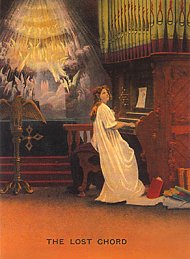

The Lost Chord
View on Wikipedia

"The Lost Chord" is a song composed by Arthur Sullivan in 1877 at the bedside of his brother Fred during Fred's last illness in Fulham, West London, England. The manuscript is dated 13 January 1877; Fred Sullivan died five days later. The lyric was written as a poem by Adelaide Anne Procter called "A Lost Chord", published in 1860 in The English Woman's Journal.[1]
The song was immediately successful[2] and became particularly associated with American contralto Antoinette Sterling, with Sullivan's close friend and mistress, Fanny Ronalds, and with British contralto Clara Butt. Sullivan was proud of the song and later noted: "I have composed much music since then, but have never written a second Lost Chord."[3]
Many singers have recorded the song, including Enrico Caruso, who sang it at the Metropolitan Opera House on 29 April 1912 at a benefit concert for families of victims of the Titanic disaster.[4] The piece has endured as one of Sullivan's best-known songs, and the setting is still performed today.[5]
Background
[edit]
In 1877, Arthur Sullivan was already Britain's foremost composer, having produced such critically praised pieces as his Irish Symphony, his Overture di Ballo, many hymns and songs, such as "Onward, Christian Soldiers", and the popular short operas Cox and Box and Trial by Jury. Adelaide Anne Procter was an extremely popular poet in Britain, second in fame only to Alfred Lord Tennyson.[5] On the early published sheet music for the song, Procter's name is written in larger letters than Sullivan's.[6] Sullivan's father's death had inspired him to write his Overture In C (In Memoriam) over a dozen years earlier.[7]
The composer's brother, Fred Sullivan, was an actor who appeared mostly in operettas and comic operas. The playwright F. C. Burnand wrote of Fred: "As he was the most absurd person, so was he the very kindliest. The brothers were devoted to each other, but Arthur went up, and poor little Fred went under."[8] Fred played roles in several of his brother's operas: Cox and Box, Thespis, The Contrabandista and Trial by Jury. He fell ill in 1876 and died in January 1877.[9]
During Fred's final illness, Arthur visited his brother frequently at his home on King's Road in Fulham, London. The composer had tried to set Procter's poem to music five years previously but had not been satisfied by the effort.[10] As he had been inspired by his grief at the death of their father, he was again inspired to compose by his brother's decline. At Fred's bedside, he sketched out the music to The Lost Chord, and the manuscript is dated 13 January 1877, five days before Fred's death.[11][3]
Although not written for sale, the song became the biggest commercial success of any British or American song of the 1870s and 1880s. The American contralto Antoinette Sterling premiered the piece on 31 January 1877 at a Boosey concert,[12] and she became one of its leading proponents,[10] as did Sullivan's close friend and sometime mistress, Fanny Ronalds,[5] who often sang it at society functions.[11] Dame Clara Butt recorded the song several times, and many famous singers recorded it, including Enrico Caruso in 1912.[4][6] A copy of the music was buried with Ronalds, who bequeathed the manuscript to Butt in 1914. Butt's husband, baritone Kennerley Rumford, gave the manuscript to the Worshipful Company of Musicians in 1950.[13]
Musicologist Derek B. Scott offers this analysis of the composition:

Sullivan's setting is structurally sophisticated in its treatment of Procter's verses, and offers a contrast to ... simple strophic setting.... This demonstrates the variety of forms to be found in drawing-room ballads before there were moves toward greater homogeneity in the 1880s.... For the most part, the song steers clear of the predictable.... There are some delightful surprises, such as the sudden coloring of the harmony with the old church Mixolydian mode as the singer recounts the striking of the mysterious chord. Sullivan shows a thorough understanding of the possibilities of the piano, ranging widely across its compass and making powerful dynamic and textural contrasts. He also does a fine job of imitating an organ style in the introduction. Sullivan's compositional skill where words are concerned is evident in the way he treats the quatrains of Procter's poem ... creating a subtle musical structure that avoids an obviously sectional character, despite the poem's hymn-like form.[10]
1888 recording for Edison
[edit]In 1888, Thomas Edison sent his "Perfected" Phonograph to Mr. George Gouraud in London, England, and on 14 August 1888, Gouraud introduced the phonograph to London in a press conference, including the playing of a piano and cornet recording of Sullivan's "The Lost Chord", one of the first recordings of music ever made.[14]
A series of parties followed, introducing the phonograph to members of society at the so-called "Little Menlo" in London. Sullivan was invited to one of these on 5 October 1888. After dinner, he recorded a speech to be sent to Thomas Edison, saying, in part:
I can only say that I am astonished and somewhat terrified at the result of this evening's experiments: astonished at the wonderful power you have developed, and terrified at the thought that so much hideous and bad music may be put on record forever. But all the same I think it is the most wonderful thing that I have ever experienced, and I congratulate you with all my heart on this wonderful discovery.[14]
These recordings were discovered in the Edison Library in New Jersey in the 1950s.[14]
Text of Sullivan's setting
[edit]

The Lost Chord
Seated one day at the organ,
I was weary and ill at ease,
And my fingers wandered idly
Over the noisy keys.
I know not what I was playing,
Or what I was dreaming then;
But I struck one chord of music,
Like the sound of a great Amen.
It flooded the crimson twilight,
Like the close of an angel's psalm,
And it lay on my fevered spirit
With a touch of infinite calm.
It quieted pain and sorrow,
Like love overcoming strife;
It seemed the harmonious echo
From our discordant life.
It linked all perplexèd meanings
Into one perfect peace,
And trembled away into silence
As if it were loth to cease.
I have sought, but I seek it vainly,
That one lost chord divine,
Which came from the soul of the organ,
And entered into mine.
It may be that death's bright angel
Will speak in that chord again,
It may be that only in Heav'n
I shall hear that grand Amen.[15]
Cultural influence
[edit]In film and television
[edit]There have been at least six films titled The Lost Chord, as well as one titled The Trail of the Lost Chord.[16] In the 1999 film Topsy-Turvy, a scene depicts Fanny Ronalds (played by Eleanor David) facetiously introducing it as "a new composition" at an 1884 party at her house; she then sings it with Sullivan (Allan Corduner) at the piano and Walter Simmonds (Matthew Mills) at the harmonium.[6]

The Strangers TV series had an episode called "The Lost Chord".[17]
Music
[edit]Jimmy Durante recorded a humorous song called "I'm the Guy Who Found the Lost Chord", which he also sings in the 1947 film This Time for Keeps.[18] George and Ira Gershwin wrote a song called "That Lost Barber Shop Chord", which was included in their 1926 revue Americana.[19] The Moody Blues produced an album called In Search of the Lost Chord in 1968. According to keyboardist Mike Pinder, the title was inspired by the Durante song.[20]
Literature and other
[edit]The novel Bad Wisdom by Bill Drummond and Mark Manning concerns their trip to the North Pole with an icon of Elvis to search for the Lost Chord.[21][page needed] Edith Wharton's novel Ethan Frome contains references to the song. In Isaac Asimov's Black Widowers story "The Quiet Place" (Ellery Queen's Mystery Magazine, March 1988), the traditional "Guest" of the Black Widowers hums this tune all through a dinner. Caryl Brahms wrote a 1975 book called Gilbert and Sullivan: Lost Chords and Discords.[22][page needed]
Notes
[edit]- ^ Proctor, Adelaide Anne. "The Lost Chord", The English Woman's Journal, March 1860, p. 36
- ^ Jacobs, p. 2
- ^ a b "The Lost Chord", The Gilbert and Sullivan Archive, accessed 13 August 2014
- ^ a b 1912 Caruso recording, Encyclopedia-titanica.org, 2005, accessed 28 August 2014
- ^ a b c "The Lost Chord, song for voice & piano"[permanent dead link], All Music Guide, ClassicalArchives.net, 2008
- ^ a b c Buckley, Jack. "In Search of The Lost Chord". MusicWeb International, accessed 22 June 2014
- ^ "Norwich Music Festival", The Observer, 4 November 1866, p. 6
- ^ Quoted, in Ayer, p. 408
- ^ Stone, David. Fred Sullivan Archived 6 September 2006 at the Wayback Machine, Who Was Who in the D'Oyly Carte Opera Company, 21 July 2009, accessed 21 October 2015
- ^ a b c Scott, Derek B. "The Musical Soirée: Rational Amusement in the Home", The Victorian Web, 2004, accessed 30 September 2009
- ^ a b Ainger, pp. 128–29.
- ^ "London Ballad Concerts", The Graphic, 3 February 1877, issue 375
- ^ Mackie, David. Arthur Sullivan and The Royal Society of Musicians, The Royal Society of Musicians of Great Britain, 2006, p. 143 ISBN 0-9509481-3-6
- ^ a b c Historic Sullivan Recordings, The Gilbert and Sullivan Archive, accessed 13 August 2014
- ^ In Procter's original poem, titled "A Lost Chord", the second verse begins "I do not know", the sixth verse has "and" instead of "but", and "Heaven" is spelled out in the last verse. The British Library holds copies of ten other settings by various composers, and most of these change the title to "The" rather than "A" Lost Chord, and also change Procter's and to but in the sixth verse, among other changes. See "Lost Chord", The British Library, accessed 19 February 2023
- ^ The Internet Movie Database listing of films called The Lost Chord
- ^ Information about the TV episode called "The Lost Chord"
- ^ Durante, Jimmy. "I'm the Guy Who Found the Lost Chord", NME magazine, IPC Media Entertainment Network, retrieved 31 December 2012
- ^ Jablonski, Edward. "Gershwin: With a New Critical Discography", Da Capo Press, 1988
- ^ Moody Blues documentary, 2013
- ^ Drummond, Bill; Manning, Mark (1996). Bad Wisdom. London: Penguin Books. ISBN 978-0140261189.
- ^ Brahms, Caryl. Gilbert and Sullivan: Lost Chords and Discords, Boston: Little, Brown and Company (1975)
References
[edit]- Ainger, Michael (2002). Gilbert and Sullivan – A Dual Biography. Oxford: Oxford University Press. ISBN 0-19-514769-3.
- Ayre, Leslie (1974). The Gilbert & Sullivan Companion. London: W.H. Allen & Co Ltd. Introduction by Martyn Green.
- Jacobs, Arthur (1984). Arthur Sullivan: A Victorian Musician. Oxford University Press. ISBN 0-19-315443-9.
- Information about Procter and the song
External links
[edit]- History and autographed manuscript at The Musicians' Company Archive
- Vocal score at IMSLP
- "The Lost Chord" at The Cyber Hymnal
- "The Lost Chord" at Project Gutenberg
Performances
- "The Lost Chord" link to recording of the song being sung by Enrico Caruso
- The Lost Chord sung by Dame Clara Butt
- Derek B. Scott singing Sullivan's setting, and information about it
- Richard Holmes singing Sullivan's setting
| Operas | |
|---|---|
| Related |
|
| Sullivan operas |
|


The Lost Chord
View on GrokipediaOrigins
The Poem by Adelaide Anne Procter
"A Lost Chord" is a poem written by Adelaide Anne Procter in 1858 and first published in March 1860 in The English Woman's Journal, a periodical she helped found to advocate for women's employment and rights.[6][7] The poem appeared on page 36 of the journal and was later reprinted in Procter's 1861 collection Legends and Lyrics, a volume that showcased her lyrical and narrative verse and became one of her most successful publications.[8][9] Adelaide Anne Procter was born on October 30, 1825, in Bedford Square, London, as the eldest daughter of the poet Bryan Waller Procter (known as Barry Cornwall), whose literary circle included prominent figures like Charles Dickens.[10][11] A prolific Victorian poet, Procter contributed regularly to periodicals such as Dickens's Household Words and was deeply engaged in social reform, co-founding the Langham Place Circle to promote women's education, property rights, and access to professions.[12] Her charitable efforts focused on aiding the homeless, destitute women, and the working poor; she volunteered at institutions like the Providence Row Night Refuge and used proceeds from her poetry sales to support such causes.[11] Plagued by chronic health issues, including tuberculosis that confined her to bed in her final years, Procter died on February 2, 1864, at the age of 38, leaving behind a legacy of over 100 published poems that blended sentiment with social commentary.[7][13] The poem explores themes of spiritual longing and transcendence, depicting a musician who, in a moment of weariness, strikes a single chord that evokes divine harmony and peace, only for it to vanish amid the discord of daily life.[14] This "lost chord" symbolizes an elusive connection to the eternal, resonating with Victorian religious sentiments of seeking solace in faith during an era of industrial upheaval and personal turmoil.[15] Procter's work carries subtle feminist undertones, reflecting the constraints of gender roles through imagery of a "discordant life" that hinders full spiritual fulfillment, echoing her advocacy for women's emancipation from societal limitations.[16] The narrative voice, often feminine and introspective, underscores emotional depth and quiet resilience in the face of earthly strife. Upon publication, "A Lost Chord" gained immediate popularity in Victorian periodicals, where it was frequently reprinted and praised for its evocative emotional resonance.[17] Charles Dickens, a close family friend and editor who had published Procter's early submissions, admired the poem's heartfelt spirituality and included it in editions of her collected works, noting its power to stir profound feelings in readers.[18] Its widespread appeal in literary circles helped establish Procter's reputation as a leading female poet of the time, later amplified by Arthur Sullivan's 1877 musical setting.[11]Arthur Sullivan's Inspiration and Composition
Arthur Seymour Sullivan, born on 13 May 1842 in Lambeth, London, was a prominent English composer renowned for his comic operas in collaboration with W.S. Gilbert, as well as his sacred music, hymns, and solo songs.[19][20] Educated as a chorister at the Chapel Royal, Sullivan developed a deep affinity for church music, composing numerous anthems and hymn tunes between 1867 and 1874 that emphasized melodic simplicity and emotional depth.[21] He was knighted by Queen Victoria on 22 May 1883 for his contributions to British music.[22] The inspiration for Sullivan's setting of "The Lost Chord" stemmed from a profound personal tragedy: the final illness of his elder brother, Frederic Sullivan, an actor who succumbed to tuberculosis on 18 January 1877.[23] Sullivan composed the song on 13 January 1877 while keeping vigil at Fred's bedside in Fulham, West London, amid weeks of mental anguish where the poem's lines by Adelaide Anne Procter repeatedly echoed in his mind.[24] The manuscript, preserved in Sullivan's handwritten score, bears the date and is dedicated to Fred, encapsulating themes of loss, spiritual longing, and transcendence that mirrored the composer's grief and the poem's mystical quest for divine harmony.[25] Written for solo voice and piano in E-flat major, the composition features a straightforward, emotive melody that Sullivan crafted to evoke the poem's ethereal essence, drawing on his expertise in hymnody and sacred works to convey quiet introspection and uplift.[26] The score's intimate structure reflects its origins in a moment of bedside solace, with Sullivan completing it as his brother briefly rested, before the imminent loss.[25]Publication and Early History
Premiere and Initial Performances
The premiere of Arthur Sullivan's "The Lost Chord" occurred on 31 January 1877 at St. James's Hall in London during a Boosey Ballad concert, where it was sung by American contralto Antoinette Sterling and accompanied by the composer on piano.[27]) The sheet music was published later that year by Boosey & Co. in London, available as a piano-vocal score with an optional harmonium accompaniment, facilitating its adoption by amateur singers in drawing-room settings. In its initial months, the song featured in London benefit concerts and private recitals, often performed by notable Victorian artists including Fanny Ronalds, a close associate of Sullivan who contributed to its early dissemination among elite social circles.[1] Antoinette Sterling further propelled its reach through her extensive tours in the United States during the 1880s, where she presented the piece to enthusiastic American audiences, enhancing its transatlantic popularity.[28]Commercial Success in the Victorian Era
Following its premiere, "The Lost Chord" achieved remarkable commercial success, with sheet music sales exceeding three million copies in the United States alone by 1897, despite limited copyright protections for British composers abroad.[29] In Britain and America, it became a staple of parlor repertoires, where amateur musicians performed it regularly in domestic settings, reflecting its accessibility and emotional resonance.[30] The piece embodied core Victorian ideals of sentimentality and spirituality, capturing the era's fascination with transcendent harmony and divine longing in a manner that resonated deeply with middle-class audiences.[4] Endorsements from royalty, including Queen Victoria's appreciation for Sullivan's oeuvre, further elevated its cultural standing.[31] Economically, "The Lost Chord" provided Sullivan with substantial income independent of his Gilbert and Sullivan collaborations, reportedly generating royalties equivalent to over £1,200,000 in modern terms from sales of more than 250,000 copies during his lifetime.[32] Published by Boosey & Co., it exemplified how popular songs could sustain a composer's finances in an era of booming sheet music markets, though pirated editions overseas diminished direct earnings.[29] By 1890, the song was regarded as one of the century's best-selling compositions, with its enduring appeal leading to amateur reproductions on emerging wax cylinder devices and solidifying Sullivan's reputation as a commercial powerhouse.Lyrics and Musical Elements
Text of Sullivan's Setting
Arthur Sullivan's musical setting of "The Lost Chord" utilizes the full text of Adelaide Anne Procter's 1860 poem, with only slight modifications to enhance singability and rhythmic flow. These include contractions such as "fever'd" and "seem'd" for smoother phrasing, and adjustments to line endings to accommodate breath points in performance, but the core content remains faithful to the original without substantive changes.[24][33] The lyrics, structured in seven quatrains, evoke a narrator's transcendent musical experience amid personal distress. They are presented below verbatim as set by Sullivan: Seated one day at the organ,I was weary and ill at ease,
And my fingers wandered idly
Over the noisy keys;
I know not what I was playing,
Or what I was dreaming then,
But I struck one chord of music,
Like the sound of a great Amen.[24] It flooded the crimson twilight,
Like the close of an Angel's Psalm,
And it lay on my fever'd spirit
With a touch of infinite calm;
It quieted pain and sorrow,
Like love overcoming strife;
It seem'd the harmonious echo
From our discordant life.[24] It link'd all perplexéd meanings
Into one perfect peace,
And trembled away into silence
As if it were loth to cease;
I have sought but I seek it vainly,
That old lost chord divine,
Which came from the soul of the organ,
And enter'd into mine.[24] It may be that Death's bright Angel
Will speak in that chord again;
It may be that only in Heaven
I shall hear that grand Amen.[24] The poem employs iambic tetrameter throughout, with a consistent ABAB rhyme scheme in each quatrain, creating a rhythmic, hymn-like cadence that mirrors the theme of musical harmony. Religious imagery permeates the text, portraying music as a conduit to divine peace, with references to angels, psalms, and the "Amen" symbolizing ultimate spiritual resolution.[34]) Thematically, the lyrics trace a progression from earthly turmoil—marked by weariness and idle wandering—to a fleeting moment of celestial harmony, followed by persistent longing for its return, and culminating in hopeful anticipation of reunion in the afterlife. This narrative arc underscores themes of human striving for transcendence and the redemptive power of divine music.[34]