


Community hub
Recent from talks
Contribute something
Nothing was collected or created yet.
Tubas (city)
View on Wikipedia32°19′20″N 35°22′07″E / 32.32222°N 35.36861°E
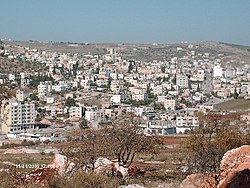
Tubas (Arabic: طوباس, Tûbâs) is a city in the northeast of the West Bank, Palestine, and capital of the Tubas Governorate. A city of over 30,000 inhabitants,[1] it is situated northeast of Nablus, west of the Jordan Valley and is an economic center. Its urban area consists of 2,271 dunams (227 hectares). It is governed by a municipal council of 15 members and most of its working inhabitants are employed in agriculture or public services.
Key Information


Tubas has been identified as the ancient town of Thebez (/ˈθiːbɛz/), a Canaanite town famous for revolting against King Abimelech. In the late 19th century, during Ottoman rule in Palestine, Arab clans living in the Jordan Valley came to live in Tubas, which became a major town in the District of Nablus, particularly known for its timber and cheese making. It came under the British Mandate of Palestine in 1922, was annexed by Jordan after their capture of the town in the 1948 Arab–Israeli War, and then occupied by Israel since the 1967 Six-Day War. The Palestinian National Authority has had control of Tubas since the city was transferred to its jurisdiction in 1995.
History
[edit]Biblical Thebez
[edit]Edward Robinson thought Tubas to be identical with the Canaanite/Israelite town of "Thebez" (Hebrew: תבץ) mentioned in the Hebrew Bible in the Book of Judges.[2][3][4] It is the namesake of the titular woman of Thebez. Besides the Biblical story, nothing is known about Thebez before or after the revolt.[5]
Roman and Byzantine periods
[edit]Archaeological remains such as cemeteries and olive presses indicate that Tubas was inhabited during the Roman period.[6]
Eusebius mentioned Thebez being 13 Roman miles east of Neapolis (Nablus), which led to it being identified with Tubas, which is 16 km (10 mi.) east of Neapolis Nablus.[5]
Ottoman period
[edit]Late 16th century
[edit]In 1596 it appeared in the Ottoman tax registers as "Tubas", in the nahiya of Jabal Sami in the liwa of Nablus. It had a population of 41 households and 16 bachelors, all Muslim. The villagers paid a fixed tax rate of 33.3% on wheat, barley, summer crops, olive trees, occasional revenues, goats, beehives, and a press for olives or grapes; a total of 11,704 akçe.[7]
Late 19th century
[edit]In the late 19th century, with Palestine still being Ottoman rule, groups of Arabs belonging to the Daraghmeh clan—mostly shepherds and farmers who lived in the Jordan Valley—migrated northward to the site because of its fertile ground, proximity to several springs, and its high elevation compared to the Jordan Valley and Wadi al-Far'a plain;[6] Mount Gerizim was visible from the area.[8] The Daraghmeh clan had lived in the Jordan Valley since the 15th century and in addition to Tubas, they founded or inhabited the nearby hamlets of Kardala, al-Farisiya, Khirbet al-Malih, Kishda, Yarza, and Ras al-Far'a. Soon after being established in Tubas, Arabs from Najd, Syria, Transjordan, Hebron and nearby Nablus came to settle in the area.[6] During this period, Tubas became the site of clashes between the 'Abd al-Hadi and Tuqan families of Nablus and suffered incursions by Bedouins from areas east of the city.[8] The Jarrar family did not inhabit, but administered Tubas, as it was located within the nahiya ("subdistrict") of Mashariq al-Jarrar.[9]
Tubas was one of the largest villages in the District of Nablus. Most of the inhabitants resided in mud-built houses or tents in order to work on their distant lands in the Jordan Valley and to graze their sheep and goat flocks.[10] According to traveler Herbert Rix, compared to other towns of its size in Samaria, Tubas was "well-to-do" and had abundant amounts of timber, which was harvested for firewood.[3] Tubas, unlike the villages in the rest of the district, depended on livestock and not olives for income. Livestock products included cheese, clarified butter, woolen rugs, tents, ropes, and cloth bags.[11] In 1882 a boys' school was established in the town.[12]
In 1877, Lieutenant Kitchener of the Palestine Exploration Fund (PEF) survey team, reported uncovering an Arabic inscription buried in the wall of the village mosque recording its building and dedication. He also wrote that the villagers had paid a bribe of £100 in gold to the Pasha of Nablus to avoid their young men being conscripted into the Turkish army fighting in Crimea. He noted that they would probably have to repeat the payment.[13]
The PEF noted that the Samaritans believed that the tomb of Asher, known locally as Nabi Tota ("the good prophet"), was located in Tubas. The tomb served as a shrine in local Muslim tradition.[14]
British Mandate
[edit]In 1917, the British captured Palestine from the Ottomans. After rule under a military government, it was reorganized in 1922–23 Tubas was incorporated into the British Mandate of Palestine.
In the 1922 census of Palestine, Tubas had a population of 3,449 (3,441 Muslims[15] and 7 Orthodox Christians[16]). In the 1931 census, Tubas, (including Kashda and Jabagia) had 773 occupied houses and a population of 4,097 (4,068 Muslims and 29 Christians).[17]
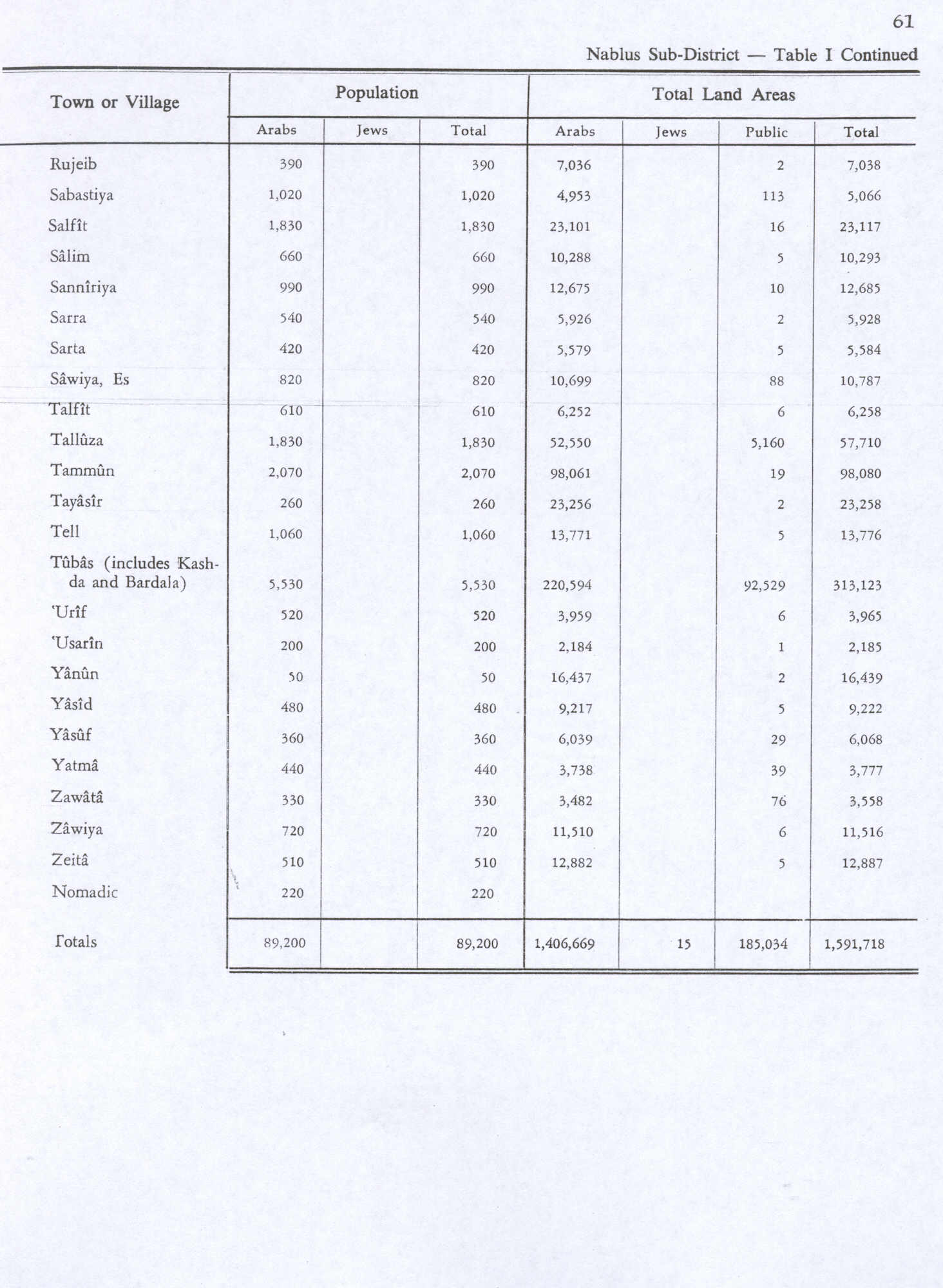
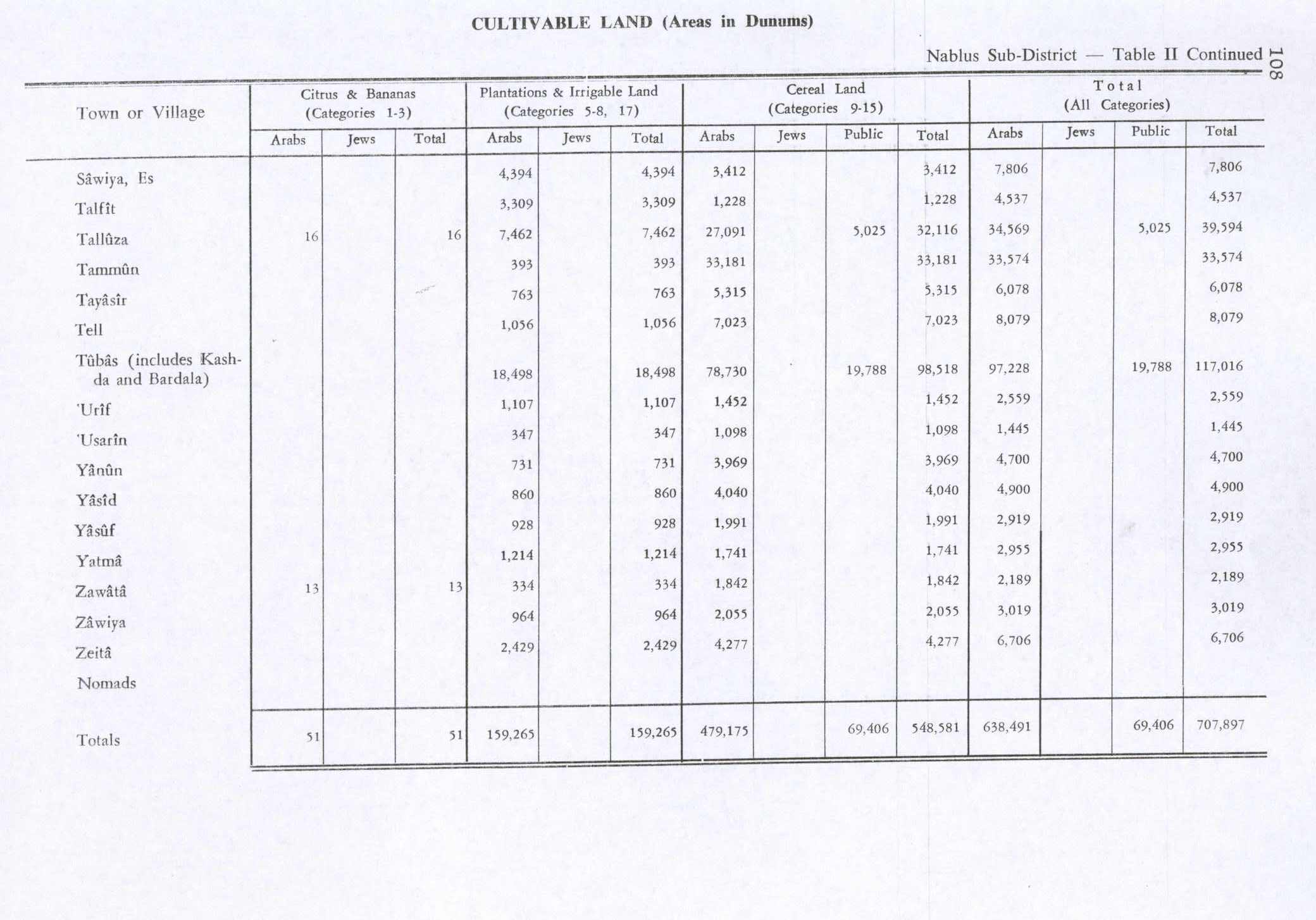
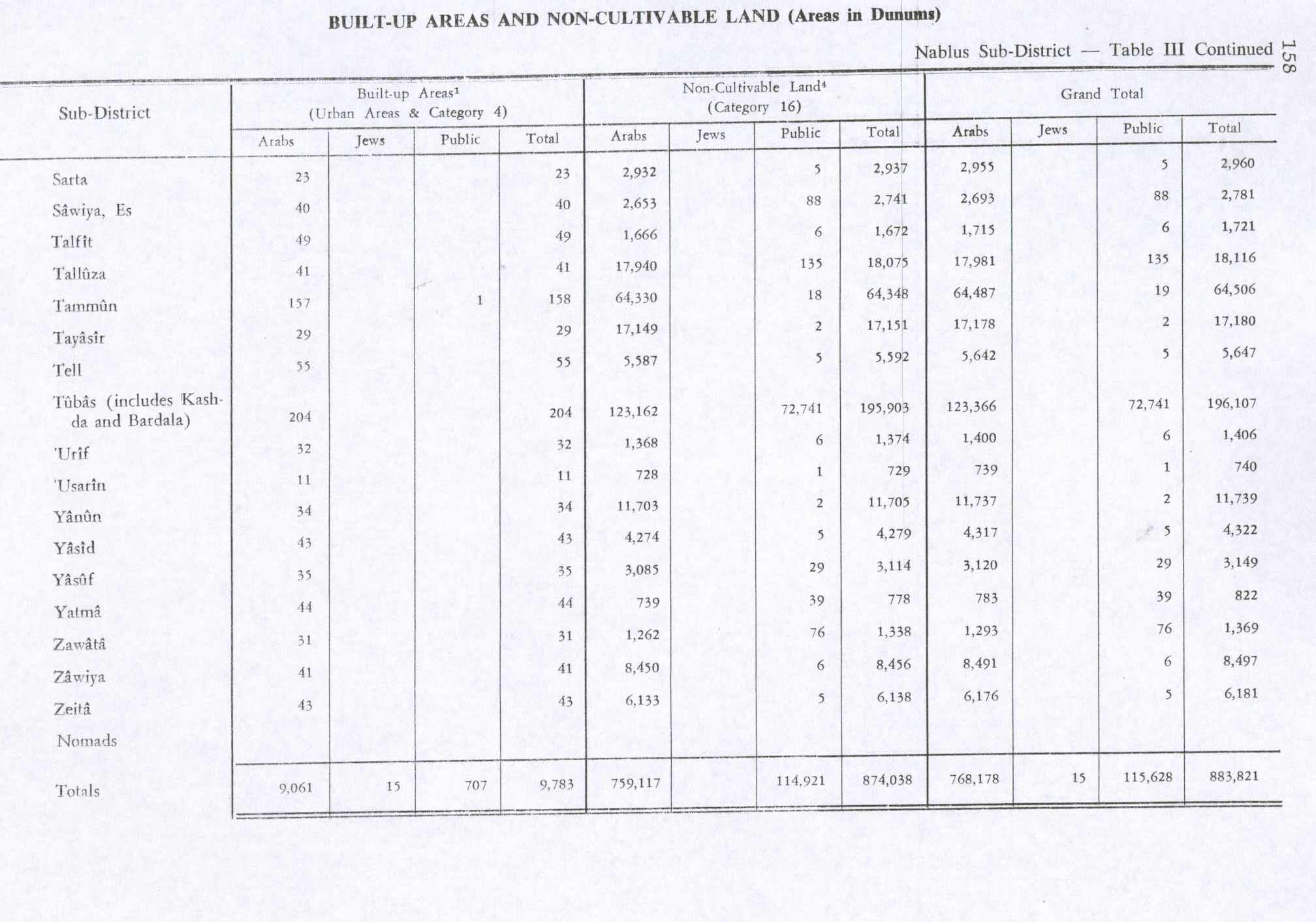
In Sami Hadawi's 1945 statistics, a land and population survey, Tubas and nearby Bardala had a combined population of 5,530 (5,470 Muslims and 60 Christians[18]), with 313,123 dunams of land, according to an official land and population survey.[19] Of this, 18,498 dunams were used for plantations and irrigable land, 98,518 dunams for cereals,[20] while 204 dunams were built-up (urban) land.[21]
In 1947, the United Nations drew up a partition plan to divide Palestine into Jewish and Arab states; Tubas and the surrounding villages and hamlets were to be included in the Arab state. During the 1948 Arab–Israeli War, Fawzi al-Qawuqji led 750 Arab Liberation Army (ALA) soldiers to Tubas from Transjordan and set up base there; Tubas would serve as the ALA's headquarters in central Palestine throughout the war.[22]
Jordanian annexation
[edit]In the wake of the 1948 Arab–Israeli War, and after the 1949 Armistice Agreements, Tubas became a part of Jordan.
In 1955 the first girls' school was opened.[12]
In 1961, the population was 5,709,[23] while in 1964, Tubas alone had a population of 5,880.[24]
Post-1967
[edit]
Since the Six-Day War in 1967, Tubas has been under Israeli occupation.
Tubas was transferred to Palestinian National Authority (PNA) control in 1995 under the Interim Agreement on the West Bank and the Gaza Strip. During the Jordanian and Israeli periods, the city was under the administration of the Nablus Governorate, but in 1996, the PNA declared Tubas and the immediate area to be an electoral district, and later, an independent administrative area—the Tubas Governorate.[25]
Tubas has not seen as much violence in the Israeli–Palestinian conflict as nearby Nablus and Jenin, but a number of incidents occurred during the Second Intifada, which began in 2000. In April 2002, the Israeli forces (IDF) killed six active Hamas members in the town, including Ashraf Tamza Daraghmeh—the chief Hamas commander in Tubas and the surrounding area.[26][27] On August 31, 2002, an Israeli Apache helicopter fired four Hellfire missiles at a civilian car suspected of carrying a local al-Aqsa Martyrs Brigades commander and a nearby home. The strike instead killed five civilians, including two children, two teenagers and a 29-year-old Fatah activist accused of being a member of the al-Aqsa Brigades. The Israeli Defense Minister, Binyamin Ben-Eliezer, issued a statement expressing "regret" over "harming" civilians in Tubas. Ben-Eliezer described the raid in Tubas as a "mistake", and promised that the army would investigate the incident.[28] On August 21, 2009, a clash between the Sawafta clan and another city clan left a member of the former dead and 38 others injured. Five homes were also burnt and Palestinian Security Forces arrested five people in connection to the death.[29]
On 27 August 2024, the IDF invaded Tubas along with Nablus, Jenin and Tulkarm as part of their "Summer Camp" offensive.
Geography
[edit]
Tubas is located in the northern West Bank with an elevation of 362 meters (1,188 ft) above sea level, whereas most of the Tubas Governorate is located within the Jordan Valley to the south.[6] In a 1945 land survey, Tubas along with nearby Bardala and Kardala consisted of 313,123 dunams (31,312 hectares) of which 220,594 was Arab-owned and the remainder being public property.[19] As of 2005[update], its total land area consists of 295,123 dunams (29,512 hectares), of which 2,271 is classified as built-up, roughly 150,000 used for agricultural purposes and about 180,000 has been expropriated by Israel for military bases and buffer zone.[30]
Tubas is located to the northeast of Nablus, and west of the Jordan Valley. Nearby localities include the town of Aqqaba to the north, Tayasir and Aqabah villages to the northeast, Ras al-Far'a to the southwest, the Palestinian refugee camp of Far'a to the south and the al-Bikai'a village cluster to the southeast.[6]
It has a moderate climate; the summer is hot and dry, and the winter is cold and wet. The average annual temperature is 21 °C (70 °F), and the average annual humidity rate is 56%.[6]
Demographics
[edit]About 1,100 residents fled Tubas after the 1967 Six-Day War mostly to the Souf refugee camp in Jordan,[31] while 260 immigrated there and in 1981 its population was 5,300.[32]
In the Palestinian Central Bureau of Statistics' (PCBS) first official census in 1997, Tubas had a population of 11,760 inhabitants. The gender make-up was 50.8% male and 49.2% female. Tubas has an overwhelmingly young population with 52.7% of the city's residents below the age of 20. People between the ages of 20 and 34 constitute 24.7%, 17.7% between the ages of 35 and 64, while people above the age of 64 constituted 4.9% of the population.[33] The census also revealed that refugees made up 6.1% of the total residents.[34]
In the 2007 census by the PCBS, Tubas had a population of 16,154,[35] increasing around 33% from 1997. The city represents roughly a third (33.4%) of the Tubas Governorate's total population. The city's modern-era founders, the Daraghmeh clan, constitute 70% of Tubas' inhabitants.[6] The clan has several smaller branches, including the Eweidat, Maslamany, Aryan, Abd al-Razeq and Abu Khazaran families.[36] The Sawafta family make up 25%, the Husheh make up 3% and the Fuquha represent the remaining 2%.[6] Residents of the village trace their origins to various places, including Hebron and Nazareth (the Zuabis). Some are Bedouins.[37]
The inhabitants of Tubas are predominantly Muslims,[2][8] but there is a community of approximately 60 Palestinian Christians, all belonging to the Greek Orthodox Church.[38] The Christian community worships at the Holy Trinity Church in the city and is serviced by a priest from nearby Zababdeh.[12]
According to the 2017 census by the PCBS, the population of Tubas was 21,431.[1]
Economy
[edit]The economical situation Tubas during the 1993–99 period was prosperous, however since the start of the Second Intifada in 2000–01, Tubas' income level has decreased by roughly 40%. Prior to the Intifada, the average household income was 2,500 NIS; it has since receded to about 1,500 NIS. A major factor that has resulted from the conflict was the confiscation of agricultural land located within the city's or its governorate's jurisdiction by Israeli settlements or military authorities. According to the PCBS, in 1999, approximately 52% of the citizens were within the working age (15-64). Of the city's labor force, 48% are females.[6] The unemployment rate increased dramatically from 20% in 1999 to 70% after the year 2000.[6] Prior to the Intifada, 35% of the total labor force worked in Israel.[39]
Currently, agriculture constitutes 60% of Tubas' economic activity, public services comprise 17%, trade is 10%, Israeli labor is 8%, construction and industry make-up the remaining 5%. In the city, there are 240 shops and stores, 70 service institutions and one big ready mix concrete factory 30 small ones.[6]
The main economic sector in Tubas is agriculture. There is a total of 150,000 dunams of arable land, of which 124,450 dunams are covered by forests and 10,604 dunams cultivated. Although the land is fertile, there is a lack of water for irrigation. The only spring used is in nearby Ein Far'a. Field crops account for 49% of the cultivable land, while fruit orchards account for 40% and vegetables make-up 11%. Israeli trenches around the neighboring villages of Ras al-Ahmar and Khirbet al-'Atuf prevent access to nearly 40% of Tubas' arable lands.[6]
Many Tubas residents keep livestock, mostly sheep; in 2005, there was a total 6,670 sheep. Other livestock owned include 96 heads of cattle, 880 goats and 126,500 poultry. In addition, 123 beehives were kept.[30] In 2006 the Golden Sheep Dairy factory was founded in Tubas with help from UCODEP, an Italian NGO. The factory specializes in the production of Italian cheese and primarily targets cosmopolitan consumers in Ramallah, Bethlehem and Jerusalem as well as international workers and diplomats living in the West Bank.[40]
Government
[edit]Tubas serves as the muhfaza ("capital" or "seat") of the Tubas Governorate. Since 1995, Tubas has been located in Area A, giving the PNA full control over its security, administration and civilian affairs.[6]
Tubas has been governed by a municipal council since 1953, when it was granted permission to do so by Jordanian authorities who controlled the West Bank at the time. The council is made up of 15 members including the mayor, and is headquartered in the municipal hall in the center of the town. The municipality has over 60 employees. Responsibilities of the municipality include civil administration, urban planning and development, social development services, distribution of social services, the issuing of building permits and infrastructural maintenance: water, electricity and solid waste collection.[6]
Husam Daraghmeh was succeeded, an independent candidate, elected in the 2022 Palestinian municipal elections. During the elections, women won two seats, and though Tubas is normally a Fatah stronghold, all seats were won by independent political lists.[41]
Education
[edit]In 2004–05, Tubas had twelve schools; four for males, three for females and five co-educational. There were 4,924 students and 191 teachers. In addition, six kindergartens are located in the city, and have a total of 620 pupils. In 1997, the literacy rate was 86%; females comprised 78.3% of the illiterate population. Of the literate population, 25.7% completed elementary education, 23.3% completed preparatory education and 22.1% completed secondary or higher education.[6] Many students throughout the Jordan Valley receive their education in Tubas.[12] The Al-Quds Open University, based in Jerusalem, has a campus in Tubas known as Al-Quds Open University-Tubas Educational Region. In 2006, 1,789 students were enrolled in the university, it had 90 professors and 24 other employees.[42]
Local infrastructure
[edit]Tubas contains six mosques. The main mosques are the Abd ar-Rahan Mosque, the al-Tawled Mosque, Umar ibn al-Khattab Mosque, and Shaheed Mosque.[6] The Holy Trinity Orthodox Church is also located in Tubas, in the northern part of the city. The church was built in 1976 to serve the small Orthodox Christian community. It consists of a prayer room, a fellowship hall, an office, and a library for children.[43]
Since Tubas is the capital and largest city in the Tubas Governorate, it acts as the main provider of services to the towns and villages of the governorate. All Palestinian National Authority offices that serve the governorate are located in the city. There are 21 government institutions in Tubas, including a post office, the Palestinian Ministry of Labor office, the Palestinian Ministry of Agriculture office, the Palestinian Ministry of Social Affairs office, the fire department and a police station.[6]
Transportation
[edit]Buses and taxis are the primary means of transportation in Tubas. The total length of paved roads is 10,000 meters (33,000 ft), whereas there are 10,000 meters (33,000 ft) of deteriorating paved roads and 25,000 meters (82,000 ft) of road that are entirely unpaved. Tubas is located on Highway 588 connected to the main Ramallah-Nablus road (Highway 60) by a network of northeastern offshoots of the road, that pass through the villages of Azmut, al-Badhan and Ras al-Far'a. It is connected to Jenin from a northern road which passes through 'Aqqaba, Zababdeh and finally to Jenin.[6] Travel to Jordan is through Highway 57 which is connected with Highway 588 just to the south of Tubas.[44]
Health care
[edit]The city contains five health centers run by various organizations including the Palestinian Red Crescent.[39] There are no hospitals in Tubas, nor in the Tubas Governorate; Residents must travel to Nablus for hospital treatment, but there are two ambulances in Tubas for emergency transportation. There are four clinics in the city: Two are run by non-governmental organizations, one by the Palestinian National Authority and one is privately owned. The clinics lack modern equipment and specialists, however. In addition, ten pharmacies exist in Tubas.[6]
Utilities
[edit]Approximately 60% of the residents have a telephone connection, and roughly 90% are connected to the water. The Tubas Municipality administers all water resources in and around the city. In addition to the water network, there is one spring (Far'a) in the immediate area which is the main provider of water for use in households. The city also has a water reservoir with a capacity of 900 cubic metres (31,783 cubic feet). This is primarily used to provide water to the urban areas of the city during Summer, and is only available once on a weekly basis.[6]
From 1963 to 1997 local municipal-owned electric generators provided Tubas with all of its electricity needs. In 1997, the city connected with the Tubas Area Electricity Network which is provided by the Israeli Electric Cooperation. In that period, 99% of households in the city were connected with electricity. Solid waste management in Tubas is operated by the municipality and Joint Services Council. It is collected 3-4 times daily from the residential area, which is sent to a shared dumping site 3 kilometers (1.9 mi) from the city. The main disposal method used is burning. Tubas is not connected to the sewage network, therefore all households dispose of their waste water in cesspits, a major source of pollution in groundwater.[6]
See also
[edit]References
[edit]- ^ a b c Preliminary Results of the Population, Housing and Establishments Census, 2017 (PDF). Palestinian Central Bureau of Statistics (PCBS) (Report). State of Palestine. February 2018. pp. 64–82. Retrieved 24 October 2023.
- ^ a b Robinson and Smith, 1856, p. 305
- ^ a b Rix, 1907, pp. 157-159
- ^ Skinner (1895), p. The International Critical Commentary on the Holy Scriptures of the Old and New Testaments, C. Scribner's Sons, p. 268.
- ^ a b Bromiley, 1995, p. 825
- ^ a b c d e f g h i j k l m n o p q r s t u Tubas City Profile Applied Research Institute - Jerusalem. February 2006.
- ^ Hütteroth and Abdulfattah, 1977, p. 125.
- ^ a b c Finn (1867/1877), pp. 92–93.
- ^ Doumani (1995), "The Hinterland of Nablus: Local Trade Networks".
- ^ Doumani (1995), Notes.
- ^ Doumani (1995), "The Hinterland of Nablus".
- ^ a b c d Irving, 2012, p. 236.
- ^ Kitchener, 1878, p. 62
- ^ Conder (1881), p. 201.
- ^ Barron, 1923, Table IX, Sub-district of Nablus, p. 24
- ^ Barron, 1923, p. 47
- ^ Mills, 1932, p. 65
- ^ Government of Palestine, Department of Statistics, 1945, p. 19
- ^ a b Government of Palestine, Department of Statistics. Village Statistics, April, 1945. Quoted in Hadawi, 1970, p. 61
- ^ Government of Palestine, Department of Statistics. Village Statistics, April, 1945. Quoted in Hadawi, 1970, p. 108
- ^ Government of Palestine, Department of Statistics. Village Statistics, April, 1945. Quoted in Hadawi, 1970, p. 158
- ^ Pipes (1990), p. 57.
- ^ Government of Jordan, 1964, p. 13
- ^ Stendel, Ori (1968).Arab Villages in Israel and Judea-Samaria (the West Bank) in Israel Economist, p. 21.
- ^ Bio Data - Tubas Archived 2008-02-29 at the Wayback Machine United Nations Office for the Coordination of Humanitarian Affairs.
- ^ Yesterday's Strike on a Terror Squad in Tubas Israeli Ministry of Foreign Affairs. 2002-04-06.
- ^ "Palestinians who were the object of a targeted killing in the West Bank". Archived from the original on 23 February 2010. Retrieved 4 December 2009.
- ^ Killing deliberately, 'by mistake' Archived 2009-08-08 at the Wayback Machine Al-Ahram Weekly. 2002-09-05.
- ^ Tubas: Clan clash kills one, injures 38, sees five homes burned. Ma'an News Agency. 2009-08-21.
- ^ a b Tubas City Fact Sheet Applied Research Institute - Jerusalem.
- ^ Souf Camp Dwellers[permanent dead link] DPA.
- ^ Welcome to Tubas British Mandate Census via PalestineRemembered.
- ^ Palestinian Population by Locality, Sex and Age Groups in Years Archived 2012-02-12 at the Wayback Machine (1997) Palestinian Central Bureau of Statistics.
- ^ Palestinian Population by Locality and Refugee Status Archived 2009-11-13 at the Wayback Machine (1997) Palestinian Central Bureau of Statistics.
- ^ 2007 PCBS Census. Palestinian Central Bureau of Statistics. p.107.
- ^ Ras al-Far'a Village Profile, ARIJ
- ^ Grossman, D. (1986). "Oscillations in the Rural Settlement of Samaria and Judaea in the Ottoman Period". in Shomron studies. Dar, S., Safrai, S., (eds). Tel Aviv: Hakibbutz Hameuchad Publishing House. p. 348
- ^ Locations: Tubas Salt of the Earth.
- ^ a b Toubas Archived 2007-10-09 at the Wayback Machine (2005) Health Work Committees.
- ^ Irving, 2012, p. 55.
- ^ Local elections (round one) - the winners according to local authority, gender and No. of votes obtained[permanent dead link] Higher Commission for Local Elections, pp. 11–13. 2004-12-23.
- ^ Toubas Educational Region Archived 2008-08-20 at the Wayback Machine Al-Quds Open University.
- ^ al-Mashni, Osama. Holy Trinity Orthodox Church in Tubas, Palestine
- ^ Satellite view of Tubas
Bibliography
[edit]- Barron, J. B., ed. (1923). Palestine: Report and General Abstracts of the Census of 1922. Government of Palestine.
- Bromiley, G.W. (1995). The International Standard Bible Encyclopedia: E-J. Wm. B. Eerdmans Publishing. ISBN 978-0-8028-3782-0.
- Conder, C.R. (1881). "Lieutenant Conder's reports". Quarterly Statement - Palestine Exploration Fund. 13: 158–208.
- Conder, C.R.; Kitchener, H.H. (1882). The Survey of Western Palestine: Memoirs of the Topography, Orography, Hydrography, and Archaeology. Vol. 2. London: Committee of the Palestine Exploration Fund.
- Dauphin, C. (1998). La Palestine byzantine, Peuplement et Populations. BAR International Series 726 (in French). Vol. III : Catalogue. Oxford: Archeopress. ISBN 0-860549-05-4.
- Doumani, B. (1995). Rediscovering Palestine: Merchants and Peasants in Jabal Nablus. University of California Press.
- Finn, J. (1877). Byeways in Palestine. London: James Nisbet.
- Government of Jordan, Department of Statistics (1964). First Census of Population and Housing. Volume I: Final Tables; General Characteristics of the Population (PDF).
- Government of Palestine, Department of Statistics (1945). Village Statistics, April, 1945.
- Guerin, V. (1875). Description Géographique, Historique et Archéologique de la Palestine. Vol 2: Samarie, pt 2. Paris, Imprimé par autorisation de l'empereur à l'Impr. impériale.
- Hadawi, S. (1970). Village Statistics of 1945: A Classification of Land and Area ownership in Palestine. Palestine Liberation Organization Research Center.
- Hütteroth, W.-D.; Abdulfattah, K. (1977). Historical Geography of Palestine, Transjordan and Southern Syria in the Late 16th Century. Erlanger Geographische Arbeiten, Sonderband 5. Erlangen, Germany: Vorstand der Fränkischen Geographischen Gesellschaft. ISBN 3-920405-41-2.
- Irving, Sarah (2012). Palestine. Bradt Travel Guides. ISBN 978-1841623672.
- Kitchener, H.H. (1878). "Journal of the Survey". Quarterly Statement - Palestine Exploration Fund. 10: 62–67.
- Mills, E., ed. (1932). Census of Palestine 1931. Population of Villages, Towns and Administrative Areas. Jerusalem: Government of Palestine.
- Palmer, E.H. (1881). The Survey of Western Palestine: Arabic and English Name Lists Collected During the Survey by Lieutenants Conder and Kitchener, R. E. Transliterated and Explained by E.H. Palmer. Committee of the Palestine Exploration Fund.
- Pipes, D. (1990). Greater Syria: The History of an Ambition. Oxford University Press. ISBN 9780195363043.
- Rix, Herbert (1907). Tent and Testament : a camping tour in Palestine, with some notes on Scripture sites. London: Williams and Norgate.
- Robinson, E.; Smith, E. (1841). Biblical Researches in Palestine, Mount Sinai and Arabia Petraea: A Journal of Travels in the year 1838. Vol. 3. Boston: Crocker & Brewster.
- Robinson, E.; Smith, E. (1856). Later Biblical Researches in Palestine and adjacent regions: A Journal of Travels in the year 1852. London: John Murray.
External links
[edit]
- Welcome To The City of Tubas
- Tubas City, Welcome to Palestine
- Tubas City (Fact Sheet), Applied Research Institute–Jerusalem, ARIJ
- Tubas City profile, ARIJ
- Survey of Western Palestine, Map 12: IAA, Wikimedia commons
- Tubas Bio Data - United Nations (pdf file)

| International | |
|---|---|
| National | |
| Other | |



Tubas (city)
View on GrokipediaHistory
Biblical and Ancient Periods
Tubas is tentatively identified by some scholars with the ancient Canaanite city of Thebez (Hebrew: תבץ), referenced in the Hebrew Bible as a fortified settlement near Shechem (modern Nablus) during the period of the Judges, circa 12th-11th century BCE. According to Judges 9:50-54, Thebez rebelled against Abimelech, an illegitimate son of Gideon who had declared himself king over Shechem and surrounding areas after massacring his 70 half-brothers; Abimelech besieged the city, but while attempting to burn its tower, he was struck on the head by an upper millstone dropped by an unnamed woman from above, leading to his death shortly thereafter to avoid the disgrace of dying by a woman's hand.[7] This event underscores Thebez's strategic role in regional power struggles within Canaanite and early Israelite territories in the central Jordan Valley.[8] The identification of Tubas with Thebez originates from 19th-century biblical topographers, including Edward Robinson, who noted the phonetic similarity (Tubas ≈ Thebez) and proximity—approximately 15 km northeast of Shechem—aligning with the biblical narrative's geographical context.[9] However, this link remains unconfirmed, as no archaeological evidence of Iron Age I fortifications, settlements, or artifacts contemporaneous with the Judges period has been documented at the Tubas site itself, despite surveys in the surrounding Tubas Governorate revealing Bronze Age and later remains elsewhere in the Jordan Valley.[10] Prior to the biblical era, the Tubas area likely formed part of broader Canaanite habitation in the northern Jordan Rift Valley during the Late Bronze Age (circa 1550-1200 BCE), characterized by agricultural villages and trade routes, though site-specific evidence for an urban center at Tubas is absent; pottery and settlement patterns from nearby tel sites indicate continuity from Chalcolithic periods but no distinct urban markers attributable to Tubas.[11] The scarcity of verifiable ancient material at Tubas contrasts with richer excavations at regional contemporaries like Shechem, suggesting Thebez—if located there—may have been a modest fortified outpost rather than a major city.Classical and Medieval Periods
Tubas is identified with the biblical site of Thebez, mentioned in the Book of Judges as the location where Abimelech met his death around 1050 BCE, though this predates the classical period.[8] In the Roman era (c. 63 BCE–324 CE), archaeological surveys reveal evidence of settlement, including cemeteries, olive oil presses, and a trapezoidal military camp known as Khirbet Khirab, measuring approximately 116 meters in length and associated with Roman army presence about 1 km west of the modern city toward the Jordan Valley.[12] These structures indicate agricultural and military activity in the fertile Jordan Valley region, supporting a small-scale inhabited community amid broader Roman control of Judea.[3] During the Byzantine period (c. 324–638 CE), Tubas, still referred to as Thebez, functioned as a village on the route from Neapolis (modern Nablus) to Scythopolis (Beth Shean), located about 13 Roman miles from Neapolis as noted by Eusebius of Caesarea in his Onomasticon (c. 325 CE).[13] Excavation surveys at Khirbet Khirab confirm Byzantine-era remains, including architectural features consistent with settlement continuity, reflecting the region's integration into the Byzantine administrative and ecclesiastical networks of Palaestina Secunda.[12] Water collection wells and burial tombs from this time underscore sustained rural habitation, likely tied to olive cultivation and local trade.[3] The transition to the early medieval Islamic period (7th–11th centuries CE) shows archaeological persistence at sites like Khirbet Khirab, with artifacts and structures dating to the Umayyad and Abbasid eras, indicating no major disruption in occupation following the Muslim conquest of 636–638 CE.[12] Middle Ages remains, including those from the Fatimid and Crusader contexts, further attest to Tubas's role as a modest agrarian outpost in the Jordan Valley, though specific events or major developments are undocumented in primary sources.[12] This continuity aligns with the broader pattern of rural stability in the region under successive Islamic rule, supported by agricultural infrastructure like olive presses repurposed across eras.[3]Ottoman and Mandate Eras
During the Ottoman era, Tubas functioned as a rural settlement within the Jabal Nablus region of the Sanjak of Nablus, part of the broader administrative structure in Palestine under imperial control from the early 16th century until 1917. The village's economy centered on agriculture and pastoralism, with families exploiting fertile lands near the Jordan River for crop cultivation and livestock rearing; late-19th-century migrations brought settlers, including the Daraghmeh clan, from areas such as the Jordan Valley, Nablus, Hebron, Syria, and Jordan (then part of Ottoman territories), as well as distant origins like Saudi Arabia, drawn by the moderate hill climate and water resources.[14] Specific Ottoman census data for Tubas remain limited, reflecting the empire's inconsistent enumeration practices that often prioritized taxable males and overlooked remote villages, but the area supported modest population growth amid broader regional stability under local notable families. The transition to British control occurred after Ottoman forces were defeated in Palestine during World War I, with Tubas falling under military administration in 1917–1918 before incorporation into the Mandate for Palestine formalized in 1922. As a village in the Nablus sub-district, it experienced gradual demographic expansion tied to agricultural productivity. The 1922 Mandate census recorded 3,449 residents, comprising 3,441 Muslims and 7 Orthodox Christians.[15] By the 1931 census, the population had risen to 4,097, indicating steady natural increase without significant external migration noted in records.[15] In 1945, British village statistics listed Tubas's population at 5,530, entirely Arab, with landholdings dominated by private Arab ownership (220,594 dunums out of 313,123 total dunums) and the remainder public property; usable land included 98,518 dunums for cereals, 2,700 dunums of olive groves, and 18,498 dunums for irrigated and plantation agriculture, underscoring the village's reliance on rain-fed and river-adjacent farming.[15] [16] No major infrastructure developments or conflicts uniquely tied to Tubas are documented during the Mandate, though the period saw administrative surveys mapping lands for taxation and demarcation, preserving the village's rural character amid rising regional tensions.[15]Post-1948 Developments
Following the 1948 Arab-Israeli War, Tubas fell under Jordanian military administration as part of the West Bank territory captured by Jordanian forces.[17] On April 24, 1950, Jordan formally annexed the West Bank, integrating it into the Hashemite Kingdom, though this act received limited international recognition beyond Britain and Pakistan.[18] During the Jordanian era (1948–1967), Tubas functioned as a municipal center with basic infrastructure development, including the opening of its first girls' school in 1955, amid broader West Bank population growth driven by high birth rates and limited refugee settlement from the 1948 displacements.[19] In the 1967 Six-Day War, Israeli forces occupied the West Bank, including Tubas, ending Jordanian control and placing the area under Israeli military administration.[17] Post-occupation, Israeli authorities reorganized Tubas's administrative boundaries, dividing its surrounding areas across the Jenin, Nablus, and Jericho districts to facilitate control and settlement planning.[5] This period saw the confiscation of land for military use and the establishment of settlements; by the mid-2000s, 10 Israeli settlements occupied 7,708 dunums in the Tubas area, with an additional 15,754 dunums seized for bases, restricting Palestinian access to agricultural lands in the Jordan Valley.[5] The 1993 Oslo Accords and subsequent Interim Agreement initiated phased transfers of authority, with Tubas city designated primarily as Area A under full Palestinian civil and security control by 1995.[20] In 1996, the Palestinian Authority formalized Tubas as an independent governorate, encompassing the city and 22 localities, enabling localized governance and institution-building in urban centers like Tubas and Tammun.[5] Population in the Tubas Governorate expanded from 35,216 residents in 1997 to 46,644 by 2005, reflecting an annual growth rate of approximately 3.1%, with 33.4% urban, 54.6% rural, and 11.9% in refugee camps.[5] However, much of the governorate remains Area C under Israeli jurisdiction, subject to over 19 military orders for land seizures and segments of the separation barrier (14.5 km by 2004), constraining expansion and economic activity.[5]Geography
Location and Physical Features
Tubas is located in the northern West Bank, serving as the administrative capital of the Tubas Governorate within the Palestinian territories.[5] Its geographic coordinates are approximately 32°19′16″N 35°22′8″E.[21] The city occupies a position in the hilly terrain of the region, at an elevation of 362 meters (1,188 feet) above sea level.[14] The surrounding landscape features undulating hills and high plains that gradually descend eastward toward the Jordan Valley, which borders the governorate to the east and includes fertile agricultural lowlands.[5] Tubas itself lies west of this valley, on more elevated ground amid the West Bank's central highlands, distinguishing it from the lower, rift valley areas that characterize much of the Tubas Governorate.[14] The terrain supports a mix of rocky hills and arable land, with the city positioned south of the Bissan plain and west of the Jordan River.[5]Climate and Environment
Tubas experiences a Mediterranean semi-arid climate, with hot, dry summers and cool, wet winters, influenced by its location in the eastern slopes of the northern West Bank near the Jordan Valley.[14] The average annual temperature is 21°C, with relative humidity averaging 56%.[14] Annual precipitation totals approximately 329 mm, primarily occurring between October and April, supporting seasonal agriculture but contributing to water scarcity during extended dry periods.[14] Summer months feature high temperatures often exceeding 30°C, with minimal rainfall and clear skies, while winters see averages around 10-15°C and occasional frost in higher elevations.[22] The semi-arid conditions exacerbate soil erosion on steep slopes, leading to land degradation that affects agricultural productivity.[23] Environmental challenges include groundwater contamination from nearby settlements and military activities, which have polluted water sources and degraded arable land.[5] Water quality issues persist due to inadequate sanitation infrastructure, though projects like wastewater treatment plants in northern Tubas have aimed to mitigate health risks and environmental pollution.[24] Climate projections indicate potential temperature rises of 2-3°C by 2050, intensifying aridity and straining limited water resources in the region.[25]Demographics
Population Dynamics
The population of Tubas city, as recorded in the 1997 Palestinian census, stood at 11,760 residents.[14] By mid-2005, estimates indicated growth to 15,591, reflecting a 32.6% increase over the preceding eight years, driven primarily by natural demographic expansion.[14] PCBS mid-year projections for the Tubas locality show further consistent expansion, with the population reaching 21,245 in 2017, aligning closely with census figures of 21,431 for that year.[26] [27] This growth continued at an average annual rate of approximately 2.2%, influenced by persistent natural increase amid regional constraints on mobility and employment.[26] Recent and projected figures underscore this trajectory, as detailed below:| Year | Mid-Year Population |
|---|---|
| 2017 | 21,245 |
| 2018 | 21,719 |
| 2019 | 22,200 |
| 2020 | 22,690 |
| 2021 | 23,186 |
| 2022 | 23,687 |
| 2023 | 24,193 |
| 2024 | 24,702 |
| 2025 | 25,214 |
| 2026 | 25,728 |