


Community hub
Recent from talks
Contribute something
Nothing was collected or created yet.
Tortilla
View on Wikipedia
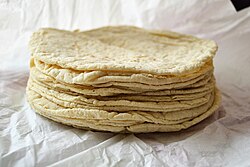
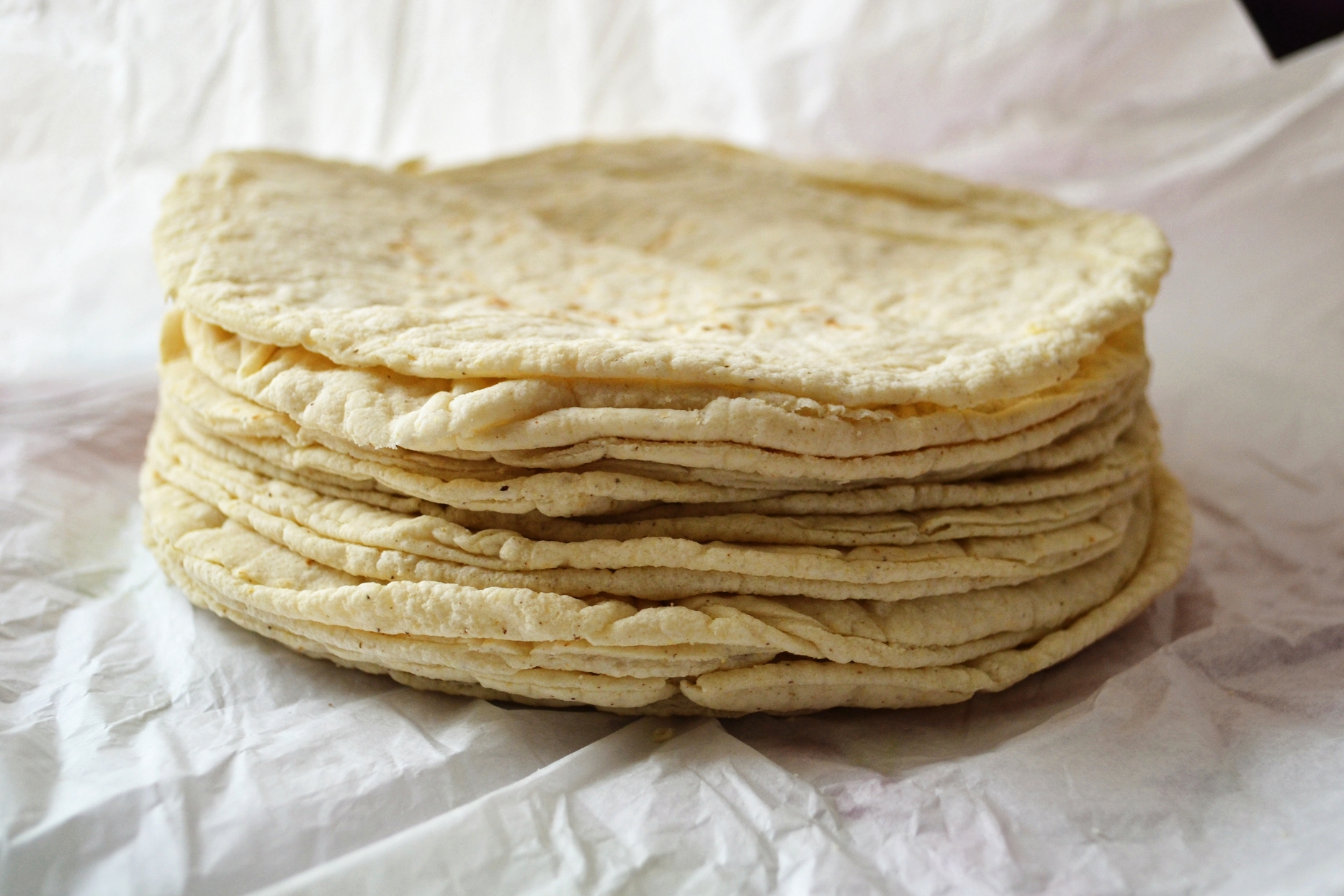
 Corn tortillas | |
| Alternative names | Torta, tortita, Titiya |
|---|---|
| Type | Flatbread |
| Place of origin | Mesoamerica |
| Region or state | Mexico and Central America |
| Main ingredients | Masa harina, Hominy, Wheat, Nopal |
A tortilla (/tɔːrˈtiːə/, Spanish: [toɾˈtiʝa]) is a thin, circular unleavened flatbread from Mesoamerica originally made from masa, and now also from wheat flour.
The Aztecs and other Nahuatl speakers called tortillas tlaxcalli ([t͡ɬaʃˈkalli]).[1] First made by the indigenous peoples of Mesoamerica before colonization, tortillas are a cornerstone of Mesoamerican cuisine. Corn tortillas in Mesoamerica are known from as early as 500 BCE.[citation needed] Flour tortillas were invented once the Spanish introduced wheat to Mexico in the 16th century.
Etymology
[edit]The word tortilla is derived from the Spanish word torta, meaning roughly 'cake' or 'pie', plus the diminutive suffix -illa; therefore tortilla can be translated as 'little cake'.[2][3]
Varieties
[edit]
Corn
[edit]Tortillas made from nixtamalized maize meal (masa de maíz) are the oldest variety of tortilla. They originated in Mexico and Central America, and remain popular throughout the Americas. Peoples of the Oaxaca region in Mexico first made tortillas at the end of the Villa Stage (1500 to 500 BCE).[4][page needed] Towards the end of the 19th century, the first mechanical utensils for making tortillas, called tortilla presses, tortilleras, or tortilladoras, were invented and manufactured in Mexico.
Wheat
[edit]Europeans introduced wheat and its cultivation to the American continent, and it remains the source for wheat flour tortillas. Wheat flour tortillas originated in the northern region of Mexico.
Wheat tortillas usually contain fats such as oil or lard, salt, often leavening agents such as baking powder, and other ingredients. Otherwise, the preparation and cooking of flour tortillas on a comal is identical to that of corn tortillas. Flour tortillas are commonly used in dishes like burritos, tacos, and fajitas. It is part of the daily food repertoire throughout Mexico, Central America, and some states in the US.
Nopaltilla
[edit]A nopaltilla is a cactus-corn tortilla. The word is a portmanteau of nopal, Spanish for the Opuntia ficus-indica cactus, and tortilla.[5][6]
See also
[edit]References
[edit]- ^ Wood, Stephanie (ed.). "tlaxcalli". Online Nahuatl Dictionary. Wired Humanities Projects at the University of Oregon. Retrieved July 19, 2020.
- ^ "Tortilla Definition & Usage Examples". Dictionary.com. January 13, 2024. Retrieved January 13, 2024.
- ^ "Tortilla Definition & Meaning". Merriam-Webster. January 13, 2024. Retrieved January 13, 2024.
- ^ Winter, Marcus (1992). Oaxaca: the Archaeological Record (2nd ed.). Minutiae Mexicana. ISBN 968-7074-31-0. OCLC 26752490.
- ^ Bernal, Marisa (February 20, 2012). "Cactus tortillas offer a novel take on traditional food". Arizona Daily Star. Retrieved July 19, 2020.
- ^ Vercammen, Paul (March 17, 2009). "Can green tortillas create new jobs?". AC360°. CNN. Archived from the original on March 23, 2021. Retrieved July 19, 2020.


External links
[edit] Media related to Tortillas at Wikimedia Commons
Tortilla
View on GrokipediaEtymology and History
Etymology
The word tortilla originates from Spanish, as the diminutive form of torta, meaning "small torta" or "little cake," with torta itself deriving from Late Latin torta, referring to a twisted or round flatbread or cake.[2] This etymology reflects its initial connotation as a small, round baked item in Spanish culinary language.[11] In Spain, tortilla denotes an omelette-like dish, typically prepared by cooking beaten eggs—often with sliced potatoes and onions—in oil, resulting in a thick, round form that aligns with the "little cake" imagery.[11] By contrast, in Mexico and much of Latin America, the term applies to a thin, unleavened flatbread made from corn masa or wheat flour, cooked on a griddle; these two applications, despite sharing the same linguistic root, describe entirely distinct foods with no direct culinary connection.[11] The adoption of tortilla for the Mesoamerican flatbread occurred during the Spanish colonial period in the 16th century, when Europeans encountered indigenous preparations known in Nahuatl as tlaxcalli—a term meaning "baked bread" or "thing roasted," derived from the verb ixca (to cook on a hot surface) plus the nominal suffix -lli—and repurposed the Spanish word to name this staple.[12] This linguistic shift integrated the term into colonial records and modern usage, distinguishing it from the European omelette sense while preserving the diminutive's core meaning of a small, flat edible.[2]Historical Origins and Evolution
The origins of the tortilla lie in pre-Columbian Mesoamerica, where maize was domesticated approximately 8,700 years ago, forming the basis of indigenous diets across the region.[13] By 1500–1200 BCE, the process of nixtamalization—treating maize with an alkaline solution to create dough for flatbreads—emerged, with the earliest archaeological evidence found on Guatemala's southern coast, marking the advent of corn tortillas as a dietary staple.[3] These corn tortillas became integral to the sustenance of ancient civilizations, including the Maya, who cultivated diverse maize varieties in the Yucatán and highlands, and the Aztecs, whose urban centers like Tenochtitlán relied on them as a primary food source produced by communal grinding and cooking.[14] The term "tortilla," derived from the Spanish for "little cake," was applied by colonizers during the 16th-century conquest to describe these indigenous flatbreads.[14] The arrival of Spanish colonizers in the 16th century introduced wheat cultivation to Mexico, leading to the creation of flour tortillas, especially in the arid northern regions where corn was harder to grow, thus fostering hybrid forms that blended European and indigenous techniques.[14] Industrialization in the late 19th and early 20th centuries revolutionized tortilla production, shifting from manual metates to mechanical processes; the first tortilla-making machines appeared in Mexico around 1904, allowing for higher output and standardization.[15] In the United States, Mexican immigrants established the first commercial tortilla factories, such as one in Los Angeles in 1920, facilitating mass production and integration into urban food systems.[16] Following World War II, waves of Mexican-American migration propelled the tortilla's evolution into a global staple, as demand for authentic Mexican cuisine grew in the U.S. and beyond, supported by expanded commercial manufacturing and cultural exchange.[17]Ingredients and Preparation
Primary Ingredients
The primary ingredient for corn tortillas is masa, a dough derived from nixtamalized corn kernels (which are alkali-processed maize soaked and cooked in limewater to enhance nutritional bioavailability—particularly of niacin—and to create a pliable dough texture essential for shaping), prepared fresh in traditional methods or using masa harina (dehydrated nixtamal flour).[18] This traditional process, originating in Mesoamerica, transforms the corn's pericarp, making it easier to grind into masa while imparting a distinctive corn flavor and aroma to the final tortillas.[19] Wheat tortillas, more common in northern Mexico and the southwestern United States, rely on refined wheat flour as the base, combined with water, fat such as lard (known regionally as manteca), and salt to form a soft, extensible dough.[20] Lard provides tenderness and flakiness, reflecting colonial European influences adapted to local tastes, though vegetable oil serves as a modern substitute in some recipes.[21] Common additives in tortillas include baking powder, which introduces leavening for a slightly puffed texture in certain wheat varieties, particularly those from Tex-Mex traditions, and natural colorants like achiote (annatto seeds) to tint corn or wheat tortillas yellow or orange without synthetic dyes.[22][23] Sourcing plays a key role in authenticity; heirloom corn varieties, such as criollo maize native to regions like Oaxaca, Mexico, are prized for their superior flavor profiles—nutty and complex—compared to commercial hybrid strains, preserving biodiversity and traditional quality in masa production.[24][25] This emphasis on heirloom sourcing contrasts with the post-colonization introduction of wheat by Spanish settlers in the 1500s, which shifted preferences in northern areas toward flour-based tortillas.[26]Traditional and Modern Preparation Techniques
Traditional preparation of corn tortillas begins with nixtamalization, an ancient Mesoamerican process where dried corn kernels are soaked and cooked in an alkaline solution of water and slaked lime (calcium hydroxide) to soften the pericarp and enhance nutritional bioavailability.[27] The kernels typically cook for 20-45 minutes before steeping in the limewater for 12-24 hours at room temperature, after which they are washed to remove excess lime and loose hulls.[27] This steeped corn, known as nixtamal, is then ground into a smooth dough called masa using a metate—a flat stone grinding surface rubbed with a cylindrical mano stone—in indigenous and rural settings.[28] The masa is portioned into balls and formed into thin, round disks either by hand-patting between the palms or by pressing between two sheets of plastic using a simple wooden or cast-iron tortilla press.[29] These tortillas are cooked on a comal, a flat clay or metal griddle heated over an open fire or stove, for about 30-60 seconds per side until lightly browned and puffed, without any added oil.[3] In contrast, traditional wheat tortillas start with mixing flour, salt, fat (such as lard or vegetable shortening), and warm water into a soft, pliable dough that rests briefly to relax the gluten.[30] The dough is divided into balls and rolled out thinly—typically 1-2 mm thick and 6-8 inches in diameter—using a rolling pin on a floured surface to achieve even rounds.[31] They are then cooked on a hot, ungreased cast-iron skillet or comal for 30-60 seconds per side, until bubbles form and light brown spots appear, ensuring a soft yet sturdy texture.[32] Modern preparation techniques have mechanized these processes for efficiency and scale, particularly in commercial settings. Electric grinders, or molinos, replace the metate for milling nixtamal into masa, while automated tortilla presses and extruders form dough into uniform shapes at high speeds—up to 840 tortillas per hour on tabletop models.[33] In factories, continuous production lines use tortilladoras, specialized machines that combine pressing, cutting, and cooking functions, often incorporating steam injection during mixing or cooking to maintain moisture and softness in the final product.[34] These advancements allow for mass production while preserving core steps like nixtamalization for corn varieties, though wheat tortillas may employ pre-gelatinized flours for faster dough preparation.[35]Varieties
Corn Tortillas
Corn tortillas, the foundational form of this flatbread, are crafted from masa dough derived from nixtamalized corn kernels, resulting in a slightly coarse texture that provides a rustic mouthfeel. When fresh and warm, they exhibit flexibility and pliability, making them ideal for folding or wrapping various fillings, while their appearance varies by corn variety—ranging from pale white to vibrant yellow, with the kernels' natural pigments influencing the final hue. Typically measuring 4 to 6 inches in diameter, these tortillas are well-suited for street food applications like tacos, where their sturdy yet bendable nature holds up to hearty ingredients without tearing.[36][13][37] Regional styles of corn tortillas highlight Mexico's diverse culinary landscapes, with variations in thickness and corn type reflecting local traditions. In Oaxaca, thin tortillas de cazuela—often cooked in clay pots over wood fires—emphasize a delicate, flavorful profile suited to regional dishes, while Sonoran versions tend to be thicker to complement robust meats and stews in northern cuisine. Blue corn, prized for its striking indigo hue and nutty flavor, adds visual appeal in central and southern preparations, enhancing the aesthetic of dishes like enchiladas or simply served plain to showcase indigenous corn diversity.[38][39][40] As a staple in central and southern Mexico, corn tortillas embody indigenous heritage, serving as the daily bread for communities since pre-Columbian times and symbolizing cultural continuity through the ancient practice of nixtamalization. This process, integral to traditional Mexican cuisine, earned UNESCO recognition as an Intangible Cultural Heritage of Humanity in 2010, underscoring its role in community rituals and sustenance.[41][38][42] Corn tortillas are best enjoyed fresh and should be stored in the refrigerator, where they last 1 to 3 weeks; at room temperature, they last only 2 to 3 days before becoming dry or susceptible to mold, but they are prone to drying out and becoming brittle if not stored properly. Traditionally, they are wrapped in clean cotton cloth to maintain moisture and warmth, a practice that preserves their soft texture during meals and echoes ancestral methods of food preservation.[43][44][45]Wheat Tortillas
Wheat tortillas, made primarily from wheat flour, emerged in northern Mexico during the colonial period after Spanish settlers introduced wheat cultivation in the 16th century. This adaptation suited the arid climates of regions like Sonora, where wheat thrived better than corn in certain areas, leading to the development of flour-based flatbreads as an alternative to traditional corn tortillas.[7] The style gained prominence in Sonora, where larger, burrito-sized versions became a staple, reflecting local culinary needs for portable, wrap-style foods.[46] In the U.S. Southwest, particularly through Tex-Mex influences, wheat tortillas further evolved, blending Mexican traditions with American adaptations in border communities.[47] These tortillas are characterized by their soft, pliable texture, which makes them ideal for folding and wrapping without cracking, often measuring 8 to 12 inches in diameter to accommodate hearty fillings. Their appearance is typically white or lightly speckled, resulting from the incorporation of fats like lard or oil during preparation, which contributes to a tender crumb and subtle richness.[22] In Sonoran styles, they are notably thin yet resilient, enhancing their versatility for regional dishes like the oversized burritos known as "tortas de harina."[46] Production of wheat tortillas involves a higher fat content—often 10-15% of the dough weight—to promote extensibility and foldability, distinguishing them from leaner corn varieties. This formulation allows for easy handling in both home and commercial settings. Since the 1960s, they have been a key component in fast-food chains like Taco Bell, which popularized items such as the soft taco and burrito, leveraging their durability for quick assembly and service.[47][48] Compared to corn tortillas, wheat versions are easier to mass-produce due to the straightforward mixing and rolling of wheat dough, bypassing complex processes like nixtamalization. Commercial wheat tortillas also benefit from a longer shelf life, often extended by preservatives such as calcium propionate, enabling widespread distribution without rapid spoilage.[49]Specialized Variations
Specialized variations of tortillas incorporate alternative ingredients to enhance nutritional profiles, cater to dietary restrictions, or introduce regional flavors, often adapting traditional preparation methods like nixtamalization or flatbread pressing. Nopaltillas, or nopal tortillas, are made by incorporating pads from the nopal cactus (Opuntia ficus-indica) into the dough, typically blended with corn or wheat flour, resulting in a lower-calorie product with higher dietary fiber content compared to standard tortillas. Developed in Mexico as a health-focused option, nopaltillas aid in diabetes management by reducing postprandial blood glucose and insulin peaks due to the cactus's soluble fiber and antioxidant properties. Studies have shown that consuming nopal-enhanced foods, such as these tortillas, can lower glycemic responses in meals, promoting better blood sugar control for individuals with type 2 diabetes.[50] Vegetable-infused tortillas, like those made with spinach or beets, add vibrant colors and modest nutritional boosts while maintaining the flatbread structure. Spinach tortillas often include pureed spinach leaves mixed into the batter, providing small amounts of vitamins A, C, and K, as well as iron and antioxidants, though commercial versions may contain only trace vegetable content primarily for aesthetic appeal. Beet tortillas, colored by beetroot puree, offer added dietary fiber and a subtle earthy flavor, making them suitable for visually appealing dishes without significantly altering calorie counts. These variations emerged in the early 2010s as part of broader trends toward colorful, nutrient-enhanced flatbreads in Western markets.[51][52] Gluten-free tortillas using cassava or almond flour have gained popularity since the post-2010 rise in demand for grain-free alternatives, addressing celiac disease and other sensitivities. Cassava flour tortillas, derived from the root of the cassava plant, yield soft, pliable results when combined with water and fats, offering a neutral taste and high fiber without gluten or grains. Almond flour versions, often blended with other low-carb flours, provide a nutty flavor and protein boost, as seen in products from brands like Siete Foods, which popularized these in the mid-2010s for paleo and low-carb diets. These alternatives mimic the texture of wheat tortillas through careful hydration and rolling techniques.[53] Exotic fusions include modern variations such as sweet potato tortillas, seen in contemporary recipes inspired by Mexican and Central American flatbread traditions, where mashed sweet potatoes replace or supplement traditional flours for a naturally sweet, orange-hued dough rich in beta-carotene. These regional adaptations highlight local staples, enhancing fiber and micronutrient content.[54] As of 2025, plant-based and keto-friendly tortillas using coconut flour have surged in popularity, driven by low-carb and vegan dietary trends, with the coconut wraps market projected to grow due to their grain-free, high-fiber composition. Coconut flour tortillas, mixed with eggs or psyllium for binding, result in low-net-carb options (around 3g per serving) that remain flexible for wrapping, appealing to health-conscious consumers seeking sustainable, nutrient-dense alternatives.[55][56]Culinary and Cultural Role
Uses in Traditional Cuisine
In traditional Mexican cuisine, tortillas serve as the foundational element in numerous staple dishes, particularly those rooted in Mesoamerican practices. Tacos, a quintessential street food, consist of soft corn tortillas folded around fillings such as grilled carne asada, seasoned with onions, cilantro, and lime, allowing the tortilla to absorb the juices and flavors of the meat and accompaniments.[57] Enchiladas involve corn tortillas that are briefly fried or softened, then dipped in a chili-based sauce, rolled around fillings like cheese or shredded chicken, and baked until the sauce infuses the tortilla with its spicy, tangy essence.[29] Tostadas feature crisp-fried corn tortillas as a sturdy base, topped with refried beans, shredded lettuce, meat, cheese, and salsa, providing a crunchy contrast to the layered toppings.[29] Beyond structured dishes, tortillas play a practical role in everyday meals, especially in rural Mexico where they function as versatile utensils. Fresh tortillas are often torn into pieces to scoop up beans, stews, or moles directly from communal bowls, minimizing the need for silverware and emphasizing their utility in simple, family-centered dining.[29] This practice extends to breakfast preparations like chilaquiles, where day-old corn tortillas are cut into strips, fried until crisp, and simmered in a red or green salsa with eggs or chicken, transforming leftovers into a hearty, flavorful start to the day.[58] Tortillas also hold symbolic significance in rituals and ceremonies across Mexican indigenous communities. During Day of the Dead observances, corn tortillas are placed on ofrendas (altars) alongside other offerings like tamales and pan de muerto, representing sustenance for returning spirits and honoring ancestral connections through shared foods. In indigenous Otomí ceremonies in regions like Guanajuato and Querétaro, specially dyed and intricately designed ceremonial tortillas are prepared for special occasions, serving as sacred bread that embodies community and tradition.[59] Tortillas are commonly paired with salsas and guacamole to enhance their role in meals, with freshness being key to optimal flavor integration. Warm, just-made corn tortillas best capture the heat and moisture from vibrant salsas—whether tomato-based rojo or tangy verde—while their pliable texture complements the creamy, avocado-rich guacamole, allowing diners to dip or wrap for a balanced bite.[29][60] This emphasis on immediacy ensures the tortilla's subtle corn flavor supports rather than overwhelms the bold accompaniments central to Mexican palates.[61]Global Adaptations and Innovations
In the United States, tortillas have become integral to Tex-Mex cuisine, a fusion style originating in the 19th century from Mexican immigrants adapting traditional recipes with local Texan ingredients and preferences.[62] Dishes like burritos, which wrap fillings in large flour tortillas, and quesadillas, featuring melted cheese between grilled tortillas, exemplify this adaptation and have driven widespread popularity.[63] The U.S. tortilla market reflects this influence, valued at approximately USD 20.87 billion in 2023 and projected to reach USD 27.67 billion by 2031, growing at a compound annual growth rate (CAGR) of 3.6%, fueled by demand for ethnic foods.[64] As the world's largest consumer, the U.S. accounts for about two-thirds of global tortilla sales, estimated at USD 57 billion in recent years.[65] Tortillas have spread internationally through migration and culinary experimentation, inspiring hybrid dishes that blend local flavors. In India, naan-tortilla hybrids appear in fusion tacos, such as those at New York City's Taco Mahal, where naan bread substitutes for traditional tortillas to encase curries and paneer fillings, reflecting Indian-Latina heritage influences.[66] In Europe, tortillas serve as wraps for kebabs, as seen in viral layered tortilla kebab skewers that incorporate spiced meats and vegetables, adapting the format to Mediterranean and Middle Eastern street food styles.[67] Asian fusions, particularly Korean BBQ tacos, combine marinated bulgogi beef with tortillas, kimchi, and sriracha crema, popularized in recipes and restaurants since the early 2010s as a nod to multicultural urban dining.[68] Commercial innovations have expanded tortilla accessibility and variety, with pre-packaged options dominating retail shelves. Flavored tortillas, such as jalapeño-infused corn varieties containing real jalapeño pieces for added heat, are produced by brands like Mission Foods, enhancing versatility in wraps and tacos.[69] Sustainability efforts have led to versions incorporating upcycled grains; for instance, as of 2025, tortilla chips enriched with brewer's spent grain and sweet potato offer a nutrient-dense, waste-reducing alternative, while brands like Tia Lupita use upcycled okara (soy pulp) in grain-free tortillas to minimize food waste.[70][71] The cultural export of tortillas has accelerated via migration and fast-food chains, transforming them from regional staples to global commodities. Mexican migration to the U.S. in the 20th century introduced tortillas to broader audiences, evolving into fast-casual formats that emphasize fresh assembly.[72] Chipotle Mexican Grill, founded in 1993 by Steve Ells in Denver, Colorado, played a pivotal role by popularizing customizable burritos and bowls using high-quality tortillas, growing into a chain with over 3,000 locations and influencing the "fast-casual" sector worldwide.[73][74] This model has exported tortilla-based meals globally, blending authenticity with convenience.Nutritional and Health Aspects
Nutritional Composition
The nutritional composition of tortillas varies by type, primarily corn or wheat, with differences in macronutrients and micronutrients influenced by base ingredients and processing. A standard 6-inch corn tortilla, typically weighing about 24-28 grams, provides approximately 50-60 calories, with 11 grams of carbohydrates, 1 gram of protein, and 0.5 grams of fat per serving. It is notably high in dietary fiber at around 2 grams, contributing to its role as a whole-grain option. In contrast, an 8-inch wheat flour tortilla, usually around 45-51 grams, contains about 140 calories, 24 grams of carbohydrates, 4 grams of protein, and 3 grams of fat. Commercial wheat tortillas are often made from enriched flour.| Nutrient (per serving) | 6-inch Corn Tortilla | 8-inch Wheat Tortilla |
|---|---|---|
| Calories | 50-60 | 140 |
| Carbohydrates (g) | 11 | 24 |
| Protein (g) | 1 | 4 |
| Total Fat (g) | 0.5 | 3 |
| Dietary Fiber (g) | 2 | 1 |