Hubbry Logo
Treasure bindingTreasure bindingMain
Open search
Treasure binding
Community hub
Treasure binding
logo
8 pages, 0 posts
0 subscribers
Be the first to start a discussion here.
Contribute something
Treasure binding
Treasure binding
from Wikipedia
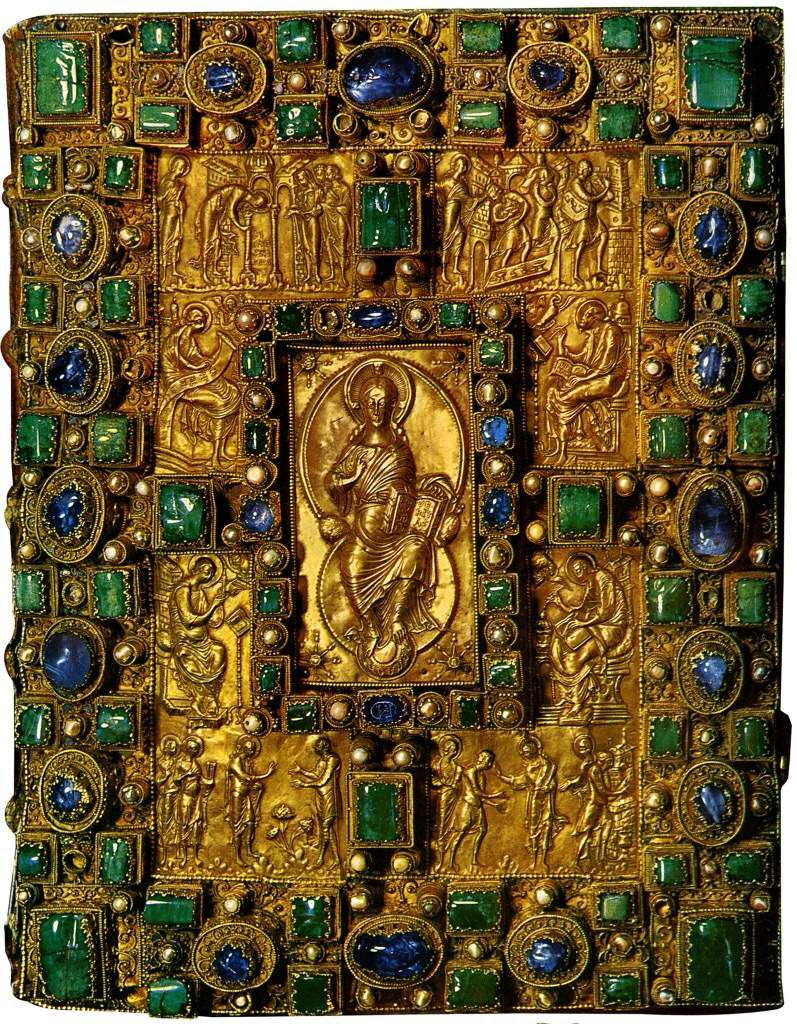
Gem-encrusted cover of the Codex Aureus of St. Emmeram, 870
Ivory plaque, probably from a book cover, Reims late 9th century, with two scenes from the life of Saint Remy and the Baptism of Clovis
Typical Limoges enamel cover, c. 1200

A treasure binding or jewelled bookbinding is a luxurious book cover using metalwork in gold or silver, jewels, or ivory, perhaps in addition to more usual bookbinding material for book covers such as leather, velvet, or other cloth.[1] The actual bookbinding technique is the same as for other medieval books, with the folios, normally of vellum, stitched together and bound to wooden cover boards. The metal furnishings of the treasure binding are then fixed, normally by tacks, onto these boards. Treasure bindings appear to have existed from at least Late Antiquity, though there are no surviving examples from so early, and Early Medieval examples are very rare. They were less used by the end of the Middle Ages, but a few continued to be produced in the West even up to the present day, and many more in areas where Eastern Orthodoxy predominated. The bindings were mainly used on grand illuminated manuscripts, especially gospel books designed for the altar and use in church services, rather than study in the library.[2]

The vast majority of these bookbindings were later destroyed as their valuable gold and jewels were removed by looters, or the owners when in need of cash. Others survive without their jewels, and many are either no longer attached to a book, or have been moved to a different book.[3] Some survive in major libraries; for example, the Morgan Library in New York City, the John Rylands Library in Manchester, the British Library in London, the Bayerische Staatsbibliothek in Munich and the Bibliothèque Nationale in Paris. As the carved ivory reliefs often used could not usually be recycled, these survive in much larger numbers, giving a better idea of the numbers of treasure bindings that once existed. Other examples are recorded in documentary sources but though the books survive the covers do not. The Book of Kells lost its binding after a robbery, and the fate of the missing cover of the Book of Lindisfarne is not recorded.

In the Eastern Orthodox churches treasure bindings have continued to be produced, mainly for liturgical gospel books, up to the present day, and exist in many artistic styles. Other styles of binding using gems, and typically pearls, have a covering of velvet or other textile, to which the gems are sewn or otherwise fixed. These were more likely to be for the private books of a grand person, especially the prayer books and books of hours of female royalty, and may also include embroidery.

Technique and production

[edit]

The techniques for producing jewelled bookbinding have evolved over the course of history with the technologies and methods used in creating books. During the 4th century of the Christian era, manuscripts on papyrus or vellum scrolls first became flattened and turned into books with cut pages tied together through holes punched in their margins. Beginning in the 5th century, books were sewn together in this manner using leather thongs to make the bind stronger and longer lasting with wooden boards placed on top and bottom to keep the pages flat. These thongs then came to be laced into the boards and covered entirely by leather.[4]

Boards afforded the opportunity for decorative ornamentation, with metal casings set into the wood for the installation of precious gems, stones, and jewels.[5] The cover material would then be laid over the casings by hand and cut around the rim of the casings to reveal the jewels. The books typically bound were gospels and other religious books made for use within the church. In the Middle Ages, the responsibility of creating adorned books went to metalworkers and guilders, not the bookbinders, who worked with sheets of gold, silver, or copper to create jewelled and enamelled panels that were nailed separately into the wooden boards.[6]

Other forms

[edit]

Metalwork book furniture also included metal clasps holding the book shut when not in use, and isolated metal elements decorating a leather or cloth cover, which were very common in grander libraries in the later Middle Ages. Decorative book clasps or straps were made with jewels or repoussé metal from the 12th century onward, particularly in Holland and Germany.[7] In Scotland and Ireland from the 9th century or earlier, books that were regarded as relics of monastic leaders were enshrined in a decorated metal reliquary box called a cumdach, and thereafter were probably not used as books. These were even carried into battle as a kind of standard, worn around the neck by a soldier like a protective amulet. Jewelled slipcases or boxes were also used to house small editions of the Qur’an during this time period.[6]

In fashion in the 16th century were "books of golde": small, devotional books adorned with jewelled or enamelled covers worn as a girdle or around the neck like pieces of jewellery by the English court. These pieces can be seen in portraits from the period and records of jewels from the reigns of Henry VIII and Edward VI.[8]

History

[edit]
Restored 16th-century binding of velvet embroidered with pearls for Elizabeth I, on a volume of church history

Treasure bindings were a luxury affordable only by wealthy elites, and were commissioned by wealthy private collectors, churches and senior clergy and royalty, and were often commissioned for presentation by or to royal or noble persons.[7] The earliest reference to them is in a letter of Saint Jerome of 384, where he "writes scornfully of the wealthy Christian women whose books are written in gold on purple vellum, and clothed with gems".[9] From at least the 6th century they are seen in mosaics and other images, such as the 6th-century icon of Christ Pantocrator from Saint Catherine's Monastery and the famous mosaic of Justinian I in the Basilica of San Vitale in Ravenna. The ivory panels often placed in the centre of covers were adapted from the style of consular diptychs, and indeed a large proportion of surviving examples of those were reused on book covers in the Middle Ages.[9] Some bindings were created to contain relics of saints, and these large books were sometimes seen suspended from golden rods and carried in the public processions of Byzantine emperors.[10] Especially in the Celtic Christianity of Ireland and Britain, relatively ordinary books that had belonged to monastic saints became treated as relics, and might be rebound with a treasure binding, or placed in a cumdach.

The gems and gold do not merely create an impression of richness, though that was certainly part of their purpose, but served both to offer a foretaste of the bejewelled nature of the Celestial city in religious contexts, and particular types of gem were believed to have actual powerful properties in various "scientific", medical and magical respects, as set out in the popular lapidary books.[11] Several liturgical books given rich bindings can be shown by textual analysis to lack essential parts of the normal textual apparatus of a "working" version of their text, like the Book of Kells and the Codex Aureus of Echternach. They may have been used for readings at services, but in a monastery were essentially part of the furnishings of the church rather than the library; as records from the Abbey of Kells show, the book of Kells lived in the sacristry.

Byzantine and Western medieval treasure bindings are often not entirely unified in style. Apart from being completed at different times, and sometimes in different countries, elements were also removed and readapted for other volumes or reset with new pieces as time passed.[12] For example, the covers now on the Lindau Gospels come from different parts of South Germany, with the lower or back cover created in the 8th century (earlier than the book they now adorn) while the upper or front cover was completed in the 9th century; both incorporate gilded metal ornamented with jewels. It is not known when they were first used on this manuscript.[13]

Outside the monasteries, the emerging bookbinders' guilds of the Middle Ages were often restricted by law with quantitative limitations on the application of jewels. Though this did not significantly affect the craft of decorating books, it did mandate the number of jewels allowed depending on the position or rank of the commissioner of the work.[14] Hardly any early medieval English treasure bindings survived the dissolution of the monasteries and the English Reformation, when ecclesiastical libraries in England were rounded up and treasure bindings removed under an act "to strip off and pay into the king's treasury all gold and silver found on Popish books of devotion." Comparable depredations were not as thorough in the Continental Protestant Reformation, but most bindings survive from Catholic areas that avoided later war and revolutions.[15]

Despite the commoditisation of book production due to the printing press, the artistic tradition of jewelled bookbinding continued in England, though less frequently and often in simpler designs.[16] Luxury bindings were still favoured by the English Court, which is evident from the records on the private library of Queen Elizabeth I, who favoured velvet bindings. On a visit to the Royal Library in 1598, Paul Hentzner remarked on the books "bound in velvet of different colours, though chiefly red, with clasps of gold and silver; some have pearls, and precious stones, set in their bindings."[17] Throughout the 16th and 17th centuries, the style evolved to be one using velvet, satin, silk, and canvas in bookbinding decorated less with jewels and more with embroidery, metal threads, pearls, and sequins.[18]

Revival

[edit]
External videos
video icon Lindau Gospels Cover, Smarthistory[19]

After jewelled bookbinding enjoyed its renaissance, the practice waned until it experienced a revival near the turn of the 20th century in England. Highly influential in the revival of this style were Francis Sangorski and George Sutcliffe of the Sangorski & Sutcliffe bindery. Their bindings were not large uncut gems as in Mediaeval times, but semi-precious stones en cabochon set into beautifully designed bindings with multi-coloured leather inlays and elaborate gilt tooling. The craftsmanship of these bindings was unsurpassable; only their competitors Riviere produced work of similar quality. The most famous of these bindings is "The Great Omar" (1909) on a large copy of FitzGerald's Rubaiyat of Omar Khayyam, which included good tooling, inlays of coloured leather, and 1050 jewels in a peacock design scheme.[20] It went down with the Titanic in 1912. Today, a third reproduction of this binding is the only one to survive, after the second one, reproduced to Sutcliffe's design by his nephew Stanley Bray, was damaged in the Blitz during World War II. Bray's second attempt at recreating the design, the third version that survives, was placed in the British Library in 1989.[17]

Other binderies creating books in this style during this period were the companies of Rivière and Zaehnsdorf. The largest collection of these masterpieces was the Phoebe Boyle one; over 100 jewelled bindings were sold in 1923. Jewelled bindings occasionally appear at auction; literature on them is surprisingly scant given their superb quality.

In 1998, Rob Shepherd of Shepherds Bookbinders bought both Zaehnsdorf and Sangorski & Sutcliffe. Presently, binding with jewels is a rare practice, and binding companies both large and small are finding the art form becoming less viable in today's society.[21] Bindings that exist today are housed in private collections or can be found in libraries and museums across the world.

Notes

[edit]

References

[edit]
[edit]
Revisions and contributorsEdit on WikipediaRead on Wikipedia
from Grokipedia
Treasure binding, also known as jeweled bookbinding, is a luxurious form of decoration with roots tracing back to , though originating prominently in the , characterized by the use of precious metals such as and silver, along with gemstones, , enamels, and other valuable materials to encase manuscripts. These bindings were primarily created for religious texts, including Gospels and sacramentaries, to venerate sacred content during liturgical services and to demonstrate the wealth, status, and devotion of patrons or monasteries. The tradition of treasure bindings emerged in the early medieval period, with notable examples from the 8th to 13th centuries in Carolingian, Ottonian, Romanesque, and early Gothic styles, often produced in monastic workshops across , such as those in and . Materials like garnets, sapphires, emeralds, pearls, and metalwork were meticulously applied, sometimes incorporating narrative reliefs or plaques to enhance the binding's artistic and symbolic value. Their purpose extended beyond , serving as portable treasures in church treasuries that could be displayed or carried in processions, though many were lost to pillaging or melting down for their raw materials. Prominent surviving examples include the 9th-century Lindau Gospels from the Abbey of St. Gall, featuring intricate gold repoussé work with pearls and gems, and the 13th-century Berthold Sacramentary from Weingarten Abbey, renowned for its opulent enamel and jeweled ornamentation. While the practice declined after the advent of the in the , it experienced revivals in the 19th and 20th centuries during the Arts and Crafts movement, with binders like Sangorski & Sutcliffe creating modern interpretations using similar lavish techniques for secular works. Today, treasure bindings are preserved in major libraries and museums, valued for their craftsmanship and historical insight into medieval artistry and patronage.

Definition and characteristics

Overview of treasure bindings

Treasure bindings are luxurious book covers crafted with metalwork in gold or silver, often inlaid with jewels, ivory carvings, or enamel, and typically applied to illuminated manuscripts such as gospel books or psalters. These bindings represent the pinnacle of medieval book decoration, transforming sacred texts into objects of extraordinary opulence and artistry. The primary purpose of treasure bindings was to enhance the sanctity and prestige of religious texts, serving as symbols of devotion that elevated the spiritual significance of the contents within. They functioned in settings as portable altarpieces or reliquary-like treasures for churches, monasteries, and royal patrons, where the bindings' splendor could inspire awe during liturgical use and reflect the wealth and of their commissioners. In general form, treasure bindings encase wooden boards—often or up to several centimeters thick—over sewn folios, providing rigid protection for the while allowing for elaborate surface decoration. The front and back panels frequently differ in elaboration, with the front cover typically featuring more intricate designs, such as repoussé figures of Christ or evangelists, to emphasize the book's ritual prominence when opened. The term "treasure binding" derives from the concept of stored , as the covers incorporated valuable materials like , silver, , pearls, and precious stones that held intrinsic economic and symbolic value. This practice evolved from earlier plain leather bindings, marking a shift toward opulent decoration in response to growing religious and artistic .

Distinguishing features from other bindings

Treasure bindings differ markedly from utilitarian medieval bookbindings, which typically featured plain or simple wooden covers designed primarily for protection and everyday handling. In contrast, treasure bindings employed precious metals and gems to create opulent exteriors that served as status symbols for or royal patrons, emphasizing prestige over mere functionality. These luxurious covers transformed books into sacred artifacts, enhancing the reverence for their contents, such as liturgical texts, rather than prioritizing portability. A key distinguishing element is the elaborate integrated into treasure bindings, featuring biblical scenes, saints, or Christ figures rendered in or techniques, often enhanced by inlays for stark contrast against the metal surfaces. This artistic complexity elevates the binding beyond the sparse or absent decorative elements in utilitarian bindings, which lacked such narrative depth. For durability, treasure bindings utilized thick wooden boards, commonly of or , reinforced with metal plaques to accommodate the weight of embedded decorations, setting them apart from the lighter, less robust boards or supports in simpler books that were more susceptible to wear. In terms of scale and weight, these bindings often reached several pounds due to the incorporation of heavy treasures, rendering them impractical for daily use but perfectly suited for ceremonial display on altars or in treasuries, unlike the lightweight construction of utilitarian bindings intended for regular reading.

Techniques and materials

Core construction methods

The core construction of treasure bindings began with the preparation of folios, typically using high-quality or sheets sourced from animal skins, which were cut to size and folded in half to form bifolia, then gathered into quires of four to eight sheets each. These quires were sewn together along the fold using a supported technique, where threads—often or —were worked through the quires and onto raised supports such as alum-tawed thongs or vegetable-fiber cords (like or ), creating a strong, flexible spine that allowed the book to open fully. This method, common in medieval European workshops, ensured durability for the text block before attachment to the covers. Board attachment followed, employing thick wooden boards—usually , , or poplar—cut slightly larger than the text block and beveled at the spine edges to facilitate closure and prevent warping. The sewn quires were laced to these boards by passing the sewing supports through tunnels or slits drilled into the board edges, securing the text block firmly while allowing slight flexibility. Primary endbands were then added at the head and of the spine, consisting of strips, cores, or hemp-wrapped threads sewn through the quires and over the board edges to reinforce the structure and provide additional support against wear. Basic casing involved lining the wooden boards with leather or textile materials to create a smooth inner surface and prepare for outer embellishments, often using paste or adhesive to affix the lining. Hinges were formed by attaching leather straps or, in some cases, metal chains to the boards, enabling the covers to open without straining the sewing; these were typically fixed with rivets or sewing to ensure secure pivoting. The workflow relied on specialized tools such as awls for punching holes and board tunnels, bone folders for precise creasing and folding of folios, and presses—both and standing types—for clamping quires during assembly and flattening the finished structure. This labor-intensive process was generally carried out in monastic scriptoria or workshops by trained binders, emphasizing precision to support the binding's role as a luxurious container for sacred texts.

Decorative elements and materials

Treasure bindings are renowned for their lavish surface decorations, which transform the wooden board bases into opulent displays of craftsmanship. Metalwork forms the foundational layer of these embellishments, with goldsmiths employing techniques such as repoussé—hammering thin sheets of gold or silver from the reverse side to create raised relief designs—and chasing, which involves incising fine details from the front using specialized punches and tools. wirework further enhances these surfaces, twisting and soldering delicate gold or silver wires into intricate patterns that allow underlying elements to remain visible. Gems and ivories were integrated to add brilliance and narrative depth, often set into the metal frameworks using claw or bezel mounts to secure stones like garnets, sapphires, emeralds, pearls, and rock crystals. For instance, in the Lindau Gospels (ca. 875), star sapphires, diamonds, and garnets are embedded within repoussé gold scenes of the . Ivory plaques, carved with figural scenes such as evangelists or saints, were affixed via nailing or gluing, providing a smooth, sculptural contrast to the metallic elements; examples include the 11th-century Sacramentary of Frontale, featuring ivory depictions of St. Theodore and archangels. Enameling techniques contributed vibrant colors and protected designs, with cloisonné—where thin metal wires form cells filled with fused paste—being prominent for creating pictorial motifs on or silver grounds. Champlevé enameling, involving the of troughs into metal before enameling, allowed for bold, recessed patterns, often combined with inlays of semi-precious stones like amethysts or beads for added texture. Pearls and (a black metallic alloy) were also inlaid to accentuate borders or figures, as seen in Byzantine examples where colored stones contrast against enameled backgrounds. Textile and accents provided subtle backdrops or framing, with or linings visible through to soften the metallic sheen and highlight gems. Tooled borders, embossed with patterns and overlaid with , bordered the edges of many bindings, offering a durable yet decorative finish; a 1771 German Book of Psalms exemplifies this with enameled elements on black underlays.

Historical development

Origins in Late Antiquity and Early Middle Ages

Treasure bindings originated in , evolving from the transition to formats in the 2nd to 4th centuries CE, where heavy wooden boards protected parchment or pages and provided surfaces for luxurious decoration. This development drew heavily from Roman consular diptychs—ivory panels carved with imperial scenes and hinged like book covers—and caskets, which featured ornate metalwork enclosing sacred objects, adapting these secular and devotional forms to Christian texts. A pivotal early endorsement came from Emperor , who in the early 4th century commissioned 50 Bibles for churches in to signify imperial piety and the sanctity of scripture. By the 5th and 6th centuries, early Christian communities in the produced the first documented treasure bindings, often using or to encase Gospel books. The Antioch Treasure, a hoard of Byzantine silver objects from around 500–600 CE, includes repoussé book covers depicting figures under arches with Christian symbols like crosses and birds, illustrating the shift toward liturgical use in Syriac and Greek contexts. Similarly, the Rabbula Gospels, a 6th-century Syriac completed in 586 CE at the Monastery of Beth Zagba in northern , features original carved plaques of Byzantine origin, marking an early fusion of Eastern craftsmanship with sacred texts. These examples adapted basic leather-over-board techniques from earlier Roman bindings but elevated them with precious materials to emphasize the book's role in worship. The Carolingian revival in the 8th and 9th centuries marked a significant resurgence, driven by 's court at , where treasure bindings became integral to the Carolingian Renaissance's revival of classical and Christian learning. commissioned opulent Gospel books and , such as the Dagulf Psalter of 795–800 CE, presented to , with ivory covers carved in high relief depicting biblical scenes like King David composing psalms. These bindings complemented illuminated manuscripts produced in court scriptoria, like the Ada Gospels and Godescalc Evangelistary, forming unified artistic ensembles that symbolized Frankish imperial authority and religious reform. Key innovations during this period included the shift to raised metal frames—often gold or silver—cloisons for setting gems and enamels, allowing for more intricate and secure adornment, as seen in the lower cover of the Lindau Gospels (ca. 870 CE), which features borders and inset pearls. Biblical motifs, inspired by , proliferated, such as within frames or evangelist symbols arranged in geometric patterns echoing Eastern mosaics and icons, enhancing the bindings' theological depth. Few intact examples from these early periods survive due to the high value of their materials; during economic crises, such as Viking raids, the , or later events like the and , bindings were frequently melted down for bullion to fund wars or church reforms. This scarcity underscores their original prestige, with surviving artifacts like those in the Morgan Library or Vatican collections preserved primarily in monastic treasuries.

High Middle Ages and regional variations

During the Ottonian period of the 10th and 11th centuries, treasure bindings reached a peak of imperial splendor in German-speaking regions, characterized by heavy encrustations of , , gems such as garnets and sapphires, and plaques, often commissioned for liturgical manuscripts like Gospels and sacramentaries. These bindings featured repoussé reliefs, work, and inlays depicting or the Virgin as , reflecting a synthesis of Carolingian, Byzantine, and local traditions. Monastic centers like and emerged as key production hubs, where workshops under bishops such as Bernward of (993–1022) crafted bindings like those for the Precious Gospels of Bernward (ca. 1015), using gilded silver frames and Byzantine to symbolize ecclesiastical authority. In the Romanesque era of the 11th and 12th centuries, this style persisted with added rock crystal overlays and jeweled borders, as seen in the Ratmann Sacramentary front cover (1159) from , which incorporated copper-gilt panels with geometric motifs and inscriptions. The transition to Gothic developments in the 12th and 13th centuries introduced lighter, more intricate designs, particularly in and , where silver and translucent enamels replaced some of the denser gem encrustations, allowing for finer narrative scenes on book covers. workshops in southwestern became renowned for champlevé enamel techniques applied to treasure bindings, producing covers with vibrant, colored scenes of biblical figures on copper bases, often exported across Europe for use in cathedrals and abbeys. Examples include the Berthold Sacramentary binding (ca. 1215–1217) from Weingarten Abbey in , which featured a silver-gilt statuette of the Virgin and Child amid and enamel accents, marking a shift toward verticality and elegance in design. Regional variations highlighted distinct cultural influences within this period. In Anglo-Saxon England, bindings emphasized restraint with ivory carvings and minimal metalwork, contrasting the opulence of continental examples, as refined in monastic scriptoria like those at . Insular Celtic traditions in Ireland and Britain incorporated intricate knotwork patterns in silver and gold , evoking earlier Hiberno-Saxon motifs on covers for books. Early Italian bindings drew on Byzantine inspirations, employing —a black metallic alloy—for detailed inscriptions and figures, as evident in Ravenna workshops producing covers with cloisonné-like effects around the 11th century. Patronage played a crucial role in the proliferation of these bindings, with abbeys and cathedrals serving as primary funders through donations from bishops, abbots, and nobility, such as for her Gospels (ca. 1060). These works often functioned as diplomatic gifts, exchanged between rulers and clergy to forge alliances, exemplified by Ottonian commissions that circulated Byzantine-influenced artifacts across Europe.

Late Middle Ages decline and Eastern persistence

In the Western Europe of the 14th and 15th centuries, the production of treasure bindings began to wane as the invention of the around 1450 democratized book production, reducing the exclusivity and demand for opulent, handcrafted covers reserved for elite religious or scholarly texts. further shifted focus toward classical learning and portable volumes, favoring simpler, more affordable bindings that emphasized textual accessibility over ostentatious decoration. Economically, the high cost of gold, silver, gems, and skilled metalwork prompted a stylistic pivot to blind-tooled covers, which became prevalent in by the mid-15th century for their and lower expense. This decline accelerated in the amid religious upheavals, particularly the Protestant Reformation, where iconoclastic fervor led to the systematic destruction of Catholic artifacts; many treasure bindings were stripped of their precious metals and jewels, which were melted down or sold, leaving few intact examples, such as very few surviving from due to the depredations under . Wars and secularization further contributed to losses, though some endured in protected royal collections, including the Habsburg Imperial Library in , where medieval treasure bindings were preserved as symbols of dynastic heritage. Among the last major Western examples were 15th-century Italian bindings commissioned for humanist patrons, such as those in the library of , featuring elaborate metal fittings and tooled designs on volumes of classical works, blending medieval luxury with restraint. In contrast, treasure binding traditions persisted robustly in Eastern Orthodox regions, drawing from Byzantine precedents and evolving into the 17th century within Russian workshops, where Gospel books received icon-like covers adorned with cloisonné enamel, pearls, and filigree to evoke divine radiance during liturgy. Moscow's armory and goldsmith workshops, active from the 16th century onward, specialized in such opulent metalwork, incorporating Byzantine-inspired motifs like enameled saints and jeweled crosses on silver-gilt plates, ensuring the continuity of these bindings as sacred treasures amid the Orthodox Church's enduring liturgical practices.

Notable examples

Western European masterpieces

One of the most renowned Western European treasure bindings is the cover of the Lindau Gospels, created around 870 in a Carolingian workshop likely in eastern . The front cover features a gold repoussé depiction of Christ crucified on a jeweled , surrounded by ten mourning figures in arched niches, with clusters of pearls, sapphires, and other gems set in raised gold frames along the borders, exemplifying the opulent repoussé and techniques of the period. The back cover, dating to the late 8th century and possibly from , consists of silver-gilt panels with enamel plaques and inlays depicting the symbols of the . This binding, originally protecting an 8th-century manuscript from St. Gall, was acquired by the Abbey of Lindau before entering the collection of J. Pierpont Morgan in 1901; it is now housed at the in New York (MS M.1) and remains in excellent condition following conservation efforts that preserved its delicate gem settings and silk doublures. The Codex Aureus of St. Emmeram, produced in 870 at the palace school of , boasts a lavish treasure binding commissioned by the emperor and featuring jeweled oak panels adorned with gold repoussé reliefs and . The front cover centers on a repoussé figure of seated on the globe of the world, holding a book inscribed with John 14:6, flanked by the in and encircled by intricate acanthus leaves; it is encrusted with emeralds, sapphires, rubies, garnets, , and pearls. The back cover includes an of the , possibly from the same workshop, set within a gem-studded frame. Donated by Arnulf of Carinthia to St. Emmeram's Abbey in Regensburg in 893, the binding survived intact and was transferred to the Bayerische Staatsbibliothek in Munich in 1811 (Clm 14000), where modern conservation has stabilized the goldwork and gems using non-invasive spectroscopic analysis. A notable French example is the late 9th-century cover of the Gospel Book, crafted in a monastic workshop near . This binding features a central plaque carved with scenes from the life of , including the Baptism of , as an example of Carolingian ivory carving integrated into book covers. Likely intended for liturgical use in a treasury, the cover demonstrates restrained elegance compared to more jeweled Carolingian pieces. It is currently preserved at the Musée de Picardie in , , with conservation focusing on stabilizing the ivory against environmental fluctuations to prevent cracking. Western European treasure bindings also include Anglo-Saxon examples held by the , such as fragments and reconstructions featuring garnet inlays from 7th- to 8th-century manuscripts. These bindings, often on boards, employed cell work filled with polished garnets to create geometric and patterns, as seen in surviving elements from Northumbrian workshops that protected books like those associated with the library. A key instance is the garnet-inlaid book cover components from the , dated to the early 8th century, which illustrate the technique's adaptation for book protection with intricate designs evoking Christian symbolism. The 's conservation efforts, including analysis and adhesive repairs, have restored these fragile pieces, ensuring their garnets retain vibrancy while preventing further of the gold cells.

Byzantine and Eastern examples

In the post-Byzantine Russian , tsarist bindings from the 16th and 17th centuries, such as the jeweled imperial devotionals in the Kremlin's Armoury Chamber, demonstrate the persistence of Byzantine influences through intricate work and incorporation of Siberian alongside and enamels. These bindings, often commissioned for works like the Gospels of Ivan IV (1571), feature frames enclosing gems and plaques symbolizing Russia's expansive , blending Eastern Orthodox with local materials for a distinctly opulence. The technique, inherited from Byzantine metalwork, allowed for delicate, light-diffusing designs that emphasized spiritual transparency. Many of these Byzantine and Eastern treasure bindings have been preserved in Russian state collections, such as the and Hermitage, where they endured less iconoclastic destruction than in the West due to the continuity of Orthodox veneration and centralized imperial safeguarding. This preservation highlights the Eastern tradition's resilience, with artifacts like the Gospels (1571) remaining intact as symbols of tsarist and cultural continuity.

Cultural and religious significance

Liturgical and devotional roles

Treasure bindings played a central role in medieval Christian liturgy, serving as sacred objects that enhanced the solemnity of religious rituals. These ornate covers, often encrusted with gems and precious metals, were primarily applied to Gospel books and lectionaries, which were elevated on altars during masses to proclaim scriptural readings central to the Eucharist. In Western European churches, such bindings adorned texts like the Lindau Gospels (ca. 880), which were placed prominently on the high altar to symbolize divine authority and draw the congregation's focus during services. In the Byzantine tradition, evangelaria—lavishly bound Gospel books—were integral to the Divine Liturgy, where they were opened and read aloud by deacons, with their jeweled exteriors evoking heavenly treasures and reinforcing the ritual's mystical dimension. Processions further highlighted the liturgical function of treasure bindings, as these books were carried aloft by clergy during ceremonial walks, such as entry rites or feast-day observances, to inspire awe and communal devotion. The gems and gold on bindings like those of the Berthold Sacramentary (ca. 1215–1217) were believed to mirror celestial splendor, transforming the act of procession into a visible affirmation of faith. In monastic settings, these volumes were stored in church treasuries rather than libraries, underscoring their active role as liturgical implements rather than mere archival items. Many treasure bindings doubled as reliquaries, incorporating holy relics such as splinters of the into their covers, which blurred the distinction between books and objects. For instance, a 12th-century binding housed a wood relic beneath a rock crystal panel depicting the , allowing the faithful to venerate both the text and the embedded sacred fragment during services. Monks regarded the protection of these bindings as a sacred duty, maintaining them in secure treasuries to preserve their spiritual potency amid the rigors of communal worship. The devotional impact of treasure bindings extended beyond formal , fostering personal through contemplation and . Their radiant materials invited extended on sacred narratives, encouraging believers to reflect on divine mysteries during quiet in churches. Inscriptions on some bindings invoked God's for donors, such as prayers etched into metal plaques requesting eternal safeguarding for the patron's . This practice amplified the objects' role in private devotion, where handling or viewing the binding became an act of spiritual engagement. Socially, treasure bindings often resulted from noble donations aimed at securing salvation, with such gifts documented in ecclesiastical charters as pious acts of atonement. Patrons like (ca. 1060) commissioned these works for monastic churches, viewing the lavish outlay as a tangible in their eternal reward, as recorded in donation records that emphasized the bindings' role in intercessory . These contributions not only enriched liturgical practices but also reinforced the donor's status within the religious community.

Artistic and symbolic importance

Treasure bindings exerted significant influence on broader medieval artistic traditions, particularly through their shared techniques and motifs with metalwork altarpieces and reliquaries. These bindings, crafted with repoussé gold, silver, and inset gems, paralleled the ornate metalwork of altarpieces such as those in Carolingian and Ottonian workshops, where similar jewel-encrusted surfaces evoked heavenly splendor and protected sacred contents. Motifs from treasure bindings, including designs, evangelist figures, and floral interlace, disseminated to —often incorporated directly into bindings as carved panels—and to jewelry, where gold and gem settings replicated the bindings' luxurious encrustations to symbolize eternal life and divine favor. The symbolic layers embedded in treasure bindings drew from biblical and theological imagery, elevating them beyond mere decoration to profound emblems of Christian doctrine. Gems, such as pearls or cabochon stones arranged in groups of twelve, frequently represented the Twelve Apostles or , mirroring the jeweled foundations of the described in the . , as the primary material, symbolized and transcendent glory, reflecting early Christian and Byzantine traditions where its radiant sheen signified God's eternal presence and spiritual illumination. These elements enhanced the bindings' devotional role by visually enacting theological concepts during liturgical use. Patronage of treasure bindings underscored their role as instruments of power and piety, often commissioned by rulers to assert imperial authority akin to Christ's earthly . Holy Roman Emperors, such as Henry III and Otto III, sponsored elaborate bindings like the Golden Gospels, integrating imperial imagery with Christological scenes to legitimize their divine-right rule through opulent displays in ceremonies. This legacy extended to book arts, where the illusionistic depiction of gems and gold in illuminated manuscripts and early printed volumes, such as those by Girolamo da , echoed medieval treasure motifs to convey wealth and sacredness. Many surviving examples, like the Lindau Gospels, retain their ancient gems despite losses from looting or wear. Institutions prioritize minimal intervention to maintain the bindings' material authenticity, balancing scholarly value against public accessibility.

Revivals and modern interpretations

19th- and 20th-century revivals

In the mid-19th century, treasure bindings experienced a revival in Western Europe as part of the Gothic Revival movement, which sought to emulate medieval craftsmanship amid the industrialization of book production. This resurgence was fueled by and antiquarian interests, with binders drawing on historical techniques to create ornate covers using metal, enamel, and gems for devotional and luxury texts. Exhibitions played a key role in popularizing these efforts; at the 1851 in London's , displays included medieval-inspired replicas such as a Book of Common Prayer (1839) adorned with clasps and an elaborate bookmark inlaid with eight precious stones—chrysolite, , , , , and —forming the word "VICTORIA." By the early 20th century, during the , British firms elevated this revival to new heights of opulence, catering to wealthy collectors who commissioned bindings as symbols of status akin to medieval ecclesiastical treasures. The London bindery Sangorski & Sutcliffe, founded in 1901, specialized in such deluxe works, producing jeweled covers that revived medieval metalwork and gem-setting traditions. Their most renowned example, The Great Omar—a 1911 binding of Edward FitzGerald's Rubáiyát of Omar Khayyám—featured multicolored inlaid leather, real gold, over 1,000 jewels and semi-precious stones, and three golden peacocks with jeweled tails entwined in vines; commissioned by the London bookseller Sotherans, it was lost when the RMS Titanic sank in 1912. Across the Atlantic, American jewelers like Tiffany & Co. contributed to the trend by crafting silver treasure bindings in the 1880s, often for Bibles and prayer books, incorporating repoussé metalwork to evoke historical grandeur. In France, the Art Nouveau period (late 19th to early 20th century) saw binders integrate enamel and occasional jewels into flowing, organic designs for poetic and devotional volumes. These efforts bridged medieval decline and modern luxury, emphasizing artisanal skill over mass production while serving collectors' desires for rarity and aesthetic splendor.

Contemporary reproductions and workshops

In the , specialized workshops have emerged to teach medieval techniques, adapting them for contemporary practitioners while emphasizing historical accuracy and modern sustainability. The American Academy of Bookbinding, based in , offers intensive courses such as the Gothic Wooden Board Binding class, where participants recreate 15th-century structures using wood boards, , and metal fittings, drawing on original artifacts for reference. These sessions, including summer workshops documented in 2023, incorporate sustainable materials like vegetable-tanned leathers to minimize environmental impact, allowing students to produce functional replicas suitable for exhibitions or personal collections. Similarly, institutions like the North Bennet Street School in provide programs in historical binding structures, focusing on medieval sewn bindings and enclosures that echo treasure binding aesthetics without the use of precious metals. Museums have undertaken projects to create facsimiles of treasure bindings, employing advanced technologies to make these artifacts accessible while preserving originals. For instance, the produces high-fidelity facsimiles of medieval manuscripts with ornate covers, such as those in the "Treasures from the British Library" series, which replicate jeweled and metalwork elements using durable modern substitutes for exhibition purposes. The has similarly invested in reproductions of illuminated books with decorative bindings, utilizing synthetic materials to mimic tooling and inlays, as seen in their collection facsimiles that support educational displays. Innovations like have enabled precise recreations; a notable example is a 2023 project producing a 15th-century Gothic binding with 3D-printed metal components and furniture, demonstrating how digital fabrication can replicate repoussé designs cost-effectively for museum replicas. Synthetic gems, such as lab-created or glass imitations, are increasingly used in these reproductions to achieve visual authenticity while avoiding the ethical concerns of natural stones. Digital platforms and craft communities have fueled a revival of treasure binding techniques among hobbyists and artists, particularly in custom and fantasy genres. Online tutorials, such as those on demonstrating bejeweled covers with epoxy-set gems and tooled , have popularized DIY adaptations for artist books, enabling creators to produce luxurious, hand-bound volumes inspired by medieval styles. Maker fairs and pop culture events feature bookbinders showcasing hybrid works that blend historical repoussé with modern elements, such as LED-illuminated covers for game tomes, influencing the broader maker movement. This trend extends to fan fiction bindings, where enthusiasts rebind popular fantasy novels with ornate, jeweled exteriors, drawing from online resources to adapt techniques for personal or convention displays. Contemporary practitioners face challenges in material sourcing and technique innovation, prompting ethical and technological advancements. Ethical concerns over animal-derived leathers have led to the adoption of plant-based alternatives, like olive-derived vegan leathers, ensuring in decorative binding projects. (CAD) software facilitates precise repoussé patterning, allowing binders to model intricate metal reliefs digitally before fabrication, as explored in studies on automated . Recent conservation efforts, such as those at the , highlight ongoing innovations; in 2022, treatments on medieval bindings emphasized minimal intervention to retain original structures, informing reproduction practices with new insights into and metal preservation. These developments build on 19th- and 20th-century revivals by integrating digital tools for broader accessibility.

References

Add your contribution
Related Hubs
Contribute something
User Avatar
No comments yet.