



Community hub
Recent from talks
Contribute something
Nothing was collected or created yet.
Two Tribes
View on Wikipedia
 | This article needs additional citations for verification. (June 2011) |
| "Two Tribes" | ||||
|---|---|---|---|---|
 | ||||
| Single by Frankie Goes to Hollywood | ||||
| from the album Welcome to the Pleasuredome | ||||
| B-side |
| |||
| Released | 4 June 1984 | |||
| Studio | ||||
| Genre | ||||
| Length | 3:56 3:23 (edit) | |||
| Label | ZTT (ZTAS 3) | |||
| Songwriters | ||||
| Producer | Trevor Horn | |||
| Frankie Goes to Hollywood singles chronology | ||||
| ||||
| Music video | ||||
| "Two Tribes" on YouTube | ||||
"Two Tribes" is an anti-war song by British band Frankie Goes to Hollywood, released in the UK by ZTT Records on 4 June 1984.[7] The song was later included on the album Welcome to the Pleasuredome. Presenting a nihilistic, gleeful lyric expressing enthusiasm for nuclear war, it juxtaposes a relentless pounding bass line and guitar riff inspired by American funk and R&B pop with influences of Russian classical music, in an opulent arrangement produced by Trevor Horn.
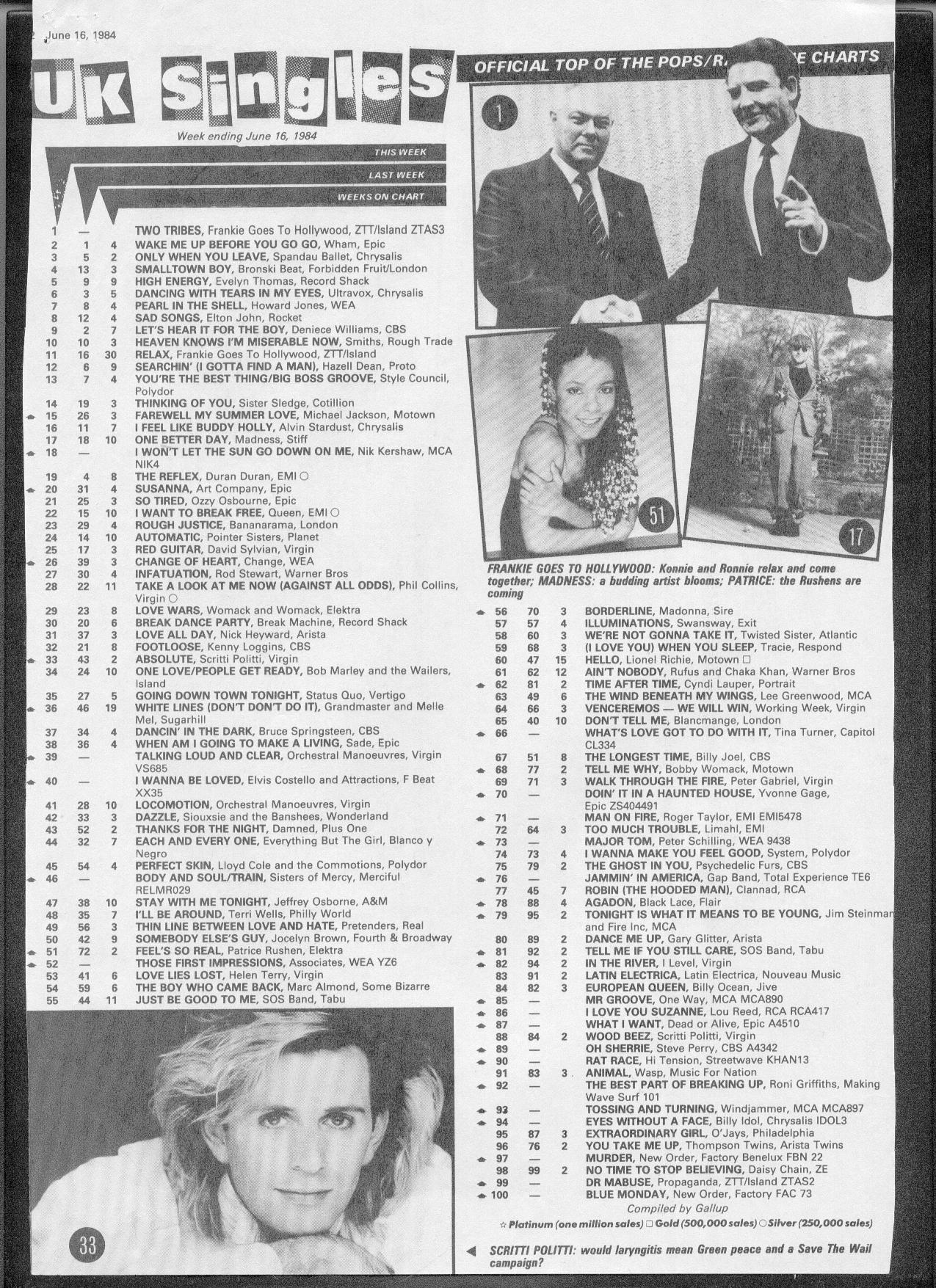
The single was a phenomenal success in the UK, helped by a wide range of remixes and supported by an advertising campaign depicting the band as members of the Red Army. It entered the UK Singles Chart at number one on 10 June 1984, where it stayed for nine consecutive weeks, during which time the group's previous single "Relax" climbed back up the charts to number two.[8][9] It was the longest-running number-one single in the UK of the 1980s. It has sold 1.58 million copies in the UK as of November 2012,[10] being in the Top 30 best-selling singles in the UK as of 2022.[11]
Songwriters Johnson, Gill and O'Toole received the 1984 Ivor Novello award for Best Song Musically and Lyrically.[12] In 2015 the song was voted by the British public as the nation's 14th-favourite 1980s number one in a poll for ITV.[13]
Music
[edit]A version of "Two Tribes" was originally recorded for a BBC John Peel session in October 1982. The basic structure of the song, including its signature bass-line, percussion arrangement and idiosyncratic introductory and middle eight sections, were already intact prior to any involvement from ZTT or eventual producer Trevor Horn.[citation needed] Further work was conducted at Producer's Workshop in Fulham, which Stephen Lipson selected as a cheaper alternative to Sarm Studios, where Frankie Goes Hollywood recorded their song "Relax". Horn identified "Two Tribes" as the band's next single due to its bassline despite reservations from Lipson, who was not impressed with the demo and thought that "there wasn't much to the song." The band recorded their parts, which was not deemed satisfactory, so Horn, Lipson, J.J. Jeczalik, and Andy Richards redid the parts themselves. From those sessions, Lipson's guitar was the only instrument retained in the final mix.[14]

After their time at Producer's Workshop, the four moved back to Sarm Studios to further develop the song. A considerable amount of attention was placed on the bass part, particularly with the articulation of each note. In an adjacent studio, Clive Langer and Alan Winstanley were in the process of mixing an album, which they temporarily left to work on a different record. By the time Langer and Winstanley returned back to Sarm Studios, the bass part was still receiving adjustments. The final programmed bass pattern included a note that dropped down an octave whereas the original lacked this element.[14]
Holly Johnson noted that there were "two elements in the music – an American funk line and a Russian line. It's the most obvious demonstration of two tribes that we have today."[15] Lipson programmed some parts on a Synclavier, including the drum break at the end of the first chorus. He recalled that Horn "thought it was the weirdest fill he'd ever heard — a jazz fill in the middle of a pop song. However, I told him I thought it was great, so he went along with it, although begrudgingly, and that was indicative of how we worked together." The LinnDrum programming was added by Horn late into the song's production.[14]
Title and lyrics
[edit]The single was released at a time when the Cold War had intensified and fears about global nuclear warfare were at a peak. Although Johnson would attest in a 1984 radio interview that the "two tribes" of the song potentially represented any pair of warring adversaries (giving the examples of "cowboys and Indians or Captain Kirk and Klingons"), the line "On the air America/I modelled shirts by Van Heusen" is a clear reference to then US President Ronald Reagan. Reagan had advertised for Phillips Van Heusen in 1953 (briefly reviving the association in the early 1980s). The title of his first film had been Love Is on the Air.
The lyric "working for the black gas" is, according to Johnson, "About oil surpassing gold. How you might as well be paid in petrol."[16] And the line "Are we living in a land where sex and horror are the new gods?" was inspired by the 1959 British film Cover Girl Killer. Johnson explained, "The TV was on in the background while I was doing me ironing and suddenly this character came out with that statement."[16] (The actual dialogue, which occurs at about 48 minutes 24 seconds into the film, is "Surely sex and horror are the new gods in this polluted world of so-called entertainment?")
The track featured snippets of narration from actor Patrick Allen, recreating his narration from the British Protect and Survive public information films about how to survive a nuclear war. (The original Protect and Survive soundtracks were sampled for the 7-inch mixes.)
The 12-inch A- and B-sides featured voice parts by British actor Chris Barrie imitating Ronald Reagan. Barrie also voiced the Reagan puppet on Spitting Image. Barrie's parts as 'Reagan' included praise for the band, as well as parts of Adolf Hitler's speech to a court after the Beer Hall Putsch: "You may pronounce us guilty a thousand times over, but the Goddess of the Eternal Court of History will smile and tear to tatters the brief of the State Prosecutor and the sentence of this court, for She acquits us." Barrie also voiced the last sentence of "History Will Absolve Me" (Spanish: "La historia me absolverá") which is the concluding sentence and subsequent title of a four-hour speech made by Fidel Castro on 16 October 1953. Castro made the speech in his own defense in court against the charges brought against him after leading an attack on the Moncada Barracks on 26 July 1953. Barrie would return for the band's next single, "The Power of Love", imitating Mike Read in a parody of the DJ's ban on their previous single, "Relax".
The song's title derives from the line "two mighty warrior tribes went to war" from the film Mad Max 2 (the line is also spoken by Holly Johnson at the beginning of the session version).[17]
Critical reception
[edit]American magazine Cash Box called it "a more scintillating anti-war track than ["The War Song"]", saying it is "both an effective dance cut and a piece of modern art."[18] Richard Harris from NME wrote, "'Two Tribes' is a fine example of why over-production is a musical virtue, not least when it ceases to be a pop song and tries to disco-ise Tchaikovsky."[19]
Promotion
[edit]ZTT aggressively marketed the single in terms of its topical political angle, promoting it with images of the group wearing American military garb in combat, as well as Soviet-style army uniforms set against an American urban backdrop.
The original cover art featured a Soviet mural of Vladimir Lenin in St Petersburg, and images of Reagan and then-UK Prime Minister Margaret Thatcher. The sleeve notes, attributed to ZTT's Paul Morley, dispassionately reported details of the relative nuclear arsenals of each superpower.
Personnel
[edit]Credits sourced from Sound on Sound.[14]
Frankie Goes to Hollywood
- Holly Johnson – lead vocals
- Paul Rutherford – backing vocals
Other musicians
- Trevor Horn – LinnDrum and Fairlight CMI programming; producer
- J.J. Jeczalik – Fairlight CMI programming
- Stephen Lipson – electric guitars, Synclavier programming
- Andy Richards – Roland Jupiter-8 synthesizer, Roland MC-4 Microcomposer sequencer, Hammond organ
Original 1984 mixes
[edit]The song appeared in the form of six mixes, including "Annihilation", "Carnage", "Hibakusha", "Cowboys and Indians", "We Don't Want to Die" and "For the Victims of Ravishment".
The first 12-inch mix ("Annihilation") started with an air-raid siren, and included advice from Allen about how to tag and dispose of family members should they die in the fallout shelter (taken from the public information film Casualties). This version appeared on CD editions of the album. "Annihilation" was the basis for the "Hibakusha" mix, which was originally released in a limited edition, Japanese-only version of the 1985 album Bang!. Hibakusha is the Japanese word for survivors of the atomic bombing of Hiroshima and Nagasaki.
"For the Victims of Ravishment" appeared on the LP and cassette editions of the album Welcome to the Pleasuredome. It is the shortest version, at 3:27 minutes. This mix derived from the "Carnage" mix, which prominently featured strings as well as vocal samples from Allen and the group's B-side interview.
Since 1984, "Two Tribes" has been re-issued several times, generally involving third-party remixes bearing little relation to the original releases in terms of either structure or character.
B-sides
[edit]The 7-inch featured "One February Friday", an interview between Morley and the group's three musicians, Mark O'Toole, Brian Nash and Peter Gill, over an otherwise untitled instrumental track. A similar track had been included on the B-side of "Relax", with the title "One September Monday".
The principal B-side to the original 12-inch single was a cover version of "War", which became the subject of an extended remix (subtitled "Hidden") on the single's third UK 12-inch release, where it was promoted as a double A-side with "Carnage".
The UK cassette single featured a cut-together combination of "Surrender", "Carnage" and "Annihilation", plus Reagan snippets and interview sections not included on any other release.
Videos
[edit]The Godley & Creme-directed video depicted a wrestling match between then-US President Ronald Reagan and Konstantin Chernenko, then Secretary of the Communist Party of the Soviet Union, in front of group members and an assembly of representatives from the world's nations. The match eventually degenerates into global destruction. Certain violent moments ("Reagan" is seen, for example, biting "Chernenko's" ear) were edited from the version shown on MTV.
A longer version of the video (based on the "Hibakusha" mix) included an introductory, heavily edited monologue by Richard Nixon taken from an ad from his 1960 US Presidential campaign ("No ... firm diplomacy ... No ... peace for America and the world"), plus similar contributions from other world leaders, including Lord Beaverbrook, Yasser Arafat and John F. Kennedy. The complete soundtrack to the extended video was eventually released as "Two Tribes (Video Destructo)" on the German version of the Twelve Inches compilation. A third version of the video, included on the band's From An Wasteland to an Artificial Paradise VHS, retains the introduction, but omits most of the inserted clips in the main wrestling sequence.
Charts
[edit]
Weekly charts[edit]
|
Year-end charts[edit]
|
Certifications
[edit]| Region | Certification | Certified units/sales |
|---|---|---|
| Canada (Music Canada)[59] | Gold | 50,000^ |
| Netherlands (NVPI)[60] | Gold | 75,000^ |
| United Kingdom (BPI)[61] | Platinum | 1,580,000[10] |
|
^ Shipments figures based on certification alone. | ||
Track listing
[edit]All discographical information pertains to the original UK single release only.
- "Two Tribes" written by Gill/Johnson/O'Toole
- "War" written by Strong/Whitfield
- "One February Friday" credited to Gill/Johnson/Morley/Nash/O'Toole/Paul Rutherford
7": ZTT / ZTAS 3 United Kingdom:
| No. | Title | Length |
|---|---|---|
| 1. | "Two Tribes" | 3:57 |
| 2. | "One February Friday"" | 4:55 |
The A-side mix is commonly referred as "Cowboys and Indians" to avoid confusion with other mixes, as ZTT commonly gives the sides on singles separate names. Thus, "One February Friday" is sometimes subtitled as either "Doctors and Nurses" (as per the regular 7") or "Only Bullets Can Stop Them Now" (as per the picture disc B-side label).
7" (picture disc): ZTT / P ZTAS 3 United Kingdom:
| No. | Title | Length |
|---|---|---|
| 1. | "Two Tribes" | 4:10 |
| 2. | "One February Friday" | 4:55 |
The A-side is an alternative mix to the regular 7" (subtitled "We Don't Want To Die" on the B-side label). A common theory within many fans is that "We Don't Want To Die" is essentially "Surrender" with vocals.
Also issued as a regular 7" in Canada.
12": ZTT / 12 ZTAS 3 United Kingdom:
- "Two Tribes" (Annihilation) – 9:08
- "War" (Hide Yourself) – 4:12
- "One February Friday" (12" edit) – 1:46
- "Two Tribes" (Surrender) – 3:46
- ["The Last Voice"] (unlisted) – 1:14
12": Island Records - ZTT Records (0-96931 - Special 12" Single - United States) / X-14065 Australia:
- "Two Tribes" (Extended Version) – 9:10
- "War" (Hide Yourself) – 4:12
- "Two Tribes" – 4:11
- "One February Friday" 4:57
"Extended Version" is the same as "Annihilation".
"Two Tribes" on the B-side is the 7" picture disc mix.
12": ZTT / 12 XZTAS 3 United Kingdom:
- "Two Tribes" (Carnage) – 7:54
- "War" (Hide Yourself) – 4:12
- "One February Friday" (12" edit) – 1:46
- "Two Tribes" (Surrender) – 3:46
- ["The Last Voice"] (unlisted) – 1:14
12": ZTT / WARTZ 3 United Kingdom:
- "War" (Hidden) – 8:33
- "Two Tribes" (Carnage) 7:54
- "One February Friday" (12" edit) – 1:46
12": ZTT / X ZIP 1 United Kingdom:
- "Two Tribes" (Hibakusha) – 6:38
- "War" (Hide Yourself) – 4:12
- "One February Friday" (12" edit) – 1:46
- "Two Tribes" (Surrender) – 3:46
- ["The Last Voice"] [Edited] (unlisted) – 0:35
12": ZTT / XZTAS 3DJ United Kingdom:
- Two Tribes (Carnage) – 7:56
- Relax (New York Mix) – 7:23
"New York Mix" was mislabeled as "U.S mix".
MC: ZTT / CTIS 103 United Kingdom:
- "[On The Subject of Frankie Goes to Hollywood]" – 0:23
- "One February Friday (part 1)" – 0:38
- "Two Tribes" (Keep The Peace) – 15:17
- "One February Friday (part 2)" – 1:08
- "War" (Somewhere Between Hiding And Hidden) [identical to "War" (Hide Yourself)] – 4:12
- "One February Friday (part 3)" – 0:21
- "[War Is Peace]" – 0:05
"Keep The Peace" is a combination of Surrender, Carnage and Annihilation.
The mixes on this cassette single reissued on vinyl for Record Store Day 2022 as Side B of 'Altered Reels' – The cassette single of "Relax" was reissued on Side A.
2014 digital download #1: Two Tribes:
- "Two Tribes" (Annihilation 7") – 3:56
- "Two Tribes" (Carnage 7") – 4:12
- "Two Tribes" (Annihilation) – 9:09
- "Two Tribes" (Carnage) – 7:54
- "Two Tribes" (Hibakusha) – 6:37
- "Two Tribes" (Hibakush-ah!) – 6:59
- "One February Friday" – 4:57
- "The Last Voice" – 1:14
"Hibakush-ah!" is an early version of "Hibakusha".
2014 digital download #2: War (Hidden):
- "War!" (Hidden) – 8:33
- "War!" (Hide yourself!) – 4:14
- "One February Friday" (12" Edit) – 1:45
- "Two Tribes" (Surrender) – 3:44
- "War!" (..And Hide) [identical to the album version] – 6:13
- "War!" (Coming out of Hiding) – 3:17
References
[edit]- ^ Lester, Paul. "Revolutions per minute – The Power of Love". Uncut. ZTT. Retrieved 31 March 2015.
- ^ a b Flynn, Paul (28 September 2023). "Only one kind of music makes clubbers dress up like this". Evening Standard.
- ^ a b Brown, Joe (3 November 1984). "'Pleasuredome': Little Pleasure". The Washington Post.
- ^ Pareles, Jon (14 November 1984). "THE POPLIFE; FRANKIE GOES TO HOLLYWOOD". The New York Times.
- ^ Weisbard, Eric; Marks, Craig, eds. (1995). Spin Alternative Record Guide. New York: Vintage Books. p. 155. ISBN 0-679-75574-8.
- ^ Marsh, Dave (1989). The Heart of Rock & Soul: The 1001 Greatest Singles Ever Made. Plume. p. 450. ISBN 0-452-26305-0.
- ^ "Record Mirror". 16 June 1984.
- ^ "Number-Ones.co.uk". number-ones.co.uk. 2014.
- ^ Roberts, David (2006). British Hit Singles & Albums (19th ed.). London: Guinness World Records Limited. pp. 437–9. ISBN 1-904994-10-5.
- ^ a b Ami Sedghi (4 November 2012). "UK's million-selling singles: the full list". The Guardian. Retrieved 4 November 2012.
- ^ "The best-selling singles of all time on the Official UK Chart". Official Charts.
- ^ Lister, David, Pop ballads bite back in lyrical fashion, The Independent, 28 May 1994
- ^ Westbrook, Caroline (25 July 2015). "The Nation's Favourite 80s Number One: 12 more classic 80s chart-toppers which didn't make the cut". Metro. Retrieved 27 July 2015.
- ^ a b c d Buskin, Richard (April 2008). "Classic Tracks: Frankie Goes To Hollywood 'Relax'". Sound on Sound. Retrieved 20 June 2025.
- ^ "The War Game". Smash Hits. 26 April 1984.
- ^ a b No 1 magazine, 4 August 1984 http://www.zttaat.com/article.php?title=181
- ^ Lynskey, Dorian (31 May 2012). "The best No 1 records: Frankie Goes to Hollywood – Two Tribes". Music. The Guardian. ISSN 1756-3224. OCLC 60623878. Retrieved 26 February 2024.
- ^ "Reviews" (PDF). Cash Box. 20 October 1984. p. 9. Archived (PDF) from the original on 14 August 2020. Retrieved 26 July 2022.
- ^ Harris, Richard (30 October 1993). "Long Play". NME. p. 28. Retrieved 5 July 2023.
- ^ "Forum – ARIA Charts: Special Occasion Charts – Top 100 Singles 1984". Australian-charts.com. Hung Medien. Retrieved 31 December 2016.
- ^ "Frankie Goes to Hollywood – Two Tribes" (in German). Ö3 Austria Top 40.
- ^ "Frankie Goes to Hollywood – Two Tribes" (in Dutch). Ultratop 50.
- ^ "Top RPM Singles: Issue 8529." RPM. Library and Archives Canada.
- ^ "Danish Chart Archive – Singles 1979 – ____ (B.T./IFPI DK)". www.ukmix.org. 30 November 2018. Retrieved 20 July 2020.
- ^ "Eurochart Hot 100 Singles" (PDF). Music & Media. No. 21/22. 27 August 1984. p. 15. Archived (PDF) from the original on 20 July 2020. Retrieved 20 July 2020.
- ^ Timo (13 August 2015). "Sisältää hitin: Levyt ja esittäjät Suomen musiikkilistoilla vuodesta 1960: Artistit FIS – FRA". Sisältää hitin. Retrieved 21 July 2020.
- ^ "InfoDisc : Tout les Titres par Artiste". Infodisc.fr. Archived from the original on 20 September 2013. Retrieved 29 March 2014.
- ^ "Topp 10 vinsælustu lögin". DV (in Icelandic). 29 June 1984. p. 37. ISSN 1021-8254. Retrieved 20 July 2020 – via Timarit.is.
- ^ "The Irish Charts – Search Results – Two Tribes". Irish Singles Chart.
- ^ "Classifiche". Musica e dischi (in Italian). Set "Tipo" on "Singoli". Then, in the "Artista" field, search "Frankie Goes To Hollywood".
- ^ "Nederlandse Top 40 – Frankie Goes to Hollywood" (in Dutch). Dutch Top 40.
- ^ "Frankie Goes to Hollywood – Two Tribes" (in Dutch). Single Top 100.
- ^ "Frankie Goes to Hollywood – Two Tribes". Top 40 Singles.
- ^ "Frankie Goes to Hollywood – Two Tribes". VG-lista.
- ^ "SA Charts 1965 – March 1989". Retrieved 17 July 2020.
- ^ "Listas de superventas: 1984". 17 July 2020.
- ^ "Frankie Goes to Hollywood – Two Tribes". Singles Top 100.
- ^ "Frankie Goes to Hollywood – Two Tribes". Swiss Singles Chart.
- ^ "Frankie Goes to Hollywood: Artist Chart History". Official Charts Company.
- ^ "Frankie Goes to Hollywood Chart History (Hot 100)". Billboard.
- ^ "Frankie Goes to Hollywood Chart History (Dance Club Songs)". Billboard.
- ^ "Frankie Goes to Hollywood Chart History (Mainstream Rock)". Billboard.
- ^ "Cash Box Top 100 Singles – Week ending December 15, 1984". Cash Box magazine. Retrieved 20 July 2020.
- ^ "Offiziellecharts.de – Frankie Goes to Hollywood – Two Tribes" (in German). GfK Entertainment charts.
- ^ Chartsventes (1 October 2016). "World singles charts and sales TOP 50 in 58 countries: FRANKIE GOES TO HOLLYWOOD". World singles charts and sales TOP 50 in 58 countries. Retrieved 25 July 2020.
- ^ "The Airplay Chart" (PDF). Music Week. 5 March 1994. p. 18. Retrieved 23 May 2025.
- ^ "The RM Club Chart" (PDF). Music Week, in Record Mirror (Dance Update Supplemental Insert). 5 February 1994. p. 4. Retrieved 15 May 2023.
- ^ "Kent Music Report No 548 – 31 December 1984 > National Top 100 Singles for 1984". Kent Music Report. Retrieved 23 January 2023 – via Imgur.com.
- ^ "Forum – ARIA Charts: Special Occasion Charts – Top 100 Singles 1984". Australian-charts.com. Hung Medien. Retrieved 31 December 2016.
- ^ "Jaaroverzichten 1984". Ultratop. Retrieved 17 July 2020.
- ^ "Top RPM Singles: Issue 9638." RPM. Library and Archives Canada. Retrieved 2 May 2022.
- ^ "Top 100-Jaaroverzicht van 1984". www.top40.nl. Retrieved 17 July 2020.
- ^ "Jaaroverzichten – Single 1984". www.dutchcharts.nl. Retrieved 17 July 2020.
- ^ "Top Selling Singles of 1984". Official NZ Music Charts.com. Recorded Music New Zealand Limited. Retrieved 31 December 2016.
- ^ "Swiss Year-End Charts 1984". www.swisscharts.com. Retrieved 17 July 2020.
- ^ "Top 100 Singles 1984" (PDF). Music Week. Archived (PDF) from the original on 13 May 2022. Retrieved 18 September 2022.
- ^ "Top Dance Songs of 1984". www.musicvf.com. Retrieved 17 July 2020.
- ^ "Top 100 Single-Jahrescharts 1984" (in German). GfK Entertainment. Retrieved 26 February 2022.
- ^ "Canadian single certifications – Frankie Goes to Hollywood – Two Tribes". Music Canada. Retrieved 29 November 2019.
- ^ "Dutch single certifications – Frankie Goes to Hollywood – Two Tribes" (in Dutch). Nederlandse Vereniging van Producenten en Importeurs van beeld- en geluidsdragers. Retrieved 29 November 2019. Enter Two Tribes in the "Artiest of titel" box. Select 1984 in the drop-down menu saying "Alle jaargangen".
- ^ "British single certifications – Frankie Goes to Hollywood – Two Tribes". British Phonographic Industry. Retrieved 29 November 2019.



Two Tribes
View on GrokipediaBackground and Development
Songwriting and Inspirations
Holly Johnson, the lead vocalist of Frankie Goes to Hollywood, conceived the core concept for "Two Tribes" by adapting a line from the 1959 British sexploitation film Cover Girl Killer, which features the phrase alluding to tribal warfare leading to devastation; Johnson reframed this as a metaphor for the Cold War standoff between the United States and the Soviet Union.[6] The lyrics, co-written with bandmates Mark O'Toole and Brian Nash, emphasize the futility and destructiveness of superpower rivalry, portraying leaders as interchangeable figures in a cycle of confrontation.[6] The song's anti-war theme drew from heightened nuclear anxieties in the early 1980s, including U.S. President Ronald Reagan's rhetoric, which band members cited as evoking apocalyptic scenarios where conflict could precipitate biblical end-times events, as Reagan had reportedly viewed nuclear war in premillennial dispensationalist terms during private discussions. Johnson described the "two tribes" as representing any polarized factions locked in zero-sum struggle, but explicitly tied it to the era's East-West tensions exacerbated by Reagan's "evil empire" address on March 8, 1983.[7] Frankie Goes to Hollywood formed in Liverpool's vibrant post-punk scene in 1980, emerging from the city's underground clubs like Eric's, where provocative performance art and synth-driven experimentation thrived amid economic decline.[8] The band signed to ZTT Records in May 1983 after Trevor Horn witnessed their raw performance of early material on television, aligning with ZTT's ethos of blending high-concept pop with cultural provocation under Horn and Paul Morley's direction.[8] This environment shaped "Two Tribes" as a bold statement against militarism, reflecting the label's strategy of using shock value to amplify political messages.[8]Recording and Production
"Two Tribes" was recorded at SARM East Studios in London, with Trevor Horn serving as producer. Horn, who owned the facility, employed advanced digital recording techniques, including the Sony PCM 3324 24-track digital machine, to capture the track's layered elements. This setup allowed for precise manipulation of sounds, marking an early adoption of digital multitrack recording in pop production.[9] The song's aggressive synth-bass line was created by first recording a real bass performance, then sampling and chopping individual notes using the Fairlight CMI sampler, which Horn sequenced to form the synthetic backbone. Drum patterns were derived from LinnDrum machine samples, layered with additional percussion elements for rhythmic intensity, reflecting Horn's approach of building tracks through meticulous sampling and overdubbing.[10][11][12] Production involved an iterative process, with extensive time spent sequencing components on the Synclavier digital audio workstation to refine the bombastic, stadium-filling quality distinct from the band's earlier, more raw demos. This perfectionism contributed to high costs, with investments in Frankie Goes to Hollywood's initial recordings exceeding £100,000, underscoring the resource-intensive nature of Horn's methods.[9][13]Personnel Involved
The core performers on "Two Tribes" included Frankie Goes to Hollywood's principal members: Holly Johnson provided lead vocals, Paul Rutherford handled backing vocals, Mark O'Toole played bass guitar, Brian Nash contributed guitar, and Peter Gill performed on drums and keyboards.[1] Production was led by Trevor Horn, who shaped the track's dense, electronic sound during sessions primarily at Sarm West Studios in London, with engineering by Stephen Lipson.[1][14] Lipson also supplied additional guitar parts, while J.J. Jeczalik handled Fairlight CMI programming for the song's rhythmic and sampled elements, and Anne Dudley added keyboard arrangements.[15][16] Frankie Goes to Hollywood operated as a manufactured act under ZTT Records, where Horn and co-founder Paul Morley exerted significant creative control, often augmenting the band's contributions with session work from Horn's associates to achieve the final polished recordings.[17]Musical Composition
Instrumentation and Arrangement
"Two Tribes" employs a synth-heavy arrangement blending new wave and post-disco influences, centered on electronic synthesizers for melody, harmony, and rhythmic drive. The track's foundation is a relentless, pounding bassline produced through synthesizers, which propels the groove with a funky, repetitive motif derived from American styles, contrasted against a more classical Russian-inspired line in the intro.[18][19] Martial percussion, including four-on-the-floor kick drums, speedy hi-hats, and delayed snares, creates a militaristic pulse that underscores the song's thematic tension.[20] Orchestral hits—simulated via synthesizers and augmented by scored string and clarinet elements in the opening—provide dramatic accents, distinguishing the production's bombastic scale from lighter early synth-pop contemporaries.[21][22] The arrangement builds tension-release dynamics through sparse verses, where minimal synth stabs and percussion establish restraint, escalating into anthemic choruses with dense layers of electronic effects, swelling pads, and intensified rhythms. This structure, set in G major at 130 beats per minute, amplifies the track's aggressive energy and evokes warfare via processed sounds like echoes and impacts integrated into the electronic palette.[23] The 7-inch radio edit clocks in at 3:23, prioritizing concise impact while retaining the core build-up.Lyrical Content and Themes
The lyrics of "Two Tribes" are characterized by a minimalist structure, dominated by the repetitive chorus: "When two tribes go to war / A point is all that you can score / Score no more! Score no more!" This refrain repeats extensively, creating a hypnotic, insistent rhythm that underscores the cyclical futility of conflict.[14] The verses are sparse, featuring fragmented imagery of leadership and power, such as "Cowboy No. 1 / A born-again poor man's son / Poor little f***er, he's a mortal leader / He's a born-again nuclear cowboy," which evokes the persona of U.S. President Ronald Reagan as a flawed, ideologically driven figure entangled in existential stakes.[14][8] Lead singer Holly Johnson described the song's meaning in 1984 as concerning "friction – between you and me, men and women and ultimately between nations," framing tribal division as a universal dynamic extending to geopolitical rivalry.[14] The title and opening line draw directly from dialogue in the 1981 film Mad Max 2: The Road Warrior, where "two mighty warrior tribes went to war," adapting a post-apocalyptic struggle to critique modern antagonism.[24] In this context, the "two tribes" represent the United States and the Soviet Union, with the zero-sum scoring mechanic—"a point is all that you can score"—highlighting the pyrrhic nature of superpower brinkmanship, where mutual destruction precludes true victory.[24] The lyrics avoid assigning moral superiority to either side, instead portraying the standoff as a shared human failing driven by mortal leaders' delusions, including references to apocalyptic ideology.[24][5] Written and recorded during the heightened nuclear anxieties of the early 1980s, the song's themes reflect the era's Cold War paranoia without prescribing solutions like unilateral disarmament, instead emphasizing reciprocal escalation's absurdity through ironic detachment.[2] Johnson later noted the track channeled public fears of "nuclear brinkmanship," portraying leaders as complicit in a game-like rivalry that risked annihilation, with the repetitive minimalism amplifying a sense of inexorable momentum toward catastrophe.[5] This textual focus on equivalence and pointlessness critiques systemic incentives for conflict rather than individual culpability, aligning with first-principles observations of game theory in bipolar standoffs where defection dominates cooperation.[24]Release and Versions
Initial Release Details
"Two Tribes" was released as a single on 4 June 1984 by ZTT Records in the United Kingdom.[25][26] It marked the second single from Frankie Goes to Hollywood's debut album Welcome to the Pleasuredome, following the commercial success and BBC ban of their prior release "Relax", which had generated significant media hype around the band.[1] The single was issued primarily through ZTT, with distribution support from Island Records in certain markets, reflecting the label's strategy to leverage the vinyl era's demand for variant editions.[1] Available in multiple 12-inch vinyl formats, including limited editions like the "Annihilation" and "Hibakusha" mixes, the release catered to collectors with exclusive extended versions not found on standard 7-inch singles.[27][28] These variants, often priced higher to emphasize scarcity, aligned with ZTT's promotional tactics amid the BBC's ongoing caution toward the band's provocative material post-"Relax".[1]Mixes and B-Sides
The "Two Tribes" single spawned several contemporaneous mixes by producer Trevor Horn, each varying in length, emphasis, and arrangement to suit different formats and listener experiences, consistent with Horn's production ethos of layering multiple takes—both programmed and performed—to create spatial depth and textural contrast.[29] The Annihilation mix, an extended 12-inch variant running 9:09, featured intensified builds with prominent synth bass lines alternating between electronic and acoustic bass guitar elements, alongside extended vocal overlays and percussive aggression.[27][30] The Carnage mix, at 7:58, adopted a more streamlined structure for broader accessibility, prioritizing rhythmic drive and vocal clarity while truncating some instrumental flourishes present in the longer form.[31][30] Additional variants included the Surrender mix on select 12-inch B-sides, offering a subdued, introspective take that de-emphasized bombast in favor of atmospheric tension.[32] Certain editions paired these with a B-side remix of "War (Hide Yourself)", a 4:17 reworking of the band's earlier Edwin Starr cover, incorporating hidden vocal effects and subdued instrumentation to complement the A-side's intensity.[31] These configurations underscored ZTT Records' strategy of theatrical multiplicity, releasing limited runs like picture discs with the Carnage mix to heighten collectibility.[29]Track Listings
The UK 12-inch single release titled Two Tribes (Annihilation) (ZTT 12 ZTAS 3, 1984) featured "Two Tribes (Annihilation)" on the A-side, running 9:07.[27] A companion UK 12-inch Two Tribes (Carnage) (ZTT XZTAS 3, 1984) included "Two Tribes (Carnage Mix)" extending to approximately 8:10 on the A-side, with additional tracks such as "War (Hide Yourself)" and "Two Tribes (Surrender)" on the B-side.[33] These releases featured sleeve artwork depicting a staged wrestling match between U.S. President Ronald Reagan and Soviet General Secretary Konstantin Chernenko.[1] In the United States, the 12-inch single (Island 0-96931, 1984) presented "Two Tribes (Annihilation)" in a version edited for radio play, shorter than the full UK extended mix.[34] "Two Tribes" appears on the band's debut album Welcome to the Pleasuredome, released October 29, 1984, as track five in a 3:28 rendition subtitled "(For the Victims of Ravishment)".[35][36]Promotion and Media
Marketing Campaign
ZTT Records launched an extensive marketing campaign for "Two Tribes," released on June 4, 1984, emphasizing provocative imagery and merchandise to amplify the song's anti-war themes amid Cold War tensions.[37] A key element involved pre-release advertising, such as the "Only Bullets Can Stop Them Now" Blitz magazine advert featuring the band in militaristic poses, photographed by Anton Corbijn and published approximately six months prior to the single's issuance to generate anticipation despite the track not being finalized.[38] This tactic, orchestrated by ZTT co-founder Paul Morley due to production delays by Trevor Horn, exemplified the label's approach of hyping non-existent or unfinished records to build cultural momentum.[38] Central to the promotion were "Frankie Say..." T-shirts bearing slogans aligned with the single's motifs, including "Frankie Say War! Hide Yourself," printed in bold black text on white fabric to evoke stark political messaging.[6] These garments proliferated rapidly, with widespread sales of official versions and numerous knockoffs purchased by tourists in London, transforming Frankie Goes to Hollywood into a visible cultural force beyond music sales.[39] The T-shirt strategy extended the band's prior "Relax" controversy—stemming from its BBC airplay ban over explicit content—by intertwining sex and politics to sustain media buzz and fan engagement.[40] The campaign integrated with the broader rollout of the debut album Welcome to the Pleasuredome, released on October 29, 1984, through a multimedia blitz of posters, adverts, and variant 12-inch singles that prolonged chart presence and merchandise appeal.[6] This prefigured contemporary viral tactics by prioritizing spectacle and collectibility over traditional radio play, with ZTT issuing multiple remixes to fuel ongoing publicity and sales.[6] Adverts like "Frankie Gives You The World!" in Record Mirror further reinforced the single's dominance, positioning it as a total sensory assault on pop consumption.[41]Music Videos and Visuals
The music video for "Two Tribes," directed by Kevin Godley and Lol Creme of Godley & Creme, premiered in 1984 alongside the single's release.[42] It portrays a surreal wrestling match between stunt doubles impersonating U.S. President Ronald Reagan and Soviet leader Konstantin Chernenko, staged as a hyperbolic parody of Cold War tensions with exaggerated violence, including punches, chokeholds, and dramatic falls amid a sparse ring setting.[24] The production employed low-budget practical effects, such as basic prosthetics for the leaders' likenesses and minimal props, emphasizing raw physicality over polished visuals to evoke a gritty, propagandistic tone.[43] The video's audio layers isolated elements from the song—such as vocal chants, synth stabs, and percussion—for synchronized dramatic emphasis, with the wrestling action timed to rhythmic builds and drops, creating a sense of escalating confrontation without full verses dominating.[44] This approach heightened the satirical edge, blending sports spectacle with political caricature to underscore themes of futile superpower rivalry. Godley and Creme, former 10cc members known for innovative video direction, shot the core sequence in a single-take style to maintain intensity, relying on choreography rather than extensive editing.[45] Extended versions of the video, such as the "Video Destructo" edit, incorporated additional archival newsreel-style footage of historical conflicts and atomic imagery, extending the runtime to amplify a dystopian aesthetic while retaining the core wrestling motif.[44] These variants maintained the original's lo-fi ethos but added montages of war clips to frame the parody within broader 20th-century militarism, produced using available stock elements for cost efficiency.[46] The stylistic restraint—favoring implication over graphic excess—drew early commentary for its bold visual rhetoric, though reactions focused on its provocative symbolism rather than technical polish.[17]Commercial Performance
Chart Achievements
"Two Tribes" debuted at number one on the UK Singles Chart dated 10 June 1984, following its release on 4 June, and held the top position for nine consecutive weeks, from 10 June to 12 August.[4] The single accumulated 33 weeks on the chart overall.[47] In the United States, "Two Tribes" entered the Billboard Hot 100 on 20 October 1984 and peaked at number 43 for one week in December.[48] It performed stronger in dance markets, reaching number 3 on the Billboard Dance Club Songs chart, with its peak dated 27 October 1984.[49] The track achieved number-one peaks across multiple European countries, including Germany, Ireland, the Netherlands, Norway, Sweden, and Switzerland.[50][51] It reached number 2 in Australia.[52] For year-end rankings, "Two Tribes" placed second on the UK singles chart for 1984, behind only the band's prior single "Relax."[53]| Country/Chart | Peak Position | Weeks at Peak | Total Weeks on Chart |
|---|---|---|---|
| UK Singles (Official Charts Company) | 1 | 9 | 33 |
| US Billboard Hot 100 | 43 | 1 | Not specified |
| US Billboard Dance Club Songs | 3 | Not specified | Not specified |
| Australia (Kent Music Report) | 2 | Not specified | Not specified |
| Germany (Official German Charts) | 1 | Not specified | Not specified |
| Netherlands (Dutch Top 40) | 1 | Not specified | Not specified |