


Community hub
Recent from talks
Contribute something
Nothing was collected or created yet.
Union (set theory)
View on Wikipedia


In set theory, the union (denoted by ∪) of a collection of sets is the set of all elements in the collection.[1] It is one of the fundamental operations through which sets can be combined and related to each other. A nullary union refers to a union of zero () sets and it is by definition equal to the empty set.

For explanation of the symbols used in this article, refer to the table of mathematical symbols.
Union of two sets
[edit]The union of two sets A and B is the set of elements which are in A, in B, or in both A and B.[2] In set-builder notation,
- .[3]

For example, if A = {1, 3, 5, 7} and B = {1, 2, 4, 6, 7} then A ∪ B = {1, 2, 3, 4, 5, 6, 7}. A more elaborate example (involving two infinite sets) is:
- A = {x is an even integer greater than 1}
- B = {x is an odd integer greater than 1}

As another example, the number 9 is not contained in the union of the set of prime numbers {2, 3, 5, 7, 11, ...} and the set of even numbers {2, 4, 6, 8, 10, ...}, because 9 is neither prime nor even.
Sets cannot have duplicate elements,[3][4] so the union of the sets {1, 2, 3} and {2, 3, 4} is {1, 2, 3, 4}.
Finite unions
[edit]One can take the union of several sets simultaneously. For example, the union of three sets A, B, and C contains all elements of A, all elements of B, and all elements of C, and nothing else. Thus, x is an element of A ∪ B ∪ C if and only if x is in at least one of A, B, and C.
A finite union is the union of a finite number of sets; the phrase does not imply that the union set is a finite set.[5][6]
Notation
[edit]The notation for the general concept can vary considerably. For a finite union of sets one often writes or . Various common notations for arbitrary unions include , , and . The last of these notations refers to the union of the collection , where I is an index set and is a set for every . In the case that the index set I is the set of natural numbers, one uses the notation , which is analogous to that of the infinite sums in series.[7]




When the symbol "∪" is placed before other symbols (instead of between them), it is usually rendered as a larger size.
Notation encoding
[edit]In Unicode, union is represented by the character U+222A ∪ UNION.[8] In TeX, is rendered from \cup and is rendered from \bigcup.


Arbitrary union
[edit]The most general notion is the union of an arbitrary collection of sets, sometimes called an infinitary union. If M is a set or class whose elements are sets, then x is an element of the union of M if and only if there is at least one element A of M such that x is an element of A.[7] In symbols:

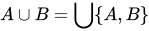
This idea subsumes the preceding sections—for example, A ∪ B ∪ C is the union of the collection {A, B, C}. Also, if M is the empty collection, then the union of M is the empty set.
Formal derivation
[edit]In Zermelo–Fraenkel set theory (ZFC) and other set theories, the ability to take the arbitrary union of any sets is granted by the axiom of union, which states that, given any set of sets , there exists a set , whose elements are exactly those of the elements of . Sometimes this axiom is less specific, where there exists a which contains the elements of the elements of , but may be larger. For example if then it may be that since contains 1 and 2. This can be fixed by using the axiom of specification to get the subset of whose elements are exactly those of the elements of . Then one can use the axiom of extensionality to show that this set is unique. For readability, define the binary predicate meaning " is the union of " or "" as:


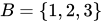


Then, one can prove the statement "for all , there is a unique , such that is the union of ":

Then, one can use an extension by definition to add the union operator to the language of ZFC as:


or equivalently:

After the union operator has been defined, the binary union can be defined by showing there exists a unique set using the axiom of pairing, and defining . Then, finite unions can be defined inductively as:



Algebraic properties
[edit]Binary union is an associative operation; that is, for any sets , Thus, the parentheses may be omitted without ambiguity: either of the above can be written as . Also, union is commutative, so the sets can be written in any order.[9] The empty set is an identity element for the operation of union. That is, , for any set . Also, the union operation is idempotent: . All these properties follow from analogous facts about logical disjunction.




Intersection distributes over union and union distributes over intersection[2] The power set of a set , together with the operations given by union, intersection, and complementation, is a Boolean algebra. In this Boolean algebra, union can be expressed in terms of intersection and complementation by the formula where the superscript denotes the complement in the universal set . Alternatively, intersection can be expressed in terms of union and complementation in a similar way: . These two expressions together are called De Morgan's laws.[10][11][12]






History and etymology
[edit]The english word union comes from the term in middle French meaning "coming together", which comes from the post-classical Latin unionem, "oneness".[13] The original term for union in set theory was Vereinigung (in german), which was introduced in 1895 by Georg Cantor.[14] The english use of union of two sets in mathematics began to be used by at least 1912, used by James Pierpont.[15][16] The symbol used for union in mathematics was introduced by Giuseppe Peano in his Arithmetices principia in 1889, along with the notations for intersection , set membership , and subsets .[17]


See also
[edit]
- Algebra of sets – Identities and relationships involving sets
- Alternation (formal language theory) − the union of sets of strings
- Axiom of union – Concept in axiomatic set theory
- Disjoint union – In mathematics, operation on sets
- Inclusion–exclusion principle – Counting technique in combinatorics
- Intersection (set theory) – Set of elements common to all of some sets
- Iterated binary operation – Repeated application of an operation to a sequence
- List of set identities and relations – Equalities for combinations of sets
- Naive set theory – Informal set theories
- Symmetric difference – Elements in exactly one of two sets
Notes
[edit]- ^ Weisstein, Eric W. "Union". Wolfram Mathworld. Archived from the original on 2009-02-07. Retrieved 2009-07-14.
- ^ a b "Set Operations | Union | Intersection | Complement | Difference | Mutually Exclusive | Partitions | De Morgan's Law | Distributive Law | Cartesian Product". Probability Course. Retrieved 2020-09-05.
- ^ a b Vereshchagin, Nikolai Konstantinovich; Shen, Alexander (2002-01-01). Basic Set Theory. American Mathematical Soc. ISBN 9780821827314.
- ^ deHaan, Lex; Koppelaars, Toon (2007-10-25). Applied Mathematics for Database Professionals. Apress. ISBN 9781430203483.
- ^ Dasgupta, Abhijit (2013-12-11). Set Theory: With an Introduction to Real Point Sets. Springer Science & Business Media. ISBN 9781461488545.
- ^ "Finite Union of Finite Sets is Finite". ProofWiki. Archived from the original on 11 September 2014. Retrieved 29 April 2018.
- ^ a b Smith, Douglas; Eggen, Maurice; Andre, Richard St (2014-08-01). A Transition to Advanced Mathematics. Cengage Learning. ISBN 9781285463261.
- ^ "The Unicode Standard, Version 15.0 – Mathematical Operators – Range: 2200–22FF" (PDF). Unicode. p. 3.
- ^ Halmos, P. R. (2013-11-27). Naive Set Theory. Springer Science & Business Media. ISBN 9781475716450.
- ^ "MathCS.org - Real Analysis: Theorem 1.1.4: De Morgan's Laws". mathcs.org. Retrieved 2024-10-22.
- ^ Doerr, Al; Levasseur, Ken. ADS Laws of Set Theory.
- ^ "The algebra of sets - Wikipedia, the free encyclopedia". www.umsl.edu. Retrieved 2024-10-22.
- ^ "Etymology of "union" by etymonline". etymonline. Retrieved 2025-04-10.
- ^ Cantor, Georg (1895-11-01). "Beiträge zur Begründung der transfiniten Mengenlehre". Mathematische Annalen (in German). 46 (4): 481–512. doi:10.1007/BF02124929. ISSN 1432-1807.
- ^ Pierpont, James (1912). Lectures On The Theory Of Functions Of Real Variables Vol II. Osmania University, Digital Library Of India. Ginn And Company.
- ^ Oxford English Dictionary, “union (n.2), sense III.17,” March 2025, https://doi.org/10.1093/OED/1665274057
- ^ "Earliest Uses of Symbols of Set Theory and Logic". Maths History. Retrieved 2025-04-10.
External links
[edit]- "Union of sets", Encyclopedia of Mathematics, EMS Press, 2001 [1994]
- Infinite Union and Intersection at ProvenMath De Morgan's laws formally proven from the axioms of set theory.
| Overview |  | |
|---|---|---|
| Axioms | ||
| Operations |
| |
| ||
| Set types | ||
| Theories | ||
| ||
| Set theorists | ||
| General | |||||||||
|---|---|---|---|---|---|---|---|---|---|
| Theorems (list) and paradoxes | |||||||||
| Logics |
| ||||||||
| Set theory |
| ||||||||
| Formal systems (list), language and syntax |
| ||||||||
| Proof theory | |||||||||
| Model theory | |||||||||
| Computability theory | |||||||||
| Related | |||||||||
Union (set theory)
View on GrokipediaFundamentals
Binary Union
The binary union of two sets and , denoted , is the set containing all elements that belong to , to , or to both.[6][7] This operation collects the distinct elements from the two sets into a single set, ensuring no duplicates.[7] Intuitively, the union merges the contents of the two sets like combining separate lists while eliminating any repeated items, resulting in a comprehensive collection of unique elements.[7] Formally, it is defined in set-builder notation as This notation specifies that membership in the union depends on the logical disjunction of membership in either operand set.[8] A simple example illustrates this: the union of and is , as the element 2 appears in both but is included only once.[6] Another basic case involves the empty set , which contains no elements; the union of any set with yields itself, since no new elements are added.[8] To verify , consider an arbitrary element . By definition, if and only if or . However, no satisfies , so the condition reduces to . Thus, the sets and have exactly the same elements, confirming equality.[8]Finite Unions
The finite union of a collection of sets extends the binary union operation to any finite number of sets through recursive application. Specifically, for sets where , the union is defined as , with the base case for being the set itself and for the empty set.[9] This recursive definition ensures that the operation builds upon the binary union, collecting all elements that belong to at least one of the sets. The order and parenthesization of the unions do not affect the result due to the associativity of the union operation. To see this, consider three sets , , and . An element belongs to if and only if or , which means or ( or ). By the associative property of logical disjunction, this is equivalent to or or , so . Thus, .[10] This property extends inductively to any finite number of sets, justifying that the recursive definition yields a unique result independent of grouping.[11] For notation, the finite union of sets is commonly written as or, for greater clarity in indexed collections, .[9] This indexed form emphasizes the collection over a finite index set . Consider the example of three sets: , , and . Their finite union is , as it includes all distinct elements from the sets. If the sets are pairwise disjoint, such as , , and , the union simply combines them without overlap.[11] If each is a subset of some universal set (i.e., for ), then the finite union , meaning the result is also a subset of and thus an element of the power set . This closure property ensures that finite unions preserve membership within the collection of subsets of .Generalizations
Infinite Unions
In set theory, an infinite union over a countable index set, such as the natural numbers , is defined as the set , where each is a set in the collection.[3] This construction extends the notion of finite unions, which can be viewed as a special case where the index set is finite.[3] A concrete example from real analysis illustrates this: consider the collection of open intervals for ; their infinite union is , as any belongs to some interval for sufficiently large .[12] Another illustrative case arises in generating dense sets: the rational numbers can be expressed as the countable union of singleton sets , where enumerates , since is countable and each singleton is a set. This demonstrates how infinite unions can construct familiar sets from simpler components in analysis. One challenge with infinite unions is that they may fail to preserve topological properties like compactness, even when each individual set is compact. For instance, in with the standard topology, the closed intervals for are each compact (closed and bounded), but their union is not compact, as it is unbounded and admits the open cover with no finite subcover.[13] While countable infinite unions behave predictably in many contexts due to the well-ordering of , uncountable infinite unions—over index sets of cardinality greater than —introduce subtler issues; for example, using the axiom of choice, one can construct an uncountable union of null sets that is neither null nor measurable.[14]Arbitrary Unions
The arbitrary union extends the union operation to any collection of sets indexed by an arbitrary index set, providing the foundational construct in set theory for combining elements across potentially uncountable families. Given an index set and a family of sets , the arbitrary union is defined as This set comprises all elements belonging to at least one set in the family, independent of the structure or cardinality of .[4] In Zermelo-Fraenkel set theory (ZF), the existence of arbitrary unions derives from core axioms, ensuring such sets are well-defined within the theory. The Union Axiom asserts that for any set , there exists a set such that This primitive operation guarantees the union of the elements of any given set of sets.[15] To construct the union over an indexed family, first form the family as a set: assuming is a set and the map is a definable function, the Axiom Schema of Replacement produces the set of pairs , from which the image is obtained via the Axiom Schema of Separation. Applying the Union Axiom to yields , the desired union. The explicit definition via existential quantification is then isolated using Separation on , confirming the set's membership criterion without invoking additional primitives. This step-by-step derivation anchors arbitrary unions in ZF's foundational structure, distinguishing them from more restrictive cases like countable unions.[4][15] For example, taking and for each , the arbitrary union is demonstrating how an uncountable indexed family reconstructs the continuum from singleton sets.[4] Arbitrary unions over non-well-ordered index sets play a key role in advanced applications, such as topology, where the index set lacks a natural ordering. A prominent example is the disjoint union topology on an uncountable family with uncountable and each a topological space (e.g., copies of ): the topology consists of unions where each is open in , yielding a space that inherits openness from components while accommodating uncountable disjointness, useful for constructing non-second-countable spaces.[16] The defining property holds by logical equivalence: if and only if such that , a direct consequence of the comprehension used in the derivation, ensuring every element in some is included and no extraneous elements are added.[15]Notation and Representation
Symbolic Notation
In set theory, the union of two sets and is denoted by the symbol , written as , which was introduced by Giuseppe Peano in his 1888 work Calcolo geometrico secondo l'Ausdehnungslehre di H. Grassmann.[17] This symbol, resembling a cup, has become the standard for binary unions and extends to general unions of multiple sets. For the union of an indexed family of sets , where is an index set, the notation is employed, using the enlarged symbol (n-ary union) with the subscript indicating the range of indices.[17] Peano introduced this large union symbol in 1908 in Formulario mathematico, tomo V, to represent unions over more than two sets.[17] Prior to the widespread adoption of , alternative notations appeared in early logical and set-theoretic texts; for instance, Ernst Schröder used the plus sign to denote the union (or logical sum) of classes in his 1890 Vorlesungen über die Algebra der Logik, volume 1. Simple juxtaposition of set names, such as , occasionally served as an informal notation for union in preliminary writings by pioneers like Georg Cantor before standardized symbols emerged. To ensure clarity in compound expressions, parentheses are conventionally used despite the associativity of union; for example, explicitly groups the operations. In mathematical typesetting with LaTeX, the binary union is produced via the command\cup, yielding , while the n-ary union uses \bigcup, yielding . These symbols correspond to Unicode code points U+222A for (UNION) and U+22C3 for (N-ARY UNION), facilitating digital representation in mathematical software and documents.
As an illustrative example, consider sets and ; their union is .
Visual Representations
Visual representations play a crucial role in set theory by providing intuitive graphical depictions of unions, helping to convey abstract concepts through spatial relationships. These diagrams illustrate how the union of sets encompasses all elements from the participating sets, often by shading or enclosing regions to highlight the combined area. Venn diagrams, introduced by John Venn in 1880, are among the most common tools for visualizing binary unions, where the union of two sets A and B is represented by the shaded region covering the entire area occupied by both circles, including their overlap. For instance, in a Venn diagram of sets A = {1, 2} and B = {2, 3}, the union A ∪ B = {1, 2, 3} is shown as the full extent of both circles, with the point labeled 2 in the intersection to demonstrate shared elements. However, traditional Venn diagrams are limited to three sets due to the increasing complexity of drawing simple closed curves that intersect in all possible ways for higher cardinalities; for more than three sets, modifications proposed by A. W. F. Edwards in 2004 use rotated ellipses or other shapes to approximate these intersections while maintaining readability. Euler diagrams offer a more general alternative, employing enclosed curves to represent sets where regions exist only if the corresponding intersections are non-empty, thus avoiding the exhaustive overlap requirements of Venn diagrams and better suiting unions of sets with empty intersections. In practice, these diagrams reveal key insights into unions, such as how A ∪ B equals A unioned with the elements of B excluding A (B \ A), visually depicted as the non-overlapping part of B added to A. For arbitrary or infinite unions, modern digital tools like SetViz enable interactive visualizations using techniques such as UpSet plots or chord diagrams to handle complex intersections beyond what static hand-drawn diagrams can achieve.Properties
Algebraic Properties
The union operation in set theory forms the join in the power set lattice and corresponds to logical disjunction in Boolean algebra, endowing it with a rich structure of identities.[11] Commutativity states that for any sets and , .[11] To prove this, consider an arbitrary element . If , then or ; by symmetry of the disjunction, this implies or , so . Conversely, if , the same symmetry yields . Thus, the sets are equal. Associativity holds: for sets , , and , .[11] The proof proceeds by double inclusion. First, show : if , then either (so or , hence ) or (so ). Conversely, if , then (so , hence ), or (so or ; if then , hence ; if then directly ).[10] Idempotence is given by for any set .[11] To verify, if , then or , which simplifies to by the idempotence of disjunction. Thus, . The reverse inclusion holds since by definition of union.[18] The absorption law asserts .[11] For the inclusion , note that and , so their union is contained in . For the reverse, follows directly from the definition of union. Distributivity of union over intersection is .[11] To verify, first show the left side is contained in the right: if , then either (so and , hence ) or (so and , implying and ). Conversely, if , then and ; if , then ; otherwise, and , so and thus .[19] These properties parallel those of intersection, which serves as the meet in the lattice structure (detailed elsewhere). A related identity from Boolean algebra is De Morgan's law, which connects union to complements: , where denotes complement relative to a universal set.[20]Cardinality and Measure
In set theory, the cardinality of the union of two finite sets and is given by the formula , which accounts for the overlap to avoid double-counting elements. This relation derives from the principle of inclusion-exclusion applied to the first two terms, where the total elements in the union equal the sum of individual cardinalities minus the shared intersection. For a proof sketch in the finite case, partition into and ; since and are disjoint, , and holds for finite cardinals, yielding the formula. For a finite or infinite family of pairwise disjoint sets , the cardinality of their union is the sum of the individual cardinalities: , where the sum is interpreted in cardinal arithmetic.[21] In the infinite case, cardinal addition is idempotent, so for infinite cardinals and with at least one infinite, the union cardinality simplifies to when sets are not necessarily disjoint, assuming the axiom of choice.[21] For example, the infinite union of singleton sets over an index set has cardinality , as it reconstructs without overlaps.[21] In measure theory, for Lebesgue measurable sets and in , the measure of their union follows an analogous subadditive relation: , extending finite additivity to account for overlap.[22] For countable unions of measurable sets, Lebesgue measure is only subadditive: , with equality if the sets are pairwise disjoint.[22] Strict inequality arises in overlapping cases; for instance, if , then .[22]Historical Development
Origins in Mathematics
The concept of union in set theory has early roots implicit in Aristotelian logic, where syllogisms combined categories—such as substances, quantities, and relations—to reason about classes of entities around 350 BCE.[23] In the 19th century, George Boole advanced this idea through his algebraic treatment of logical classes in An Investigation of the Laws of Thought (1854), defining "addition" as a partial operation representing the union of disjoint classes, thus laying groundwork for set-theoretic operations.[24] This proto-union allowed symbolic manipulation of classes, bridging logic and mathematics. Georg Cantor formalized the union explicitly in his Grundlagen einer allgemeinen Mannigfaltigkeitslehre (1883), defining Vereinigung (union) as the aggregate formed by combining elements from multiple sets, foundational to his naive set theory of infinite aggregates.[25] Giuseppe Peano contributed overlooked notation in his 1888 work Calcolo geometrico and 1889 Arithmetices principia, introducing symbols like ∪ for union, which influenced modern symbolic conventions in set theory.[26] The discovery of Bertrand Russell's paradox in 1901 exposed contradictions in naive set theory, such as the set of all sets not containing themselves, prompting a shift from descriptive to axiomatic foundations.[27] Ernst Zermelo addressed this in his 1908 axiomatization, introducing the union axiom, which guarantees the existence of the union of any set's elements as a set itself, stabilizing set theory against paradoxes. This evolution marked the transition to rigorous, paradox-free frameworks like Zermelo-Fraenkel set theory.Etymology and Terminology
The English term "union" originates from the Latin ūniō (nominative ūnio), meaning "oneness" or "unity," derived from ūnus ("one"), and entered the English language in the early 15th century via Anglo-French and Old French union, initially denoting the act of joining or a state of agreement.[28] In mathematical contexts, particularly set theory, it was adopted through 19th-century translations of continental European works, reflecting the concept of combining elements into a single whole.[29] In German, the equivalent term "Vereinigung," meaning "joining together" or "combination," was introduced by Georg Cantor in 1880 in his foundational paper "Über unendliche, lineare Punktmannigfaltigkeiten" (On Infinite Linear Point Manifolds), where it described the operation of merging sets.[30] Cantor's use of "Vereinigung" played a key role in formalizing set-theoretic language, influencing subsequent terminology across languages. The French "union" similarly emerged in mathematical usage, directly influenced by Giuseppe Peano's 1888 work Calcolo geometrico secondo l'Ausdehnungslehre di H. Grassmann, where Peano introduced the symbol ∪ for the operation of logical sum (summa logica).[26] Synonyms for the operation include "join" in lattice theory, where it denotes the least upper bound of elements, corresponding to set union in the power set lattice. In older logical and probabilistic texts, it was sometimes called "sum," evolving from George Boole's "addition" of classes in The Laws of Thought (1854), later termed "logical sum" by Peano to distinguish disjunction from arithmetic operations.[31] This terminology shifted to the standardized "union" around 1900, as set theory matured beyond Boolean logic.[29] The term's adoption in mathematics mirrors its broader cultural analogy to physical or social merging, as in "labor unions" formed by workers combining for collective strength, emphasizing unity from multiplicity—a parallel that underscores the intuitive appeal of the concept in set theory.[28]References
- https://proofwiki.org/wiki/Definition:Set_Union/Finite_Union
- https://proofwiki.org/wiki/Union_is_Associative
- https://proofwiki.org/wiki/Set_Union_is_Idempotent
- https://proofwiki.org/wiki/Union_Distributes_over_Intersection
- https://proofwiki.org/wiki/De_Morgan%27s_Laws_(Set_Theory)