


Community hub
Recent from talks
Contribute something
Nothing was collected or created yet.
Late Latin
View on Wikipedia
| Late Latin | |
|---|---|
 Augustine of Hippo (354–430), Late Latin author | |
| Native to | (Western) Roman Empire, Ostrogothic Kingdom, Gallic Empire |
| Region | Mare Nostrum region |
| Era | 3rd–6th centuries; developed into Medieval Latin |
Indo-European
| |
Early forms | |
| Latin | |
| Official status | |
Official language in | Both Roman Empires (Later replaced with Koine Greek in the East) |
| Regulated by | Schools of grammar and rhetoric |
| Language codes | |
| ISO 639-3 | – |
| Glottolog | late1252 |
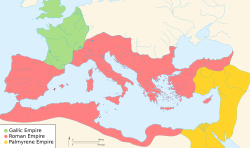
 The Late-Latin speaking world, 271 CE | |
Late Latin is the scholarly name for the form of Literary[citation needed] Latin of late antiquity.[1] English dictionary definitions of Late Latin date this period from the 3rd to 6th centuries CE,[2][3] and continuing into the 7th century in the Iberian Peninsula.[1] This somewhat ambiguously defined version of Latin was used between the eras of Classical Latin and Medieval Latin. Scholars do not agree exactly when Classical Latin should end or Medieval Latin should begin.[citation needed]
Being a written language, Late Latin is not the same as Vulgar Latin, or more specifically, the spoken Latin of the post-Imperial period. The latter served as the ancestor of the Romance languages. Although Late Latin reflects an upsurge in the use of Vulgar Latin vocabulary and constructs, it remains largely classical in its overall features, depending on the author who uses it. Some Late Latin writings are more literary and classical, but others are more inclined to the vernacular. As such it is an important source of information about changes in the spoken language, while not being a simple replication of the state of the oral language at the time.[4] Also, Late Latin is not identical to Christian patristic Latin, used in the theological writings of the early Christian fathers. While Christian writings used a subset of Late Latin, pagans, such as Ammianus Marcellinus or Macrobius, also wrote extensively in Late Latin, especially in the early part of the period.
Late Latin formed when large numbers of non-Latin-speaking peoples on the borders of the empire were being subsumed and assimilated, and the rise of Christianity was introducing a heightened divisiveness in Roman society, creating a greater need for a standard language for communicating between different socioeconomic registers and widely separated regions of the sprawling empire. A new and more universal speech evolved from the main elements: Classical Latin, Christian Latin, which featured sermo humilis (ordinary speech) in which the people were to be addressed,[5] and all the various dialects of Vulgar Latin.[6]
The linguist Antoine Meillet wrote:
"Without the exterior appearance of the language being much modified, Latin became in the course of the imperial epoch a new language... Serving as some sort of lingua franca to a large empire, Latin tended to become simpler, to keep above all what it had of the ordinary."[7][8]
Philological constructs
[edit]Late and post-classical Latin
[edit]The origin of the term 'Late Latin' remains obscure. A notice in Harper's New Monthly Magazine of the publication of Andrews' Freund's Lexicon of the Latin Language in 1850 mentions that the dictionary divides Latin into ante-classic, quite classic, Ciceronian, Augustan, post-Augustan and post-classic or late Latin,[9][10] which indicates the term already was in professional use by English classicists in the early 19th century. Instances of English vernacular use of the term may also be found from the 18th century. The term Late Antiquity meaning post-classical and pre-medieval had currency in English well before then.
Imperial Latin
[edit]Wilhelm Siegmund Teuffel's first edition (1870) of History of Roman Literature defined an early period, the Golden Age, the Silver Age and then goes on to define other ages first by dynasty and then by century (see under Classical Latin). In subsequent editions he subsumed all periods under three headings: the First Period (Old Latin), the Second Period (the Golden Age) and the Third Period, "the Imperial Age", subdivided into the Silver Age, the 2nd century, and the 3rd–6th centuries together, which was a recognition of Late Latin, as he sometimes refers to the writings of those times as "late". Imperial Latin went on into English literature; Fowler's History of Roman Literature mentions it in 1903.[11]
The beginning and end of Imperial Latin are not well defined. Politically, the excluded Augustan Period is the paradigm of imperiality, but the style cannot be grouped with either the Silver Age or Late Latin. In 6th-century Italy, the Western Roman Empire no longer existed and the rule of Gothic kings prevailed. Subsequently, the term Imperial Latin was dropped by historians of Latin literature, although it may be seen in marginal works. The Silver Age was extended a century, and the four centuries following made use of Late Latin.
Christian, patristic, Vulgate and ancient Latin
[edit]Low Latin
[edit]
Low Latin is a vague and often pejorative term that might refer to any post-classical Latin from Late Latin through Renaissance Latin, depending on the author.[clarification needed] Its origins are obscure, but the Latin expression media et infima Latinitas sprang into public notice in 1678 in the title of a Glossary (by today's standards a dictionary) by Charles du Fresne, sieur du Cange. The multivolume set had many editions and expansions by other authors subsequently. The title varies somewhat; the most commonly used was Glossarium Mediae et Infimae Latinitatis. It has been translated by expressions of widely different meanings. The uncertainty is understanding what media, "middle", and infima, "low", mean in this context.
The term media is securely connected to Medieval Latin by du Cange's terminology expounded in the Praefatio,[12] such as scriptores mediae aetatis, "writers of the middle age". Du Cange's Glossary takes words from authors ranging from the Christian period (Late Latin) to the Renaissance, dipping into the classical period if a word originated there. Either media et infima Latinitas refers to one age, which must be the middle age covering the entire post-classical range, or it refers to two consecutive periods, infima Latinitas and media Latinitas. Both interpretations have their adherents.

In the former case, the infimae appears extraneous; it recognizes the corruptio of the corrupta Latinitas which du Cange said his Glossary covered.[13] The two-period case postulates a second unity of style, infima Latinitas, translated into English as "Low Latin" (which in the one-period case would be identical to media Latinitas). Du Cange in the glossarial part of his Glossary identifies some words as being used by purioris Latinitatis scriptores, such as Cicero (of the Golden Age). He has already said in the Preface that he rejects the ages scheme used by some: Golden Age, Silver Age, Brass Age, Iron Age. A second category is the inferioris Latinitatis scriptores, such as Apuleius (Silver Age). The third and main category is the infimae Latinitatis scriptores, which must be post-classical; that is, Late Latin, unless they are also medieval. His failure to state which authors are low leaves the issue unresolved.
He does, however, give some idea of the source of his infima, which is a classical word, "lowest", of which the comparative degree is inferior, "lower". In the preface, he opposes the style of the scriptores aevi inferioris (Silver Age) to the elegantes sermones, "elegant speech", the high and low styles of Latinitas defined by the classical authors. Du Cange was basing his low style on sermo humilis,[14] the simplified speech devised by Late Latin Christian writers to address ordinary people. Humilis (humble, humility) means "low", "of the ground". The Christian writers were not interested in the elegant speech of the best or classical Latin, which belonged to their aristocratic pagan opponents. Instead, they preferred a humbler style lower in correctness, so that they might better deliver the gospel to the vulgus or "common people".
Low Latin in this view is the Latin of the two periods in which it has the least degree of purity, or is most corrupt. By corrupt, du Cange only meant that the language had resorted to nonclassical vocabulary and constructs from various sources, but his choice of words was unfortunate. It allowed the "corruption" to extend to other aspects of society, providing fuel for the fires of religious (Catholic vs. Protestant) and class (conservative vs. revolutionary) conflict. Low Latin passed from the heirs of the Italian Renaissance to the new philologists of the northern and Germanic climes, where it became a different concept.
In Britain, Gildas' view that Britain fell to the Anglo-Saxons because it was morally slack was already well known to the scholarly world. The northern Protestants now worked a role reversal; if the language was "corrupt", it must be symptomatic of a corrupt society, which indubitably led to a "decline and fall", as Edward Gibbon put it, of imperial society. Writers taking this line relied heavily on the scandalous behavior of the Julio-Claudian dynasty and the bad emperors reported by Tacitus and other writers and later by the secret history of Procopius, who hated his royal employers to such a degree that he could not contain himself about their real methods and way of life any longer. They, however, spoke elegant Latin. The Protestants changed the scenario to fit their ideology that the church needed to be purified of corruption. For example, Baron Bielfeld, a Prussian officer and comparative Latinist, characterised the low in Low Latin, which he saw as medieval Latin, as follows:
The fourth age of the Latin tongue is that of the remainder of the middle age, and the 1st centuries of modern times, during which the language fell by degrees into so great a decadency, that it became nothing better than a barbarous jargon. It is the style of these times that is given the name of Low Latin.... What indeed could be expected from this language, at a time when the barbarians had taken possession of Europe, but especially of Italy; when the empire of the east was governed by idiots; when there was a total corruption of morals; when the priests and monks were the only men of letters, and were at the same time the most ignorant and futile mortals in the world. Under these times of darkness, we must, therefore, rank that Latin, which is called lingua ecclesiastica, and which we cannot read without disgust.[15]
As 'Low Latin' tends to be muddled with Vulgar Latin, Late Latin, and Medieval Latin, and has unfortunate extensions of meaning into the sphere of socio-economics, it has gone out of use by the mainstream philologists of Latin literature. A few writers on the periphery still mention it, influenced by the dictionaries and classic writings of former times.
As Teuffel's scheme of the Golden Age and the Silver Age is the generally accepted one, the canonical list of authors should begin just after the end of the Silver Age, regardless of what 3rd-century event is cited as the beginning; otherwise there are gaps. Teuffel gave the end of the Silver Age as the death of Hadrian in 138 CE. His classification of styles left a century between that event and his final period, the 3rd–6th centuries CE, which was in other systems considered Late Antiquity.

Starting with Charles Thomas Crutwell's A History of Roman Literature from the Earliest Period to the Death of Marcus Aurelius, which first came out in 1877, English literary historians have included the spare century in Silver Latin. Accordingly, the latter ends with the death of the last of the five good emperors in 180 CE. Other authors use other events, such as the end of the Nervan–Antonine dynasty in 192 CE or later events. A good round date of 200 CE gives a canonical list of nearly no overlap.
The transition between Late Latin and Medieval Latin is by no means as easy to assess. Taking that media et infima Latinitas was one style, Mantello in a recent handbook asserts of "the Latin used in the middle ages" that it is "here interpreted broadly to include late antiquity and therefore to extend from c. AD 200 to 1500."[16] Although recognizing "late antiquity" he does not recognize Late Latin. It did not exist and Medieval Latin began directly from 200 CE. In this view, all differences from Classical Latin are bundled as though they evolved through a single continuous style.
Of the two-style interpretations the Late Latin period of Erich Auerbach and others is one of the shortest: "In the first half of the 6th century, which witnessed the beginning and end of Ostrogoth rule in Italy, Latin literature becomes medieval. Boethius was the last 'ancient' author and the role of Rome as the center of the ancient world, as communis patria, was at an end."[17] In essence, the lingua franca of classical vestiges was doomed when Italy was overrun by the Goths, but its momentum carried it one lifetime further, ending with the death of Boethius in 524 CE.
Not everyone agrees that the lingua franca came to an end with the fall of Rome, but argue that it continued and became the language of the reinstituted Carolingian Empire (predecessor of the Holy Roman Empire) under Charlemagne. Toward the end of his reign, his administration conducted some language reforms. The first recognition that Late Latin could not be understood by the masses and therefore was not a lingua franca was the decrees of 813 CE by synods at Mainz, Rheims and Tours that from then on preaching was to be done in a language more understandable to the people, which was started by Tours Canon 17 as Rustica Romana lingua, identified as Romance, the descendant of Vulgar Latin.[18] Late Latin as defined by Meillet was at an end; however, Pucci's Harrington's Mediaeval Latin sets the end of Late Latin when Romance began to be written, "Latin retired to the cloister" and "Romanitas lived on only in the fiction of the Holy Roman Empire."[19] The final date given by those authors is 900 CE.
Through the death of Boethius
[edit]


- Domitius Ulpianus (170–228), jurist, imperial officer
- Julius Paulus (2nd & 3rd centuries), jurist, imperial officer
- Aelius Marcianus (2nd & 3rd centuries), jurist
- Herennius Modestinus (3rd century), jurist
- Censorinus (3rd century), historian, essayist
- Quintus Gargilius Martialis (3rd century), horticulturalist, pharmacologist
- Gaius Asinius Quadratus (3rd century), historian
- Quintus Septimius Florens Tertullianus (160–220), "the father of Latin Christianity", polemicist against heresy
- Thascius Caecilius Cyprianus (200–258), converted rhetorician, bishop of Carthage, martyr, saint
- Novatianus (200–258), theologian, rival pope, excommunicant
- Quintus Serenus Sammonicus (2nd century, early 3rd century), scholar, educator
- Commodianus (3rd century), poet, Christian educator
- Lucius Caelius Firmianus Lactantius (240–320), converted rhetorician, scholar, Christian apologist and educator
- Ammianus Marcellinus (4th century), soldier, imperial officer, historian
- Claudius Claudianus (4th century), court poet
- Gaius Julius Solinus (3rd or 4th century), topical writer
- Nonius Marcellus (3rd or 4th century), topical writer
- Marcus Aurelius Olympius Nemesianus (fl. 283), poet
- Aquila Romanus (3rd century), rhetorician
- Eumenius of Autun (3rd century), educator
- Aelius Festus Aphthonius (3rd or 4th century), grammarian
- Calcidius (4th century), translator
- Gaius Marius Victorinus (4th century), converted philosopher
- Arnobius of Sicca (4th century), Christian apologist
- Constantine I (272–337), first Christian emperor
- Nazarius (4th century), rhetorician, educator
- Gaius Julius Victor (4th century), rhetorician
- Gaius Vettius Aquilinus Juvencus (4th century), Christian poet
- Nonius Marcellus (3rd and 4th centuries), grammarian, lexicographer
- Julius Firmicus Maternus (4th century), converted advocate, pagan and Christian writer
- Aelius Donatus (4th century), grammarian, rhetorician, educator
- Palladius (408/431 – 457/461), saint, first bishop of Ireland
- Sextus Aurelius Victor (320–390), imperial officer, historian
- Eutropius (4th century), imperial officer, historian
- Aemilius Magnus Arborius (4th century), poet, educator, friend of the imperial family
- Decimius Magnus Ausonius (c. 310 – 395), poet, rhetorician, educator, friend of the imperial family
- Claudius Mamertinus (4th century), imperial officer, panegyricist, embezzler
- Hilarius (4th century), converted neo-Platonist, theologian, bishop of Poitiers, saint
- Ambrosius (337/340–397), theologian, Bishop of Milan, saint
- Lucifer (d. 370/371), theologian, Bishop of Sardinia
- Priscillianus (d. 385), theologian, first person executed as a heretic
- Flavius Sosipater Charisius (4th century), grammarian
- Diomedes Grammaticus (4th century), grammarian
- Postumius Rufus Festus Avienius (4th century), imperial officer, poet, translator
- Priscianus Caesariensis (fl. 500), grammarian
See also
[edit]- Decline of the Roman Empire
- Panegyrici Latini, a collection of 3rd to 4th century panegyrics; their language is however predominantly classical (Golden Age) Latin base, derived from an education heavy on Cicero, mixed with a large number of Silver Age usages and a small number of Late and Vulgar terms.
Notes
[edit]- ^ a b Roberts (1996), p. 537.
- ^ "Late Latin". Webster's Third New International Dictionary. Vol. II, H–R. Chicago: Encyclopædia Britannica, Inc. 1961.
- ^ "Late Latin". The American Heritage Dictionary of the English Language (3rd ed.). Boston, New York, London: Houghton Mifflin Company.
- ^ Herman 2000, pp. 25–26
- ^ Auerbach (1958), Chapter 1, Sermo Humilis.
- ^ Harrington, Karl Pomeroy; Pucci, Joseph Michael (1997). Mediaeval Latin (2nd ed.). Chicago: University of Chicago Press. p. 67. ISBN 0-226-31713-7.
The combination of features specific to Vulgar Latin and Ecclesiastical Latin had the effect, then, of transforming the language by the fourth century into something of extraordinary vigor.
- ^ Meillet (1928), p. 270: "Sans que l'aspect extérieur de la langue se soit beaucoup modifié, le Latin est devenu au cours de l'epoque impériale une langue nouvelle."
- ^ Meillet (1928), p. 273: "Servant en quelque sorte de lingua franca à un grand empire, le Latin a tendu à se simplifier, à garder surtout ce qu'il avait de banal."
- ^ "Monthly Record of Current Events". Harper's New Monthly Magazine. Vol. I. 1850. p. 705.
- ^ Ethan Allen Andrews; William Freund (1851). A Copious and Critical Latin-English Lexicon: Founded on the Larger Latin-German Lexicon of Dr. William Freund; with Additions and Corrections from the Lexicons of Gesner, Facciolati, Scheller, Georges, Etc. Harper & Brothers.
- ^ Fowler, Harold North (1903). A History of Roman Literature. New York: D. Appleton and Co. p. 3.
The third or Imperial Period lasts from 14 A.D. to the beginning of the Middle Ages.
- ^ Du Cange, Charles du Fresne; et al. (1840). "Præfatio LXII". Glossarium mediæ et infimæ Latinitatis. Vol. 1. Paris: Firmin Didot Fratres. p. 41. Retrieved 1 June 2011.
- ^ Du Cange, Charles du Fresne; et al. (1840). "Præfatio LXIII". Glossarium mediæ et infimæ Latinitatis. Vol. 1. Paris: Firmin Didot Fratres. pp. 41–42. Retrieved 1 June 2011.
- ^ "Home". sermohumilis.com.
- ^ von Bielfeld, Jakob Friedrich (1770). The Elements of Universal Erudition, containing an Analytical Abrigement of the Sciences, Polite Arts and Belles Lettres. Vol. III. Translated by Hooper, W. London: G. Scott. p. 345.
- ^ Mantello, FAC (1999) [1996]. Mantello, Frank Anthony Carl; Rigg, A. G (eds.). Medieval Latin: an introduction and bibliographical guide. Washington, DC.contribution=Part I: The Catholic University of America Press. p. 3.
- ^ Auerbach (1965), p. 85.
- ^ Uytfanghe, Marc Van (1996). "The consciousness of a linguistic dichotomy (Latin-Romance) in Carolingian Gaul: the contradictions of the sources and of their interpretation". In Wright, Roger (ed.). Latin and the Romance languages in the early Middle Ages. University Park, Penn.: Pennsylvania State University Press. pp. 114–120. ISBN 0-271-01569-1.
- ^ Harrington, Karl Pomeroy; Pucci, Joseph Michael (1997). Mediaeval Latin (2nd ed.). Chicago: University of Chicago Press. p. 196. ISBN 0-226-31713-7.
References
[edit]- Auerbach, Erich (1965) [1958]. Literary Language and its Public in Late Latin Antiquity and in the Middle Ages. Bollingen Series LXXIV. Trans. Ralph Mannheim. Pantheon Books.
- Meillet, Antoine (1928). Esquisse d'une Histoire de la Langue Latine (in French). Paris: Hachette.
- Roberts, Michael (1996). "The Latin Literature of Late Antiquity". In Anthony, Frank; Mantello, Carl; Rigg, A.G (eds.). Medieval Latin: an introduction and bibliographical guide. Catholic University of America Press. pp. 537–546.
- Teuffel, Wilhelm Sigismund; Schwabe, Ludwig (1892). Teuffel's History of Roman Literature Revised and Enlarged. Vol. II, The Imperial Period. Trans. George C.W. Warr (from the 5th German ed.). London: George Bell & Sons.
Further reading
[edit]- Adams, J. N., Nigel Vincent, and Valerie Knight. 2016. Early and Late Latin: Continuity Or Change? Cambridge, UK: Cambridge University Press. ISBN 9781107132252
- Courcelle, Pierre. 1969. Late Latin Writers and Their Greek Sources. Translated by Harry Wedeck. Cambridge, MA: Harvard University Press.
- Elsner, Jaś, and Jesús Hernández Lobato. 2017. The Poetics of Late Latin Literature. New York: Oxford University Press. ISBN 978-0199355631
- Herman, József (2000). Vulgar Latin. Translated by Wright, Roger. University Park: Pennsylvania State University Press. ISBN 0-271-02001-6. OL 42565M.
- Langslow, D. R. 2006. The Latin Alexander Trallianus: The Text and Transmission of a Late Latin Medical Book. London: Society for the Promotion of Roman Studies. ISBN 9780907764328
- Löfstedt, Einar. 1959. Late Latin. Cambridge, MA: Harvard Univ. Press.
- Scarpanti, Edoardo. 2012. Saggi linguistici sul latino volgare. Mantova: Universitas Studiorum. ISBN 9788833690087
- Wright, Roger. 1982. Late Latin and Early Romance in Spain and Carolingian France. Liverpool, UK: Francis Cairns. ISBN 0-905205-12-X
- ——. 2003. A sociophilological study of Late Latin. Turnhout, Belgium: Brepols. ISBN 978-2-503-51338-6
External links
[edit]- "Christian Latin" (in Latin). The Latin Library. Retrieved 12 October 2009.
- Du Cange, Charles du Fresne (2009) [1710]. Glossarium ad scriptores mediae et infimae Latinitatis. Francofurti ad Moenum: apud Johannem Adamum Jungium, CAMENA - Corpus Automatum Multiplex Electorum Neolatinitatis Auctorum, University of Heidelberg.
- "du Cange, le Glossarium: en ligne". École nationale des Chartres. 2008. Retrieved 10 October 2009.
- "Glossarium Mediae et Infimae Latinitatis". Documenta Catholica Omnia. 2006. Retrieved 10 October 2009.

Late Latin
View on GrokipediaLate Latin, also known as Latinitas serior, denotes the form of literary Latin employed from roughly the third century AD to the sixth or seventh century, spanning late antiquity and marking a transitional phase between Classical Latin and Medieval Latin.[1][2] This period corresponds to the later Roman Empire, including the rise of Christianity and the fragmentation of Roman political unity, during which Latin served as the language of administration, theology, and emerging Romance vernaculars.[3] Key characteristics of Late Latin include syntactic simplifications, such as increased reliance on prepositions over inflections and the proliferation of periphrastic verb forms, reflecting influences from colloquial speech while maintaining a formal literary register.[4] Christian themes dominated much of the output, with theological treatises, hymns, and biblical commentaries comprising significant portions, as evidenced in works by Church Fathers like Ambrose and Jerome.[5] Notable authors, such as Ausonius, Claudian, and Prudentius, produced poetry blending pagan and Christian motifs, often adapting classical meters to new expressive needs.[6] These developments foreshadowed the divergence into regional Romance languages, driven by phonetic shifts and lexical innovations documented in inscriptions and papyri from the era.[7] While debates persist among philologists regarding the precise boundary with Vulgar Latin—the spoken variant—Late Latin's written corpus reveals a deliberate archaism alongside innovative tendencies, underscoring its role in preserving Roman cultural continuity amid societal upheaval.[8]
Definition and Chronology
Traditional Periodization
The traditional periodization of Late Latin commences around the third century AD, following the decline of strictly classical stylistic norms associated with the Silver Latin era (roughly 43 BC to AD 200), and extends to approximately the sixth or eighth century AD, when it transitions into Medieval Latin amid the fragmentation of the Western Roman Empire and the rise of vernacular Romance forms.[9][10] This chronology reflects empirical evidence from literary texts, legal documents, and epigraphic inscriptions, where phonological mergers (e.g., /e/~/i/ distinctions eroding) and morphological simplifications accelerate post-200 AD, diverging from Ciceronian standards.[11] Linguists anchor the onset in the Crisis of the Third Century (AD 235–284), when administrative and military pressures prompted broader use of simplified Latin in non-elite writings, as seen in the Historia Augusta (late third century) and early patristic works like those of Tertullian (c. AD 160–220), which exhibit proto-vulgar traits such as adverbial quasi for tamquam.[10] The upper boundary varies: some delimit it at the sixth century, citing the Vulgate Bible's translation (late fourth century) and Gregory of Tours' Historia Francorum (c. AD 590) as exemplars of a Latin increasingly influenced by Gallo-Romance phonology, while others extend to the eighth century Carolingian Renaissance, when Alcuin of York's reforms (c. AD 796) imposed classical revival, distinguishing "renewed" Medieval Latin from prior "debased" varieties.[11] Inscriptional corpora, such as the Latin Inscriptions Database (spanning first to seventh centuries), quantify this: by the seventh century, accusative-ablative case mergers reach 37% incidence, signaling systemic erosion of classical morphology.[11] This framework, while linguistically grounded, incorporates extralinguistic markers like the Edict of Milan (AD 313) and the fall of the Western Empire (AD 476), which correlated with Christian textual proliferation and administrative decentralization, fostering variant Latins.[10] Critics note its imprecision—e.g., elite authors like Ausonius (fourth century) adhered to archaizing styles amid vulgar substrates—but it persists as a heuristic for tracing causal linguistic drift toward Romance divergence, evidenced by consistent textual attestations rather than arbitrary political dates.[11][9]Scholarly Debates on Boundaries
Scholars debate the precise chronological boundaries of Late Latin, with no universal consensus on its onset relative to Classical Latin, often placed variably between the late 2nd century AD, marked by the end of the Silver Age with authors like Apuleius, and the 3rd century amid the Crisis of the Third Century, which accelerated sociolinguistic shifts through political instability and barbarian incursions.[12] Traditional philological views, drawing from literary evidence, favor a start around 200 AD, citing stylistic deviations in texts by Tertullian (c. 160–220 AD) and increasing syntactic simplification, while inscriptional data from databases like the LLDB reveal gradual phonological mergers (e.g., EDifferentiation from Adjacent Latin Phases
Late Latin is distinguished from Classical Latin primarily by its chronological placement after the 2nd century CE and the increasing incorporation of spoken vernacular elements into written forms, reflecting the divergence between elite literary standards and evolving popular speech. Whereas Classical Latin, spanning roughly the 1st century BCE to the 2nd century CE, maintained a highly inflected synthetic structure with precise case usage, quantitative prosody in verse, and a lexicon centered on pagan republican and imperial themes, Late Latin texts from the 3rd to 6th centuries CE exhibit phonological mergers—such as the neutralization of long and short vowel distinctions—and morphological tendencies toward analytic constructions, including greater reliance on prepositions over ablative cases.[17] For instance, authors like Apuleius and Tertullian in the 2nd-3rd centuries already display syntactic innovations like the expanded use of the accusative with infinitive alternatives, foreshadowing Romance developments, unlike the stricter Ciceronian norms of Classical prose.[18] In contrast to Medieval Latin, which emerged prominently from the 7th-8th centuries onward amid Carolingian reforms and feudal contexts, Late Latin retains stronger ties to the late Roman Empire's administrative and patristic writings, with fewer regional vernacular admixtures and less orthographic variability. Medieval Latin often features stricter adherence to Classical models in revived scholarly works—such as those of Bede or Alcuin—yet incorporates Germanic loanwords and flexible word order reflecting substrate influences, diverging from Late Latin's more uniform imperial-era phonology where /h/ aspiration persisted longer in educated speech.[19] Late Latin's lexicon, enriched by Christian neologisms like ecclesia in administrative senses, shows proto-Romance simplifications (e.g., future tense periphrasis with habere), but lacks the scholastic abstractions and abbreviations that characterize Medieval usage, such as compounded terms for theology (trinitas).[20] This boundary remains fluid, as some scholars extend Late Latin into the 7th century in regions like Iberia, but it fundamentally marks the pre-Carolingian phase before Latin's role shifted to a more artificial ecclesiastical and legal medium.[21]Historical Context
Political and Social Upheavals in the Late Empire
The Crisis of the Third Century (235–284 CE) marked the onset of severe political fragmentation in the Roman Empire, triggered by the murder of Emperor Severus Alexander in 235 CE by his own troops, leading to a succession of over 20 short-lived emperors and numerous usurpers, many assassinated amid civil strife.[22] [23] This era saw the empire splinter into breakaway states, including the Gallic Empire (260–274 CE) and the Palmyrene Empire (260–273 CE), while external pressures mounted from Germanic tribes crossing the Rhine and Danube frontiers and Sassanid Persian incursions in the east, such as Shapur I's capture of Emperor Valerian in 260 CE. Military anarchy prevailed as legions elevated generals to the throne, exacerbating internal divisions and weakening central authority.[24] Social and economic dislocations compounded the turmoil, with the Plague of Cyprian (circa 249–262 CE) ravaging populations, claiming up to 5,000 lives daily in Rome at its peak and contributing to widespread depopulation across urban centers. Currency debasement fueled hyperinflation, eroding trade and agricultural productivity, while urban decay accelerated as resources shifted toward defense. These pressures fostered ruralization, with tenants (coloni) increasingly bound to estates through legal restrictions on mobility, precursors to medieval serfdom, as landowners sought to maintain output amid labor shortages and insecurity.[25] [26] Diocletian's accession in 284 CE initiated stabilizing reforms, culminating in the Tetrarchy's establishment on March 1, 293 CE, which divided administrative rule among two senior Augusti (Diocletian in the east, Maximian in the west) and two Caesars to enhance responsiveness to threats and governance. Army size doubled to approximately 500,000 troops, bureaucracy expanded, and taxation intensified, though measures like the 301 CE Edict on Maximum Prices failed to curb inflation. Constantine I (r. 306–337 CE) further centralized power after defeating Tetrarchic rivals by 324 CE, restructuring administration by separating civil and military roles, creating mobile field armies, and founding Constantinople in 330 CE as a defensible eastern capital.[27] [28] Persistent barbarian migrations intensified in the 4th and 5th centuries, with Hunnic pressures displacing Goths into imperial territory in 376 CE, culminating in the Visigothic victory at Adrianople (378 CE) and Alaric's sack of Rome on August 24–27, 410 CE. The empire's division became permanent after Theodosius I's death on January 17, 395 CE, bequeathing the west to Honorius and the east to Arcadius, fragmenting resources and coordination. Vandal incursions led to their sack of Rome in 455 CE, and reliance on barbarian foederati eroded Roman control, ending with Odoacer's deposition of Romulus Augustulus in 476 CE, signaling the western empire's collapse amid entrenched social militarization and economic contraction.[29] [30]Christianization and Institutional Changes
The process of Christianization profoundly shaped Late Latin by introducing specialized theological vocabulary and adapting syntactic structures to accommodate scriptural and doctrinal expression, beginning in the late 2nd century in North Africa. Tertullian (c. 155–220 AD), the earliest major Christian author in Latin, coined neologisms such as trinitas to denote the Trinity and repurposed sacramentum for Christian mysteries, drawing on Greek philosophical terms while extending classical lexicon to new concepts.[31] These innovations addressed the need to articulate abstract doctrines like the Incarnation (incarnatio) absent in pagan literature, with over 100 such terms attributed to him alone.[31] Constantine's Edict of Milan in 313 AD legalized Christianity, accelerating its spread and elevating Latin as the primary vehicle for Western ecclesiastical texts, supplanting Greek dominance in theology.[32] Vocabulary expanded through Greek loanwords like ecclesia (church) and baptisma (baptism), integrated by Cyprian of Carthage (c. 200–258 AD), who used scriptura over 60 times to refer to sacred texts and martyrium 37 times for martyrdom, standardizing terms for liturgy and hierarchy.[31] Semantic shifts repurposed words such as testamentum for biblical covenants and virtus for divine power, reflecting causal links between doctrinal imperatives and lexical evolution rather than mere cultural diffusion.[31] Jerome's Vulgate translation (completed c. 405 AD) further entrenched these, incorporating Tertullianic terms like redemptio (redemption) and influencing subsequent patristic works by providing a uniform biblical idiom.[33] Syntactic features in patristic Latin adapted classical norms to Semitic and Greek influences from scripture, evident in Tertullian's use of hendiadys (e.g., sermo atque ratio for logos) and pleonastic doublets for emphasis, as in Cyprian's praecepta et mandata.[31] These included genitive absolutes and historic infinitives, aligning with vernacular trends but amplified by translational needs, such as rendering Hebrew parataxis in Latin prose.[31] Theodosius I's edicts of 380–392 AD, declaring Nicene Christianity the state religion, shifted institutional patronage from pagan to Christian production, fostering genres like apologetics and homilies that favored rhythmic, accessible prose over Ciceronian complexity.[32] Institutionally, the church's ascent paralleled imperial decline, with bishops assuming administrative roles in Latin-speaking provinces; Cyprian's epistolary corpus formalized terms like episcopi and presbyterium, embedding Latin in conciliar decrees and canon law from the Council of Arles (314 AD) onward.[31] Monasteries, emerging in the 4th century (e.g., John Cassian's foundations c. 415 AD), established scriptoria for copying Latin texts, sustaining literacy amid secular fragmentation.[34] This ecclesiastical infrastructure, reliant on Latin for unity across diverse regions, reinforced its role as a supra-regional koine, distinct from evolving vulgar dialects, until the 6th century.[32]Linguistic Characteristics
Phonological and Prosodic Shifts
In Late Latin, approximately from the 3rd to 6th centuries CE, the phonological system began to diverge significantly from Classical norms, as evidenced by inconsistencies in spelling, poetic scansion anomalies, and inscriptions reflecting spoken usage. The distinction between long and short vowels eroded, with quantity ceasing to contrast by around the 4th century, leading to a seven-vowel system (/i e ɛ a ɔ o u/) where qualitative differences predominated; this shift is attested in Gallic Latin epigraphy, where mergers like /e/ and /ɛ/ appear increasingly from the 2nd century onward.[35] Diphthongs underwent monophthongization: /ae/ and /oe/ simplified to /e/, /au/ to /o/, and /ui/ to /i/, processes observable in non-literary texts by the 3rd century, though conservative literary spellings persisted.[36] Consonantal changes included the weakening or loss of intervocalic /h/, complete by the 2nd century in speech, and the fricativization of voiced stops (/b d g/ to /β ð ɣ/), emerging in Late Latin but variable by region, as inferred from Romance outcomes and occasional misspellings in papyri. Palatalization affected velars: /k/ before front vowels (/e i/) evolved toward /t͡ʃ/ (e.g., *centum > /t͡ʃɛntum/), and /g/ similarly to /d͡ʒ/, a process accelerating in the 4th–5th centuries and documented in Vulgar Latin substrates via loanwords and inscriptions. Word-internal three-consonant clusters reduced, often via assimilation or deletion (e.g., /nkt/ > /ŋkt/ > /kt/), as analyzed in phonological models of Late Latin texts from the 3rd century.[37] Prosodically, Late Latin intensified the dynamic stress accent inherited from earlier periods, shifting emphasis from Classical quantitative metrics (vowel length-based) toward accentual rhythm, evident in Christian hymns by Ambrose (c. 340–397 CE) where stress patterns override length. This expiratory stress promoted syllable weakening: unstressed vowels underwent syncope (e.g., *omnis > *omnis > oms) or apocope (final vowel loss in monosyllables), altering prosodic structure and contributing to Romance word shapes, as seen in 4th–6th century metrics and inscriptions.[38] The loss of vowel quantity further decoupled prosody from phonology, enabling stress-driven changes like iambic shortening in compounds, though literary traditions retained quantitative vestiges until the 6th century.Morphological Simplifications
In Late Latin, nominal morphology underwent significant simplification through case syncretism and the rise of analytic alternatives, driven by phonological erosion of unstressed endings and the encroachment of spoken Vulgar Latin features into written registers. The accusative and ablative singular forms merged in the first and second declensions due to the loss of final nasals (e.g., -m in -am) and vowel reductions, yielding identical endings like -a (from classical -ām/ā) for first-declension nouns such as rosa and -o for second-declension nouns like servo (from -um/ō); these changes appear in non-literary sources like inscriptions and the Appendix Probi (ca. 3rd-4th century AD). The genitive case, traditionally synthetic (e.g., -ī in second declension), was frequently supplanted by prepositional phrases such as de + ablative (e.g., de ecclesia for ecclesiae), a pattern documented in 4th-century Gallic and African texts reflecting regional spoken usage.[40] The neuter gender exhibited erosion, with many neuter nouns adopting masculine declension patterns (e.g., third-declension neuters like tempus influencing or merging with masculine forms), contributing to its near-total loss in emerging Romance varieties by the 6th century; this shift is observable in the decreasing distinction between nominative-accusative neuter plurals and masculines in late inscriptions.[41] Adjectives and pronouns followed suit, with neuter forms often generalized to masculine and possessive pronouns simplifying through analogical extension of suus over eius in colloquial contexts.[40] Verbal morphology trended toward periphrasis and conjugation leveling to reduce irregularity. The synthetic future (e.g., amābō) declined in favor of habeō + infinitive (e.g., amāre habeō, originally 'I have to love' but reanalyzed as futurity), with attestations in 2nd-3rd century military diplomas and legal papyri, accelerating by the 4th century in administrative prose.[42] Similarly, the perfect adopted habeō + past participle for resultative senses (e.g., casa habita 'house having been built'), supplementing synthetic forms and appearing in 4th-century Christian and secular texts.[43] Fourth-conjugation verbs often shifted to third-conjugation patterns (e.g., audīre analogizing to dicere), evident in vulgar errors in authors like Commodian (mid-3rd century), streamlining the four-conjugation system toward the analytic verb phrases dominant in Romance.[40]Syntactic and Lexical Transformations
In Late Latin, spanning roughly the 3rd to 6th centuries CE, the case system exhibited progressive syncretism due to phonological erosion, including the loss of word-final consonants and distinctions in vowel length, which diminished morphological contrasts among nominative, accusative, ablative, and dative forms.[44][45] This erosion prompted a compensatory rise in prepositional constructions, with ad, de, and in expanding to encode spatial, temporal, and abstract relations previously handled by inflectional endings alone, as documented in both literary and subliterary texts from the period..pdf)[46] Bare case usages declined accordingly, marking a shift from synthetic to analytic syntax that facilitated comprehension amid dialectal variation and reduced educational access in the late Roman Empire.[47] Subordination patterns simplified, with fewer hypotactic clauses featuring accusative-plus-infinitive constructions or elaborate participial phrases, yielding to paratactic coordination via et or que and purpose clauses introduced by ut or ne.[48][49] Word order rigidified toward subject-verb-object norms in prose, diverging from Classical flexibility, while verb-second positioning emerged in some vernacular-influenced texts like the Itinerarium Egeriae (ca. 381–384 CE).[50] These alterations reflected sociolinguistic pressures, including bilingualism with Greek and Germanic languages, rather than uniform decay, as parametric syntactic parameters—such as head directionality—recalibrated gradually across registers.[51][52] Lexically, Late Latin incorporated extensive Greek borrowings for administrative, philosophical, and ecclesiastical domains, including schola (school), fabrica (workshop, from military contexts), and technical terms like hypostasis in theological debates.[53] Christianization drove neologisms and semantic extensions, such as Tertullian's (ca. 160–220 CE) coinage of trinitas to denote the divine triad, and adaptations like ecclesia shifting from "assembly" to "church" institution.[54] Vulgar derivations proliferated, with prefixes like ex- and in- repurposed for aspectual nuances in verbs (e.g., exstare evolving toward resultative senses), compensating for periphrastic expansions in the be-auxiliary system.[55][56] These innovations, tracked in inscriptions and patristic writings, bridged Classical preciosity with Romance progenitors, prioritizing functional clarity over etymological purity.[2]Key Texts and Authors
Pagan and Secular Literature
Pagan and secular literature in Late Latin persisted into the 5th century, primarily through the efforts of Roman aristocrats and court poets who emulated classical models amid the Empire's Christianization. These works often preserved pagan cultural heritage, celebrated Roman traditions, and critiqued contemporary upheavals, though many authors navigated a Christian imperial context by focusing on secular themes or indirect allusions. Key figures included senators, rhetoricians, and versifiers whose output ranged from epistolary prose to mythological epics, reflecting linguistic shifts like simplified syntax and enriched vocabulary while striving for Ciceronian elegance.[57] Quintus Aurelius Symmachus (c. 345–402 CE), a staunch pagan senator and prefect of Rome in 384 CE, produced ten books of letters documenting elite social networks, administrative duties, and defenses of traditional religion. His Relatio III, submitted to Emperor Valentinian II in 384 CE, argued for restoring state subsidies to the Altar of Victory in the Senate, invoking religious tolerance and ancestral customs against Christian dominance. These prose works exemplify Late Latin's rhetorical density and moral argumentation, drawing on Ciceronian epistolography while addressing 4th-century political tensions.[6][58][59] Decimus Magnus Ausonius (c. 310–395 CE), a Gallo-Roman rhetorician and tutor to Emperor Gratian, composed secular poetry such as the Mosella (c. 370 CE), a vivid hexameter description of the Moselle River's landscapes and fisheries, blending natural observation with classical topoi. His Professores catalogs Bordeaux's educators with epigrammatic wit, and collections like Epigrammata feature amatory and satirical verses rooted in pagan literary conventions, despite his nominal Christianity. Ausonius's oeuvre, totaling over 100 poems, illustrates morphological simplifications like case merger tendencies and a shift toward rhythmic prose influences in verse.[60][61] Claudius Claudianus, known as Claudian (c. 370–404 CE), the last major pagan poet at the Christian court of Honorius, authored panegyrics exalting generals like Stilicho, invectives against usurpers (In Rufinum, 395–396 CE; In Gildonem, 398 CE), and the unfinished epic De Raptu Proserpinae (c. 397 CE), retelling the myth with Virgilian grandeur. His 28 surviving works, composed between 394 and 404 CE, revived epic and occasional poetry, employing Late Latin's phonological innovations such as palatalization while maintaining dactylic hexameter purity. Claudian's reliance on Greek sources and pagan mythology underscored elite resistance to Christian exclusivity.[62][63] Macrobius Ambrosius Theodosius (fl. early 5th century CE) compiled the Saturnalia (after c. 431 CE), a seven-book dialogue among pagan intellectuals discussing literature, grammar, etymology, and Roman antiquities during the Saturnalian festival. This encyclopedic text preserves fragments of lost classical works, analyzes Virgil's Aeneid as a moral exemplar, and embodies Neoplatonic paganism through scholarly disputation. Complementing it, his Commentarii in Somnium Scipionis interprets Cicero's dream vision philosophically, influencing medieval thought while exemplifying Late Latin's syntactic expansions for abstract discourse.[64][65] Rutilius Namatianus (fl. 417 CE), a pagan prefect of Rome, wrote De Reditu Suo, an elegiac poem in two books chronicling his coastal voyage from Rome to Gaul, praising imperial restoration under Honorius and expressing optimism for Rome's resilience against barbarian incursions. Composed around 417 CE, it critiques monasticism and invokes pagan deities indirectly, marking one of the final expressions of classical travelogue and imperial loyalty in verse. The work's 700 lines highlight lexical borrowings from prose and prosodic shifts toward iambic cadences.[66][67]Christian Patristic and Scriptural Works
Christian patristic literature in Late Latin emerged prominently in the 2nd and 3rd centuries AD, particularly through North African authors who adapted Latin for theological apologetics and ecclesial discourse. Tertullian (c. 155–c. 240 AD), regarded as the first major Christian writer in Latin, coined key terms such as trinitas and personae to articulate Trinitarian doctrine, marking a shift toward specialized Christian vocabulary while retaining rhetorical vigor akin to earlier Latin oratory.[68] His Apologeticum (c. 197 AD) defended Christianity against Roman persecution, employing a style that blended classical eloquence with emerging Late Latin syntactic simplifications, such as increased use of prepositions over inflections.[69] Cyprian of Carthage (c. 200–258 AD), influenced by Tertullian, produced works like De Unitate Ecclesiae (c. 251 AD), emphasizing episcopal authority and church unity amid schisms. His prose maintained respect for classical norms but incorporated Late Latin features, including neologisms for sacramental concepts and a more explicit syntax reflecting spoken usage in provincial contexts.[70] These early texts laid foundational contributions to Latin ecclesiastical terminology, prioritizing doctrinal clarity over strict Ciceronian purity. In the late 4th century, Ambrose of Milan (c. 339–397 AD) advanced patristic exegesis through ethical and dogmatic treatises, such as De Officiis Ministrorum (377–391 AD), which adapted Stoic frameworks to Christian morality. Ambrose's writings exhibit Late Latin traits like rhythmic prose (cursus) and biblical allusions, influencing subsequent authors while simplifying complex subordinations for homiletic accessibility.[71] Jerome (c. 347–420 AD) contributed both patristic commentaries and the Vulgate Bible, a revision of Old Latin translations begun in 382 AD and completed by 405 AD. The Vulgate's language features greater literal fidelity to Hebrew and Greek sources, resulting in simpler constructions, explicit prepositional phrases, and avoidance of classical indirect discourse, aligning with Late Latin's trend toward analytic structures over synthetic ones.[72][73] Augustine of Hippo (354–430 AD), in works like Confessiones (c. 397–400 AD) and De Civitate Dei (413–426 AD), employed a rhetorical style enriched by African Latin idioms, including phonetic shifts and lexical innovations for introspective theology, though his sermons show more vernacular simplifications.[74] Scriptural works in Late Latin primarily consist of the Vetus Latina (pre-Vulgate translations from the 2nd–4th centuries) and Jerome's Vulgate, which standardized biblical Latin for Western liturgy and theology. These translations introduced Hebraisms and neologisms, such as evangelium for gospel, reflecting causal adaptations to convey Semitic concepts in a Latin evolving under Christian influence.[70] Patristic authors collectively drove Late Latin's transformation by prioritizing semantic precision for doctrine over aesthetic formalism, evidenced in over 30 extant treatises from Tertullian alone and Augustine's corpus exceeding five million words.[68]Non-Literary Sources: Inscriptions and Documents
Non-literary sources for Late Latin encompass epigraphic inscriptions on stone, metal, and other durable media, as well as documentary texts on papyrus, wax tablets, and ostraca, which preserve colloquial features absent from polished literary works. The Corpus Inscriptionum Latinarum (CIL), initiated in the 19th century, catalogs over 180,000 inscriptions empire-wide, with volumes XIII (Gaul), II (Hispania), and others including 3rd- to 6th-century examples such as funerary stelae, milestones, and dedications.[75] These reveal phonological vulgarisms like the bilabial /v/ pronounced as /b/ (e.g., "bixit" for classical "vixit" in 4th-century Italian epitaphs), loss of word-final -m (e.g., "equu" for "equum"), and aspiration weakening (e.g., "omne" for "hominem").[76] Provincial inscriptions from Britain and Africa show higher incidences of such traits, correlating with lower social strata and regional dialects rather than elite classical adherence.[77] Syntactic and morphological evidence in inscriptions includes analytic replacements for synthetic forms, such as prepositional phrases substituting genitive or ablative cases (e.g., "de casa" for "domo"), and irregular verb endings like -avi for -ui in perfect tenses.[76] Curse tablets (defixiones) from 3rd-5th-century Gaul and Britain exhibit colloquial syntax, including accusative objects without prepositions and subjunctive mood extensions for conditionals, reflecting spoken immediacy over literary precision.[78] These patterns, more prevalent post-Constantine (after 312 AD), indicate gradual divergence driven by multilingualism and urbanization, with fewer vulgarisms in metropolitan Rome versus frontiers.[77] Papyrus documents, numbering around 1,400 Latin items primarily from Egypt's Oxyrhynchus and other sites (3rd-7th centuries), offer private letters, contracts, and accounts showing lexical shifts (e.g., "fortis" denoting "healthy" rather than "strong") and grammatical simplifications like neuter gender erosion and increased periphrastic futures (e.g., "habere + infinitive").[79] Bilingual Greco-Latin legal papyri from Late Antiquity demonstrate code-mixing and Vulgar innovations, such as indicative for subjunctive in purpose clauses, in non-elite administrative use.[80] These texts, less edited than inscriptions, provide causal evidence of phonological drift (e.g., /k/ to /ts/ in "centum") influencing morphology, with features intensifying after the 4th century amid empire-wide disruptions.[81] Together, such sources empirically trace Late Latin's transition to proto-Romance, privileging informal registers over idealized classical models.[76]Legacy and Transitions
Influence on Medieval Latin
Medieval Latin, spanning roughly from the 6th to the 15th century, emerged as a direct evolution of Late Latin (circa 200–600 CE), preserving its core structure while amplifying tendencies toward simplification and adaptation to post-Roman contexts. Late Latin's spoken and written forms, influenced by provincial vernaculars and Christian usage, provided the phonological and syntactic foundations that Medieval scribes and authors built upon, particularly in ecclesiastical, legal, and administrative texts. This continuity is evident in the retention of Late Latin's greater tolerance for morphological variation compared to stricter Classical norms, allowing for regional influences without total breakdown of the inflectional system.[82] Grammatical features from Late Latin, such as the expanded use of prepositions to replace certain case functions and a shift toward more analytic syntax, became hallmarks of Medieval Latin, facilitating clearer expression in multilingual environments. For instance, the substitution of quod or quia clauses for classical indirect statements in accusative-plus-infinitive constructions reflects a Late Latin innovation that gained prevalence by the Carolingian period (8th–9th centuries), as seen in texts from Alcuin's reforms. Deponent verbs, traditionally passive in form but active in meaning, were increasingly employed actively in Medieval usage, mirroring Late Latin's pragmatic adjustments. Mood distinctions between subjunctive and indicative also blurred, prioritizing semantic clarity over classical precision.[82] Lexically, Late Latin's integration of Christian terminology from patristic authors like Augustine (354–430 CE) and the Vulgate translation by Jerome (late 4th century) profoundly shaped Medieval Latin, introducing words like gratia with expanded theological connotations and biblical phrasing into scholastic and liturgical works. Orthographic shifts originating in Late Latin, such as the simplification of diphthongs (ae to e, e.g., aeternum becoming eternum), standardized in Medieval manuscripts, reflecting phonetic changes in spoken Latin across the former Empire. New derivations and borrowings, often for feudal or monastic concepts (e.g., regulariter denoting rule observance), extended Late Latin's adaptive vocabulary, enabling Latin's role in documenting innovations like manorial systems by the 9th century.[83][82] In regions like Britain, Late Latin's transition intertwined with emerging vernaculars, as evidenced by Gildas's 6th-century De Excidio et Conquestu Britanniae, which incorporated loanwords like cyula (from Saxon for "ship"), prefiguring Medieval Latin's hybridity with Old English and Norman French post-1066. This mutual interference, rooted in Late Latin's provincial diversity, allowed Medieval Latin to serve as a flexible medium for insular scholarship, influencing Carolingian standardization under Charlemagne (r. 768–814). Overall, Late Latin's causal role lay in eroding Classical rigidity, enabling Medieval Latin's endurance as a supra-regional lingua franca amid linguistic fragmentation.[84]Contributions to Romance Language Formation
Late Latin's vulgar registers, spoken primarily from the 3rd to 8th centuries CE across the Roman Empire, provided the phonological, morphological, and lexical foundation for the Romance languages through gradual, regionally variable shifts driven by colloquial usage rather than literary norms.[85] These developments, evidenced in non-literary texts like inscriptions and administrative documents, reflect a transition from synthetic Classical structures to more analytic forms, with core vocabulary retention exceeding 80% in modern Romance tongues like Italian, French, and Spanish.[86] Bilingualism with substrate languages, such as Celtic in Gaul or Iberian in Hispania, introduced minor phonetic influences but did not fundamentally alter the Latin base, as confirmed by comparative reconstruction prioritizing shared innovations across daughter languages.[87] Phonological changes in Late Latin included intervocalic lenition of stops (e.g., Classical Latin vita yielding voiced or fricative outcomes like Italian vita with softened /t/), vowel mergers reducing the Classical system of ten vowels to seven in Proto-Romance, and palatalization of /k/ and /g/ before front vowels, as in centum evolving to forms like French cent (/sɑ̃/) or Italian cento (/ˈtʃɛnto/).[14] These shifts, traceable to Late Latin orthographic variations in texts from the 4th century onward, promoted prosodic simplification and syllable structure regularization, facilitating the emergence of stress-timed rhythms characteristic of Romance prosody.[88] Morphologically, Late Latin simplified nominal declensions by merging cases into nominative-accusative and genitive-dative-ablative patterns, eventually yielding two-case or caseless systems reliant on prepositions, as seen in the loss of distinct ablative forms in 6th-century Gaulish documents.[89] Verbal paradigms reduced synthetic tenses, with innovations like the periphrastic future using habere (e.g., Late Latin cantare habeo > Italian canterò, French chanterai) emerging by the 5th century, while derivational suffixes such as -icāre proliferated for denominal verbs (e.g., caballus > Spanish cabalgar).[90] Word-formation models like -mentum for action nouns (e.g., iūrāmentum > French jurement) and the adverbial -mente (from mente in ablative phrases) gained productivity in Late Latin, persisting across Romance varieties.[90] Syntactically, the shift to fixed subject-verb-object order and increased clitic pronoun placement after verbs (e.g., Late Latin enclisis in dame illum > Romanian dă-mi-l) marked a departure from Classical flexibility, evidenced in 7th-century Merovingian charters.[91] Definite articles developed from demonstratives like ille (e.g., Vulgar Latin ille aqua > Spanish el agua), first attested in Late Latin fragments around 600 CE, enhancing specificity in analytic constructions. These contributions, unevenly distributed due to geographic isolation post-476 CE, underscore Late Latin's role as a continuum rather than a discrete stage, with empirical reconstruction via the comparative method validating continuity over rupture.[87]Enduring Role in Law, Liturgy, and Scholarship
The Corpus Juris Civilis, compiled under Emperor Justinian I from 529 to 534 AD, exemplifies Late Latin's foundational role in law, systematizing centuries of Roman jurisprudence into a Latin-language corpus that included the Codex Justinianus, Digesta, Institutiones, and Novellae. This work, drafted in the Latin of the Eastern Roman Empire, preserved and rationalized legal precedents amid post-Classical linguistic shifts, influencing Byzantine legislation such as the Basilika under Basil I and Leo VI in the 9th-10th centuries.[92] Its principles permeated Western Europe via medieval glossators and canon law, shaping civil codes in continental systems and contributing terms like res publica and contractus to enduring legal discourse.[93][94] In Christian liturgy, Late Latin evolved into Ecclesiastical Latin, providing the vernacular-inflected phrasing for rituals that standardized worship across the Latin West. St. Jerome's Vulgate Bible, completed around 405 AD, incorporated Late Latin syntactic simplifications and vocabulary expansions to render Hebrew and Greek scriptures accessibly, serving as the liturgical and doctrinal standard until the 20th century.[95] This translation underpinned the Roman Rite's Mass texts, collects, and prefaces, which retained Late Latin features like periphrastic constructions even as Classical purity waned, ensuring doctrinal continuity amid linguistic fragmentation.[96] The Tridentine Mass, formalized in 1570, perpetuated these forms until reforms in the 1960s, with Latin phrases from Late Antique sources—such as those in Ambrose's hymns—persisting in choral and sacramental usage.[97] Late Latin's legacy in scholarship lies in its transition to Medieval Latin as the medium of intellectual exchange, sustaining pan-European discourse from the Carolingian Renaissance onward. Patristic texts by authors like Augustine (354-430 AD), written in Late Latin's colloquial registers, informed scholasticism, with universities from Bologna (founded 1088) to Paris employing Latin for theology, philosophy, and science until the 17th century.[98] Renaissance humanists, reviving texts via Late Latin intermediaries, adapted its pragmatic lexicon for works like Newton's Principia Mathematica (1687), delaying vernacular dominance in academia.[99] This continuity, rooted in Late Antiquity's administrative and exegetical writings, facilitated knowledge transmission despite source biases in monastic copying, where empirical fidelity often yielded to theological priorities.[100]Controversies and Modern Scholarship
Decline vs. Natural Evolution Perspectives
The traditional perspective on Late Latin, prevalent among Renaissance humanists and 19th-century philologists, frames its linguistic features as evidence of degeneration from the purity of Classical Latin, linking changes to the socio-political upheavals of the third-century crisis, barbarian migrations, and a purported collapse in grammatical education after the reign of emperors like Marcus Aurelius (r. 161–180 AD).[101] This view interprets innovations such as the increased use of prepositions over inflectional cases, the proliferation of periphrastic verb constructions (e.g., habere + participle for future perfect), and phonetic shifts like the merger of short e and i in open syllables as symptoms of cultural decay rather than adaptive mechanisms.[102] Proponents, including figures like Flavio Biondo (1392–1463), who described post-classical Italian as a fifth-century corruption of Latin, emphasized a normative hierarchy favoring Ciceronian prose, often dismissing Late Latin texts as barbarized relics unfit for emulation.[78] In opposition, modern sociolinguistic and historical linguistic scholarship rejects the decline narrative as a prescriptive artifact rooted in classical revivalism, instead positing Late Latin as a phase of natural evolution where written registers increasingly aligned with longstanding spoken varieties (Vulgar Latin), evidenced by continuity in non-literary documents from the second to eighth centuries AD.[2] Roger Wright's analyses of Iberian and Gallic manuscripts argue for "perceptual continuity," whereby scribes rendered contemporary speech in fluid orthographies without perceiving a rupture from Latin norms until Carolingian reforms around 780–800 AD standardized spelling to classical models, retroactively constructing the illusion of innovation as aberration.[103] This evolutionary model draws on comparative data from papyri and inscriptions, such as the gradual shift from synthetic to analytic syntax in Egyptian documents dated 300–600 AD, mirroring universal drifts observed in other Indo-European languages like the simplification of Old English case systems.[104] Empirical support for evolution over decline includes the persistence of sophisticated Late Latin compositions, such as Priscian's Institutiones Grammaticae (c. 500 AD), which codified ongoing changes while preserving classical paradigms, and the adaptive vitality in legal and ecclesiastical texts that facilitated Romance emergence without total breakdown.[105] While external factors like Germanic substrate influences (e.g., loanwords in Gaulish Latin by 400 AD) accelerated certain shifts, these are causal inputs in a dynamic system, not indicators of incompetence, as quantitative studies of syntactic parameters show incremental rather than catastrophic variation from Republican Latin baselines.[51] Contemporary debates, as in collections examining continuity across early and late periods, underscore that "decline" imposes anachronistic value judgments, undervaluing how linguistic systems self-organize toward efficiency amid demographic flux.[106]Register Variations: High vs. Low Latin
In Late Latin, spanning roughly the 3rd to 6th centuries CE, linguistic register variations manifested as a spectrum between a high register, characterized by deliberate adherence to classical norms in formal literary and rhetorical contexts, and a low register, reflecting spontaneous spoken forms influenced by regional substrates and evolving toward proto-Romance structures. The high register, often termed sermo urbanus or elevated style, was employed by educated elites in works like those of Ausonius or Symmachus, featuring complex syntax, archaic vocabulary, and phonological conservatism such as retention of classical quantity distinctions in vowels.[107] This style prioritized aesthetic and authoritative emulation of Cicero or Virgil, serving administrative, legal, and ecclesiastical purposes where precision and prestige demanded it, as evidenced by standardized orthography in high-status inscriptions from the 4th century onward.[108] Conversely, the low register, akin to sermo plebeius or vulgar Latin, appeared in non-literary sources such as graffiti, private letters on papyri, and substandard inscriptions, exhibiting simplifications like syncope (e.g., dominu for dominus), merger of short vowels /i/ and /e/ in unstressed positions, and increased use of periphrastic constructions such as esse + participle for future or perfect tenses, which foreshadowed Romance developments.[56] Quantitative analysis of 4th-5th century Pompeian and Roman inscriptions reveals low-register prevalence in everyday contexts, with over 20% deviation from classical spelling norms in informal epigraphy, contrasting sharply with the near-uniformity in senatorial dedications.[109] Even high-register authors occasionally lapsed into low features under metrical or colloquial pressures, indicating no absolute diglossia but a functional continuum driven by social context and audience, as low forms dominated oral transmission while high forms preserved written continuity.[2] Scholarly analysis, particularly by J.N. Adams, underscores that these variations were sociolinguistically stratified rather than merely diachronic, with low-register traits emerging in texts like the Mulomedicina Chironis (ca. 4th century), a veterinary manual blending vulgar syntax with technical lexicon, versus the polished prose of Augustine's sermons aiming for Latine purity against uulgo usage.[107] Empirical studies of morphological variation, such as ablative case endings, show low-register erosion in 70-80% of non-elite Gaulish documents from the 5th century, attributable to substrate interference from Celtic languages rather than decay per se.[51] Modern debates reject rigid high-low binarism, favoring evidence-based models of gradual shift, where register choice reflected pragmatic adaptation—high for pan-Mediterranean intelligibility, low for local efficacy—supported by comparative metrics across corpora exceeding 10,000 inscriptions and papyri.[110] This variation persisted into the early medieval period, influencing hybrid forms in Carolingian reforms that standardized high elements while vernaculars diverged.[8]Methodological Challenges in Analysis
One primary methodological challenge in analyzing Late Latin stems from the lack of consensus on periodization, as boundaries between Classical, Late, and Medieval Latin remain fluid and scholar-dependent, often spanning roughly the 3rd to 8th centuries AD but varying by criteria such as linguistic innovation or cultural shifts.[11] This arbitrariness complicates comparative studies, as features attributed to "Late Latin" may overlap with proto-Romance developments or conservative Classical revivals, rendering diachronic analysis prone to anachronism without clear demarcation.[12] For instance, sociophilological approaches highlight that until approximately 800 AD, written Late Latin effectively represented early Romance vernaculars, blurring distinctions based on script or perception rather than empirical linguistic rupture.[105] A further difficulty arises from the uneven and biased corpus of sources, which overrepresents high-register ecclesiastical and patristic texts while underdocumenting secular or colloquial usage, thus skewing perceptions toward artificial conservatism in literary works.[2] Non-literary evidence like inscriptions, papyri, and legal documents provides glimpses of vulgarisms—such as simplified syntax or phonetic shifts—but these are fragmentary, regionally variable, and often require paleographic reconstruction, limiting quantitative corpus linguistics.[111] Distinguishing "Vulgar Latin" (spoken, substandard forms) from literary Late Latin poses additional hurdles, as educated authors self-consciously emulated Classical models, masking evolutionary changes evident only in peripheral or anonymous texts.[112] Textual transmission exacerbates these issues, with most Late Latin works surviving via medieval manuscripts that introduce scribal errors, interpolations, or harmonizations to contemporary norms, necessitating rigorous textual criticism to isolate original features.[113] Methodological tensions also emerge between traditional philological intuition and modern empirical tools, such as syntactic parsing or statistical modeling of word order variation, which demand large, annotated datasets often unavailable for Late Latin's sparse profane literature.[114] Regional dialects, influenced by substrates like Celtic or Semitic languages, add complexity, as evidence from provinces (e.g., African or Gallic Latin) rarely aligns uniformly, challenging causal attributions of change to internal evolution versus external contact.[87] Overall, these factors underscore the need for interdisciplinary caution, integrating epigraphy, onomastics, and comparative Romance linguistics to mitigate source-induced distortions.References
- https://www.[researchgate](/page/ResearchGate).net/publication/310100219_Prosodic_Shift_and_Loss_of_Cases_in_Germanic_Romance_and_Hellenic_Languages_2ed